
Showing 2 items matching "general naval store"
-
 Flagstaff Hill Maritime Museum and Village
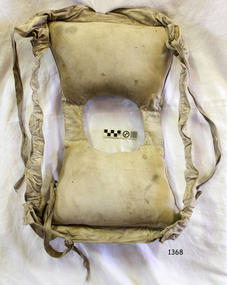
Equipment - Life Jacket, General Naval Supply G.N.S.), 1940
... ...General Naval Store...This life jacket was issued by the Australian Government's General Naval Store in N.S.W.. It was inspected in 1940. ...The life jacket was supplied by the General Naval Store, Defence Department, N.S.W., and inspected in in 1940....This life jacket was issued by the Australian Government's General Naval Store in N.S.W.. It was inspected in 1940. ...This life jacket was issued by the Australian Government's General Naval Store in N.S.W.. It was inspected in 1940. Life Jackets - Life jackets were part of the equipment carried by the Life Saving Rescue Crew of South Western Victoria, including Warrnambool, from around 1858 until the 1950s. The purpose of a life jacket is to keep the wearer afloat until he or she is rescued from the water. Life jackets were first invented in 1854 by Captain Ward of the Royal National Lifeboat Institution in Britain. The early life jackets were filled with cork, which is very buoyant. However, many times he cork caused the jacket to rise up quickly with a force that caused unconsciousness, sometimes turning the person face down in the water , causing them to drown. After the tragic loss of the ship RMS Titanic in 1912 and the lost lives of those onboard, a woman named Orpheus Newman designed the Salvus life jacket (Salvus means safe), which was filled with kapok instead of cork. Kapok comes from seed pods of the Ceiba Pentandra tree and is waterproof as well as buoyant. These Salvus jackets were used by the Royal Navy until new synthetic materials became available around the time of World War II.This life jacket is significant for its connection with local history, maritime history and marine technology. Lifesaving has been an important part of the services performed from Warrnambool's very early days, supported by State and Local Government, and based on the methods and experience of Great Britain. Hundreds of shipwrecks along the coast are evidence of the rough weather and rugged coastline. Ordinary citizens, the Harbour employees, and the volunteer boat and rescue crew, saved lives in adverse circumstances. Some were recognised as heroes, others went unrecognised. In Lady Bay, Warrnambool, there were around 16 known shipwrecks between 1850 and 1905. Many lives were saved but tragically, eight lives were lost.Life jacket, canvas covered, with two padded compartments filled with kapok. Designed to slip over the head. it has shoulder straps and straps for tying under the arms. An inscription and symbol is stamped on one shoulder strap. The life jacket was supplied by the General Naval Store, Defence Department, N.S.W., and inspected in in 1940.Inscription "G.N.S. [crown symbol] N.S.W / 12 JUN 1940 / INSPECTED".flagstaff hill maritime museum and village, flagstaff hill, maritime museum, maritime village, warrnambool, great ocean road, lady bay, warrnambool harbour, g.n.s., general naval store, 1940s life jacket, captain ward, royal national lifeboat instution, cork, kapok, life jacket, orpheus newman, salvus jacket, life saving, rescue, rescue crew, l.s.r.c., life saving equipment, marine technology, lifeboat, shipwreck victim, vintage -
 Stawell Historical Society Inc
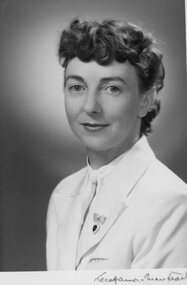
Photograph, Clare Best ne Kinsella and photos of farm
... Naval Radio Station Queensland and finally discharged at HMAS Lonsdale, Port Melbourne.. Clare married Keith Charles Best in 1946 also a Leading Telegraphist of HMAS Harman. After they were married Keith was drafted up to Darwin while Clare worked at a Roman Catholic Mission on Melville Island where she had many adventures establishing a farm at the Mission. Keith was discharged in 1952 and they both worked establishing a Pineapple Farm/ General Store...Naval Radio Station Queensland and finally discharged at HMAS Lonsdale, Port Melbourne.. Clare married Keith Charles Best in 1946 also a Leading Telegraphist of HMAS Harman. After they were married Keith was drafted up to Darwin while Clare worked at a Roman Catholic Mission on Melville Island where she had many adventures establishing a farm at the Mission. Keith was discharged in 1952 and they both worked establishing a Pineapple Farm/ General Store ...7250 Clare Kinsella born 1907 c1940 -1 Clare Kinsella in navy Signals uniform c1943 -2 Clare Kinsella in navy Signals uniform c1943 -3 William Jennings Kinsella with stationery engine at farm Maya Park Lubeck -4 Clare Kinsella with dog Pencil at Magdala farm Lubeck -5 Clare Kinsella with dog Pencil at Station Creek Magdala Farm Lubeck -6 Clare Kinsella with dog Pencil at Magdala Farm Lubeck -7 Clare with child at Magdala Farm -8 Clare with pet cocky “Cocky” -9 Horse at farm -10 William Jennings Kinsella at 93 with ham radio Clare Best nee Kinsella Clare was born December 26, 1907 at “Eyrecourt” on the corner of Scallan and Ligar Streets in Stawell. Clare was the second child of William Jennings Kinsella and Sarah Kinsella nee Peardon. In 1910 the family moved to live at ‘Mayo Park” Lubeck. In 1920’s Mayo Park was sold and a new house was built on a farm nearby called “Magdala” after the mine in which Mr Kinsella’s family had been involved. Clare attended Lubeck State Public School with her older brother Tom, younger sister Carmel and youngest brother Bill. In 1941 Clare left the farm to join the Womens Royal Australian Navy. Her WRAN service number was WR/38 and in the 4 years of service had advanced to Leading Telegraphist. Initially stationed at HMAS Harman in Canberra then Townsville Naval Radio Station Queensland and finally discharged at HMAS Lonsdale, Port Melbourne.. Clare married Keith Charles Best in 1946 also a Leading Telegraphist of HMAS Harman. After they were married Keith was drafted up to Darwin while Clare worked at a Roman Catholic Mission on Melville Island where she had many adventures establishing a farm at the Mission. Keith was discharged in 1952 and they both worked establishing a Pineapple Farm/ General Store at Noonamah just out of Darwin. Later they moved to a remote farm on the Daily River but after 10 years and 7 years of constant floods they retired to Harvey Bay Queensland. Clare led an active life and died in 1999, her ashes are in the Jennings/Kinsella Vault in the Stawell Cemetery. B/W Photos
