
Showing 33 items matching "general sir john monash"
-
 Waverley RSL Sub Branch
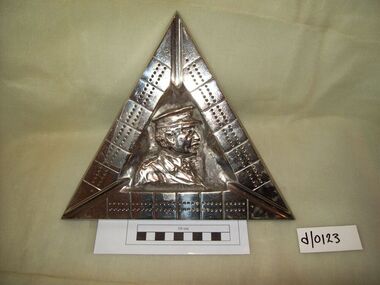
Crib board
... John Monash...General Sir...Silver triangular shape,with embossed head and shoulders General Sir John Monash...Engraved with General Sir John Monash...Engraved with General Sir John Monash Silver triangular shape,with embossed head and shoulders General Sir John Monash Crib board ...This cribbage Board was carried by W. H. Brown during his internment as a P.O.W. at Camp 4 Thailand Date To the best of our knowledge these boards were commercially made between WWI and WWII. Our research has turned up no definite date but it is possible they were made shortly after his death in 1931 Silver triangular shape,with embossed head and shoulders General Sir John MonashEngraved with General Sir John Monashjohn monash, general sir john monash, crib board, w. h. brown, camp 4 thailand, burma railway, p. o. w. -
 Federation University Historical Collection
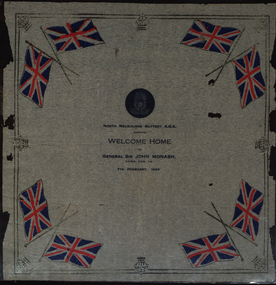
Memorabilia, Welcome Home Serviette to General Sir John Monash, 1920, 1920
... Welcome Home Serviette to General Sir John Monash, 1920...GENERAL MONASH. Ex-members of the North Melbourne Battery Australian Garrison Artillery, have arranged a welcome home dinner to their former commanding officer, Lieut.-General Sir John...Welcome Home to General Sir John Monash G.C.M.G., K.C.B., V.D. 7th February, 1920...GENERAL MONASH. Ex-members of the North Melbourne Battery Australian Garrison Artillery, have arranged a welcome home dinner to their former commanding officer, Lieut.-General Sir John ...Quite possibly this event was held at the North Melbourne Ragged Boys' Home, so there is every possibility the members of the home produced the serviette. Monash joined the Melbourne University company of the militia in 1884 and became lieutenant in the North Melbourne Battery in 1887. "WELCOME HOME TO GENERAL MONASH. Ex-members of the North Melbourne Battery Australian Garrison Artillery, have arranged a welcome home dinner to their former commanding officer, Lieut.-General Sir John Monash. All ex-members interested are requested to meet on Saturday evening at the Ragged Boys' Home, Latrobe street." (The Argus, 15 December 1919) Note the use of British Flags.Square crepe-paper serviette featuring a number of British flags. North Melbourne Battery A.G.A. Welcome Home to General Sir John Monash G.C.M.G., K.C.B., V.D. 7th February, 1920john monash, monash, general monash, north melbourne battery, ragged school, ragged boys' home, world war one, armed forces -
 Wimmera Mallee Pioneer Museum, Jeparit
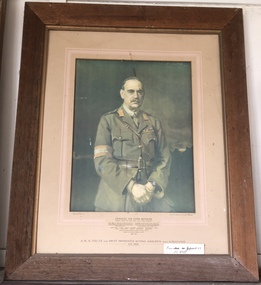
Print - Framed portrait of General Sir John Monash, 1933
... Framed portrait of General Sir John Monash ...Framed print of General Sir John Monash, probably from a 1919 portrait. ...Print Framed portrait of General Sir John Monash ...Presented to Jeparit State School in or shortly after 1933 as an A.N.A. Prize for the most improved garden and school ground for that year.Of local significance as the portrait was presented to a local school in or shortly after 1933.Framed print of General Sir John Monash, probably from a 1919 portrait. Behind glass.A.N.A. Prize for Best Improved School Garden and Ground for 1933sir john monash, schools, school gardens -
 The 5th/6th Battalion Royal Victoria Regiment Historical Collection
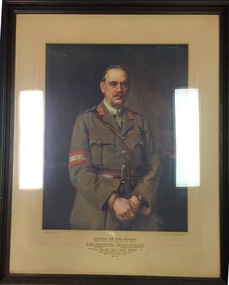
Print - Reproduction, framed, General Sir John Monash
... General Sir John Monash...Framed print of General Sir John Monash standing with hands held to his front in uniform against a dark background. ...General Sir John Monash G.C.M.G, K.C.B, V.D, B.A, D.C.L, LL.D., D. ...sir john monash john longstaff 1919 ww1 first world war great war General Sir John Monash G.C.M.G, K.C.B, V.D, B.A, D.C.L, LL.D., D. ...Framed print of General Sir John Monash standing with hands held to his front in uniform against a dark background. Encased in a moulded timber frame and behind an off white backing board with fade red borders General Sir John Monash G.C.M.G, K.C.B, V.D, B.A, D.C.L, LL.D., D. Eng., M. Inst.C.E Grande Officier de l' Ordre de la Couronne and de Croix de Guerre(Belguim); Grande Officier de la Legion d'Honneur and de Croix de Guerre avec Palme ( France); Distinguished Service Medal ( USA) commanded 4th. Aust. Inf.Bde (15 Sept., '14- 9 July, '16), 3rd Aust Div (10 July, '16-31 May,'18) and Australian Army Corps (1 June-30 Nov.,'18); Director General Repatriation and Demobilisation ( 1 Dec.,'18-15 Nov., Nov.,'19). Laanding at Anzac - Sari Bair - Messines- Broodseinde - Passchendaele - Villers-Bretonneux -Hamel - Amiens - Mont St Quentin - Hargicourt - Hindenburg Line - Beaurevoir Line Chairman of the State Electricity Commission of Victoria 1921/1931 Member of Council of Defence , 1921/1931 1865-1931 sir john monash, john longstaff, 1919, ww1, first world war, great war -
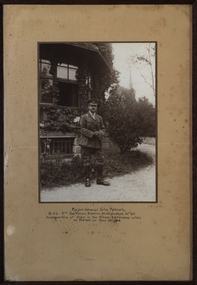 Federation University Historical Collection
Photograph, General Sir John Monash, c1917
... General Sir John Monash...Two framed photographs of General John Monash in uniform. .1) General Sir John Monash, G.C.M.G., K.C.B., V.D., C.B., D.C.L., LL.D., stands in a garden setting in his dress uniform. .2) Major-General John Monash, G.O.C. 3rd Australian Division, photographed at his headquarters at Glisy, in the Villers-Bretonneux Division....General Sir John Monash Photograph ...John Monash was a General for the AIF during World War One. Two framed photographs of General John Monash in uniform. .1) General Sir John Monash, G.C.M.G., K.C.B., V.D., C.B., D.C.L., LL.D., stands in a garden setting in his dress uniform. .2) Major-General John Monash, G.O.C. 3rd Australian Division, photographed at his headquarters at Glisy, in the Villers-Bretonneux Division.villers-bretonneux, john monash, monash, general, world war, world war one, uniform, glisy, france -
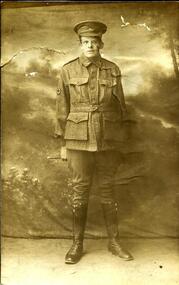 Warrnambool RSL Sub Branch
FIVE 5 PHOTOS: BOB & HAROLD at the various stages of their War service: Bob as Stretcher Bearer with the 6th Field Ambulance and later as Confidential Clerk to General Sir John Monash, GOC Australian Corps; Harold as A/B Driver, R.A.NB.T. serving at Gallipoli and, later, as 2nd Lieutenant, 47th Battery, 12th Brigade, Australian Field Artillery. The image of Mother (Rosina Snape) and her two soldier boys was prominently displayed at home, on the mantle-piece
... FIVE 5 PHOTOS: BOB & HAROLD at the various stages of their War service: Bob as Stretcher Bearer with the 6th Field Ambulance and later as Confidential Clerk to General Sir John Monash, GOC Australian Corps; Harold as A/B Driver, R.A.NB.T. serving at Gallipoli and, later, as 2nd Lieutenant, 47th Battery, 12th Brigade, Australian Field Artillery. ...Snape Collection FIVE 5 PHOTOS: BOB & HAROLD at the various stages of their War service: Bob as Stretcher Bearer with the 6th Field Ambulance and later as Confidential Clerk to General Sir John Monash, GOC Australian Corps; Harold as A/B Driver, R.A.NB.T. serving at Gallipoli and, later, as 2nd Lieutenant, 47th Battery, 12th Brigade, Australian Field Artillery. ...snape collection -
 Warrnambool RSL Sub Branch
GENERAL SIR JOHN MONASH to GOV'R GENERAL, SIR R.M. FERGUSON, PERSONAL LETTER (MANUSCRIPT) undated (but shortly after the Battle of Hamel, 4 July 1918)
... GENERAL SIR JOHN MONASH to GOV'R GENERAL, SIR R.M. FERGUSON, PERSONAL LETTER (MANUSCRIPT) undated (but shortly after the Battle of Hamel, 4 July 1918)....Snape Collection GENERAL SIR JOHN MONASH to GOV'R GENERAL, SIR R.M. FERGUSON, PERSONAL LETTER (MANUSCRIPT) undated (but shortly after the Battle of Hamel, 4 July 1918). ...snape collection -
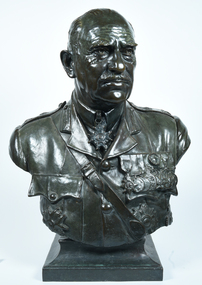 Latrobe Regional Gallery
Sculpture, MONTFORD, Paul Raphael, Lieutenant General Sir John Monash GCMG, KCB, VD, 1928
... Lieutenant General Sir John Monash GCMG, KCB, VD...Bronze Sculpture Lieutenant General Sir John Monash GCMG, KCB, VD Sculpture MONTFORD, Paul Raphael ...Bronze Sculpture -
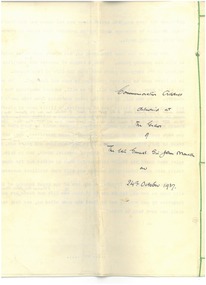 Melbourne Legacy
Document - Eulogy, Commemorative address delivered at the grave of the Late General Sir John Monash on 24 October 1937, 1937
... Commemorative address delivered at the grave of the Late General Sir John Monash on 24 October 1937...john monash speech obituary Numerous annotations in black pen, and pencil. Typed and hand written quarto paper, black on white, bound with green cord. Commemorative address delivered at the grave of the Late General Sir ...An address delivered by Legatee Brian Armstrong (according to handwritten note on Envelope L.6) at the graveside of Sir John Monash in Brighton Cemetery on 24th October 1937, six years after Monash' death. In it he mentions how he, Armstrong, was one of "the great Company of junior officers and men who carried his orders into effect." and quotes from the message sent by Monash to all the men of the Australian Army Corps before a battle on 8 August 1918 when "for the first time on the western front we fought as an Australian army, with the green grass beneath our feet and a retreating enemy in sight." Legatee John Henry Brian Armstrong was President of Melbourne Legacy in 1937, and rose from Private to Lieutenant in the AAMC 22nd Btn. He was wounded at Dernancourt 25.4.1918 and Herleville, becoming a P.O.W. 18.8.1918. He was discharged as medically unfit 2.8.1919 and became a solicitor, serving as a Legatee for 54 years. Although Melbourne Legacy is not referred to specifically, it is clear that Monash' service to his country lives on in the work of Legatees in caring for others.Typed and hand written quarto paper, black on white, bound with green cord.Numerous annotations in black pen, and pencil.john monash, speech, obituary -
 Bendigo Military Museum
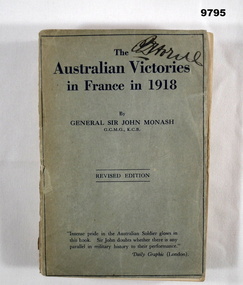
Book - FRANCE, ARMY WW1, Lieutenant General Sir John Monash, "THE AUSTRALIAN VICTORIES IN FRANCE IN 1918", First edition 1920, Second revised edition 1923. 1928
... Lieutenant General Sir John Monash..."THE AUSTRALIAN VICTORIES IN FRANCE IN 1918" Book FRANCE, ARMY WW1 Lieutenant General Sir John Monash The Lothian Book Publishing Co. ...From the front cover; "Intense pride in the Australian Soldier glow in/ this book Sir John doubts whether there is any/ parallel in military history to their performance"/ Daily Graphic (London)." Part of the "William (Bill) THOMASON" Collection. Refer Cat. No. 4136P for more items.Soft cover book. Cover - cardboard, mid grey colour with dark blue colour print on front and back. Black colour print on spine. 336 pages - cut, plain, white colour paper. Illustrated - front end papers - black and red print map of a battle. Back end papers - black and red print map of a campaign. Handwritten signature - front cover and second page from front, price notation - top of page.Handwritten signature - black ink pens - illegible. Price notation - grey lead pencil - "$ 30c"publications, books, ww1, france, monash, william (bill) thomason -
 Flagstaff Hill Maritime Museum and Village
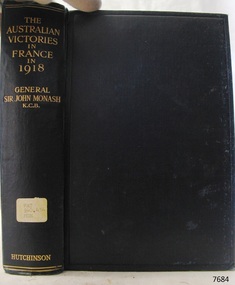
Book, The Australian Victories in France in 1918
... Lieutenant-General Sir John Monash...The Australian Victories in France in 1918 Author: Lieutenant-General Sir John Monash Publisher: Hutchinson & Co Date: 1920...Warrnambool Shipwrecked-coast Flagstaff-Hill Flagstaff-Hill-Maritime-Museum Maritime-Museum Shipwreck-coast Flagstaff-Hill-Maritime-Village Shipwrecked-artefact Book Pattison Collection Warrnambool Library Warrnambool Mechanics’ Institute Ralph Eric Pattison Corangamite Regional Library Service Warrnambool City Librarian Mechanics’ Institute Library Victorian Library Board Warrnambool books and records Warrnambool Children’s Library Great Ocean Road The Australian Victories in France in 1918 Lieutenant-General Sir John Monash Label on spine cover with typed text PAT 940.434 MON Front loose endpaper has a sticker from Warrnambool Public Library Front loose endpaper has a stamp from Corangamite Regional Library Service Front loose endpaper has a sticker from Corangamite Regional Library Service The Australian Victories in France in 1918 Author: Lieutenant-General Sir John Monash Publisher: Hutchinson & Co Date: 1920 The Australian Victories in France in 1918 Book ...This item is from the ‘Pattison Collection’, a collection of books and records that was originally owned by the Warrnambool Mechanics’ Institute, which was founded in Warrnambool in 1853. By 1886 the Warrnambool Mechanics’ Institute (WMI) had grown to have a Library, Museum and Fine Arts Gallery, with a collection of “… choice productions of art, and valuable specimens in almost every branch and many wonderful national curiosities are now to be seen there, including historic relics of the town and district.” It later included a School of Design. Although it was very well patronised, the lack of financial support led the WMI in 1911 to ask the City Council to take it over. In 1935 Ralph Pattison was appointed as City Librarian to establish and organise the Warrnambool Library as it was then called. When the WMI building was pulled down in 1963 a new civic building was erected on the site and the new Warrnambool Library, on behalf of the City Council, took over all the holdings of the WMI. At this time some of the items were separated and identified as the ‘Pattison Collection’, named after Ralph Pattison. Eventually the components of the WMI were distributed from the Warrnambool Library to various places, including the Art Gallery, Historical Society and Flagstaff Hill. Later some were even distributed to other regional branches of Corangamite Regional Library and passed to and fro. It is difficult now to trace just where all of the items have ended up. The books at Flagstaff Hill Maritime Village generally display stamps and markings from Pattison as well as a variety of other institutions including the Mechanics’ Institute itself. RALPH ERIC PATTISON Ralph Eric Pattison was born in Rockhampton, Queensland, in 1891. He married Maude Swan from Warrnambool in 1920 and they set up home in Warrnambool. In 1935 Pattison accepted a position as City Librarian for the Warrnambool City Council. His huge challenge was to make a functional library within two rooms of the Mechanics’ Institute. He tirelessly cleaned, cleared and sorted a disarrayed collection of old books, jars of preserved specimens and other items reserved for exhibition in the city’s museum. He developed and updated the library with a wide variety of books for all tastes, including reference books for students; a difficult task to fulfil during the years following the Depression. He converted all of the lower area of the building into a library, reference room and reading room for members and the public. The books were sorted and stored using a cataloguing and card index system that he had developed himself. He also prepared the upper floor of the building and established the Art Gallery and later the Museum, a place to exhibit the many old relics that had been stored for years for this purpose. One of the treasures he found was a beautiful ancient clock, which he repaired, restored and enjoyed using in his office during the years of his service there. Ralph Pattison was described as “a meticulous gentleman whose punctuality, floorless courtesy and distinctive neat dress were hallmarks of his character, and ‘his’ clock controlled his daily routine, and his opening and closing of the library’s large heavy doors to the minute.” Pattison took leave during 1942 to 1945 to serve in the Royal Australian Navy, Volunteer Reserve as Lieutenant. A few years later he converted one of the Museum’s rooms into a Children’s Library, stocking it with suitable books for the younger generation. This was an instant success. In the 1950’s he had the honour of being appointed to the Victorian Library Board and received more inspiration from the monthly conferences in Melbourne. He was sadly retired in 1959 after over 23 years of service, due to the fact that he had gone over the working age of council officers. However he continued to take a very keen interest in the continual development of the Library until his death in 1969. The Pattison Collection, along with other items at Flagstaff Hill Maritime Village, was originally part of the Warrnambool Mechanics' Institute’s collection. The Warrnambool Mechanics’ Institute Collection is primarily significant in its totality, rather than for the individual objects it contains. Its contents are highly representative of the development of Mechanics' Institute libraries across Australia, particularly Victoria. A diversity of publications and themes has been amassed, and these provide clues to our understanding of the nature of and changes in the reading habits of Victorians from the 1850s to the middle of the 20th century. The collection also highlights the Warrnambool community’s commitment to the Mechanics’ Institute, reading, literacy and learning in the regions, and proves that access to knowledge was not impeded by distance. These items help to provide a more complete picture of our community’s ideals and aspirations. The Warrnambool Mechanics Institute book collection has historical and social significance for its strong association with the Mechanics Institute movement and the important role it played in the intellectual, cultural and social development of people throughout the latter part of the nineteenth century and the early twentieth century. The collection of books is a rare example of an early lending library and its significance is enhanced by the survival of an original collection of many volumes. The Warrnambool Mechanics' Institute’s publication collection is of both local and state significance. The Australian Victories in France in 1918 Author: Lieutenant-General Sir John Monash Publisher: Hutchinson & Co Date: 1920Label on spine cover with typed text PAT 940.434 MON Front loose endpaper has a sticker from Warrnambool Public Library Front loose endpaper has a stamp from Corangamite Regional Library Service Front loose endpaper has a sticker from Corangamite Regional Library Service warrnambool, shipwrecked-coast, flagstaff-hill, flagstaff-hill-maritime-museum, maritime-museum, shipwreck-coast, flagstaff-hill-maritime-village, shipwrecked-artefact, book, pattison collection, warrnambool library, warrnambool mechanics’ institute, ralph eric pattison, corangamite regional library service, warrnambool city librarian, mechanics’ institute library, victorian library board, warrnambool books and records, warrnambool children’s library, great ocean road, the australian victories in france in 1918, lieutenant-general sir john monash -
Glen Eira Historical Society
Article - MONASH, JOHN, SIR
... Monash John Sir... Caulfield... Sir John Monash... Sculptural Commission... Clubs and associations... Monash Pioneers... Correspondence... Fundraising... Universities... Statues... Armed forces... Engineers... Languages... Art... Pianos... Diaries and journals... Jewish community... World War 1914-1918... Businesspeople... Corlett Peter... Artists... Sculptors... Headberry Michael... Monash Pioneers... Project Board... Portraits... Models... Bridges... Returned Sailors and Soldiers Imperial League... Ex-service organisations... St. Kilda... Leader... Jewish Museum of Australia... Rechter Deborah... Cohen Isaac... ‘Lieutenant General...Sir John Monash due to him being one of the most prominent Victorian Jews. There is a photo of Ashmor in fron of a statue of Monash. Newspaper not known. 3/An article from the Leader on the 30/06/2015 entitled ‘Exhibit’s unique view on Jews in WW1’. The author is unknown. The article discusses an exhibition at the Jewish Museum of Australia about the social history behind the Jewish support of the war effort. One item included in the exhibition is Isaac Cohen’s painting of Lieutenant General...Sir John Monash due to him being one of the most prominent Victorian Jews. There is a photo of Ashmor in fron of a statue of Monash. Newspaper not known. 3/An article from the Leader on the 30/06/2015 entitled ‘Exhibit’s unique view on Jews in WW1’. The author is unknown. The article discusses an exhibition at the Jewish Museum of Australia about the social history behind the Jewish support of the war effort. One item included in the exhibition is Isaac Cohen’s painting of Lieutenant General ...This file contains three items concerning Sir John Monash. 1/A two-page letter distributed at a rare book week event on the 22/07/2014 to the Glen Eira Historical Society from Michael Headberry. The letter requests support for the John Monash Sculptural Commission by the Monash Pioneers, who are seeking to erect a bronze full figure portrait of Sir John Monash, Monash University’s namesake. Monash is connected to the city of Glen Eira, as Monash University has a campus in Caulfield and there are a number of streets named after him. The letter discusses the life of Monash and his many achievements. Details in another two pages are also given of the statue to be erected and there are two photos of a wax model of the proposed statue; plus a donation form. 2/An article by Dana McCauley dated 17/05/2015 entitled ‘Push to rename Ports’ about Caulfield lawyer and Liberal Kate Ashmor. The article discusses how she wants the electorate of Melbourne Ports to be named after Sir John Monash due to him being one of the most prominent Victorian Jews. There is a photo of Ashmor in fron of a statue of Monash. Newspaper not known. 3/An article from the Leader on the 30/06/2015 entitled ‘Exhibit’s unique view on Jews in WW1’. The author is unknown. The article discusses an exhibition at the Jewish Museum of Australia about the social history behind the Jewish support of the war effort. One item included in the exhibition is Isaac Cohen’s painting of Lieutenant General Sir John Monash and there is a photograph, by Andrew Henshaw, of this work above the article.monash university, monash john sir, caulfield, sir john monash, sculptural commission, clubs and associations, monash pioneers, correspondence, fundraising, universities, statues, armed forces, engineers, languages, art, pianos, diaries and journals, jewish community, world war 1914-1918, businesspeople, corlett peter, artists, sculptors, headberry michael, monash pioneers, project board, portraits, models, bridges, returned sailors and soldiers imperial league, ex-service organisations, st. kilda, leader, jewish museum of australia, rechter deborah, cohen isaac, ‘lieutenant general sir john monash’, portraits, national gallery of victoria, henshaw andrew, ‘true jews and patriots: australian jews and world war one’, shows and exhibitions, social history, ‘exhibit’s unique view of jews in wwi’, caulfield, ‘push to rename ports’, mccauley dana, political candidates, australian liberal party, ashmor kate, electoral boundaries, local government -
 Lara RSL Sub Branch
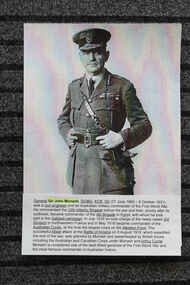
Work on paper - Internet research for World War 1 - Pictures and Maps 1918, World War 1 - Pictures and Maps 1918
... Internet Research printouts of World War 1 details - General Sir John Monash portrait, Maps of Battles etc...Internet Research material Relevant research material 1918 World War 1 world war 1 - 1918 internet research printed material australian at war 1918 General Sir Jon Monash portrait and details of service, Maps of Battles of Wold War 1 1918 Internet Research printouts of World War 1 details - General Sir John Monash portrait, Maps of Battles etc World War 1 - Pictures and Maps 1918 Work on paper Internet research for World War 1 - Pictures and Maps 1918 ...Internet Research materialRelevant research material 1918 World War 1Internet Research printouts of World War 1 details - General Sir John Monash portrait, Maps of Battles etcGeneral Sir Jon Monash portrait and details of service, Maps of Battles of Wold War 1 1918 world war 1 - 1918 internet research printed material australian at war 1918 -
 Federation University Historical Collection
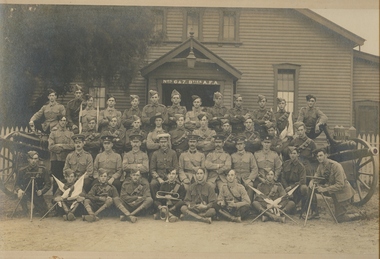
Photograph, Nos 6 & 7 Battalions A.F.A
... .1) General Sir John Monash, G.C.M.G., K.C.B., V.D., C.B., D.C.L., LL.D., stands in a garden setting in his dress uniform. .2) Major-General John Monash, G.O.C. 3rd Australian Division, photographed at his headquarters at Glisy, in the Villers-Bretonneux Division....armed services music john monash .1) General Sir John Monash, G.C.M.G., K.C.B., V.D., C.B., D.C.L., LL.D., stands in a garden setting in his dress uniform. .2) Major-General John Monash, G.O.C. 3rd Australian Division, photographed at his headquarters at Glisy, in the Villers-Bretonneux Division. ....1) General Sir John Monash, G.C.M.G., K.C.B., V.D., C.B., D.C.L., LL.D., stands in a garden setting in his dress uniform. .2) Major-General John Monash, G.O.C. 3rd Australian Division, photographed at his headquarters at Glisy, in the Villers-Bretonneux Division.armed services, music, john monash -
 Warrnambool RSL Sub Branch
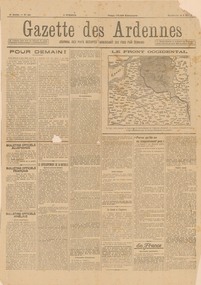
GAZETTE DES ARDENNES, 5 MAY 1918. 4th year, No 621, German newspaper, in French, for the occupied territories, printed in Charleroi, Belgium. (TRANSLATED IN PART by W.Barber), 5 May 1918
... Original, single page propaganda broadsheet, collected by Bob Snape, when he was working as Confidential Clerk to General Sir John Monash, with Australia Corps HQ, in Belgium, late 1918. ...Snape Collection Original, single page propaganda broadsheet, collected by Bob Snape, when he was working as Confidential Clerk to General Sir John Monash, with Australia Corps HQ, in Belgium, late 1918. ...Original, single page propaganda broadsheet, collected by Bob Snape, when he was working as Confidential Clerk to General Sir John Monash, with Australia Corps HQ, in Belgium, late 1918. Yellowed with age, but despite some tears along the folds and a hole the size of a 20 cent piece, it is a good legible document with a front-line mapsnape collection -
 Ringwood and District Historical Society
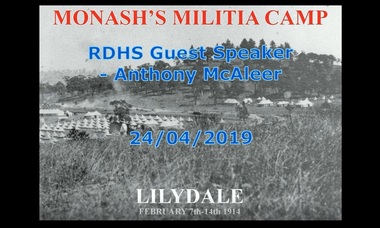
Mixed media - Video, RDHS Guest Speaker Presentation - "Monash's Militia Camp in Lilydale" - Anthony McAleer
... The camp was commanded by John Monash, later General Sir John Monash....The camp was commanded by John Monash, later General Sir John Monash. Digitised video (2.72GB). ...Digitised video (2.72GB). Duration: 50 minutes. Recorded April, 2019. (Video is available for viewing at Ringwood & District Historical Society Archives by appointment)Ringwood and District Historical Society were privileged to have military historian Anthony McAleer present this talk on the Monash Militia camp operating in Lilydale in February, 1914 - six months before the start of World War One - for 3000 citizen soldiers including some from Ringwood. The camp was commanded by John Monash, later General Sir John Monash. -
 Orbost & District Historical Society
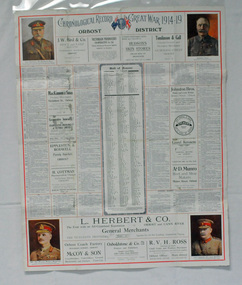
poster, Chronological Record Great War 1914 -19, 1920s?
... It contains not only the names of soldiers, but also photographs of war leaders, such as Lieutenant-General Sir John Monash, Field Marshall Sir Douglas Hay, Marshall Ferdinand Foch and General Sir William Birdwood. ...It contains not only the names of soldiers, but also photographs of war leaders, such as Lieutenant-General Sir John Monash, Field Marshall Sir Douglas Hay, Marshall Ferdinand Foch and General Sir William Birdwood. ...This poster was one of a set produced for towns in Australia. It was adapted to suit the requirements of the location. It contains not only the names of soldiers, but also photographs of war leaders, such as Lieutenant-General Sir John Monash, Field Marshall Sir Douglas Hay, Marshall Ferdinand Foch and General Sir William Birdwood. The roll of honour is surrounded by collector’s cards depicting battle scenes. It also contains the dates and details of war events from 1914 to 1919 and advertisements for several local businesses such as J.W.Bird & cO.; Victorian Producers Co-Operative; Tomlis & Gall; McKinnon & Sons; Co-Operative Insurance Co of Victoria; Epplestun & RodwellThis item is a useful research tool.A poster, titled, "Chronological Record Great War 1914 - 19". It has a sub - heading - "Orbost District" beneath two crossed flags, an Australian and a British. The roll of honour is surrounded by collector’s cards depicting battle scenes. It also contains the dates and details of war events from 1914 to 1919 and advertisements for several local businesses. In each corner is a coloured photograph of a man in a military uniform.ww!-roll-of-honour-orbost -
 Melbourne Legacy
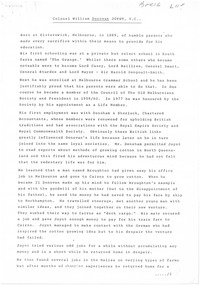
Document - Obituary, Colonel William Donovan Joynt, V.C
... He was also instrumental in gaining the support of both General Sir John Monash and the R.S.L. to build the Shrine of Remembrance, as well as ensuring media backing and thus public support for the project. ...He was also instrumental in gaining the support of both General Sir John Monash and the R.S.L. to build the Shrine of Remembrance, as well as ensuring media backing and thus public support for the project. ...Joynt was the seventh member of the newly formed Legacy in 1923 and became a member of the Board of Management in 1924 and worked closely with Stan Savige. He was also instrumental in gaining the support of both General Sir John Monash and the R.S.L. to build the Shrine of Remembrance, as well as ensuring media backing and thus public support for the project. He worked tirelessly for Legacy for 38 years until he retired at the age of 84, and entered fully into comradeship activities throughout his involvement. He won his VC in 1917 at Chuignes during one of the last battles on the Somme. The Victoria Cross is the highest award for acts of bravery in wartime and was instituted in 1856 by Queen Victoria. See also the funeral service at Cat No 01303.Detailed biography of one of the few Legatees to have been awarded the Victoria Cross.White A4 paper x 6 pages with black type.Box 16 L 11 (illegible) in black birodonovan joynt, obituary -
 Melbourne Legacy
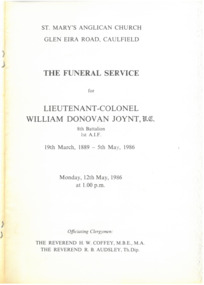
Document - Obituary, The Funeral Service for Lieutenant-Colonel William Donovan Joynt, V.C
... He was also instrumental in gaining the support of both General Sir John Monash and the R.S.L. to build the Shrine of Remembrance, as well as ensuring media backing and thus public support for the project. ...He was also instrumental in gaining the support of both General Sir John Monash and the R.S.L. to build the Shrine of Remembrance, as well as ensuring media backing and thus public support for the project. ...Joynt was the seventh member of the newly formed Legacy in 1923 and became a member of the Board of Management in 1924 and worked closely with Stan Savige. He was also instrumental in gaining the support of both General Sir John Monash and the R.S.L. to build the Shrine of Remembrance, as well as ensuring media backing and thus public support for the project. He worked tirelessly for Legacy for 38 years until he retired at the age of 84, and entered fully into comradeship activities throughout his involvement. He won his VC in 1917 at Chuignes during one of the last battles on the Somme. The Victoria Cross is the highest award for acts of bravery in wartime and was instituted in 1856 by Queen Victoria. The Chairman of Legacy Co-ordinating Council, Legatee K.D. Green, gave the eulogy (01303.5) at the funeral service.Records the life of an outstanding Australian of great social conscience, reflecting well on the Legacy organisation as a whole.01303.1-01303.2 sheets folded and stapled together to form a booklet with the order of service - black print on white paper 01303.5-01303.8 white sheets with black type. donovan joynt, founding legatee, obituary -
 Melbourne Legacy
Document - Obituary, William Donovan Joynt, V.C
... He was also instrumental in gaining the support of both General Sir John Monash and the R.S.L. to build the Shrine of Remembrance, as well as ensuring media backing and thus public support for the project. ...He was also instrumental in gaining the support of both General Sir John Monash and the R.S.L. to build the Shrine of Remembrance, as well as ensuring media backing and thus public support for the project. ...Joynt was the seventh member of the newly formed Legacy in 1923 and became a member of the Board of Management in 1924 and worked closely with Stan Savige. He was also instrumental in gaining the support of both General Sir John Monash and the R.S.L. to build the Shrine of Remembrance, as well as ensuring media backing and thus public support for the project. He worked tirelessly for Legacy for 38 years until he retired at the age of 84, and entered fully into comradeship activities throughout his involvement. He won his VC in 1917 at Chuignes during one of the last battles on the Somme. The Victoria Cross is the highest award for acts of bravery in wartime and was instituted in 1856 by Queen Victoria. See also Cat.Nos. 01303, 01350. This obituary adds further information about the life of L/- W.D. Joynt and includes a typed copy of an extract from 'They dared mightily' by Laurence Wigmore (Canberra: Australian War Memorial, 1963) pages 141, 142 & 143 which detail the action which won him the V.C.Provides more military information than in other obituaries of Joynt, as well as further information on his activities in the broader community.White A4 paper x 6 pages with black type.Box 16 L1.14 in black ballpen Confusingly it is dated 20/6/78, handwritten in black biro, although Joynt did not die until 1986.donovan joynt, obituary -
 Melbourne Legacy
Document, Resume of history of formation of W.D. Joynt & Company Pty. Ltd
... He was also instrumental in gaining the support of both General Sir John Monash and the R.S.L. to build the Shrine of Remembrance, as well as ensuring media backing and thus public support for the project. ...He was also instrumental in gaining the support of both General Sir John Monash and the R.S.L. to build the Shrine of Remembrance, as well as ensuring media backing and thus public support for the project. ...Detailed account of the business history of Legatee W.D.Joynt VC prepared by Mrs Beryl Luff. Joynt was the seventh member of the newly formed Legacy in 1923 and became a member of the Board of Management in 1924 and worked closely with Stan Savige. He was also instrumental in gaining the support of both General Sir John Monash and the R.S.L. to build the Shrine of Remembrance, as well as ensuring media backing and thus public support for the project. He worked tirelessly for Legacy for 38 years until he retired at the age of 84, and entered fully into comradeship activities throughout his involvement. He won his VC in 1917 at Chuignes during one of the last battles on the Somme. The Victoria Cross is the highest award for acts of bravery in wartime and was instituted in 1856 by Queen Victoria. See also Cat No 01303. Mrs Luff wrote extensively about Joynt's business career and the challenges he faced throughout the Great Depression and the Second World War. Despite initially losing his farm and then a colour printing business he went on to form W.D. Joynt & Co which began by printing advertising and moved on to general printing, ultimately becoming one of the three largest paperback printers in Australia. in 1976, due to the then economic difficulties in Australia, the company went into receivership, but managed to trade its way out and eventually printed most of Mills & Boon's popular romance series. In 1981 the company became part of the McPherson Group of Companies and Joynt retired. His qualities of leadership, persistence and business acumen were of great benefit to Melbourne Legacy. Illustrates some of the difficulties faced by early Legatees throughout their working lives as a result of global economic crises.5 x typed sheets black on whiteBox 16 L14 in black biro on first pagedonovan joynt, founding legatee -
 City of Melbourne Libraries
Photograph, Bull, Hugh Jones, 1897-1993, Lord Mayor's Dinner, Melbourne Town Hall
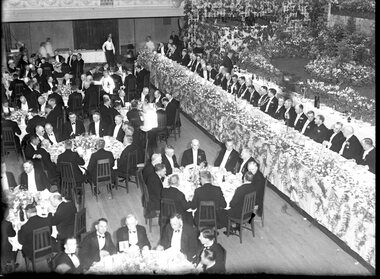
... A debate as to the siting of the statue arose from a strong view expressed by General Sir John Monash that no representation of individual members of the Australian Defence Force be located on the Shrine itself. ...A debate as to the siting of the statue arose from a strong view expressed by General Sir John Monash that no representation of individual members of the Australian Defence Force be located on the Shrine itself. ...Photographer notations on slide: "General View Of Lord Mayor's Dinner At Town Hall Nov 1936 B112" Published: The Age, Tuesday 10 November 1936, page 13 Published title: LORD MAYOR'S BANQUET Published caption: The brilliant scene inside the Melbourne Town Hall last night during the Lord Mayor’s banquet. Trove article identifier: http://nla.gov.au/nla.news-article205939431 Description: 700 guests (all men) are seated around numerous tables in the Melbourne Town Hall for the Lord Mayor's dinner in November 1936. Before the stage is a top table of 35 men, all dressed smartly in black dinner suits, with either a black or white bow tie. Many are wearing their medals. The Lord Mayor has on his Mayoral chains, and to his right is the Governor of Victoria, Lord Huntingfield. The stage is heavily decorated with fresh flowers. Research by project volunteer, Louise McKenzie: This image takes up one quarter of the photographic space on page 13 of The Age on 10 November 1936, reflecting the importance of the event and also the sheer dramatics of the image: 700 guests (all men), a top table of 35, and all dressed smartly in black dinner suits, with either a black or white bow tie. Many are wearing their medals. The Lord Mayor has on his Mayoral chains, and to his right is the Governor of Victoria, Lord Huntingfield. Further to his right is a man with an impressive sash across his chest. It is a very animated, and rather informal, moment. Banks of fresh flowers smother the stage, which is decorated in the manner of a terrace at an English stately home. Tables are laden with food, drink and decorations, and the wait staff (men and women) are also formally dressed, in the manner of Downton Abbey. It is spectacular, dramatic, and luxurious, and perpetuates the proud descriptor of “Marvellous Melbourne” as conferred by London Journalist George Augustus Sala when he visited the city in 1885. During its 1880s boom, Melbourne was the second-largest city in the British Empire, after London, and reputedly the richest city in the world. At times the expression was used with some irony, but "...in Victoria’s centenary year, 1934, with the city mired in another depression, a publisher bravely entitled a book of souvenir photographs Marvellous Melbourne, claiming that the subject ‘still finds apt expression in the happy one-time sobriquet’.” This photo seems to reflect an ongoing pride in Melbourne and a desire for it to live up to its descriptor and celebrate its post-centenary era in style. So it is no surprise to find that on page 11 of The Age on the same day, a second photo is to be found – a cropped view of one table – along with a very detailed description of the night, its purpose, and a surprise announcement. But, who was the Lord Mayor in whose honour the dinner was held? In 1934, the Lord Mayor of Melbourne was Cr. Alexander George Wales, (born Richmond, 11 October 1885, died Elsterwick, 31 May 1962). His father was a contractor and quarry-owner, but was blinded in an industrial accident in 1899. Consequently Alexander, then aged 14, left Brunswick State School to become a railway labourer working at a quarry, and in 1903 joined the Commonwealth public service as a clerk and began studying at night school, determined to improve himself. In 1907 he was appointed secretary of the Albion Quarrying Co. (in which the family had an interest), then its managing director and chairman. As the Australian Dictionary of Biography notes, he was instrumental in expanding the company’s interests, "...becoming director of the Hardware Co. of Australia Pty Ltd, the Twentieth Century Building and Investment Society, the Albion Sand Co. and the Geelong Brick Co.”. His public career began in 1914 when he was elected to the Brunswick council. He was mayor 1917-18, and in 1925 progressed to the Melbourne City Council where he remained for 29 years, being a member of most council committees. He served three successive terms as lord mayor (1934-37), was Chairman of the council’s decorations committee for Melbourne’s centenary, president of the Metropolitan Fire Brigades Board (1936), and Chairman of the Public Works Committee (1937-39). In 1936 he was elected to the Legislative Council with United Australia Party support, but later resigned over possible State government contract tender irregularities. Wales received "the customary reward” of a knighthood and was invested at Buckingham Palace by King George VI whose coronation he attended in 1937. He was an early director of what is now Ampol, and helped the development of the petroleum industry in Australia after visiting the USA in 1943 and 1946. He was impressed by that country’s wartime shipbuilding efforts and supported closer ties with the USA. “While president (1947-48) of the Melbourne Chamber of Commerce, Wales was a vocal critic of the Federal Labor Government, ...a staunch anti-socialist ... and a focus for conservative opposition to the Curtin and Chifley governments...” He is described as “a natural leader in business and civic politics,... a powerful force in the Melbourne City Council... opposing democratic reforms such as the creation of a Greater Melbourne Council and the abolition of plural voting, but advocat[ing] the redevelopment of city-owned property like the Eastern and Western markets...” So, this Lord Mayor’s dinner marks the third successive term in office for Governor Cr. A G Wales. The room is filled with powerful and influential men, and provided a platform for the Premier of Victoria, Albert Dunstan (1882-1950, United Country party) to announce that if the City Council would bear half the cost the State Government would build a bridge at Punt Road “at once”. He announced that the Government proposed to have the bridge built by the Country Roads Board, and allow the City Council to pay its share on convenient terms, and further, it would investigate the shared provision of more Yarra bridges. The proposal for the Punt Road Bridge was met with applause as the Yarra River constituted a serious traffic barrier. On 12 November 1936, two days after the Lord Mayor’s dinner, The Age published an article, “Building without a Plan”. It questions the appropriateness of the next Yarra bridge being the one at Punt Road, and encourages a “proper procedure” to look at the provision of additional Yarra bridges as a whole. But in fact this topic had been canvassed back in August when Melbourne City Council’s public works committee had recommended the replacement of the footbridge at Punt Road with a bridge, and if the Country Roads Board would declare this portion of Punt Road, including the river crossing, a State Highway, this could give the Board authority to construct the bridge and allocate the cost. Hence the reference at the dinner to a shared expense. Still an integral part of traffic management today, the Hoddle Bridge carries Punt Road over the Yarra River between Richmond and South Yarra in Melbourne. It is a five-lane road bridge with narrow footpaths on either side. It is of continuous reinforced concrete T-beam construction with five segmental arched spans, supported on transverse piers, and linked by concrete cross-beams. “The piers terminate in a series of tapered concrete pillars with Art Deco-styled steamlined decoration. Each pillar supports a Victorian-style lamp. The infill railings are geometric-patterned painted metal. Construction began in late 1937, and it was opened by Premier Albert Dunstan on 22 December 1938. It replaced an earlier footbridge, which in turn had replaced a punt service. The bridge (originally referred to as Punt Road Bridge) was named after Robert Hoddle, who planned central Melbourne’s Hoddle Grid, the grid of streets which form Melbourne’s central business district. Hoddle arrived in Australia from the UK in 1823 and went on to carry out surveys in NSW and Queensland before arriving in Melbourne in 1837. He designed layouts for both Melbourne and Williamstown, and later Geelong and other Victorian country areas. He was keen that major streets be at least 30 metres wide. ”With remarkable foresight he provided for wide boulevards from the city to the suburbs, but the subdivisions of early speculators in inner suburbs created the bottle-necks of today. After the separation of the colony in 1851, he became Victoria’s first surveyor-general... and advocated the provision of three-chain (60 m) roads and the widening of all existing main roads from one (20 m) to three chains." However, he was met with constant opposition and in 1853, was eased out of office. As a small and interesting aside: Hoddle was appointed auctioneer for the first sale of crown land in Melbourne on 1 June 1837. His commission was 57 pounds 12s 7d. and he bought two allotments for himself at a cost of 54 pounds. After he died his second wife married Richard Buckhurst Buxton, a member of the family which in 1860s Melbourne established the Australian property dynasty of Buxton Real Estate, Becton, MAB Corporation etc. Returning to the dinner and The Age article of 10 November 1836: Another topic of the after-dinner speeches was a reference to the upcoming Armistice Day. “The Minister of Customs (Mr White) said the proximity of Armistice day reminded us that eighteen years ago we had high hopes of prolonged peace.” The term “Armistice Day” was coined after WWI: “At 11 am on 11 November 1918, the guns on the Western Front fell silent after more than four years of continuous warfare. The Germans called for an armistice (suspension of fighting) in order to secure a peace settlement. They accepted the allied terms on unconditional surrender. Therefore on the 11th hour of the 11th day of the 11th month, a minute’s silence is observed and dedicated to those soldiers who died fighting to protect the nation. Originally known as Armistice Day, it was renamed Remembrance Day after World War Two to commemorate those who were killed in both World Wars. Today it refers to the loss of Australian lives from all wars and conflicts, accompanied by the words, "We will remember them, Lest we forget"." There was comment at the dinner about the need to remain firm in supporting the “democratic government in the British Empire to avoid a “plunge into savagery”. There was a grave responsibility on the British people to keep democracy alive, and that could not be done without adequate defence forces... Many weak governments in non-British countries had been swept aside by strong-fisted dictators, who now were the real threat to peace”. With the benefit of hindsight these were very pertinent comments and tragically prophetic. The Melbourne Shrine of Remembrance had only been dedicated two years earlier, at a ceremony attended by the Duke of Gloucester, son of King George V. Over 300,000 citizens attended: one third of the population of Melbourne. It became the location for the Anzac Day Dawn Service. Originally the march travelled from the Shrine into the city, however, in 1936, this was reversed, and the Shrine became the termination point for Anzac Day Marches. Also significant in 1936, was the installation of a statue in the west forecourt of the Shrine: “The Man with the Donkey” (aka 'Private John Simpson and his Little Donkey'). The work is said to represent the “valour and compassion of the Australian soldier”. Its full citation, according to the City of Melbourne City Collection is: West Side of Base: "The / Man with his Donkey / Gallipoli, April 25 to May 19 / in Commemoration / of the valour and compassion / of the Australian Soldier" AFTER LANDING AT GALLIPOLI, SIMPSON, WITH HIS LITTLE DONKEY, WORKED ALONE, DAY AND NIGHT TAKING WATER TO THE FRONT LINE AND CARRYING THE WOUNDED BACK TO THE DRESSING STATIONS. HE AND HIS DONKEY WERE KILLED BY A SHRAPNEL SHELL ON THE 19TH MAY, 1915. SIMPSON WAS MENTIONED IN DISPATCHES BY SIR IAN HAMILTON, COMMANDER-IN-CHIEF OF THE MEDITERRANEAN EXPEDITIONARY FORCE. / Erected by Public Subscription under auspices of the / Red Cross Society. East Side of Base: Private John Simpson." Their summary in background states: "A bronze figure of Simpson and his donkey with a wounded man on the donkey's back on a granite pedestal. Private John Simpson Kirkpatrick’s intrepid and short-lived exploits during the Gallipoli campaign have made him a popular figure of World War One. He has been mythologised to represent the lauded values of the digger, and he symbolises all those who went into battle unarmed. Born in England in 1892, he came to Australia in 1910. He enlisted to make his way back to England, but as a member of the 3rd Field Ambulance AIA was sent to Gallipoli. After just three weeks of bearing wounded soldiers across Shrapnel Gully on the back of his donkey, Simpson was killed by shrapnel fire. Simpson’s story became a powerful propaganda tool for enlistment in Australia, but following the war he was quickly forgotten. With the Shrine of Remembrance nearing completion in 1933, the memory of Simpson was rekindled to commemorate all who gave their lives to help others during the war. One plaque reads: ‘The / Man with his donkey / Gallipoli … / In commemoration / of the valour and compassion / of the Australian soldier’. In 1935, Wallace Anderson’s design for the memorial was selected though a competition organised by the Australian Red Cross. Anderson had served during the war and worked at the Australian War Memorial after his return. His Man with the Donkey was cast in Italy, and after some debate was sited near the shrine. Unveiled 20th June, 1936." The sculptor, Victorian-born William Wallace Anderson (1888-1975), served in France during WWI and afterwards produced a number of bronze war memorials and memorial portraits, predominantly in Victoria. “His most famous work is that of Simpson and his Donkey (1935), which he completed after winning a competition conducted by the Victorian Division of the Australian Red Cross. Anderson’s fee was 350 pounds; the cast, made by the Chiurazzi Foundry, Naples, Italy, cost 40 pounds. The work... has become well known as a symbol of the Anzac tradition.” A debate as to the siting of the statue arose from a strong view expressed by General Sir John Monash that no representation of individual members of the Australian Defence Force be located on the Shrine itself. Hence its location off to the northwest of the forecourt, in a garden of rosemary. And finally we return to the photo of the grand Lord Mayor’s dinner! An article in The Argus of 4 November 1936 refers to “Brilliant Scene at Lord Mayor’s Ball – Hall Becomes a Garden”. So now it becomes clear why the Town Hall, location of the Lord Mayor’s Dinner on 10 November 1934, only 6 days later, is so lavishly decorated. The floral decorations from the Ball are still in place - an early example of “recycling”, which is gratifying to note at a time of Depression. The reporter has captured the scene with enthusiasm: “Hundreds of tiny rose lights, hidden among pink roses, transformed the Melbourne Town Hall into a magical garden last night, when the Lord Mayor and Lady Mayoress (Councillor A. C. Wales, M.L.C., and Mrs. Wales) entertained about 3,500 guests at a ball. His Excellency the Governor (Lord Huntingfield) and Lady Huntingfield were present, while Rear-Admiral and Mrs. Lane Poole and officers from the visiting squadron were among the special guests. The balconies all round the hall were hidden by a white trellis, covered with pink blossoms and greenery. Rosy flowers were issued up every pillar, and great golden lamps, hanging from the door, were seated in greenery and trails of sweet peas. The organ gallery was converted into a terrace garden with stone steps leading to banks of pink azaleas, pink pelargoniums, masses of calceolarias, and the lovely deep mauve and blue of cinerarias. Slender Japanese maples and poplar trees grew from the higher slopes amid thickets of hostas, while a fascinating illusion was created by the lofty conservatory windows, which formed the background, and which were tinted cerulean blue to simulate the sky seen through glass. Large fern baskets hung from the conservatory roof, and the whole scene was enclosed in trellises of blossom. In the entrance palm green shrubs stood like sentinels round the passed floor, and flowers bloomed in misty golds. The long corridor upstairs leading to the council chamber was lined with an avenue of poplar trees in tubs. In the Lower Town Hall great banks of calceolarias and azaleas decked the upper dais, and each supper table was adorned with a different coloured flower with sprays of roses and Japanese maple laid on the snowy cloths. The adjoining supper-rooms were fragrant with the scent of huge bowls of stock in mauve, purple, and pink, while the white walls were covered with palm leaves and flowers. The roof garden below the clock tower was enclosed as a buffet with rose wreathed walls, and flowers were arranged attractively in the Lady Mayoress's rooms." References: LORD MAYOR'S BANQUET. CENTURY MAKERS AT THE M.C.G. BEFORE THE CHANGE. (1936, November 10). The Age (Melbourne, Vic. : 1854 - 1954), p. 13. Retrieved September 4, 2024, from http://nla.gov.au/nla.news-article205939431 'Portrait of Sir George Wales (Lord Mayor 1934-1937)', City Collection, City of Melbourne, https://citycollection.melbourne.vic.gov.au/portrait-of-sir-george-wales-lord-mayor-1934-37/ Graeme Davison, 'Marvellous Melbourne', eMelbourne, https://www.emelbourne.net.au/biogs/EM00906b.htm THE LORD MAYOR'S BANQUET. (1936, November 10). The Age (Melbourne, Vic. : 1854 - 1954), p. 11. Retrieved September 26, 2024, from http://nla.gov.au/nla.news-article205939643 BRILLIANT SCENE AT LORD MAYOR'S BALL Hall Becomes a Garden (1936, November 4). The Argus (Melbourne, Vic. : 1848 - 1957), p. 14. Retrieved September 26, 2024, from http://nla.gov.au/nla.news-article11932746 'Hoddle Bridge', Wikipedia, https://en.wikipedia.org/wiki/Hoddle_Bridge 'Hoddle Bridge', Victorian Heritage Database Report, Victorian Heritage Council, https://vhd.heritagecouncil.vic.gov.au/places/195689/download-report David Dunstan, 'Wales, Sir Alexander George (1885–1962)', Australian Dictionary of Biography, National Centre of Biography, Australian National University, https://adb.anu.edu.au/biography/wales-sir-alexander-george-8951/text15737, published first in hardcopy 1990, accessed online 26 September 2024. Marjorie J. Tipping, 'Hoddle, Robert (1794–1881)', Australian Dictionary of Biography, National Centre of Biography, Australian National University, https://adb.anu.edu.au/biography/hoddle-robert-2190/text2823, published first in hardcopy 1966, accessed online 26 September 2024. BUILDING WITHOUT A PLAN. (1936, November 12). The Age (Melbourne, Vic. : 1854 - 1954), p. 8. Retrieved September 26, 2024, from http://nla.gov.au/nla.news-article205949762 NEW BRIDGE AT PUNT ROAD (1936, August 12). The Argus (Melbourne, Vic. : 1848 - 1957), p. 10. Retrieved September 26, 2024, from http://nla.gov.au/nla.news-article11902131 'The Shrine of Remembrance', Beaconsfield’s Soldiers: https://beaconsfield.org.au/digitalmemorial/shrine-introduction/ 'Shrine of Remembrance', Wikipedia, https://en.wikipedia.org/wiki/Shrine_of_Remembrance Ken Scarlett, 'Anderson, William Wallace (1888–1975)', Australian Dictionary of Biography, National Centre of Biography, Australian National University, https://adb.anu.edu.au/biography/anderson-william-wallace-9362/text16441, published first in hardcopy 1993, accessed online 26 September 2024. 'Man with the Donkey', City Collection, City of Melbourne, https://citycollection.melbourne.vic.gov.au/man-with-the-donkey-aka-private-john-simpson-and-his-little-donkey/ 'Remembrance Day', Australian Army, https://www.army.gov.au/about-us/history-and-research/traditions/remembrance-day Photographer notations on slide: "General View Of Lord Mayor's Dinner At Town Hall Nov 1936 B112".melbourne town hall, mayors, lord mayors, centenaries, bridges, dinners, clothing and dress, festive decorations, dances and balls, eating and drinking, shrine of remembrance, governors, monuments and memorials, 1930-1939, plants -
Glenelg Shire Council Cultural Collection
Book - Book - Letters written by Sir John Monash during WW1, F.M.Cutlack, War Letters of General Monash, c. 1934
... Collection of letters written by Sir John Monash to his wife and daughter, during WW1. Includes black and white photos War Letters of General Monash Book Book - Letters written by Sir John Monash during WW1 F.M.Cutlack Halsted Printing Company LTD Angus and Robertson Sydeny ...Book, hardcover, black, gold print on spine. Collection of letters written by Sir John Monash to his wife and daughter, during WW1. Includes black and white photos -
 Warrnambool RSL Sub Branch
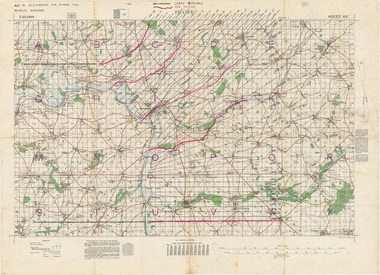
MAP TO ACCOMPANY HEAVY ARTILLERY SCHEME FOR MOBILE WARFARE".....marked with 'Lanes' and Corps/Division Boundaries, Ordnance Survey, 1:40,000, France. Sheet 62c, Dec 1917. (centring on Peronne and Mont St Quentin), December 1917
... (Bob) Snape, Reg No 8651, enlisted as a Stretcher Bearer in 1915 but, because of his secretarial skills was employed in HQ positions as soon as he arrived in France and as a stenographer who worked as Confidential Clerk to General Sir John Monash from June to December 1918; and subsequently, for General Sir Talbot Hobbs until June 1919. ...Shows detail of Artillery Planning in the area of Peronne & Mont St Quentin. Inscribed "Map to accompany H.A. Scheme for Mobile Warfare". Marked with 'Lanes' and Corps/Division Boundaries.The donor, Staff Sergeant R.O. (Bob) Snape, Reg No 8651, enlisted as a Stretcher Bearer in 1915 but, because of his secretarial skills was employed in HQ positions as soon as he arrived in France and as a stenographer who worked as Confidential Clerk to General Sir John Monash from June to December 1918; and subsequently, for General Sir Talbot Hobbs until June 1919. The map was very likely directly used in the planning of the 1918 battles such as Mont St Quentin.Original Item recovered from possibly Australian Corps HQ, probably between the Armistice, 11 November 1918, and June 1919, when Staff Sergeant R.O.(Bob) Snape was repatriated. Shows detail of Artillery Planning in the area of Peronne & Mont St Quentin. Inscribed "Map to accompany H.A. Scheme for Mobile Warfare". Marked with 'Lanes' and Corps/Division Boundaries.snape collection -
Warrnambool RSL Sub Branch
BOB: Map France 1:100,000 AMIENS, AMIENS, Geographical Section, General Staff, No 2364. October 1915; Ordnance Survey 1916; Minor Corrections 01/10/1916
... (Bob) Snape, Reg No 8651, enlisted as a Stretcher Bearer in 1915 but, because of his secretarial skills was employed in HQ positions as soon as he arrived in France and as a stenographer who worked as Confidential Clerk to General Sir John Monash from June to December 1918; and subsequently, for General Sir Tread more Snape Collection Topographical map. ...Original Item souvenired from possibly Australian Corps HQ, probably between the Armistice, 11 November 1918, and June 1919, when the Staff Sergeant R.O.(Bob) Snape was repatriated.The donor, Staff Sergeant R.O. (Bob) Snape, Reg No 8651, enlisted as a Stretcher Bearer in 1915 but, because of his secretarial skills was employed in HQ positions as soon as he arrived in France and as a stenographer who worked as Confidential Clerk to General Sir John Monash from June to December 1918; and subsequently, for General Sir Tread moreTopographical map. Full colour snape collection -
 Monbulk RSL Sub Branch
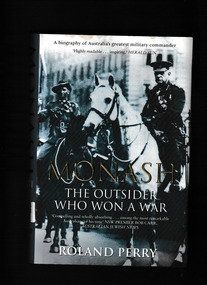
Book, Random House, Monash: The outsider who won a war, 2004
... world war 1914-1918 - australia - campaigns australia - generals - biography A biography of Australia's greatest military commander, Sir John Monash, who chnaged the way wars were fought and won. index, notes, ill, maps, p.586. ...A biography of Australia's greatest military commander, Sir John Monash, who chnaged the way wars were fought and won.index, notes, ill, maps, p.586.non-fictionA biography of Australia's greatest military commander, Sir John Monash, who chnaged the way wars were fought and won.world war 1914-1918 - australia - campaigns, australia - generals - biography -
 Monbulk RSL Sub Branch
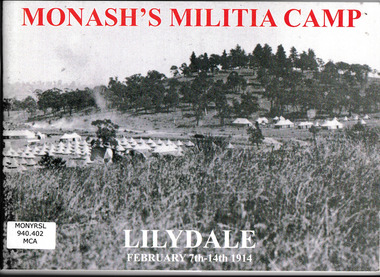
Book, Mt Evelyn RSL, Monash's militia camp Lilydale : February 7th-14th, 1914, 2014
... australia - militia military training camps - lilydale - history In February 1914 Colonel John Monash organised an annual camp for the militia to be held at Lilydale. The camp, training and mock battles were reviewed by Sir General Ian Hamilton. bibliography, ill, maps, p.36. ...In February 1914 Colonel John Monash organised an annual camp for the militia to be held at Lilydale. The camp, training and mock battles were reviewed by Sir General Ian Hamilton.bibliography, ill, maps, p.36.non-fictionIn February 1914 Colonel John Monash organised an annual camp for the militia to be held at Lilydale. The camp, training and mock battles were reviewed by Sir General Ian Hamilton.australia - militia, military training camps - lilydale - history -
 Monbulk RSL Sub Branch
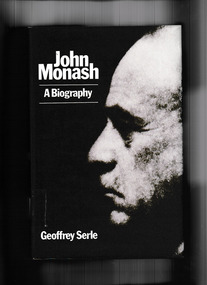
Book, Geoffrey Serle, John Monash: A Biography, 1981
... World War 1914-1918 - Generals - Biography John Monash - Biography The military valor, scholarship, and entrepreneurial leadership of Sir John Monash are recounted in this biography of one of Australia's most famous public figures. ...The military valor, scholarship, and entrepreneurial leadership of Sir John Monash are recounted in this biography of one of Australia's most famous public figures. While his academic prowess in the fields of literature, music, theater, language, and Jewish scholarship distinguished him at the University of Melbourne, Monash gained national fame during World War I when he was one of the few senior allied generals to emerge from Gallipoli with his reputation unscathed. His pioneering use of reinforced concrete, leadership of the state electricity commission, and work to secure the Gippsland's huge brown coal deposits were signatures of his domestic economic leadership. This revealing portrait provides a glimpse of the intensely personal and introspective man behind the confident leader.Index, ill, maps, p.600.non-fictionThe military valor, scholarship, and entrepreneurial leadership of Sir John Monash are recounted in this biography of one of Australia's most famous public figures. While his academic prowess in the fields of literature, music, theater, language, and Jewish scholarship distinguished him at the University of Melbourne, Monash gained national fame during World War I when he was one of the few senior allied generals to emerge from Gallipoli with his reputation unscathed. His pioneering use of reinforced concrete, leadership of the state electricity commission, and work to secure the Gippsland's huge brown coal deposits were signatures of his domestic economic leadership. This revealing portrait provides a glimpse of the intensely personal and introspective man behind the confident leader. world war 1914-1918 - generals - biography, john monash - biography -
 Bendigo Historical Society Inc.
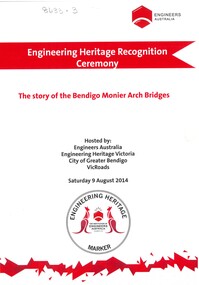
Booklet - Engineering Heritage Recognition Ceremony
... general construction technique including for the construction of bridges bridges with the first bridge built in 1875. In Victoria, Monash and Anderson, representatives of the Australian patent holders and later Victorian patent holders. The Bendigo Monier Bridges were built between 1901 and 1902. Monash's contribution was not in the actual technology but in the promotion and defence of the new technology that was faced by much doubt and scepticism. Monier Monier Bridges Sir John ...In 1867, Frenchman Joseph Monier patented the use of metal reinforced concrete for use in horticultural troughs. Francois Hennebique expanded this idea into a general construction technique including for the construction of bridges bridges with the first bridge built in 1875. In Victoria, Monash and Anderson, representatives of the Australian patent holders and later Victorian patent holders. The Bendigo Monier Bridges were built between 1901 and 1902. Monash's contribution was not in the actual technology but in the promotion and defence of the new technology that was faced by much doubt and scepticism.Ten page booklet with a red and white cardboard cover produced for the Engineering Heritage Recognition Ceremony held on 9th August 2014. Includes the story of the Monier Arched Bridges in Bendigo. Includes B&W and coloured photographs. Produced by Engineers Australia.monier, monier bridges, sir john monash, joshua anderson, engineering -
 Wodonga & District Historical Society Inc
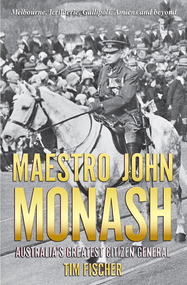
Book - Maestro John Monash - Australia's Greatest Citizen General, Tim Fischer, November 2014
... SIr John Monash Australia Military History World War 1 campaigns Tim Fischer Who was the most innovative general of WW1? ...Who was the most innovative general of WW1? In this publication, Tim Fischer declares this to be John Monash, a man who according to Fischer, for all the recognition he received in his lifetime and after, was never given his proper due. It provides a synopsis of Sir John Monash's life and achievements. The book also included an argument to posthumously promote Sir John Monash to the rank of Field Marshal. The author, Timothy Andrew Fischer AC was an Australian politician and diplomat who served as leader of the National Party from 1990 to 1999. He was Deputy Prime Minister in the Howard Government from 1996 to 1999. Fischer was born in Lockhart, New South Wales. He served with the Australian Army in the Vietnam War. Tim Fischer was born on 3 May 1946 in Lockhart, NSW and died in Albury on 22 August 2019.A paperback volume of 268 pages, 16 unnumbered pages of photos, illustrations and maps. The covers feature photos of John Monash.Who was the most innovative general of WW1? In this publication, Tim Fischer declares this to be John Monash, a man who according to Fischer, for all the recognition he received in his lifetime and after, was never given his proper due. It provides a synopsis of Sir John Monash's life and achievements. The book also included an argument to posthumously promote Sir John Monash to the rank of Field Marshal. The author, Timothy Andrew Fischer AC was an Australian politician and diplomat who served as leader of the National Party from 1990 to 1999. He was Deputy Prime Minister in the Howard Government from 1996 to 1999. Fischer was born in Lockhart, New South Wales. He served with the Australian Army in the Vietnam War. Tim Fischer was born on 3 May 1946 in Lockhart, NSW and died in Albury on 22 August 2019.sir john monash, australia military history, world war 1 campaigns, tim fischer
