
Showing 15 items matching "georgian era"
-
 Flagstaff Hill Maritime Museum and Village
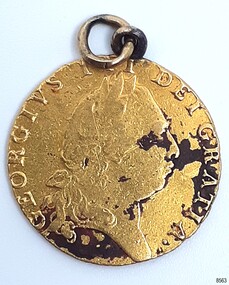
Currency - Guinea Coin, The Royal Mint, 1793 George III Spade Guinea, 1793
... ...Georgian era...Flagstaff Hill Maritime Museum and Village Warrnambool Great Ocean Road Shipwreck Coast Royal Mint British coin currency guinea military guinea Australian currency British guinea gold coin spade guinea King George III George III fifth portrait Arms of England and Scotland Arms of France Arms of Ireland Arms of the House of Hanover coins gold coins gold medallion Georgian era 1793 numismatics contamination phenomena gold corrosion good luck lucky charm pendant lucky coin trade Loch Ard wreck of the Loch Ard 1878 Mutton Bird Island Peterborough scuba diver 1980s guinea coin gold guinea shipwreck artefact relic Julie Wilkins Obverse text; 'GEORGIVS III DEI GRATIA' (translates to George the Third, by the Grace of God) Obverse relief; (King George III bust, facing right, laurel wreath on head) Reverse text; 'M.B.E.ET.H.REX.F. ...The coin was discovered by Julie Wilkins, a Victorian scuba diver who had already experienced more than 500 dives in Australia and overseas. She was holidaying in Peterborough, Victoria, and looking forward to discovering more about the famous Loch Ard ship, wrecked in June 1878 at Mutton Bird Island. The fast Glasgow-built clipper ship was only five years old when the tragedy occurred. There were 54 people on board the vessel and only two survived Julie's holiday photograph of Boat Bay reminds her of her most memorable dive. Submerged in the calm, flat sea, she was carefully scanning around the remains of the old wreck when, to her amazement, a gold coin and a small gold cross suddenly came up towards her. She excitedly cupped them in her hands, then stowed the treasures safely in her wetsuit and continued her dive. She soon discovered a group of brass carriage clock parts and some bottles of champagne. It was a day full of surprises. The items were easily recognisable, without any build-up of encrustations or concretion. Julie secretly enjoyed her treasures for twenty-four years then packed them up for the early morning train trip to Warrnambool. After a short walk to Flagstaff Hill Maritime Museum and Village, her photograph was taken as she handed over her precious find. She told her story to a local newspaper reporter, lunched a café in town then took the late afternoon train home. Her generous donation is now part of a vast collection of Loch Ard shipwreck artefacts, including the gold watch and the Minton Majolica model peacock. The coin is a British 1793 George III Gold Spade Guinea. It was already 83 years old when the Loch Ard had set sail. The loop and ring have been added, perhaps as a pendant, pocket watch accessory or similar purpose. It may have been worn for ‘good luck’ on the long journey to Australia, where ships had to carefully navigate the treacherous Bass’s Strait before arriving at their destination of Melbourne. Sadly, many met their fate on that short stretch of ocean aptly named the Shipwreck Coast. The coin is very recognisable even though it was exposed to the wrecking of the ship, its consequent movement, and the sea's turbulence. Its bent, scratched, buckled, split, dinted and worn condition is part of its story. The red-brown-black discolouration is similar to that found on other gold coins, sometimes called the ‘corrosion phenomena’. Studies suggest the possible cause is contaminants in the minting process reacting to the coins’ environment. The GEORGE III GOLD SPADE GUINEA: - The British Guinea was introduced in 1663 and was circulated until 1814. It was made of 22 carat gold, was 25 to 26 cm in diameter and weighed 8.35 grams. It had a value of 21 British shillings. The guinea coin ceased circulation after 1816 and was replaced by the one-pound note. However, the term ‘guinea’ continued to represent 21 shillings. King George (1738-1820) had six gold guinea designs minted during his reign from 1760 and 1820. Each of the six had different obverse portraits, all facing the right. There were three different reverse sides. The Spade Guinea was the fifth issue of the coin, introduced in 1787 and produced until 1799. The reverse shows a royal crown over a flat-topped shield with the Royal Arms of Great Britain, used in Scotland between 1714 and 1800. The shield images are, from left to right, top to bottom, the Arms of England and Scotland, the Arms of France, the Arms of Ireland, and the Arms of the House of Hanover. The Gold Guinea is also part of Australia’s history. It was the first coin mentioned in the announcement of Governor King of New South Wales his Australian Proclamation of a limited variety and denomination of coins accepted for use in the Australian Colony. The historic and decorative George III Spade Guinea has been reproduced for special collections of coins. However, replicas and imitations have also been made as souvenirs for tourists, as gaming tokens and chips for gamblers, and as ‘fake’ coins for profit. These coins differ in many ways; they may be only half the weight of the genuine coin. Often have a small stamp on the obverse with “COPY” or the manufacturer’s name or initials. Some have scalloped edges, some have dates that are different to the original dates of issue, and some even have text in Latin that translates as something very different to the original coin.The King George III Guinea was only produced from 1663 to 1814 and was the first English coin to be mechanically minted. The coin is the fifth edition of the King George III Guinea, the Spade Guinea, was only produced between 1787 and 1799. It is the only edition with this portrait of King George and the only one with the Royal Coat of Arms of Great Britain in Scotland on the reverse side. This edition was also the last guinea in circulation, because the sixth edition was reserved as the Military guinea. This edition of the Guinea is unique; This coin is the only guinea in our collection. It was minted in 1793, so it is now over 230 years old. The Gold Guinea is part of Australia’s history; it was the first coin in the list of coins for use in the Australian Colonies, mentioned by Governor King of New South Wales in his Australian Proclamation speech of 1800. The George III Spade Guinea was included in the Limited Edition Sherwood 12 Coin Collection of Notable Coinage of Australia. This coin is the only known guinea coin recovered from the wreck of the Loch Ard. It was already 85 years old when the ship was wrecked.Gold coin; British. 1793, King George III of the United Kingdom of Great Britain and Ireland (1760-1820), Spade Guinea. Yellow gold coin with gold metal loop mount and a gold ring through the loop. The design is the fifth issue of the George III Gold Guinea. The obverse relief is a portrait of George III facing right. Reverse relief is a crown above the Coats of Arms (1801-1816) of flat top spade-shaped shield divided into four quadrants that depict crowned lions, fleur de lies, a harp. These images are identified as, from left to right, top to bottom, England and Scotland, France, Ireland and Hanover. Inscriptions are minted around the rims of each side. The coin is dated 1793. Its surface has dark areas on both sides and the reed edge and surfaces are well worn. The loop mount is bent and the ring is buckled. The coin was recovered from the wreck of the ship Loch Ard.Obverse text; 'GEORGIVS III DEI GRATIA' (translates to George the Third, by the Grace of God) Obverse relief; (King George III bust, facing right, laurel wreath on head) Reverse text; 'M.B.E.ET.H.REX.F. D.B.ET.L.D. S.R.I.A.T.ET.E' '1793' (translates to: King of Great Britain, France and Ireland, Defender of the Faith, Duke of Brunswick and Lüneburg, Arch-Treasurer and Elector of the Holy Roman Empire) Reverse relief; a spade-shaped image i.e. (Crown with fleer de lies, above Shield with crowned lions in different postures, a harp, and other details)flagstaff hill maritime museum and village, warrnambool, great ocean road, shipwreck coast, royal mint, british coin, currency, guinea, military guinea, australian currency, british guinea, gold coin, spade guinea, king george iii, george iii, fifth portrait, arms of england and scotland, arms of france, arms of ireland, arms of the house of hanover, coins, gold coins, gold medallion, georgian era, 1793, numismatics, contamination phenomena, gold corrosion, good luck, lucky charm, pendant, lucky coin, trade, loch ard, wreck of the loch ard, 1878, mutton bird island, peterborough, scuba diver, 1980s, guinea coin, gold guinea, shipwreck artefact, relic, julie wilkins -
 Embroiderers Guild, Victoria
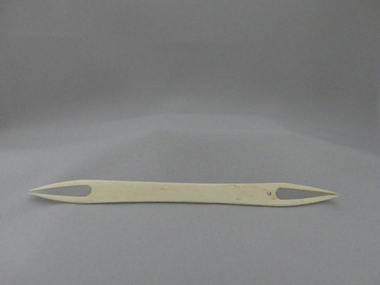
Tool - Netting needle, 1880's
... Netting is an ancient craft which became popular during the Georgian and Victorian eras. ...Netting is an ancient craft which became popular during the Georgian and Victorian eras. Netting was popular during Georgian and Victorian times, these long needles had thread wound around them and were passed through the netting loops Netting none Netting needle - long flat tool with two pronged fork on either end Netting needle Tool Netting needle ...Netting is an ancient craft which became popular during the Georgian and Victorian eras. Netting was popular during Georgian and Victorian times, these long needles had thread wound around them and were passed through the netting loopsNetting needle - long flat tool with two pronged fork on either endnonenetting -
 Embroiderers Guild, Victoria
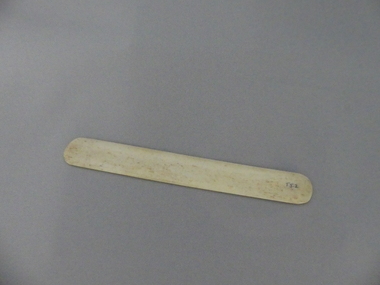
Tool - Netting gauge, Netting gauges, 1880's
... Netting is an ancient craft which became popular during the Georgian and Victorian eras. ...Netting is an ancient craft which became popular during the Georgian and Victorian eras. Netting was popular during Georgian and Victorian times, gauges such as these were used to ensure size of netting loops Netting none Netting gauge, flat rectangular shape with rounded ends Netting gauges Tool Netting gauge ...Netting is an ancient craft which became popular during the Georgian and Victorian eras. Netting was popular during Georgian and Victorian times, gauges such as these were used to ensure size of netting loopsNetting gauge, flat rectangular shape with rounded endsnonenetting -
 Embroiderers Guild, Victoria
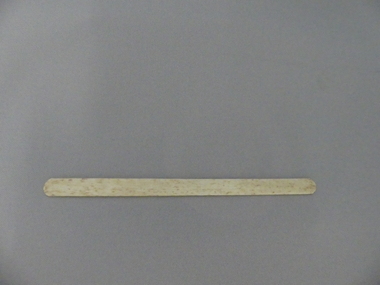
Tool - Netting gauge, Netting gauges, 1880's
... Netting is an ancient craft which became popular during the Georgian and Victorian eras. ...Netting is an ancient craft which became popular during the Georgian and Victorian eras. Netting was popular during Georgian and Victorian times, gauges such as these were used to ensure even loops were made Netting none Netting gauge, flat rectangular shape with rounded ends Netting gauges Tool Netting gauge ...Netting is an ancient craft which became popular during the Georgian and Victorian eras. Netting was popular during Georgian and Victorian times, gauges such as these were used to ensure even loops were made Netting gauge, flat rectangular shape with rounded endsnonenetting -
 Embroiderers Guild, Victoria
Tool - Crochet Hook, Netting set with some crochet hooks, 1880's
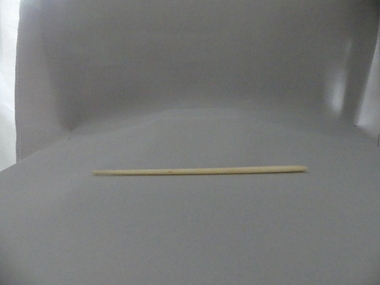
... Netting is an ancient craft which became popular during the Georgian and Victorian eras. ...Netting is an ancient craft which became popular during the Georgian and Victorian eras. Netting was popular during Georgian and Victorian times, gauges such as these were used to ensure size of netting loops Netting none Bone crochet hook, long bone piece with one hooked end Netting set with some crochet hooks Tool Crochet Hook ...Netting is an ancient craft which became popular during the Georgian and Victorian eras. Netting was popular during Georgian and Victorian times, gauges such as these were used to ensure size of netting loopsBone crochet hook, long bone piece with one hooked endnonenetting -
 St Kilda Historical Society
Ephemera - Postcard, City of Port Phillip, St Vincent Gardens annual bedding display 1995, c. 1995
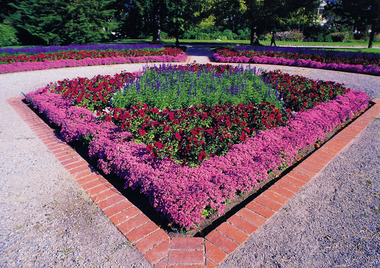
... Designed by Clement Hodgkinson in 1868 the garden reflects the Georgian era. Image description: Tree plantings are arranged in symmetrical patterns with themed plantings throughout the gardens timescale, four of which are registered with the National Trust. ...Designed by Clement Hodgkinson in 1868 the garden reflects the Georgian era. Image description: Tree plantings are arranged in symmetrical patterns with themed plantings throughout the gardens timescale, four of which are registered with the National Trust. ...One of a series of postcards celebrating the launch of 'Flora for Victoria 1996', a project to celebrate the Royal Botanic Gardens of Melbourne`s 150th anniversary and the centenary of the death of its first director Baron Ferdinand von Mueller (1825 -1896). St Vincent Gardens is of national significance for its English style. Designed by Clement Hodgkinson in 1868 the garden reflects the Georgian era. Image description: Tree plantings are arranged in symmetrical patterns with themed plantings throughout the gardens timescale, four of which are registered with the National Trust. Message to residents on two of the postcards reads: "Dear Resident. NATURE STRIPS MOWING: The nature strips are a vital part of the streetscapes and the assistance you provide by maintaining the grassed nature strip is appreciated. The Parks team has mown your nature strip today as it was becoming quite long, however, Council encourages residents to mow their nature strip as it has limited resources. Pensioners or others unable to mow the nature strip are encouraged to advise the Parks team. Council also operates a 'Free lawn mower borrowing service' from the Albert Park Nursery, at 42 Mills Street, Albert Park. Lawn mowers are available daily 9.00am to 4.00pm except Christmas Day, Good Friday, and Anzac Day. For further information contact Parks on 9209 6672."Colour postcard (3 identical photos on each)St Vincent Gardens annual bedding display 1995 Historic gardens in the City of Port Phillip postcard series celebrating the launch of the Royal Botanic Garden's [sic] Melbourne, 'Flora for Victoria 1996' Produced by the City of Port Phillip, Melbourne Victoria Australia 9209 6209 City of Port Phillip logoalbert park, st vincent gardens, clement hodgkinson, city of port phillip, parks, gardens -
 Flagstaff Hill Maritime Museum and Village
Domestic object - Spoon
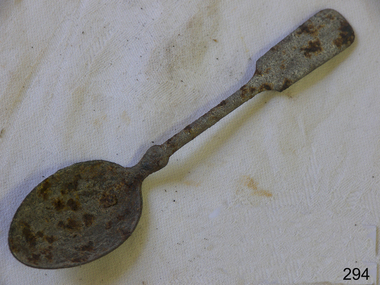
... Widespread use and the modern size dates back to the Georgian era. The teaspoon is first mentioned in an advertisement in a 1686 edition of the London Gazette. ...Widespread use and the modern size dates back to the Georgian era. The teaspoon is first mentioned in an advertisement in a 1686 edition of the London Gazette. ...The teaspoon is a European invention. Small spoons were common in Europe since at least the 13th century; the special spoons were introduced almost simultaneously with tea and coffee. (Pettigrew points to its use in the mid-17th century.) Originally the teaspoons were exotic items, precious and small, resembling the demitasse spoons of later times. Also used for coffee, these spoons were usually made of gilt silver, and were available with a variety of handle shapes: plain, twisted, or decorated with knobs, also known as knops, hence the knop-top name for such spoons. Widespread use and the modern size dates back to the Georgian era. The teaspoon is first mentioned in an advertisement in a 1686 edition of the London Gazette. Teaspoons, probably of English origin, are present in the 1700 Dutch painting by Nicholas Verkolje, "A Tea Party". An 1825 cartoon makes fun of a Frenchman unfamiliar with the British etiquette. The guest did not place his spoon into the cup and is thus being offered his thirteenth cup of tea! A special dish for resting the teaspoons, a "spoon boat", was a part of the tea set in the 18th century. At that time, the spoons played an important role in tea drinking etiquette: a spoon laid "across" the teacup indicated that the guest did not need any more tea, otherwise, the hostess was obligated to offer a fresh cup of tea, and it was considered impolite to refuse the offering. Pettigrew reports that sometimes the spoons were numbered to make it easier to match the cups with the guests after a refill. https://en.wikipedia.org/wiki/Teaspoon#:~:text=Teaspoon%20is%20a%20European%20invention,the%20mid%2D17th%20century).A history of the teaspoon.Metal teaspoon, badly corrodedNoneflagstaff hill, warrnambool, shipwrecked-coast, flagstaff-hill, flagstaff-hill-maritime-museum, maritime-museum, shipwreck-coast, flagstaff-hill-maritime-village -
 Flagstaff Hill Maritime Museum and Village
Book - Compalation of Plays, Prologues, Sociatal Observations, Richard Brinsley Sheridan, The Works of Richard Brinsley Sheridan, 1874
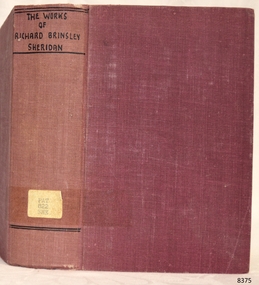
... It was designed to bring together the complete literary, political, and personal legacy of one of the Georgian era's most brilliant figures and, as such, is a first edition of this compilation. ...It was designed to bring together the complete literary, political, and personal legacy of one of the Georgian era's most brilliant figures and, as such, is a first edition of this compilation. ...Richard Brinsley Sheridan (1751–1816) was an Irish-born playwright, impresario, wit, and prominent Whig politician. He was a dazzling figure in late 18th-century London high society. The book, The Works of Richard Brinsley Sheridan, edited by Francis Stainforth, is an omnibus collection showcasing the full breadth of his career. The volume opens with a substantial biographical introduction (the "memoir"). It traces Sheridan's meteoric rise from an impoverished Irish theater family to the heights of Parliament and Westminster Abbey, balanced against his chaotic personal finances and battles with alcoholism. Rather than just printing his famous plays, this single-volume edition compiles his complete theatrical catalog (The Rivals, The School for Scandal, The Duenna, The Critic, Pizarro, etc.). Also included are his lesser-known verse, prologues written for the theater, classical translations, a selection of his most famous parliamentary orations, and fragments of plays and essays he never completed. The addition of a collection on “ANA,” noted on the book's flyleaf, refers to a 19th-century publishing term for a collection of anecdotes, memorable sayings, table-talk, and biographical trivia regarding a famous person. The "Sheridaniana" section in this book compiles the sharp-witted jokes, pranks, and clever remarks Sheridan made throughout his life.The Works of Richard Brinsley Sheridan Author: Richard Brinsley Sheridan Publisher: Chatto and Windus Date: 1874 Editor: Francis Edward StainforthfictionRichard Brinsley Sheridan (1751–1816) was an Irish-born playwright, impresario, wit, and prominent Whig politician. He was a dazzling figure in late 18th-century London high society. The book, The Works of Richard Brinsley Sheridan, edited by Francis Stainforth, is an omnibus collection showcasing the full breadth of his career. The volume opens with a substantial biographical introduction (the "memoir"). It traces Sheridan's meteoric rise from an impoverished Irish theater family to the heights of Parliament and Westminster Abbey, balanced against his chaotic personal finances and battles with alcoholism. Rather than just printing his famous plays, this single-volume edition compiles his complete theatrical catalog (The Rivals, The School for Scandal, The Duenna, The Critic, Pizarro, etc.). Also included are his lesser-known verse, prologues written for the theater, classical translations, a selection of his most famous parliamentary orations, and fragments of plays and essays he never completed. The addition of a collection on “ANA,” noted on the book's flyleaf, refers to a 19th-century publishing term for a collection of anecdotes, memorable sayings, table-talk, and biographical trivia regarding a famous person. The "Sheridaniana" section in this book compiles the sharp-witted jokes, pranks, and clever remarks Sheridan made throughout his life.flagstaff hil, warrnambool, flagstaff hill maritime museum, maritime museum, shipwreck coast, great ocean road, book, pattison collection, warrnambool library, warrnambool mechanics’ institute, ralph eric pattison, corangamite regional library service, warrnambool city librarian, mechanics’ institute library, victorian library board, warrnambool books and records, warrnambool children’s library, the works of richard brinsley sheridan, richard brinsley sheridan, f stainforth, plays, drama -
 Eltham District Historical Society Inc
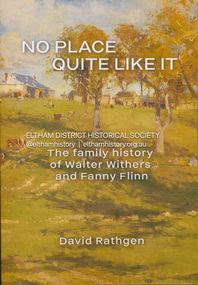
Book, David Rathgen, No Place Quite Like It; The family history of Walter Withers and Fanny Flinn, 2023
... Summary For over 250 years the Withers family of Birmingham worked as tailors, sometimes also as butchers. During the Georgian era, English society changed and the Withers family with it. ...Summary For over 250 years the Withers family of Birmingham worked as tailors, sometimes also as butchers. During the Georgian era, English society changed and the Withers family with it. ...Summary For over 250 years the Withers family of Birmingham worked as tailors, sometimes also as butchers. During the Georgian era, English society changed and the Withers family with it. First came a gentleman amateur artist in the form of Edward Weston Withers, grandfather of Walter Withers. Then Edwin Withers, Walter Withers' father, took to tobacco, rope and twine manufacturing which put an end to the traditions of butchery and tailoring.The origins of Walter's painterly ambitions are explored. There was a physical altercation between Walter and his father, Edwin. That fight emerged out of contradictory expectations between Walter's father, Edwin and his grandfather Edward. Those expectations and the societies which kindled them contributed to Walter's character and art. Up until now there has been no family history about Walter Herbert Withers (1854-1914) a notable Australian landscape artist of the Heidelberg school and friend to Tom Roberts, Frederick McCubbin, Arthur Streeton and Clara Southern. Walter, the son of a rich Victorian businessman, married Fanny Flinn, the daughter of a commercial salesman who also owned part of a Birmingham brewery. In No Place Quite Like It, Walter, his wife Fanny and his family are depicted against the social contexts in which they each grew up. Our appreciation of Walter Withers' art is expanded: by knowing those forces which helped shape his early years and how he responded to them; by gaining new insights into his origins and how he grew into the man he was. We also gain a fresh appreciation of his wife Fanny, and the influence she had upon him, their children, and upon the society in which she lived. Includes 200 pages of text, Prefaces by Andrew Mackenzie OAM (art historian), and Eileen Mackley AM (President, Victorian Artists Society), Bibliography and an Index, extensive images, maps, charts and family trees, provide a visual porthole through which an insight might be had into the lives and times of Walter Withers and his family history.walter withers, fanny withers (nee flinn), family history -
 Flagstaff Hill Maritime Museum and Village
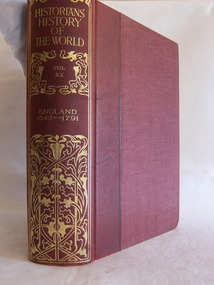
Book - Reference Book/History, Henry Smith Williams, The Historians History of the World Vol 20 set 1 - Edited by Henry Smith Williams L.L.D. Published by “The Times” 1908, 1908
... The era called “The Enlightenment,” the political and social developments throughout the early Georgian period leading up to 1791, including the rise of the British Empire's influence and the early stages of the Industrial Revolution. ...The era called “The Enlightenment,” the political and social developments throughout the early Georgian period leading up to 1791, including the rise of the British Empire's influence and the early stages of the Industrial Revolution. ...Henry Smith Williams’ “The Historians' History of the World” is a chronological and geographical "tapestry" of human events, these twenty five volumes occupy a very specific and prestigious place in historical research. Volume 20 focuses on the transformation period of England from the outbreak of the English Civil War to the late 18th century.The Book is part of a 25 volume set with red cloth bindings and gold filigree design to rib.non-fictionHenry Smith Williams’ “The Historians' History of the World” is a chronological and geographical "tapestry" of human events, these twenty five volumes occupy a very specific and prestigious place in historical research. Volume 20 focuses on the transformation period of England from the outbreak of the English Civil War to the late 18th century. warrnambool, flagstaff-hill, flagstaff-hill-maritime-museum, maritime-museum, shipwreck-coast, flagstaff-hill-maritime-village, book, the historians history of the world vol 20 set 1, henry smith williams -
 Flagstaff Hill Maritime Museum and Village
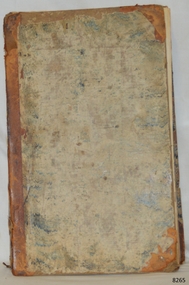
Book - Reference Travel/History/Cartography, Mr Salmon (Thomas Salmon) et al, Modern History or, the Present State of All Nations. Vol III, 1746
... The inclusion of Herman Moll’s maps renders this set highly significant to map collectors, as it captures the colonial borders, sea routes, and geographic assumptions of the early Georgian era. Printed right at the height of Paternoster Row's dominance as the heart of the London book trade, it has added significance as it carries the rare combined Longman & Shewell imprint. ...This 1746 3rd Edition of Thomas Salmon’s Modern History is a fantastic slice of Enlightenment era geography and publishing history. It sits at a fascinating intersection of early modern travel literature, top tier cartography, and the rise of one of London's most famous publishing houses. Thomas Salmon’s Modern History: or, the Present State of All Nations was an ambitious encyclopedic project. Rather than focusing strictly on dynastic timelines, Salmon took a modern geographical and ethnographic approach. For each region covered, he detailed its geography and climate, along with its natural resources, plants, animals, and minerals. Culture and society were covered by focusing on local habits, dress, religious rites, laws, customs, and architecture. Economy and trade were also detailed, including the arts, sciences, husbandry, and commercial manufactures.Hard cover book,Modern History: or, the Present State of All Nations Vol III Author: Mr Salmon (Thomas Salmon) Illustrator: Herman Moll Publisher: T Longman and T Shewell, London. Date: 1746 (MDCCXLVI), 3rd Edition Further Information: Set of Three Volumes. Hard covered book has reinforcing on the spine and corners. The cover is very well worn and has remnants of a coloured design. The fly page is printed in red and black ink and has a long description of the contents. Inside the cover is printed a Coat of Arms, there is a stocker on the inside cover. non-fictionThis 1746 3rd Edition of Thomas Salmon’s Modern History is a fantastic slice of Enlightenment era geography and publishing history. It sits at a fascinating intersection of early modern travel literature, top tier cartography, and the rise of one of London's most famous publishing houses. Thomas Salmon’s Modern History: or, the Present State of All Nations was an ambitious encyclopedic project. Rather than focusing strictly on dynastic timelines, Salmon took a modern geographical and ethnographic approach. For each region covered, he detailed its geography and climate, along with its natural resources, plants, animals, and minerals. Culture and society were covered by focusing on local habits, dress, religious rites, laws, customs, and architecture. Economy and trade were also detailed, including the arts, sciences, husbandry, and commercial manufactures.flagstaff hill, flagstaff hill maritime museum and village, warrnambool, maritime museum, maritime village, great ocean road, shipwreck coast, pattison collection, ralph eric pattison, warrnambool mechanics’ institute, mechanics’ institute library, warrnambool library, free library, corangamite regional library service, mr salmon, thomas salmon, 18th century, 1746, history, geography, social studies, culture, maps, modern history, present state of all nations vol iii, herman moll, t longman and t shewell, social history, cartography -
 Flagstaff Hill Maritime Museum and Village
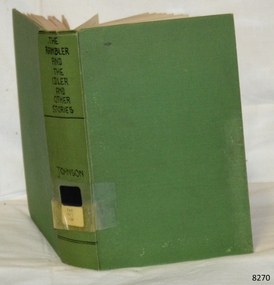
Book - Periodical Essays, Dr. Samuel Johnson et al, The Rambler, The Idler, The Adventurer & The Connoisseur, 1876
... They provide a brilliant, firsthand window into Georgian London’s coffee-house culture, its class anxieties, shifting moral perspectives, and the everyday observations of the era's greatest sharp-witted minds. movements, like Mechanics' Institutes. ...They provide a brilliant, firsthand window into Georgian London’s coffee-house culture, its class anxieties, shifting moral perspectives, and the everyday observations of the era's greatest sharp-witted minds. ...This single 1876 volume combines four of the most influential weekly and semi weekly periodical essay series of the mid-18th century. Despite the phrasing of the era, these are not fiction stories or novels. They are periodical essays brief, single-topic pieces written to critique, educate, and entertain 18th-century readers. The collection covers three themes: morality and human nature, with a focus on reflections relating to the disappointments of life, the inevitability of death, managing one's passions, and the search for true happiness, featuring mainly in The Rambler; social satire and manners, with lighthearted and witty take downs of London high society, modern trends, vanity, and standard eccentric characters of the town; and literary criticism, with essays that analyse contemporary poetry and the theatre, along with the evolving English language.Hard cover book,The Rambler & The Idler Author: Dr. Samuel Johnson, Mr. Town, John Hawkesworth Publisher: William P Nimmo, 14 King William St, The Strand, London. W1. Date: 1876 Further Information: The flyleaf reads The Rambler and the Idler. By Samuel Johnson. The Adventurer. By John Hawkesworth. The Connoisseur. By (Mr. Town Pen Name) Green Cloth hardcover with a green spine and lettering in black texter. The spine has a Library label with an inscription.non-fictionThis single 1876 volume combines four of the most influential weekly and semi weekly periodical essay series of the mid-18th century. Despite the phrasing of the era, these are not fiction stories or novels. They are periodical essays brief, single-topic pieces written to critique, educate, and entertain 18th-century readers. The collection covers three themes: morality and human nature, with a focus on reflections relating to the disappointments of life, the inevitability of death, managing one's passions, and the search for true happiness, featuring mainly in The Rambler; social satire and manners, with lighthearted and witty take downs of London high society, modern trends, vanity, and standard eccentric characters of the town; and literary criticism, with essays that analyse contemporary poetry and the theatre, along with the evolving English language.flagstaff hill, warrnambool, shipwrecked coast, flagstaff hill maritime museum, maritime museum, shipwreck coast, flagstaff hill maritime village, great ocean road, book, pattison collection, warrnambool library, warrnambool mechanics’ institute, ralph eric pattison, corangamite regional library service, warrnambool city librarian, mechanics’ institute library, victorian library board, warrnambool books and records, warrnambool children’s library, the rambler and the idler, john hawkesworth., mr. town, samuel johnson -
 Ithacan Historical Society
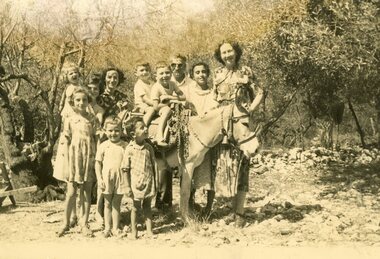
Photograph - Rousso the Donkey, 1952
... Georgia Benia, Michali Kavadeas, unknown. Annie Vlass together with her husband Stathi Vlass and children Demetri and Con spent 6-9 months in Greece in 1952 at the Vlassopoulos (Kopela) family home in Lahos whilst in Ithaca. Although not common prior to the 1960s, some Ithacans, who had settled in Australia prior to the post war era ...Donkeys were a standard form of transport and a beast of burden for Ithacans as the island is very mountainous. Stepped tracks designed for donkeys to ascend the mountains can be still be located. The donkey in the photo, 'Rousso' was owned by Achileas Benias and was used to transport the olives and produce form their farming plot. Photographed from L-R back are: Freda Lucas (nee Benia) holding Jenny Kyriakakis, Con and Demetri Vlass on the donkey, Georgos Sombola, Angeliki Lekatsa (Spiliatsos), and Annie Vlass. In the front are Georgia Benia, Michali Kavadeas, unknown.Annie Vlass together with her husband Stathi Vlass and children Demetri and Con spent 6-9 months in Greece in 1952 at the Vlassopoulos (Kopela) family home in Lahos whilst in Ithaca. Although not common prior to the 1960s, some Ithacans, who had settled in Australia prior to the post war era, did travel back to their homeland to visit family and to introduce spouses and children to their place of birth. Today many of Ithacan heritage travel to the island, particularly during the northern summer, to reconnect with their family roots.A sepia photograph of eleven people, eight children and three adults standing in a cleared wooded area around a donkey. Two of the children are on the back of the donkey.kopella -
 Embroiderers Guild, Victoria
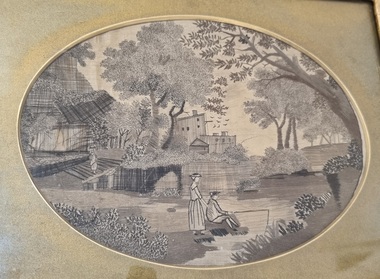
Textile - 18th C Hair and Silk Embroidered Rondel
... Hair was often used to embroider memorial pieces. Example of Georgian era hair embroidery River rural fishing figures Auction number 254 on reverse of frame Framed embroidery of a rural scene with a woman and man fishing in a river. ...18th century piece from collection of Lady Amies (b1906-d1982). Likely English. Purchased by Donor at auction of Lady Amies collection. Hair was often used to embroider memorial pieces.Example of Georgian era hair embroideryFramed embroidery of a rural scene with a woman and man fishing in a river. Stitched in silk/hair on silk fabricAuction number 254 on reverse of frameriver, rural, fishing, figures -
 Linton Mechanics Institute and Free Library Collection
Book - Novel, Castle, Agnes et al, The Bath Comedy, 1900
... Agnes Castle Egerton Castle Fiction comedy romance The narrative unfolds in the elegant and often scandalous society of Bath, focusing on characters embroiled in romantic entanglements and social intrigues during the Georgian era. The two main characters introduced are Lady Standish, who worries about her husband's diminishing affection, and Mistress Kitty Bellairs, a witty widow who offers her friend mischievous advice on how to rekindle love and friendship amid societal expectations. 243p. : dark grey/black cover : title and author embossed in gold on spine and front cover. ...The narrative unfolds in the elegant and often scandalous society of Bath, focusing on characters embroiled in romantic entanglements and social intrigues during the Georgian era. The two main characters introduced are Lady Standish, who worries about her husband's diminishing affection, and Mistress Kitty Bellairs, a witty widow who offers her friend mischievous advice on how to rekindle love and friendship amid societal expectations.243p. : dark grey/black cover : title and author embossed in gold on spine and front cover. First part of Preface is missing.fictionThe narrative unfolds in the elegant and often scandalous society of Bath, focusing on characters embroiled in romantic entanglements and social intrigues during the Georgian era. The two main characters introduced are Lady Standish, who worries about her husband's diminishing affection, and Mistress Kitty Bellairs, a witty widow who offers her friend mischievous advice on how to rekindle love and friendship amid societal expectations.agnes castle, egerton castle, fiction, comedy, romance
