
Showing 14 items matching "german migrants wodonga"
-
 Wodonga & District Historical Society Inc
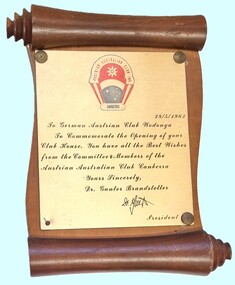
Plaque - German-Austrian Club Wodonga Opening, 1983
... ...German migrants Wodonga...Thousands of German migrants started a new life at Bonegilla, Victoria in the 1950s. Among them were five men who met each other in Wodonga, became friends and decided to form a German Austrian Club, where they could enjoy the company of likeminded individuals. ...German Austrian Australian Club. Over recent years patronage and interest in the Club and its activities changed. Children of the original members had become “real Aussies” and did not always want to carry on traditions. Aging membership and lack of volunteers forced the Club to disband in 2025. The Club building has been gifted to the Albury Wodonga Theatre Company. These items are significant because they are representative of an important cultural organisation which operated in Wodonga for over 60 years. German Austrian Australian Club German migrants ...Thousands of German migrants started a new life at Bonegilla, Victoria in the 1950s. Among them were five men who met each other in Wodonga, became friends and decided to form a German Austrian Club, where they could enjoy the company of likeminded individuals. They were Kurt Mueller, Willi Klimt, Toni Krischa and Erwin Klein from Germany and Manfred Teissl from Austria. On the 16th July 1960, after advertising in the Border Morning Mail the German Austrian Club in Wodonga was born. Office bearers were Paul Peters as President. Gerhard Ziermann as Secretary and Günter Schmehl as Treasurer. Their aim was "To promote the upkeep of the German language in written and spoken form and to promote good German fellowship, while enjoying functions of a cultural and entertaining nature". By 1963 the Club boasted 40 members, holding meetings at the RSL Clubrooms and other suitable locations before they found a house in Hovell Street, Wodonga. It was used for meetings, Skat meetings, film nights and Sonnabendschule” or Saturday school where children of members could continue to learn German. The Committee organised a wide range of activities and functions in their small rooms but dreamed of having a bigger home. This became reality in July 1979, when the Committee purchased land from the Albury Wodonga Development Corporation at 5 McFarland Road, Wodonga. The first brick was laid on the Club's land in May 1980, and the double-story brick building was completed within 12 months voluntarily by Club members. At the same time members supported other organisations and charities in the Wodonga and wider community. The first Oktoberfest in Wodonga was held in 1975, drawing 4,000 attendees. The event was organized to promote German culture, and the profits from the first year were donated to the Wodonga District Hospital, raising $20,000. In 2001 the German Austrian Club was presented with the Certificate of Meritorious Service by the Government of Victoria for Community Works in Wodonga and district. The Club raised $23,000 for the Wodonga Hospital, had numerous fundraisers to assist in bushfires and drought situations and was involved in the Red Cross Calling campaign for many years. After much fundraising, hard work and making their way through extensive government red tape, the Club moved to its new premises in McFarland Road on 1st August 1981. The members continued to make necessary internal adjustments and sought an alcohol licence. The building was officially opened in May 1983. The Club prospered and had 300 members, making it necessary for new applicants to be put on a waiting list to be accepted as members. Interest groups formed consisted of Competition Air Rifle Shooting Group, a Skat (German Card game) Group, Folk Dancing Group, Ladies Group, Table Tennis Group, Darts Group, Chess Group and the Billiard Group. In later years, as so many Australians became members, the Club’s name was changed to the German Austrian Australian Club. Over recent years patronage and interest in the Club and its activities changed. Children of the original members had become “real Aussies” and did not always want to carry on traditions. Aging membership and lack of volunteers forced the Club to disband in 2025. The Club building has been gifted to the Albury Wodonga Theatre Company. These items are significant because they are representative of an important cultural organisation which operated in Wodonga for over 60 years.A metal plaque attached to a wooden backing shaped like a scroll. The text is in the form of a letter.Emblem of the Austrian - Australian Clubs Inc. Canberra 28/5/1983 To German Austrian Club Wodonga To Commemorate the Opening of your Club House. You have all the Best Wishes from the Committee & Members of the Austrian Australian Club Canberra Yours Sincerely, Dr. Gunter Brandstetter Presidentgerman austrian australian club, german migrants wodonga -
 Wodonga & District Historical Society Inc
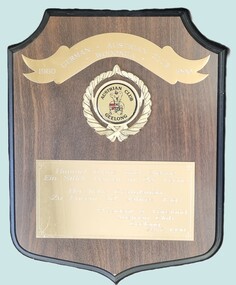
Plaque - German-Austrian Club Wodonga 30th Anniversary, 1990
... ...German migrants Wodonga...Thousands of German migrants started a new life at Bonegilla, Victoria in the 1950s. Among them were five men who met each other in Wodonga, became friends and decided to form a German Austrian Club, where they could enjoy the company of likeminded individuals. ...German Austrian Australian Club. Over recent years patronage and interest in the Club and its activities changed. Children of the original members had become “real Aussies” and did not always want to carry on traditions. Aging membership and lack of volunteers forced the Club to disband in 2025. The Club building has been gifted to the Albury Wodonga Theatre Company. This item is significant because it is representative of an important cultural organisation which operated in Wodonga for over 60 years. German Austrian Australian Club German migrants ...Thousands of German migrants started a new life at Bonegilla, Victoria in the 1950s. Among them were five men who met each other in Wodonga, became friends and decided to form a German Austrian Club, where they could enjoy the company of likeminded individuals. They were Kurt Mueller, Willi Klimt, Toni Krischa and Erwin Klein from Germany and Manfred Teissl from Austria. On the 16th July 1960, after advertising in the Border Morning Mail the German Austrian Club in Wodonga was born. Office bearers were Paul Peters as President. Gerhard Ziermann as Secretary and Günter Schmehl as Treasurer. Their aim was "To promote the upkeep of the German language in written and spoken form and to promote good German fellowship, while enjoying functions of a cultural and entertaining nature". By 1963 the Club boasted 40 members, holding meetings at the RSL Clubrooms and other suitable locations before they found a house in Hovell Street, Wodonga. It was used for meetings, Skat meetings, film nights and Sonnabendschule” or Saturday school where children of members could continue to learn German. The Committee organised a wide range of activities and functions in their small rooms but dreamed of having a bigger home. This became reality in July 1979, when the Committee purchased land from the Albury Wodonga Development Corporation at 5 McFarland Road, Wodonga. The first brick was laid on the Club's land in May 1980, and the double-story brick building was completed within 12 months voluntarily by Club members. At the same time members supported other organisations and charities in the Wodonga and wider community. The first Oktoberfest in Wodonga was held in 1975, drawing 4,000 attendees. The event was organized to promote German culture, and the profits from the first year were donated to the Wodonga District Hospital, raising $20,000. In 2001 the German Austrian Club was presented with the Certificate of Meritorious Service by the Government of Victoria for Community Works in Wodonga and district. The Club raised $23,000 for the Wodonga Hospital, had numerous fundraisers to assist in bushfires and drought situations and was involved in the Red Cross Calling campaign for many years. After much fundraising, hard work and making their way through extensive government red tape, the Club moved to its new premises in McFarland Road on 1st August 1981. The members continued to make necessary internal adjustments and sought an alcohol licence. The building was officially opened in May 1983. The Club prospered and had 300 members, making it necessary for new applicants to be put on a waiting list to be accepted as members. Interest groups formed consisted of Competition Air Rifle Shooting Group, a Skat (German Card game) Group, Folk Dancing Group, Ladies Group, Table Tennis Group, Darts Group, Chess Group and the Billiard Group. In later years, as so many Australians became members, the Club’s name was changed to the German Austrian Australian Club. Over recent years patronage and interest in the Club and its activities changed. Children of the original members had become “real Aussies” and did not always want to carry on traditions. Aging membership and lack of volunteers forced the Club to disband in 2025. The Club building has been gifted to the Albury Wodonga Theatre Company.This item is significant because it is representative of an important cultural organisation which operated in Wodonga for over 60 years.A wooden plaque with metal insignia and a plate with text in German. This plaque was presented by the German Austrian Club of Geelong on the occasion of the 30th Anniversary of the Wodonga Club and bears its insignia.Himmel Glanz und Sterne Ein Stuck Heimat in Der Fern Herzliche Gratulation Zu Eurem 30 Jahres Tag President and Vorstand Translation Sky, splendour and stars A piece of home away from home Congratulations On your 30th anniversary President and Board of Directorsgerman austrian australian club, german migrants wodonga -
 Wodonga & District Historical Society Inc
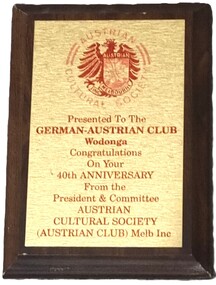
Plaque - German-Austrian Club Wodonga 40th Anniversary, 2000
... ...German migrants Wodonga...Thousands of German migrants started a new life at Bonegilla, Victoria in the 1950s. Among them were five men who met each other in Wodonga, became friends and decided to form a German Austrian Club, where they could enjoy the company of likeminded individuals. ...German Austrian Australian Club. Over recent years patronage and interest in the Club and its activities changed. Children of the original members had become “real Aussies” and did not always want to carry on traditions. Aging membership and lack of volunteers forced the Club to disband in 2025. The Club building has been gifted to the Albury Wodonga Theatre Company. This item is significant because it is representative of an important cultural organisation which operated in Wodonga for over 60 years. German Austrian Australian Club German migrants ...Thousands of German migrants started a new life at Bonegilla, Victoria in the 1950s. Among them were five men who met each other in Wodonga, became friends and decided to form a German Austrian Club, where they could enjoy the company of likeminded individuals. They were Kurt Mueller, Willi Klimt, Toni Krischa and Erwin Klein from Germany and Manfred Teissl from Austria. On the 16th July 1960, after advertising in the Border Morning Mail the German Austrian Club in Wodonga was born. Office bearers were Paul Peters as President. Gerhard Ziermann as Secretary and Günter Schmehl as Treasurer. Their aim was "To promote the upkeep of the German language in written and spoken form and to promote good German fellowship, while enjoying functions of a cultural and entertaining nature". By 1963 the Club boasted 40 members, holding meetings at the RSL Clubrooms and other suitable locations before they found a house in Hovell Street, Wodonga. It was used for meetings, Skat meetings, film nights and Sonnabendschule” or Saturday school where children of members could continue to learn German. The Committee organised a wide range of activities and functions in their small rooms but dreamed of having a bigger home. This became reality in July 1979, when the Committee purchased land from the Albury Wodonga Development Corporation at 5 McFarland Road, Wodonga. The first brick was laid on the Club's land in May 1980, and the double-story brick building was completed within 12 months voluntarily by Club members. At the same time members supported other organisations and charities in the Wodonga and wider community. The first Oktoberfest in Wodonga was held in 1975, drawing 4,000 attendees. The event was organized to promote German culture, and the profits from the first year were donated to the Wodonga District Hospital, raising $20,000. In 2001 the German Austrian Club was presented with the Certificate of Meritorious Service by the Government of Victoria for Community Works in Wodonga and district. The Club raised $23,000 for the Wodonga Hospital, had numerous fundraisers to assist in bushfires and drought situations and was involved in the Red Cross Calling campaign for many years. After much fundraising, hard work and making their way through extensive government red tape, the Club moved to its new premises in McFarland Road on 1st August 1981. The members continued to make necessary internal adjustments and sought an alcohol licence. The building was officially opened in May 1983. The Club prospered and had 300 members, making it necessary for new applicants to be put on a waiting list to be accepted as members. Interest groups formed consisted of Competition Air Rifle Shooting Group, a Skat (German Card game) Group, Folk Dancing Group, Ladies Group, Table Tennis Group, Darts Group, Chess Group and the Billiard Group. In later years, as so many Australians became members, the Club’s name was changed to the German Austrian Australian Club. Over recent years patronage and interest in the Club and its activities changed. Children of the original members had become “real Aussies” and did not always want to carry on traditions. Aging membership and lack of volunteers forced the Club to disband in 2025. The Club building has been gifted to the Albury Wodonga Theatre Company.This item is significant because it is representative of an important cultural organisation which operated in Wodonga for over 60 years.A small metal plaque on a wooden backing with red text. It includes the insignia of the Austrian Cultural Society of Melbourne.Presented To The GERMAN-AUSTRIAN CLUB Wodonga Congratulations On Your 40th ANNIVERSARY From the President & Committee AUSTRIAN CULTURAL SOCIETY (AUSTRIAN CLUB) Melb Incgerman austrian australian club, german migrants wodonga -
 Wodonga & District Historical Society Inc
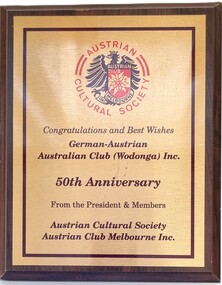
Plaque - German-Austrian Club Wodonga 50th Anniversary, 2010
... ...German migrants Wodonga...Thousands of German migrants started a new life at Bonegilla, Victoria in the 1950s. Among them were five men who met each other in Wodonga, became friends and decided to form a German Austrian Club, where they could enjoy the company of likeminded individuals. ...German Austrian Australian Club. Over recent years patronage and interest in the Club and its activities changed. Children of the original members had become “real Aussies” and did not always want to carry on traditions. Aging membership and lack of volunteers forced the Club to disband in 2025. The Club building has been gifted to the Albury Wodonga Theatre Company. This item is significant because it is representative of an important cultural organisation which operated in Wodonga for over 60 years. German Austrian Australian Club German migrants ...Thousands of German migrants started a new life at Bonegilla, Victoria in the 1950s. Among them were five men who met each other in Wodonga, became friends and decided to form a German Austrian Club, where they could enjoy the company of likeminded individuals. They were Kurt Mueller, Willi Klimt, Toni Krischa and Erwin Klein from Germany and Manfred Teissl from Austria. On the 16th July 1960, after advertising in the Border Morning Mail the German Austrian Club in Wodonga was born. Office bearers were Paul Peters as President. Gerhard Ziermann as Secretary and Günter Schmehl as Treasurer. Their aim was "To promote the upkeep of the German language in written and spoken form and to promote good German fellowship, while enjoying functions of a cultural and entertaining nature". By 1963 the Club boasted 40 members, holding meetings at the RSL Clubrooms and other suitable locations before they found a house in Hovell Street, Wodonga. It was used for meetings, Skat meetings, film nights and Sonnabendschule” or Saturday school where children of members could continue to learn German. The Committee organised a wide range of activities and functions in their small rooms but dreamed of having a bigger home. This became reality in July 1979, when the Committee purchased land from the Albury Wodonga Development Corporation at 5 McFarland Road, Wodonga. The first brick was laid on the Club's land in May 1980, and the double-story brick building was completed within 12 months voluntarily by Club members. At the same time members supported other organisations and charities in the Wodonga and wider community. The first Oktoberfest in Wodonga was held in 1975, drawing 4,000 attendees. The event was organized to promote German culture, and the profits from the first year were donated to the Wodonga District Hospital, raising $20,000. In 2001 the German Austrian Club was presented with the Certificate of Meritorious Service by the Government of Victoria for Community Works in Wodonga and district. The Club raised $23,000 for the Wodonga Hospital, had numerous fundraisers to assist in bushfires and drought situations and was involved in the Red Cross Calling campaign for many years. After much fundraising, hard work and making their way through extensive government red tape, the Club moved to its new premises in McFarland Road on 1st August 1981. The members continued to make necessary internal adjustments and sought an alcohol licence. The building was officially opened in May 1983. The Club prospered and had 300 members, making it necessary for new applicants to be put on a waiting list to be accepted as members. Interest groups formed consisted of Competition Air Rifle Shooting Group, a Skat (German Card game) Group, Folk Dancing Group, Ladies Group, Table Tennis Group, Darts Group, Chess Group and the Billiard Group. In later years, as so many Australians became members, the Club’s name was changed to the German Austrian Australian Club. Over recent years patronage and interest in the Club and its activities changed. Children of the original members had become “real Aussies” and did not always want to carry on traditions. Aging membership and lack of volunteers forced the Club to disband in 2025. The Club building has been gifted to the Albury Wodonga Theatre Company.This item is significant because it is representative of an important cultural organisation which operated in Wodonga for over 60 years.A small metal plaque on a wooden backing with red text. It includes the insignia of the Austrian Cultural Society of Melbourne.Congratulations and Best Wishes German-Austrian Australian Club (Wodonga) Inc. 50th Anniversary From the President & Members Austrian Cultural Society Austrian Club Melbourne Inc.german austrian australian club, german migrants wodonga -
 The Beechworth Burke Museum
Photograph, Between 1946 and 1961
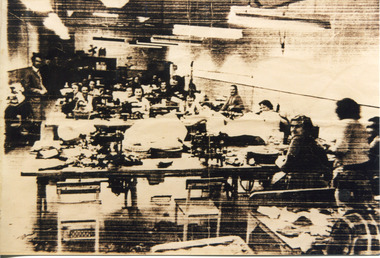
... migrants from the UK, 102 from Hungary, and 63 from Germany. The factory closed in 1961 as increased centralisation of both populations and industry in the larger nearby towns of Wangaratta and Wodonga lead to the closure of many factories in small towns in the 1960s and 1970s. ...migrants from the UK, 102 from Hungary, and 63 from Germany. The factory closed in 1961 as increased centralisation of both populations and industry in the larger nearby towns of Wangaratta and Wodonga lead to the closure of many factories in small towns in the 1960s and 1970s. ...Elgin Shoes Pty., Ltd., established a branch shoe factory in Beechworth in 1946. Managing director, Mr T Nagle Pitman, selected Beechworth as a suitable location for the factory due to the availability of labour in the town, particularly girls under sixteen years of age. At its peak, the shoe factory employed thirty six women and girls, which also included post-war migrants. After the Second World War, Australia admitted increasing numbers of immigrants in order to fulfil labour requirements for a rapidly inflating demand of consumer goods. These migrants were largely from European Countries in line with the ‘White Australia Policy’. In 1954 Beechworth had 170 migrants from the UK, 102 from Hungary, and 63 from Germany. The factory closed in 1961 as increased centralisation of both populations and industry in the larger nearby towns of Wangaratta and Wodonga lead to the closure of many factories in small towns in the 1960s and 1970s. This photograph is historically significant as it shows the working conditions in a factory primarily staffed by women at some point between the late 1940s and early 1960s. Sepia rectangular photograph printed on matte photographic paperReverse: 14 / AFGA / 6982 / pitman shoe factory, elgin shoe company, industry, shoe factory, shoemaking, working women, post-war migration, factory, white australia policy, mid-twentieth century women's working conditions, twentieth-century working conditions, pitman, elgin, shoe, sewing machine, leather, pittman -
 Wodonga & District Historical Society Inc
Book - Schlink of Prince Alfred - A Biography of Sir Herbert Schlink, Kempson Maddox, 1978
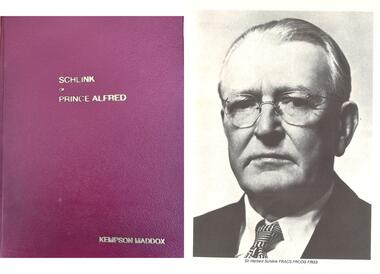
... He was born on 28 March 1883 in Wodonga, Victoria to German migrants Albert Joseph Schlink and Franziska Trudewind. ...A detailed biography of the life and achievements of Sir Herbert Schlink. He was born on 28 March 1883 in Wodonga, Victoria to German migrants Albert Joseph Schlink and Franziska Trudewind. Herbert initially enrolled in the Faculty of Arts at the University of Sydney, but after one year he transferred to medicine and graduated in 1907. This marked the beginning of a brilliant career. Herbert was appointed as Honorary Gynaecological Surgeon at Royal Prince Alfred, Sydney NSW from 1922. As a director of the hospital board from 1926, Schlink as Chairman (1934-62) supervised the opening of Gloucester House, King George V Memorial Hospital for Mothers and Babies, Queen Mary Nurses' Home, the neurosurgical and psychiatric blocks, the (Sir Earle) Page Chest Pavilion and the hospital chapel. As a gynaecologist, Herbert pioneered the use of cobalt ray therapy in treating pelvic cancer and instigated the systematic follow-up of cancer patients. In 1954, Herbert was created Knight Bachelor for his public services and his service to medicine. He had previously received the Silver Jubilee Medal from his Majesty King George V, and the Coronation Medals of 1937 and 1953.This book is bound in maroon leather with gold lettering. It includes biographical information and images. The appendix includes an extensive Curriculum Vitae containing a list of medical publications by Sir Herbert Schlink and develops made at the Royal Prince Alfred Hospital during his Chairmanship. The book has an extensive bibliographical references and an index.fictionA detailed biography of the life and achievements of Sir Herbert Schlink. He was born on 28 March 1883 in Wodonga, Victoria to German migrants Albert Joseph Schlink and Franziska Trudewind. Herbert initially enrolled in the Faculty of Arts at the University of Sydney, but after one year he transferred to medicine and graduated in 1907. This marked the beginning of a brilliant career. Herbert was appointed as Honorary Gynaecological Surgeon at Royal Prince Alfred, Sydney NSW from 1922. As a director of the hospital board from 1926, Schlink as Chairman (1934-62) supervised the opening of Gloucester House, King George V Memorial Hospital for Mothers and Babies, Queen Mary Nurses' Home, the neurosurgical and psychiatric blocks, the (Sir Earle) Page Chest Pavilion and the hospital chapel. As a gynaecologist, Herbert pioneered the use of cobalt ray therapy in treating pelvic cancer and instigated the systematic follow-up of cancer patients. In 1954, Herbert was created Knight Bachelor for his public services and his service to medicine. He had previously received the Silver Jubilee Medal from his Majesty King George V, and the Coronation Medals of 1937 and 1953.sir herbert schlink, schlink family of wodonga -
 Wodonga & District Historical Society Inc
Memorabilia - German and Austrian miniature flags, Unknown
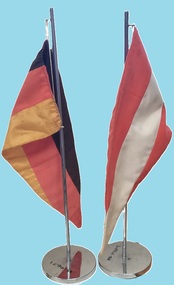
... Thousands of German migrants started a new life at Bonegilla, Victoria in the 1950s. Among them were five men who met each other in Wodonga, became friends and decided to form a German Austrian Club, where they could enjoy the company of likeminded individuals. ...Thousands of German migrants started a new life at Bonegilla, Victoria in the 1950s. Among them were five men who met each other in Wodonga, became friends and decided to form a German Austrian Club, where they could enjoy the company of likeminded individuals. ...Thousands of German migrants started a new life at Bonegilla, Victoria in the 1950s. Among them were five men who met each other in Wodonga, became friends and decided to form a German Austrian Club, where they could enjoy the company of likeminded individuals. They were Kurt Mueller, Willi Klimt, Toni Krischa and Erwin Klein from Germany and Manfred Teissl from Austria. On the 16th July 1960, after advertising in the Border Morning Mail, the German Austrian Club in Wodonga was born. Office bearers were Paul Peters as President. Gerhard Ziermann as Secretary and Günter Schmehl as Treasurer. Their aim was "To promote the upkeep of the German language in written and spoken form and to promote good German fellowship, while enjoying functions of a cultural and entertaining nature". By 1963 the Club boasted 40 members, holding meetings at the RSL Clubrooms and other suitable locations before they found a house in Hovell Street, Wodonga. It was used for meetings, Skat meetings, film nights and "Sonnabendschule” or Saturday school where children of members could continue to learn German. The Committee organised a wide range of activities and functions in their small rooms but dreamed of having a bigger home. This became reality in July 1979, when the Committee purchased land from the Albury Wodonga Development Corporation at 5 McFarland Road, Wodonga. The first brick was laid on the Club's land in May 1980, and the double-storey brick building was completed within 12 months voluntarily by Club members. At the same time members supported other organisations and charities in the Wodonga and wider community. The first Oktoberfest in Wodonga was held in 1975, drawing 4,000 attendees. The event was organized to promote German culture, and the profits from the first year were donated to the Wodonga District Hospital, raising $20,000. In 2001 the German Austrian Club was presented with the Certificate of Meritorious Service by the Government of Victoria for Community Works in Wodonga and district. The Club raised $23,000 for the Wodonga Hospital, had numerous fundraisers to assist in bushfires and drought situations and was involved in the Red Cross Calling campaign for many years. After much fundraising, hard work and making their way through extensive government red tape, the Club moved to its new premises in McFarland Road on 1st August 1981. The members continued to make necessary internal adjustments and sought an alcohol licence. The building was officially opened in May 1983. The Club prospered and had 300 members, making it necessary for new applicants to be put on a waiting list to be accepted as members. Interest groups consisted of Competition Air Rifle Shooting Group, a Skat (German Card game) Group, Folk Dancing Group, Ladies Group, Table Tennis Group, Darts Group, Chess Group and the Billiard Group. In later years, as so many Australians became members, the Club’s name was changed to the German Austrian Australian Club. Over recent years patronage and interest in the Club and its activities changed. Children of the original members had become “real Aussies” and did not always want to carry on traditions. Aging membership and lack of volunteers forced the Club to disband in 2025. The Club building has been gifted to the Albury Wodonga Theatre Company.These items are significant because they are representative of an important cultural organisation which operated in Wodonga for over 60 years.Two small flags of Germany and Austria attached to metal stands with string. Each stand has a metal circular base. "Lufthansa" is inscribed on the base.On base: Lufthansagerman austrian australian club, german austrian club -
 Wodonga & District Historical Society Inc
Photograph - Franz Gördes, Boot and Shoemaker, Wodonga
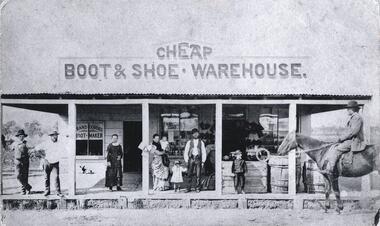
... Businesses Wodonga Franz Gördes German Migrants Above shop: Cheap / Boot & Shoe Warehouse A black and white photo which has also been digitised. ...Franz Gördes (b.1843) who immigrated to Australia from Germany in 1871. After docking in Melbourne Franz headed for the goldfields at Spring Gully near Beechworth, but didn't strike gold. He returned to his trade and opened a boot shop in Wodonga, which burnt to the ground the day before the opening. Undeterred, he rebuilt and operated the business until his death on 8 June 1928. He was survived by his widow, Margaret as well as six sons and three daughters. Franz Gordes’ Boot & Shoe Warehouse was situated in Sydney Road, now High Street, Wodonga.This item has a well documented provenance and connection to the local history of Wodonga.A black and white photo which has also been digitised. Above shop: Cheap / Boot & Shoe Warehousebusinesses wodonga, franz gördes, german migrants -
 Wodonga & District Historical Society Inc
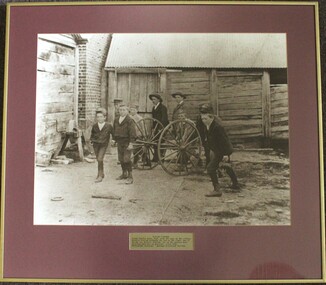
Photograph - Playing Fireman, c1900
... Herbert Schlink, on the right of the image was born on 28 March 1883 in Wodonga, Victoria to German migrants Albert Joseph Schlink and Franziska Trudewind. ...Herbert Schlink, on the right of the image was born on 28 March 1883 in Wodonga, Victoria to German migrants Albert Joseph Schlink and Franziska Trudewind. ...This photograph was taken about 1900. Herbert Schlink, on the right of the image was born on 28 March 1883 in Wodonga, Victoria to German migrants Albert Joseph Schlink and Franziska Trudewind. He initially enrolled in Faculty of Arts at the University of Sydney, but after one year he transferred to medicine and graduated in 1907. This marked the beginning of a brilliant career. He was appointed as honorary gynaecological surgeon at Royal Prince Alfred, Sydney NSW from 1922. As a director of the hospital board from 1926, Schlink as chairman (1934-62) supervised the opening of Gloucester House, King George V Memorial Hospital for Mothers and Babies, Queen Mary Nurses' Home, the neurosurgical and psychiatric blocks, the (Sir Earle) Page Chest Pavilion and the hospital chapel. As a gynaecologist, Herbert pioneered the use of cobalt ray therapy in treating pelvic cancer and instigated the systematic follow-up of cancer patients. In 1954, Herbert was created Knight Bachelor for his public services and his service to medicine. He had previously received the Silver Jubilee Medal from his Majesty King George V, and the Coronation Medals of 1937 and 1953. Outside of his medical career, Dr Schlink was an enthusiastic skier. In 1926 he made the first winter crossing from Kiandra to Kosciusko. He was a foundation member of the Kosciusko Alpine Club and was directly responsible for the building of the first chalet at Charlotte Pass. Schlink Pass near Guthega in the Snowy Mountains is also named in his honour. Charlie Ryan is the boy on the left. He was to later become the editor of the Wodonga and Towong Sentinel after the death of his father in 1912.This image is of significant as it depicts a group of local boys including a preeminent medical professional who was born in Wodonga and a newspaper editor.A framed photo of a group of boys playing with a fire cart in Wodonga.Below photograph: "PLAYING FIREMEN / Young Charlie Ryan, left, with the boys of the village./ Herbert Schlink, probably the boy on the right, was to/ become Sir Herbert Schlink, on of the nations most/ distinguished men of medicine. Circa 1900. Photograph courtesy: Wodonga Historical Society"wodonga fire fighters, sir herbert schlink, charles henry ryan -
 Wodonga & District Historical Society Inc
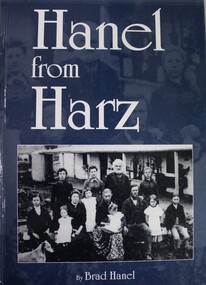
Book - HANEL FROM HARZ, Brad Hanel, 2001
... Like many German migrants, they first landed in South Australia before moving on to Victoria and southern New South Wales, including Albury, Wodonga, Culcairn, Chiltern and surrounding districts. ...A History and Family Tree of Heinrich August Hanel and his wife Henriette Julianne Sommer and their descendants 1813-1997. Like many German migrants, they first landed in South Australia before moving on to Victoria and southern New South Wales, including Albury, Wodonga, Culcairn, Chiltern and surrounding districts. This book provides a detailed history of their origins and migration to Australia as well as the achievements of their descendants in Australia.non-fictionA History and Family Tree of Heinrich August Hanel and his wife Henriette Julianne Sommer and their descendants 1813-1997. Like many German migrants, they first landed in South Australia before moving on to Victoria and southern New South Wales, including Albury, Wodonga, Culcairn, Chiltern and surrounding districts. This book provides a detailed history of their origins and migration to Australia as well as the achievements of their descendants in Australia. hanel family., harz mountains region, german migration -
 Wodonga & District Historical Society Inc
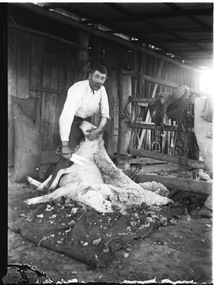
Negative - Haeusler Glass Negatives Collection - Harry Schuster blade shearing
... Wodonga community. The Haeusler family migrated from Prussia (Germany) to South Australia in the 1840s and 1850s, before purchasing 100 acres of Crown Land made available under the Victorian Lands Act 1862 (also known as ‘Duffy’s Land Act’) in 1866 in what is now Wodonga West. The Haeusler family were one of several German families to migrate from South Australia to Wodonga in the 1860s. The Schuster family were also of German migrant...Wodonga community. The Haeusler family migrated from Prussia (Germany) to South Australia in the 1840s and 1850s, before purchasing 100 acres of Crown Land made available under the Victorian Lands Act 1862 (also known as ‘Duffy’s Land Act’) in 1866 in what is now Wodonga West. The Haeusler family were one of several German families to migrate from South Australia to Wodonga in the 1860s. The Schuster family were also of German migrant ...The Wodonga Historical Society Haeusler Collection provides invaluable insight into life in late nineteenth and early twentieth century north east Victoria. The collection comprises manuscripts, personal artefacts used by the Haeusler family on their farm in Wodonga, and a set of glass negatives which offer a unique visual snapshot of the domestic and social lives of the Haeusler family and local Wodonga community. The Haeusler family migrated from Prussia (Germany) to South Australia in the 1840s and 1850s, before purchasing 100 acres of Crown Land made available under the Victorian Lands Act 1862 (also known as ‘Duffy’s Land Act’) in 1866 in what is now Wodonga West. The Haeusler family were one of several German families to migrate from South Australia to Wodonga in the 1860s. The Schuster family were also of German migrant background. Johannes Edward Schuster was born in Hoyles Plains, South Australia and with his wife Johanna and young family moved to Victoria circa 1882. He took up farming land in Wodonga West. The St John’s Lutheran Church Sunday school hall was erected from part of the proceeds of the sale of some 41 acres of land at Wodonga West, which had been bequeathed to the Wodonga congregation by the late Johannes Edward Schuster. This land was the original home site of the Schuster family on arrival from South Australia. Shearing - Although the first mechanised sheep shearing machine was created by James Higham, from Melbourne in 1868, the use of blade shears were more common well into the early 20th century. Pastoralists on smaller holdings continued to either shear their own sheep or employ blade shearers rather than outlay the cost of machines. In large sheds, professional shearers worked as they travelled the country. They would earn around 17 to 20 shillings per day in the early days of the wool industry. However mechanisation continued and by 1915 most sheep shearing sheds in Australia contained sheep shearing machines. The original machines were powered by steam and later combustion engines were used. This digital image was produced from one of the glass negatives that form part of the collection, probably taken by Louis Haeusler (b.1887) with the photographic equipment in the Wodonga Historical Society Haeusler Collection.This item is unique and has well documented provenance and a known owner. It forms part of a significant and representative historical collection which reflects the local history of Wodonga. It contributes to our understanding of domestic and family life in early twentieth century Wodonga, as well as providing interpretative capacity for themes including local history and social history.Digital image created from the Haeusler Glass negative collection. Harry Schuster shearing sheep using blade shears. wodonga pioneers, haeusler family, glass negatives, dry plate photography, blade shearing, schuster family -
 Wodonga & District Historical Society Inc
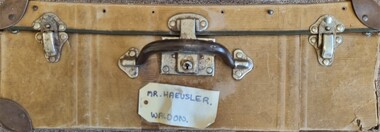
Functional object - Alf Haeusler's Suitcase, Everwear Brand, c1920
... German families to migrate from South Australia to Wodonga in the 1860s. John Alfred Lyell "Alf" Haeusler was born on 3rd February 1922 in Wodonga, and was the only child of Louis and Ilma Haeusler. Ilma Haeusler passed away in child birth when Alf was only six years old and he was raised by his father Louis with support from extended family. Alf never married and bequeathed the items in the Haeusler Collection to Wodonga & District Historical Society. This suitcase is part of the Haeusler Collection which documents the life of a German migrant ...The Haeusler Collection consisting of manuscripts, personal artefacts used by the Haeusler family and a set of glass negatives was bequeathed to the Wodonga & District Historical Society. It offers a unique visual snapshot of the domestic and social lives of the Haeusler family and local Wodonga community in the early 20th century. The Haeusler family migrated from Prussia (Germany) to South Australia in the 1840s and 1850s, before purchasing 100 acres of Crown Land made available under the Victorian Lands Act 1862 (also known as ‘Duffy’s Land Act’) in 1866 in what is now Wodonga West. The Haeusler family were one of several German families to migrate from South Australia to Wodonga in the 1860s. John Alfred Lyell "Alf" Haeusler was born on 3rd February 1922 in Wodonga, and was the only child of Louis and Ilma Haeusler. Ilma Haeusler passed away in child birth when Alf was only six years old and he was raised by his father Louis with support from extended family. Alf never married and bequeathed the items in the Haeusler Collection to Wodonga & District Historical Society.This suitcase is part of the Haeusler Collection which documents the life of a German migrant family in Wodonga from the mid 1860s.A small brown suitcase with metal reinforcement on the corners. It has metal clasps and a barrel key lock in the centre of front.Everwear Brand REGD on one sidesuitcase, wodonga, alf haeusler -
 Wodonga & District Historical Society Inc
Memorabilia - Wodonga Oktoberfest Stein, c1979
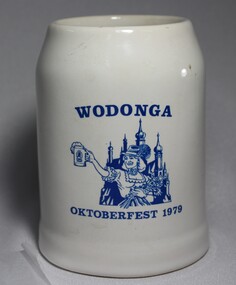
... Wodonga, the foundation stone being laid in 1874. By the 1890s to the early 1900s many other Germany names were added to the local community including Muller, Lange, Pumpa, Greschke, Lobbe, Posselt, Kreuger, Schuster, Pertzel, Star, Draper, Mueller, Semmler, Thiele, Terlich, Wegener, Schreiber and Draper. Germans continued to arrive in the area until 1914. In the great post-war migration that started through Bonegilla in December 1947, Germans were among the tens of thousands who arrived. Most of the migrants...Wodonga, the foundation stone being laid in 1874. By the 1890s to the early 1900s many other Germany names were added to the local community including Muller, Lange, Pumpa, Greschke, Lobbe, Posselt, Kreuger, Schuster, Pertzel, Star, Draper, Mueller, Semmler, Thiele, Terlich, Wegener, Schreiber and Draper. Germans continued to arrive in the area until 1914. In the great post-war migration that started through Bonegilla in December 1947, Germans were among the tens of thousands who arrived. Most of the migrants ...Several German families arrived in Wodonga, usually via South Australia, in the late 1850 and 1860s. Some of the earliest settlers to arrive were the Haeusler, Schlink, Trudewind, Pfeiffer and Klinge families. Many of them had left from Prussia and Bavaria to escape religious persecution. They all became actively involved in the community and made outstanding and lasting contributions to the development of the town. In the years 1868-69 more settlers arrived from South Australia and other parts of Victoria. Among the names were Heckendorf, Mueller, Zeinert and Schubert. These families were instrumental in lobbying for the establishment of the St. John's Lutheran Church in Wodonga, the foundation stone being laid in 1874. By the 1890s to the early 1900s many other Germany names were added to the local community including Muller, Lange, Pumpa, Greschke, Lobbe, Posselt, Kreuger, Schuster, Pertzel, Star, Draper, Mueller, Semmler, Thiele, Terlich, Wegener, Schreiber and Draper. Germans continued to arrive in the area until 1914. In the great post-war migration that started through Bonegilla in December 1947, Germans were among the tens of thousands who arrived. Most of the migrants who settled in Wodonga at this time were born in Germany. According to the 2016 Census, Wodonga still has a larger percentage of people with German ancestry than most other rural communities in Victoria. The German Austrian Australian Club, Wodonga was originally formed in 1960 by immigrants to Australia, to provide a meeting place for refugees and immigrants from Europe. Oktoberfest has become a world-wide occasion for all people to share in the celebration of Bavarian traditions. The Wodonga Hospital approached the Club and asked for their involvement in holding an Oktoberfest to raise funds for the Hospital. These Fests took 11 months to organize and ended up raising over $27,000.00 for the Hospital. A large number of families of German origin have arrived in the Wodonga area from as early as the 1850s. They have made valuable and lasting contributions to the area in a range of fields including agriculture, local government, businesses, retail and medical services. Their contributions are recognised in several street names in Wodonga. A white china beer stein bearing the blue logo of the Wodonga 1979 Oktoberfest. Logo includes an image of a woman in German national costume.Above the image "WODONGA" Underneath the image "OKTOBERFEST 1979"wodonga, oktoberfest, german immigrants -
 Wodonga & District Historical Society Inc
Book - DREAMS & MEMORIES : FIFTY YEARS IN LIFE OF GERMAN AUSTRIAN AUSTRALIAN CLUB (WODONGA) INC. 1960-2010, Doina Eitler, 2010
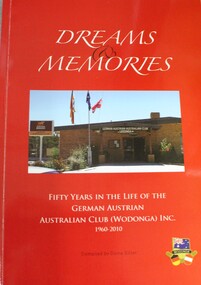
... German Austrian Australian Club Wodonga clubs German immigration A history of The German Austrian Club which was founded on the 16th July 1960. Migrants ...A history of The German Austrian Club which was founded on the 16th July 1960. Migrants from Germany and Austria arrived in Bonegilla during the 50s and 60s and many were lonely and homesick. The Club became a meeting place for these people. This book follows the evolution of the club as a recognised social venue and contributor to the Wodonga community.non-fictionA history of The German Austrian Club which was founded on the 16th July 1960. Migrants from Germany and Austria arrived in Bonegilla during the 50s and 60s and many were lonely and homesick. The Club became a meeting place for these people. This book follows the evolution of the club as a recognised social venue and contributor to the Wodonga community.german austrian australian club, wodonga clubs, german immigration
