
Showing 5 items matching "germany - armed forces - history"
-
 Monbulk RSL Sub Branch
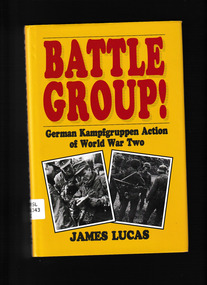
Book, Frontline Books, Battle Group : German Kamfgruppen Action in World War Two, 2014
... germany - armed forces - history...germany - armed forces - history germany - regimental histories The German army in the Second World War sought to fight and win swift, decisive victories in a succession of short campaigns - blitzkrieg, or lightning war. ...The German army in the Second World War sought to fight and win swift, decisive victories in a succession of short campaigns - blitzkrieg, or lightning war. Flexibility was as essential as the will to win. Battle groups, or shock troops, were created from miscellaneous, and often disparate military units to undertake a specific local operation; it was the army's skill in combining superior numbers, aggressive tactics and the battle group commander's ability to exploit the changing situation on the ground which brought success on the battlefield. The actions described here cover all theatres of the war, and include battle groups large and small, deployed usually to smash a breach in the enemy line or seal off an enemy penetration. It covers operations in the first dynamic years when Wehrmacht forces defeated the armies of one European country after another in fast campaigns, through to the years after Stalingrad and Africa as they moved towards defeat. The battle groups' contribution to Wehrmacht fortunes offer powerful lessons in the tactics of battle management and this book by James Lucas, a military historian known for his close studies of the German soldier, is considered to be one of the most detailed and authoritative accounts on the subject. Collapse summaryIndex, bibliography, maps, ill, p.173.non-fictionThe German army in the Second World War sought to fight and win swift, decisive victories in a succession of short campaigns - blitzkrieg, or lightning war. Flexibility was as essential as the will to win. Battle groups, or shock troops, were created from miscellaneous, and often disparate military units to undertake a specific local operation; it was the army's skill in combining superior numbers, aggressive tactics and the battle group commander's ability to exploit the changing situation on the ground which brought success on the battlefield. The actions described here cover all theatres of the war, and include battle groups large and small, deployed usually to smash a breach in the enemy line or seal off an enemy penetration. It covers operations in the first dynamic years when Wehrmacht forces defeated the armies of one European country after another in fast campaigns, through to the years after Stalingrad and Africa as they moved towards defeat. The battle groups' contribution to Wehrmacht fortunes offer powerful lessons in the tactics of battle management and this book by James Lucas, a military historian known for his close studies of the German soldier, is considered to be one of the most detailed and authoritative accounts on the subject. Collapse summary germany - armed forces - history, germany - regimental histories -
 Monbulk RSL Sub Branch
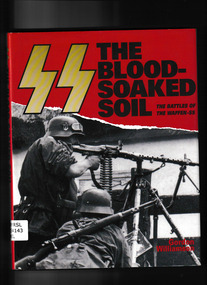
Book, Brown, SS : the blood-soaked soil : the battles of the Waffen-SS, 1995
... history...world war 1939-1945 - armed forces - germany...waffen ss - history world war 1939-1945 - armed forces - germany The battles of the Waffen-SS in various theatres are described in detail. ...The battles of the Waffen-SS in various theatres are described in detail.Index, bibliography,ill, maps, p.192.non-fictionThe battles of the Waffen-SS in various theatres are described in detail.waffen ss - history, world war 1939-1945 - armed forces - germany -
 Monbulk RSL Sub Branch
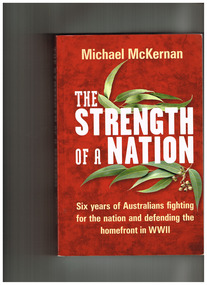
Book, Allan and Unwin, The strength of a nation: Six years of Australians fighting for the nation and defending the homefront in WWII, 2008
... history of Australia in World War Two Australia - Politics and government - 1939-1945 Nearly one million Australians out of a total population of just seven million people joined the armed forces in World War II. They made an enormous contribution to the allied war effort; they inflicted the first land defeat of the Japanese at Milne Bay in New Guinea during that war and played a crucial part in the Battle of El Alamein in North Africa, the first defeat on land of the Germans. ...Nearly one million Australians out of a total population of just seven million people joined the armed forces in World War II. They made an enormous contribution to the allied war effort; they inflicted the first land defeat of the Japanese at Milne Bay in New Guinea during that war and played a crucial part in the Battle of El Alamein in North Africa, the first defeat on land of the Germans. These victories in battle were only made possible by their support from home. Still recovering from the First World War and the Great Depression the Australian population rallied to make these achievements possible. This is the story of Australia and Australians at war at home and abroad in the six years, 1939 to 1945Index, ill, p.485.Nearly one million Australians out of a total population of just seven million people joined the armed forces in World War II. They made an enormous contribution to the allied war effort; they inflicted the first land defeat of the Japanese at Milne Bay in New Guinea during that war and played a crucial part in the Battle of El Alamein in North Africa, the first defeat on land of the Germans. These victories in battle were only made possible by their support from home. Still recovering from the First World War and the Great Depression the Australian population rallied to make these achievements possible. This is the story of Australia and Australians at war at home and abroad in the six years, 1939 to 1945military history of australia in world war two, australia - politics and government - 1939-1945 -
 Mrs Aeneas Gunn Memorial Library
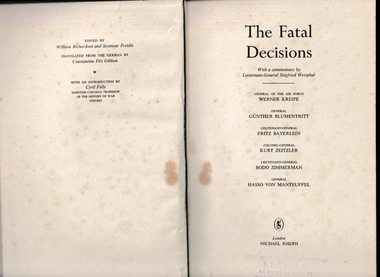
Book, Michael Joseph, The fatal decisions, 1956
... World War 1939-1945 - Campaigns - Germany Germany - History - Military Analysis of six decisive battles fought by the German armed forces in World War Two as described by the generals involved. ...Analysis of six decisive battles fought by the German armed forces in World War Two as described by the generals involved.Index, ill, maps, p.261.non-fictionAnalysis of six decisive battles fought by the German armed forces in World War Two as described by the generals involved.world war 1939-1945 - campaigns - germany, germany - history - military -
 Returned Nurses RSL Sub-branch
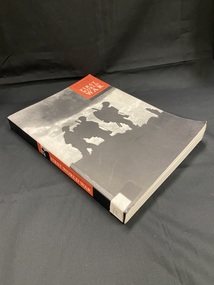
Book - Illustrated paperback book, Oxford University Press, The Oxford illustrated history of the First World War, 1998
... Australian Armed Forces WW1 WWI World War One World War 1914-1918 military history The First World War, now a century ago, still shapes the world in which we live, and its legacy lives on, in poetry, in prose, in collective memory and political culture. By the time the war ended in 1918, millions lay dead. Three major empires lay shattered by defeat, those of Germany ...The First World War, now a century ago, still shapes the world in which we live, and its legacy lives on, in poetry, in prose, in collective memory and political culture. By the time the war ended in 1918, millions lay dead. Three major empires lay shattered by defeat, those of Germany, Austria-Hungary, and the Ottomans. A fourth, Russia, was in the throes of a revolution that helped define the rest of the twentieth century. The Oxford History of the First World War brings together in one volume many of the most distinguished historians of the conflict, in an account that matches the scale of the events. From its causes to its consequences, from the Western Front to the Eastern, from the strategy of the politicians to the tactics of the generals, they chart the course of the war and assess its profound political and human consequences. Chapters on economic mobilization, the impact on women, the role of propaganda, and the rise of socialism establish the wider context of the fighting at sea and in the air, and which ranged on land from the trenches of Flanders to the mountains of the Balkans and the deserts of the Middle East. First published for the 90th anniversary of the 1918 Armistice, this highly illustrated revised edition contains significant new material to mark the 100th anniversary of the war’s outbreak. [taken from Trove record]Paperback cover with black spine. The spine contains a red panel with title details and a silhouette of a soldier. The front cover is a black and white image of the silhouettes of three soldiers, there is a red panel in the top right corner showing the title and author. At the base of the spine is a white label.non-fiction The First World War, now a century ago, still shapes the world in which we live, and its legacy lives on, in poetry, in prose, in collective memory and political culture. By the time the war ended in 1918, millions lay dead. Three major empires lay shattered by defeat, those of Germany, Austria-Hungary, and the Ottomans. A fourth, Russia, was in the throes of a revolution that helped define the rest of the twentieth century. The Oxford History of the First World War brings together in one volume many of the most distinguished historians of the conflict, in an account that matches the scale of the events. From its causes to its consequences, from the Western Front to the Eastern, from the strategy of the politicians to the tactics of the generals, they chart the course of the war and assess its profound political and human consequences. Chapters on economic mobilization, the impact on women, the role of propaganda, and the rise of socialism establish the wider context of the fighting at sea and in the air, and which ranged on land from the trenches of Flanders to the mountains of the Balkans and the deserts of the Middle East. First published for the 90th anniversary of the 1918 Armistice, this highly illustrated revised edition contains significant new material to mark the 100th anniversary of the war’s outbreak. [taken from Trove record]australian armed forces, ww1, wwi, world war one, world war 1914-1918, military history
