
Showing 200 items matching "ginger"
-
 Dandenong & District Historical Society
Document - Ginger Jones Cafe, Articles Concerning Ginger Jones Cafe
... Articles Concerning Ginger Jones Cafe...Ginger Jones Cafe, Newspaper Article, History...Articles concerning Ginger Jones Cafe...Ginger Jones Cafe, Newspaper Article, History Articles concerning Ginger Jones Cafe Articles Concerning Ginger Jones Cafe Document Ginger Jones Cafe ...Ginger Jones Cafe, Newspaper Article, History -
Whitehorse Historical Society Inc.
Document, Ginger Ralph, 1/03/2006 12:00:00 AM
... Ginger Ralph......Ginger...Interview with Ginger Ralph, who migrated to Australia from South Africa in 1962. ...Tape at NP3467 Ralph Ginger Emigration Oral History Migration Program Interview with Ginger Ralph, who migrated to Australia from South Africa in 1962. ...Interview with Ginger Ralph, who migrated to Australia from South Africa in 1962.Interview with Ginger Ralph, who migrated to Australia from South Africa in 1962. Interviewed by Fred Smith 16 March 2006. Tape at NP3467Interview with Ginger Ralph, who migrated to Australia from South Africa in 1962. ralph, ginger, emigration, oral history migration program -
 Federation University Historical Collection
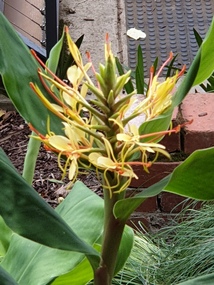
Photograph, Clare Gervasoni, Ginger in the Ballarat School of Mines Gardens, 23/04/2020
... Ginger in the Ballarat School of Mines Gardens......ginger...Colour photograph of ginger in the botanical garden sat the back of the Ballarat School of Mines Administration Building....Ginger in the Ballarat School of Mines Gardens Photograph Australia Victoria Ballarat Clare Gervasoni ...The Ballarat School of Mines Botanical Gardens were established in 1879, and are situated at the rear of the current administration building. The gardens enabled the students to sit for examinations for registration by the Pharmacy Board of Victoria. An important aspect of this course was the study of Materia Medica, or botanical materials used for medicinal purposes.Colour photograph of ginger in the botanical garden sat the back of the Ballarat School of Mines Administration Building.smb botanical gardens, botanical gardens, smb, ballarat school of mines, school of mines ballarat, ballarat, photograph, ginger -
 Federation University Historical Collection
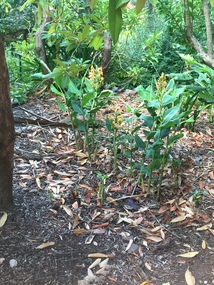
Photograph, Clare Gervasoni, Ginger in the Ballarat School of Mines Gardens, 26/03/2017
... Ginger in the Ballarat School of Mines Gardens......ginger...Colour photograph of ginger in the botanical garden sat the back of the Ballarat School of Mines Administration Building....Ginger in the Ballarat School of Mines Gardens Photograph Australia Victoria Ballarat Clare Gervasoni ...The Ballarat School of Mines Botanical Gardens were established in 1879, and are situated at the rear of the current administration building. The gardens enabled the students to sit for examinations for registration by the Pharmacy Board of Victoria. An important aspect of this course was the study of Materia Medica, or botanical materials used for medicinal purposes.Colour photograph of ginger in the botanical garden sat the back of the Ballarat School of Mines Administration Building.smb botanical gardens, botanical gardens, smb, ballarat school of mines, school of mines ballarat, ballarat, photograph, ginger -
Clunes Museum
Container - BOTTLE, THE BENDIGO POTTERY, CIRCA 1850
... STONEWARE GINGER BEER CONTAINER FOR COLAC AERATED WATER CO....STONEWARE GINGER BEER BOTTLE ...COLAC AERRATED WATER CO. GEO. HAY'S GINGER BEER PHONE 85 - THE BENDIGO POTTERY EPSO BENDIGO...STONEWARE GINGER BEER CONTAINER FOR COLAC AERATED WATER CO. ...STONEWARE GINGER BEER CONTAINER FOR COLAC AERATED WATER CO.STONEWARE GINGER BEER BOTTLE COLAC AERRATED WATER CO. GEO. HAY'S GINGER BEER PHONE 85 - THE BENDIGO POTTERY EPSO BENDIGOlocal history, domestic item, containers, eberhard -
 Flagstaff Hill Maritime Museum and Village
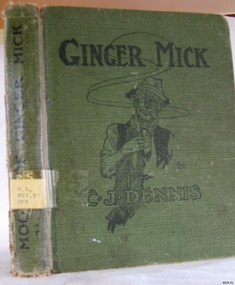
Book, The Moods of Ginger Mick
... The Moods of Ginger Mick...The Moods of Ginger Mick Author: C J Dennis Publisher: Angus & Robertson Date: 1916...The Warrnambool Mechanics' Institute Library book collection is deemed to be of great importance because it is one of the few collections in an almost intact state, and many of the books are now very rare and of great value. warrnambool shipwrecked-coast flagstaff-hill flagstaff-hill-maritime-museum maritime-museum shipwreck-coast flagstaff-hill-maritime-village shipwrecked-artefact great ocean road book warrnambool library warrnambool mechanics’ institute mechanics’ institute library victorian library board warrnambool books and records warrnambool children’s library warrnambool public library The Moods of Ginger Mick C J Dennis Label on spine cover with typed text RA 821.91 DEN Pastedown front endpaper has sticker from Warrnambool Mechanics Institute and Free Library Front loose endpaper has a stamp from Warrnambool Mechanics Institute The Moods of Ginger Mick Author: C J Dennis Publisher: Angus & Robertson Date: 1916 The Moods of Ginger Mick Book ...WARRNAMBOOL'S MECHANICS' INSTITUTE Warrnambool's Mechanics' Institute (or Institution as it was sometimes called) was one of the earliest in Victoria. On 17th October 1853 a meeting was held where it was resolved to request the Lieutenant Governor of the Colony to grant land for the erection of a Mechanics' Institutes building. A committee was formed at the meeting and Richard Osburne chaired the first meeting of this committee. The land on the North West corner of Banyan and Merri Streets was granted but there were no funds to erect the building. The Formal Rights of the Warrnambool Mechanics' Institute's encompassed its aims and these were officially adopted in1859; "This Institution has for its object the diffusion of literary, scientific, and other useful knowledge amongst its members, excluding all controversial subjects, religious or political. These objects are sought to be obtained by means of a circulating library, a reading room, the establishment of classes, debates, and the occasional delivery of lectures on natural and experimental philosophy, mechanics, astronomy, chemistry, natural history, literature, and the useful and ornamental arts, particularly those which have a more immediate reference to the colony." The Warrnambool Mechanics' Institute opened its first reading room in November1884 in the National School building at the corner of Banyan and Timor Streets. The Institute was funded by member subscription, payable on a quarterly, half yearly or yearly basis. Samuel Hannaford, the Manager of the Warrnambool Bank of Australasia, was the first Honorary Secretary of the Mechanics' Institutes, and an early President and Vice-President. He also gave several of the early lectures in the Reading Room. Another early Secretary, Librarian and lecturer was Marmaduke Fisher, the teacher at the National School. Lecture topics included The Poets and Poetry of Ireland', 'The Birth and Development of the Earth', 'The Vertebrae - with Remarks on the pleasures resulting from the study of Natural History' and 'Architecture'. In 1856 the Reading Room was moved to James Hider's shop in Timor Street, and by 1864 it was located in the bookshop of Davies and Read. In the 1860's the Mechanics' Institute struggled as membership waned but in 1866, after a series of fund raising efforts, the committee was able to purchase land in Liebig Street, on a site then called Market Square, between the weighbridge and the fire station. A Mechanics' Institute building was opened at this site in August 1871. The following year four more rooms were added to the main Reading Room and in 1873 the Artisan School of Design was incorporated into the Institute. The same year Joseph Archibald established a Museum; however it deteriorated when he was transferred to Bendigo in 1877. In 1880, with Archibald's return to Warrnambool, the Museum was re-established, and in 1885 a new building was built at the back of the Institute to accommodate the re-created School of Design, the Art Gallery and the Museum. In 1887 the Museum section was moved to the former court house in Timor Street (for some time the walls of the building formed part of the TAFE cafeteria but all is now demolished)). In 1911 the Museum was transferred back to the original building and the management of the Mechanics' Institute was handed over to the Warrnambool City Council. The Museum and Art Gallery became one and housed many fine works of art, and the Library continued to grow. The building was well patronised, with records showing that at the beginning of the 20th century there were between 500 and 800 visitors. During World War One the monthly figures were in the thousands, with 3,400 people visiting in January 1915. The Museum was a much loved Institution in Warrnambool until the contents of the Museum and Art Gallery were removed to make room for the Warrnambool City Council Engineers' Department. The contents were stored but many of the items were scattered or lost. When the original building was demolished the site became occupied by the Civic Centre, which included the new City Library. (The library was temporarily located in the old Palais building in Koroit Street.) In the process of reorganisation the Collection was distributed amongst the community groups: -The new City Library took some of the historic books and some important documents, historic photographs and newspapers. -The Art Gallery kept the 19th Century art collection and some of the artefacts from the museum. -The Historic Society has some items -The State Museum has some items -Some items were destroyed -Flagstaff Hill Maritime Village has old newspapers, Government Gazettes, most of the Mechanics' Institute Library, ledgers and documents connected to the Mechanics' Institute Library, some framed and unframed art works and some photographs. The Warrnambool Mechanics' Institute Library book collection is deemed to be of great importance because it is one of the few collections in an almost intact state, and many of the books are now very rare and of great value. The Moods of Ginger Mick Author: C J Dennis Publisher: Angus & Robertson Date: 1916Label on spine cover with typed text RA 821.91 DEN Pastedown front endpaper has sticker from Warrnambool Mechanics Institute and Free Library Front loose endpaper has a stamp from Warrnambool Mechanics Institute warrnambool, shipwrecked-coast, flagstaff-hill, flagstaff-hill-maritime-museum, maritime-museum, shipwreck-coast, flagstaff-hill-maritime-village, shipwrecked-artefact, great ocean road, book, warrnambool library, warrnambool mechanics’ institute, mechanics’ institute library, victorian library board, warrnambool books and records, warrnambool children’s library, warrnambool public library, the moods of ginger mick, c j dennis -
 Flagstaff Hill Maritime Museum and Village
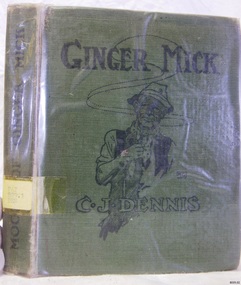
Book, The Moods of Ginger Mick
... The Moods of Ginger Mick...The Moods of Ginger Mick Author: C J Dennis Publisher: Angus & Robertson Date: 1916...The Warrnambool Mechanics' Institute’s publication collection is of both local and state significance. warrnambool shipwrecked-coast flagstaff-hill flagstaff-hill-maritime-museum maritime-museum shipwreck-coast flagstaff-hill-maritime-village shipwrecked-artefact book pattison collection warrnambool library warrnambool mechanics’ institute ralph eric pattison corangamite regional library service warrnambool city librarian mechanics’ institute library victorian library board warrnambool books and records warrnambool children’s library great ocean road The Moods of Ginger Mick C J Dennis Label on spine cover with typed text PAT 899.1 DEN Pastedown front endpaper has sticker from Warrnambool Mechanics Institute and Free Library covered by a sticker from Corangamite Regional Library Service Front loose endpaper has a stamp from Corangamite Regional Library Service The Moods of Ginger Mick Author: C J Dennis Publisher: Angus & Robertson Date: 1916 The Moods of Ginger Mick Book Book ...This item is from the ‘Pattison Collection’, a collection of books and records that was originally owned by the Warrnambool Mechanics’ Institute, which was founded in Warrnambool in 1853. By 1886 the Warrnambool Mechanics’ Institute (WMI) had grown to have a Library, Museum and Fine Arts Gallery, with a collection of “… choice productions of art, and valuable specimens in almost every branch and many wonderful national curiosities are now to be seen there, including historic relics of the town and district.” It later included a School of Design. Although it was very well patronised, the lack of financial support led the WMI in 1911 to ask the City Council to take it over. In 1935 Ralph Pattison was appointed as City Librarian to establish and organise the Warrnambool Library as it was then called. When the WMI building was pulled down in 1963 a new civic building was erected on the site and the new Warrnambool Library, on behalf of the City Council, took over all the holdings of the WMI. At this time some of the items were separated and identified as the ‘Pattison Collection’, named after Ralph Pattison. Eventually the components of the WMI were distributed from the Warrnambool Library to various places, including the Art Gallery, Historical Society and Flagstaff Hill. Later some were even distributed to other regional branches of Corangamite Regional Library and passed to and fro. It is difficult now to trace just where all of the items have ended up. The books at Flagstaff Hill Maritime Village generally display stamps and markings from Pattison as well as a variety of other institutions including the Mechanics’ Institute itself. RALPH ERIC PATTISON Ralph Eric Pattison was born in Rockhampton, Queensland, in 1891. He married Maude Swan from Warrnambool in 1920 and they set up home in Warrnambool. In 1935 Pattison accepted a position as City Librarian for the Warrnambool City Council. His huge challenge was to make a functional library within two rooms of the Mechanics’ Institute. He tirelessly cleaned, cleared and sorted a disarrayed collection of old books, jars of preserved specimens and other items reserved for exhibition in the city’s museum. He developed and updated the library with a wide variety of books for all tastes, including reference books for students; a difficult task to fulfil during the years following the Depression. He converted all of the lower area of the building into a library, reference room and reading room for members and the public. The books were sorted and stored using a cataloguing and card index system that he had developed himself. He also prepared the upper floor of the building and established the Art Gallery and later the Museum, a place to exhibit the many old relics that had been stored for years for this purpose. One of the treasures he found was a beautiful ancient clock, which he repaired, restored and enjoyed using in his office during the years of his service there. Ralph Pattison was described as “a meticulous gentleman whose punctuality, floorless courtesy and distinctive neat dress were hallmarks of his character, and ‘his’ clock controlled his daily routine, and his opening and closing of the library’s large heavy doors to the minute.” Pattison took leave during 1942 to 1945 to serve in the Royal Australian Navy, Volunteer Reserve as Lieutenant. A few years later he converted one of the Museum’s rooms into a Children’s Library, stocking it with suitable books for the younger generation. This was an instant success. In the 1950’s he had the honour of being appointed to the Victorian Library Board and received more inspiration from the monthly conferences in Melbourne. He was sadly retired in 1959 after over 23 years of service, due to the fact that he had gone over the working age of council officers. However he continued to take a very keen interest in the continual development of the Library until his death in 1969. WARRNAMBOOL'S MECHANICS' INSTITUTE Warrnambool's Mechanics' Institute (or Institution as it was sometimes called) was one of the earliest in Victoria. On 17th October 1853 a meeting was held where it was resolved to request the Lieutenant Governor of the Colony to grant land for the erection of a Mechanics' Institutes building. A committee was formed at the meeting and Richard Osburne chaired the first meeting of this committee. The land on the North West corner of Banyan and Merri Streets was granted but there were no funds to erect the building. The Formal Rights of the Warrnambool Mechanics' Institute's encompassed its aims and these were officially adopted in1859; "This Institution has for its object the diffusion of literary, scientific, and other useful knowledge amongst its members, excluding all controversial subjects, religious or political. These objects are sought to be obtained by means of a circulating library, a reading room, the establishment of classes, debates, and the occasional delivery of lectures on natural and experimental philosophy, mechanics, astronomy, chemistry, natural history, literature, and the useful and ornamental arts, particularly those which have a more immediate reference to the colony." The Warrnambool Mechanics' Institute opened its first reading room in November1884 in the National School building at the corner of Banyan and Timor Streets. The Institute was funded by member subscription, payable on a quarterly, half yearly or yearly basis. Samuel Hannaford, the Manager of the Warrnambool Bank of Australasia, was the first Honorary Secretary of the Mechanics' Institutes, and an early President and Vice-President. He also gave several of the early lectures in the Reading Room. Another early Secretary, Librarian and lecturer was Marmaduke Fisher, the teacher at the National School. Lecture topics included The Poets and Poetry of Ireland', 'The Birth and Development of the Earth', 'The Vertebrae - with Remarks on the pleasures resulting from the study of Natural History' and 'Architecture'. In 1856 the Reading Room was moved to James Hider's shop in Timor Street, and by 1864 it was located in the bookshop of Davies and Read. In the 1860's the Mechanics' Institute struggled as membership waned but in 1866, after a series of fund raising efforts, the committee was able to purchase land in Liebig Street, on a site then called Market Square, between the weighbridge and the fire station. A Mechanics' Institute building was opened at this site in August 1871. The following year four more rooms were added to the main Reading Room and in 1873 the Artisan School of Design was incorporated into the Institute. The same year Joseph Archibald established a Museum; however it deteriorated when he was transferred to Bendigo in 1877. In 1880, with Archibald's return to Warrnambool, the Museum was re-established, and in 1885 a new building was built at the back of the Institute to accommodate the re-created School of Design, the Art Gallery and the Museum. In 1887 the Museum section was moved to the former court house in Timor Street (for some time the walls of the building formed part of the TAFE cafeteria but all is now demolished)). In 1911 the Museum was transferred back to the original building and the management of the Mechanics' Institute was handed over to the Warrnambool City Council. The Museum and Art Gallery became one and housed many fine works of art, and the Library continued to grow. The building was well patronised, with records showing that at the beginning of the 20th century there were between 500 and 800 visitors. During World War One the monthly figures were in the thousands, with 3,400 people visiting in January 1915. The Museum was a much loved Institution in Warrnambool until the contents of the Museum and Art Gallery were removed to make room for the Warrnambool City Council Engineers' Department. The contents were stored but many of the items were scattered or lost. When the original building was demolished the site became occupied by the Civic Centre, which included the new City Library. (The library was temporarily located in the old Palais building in Koroit Street.) In the process of reorganisation the Collection was distributed amongst the community groups: -The new City Library took some of the historic books and some important documents, historic photographs and newspapers. -The Art Gallery kept the 19th Century art collection and some of the artefacts from the museum. -The Historic Society has some items -The State Museum has some items -Some items were destroyed -Flagstaff Hill Maritime Village has old newspapers, Government Gazettes, most of the Mechanics' Institute Library, ledgers and documents connected to the Mechanics' Institute Library, some framed and unframed art works and some photographs. The Warrnambool Mechanics' Institute Library book collection is deemed to be of great importance because it is one of the few collections in an almost intact state, and many of the books are now very rare and of great value. The Pattison Collection, along with other items at Flagstaff Hill Maritime Village, was originally part of the Warrnambool Mechanics' Institute’s collection. The Warrnambool Mechanics’ Institute Collection is primarily significant in its totality, rather than for the individual objects it contains. Its contents are highly representative of the development of Mechanics' Institute libraries across Australia, particularly Victoria. A diversity of publications and themes has been amassed, and these provide clues to our understanding of the nature of and changes in the reading habits of Victorians from the 1850s to the middle of the 20th century. The collection also highlights the Warrnambool community’s commitment to the Mechanics’ Institute, reading, literacy and learning in the regions, and proves that access to knowledge was not impeded by distance. These items help to provide a more complete picture of our community’s ideals and aspirations. The Warrnambool Mechanics Institute book collection has historical and social significance for its strong association with the Mechanics Institute movement and the important role it played in the intellectual, cultural and social development of people throughout the latter part of the nineteenth century and the early twentieth century. The collection of books is a rare example of an early lending library and its significance is enhanced by the survival of an original collection of many volumes. The Warrnambool Mechanics' Institute’s publication collection is of both local and state significance. The Moods of Ginger Mick Author: C J Dennis Publisher: Angus & Robertson Date: 1916Label on spine cover with typed text PAT 899.1 DEN Pastedown front endpaper has sticker from Warrnambool Mechanics Institute and Free Library covered by a sticker from Corangamite Regional Library Service Front loose endpaper has a stamp from Corangamite Regional Library Servicewarrnambool, shipwrecked-coast, flagstaff-hill, flagstaff-hill-maritime-museum, maritime-museum, shipwreck-coast, flagstaff-hill-maritime-village, shipwrecked-artefact, book, pattison collection, warrnambool library, warrnambool mechanics’ institute, ralph eric pattison, corangamite regional library service, warrnambool city librarian, mechanics’ institute library, victorian library board, warrnambool books and records, warrnambool children’s library, great ocean road, the moods of ginger mick, c j dennis -
Clunes Museum
Memorabilia - LABEL
... LABEL USED FOR BOTTLES OF DRY GINGER ALE MADE AT EBERHARD & CO. CORDIAL FACTORY IN CLUNES...LABEL FOR DRY GINGER ALE - RECTANGULAR, WHITE BACKGROUND WITH SEPIA PRINTING...EBERHARD'S DRY GINGER ALE.DEPOSIT 3D. WITH THIS LABEL ATTACHED. ...LABEL USED FOR BOTTLES OF DRY GINGER ALE MADE AT EBERHARD & CO. CORDIAL FACTORY IN CLUNES local history commerce labels eberhard & co labels EBERHARD'S DRY GINGER ALE.DEPOSIT 3D. ...LABEL USED FOR BOTTLES OF DRY GINGER ALE MADE AT EBERHARD & CO. CORDIAL FACTORY IN CLUNESLABEL FOR DRY GINGER ALE - RECTANGULAR, WHITE BACKGROUND WITH SEPIA PRINTINGEBERHARD'S DRY GINGER ALE.DEPOSIT 3D. WITH THIS LABEL ATTACHED. EBERHARD & CO. CLUNES-TALBOTlocal history, commerce, labels, eberhard & co labels -
University of Melbourne, Burnley Campus Archives
Document, Report on costs and returns in ginger growing, 1976
... Report on costs and returns in ginger growing......ginger...burnley horticultural college ginger R.L. Ada & L.C. Hannah for Dept. of Primary Industries, Queensland Report on costs and returns in ginger growing Document ...R.L. Ada & L.C. Hannah for Dept. of Primary Industries, Queenslandburnley horticultural college, ginger -
 Robin Boyd Foundation
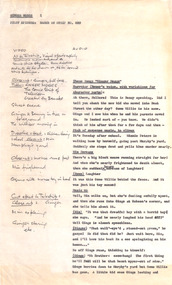
Document - Script, Robin Boyd, Ginger Meggs Pilot Episode, 1963
... Ginger Meggs Pilot Episode....Ginger goes to Osmo's house to get an apology from him to Mim, but instead Osmo invites Ginger to his birthday party. ...Ginger goes to Osmo's house to get an apology from him to Mim, but instead Osmo invites Ginger to his birthday party. ...Ginger Meggs, Australia's most popular and longest-running comic strip, was created in the early 1920s by Jimmy Bancks. The strip (based on Strip No. 589) follows the escapades of a red-haired prepubescent mischief-maker who lives in an inner suburban working-class household. This story follows characters Ginger and Mim, and their attempt to find and get an apology from new kid, Osmo Willis who plays a prank with a toy mouse on Mim. Ginger goes to Osmo's house to get an apology from him to Mim, but instead Osmo invites Ginger to his birthday party. Ginger then takes Osmo to buy ice-cream. Ginger in the end, gets caught out in his lie to Mim, that he couldn't find Osmo. Min finds out and scolds Ginger for being deceitful. "If only you were half a gentleman..." she says.Crawford Productions and Robin Boyd also explored ideas for other television productions, besides the successful 'The Flying Dogtor" series.Typewritten, carbon copy, foolscap, 3 pagesHandwritten side notes by Robin Boyd in pencil.ginger meggs, cartoon strip, jimmy bancks, robin boyd, crawford productions -
 Greensborough Historical Society
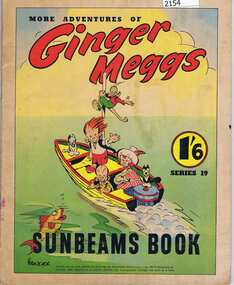
Book, Associated Newspapers, More adventures of Ginger Meggs, Series 19, 1942_
... More adventures of Ginger Meggs, Series 19....A 1941 edition of Ginger Meggs comic strips. Ginger Meggs was created in the early 1920s by Jimmy Bancks and first published in the 'Sunbeams" section of the Sydney Sun. ...A 1941 edition of Ginger Meggs comic strips. Ginger Meggs was created in the early 1920s by Jimmy Bancks and first published in the 'Sunbeams" section of the Sydney Sun. ...A 1941 edition of Ginger Meggs comic strips. Ginger Meggs was created in the early 1920s by Jimmy Bancks and first published in the 'Sunbeams" section of the Sydney Sun. Several other cartoonists drew Ginger Meggs strips after Bancks death in 1952. This edition is a "Sunbeams Book". An original 1941 copy of this book, in good condition.Comic book, 32 pages, colour illustrations.ginger meggs, jimmy bancks, sunbeams book, cartoons -
Clunes Museum
Memorabilia - LABEL
... LABEL FOR BOTTLES OF GINGER ALE MADE AT EBERHARD & CO. CORDIAL FACTORY IN CLUNES...LABEL FOR GINGER ALE BOTTLE -OVAL, WHITE BACKGROUND WITH ROYAL BLUE PRINTING & CROWN DESIGN...REFUNDED WITH THIS LABEL ATTACHED GINGER ALE EBERHARD & CO. CLUNES & TALBOT...REFUNDED WITH THIS LABEL ATTACHED GINGER ALE EBERHARD & CO. CLUNES & TALBOT LABEL FOR GINGER ALE BOTTLE -OVAL, WHITE BACKGROUND WITH ROYAL BLUE PRINTING & CROWN DESIGN Memorabilia LABEL ...LABEL FOR BOTTLES OF GINGER ALE MADE AT EBERHARD & CO. CORDIAL FACTORY IN CLUNESLABEL FOR GINGER ALE BOTTLE -OVAL, WHITE BACKGROUND WITH ROYAL BLUE PRINTING & CROWN DESIGNDEPOSIT 3D. REFUNDED WITH THIS LABEL ATTACHED GINGER ALE EBERHARD & CO. CLUNES & TALBOTlocal history, commerce, labels, eberhard & co. labels -
 Greensborough Historical Society
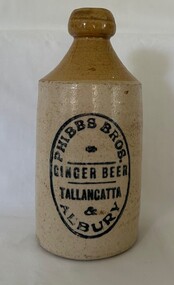
Container - Bottle, Phibbs Bros. Ginger Beer bottle. Tallangatta & Albury, 1930s
... Phibbs Bros. Ginger Beer bottle. Tallangatta & Albury...Small stoneware Ginger Beer bottle made by Phibbs Bros. Tallangatta & Albury....Small stoneware Ginger Beer bottle made by Phibbs Bros. Tallangatta & Albury. phibbs bros ginger beer tallangatta albury stoneware bottles Cream and brown glazed stoneware bottle Phibbs Bros. ...Small stoneware Ginger Beer bottle made by Phibbs Bros. Tallangatta & Albury.Cream and brown glazed stoneware bottlephibbs bros, ginger beer, tallangatta, albury, stoneware bottles -
 Nillumbik Shire Council
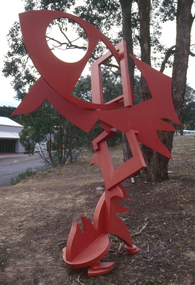
Public Art: Edward GINGER (b.1951 Kegalle, Sri Lanka - arrived 1975 Aus), Edward Ginger, The Breeze, Location: Main Road, Research - opposite Eltham Little Theatre, 1990
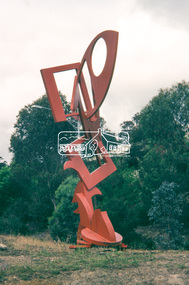
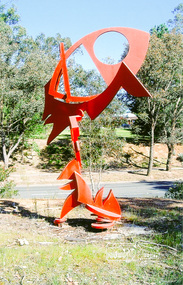
... ...ginger...Edward Ginger...The Breeze, Location: Main Road, Research - opposite Eltham Little Theatre Public Art: Edward GINGER (b.1951 Kegalle, Sri Lanka - arrived 1975 Aus) Edward Ginger ...The first sculpture awarded the Shire of Eltham 'Art in Public Places' Award/Commission. The Judges were Inge King, Jenny Zimmer and Daryl Jackson. The work deals with the juxtaposition of suburban and rural surroundings. This scupture is a typical example of the artist's oevre of the period. This sculptre is site specific and refers to the nature of the environment. The colour - bushfire red / sienna - alludes to the history of fire in the urban/rural fringe and the title, as well as the sculpture's shapes, forms and material refer to the natural and local elements. Judges report noted: "The most vital and expressive work for the site...with a great sense of dynamic movement and vibrant colour. Its' abstract forms will enliven the surroundings and the urban and natural environment. This work is the most appropriate for the site and expressive of the dynamics of an evolving community in which artistic discourse and debate has always thrived." The work has acquired the status of a major landmark from the National Trust. The Breeze is an abstract work made out of welded steel and painted in enamel in bush fire red / sienna. It comprises a series of flat, cut-out shapes, interlocking at different angles, giving the impression of being hinged together rather than fixed. The work references nature and the built environment. Its geometric shapes suggest man-made structures within industry and suburban life, while rural areas can be identified by the organic flame-like shapes fanned by the wind. The circular cut-out in the eye mimics the sun, symbolising the intense heat of the Australian climate, while the colour red alludes to the history of bushfire within the urban and rural fringe. N/Apublic art, ginger, red, sienna, elements, steel, abstract, breeze, fire, sculpture -
 Warrnambool and District Historical Society Inc.
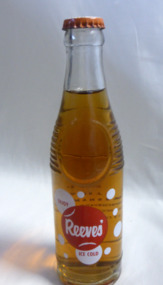
Functional object - Bottle, Reeves Dry Ginger, Circa late 20th century
... Reeves Dry Ginger...Top is white with orange writing. Contains Dry Ginger....Top is white with orange writing. Contains Dry Ginger. Reeves Dry Ginger Functional object Bottle ...Ralph Reeves purchased an established cordial factory in the early 1900’s from the estate of J Fletcher. It was operated by the Reeves family, firstly Reginald, followed by his son-in-law Murray Moon until the latter part of the 20th century. A common object familiar to a large number of people in the Warrnambool area with links to one of Warrnambool’s longest established family businesses.Two clear glass bottles with rib pattern and circles at bottom of neck. Transfer label with small white circles and one larger red one. Top is white with orange writing. Contains Dry Ginger.Enjoy Reeves’ ice cold on the front, Bottled by R.J Reeves Warrnambool. Preservative added artificially coloured. Net contents 7 FL. OZ. warrnambool, reeves, reeves soft drink, reeves cordial. -
 Flagstaff Hill Maritime Museum and Village
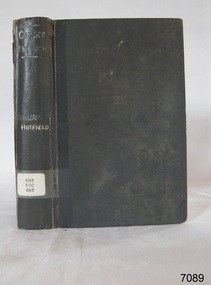
Book - A Fictional Story, William Hatfield, Ginger Murdoch, 1932
... Ginger Murdoch...Hard cover book. Ginger Murdoch Author: William Hatfield Publisher: Angus & Robertson Date: 1932 Further Information: Dark Blue plain cloth hardcover with lettering and patterning to spine in white. ...It's about a hard-drinking bushman named Ginger Murdoch. The stories (titles like 'Ginger Murdoch: Horse Dealer', 'Ginger Murdoch, Publican', 'Ginger Murdoch–Outlaw', 'Ginger Murdoch: Squatter') cast him as a knockabout outback figure a horse-dealer, publican, 'knight errant', squatter moving through the kind of droving, station and bush-town life Hatfield knew first-hand. ...Ginger Murdoch is a novel built around a recurring bush character of Hatfield's, which had already been running as a series of short stories in The Sydney Mail from 1931 onward. It's about a hard-drinking bushman named Ginger Murdoch. The stories (titles like 'Ginger Murdoch: Horse Dealer', 'Ginger Murdoch, Publican', 'Ginger Murdoch–Outlaw', 'Ginger Murdoch: Squatter') cast him as a knockabout outback figure a horse-dealer, publican, 'knight errant', squatter moving through the kind of droving, station and bush-town life Hatfield knew first-hand. The 1932 Angus & Robertson first edition ran to 268 pages, and the dust-jacket art shows Ginger Murdoch on horseback, exploring the countryside consistent with a picaresque, episodic outback adventure rather than a tightly plotted single narrative.Hard cover book. Ginger Murdoch Author: William Hatfield Publisher: Angus & Robertson Date: 1932 Further Information: Dark Blue plain cloth hardcover with lettering and patterning to spine in white. The spine has a Library label with an inscription.fictionGinger Murdoch is a novel built around a recurring bush character of Hatfield's, which had already been running as a series of short stories in The Sydney Mail from 1931 onward. It's about a hard-drinking bushman named Ginger Murdoch. The stories (titles like 'Ginger Murdoch: Horse Dealer', 'Ginger Murdoch, Publican', 'Ginger Murdoch–Outlaw', 'Ginger Murdoch: Squatter') cast him as a knockabout outback figure a horse-dealer, publican, 'knight errant', squatter moving through the kind of droving, station and bush-town life Hatfield knew first-hand. The 1932 Angus & Robertson first edition ran to 268 pages, and the dust-jacket art shows Ginger Murdoch on horseback, exploring the countryside consistent with a picaresque, episodic outback adventure rather than a tightly plotted single narrative.warrnambool, shipwrecked-coast, flagstaff-hill, flagstaff-hill-maritime-museum, maritime-museum, shipwreck-coast, flagstaff-hill-maritime-village, shipwrecked-artefact, book, ginger murdoch, william hatfield -
Clunes Museum
Ephemera - LABEL, EBERHARD CO, UNKNOWN
... EBERHARD & CO. LABEL FOR GINGER BEER...GINGER BEER EBERHARD & CO. CLUNES....LABEL FOR GINGER BEER Ephemera LABEL EBERHARD CO. ...SEE REG. NO.2037EBERHARD & CO. LABEL FOR GINGER BEERGINGER BEER EBERHARD & CO. CLUNES.local history, commerce, labels, eberhard & co labels -
 Stawell Historical Society Inc
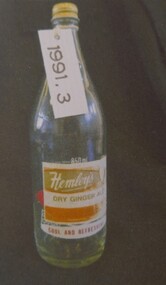
Functional object - Bottle, Hemley's Bottle
... Hemley's Dry Ginger Soft drink Bottle Gold screw on cap & paper label...Hemley's Dry Ginger...Stawell Hemley's Dry Ginger Hemley's Dry Ginger Soft drink Bottle Gold screw on cap & paper label Hemley's Bottle Functional object Bottle ...Hemley's Dry Ginger Soft drink Bottle Gold screw on cap & paper labelHemley's Dry Gingerstawell -
Clunes Museum
Container - BOTTLE
... EBERHARD & CO. BREWED GINGER BEER STONE BOTTLE...EBERHARD & CO BREWED GINGER BEER. CLUNES...EBERHARD & CO BREWED GINGER BEER. CLUNES EBERHARD & CO. BREWED GINGER BEER STONE BOTTLE Container BOTTLE ...EBERHARD & CO. BREWED GINGER BEER STONE BOTTLEEBERHARD & CO BREWED GINGER BEER. CLUNESlocal history, domestic item, containers, eberhard co. -
 Whitehorse Historical Society Inc.
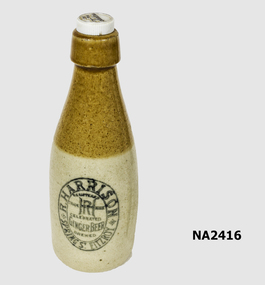
Container - Bottle
... Stone ginger beer bottle. Light brown glaze on top....Harrison Spring St Fitzroy| Celebrated Ginger Beer Brewed....Harrison Spring St Fitzroy| Celebrated Ginger Beer Brewed. Stone ginger beer bottle. ...Has been used as a hot water bottle.Stone ginger beer bottle. Light brown glaze on top.R. Harrison Spring St Fitzroy| Celebrated Ginger Beer Brewed.domestic items, containers -
Clunes Museum
Container - BOTTLE
... Ginger beer bottle and cork, stoneware bottle, pale on bottom darker on top, cork tied in with string...COLE & CO. GEELONG GINGER BEER TRADE MARK BESIDE IMAGE OF EAGLE...Stoneware Ginger beer Bottle On label; CHAS. COLE & CO. ...Ginger beer bottle and cork, stoneware bottle, pale on bottom darker on top, cork tied in with stringOn label; CHAS. COLE & CO. GEELONG GINGER BEER TRADE MARK BESIDE IMAGE OF EAGLEstoneware, ginger beer, bottle -
 Flagstaff Hill Maritime Museum and Village
Container - Bottle, c. 1905
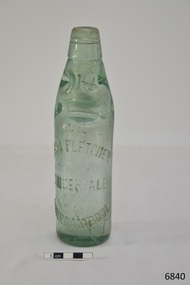
... This bottle once contained John Fletcher’s ginger cordial. It was found in August 2014 in the sand dunes at Levy's Point, near McKinnon's quarry, Warrnambool. ...Bottle, aqua/green glass, with glass marble inside. John Fletcher's Ginger Ale, Warrnambool. Container is often called a "Codd neck bottle", “marble bottle” or “Codd’s patent bottle”. ...Marks moulded into glass; "JOHN FLETCHER / GINGER ALE / WARRNAMBOOL" and “DOBSON” and on base “G”. ...This bottle once contained John Fletcher’s ginger cordial. It was found in August 2014 in the sand dunes at Levy's Point, near McKinnon's quarry, Warrnambool. ...This bottle once contained John Fletcher’s ginger cordial. It was found in August 2014 in the sand dunes at Levy's Point, near McKinnon's quarry, Warrnambool. ABOUT JOHN FLETCHER of WARRNAMBOOL John Fletcher Cordial (or Beverage) Co.. Warrnambool supplied cordial and aerated drinks to the Western District of Victoria. John Fletcher was named as a cordial manufacturer in the Warrnambool Standard of June 13th 1895, when he attended a Publican’s Association meeting. Mr John Fletcher, aerated water and cordial manufacturer of Koroit Street, Warrnambool, had a summary of his factory printed in a short article in the Advocate, Melbourne, in February 1901. The article said, “one of the most complete plants outside the metropolis … spacious … well appointed …old-established business … noted for the excellence of the quality … a trial [of the beverage] is solicited.” John Fletcher and Harold Caffin, trading as J.S. Rowley & Co, cordial manufacturers in 1903, were prosecuted in September that year when the Board of Health found an analysed sample of Raspberry Vinegar to contain coal tar colouring, which could be injurious to health, particularly to the kidneys. The factory was still in operation in December 1924, when sadly, Mr S. Fletcher, who was carrying bottles of aerated water at Mr John Fletcher’s cordial factory, sustained an eye injury when one of the bottles burst. Later, the eye had to be removed at the Warrnambool Base Hospital. ABOUT CODD BOTTLES Many inventions during the mid-to-late 1800s kept the fizz in carbonated drinks, such as ginger ale, soda water, and fruit drinks. Hiram Codd, an English engineer, invented a successful process that he patented as “Codd’s patented globe stopper bottle” in 1872. The Codd-neck bottle (commonly called Codd or marble bottle) is manufactured in two parts. The body of the bottle is cast in two sections. At the time of joining the sections, a glass marble and rubber seal are inserted into the neck section. The lip is then applied to the top of the bottle. The Codd bottle is filled upside down as the pressure of the gas from the carbonated liquid holds the marble up and out of the way. When the bottle stands upright, the gas pushes the marble up against the washer, creating a firm seal to keep the fizz inside. The bottle is opened by pushing the marble down firmly to allow some of the gas to escape. The marble drops down and is caught in a depression formed in the neck. When the bottle is tilted to pour or drink the liquid, the marble rests in a dimple. Some have said that the bottle is a character, the shape having a face with its mouth keeping the marble out of the drink and eyes that catch the marble so that it doesn’t roll into the mouth of the drinker. The Codd bottle was expensive to produce, and children loved to destroy the marbles to play with the marbles inside. Many shops and factories added a deposit to the cost of buying the drink to encourage children to return the bottles rather than break it for the marble. Codd bottles are still being produced in India and Japan for soft drinks. A Codd bottle with the same markings as this one is valued on today’s Australian auction sites from AUD 35 - $75. Bottle, aqua/green glass, with glass marble inside. John Fletcher's Ginger Ale, Warrnambool. Container is often called a "Codd neck bottle", “marble bottle” or “Codd’s patent bottle”. Bottle made by Dobson. Inscription on bottle and base. c. 1905Marks moulded into glass; "JOHN FLETCHER / GINGER ALE / WARRNAMBOOL" and “DOBSON” and on base “G”. flagstaff hill, warrnambool, shipwrecked coast, flagstaff hill maritime museum, maritime museum, shipwreck coast, flagstaff hill maritime village, great ocean road, codd bottle, codd neck bottle, marble bottle, ginger beer bottle, john fletcher soft drinks, warrnambool soft drinks and cordials, john fletcher cordial (or beverage) co ., codd neck bottle, glass stopper bottle, hiram codd, antique bottle, harold caffin, john fletcher -
 Greensborough Historical Society
Document, Rosie Bray, Tribute to Keith "Ginger" Weedon,by Rosie Bray, 2018_
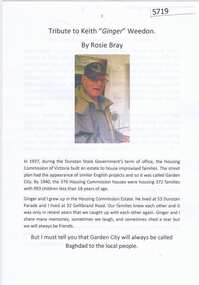
... Tribute to Keith "Ginger" Weedon,by Rosie Bray...Originally from Garden City, Port Melbourne, Keith Weedon moved to Macleod in 1971. keith weedon ginger weedon macleod 3 p. typescript, 1 colour photograph Tribute to Keith "Ginger" Weedon,by Rosie Bray Document Rosie Bray ...Originally from Garden City, Port Melbourne, Keith Weedon moved to Macleod in 1971.3 p. typescript, 1 colour photographkeith weedon, ginger weedon, macleod -
 Eltham District Historical Society Inc
Slide - Photograph, The Breeze (1990), Edward Ginger, Main Road Research, c.1993
... The Breeze (1990), Edward Ginger, Main Road Research...Edward Ginger Public Art Research (Vic.) Sculptures The Breeze (1990) 35mm colour positive transparency Mount - Black and White The Breeze (1990), Edward Ginger, Main Road Research Slide Photograph ...35mm colour positive transparency Mount - Black and Whiteedward ginger, public art, research (vic.), sculptures, the breeze (1990) -
 Eltham District Historical Society Inc
Photograph, The Breeze (1990), Edward Ginger, Main Road Research
... The Breeze (1990), Edward Ginger, Main Road Research ...art edward ginger research (vic.) sculptures the breeze (1990) Colour photograph The Breeze (1990), Edward Ginger, Main Road Research Photograph ...Colour photographart, edward ginger, research (vic.), sculptures, the breeze (1990) -
 Robin Boyd Foundation
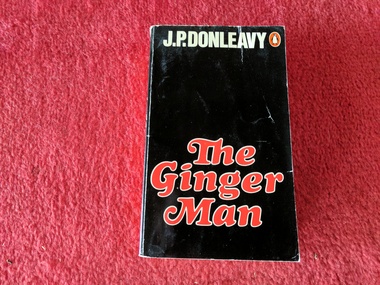
Book, J. P. Donleavy, The Ginger Man, 1979
... The Ginger Man...Walsh St library Softcover The Ginger Man Book J. P. Donleavy Penguin Books ...Softcoverwalsh st library -
 The Adam Lindsay Gordon Commemorative Committee Inc.
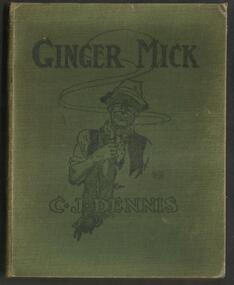
Book, Ginger Mick- C.J. Dennis- Angus and Robertson 1916
... Ginger Mick- C.J. Dennis- Angus and Robertson 1916...Ginger Mick- C.J. Dennis- Angus and Robertson 1916 Book ... -
Box Hill Historical Society
Book, Dennis, C.J, The moods of Ginger Mick, 1917
... The moods of Ginger Mick...Dennis. 143p. colour plates & b&w sketches The moods of Ginger Mick Book Dennis, C.J. Angus and Robertson ...A book of poems by C.J. Dennis.143p. colour plates & b&w sketchesA book of poems by C.J. Dennis. dennis> c.j., poetry, cemeteries, box hill -
Art Gallery of Swan Hill
Print, OSBORNE, Cheryl, Ginger lily, unknown
... Ginger lily...Ginger lily Print OSBORNE, Cheryl ... -
 Nillumbik Shire Council
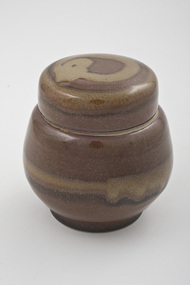
Pottery (jar): Phyl DUNN (b.1911 - d.1999 Melb, AUS), Ginger Jar
... Ginger Jar ...Ginger Jar Pottery (jar): Phyl DUNN (b.1911 - d.1999 Melb, AUS) ...
