
Showing 394 items matching "gladys thomas"
-
 Returned Nurses RSL Sub-branch
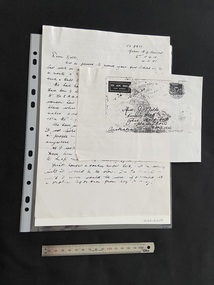
Letter - Photocopy of a letter and envelope, Gladys Thomas, June 6, 1941
... Gladys Thomas...Gladys Thomas...Letter Photocopy of a letter and envelope Gladys Thomas ...A letter from an Australian Army Nurse serving overseas in WWII, to another nurse working at a Base Hospital in Victoria, Australia.Photocopied pages of a handwritten letter and an addressed air mail envelope with postage marks.gladys thomas, j.nolte, world war 1939-1945, wwii -
 Bendigo Historical Society Inc.
Document - The Reynolds Family Records Collection (Folder 3 of 4) Gladys Hinde and Thomas Scott Marriage Certificate, 1935
... The Reynolds Family Records Collection (Folder 3 of 4) Gladys Hinde and Thomas Scott Marriage Certificate......Gladys Hinde and Thomas Scott...This item contains the following document: Gladys Hinde and Thomas Scott Marriage Certificate - Contact the Society for details... Hinde and Thomas Scott The four folders contain family history documents and photos of the descendants of Eleanor Hinde. This item contains the following document: Gladys Hinde and Thomas Scott Marriage Certificate - Contact the Society for details Document The Reynolds Family Records Collection (Folder 3 of 4) Gladys Hinde and Thomas Scott Marriage Certificate ...Eleanor Hinde (1842-1902) was born in Lancashire England. In 1858, Eleanor married Richard Reynold in the Forest St Wesleyn Methodist Church in Sandhurst. They both gave their address as Sailors Gully Goldfields. They had seven children together. Richard was a skilled tradesman and after he died in 1872 from lung disease, Eleanor married Arculus Opie. Eleanor owned a property on the corner of Gladstone and Stanley Streets which later became an electrical substation. She sold poultry and eggs and preserves. One of Eleanor's sons, William John, married Anna (Annie) Jorgensen, and one of her daughters. Amelia, married Anna's brother Thomas Joynes Jorgensen. The Jorgensens founded and managed Jorgensen and Sons foundry and engineering works. Peter Jorgensen (1849-1914), was a mining contractor, he lived at, "Bro," Russell street, Quarry Hill. His firm was Jorgensen and Sons, mining contractors. He was a native of the Island of Alsen, Denmark. He left Denmark in the year 1861, embarking at Hamburg in a small sailing Ship. The four folders contain family history documents and photos of the descendants of Eleanor Hinde. This item contains the following document: Gladys Hinde and Thomas Scott Marriage Certificate - Contact the Society for detailssandhurst, peter jorgensen, eleanor hinde, eleanor reynolds, eleanor opie, reynolds collection, gladys hinde and thomas scott -
 Eltham District Historical Society Inc
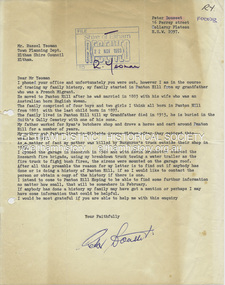
Folder, Peter Dousset, 1983
... Ester Stutley (nee Thomas)...Gladys...Copy of death certificate, Gladys Dousset (nee Stutley), 12 Oct 1970 (VIC 885/71), daughter of Alfred Stutley and Ester Stutley (nee Thomas) 4. ...Research Fire Brigade Ryan's Butcher shop Panton Hill Hotel Hillside Avenue Alfred Stutley Christina Dousset (nee Newlands) Ernest Pierre Dousset Ester Stutley (nee Thomas) Gladys Dousset (nee Stutley) Pierre Francois Dousset Queenstown Cemetery Smith's Gully Cemetery Folder of information on Peter Dousset and ancestors, Panton Hill and Research Peter Dousset Folder ...Contents: 1. Letter from Peter Dousset of Collaroy Plateau, NSW, Nov. 1983. Provides brief history of family origins in district. Grandfather was a French migrant who married an Australian woman in 1883 in Panton Hill and had four boys and two girls. Father worked for Ryan's Butcher shop in Panton Hill for many years. Parents retired to Hillside Avenue Eltham. Mother was kiiled by Burgoyne's truck in 1970 outside the Burgoyne shop (Inquest held Melbourne, 16 Dec 1970 VPRS 24/P0002, 1970/2408). Peter Dousset opened a garage in Research in 1948 with Kevin Brinkkotter and they started the Research Fire Brigade using his breakdown truck towing a water trailer. 2. Copy of death certificate, Ernest Pierre Dousset 13 May 1963 (VIC 9061/63), son of Pierre Francois Dousset and Christina Dousset (nee Newlands), buried Smiths Gully Cemetery (Queenstown Cemetery) 3. Copy of death certificate, Gladys Dousset (nee Stutley), 12 Oct 1970 (VIC 885/71), daughter of Alfred Stutley and Ester Stutley (nee Thomas) 4. Copy of six pages extracted from an autobiography written by Peter Dousset 5. Copy of photo taken 1912 outside the Panton Hill Hotel with Peter Dousset's grandparents on the right side 6. Copy of photo of the Dousset family home in Panton Hill 7. Copy of vaccination certificate of Pierre Dousset aged 6 months at Panton Hill, 26 October 1897 [Items 2-7 are digital file copies only] Folder of information on Peter Dousset and ancestors, Panton Hill and Researchpeter dousset, burgoyne's shop, eltham, kevin brinkkotter, panton hill, research (vic.), research fire brigade, ryan's butcher shop, panton hill hotel, hillside avenue, alfred stutley, christina dousset (nee newlands), ernest pierre dousset, ester stutley (nee thomas), gladys dousset (nee stutley), pierre francois dousset, queenstown cemetery, smith's gully cemetery -
 Expression Australia
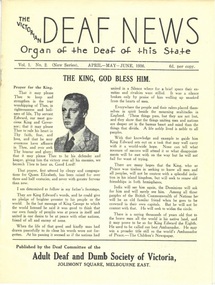
Newsletter, The Victorian Deaf News April-May-June 1936
... george oakley, maggie cruickshank, mr and mrs frank dyble, abraham, johnston, mary retallick, allsopp, doney, l. sanders, melby allsopp, maisie reiffel, ruby mcdonald, dulcie jones, betty doyle, ludbrook, ashby, monahan, hately, bay steamesr, evans, peters empson, johnston, elsie abraham, louis mccubin, john longstaff, elsie spears jackson, anniesecombe, e. thomas, gladys bates, andrew rankine, paqualin, don wallis, damman, e. roxburgh, arthur morgan, h. r. gillett, frank williams, t. parkinson, jack boal, annie webb, davis, margaret gibson, e. r. noble, j. m. johnston, e. sturcke, emma reade, williamson, allen, mona stevens, colin johns, o. quinton, a. stokes, d. ashby, w. dunstan, roy windridge, g. thomas, c. mortimer, arthur edward raines, jean mccollough, w. mcmillin, dorothy campbell, herbert wilson, harold w. bickford, elizabeth jones, william jones, a. e. clarkson,...Expression Australia Level 4 340 Albert Street East Melbourne melbourne Published by the Deaf Committee of the Adult Deaf and Dumb Society of Victoria 'The Victorian Deaf News' Newsletter is a significant publication as an historical record giving and insight into the people, activities and events of the Deaf Community in Victoria george oakley, maggie cruickshank, mr and mrs frank dyble, abraham, johnston, mary retallick, allsopp, doney, l. sanders, melby allsopp, maisie reiffel, ruby mcdonald, dulcie jones, betty doyle, ludbrook, ashby, monahan, hately, bay steamesr, evans, peters empson, johnston, elsie abraham, louis mccubin, john longstaff, elsie spears jackson, anniesecombe, e. thomas, gladys bates, andrew rankine, paqualin, don wallis, damman, e. roxburgh, arthur morgan, h. r. gillett, frank williams, t. parkinson, jack boal, annie webb, davis, margaret gibson, e. r. noble, j. m. johnston, e. sturcke, emma reade, williamson, allen, mona stevens, colin johns, o. quinton, a. stokes, d. ashby, w. dunstan, roy windridge, g. thomas, c. mortimer, arthur edward raines, jean mccollough, w. mcmillin, dorothy campbell, herbert wilson, harold w. bickford, elizabeth jones, william jones, a. e. clarkson, Vol. 1 No. 2 (New Series) April-May-June 1936; Size 24.5cmHx18.5cmW; 20 pages The Victorian Deaf News April-May-June 1936 Newsletter ...Published by the Deaf Committee of the Adult Deaf and Dumb Society of Victoria'The Victorian Deaf News' Newsletter is a significant publication as an historical record giving and insight into the people, activities and events of the Deaf Community in VictoriaVol. 1 No. 2 (New Series) April-May-June 1936; Size 24.5cmHx18.5cmW; 20 pagesgeorge oakley, maggie cruickshank, mr and mrs frank dyble, abraham, johnston, mary retallick, allsopp, doney, l. sanders, melby allsopp, maisie reiffel, ruby mcdonald, dulcie jones, betty doyle, ludbrook, ashby, monahan, hately, bay steamesr, evans, peters empson, johnston, elsie abraham, louis mccubin, john longstaff, elsie spears jackson, anniesecombe, e. thomas, gladys bates, andrew rankine, paqualin, don wallis, damman, e. roxburgh, arthur morgan, h. r. gillett, frank williams, t. parkinson, jack boal, annie webb, davis, margaret gibson, e. r. noble, j. m. johnston, e. sturcke, emma reade, williamson, allen, mona stevens, colin johns, o. quinton, a. stokes, d. ashby, w. dunstan, roy windridge, g. thomas, c. mortimer, arthur edward raines, jean mccollough, w. mcmillin, dorothy campbell, herbert wilson, harold w. bickford, elizabeth jones, william jones, a. e. clarkson, -
 Warrnambool and District Historical Society Inc.
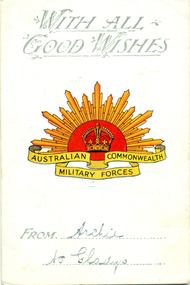
Postcard - Postcards Gladys Holmes collection. WW1, 10 Post Cards from Archie to Gladys, Circa 1915-1920
... Gladys. Some of the seven servicemen died and are remembered on the Byaduk war memorial- Wilfred Rentsch, William Thomas Harper, Stanley O Miller, Albert V Harper and Walter Kinghorn. ...Gladys. Some of the seven servicemen died and are remembered on the Byaduk war memorial- Wilfred Rentsch, William Thomas Harper, Stanley O Miller, Albert V Harper and Walter Kinghorn. ...All overseas correspondence to Gladys Holmes. Vida Holmes, Frank and Jim from Byaduk servicemen, relatives and friends, during WW! service 1915-1919. Except Letters and postcards from Orford Critchlow to Gladys. Some of the seven servicemen died and are remembered on the Byaduk war memorial- Wilfred Rentsch, William Thomas Harper, Stanley O Miller, Albert V Harper and Walter Kinghorn. Gladys wad born in Byaduk 1897 daughter to Joseph (Baker) and Agnes Holmes with sisters Vida and Una and brother Frank. She married Alexander George Anderson of Stawell in 1924. Archie McGillivray married Minnie Ramsay, the Scottish sister of a friend Ashley Ramsay.Primary documents sent to Byaduk residents from local friends serving overseas in WW!. Details of feelings, ship journeys, overseas war service and few photographs of period 1915/6- 1919. some of the writers/authors have photographs on the Byaduk Memorial hall Honour Board.001800.1 -001800.10 Cardboard postcards, some colour, one photograph and one embroidered001800.1: To Gladys from Archie - undated 001800.2: To Gladys, With Kindest Regards, From Archie - undated 001800.3: Dear Gladys.. Sept 14.... Bye Archie; Harefield Hospital 001800.4: Dear Gladys...Kindest regards Archie; Sutton Veny June 16/1918 001800.5: Dear Gladys..Archie; Belgium, March 21/1919 001800.6: To Gladys ....From Archie; 16/3/1918 001800.7: Dear Gladys...Your old pal Archie; Belgium, 16/3/1918 001800.8: Dear Gladys....Love from Archie, France, Jan 27/1918 001800.9: To Gladys from Archie; Christmas 1918 001800.10: Dear Gladys....from Arch, France Nov 7 1917 001800.8: 001800.9: gladys, vida holmes, frank holmes, archie mcvillivray, wilfred rentsch, william t harper, albert v harper -
 Warrnambool and District Historical Society Inc.
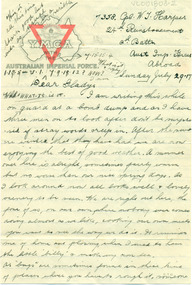
Document - World War Letters, Letters: July 1917 To Gladys from 7358 Pte William Thomas Harper, pre 1917
... ...william thomas harper...gladys...Original documents, envelopes, diet sheet,letters and photograph sent from abroad from William Thomas harper to Gladys Holmes, Byaduk 7358 Pte William Thomas Harper b. 1896, Byaduk, 8th Battalion - 24th Reinforcements, embarked on 19th February 1917 on HMAT A70 Ballarat. ...Cousin to twin AV Harper and RS Harper. one of eight correspondents to Gladys Holmes, Byaduk Original documents, part of 14 sets of correspondence to Gladys Holmes and local Byaduk residents from local servicemen during WW 1.. William Thomas Harper, Gladys Holmes, Byaduk WW1, letter, photograph, envelope, A.I.F. warrnambool byaduk william thomas harper gladys holmes 001803.1: Envelope, addressed to Miss Gladys Holmes/Byaduk/Hamilton/Victoria/Australia. ...Original documents, envelopes, diet sheet,letters and photograph sent from abroad from William Thomas harper to Gladys Holmes, Byaduk 7358 Pte William Thomas Harper b. 1896, Byaduk, 8th Battalion - 24th Reinforcements, embarked on 19th February 1917 on HMAT A70 Ballarat. Killed in France on 3rd May 1918. Buried Outtersteene Communal Cemetery Extension, Bailleul France. Cousin to twin AV Harper and RS Harper. one of eight correspondents to Gladys Holmes, ByadukOriginal documents, part of 14 sets of correspondence to Gladys Holmes and local Byaduk residents from local servicemen during WW 1..001803.1: Envelope 001803.2 -.6R: Buff coloured paper, 6 sheets with YMCA logo on map of Australia and red triangle. 001803.7 - 7R: Envelope has a red 1d stamp with 20 SEP 17 black ink postmark and blue ink handwritten address with sender's details. 001803.8 - 8R: note and Diet sheet Week Aug 26 - Sep 2 1917 001803.9 - 9R: Small sepia photograph of physical training soldier, and reverse has handwritten notes001803.1: Envelope, addressed to Miss Gladys Holmes/Byaduk/Hamilton/Victoria/Australia. Postmark ...CAMP B.O. SALISBURY 10 UY 17 001803.2-.6R: Leeter: 24th Reinforcement/2nd Battn/Aust Imp Forces/Abroad/Sunday July 29.17 to Dear Gladys 001803.7- 7R: Envelope: Red id stamp with black postmark 11.45AM, 20 SEP 17, Address-Miss Gladys Holmes/Byaduk/Hamilton/Victoria/Australia. Sender: 7538 8th Batt. Reverse: Received 24th Nov 1917. 18.8.17/Use old/address/still/ 24.8 A.I.F. etc 001803.8- 8R: Note andDIET SHEET Week Aug 26 to Sep 2, Breakfast Dinner & Tea 1001803.9 - 9R: Photograph of physical trainer and reverse has 11 lines of informationwilliam thomas harper, gladys holmes, byaduk ww1, letter, photograph, envelope, a.i.f., warrnambool, byaduk, william thomas harper, gladys holmes -
 Warrnambool and District Historical Society Inc.
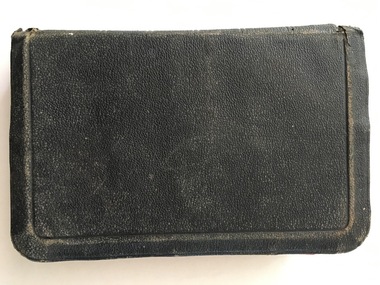
Book, The Holy Bible, Early 20th century
... Thomas Scott and later Doctor Gerald Baldwin at the ‘Alveston’ Private Hospital (corner Darling and Banyan Streets, Warrnambool). She then took sole control of the private hospital and ran this hospital for a great number of years, providing expert care for midwifery, surgical and medical cases. Berenice Angus (Berry McDade) is the daughter of Dr Roy and Gladys...Thomas Scott and later Doctor Gerald Baldwin at the ‘Alveston’ Private Hospital (corner Darling and Banyan Streets, Warrnambool). She then took sole control of the private hospital and ran this hospital for a great number of years, providing expert care for midwifery, surgical and medical cases. Berenice Angus (Berry McDade) is the daughter of Dr Roy and Gladys ...The original inscription in this Bible is interesting but no information has been found on Mary MacLeod or Hazel O’Moore-Skelly except to note that Eleanor Hazel Cameron, nee O’Moore-Skelly, (1914 -1989) is buried in the Allambie Park Cemetery, Albany. The Bible was given to Berenice Angus by Sister Ingpen of Warrnambool. The accompanying note that indicated that it came from Sister Ingpen is now missing. The later inscriptions indicate that Berenice Angus had this Bible in the early 1950s at her school in Geelong, ‘The Hermitage’. Sister Amy Ingpen (1878- 1965) was an important figure in Warrnambool’s history. She trained as a nurse and was said to be the first Victorian country nurse to qualify for the Midwifery Certificate. She initially assisted Dr Thomas Scott and later Doctor Gerald Baldwin at the ‘Alveston’ Private Hospital (corner Darling and Banyan Streets, Warrnambool). She then took sole control of the private hospital and ran this hospital for a great number of years, providing expert care for midwifery, surgical and medical cases. Berenice Angus (Berry McDade) is the daughter of Dr Roy and Gladys Angus. Dr Angus (1901-1970) came to Warrnambool in 1939 and practised at ‘Birchwood’ in Koroit Street and in later years as an ophthalmologist. This book is of interest because of its connection with Sister Ingpen, a prominent nurse in 20th century Warrnambool and the Angus family of Warrnambool. This is a black soft leather- covered Bible of 1208 pages. The cover extends over the edges of the pages. It has gold lettering on the spine and gold edging on the pages. The inside covers are black. The book has been silk bound but is now partly detached from inside the spine. Some pages are loose and have been mended with glue. Some of the pages have ink staining and the cover is worn with the top and bottom of the spine cover broken and torn. There is an inscription on the black inside cover and one of the first pages and a stamp from the Warrnambool & District Historical Society.‘Mary’ ‘Mary MacLeod with love from Hazel O’Moore-Skelly’ ‘When this you see, Remember me’ ‘Berenice Angus, 1952’ ‘Berenice Angus, The Hermitage, Geelong, 1952 (almost indecipherable) hazel o’moore-skelly, mary macleod, berenice mcdade (angus), dr angus, sister ingpen, history of warrnambool, berenice angus -
Federation University Historical Collection
Letter, Ballarat School of Mines Rough Correspondence, 1916-1917, 1916-17
... Gladys Kitchen H. BEanland Eva Betteridge Victor Greenhalgh Staff Salary Goliath and Hercules Cuming Smith and Co Australian Engineering School E.J. Powell E.W. Hurfield E.J. McConnon Hilda Wardle Dorothy Hambly Assay Report North Woah Hawp Supplementary Examinations Hugh M. Rowlands Frank B. Maxwell Richard Buchanan Walter J. Ewart R.F. Finnis F.G. Davis W.G. Walker Charles Schroeder K. Bailey Fisher Robert Hutchinson W. O'Halloran S.J. Chambers A. Westcott M.F. Larking K. Jebb John Dulfer Daniel Liddy Louis Vernon Pharmacy Board Victoria Scholarships David Cochrane Howard Bennett herbert werner frederick de nully Thomas ...The Ballarat School of Mines was established in 1870, and is a predecessor institution of Federation University Australia. A bundle of rough correspondence from the Ballarat School of Mines. Includes Ballarat School of Mines Letterhead, a list of Trade Students, their address and the fees they paid; Special Grant for Photography Equipment; Building valuations; Annual Staff Social, Ballarat School of Mines Technical School Annual Report, Quarterly Attendance Return, Medical Certificate ballarat school of mines, 45th a.a.m.c., 49th a.a.m.c., camp, f.c. buchanan, e.l. fidge, r.c. valentine, r.c. smith, j.m. turnbull, w.l. carroll, e.w. simmering, f.m. wesley, k. whittle, allan bernaldo, j.b. sutcliffe, e.n.t. henry, f.t. jellett, a.p. doran, e. somerville, t.h. robinson, ballarat school of mines evening trade time table, victorian education department receipt, letterhead, charles graham, h.s. hall, gauge tower, trade fees., trades, f.r. eva, m.a. fiscalini, v. giuliano, walter baxter, humffray, james walker, clemence hill, mcpherson's pty ltd, robinson, telephone account, charles e. bright, plumbing, g.r. king, a.e. anderson, buildings, n.r. worrell, h.v. duncan, ballarat junior technical school, a.w. steane, philately, stamp duty, bhp, broken hill, excursion, broken hill south mining co, g. fenner, wallaroo, moonta, daniel walker, t.h. shattock, j.m. sutherland, myra bolte, nellie grigg, j.a. greenshields, dora gooch, myra howe, mavis mcgrath, charles mcnamara, kath reidy, percy albert trompf, percy trompf, h.g. wakeling, rene hardess, quarterly returns, accounting, sands and mcdougall, travel lists, w. coltman, gladys kitchen, h. beanland, eva betteridge, victor greenhalgh, staff salary, goliath and hercules, cuming smith and co, australian engineering school, e.j. powell, e.w. hurfield, e.j. mcconnon, hilda wardle, dorothy hambly, assay report, north woah hawp, supplementary examinations, hugh m. rowlands, frank b. maxwell, richard buchanan, walter j. ewart, r.f. finnis, f.g. davis, w.g. walker, charles schroeder, k. bailey fisher, robert hutchinson, w. o'halloran, s.j. chambers, a. westcott, m.f. larking, k. jebb, john dulfer, daniel liddy, louis vernon, pharmacy board victoria, scholarships, david cochrane, howard bennett, herbert werner frederick de nully, thomas robinson, john sutcliffe, thomas carmichael, bessie beatrice robertson -
 Bendigo Military Museum
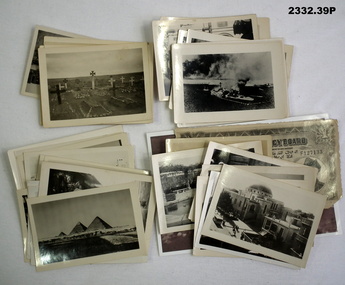
Photograph - PHOTOGRAPHS WW2, 1) 1941; .2 - .39) 1940-45
... .1) 19.1.41 To Gladys with best wishes from Viv. Later someone has written VX15538 VRG THOMAS D Coy 2/14 Battalion Vivian Raymond George Thomas enlisted in the 2nd AIF on 17.5.1940 age 28 years. ...Bendigo Military Museum 37 - 39 Pall Mall Bendigo goldfields .1) 19.1.41 To Gladys with best wishes from Viv. Later someone has written VX15538 VRG THOMAS D Coy 2/14 Battalion Vivian Raymond George Thomas enlisted in the 2nd AIF on 17.5.1940 age 28 years. ....1) 19.1.41 To Gladys with best wishes from Viv. Later someone has written VX15538 VRG THOMAS D Coy 2/14 Battalion Vivian Raymond George Thomas enlisted in the 2nd AIF on 17.5.1940 age 28 years. He is listed as KIA at Gona New Guinea on 28.11.1942 while serving in the 2/14th Batt with the rank of Cpl and is buried in the Bomana War Cemetery Port Moresby..1) Post card in the form of a 'One Palestine Pound' with inset photo of an Australian Soldier VRG THOMAS. Colour in sepia tones. .2) Photograph copy enlarged from .3) showing German graves. Sepia colour. .3) - .39) Series of original photographs in black & white, sepia re war in North Africa, pyramids, towns, cities. Several are in the islands.photography-photographs, military history - army, documents - postcards -
 Federation University Historical Collection
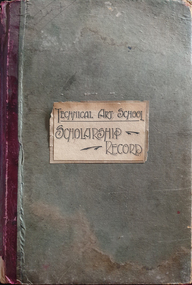
Book - Documents, Ballarat Technical Art School Scholarship Record, 1915-1929, 1915-1929
... Barker Library (top floor) Mount Helen goldfields Ernest Robson received a Senior Technical Scholarship for his evening study in Stained Glass. ballarat school of mines ballarat technical art school gladstone proctor edwin cannon ted cannon allan bernaldo percy trompf elsie mckissock claudia mcilvena ernest robson stained glass leslie gower constance weeks enrico campi mary j. hopwood victor greenhalgh violet hambly graham hopwood jack colbourn john colbourn honor mccubbin annie coates ernest gower john skilbeck gladys tong way gladys tongway jean ronaldson jack strange jack kopke kenneth campi coral wakeling sylvia copperwaite edna grigg b. pembathy r.l. cutter l. morshead elmer somerville amalie feild hazwl gower eric ainsworth ethel kift douglas cotton annie hall jean colburn mary fogart clare cummins gladys dunstan elizabeth van beek melva gribble nellie campi rita tainsh nellie nicholls olga dulfer edith curnow elvie thege jean roff thelma coulter thomas shattock edwin robertson elvie w. ford robert graham elvie ford nancy bowe jack colburn nancy rowe Amy Robson Margery Woolcott Grey hard covered book with hand written names of scholarship recipients, their role and who they work for. ...Ernest Robson received a Senior Technical Scholarship for his evening study in Stained Glass.Grey hard covered book with hand written names of scholarship recipients, their role and who they work for. The scholarships are: Senior Tech Day Course (50 pounds) Senior Tech Evening COurse (10 pounds) City Council Scholarships State School Departmental Scholarships Student Teacher Scholarships Junior Technical School Day Course Scholarships Junior Technical School Evening Course Scholarships Girls Preparatory Scholarships Exhibition Scholarships McRobertson Scholarship Ladies Art Scholarship ballarat school of mines, ballarat technical art school, gladstone proctor, edwin cannon, ted cannon, allan bernaldo, percy trompf, elsie mckissock, claudia mcilvena, ernest robson, stained glass, leslie gower, constance weeks, enrico campi, mary j. hopwood, victor greenhalgh, violet hambly, graham hopwood, jack colbourn, john colbourn, honor mccubbin, annie coates, ernest gower, john skilbeck, gladys tong way, gladys tongway, jean ronaldson, jack strange, jack kopke, kenneth campi, coral wakeling, sylvia copperwaite, edna grigg, b. pembathy, r.l. cutter, l. morshead, elmer somerville, amalie feild, hazwl gower, eric ainsworth, ethel kift, douglas cotton, annie hall, jean colburn, mary fogart, clare cummins, gladys dunstan, elizabeth van beek, melva gribble, nellie campi, rita tainsh, nellie nicholls, olga dulfer, edith curnow, elvie thege, jean roff, thelma coulter, thomas shattock, edwin robertson, elvie w. ford, robert graham, elvie ford, nancy bowe, jack colburn, nancy rowe, amy robson, margery woolcott -
 Flagstaff Hill Maritime Museum and Village
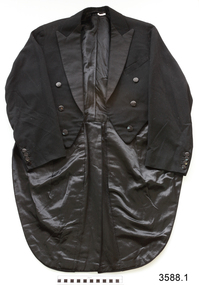
Formal suit, 1925
... Thomas Francis Ryan (T.F. Ryan, or Tom), in Nhill, Victoria, where his experiences included radiology and pharmacy. In 1927 he was Acting House Surgeon in Dr Tom Ryan’s absence. Dr Angus had become engaged to Gladys...Thomas Francis Ryan (T.F. Ryan, or Tom), in Nhill, Victoria, where his experiences included radiology and pharmacy. In 1927 he was Acting House Surgeon in Dr Tom Ryan’s absence. Dr Angus had become engaged to Gladys ...This formal suit, comprising tails coat, trousers, waistcoat and shirt, is believed by Berry McDade (daughter of Dr Angus) to be the one donated to Flagstaff Hill Maritime Village by the family of Doctor William Roy Angus, Surgeon and Oculist, according to the doner.. There is another name on some of the garments, possibly because the suit components were acquired second hand at the time when Dr Angus was in his early practice days. It is part of the “W.R. Angus Collection” that includes historical medical equipment, surgical instruments and material once belonging to Dr Edward Ryan and Dr Thomas Francis Ryan, (both of Nhill, Victoria) as well as Dr Angus’ own belongings. The Collection’s history spans the medical practices of the two Doctors Ryan, from 1885-1926 plus that of Dr Angus, up until 1969. ABOUT THE “W.R.ANGUS COLLECTION” Doctor William Roy Angus M.B., B.S., Adel., 1923, F.R.C.S. Edin.,1928 (also known as Dr Roy Angus) was born in Murrumbeena, Victoria in 1901 and lived until 1970. He qualified as a doctor in 1923 at University of Adelaide, was Resident Medical Officer at the Royal Adelaide Hospital in 1924 and for a period was house surgeon to Sir (then Mr.) Henry Simpson Newland. Dr Angus was briefly an Assistant to Dr Riddell of Kapunda, then commenced private practice at Curramulka, Yorke Peninsula, SA, where he was physician, surgeon and chemist. In 1926, he was appointed as new Medical Assistant to Dr Thomas Francis Ryan (T.F. Ryan, or Tom), in Nhill, Victoria, where his experiences included radiology and pharmacy. In 1927 he was Acting House Surgeon in Dr Tom Ryan’s absence. Dr Angus had become engaged to Gladys Forsyth and they decided he would take time to further his studies overseas in the UK in 1927. He studied at London University College Hospital and at Edinburgh Royal Infirmary and in 1928, was awarded FRCS (Fellow from the Royal College of Surgeons), Edinburgh. He worked his passage back to Australia as a Ship’s Surgeon on the on the Australian Commonwealth Line’s SS Largs Bay. Dr Angus married Gladys in 1929, in Ballarat. (They went on to have one son (Graham 1932, born in SA) and two daughters (Helen (died 12/07/1996) and Berenice (Berry), both born at Mira, Nhill ) Dr Angus was a ‘flying doctor’ for the A.I.M. (Australian Inland Ministry) Aerial Medical Service in 1928 . The organisation began in South Australia through the Presbyterian Church in that year, with its first station being in the remote town of Oodnadatta, where Dr Angus was stationed. He was locum tenens there on North-South Railway at 21 Mile Camp. He took up this ‘flying doctor’ position in response to a call from Dr John Flynn; the organisation was later known as the Flying Doctor Service, then the Royal Flying Doctor Service. A lot of his work during this time involved dental surgery also. Between 1928-1932 he was surgeon at the Curramulka Hospital, Yorke Peninsula, South Australia. In 1933 Dr Angus returned to Nhill where he’d previously worked as Medical Assistant and purchased a share of the Nelson Street practice and Mira hospital from Dr Les Middleton one of the Middleton Brothers, the current owners of what was once Dr Tom Ryan’s practice. Dr L Middleton was House Surgeon to the Nhill Hospital 1926-1933, when he resigned. [Dr Tom Ryan’s practice had originally belonged to his older brother Dr Edward Ryan, who came to Nhill in 1885. Dr Edward saw patients at his rooms, firstly in Victoria Street and in 1886 in Nelson Street, until 1901. The Nelson Street practice also had a 2 bed ward, called Mira Private Hospital ). Dr Edward Ryan was House Surgeon at the Nhill Hospital 1884-1902 . He also had occasions where he successfully performed veterinary surgery for the local farmers too. Dr Tom Ryan then purchased the practice from his brother in 1901. Both Dr Edward and Dr Tom Ryan work as surgeons included eye surgery. Dr Tom Ryan performed many of his operations in the Mira private hospital on his premises. He too was House Surgeon at the Nhill Hospital 1902-1926. Dr Tom Ryan had one of the only two pieces of radiology equipment in Victoria during his practicing years – The Royal Melbourne Hospital had the other one. Over the years Dr Tom Ryan gradually set up what was effectively a training school for country general-practitioner-surgeons. Each patient was carefully examined, including using the X-ray machine, and any surgery was discussed and planned with Dr Ryan’s assistants several days in advance. Dr Angus gained experience in using the X-ray machine there during his time as assistant to Dr Ryan. Dr Tom Ryan moved from Nhill in 1926. He became a Fellow of the Royal Australasian College of Surgeons in 1927, soon after its formation, a rare accolade for a doctor outside any of the major cities. He remained a bachelor and died suddenly on 7th Dec 1955, aged 91, at his home in Ararat. Scholarships and prizes are still awarded to medical students in the honour of Dr T.F. Ryan and his father, Dr Michael Ryan, and brother, John Patrick Ryan. ] When Dr Angus bought into the Nelson Street premises in Nhill he was also appointed as the Nhill Hospital’s Honorary House Surgeon 1933-1938. His practitioner’s plate from his Nhill surgery states “HOURS Daily, except Tuesdays, Fridays and Saturday afternoons, 9-10am, 2-4pm, 7-8pm. Sundays by appointment”. This plate is now mounted on the doorway to the Port Medical Office at Flagstaff Hill Maritime Village, Warrnambool. Dr Edward Ryan and Dr Tom Ryan had an extensive collection of historical medical equipment and materials spanning 1884-1926 and when Dr Angus took up practice in their old premises he obtained this collection, a large part of which is now on display at the Port Medical Office at Flagstaff Hill Maritime Village in Warrnambool. During his time in Nhill Dr Angus was involved in the merging of the Mira Hospital and Nhill Public Hospital into one public hospital and the property titles passed on to Nhill Hospital in 1939. In 1939 Dr Angus and his family moved to Warrnambool where he purchased “Birchwood,” the 1852 home and medical practice of Dr John Hunter Henderson, at 214 Koroit Street. (This property was sold in1965 to the State Government and is now the site of the Warrnambool Police Station. ). The Angus family was able to afford gardeners, cooks and maids; their home was a popular place for visiting dignitaries to stay whilst visiting Warrnambool. Dr Angus had his own silk worm farm at home in a Mulberry tree. His young daughter used his centrifuge for spinning the silk. Dr Angus was appointed on a part-time basis as Port Medical Officer (Health Officer) in Warrnambool and held this position until the 1940’s when the government no longer required the service of a Port Medical Officer in Warrnambool; he was thus Warrnambool’s last serving Port Medical Officer. (The duties of a Port Medical Officer were outlined by the Colonial Secretary on 21st June, 1839 under the terms of the Quarantine Act. Masters of immigrant ships arriving in port reported incidents of diseases, illness and death and the Port Medical Officer made a decision on whether the ship required Quarantine and for how long, in this way preventing contagious illness from spreading from new immigrants to the residents already in the colony.) Dr Angus was a member of the Australian Medical Association, for 35 years and surgeon at the Warrnambool Base Hospital 1939-1942, He served as a Surgeon Captain during WWII1942-45, in Ballarat, Victoria, and in Bonegilla, N.S.W., completing his service just before the end of the war due to suffering from a heart attack. During his convalescence he carved an intricate and ‘most artistic’ chess set from the material that dentures were made from. He then studied ophthalmology at the Royal Melbourne Eye and Ear Hospital and created cosmetically superior artificial eyes by pioneering using the intrascleral cartilage. Angus received accolades from the Ophthalmological Society of Australasia for this work. He returned to Warrnambool to commence practice as an ophthalmologist, pioneering in artificial eye improvements. He was Honorary Consultant Ophthalmologist to Warrnambool Base Hospital for 31 years. He made monthly visits to Portland as a visiting surgeon, to perform eye surgery. He represented the Victorian South-West subdivision of the Australian Medical Association as its secretary between 1949 and 1956 and as chairman from 1956 to 1958. In 1968 Dr Angus was elected member of Spain’s Barraquer Institute of Barcelona after his research work in Intrasclearal cartilage grafting, becoming one of the few Australian ophthalmologists to receive this honour, and in the following year presented his final paper on Living Intrasclearal Cartilage Implants at the Inaugural Meeting of the Australian College of Ophthalmologists in Melbourne In his personal life Dr Angus was a Presbyterian and treated Sunday as a Sabbath, a day of rest. He would visit 3 or 4 country patients on a Sunday, taking his children along ‘for the ride’ and to visit with him. Sunday evenings he would play the pianola and sing Scottish songs to his family. One of Dr Angus’ patients was Margaret MacKenzie, author of a book on local shipwrecks that she’d seen as an eye witness from the late 1880’s in Peterborough, Victoria. In the early 1950’s Dr Angus, painted a picture of a shipwreck for the cover jacket of Margaret’s book, Shipwrecks and More Shipwrecks. She was blind in later life and her daughter wrote the actual book for her. Dr Angus and his wife Gladys were very involved in Warrnambool’s society with a strong interest in civic affairs. Their interests included organisations such as Red Cross, Rostrum, Warrnambool and District Historical Society (founding members), Wine and Food Society, Steering Committee for Tertiary Education in Warrnambool, Local National Trust, Good Neighbour Council, Housing Commission Advisory Board, United Services Institute, Legion of Ex-Servicemen, Olympic Pool Committee, Food for Britain Organisation, Warrnambool Hospital, Anti-Cancer Council, Boys’ Club, Charitable Council, National Fitness Council and Air Raid Precautions Group. He was also a member of the Steam Preservation Society and derived much pleasure from a steam traction engine on his farm. He had an interest in people and the community He and his wife Gladys were both involved in the creation of Flagstaff Hill, including the layout of the gardens. After his death (28th March 1970) his family requested his practitioner’s plate, medical instruments and some personal belongings be displayed in the Port Medical Office surgery at Flagstaff Hill Maritime Village, and be called the “W. R. Angus Collection”. The W.R. Angus Collection is significant for still being located at the site it is connected with, Doctor Angus being the last Port Medical Officer in Warrnambool. The collection of medical instruments and other equipment is culturally significant, being an historical example of medicine from late 19th to mid-20th century. Dr Angus assisted Dr Tom Ryan, a pioneer in the use of X-rays and in ocular surgery. Formal suit, worn by Dr Angus, Coat (.1): black double-breasted with tails, black round flat, shank buttons, quilting inside (under armholes), label "BRAHAM & CO / 614 ALDERSGATE ST E.C / Mr G Hobson, 1925 Aug". Trousers (.2): black, button fly, black braid stripe, nametag "J.C. RENYARD" stamped number on front right pocket lining "163332-2-3398F" Waistcoat (.3): black, 4x 4-holed black buttons. Shirt (.4); white cotton, long sleeves, round neck, long tailed, bib front, 4x button holes each side, stamp around neck "4.AM:25", label "THE AINSLY SHIRT", name in pen "R115 RENYARD", remnants of red cotton stitching on neck (W.R. Angus Collection)Jacket has label label "BRAHAM & CO / 614 ALDERSGATE ST E.C / Mr G Hobson, 1925 Aug Trousers nametag "J.C. RENYARD" stamped number on front right pocket lining "163332-2-3398F" Shirt has stamp around neck label "THE AINSLY SHIRT", name in pen "R115 RENYARDflagstaff hill, warrnambool, shipwrecked-coast, flagstaff-hill, flagstaff-hill-maritime-museum, maritime-museum, shipwreck-coast, flagstaff-hill-maritime-village, formal sout, tails suit, dr w r angus, the ailsley shirt, ophthalmology, formal clothing, mira hospital, nhill base hospital -
 Flagstaff Hill Maritime Museum and Village
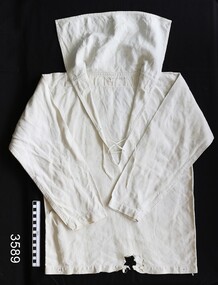
Uniform - Sailor's Shirt, 1920's
... Thomas Francis Ryan (T.F. Ryan, or Tom), in Nhill, Victoria, where his experiences included radiology and pharmacy. In 1927 he was Acting House Surgeon in Dr Tom Ryan’s absence. Dr Angus had become engaged to Gladys...Thomas Francis Ryan (T.F. Ryan, or Tom), in Nhill, Victoria, where his experiences included radiology and pharmacy. In 1927 he was Acting House Surgeon in Dr Tom Ryan’s absence. Dr Angus had become engaged to Gladys ...This sailor's white linen shirt or top was acquired by Dr Angus when working as a Ship's Surgeon on S.S. 'Larg's Bay' returning from the U.K. in 1928 after studies. It was donated to Flagstaff Hill Maritime Village by the family of Doctor William Roy Angus, Surgeon and Oculist. It is part of the “W.R. Angus Collection” which includes historical medical equipment, surgical instruments and material once belonging to Dr Edward Ryan and Dr Thomas Francis Ryan, (both of Nhill, Victoria) as well as Dr Angus’ belongings. The Collection’s history spans the medical practices of the two Doctors Ryan, from 1885-1926 plus that of Dr Angus, up until 1969. ABOUT THE “W.R.ANGUS COLLECTION” Doctor William Roy Angus M.B., B.S., Adel., 1923, F.R.C.S. Edin.,1928 (also known as Dr Roy Angus) was born in Murrumbeena, Victoria in 1901 and lived until 1970. He qualified as a doctor in 1923 at University of Adelaide, was Resident Medical Officer at the Royal Adelaide Hospital in 1924 and for a period was house surgeon to Sir (then Mr.) Henry Simpson Newland. Dr Angus was briefly an Assistant to Dr Riddell of Kapunda, then commenced private practice at Curramulka, Yorke Peninsula, SA, where he was physician, surgeon and chemist. In 1926, he was appointed as new Medical Assistant to Dr Thomas Francis Ryan (T.F. Ryan, or Tom), in Nhill, Victoria, where his experiences included radiology and pharmacy. In 1927 he was Acting House Surgeon in Dr Tom Ryan’s absence. Dr Angus had become engaged to Gladys Forsyth and they decided he would take time to further his studies overseas in the UK in 1927. He studied at London University College Hospital and at Edinburgh Royal Infirmary and in 1928, was awarded FRCS (Fellow from the Royal College of Surgeons), Edinburgh. He worked his passage back to Australia as a Ship’s Surgeon on the on the Australian Commonwealth Line’s SS Largs Bay. Dr Angus married Gladys in 1929, in Ballarat. (They went on to have one son (Graham 1932, born in SA) and two daughters (Helen (died 12/07/1996) and Berenice (Berry), both born at Mira, Nhill ) Dr Angus was a ‘flying doctor’ for the A.I.M. (Australian Inland Ministry) Aerial Medical Service in 1928 . The organisation began in South Australia through the Presbyterian Church in that year, with its first station being in the remote town of Oodnadatta, where Dr Angus was stationed. He was locum tenens there on North-South Railway at 21 Mile Camp. He took up this ‘flying doctor’ position in response to a call from Dr John Flynn; the organisation was later known as the Flying Doctor Service, then the Royal Flying Doctor Service. A lot of his work during this time involved dental surgery also. Between 1928-1932 he was surgeon at the Curramulka Hospital, Yorke Peninsula, South Australia. In 1933 Dr Angus returned to Nhill where he’d previously worked as Medical Assistant and purchased a share of the Nelson Street practice and Mira hospital from Dr Les Middleton one of the Middleton Brothers, the current owners of what was once Dr Tom Ryan’s practice. Dr L Middleton was House Surgeon to the Nhill Hospital 1926-1933, when he resigned. [Dr Tom Ryan’s practice had originally belonged to his older brother Dr Edward Ryan, who came to Nhill in 1885. Dr Edward saw patients at his rooms, firstly in Victoria Street and in 1886 in Nelson Street, until 1901. The Nelson Street practice also had a 2 bed ward, called Mira Private Hospital ). Dr Edward Ryan was House Surgeon at the Nhill Hospital 1884-1902 . He also had occasions where he successfully performed veterinary surgery for the local farmers too. Dr Tom Ryan then purchased the practice from his brother in 1901. Both Dr Edward and Dr Tom Ryan work as surgeons included eye surgery. Dr Tom Ryan performed many of his operations in the Mira private hospital on his premises. He too was House Surgeon at the Nhill Hospital 1902-1926. Dr Tom Ryan had one of the only two pieces of radiology equipment in Victoria during his practicing years – The Royal Melbourne Hospital had the other one. Over the years Dr Tom Ryan gradually set up what was effectively a training school for country general-practitioner-surgeons. Each patient was carefully examined, including using the X-ray machine, and any surgery was discussed and planned with Dr Ryan’s assistants several days in advance. Dr Angus gained experience in using the X-ray machine there during his time as assistant to Dr Ryan. Dr Tom Ryan moved from Nhill in 1926. He became a Fellow of the Royal Australasian College of Surgeons in 1927, soon after its formation, a rare accolade for a doctor outside any of the major cities. He remained a bachelor and died suddenly on 7th Dec 1955, aged 91, at his home in Ararat. Scholarships and prizes are still awarded to medical students in the honour of Dr T.F. Ryan and his father, Dr Michael Ryan, and brother, John Patrick Ryan. ] When Dr Angus bought into the Nelson Street premises in Nhill he was also appointed as the Nhill Hospital’s Honorary House Surgeon 1933-1938. His practitioner’s plate from his Nhill surgery states “HOURS Daily, except Tuesdays, Fridays and Saturday afternoons, 9-10am, 2-4pm, 7-8pm. Sundays by appointment”. This plate is now mounted on the doorway to the Port Medical Office at Flagstaff Hill Maritime Village, Warrnambool. Dr Edward Ryan and Dr Tom Ryan had an extensive collection of historical medical equipment and materials spanning 1884-1926 and when Dr Angus took up practice in their old premises he obtained this collection, a large part of which is now on display at the Port Medical Office at Flagstaff Hill Maritime Village in Warrnambool. During his time in Nhill Dr Angus was involved in the merging of the Mira Hospital and Nhill Public Hospital into one public hospital and the property titles passed on to Nhill Hospital in 1939. In 1939 Dr Angus and his family moved to Warrnambool where he purchased “Birchwood,” the 1852 home and medical practice of Dr John Hunter Henderson, at 214 Koroit Street. (This property was sold in1965 to the State Government and is now the site of the Warrnambool Police Station. ). The Angus family was able to afford gardeners, cooks and maids; their home was a popular place for visiting dignitaries to stay whilst visiting Warrnambool. Dr Angus had his own silk worm farm at home in a Mulberry tree. His young daughter used his centrifuge for spinning the silk. Dr Angus was appointed on a part-time basis as Port Medical Officer (Health Officer) in Warrnambool and held this position until the 1940’s when the government no longer required the service of a Port Medical Officer in Warrnambool; he was thus Warrnambool’s last serving Port Medical Officer. (The duties of a Port Medical Officer were outlined by the Colonial Secretary on 21st June, 1839 under the terms of the Quarantine Act. Masters of immigrant ships arriving in port reported incidents of diseases, illness and death and the Port Medical Officer made a decision on whether the ship required Quarantine and for how long, in this way preventing contagious illness from spreading from new immigrants to the residents already in the colony.) Dr Angus was a member of the Australian Medical Association, for 35 years and surgeon at the Warrnambool Base Hospital 1939-1942, He served as a Surgeon Captain during WWII1942-45, in Ballarat, Victoria, and in Bonegilla, N.S.W., completing his service just before the end of the war due to suffering from a heart attack. During his convalescence he carved an intricate and ‘most artistic’ chess set from the material that dentures were made from. He then studied ophthalmology at the Royal Melbourne Eye and Ear Hospital and created cosmetically superior artificial eyes by pioneering using the intrascleral cartilage. Angus received accolades from the Ophthalmological Society of Australasia for this work. He returned to Warrnambool to commence practice as an ophthalmologist, pioneering in artificial eye improvements. He was Honorary Consultant Ophthalmologist to Warrnambool Base Hospital for 31 years. He made monthly visits to Portland as a visiting surgeon, to perform eye surgery. He represented the Victorian South-West subdivision of the Australian Medical Association as its secretary between 1949 and 1956 and as chairman from 1956 to 1958. In 1968 Dr Angus was elected member of Spain’s Barraquer Institute of Barcelona after his research work in Intrasclearal cartilage grafting, becoming one of the few Australian ophthalmologists to receive this honour, and in the following year presented his final paper on Living Intrasclearal Cartilage Implants at the Inaugural Meeting of the Australian College of Ophthalmologists in Melbourne In his personal life Dr Angus was a Presbyterian and treated Sunday as a Sabbath, a day of rest. He would visit 3 or 4 country patients on a Sunday, taking his children along ‘for the ride’ and to visit with him. Sunday evenings he would play the pianola and sing Scottish songs to his family. One of Dr Angus’ patients was Margaret MacKenzie, author of a book on local shipwrecks that she’d seen as an eye witness from the late 1880’s in Peterborough, Victoria. In the early 1950’s Dr Angus, painted a picture of a shipwreck for the cover jacket of Margaret’s book, Shipwrecks and More Shipwrecks. She was blind in later life and her daughter wrote the actual book for her. Dr Angus and his wife Gladys were very involved in Warrnambool’s society with a strong interest in civic affairs. Their interests included organisations such as Red Cross, Rostrum, Warrnambool and District Historical Society (founding members), Wine and Food Society, Steering Committee for Tertiary Education in Warrnambool, Local National Trust, Good Neighbour Council, Housing Commission Advisory Board, United Services Institute, Legion of Ex-Servicemen, Olympic Pool Committee, Food for Britain Organisation, Warrnambool Hospital, Anti-Cancer Council, Boys’ Club, Charitable Council, National Fitness Council and Air Raid Precautions Group. He was also a member of the Steam Preservation Society and derived much pleasure from a steam traction engine on his farm. He had an interest in people and the community He and his wife Gladys were both involved in the creation of Flagstaff Hill, including the layout of the gardens. After his death (28th March 1970) his family requested his practitioner’s plate, medical instruments and some personal belongings be displayed in the Port Medical Office surgery at Flagstaff Hill Maritime Village, and be called the “W. R. Angus Collection”. The W.R. Angus Collection is significant for still being located at the site it is connected with, Doctor Angus being the last Port Medical Officer in Warrnambool. The collection of medical instruments and other equipment is culturally significant, being a historical example of medicine from late 19th to mid-20th century. Dr Angus assisted Dr Tom Ryan, a pioneer in the use of X-rays and ocular surgery. Sailor’s shirt (or top); white linen 1920s-era shirt with a square collar at the back. The neck slit has eyelets with lacing threaded across. Pocket inside on left breast. Hem has four eyelet holes, two at the front, and two at the back. It is part of the W.R. Angus CollectionMaker's tag "MADE BY / - - - - JONES / S - - - - E -", size tag "2.", hand written "LOGAN". flagstaff hill, flagstaff hill maritime museum and village, warrnambool, maritime museum, maritime village, great ocean road, shipwreck coast, sailor’s shirt, sailor’s top, sailor’s uniform, uniform, w r angus, largs bay, 1928, 1920s, ship’s doctor -
 Flagstaff Hill Maritime Museum and Village
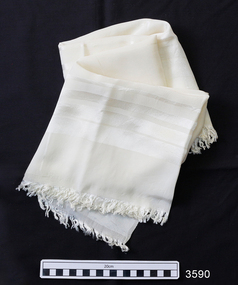
Scarf, 20th century
... Thomas Francis Ryan (T.F. Ryan, or Tom), in Nhill, Victoria, where his experiences included radiology and pharmacy. In 1927 he was Acting House Surgeon in Dr Tom Ryan’s absence. Dr Angus had become engaged to Gladys...Thomas Francis Ryan (T.F. Ryan, or Tom), in Nhill, Victoria, where his experiences included radiology and pharmacy. In 1927 he was Acting House Surgeon in Dr Tom Ryan’s absence. Dr Angus had become engaged to Gladys ...This scarf was worn by Dr. W.R. Angus on formal occasions, together with his formal suit. Suit and scarf were donated to Flagstaff Hill Maritime Village by the family of Doctor William Roy Angus, Surgeon and Oculist. It is part of the “W.R. Angus Collection” that includes historical medical equipment, surgical instruments and material once belonging to Dr Edward Ryan and Dr Thomas Francis Ryan, (both of Nhill, Victoria) as well as Dr Angus’ own belongings. The Collection’s history spans the medical practices of the two Doctors Ryan, from 1885-1926 plus that of Dr Angus, up until 1969. ABOUT THE “W.R.ANGUS COLLECTION” Doctor William Roy Angus M.B., B.S., Adel., 1923, F.R.C.S. Edin.,1928 (also known as Dr Roy Angus) was born in Murrumbeena, Victoria in 1901 and lived until 1970. He qualified as a doctor in 1923 at University of Adelaide, was Resident Medical Officer at the Royal Adelaide Hospital in 1924 and for a period was house surgeon to Sir (then Mr.) Henry Simpson Newland. Dr Angus was briefly an Assistant to Dr Riddell of Kapunda, then commenced private practice at Curramulka, Yorke Peninsula, SA, where he was physician, surgeon and chemist. In 1926, he was appointed as new Medical Assistant to Dr Thomas Francis Ryan (T.F. Ryan, or Tom), in Nhill, Victoria, where his experiences included radiology and pharmacy. In 1927 he was Acting House Surgeon in Dr Tom Ryan’s absence. Dr Angus had become engaged to Gladys Forsyth and they decided he would take time to further his studies overseas in the UK in 1927. He studied at London University College Hospital and at Edinburgh Royal Infirmary and in 1928, was awarded FRCS (Fellow from the Royal College of Surgeons), Edinburgh. He worked his passage back to Australia as a Ship’s Surgeon on the on the Australian Commonwealth Line’s T.S.S. Largs Bay. Dr Angus married Gladys in 1929, in Ballarat. (They went on to have one son (Graham 1932, born in SA) and two daughters (Helen (died 12/07/1996) and Berenice (Berry), both born at Mira, Nhill ) Dr Angus was a ‘flying doctor’ for the A.I.M. (Australian Inland Ministry) Aerial Medical Service in 1928 . The organisation began in South Australia through the Presbyterian Church in that year, with its first station being in the remote town of Oodnadatta, where Dr Angus was stationed. He was locum tenens there on North-South Railway at 21 Mile Camp. He took up this ‘flying doctor’ position in response to a call from Dr John Flynn; the organisation was later known as the Flying Doctor Service, then the Royal Flying Doctor Service. A lot of his work during this time involved dental surgery also. Between 1928-1932 he was surgeon at the Curramulka Hospital, Yorke Peninsula, South Australia. In 1933 Dr Angus returned to Nhill where he’d previously worked as Medical Assistant and purchased a share of the Nelson Street practice and Mira hospital from Dr Les Middleton one of the Middleton Brothers, the current owners of what was once Dr Tom Ryan’s practice. Dr L Middleton was House Surgeon to the Nhill Hospital 1926-1933, when he resigned. [Dr Tom Ryan’s practice had originally belonged to his older brother Dr Edward Ryan, who came to Nhill in 1885. Dr Edward saw patients at his rooms, firstly in Victoria Street and in 1886 in Nelson Street, until 1901. The Nelson Street practice also had a 2 bed ward, called Mira Private Hospital ). Dr Edward Ryan was House Surgeon at the Nhill Hospital 1884-1902 . He also had occasions where he successfully performed veterinary surgery for the local farmers too. Dr Tom Ryan then purchased the practice from his brother in 1901. Both Dr Edward and Dr Tom Ryan work as surgeons included eye surgery. Dr Tom Ryan performed many of his operations in the Mira private hospital on his premises. He too was House Surgeon at the Nhill Hospital 1902-1926. Dr Tom Ryan had one of the only two pieces of radiology equipment in Victoria during his practicing years – The Royal Melbourne Hospital had the other one. Over the years Dr Tom Ryan gradually set up what was effectively a training school for country general-practitioner-surgeons. Each patient was carefully examined, including using the X-ray machine, and any surgery was discussed and planned with Dr Ryan’s assistants several days in advance. Dr Angus gained experience in using the X-ray machine there during his time as assistant to Dr Ryan. Dr Tom Ryan moved from Nhill in 1926. He became a Fellow of the Royal Australasian College of Surgeons in 1927, soon after its formation, a rare accolade for a doctor outside any of the major cities. He remained a bachelor and died suddenly on 7th Dec 1955, aged 91, at his home in Ararat. Scholarships and prizes are still awarded to medical students in the honour of Dr T.F. Ryan and his father, Dr Michael Ryan, and brother, John Patrick Ryan. ] When Dr Angus bought into the Nelson Street premises in Nhill he was also appointed as the Nhill Hospital’s Honorary House Surgeon 1933-1938. His practitioner’s plate from his Nhill surgery states “HOURS Daily, except Tuesdays, Fridays and Saturday afternoons, 9-10am, 2-4pm, 7-8pm. Sundays by appointment”. This plate is now mounted on the doorway to the Port Medical Office at Flagstaff Hill Maritime Village, Warrnambool. Dr Edward Ryan and Dr Tom Ryan had an extensive collection of historical medical equipment and materials spanning 1884-1926 and when Dr Angus took up practice in their old premises he obtained this collection, a large part of which is now on display at the Port Medical Office at Flagstaff Hill Maritime Village in Warrnambool. During his time in Nhill Dr Angus was involved in the merging of the Mira Hospital and Nhill Public Hospital into one public hospital and the property titles passed on to Nhill Hospital in 1939. In 1939 Dr Angus and his family moved to Warrnambool where he purchased “Birchwood,” the 1852 home and medical practice of Dr John Hunter Henderson, at 214 Koroit Street. (This property was sold in1965 to the State Government and is now the site of the Warrnambool Police Station. ). The Angus family was able to afford gardeners, cooks and maids; their home was a popular place for visiting dignitaries to stay whilst visiting Warrnambool. Dr Angus had his own silk worm farm at home in a Mulberry tree. His young daughter used his centrifuge for spinning the silk. Dr Angus was appointed on a part-time basis as Port Medical Officer (Health Officer) in Warrnambool and held this position until the 1940’s when the government no longer required the service of a Port Medical Officer in Warrnambool; he was thus Warrnambool’s last serving Port Medical Officer. (The duties of a Port Medical Officer were outlined by the Colonial Secretary on 21st June, 1839 under the terms of the Quarantine Act. Masters of immigrant ships arriving in port reported incidents of diseases, illness and death and the Port Medical Officer made a decision on whether the ship required Quarantine and for how long, in this way preventing contagious illness from spreading from new immigrants to the residents already in the colony.) Dr Angus was a member of the Australian Medical Association, for 35 years and surgeon at the Warrnambool Base Hospital 1939-1942, He served as a Surgeon Captain during WWII 1941-45, in Ballarat, Victoria, and in Bonegilla, N.S.W., completing his service just before the end of the war due to suffering from a heart attack. During his convalescence he carved an intricate and ‘most artistic’ chess set from the material that dentures were made from. He then studied ophthalmology at the Royal Melbourne Eye and Ear Hospital and created cosmetically superior artificial eyes by pioneering using the intrascleral cartilage. Angus received accolades from the Ophthalmological Society of Australasia for this work. He returned to Warrnambool to commence practice as an ophthalmologist, pioneering in artificial eye improvements. He was Honorary Consultant Ophthalmologist to Warrnambool Base Hospital for 31 years. He made monthly visits to Portland as a visiting surgeon, to perform eye surgery. He represented the Victorian South-West subdivision of the Australian Medical Association as its secretary between 1949 and 1956 and as chairman from 1956 to 1958. In 1968 Dr Angus was elected member of Spain’s Barraquer Institute of Barcelona after his research work in Intrasclearal cartilage grafting, becoming one of the few Australian ophthalmologists to receive this honour, and in the following year presented his final paper on Living Intrasclearal Cartilage Implants at the Inaugural Meeting of the Australian College of Ophthalmologists in Melbourne In his personal life Dr Angus was a Presbyterian and treated Sunday as a Sabbath, a day of rest. He would visit 3 or 4 country patients on a Sunday, taking his children along ‘for the ride’ and to visit with him. Sunday evenings he would play the pianola and sing Scottish songs to his family. One of Dr Angus’ patients was Margaret MacKenzie, author of a book on local shipwrecks that she’d seen as an eye witness from the late 1880’s in Peterborough, Victoria. In the early 1950’s Dr Angus, painted a picture of a shipwreck for the cover jacket of Margaret’s book, Shipwrecks and More Shipwrecks. She was blind in later life and her daughter wrote the actual book for her. Dr Angus and his wife Gladys were very involved in Warrnambool’s society with a strong interest in civic affairs. Their interests included organisations such as Red Cross, Rostrum, Warrnambool and District Historical Society (founding members), Wine and Food Society, Steering Committee for Tertiary Education in Warrnambool, Local National Trust, Good Neighbour Council, Housing Commission Advisory Board, United Services Institute, Legion of Ex-Servicemen, Olympic Pool Committee, Food for Britain Organisation, Warrnambool Hospital, Anti-Cancer Council, Boys’ Club, Charitable Council, National Fitness Council and Air Raid Precautions Group. He was also a member of the Steam Preservation Society and derived much pleasure from a steam traction engine on his farm. He had an interest in people and the community He and his wife Gladys were both involved in the creation of Flagstaff Hill, including the layout of the gardens. After his death (28th March 1970) his family requested his practitioner’s plate, medical instruments and some personal belongings be displayed in the Port Medical Office surgery at Flagstaff Hill Maritime Village, and be called the “W. R. Angus Collection”. The W.R. Angus Collection is significant for still being located at the site it is connected with, Doctor Angus being the last Port Medical Officer in Warrnambool. The collection of medical instruments and other equipment is culturally significant, being an historical example of medicine from late 19th to mid-20th century. Dr Angus assisted Dr Tom Ryan, a pioneer in the use of X-rays and in ocular surgery. Silk scarf, off white colour, embossed self patterned, fringed on 2 sides. This scarf was worn by Dr. W.R.Angus, together with his evening suit, on cold evenings in Warrnambool. flagstaff hill, warrnambool, shipwrecked-coast, flagstaff-hill, flagstaff-hill-maritime-museum, maritime-museum, shipwreck-coast, flagstaff-hill-maritime-village, great ocean road, dr w r angus, dr ryan, surgical instrument, t.s.s. largs bay, warrnambool base hospital, nhill base hospital, mira hospital, flying doctor, silk scarf, formal suit, formal attire 20th century, men's clothing -
 Flagstaff Hill Maritime Museum and Village
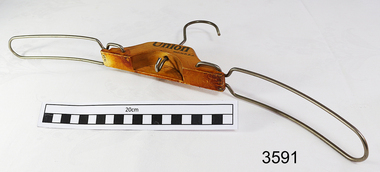
Coat hanger, mid 1900's
... Thomas Francis Ryan (T.F. Ryan, or Tom), in Nhill, Victoria, where his experiences included radiology and pharmacy. In 1927 he was Acting House Surgeon in Dr Tom Ryan’s absence. Dr Angus had become engaged to Gladys...Thomas Francis Ryan (T.F. Ryan, or Tom), in Nhill, Victoria, where his experiences included radiology and pharmacy. In 1927 he was Acting House Surgeon in Dr Tom Ryan’s absence. Dr Angus had become engaged to Gladys ...This wooden and wire, folding coat hanger was donated to Flagstaff Hill Maritime Village by the family of Doctor William Roy Angus, Surgeon and Oculist. It is part of the “W.R. Angus Collection” that includes historical medical equipment, surgical instruments and material once belonging to Dr Edward Ryan and Dr Thomas Francis Ryan, (both of Nhill, Victoria) as well as Dr Angus’ own belongings. The Collection’s history spans the medical practices of the two Doctors Ryan, from 1885-1926 plus that of Dr Angus, up until 1969. ABOUT THE “W.R.ANGUS COLLECTION” Doctor William Roy Angus M.B., B.S., Adel., 1923, F.R.C.S. Edin.,1928 (also known as Dr Roy Angus) was born in Murrumbeena, Victoria in 1901 and lived until 1970. He qualified as a doctor in 1923 at University of Adelaide, was Resident Medical Officer at the Royal Adelaide Hospital in 1924 and for a period was house surgeon to Sir (then Mr.) Henry Simpson Newland. Dr Angus was briefly an Assistant to Dr Riddell of Kapunda, then commenced private practice at Curramulka, Yorke Peninsula, SA, where he was physician, surgeon and chemist. In 1926, he was appointed as new Medical Assistant to Dr Thomas Francis Ryan (T.F. Ryan, or Tom), in Nhill, Victoria, where his experiences included radiology and pharmacy. In 1927 he was Acting House Surgeon in Dr Tom Ryan’s absence. Dr Angus had become engaged to Gladys Forsyth and they decided he would take time to further his studies overseas in the UK in 1927. He studied at London University College Hospital and at Edinburgh Royal Infirmary and in 1928, was awarded FRCS (Fellow from the Royal College of Surgeons), Edinburgh. He worked his passage back to Australia as a Ship’s Surgeon on the on the Australian Commonwealth Line’s SS Largs Bay. Dr Angus married Gladys in 1929, in Ballarat. (They went on to have one son (Graham 1932, born in SA) and two daughters (Helen (died 12/07/1996) and Berenice (Berry), both born at Mira, Nhill ) Dr Angus was a ‘flying doctor’ for the A.I.M. (Australian Inland Ministry) Aerial Medical Service in 1928 . The organisation began in South Australia through the Presbyterian Church in that year, with its first station being in the remote town of Oodnadatta, where Dr Angus was stationed. He was locum tenens there on North-South Railway at 21 Mile Camp. He took up this ‘flying doctor’ position in response to a call from Dr John Flynn; the organisation was later known as the Flying Doctor Service, then the Royal Flying Doctor Service. A lot of his work during this time involved dental surgery also. Between 1928-1932 he was surgeon at the Curramulka Hospital, Yorke Peninsula, South Australia. In 1933 Dr Angus returned to Nhill where he’d previously worked as Medical Assistant and purchased a share of the Nelson Street practice and Mira hospital from Dr Les Middleton one of the Middleton Brothers, the current owners of what was once Dr Tom Ryan’s practice. Dr L Middleton was House Surgeon to the Nhill Hospital 1926-1933, when he resigned. [Dr Tom Ryan’s practice had originally belonged to his older brother Dr Edward Ryan, who came to Nhill in 1885. Dr Edward saw patients at his rooms, firstly in Victoria Street and in 1886 in Nelson Street, until 1901. The Nelson Street practice also had a 2 bed ward, called Mira Private Hospital ). Dr Edward Ryan was House Surgeon at the Nhill Hospital 1884-1902 . He also had occasions where he successfully performed veterinary surgery for the local farmers too. Dr Tom Ryan then purchased the practice from his brother in 1901. Both Dr Edward and Dr Tom Ryan work as surgeons included eye surgery. Dr Tom Ryan performed many of his operations in the Mira private hospital on his premises. He too was House Surgeon at the Nhill Hospital 1902-1926. Dr Tom Ryan had one of the only two pieces of radiology equipment in Victoria during his practicing years – The Royal Melbourne Hospital had the other one. Over the years Dr Tom Ryan gradually set up what was effectively a training school for country general-practitioner-surgeons. Each patient was carefully examined, including using the X-ray machine, and any surgery was discussed and planned with Dr Ryan’s assistants several days in advance. Dr Angus gained experience in using the X-ray machine there during his time as assistant to Dr Ryan. Dr Tom Ryan moved from Nhill in 1926. He became a Fellow of the Royal Australasian College of Surgeons in 1927, soon after its formation, a rare accolade for a doctor outside any of the major cities. He remained a bachelor and died suddenly on 7th Dec 1955, aged 91, at his home in Ararat. Scholarships and prizes are still awarded to medical students in the honour of Dr T.F. Ryan and his father, Dr Michael Ryan, and brother, John Patrick Ryan. ] When Dr Angus bought into the Nelson Street premises in Nhill he was also appointed as the Nhill Hospital’s Honorary House Surgeon 1933-1938. His practitioner’s plate from his Nhill surgery states “HOURS Daily, except Tuesdays, Fridays and Saturday afternoons, 9-10am, 2-4pm, 7-8pm. Sundays by appointment”. This plate is now mounted on the doorway to the Port Medical Office at Flagstaff Hill Maritime Village, Warrnambool. Dr Edward Ryan and Dr Tom Ryan had an extensive collection of historical medical equipment and materials spanning 1884-1926 and when Dr Angus took up practice in their old premises he obtained this collection, a large part of which is now on display at the Port Medical Office at Flagstaff Hill Maritime Village in Warrnambool. During his time in Nhill Dr Angus was involved in the merging of the Mira Hospital and Nhill Public Hospital into one public hospital and the property titles passed on to Nhill Hospital in 1939. In 1939 Dr Angus and his family moved to Warrnambool where he purchased “Birchwood,” the 1852 home and medical practice of Dr John Hunter Henderson, at 214 Koroit Street. (This property was sold in1965 to the State Government and is now the site of the Warrnambool Police Station. ). The Angus family was able to afford gardeners, cooks and maids; their home was a popular place for visiting dignitaries to stay whilst visiting Warrnambool. Dr Angus had his own silk worm farm at home in a Mulberry tree. His young daughter used his centrifuge for spinning the silk. Dr Angus was appointed on a part-time basis as Port Medical Officer (Health Officer) in Warrnambool and held this position until the 1940’s when the government no longer required the service of a Port Medical Officer in Warrnambool; he was thus Warrnambool’s last serving Port Medical Officer. (The duties of a Port Medical Officer were outlined by the Colonial Secretary on 21st June, 1839 under the terms of the Quarantine Act. Masters of immigrant ships arriving in port reported incidents of diseases, illness and death and the Port Medical Officer made a decision on whether the ship required Quarantine and for how long, in this way preventing contagious illness from spreading from new immigrants to the residents already in the colony.) Dr Angus was a member of the Australian Medical Association, for 35 years and surgeon at the Warrnambool Base Hospital 1939-1942, He served as a Surgeon Captain during WWII1942-45, in Ballarat, Victoria, and in Bonegilla, N.S.W., completing his service just before the end of the war due to suffering from a heart attack. During his convalescence he carved an intricate and ‘most artistic’ chess set from the material that dentures were made from. He then studied ophthalmology at the Royal Melbourne Eye and Ear Hospital and created cosmetically superior artificial eyes by pioneering using the intrascleral cartilage. Angus received accolades from the Ophthalmological Society of Australasia for this work. He returned to Warrnambool to commence practice as an ophthalmologist, pioneering in artificial eye improvements. He was Honorary Consultant Ophthalmologist to Warrnambool Base Hospital for 31 years. He made monthly visits to Portland as a visiting surgeon, to perform eye surgery. He represented the Victorian South-West subdivision of the Australian Medical Association as its secretary between 1949 and 1956 and as chairman from 1956 to 1958. In 1968 Dr Angus was elected member of Spain’s Barraquer Institute of Barcelona after his research work in Intrasclearal cartilage grafting, becoming one of the few Australian ophthalmologists to receive this honour, and in the following year presented his final paper on Living Intrasclearal Cartilage Implants at the Inaugural Meeting of the Australian College of Ophthalmologists in Melbourne In his personal life Dr Angus was a Presbyterian and treated Sunday as a Sabbath, a day of rest. He would visit 3 or 4 country patients on a Sunday, taking his children along ‘for the ride’ and to visit with him. Sunday evenings he would play the pianola and sing Scottish songs to his family. One of Dr Angus’ patients was Margaret MacKenzie, author of a book on local shipwrecks that she’d seen as an eye witness from the late 1880’s in Peterborough, Victoria. In the early 1950’s Dr Angus, painted a picture of a shipwreck for the cover jacket of Margaret’s book, Shipwrecks and More Shipwrecks. She was blind in later life and her daughter wrote the actual book for her. Dr Angus and his wife Gladys were very involved in Warrnambool’s society with a strong interest in civic affairs. Their interests included organisations such as Red Cross, Rostrum, Warrnambool and District Historical Society (founding members), Wine and Food Society, Steering Committee for Tertiary Education in Warrnambool, Local National Trust, Good Neighbour Council, Housing Commission Advisory Board, United Services Institute, Legion of Ex-Servicemen, Olympic Pool Committee, Food for Britain Organisation, Warrnambool Hospital, Anti-Cancer Council, Boys’ Club, Charitable Council, National Fitness Council and Air Raid Precautions Group. He was also a member of the Steam Preservation Society and derived much pleasure from a steam traction engine on his farm. He had an interest in people and the community He and his wife Gladys were both involved in the creation of Flagstaff Hill, including the layout of the gardens. After his death (28th March 1970) his family requested his practitioner’s plate, medical instruments and some personal belongings be displayed in the Port Medical Office surgery at Flagstaff Hill Maritime Village, and be called the “W. R. Angus Collection”. The W.R. Angus Collection is significant for still being located at the site it is connected with, Doctor Angus being the last Port Medical Officer in Warrnambool. The collection of medical instruments and other equipment is culturally significant, being an historical example of medicine from late 19th to mid-20th century. Dr Angus assisted Dr Tom Ryan, a pioneer in the use of X-rays and in ocular surgery. Folding coat hanger owned by Dr Angus. Wooden centre piece and looped metal shoulder pieces and metal hook. Wood is stamped “UNION / Made in U.S.A.” and hand engraved “W.R.A.”. Folded measurements (W.R. Angus Collection) Wood is stamped “UNION / Made in U.S.A.” and hand engraved “W.R.A.”. flagstaff hill, warrnambool, shipwrecked-coast, flagstaff-hill, flagstaff-hill-maritime-museum, maritime-museum, shipwreck-coast, flagstaff-hill-maritime-village, dr w r angus, medical equipment, surgical instrument, dr ryan, ophthalmology, warrnambool base hospital, nhill base hospital, flying doctor, medical history, medical treatment, mira hospital, medical education, medical text book, t.s.s largs bay -
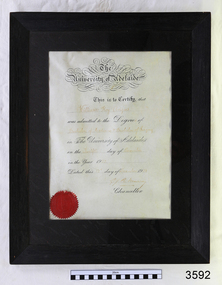 Flagstaff Hill Maritime Museum and Village
Certificate, 1923
... Thomas Francis Ryan (T.F. Ryan, or Tom), in Nhill, Victoria, where his experiences included radiology and pharmacy. In 1927 he was Acting House Surgeon in Dr Tom Ryan’s absence. Dr Angus had become engaged to Gladys...Thomas Francis Ryan (T.F. Ryan, or Tom), in Nhill, Victoria, where his experiences included radiology and pharmacy. In 1927 he was Acting House Surgeon in Dr Tom Ryan’s absence. Dr Angus had become engaged to Gladys ...This Certificate was donated to Flagstaff Hill Maritime Village by the family of Doctor William Roy Angus, Surgeon and Oculist. It is part of the “W.R. Angus Collection” that includes historical medical equipment, surgical instruments and material once belonging to Dr Edward Ryan and Dr Thomas Francis Ryan, (both of Nhill, Victoria) as well as Dr Angus’ own belongings. The Collection’s history spans the medical practices of the two Doctors Ryan, from 1885-1926 plus that of Dr Angus, up until 1969. ABOUT THE “W.R.ANGUS COLLECTION” Doctor William Roy Angus M.B., B.S., Adel., 1923, F.R.C.S. Edin.,1928 (also known as Dr Roy Angus) was born in Murrumbeena, Victoria in 1901 and lived until 1970. He qualified as a doctor in 1923 at University of Adelaide, was Resident Medical Officer at the Royal Adelaide Hospital in 1924 and for a period was house surgeon to Sir (then Mr.) Henry Simpson Newland. Dr Angus was briefly an Assistant to Dr Riddell of Kapunda, then commenced private practice at Curramulka, Yorke Peninsula, SA, where he was physician, surgeon and chemist. In 1926, he was appointed as new Medical Assistant to Dr Thomas Francis Ryan (T.F. Ryan, or Tom), in Nhill, Victoria, where his experiences included radiology and pharmacy. In 1927 he was Acting House Surgeon in Dr Tom Ryan’s absence. Dr Angus had become engaged to Gladys Forsyth and they decided he would take time to further his studies overseas in the UK in 1927. He studied at London University College Hospital and at Edinburgh Royal Infirmary and in 1928, was awarded FRCS (Fellow from the Royal College of Surgeons), Edinburgh. He worked his passage back to Australia as a Ship’s Surgeon on the on the Australian Commonwealth Line’s T.S.S. Largs Bay. Dr Angus married Gladys in 1929, in Ballarat. (They went on to have one son (Graham 1932, born in SA) and two daughters (Helen (died 12/07/1996) and Berenice (Berry), both born at Mira, Nhill ) Dr Angus was a ‘flying doctor’ for the A.I.M. (Australian Inland Ministry) Aerial Medical Service in 1928 . The organisation began in South Australia through the Presbyterian Church in that year, with its first station being in the remote town of Oodnadatta, where Dr Angus was stationed. He was locum tenens there on North-South Railway at 21 Mile Camp. He took up this ‘flying doctor’ position in response to a call from Dr John Flynn; the organisation was later known as the Flying Doctor Service, then the Royal Flying Doctor Service. A lot of his work during this time involved dental surgery also. Between 1928-1932 he was surgeon at the Curramulka Hospital, Yorke Peninsula, South Australia. In 1933 Dr Angus returned to Nhill where he’d previously worked as Medical Assistant and purchased a share of the Nelson Street practice and Mira hospital from Dr Les Middleton one of the Middleton Brothers, the current owners of what was once Dr Tom Ryan’s practice. Dr L Middleton was House Surgeon to the Nhill Hospital 1926-1933, when he resigned. [Dr Tom Ryan’s practice had originally belonged to his older brother Dr Edward Ryan, who came to Nhill in 1885. Dr Edward saw patients at his rooms, firstly in Victoria Street and in 1886 in Nelson Street, until 1901. The Nelson Street practice also had a 2 bed ward, called Mira Private Hospital ). Dr Edward Ryan was House Surgeon at the Nhill Hospital 1884-1902 . He also had occasions where he successfully performed veterinary surgery for the local farmers too. Dr Tom Ryan then purchased the practice from his brother in 1901. Both Dr Edward and Dr Tom Ryan work as surgeons included eye surgery. Dr Tom Ryan performed many of his operations in the Mira private hospital on his premises. He too was House Surgeon at the Nhill Hospital 1902-1926. Dr Tom Ryan had one of the only two pieces of radiology equipment in Victoria during his practicing years – The Royal Melbourne Hospital had the other one. Over the years Dr Tom Ryan gradually set up what was effectively a training school for country general-practitioner-surgeons. Each patient was carefully examined, including using the X-ray machine, and any surgery was discussed and planned with Dr Ryan’s assistants several days in advance. Dr Angus gained experience in using the X-ray machine there during his time as assistant to Dr Ryan. Dr Tom Ryan moved from Nhill in 1926. He became a Fellow of the Royal Australasian College of Surgeons in 1927, soon after its formation, a rare accolade for a doctor outside any of the major cities. He remained a bachelor and died suddenly on 7th Dec 1955, aged 91, at his home in Ararat. Scholarships and prizes are still awarded to medical students in the honour of Dr T.F. Ryan and his father, Dr Michael Ryan, and brother, John Patrick Ryan. ] When Dr Angus bought into the Nelson Street premises in Nhill he was also appointed as the Nhill Hospital’s Honorary House Surgeon 1933-1938. His practitioner’s plate from his Nhill surgery states “HOURS Daily, except Tuesdays, Fridays and Saturday afternoons, 9-10am, 2-4pm, 7-8pm. Sundays by appointment”. This plate is now mounted on the doorway to the Port Medical Office at Flagstaff Hill Maritime Village, Warrnambool. Dr Edward Ryan and Dr Tom Ryan had an extensive collection of historical medical equipment and materials spanning 1884-1926 and when Dr Angus took up practice in their old premises he obtained this collection, a large part of which is now on display at the Port Medical Office at Flagstaff Hill Maritime Village in Warrnambool. During his time in Nhill Dr Angus was involved in the merging of the Mira Hospital and Nhill Public Hospital into one public hospital and the property titles passed on to Nhill Hospital in 1939. In 1939 Dr Angus and his family moved to Warrnambool where he purchased “Birchwood,” the 1852 home and medical practice of Dr John Hunter Henderson, at 214 Koroit Street. (This property was sold in1965 to the State Government and is now the site of the Warrnambool Police Station. ). The Angus family was able to afford gardeners, cooks and maids; their home was a popular place for visiting dignitaries to stay whilst visiting Warrnambool. Dr Angus had his own silk worm farm at home in a Mulberry tree. His young daughter used his centrifuge for spinning the silk. Dr Angus was appointed on a part-time basis as Port Medical Officer (Health Officer) in Warrnambool and held this position until the 1940’s when the government no longer required the service of a Port Medical Officer in Warrnambool; he was thus Warrnambool’s last serving Port Medical Officer. (The duties of a Port Medical Officer were outlined by the Colonial Secretary on 21st June, 1839 under the terms of the Quarantine Act. Masters of immigrant ships arriving in port reported incidents of diseases, illness and death and the Port Medical Officer made a decision on whether the ship required Quarantine and for how long, in this way preventing contagious illness from spreading from new immigrants to the residents already in the colony.) Dr Angus was a member of the Australian Medical Association, for 35 years and surgeon at the Warrnambool Base Hospital 1939-1942, He served as a Surgeon Captain during WWII1942-45, in Ballarat, Victoria, and in Bonegilla, N.S.W., completing his service just before the end of the war due to suffering from a heart attack. During his convalescence he carved an intricate and ‘most artistic’ chess set from the material that dentures were made from. He then studied ophthalmology at the Royal Melbourne Eye and Ear Hospital and created cosmetically superior artificial eyes by pioneering using the intrascleral cartilage. Angus received accolades from the Ophthalmological Society of Australasia for this work. He returned to Warrnambool to commence practice as an ophthalmologist, pioneering in artificial eye improvements. He was Honorary Consultant Ophthalmologist to Warrnambool Base Hospital for 31 years. He made monthly visits to Portland as a visiting surgeon, to perform eye surgery. He represented the Victorian South-West subdivision of the Australian Medical Association as its secretary between 1949 and 1956 and as chairman from 1956 to 1958. In 1968 Dr Angus was elected member of Spain’s Barraquer Institute of Barcelona after his research work in Intrasclearal cartilage grafting, becoming one of the few Australian ophthalmologists to receive this honour, and in the following year presented his final paper on Living Intrasclearal Cartilage Implants at the Inaugural Meeting of the Australian College of Ophthalmologists in Melbourne In his personal life Dr Angus was a Presbyterian and treated Sunday as a Sabbath, a day of rest. He would visit 3 or 4 country patients on a Sunday, taking his children along ‘for the ride’ and to visit with him. Sunday evenings he would play the pianola and sing Scottish songs to his family. One of Dr Angus’ patients was Margaret MacKenzie, author of a book on local shipwrecks that she’d seen as an eye witness from the late 1880’s in Peterborough, Victoria. In the early 1950’s Dr Angus, painted a picture of a shipwreck for the cover jacket of Margaret’s book, Shipwrecks and More Shipwrecks. She was blind in later life and her daughter wrote the actual book for her. Dr Angus and his wife Gladys were very involved in Warrnambool’s society with a strong interest in civic affairs. Their interests included organisations such as Red Cross, Rostrum, Warrnambool and District Historical Society (founding members), Wine and Food Society, Steering Committee for Tertiary Education in Warrnambool, Local National Trust, Good Neighbour Council, Housing Commission Advisory Board, United Services Institute, Legion of Ex-Servicemen, Olympic Pool Committee, Food for Britain Organisation, Warrnambool Hospital, Anti-Cancer Council, Boys’ Club, Charitable Council, National Fitness Council and Air Raid Precautions Group. He was also a member of the Steam Preservation Society and derived much pleasure from a steam traction engine on his farm. He had an interest in people and the community He and his wife Gladys were both involved in the creation of Flagstaff Hill, including the layout of the gardens. After his death (28th March 1970) his family requested his practitioner’s plate, medical instruments and some personal belongings be displayed in the Port Medical Office surgery at Flagstaff Hill Maritime Village, and be called the “W. R. Angus Collection”. The W.R. Angus Collection is significant for still being located at the site it is connected with, Doctor Angus being the last Port Medical Officer in Warrnambool. The collection of medical instruments and other equipment is culturally significant, being an historical example of medicine from late 19th to mid-20th century. Dr Angus assisted Dr Tom Ryan, a pioneer in the use of X-rays and in ocular surgery. Framed Certificate, The University of Adelaide, Bachelor of Medicine & Bachelor of Surgery, WR Angus, 1923 (W.R. Angus Collection). Certificate has wooden frame, dark stain, and glass front.flagstaff hill, warrnambool, shipwrecked-coast, flagstaff-hill, flagstaff-hill-maritime-museum, maritime-museum, shipwreck-coast, flagstaff-hill-maritime-village, university of adelaide, medical history, medical education -
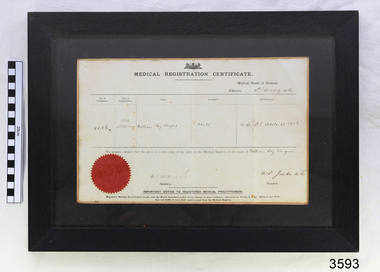 Flagstaff Hill Maritime Museum and Village
Certificate, 04/02/1926
... Thomas Francis Ryan (T.F. Ryan, or Tom), in Nhill, Victoria, where his experiences included radiology and pharmacy. In 1927 he was Acting House Surgeon in Dr Tom Ryan’s absence. Dr Angus had become engaged to Gladys...Thomas Francis Ryan (T.F. Ryan, or Tom), in Nhill, Victoria, where his experiences included radiology and pharmacy. In 1927 he was Acting House Surgeon in Dr Tom Ryan’s absence. Dr Angus had become engaged to Gladys ...This Certificate was donated to Flagstaff Hill Maritime Village by the family of Doctor William Roy Angus, Surgeon and Oculist. It is part of the “W.R. Angus Collection” that includes historical medical equipment, surgical instruments and material once belonging to Dr Edward Ryan and Dr Thomas Francis Ryan, (both of Nhill, Victoria) as well as Dr Angus’ own belongings. The Collection’s history spans the medical practices of the two Doctors Ryan, from 1885-1926 plus that of Dr Angus, up until 1969. ABOUT THE “W.R.ANGUS COLLECTION” Doctor William Roy Angus M.B., B.S., Adel., 1923, F.R.C.S. Edin.,1928 (also known as Dr Roy Angus) was born in Murrumbeena, Victoria in 1901 and lived until 1970. He qualified as a doctor in 1923 at University of Adelaide, was Resident Medical Officer at the Royal Adelaide Hospital in 1924 and for a period was house surgeon to Sir (then Mr.) Henry Simpson Newland. Dr Angus was briefly an Assistant to Dr Riddell of Kapunda, then commenced private practice at Curramulka, Yorke Peninsula, SA, where he was physician, surgeon and chemist. In 1926, he was appointed as new Medical Assistant to Dr Thomas Francis Ryan (T.F. Ryan, or Tom), in Nhill, Victoria, where his experiences included radiology and pharmacy. In 1927 he was Acting House Surgeon in Dr Tom Ryan’s absence. Dr Angus had become engaged to Gladys Forsyth and they decided he would take time to further his studies overseas in the UK in 1927. He studied at London University College Hospital and at Edinburgh Royal Infirmary and in 1928, was awarded FRCS (Fellow from the Royal College of Surgeons), Edinburgh. He worked his passage back to Australia as a Ship’s Surgeon on the on the Australian Commonwealth Line’s T.S.S. Largs Bay. Dr Angus married Gladys in 1929, in Ballarat. (They went on to have one son (Graham 1932, born in SA) and two daughters (Helen (died 12/07/1996) and Berenice (Berry), both born at Mira, Nhill ) Dr Angus was a ‘flying doctor’ for the A.I.M. (Australian Inland Ministry) Aerial Medical Service in 1928 . The organisation began in South Australia through the Presbyterian Church in that year, with its first station being in the remote town of Oodnadatta, where Dr Angus was stationed. He was locum tenens there on North-South Railway at 21 Mile Camp. He took up this ‘flying doctor’ position in response to a call from Dr John Flynn; the organisation was later known as the Flying Doctor Service, then the Royal Flying Doctor Service. A lot of his work during this time involved dental surgery also. Between 1928-1932 he was surgeon at the Curramulka Hospital, Yorke Peninsula, South Australia. In 1933 Dr Angus returned to Nhill where he’d previously worked as Medical Assistant and purchased a share of the Nelson Street practice and Mira hospital from Dr Les Middleton one of the Middleton Brothers, the current owners of what was once Dr Tom Ryan’s practice. Dr L Middleton was House Surgeon to the Nhill Hospital 1926-1933, when he resigned. [Dr Tom Ryan’s practice had originally belonged to his older brother Dr Edward Ryan, who came to Nhill in 1885. Dr Edward saw patients at his rooms, firstly in Victoria Street and in 1886 in Nelson Street, until 1901. The Nelson Street practice also had a 2 bed ward, called Mira Private Hospital ). Dr Edward Ryan was House Surgeon at the Nhill Hospital 1884-1902 . He also had occasions where he successfully performed veterinary surgery for the local farmers too. Dr Tom Ryan then purchased the practice from his brother in 1901. Both Dr Edward and Dr Tom Ryan work as surgeons included eye surgery. Dr Tom Ryan performed many of his operations in the Mira private hospital on his premises. He too was House Surgeon at the Nhill Hospital 1902-1926. Dr Tom Ryan had one of the only two pieces of radiology equipment in Victoria during his practicing years – The Royal Melbourne Hospital had the other one. Over the years Dr Tom Ryan gradually set up what was effectively a training school for country general-practitioner-surgeons. Each patient was carefully examined, including using the X-ray machine, and any surgery was discussed and planned with Dr Ryan’s assistants several days in advance. Dr Angus gained experience in using the X-ray machine there during his time as assistant to Dr Ryan. Dr Tom Ryan moved from Nhill in 1926. He became a Fellow of the Royal Australasian College of Surgeons in 1927, soon after its formation, a rare accolade for a doctor outside any of the major cities. He remained a bachelor and died suddenly on 7th Dec 1955, aged 91, at his home in Ararat. Scholarships and prizes are still awarded to medical students in the honour of Dr T.F. Ryan and his father, Dr Michael Ryan, and brother, John Patrick Ryan. ] When Dr Angus bought into the Nelson Street premises in Nhill he was also appointed as the Nhill Hospital’s Honorary House Surgeon 1933-1938. His practitioner’s plate from his Nhill surgery states “HOURS Daily, except Tuesdays, Fridays and Saturday afternoons, 9-10am, 2-4pm, 7-8pm. Sundays by appointment”. This plate is now mounted on the doorway to the Port Medical Office at Flagstaff Hill Maritime Village, Warrnambool. Dr Edward Ryan and Dr Tom Ryan had an extensive collection of historical medical equipment and materials spanning 1884-1926 and when Dr Angus took up practice in their old premises he obtained this collection, a large part of which is now on display at the Port Medical Office at Flagstaff Hill Maritime Village in Warrnambool. During his time in Nhill Dr Angus was involved in the merging of the Mira Hospital and Nhill Public Hospital into one public hospital and the property titles passed on to Nhill Hospital in 1939. In 1939 Dr Angus and his family moved to Warrnambool where he purchased “Birchwood,” the 1852 home and medical practice of Dr John Hunter Henderson, at 214 Koroit Street. (This property was sold in1965 to the State Government and is now the site of the Warrnambool Police Station. ). The Angus family was able to afford gardeners, cooks and maids; their home was a popular place for visiting dignitaries to stay whilst visiting Warrnambool. Dr Angus had his own silk worm farm at home in a Mulberry tree. His young daughter used his centrifuge for spinning the silk. Dr Angus was appointed on a part-time basis as Port Medical Officer (Health Officer) in Warrnambool and held this position until the 1940’s when the government no longer required the service of a Port Medical Officer in Warrnambool; he was thus Warrnambool’s last serving Port Medical Officer. (The duties of a Port Medical Officer were outlined by the Colonial Secretary on 21st June, 1839 under the terms of the Quarantine Act. Masters of immigrant ships arriving in port reported incidents of diseases, illness and death and the Port Medical Officer made a decision on whether the ship required Quarantine and for how long, in this way preventing contagious illness from spreading from new immigrants to the residents already in the colony.) Dr Angus was a member of the Australian Medical Association, for 35 years and surgeon at the Warrnambool Base Hospital 1939-1942, He served as a Surgeon Captain during WWII1942-45, in Ballarat, Victoria, and in Bonegilla, N.S.W., completing his service just before the end of the war due to suffering from a heart attack. During his convalescence he carved an intricate and ‘most artistic’ chess set from the material that dentures were made from. He then studied ophthalmology at the Royal Melbourne Eye and Ear Hospital and created cosmetically superior artificial eyes by pioneering using the intrascleral cartilage. Angus received accolades from the Ophthalmological Society of Australasia for this work. He returned to Warrnambool to commence practice as an ophthalmologist, pioneering in artificial eye improvements. He was Honorary Consultant Ophthalmologist to Warrnambool Base Hospital for 31 years. He made monthly visits to Portland as a visiting surgeon, to perform eye surgery. He represented the Victorian South-West subdivision of the Australian Medical Association as its secretary between 1949 and 1956 and as chairman from 1956 to 1958. In 1968 Dr Angus was elected member of Spain’s Barraquer Institute of Barcelona after his research work in Intrasclearal cartilage grafting, becoming one of the few Australian ophthalmologists to receive this honour, and in the following year presented his final paper on Living Intrasclearal Cartilage Implants at the Inaugural Meeting of the Australian College of Ophthalmologists in Melbourne In his personal life Dr Angus was a Presbyterian and treated Sunday as a Sabbath, a day of rest. He would visit 3 or 4 country patients on a Sunday, taking his children along ‘for the ride’ and to visit with him. Sunday evenings he would play the pianola and sing Scottish songs to his family. One of Dr Angus’ patients was Margaret MacKenzie, author of a book on local shipwrecks that she’d seen as an eye witness from the late 1880’s in Peterborough, Victoria. In the early 1950’s Dr Angus, painted a picture of a shipwreck for the cover jacket of Margaret’s book, Shipwrecks and More Shipwrecks. She was blind in later life and her daughter wrote the actual book for her. Dr Angus and his wife Gladys were very involved in Warrnambool’s society with a strong interest in civic affairs. Their interests included organisations such as Red Cross, Rostrum, Warrnambool and District Historical Society (founding members), Wine and Food Society, Steering Committee for Tertiary Education in Warrnambool, Local National Trust, Good Neighbour Council, Housing Commission Advisory Board, United Services Institute, Legion of Ex-Servicemen, Olympic Pool Committee, Food for Britain Organisation, Warrnambool Hospital, Anti-Cancer Council, Boys’ Club, Charitable Council, National Fitness Council and Air Raid Precautions Group. He was also a member of the Steam Preservation Society and derived much pleasure from a steam traction engine on his farm. He had an interest in people and the community He and his wife Gladys were both involved in the creation of Flagstaff Hill, including the layout of the gardens. After his death (28th March 1970) his family requested his practitioner’s plate, medical instruments and some personal belongings be displayed in the Port Medical Office surgery at Flagstaff Hill Maritime Village, and be called the “W. R. Angus Collection”. The W.R. Angus Collection is significant for still being located at the site it is connected with, Doctor Angus being the last Port Medical Officer in Warrnambool. The collection of medical instruments and other equipment is culturally significant, being an historical example of medicine from late 19th to mid-20th century. Dr Angus assisted Dr Tom Ryan, a pioneer in the use of X-rays and in ocular surgery. Framed Certificate, Medical Registration, Medical Board of Victoria, W.R. Angus, 4/2/1926. Wooden frame, dark stained, with glass front. (W.R. Angus Collection). flagstaff hill, warrnambool, shipwrecked-coast, flagstaff-hill, flagstaff-hill-maritime-museum, maritime-museum, shipwreck-coast, flagstaff-hill-maritime-village, medical board of victoria, medical qualificaiton, dr w r angus, medical history, medical education -
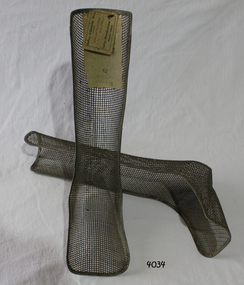 Flagstaff Hill Maritime Museum and Village
Splint, c. 1910-1920
... Thomas Francis Ryan (T.F. Ryan, or Tom), in Nhill, Victoria, where his experiences included radiology and pharmacy. In 1927 he was Acting House Surgeon in Dr Tom Ryan’s absence. Dr Angus had become engaged to Gladys...Thomas Francis Ryan (T.F. Ryan, or Tom), in Nhill, Victoria, where his experiences included radiology and pharmacy. In 1927 he was Acting House Surgeon in Dr Tom Ryan’s absence. Dr Angus had become engaged to Gladys ...This is a pair of vintage DePuy wire mesh splints made to support a broken leg while the bone mended. The design was in use before and during WWI. It replaced the wooden splints previously used to reset bones in the late nineteenth to early 20th century. This new splint was invented by a traveling pharmaceutical salesman, Revra DePuy. He began manufacturing in his Warsaw, Indiana in 1895; the first commercial manufacture of orthopaedic equipment in the world . The company eventually became Johnson & Johnson. This pair of splints was donated to Flagstaff Hill Maritime Village by the family of Doctor William Roy Angus, Surgeon and Oculist. It is part of the “W.R. Angus Collection” that includes historical medical equipment, surgical instruments and material once belonging to Dr Edward Ryan and Dr Thomas Francis Ryan, (both of Nhill, Victoria) as well as Dr Angus’ own belongings. The Collection’s history spans the medical practices of the two Doctors Ryan, from 1885-1926 plus that of Dr Angus, up until 1969. These splints would have belonged to Dr Tom Ryan before being passed onto Dr. W.R. Angus. ABOUT THE “W.R.ANGUS COLLECTION” Doctor William Roy Angus M.B., B.S., Adel., 1923, F.R.C.S. Edin.,1928 (also known as Dr Roy Angus) was born in Murrumbeena, Victoria in 1901 and lived until 1970. He qualified as a doctor in 1923 at University of Adelaide, was Resident Medical Officer at the Royal Adelaide Hospital in 1924 and for a period was house surgeon to Sir (then Mr.) Henry Simpson Newland. Dr Angus was briefly an Assistant to Dr Riddell of Kapunda, then commenced private practice at Curramulka, Yorke Peninsula, SA, where he was physician, surgeon and chemist. In 1926, he was appointed as new Medical Assistant to Dr Thomas Francis Ryan (T.F. Ryan, or Tom), in Nhill, Victoria, where his experiences included radiology and pharmacy. In 1927 he was Acting House Surgeon in Dr Tom Ryan’s absence. Dr Angus had become engaged to Gladys Forsyth and they decided he would take time to further his studies overseas in the UK in 1927. He studied at London University College Hospital and at Edinburgh Royal Infirmary and in 1928, was awarded FRCS (Fellow from the Royal College of Surgeons), Edinburgh. He worked his passage back to Australia as a Ship’s Surgeon on the on the Australian Commonwealth Line’s T.S.S. Largs Bay. Dr Angus married Gladys in 1929, in Ballarat. (They went on to have one son (Graham 1932, born in SA) and two daughters (Helen (died 12/07/1996) and Berenice (Berry), both born at Mira, Nhill ) Dr Angus was a ‘flying doctor’ for the A.I.M. (Australian Inland Ministry) Aerial Medical Service in 1928 . The organisation began in South Australia through the Presbyterian Church in that year, with its first station being in the remote town of Oodnadatta, where Dr Angus was stationed. He was locum tenens there on North-South Railway at 21 Mile Camp. He took up this ‘flying doctor’ position in response to a call from Dr John Flynn; the organisation was later known as the Flying Doctor Service, then the Royal Flying Doctor Service. A lot of his work during this time involved dental surgery also. Between 1928-1932 he was surgeon at the Curramulka Hospital, Yorke Peninsula, South Australia. In 1933 Dr Angus returned to Nhill where he’d previously worked as Medical Assistant and purchased a share of the Nelson Street practice and Mira hospital from Dr Les Middleton one of the Middleton Brothers, the current owners of what was once Dr Tom Ryan’s practice. Dr L Middleton was House Surgeon to the Nhill Hospital 1926-1933, when he resigned. [Dr Tom Ryan’s practice had originally belonged to his older brother Dr Edward Ryan, who came to Nhill in 1885. Dr Edward saw patients at his rooms, firstly in Victoria Street and in 1886 in Nelson Street, until 1901. The Nelson Street practice also had a 2 bed ward, called Mira Private Hospital ). Dr Edward Ryan was House Surgeon at the Nhill Hospital 1884-1902 . He also had occasions where he successfully performed veterinary surgery for the local farmers too. Dr Tom Ryan then purchased the practice from his brother in 1901. Both Dr Edward and Dr Tom Ryan work as surgeons included eye surgery. Dr Tom Ryan performed many of his operations in the Mira private hospital on his premises. He too was House Surgeon at the Nhill Hospital 1902-1926. Dr Tom Ryan had one of the only two pieces of radiology equipment in Victoria during his practicing years – The Royal Melbourne Hospital had the other one. Over the years Dr Tom Ryan gradually set up what was effectively a training school for country general-practitioner-surgeons. Each patient was carefully examined, including using the X-ray machine, and any surgery was discussed and planned with Dr Ryan’s assistants several days in advance. Dr Angus gained experience in using the X-ray machine there during his time as assistant to Dr Ryan. Dr Tom Ryan moved from Nhill in 1926. He became a Fellow of the Royal Australasian College of Surgeons in 1927, soon after its formation, a rare accolade for a doctor outside any of the major cities. He remained a bachelor and died suddenly on 7th Dec 1955, aged 91, at his home in Ararat. Scholarships and prizes are still awarded to medical students in the honour of Dr T.F. Ryan and his father, Dr Michael Ryan, and brother, John Patrick Ryan. ] When Dr Angus bought into the Nelson Street premises in Nhill he was also appointed as the Nhill Hospital’s Honorary House Surgeon 1933-1938. His practitioner’s plate from his Nhill surgery states “HOURS Daily, except Tuesdays, Fridays and Saturday afternoons, 9-10am, 2-4pm, 7-8pm. Sundays by appointment”. This plate is now mounted on the doorway to the Port Medical Office at Flagstaff Hill Maritime Village, Warrnambool. Dr Edward Ryan and Dr Tom Ryan had an extensive collection of historical medical equipment and materials spanning 1884-1926 and when Dr Angus took up practice in their old premises he obtained this collection, a large part of which is now on display at the Port Medical Office at Flagstaff Hill Maritime Village in Warrnambool. During his time in Nhill Dr Angus was involved in the merging of the Mira Hospital and Nhill Public Hospital into one public hospital and the property titles passed on to Nhill Hospital in 1939. In 1939 Dr Angus and his family moved to Warrnambool where he purchased “Birchwood,” the 1852 home and medical practice of Dr John Hunter Henderson, at 214 Koroit Street. (This property was sold in1965 to the State Government and is now the site of the Warrnambool Police Station. ). The Angus family was able to afford gardeners, cooks and maids; their home was a popular place for visiting dignitaries to stay whilst visiting Warrnambool. Dr Angus had his own silk worm farm at home in a Mulberry tree. His young daughter used his centrifuge for spinning the silk. Dr Angus was appointed on a part-time basis as Port Medical Officer (Health Officer) in Warrnambool and held this position until the 1940’s when the government no longer required the service of a Port Medical Officer in Warrnambool; he was thus Warrnambool’s last serving Port Medical Officer. (The duties of a Port Medical Officer were outlined by the Colonial Secretary on 21st June, 1839 under the terms of the Quarantine Act. Masters of immigrant ships arriving in port reported incidents of diseases, illness and death and the Port Medical Officer made a decision on whether the ship required Quarantine and for how long, in this way preventing contagious illness from spreading from new immigrants to the residents already in the colony.) Dr Angus was a member of the Australian Medical Association, for 35 years and surgeon at the Warrnambool Base Hospital 1939-1942, He served as a Surgeon Captain during WWII1942-45, in Ballarat, Victoria, and in Bonegilla, N.S.W., completing his service just before the end of the war due to suffering from a heart attack. During his convalescence he carved an intricate and ‘most artistic’ chess set from the material that dentures were made from. He then studied ophthalmology at the Royal Melbourne Eye and Ear Hospital and created cosmetically superior artificial eyes by pioneering using the intrascleral cartilage. Angus received accolades from the Ophthalmological Society of Australasia for this work. He returned to Warrnambool to commence practice as an ophthalmologist, pioneering in artificial eye improvements. He was Honorary Consultant Ophthalmologist to Warrnambool Base Hospital for 31 years. He made monthly visits to Portland as a visiting surgeon, to perform eye surgery. He represented the Victorian South-West subdivision of the Australian Medical Association as its secretary between 1949 and 1956 and as chairman from 1956 to 1958. In 1968 Dr Angus was elected member of Spain’s Barraquer Institute of Barcelona after his research work in Intrasclearal cartilage grafting, becoming one of the few Australian ophthalmologists to receive this honour, and in the following year presented his final paper on Living Intrasclearal Cartilage Implants at the Inaugural Meeting of the Australian College of Ophthalmologists in Melbourne In his personal life Dr Angus was a Presbyterian and treated Sunday as a Sabbath, a day of rest. He would visit 3 or 4 country patients on a Sunday, taking his children along ‘for the ride’ and to visit with him. Sunday evenings he would play the pianola and sing Scottish songs to his family. One of Dr Angus’ patients was Margaret MacKenzie, author of a book on local shipwrecks that she’d seen as an eye witness from the late 1880’s in Peterborough, Victoria. In the early 1950’s Dr Angus, painted a picture of a shipwreck for the cover jacket of Margaret’s book, Shipwrecks and More Shipwrecks. She was blind in later life and her daughter wrote the actual book for her. Dr Angus and his wife Gladys were very involved in Warrnambool’s society with a strong interest in civic affairs. Their interests included organisations such as Red Cross, Rostrum, Warrnambool and District Historical Society (founding members), Wine and Food Society, Steering Committee for Tertiary Education in Warrnambool, Local National Trust, Good Neighbour Council, Housing Commission Advisory Board, United Services Institute, Legion of Ex-Servicemen, Olympic Pool Committee, Food for Britain Organisation, Warrnambool Hospital, Anti-Cancer Council, Boys’ Club, Charitable Council, National Fitness Council and Air Raid Precautions Group. He was also a member of the Steam Preservation Society and derived much pleasure from a steam traction engine on his farm. He had an interest in people and the community He and his wife Gladys were both involved in the creation of Flagstaff Hill, including the layout of the gardens. After his death (28th March 1970) his family requested his practitioner’s plate, medical instruments and some personal belongings be displayed in the Port Medical Office surgery at Flagstaff Hill Maritime Village, and be called the “W. R. Angus Collection”. The pair of splints was made by the world’s oldest orthopedic company, founded in 1895. The splint was a part of Dr. Tom Ryan’s equipment that was passed onto Dr W.R. Angus. It is part of the collection of historical medical equipment used in Western Victoria in the late 19th and early 20th century. The W.R. Angus Collection is significant for still being located at the site it is connected with, Doctor Angus being the last Port Medical Officer in Warrnambool. The collection of medical instruments and other equipment is culturally significant, being an historical example of medicine from late 19th to mid-20th century. Dr Angus assisted Dr Tom Ryan, a pioneer in the use of X-rays and in ocular surgery. Splint, (pair of 2) from the W.R. Angus Collection. Stiff wire mesh with a hard metal border around the edges, shaped as a food and half leg, with printed paper labels attached to the top. Labels show manufacturer and instructions. Made for supporting Tibia and Fibula bones. Label attached to one split reads "DePuy Adjustable Wire / PATENTED / Tibia and Fibula Splint / No. 32 Medium Posterior / DePuy Manufacturing Co. / Warsaw, Indiana""DePuy Adjustable Wire / PATENTED / Tibia and Fibula Splint / No. 32 Medium Posterior / DePuy Manufacturing Co. / Warsaw, Indiana"flagstaff hill, warrnambool, shipwrecked coast, flagstaff hill maritime museum, maritime museum, shipwreck coast, flagstaff hill maritime village, great ocean road, dr w r angus, dr ryan, surgical instrument, t.s.s. largs bay, warrnambool base hospital, nhill base hospital, mira hospital, flying doctor, medical treatment, medical history, medical education, medical text book, wire mesh splint, wire mesh cast, orthopaedic medical equipment, bone setting equipment, 1910’s medical equipment, medical artefact -
Eltham District Historical Society Inc
Document - Folder, Shillinglaw family
... George Shillinglaw Thomas Shillinglaw William Shillinglaw Andrew Shillinglaw Philip Shillinglaw Anne Shillinglaw Caroline Shillinglaw Edward Edwards Philip Edwards Caroline Edwards James Edwards Charlotte Edwards Margaret Edwards Edith Edwards Elizabeth Edwards Marth Edwards Sarah Ann Kidd Sarah Ann Shillinglaw Jane Shillinglaw Christopher Watson Jean Watson Elizabeth Ann Shillinglaw Mary Ann Shillinglaw Margaret Susan Shillinglaw Alfred Philip Shillinglaw Arthur James Shillinglaw Florence May Shillinglaw Edward Thomas Bunker Edward Ernest Bunker Sebella Doris Noye Florence Joyce Bunker Graham Leslie Gibson Lehanne Gibson Glenn Leslie Gibson Janine Gibson Ernest Geoffrey Bunker Shirley Mary Sealy Wayne Geoffrey Bunker Jennifer Thorton Leslie Bunker Anthony Bunker Bruce Bunker Christina Bunker Robin Gaye Bunker Colin Anderson Malcolm Stewart Anderson Yana Gaye Anderson Alisha Rae Anderson Carley Johanna Anderson Debby Lee Bunker Christopher Alan McGeachin Ronald Graham Woof Benjamine Alan McGeachin Scott William McGeachin Justin Lee McGeachin Brit Raymond Woff Kerry Ann Woff Ronald James woff Sharon Mary Bunker Dennis Alfred Kernaghan Terry Alfred Kernaghan Jason Jeffrey Kernaghan Michelle Ann Bunker Christopher Hayes Ian Lindsay Eastlake Shane Anthony Bunker Arron John Hayes Cheryl Eastlake Troy William Eastlake Philip Alan Bunker Ethol Myra Bunker Richard Johnson Sadie Forence Bunker Walter Hardley Margaret Hardley Ernest John Ball Robert John Ball Sharon Ann Ball Damien Sproule-Carroll Kieran Peter Sproule-Carroll Riley John Sproule-Carroll Tyson Josh Sproule-Carroll Elyshia Jade Sproule-Carroll Elizabeth Hardley John Ewan Horton Keith Campbell Bell Paula Nash Sarah Mounsey Winona Horton Ned Robert Horton Archie James Horton Kiraly Ewan Horton Andrew Burgess Finley Rusty Burgess Rose Elizabeth Jonty Burgess Zoe Vera Pat Burgess Wade James Ewan Horton Simone O'Reilly Matthew John Ewan Horton Ethan Jude Walter Horton William John Leslie Horton Ada Eveleen Bunker Walter Britton Lorna Valerie Britton Graeme Bunton Donna Lee Britton Steve McLeod Gavin McLeod Dannielle McLeod Nicole McLeod Adam McLeod Andrew Graeme Bunton Lyle Walter Britton Denise Britton Karen Britton Robin Britton Zade Lookie Ryan Lookie Matt Lookie Graeme Britton Wendy Harris Jason Britton Laurel Britton Marjorie Eveleen Britton Brian Reid Paul Reid Diane Reid Brandon Reid Catelyn Reid Julie Reif Ronald Edward Britton Megan Britton Sean Britton Michelle Britton Dorothy Joan Britton Graham Paul Deona Paul Lucas Paul Fletcher Paul Cohen Paul Oakley Paul Ian Leslie Britton Gordon Keith Bunker Jean Kinsmore Alan Gordon Bunker Lorraine Bunker Jimmy Pryor Sue Pryor Lindy Pryor Craig Pryor Dannielle Pryor Jessica Pryor Dylan Pryor Kaytlin Pryor Davin Pryor Rebecca Pryor Nicole Pryor Maurice Bunker Marjorie McNelley Maurine Isobel Bradley Rowina Lee Bunker Justin Dale Bunker Doris Bunker Eva Bessie Bunker John Ramsay Trevena Myra Edith Trevena Jeffrey Charles Amey Carolyn Amey Michael Andrew Aitkin Wesley Matthew Amery June Dulcie Trevena Michael Scorgie Mark Andrew Scorgie Vickie Berry Nyssa Scorgie Paul Timothy Scorgie Philip David Scorgie Marien Ludus Peter John Trevena Lesley Richardson Craig Trevena Lisa Helen Trevena Rhonda Jean Trevena Richard Maurice Lawrence Matthew Stewart Lawrence Glenn Richard Lawrence Ernest Samuel Shillinglaw Anna Lucy Barlow Melva Lucie Shillinglaw Donald George Richards Katheryn Lucille Richards Philip Scicluna Leslie Ernest Shillinglaw Kenneth Ernest Shillinglaw Valerie Joy Shillinglaw Lynette Ann Shillinglaw Heather Marie Shillinglaw Philip John Shillinglaw Raymond Leslie Shillinglaw Ada Maria Shillinglaw William Pearce Chrisfield Mary Shillinglaw William James Somerville Joseph Shillinglaw Jane Davidson Samuel Shillinglaw Agnes Mary McIntosh Arthur Samuel Shillinglaw Agnes Mary Shillinglaw Barbara Ethol Shillinglaw Lillian Muriel Shillinglaw Elsie Gladys Shillinglaw Catherine Shillinglaw Edward Bottle Sarah Shillinglaw Charles Aldous Margaret Shillinglaw James Shillinglaw Elizabeth Shillinglaw John Docherty Ann Shillinglaw William Henry Long John Peter Long Mary Ann Long Elizabeth Ann Clements Doras Pearce Lillias Long Bertha Long Eliza Long Arthur Long Hedley Long Agnes Long Philip Thomas Long Martha Agnes Long Ella-Fanny Long Martha Shillinglaw William Lilburne Liliac Whilhelmina Lilburne Arthur Edmond Lilburne Claire Jepson William Harvey Lilburne John Ross Margaret Wilson James Bird Mary Ann Bird William Bird Sarah Ann Bird William Kidd Caroline Bird Jane Bird Maria Bird George Stebbing George Kidd Janet Bird Ship Fairlie master R Cowan Janet Kilpatrick William James Bird Mary Jane Bird George Hugh Bird Edwin John Bird Edward Ernest Pepper George Pepper Ernest Henry Pepper Francis Pepper Howard Pepper David Pepper Jessie Pepper Ivan Pepper Evelyn Bird Ernest Reginald Bird Arthur Andrew Bird Ellen May Bird Ada Janet Bird Helen Lyon Harold Bird Roger Bird William Mealy Edwin Mealy Lloyd Mealy Warwick Mealy Winifred Mealy Janet Mealy Stan Lowe Dave Lowe Alie Lowe Beryl Lowe Ted Lowe Lily Low Elleen Lowe Samuel Kidd John Kilpatrick Mary Gilmour James Logan Ship Talbot Thomas Kidd Sarah Kidd James Kidd Caroline Kidd Adeline Kidd Sabina Kidd Susan Kidd Jane Kidd Mathew Kidd Maria Kidd Mary Kidd James Kilpatrick Sarah Boxen Jane Kilpatrick Hugh Kilpatrick Mary Kilpatrick William Bridbane Sarah Kilpatrick William Kilpatrick Andrew Kilpatrick David Kilpatrick Emily Saunders Montague Pepper William Pepper Catherine Pepper Albert Pepper Henriette Pepper Alexander Pepper Alice Pepper Edward Pepper Sarah Pepper Sarah Bird Mary Bird George Bird Edwin Bird Ada Bird Ellen Bird Arthur Bird Reginald Bird Carline Bird Ruth Logan John Logan Jane Logan William Logan Helen Logan Andrew Logan Hugh Logan Mary Logan Sarah Logan Sarah Anne Bird Ernest Pepper Frank Pepper Jne Perrin nee Brown Marriott's market garden Bentleigh David Lowe Alice Lowe Ten Lowe Lily Lowe Eileen Lowe Nell Bird 204 Pitt Street Eltham Wendy Bird Very Bird Bird Bros Eltham Yarra Valley Mills Marlene Bird Duncan Fraser View Hill Pitt Streeet Eltham Eltham Methodist Church Hilda Pepper Rickliffe Stret Eltham View Hill Crescent Eltham Ann Tonkin James Clark Margaret Tonkin Richard Martin Sarah Tonkin Duncan McCallum Isabella Tonkin Thomas Giblett Flora Tonkin John Sinclair Strachan Carol Tonkin Samuel Wood Charlotte Tonkin John Thomas Moyes Albertha Tonkin Leslie Frederick Burley Goodwin Alexandrina Hutchinson Tonkin William Henry Johns Florateina Tonkin Benjamin Clayton Henrietta Tonkin William Johansen Caroline Farie Kidd Ruth Wilson Alexander Stewart James George Reynolds Alice Jackson Reynolds William Henry Mills Alfred Mason Matthew Kidd Mary Ann Kidd Alexander Kirk Stewart Caroline Fairlie Kidd Grace McKenzie James Leslie Stewart William Alexander Stewart Olive Rose Stewart Alfred Henry Grimshaw John Lee Grimshaw Mary Yates Angus George Stewart Percival Roy Stewart Clive Thornton Stewart Amy Cunningham Mary Anne Kidd James G Renolds William A Williams Aldous family Barlow family Bird family Blemmier family Bottle family Britton family Brown family Bunker family Crichton family Christfield family Docherty family Hobson family Hardley family Johnston family Kidd family Kinsmore family Lilburne family Long family MacRobinson family McGrath family McIntosh family McNelley family Murphy family Noble family Noye family Somerville family Taylor family Trevena family Trivett family Watson family White family Margaret Ball Corrie Shillinglaw Carrie Watson Melva Lucie Richards Kathryn Richardson Barque India Ship Roland Shillinglaw Cottage Raymond Shillinglaw Valerie Shillinglaw Lynette Shillinglaw Heather Shillinglaw Melva Lucie Richards nee Shillinglaw Carrie Shillinglaw nee Watson J R Trevena nee Bunker W Hardley nee Bunker Sadie Hartley nee Bunker Dupplin Gardens Coburg Jean Shillinglaw nee Blemner Sarah Ann Shillinglaw nee Kidd Helen Castafaro nee Shillinglaw Lesley Ernest Shillinglaw Helen Shillinglaw Jean Shilling nee Blemner Sarah Aldous nee Shillinglaw Florence May Beerereg nee Shillinglaw Elizabeth Annie Mooney nee Aldous James Mooney Percival John Aldous Ada Lillian Wilson nee Aldous Charles Douglas Wilson Alice Blemner Gunn nee Aldous Ernest James Gunn Ethel Vera Brian nee Aldous Thomas Lindsay Brian Peter Brian Thomas Brian John Aldous Anna Marion Aldous nee Read Elizabeth Ann Aldous Elizabeth Annie Aldous Florence May Aldous Alice Blamire Gunn nee Aldous William Beere Charles Peace Ethel Vera Aldous Phillip Shillinglaw Elizabeth Crawford Ship India Martha Lilburne nee Shillinglaw Newspaper clippings, A4 photocopies, etc Shillinglaw family Document Folder ...Phillip Shillinglaw and four of his children arrived in the Port Phillip District in 184, travelling on the "India". His grandson, also Phillip, settled in Eltham where his house, Shillinglaw Cottage, still stands. Contents Sleeve containing list of "Descendants of George Shillinglaw". Sleeve containing "Bird family tree". Sleeve containing "Kidd family history". Sleeve containing Shillinglaw and Aldous connection Flier: "150th Anniversary Shillinglaw Family, 20 October 1991". Photograph: Shllinglaw group, 1 January 1909. Photograph: Shillinglaw group with carriage, 1907. Sleeve containing two lists of Bunker family members. Photocopy of Will of Philip Shillinglaw dated 6 September 1913. Letter Ken Shillinglaw to EDHS, 12 December 1980: Provides information on Shillinglaw family and Shillinglaw Cottage. Newsletter items: "Shillinglaw Family History:, Eltham District Historical Society, January 2008 and March 2008. Email Helen Castafaro nee Shillinglaw, 7 March 2013: Enquiring about Shillinglaw family bible. Funeral notice and Tribute: Melva Lucie Richards, 2 October 2017. Journal article: "Glad were they to rest on Australia's Shore", Ancestors, March 2008. Elizabeth Crawford's story of Philip Shillinglaw and children. Printout, "Eltham Court, Tuesday, February 21", Advertiser, 22 February 1929.Elizabeth Shillinglaw fined for filing to destroy noxious weeks under the Vermin and Noxious Weeds Act. Sleeve containing "About the Shillinglaws", Borders Family History Society Newsletter 5, November 1987; map of Shillinglaw Wall; leaflet "Traquair"; Note that material is not connected to Eltham Shillinglaw family according to Margaret Ball September 2017. Newspaper clippings, A4 photocopies, etcgeorge shillinglaw, thomas shillinglaw, william shillinglaw, andrew shillinglaw, philip shillinglaw, anne shillinglaw, caroline shillinglaw, edward edwards, philip edwards, caroline edwards, james edwards, charlotte edwards, margaret edwards, edith edwards, elizabeth edwards, marth edwards, sarah ann kidd, sarah ann shillinglaw, jane shillinglaw, christopher watson, jean watson, elizabeth ann shillinglaw, mary ann shillinglaw, margaret susan shillinglaw, alfred philip shillinglaw, arthur james shillinglaw, florence may shillinglaw, edward thomas bunker, edward ernest bunker, sebella doris noye, florence joyce bunker, graham leslie gibson, lehanne gibson, glenn leslie gibson, janine gibson, ernest geoffrey bunker, shirley mary sealy, wayne geoffrey bunker, jennifer thorton, leslie bunker, anthony bunker, bruce bunker, christina bunker, robin gaye bunker, colin anderson, malcolm stewart anderson, yana gaye anderson, alisha rae anderson, carley johanna anderson, debby lee bunker, christopher alan mcgeachin, ronald graham woof, benjamine alan mcgeachin, scott william mcgeachin, justin lee mcgeachin, brit raymond woff, kerry ann woff, ronald james woff, sharon mary bunker, dennis alfred kernaghan, terry alfred kernaghan, jason jeffrey kernaghan, michelle ann bunker, christopher hayes, ian lindsay eastlake, shane anthony bunker, arron john hayes, cheryl eastlake, troy william eastlake, philip alan bunker, ethol myra bunker, richard johnson, sadie forence bunker, walter hardley, margaret hardley, ernest john ball, robert john ball, sharon ann ball, damien sproule-carroll, kieran peter sproule-carroll, riley john sproule-carroll, tyson josh sproule-carroll, elyshia jade sproule-carroll, elizabeth hardley, john ewan horton, keith campbell bell, paula nash, sarah mounsey, winona horton, ned robert horton, archie james horton, kiraly ewan horton, andrew burgess, finley rusty burgess, rose elizabeth jonty burgess, zoe vera pat burgess, wade james ewan horton, simone o'reilly, matthew john ewan horton, ethan jude walter horton, william john leslie horton, ada eveleen bunker, walter britton, lorna valerie britton, graeme bunton, donna lee britton, steve mcleod, gavin mcleod, dannielle mcleod, nicole mcleod, adam mcleod, andrew graeme bunton, lyle walter britton, denise britton, karen britton, robin britton, zade lookie, ryan lookie, matt lookie, graeme britton, wendy harris, jason britton, laurel britton, marjorie eveleen britton, brian reid, paul reid, diane reid, brandon reid, catelyn reid, julie reif, ronald edward britton, megan britton, sean britton, michelle britton, dorothy joan britton, graham paul, deona paul, lucas paul, fletcher paul, cohen paul, oakley paul, ian leslie britton, gordon keith bunker, jean kinsmore, alan gordon bunker, lorraine bunker, jimmy pryor, sue pryor, lindy pryor, craig pryor, dannielle pryor, jessica pryor, dylan pryor, kaytlin pryor, davin pryor, rebecca pryor, nicole pryor, maurice bunker, marjorie mcnelley, maurine isobel bradley, rowina lee bunker, justin dale bunker, doris bunker, eva bessie bunker, john ramsay trevena, myra edith trevena, jeffrey charles amey, carolyn amey, michael andrew aitkin, wesley matthew amery, june dulcie trevena, michael scorgie, mark andrew scorgie, vickie berry, nyssa scorgie, paul timothy scorgie, philip david scorgie, marien ludus, peter john trevena, lesley richardson, craig trevena, lisa helen trevena, rhonda jean trevena, richard maurice lawrence, matthew stewart lawrence, glenn richard lawrence, ernest samuel shillinglaw, anna lucy barlow, melva lucie shillinglaw, donald george richards, katheryn lucille richards, philip scicluna, leslie ernest shillinglaw, kenneth ernest shillinglaw, valerie joy shillinglaw, lynette ann shillinglaw, heather marie shillinglaw, philip john shillinglaw, raymond leslie shillinglaw, ada maria shillinglaw, william pearce chrisfield, mary shillinglaw, william james somerville, joseph shillinglaw, jane davidson, samuel shillinglaw, agnes mary mcintosh, arthur samuel shillinglaw, agnes mary shillinglaw, barbara ethol shillinglaw, lillian muriel shillinglaw, elsie gladys shillinglaw, catherine shillinglaw, edward bottle, sarah shillinglaw, charles aldous, margaret shillinglaw, james shillinglaw, elizabeth shillinglaw, john docherty, ann shillinglaw, william henry long, john peter long, mary ann long, elizabeth ann clements, doras pearce, lillias long, bertha long, eliza long, arthur long, hedley long, agnes long, philip thomas long, martha agnes long, ella-fanny long, martha shillinglaw, william lilburne, liliac whilhelmina lilburne, arthur edmond lilburne, claire jepson, william harvey lilburne, john ross, margaret wilson, james bird, mary ann bird, william bird, sarah ann bird, william kidd, caroline bird, jane bird, maria bird, george stebbing, george kidd, janet bird, ship fairlie master r cowan, janet kilpatrick, william james bird, mary jane bird, george hugh bird, edwin john bird, edward ernest pepper, george pepper, ernest henry pepper, francis pepper, howard pepper, david pepper, jessie pepper, ivan pepper, evelyn bird, ernest reginald bird, arthur andrew bird, ellen may bird, ada janet bird, helen lyon, harold bird, roger bird, william mealy, edwin mealy, lloyd mealy, warwick mealy, winifred mealy, janet mealy, stan lowe, dave lowe, alie lowe, beryl lowe, ted lowe, lily low, elleen lowe, samuel kidd, john kilpatrick, mary gilmour, james logan, ship talbot, thomas kidd, sarah kidd, james kidd, caroline kidd, adeline kidd, sabina kidd, susan kidd, jane kidd, mathew kidd, maria kidd, mary kidd, james kilpatrick, sarah boxen, jane kilpatrick, hugh kilpatrick, mary kilpatrick, william bridbane, sarah kilpatrick, william kilpatrick, andrew kilpatrick, david kilpatrick, emily saunders, montague pepper, william pepper, catherine pepper, albert pepper, henriette pepper, alexander pepper, alice pepper, edward pepper, sarah pepper, sarah bird, mary bird, george bird, edwin bird, ada bird, ellen bird, arthur bird, reginald bird, carline bird, ruth logan, john logan, jane logan, william logan, helen logan, andrew logan, hugh logan, mary logan, sarah logan, sarah anne bird, ernest pepper, frank pepper, jne perrin nee brown, marriott's market garden bentleigh, david lowe, alice lowe, ten lowe, lily lowe, eileen lowe, nell bird, 204 pitt street eltham, wendy bird, very bird, bird bros eltham, yarra valley mills, marlene bird, duncan fraser, view hill pitt streeet eltham, eltham methodist church, hilda pepper, rickliffe stret eltham, view hill crescent eltham, ann tonkin, james clark, margaret tonkin, richard martin, sarah tonkin, duncan mccallum, isabella tonkin, thomas giblett, flora tonkin, john sinclair strachan, carol tonkin, samuel wood, charlotte tonkin, john thomas moyes, albertha tonkin, leslie frederick burley goodwin, alexandrina hutchinson tonkin, william henry johns, florateina tonkin, benjamin clayton, henrietta tonkin, william johansen, caroline farie kidd, ruth wilson, alexander stewart, james george reynolds, alice jackson reynolds, william henry mills, alfred mason, matthew kidd, mary ann kidd, alexander kirk stewart, caroline fairlie kidd, grace mckenzie, james leslie stewart, william alexander stewart, olive rose stewart, alfred henry grimshaw, john lee grimshaw, mary yates, angus george stewart, percival roy stewart, clive thornton stewart, amy cunningham, mary anne kidd, james g renolds, william a williams, aldous family, barlow family, bird family, blemmier family, bottle family, britton family, brown family, bunker family, crichton family, christfield family, docherty family, hobson family, hardley family, johnston family, kidd family, kinsmore family, lilburne family, long family, macrobinson family, mcgrath family, mcintosh family, mcnelley family, murphy family, noble family, noye family, somerville family, taylor family, trevena family, trivett family, watson family, white family, margaret ball, corrie shillinglaw, carrie watson, melva lucie richards, kathryn richardson, barque india, ship roland, shillinglaw cottage, raymond shillinglaw, valerie shillinglaw, lynette shillinglaw, heather shillinglaw, melva lucie richards nee shillinglaw, carrie shillinglaw nee watson, j r trevena nee bunker, w hardley nee bunker, sadie hartley nee bunker, dupplin gardens coburg, jean shillinglaw nee blemner, sarah ann shillinglaw nee kidd, helen castafaro nee shillinglaw, lesley ernest shillinglaw, helen shillinglaw, jean shilling nee blemner, sarah aldous nee shillinglaw, florence may beerereg nee shillinglaw, elizabeth annie mooney nee aldous, james mooney, percival john aldous, ada lillian wilson nee aldous, charles douglas wilson, alice blemner gunn nee aldous, ernest james gunn, ethel vera brian nee aldous, thomas lindsay brian, peter brian, thomas brian, john aldous, anna marion aldous nee read, elizabeth ann aldous, elizabeth annie aldous, florence may aldous, alice blamire gunn nee aldous, william beere, charles peace, ethel vera aldous, phillip shillinglaw, elizabeth crawford, ship india, martha lilburne nee shillinglaw -
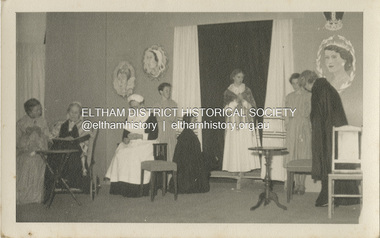 Eltham District Historical Society Inc
Photograph - Black and White Print, Three Queens with Crowns of Gold: A Coronation Pageant; Friday 5th June 1953. Presented by the Diamond Valley Group of the C.W.A. of Victoria at Shire Hall Eltham, 1953
... Pty Ltd Bridgene Brinkkotter Caroline Bean Caroline Lewis Claire Timms Constance Balaam Daphne Ratz Deidre Squire Des Tait Doreen Troutbeck Doris Carrick Doris Hillhouse Doris Kilby Doris Moody Doris Rhymer Doris Stack Dorothy Hickson Dorothy Tingate Dorothy Wills Dorotyh Youlton Dorrie Carrick Edna Hedley Edna Whitehead Elizabeth Eaton Elizabeth Green Ella Beraton Elsie Collins Elsie Sidwell Ethel Collins Eula Buck Eva Cunningham Evelyn Brain Frances Weeks Fred Balaam Freda Smith Gail Erswell George Green Gertrude Joyce Gladys Callahan Grace Bradshaw Grace Jones Grace Monks Grace Thomas Graeme Balaam Gwendoline Jones Gwladys Green Harold Peck Harriet Foubister Hazel Squire Hilda Francis Howard Cornish Ina Vincent Inthea North Irene Graham Isabel Cracknell Isabel Dunn Isie Pitman J.C. ...A Pageant of Three Queens Presented by The Diamond Valley Group of the C.W.A. of Victoria as a Coronation Gesture Written and produced for the Group by Doris Moody Group President Dorothy Tingate See also programme 04610-4 List of all performers and contributors in key word subjectsBlack and white sepia printcoronation, cwa, diamond valley group cwa, eltham public hall, eltham shire hall, performance, ada smith, ada stanbury, adelaide huntley, alf cornish, alice cracknell, alice gardner, allison wasley, alma eaton, ann berry, anna lejins, audrey wadeson, barbara mason, beryl hauser, beryl maver, beth powell, betty colclough, betty forrest, betty steve, betty walsey, betty wickham, beverley collins, briar hill timber & trading co. pty ltd, bridgene brinkkotter, caroline bean, caroline lewis, claire timms, constance balaam, daphne ratz, deidre squire, des tait, doreen troutbeck, doris carrick, doris hillhouse, doris kilby, doris moody, doris rhymer, doris stack, dorothy hickson, dorothy tingate, dorothy wills, dorotyh youlton, dorrie carrick, edna hedley, edna whitehead, elizabeth eaton, elizabeth green, ella beraton, elsie collins, elsie sidwell, ethel collins, eula buck, eva cunningham, evelyn brain, frances weeks, fred balaam, freda smith, gail erswell, george green, gertrude joyce, gladys callahan, grace bradshaw, grace jones, grace monks, grace thomas, graeme balaam, gwendoline jones, gwladys green, harold peck, harriet foubister, hazel squire, hilda francis, howard cornish, ina vincent, inthea north, irene graham, isabel cracknell, isabel dunn, isie pitman, j.c. williamson, jean hanson, jean healey, jean johnston, jeannie brown, josephine johnson, judith green, julie eisura, june leache, june pascoe, katherine sullivan, kuitty smith, laurie caelli, leokadia pentakas, loretta ratz, lorraine daws, louise forster, lynette joyce, lynette pascoe, mabel carrick, margaret banks, margaret duncan, margaret mclean, margot gray, marie berry, marion erswell, marion mcewan, marjorie bishop, marjorie palmer, mary barling, mary cecil, mary english, mary gannon, mary hodgson, mary iredale, mary versoe, mavis chivers, mavis searle, may middleton, meredisth jelbart, merle turney, mildred matthews, miriam oldham, mona nott, myra cracknell, nacy hawkins, nellie lott, olwyn bradford, pam sutherland, pat ballard, patricia boase, peter smith, phyllis mcewan, ray ericksen, rex cornish, rhoda mowat, roma shanhun, rosa nicholson, rosemary stocks, ross nicholson, ruby cracknell, ruth lindsay, sandra hem, shirley harrison, sophie coffey, stuart wilkie, sylvia collins, ursula morrissey, vera addison (nee staley), vera earl, vera harris, vera kertrigan, violet harrison, wendy pettie, wendy weeks, winifred bow, yvonne carrick, yvonne mccarthy, yvonne smith, eltham cwa, greensborough cwa, templestowe cwa, kangaroo ground cwa, hurstbridge cwa, panton hill cwa -
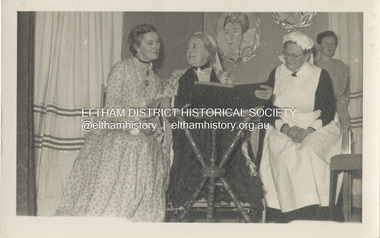 Eltham District Historical Society Inc
Photograph - Black and White Print, Three Queens with Crowns of Gold: A Coronation Pageant; Friday 5th June 1953. Presented by the Diamond Valley Group of the C.W.A. of Victoria at Shire Hall Eltham, 1953
... Pty Ltd Bridgene Brinkkotter Caroline Bean Caroline Lewis Claire Timms Constance Balaam Daphne Ratz Deidre Squire Des Tait Doreen Troutbeck Doris Carrick Doris Hillhouse Doris Kilby Doris Moody Doris Rhymer Doris Stack Dorothy Hickson Dorothy Tingate Dorothy Wills Dorotyh Youlton Dorrie Carrick Edna Hedley Edna Whitehead Elizabeth Eaton Elizabeth Green Ella Beraton Elsie Collins Elsie Sidwell Ethel Collins Eula Buck Eva Cunningham Evelyn Brain Frances Weeks Fred Balaam Freda Smith Gail Erswell George Green Gertrude Joyce Gladys Callahan Grace Bradshaw Grace Jones Grace Monks Grace Thomas Graeme Balaam Gwendoline Jones Gwladys Green Harold Peck Harriet Foubister Hazel Squire Hilda Francis Howard Cornish Ina Vincent Inthea North Irene Graham Isabel Cracknell Isabel Dunn Isie Pitman J.C. ...A Pageant of Three Queens Presented by The Diamond Valley Group of the C.W.A. of Victoria as a Coronation Gesture Written and produced for the Group by Doris Moody Group President Dorothy Tingate See also programme 04610-4 List of all performers and contributors in key word subjectsBlack and white sepia printcoronation, cwa, diamond valley group cwa, eltham public hall, eltham shire hall, performance, ada smith, ada stanbury, adelaide huntley, alf cornish, alice cracknell, alice gardner, allison wasley, alma eaton, ann berry, anna lejins, audrey wadeson, barbara mason, beryl hauser, beryl maver, beth powell, betty colclough, betty forrest, betty steve, betty walsey, betty wickham, beverley collins, briar hill timber & trading co. pty ltd, bridgene brinkkotter, caroline bean, caroline lewis, claire timms, constance balaam, daphne ratz, deidre squire, des tait, doreen troutbeck, doris carrick, doris hillhouse, doris kilby, doris moody, doris rhymer, doris stack, dorothy hickson, dorothy tingate, dorothy wills, dorotyh youlton, dorrie carrick, edna hedley, edna whitehead, elizabeth eaton, elizabeth green, ella beraton, elsie collins, elsie sidwell, ethel collins, eula buck, eva cunningham, evelyn brain, frances weeks, fred balaam, freda smith, gail erswell, george green, gertrude joyce, gladys callahan, grace bradshaw, grace jones, grace monks, grace thomas, graeme balaam, gwendoline jones, gwladys green, harold peck, harriet foubister, hazel squire, hilda francis, howard cornish, ina vincent, inthea north, irene graham, isabel cracknell, isabel dunn, isie pitman, j.c. williamson, jean hanson, jean healey, jean johnston, jeannie brown, josephine johnson, judith green, julie eisura, june leache, june pascoe, katherine sullivan, kuitty smith, laurie caelli, leokadia pentakas, loretta ratz, lorraine daws, louise forster, lynette joyce, lynette pascoe, mabel carrick, margaret banks, margaret duncan, margaret mclean, margot gray, marie berry, marion erswell, marion mcewan, marjorie bishop, marjorie palmer, mary barling, mary cecil, mary english, mary gannon, mary hodgson, mary iredale, mary versoe, mavis chivers, mavis searle, may middleton, meredisth jelbart, merle turney, mildred matthews, miriam oldham, mona nott, myra cracknell, nacy hawkins, nellie lott, olwyn bradford, pam sutherland, pat ballard, patricia boase, peter smith, phyllis mcewan, ray ericksen, rex cornish, rhoda mowat, roma shanhun, rosa nicholson, rosemary stocks, ross nicholson, ruby cracknell, ruth lindsay, sandra hem, shirley harrison, sophie coffey, stuart wilkie, sylvia collins, ursula morrissey, vera addison (nee staley), vera earl, vera harris, vera kertrigan, violet harrison, wendy pettie, wendy weeks, winifred bow, yvonne carrick, yvonne mccarthy, yvonne smith, eltham cwa, greensborough cwa, templestowe cwa, kangaroo ground cwa, hurstbridge cwa, panton hill cwa -
Glen Eira Historical Society
Letter - Lirrewa
... Lirrewa Lirrewa Grove O’Donnell J Fulton Thomas Land subdivisions Glen Eira Road Glen Huntly Road Kooyong Road Tennant Dr Cox James Dr Brooks Walter Richard Baby health care Bryce Percy H Sylverly House names Market gardens Chinese community Langdon Montague William Langdon Henry Joseph Rosecraddock Langdon Elizabeth Tarqua St Marys church Caulfield Hawthorn Road Lirrewa Grove Stables Architectural features Brooks Gladys Brooks Walter Councillors Scott Robert Redcliff Mr Architects McCulloch Mr Teachers Office workers Farmer Mr Ward Andrew Mansions Verandahs Slate tiles Fountains Leadlights Fireplaces Grant RS Black RS Anderson P Russell Edwin R Cast ironwork Flats Marble Mantel pieces Gothic revival style Brick Arches Letter Lirrewa ...Four articles on Lirrewa’s history, conservation study and notes on architectural features and correspondence from National trust to Mrs W Brooks. Photocopy of an extract from Caulfied Historical Newsletter (No 4 April 1973) containing 2 articles about Lirrewa and Caulfield (one by J O’Donnell, one by Mrs AP Bell) Photocopied extract from the Caulfield Conservation study detailing history and features of Lirrewa written by Andrew Ward (January 1995) Handwritten notes on architectural features of home and hand drawn designs of side and centre windows and design above all main room doors. Includes typed directory listings from 1886 to 1921. Date and author unknown Copy of correspondence to Mrs W Brooks from the Administration National Trust of Australia regarding classification Lirrewa 20/03/1973 and stables.lirrewa, lirrewa grove, o’donnell j, fulton thomas, land subdivisions, glen eira road, glen huntly road, kooyong road, tennant dr, cox james dr, brooks walter richard, baby health care, bryce percy h, sylverly, house names, market gardens, chinese community, langdon montague william, langdon henry joseph, rosecraddock, langdon elizabeth, tarqua, st marys church, caulfield, hawthorn road, lirrewa grove, stables, architectural features, brooks gladys, brooks walter, councillors, scott robert, redcliff mr, architects, mcculloch mr, teachers, office workers, farmer mr, ward andrew, mansions, verandahs, slate tiles, fountains, leadlights, fireplaces, grant rs, black rs, anderson p, russell edwin r, cast ironwork, flats, marble, mantel pieces, gothic revival style, brick, arches -
Glen Eira Historical Society
Newsletter - St John’s Presbyterian Church, Elsternwick
... (October 1984); Orders, Dorothy, Mrs (October 1984); Matthews, Janet, Mrs (December 1984); Barnes, Marjorie, Mrs (December 1984); Angus, Catherine, Mrs (December 1984); Burstal, Gladys, Mrs (December 1984). St John's Newsletter – Final of Rev. Thomas October 1988 - plus general activities. 2/ St. ...(October 1984); Orders, Dorothy, Mrs (October 1984); Matthews, Janet, Mrs (December 1984); Barnes, Marjorie, Mrs (December 1984); Angus, Catherine, Mrs (December 1984); Burstal, Gladys, Mrs (December 1984). St John's Newsletter – Final of Rev. Thomas October 1988 - plus general activities. 2/ St. ...This file contains 15 documents produced by St John's, in 3 groups: 13 newsletters containing general church activities, Leprosy Mission, Financial Report, Clubs and Fundraising over 1983-84; Annual Report for 1987; and 2 editions of its LINK newsletter (2010 & 2012). 1/ St John’s Newsletter – Copies for the following dates June 1983; July 1983; August 1983; Sept 1983, October 1983, Nov. 1983, December 1983, February 1984, April 1984; October 1984; December 1984, October 1988. These include obituaries – Woods, Muriel, Mrs (September 1983); Bradshaw ,Olive, Mrs (September 1983); Gallagher, Janet, Miss (October 1983); Christiansen, Ilma, Mrs (November 1983); McNicol, Jean, Miss (November 1983); Booth, Alison, Mrs (February 1984); Stewart, Jean, Miss (February 1984); Tulloch, Annie, Miss (October 1984); Smith, R. Douglas, DR. (October 1984); Orders, Dorothy, Mrs (October 1984); Matthews, Janet, Mrs (December 1984); Barnes, Marjorie, Mrs (December 1984); Angus, Catherine, Mrs (December 1984); Burstal, Gladys, Mrs (December 1984). St John's Newsletter – Final of Rev. Thomas October 1988 - plus general activities. 2/ St. John’s Uniting Church Annual Report 1987 3/ LINK connecting the people of St John’s Elsternwick August – September 2010. General Church Activities. LINK Feb – March 2012. Pastor Christine Clinch Treasurer : Cathy McNicol. Presbytery Representative: Audrey Nelson. Members.glen huntly road elsternwick, st john’s uniting, dance percy mr., jordan marjorie mrs, onkin ivy mrs, thomas eric reverend, freeland e. miss, wood muriel mrs., bradshaw olive mrs, gallagher janet mrs., christiansen llma mrs., mcnicol jean mrs., booth alison mrs., stamp sales, leprosy mission, women’s gas association, stamp sales, cricket club., stewart jean miss, tulloch annie miss, smith r. douglas dr., orders dorothy mrs., greenstreet duncan mr., clinch christine pastor, matthews janet mrs., barnes marjorie mrs, angus catherine mrs., bustal gladys mrs, barkland les mr., campbell a. j., baker tim organist, presbyterian churches, st john's presbyterian church -
Glen Eira Historical Society
Article - Carnegie Primary School No. 2897
... These appear to be drafts for the article -'Carnegie Primary School No.2987 printed in the Caulfield Historical Society Newsletter 37, April 1993, Editor: Gladys Vallati. 3/Sunday Herald Sun dated 03/04/2011, article on two former school students. Carnegie State School Findlay Francis Slate tiles Sheltersheds Rosstown Truganini Road Anderson Mr. Rosstown Swamp Evans Thomas ...Brief history of Carnegie state school from two sources and an article on former students including photograph dated 03/04/2011: 1/Handwritten extract, date unknown taken from the Education Dept. Of History at Latrobe Library with information from 1887 to 1913 2/Three typed copies of school history with much the same information as above handwritten copy, provided by Caulfield Historical Society, date and author unknown. Includes information on the opening of the school in 1888 and brief comments on its development to 1927. These appear to be drafts for the article -'Carnegie Primary School No.2987 printed in the Caulfield Historical Society Newsletter 37, April 1993, Editor: Gladys Vallati. 3/Sunday Herald Sun dated 03/04/2011, article on two former school students.carnegie state school, findlay francis, slate tiles, sheltersheds, rosstown, truganini road, anderson mr., rosstown swamp, evans thomas, boardman mr., swamps, craig robert, wesleyan church., market gardens, liddelow a, toolambool road., brick, marshall noreen, rodgers keith, carnegie methodist church., church of christ, carnegie -
Glen Eira Historical Society
Book - Carnegie Primary School No. 2897
... Thomas William Steele Miss Young Mac Young Margaret Cooper Cyril Cooper Bill Whiteside D. Broadbent Neil Broadbent Mr. Carnegie Theatre Theatres Morton family Clarke family Quickand Neals Grocery Store Grocers Billy Guyatt’s Shops Spencer the Removalist Removalists Collister Harold Collister Bill Caulfield Band Bands Carthews the Drapers Drapers McCarrons Alec Blacksmiths Skewes Keith Oliver Frank Pitt ‘Squeaker’ Knevitt ‘Skeeter’ Harry Jockeys Britter Jack Stanistreet family Gear Rita Culleen Billy Tailors Sherwoods Butchers Butchers Jersey Parade Riley Didlo Verne Harry Cooper Horace Cooper Linda Cooper Martin Cooper Claude Cooper Reginald Cooper Stanley Cooper Gladys Cooper Muriel Cooper Percival Cooper Cyril Beaumont W.A. ...Carnegie Primary School centenary book (96 pages x 2 copies) ‘The First Hundred Years NO2897. Carnegie Primary School 1888-1988’ compiled and edited by Isabel Couper and Deidre Lynch. A detailed history of the school’s beginnings. Many informative memories and recollections from school’s first students and teachers; includes social history of area and people, football teams, debutante sets and school. Also a reprinted newspaper article from school’s Golden Anniversary and photo of school band; and a couple of social history photographs.anderson james, murrumbeena, glen huntly railway station, carnegie state school, wesleyan hall, neerim road, railway stations, carnegie primary school, rosstown, toolambool road, lynch deidre, mcvey claire, ross william murray, findlay francis, couper isabel, brown wesley, rosstown state school, brisbane w, carnegie uniting church, liddelow m.h., evans thomas, selboskar phyl, centenaries, margaret street, caulfield, brewster mr., taylor mr., draper mrs., mcfarlane mr., rule thomas, teachers, campbell ada, ‘ava’, campbell aubrey, campbell vera, matthews ben, hewitts road, matthews funeral service, funeral parlours, leo amy, leo alfie, rudge family, rudge mr., transport, phillips store, general store, phillips corner, emily street, hamlya family, pitt family, sheppard family, pemberton mr., pemberton mrs., dunlop misses, preschools, whitlam family, whitlam gordon, woods family, woods lorna, swaggie, swagman, liddelow amy, anderson mr., anderson archie, dunlop bill, phillips linda, hansen alice, lodge laura, fox arthur , hamlyn eric, hansen dagmar, cooper lina , woods lorna, waite family, cove family, johansen family, koornang road, market gardens, sheppard ernie, wood a.m., ‘nisava’, wood family, wood bill, evans rachel, evans thomas, wood millicent, whitfield mr., griffiths mr., wood malcolm, wood forest, wood joe, roxburgh miss, grange road, clifton street, lord street, wood frederick geo, egan miss dressmakers, whitlam fred, whitlam christine, whitlam george, whitlam gough, whitlam freda, whitfield mr., patterson road, graceburn avenue, griffiths r.h., koornang road, scales mr., reid athol, lording dr., mernda ave, farmstead, lord reserve, leman’s swamp, koornang park, cobby harry, larkin aircraft company, dawson howard, rosedale avenue, spencer reg, turner ruth, turner jack, turner noreen, turner marie, morton alan, morton barney, gardiner martin, frogmore estate, oakleigh road, frogmore road, koornang park, hunt club kennels, raeke miss, morgan miss, pitt winnie, jiggins mr., smith mr., blundy violet, ryall ray, mimosa road, wolseley mr., wolseley family, wolseley ted, brunstein madge, murrumbeena cricket club, sinclair alan, sincliar tinny, thomas ted, walker alec, bone bob, footballers, middleton colin, farquahson mrs., eddy family, eddy rose, wolseley jack, buswell stan, buswell doug, buswell. stan jnr., irving nell, brims ethel, bailey bruce, eason sisters, hands hilda, windlow isabel, madden road, glenhuntly road, griffiths rita, jackson jean, scott mr., ward ‘cap’, caulfield grammar school, kokaribb road, carnegie traders, cricket teams, carnegie south, ward marjory, ryan mr., phillips tony, phillips bessie, buckley street, phillips harriet, phillips marion, phillips ernest, phillips hilda, phillips david, phillips florence, phillips linda, lihou miss, jersey parade, meake family, skewe family, mansfield family, fraser jean, collister alma, sturges millie, retallick girls, lillywhite family, mason nellie, johns nancy, bowsfield family, jenner family, chisholm emma, chisholm doris, chisholm ivy, chisholm netta, chisholm beryl, chisholm eileen, wadsworth ethel, luke mr., plummer t.w., raecke miss, sargent ron, sarkie family, reid family, meake violet, collett reg, mcneil miss, scales mr., carmody thomas william, steele miss, young mac, young margaret, cooper cyril, cooper bill, whiteside d., broadbent neil, broadbent mr., carnegie theatre, theatres, morton family, clarke family, quickand neals grocery store, grocers, billy guyatt’s, shops, spencer the removalist, removalists, collister harold, collister bill, caulfield band, bands, carthews the drapers, drapers, mccarrons alec blacksmiths, skewes keith, oliver frank, pitt ‘squeaker’, knevitt ‘skeeter’ harry, jockeys, britter jack, stanistreet family, gear rita, culleen billy, tailors, sherwoods butchers, butchers, jersey parade, riley didlo, verne harry, cooper horace, cooper linda, cooper martin, cooper claude, cooper reginald, cooper stanley, cooper gladys, cooper muriel, cooper percival, cooper cyril, beaumont w.a., whittfield joe, beaumont eileen, major mary anne sister, major myrtle, major bessie, major alma, stagholl walter, stagholl margaret, stagholl eric, robertson bessie, robertson fred, robertson norman, robertson donald, robertson alma, robertson alan, baird neil, baird john, baird rosemary, dunn helen, baird ian, baird heather, baird dianne, petrie stuart, petrie richard, bailey ron, gaunt mabel, reading harold, reading marge, irwin joyce, dickson margaret, dickson jennifer, dickson peter, wood malcolm, wood millicent, wood forest, wood joe, sinclair ‘trinny’, roberts ‘fly’, footballers, malcolm mr., henderson reg, henderson alice, brew l., rule mr., philbrick mr., wood mr., trembath mr., keogh mr., plummer tom, lane a., fox ernest, souters, market gardeners, fox belle, fox bella, fox vern, couper margaret, couper sandra, couper peter, couper narelle, couper clare, couper jarrod, scott mr., doughty will, doughty tom, lloyd miss, islingworth master, adams joyce, hogan mr., markus jean, cosgrove joan, cosgrove mrs., cosgrove mr., marshall jim, kellow fred, fretwell elizabeth, fretwell betty, shepparson ave, singers, edmonson miss, butters shirley, harwood vera, bracher lloyd, dewhurst irene, dewhurst jack, boyle mr., gow jack, welch len, stanistreet harry, stanistreet jack, stanistreet kathleen, stanistreet frank, stanistreet kingsley, ‘ray sullivan’s harmony boys’, carnegie memorial hall, st. anthony’s hall, welch len, gibbons norm, ashley sylvia, crosswell edna, marks peggy, worth phyllis, cleal jean, tabner edith, jenkins elva, mcintosh gladys, worth reg, waters cyril, downard rex, wild mavis, wild darby, hill roland, eason jean, tyers noel, tyers clive, witten hope, strickland doris, chisholm beryl, harwood family, battershill sid, battershill walter, dixon mavis, boyle mr., ford hilda, forsythe miss, edmonsen miss, ryan mr., grimsley mr., allaway mrs., grant mrs., bone bob, bone bruce, w. bone & son nursery men, bone norman, bone jack, bone william, railway road, green kevin, paris marjorie, mimosa road, green joan, allaway winnie, elliot miss, mcburney mr., purdy mrs., allaway suzanne, barron shirley, hogan mr., rutherford mrs., curtin mr., mckee’s, stores, whelan’s, coles, koornang road, gardiner marty, grange road dairy, dairies, mcwhinney’s tuck shop, shops, williams dorothy, kennedy irene regina, rigby miss, grimsley steve, grimsley muriel, grimsley jack, grimsley margaret, grimsley aimee, grimsley bill, blinkinsop steve, blinkinsop jeannie, mathers max, howie rex, major mr., flatmans paddock, crossover, reid eric, reid athol, lowe margaret, lowe dorothy, lowe ian, poliomyelitis epidemic diseases, forsythe miss, cuddihy miss, dougall keith, grace miss, hattam’s, stores, driver wally, perry max, perry don, perry jack, meagher j., ‘hostile’, racehorses, edney jack, carthews the drapers, fretwell elizabeth, kellow fred, muddyman bill, graceburn ave, caulfield junior citizens band, bands, luke mr., luke percy, luke maise, luke nessie, luke geoff, luke ross, luke jan, luke lynette, bolton douglas, anderson mrs., mcburney mr., hogan mr., scott mr., tyers s., ross j., ryan j., irvine j., muirhead mrs., muirhead j., mcnab m., buller l., emmanuel p., buller m., paton v., moor j., condron a., bibby d., matthews n., holman l., cotterell m., whelan j., jennion g., walker b., taylor e., green a., turner r., matthews e., smith joan, gardiner marty, dairies, hanson family, cove family, gallop family, barrett family, barrett w.a., bolch family, bolch b., burke w., burke bill, burke s., mobbs h., young g., young c., burke m., ward c., hopwood g., gordon mr., milk bars, cooper cr., phillips t., swindell mr., grogan mr., wadsworth mrs., bourke mrs., lewis mrs., worsley mrs., quickenstead mrs., brown wesley, musicians, purdy h., curtain les, jenner’s dairy, riley’s wood yard, occupations, jenner vic, jenner les, grant noel, parker george, connolly keith, purdy mr., glen huntly picture theatre, picture theatres, irvine jack, law christie, hatter bob, joppick les, driver geoff, curtin mrs., frederick street, ormond, waters ron, carnegie junior citizens band, carnegie salvation army band – bands, whelan evan, irwin ray, balgleish jack, cowen laurie, smyth wally, lambeth margaret, kind lorraine, bondini joy, tredennick miss, linton miss, heath graham, shiell bill, shiell myrtle, archard bess, bull joan, craig ida, collins dorrie, collins doreen, diggans jess, cornthwaite h., cripps e., dougall n., dixon joyce, francis d., evans mrs., glass peg, greene jess, grace merle, hocking freda, jillings mrs., price mrs., day kitty, kerr may, mason marge, kind sylvia, muirhead d, mcconchie netta, needham nancy, nickless w, o’connor linda, pilven mrs., ryall h., strother ivy, singleton mrs., kelly phyl, waters von, usher mrs., trotter maude, watson mrs., williams mabel, withers olive, aarsmann norma, shiell norma, close peter, ‘wild cherry’ cake shop, rudi miss, anderson miss, eddy mr., hunter jean, nelson vera, fisher john, hunter ron, read jean, smith brian, newsreaders, nelson miss, singleton billy, quon miss, mchutchison george, valma smith, millar royal r., donoghue nora, lester mr., roberts tom, andreisen colin, miles alec, hine mr., baker mr., clements george, bracher lloyd, dimick miss, muir judy, dunn margaret, sant richard, myring miss, ryan mr., armstrong margaret, share wally, howie rex, barclay bob, rockman udo, hoult david, eisfelder kevin, jacques mr., smith mr., magee mr., stehle belinda, wallace mr., james mrs., main mr., wood miss, verso mr., mcpherson mrs., felotico miss, stehle john, howards mrs., collard mrs., webster vivian, stehle siggy, truong le sen, mcpherson barbara, mitchell eva, moutsos mark, chan benjamin, wilson del, jewell christopher, mitchell keith, grant marilyn, caskie alastair, dixon dennis, armstrong john, lucas edward, clark deanne, coutts natalie, flood zivanja, derham peter, momandwall shaper, couper jarrod, heslop joanne, breeze ginaya, caskie fiona, filippone nadya, mcmahon nina, hedges nigel, williams shae, grimm karen, mcgregor clare, vagenes john, gallagher glenn, mcalister rob, varga marilyn, hunter debbie, courtney cathy, booth carol, mcmahon mary, brown danielle, burska maciej, campbell jason, chryssis aris, d’arcy michael, delaney matthew, doukas vivian, dower samantha, fournarakis andrew, genoli amanda, grammatos jimmy, harrington melanie, karamoshos john, karim sadruddin, kennedy russel, lalani zahra, lightfoot kylie, looby mark, louange veronica, park sung mi, perera dennis, pozvek julie, scurry kate, sievers sarah, smith matthew, svarnas dennis, vassiliou denise, wright tracey, zouzounis spirros, adahall jojie, agar jude, anderson lynette, black renae, bobrowski ursula, caskie catherine, devon hayley, diakoumis maria, duljas kristie, evans lindsay, faucett ebony, filippone annette, fournarakis jimmy, francese sean, gibson jay, gordon michelle, guslitser dora, king jane, lianos villi, lorkin christopher, macleod cheryl, maggs amberley, mitchell keith, mucic renae, o’brien jessica, park matthew, pozvek richard, psarras nancy, rhodes suzanne, simons emma, smith christopher, spokes melanie, tia michael, timewell amanda, vavoudis peter, abbott kristi, allender daniel, bobrowski jacob, carey rebecca, carter daimein, catramados john, christou eugenia, couper jarrod, healey michael, kalaitzakis nick, kennedy rebecca, macleod suzanne, mavridis angelo, morosini amanda, mowforth dustin, okolicsanyi george, park sung chul, pemberton michael, reisman elizabeth, richards kylie, savrone leah, tia charlie, tran paul, wiseman derek, wright dean, wyatt marilyn, andre ryan, breeze ginaya, brown james, campbell chad, charles benjamin, devon john, diakmoumis stacey, diamantis chris, duljas michael, grammatos harry, hill bradd, karim salim, lindsay amanda, lynch jennifer, marrello sol, momandwall shaker, moutsos ireni, oram scott, o’sughrue kristy, panevin david, park catherine, pozvek louise, stratton alisa, timewell rebecca, tsigos stam, yeow sook ling, anderson peter, batson tracey, black craig, brain jason, breeze benjamin, brown kylie, carrington harata, caskie fiona, catramados hercule, chan daphne, christou chris, clarke simone, diamantis anthony, faucett sara, flood natalia, holmes gavin, kotrotsos tony, kuk robin, mitchell david, okolicsanyi steve, pemberton samuel, soos melinda, stephenson gabrielle, tran pauline, vassiliou evan, agar natalia, bennett tracey, buhmann wayne, couper clare, faucett sean, filippone nadya, filippone marie, gallagher glenn, gelman roman, grant shawn, hill tania, jewel chris, kaliappa danny, kiss robert, liacopoulos aris, louey david, macleod mike, malamas voula, oram michelle, scurry ivan, wardley amanda, zouzounis sam, anderson robert, antoniou nick, carey tamara, derham peter, diep dianne, filippone danielle, flood zivanja, frangos katina, handley scott, harrison robin, heath cheryl, hedges megan, hedges nigel, hudson raelene, jacovou daniel, katrotsos george, kuk maggie, leung tracy, lightfoot wendy, mcmahon nina, taylor stephen, vassiliou litsa, liddelow e., anderson james h., boardman thomas h., rule thomas, whitfield j.p., griffiths r.h., scales e., boyle j.b., ryan owen w., eddy h.m., millar royal r., lester russel a., donoghue r., bracher a. lloyd (acting principle), o’brien john d., moller henry r., monahan t.v., barclay robert l., somerville albert v., magee frank c. (acting principle), wallis keith, laing allan i., verso ron (acting principle), wood moira (acting principle), tonkin ernest, share wallace (acting principle), howie rex, harding malcolm (acting principle), crowe brian, schmidt david (acting principle), lynch deidre (acting principle), o’keeffe leo, brierley bob, brierley marjorie, couper isabel, couper peter, lindsay janine, lynch deidre, selboskar phyl, stehle siggy, webster jennifer -
Glen Eira Historical Society
Document - Elsternwick Club, Sandham Street, 19, Elsternwick
... Elsternwick Club Sandham Street Elsternwick Tatchell Joseph Glenhuntly Road Phebe Theatre Renown Theatre Sharp T C Akhust A G Kirkham C F Little A E Tatchell J T Brace F Clements G Dunbar A Johnston F W Masters G Spiers J Bent Thomas Sir Gentlemans Club St Georges Road S M Allen Auctioneers Wilson E W Edny J Stanmere Allison Road Gooley Hec Lawn bowls Returned Servicemens League Ellis A Monahan Thomas Ripponlea Sargood F J Short W H Melvin J C Lillie A E Akhurst A C Hall John St Pullman Cedric Morris Thomas Bunny Donald City of Caulfield Borough Town Peppard Michael Hackett E E Campbell F Campbell A J E Caulfield Returned Soldiers League Royal Victorian Bowls Association Victorian Ladies Bowls Association Snowball Betty Pullman C Campbell Felicitie Stanmere Short William Henry junior Short Elizabeth Short William Henry senior Glen Eira Historical Society Brooks Jan Brooks W R Normanby Road Caulfield Brooks family Brooks Gladys Hart T J Document Elsternwick Club, Sandham Street, 19, Elsternwick ...Six documents associated with the Elsternwick Club: 1/ Two copies of a seven page pamphlet titled the Elsternwick Club 1898-1984, written by E E Hackett, on the history, development and founding of the Elsternwick Club. 2/ A five page typed manuscript of the pamphlet dated 08/05/1984 by E.E. Hackett. 3/ Two Honorary Membership certificates, one for F Campbell and one for A J E Campbell, awarded for the 1986-1987 season of the Elsternwick Club. 4/ One page of typed notes on the history from 1899 of the Elsternwick Club with accompanying handwritten notes, dated 1981 and signed by Betty Snowball and C Pullman. 5/ One page printout of an email from Jan Brooks to the Glen Eira Historical Society, dated 19/10/2009, regarding the history of the Elsternwick Club, her family’s connection to the original club owners and general information about her family, the Brooks. 6/ One page typed letter from T J Hart of Caulfield Historical Society to the Elsternwick Club, dated 15/10/1973, congratulating the Club about the National Trust’s classification of the Club building.elsternwick club, sandham street, elsternwick, tatchell joseph, glenhuntly road, phebe theatre, renown theatre, sharp t c, akhust a g, kirkham c f, little a e, tatchell j t, brace f, clements g, dunbar a, johnston f w, masters g, spiers j, bent thomas sir, gentlemans club, st georges road, s m allen auctioneers, wilson e w, edny j, stanmere, allison road, gooley hec, lawn bowls, returned servicemens league, ellis a, monahan thomas, ripponlea, sargood f j, short w h, melvin j c, lillie a e, akhurst a c, hall john st, pullman cedric, morris thomas, bunny donald, city of caulfield, borough town, peppard michael, hackett e e, campbell f, campbell a j e, caulfield, returned soldiers league, royal victorian bowls association, victorian ladies bowls association, snowball betty, pullman c, campbell felicitie, stanmere, short william henry junior, short elizabeth, short william henry senior, glen eira historical society, brooks jan, brooks w r, normanby road, caulfield, brooks family, brooks gladys, hart t j -
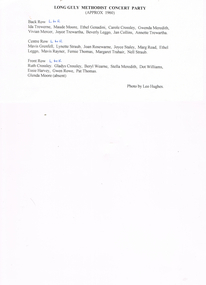 Bendigo Historical Society Inc.
Document - LONG GULLY HISTORY GROUP COLLECTION: LONG GULLY METHODIST CONCERT PARTY
... Centre Row L to R - Mavis Grenfell, Lynette Straub, Joan Rosewarne, Joyce Staley, Marg Read, Ethel Leggo, Mavis Rayner, Fernie Thomas, Margaret Trahair, Nell Straub. Front Row L to R - Ruth Crossley, Gladys Crossley, Beryl Wearne, Stella Meredith, Dot Williams, Essie Harvey, Gwen Rowe, Pat Thomas. ...Centre Row L to R - Mavis Grenfell, Lynette Straub, Joan Rosewarne, Joyce Staley, Marg Read, Ethel Leggo, Mavis Rayner, Fernie Thomas, Margaret Trahair, Nell Straub. Front Row L to R - Ruth Crossley, Gladys Crossley, Beryl Wearne, Stella Meredith, Dot Williams, Essie Harvey, Gwen Rowe, Pat Thomas. ...Typed piece of paper titled Long Gully Methodist Concert Party (Approx 1960). Typed names are - Back Row L to R - Ida Trewarne, Maude Moore, Ethel Genadini, Carole Crossley, Gwenda Meredith, Vivian Mercer, Joyce Trewartha, Beverly Leggo, Jan Collins, Annette Trewartha. Centre Row L to R - Mavis Grenfell, Lynette Straub, Joan Rosewarne, Joyce Staley, Marg Read, Ethel Leggo, Mavis Rayner, Fernie Thomas, Margaret Trahair, Nell Straub. Front Row L to R - Ruth Crossley, Gladys Crossley, Beryl Wearne, Stella Meredith, Dot Williams, Essie Harvey, Gwen Rowe, Pat Thomas. Glenda Moore (absent) Photo by Leo Hughes. (no photo)bendigo, history, long gully history group, the long gully history group - long gully methodist concert party, ida trewarne, maude moore, ethel genadini, carole crossley, gwenda meredith, vivian mercer, joyce trewartha, beverly leggo, jan collins, annette trewartha, mavis grenfell, lynette straub, joan rosewarne, joyce staley, marg read, ethel leggo, mavis rayner, fernie thomas, margaret trahair, nell straub, ruth crossley, gladys grossley, beryl wearne, stella meredith, dot williams, glenda moore, leo hughes -
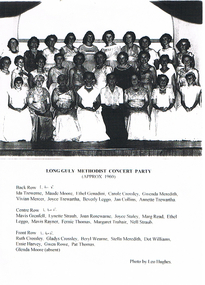 Bendigo Historical Society Inc.
Photograph - LONG GULLY HISTORY GROUP COLLECTION: LONG GULLY METHODIST CONCERT PARTY
... . - Mavis Grenfell, Lynette Straub, Joan Rosewarne, Joyce Staley, Marg Read, Ethel Leggo, Mavis Rayner, Fernie Thomas, Margaret Trahair, Nell Straub Front Row L to R - Ruth Crossley, Gladys Crossley, Beryl Wearne, Stella Meredith, Dot Williams, Glenda Moore Photo by Leo Hughes....History House 11 Mackenzie Street Bendigo goldfields BENDIGO History long gully history group The Long Gully History Group - Long Gully Methodist Concert Party Ida Trewerne Maude Moore Ethel Genadini Carole Crossley Gwenda Meredith Vivian Mercer Joyce Trewartha Beverly Leggo Jan Collins Annette Trewartha Mavis Grenfell Lynette Straub Joan Rosewarne Joyce Staley Marg Read Ethel Leggo Mavis Rayner Fernie Thomas Margaret Trahair Nell Straub Ruth Crossley Gladys Crossley Beryl Wearne Stella Meredith Dot Williams Glenda Moore Leo Hughes Black and white copy of the Long Gully Methodist Concert Party (Approx 1960). ...Black and white copy of the Long Gully Methodist Concert Party (Approx 1960). Photo shows ladies dressed in evening attire. Printed under the photo:- Long Gully Methodist Concert Party (Aprox 1960). Back Row L to R. - Ida Trewerne, Maude Moore, Ethel Genadini, Carole Crossley, Gwenda Meredith, Vivian Mercer, Joyce Trewartha, Beverly Leggo, Jan Collins, Annette Trewartha. Centre Row L to R. - Mavis Grenfell, Lynette Straub, Joan Rosewarne, Joyce Staley, Marg Read, Ethel Leggo, Mavis Rayner, Fernie Thomas, Margaret Trahair, Nell Straub Front Row L to R - Ruth Crossley, Gladys Crossley, Beryl Wearne, Stella Meredith, Dot Williams, Glenda Moore Photo by Leo Hughes.bendigo, history, long gully history group, the long gully history group - long gully methodist concert party, ida trewerne, maude moore, ethel genadini, carole crossley, gwenda meredith, vivian mercer, joyce trewartha, beverly leggo, jan collins, annette trewartha, mavis grenfell, lynette straub, joan rosewarne, joyce staley, marg read, ethel leggo, mavis rayner, fernie thomas, margaret trahair, nell straub, ruth crossley, gladys crossley, beryl wearne, stella meredith, dot williams, glenda moore, leo hughes -
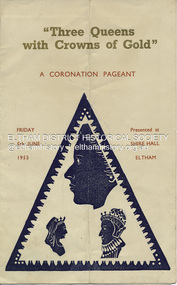 Eltham District Historical Society Inc
Programme - Souvenir Program, Three Queens with Crowns of Gold: A Coronation Pageant; Friday 5th June 1953. Presented by the Diamond Valley Group of the C.W.A. of Victoria at Shire Hall Eltham
... Pty Ltd Bridgene Brinkkotter Caroline Bean Caroline Lewis Claire Timms Constance Balaam Coronation CWA Daphne Ratz Deidre Squire Des Tait Diamond Valley Group CWA Doreen Troutbeck Doris Carrick Doris Hillhouse Doris Kilby Doris Moody Doris Rhymer Doris Stack Dorothy Hickson Dorothy Tingate Dorothy Wills Dorotyh Youlton Dorrie Carrick Edna Hedley Edna Whitehead Elizabeth Eaton Elizabeth Green Ella Beraton Elsie Collins Elsie Sidwell Eltham CWA Eltham Public Hall Eltham Shire Hall Ethel Collins Eula Buck Eva Cunningham Evelyn Brain Frances Weeks Fred Balaam Freda Smith Gail Erswell George Green Gertrude Joyce Gladys Callahan Grace Bradshaw Grace Jones Grace Monks Grace Thomas Graeme Balaam Greensborough CWA Gwendoline Jones Gwladys Green Harold Peck Harriet Foubister Hazel Squire Hilda Francis Howard Cornish Hurstbridge CWA Ina Vincent Inthea North Irene Graham Isabel Cracknell Isabel Dunn Isie Pitman J.C. ...A Pageant of Three Queens Presented by The Diamond Valley Group of the C.W.A. of Victoria as a Coronation Gesture Written and produced for the Group by Doris Moody Group President Dorothy Tingate See also photos 07202 and 07203 List of all performers and contributors in key word subjectsSouvenir Program; 4 pages 22 x 14.3 cm each (single folded sheet) single stapled to a printed paper card folded cover 25.3 x 15.8 cm 3 copies, one copy with fold mark down centreada smith, ada stanbury, adelaide huntley, alf cornish, alice cracknell, alice gardner, allison wasley, alma eaton, ann berry, anna lejins, audrey wadeson, barbara mason, beryl hauser, beryl maver, beth powell, betty colclough, betty forrest, betty steve, betty walsey, betty wickham, beverley collins, briar hill timber & trading co. pty ltd, bridgene brinkkotter, caroline bean, caroline lewis, claire timms, constance balaam, coronation, cwa, daphne ratz, deidre squire, des tait, diamond valley group cwa, doreen troutbeck, doris carrick, doris hillhouse, doris kilby, doris moody, doris rhymer, doris stack, dorothy hickson, dorothy tingate, dorothy wills, dorotyh youlton, dorrie carrick, edna hedley, edna whitehead, elizabeth eaton, elizabeth green, ella beraton, elsie collins, elsie sidwell, eltham cwa, eltham public hall, eltham shire hall, ethel collins, eula buck, eva cunningham, evelyn brain, frances weeks, fred balaam, freda smith, gail erswell, george green, gertrude joyce, gladys callahan, grace bradshaw, grace jones, grace monks, grace thomas, graeme balaam, greensborough cwa, gwendoline jones, gwladys green, harold peck, harriet foubister, hazel squire, hilda francis, howard cornish, hurstbridge cwa, ina vincent, inthea north, irene graham, isabel cracknell, isabel dunn, isie pitman, j.c. williamson, jean hanson, jean healey, jean johnston, jeannie brown, josephine johnson, judith green, julie eisura, june leache, june pascoe, kangaroo ground cwa, katherine sullivan, kuitty smith, laurie caelli, leokadia pentakas, loretta ratz, lorraine daws, louise forster, lynette joyce, lynette pascoe, mabel carrick, margaret banks, margaret duncan, margaret mclean, margot gray, marie berry, marion erswell, marion mcewan, marjorie bishop, marjorie palmer, mary barling, mary cecil, mary english, mary gannon, mary hodgson, mary iredale, mary versoe, mavis chivers, mavis searle, may middleton, meredisth jelbart, merle turney, mildred matthews, miriam oldham, mona nott, myra cracknell, nacy hawkins, nellie lott, olwyn bradford, pam sutherland, panton hill cwa, pat ballard, patricia boase, performance, peter smith, phyllis mcewan, ray ericksen, rex cornish, rhoda mowat, roma shanhun, rosa nicholson, rosemary stocks, ross nicholson, ruby cracknell, ruth lindsay, sandra hem, shirley harrison, sophie coffey, stuart wilkie, sylvia collins, templestowe cwa, ursula morrissey, vera addison (nee staley), vera earl, vera harris, vera kertrigan, violet harrison, wendy pettie, wendy weeks, winifred bow, yvonne carrick, yvonne mccarthy, yvonne smith -
Bendigo Historical Society Inc.
Document - The Reynolds Family Records Collection (Folder 3 of 4) Gladys Winifred Hinde Birth Certificate, 1905
... Thomas Joynes Jorgensen. The Jorgensens founded and managed Jorgensen and Sons foundry and engineering works. Peter Jorgensen (1849-1914), was a mining contractor, he lived at, "Bro," Russell street, Quarry Hill. His firm was Jorgensen and Sons, mining contractors. He was a native of the Island of Alsen, Denmark. He left Denmark in the year 1861, embarking at Hamburg in a small sailing Ship. bendigo sandhurst peter jorgensen eleanor hinde eleanor reynolds eleanor opie reynolds collection Gladys ...Eleanor Hinde (1842-1902) was born in Lancashire England. In 1858, Eleanor married Richard Reynold in the Forest St Wesleyn Methodist Church in Sandhurst. They both gave their address as Sailors Gully Goldfields. They had seven children together. Richard was a skilled tradesman and after he died in 1872 from lung disease, Eleanor married Arculus Opie. Eleanor owned a property on the corner of Gladstone and Stanley Streets which later became an electrical substation. She sold poultry and eggs and preserves. One of Eleanor's sons, William John, married Anna (Annie) Jorgensen, and one of her daughters. Amelia, married Anna's brother Thomas Joynes Jorgensen. The Jorgensens founded and managed Jorgensen and Sons foundry and engineering works. Peter Jorgensen (1849-1914), was a mining contractor, he lived at, "Bro," Russell street, Quarry Hill. His firm was Jorgensen and Sons, mining contractors. He was a native of the Island of Alsen, Denmark. He left Denmark in the year 1861, embarking at Hamburg in a small sailing Ship. The four folders contain family history documents and photos of the descendants of Eleanor Hinde. This item contains the following documents: Gladys Winifred Hinde Birth Certificate, 11 June 1905 in Perth, Parents William Robert Hinde and Alice Marguerite Mullerbendigo, sandhurst, peter jorgensen, eleanor hinde, eleanor reynolds, eleanor opie, reynolds collection, gladys winifred hinde -
Bendigo Historical Society Inc.
Document - The Reynolds Family Records Collection (Folder 3 of 4) Gladys Winifred Scott Death Certificate, 1970
... Thomas Joynes Jorgensen. The Jorgensens founded and managed Jorgensen and Sons foundry and engineering works. Peter Jorgensen (1849-1914), was a mining contractor, he lived at, "Bro," Russell street, Quarry Hill. His firm was Jorgensen and Sons, mining contractors. He was a native of the Island of Alsen, Denmark. He left Denmark in the year 1861, embarking at Hamburg in a small sailing Ship. bendigo sandhurst peter jorgensen eleanor hinde eleanor reynolds eleanor opie reynolds collection gladys ...Eleanor Hinde (1842-1902) was born in Lancashire England. In 1858, Eleanor married Richard Reynold in the Forest St Wesleyn Methodist Church in Sandhurst. They both gave their address as Sailors Gully Goldfields. They had seven children together. Richard was a skilled tradesman and after he died in 1872 from lung disease, Eleanor married Arculus Opie. Eleanor owned a property on the corner of Gladstone and Stanley Streets which later became an electrical substation. She sold poultry and eggs and preserves. One of Eleanor's sons, William John, married Anna (Annie) Jorgensen, and one of her daughters. Amelia, married Anna's brother Thomas Joynes Jorgensen. The Jorgensens founded and managed Jorgensen and Sons foundry and engineering works. Peter Jorgensen (1849-1914), was a mining contractor, he lived at, "Bro," Russell street, Quarry Hill. His firm was Jorgensen and Sons, mining contractors. He was a native of the Island of Alsen, Denmark. He left Denmark in the year 1861, embarking at Hamburg in a small sailing Ship. The four folders contain family history documents and photos of the descendants of Eleanor Hinde. This item contains the following documents: Gladys Winifred Scott Death Certificate - Contact the Society for detailsbendigo, sandhurst, peter jorgensen, eleanor hinde, eleanor reynolds, eleanor opie, reynolds collection, gladys winifred scott
