
Showing 13 items matching "glass floats"
-
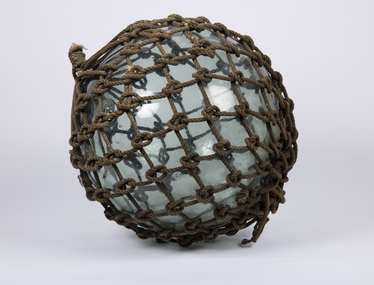 Queenscliffe Maritime Museum
Equipment - Float
... ...Glass Floats...The earliest floats, including most Japanese glass fishing floats, were handmade by a glassblower. ...A glass float with intact knotted rope net attached...Fishing Floats Glass Floats A glass float with intact knotted rope net attached Equipment Float ...Norway, around 1840, was the first country to produce and use glass fishing floats. Many of them can still be found in local boathouses. Christopher Faye, a Norwegian merchant from Bergen, is credited with their invention. The earliest floats, including most Japanese glass fishing floats, were handmade by a glassblower. Recycled glass, especially old sake bottles in Japan, was typically used and air bubbles/imperfections in the glass are a result of the rapid recycling process. Glass floats have since been replaced by aluminum, plastic, or Styrofoam. Today most of the glass floats remaining in the ocean are stuck in a circular pattern of ocean currents in the North Pacific.By the 1940s, glass had replaced wood or cork throughout much of Europe, Russia, North America, and Japan. Japan started using the glass floats as early as 1910. Now they are still highly sought after as decoration.A glass float with intact knotted rope net attachedfishing, floats, glass floats -
 Flagstaff Hill Maritime Museum and Village
Float
... ...glass float...Glass floats are used in the fishing trade as a marker, such as for location of fishing nets....Float, (collection of 46) hollow, blown glass ball in knotted rope holder. ...Some are clear glass and some are coloured glass. Float ...Glass floats are used in the fishing trade as a marker, such as for location of fishing nets.Float, (collection of 46) hollow, blown glass ball in knotted rope holder. Some are clear glass and some are coloured glass.flagstaff hill, warrnambool, shipwrecked-coast, flagstaff-hill, flagstaff-hill-maritime-museum, maritime-museum, shipwreck-coast, flagstaff-hill-maritime-village, float, glass float, fishing industry -
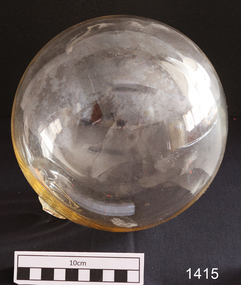 Flagstaff Hill Maritime Museum and Village
Float
... ...glass float...Float glass, transparent, hollow. Raised area where the sphere was sealed....flagstaff hill warrnambool shipwrecked-coast flagstaff-hill flagstaff-hill-maritime-museum maritime-museum shipwreck-coast flagstaff-hill-maritime-village float glass float Float glass, transparent, hollow. ...Float glass, transparent, hollow. Raised area where the sphere was sealed.flagstaff hill, warrnambool, shipwrecked-coast, flagstaff-hill, flagstaff-hill-maritime-museum, maritime-museum, shipwreck-coast, flagstaff-hill-maritime-village, float, glass float -
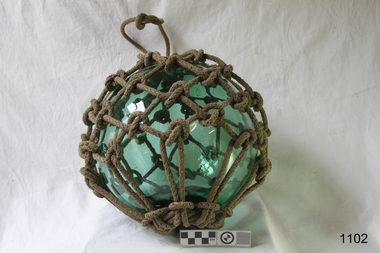 Flagstaff Hill Maritime Museum and Village
Float
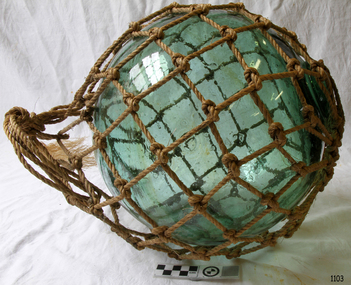
... ...glass float...Float green glass ball held in knotted rope holder...flagstaff hill warrnambool shipwrecked-coast flagstaff-hill flagstaff-hill-maritime-museum maritime-museum shipwreck-coast flagstaff-hill-maritime-village float glass float Float green glass ball held in knotted rope holder Float ...Float green glass ball held in knotted rope holderflagstaff hill, warrnambool, shipwrecked-coast, flagstaff-hill, flagstaff-hill-maritime-museum, maritime-museum, shipwreck-coast, flagstaff-hill-maritime-village, float, glass float -
 Flagstaff Hill Maritime Museum and Village
Float
... ...glass float...Float green glass ball held in knotted rope holder...flagstaff hill warrnambool shipwrecked-coast flagstaff-hill flagstaff-hill-maritime-museum maritime-museum shipwreck-coast flagstaff-hill-maritime-village Float glass float Float green glass ball held in knotted rope holder Float ...Float green glass ball held in knotted rope holderflagstaff hill, warrnambool, shipwrecked-coast, flagstaff-hill, flagstaff-hill-maritime-museum, maritime-museum, shipwreck-coast, flagstaff-hill-maritime-village, float, glass float -
 Dandenong & District Historical Society
Document - PILKINGTON'S, Articles Concerning PILKINGTON'S
... Articles concerning PILKINGTON'S - Note that lots of images and movies of the Pilkington Float Glass organization reside at the DDHS rooms...PILKINGTON'S, Newspaper Article, History Articles concerning PILKINGTON'S - Note that lots of images and movies of the Pilkington Float Glass organization reside at the DDHS rooms Articles Concerning PILKINGTON'S Document PILKINGTON'S ...PILKINGTON'S, Newspaper Article, History -
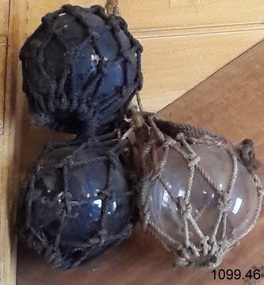
 Flagstaff Hill Maritime Museum and Village
Float
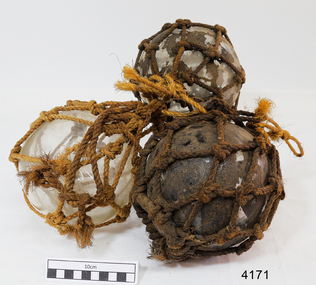
... ...glass float...Floats (3) glass enclosed by knotted rope, 2 dark coloured glass, 1 clear glass. ...flagstaff hill warrnambool shipwrecked-coast flagstaff-hill flagstaff-hill-maritime-museum maritime-museum glass float fishing float fishing industry shipwreck-coast flagstaff-hill-maritime-village Floats (3) glass enclosed by knotted rope, 2 dark coloured glass, 1 clear glass. ...Floats (3) glass enclosed by knotted rope, 2 dark coloured glass, 1 clear glass. flagstaff hill, warrnambool, shipwrecked-coast, flagstaff-hill, flagstaff-hill-maritime-museum, maritime-museum, glass float, fishing float, fishing industry, shipwreck-coast, flagstaff-hill-maritime-village -
 Flagstaff Hill Maritime Museum and Village
Tool - Spirit level, Early to mid-20th century
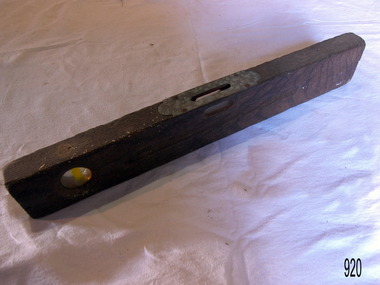
... glass tube containing alcohol and an air bubble. It was invented in 1661 and was first used on telescopes and later on surveying instruments, but it did not become a carpenter's tool until the factory-made models were introduced in the mid-19th century. The circular level, in which a bubble floated...glass tube containing alcohol and an air bubble. It was invented in 1661 and was first used on telescopes and later on surveying instruments, but it did not become a carpenter's tool until the factory-made models were introduced in the mid-19th century. The circular level, in which a bubble floated ...The tool is used for establishing a horizontal plane, it consists of a small glass tube containing alcohol or similar liquid and an air bubble. The tube is sealed and fixed horizontally in a wooden or metallic block or frame with a smooth lower surface. The glass tube is slightly bowed, and adjustment to the horizontal is indicated by the movement of the bubble. The device is on a level surface when the bubble is in the middle of the glass tube. The level sensitivity is proportional to the radius of the curvature of the glass. The spirit or bubble level consists of a sealed glass tube containing alcohol and an air bubble. It was invented in 1661 and was first used on telescopes and later on surveying instruments, but it did not become a carpenter's tool until the factory-made models were introduced in the mid-19th century. The circular level, in which a bubble floated under a circular glass to indicate the level in all directions, was invented in 1777. But It lacked the sensitivity of the conventional level.A hand tool that has not changed much since its invention in 1661, this tool is used today and although the materials it is made from have changed it's use has not.Spirit level wooden with two windows one of which has a piece of brass sheet metal protecting it.Noneflagstaff hill, warrnambool, flagstaff-hill, flagstaff-hill-maritime-museum, maritime-museum, shipwreck-coast, flagstaff-hill-maritime-village, hand tool, spirit level, carpenders tool, builders tool, surveyors instrument -
 Flagstaff Hill Maritime Museum and Village
Tool - Level, Mid 19th to mid 20th century
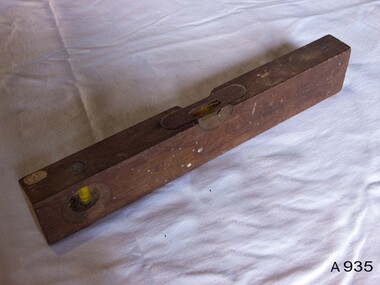
... glass tube containing alcohol and an air bubble. It was invented in 1661 and was first used on telescopes and later on surveying instruments, but it did not become a carpenter's tool until the factory-made models were introduced in the mid-19th century. The circular level, in which a bubble floated...glass tube containing alcohol and an air bubble. It was invented in 1661 and was first used on telescopes and later on surveying instruments, but it did not become a carpenter's tool until the factory-made models were introduced in the mid-19th century. The circular level, in which a bubble floated ...The tool is used for establishing a horizontal plane, it consists of a small glass tube containing alcohol or similar liquid and an air bubble. The tube is sealed and fixed horizontally in a wooden or metallic block or frame with a smooth lower surface. The glass tube is slightly bowed, and adjustment to the horizontal is indicated by the movement of the bubble. The device is on a level surface when the bubble is in the middle of the glass tube. The level sensitivity is proportional to the radius of the curvature of the glass. The spirit or bubble level consists of a sealed glass tube containing alcohol and an air bubble. It was invented in 1661 and was first used on telescopes and later on surveying instruments, but it did not become a carpenter's tool until the factory-made models were introduced in the mid-19th century. The circular level, in which a bubble floated under a circular glass to indicate the level in all directions, was invented in 1777. But It lacked the sensitivity of the conventional level.A hand tool that has not changed much since its invention in 1661, this tool is used today and although the materials it is made from have changed it's use has not.Spirit level wooden has 2 glass levels, 1 horizontal & 1 vertical Noneflagstaff hill, warrnambool, shipwrecked-coast, flagstaff-hill, flagstaff-hill-maritime-museum, maritime-museum, shipwreck-coast, flagstaff-hill-maritime-village -
 The Beechworth Burke Museum
Photograph, c.2000s
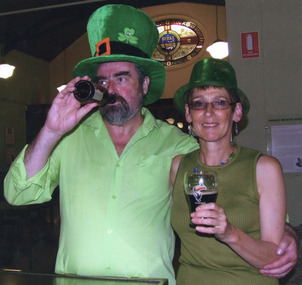
... glass oval window in the background. The Museum, situated in Beechworth, holds a collection of over 30,000 individual objects - including this photograph. James Toole (left) was the 'face of the Beechworth Post Office' until his retirement in 2015, following a 45-year career in mail service. He is a Friend of the Burke Museum, volunteering on projects such as crafting the Burke Museum's float...glass oval window in the background. The Museum, situated in Beechworth, holds a collection of over 30,000 individual objects - including this photograph. James Toole (left) was the 'face of the Beechworth Post Office' until his retirement in 2015, following a 45-year career in mail service. He is a Friend of the Burke Museum, volunteering on projects such as crafting the Burke Museum's float ...This is a photograph of two people (James Toole and Beryl Witkowski) amid celebrations for St Patrick's Day at the Burke Museum in an unknown year. St Patrick's Day is traditionally an Irish religious holiday, but has been adopted in countries such as Australia to celebrate an idea of Irish culture. These celebrations often include wearing green clothes, especially a shamrock hat, and drinking beer, all pictured here. This celebration appears to be taking place within the Burke Museum itself, with museum's iconic stained glass oval window in the background. The Museum, situated in Beechworth, holds a collection of over 30,000 individual objects - including this photograph. James Toole (left) was the 'face of the Beechworth Post Office' until his retirement in 2015, following a 45-year career in mail service. He is a Friend of the Burke Museum, volunteering on projects such as crafting the Burke Museum's float in the 2018 Beechworth Bakery and Beechworth Honey Grand Parade at the Golden Horseshoes Festival. He is known for his flamboyant character. Beryl Witkowski (right) was a historian and curator for the Burke Museum, retiring from her position in 2016. She was involved as a Friend of the Burke Museum from at least 2004.This photograph is significant to the Burke Museum and Beechworth as it depicts two prominent, contemporary members of the museum's paid and volunteer staff in the museum itself. It highlights both how the staff interacted with the museum through celebrations and how the museum itself was used in capacities other than object display. The photograph can also be used to interpret Australia's relationship to the St Patrick's Day holiday, especially given the presence of Irish immigrants to the Beechworth area in the nineteenth century.A colour, square photograph printed on rectangular photographic paper.First Card: WITKOWSKI, Beryl / TOOLE, James / BMM 3067 / Databased Second Card: Burke Museum / 3067 /burke museum, beechworth, museum staff, celebrations, st patrick's day, beer, australia, st patrick's day celebration -
 Alfred Hospital Nurses League - Nursing History Collection
Instrument - Specific gravity urinometer, Diabetes Urinometer
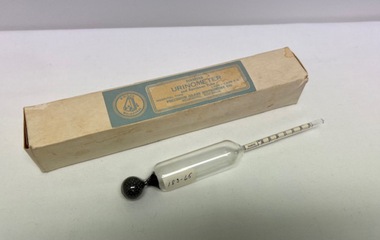
... Blown glass urinometer used to measure the specific gravity of urine. It consists of 3 parts: I. The float...Blown glass urinometer used to measure the specific gravity of urine. It consists of 3 parts: I. The float ...Glass urine specific gravity measure.Cream coloured manufacturers box labelled with a pale blue and cream label: "Diabetes Urinometer and Specimen Tube. Manufacturer Precision Glass Instrument Co, Melbourne". Blown glass urinometer used to measure the specific gravity of urine. It consists of 3 parts: I. The float: is the air containing part II. Weight: the lower end of urinometer (metal ball bearings) III. Stem- Has calibrations with numbers marked to measure the specific gravity Missing urine holding specimen tubeHospital type diabetes urinometer 60 degrees F Precision Glass Instrument Co. Melb. Measurements on stem from 000 to 030 urine specific gravity measure, urine testing -
 Hymettus Cottage & Garden Ballarat
Decorative object - bowl, Float Bowl
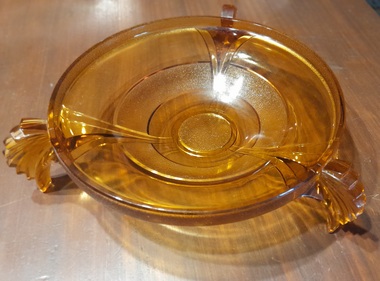
... Glass...Art-Deco...Float...Amber glass with distinctive art-deco features. Glass Art-Deco Float bowl nil Amber glass bowl with three stepped feet. ...Amber glass with distinctive art-deco features.Amber glass bowl with three stepped feet.nilglass, art-deco, float bowl -
 City of Melbourne Libraries
Photograph, Bull, Hugh Jones, 1897-1993, RMS Orford departing from Station Pier, Port Melbourne
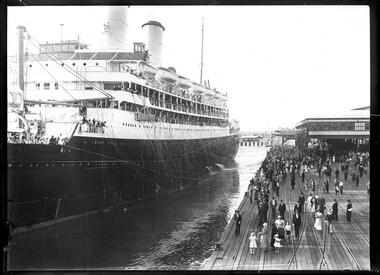
... floated and broken up at Savona. . . References: R.M.S. ORFORD. (1928, November 23). The Sydney Morning Herald (NSW : 1842 - 1954), p. 14. Retrieved September 15, 2023, from http://nla.gov.au/nla.news-article16511535 ARRIVAL OF THE ORFORD (1928, November 30). The Week (Brisbane, Qld. : 1876 - 1934), p. 21. Retrieved September 15, 2023, from http://nla.gov.au/nla.news-article181126802 CROWDED TOURIST SHIP WILL CARRY TEST AND DAVIS CUP TEAMS. (1934, March 21). The Age (Melbourne, Vic. : 1854 - 1954), p. 11. Retrieved October 5, 2023, from http://nla.gov.au/nla.news-article203826897 tennis ships Photographer notations on slide: "B19". Glass ...Published: 21 March 1934 The Age p11 Published title: CROWDED TOURIST SHIP WILL CARRY TEST AND DAVIS CUP TEAMS. Published caption: Carrying an exceptionally large number of tourists, business men and prominent sporting personalities, R.M.S. Orford sailed for London yesterday. Over two hundred passengers embarked at Melbourne, and on leaving the Australian coast there will be two thousand persons on board. The Australian Test team will join the vessel at Fremantle and the remaining two Davis Cup representatives will embark at Adelaide. A picture of the Orford taken just as she moved out from Station Pier, Port Melbourne, under her own steam. Trove article identifier: http://nla.gov.au/nla.news-article203826897 Description: Passenger ship about to depart Station Pier, Port Melbourne. Research by project volunteer, Fiona Collyer: The RMS Orford was built by Vickers-Armstrong Shipyard Barrow-in-Furness, Cumbria, England and launched in 1927 by Lady Ryrie, the wife of Sir Granville Ryrie, the Australian Ambassador to the UK. The Orford was owned by the Orient Steam Navigation Ltd and was designed for the mail and passenger service between England and Australia. She was 20,000 tons, 658 ft long, 75 ft across and 80 ft high from water-line to deck. She had eight decks, a swimming pool and cost more than £1,000,000. She could travel at 20 knots – 480 miles a day, a 5 week voyage between Australia and England. There were enough lifeboats to accommodate every person on board. Promoted as a ship of comfort, luxury, speed and grace with spacious, beautifully decorated lounges, smoking-rooms and writing rooms, the SMH 23/11/1928 review said “sitting-rooms where the furniture recreates the air of quiet, exquisite, safe luxury; suites where you may retire from other people, and on a sea voyage other people, even the most charming other people, often begin to resemble one’s worst enemies towards the end of several weeks sea voyaging together”. “Travel like a human being. This is what the great liners give you today. The Orford dining room is enormous (it seated 350 people) the walls sweep up to a white, cool roof supported on decorative pillars. Panels of grey scagliola and carved designs remove the bleak, comfortless air which used to cling to dining-rooms of ships. Everything about them was so wretchedly temporary that you could not enter them without wishing that you stayed at home. They gave you the creeps and indigestion. This room is gay, bright, sunlit, like a luxurious café overlooking the sea.” “You really feel in here that you are a human being and not a piece of cargo endowed with sensation.” The Orford had the punkah louvre system of ventilation which forced draughts through every part of the ship, ensuring “No Ship Smells!!” and avoiding - “… a mayonnaise of all the unpleasant odours generated under heaven. From the hot oil of the engines, from those overheated, bottomless pits below the water-line, from new paint and food, from people perspiring at work, from rope and tar and grease and fruit and wet clothes and tobacco, rises a deplorable incense that lingers unsettlingly in the nostril long after one has left the ship. Those dreadful odours will never rise to torture the senses of passengers who feel that all is over with them.” The modern electric kitchen had a roll making machine capable of producing 2000 rolls for the table an hour and a bread and butter machine which cut the bread into slices and spread the butter in one operation. (The Week – Brisbane 30/11/1928) On 13/10/1928, the Orford made its first voyage to Australia with 520 first class and 1100 3rd class passengers. The name of the passengers embarking and disembarking and their reason for visiting were published in newspapers and the number of migrants for the New Settlers Scheme and the Dreadnought Boys Co program to promote and assist the migration of British youths willing to become farm workers in Australia 1911-1939 were noted too. On the 19th March 1932, RMS Orford featured in the “Parade of Ships” celebrating the official opening of the Sydney Harbour Bridge. Only country people were allowed to book a ticket as a guest on board. The Post Office issued commemorative postage stamps showing the Orford sailing under the bridge. In March 1934, the Orford sailed from Australia to London, via Colombo, Aden, Port Said, Naples, Villefranche, Toulon, Parma, Gibraltar and Channel Port. Amongst the 2000 passengers on board was the Davis Cup Tennis team, tennis champions Joan Hartigan and Nell Hopman, the Australian Test cricket team and British champion swimmer Joyce Cooper. Every day tennis player Harry Hopman and an Australian Press Association reporter radioed through reports on their activities, which included – - Test cricket batsman Len Darling having spend 4 days in his cabin after straining his groin when he slipped over while playing ball tennis in his slippers. - Batsman Bill Brown dancing the fox-trot, displaying footwork similar to the grace he showed at the wicket. - Alluding to the seasickness of Don Bradman and Stan McCabe and how they were making up for meals lost on the Great (very choppy) Australian Bight. - Miss Joan Hartigan discarding her bright blue shorts for brighter blue bathers and being first into the pool. - Bowler Bill O’Reilly being tripped by a passenger on the deck and spending the voyage with bandaged wrists with daily updates of his progress in the press. - Wicketkeeper Ben Barnett’s conjuring tricks and constant whirring movie camera. - Results of the quoits, ball tennis and bridge tournaments. A fancy dress ball was held one night and the cricketers dressed as sheiks and sang “The Riff Song” from the pre-code 1929 operetta film “The Desert Song” starring John Bates as the Red Shadow and Myrna Lay as a native dancing girl. Alan Kippax’s beard blew overboard! Joan Hartigan dressed as Burlington Bertie from the music hall song and Nell Hopman a doll in a box wearing a crinkled paper dress. On arrival at Southampton, while they waited for the gangway to be lowered, Bradman entertained the team at the piano playing popular tunes while the cricketers sang. . In 1935, RMS Orford’s third class accommodation was converted to tourist class. Her passenger capacity was now 468 First Class, 515 tourist class and 440 crew. First saloon from Sydney fares cost for single £76, £82, £88 and Third Class fares were £21, £23, £25. Less than a penny a mile. . In 1936, the Orford embarked the exiled Emperor of Ethiopia, Haile Selassie at Gibraltar on his way to the UK. In 1939, she was requisitioned for Australian government service and on 7/1/1940 she conveyed the first Australian troops to Egypt and was then used to carry French troops from Tamatave, Madagascar to Marseilles. On 1/6/1940 RMS Orford was bombed and set on fire at Marseilles by German aircraft. 14 crew were killed, 25 wounded. In 1947, the wreck was re-floated and broken up at Savona. . . References: R.M.S. ORFORD. (1928, November 23). The Sydney Morning Herald (NSW : 1842 - 1954), p. 14. Retrieved September 15, 2023, from http://nla.gov.au/nla.news-article16511535 ARRIVAL OF THE ORFORD (1928, November 30). The Week (Brisbane, Qld. : 1876 - 1934), p. 21. Retrieved September 15, 2023, from http://nla.gov.au/nla.news-article181126802 CROWDED TOURIST SHIP WILL CARRY TEST AND DAVIS CUP TEAMS. (1934, March 21). The Age (Melbourne, Vic. : 1854 - 1954), p. 11. Retrieved October 5, 2023, from http://nla.gov.au/nla.news-article203826897 Photographer notations on slide: "B19".tennis, ships
