
Showing 4 items matching "glider aerodynamics"
-
 Moorabbin Air Museum
Book - Gliders & sailplanes, Building & Flying Sailplanes & Gliders
... Glider aerodynamics...Gliders & sailplanes Glider aerodynamics Contruction materials & design Plans & kits Cheap gliders Overview of home building gliders & sailplanes, circa 1980 Building & Flying Sailplanes & Gliders Book Gliders & sailplanes ...Overview of home building gliders & sailplanes, circa 1980non-fictionOverview of home building gliders & sailplanes, circa 1980glider aerodynamics, contruction materials & design, plans & kits, cheap gliders -
 Kiewa Valley Historical Society
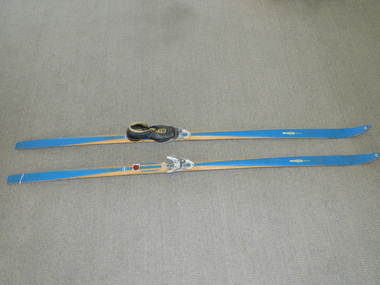
Skis Snow Competition, circa 1966
... Glider or grip wax was applied onto this base. The top body of the skis is tapered from shoe position to both front and back tips.Tapered curvatures from foot radiating to all sides provides the required aerodynamics. ...Glider or grip wax was applied onto this base. The top body of the skis is tapered from shoe position to both front and back tips.Tapered curvatures from foot radiating to all sides provides the required aerodynamics. ...The post World War II migration of European "snow skiiers" into Australia combined with the construction of Hydo Electricity Schemes in both the N.S.W.and Victorian Alps regions, opened up these winter snow areas to a greater influx of tourists and holiday adventurers interested in "winter" sports. The ability to project, on a global scale, skiing facilities of international standards to those in the northern hemisphere during their summer has opened up the Australia ski resorts and their facilities to a much greater winter sport orientated population. These cross country skis were purchased by a member of the Bogong Ski Club and were part of a bulk ski stock consignment from Finland in 1966/67. They were introduced into the Victorian Alps to encourage skiers to take up cross country skiing both at Falls Creek and Mount Buller. This initiative spurred on the now annual 42 kilometre cross country "Kangaroo Hoppet" race at Falls Creek. This race is currently the biggest cross country snow skiing race in Australia. These snow skis were made in Finland. They are wooden (hickory) skis and made from four strips (glued and shaped) pieces of wood that are not laminated. There is a painted blue flash on the top of the skis that extends the full length of the skis. The face of the underside of the skis is flat and is coated in black Stockholm tar. Glider or grip wax was applied onto this base. The top body of the skis is tapered from shoe position to both front and back tips.Tapered curvatures from foot radiating to all sides provides the required aerodynamics. Metal boot bindings consisting of a toe plate with adjustable toe clip and a heel plate, both of which are screwed onto the skis. "KILPA, KARHU URHEILUTARPEITA SPORTART1KLAR, Karhu-Valtz Finland. Hickorypohjin"snow skiing, cross country skiing, falls creek winter tourism -
 Australian Gliding Museum
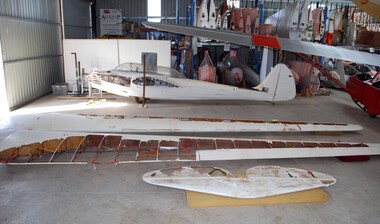
Machine - Glider - Sailplane, 1943
... glider. It is understood that the reduction in weight and cleaner aerodynamics from the changes could increase the glide ratio from 1:24 to something like 1:30. ...glider. It is understood that the reduction in weight and cleaner aerodynamics from the changes could increase the glide ratio from 1:24 to something like 1:30. ...The Laister-Kauffman 10A (LK10A) is a 2 seat a military training glider developed from a successful Jack Laister single seat glider called Yankee Doodle that first flew in 1938 and was exhibited at the Paris Air Show of 1939. The two seater variation was ordered in 1941 by the US Army for training glider pilots of troop carrying gliders. The military designation was XTG-4. The LK 10A glider was a simpler, more robust design than Yankee Doodle. A longer canopy enclosed both seating positions. The top of the fuselage formed a straight ridge from the top of the canopy to the point where the fin – rudder connected. Also, the design was simplified by adopting straight spar wings of 15.2 metres in place of gull wings of 14.170 metres. During the war years 156 LK10As were produced before the contracts to supply the US Army were terminated. Many of these were later sold as surplus. The Museum’s exhibit (serial number 122) was built in 1943. It was imported into Australia in the 1950s by Ric New, a member of the Gliding Club of Western Australia. Ric New modified the glider by “flat topping” the fuselage and making other aerodynamic changes. This kind of modification of the LK10A was a well tried strategy in United States for extracting better performance from the glider. It is understood that the reduction in weight and cleaner aerodynamics from the changes could increase the glide ratio from 1:24 to something like 1:30. The LK10A was located at the Gliding Club of Western Australia for many years. Records reveal that it was kept airworthy until about 1975. The LK10A is an important acquisition in that it allows one to compare the state of two seat glider design in United States and the United Kingdom in the immediate post war period. It is interesting to note that at that time a number of clubs in Australia who acquired a two seat glider for training chose the United Kingdom open cockpit high strutted wing offerings from Slingsby (e.g. T31) instead of more innovative military surplus gliders from America. Modified LK10A glider consisting of tubular steel fuselage with a combination of fabric and metal covering, fabric covered wooden wings and other flying surfaces.australian gliding, glider, sailplane, laister, kauffman, ric new, gliding club of western australia, lk10a, yankee doodle, xtg-4 -
Moorabbin Air Museum
Book - Flight handbooks, Flight Handbook
... Flight handbooks First principles Aerodynamics Aircraft structures Gliders & sailplanes Airscrews Aircraft power units Types of aircraft engines Supercharging Stratosphere flight Modern developments Aircraft instruments A manual of aeronautical theory & practice, circa 1944 Flight Handbook Book Flight handbooks ...A manual of aeronautical theory & practice, circa 1944non-fictionA manual of aeronautical theory & practice, circa 1944first principles, aerodynamics, aircraft structures, gliders & sailplanes, airscrews, aircraft power units, types of aircraft engines, supercharging, stratosphere flight, modern developments, aircraft instruments
