
Showing 149 items matching "gliders"
-
 Moorabbin Air Museum
Book - RAF MUSEUM SERIES Volume 8, RAF Airborne Forces Manual, The Official Air Publications for RAF Paratroop Aircraft and Gliders, 1942-1946, RAF Airborne Forces Manual, The Official Air Publications for RAF Paratroop Aircraft and Gliders, 1942-1946, 1979
... RAF Airborne Forces Manual, The Official Air Publications for RAF Paratroop Aircraft and Gliders, 1942-1946...RAF MUSEUM SERIES Volume 8, RAF Airborne Forces Manual, The Official Air Publications for RAF Paratroop Aircraft and Gliders, 1942-1946...Jacket showing small tank emerging from glider, white background...RAF MUSEUM SERIES Volume 8, RAF Airborne Forces Manual, The Official Air Publications for RAF Paratroop Aircraft and Gliders, 1942-1946 RAF MUSEUM SERIES Volume 8, RAF Airborne Forces Manual, The Official Air Publications for RAF Paratroop Aircraft and Gliders, 1942-1946 Jacket showing small tank emerging from glider, white background RAF Airborne Forces Manual, The Official Air Publications for RAF Paratroop Aircraft and Gliders, 1942-1946 Book RAF MUSEUM SERIES Volume 8, RAF Airborne Forces Manual, The Official Air Publications for RAF Paratroop Aircraft and Gliders, 1942-1946 RAF ...RAF MUSEUM SERIES Volume 8, RAF Airborne Forces Manual, The Official Air Publications for RAF Paratroop Aircraft and Gliders, 1942-1946Jacket showing small tank emerging from glider, white backgroundnon-fictionRAF MUSEUM SERIES Volume 8, RAF Airborne Forces Manual, The Official Air Publications for RAF Paratroop Aircraft and Gliders, 1942-1946 -
 Flagstaff Hill Maritime Museum and Village
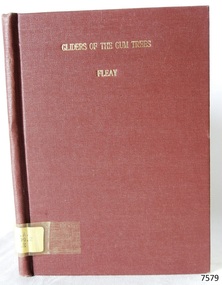
Book, Gliders of The Gum Trees
... Gliders of The Gum Trees...Gliders of The Gum Trees Author: David Fleay Publisher: Bread & Cheese Club Date: 1947 ...Warrnambool Shipwrecked-coast Flagstaff-Hill Flagstaff-Hill-Maritime-Museum Maritime-Museum Shipwreck-coast Flagstaff-Hill-Maritime-Village Shipwrecked-artefact Book Warrnambool books and records Warrnambool Children’s Library Gliders of The Gum Trees David Fleay Label on spine cover with typed text R.A. 599.2 FLE Front loose endpaper has a sticker from Warrnambool Children's Library Gliders of The Gum Trees Author: David Fleay Publisher: Bread & Cheese Club Date: 1947 Gliders of The Gum Trees Book ...Gliders of The Gum Trees Author: David Fleay Publisher: Bread & Cheese Club Date: 1947 Label on spine cover with typed text R.A. 599.2 FLE Front loose endpaper has a sticker from Warrnambool Children's Library warrnambool, shipwrecked-coast, flagstaff-hill, flagstaff-hill-maritime-museum, maritime-museum, shipwreck-coast, flagstaff-hill-maritime-village, shipwrecked-artefact, book, warrnambool books and records, warrnambool children’s library, gliders of the gum trees, david fleay -
 Australian Gliding Museum
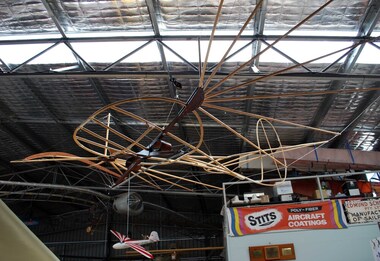
Equipment - Glider – Hang Glider Type, 2013 - 2014
... glider...He developed and tested bird-like gliders controlled by weight shift by the pilot (a similar method to modern hang gliders). ...Hang glider made of wood with wire bracing – yet to be covered with authentic cotton fabric. ...The glider has a small plate with identification details including name of builder (Bruce Hearn) ...Equipment Glider – Hang Glider Type Bruce Hearn ...Otto Lilienthal (1848-1896) from Berlin, Germany, is widely credited as being the first person to make repeated successful gliding flights. He was known for adopting a thorough scientific approach founded on observations of the flight of birds in relation to the problem of inventing a man carrying heavier than air machine that would fly. He developed and tested bird-like gliders controlled by weight shift by the pilot (a similar method to modern hang gliders). The pilot held on to the glider with his forearms resting in hoops mounted on the main structural beam connecting the wings. The weight shift was achieved by the pilot swinging his trunk and legs. In contrast, the pilot of a modern hang glider is suspended below the glider and, with the use of an A-frame, allows the whole body to be moved around to achieve control. The Lilienthal design apparently had a tendency to pitch down and a tailplane was added to mitigate this problem. Lilienthal flew from hills in the Rhinow region and from a conical hill he built near Berlin. He made over 2000 flights. Importantly, for others seeking to progress manned flight at the time and also for the historical record, reports of Lilienthal’s flights (some with photographs) were published and Lilienthal detailed his experiences and corresponded with other flight pioneers. Lilienthal’s work became well known and influenced Orville and Wilbur Wright in their initial experiments with gliders in 1899 (although in their quest to design and fly an aeroplane they relied on new data created by wind tunnel testing). The replica built by Bruce Hearn is of the 1893 Lilienthal glider. It is very similar to the “Normal-Segalapparat” (Normal Glider) for which patent protection was later granted a few years later. The Lilienthal replica glider is an important addition to the AGM collection as it represents the beginning of successful gliding flight. Hang glider made of wood with wire bracing – yet to be covered with authentic cotton fabric. The glider has a small plate with identification details including name of builder (Bruce Hearn) glider, hang glider, lilienthal, hearn, replica -
Moorabbin Air Museum
Book - Gliders & sailplanes, Building & Flying Sailplanes & Gliders
... Building & Flying Sailplanes & Gliders...Gliders & sailplanes...Gliders & sailplanes Glider aerodynamics Contruction materials & design Plans & kits Cheap gliders Overview of home building gliders & sailplanes, circa 1980 Building & Flying Sailplanes & Gliders Book Gliders & sailplanes ...Overview of home building gliders & sailplanes, circa 1980non-fictionOverview of home building gliders & sailplanes, circa 1980glider aerodynamics, contruction materials & design, plans & kits, cheap gliders -
 Whitehorse Historical Society Inc.
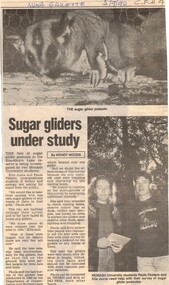
Article, Sugar Gliders under study, 5/09/1990 12:00:00 AM
... Sugar Gliders under study...Article from Nunawading Gazette 5 September 1990 about investigation into fate of sugar glider possums in the Blackburn Lake Reserve. ...wildlife sugar gliders blackburn lake sanctuary peeters paula juzva kris Article from Nunawading Gazette 5 September 1990 about investigation into fate of sugar glider possums in the Blackburn Lake Reserve. ...Article from Nunawading Gazette 5 September 1990 about investigation into fate of sugar glider possums in the Blackburn Lake Reserve. Research by Monash University students Kris Juzva and Paula Peeters.wildlife, sugar gliders, blackburn lake sanctuary, peeters, paula, juzva, kris -
 Australian Gliding Museum
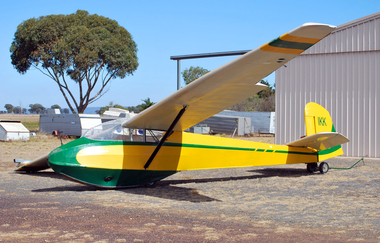
Machine - Glider – Sailplane, 1957
... ...glider...On 9 January 2000 it was donated to Vintage Gliders Australia by Kevin Sedgman at a presentation ceremony with Alan Patching receiving the glider during the Rally at Lake Keepit. ...Prior to restoration work, the glider was finished in a white, green and yellow paint scheme. ...“Vintage Gliders Australia” name in white lettering on fuselage sides and registration VH-IKK in black lettering on rudder...Machine Glider – Sailplane Alexander Schleicher Gmbh ...The Alexander Schleicher K4 was designed in the mid 1950s by Rudolf Kaiser as a club training glider and several hundred were built. The Australian Gliding Museum’s K4, VH-IKK, serial number 55, was built in 1957 and purchased by the RAF Air Training Corp. U.K. After some years it was sold to a New Zealand Gliding Club and in 1990 with over 4800 hours, number of launches unknown, it was purchased by the Brisbane Valley Soaring Club and in 1994 was transferred to the Far North Queensland Soaring Centre who operated it from the Mareeba airfield. On 9 January 2000 it was donated to Vintage Gliders Australia by Kevin Sedgman at a presentation ceremony with Alan Patching receiving the glider during the Rally at Lake Keepit. It has been flown regularly at vintage glider rallies and on several occasions at Museum open days. However, it has subsequently been grounded on account of potential structural defects. VH-IKK is one of two K4s in Australia, the other being VH-XJP which is believed to be in storage in Queensland in a damaged condition. When restored, this exhibit will be representative example of the AS-K4 glider-sailplane type.Tandem two seat high wing strutted glider consisting of wood with plywood and fabric wings, tailplane / elevators, fin / rudder, and tubular steel framed, fabric covered fuselage. Prior to restoration work, the glider was finished in a white, green and yellow paint scheme. “Vintage Gliders Australia” name in white lettering on fuselage sides and registration VH-IKK in black lettering on rudderaustralian gliding, glider, sailplane, alexander schleicher, k4, kaiser, raf air training corp, brisbane valley soaring club, far north queensland soaring centre, vintage gliders australia, sedgman, patching -
 Australian Gliding Museum
Machine - Glider – Sailplane, 1963
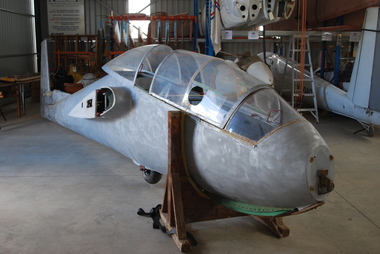
... ...glider...Reg Hancock purchased the damaged glider and rebuilt the port wing and restored it to airworthy condition (September 1976). ...This exhibit is a large two seat glider /sailplane of wood and fabric construction. ...The glider, serial number 803, was registered as VH-GNL...SZD (Szybowcowy Zakład Doświadczalny) – “Glider Experimental Works”...Subject to restoration, this exhibit may be representative of the 1950s - 1960s Bocian two seat sailplane type australian gliding glider sailplane bocian cumulus alice springs gliding club darwin gliding club colac gliding group geelong gliding club hancock The glider, serial number 803, was registered as VH-GNL This exhibit is a large two seat glider /sailplane of wood and fabric construction. ...The Bocian is a versatile training sailplane that first flew in 1952. The type has been modified in several respects over the course of production by SZD (tailplane and rudder in particular). About 600 have been built; many for export to 27 countries (including Australia). The aerobatic capability and fine performance (best glide ratio of 26) has enabled the Bocian to be used to train competition pilots as well as those of lesser experience. Many world gliding records were set in the 1950s and 1960s in Bocian gliders. The Museum’s example is a type D test flown in Poland on 3 and 4 April 1963. It was imported into Australia in September 1963 by Austerserve Pty Ltd. The first owner was the Alice Springs Gliding Club and the glider had name “Cumulus” painted on the side of the fuselage (since removed). The glider had recorded 726 hours 46 minutes flying time from 2138 launches as at July 1967 when it was transferred to the Darwin Gliding Club. It appears that the glider was damaged in June 1968. The substantial repairs to the fuselage, both wings and tailplane and other minor repairs were completed on 13 October 1968. The glider continued flying with the Darwin Gliding Club until August 1969 at which time the service to that club amounted to 59 hours 7 minutes flying time from 348 flights. Between August 1969 and August 1976 no flights are recorded in the logbook. It is understood that on its last flight at Bachelor, south of Darwin in the Northern Territory (August 1969) it was severely damaged when it crashed after spinning while being auto-tow launched (although this is not expressly mentioned in the logbook). Reg Hancock purchased the damaged glider and rebuilt the port wing and restored it to airworthy condition (September 1976). It was then transferred to Colac, Victoria, and used by the Colac Gliding Group at the Yeo airfield until February 1981, adding another 153 hours from 403 flights to the glider’s record. After airworthy inspection in September 1982 the glider was used by the Geelong Gliding Club until 1983 (logbook details not held). The 20 year survey was then due and the glider fell out of service. In the course of the most recent restoration attempt it was discovered that the glue used in construction had deteriorated and that it was no longer feasible to bring it back to an airworthy condition. Subject to restoration, this exhibit may be representative of the 1950s - 1960s Bocian two seat sailplane typeThis exhibit is a large two seat glider /sailplane of wood and fabric construction. All components are present with the exception of instruments. However, at the time that the aircraft was transferred to the Museum it had been taken apart for major restoration work. As received it is stripped of the top coats of paint and a number of components (including, amongst others, tip fairings, nose cone and cockpit elements) that were removed for facilitating the repair process. The glider, serial number 803, was registered as VH-GNLaustralian gliding, glider, sailplane, bocian, cumulus, alice springs gliding club, darwin gliding club, colac gliding group, geelong gliding club, hancock -
 Australian Gliding Museum
Functional object - Rudder from Geelong Gliding Club Primary Glider, 1929
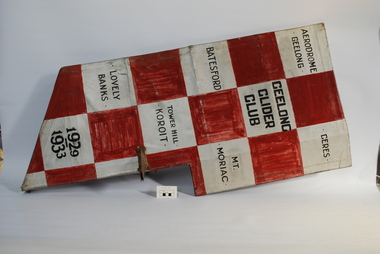
... ...glider...The Geelong Glider Club was formed in June 1929 at a meeting held at the Belmont Common hangar of Percy Pratt. ...Fabric covered wooden framed primary glider rudder with metal levers decorated with silver and dark red checkered design. ...On starboard side – Geelong Glider Club; and place names including Geelong Aerodrome, Batesford, Ceres, Lovely Banks, Tower Hill, Koroit, Mount Moriac; and years, 1929-1933 ...Exhibit is a historical link to the earliest gliding activities of the Geelong Glider Club. australian gliding glider zogling primary glider rudder geelong gliding club lovely banks tower hill. koroit On port side – Cat logo. ...The Geelong Glider Club was formed in June 1929 at a meeting held at the Belmont Common hangar of Percy Pratt. The club built a Zogling (Primary Glider) based on plans obtained from Germany and flew it off nearby hills at Lovely Banks and other places in the Geelong region. The checked rudder design (without logo and markings) is evident in a picture of a Geelong Glider Club Zogling flying at Tower Hill near Warrambool, Victoria, at Easter 1931 and this lends support to the conclusion that the rudder was part of the Club’s first glider. The logo and markings appear to be a more recent elaboration to the design. Exhibit is a historical link to the earliest gliding activities of the Geelong Glider Club.Fabric covered wooden framed primary glider rudder with metal levers decorated with silver and dark red checkered design. The item has a cat logo on one side and markings on the other of places where the Geelong Gliding Club flew in its early years.On port side – Cat logo. On starboard side – Geelong Glider Club; and place names including Geelong Aerodrome, Batesford, Ceres, Lovely Banks, Tower Hill, Koroit, Mount Moriac; and years, 1929-1933 australian gliding, glider, zogling, primary glider, rudder, geelong gliding club, lovely banks, tower hill. koroit -
Moorabbin Air Museum
Document (item) - Articles on - Nomad, Jindivik, Gnat, Genairco,GAF Hawk, British Gliders, Night Shadow, Fouga, Gloster & Gladiator, Javelin, Swift, Airvan, F16, F111
... Articles on - Nomad, Jindivik, Gnat, Genairco,GAF Hawk, British Gliders, Night Shadow, Fouga, Gloster & Gladiator, Javelin, Swift, Airvan, F16, F111...Articles on - Nomad, Jindivik, Gnat, Genairco,GAF Hawk, British Gliders, Night Shadow, Fouga, Gloster & Gladiator, Javelin, Swift, Airvan, F16, F111 Document Articles on - Nomad, Jindivik, Gnat, Genairco,GAF Hawk, British Gliders, Night Shadow, Fouga, Gloster & Gladiator, Javelin, Swift, Airvan, F16, F111 ... -
Moorabbin Air Museum
Booklet - CAC Commonwealth Aircraft Corporation, Ministry of Supply Collected Researches on the Stability of Kites and Towed Gliders
... Ministry of Supply Collected Researches on the Stability of Kites and Towed Gliders ...Ministry of Supply Collected Researches on the Stability of Kites and Towed Gliders Booklet CAC Commonwealth Aircraft Corporation ... -
Moorabbin Air Museum
Manual (Item) - Hotspur Gliders repair scheme - Two Copies, Part 4 Major Repair Scheme for Hotspur I and III Gliders
... Part 4 Major Repair Scheme for Hotspur I and III Gliders...British Air Ministry Part 4 Major Repair Scheme for Hotspur I and III Gliders Manual Hotspur Gliders repair scheme - Two Copies ...British Air Ministry -
Moorabbin Air Museum
Photograph (Item) - Photos various - Military, Civilian, Gliders, RC aircraft and models - WW2 RAAF public relations photos
... Photos various - Military, Civilian, Gliders, RC aircraft and models - WW2 RAAF public relations photos ...Photos various - Military, Civilian, Gliders, RC aircraft and models - WW2 RAAF public relations photos Photograph Photos various - Military, Civilian, Gliders, RC aircraft and models - WW2 RAAF public relations photos ... -
 Kingston Arts
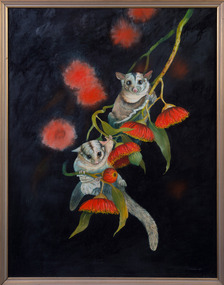
Painting, Dawn Stubbs, Sugar Gliders, 1989
... Sugar Gliders...Sugar Gliders Painting Dawn Stubbs ... -
Moorabbin Air Museum
Book - GLIDERS FOR ALL SEASONS, David A. Craddock, 1996
... GLIDERS FOR ALL SEASONS...GLIDERS FOR ALL SEASONS Book GLIDERS FOR ALL SEASONS David A. ... -
Moorabbin Air Museum
Book - THE GLIDERS, Alan Lloyd, 1982
... THE GLIDERS...THE GLIDERS Book THE GLIDERS Alan Lloyd Leo Cooper ... -
 Federation University Art Collection
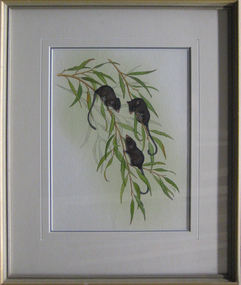
Watercolour, 'Feathertail Gliders' by Lynne Cooke
... 'Feathertail Gliders' by Lynne Cooke...Fraillon, Creswick 1990-2002. 'Feathertail Gliders' by Lynne Cooke Watercolour ...Lynne COOKE Lynne Cooke is known for her detailed drawings of native wildlife. This item is part of the Federation University Art Collection. The Art Collection features over 1000 works and was listed as a 'Ballarat Treasure' in 2007.Framed watercolour on paper. Donated in memory of Dr Janis M.G. Fraillon, Creswick 1990-2002.art, artwork, lynne cooke, available, feathertail gliders, animals -
 Australian Gliding Museum
Machine - Glider - Sailplane, 1946
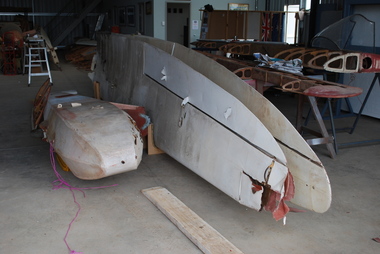
... ...glider...In 1957 the Blue Grunau moved to Western Australia and was added to the Glider Register as VH-GLC. Thereafter the glider had a series of owners. ...Single seat glider /sailplane of wooden construction with plywood and fabric covering....Machine Glider - Sailplane Australian Sailplanes ...This Grunau Baby 2B glider, often referred to as the “Blue Grunau”, was built by Australian Sailplanes in 1946 and acquired by a syndicate consisting of Norm Hyde, Rob Dowling, Leo Dowling, Dick Duckworth and Ted Desmond of the Gliding Club of Victoria. Piloted by syndicate members and other GCV members the glider performed well in soaring and cross country flights at the various sites used by the GCV in 1947, 1948 and 1949. The glider went to Sydney for a while and then returned to be operated by another syndicate at the GCV. Pat Burke and Bob McAliece bought the glider in the 1950s and then sold it to Keith, Jack and Bruce Hearn of Melbourne. In 1957 the Blue Grunau moved to Western Australia and was added to the Glider Register as VH-GLC. Thereafter the glider had a series of owners. The glider has come to the Australian Gliding Museum via the RAAFA (WA) Division. The flying record of the Blue Grunau has been logged for the period of 28 December 1957 to 17 September 1975: Time in air – 559 hours 37 minutes from 1513 flights. Single seat glider /sailplane of wooden construction with plywood and fabric covering.australian gliding, glider, sailplane, grunau, blue grunau, australian sailplanes, hyde, dowling, duckworth, desmond, burke, hearn, gliding club of victoria, gliding club of western australia, narrogin gliding club -
 Australian Gliding Museum
Machine - Glider – Sailplane, 1956
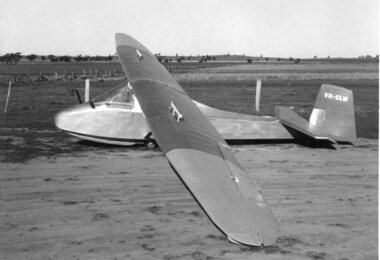
... By that time the glider had flown 1161 hrs 11 minutes from 5228 launches. ...Currently the glider features a predominately silver grey colour scheme. ...Machine Glider – Sailplane Alex. Mackie ...This exhibit is a home built glider of a Grunau Baby 2 design modified by the addition of a fully enclosing Perspex canopy, spoilers, and a landing wheel. It was built by Alex Mackie and was originally owned by the Southern Cross Gliding Club at Camden, New South Wales. The first flight was on 19 May 1956. After about 10 years service with that club it passed through a series of owners, including the Forbes Soaring Club, Beaudesert Gliding Club and private operators. The last major inspection and overhaul of the glider was April 1972. It passed a further airworthy inspection in April 1975. At that time, questions were raised about the weight of the glider (found to be 400 lbs empty). In 1976 it had fallen into a non-airworthy condition and has not flown since. By that time the glider had flown 1161 hrs 11 minutes from 5228 launches. This exhibit is an example of a Grunau Baby 2 type incorporating some improvements as typical of post war built Grunau Baby gliders. Wooden – fabric covered glider – missing canopy perspex, Instrument panel has turn and bank only. Currently the glider features a predominately silver grey colour scheme. australian gliding, grunau, southern cross gliding club, forbes soaring club, beaudesert gliding club -
 Australian Gliding Museum
Machine - Glider
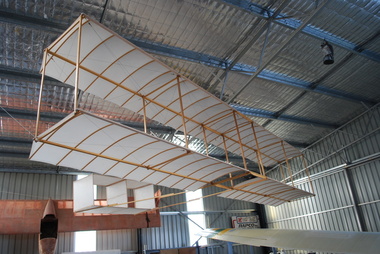
... Glider ......glider...On that historic day the glider was also flown by Edward Hallstrom, Charles Schultz, and Mrs Taylor and Mrs Schultz. ...Wooden frame, wire braced and fabric covered biplane hang-glider...The replicas were built by the Museum to celebrate the centenary of the first Australian heavier than air flight. The glider is an accurate full size replica of George Taylor’s Glider. australian gliding glider biplane george taylor edward hallstrom charles schultz narrabeen first flight None Wooden frame, wire braced and fabric covered biplane hang-glider Machine Glider Australian Gliding Museum ...The original “Taylor glider” was the aircraft used by George Taylor for the first heavier than air flight in Australia, which occurred on the 5 December 1909 on the beach at Narrabeen, New South Wales. On that historic day the glider was also flown by Edward Hallstrom, Charles Schultz, and Mrs Taylor and Mrs Schultz. The replicas were built by the Museum to celebrate the centenary of the first Australian heavier than air flight. The glider is an accurate full size replica of George Taylor’s Glider.Wooden frame, wire braced and fabric covered biplane hang-gliderNoneaustralian gliding, glider, biplane, george taylor, edward hallstrom, charles schultz, narrabeen, first flight -
 Australian Gliding Museum
Machine - Glider – Sailplane, 2015
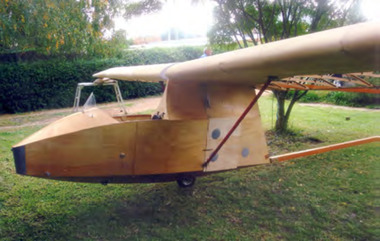
... ...glider...The Salamandra is a Polish glider designed by Waclaw Czerwinski at the Military Glider Workshops in Krakow in 1936. ...Nacelled solo training glider of traditional wood and fabric construction. ...The Salamandra is a Polish glider designed by Waclaw Czerwinski at the Military Glider Workshops in Krakow in 1936. ...The Salamandra is a Polish glider designed by Waclaw Czerwinski at the Military Glider Workshops in Krakow in 1936. This glider, designated “W.W.S.1”, was produced in substantial numbers prior to the second world war and used in Poland and some other eastern European countries for training pilots. Only one example survived the war, hidden away in the village of Goleszow in Silesia. In addition, no technical drawings could be found, so when the glider was discovered, the Gliding Institute being keen to re-establish gliding in Poland, used the glider to draw up new plans for construction. Five were built for the Institute in 1947 before production was resumed of the “Salamandra 48” at the SZD Jezow Workshops. Improvement were made by adding airbrakes and structural changes for the “Salamandra 49” and a windscreen and larger tailplane were changes adopted for the “Salamandra 53”. An export version designated “53A” was sold to and built under licence in China. Production of the Salamandra ceased in the early 1960s. Total production may have been in excess of 500. The glider was well regarded as a light weight trainer capable of soaring performance. The Museum’s replica was built by Ray Ash and may be may be classified as a “Salamandra 53”. However, he has added something of his own to the design by replacing the cable runs in the wings with control rods. The glider is substantially complete. The wings and tail / rudder surfaces have been covered with poly-fibre fabric. The fuselage woodwork is sealed with varnish. In addition to the finishing work (including painting) and rigging of the main components, the linkages for Ray’s control rod modification may need further engineering to make them operational. The Ray Ash Salamandra is the first of the type to appear in Australia. The Salamandra did not play any role in the development of gliding in Australia in the early years. However, it is an important exhibit in that it shows in tangible form a nacelle fuselage training glider in configuration and construction detail. As such it revisits the pioneering era of the 1930s and 1940s in Australia when wood, wire and fabric were the rule and the nacelle primary glider was generally the first step up for pilots who had mastered the basics in an open primary.Nacelled solo training glider of traditional wood and fabric construction. Construction incomplete.Noneaustralian gliding, sailplane, glider, salamandra, czerwinshi, poland, ash -
 Australian Gliding Museum
Machine - Glider - Sailplane, 1967
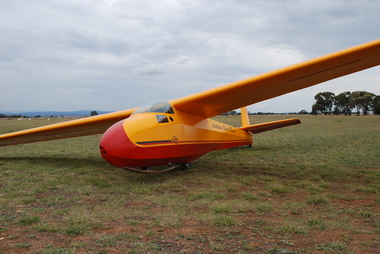
... ...glider...The last entry in the log book is dated January 1995 at which time the glider had accumulated 1148 hours from 2303 flights. ...The glider serial number 8478-SH and the registration VH-GMA....The structure is fabric covered. Machine Glider - Sailplane RAAF Williamtown Gliding Club ...The Ka 8 was designed by Rudolf Kaiser in 1957 and built by Alexander Schleicher. It has been described as the single seat version of the Ka 7 Rhonadler. The Ka 8 proved popular with clubs in its role as a sailplane for early solo flying. Over 1100 were produced. The Museum’s example is a Ka 8B which is the second variant of the design, distinguishable by a larger blown Plexiglas canopy and improved ailerons. The particular glider was built by the RAAF Williamtown Gliding Club from kit supplied by Edmund Schneider Ltd of South Australia as agent for Alexander Schleicher. It was test flown on 8 July 1967. For a period from August 1994 it was owned by a syndicate at the Bendigo Gliding Club. The last entry in the log book is dated January 1995 at which time the glider had accumulated 1148 hours from 2303 flights. From 1967 to 1994, the glider was flown at numerous places including Williamtown, Bellata, Warkworth, Dubbo, Waikerie, Quirindi, Tamworth, Redding, Narromine, Leeton and Keepit. During 1994 and 1995 it was flown a small number of times at Bendigo. A notable flight recorded in the logbook is dated 31 October 1971 when W. Kenny reached 11,000 feet in height during a flight of 5 hours 10 minutes. The last owner prior to the transfer of the glider to the Australian Gliding Museum in 2015 was John Ashford of the Geelong Gliding Club. The glider carries Serial Number 8478-SH and appears to have been registered firstly as VH-GPA and secondly as VH-GMA. The last registration (VH-GMA) was cancelled in 2011.This Kaiser Ka8B sailplane, when fully restored, will be an airworthy example of a popular 1960s German club sailplane type. It is a rarity in Australia as only 4 of the type have been registered and flown here.Single seat sailplane made with a steel tube framed fuselage and wooden wings. A glass plastic moulding has been used to form the top of the fuselage forward of the cockpit. The structure is fabric covered.The glider serial number 8478-SH and the registration VH-GMA.australian gliding, glider, sailplane, schleicher, kaiser, ka 8, schneider, raaf williamtown gliding club, bendigo gliding club, geelong gliding club, ashford -
 Australian Gliding Museum
Machine - Glider - Sailplane
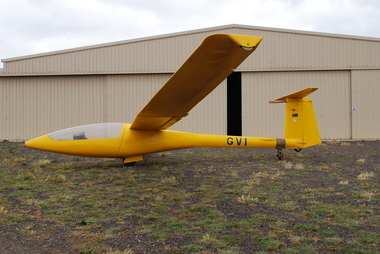
... ...glider...Changes were made along the way in the light of construction experience and the completed glider was given the designation MOBA2C. The glider first flew on 12 December 1979. ...Composite single seat glider / sailplane finished in bright yellow...Changes were made along the way in the light of construction experience and the completed glider was given the designation MOBA2C. The glider first flew on 12 December 1979. ...MOBA2 is a 15 metre sailplane designed by Gary Sunderland, who was an aeronautical engineer working for the Department of Civil Aviation (Australia) and a member of the Victorian Motorless Flight Group (VMFG). The design gave effect to ideas that he developed circa 1970 for an aircraft that he could build himself. He entered a 13 metre wingspan version of his MOBA design (MOBA2B) in an Australian Gliding sailplane design competition that was announced in 1970. The competition called for sailplane designs with a maximum wingspan of 13 metres that could be built by amateurs in a small workshop with limited tools and facilities. In 1973, Gary’s MOBA was judged by the competition panel as equal best with the other outstanding submission, which were chosen from a field of 19 entrants. However, after gathering further information and deliberation by the competition panel neither of the two outstanding designs were chosen as the winner. Notwithstanding the outcome, in 1974 Gary proceeded built his glider to the original 15 metre design. The wing was equipped with camber changing flaps that were permitted under special standard class rules for the 1974 world championships. Changes were made along the way in the light of construction experience and the completed glider was given the designation MOBA2C. The glider first flew on 12 December 1979. It was never flown in standard class competition as by the time the glider was built the special 1974 rules were revoked and wing flaps were no longer permitted in that class. However, Gary flew MOBA2C in the Australian national gliding competitions held at Benalla in the summer of 1979 / 1980 competing in the open class. After adjustment to the aileron gearing during initial trials MOBA2C was found to fly well and in competition produced performances believed to be better than contemporary standard class sailplanes but not as good as the open class machines. The glider was later modified in a number of respects including amongst other things the installation of spoilers located just forward of the wing flaps and by increasing the chord marginally at the wing root. With these changes the glider type was given the designation MOBA2D. The last recorded flights occurred in February 1996 at which time MOBA2 had flown an aggregate of 401 hours and 59 minutes during its 297 launches. Its operational life was brought to an end due to expansion of the foam in the wings causing distortion of the wing surface.The MOBA2 is a notable home built 1970s sailplane design that featured a number of innovative elements including composite construction without the need for expensive jigs, nose cone canopy and asymmetrical placement of control column.Composite single seat glider / sailplane finished in bright yellowRegistration "GVI" on fuselage; Kangaroo, Australian Flag and VMFG decals on vertical stabiliseraustralian gliding, glider, sailplane, moba2b, moba2c, sunderland, moba2d, victorian motorless flight group, vmfg -
 Australian Gliding Museum
Machine - Glider – Sailplane
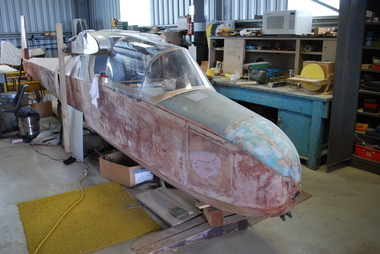
... ...glider...The ES49 glider / sailplane was designed by Edmund Schneider in Germany before he migrated to Australia in the early 1950s. ...Tandem two seat high wing strut braced glider-sailplane finished in silver grey colour scheme....Machine Glider – Sailplane Adelaide Soaring Club ...The ES49 glider / sailplane was designed by Edmund Schneider in Germany before he migrated to Australia in the early 1950s. In Germany the ES49 was put into limited production by the Schleicher factory from 1951 to 1953 (8 produced). In Australia the ES49 is commonly referred to as the “Wallaby”; two were built by the Adelaide Soaring Club with assistance from Edmund Schneider Ltd and one independently from plans by Eric Hader and members of the Cooma Gliding Club. The Museum’s ES49 – serial number GFA-HB-36 - was built at Gawler from 1955 to 1958 and registered as VH-GLL on 15 January 1959. It was the second of the ES49s built by the Adelaide Soaring Club. Originally it had a rather distinctive appearance due to the use of a sleek P51 Mustang canopy to enclose the forward seating position of the cockpit. The glider, together with its sister VH-GDK, was used at the Gliding Federation of Australia National Gliding Schools at Gawler. In 1964 the glider was transferred to the Newcastle Gliding Club, Newcastle, in New South Wales and then in 1966 it went to the Albury and District Gliding Club, Albury, New South Wales. The Snowy Mountains Gliding Club, Khancoban, New South Wales acquired the glider in 1968 where it remained until 1974. In 1974 the glider transferred into private hands at Wodonga, Victoria, for two years and then to interests at Albury until 1985. At that stage the glider was acquired by a private owner at Bathurst, New South Wales, who undertook a restoration that included, amongst other work, the fitting of a more conventional cockpit canopy. The glider was at Warkworth, New South Wales in 1992 and became to be owned by Eric Oates who preserved it until he donated it to the Australian Gliding Museum. According to the logbook for VH-GLL held by the Museum, the glider was last flown in November 1990 and at that time had logged 2758 hours and 57 minutes from 15775 launches. The fuselage is currently under restoration at the Museum’s Dave Darbyshire workshop. The ES49 – VH-GLL – is an example of the state of wood and fabric dual place sailplane design in the late 1940s. The glider served the Adelaide Soaring Club and subsequent owners well as a training and general purpose sailplane over many years. It is a rare example of the type (one of 4 existing in the world). Tandem two seat high wing strut braced glider-sailplane finished in silver grey colour scheme.australian fliding, glider, sailplane, schneider, es 49, wallaby, oats, adelaide soaring club, hader, cooma gliding club, newcastle gliding club, albury & district gliding club, snowy mountains gliding club -
 Australian Gliding Museum
Machine - Glider - Sailplane, 1943
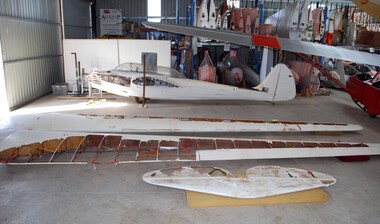
... ...glider...The two seater variation was ordered in 1941 by the US Army for training glider pilots of troop carrying gliders. The military designation was XTG-4. ...Modified LK10A glider consisting of tubular steel fuselage with a combination of fabric and metal covering, fabric covered wooden wings and other flying surfaces....The two seater variation was ordered in 1941 by the US Army for training glider pilots of troop carrying gliders. The military designation was XTG-4. ...The Laister-Kauffman 10A (LK10A) is a 2 seat a military training glider developed from a successful Jack Laister single seat glider called Yankee Doodle that first flew in 1938 and was exhibited at the Paris Air Show of 1939. The two seater variation was ordered in 1941 by the US Army for training glider pilots of troop carrying gliders. The military designation was XTG-4. The LK 10A glider was a simpler, more robust design than Yankee Doodle. A longer canopy enclosed both seating positions. The top of the fuselage formed a straight ridge from the top of the canopy to the point where the fin – rudder connected. Also, the design was simplified by adopting straight spar wings of 15.2 metres in place of gull wings of 14.170 metres. During the war years 156 LK10As were produced before the contracts to supply the US Army were terminated. Many of these were later sold as surplus. The Museum’s exhibit (serial number 122) was built in 1943. It was imported into Australia in the 1950s by Ric New, a member of the Gliding Club of Western Australia. Ric New modified the glider by “flat topping” the fuselage and making other aerodynamic changes. This kind of modification of the LK10A was a well tried strategy in United States for extracting better performance from the glider. It is understood that the reduction in weight and cleaner aerodynamics from the changes could increase the glide ratio from 1:24 to something like 1:30. The LK10A was located at the Gliding Club of Western Australia for many years. Records reveal that it was kept airworthy until about 1975. The LK10A is an important acquisition in that it allows one to compare the state of two seat glider design in United States and the United Kingdom in the immediate post war period. It is interesting to note that at that time a number of clubs in Australia who acquired a two seat glider for training chose the United Kingdom open cockpit high strutted wing offerings from Slingsby (e.g. T31) instead of more innovative military surplus gliders from America. Modified LK10A glider consisting of tubular steel fuselage with a combination of fabric and metal covering, fabric covered wooden wings and other flying surfaces.australian gliding, glider, sailplane, laister, kauffman, ric new, gliding club of western australia, lk10a, yankee doodle, xtg-4 -
 Australian Gliding Museum
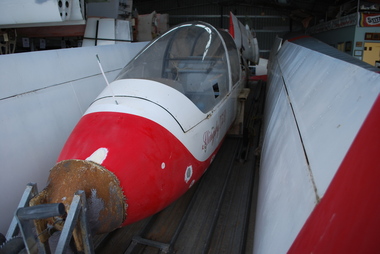
Machine - Glider – Sailplane, 1967
... ...glider...The Slingsby T53 glider was designed by J. Sellars in the 1960s as an easily maintained two seat trainer suitable for RAF Air Training Corp use and for sale in the USA and Australian markets where wooden gliders were becoming less popular. ...All metal twin seat glider / sailplane, painted white with red tips and markings....Machine Glider – Sailplane Slingsby Aviation ...The Slingsby T53 glider was designed by J. Sellars in the 1960s as an easily maintained two seat trainer suitable for RAF Air Training Corp use and for sale in the USA and Australian markets where wooden gliders were becoming less popular. The Slingsby T53 prototype first flew in 1967. The T53B version has a conventional fixed tailplane with elevator instead of the all-moving tailplane of the original type. The “B” version also has ailerons of narrower chord and lacks wing flaps. Further changes were made to the fin (extended above the tailplane) for the final “C” version. Production of the T53 at Slingsby was disrupted by a fire at the factory in 1968. As a consequence the contract to supply 40 of the type to the RAF was cancelled and only a relatively small number (possibly 27) were made by Slingsby before the project was discontinued. The rights were later sold to Yorkshire Sailplanes. It designated the glider as the YS53 Sovereign – only a few were produced (possibly 3). The Australian Gliding Museum’s example is a type “B” model. It bears serial number 1686 and was manufactured in 1967. It was registered in Australia as VH-GUB in name of Boonah Gliding Club, Boonah, which is about 90 kilometres south west of Brisbane in Queensland. Locally it was called “the Bomber”! This exhibit is a representative example of the Slingsby T53 sailplane type. It is a rarity in Australia.All metal twin seat glider / sailplane, painted white with red tips and markings.“Slingsby T53B” on each side of fuselage below cockpit opening; Registration VH-GUB on each side of fuselage at rear.australian gliding, glider, sailplane, slingsby, t53, sellars, boonah gliding club, slocombe, boyle -
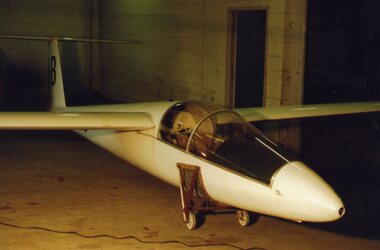 Australian Gliding Museum
Machine - Glider – Sailplane, 1967 to 1974
... ...glider...Warren Mayfield donated the glider to the Museum in April 2002. ...All metal single seat glider sailplane...Warren Mayfield donated the glider to the Museum in April 2002. australian gliding glider sailplane schreder coxon georgeson mayfield slingsby bache waikerie gliding club Registration lettering on rudder and fuselage sides All metal single seat glider sailplane Machine Glider – Sailplane C Coxon ...The Schreder HP 14T is a variant of an all metal single seat sailplane designed by Richard Schreder of USA in the 1960s. The HP14T featured a ‘T’ tail in place of ‘V’ tail of the HP14V. The design was marketed to home builders in kit form. The Museum’s Schreder HP14T (VH-GIB) first flew on 31 August 1974. It has recorded 280 hours in the air from 239 launches to 28 January 1989, the date of its last flight. It is understood that VH-GIB was partly constructed in North America and completed in South Australia by C.G.M. Coxon. Ownership passed to the Georgeson Syndicate of Rockhamption, Queensland and later to Warren Mayfield of Victoria. Warren Mayfield donated the glider to the Museum in April 2002. All metal single seat glider sailplaneRegistration lettering on rudder and fuselage sidesaustralian gliding, glider, sailplane, schreder, coxon, georgeson, mayfield, slingsby, bache, waikerie gliding club -
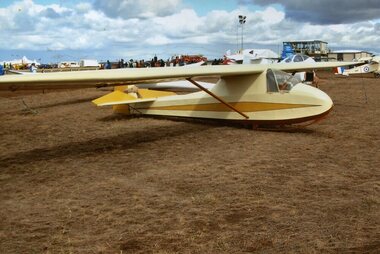 Australian Gliding Museum
Machine - Glider – Sailplane, 1952-1953
... This aircraft, the first glider built by Schneiders after they immigrated to Australia, was test flown on 3 January 1953 by Dave Darbyshire and Owen Lewis. ...Single seat glider of wood and fabric construction, with steel wing struts. ...Underside of fuselage is painted orange. Machine Glider – Sailplane Edmund Schneider Ltd and Gliding Club of Victoria ...This aircraft, the first glider built by Schneiders after they immigrated to Australia, was test flown on 3 January 1953 by Dave Darbyshire and Owen Lewis. It is the only machine of its type. It is essentially a Grunau Baby 2B with a Perspex enclosed cockpit, wing airbrakes and a landing wheel. However, the wing design came from an existing Grunau 3 type that was being built in Germany. The glider has given extensive service for a number of owners – including the Gliding Club of Victoria, Sunraysia Gliding Club, Millicent Gliding Club, Max Bugler of Morwell and Garth Hudson of Brighton in Victoria. Prior to being donated to the Australian Gliding Museum in January 2001 the glider had logged over 2200 hours flying time from over 9000 flights. The glider is an improved Grunau Baby design that Edmund Schneider built after coming to Australia.Single seat glider of wood and fabric construction, with steel wing struts. Currently painted crème with yellow details. Underside of fuselage is painted orange.australian gliding, grunau, grunau baby, schneider, gliding club of victoria, sunraysia gliding club, millicent gliding club, darbyshire, lewis, bugler, hudson -
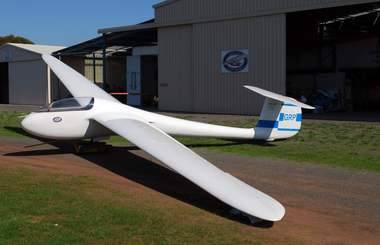 Australian Gliding Museum
Machine - Glider –Sailplane, 1960
... ...glider...In the course of its flying history the glider was damaged several times and repaired. ...Australian registration GRP on rudder; Serial Number 403 and Vintage glider club of Netherlands plaque in cockpit...Machine Glider –Sailplane Bolkow Apparaterbao Gmbh ...The FS-24 Phonix is the first sailplane design to be built using a moulded fiberglass sandwich technique. It was designed by Hermann Nagele and Richard Eppler leading a group setup for the purpose at Stuttgart Technical University in the early 1950s. Initial construction was undertaken at workshops of Wolf Hirth and the first prototype was completed at the Bolkow Aircraft Company where Nagele and another member of the group, Rudi Lindner, had gained employment. It flew on 27 November 1957. Two further prototypes were built incorporating a T-tail and other refinements. Eight in all were built before production was stopped in 1961. A number of gliding records were broken in Phonix sailplanes in Germany in 1962-1963. It was found to have a best glide ratio of 40:1. The Museum’s example, No. 403 was originally a prototype built on 25 May 1960 [Registration D-8354]. It was converted at Bolkow to a Phonix T in 1963 and sold to a private owner in Switzerland [Registration HB-746] and later then to gliding club Segelfluggruppe Solothurn in 1965. The glider returned to Germany in 1971 (Meersburg) and re-registered as D-0738. It moved to a new owner in Allershausen in 1976, and again to Lindhoft in 1982. In 1983 the glider was sold to owners at Hasselt, Belgium and given registration OO-ZQD. In 1989 a further change of ownership occurred and the glider went to Leusden in the Netherlands where it was registered as PH-949. In 2006 the Phonix No.403 was imported into Australia by John Ashford of the Geelong Gliding Club. On 30 January 2007, it was registered as VH-GRP. However, as at January 2016 it has not been flown in Australia. In the course of its flying history the glider was damaged several times and repaired. At one stage a larger rudder was fitted and later on this modification was reversed. With the original conversion to a Phonix T and subsequent repairs and changes to equipment the weight of the airframe increased from 182 kg to approximately 220 kg. Nevertheless, the wing loading is a modest 20kg/square metre. As at January 2016, minor repairs and airworthiness certification are required to return the glider to flying condition. This exhibit is highly significant as it is one of only eight of this pioneering sailplane design. It is the only one in Australia. Glassfibre single seat sailplane, finished white with blue stripes on fin and rudder.Australian registration GRP on rudder; Serial Number 403 and Vintage glider club of Netherlands plaque in cockpitaustralian gliding, sailplane, glider, fs-24, phonix, nagele, eppler, lindner, stuttgart technical university, bolkov aircraft company, segelfluggruppe solothurn, ashford, geelong gliding club. -
 Australian Gliding Museum
Machine - Glider – Sailplane, 1972
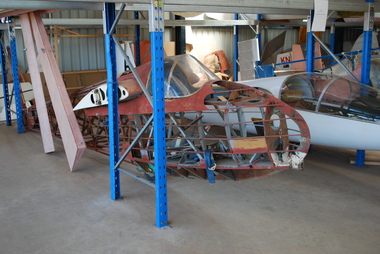
... ...glider...The Hall Cherokee II glider is an American design for amateur construction from plans. ...The Hall Cherokee (formerly registered as VH-GVO) is a single seat wooden home built glider. The glider is constructed from wood, plywood, fabric and metal fittings, all commercial grade except for main wing fittings, pulleys, cables and bolts. ...The Hall Cherokee II glider is an American design for amateur construction from plans. ...The Hall Cherokee II glider is an American design for amateur construction from plans. The designer was Stan Hall (1915-2009), a professional engineer, who gained extensive experience in the United States aviation industry during World War 2 including the programs for military gliders. He continued to work as an engineer for aircraft manufacturers and as a consultant to the industry after the war. He was active in gliding and, in particular, the home built sailplane movement. The Cherokee II was one of about 10 glider designs that he produced: it came out in 1956. It is understood that over 100 Cherokee gliders have been built. In Australia the number is possibly 10 or 11. The Hall Cherokee VH-GVO was built by R.D Meares of Caringbah, New South Wales. The glider was registered as VH-GVO on 11 October 1973 and given serial number “GFA-HB-82” by the Gliding Federation of Australia. The Logbook for VH-GVO appears to be a complete record of the flying history; in aggregate 210 hours 40 minutes in the air from 331 flights. The first test hop occurred on 29 July 1972 at Camden, New South Wales. VH-GVO was last flown on 22 July 1986. Many of the flights recorded are of one or two hours duration. The glider was last inspected and certified as airworthy and in a reasonable condition at the Hunter Valley Gliding Club in July 1986. Since that time, until transferred to the Australian Gliding Museum, the glider was in storage. Structural restoration work has been completed on the fuselage and one wing. However, inspection of the other wing revealed extensive damage to the ribs and spars and consequently a decision was taken to make it a static exhibit. The exhibit is an example of home built construction of a type that has proved popular amongst amateur glider builders.The Hall Cherokee (formerly registered as VH-GVO) is a single seat wooden home built glider. The glider is constructed from wood, plywood, fabric and metal fittings, all commercial grade except for main wing fittings, pulleys, cables and bolts. The fuselage is simple with four main longerons and bulkheads with diagonal bracing. The wing has two identical solid spars which form a geodetic structure, hence the leading edge is non-structural. Registration VH-GVO – serial number GFA-HB-82 australian gliding, glider, sailplane, hall, cherokee, meares, hunter valley gliding club -
 Australian Gliding Museum
Machine - Glider - Sailplane, 2012
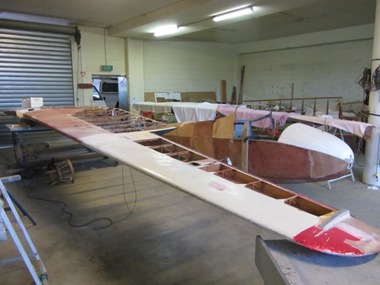
... ...glider...The glider was in a damaged condition when it was acquired by the Museum. ...Fuselage marked with Edmund Schneider Pty Ltd Serial Number 9 and comes from the glider previously registered as VH-GFF....The glider was in a damaged condition when it was acquired by the Museum. ...The ES52 Kookaburra is a two seat high wing glider – sailplane of wooden construction designed by Harry Schneider and built Edmund Schneider Pty Ltd. It was first flown on 26 June 1954 and became the glider of choice for training new pilots of many gliding clubs around Australia in the 1950s, 1960s and 1970s. Several found there way to New Zealand. Further two kits were sent to Brazil and at least one of these was finished and flow successfully. The ES52 performed well with a glide ratio of about 22:1 and had soaring and cross-country capabilities. A notable feature of the ES52 design was the staggered side-by-side seating arrangement of the cockpit. This made for good in flight communication between instructor and trainee. Overall, thirty six were built by Edmund Schneider Pty Ltd. A longer wing version (the ES52B) was also introduced that had a better glide ratio (around 25:1). Five examples of this version were built. In Germany a modified ES52 was built incorporating a metal tube fuselage frame and with the addition of a engine driven propeller mounted on top of the wing which enabled the glider to be self launching. This museum collection item consists of the fuselage, tailplane, elevators, fin, rudder from the Mark I, ES 52 Kookaburra, formerly registered as VH-GFF and last owned by the Barcaldine and District Airsports Club of Queensland. The glider was in a damaged condition when it was acquired by the Museum. A decision was made by the Museum to repair the glider for display rather than endeavouring to restore it to an airworthy condition. The reconstruction of the wings is being undertaken by using parts of damaged ES 52 Kookaburra wings (as it happened from later ES 52 Marks). The Log Book for VH-GFF reveals operational life with a succession of gliding clubs around Australia. This exhibit will be of interest to gliding enthusiasts wishing to inspect the popular two seat club trainer of a by-gone era.This is a wood and fabric covered aircraft that is being rebuilt from the components of several aircraft as a non-flying exhibit.Fuselage marked with Edmund Schneider Pty Ltd Serial Number 9 and comes from the glider previously registered as VH-GFF.australian gliding, glider, sailplane, edmund schneider, es 52, kookaburra, barcaldine and district airsports club, victorian motorless flight group, alice springs gliding club, raaf richmond, raaf williamtown, gayndah gliding club, blackwater gliding club, southern downs aero and soaring club, charleville gliding club
