
Showing 6 items matching "gold discoveries before 1851"
-
 Bendigo Historical Society Inc.
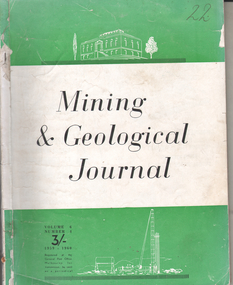
Book - Kairn Collection: Mining and Geological Journal, Department of Mines, Victoria, 1959 - 1960
... ...gold discoveries before 1851...Geology mining gold mining Bendigo Department of Mines gold discoveries before 1851 upper devonian fossils ordovician Green and white cover, black text. ...The Mining & Geological Journal was produced by the Department of Mines, Victoria twice a year, during the period 1937 to 1972. It was an official publication of the Victorian Government, Department of Mines, devoted to issues and events surrounding mining and metallurgical engineering in Victoria along with education, research and innovations in mining. The journal also included advertisements and references to business interests. Green and white cover, black text. On cover: 'Mining & Geological Journal' Volume 6, Number 1. 1959 - 1960. Line drawing of drill rig on cover. Seventy-six pages with black and white photographs. geology, mining, gold mining, bendigo, department of mines, gold discoveries before 1851, upper devonian, fossils, ordovician -
 Greensborough Historical Society
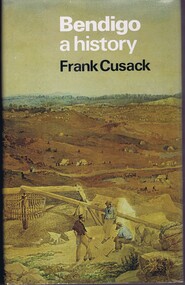
Book, Frank Cusack, Bendigo: a history, 1973
... gold rush in 1851-1852. This book traces its development from canvas shanty town to city, covering the growth of institutions, industry, social life and historic occasions. Bendigo (Vic.) - history gold discoveries victoria gold mining A history of Bendigo from before the first gold discovery to the closure of the last mine in 1954. 262 p., illus. ...A history of Bendigo from before the first gold discovery to the closure of the last mine in 1954.262 p., illus.non-fictionA history of Bendigo from before the first gold discovery to the closure of the last mine in 1954.bendigo (vic.) - history, gold discoveries victoria, gold mining -
 Eltham District Historical Society Inc
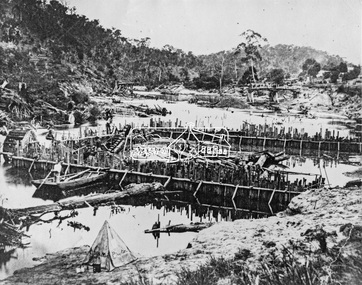
Negative - Photograph, Carl Walter 1831-1907, Coffer dam in the Yarra River at Anderson's Creek, 1864
... Gold was first discovered in this area at Andersons Creek (Warrandyte) in June 1851 by Louis Michel. Discoveries north of the Yarra did not occur until about 1854. Although it took some months for a true rush to develop it was not long before...Gold was first discovered in this area at Andersons Creek (Warrandyte) in June 1851 by Louis Michel. Discoveries north of the Yarra did not occur until about 1854. Although it took some months for a true rush to develop it was not long before ...1864 photograph of the Coffer Dam in the River Yarra situated (approximately) opposite Whipstick Gully. Remains of bridge built in 1860(?) wrecked by 1863 flood in background. Reproduced page 29 of ‘Pioneers & Painters’ Gold was first discovered in this area at Andersons Creek (Warrandyte) in June 1851 by Louis Michel. Discoveries north of the Yarra did not occur until about 1854. Although it took some months for a true rush to develop it was not long before alluvial workings were being carried on in most of the Shire of Eltham. The last area in which gold was discovered was Kinglake. As the gold became harder to find, deep mining took over from alluvial diggings in the gullies. Perhaps the most extensive of the deep workings was the Diamond Creek Mine just outside the boundary of the Shire. This form of mining was continued into the 1930s. There are believed to be some mines in the area still capable of producing gold but present prices make working these uneconomical. Some gold is still found by weekend prospectors. Photo: Carl Walter 1831-1907 – inscribed on tent “C. Walter Photo” The State Library of Victoria holds over 150 photos by Carl Walter, most of which are portraits of Aboriginal natives including William Barak.This photo forms part of a collection of photographs gathered by the Shire of Eltham for their centenary project book,"Pioneers and Painters: 100 years of the Shire of Eltham" by Alan Marshall (1971). The collection of over 500 images is held in partnership between Eltham District Historical Society and Yarra Plenty Regional Library (Eltham Library) and is now formally known as 'The Shire of Eltham Pioneers Photograph Collection.' It is significant in being the first community sourced collection representing the places and people of the Shire's first one hundred years.Digital image 4 x 5 inch B&W Neg (2) Print 20 x 25 cmshire of eltham pioneers photograph collection, anderson's creek, coffer dam, floods, gold mining, other areas, pioneers and painters, warrandyte, warrandyte bridge, yarra river -
 Bendigo Historical Society Inc.
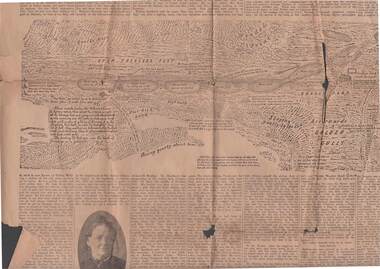
Newspaper - 1911 BENDIGO ADVERTISER, 14th July, 1914
... 1851 discovery of gold significant portion. Part of G Mackay 'Annals of Bendgo'Page 5 has an article titled Annals of Bendigo ''-the first article under this heading was published in the Bendigo Advertiser on 7th July .Included are Cameo photos of Messrs Johnson , Fenton , Sandbach , Frencham and Mrs Kennedy together with an early sketched map of the Bendigo Goldfields . Within the article is a mention of the sketched map as follows - '' The accompanying map was drawn from memory by W. Sandbach who lived a month in the Mia mia (22nd November to 19th December 1851 ) …The map was laid before...1851 discovery of gold significant portion. Part of G Mackay 'Annals of Bendgo'Page 5 has an article titled Annals of Bendigo ''-the first article under this heading was published in the Bendigo Advertiser on 7th July .Included are Cameo photos of Messrs Johnson , Fenton , Sandbach , Frencham and Mrs Kennedy together with an early sketched map of the Bendigo Goldfields . Within the article is a mention of the sketched map as follows - '' The accompanying map was drawn from memory by W. Sandbach who lived a month in the Mia mia (22nd November to 19th December 1851 ) …The map was laid before ...( x ref 5673 , 8235 , Box 83 , 9077 ) Page 5 and 6 from the Bendigo Advertiser Friday July 14 1911. 1851 discovery of gold significant portion. Part of G Mackay 'Annals of Bendgo'Page 5 has an article titled Annals of Bendigo ''-the first article under this heading was published in the Bendigo Advertiser on 7th July .Included are Cameo photos of Messrs Johnson , Fenton , Sandbach , Frencham and Mrs Kennedy together with an early sketched map of the Bendigo Goldfields . Within the article is a mention of the sketched map as follows - '' The accompanying map was drawn from memory by W. Sandbach who lived a month in the Mia mia (22nd November to 19th December 1851 ) …The map was laid before the Frencham committee at the inquiry. The map shows geographical features such as 'Gentle Rise , Wooded pointbendigo, gold mining, bendigo discovery -
 Uniting Church Archives - Synod of Victoria
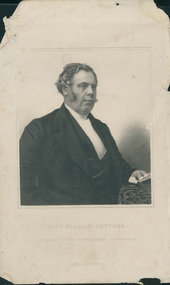
Printed etching, Undated c.1858
... discovery of gold in 1851. Appointed to Adelaide 1855 - 1862. returned to Victoria in 1862, but his health broke down completely and he returned to England in 1863 and became a supernumerary. A founder of the Wesleyan Mission Carlton. President of the Australasian Conference in 1858. William Butters lived for 24 years in the London (Brixton) circuit before...discovery of gold in 1851. Appointed to Adelaide 1855 - 1862. returned to Victoria in 1862, but his health broke down completely and he returned to England in 1863 and became a supernumerary. A founder of the Wesleyan Mission Carlton. President of the Australasian Conference in 1858. William Butters lived for 24 years in the London (Brixton) circuit before ...Rev William Butters (1810 - 1887). Born Hibbaldstone, Lincolnshire on 24 January 1810. Entered the Wesleyan ministry in 1833 and sent as a missionary to Van Dieman's Land. Worked with convicts at Port Arthur, then served at Hobart, Ross and Launceston. In 1850 he was appointed to Melbourne. His health failed during the unprecedented difficulties initiated by the discovery of gold in 1851. Appointed to Adelaide 1855 - 1862. returned to Victoria in 1862, but his health broke down completely and he returned to England in 1863 and became a supernumerary. A founder of the Wesleyan Mission Carlton. President of the Australasian Conference in 1858. William Butters lived for 24 years in the London (Brixton) circuit before dying suddenly on 10 October 1887.B & W waist length printed etching of Rev. William Butters"Revd William Butters President of the Australasian Conference"william butters, wesleyan, methodist, minister, chaplain, port arthur, van dieman's land, wesleyan mission carlton, president of conference -
 Sunshine and District Historical Society Incorporated
Document - Brimbank Rising, Tony Smith, 2018
... Recent geological and ecological history had been productively harnessed by the Wurundjeri before all were disrupted by the arrival of unauthorised settlers from Tasmania and their livestock focused on serving markets in and using methods more appropriate to the other side of the world. Following colonial separation and the discovery of gold in 1851...Recent geological and ecological history had been productively harnessed by the Wurundjeri before all were disrupted by the arrival of unauthorised settlers from Tasmania and their livestock focused on serving markets in and using methods more appropriate to the other side of the world. Following colonial separation and the discovery of gold in 1851 ...The suburban municipality of Brimbank is strategically located across key transport corridors serving Melbourne’s rapid western and northwestern expansion. Brimbank Rising steps through local prehistory and history with attention to planning events from Hoddle’s 1840 survey to the recent Regional Rail Link which shape the area. Across five periods, this history sees planning as a contributory process to city shaping, with specific plans as snapshots in time of endorsed intentions, all through the lens of complexity, connectedness and contingency. Recent geological and ecological history had been productively harnessed by the Wurundjeri before all were disrupted by the arrival of unauthorised settlers from Tasmania and their livestock focused on serving markets in and using methods more appropriate to the other side of the world. Following colonial separation and the discovery of gold in 1851, the second part follows the expansion of heavy rail and the multifaceted influence of leading industrialist H V McKay’s Sunshine Harvester Works through and between the booms of the 1880s and 1920s. Postwar flooding of the Harvester Works, and of the region with migrants, demanded major infrastructure investment and municipal capabilities which were consistent with wider suburbanisation and growing dominance of road transport without challenging the area’s politically safe status. The penultimate section is focused on concurrent events in 2009 and how they play out through council in administration’s Sunshine Rising campaign to capitalise on the local potential of Sunshine’s rail upgrade and complementary infrastructure investments. Finally, there is discussion of current state policies and planning which relate to Brimbank and which the council and community need to continue to work with and advocate for further Rising to ensure Brimbank’s potential as service corridor for the Growth Areas is realised.Brimbank Rising From a History of Failed Local Councils, Officers and Administrators Promote and Support Sunshine Risingaboriginal, first nation, h.v. mckay, sunshine harvester factory
