
Showing 7 items matching "government leaks"
-
 Unions Ballarat
Secrets of State: A Detailed Assessment of the Book They Banned, Munster, George, 1982
... ...government leaks...Secret (leaked) government documents dealing with East Timor, US military bases in Australia, the Soviet Navy in the Indian Ocean, the Shah’s regime in Iran and the Vietnam War. ...Secret (leaked) government documents dealing with East Timor, US military bases in Australia, the Soviet Navy in the Indian Ocean, the Shah’s regime in Iran and the Vietnam War. ...Secret (leaked) government documents dealing with East Timor, US military bases in Australia, the Soviet Navy in the Indian Ocean, the Shah’s regime in Iran and the Vietnam War. Originally published as "Documents on Australian Defence and Foreign Policy 1968-1975" - this edition was previously banned and all unsold copies were destroyed by the government.Significant to Australian foreign relations in the period 1968-1975.Paper; book. Front cover: black background; pictures of newspapers and a book; red and white text.Front cover: author's name and title.btlc, ballarat trades hall, ballarat trades and labour council, east timor, us military bases, soviet navy, vietnam, iran, vietnam war, documents on australian defence and foreign policy, government leaks, shah of iran -
 Flagstaff Hill Maritime Museum and Village
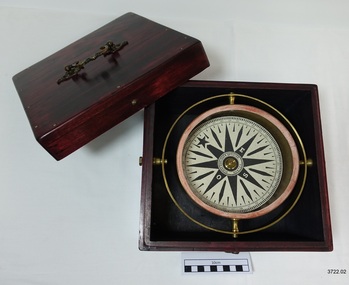
Functional object - Compass, mid-19th Century
... leak, and water soon filled the hull during the next two hours. Some of the crew began throwing the cargo overboard to lighten the vessel, hoping to keep it afloat until daylight. When the water reached over 2 meters in the hull, they realised their efforts were in vain. On the 30th April 1889, the crew left the vessel the ship was sinking fast, so they made for the shore. While still miles off Cape Hawke, all seven crew members, including the Captain, were rescued by the Government...leak, and water soon filled the hull during the next two hours. Some of the crew began throwing the cargo overboard to lighten the vessel, hoping to keep it afloat until daylight. When the water reached over 2 meters in the hull, they realised their efforts were in vain. On the 30th April 1889, the crew left the vessel the ship was sinking fast, so they made for the shore. While still miles off Cape Hawke, all seven crew members, including the Captain, were rescued by the Government ...Captain Robilliard: James Arthur Robilliard was a sea captain and tentmaker, born on the 19th April 1843 at Saint Helier, Jersey. He trained there in his father's sail loft as a sailmaker. His first job as a sailor was in Liverpool, England, and in 1875, James Robilliard migrated to Australia as a mate on the "E.M. Young". James Robilliard and his family were amongst the early settlers who arrived along the Curdies River in the Heytesbury district of Western Victoria. In 1877, he became a Captain and would have used his compass from ship to ship. On 28th May 1877, in that same district, a small 3-masted schooner, the "Young Australian", was wrecked. This schooner had been built in 1864 at Jervis Bay, NSW. It had been on her way from Maryborough, Queensland, to Adelaide, under the command of Captain Whitfield, when it lost its mainmast in a heavy gale. It was beached at Curdies Inlet in Peterborough, Victoria. Captain Robilliard was placed in charge of the salvaging operation and recovered a good portion of the cargo. Not long after this incident, a Warrnambool shop owner, David Evans, found employment for James Robilliard with Evan Evans, who produced tents, sails, tarpaulins and similar goods; James already had the necessary skills for this work. Evan Evans was the same sailor rescued from the “Young Australian”. Soon after his rescue, Evan recalled he had a relative in Australia in a town called Warrnambool, and while walking in Timor Street, Warrnambool, he saw a sign over a shop that said “David Evans,” and once the two men met, Evan was warmly welcomed. David then helped his relative establish a tent and tarpaulin-making business there. Evan later transferred his successful business to a shop in Elizabeth St, Melbourne, under the name Evan Evans Pty. Ltd.) James Robilliard was a committed Christian and accredited Lay Preacher with the Methodist Church. He travelled around the local district leading the settlers in worship. On 14th November 1879, Captain Robilliard married Helen Beckett. Alfred and Selina Beckett and their family all attended the church at Brucknell, where Captain Robilliard preached. He was said to have been taken by their young daughter, Helen. James and Helen had ten children: James Arthur (Jnr), Henry William, Nellie Jessie, Alfred Albert, Rubena Nellie, De Jersy Norman, Clifford Beckett, Olive Ida, Frances Ridley Havergal and Nellie Elvie, all born in Victoria. In the 1880s, James Robilliard captained the cutter "Hannah Thompson" into Port Campbell, Victoria. This vessel was the first coastal trader to operate between Melbourne and Port Campbell. At one time, Captain Robilliard had to beach the "Hannah Thompson" for repairs. In 1923, the vessel was blown ashore in a gale and wrecked at Oberon Bay, at Wilson's Promontory. In 1889, the compass was saved by Captain James Arthur Robilliard from his sinking brigantine "Mary Campbell". This vessel was used to carry equipment for the Sydney Sugar Refinery's Mill in Southgate, NSW. The ship had been built in 1869 and traded for the next 20 years between Australian ports and rivers along the east coast, as well as regular ports in New Zealand. It was recognised by the Sydney Morning Herald as one of the best "carrying vessels in the timber trade". It had several owners over this time, the last one being Captain James A. Robilliard. On 29th April 1889, the "Mary Campbell", with Captain James A Robilliard as captain and owner, was on its way from Clarence River, NSW to Melbourne, Victoria with a cargo of railway girders for the Melbourne Harbour Trust. Captain Robilliard encountered a storm off Port Macquarie. He sailed the vessel south to about 40km east of Cape Hawke, near Tuncurry. At around 7 pm, he discovered that the cargo had shifted during the storm and the heavy girders had damaged the hull, causing a leak. The pumps were inadequate to stem the fast-flowing leak, and water soon filled the hull during the next two hours. Some of the crew began throwing the cargo overboard to lighten the vessel, hoping to keep it afloat until daylight. When the water reached over 2 meters in the hull, they realised their efforts were in vain. On the 30th April 1889, the crew left the vessel the ship was sinking fast, so they made for the shore. While still miles off Cape Hawke, all seven crew members, including the Captain, were rescued by the Government Tug "Rhea" and taken to Port Macquarie Hospital and later returned to Sydney in the vessel "Wellington". No cargo had been saved, and the consignment had been under-insured, only covered for half its value. The name of the last ship Captain Robilliard sailed is currently unknown; however, he sailed that ship from the port of Marlborough, Queensland, carting steel railway girders for the Geelong-to-Camperdown railway line. On this trip, the ship hit a storm, the cargo shifted, and the ship was wrecked along the NSW coast. After this, Captain Robilliard retired from the sea and began farming in Peterborough. In about 1897, verging on retirement, Capt. Robilliard superintended the Melbourne Sailors’ Home in Spencer Street, Melbourne, before being asked to leave this position in 1902 for trying to shut down a local hotel. On 6th May 1917, Captain James Arthur Robilliard J.P. died at Blackwood Park, in the Cobden district of Brucknell, the first Robilliard family homestead in Australia. He was buried in the Melbourne General Cemetery, Victoria. His wife Helen, passed away in 1947. This compass, once belonging to Captain James Arthur Robilliard, is of local and state historical significance for its use by the Captain with his vessel, the "Mary Campbell", a trading vessel that was bringing railway girders to the Melbourne Harbour Trust. He also used this compass on the "Hannah Thompson", listed on the Victorian Heritage Register and known as being the first coastal trader to operate between Melbourne and Port Campbell. The compass is also a very fine example of maritime navigational instruments manufactured and used in the mid-19th century. Marine compass, brass, in a wooden box with a separate, fitted lid. The compass card has sixteen points. The four principal points are marked: North with a star-shape, South with an “S”, East with an “E” and West with an “O” (French word OUEST). Each quadrant of the circle is numbered from 0 – 90 degrees. The card is floating in a liquid. The compass gimbal is attached to the sides of the box and to the front and back of the compass’ cylindrical brass frame. The mahogany coloured timber storage case is joined with brass nails. The centre of the lid has a folding decorative brass handle. The lid fits over the base and closes with a brass screw and hook on both front and back. Maker: Dubas Watchmaker Optician, Nantes, France, c 1860-1870. Compass came from the ship “Mary Campbell”, which sank off the NSW coast in 1889, near Forster. The compass, as well as the ship, belonged to Captain James Arthur Robilliard and was donated by his family. “DUBAS MANTES” stamped into the side of the gimbal. “DUBAS HORLOGER OPTICIEN. NANTES.” printed around the centre of the card. flagstaff hill, warrnambool, shipwrecked coast, flagstaff hill maritime museum, maritime museum, shipwreck coast, flagstaff hill maritime village, great ocean road, marine compass, navigation instrument 19th century, marine instruments, dubas mantes, captain james arthur robilliard, j.a. robilliard, helen beckett, ship young australian, ship young australia(n), ship hannah thompson, ship mary campbell, melbourne sailors home, david evans, evan evans, curdies inlet, brucknell church, curdies railway, great lakes museum, dubas horloger opticien. nantes -
Port Melbourne Historical & Preservation Society
Book - Port Melbourne Council, J Harrop, Sanitary Inspector, Sanitary Inspectors Report Book, 1900 - 1905
... local government - town of port melbourne environmental issues health - general health business and traders industry - noxious nightsoil engineering - canals and drainage built environment livestock j harrop - sanitary inspector dr sandford - acting medical officer Sanitary Inspector's Reports to Port Melbourne Council 1900-1905, detailing infectious diseases reported, nuisances, smells, smoke, drain sewerage leaks, illegal dumping of manure and other refuse, animals found wandering, inspections of premises, tips, piggeries, factories, fumigating, laying baits, carrying out orders of Health Officer. ...Sanitary Inspector's Reports to Port Melbourne Council 1900-1905, detailing infectious diseases reported, nuisances, smells, smoke, drain sewerage leaks, illegal dumping of manure and other refuse, animals found wandering, inspections of premises, tips, piggeries, factories, fumigating, laying baits, carrying out orders of Health Officer.local government - town of port melbourne, environmental issues, health - general health, business and traders, industry - noxious, nightsoil, engineering - canals and drainage, built environment, livestock, j harrop - sanitary inspector, dr sandford - acting medical officer -
 Bendigo Historical Society Inc.
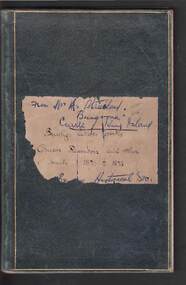
Book - JOSEPH BRADY COLLECTION: NOTEBOOK, BENDIGO WATER WORKS - CRUSOE RESERVOIR AND OTHER CONTRACTS 1870 TO 1874
... Government should purchase the Bendigo Waterworks, and to construct the Upper Coliban reservoir, additional expenditure may be required. (from Daily Telegraph - 1868). The second is some information on The Yan Yean Aqueduct. The third is a letter to the Editor of the Argus from Joseph Brady, dated August 2, 1870, in reference to repairing the leak...Government should purchase the Bendigo Waterworks, and to construct the Upper Coliban reservoir, additional expenditure may be required. (from Daily Telegraph - 1868). The second is some information on The Yan Yean Aqueduct. The third is a letter to the Editor of the Argus from Joseph Brady, dated August 2, 1870, in reference to repairing the leak ...Dark green covered book with gold edging front and back and seven horizontal lines on the spine. On front cover: buff sticker, with Bendigo Water Works, Crusoe Reservoir and others, contracts 1870 - 1874 written in cursive script. Later writing 'from Mrs. H. Strickland, Bungoona, Currie, King Island'. Written inside is: Presented to Bendigo Historical Society by Mrs A Strickland, Bungoona, Currie, King Island. Also the Historical Society Stamp. The next page has three newspaper cuttings. The first is 'The Victorian Waterworks'. It has costings for contracts for water supply, amounts which will supply water from the Coliban to the Castlemaine and Sandhurst districts, and if the Government should purchase the Bendigo Waterworks, and to construct the Upper Coliban reservoir, additional expenditure may be required. (from Daily Telegraph - 1868). The second is some information on The Yan Yean Aqueduct. The third is a letter to the Editor of the Argus from Joseph Brady, dated August 2, 1870, in reference to repairing the leak in the outlet tunnel of the Malmsbury Reservoir. He says the repair of the tunnel was not essential and is unnecessary and 2nd. If the bank was cut through and restored, for years the bank would not be safe, as the earth used in the restoration would require time to subside and unite with the old work. He hopes the embankment would be allowed to stand intact.civil engineering, water supply, coliban, bendigo water works - crusoe reservoir and other contracts 1870 to 1874, mrs a strictland, royal historical society of victoria bendigo branch, coliban scheme, upper coliban reservoir, daily telegraph 1868, yan yean aqueduct, age, argus 2/8/1870, malmsbury reservoir, joseph brady, charles cook, fishburn morton & kennedy, bernard ward & co, the fulton foundry co ltd, james mcewan & co, laylands foundry co, melbourne sewers & water supply, c w gore, crusoe office, john mcilwraith, edward chandler, ia-s miller & co, robison br & co, guthrie/white hills pottery, peter mcpherson, slater & co, john danks, mclean br & rigg, william beebe, t i connelly, i horwoods -
Eltham District Historical Society Inc
Document - Folder, Rochford, Barry
... leak of documents about unsuccessful applicants for Nillumbik CEO job. Newspaper article: "19 on council inquiry list", Diamond Valley News, 18 September 1996. Inquiries from specific people to be dealt with only by CEO of Chief Commissioner. Newspaper article: "Discrimination claim over the 'special treatment' list", Diamond Valley News, undated 1996. Special treatment claim referred to State government...leak of documents about unsuccessful applicants for Nillumbik CEO job. Newspaper article: "19 on council inquiry list", Diamond Valley News, 18 September 1996. Inquiries from specific people to be dealt with only by CEO of Chief Commissioner. Newspaper article: "Discrimination claim over the 'special treatment' list", Diamond Valley News, undated 1996. Special treatment claim referred to State government ...Barry Rochford was CEO of Nillumbik Council for 1995=1998. Contents Newspaper article: "Young CEO for Nillumbik", Diamond Valley News, 15 February 1975. Barry Rochford appointed CEO for Nillumbik. Newspaper article: "Rochford set to impact on shire", Diamond Valley News, 22 February 1975. Barry Rochford interviewed. Newspaper article: "CEO is MAPS director", Diamond Valley News, 24 May1975. Barry Rochford, director of Municipal Authorities Purchasing Scheme. Newspaper article: "Rochford runs the gauntlet in city", Diamond Valley News, 14 April 1975. Industrial dispute among Nillumbik council staff. Newspaper article: "Council leak to be investigated", Diamond Valley News, undated. Inquiry into leak of documents about unsuccessful applicants for Nillumbik CEO job. Newspaper article: "19 on council inquiry list", Diamond Valley News, 18 September 1996. Inquiries from specific people to be dealt with only by CEO of Chief Commissioner. Newspaper article: "Discrimination claim over the 'special treatment' list", Diamond Valley News, undated 1996. Special treatment claim referred to State government ombudsman and Equal Opportunity Commission. Newspaper article: "CEO is an 'embarrassment': MP". The Advertiser, 15 October 1996. Labor MLC Pat Power raised issue of special list in Legislative Council. Newspaper article: "CEO quits", Diamond Valley News, 9 September 1998. Resignation of Nillumbik CEO Barry Rochford. Newspaper article: "Controversial chief in court", Diamond Valley Leader, 7 May 2008. Rochford charged with firearms and criminal damage in Bendigo. Newspaper article: "Dog cruelty charge that shocked Bendigo", "The Age", 8 June 2008. Rochford charged with dog cruelty in Bendigo. Newspaper clippings, A4 photocopies, etcbarry rochford, nillumbik council, warrnambool council, don cordell, municipal authorities purchasing scheme, anne rochford, connor rochford, thomas rochford, joy nunn, rodney roscholler, roger hallam, robert marshall, mary grant, margaret devlin, milawa council, joanne anderson, ian chapman, doug owens, eltham gateway action group, roy loyd, bluelake development, pat powel mlc, john cohen, mark birrell, rspca, debbi edwards, bendigo animal shelter, detective sergeant brendan murphy, barry patrick rochford, graeme pearce, mandurang country fire authority, lex de man, natalie woodley, marg jennings, john graves -
 Sunshine and District Historical Society Incorporated
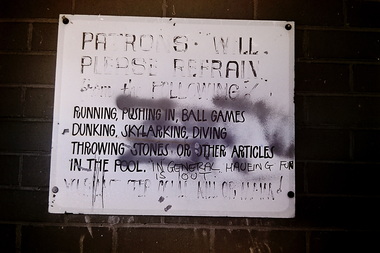
Photograph - Deer Park Swimming Pool Sassella Park Station Road Deer Park 1988 Photographs, The Sunshine Advocate, 15th June 1988
... leaks in the structure. The closure sparked significant community protest, with strong support from local residents and several councillors who wanted a new pool built on the same site. Despite the campaign, the government...leaks in the structure. The closure sparked significant community protest, with strong support from local residents and several councillors who wanted a new pool built on the same site. Despite the campaign, the government ...A formal, concrete constructed swimming pool was built in the north‑east corner of Sassella Park, Station Road, Deer Park. Sassella Park itself was established in 1929 as a major sports ground for the district In 1972, the pool was ordered to close due to major leaks in the structure. The closure sparked significant community protest, with strong support from local residents and several councillors who wanted a new pool built on the same site. Despite the campaign, the government instead built a new pool at Taylors Road, Keilor Downs, not Deer Park. The old Deer Park pool was demolished, and the site is now used as overflow parking for events at Sassella Park.Bernard Reilly Deer Park Swimming Pool 532.2deer park swimming pool, sassella park, station road, deer park -
 Sunshine and District Historical Society Incorporated
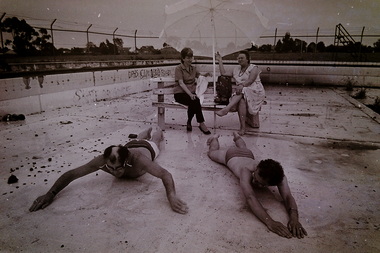
Photograph - Deer Park Swimming Pool Station Road Deer Park 1988 Photograph, Adam Ellwood, 21st October 1988
... leaks in the structure. The closure sparked significant community protest, with strong support from local residents and several councillors who wanted a new pool built on the same site. Despite the campaign, the government...leaks in the structure. The closure sparked significant community protest, with strong support from local residents and several councillors who wanted a new pool built on the same site. Despite the campaign, the government ...A formal, concrete constructed swimming pool was built in the north‑east corner of Sassella Park, Station Road, Deer Park. Sassella Park itself was established in 1929 as a major sports ground for the district In 1972, the pool was ordered to close due to major leaks in the structure. The closure sparked significant community protest, with strong support from local residents and several councillors who wanted a new pool built on the same site. Despite the campaign, the government instead built a new pool at Taylors Road, Keilor Downs, not Deer Park. The old Deer Park pool was demolished, and the site is now used as overflow parking for events at Sassella Park.People in empty swimming pool Deer Park Swimming Pooldeer park swimming pool, sassella park, station road, deer park
