
Showing 75 items matching "great britain - military history"
-
 Monbulk RSL Sub Branch
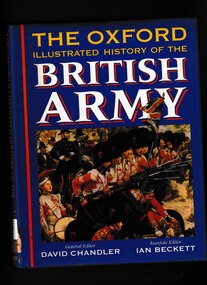
Book, David Chandler, The Oxford illustrated history of the British Army, 1994
... great britain - military history...great britain - military history great britain - military tradition From longbow, pike, and musket to Challenger tanks, from the Napoleonic Wars to the Gulf campaign, the Duke of Marlborough to Field Marshal Montgomery, The Oxford Illustrated History of the British Army recounts the history of the British army from its medieval antecedents to the present day. ...From longbow, pike, and musket to Challenger tanks, from the Napoleonic Wars to the Gulf campaign, the Duke of Marlborough to Field Marshal Montgomery, The Oxford Illustrated History of the British Army recounts the history of the British army from its medieval antecedents to the present day. Drawing on the latest scholarship, this survey shows how British fighting forces have evolved over the last five centuries. The continuities revealed are sometimes surprising: narrow recruitment patterns, friction between soldiers and civilians, financial constraints and recurrent political pressure for economies are constant themes. Commanders, campaigns, battles, organization, and weaponry are covered in detail within the wider context of the social, economic, and political environment in which armies exist and fight. The British army has been remarkably successful in fighting terms, losing only one major war (of American Independence 1775-83). As one of the engines of empire it has been active all over the world, as well as shaping the internal destiny of the nation in civil war and revolution. Its history is charted in a sequence of chronological chapters, each containing special feature articles, beginning with the medieval, Elizabethan, and Restoration army and moving on through the eighteenth and nineteenth centuries to the two world wars of the twentieth. The book concludes with accounts of the army of British India, the amateur military tradition, the British way in warfare, and an assessment of what the future may hold in the light of the Options for Change review. Extensively illustrated in black and white and colour, and with a detailed chronology and further reading lists, this is the definitive one-volume history of the British army for specialists and non-specialists alike.Bibliography, Index, Chronology, ill (plates, col, b/w) maps. p.452.non-fictionFrom longbow, pike, and musket to Challenger tanks, from the Napoleonic Wars to the Gulf campaign, the Duke of Marlborough to Field Marshal Montgomery, The Oxford Illustrated History of the British Army recounts the history of the British army from its medieval antecedents to the present day. Drawing on the latest scholarship, this survey shows how British fighting forces have evolved over the last five centuries. The continuities revealed are sometimes surprising: narrow recruitment patterns, friction between soldiers and civilians, financial constraints and recurrent political pressure for economies are constant themes. Commanders, campaigns, battles, organization, and weaponry are covered in detail within the wider context of the social, economic, and political environment in which armies exist and fight. The British army has been remarkably successful in fighting terms, losing only one major war (of American Independence 1775-83). As one of the engines of empire it has been active all over the world, as well as shaping the internal destiny of the nation in civil war and revolution. Its history is charted in a sequence of chronological chapters, each containing special feature articles, beginning with the medieval, Elizabethan, and Restoration army and moving on through the eighteenth and nineteenth centuries to the two world wars of the twentieth. The book concludes with accounts of the army of British India, the amateur military tradition, the British way in warfare, and an assessment of what the future may hold in the light of the Options for Change review. Extensively illustrated in black and white and colour, and with a detailed chronology and further reading lists, this is the definitive one-volume history of the British army for specialists and non-specialists alike.great britain - military history, great britain - military tradition -
 Monbulk RSL Sub Branch
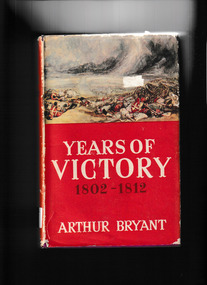
Book, Collins, Years of victory 1802-1812, 1944
... great britain - history - 1802-1837...great britain - military...great britain - history - 1802-1837 great britain - military history In the nine years of war between 1802 and 1814 Britain triumphed of Napoleon in a number of battles. index, ill (maps), p.499. ...In the nine years of war between 1802 and 1814 Britain triumphed of Napoleon in a number of battles.index, ill (maps), p.499.non-fictionIn the nine years of war between 1802 and 1814 Britain triumphed of Napoleon in a number of battles. great britain - history - 1802-1837, great britain - military history -
 Monbulk RSL Sub Branch
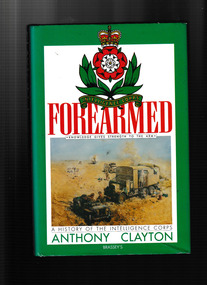
Book, Brasseys, Forearmed : a history of the Intelligence Corps, 1993
... ...great britain - military history...Military Intelligence - Great Britain - History great britain - military history A history of the Intelligence Corps of the British Army Index, ill, bib, p.318. ...A history of the Intelligence Corps of the British ArmyIndex, ill, bib, p.318.non-fictionA history of the Intelligence Corps of the British Armymilitary intelligence - great britain - history, great britain - military history -
 Monbulk RSL Sub Branch
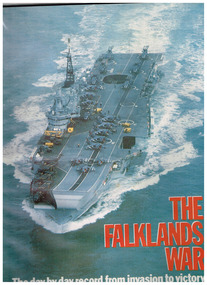
Book, Marshall Cavendish, The Falklands war: The day by day record frpm the invasion to victory, 1983
... ...great britain - military history...Falklands war 1982 great britain - military history British military forces. ...British military forces. Implications of Falkland Islands WarIll, maps, 14 part record of the conflictnon-fictionBritish military forces. Implications of Falkland Islands Warfalklands war 1982, great britain - military history -
 Mrs Aeneas Gunn Memorial Library
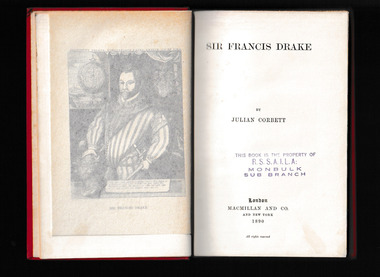
Book, Macmillan and Co, Sir Francis Drake, 1890
... Great Britain - Military history...Great Britain - Military history Great Britain - Admirals - Biography The life and times of Sir Francis Drake p.209. ...The life and times of Sir Francis Drakep.209.non-fictionThe life and times of Sir Francis Drakegreat britain - military history, great britain - admirals - biography -
 Mrs Aeneas Gunn Memorial Library
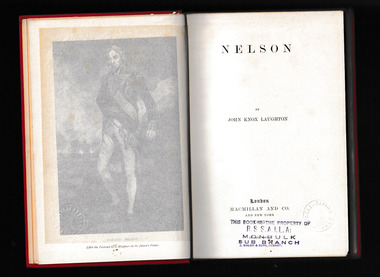
Book, Macmillan and Co, Nelson, 1890
... Great Britain - Military history...Great Britain - Military history Great Britain - Admirals - Biography The life and times of Nelson p.240. ...The life and times of Nelsonp.240.non-fictionThe life and times of Nelsongreat britain - military history, great britain - admirals - biography -
 Mrs Aeneas Gunn Memorial Library
Book, J. Murray, Deeds that won the Empire : historic battle scenes, 1917
... Great Britain - Military history...Great Britain - Military history Napoleonic wars A patriotic tale of British wartime exploits primarily during the Napoleonic wars Ill, maps, p.328. ...A patriotic tale of British wartime exploits primarily during the Napoleonic warsIll, maps, p.328.non-fictionA patriotic tale of British wartime exploits primarily during the Napoleonic wars great britain - military history, napoleonic wars -
 Mrs Aeneas Gunn Memorial Library
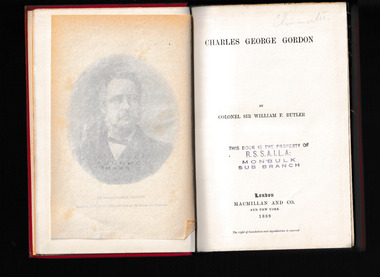
Book, Macmillan and Co, Charles George Gordon, 1889
... Great Britain - Military history...Great Britain - Military history Gordon of Khartoum The life and times of Charles George Gordon p.255. ...The life and times of Charles George Gordonp.255.non-fictionThe life and times of Charles George Gordongreat britain - military history, gordon of khartoum -
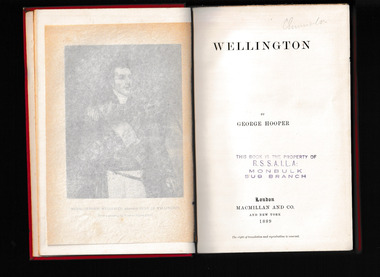 Mrs Aeneas Gunn Memorial Library
Book, Macmillan and Co, Wellington, 1889
... Great Britain - Military history...Great Britain - Military history Arthur Wellesley Duke of Wellington The life and times of the Duke of Wellington p.254. ...The life and times of the Duke of Wellingtonp.254.non-fictionThe life and times of the Duke of Wellingtongreat britain - military history, arthur wellesley duke of wellington -
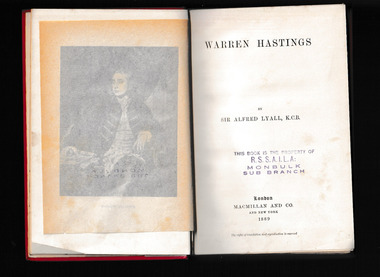 Mrs Aeneas Gunn Memorial Library
Book, Macmillan and Co, Warren Hastings, 1889
... Great Britain - Military history...Great Britain - Military history India - British occupation The life and times of Warren hastings p.235. ...The life and times of Warren hastingsp.235.non-fictionThe life and times of Warren hastingsgreat britain - military history, india - british occupation -
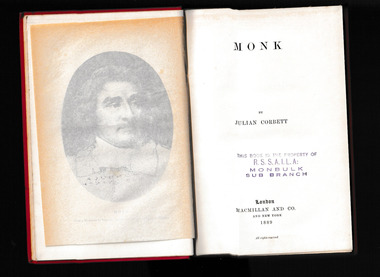 Mrs Aeneas Gunn Memorial Library
Book, Macmillan and Co, Monk, 1889
... Great Britain - Military history...Great Britain - Military history English civil war The life and times of George Monk p.221. ...The life and times of George Monkp.221.non-fictionThe life and times of George Monkgreat britain - military history, english civil war -
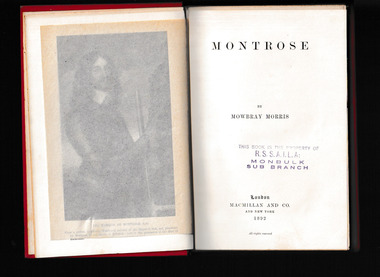 Mrs Aeneas Gunn Memorial Library
Book, Macmillan and Co, Montrose, 1892
... Great Britain - Military history...Great Britain - Military history Scotland - History The life and times of the marquis of Montrose p.229. ...The life and times of the marquis of Montrosep.229.non-fictionThe life and times of the marquis of Montrosegreat britain - military history, scotland - history -
 Mrs Aeneas Gunn Memorial Library
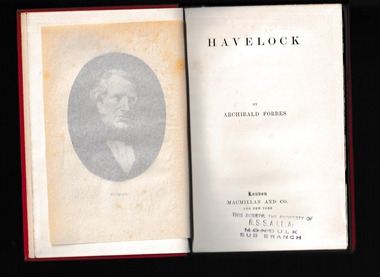
Book, Macmillan and Co, Havelock, 1892
... Great Britain - Military history...Great Britain - Military history India - British occupation The life and times of Henry Havelock p.223. ...The life and times of Henry Havelockp.223.non-fictionThe life and times of Henry Havelockgreat britain - military history, india - british occupation -
 Mrs Aeneas Gunn Memorial Library
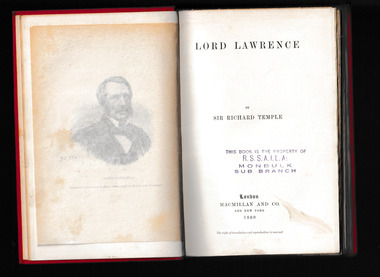
Book, Macmillan and Co, Lord Lawrence, 1892
... Great Britain - Military history...Great Britain - Military history India - British occupation The life and times of Lord Lawrence p.203. ...The life and times of Lord Lawrencep.203.non-fictionThe life and times of Lord Lawrencegreat britain - military history, india - british occupation -
 Mrs Aeneas Gunn Memorial Library
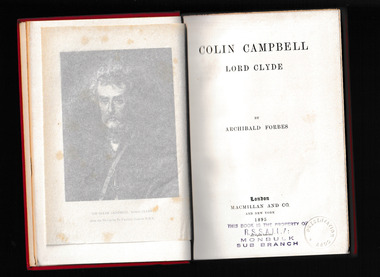
Book, Macmillan and Co, Colin Campbell, 1892
... Great Britain - Military history...Great Britain - Military history India - British occupation The life and times of Colin Campbell p.222. ...The life and times of Colin Campbellp.222.non-fictionThe life and times of Colin Campbellgreat britain - military history, india - british occupation -
 Mrs Aeneas Gunn Memorial Library
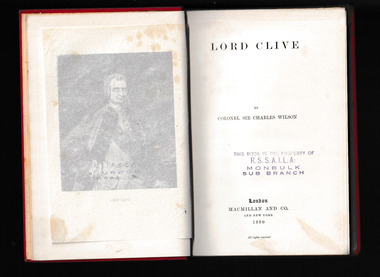
Book, Macmillan and Co, Lord Clive, 1892
... Great Britain - Military history...Great Britain - Military history India - British occupation The life and times of Lord Clive p.221. ...The life and times of Lord Clivep.221.non-fictionThe life and times of Lord Clivegreat britain - military history, india - british occupation -
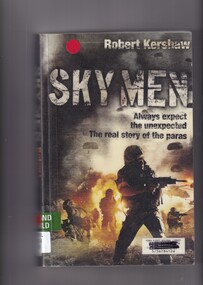 Monbulk RSL Sub Branch
Book, Robert Kershaw, Sky men: The real story of the paras, 2010
... great britain - history - military...great britain - history - military great britain - parachute regiment From the 1930s through WWII to Afghanistan today, from total war to counterinsurgency, this history unravels and defines the intangible qualities that differentiate the "Sky Men" from other soldiers Seventy years ago the Parachute Regiment was formed - the army's elite air assault force was tough, well-trained, and designed to fight hazardous operations behind enemy lines with little or no backup. ...From the 1930s through WWII to Afghanistan today, from total war to counterinsurgency, this history unravels and defines the intangible qualities that differentiate the "Sky Men" from other soldiers Seventy years ago the Parachute Regiment was formed - the army's elite air assault force was tough, well-trained, and designed to fight hazardous operations behind enemy lines with little or no backup. Dropping into the middle of enemy territory, these "Sky Men"- British, American, German, and Russian soldiers - engage in gruelling combat in the most dangerous conflict zones around the world. Ex-Parachute Regiment officer Robert Kershaw reveals the history of these airborne forces and their role during the most dramatic battles of the 20th century. He finds out what drives a "Sky Man" to take these extraordinary risks, and what marks these sky warriors out from ordinary soldiers. How do military paratroopers conquer the fear of jumping from aircraft at low level, by night, and frequently under fire? Has the helicopter replaced the need for parachutists in the 21st Century? Has the increasing lethality of anti-aircraft weapons made the airborne option redundant? These issues are examined alongside the personal experiences of the Soviet "Locust Warriors," German Fallschirmjäger, British Red Devils, American "devils in baggy-pants," and Les Paras. Based on letters, diaries, and exclusive interviews with soldiers from around the world, this book is full of vivid personalities and nail-biting action.Index, bibliography, notes, ill (b/w), p.348.From the 1930s through WWII to Afghanistan today, from total war to counterinsurgency, this history unravels and defines the intangible qualities that differentiate the "Sky Men" from other soldiers Seventy years ago the Parachute Regiment was formed - the army's elite air assault force was tough, well-trained, and designed to fight hazardous operations behind enemy lines with little or no backup. Dropping into the middle of enemy territory, these "Sky Men"- British, American, German, and Russian soldiers - engage in gruelling combat in the most dangerous conflict zones around the world. Ex-Parachute Regiment officer Robert Kershaw reveals the history of these airborne forces and their role during the most dramatic battles of the 20th century. He finds out what drives a "Sky Man" to take these extraordinary risks, and what marks these sky warriors out from ordinary soldiers. How do military paratroopers conquer the fear of jumping from aircraft at low level, by night, and frequently under fire? Has the helicopter replaced the need for parachutists in the 21st Century? Has the increasing lethality of anti-aircraft weapons made the airborne option redundant? These issues are examined alongside the personal experiences of the Soviet "Locust Warriors," German Fallschirmjäger, British Red Devils, American "devils in baggy-pants," and Les Paras. Based on letters, diaries, and exclusive interviews with soldiers from around the world, this book is full of vivid personalities and nail-biting action.great britain - history - military, great britain - parachute regiment -
 Mrs Aeneas Gunn Memorial Library
Book, George G Harrap and Co, The story of Lord Kitchener, 1916
... Great Britain - Biography...Great Britain - History - Military...Generals - Great Britain - Biography Great Britain - History - Military The life and times of Lord Kitchener Ill, p.288. ...The life and times of Lord KitchenerIll, p.288.non-fictionThe life and times of Lord Kitchenergenerals - great britain - biography, great britain - history - military -
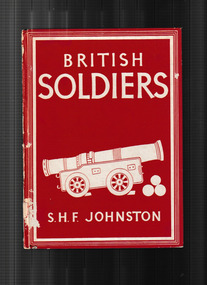 Mrs Aeneas Gunn Memorial Library
Book, British soldiers, 1944
... Great Britain - History - Military...Great Britain - History - Military Great Britain - History - Army A short history of the British army Ill, bib, p.47. ...A short history of the British armyIll, bib, p.47.non-fictionA short history of the British armygreat britain - history - military, great britain - history - army -
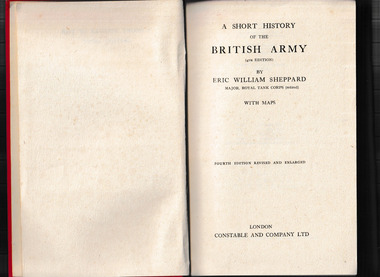 Mrs Aeneas Gunn Memorial Library
Book, Constable, A short history of the British Army, 1950
... Great Britain - History - Army...Great Britain - History - Military...Great Britain - History - Army Great Britain - History - Military A history of the British army up to the end of World War II A short history of the British Army Book Constable Eric William Sheppard ...A history of the British army up to the end of World War IInon-fictionA history of the British army up to the end of World War IIgreat britain - history - army, great britain - history - military -
 Flagstaff Hill Maritime Museum and Village
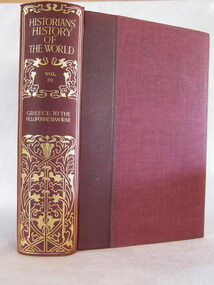
Book - Reference Book/History, Henry Smith Williams, The Historians History of the World Vol 3 set 1 - Edited by Henry Smith Williams L.L.D. Published by “The Times” 1908, 1908
... military social structure of Sparta, and the heroic resistance against the Persian Empire (Marathon, Thermopylae, and Salamis). This edition was part of a major marketing push to bring "the best of human thought" to the British public. It features like the other volumes in the set, signature red cloth or half-leather bindings typical of The Times subscription sets. The set is of historiographical value and significant because it captures the state of historical knowledge in 1908. In addition it reflects the "Great Man" theory of history ...The 1908 edition of The Historians' History of the World is a monumental work of Edwardian scholarship, representing a specific era of "universal history" where the goal was to synthesise all human knowledge into a single narrative. Volume 3 is a pivotal installment in the series, shifting the narrative from the "stagnant" (as viewed by 1904 scholars) empires of the East to the dynamic birth of Western civilisation.Book is part of a 25 volume set with red cloth bindings and gold filigree design to rib.non-fictionThe 1908 edition of The Historians' History of the World is a monumental work of Edwardian scholarship, representing a specific era of "universal history" where the goal was to synthesise all human knowledge into a single narrative. Volume 3 is a pivotal installment in the series, shifting the narrative from the "stagnant" (as viewed by 1904 scholars) empires of the East to the dynamic birth of Western civilisation.flagstaff hill, warrnambool, shipwrecked-coast, flagstaff-hill, flagstaff-hill-maritime-museum, maritime-museum, shipwreck-coast, flagstaff-hill-maritime-village, book, the historians history of the world vol 3 set 1 -
 Flagstaff Hill Maritime Museum and Village
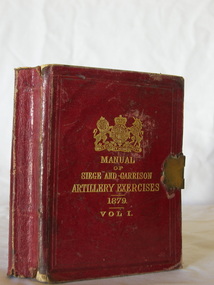
Book - Instruction Manual, British War Office, Manual of Siege and Garrison Artillery Exercises Vol 1, ca 24-06-1882
... British and Australian history, being issued for the training of the garrison defense of both countries in the late 10th Century. It is also significant for its connection with other historical military items within the Collection at Flagstaff Hill Maritime Museum and Village. Flagstaff Hill Flagstaff Hill Maritime Museum and Village Warrnambool Maritime Museum Maritime Village Great ...This little book has been designed to fit into a small space such as a pocket, backpack or trunk. The brass book lock helps keep the pages and covers together, preserving them from being bent, torn or damaged in handling.The book includes four of ten parts of the Manual, published for use in training the garrison troops, including the placement and firing of cannon. The four parts included in this Volume I are: - Part 1 - Gunnery Part 2 - Ammunition Part 3 - Siege Artillery Part 4 - Garrison Gun Drills The remaining six of then parts are: - Part 5 - Material and Appliances Part 6 - Elementary Instruction Part 7 - Machines Part 8 - Mounting and Dismounting Ordnance Part 9 - Sleighs Part 10 - Sheers and DerricksThe book is significant to both British and Australian history, being issued for the training of the garrison defense of both countries in the late 10th Century. It is also significant for its connection with other historical military items within the Collection at Flagstaff Hill Maritime Museum and Village.Manual of Siege and Garrison Artillery Exercises Vol 1 [Parts I, II, III, IV] Publisher Her Majestys Stationery Office Date 1879, Corrected June 24th 1882 Small, red, hard-cover book with embossed gold letters and British Coat of Arms on the front. The book has a brass closure or locking clip across the text block. There are diagrams and a foldout table within the text. flagstaff hill, flagstaff hill maritime museum and village, warrnambool, maritime museum, maritime village, great ocean road, shipwreck coast, training manual, book, british garrison, garrison artillery, siege exercises, british government training book, technical book, pocket book, manual of siege and garrison artillery exercises vol 1, garrison exercises, military training, defense training, british artillery, royal artillery, gunnery, gun drill, brass book lock, british war office, locking clip, reference book -
 Flagstaff Hill Maritime Museum and Village
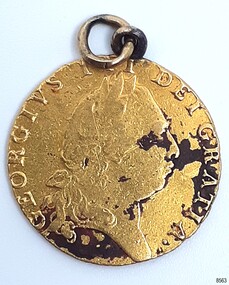
Currency - Guinea Coin, The Royal Mint, 1793 George III Spade Guinea, 1793
... Great Britain in Scotland on the reverse side. This edition was also the last guinea in circulation, because the sixth edition was reserved as the Military guinea. This edition of the Guinea is unique; This coin is the only guinea in our collection. It was minted in 1793, so it is now over 230 years old. The Gold Guinea is part of Australia’s history ...The coin was discovered by Julie Wilkins, a Victorian scuba diver who had already experienced more than 500 dives in Australia and overseas. She was holidaying in Peterborough, Victoria, and looking forward to discovering more about the famous Loch Ard ship, wrecked in June 1878 at Mutton Bird Island. The fast Glasgow-built clipper ship was only five years old when the tragedy occurred. There were 54 people on board the vessel and only two survived Julie's holiday photograph of Boat Bay reminds her of her most memorable dive. Submerged in the calm, flat sea, she was carefully scanning around the remains of the old wreck when, to her amazement, a gold coin and a small gold cross suddenly came up towards her. She excitedly cupped them in her hands, then stowed the treasures safely in her wetsuit and continued her dive. She soon discovered a group of brass carriage clock parts and some bottles of champagne. It was a day full of surprises. The items were easily recognisable, without any build-up of encrustations or concretion. Julie secretly enjoyed her treasures for twenty-four years then packed them up for the early morning train trip to Warrnambool. After a short walk to Flagstaff Hill Maritime Museum and Village, her photograph was taken as she handed over her precious find. She told her story to a local newspaper reporter, lunched a café in town then took the late afternoon train home. Her generous donation is now part of a vast collection of Loch Ard shipwreck artefacts, including the gold watch and the Minton Majolica model peacock. The coin is a British 1793 George III Gold Spade Guinea. It was already 83 years old when the Loch Ard had set sail. The loop and ring have been added, perhaps as a pendant, pocket watch accessory or similar purpose. It may have been worn for ‘good luck’ on the long journey to Australia, where ships had to carefully navigate the treacherous Bass’s Strait before arriving at their destination of Melbourne. Sadly, many met their fate on that short stretch of ocean aptly named the Shipwreck Coast. The coin is very recognisable even though it was exposed to the wrecking of the ship, its consequent movement, and the sea's turbulence. Its bent, scratched, buckled, split, dinted and worn condition is part of its story. The red-brown-black discolouration is similar to that found on other gold coins, sometimes called the ‘corrosion phenomena’. Studies suggest the possible cause is contaminants in the minting process reacting to the coins’ environment. The GEORGE III GOLD SPADE GUINEA: - The British Guinea was introduced in 1663 and was circulated until 1814. It was made of 22 carat gold, was 25 to 26 cm in diameter and weighed 8.35 grams. It had a value of 21 British shillings. The guinea coin ceased circulation after 1816 and was replaced by the one-pound note. However, the term ‘guinea’ continued to represent 21 shillings. King George (1738-1820) had six gold guinea designs minted during his reign from 1760 and 1820. Each of the six had different obverse portraits, all facing the right. There were three different reverse sides. The Spade Guinea was the fifth issue of the coin, introduced in 1787 and produced until 1799. The reverse shows a royal crown over a flat-topped shield with the Royal Arms of Great Britain, used in Scotland between 1714 and 1800. The shield images are, from left to right, top to bottom, the Arms of England and Scotland, the Arms of France, the Arms of Ireland, and the Arms of the House of Hanover. The Gold Guinea is also part of Australia’s history. It was the first coin mentioned in the announcement of Governor King of New South Wales his Australian Proclamation of a limited variety and denomination of coins accepted for use in the Australian Colony. The historic and decorative George III Spade Guinea has been reproduced for special collections of coins. However, replicas and imitations have also been made as souvenirs for tourists, as gaming tokens and chips for gamblers, and as ‘fake’ coins for profit. These coins differ in many ways; they may be only half the weight of the genuine coin. Often have a small stamp on the obverse with “COPY” or the manufacturer’s name or initials. Some have scalloped edges, some have dates that are different to the original dates of issue, and some even have text in Latin that translates as something very different to the original coin.The King George III Guinea was only produced from 1663 to 1814 and was the first English coin to be mechanically minted. The coin is the fifth edition of the King George III Guinea, the Spade Guinea, was only produced between 1787 and 1799. It is the only edition with this portrait of King George and the only one with the Royal Coat of Arms of Great Britain in Scotland on the reverse side. This edition was also the last guinea in circulation, because the sixth edition was reserved as the Military guinea. This edition of the Guinea is unique; This coin is the only guinea in our collection. It was minted in 1793, so it is now over 230 years old. The Gold Guinea is part of Australia’s history; it was the first coin in the list of coins for use in the Australian Colonies, mentioned by Governor King of New South Wales in his Australian Proclamation speech of 1800. The George III Spade Guinea was included in the Limited Edition Sherwood 12 Coin Collection of Notable Coinage of Australia. This coin is the only known guinea coin recovered from the wreck of the Loch Ard. It was already 85 years old when the ship was wrecked.Gold coin; British. 1793, King George III of the United Kingdom of Great Britain and Ireland (1760-1820), Spade Guinea. Yellow gold coin with gold metal loop mount and a gold ring through the loop. The design is the fifth issue of the George III Gold Guinea. The obverse relief is a portrait of George III facing right. Reverse relief is a crown above the Coats of Arms (1801-1816) of flat top spade-shaped shield divided into four quadrants that depict crowned lions, fleur de lies, a harp. These images are identified as, from left to right, top to bottom, England and Scotland, France, Ireland and Hanover. Inscriptions are minted around the rims of each side. The coin is dated 1793. Its surface has dark areas on both sides and the reed edge and surfaces are well worn. The loop mount is bent and the ring is buckled. The coin was recovered from the wreck of the ship Loch Ard.Obverse text; 'GEORGIVS III DEI GRATIA' (translates to George the Third, by the Grace of God) Obverse relief; (King George III bust, facing right, laurel wreath on head) Reverse text; 'M.B.E.ET.H.REX.F. D.B.ET.L.D. S.R.I.A.T.ET.E' '1793' (translates to: King of Great Britain, France and Ireland, Defender of the Faith, Duke of Brunswick and Lüneburg, Arch-Treasurer and Elector of the Holy Roman Empire) Reverse relief; a spade-shaped image i.e. (Crown with fleer de lies, above Shield with crowned lions in different postures, a harp, and other details)flagstaff hill maritime museum and village, warrnambool, great ocean road, shipwreck coast, royal mint, british coin, currency, guinea, military guinea, australian currency, british guinea, gold coin, spade guinea, king george iii, george iii, fifth portrait, arms of england and scotland, arms of france, arms of ireland, arms of the house of hanover, coins, gold coins, gold medallion, georgian era, 1793, numismatics, contamination phenomena, gold corrosion, good luck, lucky charm, pendant, lucky coin, trade, loch ard, wreck of the loch ard, 1878, mutton bird island, peterborough, scuba diver, 1980s, guinea coin, gold guinea, shipwreck artefact, relic, julie wilkins -
 Flagstaff Hill Maritime Museum and Village
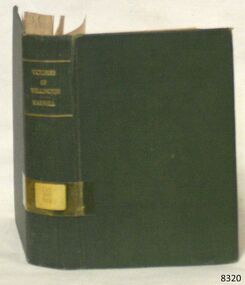
Book - Biographical/ Military History, W. H. Maxwell, The Victories of Wellington, 1871
... British public preferred to remember the Napoleonic Wars decades after they ended. (For more information on the Pattison Collection see item 3678 Flagstaff Hill collections) https://victoriancollections.net.au/items/5580c7e72162f114d8b758db flagstaff hill warrnambool shipwrecked coast flagstaff hill maritime museum maritime museum shipwreck coast flagstaff hill maritime village great ocean road book pattison collection warrnambool library warrnambool mechanics’ institute ralph eric pattison corangamite regional library service warrnambool city librarian mechanics’ institute library victorian library board warrnambool books and records warrnambool children’s library the victories of wellington W H Maxwell The Duke of Wellington Waterloo 1812 This book is a detailed military history and biographical tribute celebrating Arthur Wellesley, the Duke of Wellington, and the triumphs of the British military during the early 19th century. ...This book is a detailed military history and biographical tribute celebrating Arthur Wellesley, the Duke of Wellington, and the triumphs of the British military during the early 19th century. It focuses heavily on the Peninsular War fought against Napoleon's forces in Spain and Portugal and concludes with the famous Battle of Waterloo in 1815. Written with a flair for action, it blends tactical overviews of famous battles with dramatic anecdotes of soldierly bravery, making it highly accessible to the general Victorian public, who voraciously consumed patriotic military histories.The Victories of Wellington Author: W. H. Maxwell Publisher: Bell & Daldy Date: 1871 Further Information: non-fictionThis book is a detailed military history and biographical tribute celebrating Arthur Wellesley, the Duke of Wellington, and the triumphs of the British military during the early 19th century. It focuses heavily on the Peninsular War fought against Napoleon's forces in Spain and Portugal and concludes with the famous Battle of Waterloo in 1815. Written with a flair for action, it blends tactical overviews of famous battles with dramatic anecdotes of soldierly bravery, making it highly accessible to the general Victorian public, who voraciously consumed patriotic military histories.flagstaff hill, warrnambool, shipwrecked coast, flagstaff hill maritime museum, maritime museum, shipwreck coast, flagstaff hill maritime village, great ocean road, book, pattison collection, warrnambool library, warrnambool mechanics’ institute, ralph eric pattison, corangamite regional library service, warrnambool city librarian, mechanics’ institute library, victorian library board, warrnambool books and records, warrnambool children’s library, the victories of wellington, w h maxwell, the duke of wellington, waterloo, 1812 -
 Flagstaff Hill Maritime Museum and Village
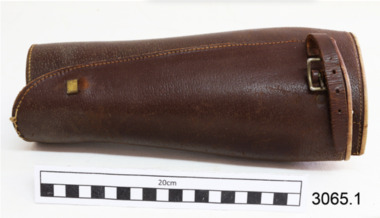
Clothing - Leather Leggings, 1899 to 1920
... military history. It was a time when many young men gave their lives during the South African and First World Wars in the defence of the then British Empire as part of the Imperial Forces that were gathered from many British-controlled Colonial countries. flagstaff hill warrnambool flagstaff hill maritime museum shipwreck coast flagstaff hill maritime village great ocean road leggings leather leggings protective leggings protective clothing Australian Mounted Light Horse Units Military Equipment None A pair of two Leather Leggings used by Mounted Australian soldiers during the first world war. ...The subject leather leggings are associated with mounted troops known as the Australian Light Horse that served in the South African War from 1899 to 1902. After the war, Britain wanted to use fewer mounted troops and restructured its force around a style of combat that needed more infantry. But the defence of Australia still relied upon mounted military units as these were more mobile than infantry and could travel faster over long distances. Light Horse brigades in the Australian Imperial Force (AIF) mostly contained recruits who served in the Light Horse regiments of the Citizen Forces. Many young men from rural areas of Australia volunteered for the Light Horse regiments. They had to pass a riding test to join, this test was easier for men from the bush because horses were still the main method of transport on farms and in country towns. The army did not officially accept First Australians into the AIF until May 1917 when enlistment standards were relaxed to include 'half-castes' with a parent of European origin. Indigenous soldiers served as valuable members of the Light Horse and many possessed excellent horse handling skills and specialist tracking knowledge.The subject items are part of the uniform for the Light Horse Units that served in the Australian army from 1899 until 1918. These leggings were worn by soldiers on horseback and are significant as they represent a noteworthy time in Australia's early military history. It was a time when many young men gave their lives during the South African and First World Wars in the defence of the then British Empire as part of the Imperial Forces that were gathered from many British-controlled Colonial countries.A pair of two Leather Leggings used by Mounted Australian soldiers during the first world war. The leggings are dark tan in colour with stitching to attach buckles and fastener straps. The strap buckles are made of brass and the leather legging straps are of same leather as leggings. Noneflagstaff hill, warrnambool, flagstaff hill maritime museum, shipwreck coast, flagstaff hill maritime village, great ocean road, leggings, leather leggings, protective leggings, protective clothing, australian mounted light horse units, military equipment -
 Flagstaff Hill Maritime Museum and Village
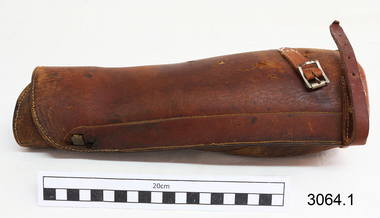
Clothing - Leather Leggings, 1899 to 1918
... military history. It was a time when many young men gave their lives during the South African and First World Wars in the defence of the then British Empire as part of the Imperial Forces that were gathered from many British-controlled Colonial countries. flagstaff hill warrnambool flagstaff hill maritime museum shipwreck coast flagstaff hill maritime village great ocean road leggings leather leggings protective leggings protective clothing Australian Mounted Light Horse Units Military Equipment None A pair of two Leather Leggings used by Mounted Australian soldiers during the first world war. ...The subject leather leggings are associated with mounted troops known as the Australian Light Horse that served in the South African War from 1899 to 1902. After the war, Britain wanted to use fewer mounted troops and restructured its force around a style of combat that needed more infantry. But the defence of Australia still relied upon mounted military units as these were more mobile than infantry and could travel faster over long distances. Light Horse brigades in the Australian Imperial Force (AIF) mostly contained recruits who served in the Light Horse regiments of the Citizen Forces. Many young men from rural areas of Australia volunteered for the Light Horse regiments. They had to pass a riding test to join, this test was easier for men from the bush because horses were still the main method of transport on farms and in country towns. The army did not officially accept First Australians into the AIF until May 1917 when enlistment standards were relaxed to include 'half-castes' with a parent of European origin. Indigenous soldiers served as valuable members of the Light Horse and many possessed excellent horse handling skills and specialist tracking knowledge.The subject items are part of the uniform for the Light Horse Units that served in the Australian army from 1899 until 1918. These leggings were worn by soldiers on horseback and are significant as they represent a noteworthy time in Australia's early military history. It was a time when many young men gave their lives during the South African and First World Wars in the defence of the then British Empire as part of the Imperial Forces that were gathered from many British-controlled Colonial countries.A pair of two Leather Leggings used by Mounted Australian soldiers during the first world war. The leggings are dark tan in colour with stitching to attach buckles and fastener straps. The strap buckles are made of brass and the leather legging straps are of same leather as leggings. Noneflagstaff hill, warrnambool, flagstaff hill maritime museum, shipwreck coast, flagstaff hill maritime village, great ocean road, leggings, leather leggings, protective leggings, protective clothing, australian mounted light horse units, military equipment -
 Bendigo Military Museum
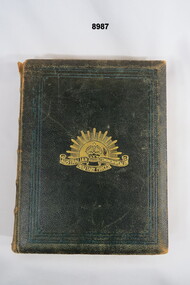
Book - THE ALL- AUSTRALIAN MEMORIAL, British - Australian Publishing Service, 1917
... PBTCOLLECTIONS Passchendaele barracks trust Memorial Manual Book WW1 Jack Swatton “Australian Commonwealth Military Forces” “British Australian Publishing Service 1917” “Dedication page - refer to Historical context” Large book recording the ANZAC achievements. It is wholly Australian contents and it represents almost two (2) years of data relating to Australia's part in the Great War during 1915-1916. Chapter 1 - History ...Dedication Page. Photo John W. Swatton. SWATTON J.W. Gnr. No. 4905. No 43rd Bty 11th Fld Arty Bgde. Son of Mr. William and Mrs. Elizabeth Swatton, McKenzie St. Bendigo; Born at Melbourne, Dec 24, 1895. educated at Golden Square State School. Occup. Grocer. Enlisted: Bendigo, July 10, 1915. War Service - France. Historical - "Jack Swatton". Refer Cat No. 6719.2P for his service details. Large book recording the ANZAC achievements. It is wholly Australian contents and it represents almost two (2) years of data relating to Australia's part in the Great War during 1915-1916. Chapter 1 - History of the Dardanelles Operation. Part 2, Names of Soldiers officially reported killed in action or died of wounds up to December 1916 - from Victorian Regiments. Part 3. Australia's Fighting Families from Victoria. Part 4. Regimental Register of Victorian Units on Embarkation.“Australian Commonwealth Military Forces” “British Australian Publishing Service 1917” “Dedication page - refer to Historical context”pbtcollections, passchendaele barracks trust, memorial, manual, book, ww1, jack swatton -
 Bendigo Military Museum
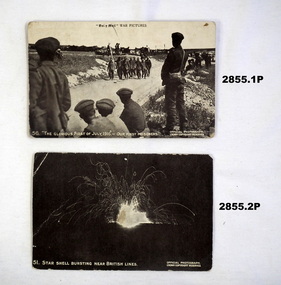
Postcard - POSTCARDS, PHOTOGRAPHIC WW1, Daily Mail, c.1914 - 1918
... Daily Mail Battle Pictures, Series VII. photography-photographs military history Passchendaele Barracks Trust .1) The glorious first of July 1916 - Our first prisoners, SVII No 49. .2) Star shell bursting near British lines, SVII No 51. .3) Army Chaplain tending British graves, SVII No 52. .4) The Fighting Fifth (Northumberland Fusiliers) after the Battle of St Eloi, SVII No 52. .5) Tommy's lookout in a captured trench at Orvillers, SVII No 52. .6) London Scottish going into their trenches,m SVII No 55. .7) Sir D Haig introducing Sir Pertab Singh to Generall Joffre, SV11 No 49. Seven black & white postcards of aspects of the Great ...Daily Mail Battle Pictures, Series VII.Seven black & white postcards of aspects of the Great War..1) The glorious first of July 1916 - Our first prisoners, SVII No 49. .2) Star shell bursting near British lines, SVII No 51. .3) Army Chaplain tending British graves, SVII No 52. .4) The Fighting Fifth (Northumberland Fusiliers) after the Battle of St Eloi, SVII No 52. .5) Tommy's lookout in a captured trench at Orvillers, SVII No 52. .6) London Scottish going into their trenches,m SVII No 55. .7) Sir D Haig introducing Sir Pertab Singh to Generall Joffre, SV11 No 49.photography-photographs, military history, passchendaele barracks trust -
 Bendigo Military Museum
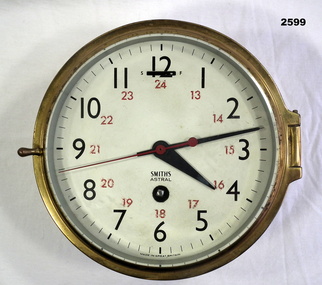
Accessory - NAVY CLOCK, Smiths Astral, Possibly pre WW2
... horology - clocks military history - navy “Smiths Astral, Made in Great Britain” Circular brass clock, Naval, has hour, minute & second hands. ...Circular brass clock, Naval, has hour, minute & second hands. The face is white with 12 hr figures in black, the 24 hr numerals are in white. The glass front has a hinge on the right side. A small brass knob on the left side acts as the handle. The clock is mechanical, wound up from the front.“Smiths Astral, Made in Great Britain”horology - clocks, military history - navy -
 Monbulk RSL Sub Branch
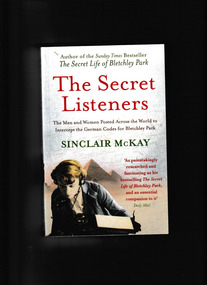
Book, Aurum Press Ltd, The secret listeners : The men and women posted across the world to intercept the secret german codes for Bletchley Park, 2012
... World War 1939-1945 - Great Britain - Intelligence World war 1939-1945 - Cryptography Before Bletchley Park could break the German war machine's code, its daily military communications had to be monitored and recorded by 'the Listening Service', the wartime department whose bases moved with every theatre of war (Cairo, Malta, Gibraltar, Iraq, Cyprus) as well as having listening stations along the eastern coast of Britain to intercept radio traffic in the European theatre. This is the story of the - usually very young - men and women sent out to farflung outposts to listen in for Bletchley Park, an oral history ...Before Bletchley Park could break the German war machine's code, its daily military communications had to be monitored and recorded by 'the Listening Service', the wartime department whose bases moved with every theatre of war (Cairo, Malta, Gibraltar, Iraq, Cyprus) as well as having listening stations along the eastern coast of Britain to intercept radio traffic in the European theatre. This is the story of the - usually very young - men and women sent out to farflung outposts to listen in for Bletchley Park, an oral history of exotic locations and ordinary lives turned upside down by a sudden remote posting - the heady nightlife in Cairo, filing cabinets full of snakes in North Africa, and flights out to Delhi by luxurious flying boat.Index, ill, map, p.354.non-fictionBefore Bletchley Park could break the German war machine's code, its daily military communications had to be monitored and recorded by 'the Listening Service', the wartime department whose bases moved with every theatre of war (Cairo, Malta, Gibraltar, Iraq, Cyprus) as well as having listening stations along the eastern coast of Britain to intercept radio traffic in the European theatre. This is the story of the - usually very young - men and women sent out to farflung outposts to listen in for Bletchley Park, an oral history of exotic locations and ordinary lives turned upside down by a sudden remote posting - the heady nightlife in Cairo, filing cabinets full of snakes in North Africa, and flights out to Delhi by luxurious flying boat.world war 1939-1945 - great britain - intelligence, world war 1939-1945 - cryptography
