
Showing 71 items matching "great britain -- law"
-
 RMIT GSBL Justice Smith Collection
Book, Henty, R. I. et al, Lewin's practical treatise on the law of trusts, 1939
... great britain...great britain -- law...trusts and trustees -- great britain great britain -- law Fourteenth edition Includes 2 supplements inside back cover Lewin's practical treatise on the law of trusts Book Lewin, Thomas Henty, R. ...Fourteenth edition Includes 2 supplements inside back covertrusts and trustees -- great britain, great britain -- law -
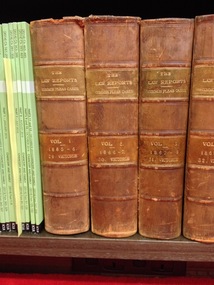 RMIT GSBL Justice Smith Collection
Journal series, Bulwer, J. R, The law reports : court of common pleas, 1866
... law reports; digests; etc. -- great britain...law...Smith law reports; digests; etc. -- great britain law reports; digests; etc. -- great britain -- periodicals No. of volumes: 15 Volume range: Vol. 1 (1865-66) - Vol. 10 (1874-75) & Vol. 1 (1875-76) - Vol. 5 (1879-80) The law reports : court of common pleas Journal series Bulwer, J. ...Previous owners: T. H. Smith, T. W. SmithNo. of volumes: 15 Volume range: Vol. 1 (1865-66) - Vol. 10 (1874-75) & Vol. 1 (1875-76) - Vol. 5 (1879-80) law reports; digests; etc. -- great britain, law reports; digests; etc. -- great britain -- periodicals -
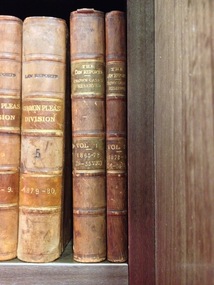 RMIT GSBL Justice Smith Collection
Journal series, Bulwer, J. R, The law reports : cases determined by the Court of Crown Cases reserved, 1872
... ...criminal law -- great britain -- cases...Smith law reports; digests; etc. -- great britain criminal law -- great britain -- cases law reports; digests; etc. -- great britain -- periodicals No. of volumes: 2 Volume range: Vol. 1 (1865-1872) - Vol. 2 (1872-1875) The law reports : cases determined by the Court of Crown Cases reserved Journal series Bulwer, J. ...Previous owners: T. H. Smith, T. W. SmithNo. of volumes: 2 Volume range: Vol. 1 (1865-1872) - Vol. 2 (1872-1875) law reports; digests; etc. -- great britain, criminal law -- great britain -- cases, law reports; digests; etc. -- great britain -- periodicals -
![Journal series, The Incorporated Council of Law Reporting for England and Wales, The law reports : Privy Council appeal cases heard and determined by the Judicial Committee and the Lords of Her Majesty's most honourable Privy Council [Appeal], 1865](/media/collectors/54a9bcce2162f11b1cc120f2/items/54b5e3fd2162f714587ae15b/item-media/5508d5392162f1199c216869/item-fit-380x285.jpg?cb=6) RMIT GSBL Justice Smith Collection
RMIT GSBL Justice Smith CollectionJournal series, The Incorporated Council of Law Reporting for England and Wales, The law reports : Privy Council appeal cases heard and determined by the Judicial Committee and the Lords of Her Majesty's most honourable Privy Council [Appeal], 1865
... law reports: digests: etc. -- great britain -- periodicals...Smith law reports: digests: etc. -- great britain -- periodicals law reports: digests: etc. -- great britain appellate procedure -- great britain -- cases No. of volumes: 218 Volume range: Vol. 1-6 (1865-1875), Vol. 1-15 (1875-1890), Vol. 1891-2014 (Years with 2 parts: 1916, 1921-1922, 1967, 1969, 1983, 1990-1992, 1994-1995, 1999-2007) (2009-2014 unbound) Later title: Appeal cases Reporters: Moore, E. ...Previous owners: T. H. Smith, T. W. SmithNo. of volumes: 218 Volume range: Vol. 1-6 (1865-1875), Vol. 1-15 (1875-1890), Vol. 1891-2014 (Years with 2 parts: 1916, 1921-1922, 1967, 1969, 1983, 1990-1992, 1994-1995, 1999-2007) (2009-2014 unbound) Later title: Appeal cases Reporters: Moore, E. F. (1865-1873) MacPherson, W. (1973-1874) Cowell, H. (1874-1881) Clark, C. (1975-1881) MacQueen, J. F. (1875-1879) Wheeler, G. J. (1879-1881) Editors: Bulwer, J. F. (1881-1885) Stone, A. P. (1886-1894) Pollock, F. (1895-1936) Topham, A. F. (1936-1939) Williams, R. E. L. V. (1940) Sutton, R. (1941-1952) Colinvaux, R. P. (1953-1968) Lamb, J. F. (1969) Ellis, C. J. (1970 - 1995) Williams, R. (1996-2007) Scowen, C. (2008)law reports: digests: etc. -- great britain -- periodicals, law reports: digests: etc. -- great britain, appellate procedure -- great britain -- cases -
![Journal series, The Incorporated Council of Law Reporting for England and Wales, The law reports : Probate division : in the courts of probate and divorce : in the admiralty and ecclesiastical courts : and in the Privy Council [Family division and on appeal there from in the Court of Appeal and decisions in the ecclesiastical courts], 1869](/media/collectors/54a9bcce2162f11b1cc120f2/items/54b70efe2162f113803d6e56/item-media/54e69a7b2162ff01240c2a90/item-fit-380x285.jpg?cb=6) RMIT GSBL Justice Smith Collection
RMIT GSBL Justice Smith CollectionJournal series, The Incorporated Council of Law Reporting for England and Wales, The law reports : Probate division : in the courts of probate and divorce : in the admiralty and ecclesiastical courts : and in the Privy Council [Family division and on appeal there from in the Court of Appeal and decisions in the ecclesiastical courts], 1869
... law reports: digests: etc -- great britain...Smith law reports: digests: etc -- great britain probate law and practice -- great britain -- cases divorce -- great britain -- cases admiralty -- great britain -- cases No. of volumes: 124 Volume range: 1865-2014 (2008-2014 included within Chancery parts) Probate & divorce: Vol. 1 (1865) - Vol. 3 (1875) Probate: Vol. 1 (1875) - Vol. 15 (1890), Vol. 1891-1971 Family: Vol. 1972-2007 Editors: Bulwer, J. ...Previous owners: T. H. Smith, T. W. SmithNo. of volumes: 124 Volume range: 1865-2014 (2008-2014 included within Chancery parts) Probate & divorce: Vol. 1 (1865) - Vol. 3 (1875) Probate: Vol. 1 (1875) - Vol. 15 (1890), Vol. 1891-1971 Family: Vol. 1972-2007 Editors: Bulwer, J. R. (1865-1885) Stone, A. P. (1886-1894) Pollock, F. (1895-1936) Topham, A. F. (1936-1939) Williams, R. E. L. V. (1940) Sutton, R. (1941-1952) Colinvaux, R. P. (1953-1968) Lamb, J. F. (1969) Ellis, C. J. (1970-1995) Williams, R. (1996-2007)law reports: digests: etc -- great britain, probate law and practice -- great britain -- cases, divorce -- great britain -- cases, admiralty -- great britain -- cases -
RMIT GSBL Justice Smith Collection
Book, Ball, W. Valentine et al, The law of libel and slander, 1936
... libel and slander -- great britain...press law...libel and slander -- great britain press law -- great britain Second edition The law of libel and slander Book Ball, W. ...Second editionlibel and slander -- great britain, press law -- great britain -
RMIT GSBL Justice Smith Collection
Book, Guest, Anthony Gordon, Principles of the English law of contract and of agency in its relation to contract, 1959
... contracts -- great britain...agency (law...contracts contracts -- great britain agency (law) -- great britain Twenty-first edition Principles of the English law of contract and of agency in its relation to contract Book Guest, Anthony Gordon Oxford University Press ...Twenty-first editioncontracts, contracts -- great britain, agency (law) -- great britain -
RMIT GSBL Justice Smith Collection
Book, Chalmers, Mackenzie Dalzell, The Sale of Goods Act,1893, including The Factors Act, 1889 & 1890, 1922
... sales -- great britain...agency (law...Smith sales -- great britain agency (law) -- great britain Ninth edition The Sale of Goods Act,1893, including The Factors Act, 1889 & 1890 Book Chalmers, Mackenzie Dalzell Butterworth & Co. ...Previous owners: T. H. Smith, T. W. SmithNinth editionsales -- great britain, agency (law) -- great britain -
RMIT GSBL Justice Smith Collection
Book, Simpson, Archibald. H, A treatise on the law and practice relating to infants, 1890
... great britain...infants -- legal status: laws: etc -- great britain...family law...Smith children -- legal status: laws: etc -- great britain infants -- legal status: laws: etc -- great britain family law -- great britain child support -- great britain domestic relations -- great britain. ...Previous owners: T. H. Smith, T. W. SmithSecond editionchildren -- legal status: laws: etc -- great britain, infants -- legal status: laws: etc -- great britain, family law -- great britain, child support -- great britain, domestic relations -- great britain. -
RMIT GSBL Justice Smith Collection
Book, Dicey, Albert Venn, Introduction to the study of the law of the Constitution, 1915
... constitutional law -- great britain...Smith constitutional law -- great britain great britain -- constitutional law Eighth edition Introduction to the study of the law of the Constitution Book Dicey, Albert Venn MacMillan and Co. ...Previous owners: T. H. Smith, T. W. SmithEighth editionconstitutional law -- great britain, great britain -- constitutional law -
RMIT GSBL Justice Smith Collection
Book series, Powell, Maurice, Roscoe's digest of the law of evidence on the trial of actions at Nisi Prius, 1900
... ...evidence (law) -- great britain...Smith nisi prius evidence (law) -- great britain faclaw law Seventeenth edition No. of volumes: 2 Volume range: Vol. ...Previous owners: T. H. Smith, T. W. SmithSeventeenth edition No. of volumes: 2 Volume range: Vol. I & IInisi prius, evidence (law) -- great britain, faclaw law -
RMIT GSBL Justice Smith Collection
Book, Bray, Edward, The principles and practice of discovery with an appendix of forms including suggested forms for stating objections to discovery, 1885
... equity pleading and procedure -- great britain: discovery (law) -- great britain...Smith discovery (law) -- great britain -- forms equity pleading and procedure -- great britain: discovery (law) -- great britain pre-trial procedure -- great britain The principles and practice of discovery with an appendix of forms including suggested forms for stating objections to discovery Book Bray, Edward Reeves and Turner ...Previous owners: T. H. Smith, T. W. Smithdiscovery (law) -- great britain -- forms, equity pleading and procedure -- great britain: discovery (law) -- great britain, pre-trial procedure -- great britain -
![Journal series, The Council of Law Reporting, The law reports : chancery appeal cases, including bankruptcy and lunacy cases, before the Lord Chancellor, and the Court of Appeal in Chancery [Chancery], 1866](/media/collectors/54a9bcce2162f11b1cc120f2/items/54b36cb32162f10f380f57f9/item-media/54e69cf22162ff01240c486f/item-fit-380x285.jpg?cb=6) RMIT GSBL Justice Smith Collection
RMIT GSBL Justice Smith CollectionJournal series, The Council of Law Reporting, The law reports : chancery appeal cases, including bankruptcy and lunacy cases, before the Lord Chancellor, and the Court of Appeal in Chancery [Chancery], 1866
... great britain -- cases...bankruptcy -- great britain -- cases...insanity (law...Smith law reports: digests: etc -- great britain equity -- great britain -- cases bankruptcy -- great britain -- cases insanity (law) -- great britain -- cases ISBN: 9780852891926 (thin paper) No. of volumes: 263 Volume range: Vol. 1 (1865-1866) - Vol. 10 (1874-1875) & Vol. 1 (1875/1876) - 2008), 2009-2014 (unbound) Missing volumes: 2002 (Part 2) Later title: Division I - Chancery : cases determined by the Chancery division of the High Court of Justice and by the Chief Judge in bankruptcy and by the Court of Appeal on appeal from the Chancery Division and the Chief Judge and in lunacy Editors: Hemming, G. ...Previous owners: T. H. Smith, T. W. SmithNo. of volumes: 263 Volume range: Vol. 1 (1865-1866) - Vol. 10 (1874-1875) & Vol. 1 (1875/1876) - 2008), 2009-2014 (unbound) Missing volumes: 2002 (Part 2) Later title: Division I - Chancery : cases determined by the Chancery division of the High Court of Justice and by the Chief Judge in bankruptcy and by the Court of Appeal on appeal from the Chancery Division and the Chief Judge and in lunacy Editors: Hemming, G. W. (1865-1895) Pollock, F. (1896-1936) Topham, A. F. (1936-1939) Williams, R. E. L. V. (1940) Sutton, R. (1941-1952) Colinvaux, R. P. (1953-1968) Lamb, J. F. (1969) Ellis, C. J. (1970-1995) Williams, R. (1996-2007) Scowen, C. (2008) ISBN: 9780852891926 (thin paper)law reports: digests: etc -- great britain, equity -- great britain -- cases, bankruptcy -- great britain -- cases, insanity (law) -- great britain -- cases -
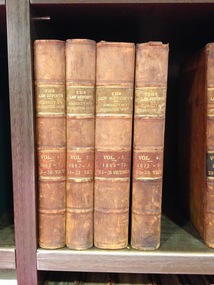 RMIT GSBL Justice Smith Collection
Journal series, Bulwer, J. R, The law reports : high court of admiralty and ecclesiastical courts, 1867
... admiralty -- great britain -- cases...ecclesiastical law...Smith, law reports; digests; etc. -- great britain admiralty -- great britain -- cases ecclesiastical law -- great britain -- cases No. of volumes: 4 Volume range: Vol. 1 (1867) - Vol. 4 (1875) The law reports : high court of admiralty and ecclesiastical courts Journal series Bulwer, J. ...Previous owners: T. H. Smith, T. W. Smith, No. of volumes: 4 Volume range: Vol. 1 (1867) - Vol. 4 (1875)law reports; digests; etc. -- great britain, admiralty -- great britain -- cases, ecclesiastical law -- great britain -- cases -
RMIT GSBL Justice Smith Collection
Book, Stevens and Sons Limited, The law of real property, 1959
... great britain...land tenure -- law and legislation -- great britain...Smith real property -- great britain land tenure -- law and legislation -- great britain Second edition The law of real property Book MeGarry, Robert Edgar and Wade, H.W.R Stevens and Sons Limited ...Previous owners: T. H. Smith, T. W. SmithSecond editionreal property -- great britain, land tenure -- law and legislation -- great britain -
 Flagstaff Hill Maritime Museum and Village
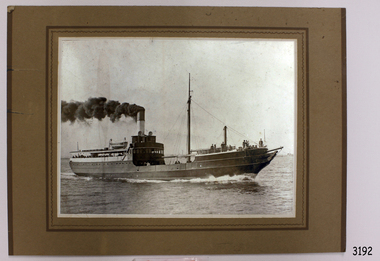
Photograph - Vessel, Steam Ship, after 1890
... The SS Edina’s original ‘fair maid of Judea’ figurehead was broken to pieces in a collision with another vessel (the SS Dandenong) in a gale off Warrnambool, Victoria, in 1870. warrnambool shipwrecked coast flagstaff hill flagstaff hill maritime museum maritime museum shipwreck coast flagstaff hill maritime village shipwrecked artefact barclay & curle figurehead 'fair maid of judea' centenary maritime exhibition 1934 a brief review of steam navigation in victoria pleasure steamer edina trade and travel late 19th and early 20th century trade melbourne to geelong screw steamer edina coastal trader edina lighter dinah cargo carrying for cremean war cargo carrying for american civil war passenger and trade in western district of victoria export gold and currency and gold diggers to new zealand export vessel to h r h the duke of edinburgh melbourne - warrnambool - port fairy - portland cargo run warrnambool steam packet company stephen henty captain john thompson chief engineer john davies lady bay warrnambool lighter edina shipping victoria port phillip bay steamers steamship great britain edina, vhr s199 victorian heritage database photograph of ss edina post 1890 photograph australian screw steamer pleasure vessel victoria post 1890 Inscription on the reverse: "Donated by Mrs. Nancy Mason, Bayview. Receipt 409a. Owned by Mac Fordham, Chief Engineer, 'Edina', then given to Mrs. Mason's father-in-law ...This photograph was donated by Mrs Nancy Mason, daughter-in-law of the last owner, Arnold Mason. Andrew Mason had been given the photograph by Mr. Mac Fordham, who was the Chief Engineer of the SS Edina. Both men had been Engineers in WW I. The configuration of the SS Edina in the photograph is post 1890. ABOUT THE S S EDINA The three-masted iron screw steamer SS Edina was built in Glasgow, Scotland, in 1854 by Barclay and Curle. She was adorned with the figurehead of ‘fair maid of Judea’. The many years of service made SS Edina famous worldwide as the longest-serving screw steamer. (The term screw steamer comes from being driven by a single propeller, sometimes called a screw, driven by a steam engine.) SS Edina’s interesting history includes English Channel runs, serving in the Crimean War carrying ammunition, horses and stores to the Black Sea, and further service in the American Civil War and later, serving in the western district of Victoria as well as in Queensland and carried gold, currency and gold prospectors Australia to New Zealand. SS Edina had the privilege of being an escort vessel to H.R.H. the Duke of Edinburgh during his visit to Australia in 1867. In March 1863, SS Edina arrived in Port Phillip Bay, Melbourne and was bought by Stephen Henty, of Portland fame, to work the cargo and passenger run from Melbourne – Warrnambool – Port Fairy - Portland. After a short time of working the run from Australia to New Zealand, with passengers and cargo that included gold and currency, she returned to her Melbourne - Warrnambool – Port Fairy run, with cargo including bales of wool produced in the western district of Victoria. The Warrnambool Steam Packet Company purchased SS Edina in 1867; she was now commanded by Captain John Thompson and Chief Engineer John Davies. She survived several mishaps at sea, had a complete service and overhaul and several changes of commanders. In 1870 SS Edina was in Lady Bay, Warrnambool, when a gale sprung up and caused a collision with the iron screw steamer SS Dandenong. SS Edina’s figurehead was broken into pieces and it was not ever replaced. SS Edina was refitted in 1870 then was used as a coastal trader in Queensland for a period. She was then brought to Melbourne to carry cargo and passengers between Melbourne and Geelong and performed this service 1880-1938. During this time (1917) she was again refitted with a new mast, funnel, bridge and promenade deck, altering her appearance. In 1938, after more collisions, SS Edina was taken out of service. However, she was later renamed Dinah and used as a ‘lighter’ (a vessel without engine or superstructure) to be towed and carry wool and general cargo between Melbourne and Geelong. In 1957, after 104 years, the SS Edina was broken up at Footscray, Melbourne. Remains of SS Edina’s hull can be found in the Maribyrnong River, Port Phillip Bay. This photograph of the SS Edina is significant for its association with the screw steamer SS Edina. The SS Edina is heritage listed on the Victorian Heritage Database VHR S199. She had endeared herself to the people of Port Phillip Bay as a passenger ferry, part of their history and culture. She played a significant role in the Crimean War, the American Civil War and the gold rush in New Zealand. She also served western Victoria for many years in her cargo and passenger runs. The SS Edina is famous for being the longest serving screw steamer in the world. After spending her first nine years overseas she arrived in Melbourne and her work included running the essential service of transporting cargo and passengers between Melbourne and the western Victoria ports of Warrnambool, Port Fairy and Portland. The SS Edina was purchased in the late 1860’s by local Warrnambool business, the Warrnambool Steam Packet Co. and continued trading from there as part of the local business community. The SS Edina’s original ‘fair maid of Judea’ figurehead was broken to pieces in a collision with another vessel (the SS Dandenong) in a gale off Warrnambool, Victoria, in 1870.Black and White photograph mounted on brown card of SS Edina. Inscription on the reverse side. The photograph shows the SS Edina moving under steam power, with many people on both the bow and stern and a few people in the centre of the vessel. There are buildings on the shore in the background. The ship's configuration is dated post 1890.Inscription on the reverse: "Donated by Mrs. Nancy Mason, Bayview. Receipt 409a. Owned by Mac Fordham, Chief Engineer, 'Edina', then given to Mrs. Mason's father-in-law Arnold Mason. (both Engineers W.W 1)."warrnambool, shipwrecked coast, flagstaff hill, flagstaff hill maritime museum, maritime museum, shipwreck coast, flagstaff hill maritime village, shipwrecked artefact, barclay & curle, figurehead 'fair maid of judea', centenary maritime exhibition 1934, a brief review of steam navigation in victoria, pleasure steamer edina, trade and travel late 19th and early 20th century, trade melbourne to geelong, screw steamer edina, coastal trader edina, lighter dinah, cargo carrying for cremean war, cargo carrying for american civil war, passenger and trade in western district of victoria, export gold and currency and gold diggers to new zealand, export vessel to h r h the duke of edinburgh, melbourne - warrnambool - port fairy - portland cargo run, warrnambool steam packet company, stephen henty, captain john thompson, chief engineer john davies, lady bay warrnambool, lighter edina, shipping victoria, port phillip bay steamers, steamship great britain, edina, vhr s199 victorian heritage database, photograph of ss edina post 1890, photograph australian screw steamer, pleasure vessel victoria post 1890 -
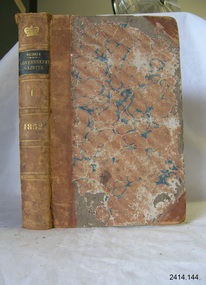 Flagstaff Hill Maritime Museum and Village
Book - Reference/Legal Statutes, John Ferres, Government Printer, The Victorian Government Gazette Vol 1 (January 1st to 30th June), 1852
... There is also great regional significance: as the newly independent Colony of Victoria was expanding rapidly, the colony needed a literal rule book, used by local Colonial officers to enforce imperial laws, collect duties on incoming British and international merchant ships, and regulate the day-to-day business of the Colony. ...This volume is a primary historical document recording the foundational legal acts, official proclamations, and government notices that established the administration of the newly independent Colony of Victoria. Volume 1, one of the earliest Victorian Statutes, contains the initial Acts passed by the newly formed Legislative Council of Victoria following its formal separation from New South Wales on 1 July 1851. The inclusion of Charles Joseph La Trobe, Victoria's first Lieutenant-Governor, appointed in July 1851, signifies that this volume records official proclamations establishing colonial courts, administrative divisions, civil service appointments, and public order measures.Hard cover book,The Victorian Statutes Vol 1. Author: Corporate Author Charles Joseph L A Trobe “The Colony of Victoria” Publisher: John Ferres Government Printer Melbourne. Date: 1852 Three quarter leather, patterned covers. Top section of leather on spine frayed, lettering in gilt. No Library labels. Pencil text to flyleaf unreadable.non-fictionThis volume is a primary historical document recording the foundational legal acts, official proclamations, and government notices that established the administration of the newly independent Colony of Victoria. Volume 1, one of the earliest Victorian Statutes, contains the initial Acts passed by the newly formed Legislative Council of Victoria following its formal separation from New South Wales on 1 July 1851. The inclusion of Charles Joseph La Trobe, Victoria's first Lieutenant-Governor, appointed in July 1851, signifies that this volume records official proclamations establishing colonial courts, administrative divisions, civil service appointments, and public order measures.flagstaff hill, warrnambool, shipwrecked coast, flagstaff hill maritime museum, maritime museum, shipwreck coast, flagstaff hill maritime village, great ocean road, book, pattison collection, warrnambool library, warrnambool mechanics’ institute, ralph eric pattison, corangamite regional library service, warrnambool city librarian, mechanics’ institute library, victorian library board, warrnambool books and records, warrnambool children’s library -
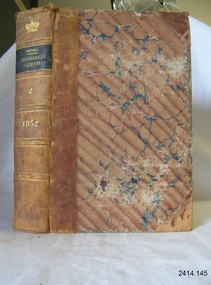 Flagstaff Hill Maritime Museum and Village
Book - Reference/Legal Statutes, John Ferres, Government Printer, The Victorian Government Gazette Vol 2 (July 1st to 31st December), 1852
... There is also great regional significance: as the newly independent Colony of Victoria was expanding rapidly, the colony needed a literal rule book, used by local Colonial officers to enforce imperial laws, collect duties on incoming British and international merchant ships, and regulate the day-to-day business of the Colony. ...This volume is a primary historical document recording the foundational legal acts, official proclamations, and government notices that established the administration of the newly independent Colony of Victoria. Volume 1, one of the earliest Victorian Statutes, contains the initial Acts passed by the newly formed Legislative Council of Victoria following its formal separation from New South Wales on 1 July 1851. The inclusion of Charles Joseph La Trobe, Victoria's first Lieutenant-Governor, appointed in July 1851, signifies that this volume records official proclamations establishing colonial courts, administrative divisions, civil service appointments, and public order measures.Hard cover book,The Victorian Statutes Vol 2. Author: Corporate Author Charles Joseph L A Trobe “The Colony of Victoria” Publisher: John Ferres Government Printer Melbourne. Date: 1852 Further information: Three quarter leather, patterned covers. Top section of leather on spine frayed at top, lettering in gilt. No Library labels.non-fictionThis volume is a primary historical document recording the foundational legal acts, official proclamations, and government notices that established the administration of the newly independent Colony of Victoria. Volume 1, one of the earliest Victorian Statutes, contains the initial Acts passed by the newly formed Legislative Council of Victoria following its formal separation from New South Wales on 1 July 1851. The inclusion of Charles Joseph La Trobe, Victoria's first Lieutenant-Governor, appointed in July 1851, signifies that this volume records official proclamations establishing colonial courts, administrative divisions, civil service appointments, and public order measures.flagstaff hill, warrnambool, shipwrecked coast, flagstaff hill maritime museum, maritime museum, shipwreck coast, flagstaff hill maritime village, great ocean road, book, pattison collection, warrnambool library, warrnambool mechanics’ institute, ralph eric pattison, corangamite regional library service, warrnambool city librarian, mechanics’ institute library, victorian library board, warrnambool books and records, warrnambool children’s library -
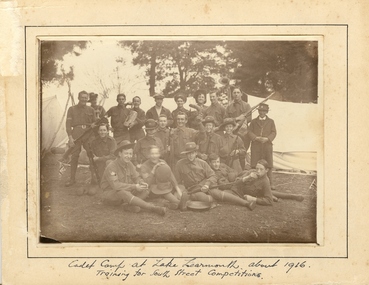 Federation University Historical Collection
Photograph - Photograph - Sepia, Ballarat School of Mines Cadets, 1916, c1916
... Great Britain was invited by Prime Minister Deakin in 1909 to visit Australia and advise on the best way to provide Australia with a land defence. Kitchener’s report echoed the bill, introduced to Parliament in 1909 and supported by the Opposition Labor Party at its 1908 conference, to introduce compulsory military training in peace time (referred to as universal training). On 1 January 1911, the Commonwealth Defence Act 1911 (Cth) was passed as law...Great Britain was invited by Prime Minister Deakin in 1909 to visit Australia and advise on the best way to provide Australia with a land defence. Kitchener’s report echoed the bill, introduced to Parliament in 1909 and supported by the Opposition Labor Party at its 1908 conference, to introduce compulsory military training in peace time (referred to as universal training). On 1 January 1911, the Commonwealth Defence Act 1911 (Cth) was passed as law ...Field Marshal Viscount Kitchener of Great Britain was invited by Prime Minister Deakin in 1909 to visit Australia and advise on the best way to provide Australia with a land defence. Kitchener’s report echoed the bill, introduced to Parliament in 1909 and supported by the Opposition Labor Party at its 1908 conference, to introduce compulsory military training in peace time (referred to as universal training). On 1 January 1911, the Commonwealth Defence Act 1911 (Cth) was passed as law and all males aged 12 to 26 were required to receive military training. Men were divided according to age, with junior cadets comprising boys 12-14 years of age, senior cadets comprising boys 14-18, and young men aged 18-26 assigned to the home militia defence. The support of schools was vital to the success of the scheme, since the system of cadet training began in the primary schools, with physical training prescribed by military authorities. Junior cadet training was entirely in the hands of school teachers, who had first been trained by military officers. This early training was less military in nature than focused on physical drill and sport. It also acted to inculcate boys with the notions of loyalty to country and empire. At this age, uniforms were not worn, although there were schools with pre-existing uniformed cadet units, who continued to do so. Senior Cadets were organised by Training Areas, administered by Area Officers. If a school had at least 60 senior cadets, they could form their own units. Unlike their junior counterparts, Senior Cadets were issued uniforms, a rifle, and learned the foundations necessary for service in any arm of the defence forces. Boys and men could be exempted from compulsory training if they lived more than five miles from the nearest training site, or were passed medically unfit. Those who failed to register for training were punished with fines or jail sentences, and the severity of this punishment generated some of the strongest opposition to the scheme. While institutions such as the political parties and most churches generally supported universal training, some in the broader labour movement were less enthusiastic, as evidenced in the Daily Herald newspaper’s editorials and letters. Universal military training persisted after the conclusion of World War 1, with the Junior Cadet scheme the first to go, in 1922. Senior cadets and service with the militia was suspended in November 1929. (http://guides.slsa.sa.gov.au/content.php?pid=575383&sid=4788359, accessed 29/10/2015) According to Neil Leckie, Manager of the Ballarat Ranger Military Museum: * Originally 12 – 14 year olds went to Junior Cadets attached to their school. * From age 14 – 17 they were Senior Cadets attached to the local militia unit. * After 1 July of the year a Cadet turned 18, the Cadet left the Senior Cadets and became a member of the Citizen Military Force. * In October 1918 the AIF, Militia and Cadets were renamed to give some connection to the AIF battalion raised in the area. Ballarat saw: 8th Australian Infantry Regiment comprising: * 8th Battalion AIF renamed 1st Battalion 8th Australian Infantry Regiment * 70th Infantry Militia renamed 2nd Battalion 8th Australian Infantry Regiment * 70th Infantry Cadets renamed 3rd B, 8th Australian Infantry. 39th Australian Infantry Regiment comprising: * 39th Battalion AIF renamed 1st Battalion 39th Australian Regiment * 71st Infantry Militia renamed 2nd Bn, 39th Australian Infantry Regiment * 71st Infantry Cadets renamed 3rd Bn, 39th Australian Infantry Regiment Prior to the reorganisation in 1918 the 18th Brigade was the 70th, 71st and 73rd Infantry. It is thought that the 18th Brigade Cadet units in 1920 were those that came from the old: * 69th Infantry (Geelong/Queenscliff) * 70th Infantry (Ballarat/Colac) * 71st Infantry (Ballarat West) * 72nd Infantry Warrnambool) * 73rd Infantry (NW Vic) The next name change came in 1921!Mounted sepia photograph of 21 young males. They are the Ballarat School of Mines Cadets on a training camp at Lake Learmonth. Back row left to right: Harold Wakeling; ? ; T. Wasley; H. Witter; H.V. Maddison (staff); Lieutenant S.J. Proctor, Joe ? ; ? ; B.C. Burrows. Centre left to right: Howard Beanland; ? ; F.N. Gibbs; H. Siemering; P. Riley; ? : E. Adamthwaite. Front row left to right: Albert E. Williams; Francis Davis (RAAF Dec.); A. Miller; W. Shattock; T. Rees From the Ballarat School of Mines Magazine, 1916 "Our Competition Team, 1916 At a parade, held on the 25th August competition teams were called from from the three colleges - Ballarat College, St Patrick's College, and the School of Mines. In each case, a large muster was obtained, twenty-nine volunteering fro the School of Mines. On account of the number in a team being limited to 21, some had to be weeded out. The team decided to have a camp at Learmonth in the vacation for the benefit of training for the coming competitions. The tents, within our baggage, were brought to the Junior Technical School at 10 a.m. on Monday, 11 September. Everything was carted to the station on a lorry, which was very kindly lent by Mr C. Burrow. ... Arriving at our camp, which was in the Park, we first raised the tents. This was done in record time. Three large tents, A.B.C., were pitched one behind the other. We also pitched a smaller one to act as a provisions tent. The provisions supplied by each cadet were placed in this tent. Dinner was ready by 3.30, and was prepared by the three senior non-coms., who also acted as orderlies. Things went alright Monday night, the two senior non-coms. acting as sentries for the first two hours. On Tuesday morning Reville sounded at 7. There was no need for it, however, as nearly all the cadets were up before daylight, owing to their beds being too hard. After physical exercises were gone through we had breakfast. We then had rifle exercises until Messrs A.W. Steane and F.N. King arrived. The former put the team through the table of physical exercises set down for competition work, many valuable points being obtained. The visitors remained for dinner, afterwards returning to Ballarat. Wednesday was uneventful, until the soldiers arrived at about 11 a.m., stopping at the park for lunch. As we handed over the coppers, etc., to them, our lunch was delayed. Two more visitors arrived after lunch, and after taking a few photos returned home. That night we had a "Sing-a-long" in C Tent until "Lights out" sounded at 9.30. After physical exercises ad breakfast on Thursday, we went for a six mile route march round the lake, doing skirmishing on the way. In the afternoon we practised rifle exercises and the march past. A concert was arranged for that night, the chief singers being cadets H. Siemering and W. Shattock. Supper was served at the end of the entertainment. On Friday, Reveille sounded at 6.30 instead of 7, and, as usual, we had physical exercises before breakfast, after which the team went through skirmishing at the reserve. In the afternoon, section drill and the march past were practised. Friday night, being our last night in camp, leave was granted until 10 p.m., "lights out" sounding at 11. Reveille sounded on Saturday at 4.30, the reason being that all kits, tents, etc., had to be packed away ready to catch the 8.15 train to Balalrat. At 7.30 we were all ready to leave for the station. We had a very enjoyable time in the train, each cadet having a chip in at the patriotic songs. On arriving at Ballarat, we found the lorry awaiting us. The luggage was carted to the Junior Technical School, the team following. The team were here dismissed, everyone feeling that he had had a very good time. F.G. Davis"Written in ink on front 'cadet camp at Lake Learmonth about 1916. Training for South Street Competitions. ballarat school of mines, cadets, ballarat school of mines cadets, lake learmonth, world war one, boomerang, camp, cadet camp, h.g. wakeling, harold wakeling, f.g. davis, albert w. steane, f.n. king, h. siermering, w. shattock, francis davis, harold wakeling, t. wasley, h. witter, h.v. maddison, s.j. proctor, b.c. burrows, howard beanland, f.n. gibbs, h. siemering, p. riley, e. adamthwaite, albert e. williams; francis davis, a. miller, w. shattock, t. rees, photography, foto, boxing gloves -
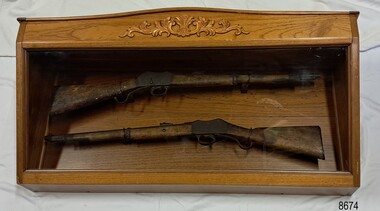 Flagstaff Hill Maritime Museum and Village
Weapon - Historic Rifles, Royal Small Arms Factory, 1877-1900
... law and order in a remote area. They are significant for their association with the township of Woodford, which was important to travel in the southwest Victoria district, providing access across a river for a road between Port Fairy and Melbourne, and later Warrnambool, and supplying food, goods and accommodation for the travellers. Flagstaff Hill Maritime Museum and Village Great Ocean Road Shipwreck Coast Martini Henry Victoria Police Woodford Police Station rifle Carbine display case British ...Martini-Henry Artillery Carbin rifles were made by the Royal Small Arms Factory at Enfield, Britain, from 1877 until 1900. Many were distributed to the British Colonies, including this pair, which was allocated to the Woodford Police, Victoria Police District of Warrnambool, Southwest Victoria. The Carbine model rifles were shorter than the standard rifles and more suited to mounted police and troopers. It is likely that in the early 20th century, Victoria Police replaced the two carbines with more modern firearms, and the outdated guns were stored in the stables. The rifles were left there and likely forgotten about due to changes in police staff. In 1915, police authorities announced that they would be replacing patrol horses with bicycles and would also close some smaller police stations. This affected Woodford Police Station, which closed in 1917. The forgotten firearms remained in the stables and were noticed by schoolboy Robert Jellie in 1940 and seen again in 1946. In 1995, the property was sold by the Education Department to a private owner. The Woodford Community donated the pair of Martini-Henry Carbines to the Victoria Police Museum in the late 1990s for mounting and display, which was funded by the Victoria Police Historical Society Inc. The decorative wood and glass display case and frame were designed to preserve the significant history of the guns. On November 1st 1999, the display was presented to Warrnambool Police and the local community due to the historical significance of the Woodford Police Station. In 2025, these items were formally deaccessioned by the Victoria Police Museum, and ownership was transferred to the Warrnambool Police Station. On March 10th, 2025, the display was transferred to Flagstaff Hill Maritime Museum and Village, where the historical story of the Martini-Henry Carbines could continue to be preserved and accessed by local families, the community, visitors to the area, and online visitors. WOODFORD POLICE: - The small settlement at Woodford was established in the 1840s around the Merri River where there was a ford across the water and a bridge from 1848 to 1851. The area was settled very early in Victoria’s history, and the river crossing provided travellers with access to the early route between Port Fairy (named Belfast at that time), Warrnambool and Melbourne. Occasionally, a Warrnambool police trooper would ride through Woodford and the district. In December 1854, Woodford Police barracks and stables were built on the hill by the Merri River on Bridge Road east, where Jubilee Park now stands. A local mounted trooper kept law and order in the area. In 1856, a lock-up was installed, and the first Woodford Police Station was in action in 1857. By 1871, the police station had been moved from the hill to land across the Merri River bridge, on the southern side of Bridge Road west, near Mill Street. In 1890, the police residence there was replaced by a stone Edwardian-style building with the stables and lock-up behind it and the old police station at the rear. The police continued to have a presence in Woodford until it was closed by the Police Commissioner in July 1917 for economic reasons. The residence was used for government housing until 1923, when it was taken over by the Education Department for the school teacher’s home. In 1995, it became privately owned. THE MARTINI-HENRY ARTILLERY CARBINE: - The Martini-Henry rifles were made in Britain from 1871 at the Royal Small Arms factory at Enfield and were stamped with the symbol of the Royal Cipher (Crown over VR) over ENFIELD to identify their origin. They were named after two of several people who helped design this method: Swiss Friederich von Martini and Scotsman Alexander Henry. The design was breech-loaded, and the inner barrel was rifled. A thumb rest was incorporated into the top right of the bullet receiver’s chamber. The small teardrop lever on the right side of the rifle showed whether the rifle was ready to be shot. In 1877, the shorter, lighter-weight Carbine version of the firearm was produced for mounted troops and artillery. Its official name was “Carbine, B.L., Rifled, Martini-Henry.” The bullets were slightly lighter in weight than those used for the longer rifle. The sight position was adjusted for the shorter gun, and wings were added to the sight on the tip, making it easier to slide the rifle back into a saddle bag. Some of the later Carbines also had leather sight covers screwed to the stock to prevent them from catching on the saddle bags. The Carbines had accessories available, such as barrel extensions with bayonets and swivels for adding slings. The Martini-Henry Carbine designs were later modified to fire the British .303 ammunition. Eventually, by 1900, the Martini-Henry Carbines were replaced by the Lee Enfield gun design. The pair of Martini-Henry Carbine firearms represents policing in the early pre-1900 days of colonial settlement; Woodford was one of the first townships settled in Victoria, and it had a police presence from 1854 until 1917. The rifles and display provide a historic connection between the location of Woodford and relatives and associates. The carbine rifles show a stage in the evolution of weapon design, adapted to suit mounted troops, and adding features to streamline use and storage. The ammunition was also improved during this progression. The carbines are important for their connection to policing law and order in a remote area. They are significant for their association with the township of Woodford, which was important to travel in the southwest Victoria district, providing access across a river for a road between Port Fairy and Melbourne, and later Warrnambool, and supplying food, goods and accommodation for the travellers. A pair of mounted rifles is mounted behind glass in a timer case, accompanied by a framed display of two photographs and an account of the rifles’ history. The case and display each have a horizontal board with a gently curved edge and carved decorations added. The identical firearms are British-made Martini Henry Carbine breach-loaded rifled guns, supplied by Britain to its Colonial troops from around 1877. The rifles are lever-action, single-shot .500 calibre weapons. They have a teardrop lever on their right side. They were used by Victoria Police mounted troops at the Woodford Police Station, Victoria. The black and white photographs were taken in 1946. The left photograph has a circled area; the right photograph is an enlarged view of the circled area, showing the Woodford Police Station in detail. The printed text is on textured paper with the Victoria Police watermark. It gives a summary of the rifle’s history. There is an inscription on the left photograph. Left photograph, handwritten in white pen: “WOODFORD” Document’s print: “During the late 1840s the small town of Woodford grew around the crossing of the Merri River on the Melbourne/Port Fairy Rad. Woodford was proclaimed a township in 1854 and a police quarters was established there in 1857. The police station remained until 1917 when it was closed and police service from then on was provided from Warrnambool. The building was then used as a school residence and is now privately owned. In !940 Robert JELLIE, then a schoolboy, observed two rifles mounted on the wall of the disused stable at the rear of the old police building. Following the devastating flood of 1946 (see photograph above) the rifles were again seen in the room next to the stable but were not seen again until the building was sold by the Education Department many years later. It was a recognition of the historical value of the rifles which led to their donation to the Warrnambool Police Complex. The rifles have been authenticated by the Victoria Police Armoury as being Victoria Police issue some time before 1900. The rifles are an identical pair of the famous British-made Martini Henry, a .500 inch calibre military weapon widely used by British Colonial troops. Victoria Police and the wider community of Warrnambool are indebted to the members of the Woodford community for their fine gesture in donating the rifles for mounting so that their historical importance can be preserved and they can be displayed for generations to come. This display was funded by the Victoria Police Historical Society Incorporated, and presented on the first day of November, 1999.”flagstaff hill maritime museum and village, great ocean road, shipwreck coast, martini henry, victoria police, woodford police station, rifle, carbine, display case, british, martini henry carbine, breech-loaded, rifled, colonial, single-shot, .500 calibre, weapon, gun, 1877, troops, mounted troops, merri river, victoria police woodford, victoria police warrnambool, victoria police melbourne, police quarters, robert jellie, school residence, stable, 1946 flood, victoria police armoury, identical pair, british colonial troops, victoria police historical society incorporated, woodford, bicycles, found by a schoolboy, edwardian-style building, victoria police museum, warrnambool police station -
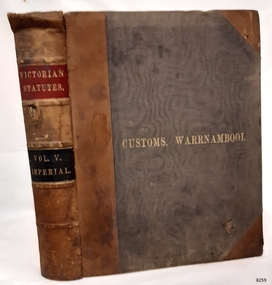 Flagstaff Hill Maritime Museum and Village
Book - Reference/Legal Statutes, John Ferres, Government Printer, The Victorian Imperial Statutes Vol 5 Customs Warrnambool, 1868
... British and colonial law operating right on the Shipwreck Coast during the peak of the 19th-century shipping boom. For more information on the Pattison Collection see item 3678 Flagstaff Hill collections) https://victoriancollections.net.au/items/5580c7e72162f114d8b758db flagstaff hill warrnambool shipwrecked coast flagstaff hill maritime museum maritime museum shipwreck coast flagstaff hill maritime village great ocean road book pattison collection warrnambool library warrnambool mechanics’ institute ralph eric pattison corangamite regional library service warrnambool city librarian mechanics’ institute library victorian library board warrnambool books and records warrnambool children’s library This volume is part of the first comprehensive consolidation of laws for the Colony of Victoria after it separated from New South Wales and established its own parliament. ...This volume is part of the first comprehensive consolidation of laws for the Colony of Victoria after it separated from New South Wales and established its own parliament. Specifically, Volume 5 (published in 1868) is dedicated to "A selection of the imperial statutes apparently in force in Victoria". Because Victoria was still a British colony, laws passed by the British (Imperial) Parliament in Westminster still applied locally if they hadn't been superseded by local Victorian colonial acts. Volume 5 was the legal handbook used by lawyers, judges, and government officials to determine exactly which British laws still governed colonial matters, ranging from shipping and trade to criminal law and merchant customs.The Victorian Statutes Vol 5 Customs Warrnambool Publisher: John Ferres Government Printer Melbourne Date: 1868 Further Information: Three quarter leather. Junction between front board and spine slightly exposed. Top section of leather on spine damaged. non-fictionThis volume is part of the first comprehensive consolidation of laws for the Colony of Victoria after it separated from New South Wales and established its own parliament. Specifically, Volume 5 (published in 1868) is dedicated to "A selection of the imperial statutes apparently in force in Victoria". Because Victoria was still a British colony, laws passed by the British (Imperial) Parliament in Westminster still applied locally if they hadn't been superseded by local Victorian colonial acts. Volume 5 was the legal handbook used by lawyers, judges, and government officials to determine exactly which British laws still governed colonial matters, ranging from shipping and trade to criminal law and merchant customs.flagstaff hill, warrnambool, shipwrecked coast, flagstaff hill maritime museum, maritime museum, shipwreck coast, flagstaff hill maritime village, great ocean road, book, pattison collection, warrnambool library, warrnambool mechanics’ institute, ralph eric pattison, corangamite regional library service, warrnambool city librarian, mechanics’ institute library, victorian library board, warrnambool books and records, warrnambool children’s library -
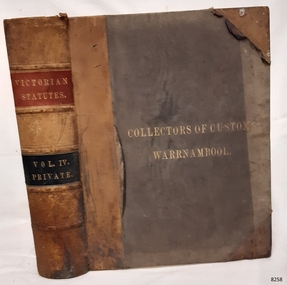 Flagstaff Hill Maritime Museum and Village
Book - Reference/Legal Statutes, John Ferres, Government Printer, The Victorian Statutes Vol 4 Various Legal Statues /Warrnambool, 1866
... British and colonial law operating right on the Shipwreck Coast during the peak of the 19th-century. For more information on the Pattison Collection see item 3678 Flagstaff Hill collections) https://victoriancollections.net.au/items/5580c7e72162f114d8b758db flagstaff hill warrnambool shipwrecked coast flagstaff hill maritime museum maritime museum shipwreck coast flagstaff hill maritime village great ocean road book pattison collection warrnambool library warrnambool mechanics’ institute ralph eric pattison corangamite regional library service warrnambool city librarian mechanics’ institute library victorian library board warrnambool books and records warrnambool children’s library This volume is part of the first comprehensive consolidation of laws for the Colony of Victoria after it separated from New South Wales and established its own parliament. ...This volume is part of the first comprehensive consolidation of laws for the Colony of Victoria after it separated from New South Wales and established its own parliament. Specifically, Volume 4 (published in 1866) contains Local Colonial Acts. These were laws debated, passed, and enacted right here in Melbourne by the newly formed Parliament of the Colony of Victoria. They dealt with purely domestic, local matters, such as Victorian land selection, goldfields regulations, local municipal boundaries, and colonial courts. Volume 4 was the handbook for everyday domestic Victorian life, governing how a local town council operated, how gold claims were filed, or how local debts were settled in a Victorian county court.The Victorian Statutes Vol 4 Various Legal Statues /Warrnambool Publisher: John Ferres Government Printer Melbourne Date: 1866 Further Information: Three quarter leather. Junction between front board and spine slightly exposed. non-fictionThis volume is part of the first comprehensive consolidation of laws for the Colony of Victoria after it separated from New South Wales and established its own parliament. Specifically, Volume 4 (published in 1866) contains Local Colonial Acts. These were laws debated, passed, and enacted right here in Melbourne by the newly formed Parliament of the Colony of Victoria. They dealt with purely domestic, local matters, such as Victorian land selection, goldfields regulations, local municipal boundaries, and colonial courts. Volume 4 was the handbook for everyday domestic Victorian life, governing how a local town council operated, how gold claims were filed, or how local debts were settled in a Victorian county court.flagstaff hill, warrnambool, shipwrecked coast, flagstaff hill maritime museum, maritime museum, shipwreck coast, flagstaff hill maritime village, great ocean road, book, pattison collection, warrnambool library, warrnambool mechanics’ institute, ralph eric pattison, corangamite regional library service, warrnambool city librarian, mechanics’ institute library, victorian library board, warrnambool books and records, warrnambool children’s library -
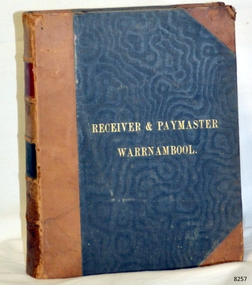 Flagstaff Hill Maritime Museum and Village
Book - Reference/Legal Statutes, John Ferres, Government Printer, The Victorian Legal Statutes Vol 3, Receiver Paymaster/Warrnambool, 1866
... British and colonial law operating right on the Shipwreck Coast during the peak of the 19th-century. For more information on the Pattison Collection see item 3678 Flagstaff Hill collections) https://victoriancollections.net.au/items/5580c7e72162f114d8b758db flagstaff hill warrnambool shipwrecked coast flagstaff hill maritime museum maritime museum shipwreck coast flagstaff hill maritime village great ocean road book pattison collection warrnambool library warrnambool mechanics’ institute ralph eric pattison corangamite regional library service warrnambool city librarian mechanics’ institute library victorian library board warrnambool books and records warrnambool children’s library This volume is part of the first comprehensive consolidation of laws for the Colony of Victoria after it separated from New South Wales and established its own parliament. ...This volume is part of the first comprehensive consolidation of laws for the Colony of Victoria after it separated from New South Wales and established its own parliament. Specifically, Volume 3 is the final part of the core "Public and General" Victorian colonial laws. The first three volumes of the 1866 consolidation were organised alphabetically by legal topic. Volume 3 specifically contains all the major public acts running from P to W. Because it covers the tail end of the alphabet, it holds some of the most critical laws that built day-to-day society in 19th-century Victoria. These include: · Police Offences and Public Order: The legal frameworks for policing the goldfield boomtowns, managing public behaviour, and running early colonial prisons. · Public Works and Infrastructure: The acts authorising the construction of roads, bridges, and early municipal water supplies across the fast-growing colony. · Railways: The specific general legislation governing the expansion of Victoria's heavily subsidised, state-expanding railway networks. · Property and Land Transfer: Crucial laws managing land ownership, inheritance, and the foundational transfers of property as the colony shifted away from old squatter runs to permanent towns. · Wines, Beer, and Spirits: The colonial acts regulating the licensing of hotels and public houses, and managing the highly lucrative, tightly controlled alcohol trade.The Victorian Statutes Vol 3 Various Legal Statues /Warrnambool Publisher: John Ferres Government Printer Melbourne Date: 1866 Further Information: Three quarter leather. Corners worn lettering in gilt. non-fictionThis volume is part of the first comprehensive consolidation of laws for the Colony of Victoria after it separated from New South Wales and established its own parliament. Specifically, Volume 3 is the final part of the core "Public and General" Victorian colonial laws. The first three volumes of the 1866 consolidation were organised alphabetically by legal topic. Volume 3 specifically contains all the major public acts running from P to W. Because it covers the tail end of the alphabet, it holds some of the most critical laws that built day-to-day society in 19th-century Victoria. These include: · Police Offences and Public Order: The legal frameworks for policing the goldfield boomtowns, managing public behaviour, and running early colonial prisons. · Public Works and Infrastructure: The acts authorising the construction of roads, bridges, and early municipal water supplies across the fast-growing colony. · Railways: The specific general legislation governing the expansion of Victoria's heavily subsidised, state-expanding railway networks. · Property and Land Transfer: Crucial laws managing land ownership, inheritance, and the foundational transfers of property as the colony shifted away from old squatter runs to permanent towns. · Wines, Beer, and Spirits: The colonial acts regulating the licensing of hotels and public houses, and managing the highly lucrative, tightly controlled alcohol trade.flagstaff hill, warrnambool, shipwrecked coast, flagstaff hill maritime museum, maritime museum, shipwreck coast, flagstaff hill maritime village, great ocean road, book, pattison collection, warrnambool library, warrnambool mechanics’ institute, ralph eric pattison, corangamite regional library service, warrnambool city librarian, mechanics’ institute library, victorian library board, warrnambool books and records, warrnambool children’s library -
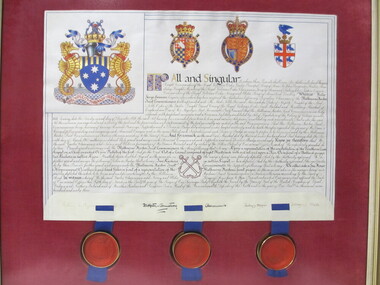 Seaworks Maritime Museum
Document
... laws of/ Arms. In witness whereof we the said Garter Clarenceux and a Norroy and Ulster Kings of Arms have to these presents subscribed Our names and affixed the seals/ Of our Several offices this fith day of March in the Twelfth Year of the reign of our Soveriegn Lady Elizabeth the Second by the Grace of God of the United Kingdom of Great/ Britain and Northern Ireland and of Her other Realms and Territories Queen head of the Commonwealth Defender of the Faith and in the years of Our Lord One Thousand nine/ hundred and sixty three" "Prosperity Through Service"...laws of/ Arms. In witness whereof we the said Garter Clarenceux and a Norroy and Ulster Kings of Arms have to these presents subscribed Our names and affixed the seals/ Of our Several offices this fith day of March in the Twelfth Year of the reign of our Soveriegn Lady Elizabeth the Second by the Grace of God of the United Kingdom of Great/ Britain and Northern Ireland and of Her other Realms and Territories Queen head of the Commonwealth Defender of the Faith and in the years of Our Lord One Thousand nine/ hundred and sixty three" "Prosperity Through Service" Large paper document including colour illustrations of Melbourne Harbor Trust shield and other shields. ...Large paper document including colour illustrations of Melbourne Harbor Trust shield and other shields. Includes three wax seals attached to document with blue ribbon."To All and Singular to whom these presents shall come, Sire Anthony Richard Wagner/ Knight Commander of the Royal Victorian Order Garter Principal King of Arms. Sir John Lunamace Heaton Arm/ Strong Knight, Member of the Royal Victorian Order. Clarenceux King of Arms an Aubrey John Toppin Esquire/ Commander of the Royal Victorian Order. Norroy and Ulster King of Arms Send Greeting! Whereas Victor/ George Swanson. Esquire upon whom has been conferred the Australian Efficiency Decoration Chairman of the Melbourne Harbor/ Trust Commissioners hath represented unto The Most Noble Bernard Marmaduke, Duke of Norfolk, Knight of the Most/ Noble Order of the Garter Knight Grand Cress of the Royal Victorian Order, Earl Marshal and Hereditary Marshal of/ England and one of Her Majesty's Most Honourable Privy Council that the Melbourne Harbor Trust Commissioners is a body/ corporate with perpetual succession and a Common Seal duly constituted by Act of Legislature of the Colony of Victoria number/ DLII bearing date Twenty second day of December 1876 the said Act having been amended from time to time and various Acts passed consolidating such amendments that under the said/ Act the exclusive management and control of the port and the preservation and improvement of the port generally as vested in the said Commissioners. That the Melbourne Harbour Trust/ Commissioners being desirous of having Armorial Bearings, Supporters and a Device or Badge duly assigned under lawful authority and he hath therefore requested the favour of His Grace's/ Warrant for Ouigranting and assigning such Armorial Ensigns and in the same Patent such Supporters and such Device or Badge as may be proper to be borne and used by the Melbourne/ Harbor Trust Commissioners on Seals otherwise accoding to the Laws of Arms. And forasmuch as the said Earl Marshal did by warrant under his hand and Seal bearing date the Sev-/ enth day of March 1962 authorize and direct Us to grant and assign such Armorial Ensigns and such Supporters and such Device or Badge Accordingly. Know ye therefore that we/ the said Garter Clarenceux and Norroy and Ulster in pursuance of His Grace's warrant and by virtue of the Letters of Patent of Our several offices to each of us respectively granted do/ by these Presents grant and assign unto the Melbourne Harbor Trust Commissioners the Arms following that is to say: Azure a representation of the constellation of the Southern Cross/ Argent on a Chief enarched on five Pallets of the first. And for the Crest Out of a Coronet composed of eight Masts each with sail set and upon Rim Or in front of a Bollard proper/ two Anchors in saltire Azure Mantled figure doubled Argent as the same are in the margin here of more plainly depicted. And by the Authority aforesaid We do/ further grant and assign the following Device or Badge that is to say: Two Anchors in saltire Argent as here depicted And by the Authority aforesaid the said Garter/ do by these Presents further grant and assign unto the Melbourne Harbor Trust Commissioners the Supporters following that is to say : On either side a Sea Horse/ (Hippocampus) or collared and lined Gules in front of a representation of the Melbourne Harbour front proper as the same are also in the margins here of more/ arms plainly depicted the whole to be borne and used forever hereafter by the Melbourne Harbour Trust Commissioners on seals otherwise according to the laws of/ Arms. In witness whereof we the said Garter Clarenceux and a Norroy and Ulster Kings of Arms have to these presents subscribed Our names and affixed the seals/ Of our Several offices this fith day of March in the Twelfth Year of the reign of our Soveriegn Lady Elizabeth the Second by the Grace of God of the United Kingdom of Great/ Britain and Northern Ireland and of Her other Realms and Territories Queen head of the Commonwealth Defender of the Faith and in the years of Our Lord One Thousand nine/ hundred and sixty three" "Prosperity Through Service" -
 J. Ward Museum Complex
Book - Sermons, or Homilies - circa. 1861, Select Homilies
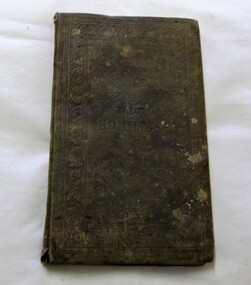
... Great Queen Street, London, to form "The Prayer Book and Homily Society." The founders were also members of the Church Missionary Society (founded 1799) and the British and Foreign Bible Society (founded 1804). The purpose of this Society was to print and distribute the Book of Common Prayer (1662) in English and in other languages, as needed by missionaries; and also to publish "The Book of Homilies" which is referred to in "The Thirty-Nine Articles of Religion" as a source of the foundational doctrine of the Church of England by law established. ...On May 20 1812, a group of Church of England evangelical clergy & laity met in The Freemasons' Tavern in Great Queen Street, London, to form "The Prayer Book and Homily Society." The founders were also members of the Church Missionary Society (founded 1799) and the British and Foreign Bible Society (founded 1804). The purpose of this Society was to print and distribute the Book of Common Prayer (1662) in English and in other languages, as needed by missionaries; and also to publish "The Book of Homilies" which is referred to in "The Thirty-Nine Articles of Religion" as a source of the foundational doctrine of the Church of England by law established. The Society published the Prayer Book in at least 12 languages and seems to have been at the peak of its activity in 1828-1833. The Homilies were only published in English and in editions without the critical apparatus. http://pbs1928.blogspot.com/2003/01/prayer-book-homily-society.htmlThe book has a dark green and brown leather hardback cover. There are also water stains and what appears to be mould growth. The cover has an Imprinted border around the edges of the title. The spine is torn at the top and bottom. A page is torn out between front cover and introduction page. The pages have stains from use and some foxing. On May 20 1812, a group of Church of England evangelical clergy & laity met in The Freemasons' Tavern in Great Queen Street, London, to form "The Prayer Book and Homily Society." The founders were also members of the Church Missionary Society (founded 1799) and the British and Foreign Bible Society (founded 1804). The purpose of this Society was to print and distribute the Book of Common Prayer (1662) in English and in other languages, as needed by missionaries; and also to publish "The Book of Homilies" which is referred to in "The Thirty-Nine Articles of Religion" as a source of the foundational doctrine of the Church of England by law established. The Society published the Prayer Book in at least 12 languages and seems to have been at the peak of its activity in 1828-1833. The Homilies were only published in English and in editions without the critical apparatus. http://pbs1928.blogspot.com/2003/01/prayer-book-homily-society.htmlreligion, religious text, sermons, homilies -
 Bendigo Historical Society Inc.
Certificate - George Josph Pittman Solicitor Certificate, 02/09/1860
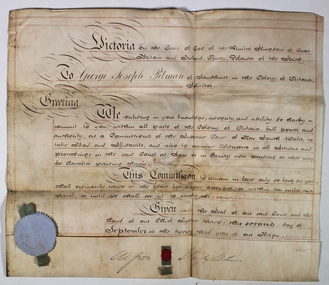
... Great Britain and Ireland, Queen. Defender of the Faith To Geoge Joseph Pitman of Sandhurst in the Colony of Victoria, Solicitor. Greeting, We confiding in your knowledge, integrity, and ability to herby commit to you within all parts of the Colony of Victoria, full power and authority as a Commissioner of the Supreme court of New South Wales take Bail and affidavits and also to examine Witnesses in all (unreadable) and proceedings in the said Court at Law or in Equity now knowing or that may be grafted pounding therein. ...Great Britain and Ireland, Queen. Defender of the Faith To Geoge Joseph Pitman of Sandhurst in the Colony of Victoria, Solicitor. Greeting, We confiding in your knowledge, integrity, and ability to herby commit to you within all parts of the Colony of Victoria, full power and authority as a Commissioner of the Supreme court of New South Wales take Bail and affidavits and also to examine Witnesses in all (unreadable) and proceedings in the said Court at Law or in Equity now knowing or that may be grafted pounding therein. ...George Joseph Pitman was born on 2 May 1803, in Bristol, England, his father, Thomas Dix Pitman, was 40 and his mother, Anna Simmonds, was 38. He married Clara Matilda Hamilton on 15 November 1827, in St Pancras Old Church, St Pancras, London, England, United Kingdom. They were the parents of at least 3 sons and 7 daughters. He immigrated to Port Adelaide, South Australia, Australia in 1850 and lived in Barnstaple, Devon, England, United Kingdom in 1841. In 1856, his occupation is listed as solicitor in Bendigo, Victoria, Australia. He died on 14 January 1896, in Hawthorn, Victoria, Australia, at the age of 92, and was buried Kew Cemetery Boroondara Victoriahttps://ancestors.familysearch.org/en/L77X-BQS/george-joseph-pitman-1803-1896g George Joseph Pitman is believed to be the first solicitor on the Sandhurst Gold FieldAn off white coloured thick paper with black writing and red lines Victoria by the Grace of God of The United Kingdom of Great Britain and Ireland, Queen. Defender of the Faith To Geoge Joseph Pitman of Sandhurst in the Colony of Victoria, Solicitor. Greeting, We confiding in your knowledge, integrity, and ability to herby commit to you within all parts of the Colony of Victoria, full power and authority as a Commissioner of the Supreme court of New South Wales take Bail and affidavits and also to examine Witnesses in all (unreadable) and proceedings in the said Court at Law or in Equity now knowing or that may be grafted pounding therein. This Commission to remain in force only so long as you shall continually reside at the place first described or within ten miles thereof, or until we shall see fit to revoke the same. Given under the Seal of our said Court and hand of our Chief Justice thereof this second day of September in the twenty third year of our reign An impression of THE SEAL OF THE SUPREME COURT OF THE COLONY OF VICTORIA (originally attached to the document with a piece of silk) with an illegible signature on both sides. george joseph pitman, bendigo's first solicitor, solicitor certificate -
 Royal Australian and New Zealand College of Obstetricians & Gynaecologists (RANZCOG)
Book - Book, 'A Synopsis of the British Pharmacopoeia', used by Dr Margaret Alison Mackie, 1933, H. Wippell Gadd, A Synopsis of the British Pharmacopoeia, 1932, and of the Poison Laws of Great Britain, Northern Ireland and the Irish Free State, 1932
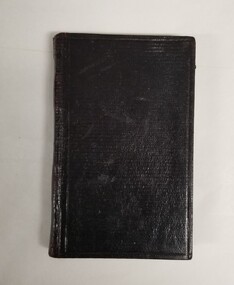
... A Synopsis of the British Pharmacopoeia, 1932, and of the Poison Laws of Great Britain, Northern Ireland and the Irish Free State Book Book, 'A Synopsis of the British Pharmacopoeia', used by Dr Margaret Alison Mackie, 1933 H. ...The book is annotated throughout with Dr Margaret Alison Mackie's notes. It was used as a reference guide during her medical studies. Dr Margaret Alison Mackie (1910-1991) was in active practice between 1936 and 1970. She was a Fellow of the College, and was appointed a Commander of the Order of St Michael and St George (CMG) for services to medicine in 1975. Small, leatherbound pocket reference book. The title page is inscribed with handwriting which reads 'M.A. Mackie/1933'. Title page also indicated this is the 'Twelfth Edition', and that the book was published in London by Bailliere, Tindall & Cox in 1932. The book is annotated throughout with handwritten comments.medicine -
 Bendigo Historical Society Inc.
Document - LONG GULLY HISTORY GROUP COLLECTION: THE BENDIGO POST OFFICE
... Law Courts... The Hamburg... The European... The Prince Bismark... The Lord Kitchener... The Bendigo... The Rosalind Park... The Showgrounds... Atheneum Club... Olivers... Bridge Hotel... Bourkes... The Globe... The Hibernia... Albert... Albion... Abbotts... Australian... Belvidere... Beehive... British Queen... Black Eagle... British and American... Brian Boru... Bakers Arms... Butchers Arms... Brick Layers Arms... Bull and Mouth... Cresent... Clarence... Back Creek Bridge... Cape Clear... Crooked Billet... Cambridgeshire Arms... Camp... Coach and Horses... Cricketers Arms... Diggers Rest... Ellesmere... Five Lions... Franklyn... Golden Square... Golden Gate... Golden Gully... Golden Age... Golden Vine... Gumtree... Glasgow Reef... Great Britain...Names of the pubs are: The Freemasons, The Courthouse, The Commercial Law Courts, The Hamburg, The European, The Prince Bismark, The Lord Kitchener, The Bendigo, The Rosalind Park, The Showgrounds, Atheneum Club, Olivers, Bridge Hotel, Bourkes, The Globe, The Hibernia, Albert, Albion, Abbotts, Australian, Belvidere, Beehive, British Queen, Black Eagle, British and American, Brian Boru, Bakers Arms, Butchers Arms, Brick Layers Arms, Bull and Mouth, Cresent, Clarence, Back Creek Bridge, Cape Clear, Crooked Billet, Cambridgeshire Arms, Camp, Coach and Horses, Cricketers Arms, Diggers Rest, Ellesmere, Five Lions, Franklyn, Golden Square, Golden Gate, Golden Gully, Golden Age, Golden Vine, Gumtree, Glasgow Reef, Great Britain, Haymarket, Daniel O'Connell, Half Way House, Fleece Inn, Ironbark, Johnsons Reef, Lancashire, Live and Let Live, Manchester Arms, Gold Mines, Metropolitan, Crown, National, New Chum, Honeysuckle Street, Pavilion, Napier Arms, Quartz Miners Arms, Retreat Inn, Rainbow, Rose of Australia, Lake View, Robin Hood, Fountain, Southern Cross, Bath, Berlin, Spring Gully, Star, Sir Charles Hotham, Silvermines, Royal Oak, Suburban, Town Hall, Temperance, Ship Inn, View Point, View Bend, Victoria, Exchange, American, Arcade, Belfast, All Nations, Union, United Kingdom, Union Jack, Westend, Washington, Waterloo, Wellington, Whitehorse, Wheat Sheaf, Yorkshire, Niagra and Noahs Ark....BENDIGO History long gully history group The Long Gully History Group - The Bendigo Post Office L C Bennetts Mt Alexander Post Office Porcupine Inn Cenotaph Pike or Pyke Baby Health Centre Sandhurst Post Office Government Survey Office Queen Elizabeth Oval Sandhurst Trustees Company Mr H B Briston Savings Bank Telegraph Office The Sub-Treasury Sir Henry Brougham Lock KCB Sir John Nimmo MLA Prince of Wales group of mines The New Prince of Wales Eaglehawk Golf Links New Prince of Wales No 2 The Whip and Jersey Mines Department Lansell's Big 180 New Chum and Victoria Mine and Battery New Chum Railway Koch's Pioneer South New Moon Catherine Reef United New Moon The Virginia South Bell Vue Central Nell Gwynne North Nell Gwynne Miner's Phthisis Hercules Engine House Ironbark New Chum Syncline Hercules Energetic Roberts & Sons Harkness & Co Horwoods Great Southern Ulster Carlisle Lansells Big 180 Victoria Quartz New St Mungo Duchess Tribute South Devonshire Hopewell Mine Saxby Mine McNair & Co Shamrock Mr King Burke and Wills Expedition Sandhurst Hotel Courthouse Hiberian The Freemasons The Courthouse The Commercial Law Courts The Hamburg The European The Prince Bismark The Lord Kitchener The Bendigo The Rosalind Park The Showgrounds Atheneum Club Olivers Bridge Hotel Bourkes The Globe The Hibernia Albert Albion Abbotts Australian Belvidere Beehive British Queen Black Eagle British and American Brian Boru Bakers Arms Butchers Arms Brick Layers Arms Bull and Mouth Cresent Clarence Back Creek Bridge Cape Clear Crooked Billet Cambridgeshire Arms Camp Coach and Horses Cricketers Arms Diggers Rest Ellesmere Five Lions Franklyn Golden Square Golden Gate Golden Gully Golden Age Golden Vine Gumtree Glasgow Reef Great Britain Haymarket Daniel O'Connell Half Way House Fleece Inn Ironbark Johnsons Reef Lancashire Live and Let Live Manchester Arms Gold Mines Metropolitan Crown National New Chum Honeysuckle Street Pavilion Napier Arms Quartz Miners Arms Retreat Inn Rainbow Rose of Australia Lake View Robin Hood Fountain Southern Cross Bath Berlin Spring Gully Star Sir Charles Hotham Silvermines Royal Oak Suburban Town Hall Temperance Ship Inn View Point View Bend Victoria Exchange American Arcade Belfast All Nations Union United Kingdom Union Jack Westend Washington Waterloo Wellington Whitehorse Wheat Sheaf Yorkshire Niagra Noahs Ark Article titled The Bendigo Post Office, compiled by L C Bennetts. ...Article titled The Bendigo Post Office, compiled by L C Bennetts. Mentioned is the history of the Bendigo Post Office and postmarks, some information on mining, Bendigo foundries, Underground connections of mines, expenses and shaft sinking costs. Also mentioned is Bendigo and Eaglehawk - 60 years ago and the role the pubs played in daily living. They were where theatres, concerts and dances were held, and the meeting rooms for clubs and lodges, even church benefits. Listed is a number of Bendigo hotels. Some even had a few names. Names of the pubs are: The Freemasons, The Courthouse, The Commercial Law Courts, The Hamburg, The European, The Prince Bismark, The Lord Kitchener, The Bendigo, The Rosalind Park, The Showgrounds, Atheneum Club, Olivers, Bridge Hotel, Bourkes, The Globe, The Hibernia, Albert, Albion, Abbotts, Australian, Belvidere, Beehive, British Queen, Black Eagle, British and American, Brian Boru, Bakers Arms, Butchers Arms, Brick Layers Arms, Bull and Mouth, Cresent, Clarence, Back Creek Bridge, Cape Clear, Crooked Billet, Cambridgeshire Arms, Camp, Coach and Horses, Cricketers Arms, Diggers Rest, Ellesmere, Five Lions, Franklyn, Golden Square, Golden Gate, Golden Gully, Golden Age, Golden Vine, Gumtree, Glasgow Reef, Great Britain, Haymarket, Daniel O'Connell, Half Way House, Fleece Inn, Ironbark, Johnsons Reef, Lancashire, Live and Let Live, Manchester Arms, Gold Mines, Metropolitan, Crown, National, New Chum, Honeysuckle Street, Pavilion, Napier Arms, Quartz Miners Arms, Retreat Inn, Rainbow, Rose of Australia, Lake View, Robin Hood, Fountain, Southern Cross, Bath, Berlin, Spring Gully, Star, Sir Charles Hotham, Silvermines, Royal Oak, Suburban, Town Hall, Temperance, Ship Inn, View Point, View Bend, Victoria, Exchange, American, Arcade, Belfast, All Nations, Union, United Kingdom, Union Jack, Westend, Washington, Waterloo, Wellington, Whitehorse, Wheat Sheaf, Yorkshire, Niagra and Noahs Ark.bendigo, history, long gully history group, the long gully history group - the bendigo post office, l c bennetts, mt alexander post office, porcupine inn, cenotaph, pike or pyke, baby health centre, sandhurst post office, government survey office, queen elizabeth oval, sandhurst trustees company, mr h b briston, savings bank, telegraph office, the sub-treasury, sir henry brougham lock kcb, sir john nimmo mla, prince of wales group of mines, the new prince of wales, eaglehawk golf links, new prince of wales no 2, the whip and jersey, mines department, lansell's big 180, new chum and victoria mine and battery, new chum railway, koch's pioneer, south new moon, catherine reef united, new moon, the virginia, south bell vue, central nell gwynne, north nell gwynne, miner's phthisis, hercules engine house, ironbark, new chum syncline, hercules energetic, roberts & sons, harkness & co, horwoods, great southern, ulster, carlisle, lansells big 180, victoria quartz, new st mungo, duchess tribute, south devonshire, hopewell mine, saxby mine, mcnair & co, shamrock, mr king, burke and wills expedition, sandhurst hotel, courthouse, hiberian, the freemasons, the courthouse, the commercial law courts, the hamburg, the european, the prince bismark, the lord kitchener, the bendigo, the rosalind park, the showgrounds, atheneum club, olivers, bridge hotel, bourkes, the globe, the hibernia, albert, albion, abbotts, australian, belvidere, beehive, british queen, black eagle, british and american, brian boru, bakers arms, butchers arms, brick layers arms, bull and mouth, cresent, clarence, back creek bridge, cape clear, crooked billet, cambridgeshire arms, camp, coach and horses, cricketers arms, diggers rest, ellesmere, five lions, franklyn, golden square, golden gate, golden gully, golden age, golden vine, gumtree, glasgow reef, great britain, haymarket, daniel o'connell, half way house, fleece inn, ironbark, johnsons reef, lancashire, live and let live, manchester arms, gold mines, metropolitan, crown, national, new chum, honeysuckle street, pavilion, napier arms, quartz miners arms, retreat inn, rainbow, rose of australia, lake view, robin hood, fountain, southern cross, bath, berlin, spring gully, star, sir charles hotham, silvermines, royal oak, suburban, town hall, temperance, ship inn, view point, view bend, victoria, exchange, american, arcade, belfast, all nations, union, united kingdom, union jack, westend, washington, waterloo, wellington, whitehorse, wheat sheaf, yorkshire, niagra, noahs ark -
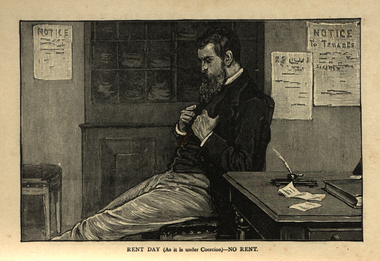 Ballarat and District Irish Association
Image, Rent Day (as it is under coercion) - No Rent, c1864, c1864
... Protection of Person and Property Act 1881 The ''Protection of Person and Property Act 1881'' was one of more than 100 Coercion Acts passed by the Parliament of United Kingdom of Great Britain and Ireland between 1801 and 1922, in an attempt to establish law and order in Ireland. ...Protection of Person and Property Act 1881 The ''Protection of Person and Property Act 1881'' was one of more than 100 Coercion Acts passed by the Parliament of United Kingdom of Great Britain and Ireland between 1801 and 1922, in an attempt to establish law and order in Ireland. ...Protection of Person and Property Act 1881 The ''Protection of Person and Property Act 1881'' was one of more than 100 Coercion Acts passed by the Parliament of United Kingdom of Great Britain and Ireland between 1801 and 1922, in an attempt to establish law and order in Ireland. The 1881 Act was passed by parliament and introduced by Gladstone. It allowed for persons to be imprisoned without trial. On 13 October 1881, the Act was used to arrest Charles Parnell after his newspaper, the ''United Ireland'', had attacked the Land Act. On Gladstone's return to office in 1880, William Edward Forster was made Chief Secretary for Ireland. He carried the Compensation for Disturbance Bill through the Commons, only to see it thrown out in the Lords. On 24 January 1881, he introduced a new Coercion Bill in the House of Commons, to deal with the growth of the Irish National Land League. Despite a 41-hour long fillibuster in the House by the Irish Parliamentary Party, the bill passed, among its provisions being one enabling the British government in Ireland to arrest without trial persons "reasonably suspected" of crime and conspiracy. However those arrested were often not always suspect, only supportive of the Irish National Land League's movements. Over 100 such acts were passed, some of the more notable of which were "An Act for the more effectual Suppression of Local Disturbances and Dangerous Associations in Ireland", "The Protection of Life and Property in Certain Parts of Ireland Act", and the "Protection of Person and Property Act 1881". An Irish Coercion Bill was proposed by Sir Robert Peel to calm the increasing difficult situation in Ireland as a result of the Great Famine 1844–47. The Bill was blocked and this led, in part, to Peel's retirement as Prime Minister. Later attempts to introduce Irish coercion acts were blocked by the filibustering of Joseph Biggar. As a response to the Plan of Campaign of the mid-1880s the new Chief Secretary for Ireland Arthur Balfour secured a tough Perpetual Crimes Act (1887) (or Coercion Act) aimed at the prevention of boycotting, intimidation, unlawful assembly and the organisation of conspiracies against the payment of agreed rents. The Act resulted in the imprisonment of hundreds of people including over twenty MPs. The so-called ''Crimes Act'' (or "Coercion" Act) was condemned by the Catholic hierarchy since it was to become a permanent part of the law and did not have to be renewed annually by parliament, but the Papacy issued the bull Link: "Saepe Nos" in 1888 which was uncritical of the Acts. Trial by jury was abolished. An influential analysis of the pros and cons of the Act was published in 1888 by W. H. Hurlbert, a Catholic Irish-American author. Many hundreds were imprisoned at times under the Acts, including many prominent politicians and agrarian agitators, Joseph Biggar, Alexander Blane, Michael Davitt, John Dillon, James Gilhooly, Patrick Guiney, Matthew Harris, John Hayden, J. E. Kenny, Andrew Kettle, Denis Kilbride, Pat O'Brien, William O'Brien, James O'Kelly, Charles Stewart Parnell, Douglas Pyne, Willie Redmond, Timothy Sullivan. [http://shelf3d.com/i/Irish%20Coercion%20Act, accessed 13/12/2013]A many sits on a table holding the lapels of his Jacket. ballarat irish, cabin, rent, tenants, quill, biggar, davitt -
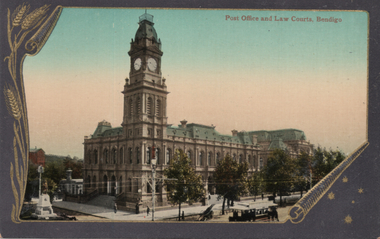 Ballarat Tramway Museum
Postcard, Valentine & Sons Publishing Co, "Post Office and Law Courts, Bendigo", c1910
... Law Courts buildings. There is one ESCo tram in the view along the bottom edge. Card by Valentine & Sons, printed in Great Britain. ...Law Courts buildings. There is one ESCo tram in the view along the bottom edge. Card by Valentine & Sons, printed in Great Britain. ...Printed embossed postcard of a view looking at the Bendigo Post Office, Town Hall and Law Courts buildings. There is one ESCo tram in the view along the bottom edge. Card by Valentine & Sons, printed in Great Britain. The card has a sprigg of wattle on the left-hand side and the stars of the Southern Cross in the bottom right-hand corner, which have been embossed into the card.Demonstrates a embossed card of a view of Bendigo's Government buildings.Postcard coloured - divided back - unused, embossed.Has the "K J Magor No. " stamp along the bottom edge on the rear.tramways, trams, bendigo, esco, post office, town hall, bendigo tramway
