
Showing 62 items matching "grind stone"
-
 Federation University Historical Collection
Ethnographic Material, Aboriginal Grind Stone
... Aboriginal Grind Stone......grind stone...aboriginal stone tool grind stone A grinstone and hammer which di not fit the groove of the grindstone Aboriginal Grind Stone Ethnographic Material ...A grinstone and hammer which di not fit the groove of the grindstoneaboriginal, stone, tool, grind stone -
Malmsbury Historical Society
Photograph (Item), M.H.S. Memorabilia Exhibition Old Grind Stone, Malmsbury ca1990
... Memorabilia Exhibition Old Grind Stone, Malmsbury ca1990...Memorabilia Exhibition Old Grind Stone, Malmsbury ca1990 Photograph Photograph ...Associated with - M.H.S. Buildings - Malmsbury Town Hall -
 Federation University Historical Collection
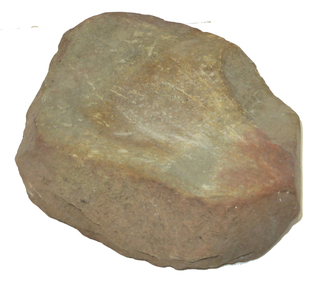
Ethnographic, Aboriginal Grinding Stone (lower section)
... ...grind stone...Lower section of a grinding stone, with 32 excess flakes. Evidence of green paint on the bottom section....grinding stone grind stone aboriginal aborigines tools flakes archaeology stone tools Lower section of a grinding stone, with 32 excess flakes. ...Lower section of a grinding stone, with 32 excess flakes. Evidence of green paint on the bottom section.grinding stone, grind stone, aboriginal, aborigines, tools, flakes, archaeology, stone tools -
Phillip Island and District Historical Society Inc.
Grinding Stone, Unknown
... Upper Grinding Stone donated by Alan West...Light coloured flat Grinding Stone...Upper Grinding Stone donated by Alan West australian aboriginal history aboriginal artifact stone implement grinding stone Kulpitjata, Northern Territory Light coloured flat Grinding Stone Grinding Stone ...Upper Grinding Stone donated by Alan WestLight coloured flat Grinding StoneKulpitjata, Northern Territoryaustralian aboriginal history, aboriginal artifact, stone implement, grinding stone -
 Flagstaff Hill Maritime Museum and Village
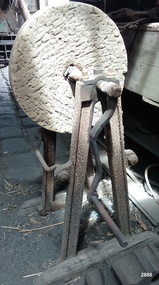
Grinder
... Grinding stone on stand...flagstaff hill warrnambool shipwrecked-coast flagstaff-hill flagstaff-hill-maritime-museum maritime-museum shipwreck-coast flagstaff-hill-maritime-village grinding stone Grinding stone on stand Grinder ...Grinding stone on standflagstaff hill, warrnambool, shipwrecked-coast, flagstaff-hill, flagstaff-hill-maritime-museum, maritime-museum, shipwreck-coast, flagstaff-hill-maritime-village, grinding stone -
Clunes Museum
Tool - ROUND GRINDING STONE, UNKNOWN
... THIS IS A ROUND GRINDING STONE...ROUND GRINDING STONE ABORIGINAL THIS IS A ROUND GRINDING STONE Tool ROUND GRINDING STONE ...THIS IS A ROUND GRINDING STONEround grinding stone, aboriginal -
Phillip Island and District Historical Society Inc.
Grinding Stone, Unknown
... Light brown Grinding Stone...Donated by Alan West found Fregon, South Australia (now Northern Territory) australian aboriginal history aboriginal artifact stone implement grinding stone Light brown Grinding Stone Grinding Stone ...Donated by Alan West found Fregon, South Australia (now Northern Territory)Light brown Grinding Stoneaustralian aboriginal history, aboriginal artifact, stone implement, grinding stone -
Phillip Island and District Historical Society Inc.
Grinding Stone, Unknown
... Flat light brown Grinding Stone...Donated by Alan West found in Northern Territory australian aboriginal history aboriginal artifact stone implement grinding stone Kulpitjata, Northern Territory Flat light brown Grinding Stone Grinding Stone ...Donated by Alan West found in Northern TerritoryFlat light brown Grinding StoneKulpitjata, Northern Territoryaustralian aboriginal history, aboriginal artifact, stone implement, grinding stone -
Clunes Museum
Tool - GRINDING STONE
... GRINDING STONE WITH FIRE STARTER ON BACK...GRINDING STONE FIRE STARTER ABORIGINAL ARTIFACT GRINDING STONE WITH FIRE STARTER ON BACK Tool GRINDING STONE ...GRINDING STONE WITH FIRE STARTER ON BACKgrinding stone, fire starter, aboriginal artifact -
Clunes Museum
Tool - A DOUBLE SIDED GRINDING STONE, UNKNOWN
... ABORIGINAL DOUBLE SIDED GRINDING STONE...ABORIGINAL GRINDING STONE ABORIGINAL DOUBLE SIDED GRINDING STONE Tool A DOUBLE SIDED GRINDING STONE ...ABORIGINAL DOUBLE SIDED GRINDING STONEaboriginal, grinding stone -
 Port Fairy Historical Society Museum and Archives
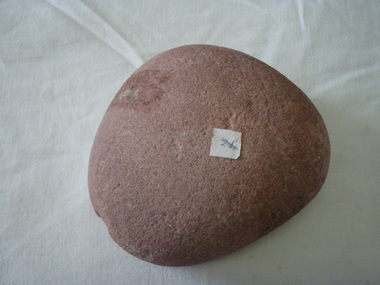
Tool - Grinding Stone
... 2 grinding stones. The larger stone is flatter and worn on both sides. ...local history ethnographic material household grinding stone 2 grinding stones. The larger stone is flatter and worn on both sides. ...2 grinding stones. The larger stone is flatter and worn on both sides. The top grinding stone is rounder and worn on one side top fit into hand easilylocal history, ethnographic material, household, grinding stone -
 Puffing Billy Railway
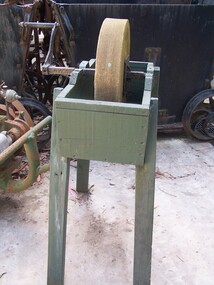
grinding wheel, Blacksmith
... Blacksmith grinding wheel - stone is original but stand has been made by Puffing Billy Museum volunteers stand scrapped - damaged - Feb 2018...Blacksmith grinding wheel - stone is original but stand has been made by Puffing Billy Museum volunteers Wheel made of stone and wrought iron...Blacksmith grinding wheel - stone is original but stand has been made by Puffing Billy Museum volunteers stand scrapped - damaged - Feb 2018 Historic -Industrial Tool - Grinding wheel blacksmith grinding wheel puffing billy Blacksmith grinding wheel - stone is original but stand has been made by Puffing Billy Museum volunteers Wheel made of stone and wrought iron Blacksmith grinding wheel ...Blacksmith grinding wheel - stone is original but stand has been made by Puffing Billy Museum volunteers stand scrapped - damaged - Feb 2018Historic -Industrial Tool - Grinding wheel Blacksmith grinding wheel - stone is original but stand has been made by Puffing Billy Museum volunteers Wheel made of stone and wrought ironblacksmith grinding wheel, puffing billy -
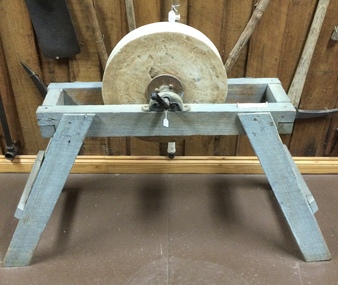 Mont De Lancey
Tool - Grinding Stone, Unknown
... A large sandstone grinding stone disc with a pale blue wooden frame and metal turning handle/ It was used for sharpening tools such as axes in the late 19th or early 20th Century. ...Tool Grinding Stone ...Owned and used by the late Mr W.T. Sebire 1900. The frame was rebuilt by Russell Sebire.A large sandstone grinding stone disc with a pale blue wooden frame and metal turning handle/ It was used for sharpening tools such as axes in the late 19th or early 20th Century. grinding stones, sandstone, equipment, sharpeners, sharpening stones, steel, wood -
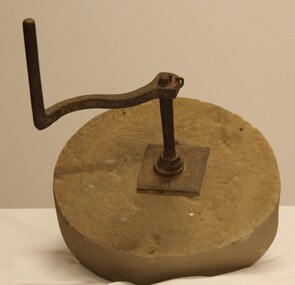 Wodonga & District Historical Society Inc
Functional object - Sandstone Grinding Wheel
... A large circular grinding stone with metal handle. It was used on a stand and also with water to shapen blades such as knives, axes and hand shears. ...This item is representative of grinding stones used throughout Australia to enable people to maintain farm and domestic utensils. ...This item is representative of grinding stones used throughout Australia to enable people to maintain farm and domestic utensils.A large circular grinding stone with metal handle. It was used on a stand and also with water to shapen blades such as knives, axes and hand shears. The wheel is a large cirle of sandstone. These were common in the late 19th and early 20th Century. It would have been used on a wooden frame.domestic tools, household utensils -
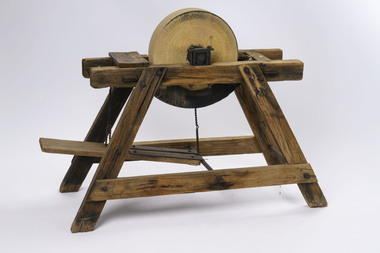 Department of Energy, Environment and Climate Action
Stone Grinding Wheel
... Large stone grinding wheel in wooden frame (pedal operated)...Used to sharpen axes and other hand tools Forests Commission Victoria (FCV) Hand tools Large stone grinding wheel in wooden frame (pedal operated) Stone Grinding Wheel ...Used to sharpen axes and other hand toolsLarge stone grinding wheel in wooden frame (pedal operated)forests commission victoria (fcv), hand tools -
 Eltham District Historical Society Inc
Newsletter, Newsletter, No. 209 March 2013
... Contents: • Next meeting, guest speaker; Jane Woollard: Laughing Waters Stories • Laughing Waters Stories • Annual General Meeting • March Excursion – Karingal Yallock Creek Walk • The Old Grinding Stone • Safe in the Courthouse • School Days • And Also ...Contents: • Next meeting, guest speaker; Jane Woollard: Laughing Waters Stories • Laughing Waters Stories • Annual General Meeting • March Excursion – Karingal Yallock Creek Walk • The Old Grinding Stone • Safe in the Courthouse • School Days • And Also The Shire of Eltham Historical Society was formed in October 1967. ...Contents: • Next meeting, guest speaker; Jane Woollard: Laughing Waters Stories • Laughing Waters Stories • Annual General Meeting • March Excursion – Karingal Yallock Creek Walk • The Old Grinding Stone • Safe in the Courthouse • School Days • And Also The Shire of Eltham Historical Society was formed in October 1967. The first newsletter of the Society was issued May 1978 and has been published continuously ever since on a bi-monthly basis. With the cessation of the Shire of Eltham in late 1994, the Society's name was revised to Eltham District Historical Society and this name first appeared with issue No. 103, July 1995. The collection of the Society's newsletters provides a valuable resource on the history of the Society's activities, office bearers and committee members, guest speakers and subjects of historical interest pertinent to the former Shire of Eltham and the Eltham District.A4 photocopied newsletter distributed to membersnewsletter, eltham district historical society, shire of eltham historical society -
 Orbost & District Historical Society
grindstone
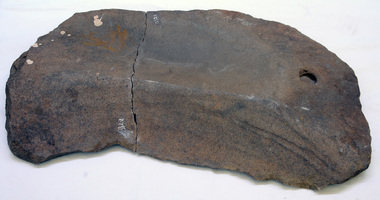
... Inspected by Joanna Freslov, archaeologist 2.6.22008. Grinding stones are slabs of stone that Aboriginal people used to grind and crush different materials. ...Smaller grinding stones were carried between sites. Grinding stones were not abandoned when they became worn and smooth through use. ...Inspected by Joanna Freslov, archaeologist 2.6.22008. Grinding stones are slabs of stone that Aboriginal people used to grind and crush different materials. Bulbs, berries, seeds, insects and many other things were ground between a large lower stone and a smaller upper stone. This is the lower stone.Large grinding stones such as this one were designed to be left at a camp site for use the next time the group moved there. Smaller grinding stones were carried between sites. Grinding stones were not abandoned when they became worn and smooth through use. The stone would simply be roughened again so it was once again suitable for its function. This is an example of a food preparation utensil used by the Early Indigenous people of Eastern Australia.A large flat rock with grind hole in top. Rock has split. gridstone aboriginal stone-artefact -
 Flagstaff Hill Maritime Museum and Village
Grinder
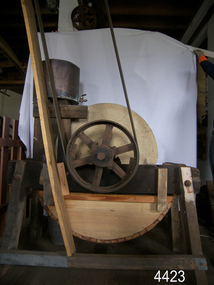
... Grinding wheel, stone belt driven from the steam engine used for sharpening tools. ...flagstaff hill warrnambool shipwrecked-coast flagstaff-hill flagstaff-hill-maritime-museum maritime-museum shipwreck-coast flagstaff-hill-maritime-village Grinding wheel Grinding wheel, stone belt driven from the steam engine used for sharpening tools. ...Grinding wheel, stone belt driven from the steam engine used for sharpening tools. Has a copper tub on top for water to run onto wheel.flagstaff hill, warrnambool, shipwrecked-coast, flagstaff-hill, flagstaff-hill-maritime-museum, maritime-museum, shipwreck-coast, flagstaff-hill-maritime-village, grinding wheel -
 Wodonga & District Historical Society Inc
Domestic object - Grain Mill
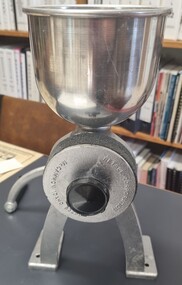
... In the early years of the Retsel Corporation established 1962, their designers carried out research which convinced them that grinding of flour between slow turning stones produced a better quality of flour. ...A grain mill made from metal with two grinding stones. The small black knob on the side enables the distance between stones to be adjusted. ...Domestic appliances Grain mills On handle and circular disc: RETSEL CORPORATION McCAMMON IDAHO 83250 A grain mill made from metal with two grinding stones. The small black knob on the side enables the distance between stones to be adjusted. ...Flour has been produced for centuries by grinding a variety of grains to make flour. In the early years of the Retsel Corporation established 1962, their designers carried out research which convinced them that grinding of flour between slow turning stones produced a better quality of flour. They continue to market grain mills similar to this item. The black knob on the side allows for the distance between the stones to be adjusted so that flour of varying coarseness can be milled. Grain mills such as this were used widely throughout the Wodonga district in the late 20th Century and have had a resurgence in many areas.This item is significant because it is representative of domestic appliances used in the Wodonga district.A grain mill made from metal with two grinding stones. The small black knob on the side enables the distance between stones to be adjusted. Each foot has holes to allow the mill to be screwed to a bench for added stability. The long handle is used to turned to drive the machine. The large funnel is set into a hole on the top of the mill to hold grain. Another bowl would be placed underneath the outlet at the bottom to catch the flour.On handle and circular disc: RETSEL CORPORATION McCAMMON IDAHO 83250domestic appliances, grain mills -
 Greensborough Historical Society
Poster, Victoria. Department of Natural Resources and Environment, Site identification mini poster (#1-2, 4-6, 8-10, 13-14), 2002
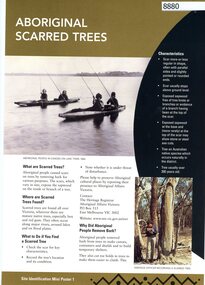
... Mini poster 1: Aboriginal scarred trees; 2 Aboriginal mounds; [3 missing]; 4 Aboriginal flaked stone tools; 5 Aboriginal burials; 6 Aboriginal surface scatters; [7 missing]; 8 Aboriginal ground-edge axes; 9 Aboriginal grinding stones; 10 Aboriginal stone arrangements; [11 missing]; 12 Aboriginal axe-grinding grooves; 13 Aboriginal coastal shell middens; 14 Aboriginal rock art....Mini poster 1: Aboriginal scarred trees; 2 Aboriginal mounds; [3 missing]; 4 Aboriginal flaked stone tools; 5 Aboriginal burials; 6 Aboriginal surface scatters; [7 missing]; 8 Aboriginal ground-edge axes; 9 Aboriginal grinding stones; 10 Aboriginal stone arrangements; [11 missing]; 12 Aboriginal axe-grinding grooves; 13 Aboriginal coastal shell middens; 14 Aboriginal rock art. aborigines - victoria aboriginal affairs victoria 11 parts of incomplete set, each two sided, text and photographs Site identification mini poster (#1-2, 4-6, 8-10, 13-14) Poster Poster Victoria. ...This set produced by the Victorian Department of Natural Resources and Environ met and Aboriginal Affairs Victoria. Mini poster 1: Aboriginal scarred trees; 2 Aboriginal mounds; [3 missing]; 4 Aboriginal flaked stone tools; 5 Aboriginal burials; 6 Aboriginal surface scatters; [7 missing]; 8 Aboriginal ground-edge axes; 9 Aboriginal grinding stones; 10 Aboriginal stone arrangements; [11 missing]; 12 Aboriginal axe-grinding grooves; 13 Aboriginal coastal shell middens; 14 Aboriginal rock art.11 parts of incomplete set, each two sided, text and photographsaborigines - victoria, aboriginal affairs victoria -
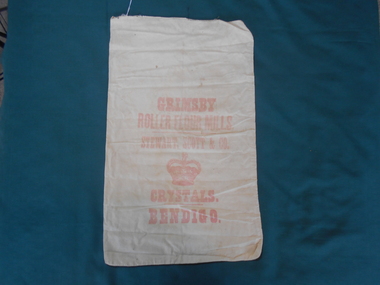 Bendigo Historical Society Inc.
Textile - FLOUR BAG COLLECTION: GRIMSBY ROLLER MILL, BENDIGO, 1900-1950
... The two-story section of this mill was built in about 1873 with grinding stones. In 1887 the owners Stewart and Scott purchased new roller machinery and built a four-storey building to house it. ...The two-story section of this mill was built in about 1873 with grinding stones. In 1887 the owners Stewart and Scott purchased new roller machinery and built a four-storey building to house it. ...Textiles. Calico flour bag printed on one side in red "GRIMSBY ROLLER FLOUR MILLS, STEWART SCOTT & CO CRYSTALS, BENDIGO''. In centre is a crown. Remnants of black cotton stitching along top opening. The two-story section of this mill was built in about 1873 with grinding stones. In 1887 the owners Stewart and Scott purchased new roller machinery and built a four-storey building to house it. The new building was designed by Architects Beebe and Son.textiles, domestic, grimsby roller mill bendigo flour bag -
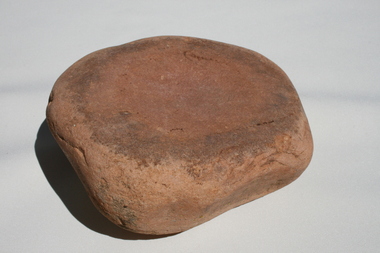 Donald History and Natural History Group operating the Donald Court House Museum
Aboriginal grinding stone (mortar)
... This grinding stone (mortar) was used by Aboriginal people to grind or crush different materials such as berries and seeds for food production. ...Stone Aboriginal grinding stone (mortar). ...This grinding stone (mortar) was used by Aboriginal people to grind or crush different materials such as berries and seeds for food production. In order to grind material, a smaller upper stone (the pestle) would have been used to grind material against this lower stone (the mortar). The stone was found by a farmer on land south of Donald in the 1950’s and was used as a door stop in the family home for many years. In the 1990's the stone was used by the farmer's grandaughter at her home at Swanwater West, to hold the lid down on an above ground swimming pool skimmer box. Stone -
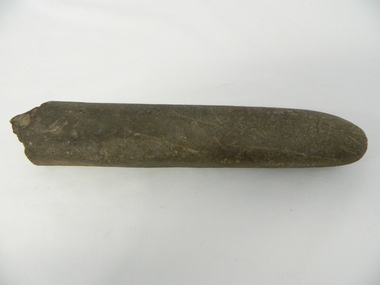 Kiewa Valley Historical Society
Grinder / Pounding Stone, Dhudhuroa language Aboriginal tribe, pre British/European colonisation
... In conjunction with its grinding stone was used not only to grind seeds and but also to dig up eatable roots and leaves and served with the regions Bogong moth. ...Grooved stone, carved to a cylindrical shape with a relative pointed end tip one side (grinding or pounding end) and a rough other end (holding end} Made from Rhyolite stone...In conjunction with its grinding stone was used not only to grind seeds and but also to dig up eatable roots and leaves and served with the regions Bogong moth. ...This stone Grinder or pounder was used as part of an indigenous grinding food preparation method, by the original inhabitants of the Kiewa Valley and its region. In conjunction with its grinding stone was used not only to grind seeds and but also to dig up eatable roots and leaves and served with the regions Bogong moth. This method of food preparation has survived in its basic form for centuries and is still used by master chiefs in modern eateries. This item has been registered with Aboriginal Affairs in Wangaratta, Victoria. Dhudhuroa elder Alan Murray has examined this tool, in Feb 2015, and said it was also used for sharpening axe heads as well as pounding food items. This item has a very significant historical and social aspect to it. Firstly it demonstrates the division of labour within a indigenous tribe. It was an era when the female had a definitive role within the family and the broader social indigenous tribal group of, gathering and preparing non animal(hunted) food. Hunted food was the domain of the initiated males of the tribe.Secondly it demonstrates the ability to fashion implements from raw materials(rock) into effective tools for the purpose of preparing a meal for human consumption. This was in an era where inter family and intra family participation in an indigenous tribal social protective environment was at a very high level. The Kiewa Valley/Mount Bogong region was an area where annual "get together" indigenous tribes for feasting, bartering and settling of disputes highlighting the importance of a regional gathering. Grooved stone, carved to a cylindrical shape with a relative pointed end tip one side (grinding or pounding end) and a rough other end (holding end} Made from Rhyolite stoneThere is a worn grove in the top side due to this tool being used for axe sharpening. indigenous, aboriginal, stone grinding, meal preparation, natural environment, pounding stone -
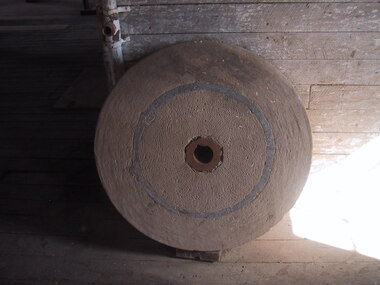 Parks Victoria - Andersons Mill
Machine - Grinding Stone
... Appears to be a millstone that would have been used with another stone to grind wheat....It has a hole through the middle with a metal fixture in it. Machine Grinding Stone ...Appears to be a millstone that would have been used with another stone to grind wheat.Large circular stone wheel with ridges carved into its outer side. It has a hole through the middle with a metal fixture in it. -
 Federation University Historical Collection
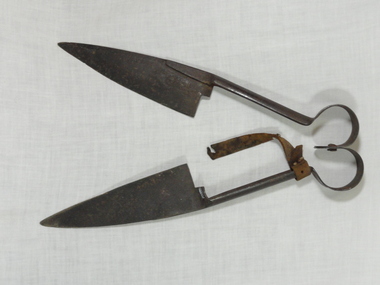
Tool, Handshears
... Blades had to be regularly sharpened on a grinding stone. Most hand shears were made in Sheffield, England, with various models produced offering wide or narrow blades, sharp or rounded points, and various grips and bows. ...Blades had to be regularly sharpened on a grinding stone. Most hand shears were made in Sheffield, England, with various models produced offering wide or narrow blades, sharp or rounded points, and various grips and bows. ...Hand shears needed to be very sharp and often had a leather strap or ‘driver’ which passed over the hand. Others had sheepskin bound around the grip. Blades had to be regularly sharpened on a grinding stone. Most hand shears were made in Sheffield, England, with various models produced offering wide or narrow blades, sharp or rounded points, and various grips and bows. The technique of Australian hand shearing gradually developed from the 1830s using the old English method of cutting the flank with hand shears in a series of circular cuts from the sheep’s neck to the tail. In the early 1930s the Ballarat School of Mines introduced a wide-ranging Wool Classing Course as jobs were in extremely short supply during the Great Depression. Metal handshears used for shearing sheep.ballarat school of mines, shearing, woolclassing, sheep -
Phillip Island and District Historical Society Inc.
Grinding Mill, 1800 - 1900 (Estimated)
... "A veritable powder puff of the stone ages and one of the most interesting relics of the Aborigines yet found on Phillip Island. A Grinding...Grinding mill, oval shaped, stone is very regular and smooth with a textured surface. ...This label is a typed version of the original label. local aboriginal history aboriginal artifact stone tool aboriginal grinding mill Grinding mill, oval shaped, stone is very regular and smooth with a textured surface. ..."A veritable powder puff of the stone ages and one of the most interesting relics of the Aborigines yet found on Phillip Island. A Grinding Mill for the soft red stone used for decorating the body. It was picked up by Mr H. R. Balfour of Hopetown Road, Toorak, in November 1904 and was kindly given to a member of the Phillip Island & Western Port Historical Society. Although used for the last ime more than 100 years earlier, some of the ground stone adheres to the surface that has been smoothed by much use." Taken from the label associated with this object. This label is a typed version of the original label.Grinding mill, oval shaped, stone is very regular and smooth with a textured surface. One side is worn flat and smooth and has traces of red ochre on it.local aboriginal history, aboriginal artifact, stone tool, aboriginal grinding mill -
 Orbost & District Historical Society
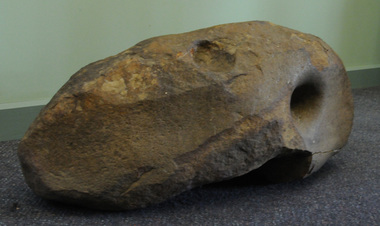
Aboriginal grinding stone, Aboriginal people have shaped this rock through usage, pre-European Australia
... A large rock of generally oval shape and with a number of flatish surfaces and hole indentations which were identified by archaeologist Dr Joanna Freslov 2.6.2008 as being used by Aboriginal people as a grinding or tool-sharpening stone....Aboriginal grinding stone Aboriginal people have shaped this rock through usage ...This large and very heavy stone was donated by Albert Emphield. Where he found it is unknown, but he worked in the Orbost forest areas and lived at Cabbage Tree Creek.Aboriginal usage, tool manufacture.A large rock of generally oval shape and with a number of flatish surfaces and hole indentations which were identified by archaeologist Dr Joanna Freslov 2.6.2008 as being used by Aboriginal people as a grinding or tool-sharpening stone.aboriginal-grinding-stone -
Tarnagulla History Archive
Photograph - Photograph: Workers at Tarnagulla Flour Mill, c. 1873-1920, probably around 1900
... The Mill operated with grinding stones until 1899 when new rollers and a considerable amount of new equipment was installed, including a new, more powerful engine to drive the Mill. ...The Mill operated with grinding stones until 1899 when new rollers and a considerable amount of new equipment was installed, including a new, more powerful engine to drive the Mill. ...Williams Family Collection. A meeting was called at the Golden Age Hotel on 11th June 1868 when it was resolved to build a flour mill. Tenders were called by H.C. Bristol, in the Tarnagulla Courier of January 10, 1874, for the erection of the mill. Building of the Mill commenced in 1874. Pipes were laid to Company's Dam to obtain water for the Mill's boilers. Steam was got up for the first time on 30th March, 1882. A boiler burst about April 29th. Two men (J.H. Smith and W. Hargreaves) died as a result and two others were seriously injured. The mill commenced operations on 13th June 1882 with Mr. W. Fitzgerald as manager. Thomas Comrie was the proprietor and was responsible for the Mill being built. The Mill operated with grinding stones until 1899 when new rollers and a considerable amount of new equipment was installed, including a new, more powerful engine to drive the Mill. In January 1901, 6,000 bags of wheat were received weekly and it was a common sight to see the streets lined with wagons. In 1913, 15,000 bags of wheat were bought at three shillings and four pence per bushell. In January 1914, wheat came in at the rate of 1500 bags a day with 20,000 bags in storage. Thomas Comrie died on 4th August 1910. The Mill was carried on by his executors, then closed for a short period prior to being sold in September 1918 to a Mr. O. Albert of Talbot. Albert operated the Mill for a few years but during the 1920s it was closed down and then pulled down. It was later re-erected at Mildura where it operated for many years.Monochrome photograph depicting workers at Tarnagulla Flour Mill, some loading or unloading a horse-drawn cart. An original photograph, mounted on card. Handwritten on back: 'L.Williams Tarnagulla' and 'Leo Fitzgerald' and full recipe for a red currant dessert.tarnagulla -
 Tarnagulla History Archive
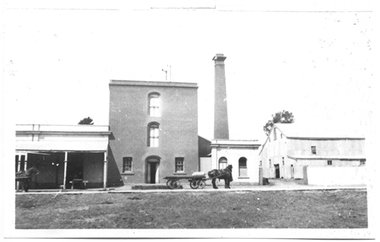
Photograph of Flour Mill, Tarnagulla, Flour Mill, Tarnagulla, circa 1920
... The Mill operated with grinding stones until 1899 when new rollers and a considerable amount of new equipment was installed, including a new, more powerful engine to drive the Mill. ...The Mill operated with grinding stones until 1899 when new rollers and a considerable amount of new equipment was installed, including a new, more powerful engine to drive the Mill. ...Murray Comrie Collection. Information written by Murray Comrie: A meeting was called at the Golden Age Hotel on 11th June 1868 when it was resolved to build a flour mill. Tenders were called by H.C. Bristol, in the Tarnagulla Courier of January 10, 1874, for the erection of the mill. Building of the Mill commenced in 1874. Pipes were laid to Company's Dam to obtain water for the Mill's boilers. Steam was got up for the first time on 30th March, 1882. A boiler burst about April 29th. Two men (J.H. Smith and W. Hargreaves) died as a result and two others were seriously injured. The mill commenced operations on 13th June 1882 with Mr. W. Fitzgerald as manager. Thomas Comrie was the proprietor and was responsible for the Mill being built. The Mill operated with grinding stones until 1899 when new rollers and a considerable amount of new equipment was installed, including a new, more powerful engine to drive the Mill. In January 1901, 6,000 bags of wheat were received weekly and it was a common sight to see the streets lined with wagons. In 1913, 15,000 bags of wheat were bought at three shillings and four pence per bushell. In January 1914, wheat came in at the rate of 1500 bags a day with 20,000 bags in storage. Thomas Comrie died on 4th August 1910. The Mill was carried on by his executors, then closed for a short period prior to being sold in September 1918 to a Mr. O. Albert of Talbot. Albert operated the Mill for a few years but during the 1920s it was closed down and then pulled down. It was later re-erected at Mildura where it operated for many years. This is a poor copy of an older original. Copy probably made by Murray Comrie in the late 1960s. Monochrome photograph of the Flour Mill in Tarnagulla, around 1920.tarnagulla, commerce, agriculture, food production, mill, milling, horses, transport, buildings, commercial road, main street -
 Tarnagulla History Archive
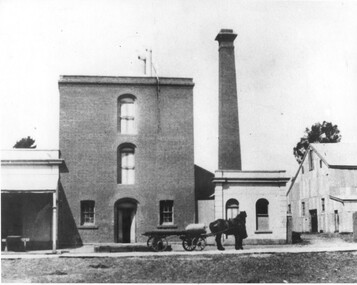
Photograph of Flour Mill, Tarnagulla, Flour Mill, Tarnagulla, circa 1920 (original image)
... The Mill operated with grinding stones until 1899 when new rollers and a considerable amount of new equipment was installed, including a new, more powerful engine to drive the Mill. ...The Mill operated with grinding stones until 1899 when new rollers and a considerable amount of new equipment was installed, including a new, more powerful engine to drive the Mill. ...Murray Comrie Collection. Information written by Murray Comrie: A meeting was called at the Golden Age Hotel on 11th June 1868 when it was resolved to build a flour mill. Tenders were called by H.C. Bristol, in the Tarnagulla Courier of January 10, 1874, for the erection of the mill. Building of the Mill commenced in 1874. Pipes were laid to Company's Dam to obtain water for the Mill's boilers. Steam was got up for the first time on 30th March, 1882. A boiler burst about April 29th. Two men (J.H. Smith and W. Hargreaves) died as a result and two others were seriously injured. The mill commenced operations on 13th June 1882 with Mr. W. Fitzgerald as manager. Thomas Comrie was the proprietor and was responsible for the Mill being built. The Mill operated with grinding stones until 1899 when new rollers and a considerable amount of new equipment was installed, including a new, more powerful engine to drive the Mill. In January 1901, 6,000 bags of wheat were received weekly and it was a common sight to see the streets lined with wagons. In 1913, 15,000 bags of wheat were bought at three shillings and four pence per bushell. In January 1914, wheat came in at the rate of 1500 bags a day with 20,000 bags in storage. Thomas Comrie died on 4th August 1910. The Mill was carried on by his executors, then closed for a short period prior to being sold in September 1918 to a Mr. O. Albert of Talbot. Albert operated the Mill for a few years but during the 1920s it was closed down and then pulled down. It was later re-erected at Mildura where it operated for many years. This is a poor copy of an older original. Copy probably made by Murray Comrie in the late 1960s. Monochrome photograph of the Flour Mill in Tarnagulla, around 1920. Cropped version of 2019.0047.tarnagulla, commerce, agriculture, food production, mill, milling, horses, transport, buildings, commercial road, main street
