
Showing 12 items matching "groins"
-
 Bendigo Military Museum
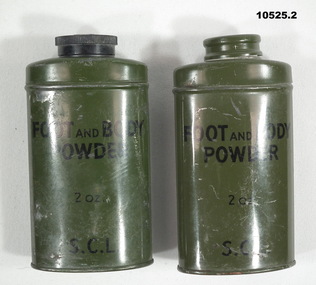
Equipment - FOOT POWDER
... On one side, "Foot and Body Powder - 2 oz - S.C.L" The other side has explains to apply to "toes, groin & arm pits"...Jones 3790932, refer Cat No 10053.2P for his service details. powder foot body gajones On one side, "Foot and Body Powder - 2 oz - S.C.L" The other side has explains to apply to "toes, groin & arm pits" (.1 - .2) Foot and body powder tins, metal and plastic, green colour, oval shape, both sides have details in black text. (.1) Has plastic screw top lid, (.2) has metal screw top lid. ...Collection re G.A. Jones 3790932, refer Cat No 10053.2P for his service details. (.1 - .2) Foot and body powder tins, metal and plastic, green colour, oval shape, both sides have details in black text. (.1) Has plastic screw top lid, (.2) has metal screw top lid.On one side, "Foot and Body Powder - 2 oz - S.C.L" The other side has explains to apply to "toes, groin & arm pits"powder, foot, body, gajones -
 Victoria Police Museum
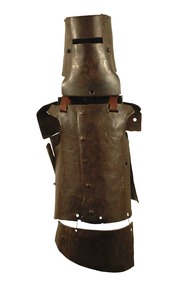
Armour (Dan Kelly), 1880
... Armour worn by bushranger Dan Kelly including helmet (VPM1799.1); chest plate (VPM1799.2); back plate (VPM1799.3) and groin plate (1799.4). Armour constructed from heavy metal plough plates, bolted and welded together....Kelly' Impressed on plough VPM1799.3 'Huntly Crucible Cast' Armour worn by bushranger Dan Kelly including helmet (VPM1799.1); chest plate (VPM1799.2); back plate (VPM1799.3) and groin plate (1799.4). Armour constructed from heavy metal plough plates, bolted and welded together. ...Armour worn by Dan Kelly, Kelly Gang member and brother to Ned Kelly, during the Glenrowan Siege, August 1880.Armour worn by bushranger Dan Kelly including helmet (VPM1799.1); chest plate (VPM1799.2); back plate (VPM1799.3) and groin plate (1799.4). Armour constructed from heavy metal plough plates, bolted and welded together.Painted on inside of armour : 'Dan Kelly', 'Police Exhibition', 'E. Kelly' Impressed on plough VPM1799.3 'Huntly Crucible Cast'ned kelly, bushranger, kelly gang, dan kelly, glenrowan, victoria police -
 Bendigo Historical Society Inc.
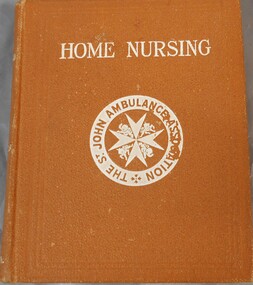
Manual - Home Nursing
... On back page: 4" shoulder and groin. 3" on leg spica, 3" ankle? leg, 2" foot and two un-legible words....On back page: 4" shoulder and groin. 3" on leg spica, 3" ankle? leg, 2" foot and two un-legible words. ...Brown hardcover book. Home Nursing and the St. John Ambulance Association logo on the front in white lettering. Home Nursing 4th edition, SJAA on the spine. The book has 280 pages. Aileen and John Ellison Collection.20 c on first page. On back page: 4" shoulder and groin. 3" on leg spica, 3" ankle? leg, 2" foot and two un-legible words.home nursing, st. john ambulance -
 Glenelg Shire Council Cultural Collection
Photograph - Photograph - Early Shipping: Ocean / Railway Pier, n.d
... In foreground, creek entering harbour, groin, Railway Pier, Ocean Pier, swimming baths. ...In foreground, creek entering harbour, groin, Railway Pier, Ocean Pier, swimming baths. ...Port of Portland Authority Archivesport of portland archives, railway pier, ocean pier -
Glenelg Shire Council Cultural Collection
Photograph - Photograph - Lee Breakwater, Portland, n.d
... Several men in the water making rafts. Groin, Fishermen's Breakwater in the background....Several men in the water making rafts. Groin, Fishermen's Breakwater in the background. ...Port of Portland Authority Archivesport of portland archives, henty beach, construction, fishermans breakwater, raft, marine, maritime -
 Port Fairy Historical Society Museum and Archives
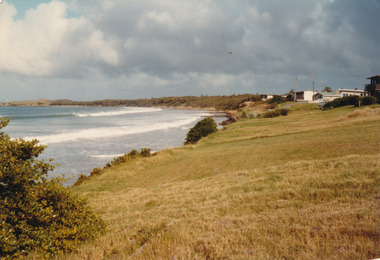
Photograph
... ...Groins...East Beach looking South June 1983 East beach Groins houses marram grass dune 1983 Photograph Photograph ...East Beach looking South June 1983east beach, groins, houses, marram grass, dune, 1983 -
 Bendigo Military Museum
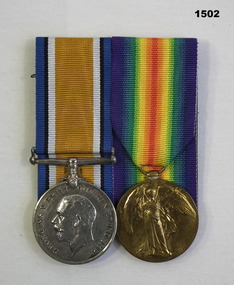
Award - MEDAL SET WW1, post 1919
... WIA 11.8.18 shrapnel wound to groin severe. To hospital at sea with Influenza 6.2.19. ...WIA 11.8.18 shrapnel wound to groin severe. To hospital at sea with Influenza 6.2.19. ...Hughy Pippin (born Euston, enlisted Mildura) No 1895 C Coy 38th Batt AIF. Hughy enlisted in the 2nd reinforcements to the Batt on 3.4.16. Embarked 16.8.16. WIA 4.2.17 GSW to face. WIA 11.8.18 shrapnel wound to groin severe. To hospital at sea with Influenza 6.2.19. Discharged from the AIF on 25.5.19. Medal set, court mounted, set of 2 re H Pippin. 1. War Medal 1914-18 2. Victory medal 1914 - 1919."1895 L Cpl H Pippin 38th Bn AIF"medals, campaign, military -
 Bendigo Military Museum
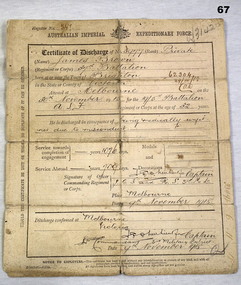
Administrative record - CERTIFICATE OF DISCHARGE WW1, 9.11.1918
... Hospitalised 14.6. 1917 with Exhaustion later as growth in groin. From here he gets himself into trouble. ...Hospitalised 14.6. 1917 with Exhaustion later as growth in groin. From here he gets himself into trouble. ...James BROWN No 5977 enlisted in the AIF in 19th reinforcements 5th Batt on 30.11.1915 aged 32 years 3 months. Embarked for England 27.7.1916, transfer to 37th Battalion 23.9.1916, hospitalised 9.10.1916 with Scabies. Rejoined unit 6.1.1917, allowed Regt No 5977A, embarked for France 25.2.1917. Hospitalised 16.3.1917 with Enteritis, rejoined unit 25.3.1917. Hospitalised 21.5.1917 with Debility, rejoined unit 1.6.1917. Hospitalised 14.6. 1917 with Exhaustion later as growth in groin. From here he gets himself into trouble. Hospitalised 24.12.1917 with Nephritis, discharged from the AIF 9.11.1918 medically unfit.Certificate of Discharge Register No 547 for James BROWN Regt No 5977 AIFdocuments - certificates, military history - army records -
 Bendigo Military Museum
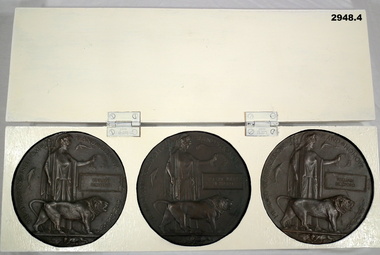
Memorabilia - MEMORIAL PLAQUES, Bickford Family, Plaques post WW1
... Embark for Egypt 8.4.1915, embark for Gallipoli 29.8.1915, hospital with Mumpa 20.1.1916, rejoin unit 7.3.1916, embark for France 19.3.1916, awarded the Military Medal (MM) as a Lewis Gunner and Gallantry under fire since March 1916, promoted CPL 1.9.1916, hospital with Odema of the feet 8.11.1916, rejoin unit 22.11.1916, WIA 12.1.1917 SW’s to Groin and Abdomen, DOW;s Flers 12.1.1917. ...Embark for Egypt 8.4.1915, embark for Gallipoli 29.8.1915, hospital with Mumpa 20.1.1916, rejoin unit 7.3.1916, embark for France 19.3.1916, awarded the Military Medal (MM) as a Lewis Gunner and Gallantry under fire since March 1916, promoted CPL 1.9.1916, hospital with Odema of the feet 8.11.1916, rejoin unit 22.11.1916, WIA 12.1.1917 SW’s to Groin and Abdomen, DOW;s Flers 12.1.1917. ...Edward Bickford No 1519 enlisted in the AIF in the 1st reinforcements 21st Batt on 8.4.1915 age 25 years. Embarked for for Egypt 28.6.1915, embark for Gallipoli 29.8.1915, embark for France 19.3.1916, reported MIA 26.8.1916, a Court of inquiry dated 20.7.1917 found that he was KIA 26.8.1916 at Moquet Farm. Robert John Bickford No 1518 enlisted in the AIF in the 1st reinforcements 21st Batt on 8.4.1915 age 30 years 11 months. Embark for Egypt 8.4.1915, embark for Gallipoli 29.8.1915, hospital with Mumpa 20.1.1916, rejoin unit 7.3.1916, embark for France 19.3.1916, awarded the Military Medal (MM) as a Lewis Gunner and Gallantry under fire since March 1916, promoted CPL 1.9.1916, hospital with Odema of the feet 8.11.1916, rejoin unit 22.11.1916, WIA 12.1.1917 SW’s to Groin and Abdomen, DOW;s Flers 12.1.1917. William Bickmore No 815 enlisted in G Coy 14th Batt on 12.9.1914 age 21 years 11 months. Embark for Egypt 22.12.1914, embarked for Gallipoli, WIA 4.6.1915 shrapnel wound left arm, returned to Australia for discharge stating Stiffness of the Arm15.8.1915, return to Egypt in the 14th reinforcements and rejoin the 14th Batt 2.4.1916, embark for France 1.6.1916, promoted L/Cpl 1.9.1916, promoted Cpl 24.3.1917, reported MIA 11.4.1917, Court of Inquiry found he was KIA 11.4.1917 at Bullecourt. Refer 2949P, 2950P, 2991P for their photos.Bickford Family Set of WWI Commemorative Plaques: .1) Bronze Death Plaque, British pattern showing a helmeted female (Brittanica) in classic style dress holding a trident in right hand, wreath in the other & a lion at her side. In the rectangular box, embossed is the name Edward Bickford. .2) As above description though in the rectangular box is the name Robert John Bickford. .3) Descriptions as above though in the rectangular box is the name William Bickford. .4) Heavy wooden display case painted cream colour, 2 hinges on the side, no lock or catch. Inside are 3 recessed circular holes to hold the plaques.Written on rear of box is: “A.T.B. 94”military history, memorial, plaques -
 Ballarat and District Irish Association
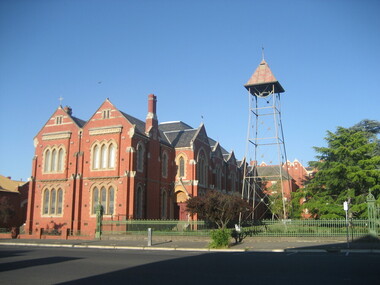
Photograph - Colour, Clare Gervasoni, St Patrick's Cathedral Hall, Ballarat, 2007, 20/11/2007
... Pointed Gothic windows on the upper level intersect the curved ceiling in a simple groined junction. The plaster ceiling is coffered by intersecting beams, while a central skylight floods the hall with natural light. ...Pointed Gothic windows on the upper level intersect the curved ceiling in a simple groined junction. The plaster ceiling is coffered by intersecting beams, while a central skylight floods the hall with natural light. ...St Patrick's Cathedral Hall was erected in 1900 to the architectural plans of Clegg, Kell and Miller. The builder was Peter Bodger. The Cathedral Hall is a massive structure in the Gothic manner, with slender proportions and Gothic window detailing. The main hipped roof of the hall is intersected on both sides by four gables, and the front ridge is intersected by two further gables to form the street elevation. Internally the hall resembles many town halls except for the two tiers of Gothic windows and the manner in which the ceiling curves downward towards the walls. Pointed Gothic windows on the upper level intersect the curved ceiling in a simple groined junction. The plaster ceiling is coffered by intersecting beams, while a central skylight floods the hall with natural light. Other features of note are the ridging on the front gables, and the iron bell tower framed in steel angles and braced with criss-crossed rods, complete with a huge wheel and a great bell. St Patrick's Hall demonstrates a notable application of decorative schemes, particularly its highly decorated ceiling which has few parallels amongst other church halls in Victoria. The hall is in an important location as part of St Patrick's complex, as well as part of the group of churches which include St Andrew's Kirk and the former Baptist Church, opposite in Dawson Street. (http://stpatscathedral.weebly.com/cathedral-hall--presbytery.html, accessed 13 November 2013.A series of colour digital photographs showing a large red brick hall associated with St Patrick's Cathedral, Ballarat. The bell tower is situated to the right of the hall.ballarat irish, st patrick's cathedral hall, cathedral hall ballarat, bell, bell tower -
 Beechworth RSL Sub-Branch
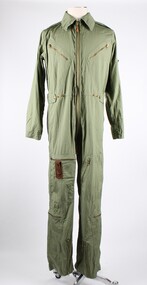
Flying Suit, 1988
... One long zip at the front from the groin to the collar. This has two zip handles, each with a thin piece of leather attached to aid zipping. ...One long zip at the front from the groin to the collar. This has two zip handles, each with a thin piece of leather attached to aid zipping. ...This flying suit would have been worn by a pilot of the Royal Australian Air Force. It is a drill suit and most likely was not used in active service. This flying suit dates to 1988. It is no longer manufactured and is an historically significant article of military clothing. It is also in good condition.Olive drab coloured overalls. Full length sleeves and full length legs. Two pockets on the front of each leg. One zip at the front of each leg with extra fabric in the interior for fabric width enhancement. One access zip on each hip. Two diagonal breast pockets, either side of chest. One small pocket on each arm. All pockets are fastened with metallic brass colour zips. Another pocket on the left upper arm with stitched sections for storing pens. A silver coloured metallic pen holder is clipped and stitched into this section. One epaulet on each shoulder, each fastened with a brass coloured metallic stud. Regular shirt collar. One long zip at the front from the groin to the collar. This has two zip handles, each with a thin piece of leather attached to aid zipping. A patch with inscriptions machine stitched to nape of neck interior. Three brass coloured metallic studs, with a small piece of size adjustment fabric (and the clipping stud attached to this) on each sleeve. Three brass coloured metallic studs, with a small piece of size adjustment fabric (and the clipping stud attached to this) on each side of the waist. One rectangular leather clip attached to the upper right leg pocket. Patch stitched to nape of neck interior has the following inscriptions: A.G.C.F. VIC 1988 (symbol of broad arrow) SIZE.3 8415.66.013.1557 NO NAMEflying suit, royal australian air force -
 City of Melbourne Libraries
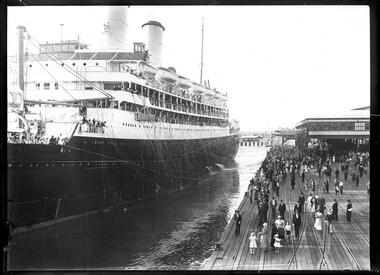
Photograph, Bull, Hugh Jones, 1897-1993, RMS Orford departing from Station Pier, Port Melbourne
... Every day tennis player Harry Hopman and an Australian Press Association reporter radioed through reports on their activities, which included – - Test cricket batsman Len Darling having spend 4 days in his cabin after straining his groin when he slipped over while playing ball tennis in his slippers. - Batsman Bill Brown dancing the fox-trot, displaying footwork similar to the grace he showed at the wicket. - Alluding to the seasickness of Don Bradman and Stan McCabe and how they were making up for meals lost on the Great (very choppy) Australian Bight. - Miss Joan Hartigan discarding her bright blue shorts for brighter blue bathers and being first into the pool. - Bowler Bill O’Reilly being tripped by a passenger on the deck and spending the voyage with bandaged wrists with daily updates of his progress in the press. - Wicketkeeper Ben Barnett’s conjuring tricks and constant whirring movie camera. - Results of the quoits, ball tennis and bridge tournaments. ...Every day tennis player Harry Hopman and an Australian Press Association reporter radioed through reports on their activities, which included – - Test cricket batsman Len Darling having spend 4 days in his cabin after straining his groin when he slipped over while playing ball tennis in his slippers. - Batsman Bill Brown dancing the fox-trot, displaying footwork similar to the grace he showed at the wicket. - Alluding to the seasickness of Don Bradman and Stan McCabe and how they were making up for meals lost on the Great (very choppy) Australian Bight. - Miss Joan Hartigan discarding her bright blue shorts for brighter blue bathers and being first into the pool. - Bowler Bill O’Reilly being tripped by a passenger on the deck and spending the voyage with bandaged wrists with daily updates of his progress in the press. - Wicketkeeper Ben Barnett’s conjuring tricks and constant whirring movie camera. - Results of the quoits, ball tennis and bridge tournaments. ...Published: 21 March 1934 The Age p11 Published title: CROWDED TOURIST SHIP WILL CARRY TEST AND DAVIS CUP TEAMS. Published caption: Carrying an exceptionally large number of tourists, business men and prominent sporting personalities, R.M.S. Orford sailed for London yesterday. Over two hundred passengers embarked at Melbourne, and on leaving the Australian coast there will be two thousand persons on board. The Australian Test team will join the vessel at Fremantle and the remaining two Davis Cup representatives will embark at Adelaide. A picture of the Orford taken just as she moved out from Station Pier, Port Melbourne, under her own steam. Trove article identifier: http://nla.gov.au/nla.news-article203826897 Description: Passenger ship about to depart Station Pier, Port Melbourne. Research by project volunteer, Fiona Collyer: The RMS Orford was built by Vickers-Armstrong Shipyard Barrow-in-Furness, Cumbria, England and launched in 1927 by Lady Ryrie, the wife of Sir Granville Ryrie, the Australian Ambassador to the UK. The Orford was owned by the Orient Steam Navigation Ltd and was designed for the mail and passenger service between England and Australia. She was 20,000 tons, 658 ft long, 75 ft across and 80 ft high from water-line to deck. She had eight decks, a swimming pool and cost more than £1,000,000. She could travel at 20 knots – 480 miles a day, a 5 week voyage between Australia and England. There were enough lifeboats to accommodate every person on board. Promoted as a ship of comfort, luxury, speed and grace with spacious, beautifully decorated lounges, smoking-rooms and writing rooms, the SMH 23/11/1928 review said “sitting-rooms where the furniture recreates the air of quiet, exquisite, safe luxury; suites where you may retire from other people, and on a sea voyage other people, even the most charming other people, often begin to resemble one’s worst enemies towards the end of several weeks sea voyaging together”. “Travel like a human being. This is what the great liners give you today. The Orford dining room is enormous (it seated 350 people) the walls sweep up to a white, cool roof supported on decorative pillars. Panels of grey scagliola and carved designs remove the bleak, comfortless air which used to cling to dining-rooms of ships. Everything about them was so wretchedly temporary that you could not enter them without wishing that you stayed at home. They gave you the creeps and indigestion. This room is gay, bright, sunlit, like a luxurious café overlooking the sea.” “You really feel in here that you are a human being and not a piece of cargo endowed with sensation.” The Orford had the punkah louvre system of ventilation which forced draughts through every part of the ship, ensuring “No Ship Smells!!” and avoiding - “… a mayonnaise of all the unpleasant odours generated under heaven. From the hot oil of the engines, from those overheated, bottomless pits below the water-line, from new paint and food, from people perspiring at work, from rope and tar and grease and fruit and wet clothes and tobacco, rises a deplorable incense that lingers unsettlingly in the nostril long after one has left the ship. Those dreadful odours will never rise to torture the senses of passengers who feel that all is over with them.” The modern electric kitchen had a roll making machine capable of producing 2000 rolls for the table an hour and a bread and butter machine which cut the bread into slices and spread the butter in one operation. (The Week – Brisbane 30/11/1928) On 13/10/1928, the Orford made its first voyage to Australia with 520 first class and 1100 3rd class passengers. The name of the passengers embarking and disembarking and their reason for visiting were published in newspapers and the number of migrants for the New Settlers Scheme and the Dreadnought Boys Co program to promote and assist the migration of British youths willing to become farm workers in Australia 1911-1939 were noted too. On the 19th March 1932, RMS Orford featured in the “Parade of Ships” celebrating the official opening of the Sydney Harbour Bridge. Only country people were allowed to book a ticket as a guest on board. The Post Office issued commemorative postage stamps showing the Orford sailing under the bridge. In March 1934, the Orford sailed from Australia to London, via Colombo, Aden, Port Said, Naples, Villefranche, Toulon, Parma, Gibraltar and Channel Port. Amongst the 2000 passengers on board was the Davis Cup Tennis team, tennis champions Joan Hartigan and Nell Hopman, the Australian Test cricket team and British champion swimmer Joyce Cooper. Every day tennis player Harry Hopman and an Australian Press Association reporter radioed through reports on their activities, which included – - Test cricket batsman Len Darling having spend 4 days in his cabin after straining his groin when he slipped over while playing ball tennis in his slippers. - Batsman Bill Brown dancing the fox-trot, displaying footwork similar to the grace he showed at the wicket. - Alluding to the seasickness of Don Bradman and Stan McCabe and how they were making up for meals lost on the Great (very choppy) Australian Bight. - Miss Joan Hartigan discarding her bright blue shorts for brighter blue bathers and being first into the pool. - Bowler Bill O’Reilly being tripped by a passenger on the deck and spending the voyage with bandaged wrists with daily updates of his progress in the press. - Wicketkeeper Ben Barnett’s conjuring tricks and constant whirring movie camera. - Results of the quoits, ball tennis and bridge tournaments. A fancy dress ball was held one night and the cricketers dressed as sheiks and sang “The Riff Song” from the pre-code 1929 operetta film “The Desert Song” starring John Bates as the Red Shadow and Myrna Lay as a native dancing girl. Alan Kippax’s beard blew overboard! Joan Hartigan dressed as Burlington Bertie from the music hall song and Nell Hopman a doll in a box wearing a crinkled paper dress. On arrival at Southampton, while they waited for the gangway to be lowered, Bradman entertained the team at the piano playing popular tunes while the cricketers sang. . In 1935, RMS Orford’s third class accommodation was converted to tourist class. Her passenger capacity was now 468 First Class, 515 tourist class and 440 crew. First saloon from Sydney fares cost for single £76, £82, £88 and Third Class fares were £21, £23, £25. Less than a penny a mile. . In 1936, the Orford embarked the exiled Emperor of Ethiopia, Haile Selassie at Gibraltar on his way to the UK. In 1939, she was requisitioned for Australian government service and on 7/1/1940 she conveyed the first Australian troops to Egypt and was then used to carry French troops from Tamatave, Madagascar to Marseilles. On 1/6/1940 RMS Orford was bombed and set on fire at Marseilles by German aircraft. 14 crew were killed, 25 wounded. In 1947, the wreck was re-floated and broken up at Savona. . . References: R.M.S. ORFORD. (1928, November 23). The Sydney Morning Herald (NSW : 1842 - 1954), p. 14. Retrieved September 15, 2023, from http://nla.gov.au/nla.news-article16511535 ARRIVAL OF THE ORFORD (1928, November 30). The Week (Brisbane, Qld. : 1876 - 1934), p. 21. Retrieved September 15, 2023, from http://nla.gov.au/nla.news-article181126802 CROWDED TOURIST SHIP WILL CARRY TEST AND DAVIS CUP TEAMS. (1934, March 21). The Age (Melbourne, Vic. : 1854 - 1954), p. 11. Retrieved October 5, 2023, from http://nla.gov.au/nla.news-article203826897 Photographer notations on slide: "B19".tennis, ships
