
Showing 21 items matching "gum blossom"
-
 National Wool Museum
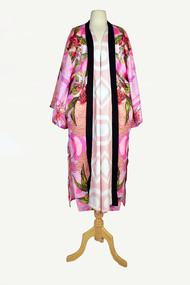
Textile - Cloak, Dr Deanne Gilson, Gum Blossom and Bottle Brush in Dilly Bag Cloak (Women Basket Making and Sharing Knowledge), 2022
... Gum Blossom and Bottle Brush in Dilly Bag Cloak (Women Basket Making and Sharing Knowledge)...This cloak pays homage to them and the changing seasons as they created, particularly the cooler months leading into the warmer season when several gum blossom flower. This cloak was worn once by artist Deanne Gilson at a formal opening at the Art Gallery of Ballarat in 2022. ...Cloak is machine sewn and handstitched with hand stitching on shoulder seam. Gum Blossom and Bottle Brush in Dilly Bag Cloak (Women Basket Making and Sharing Knowledge) Textile Cloak Dr Deanne Gilson Christene Zlatkovic ...Standing proud, still here, the spirit of ten ancestral matriarchs adorned in contemporary ceremonial cloaks. Representing our women past, present and future, her Spirit, our culture, our Country (spelt with a capital for its importance and this is part of First Peoples protocols on acknowledging Country, our strength, our resilience and healing towards a sustainable future). The colours of this cloak refer to natural pink ochre and indigenous flowering plants on Wadawurrung Dja. The pink ochre is sourced by Deanne Gilson at Black Hill in Ballarat, Victoria. Men also made woven dilly bags to hold their possessions in. The basket making was an ongoing aspect of daily life for Wadawurrung people and often done in cooler months when the weather was too bad to go outside. Many women and family groups had their own style and techniques that were traded amongst other groups. Wadawurrung women had a particular stitch they used and incorporated elaborate symbols into the basket designs. Tammy Gilson’s weaving represents this stitch. This cloak pays homage to them and the changing seasons as they created, particularly the cooler months leading into the warmer season when several gum blossom flower. This cloak was worn once by artist Deanne Gilson at a formal opening at the Art Gallery of Ballarat in 2022. A Welcome to Country ceremony was performed while wearing it.Pink native flower in baskets motif on a pink background on outer cloak, pink and white diamond and circle design in lining. Solid black trimming. Cloak is machine sewn and handstitched with hand stitching on shoulder seam.deanne gilson, wadawurrung dja, first nations art -
 Ballarat Heritage Services
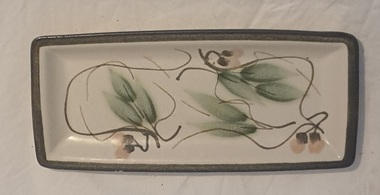
Ceramic - Artwork - Ceramics, Ian Cook, Plate by Ian F. Cook
... ...gum blossom...A ceramic plate with leaf and gum blossom design. ...COOK Studio potter in Geelong. ian cook ceramics studio pottery ian f. cook Australian studio ceramics gum blossom A ceramic plate with leaf and gum blossom design. ...Ian F. COOK Studio potter in Geelong.A ceramic plate with leaf and gum blossom design. ian cook, ceramics, studio pottery, ian f. cook, australian studio ceramics, gum blossom -
 Ballarat Heritage Services
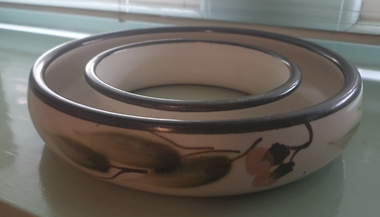
Ceramic - Artwork - Ceramics, Float Bowl by Ian F. Cook
... ...gum blossom...A ceramic float bowl with leaf and gum blossom design. ...COOK Studio potter in Geelong. ian cook ceramics studio pottery ian f. cook Australian studio ceramics gum blossom A ceramic float bowl with leaf and gum blossom design. ...Ian F. COOK Studio potter in Geelong.A ceramic float bowl with leaf and gum blossom design. ian cook, ceramics, studio pottery, ian f. cook, australian studio ceramics, gum blossom -
 Ballarat Heritage Services
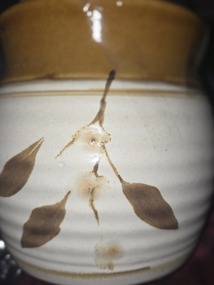
Photograph - Australian Studio Pottery, Lidded cannister by Old Ballarat Pottery
... ...gum blossom...Colour photograph of a lidded cannister by Old Ballarat Pottery, with leaves and gum blossom depicted in glaze....Old Ballarat Pottery gum blossom lidded vessel Australian Studio Pottery ceramics Colour photograph of a lidded cannister by Old Ballarat Pottery, with leaves and gum blossom depicted in glaze. ...Colour photograph of a lidded cannister by Old Ballarat Pottery, with leaves and gum blossom depicted in glaze.old ballarat pottery, gum blossom, lidded vessel, australian studio pottery, ceramics -
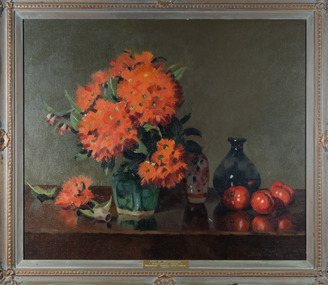 Kingston Arts
Painting, Judith Wills, Gum Blossom, 1981
... Gum Blossom...Gum Blossom Painting Judith Wills ... -
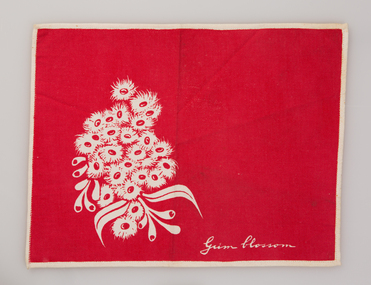 Ararat Gallery TAMA
Frances Burke, Gum Blossom (place mat), c. 1955
... Gum Blossom (place mat)...Written by Nanette Carter and Robyn Oswald-Jacobs. Gum Blossom (place mat) Frances Burke ...Frances Burke: Designer of Modern Textiles Australia’s most influential and celebrated textile designer of the mid-20th century, Frances Burke (1904-1994), employed Australian native flora, garden flowers, marine subjects, Indigenous culture and increasingly, abstract motifs in her stunning modern fabrics. A confident, determined designer and businesswoman; Burke made the shift from fine art to design in 1937. While she began by designing dress fabrics for Melbourne’s fashionable Georges Department store, printing them on linen using lino blocks, she was an early adopter of the screen-printing process and during the war years began printing on cotton. Burke’s furnishing fabrics took their place in influential modern buildings Australia-wide through collaborations with leading architects and interior designers. They included Robin Boyd’s 1949 House of Tomorrow, Roy Grounds’ Quamby flats, Guilford Bell’s Royal Hayman Island Resort for Ansett Airlines, and Yuncken, Freeman Brothers, Griffiths and Simpson’s Canberra Civic Centre Theatre. In the post-war period, Burke made regular trips to the United States and Europe, on her return advising homeowners and manufacturers on the latest trends in products, colours and home design in lectures and interviews. At New Design her fabric showroom and interior design consultancy Burke introduced furniture by emerging designers Clement Meadmore and Grant Featherston in the early 1950s and presented local and imported homewares, mostly from the United States. She was enthusiastic about the convenient and comfortable lifestyle experienced by ordinary American women. Her fabrics and advice were regularly featured in Australian Home Beautiful, Australian House and Garden and the newspapers of the day. Some of Burke’s designs had remarkable longevity. Tiger Stripe (1938) for example, continued to be produced in a wide range of colours until 1970 and Crete (1946) remained a popular choice for interiors into the 1960s. Drawing from a rich variety of sources including Indigenous culture in Goanna (c.1954) and Pacific Island tapa cloth designs in Bird and Tree (1940), Burke also looked to Japan in designs such as Plum Blossom (1948) and Zen (1965). She loved exploring the potential of native flora, seen in designs including Waratah (1955) and Flannel Flower (1955), while garden flowers were the source for many other designs including Belladonna (1940), Periwinkle (n.d.) and Rose (1947). Burke’s clever interplay of a single striking printed colour with lively gestural lines revealing the white base fabric, gave her designs a vibrancy that characterised the optimistic post-war era. This can be seen in Burke’s fabrics for Hayman Island including Angel Fish and Seapiece (both 1949) which expressed the freshness and excitement of the luxurious new tropical resort and led to further commissions. Burke’s three decades in business (1937-1970) were an unparalleled success in the story of Australian design. Her fabrics have been collected by the NGA, the Powerhouse Museum, NGV, RMIT Design Archives and Sydney Living Museums in addition to Ararat Gallery TAMA. Written by Nanette Carter and Robyn Oswald-Jacobs. -
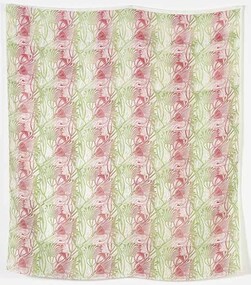 Wangaratta Art Gallery
Textile, Christine Upton, Gum Blossoms, 1989-1992
... A repetitive pattern of gum blossoms that has been printed on a rectangular piece of pure silk twill in green and red ink by a lino block....Gum Blossoms Textile Christine Upton ...The inks used were fabric printing inks and two colours were applied at the one time on the same roller, the roller being inked with green on one side and red on the other. The roller was a sponge paint roller 100mm wide. The technique used was 'soft bed release'. This is where the fabric is placed over a soft bed (woolen blanket with cotton overlay) and the inked block is placed on top of the fabric, then body weight is applied to the back of the block by placing the hands on the block and transferring weight through the body and into the hands. The block is then lifted and the process starts allover again.Rural City of Wangaratta CollectionA repetitive pattern of gum blossoms that has been printed on a rectangular piece of pure silk twill in green and red ink by a lino block.wangaratta art galley, print, lino block, flora, gum, christine upton, textile, australian flora -
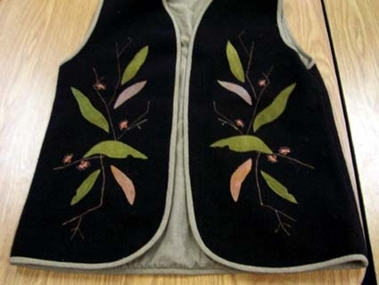 Whitehorse Historical Society Inc.
Clothing - Vest, 1983
... Both fronts are decorated with embroidered gum blossom and appliqued gum leaves in green and brown with blossom in pink and cream....Both fronts are decorated with embroidered gum blossom and appliqued gum leaves in green and brown with blossom in pink and cream. ...Made by Heather Hillier for donor, Wendy Standfield1983 Black felt vest lined with gold/grey cotton. Both fronts are decorated with embroidered gum blossom and appliqued gum leaves in green and brown with blossom in pink and cream.costume, female -
 Tatura Irrigation & Wartime Camps Museum
Pamphlet - The Murray Darling Basin map, flora and fauna and general information, The Murray Darling Basin Pamphlet
... A3 size folded colour pamphlet, Murray Darling Basin with gum blossoms anf photos taken in various places along the rivers. ...Murray Darling Basin A3 size folded colour pamphlet, Murray Darling Basin with gum blossoms anf photos taken in various places along the rivers. ...A3 size folded colour pamphlet, Murray Darling Basin with gum blossoms anf photos taken in various places along the rivers. Folds out to a section with photos and general info about the basin. Folds againto centre with map, and pictures of indigenous birds and animals. Rear has more information, plus a picture of Quandong sprig and trout cod fish. Also on display Murray Darling Basin -
 Embroiderers Guild, Victoria
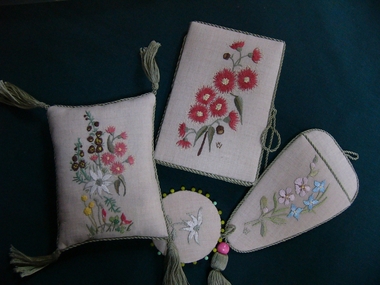
Textile - Chatelaine, Miss Kath Wilson, Thelma Crawford Design, 1970
... Motifs are executed with one strand of stranded cotton A) Needlecase, spray of deep pink flowering gum (12 x 8 cms) B) Pincushion, spray of Boronia, gum blossom, flannel flower, billy buttons and running postman (11 x 8 cms) C) Scissors case, spray of correa (12 cms) D) Pin holder flannel flower (6cm diameter) ...Motifs are executed with one strand of stranded cotton A) Needlecase, spray of deep pink flowering gum (12 x 8 cms) B) Pincushion, spray of Boronia, gum blossom, flannel flower, billy buttons and running postman (11 x 8 cms) C) Scissors case, spray of correa (12 cms) D) Pin holder flannel flower (6cm diameter) Thelma Crawford Design Textile Chatelaine Miss Kath Wilson ...The designs were adapted from Thelma Crawfords Australian wildflower designs and pieces were made for a Guild exhibition at George's in the early 1970's. Aeroplane linen was used on aeroplanes before and during the war.The embroidery is done on "Aeroplane Linen" i.e. fine linen. (Actually used on aeroplanes). Motifs are executed with one strand of stranded cotton A) Needlecase, spray of deep pink flowering gum (12 x 8 cms) B) Pincushion, spray of Boronia, gum blossom, flannel flower, billy buttons and running postman (11 x 8 cms) C) Scissors case, spray of correa (12 cms) D) Pin holder flannel flower (6cm diameter) embroidery, small articles, 1960-80, australia, surface stitchery -
 Royal Brighton Yacht Club
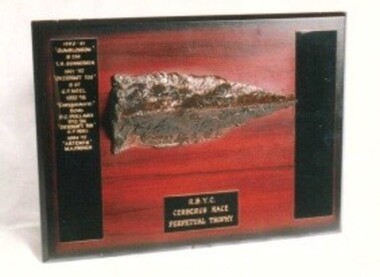
Trophy, Cerberus Trophy
... The actual trophy is made from timber taken from the deck of the Cerberus. First Winner: Gum Blossom, T. Gunnerson 1990/91 ...The actual trophy is made from timber taken from the deck of the Cerberus. First Winner: Gum Blossom, T. Gunnerson 1990/91 Cerebrus RYCV Black Rock Cerberus Trophy Trophy ...Cerberus Trophy Donor : Deed of Gift: No For several years at the end of the season, the yachts Dystiny and Phantom had a picnic race to the Cerberus located at Black Rock. This was later taken up by the RBYC and became the end-of-season race for all RBYC yachts. The clubs’ staff set up a BBQ and bar on the deck of the Cerberus and a great time was had by all prior to returning to the RBYC. Later when the Cerberus became too dangerous to board, the destination was changed to a laid mark north of the wreck with the race finishing at the RBYC tower. The BBQ continues and is organised by the race management team. The actual trophy is made from timber taken from the deck of the Cerberus. First Winner: Gum Blossom, T. Gunnerson 1990/91 cerebrus, rycv, black rock -
 City of Greater Bendigo - Civic Collection
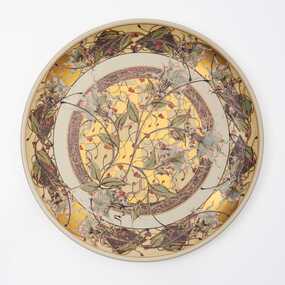
Artwork, other - Platter, Peter Minko, 2000
... Hand thrown, burnished, porcelain platter with central checked gold and cream under pattern overlaid with a combination of decals and hand painted gum leaf and pink blossom design. ...Minko / (signature) / Bendigo / Australia / 2000 Hand thrown, burnished, porcelain platter with central checked gold and cream under pattern overlaid with a combination of decals and hand painted gum leaf and pink blossom design. Artwork, other Platter Peter Minko ...Peter Minko is a ceramic artist based in Bendigo, Victoria. His hand-thrown works using a fine porcelain body are usually a combination of burnished and bisque-fired ith hand-painted metallic oxides and sometimes fired a third time to apply gold or platinum to the design. He began potting in 1977 and has built a strong reputation as a porcelain artist, with work being commissioned by the Federal Government for official presentations and his designs being used by Australian Fine China for a range of dinnerware. Hand thrown, burnished, porcelain platter with central checked gold and cream under pattern overlaid with a combination of decals and hand painted gum leaf and pink blossom design. Minko / (signature) / Bendigo / Australia / 2000 -
 8th/13th Victorian Mounted Rifles Regimental Collection
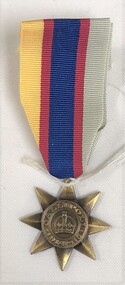
Medal - Gallipoli medal
... The colours of the ribbon are blue, representing the ocean, gold, representing Australian Wattle, silver grey, representing New Zealand fern, and red for the colour of Australian gum blossom and the New Zealand Rata flower....The colours of the ribbon are blue, representing the ocean, gold, representing Australian Wattle, silver grey, representing New Zealand fern, and red for the colour of Australian gum blossom and the New Zealand Rata flower. medal gallipoli World War One WWI Gallipoli Star is a star shaped medal with raised crown at centre suspended on a coloured ribbon. ...The Gallipoli Star and its ribbon were designed in 1917 by R K Peacock, but official approval from King George V for the proposed campaign medal was withdrawn after the ribbon, but not the medal, had been manufactured, because it was to have been presented only to Australians and New Zealanders, but not British or other Empire soldiers involved in the campaign. Some Anzac veterans are known to have been issued with lengths of ribbon during the war in anticipation of the medal's production. In 1990, Mr Ross Smith, a former Australian Army Warrant Officer and Vietnam veteran, arranged, at his own expense, for dies from the original design to be manufactured, and for A J Parkes & Co Pty Ltd, of Brisbane, to strike 1000 examples of the medal. 200 of these stars were presented to surviving Australian and New Zealand Gallipoli veterans to mark the 75th anniversary of the campaign. The remainder were sold to the public. A further 1000 were later struck for sale to collectors. The design features an eight pointed star, representing the states and territories of Australia (seven points) and New Zealand. The colours of the ribbon are blue, representing the ocean, gold, representing Australian Wattle, silver grey, representing New Zealand fern, and red for the colour of Australian gum blossom and the New Zealand Rata flower.Gallipoli Star is a star shaped medal with raised crown at centre suspended on a coloured ribbon.medal, gallipoli, world war one, wwi -
 Wangaratta RSL Sub Branch
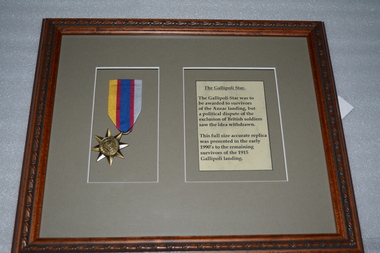
Medal - Framed Medal, Gallipoli Star, C1917
... The colours of the ribbon are blue, representing the ocean, gold, representing Australian Wattle, silver grey, representing New Zealand fern, and red for the colour of Australian gum blossom and the New Zealand Rata flower. ...The colours of the ribbon are blue, representing the ocean, gold, representing Australian Wattle, silver grey, representing New Zealand fern, and red for the colour of Australian gum blossom and the New Zealand Rata flower. This full size accurate replica was presented in the early 1990's to the remaining survivors of the 1915 Gallipoli landing. ...The Gallipoli Star and its ribbon were designed in 1917 by R K Peacock, but official approval from King George V for the proposed campaign medal was withdrawn after the ribbon, but not the medal, had been manufactured, because it was to have been presented only to Australians and New Zealanders, but not British or other Empire soldiers involved in the campaign. Some Anzac veterans are known to have been issued with lengths of ribbon during the war in anticipation of the medal's production. In 1990, Mr Ross Smith, a former Australian Army Warrant Officer and Vietnam veteran, arranged, at his own expense, for dies from the original design to be manufactured, and for A J Parkes & Co Pty Ltd, of Brisbane, to strike 1000 examples of the medal. 200 of these stars were presented to surviving Australian and New Zealand Gallipoli veterans to mark the 75th anniversary of the campaign. The remainder were sold to the public. A further 1000 were later struck for sale to collectors. The design features an eight pointed star, representing the states and territories of Australia (seven points) and New Zealand. The colours of the ribbon are blue, representing the ocean, gold, representing Australian Wattle, silver grey, representing New Zealand fern, and red for the colour of Australian gum blossom and the New Zealand Rata flower. This full size accurate replica was presented in the early 1990's to the remaining survivors of the 1915 Gallipoli landing. The Gallipoli Star Medal 1914-1915 was to be awarded to survivors of the Anzac landing but a political dispute of the exclusion of British Soldiers saw the idea withdrawn. Timber look frame containing medal on yellow/blue/red ribbon and paper with black writing on grey cardboard surround.gallipoli star, medal, 1914-1915 -
 City of Greater Bendigo - Civic Collection
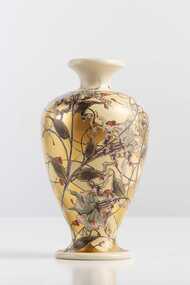
Artwork, other - Vase, Peter Minko, 2000
... Heavily decorated with checked gold and cream under pattern overlaid with a combination of decals and hand painted gum leaf and pink blossom design. Interior glazed with tenmoku glaze. ...Heavily decorated with checked gold and cream under pattern overlaid with a combination of decals and hand painted gum leaf and pink blossom design. Interior glazed with tenmoku glaze. ...Peter Minko is a ceramic artist based in Bendigo, Victoria. His hand-thrown works using a fine porcelain body are usually a combination of burnished and bisque-fired ith hand-painted metallic oxides and sometimes fired a third time to apply gold or platinum to the design. He began potting in 1977 and has built a strong reputation as a porcelain artist, with work being commissioned by the Federal Government for official presentations and his designs being used by Australian Fine China for a range of dinnerware. Hand thrown, burnished porcelain vase. Amphora shape with lip and thin neck. Heavily decorated with checked gold and cream under pattern overlaid with a combination of decals and hand painted gum leaf and pink blossom design. Interior glazed with tenmoku glaze. Minko / (signature) / Bendigo / Australia / 2000 -
 City of Greater Bendigo - Civic Collection
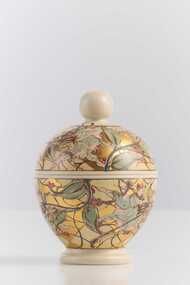
Artwork, other - Lidded vessel, Peter Minko, 2000
... Checked gold and cream under pattern overlaid with a combination of decals and hand painted gum leaf and pink blossom design. Interior glazed with tenmoku glaze. ...Checked gold and cream under pattern overlaid with a combination of decals and hand painted gum leaf and pink blossom design. Interior glazed with tenmoku glaze. ...Peter Minko is a ceramic artist based in Bendigo, Victoria. His hand-thrown works using a fine porcelain body are usually a combination of burnished and bisque-fired ith hand-painted metallic oxides and sometimes fired a third time to apply gold or platinum to the design. He began potting in 1977 and has built a strong reputation as a porcelain artist, with work being commissioned by the Federal Government for official presentations and his designs being used by Australian Fine China for a range of dinnerware. Hand thrown, round body, footed and lidded vessel. Decorated directly onto the burnished porcelain surface. Checked gold and cream under pattern overlaid with a combination of decals and hand painted gum leaf and pink blossom design. Interior glazed with tenmoku glaze. Minko / (signature) / Bendigo / Australia / 2000 -
 Embroiderers Guild, Victoria
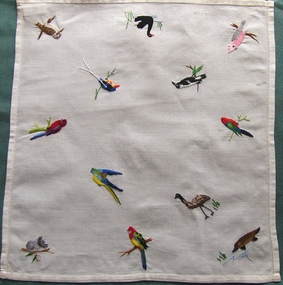
Accessory - Six Geoff Riley Design Handkerchiefs, Geoff Riley, 1930-50?
... Motifs - flannel flower, gum blossom, geralton wax flower, spider orch, fringed lily, leschenauther, sturt desert pea, blue tinsel lily and flox lily. ...Motifs - flannel flower, gum blossom, geralton wax flower, spider orch, fringed lily, leschenauther, sturt desert pea, blue tinsel lily and flox lily. ...Six embroidered motif samplers. Motifs designed by Geoff Riley and gifted to the Guild from the estate of the late Dulcie Fone, via her niece Mrs Lana Newton and her solicitor to Miss Dorothy Weaver.A. Cream cotton, machine hemstitched handkerchief. Motifs - playpus, koala, emu, black swan, kookaburra, galah, magpie, white tailed king fisher andfour parrots, crimson rosella, king parrot, turquoise parrot and eastern rosella, 30 x 28 cms. Work marked No. 1. B. Cream cotton, machine hemstitched handkerchief, motifs - 2 x kangaroos, pair of penquins, pair of bugerigars, bee eater bird, red breasted robin, purple crowned wren, blue wren, gouldian finch, scarlet honeyeater. Ink marked No. 2 29.5 x 28 cms. C. Cream cotton, machine hemstitched handkerchief. Motifs, warratah, blue sun orchid, ti-tree. Ink marked No. 3 29 x 28.5 cms D. Cream cotton, machine hemstitched handkerchief. Motifs - kangaroo paw, correa, blue water lily, grevillea, chorizema flat pea, a pink flower and three unworked stamped flower motifs. Ink marked No. 4 29 x 28.5 cms E. Cream linen, crocheted edged handkerchief. Motifs - flannel flower, gum blossom, geralton wax flower, spider orch, fringed lily, leschenauther, sturt desert pea, blue tinsel lily and flox lily. Ink marked No. 5, 28 x 29 cms F. Cream cotton, machine hemstitched handkerchief. Motifs - boronia, spider orchid, blue tinsel lily, red centred mauve hibiscus, Tasmanian appleberry. Ink marked No. 6, 29 x 28 cmsembroidery, surface embroidery, handkerchiefs, geoff riley, 1940-60, australia, sampler -
 Surrey Hills Historical Society Collection
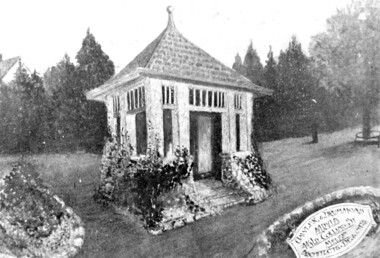
Photograph, Artist's impression of The Shrine in the Surrey Gardens
... It was one of the first WW1 memorials to be built and is noted for its use of Australian motifs, wattle blossom and gum leaves. The boomerang over the full width of the monument was said to be symbolic of both those who did and did not return. ...It was one of the first WW1 memorials to be built and is noted for its use of Australian motifs, wattle blossom and gum leaves. The boomerang over the full width of the monument was said to be symbolic of both those who did and did not return. ...The photo comes from a souvenir brochure printed for the dedication of The Shrine on 7 April 1918, a copy of which is also held in the collection.. The Shrine was opened on Sunday 7 April 1918. Mrs C H D Steele, President of the local Patriotic League, is credited with the idea of building The Shrine as a fitting memorial to the WW1 soldiers of the district. The Surrey Hills Progress Association coordinated raising funds from local residents. John Kendrick Blogg carved the beautiful honor roll in Indian teak and Australian white mahogany and the design of the Shrine was by John Stevens Gawler, architect of Gawler & Drummond. Both men donated their services. It was one of the first WW1 memorials to be built and is noted for its use of Australian motifs, wattle blossom and gum leaves. The boomerang over the full width of the monument was said to be symbolic of both those who did and did not return. Surrey Hills Progress Association coordinated fundraising to build the memorial. There is a bound copy of a history of The Shrine by Robin Doble in the collection.Black & white photo of the artist's impression of The Shrine in the Surrey Gardens. surrey gardens, john kendrick blogg (mr), surrey hills progress association, john stevens gawler, gawler and drummond, the shrine, war memorials, sarah margaret russell (miss), sarah margaret steele (mrs), mrs charles henry dillon steele -
 Surrey Hills Historical Society Collection
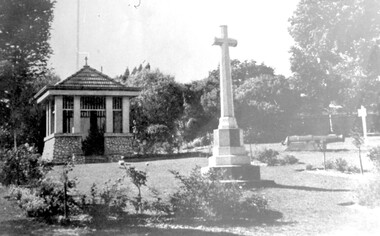
Photograph, City of Camberwell Council, Surrey Gardens, looking east from Union Road, 1933
... Its Honor Roll is also a noted example of sculptor John Kendrick Blogg's work and valued especially for its incorporation of Australian motifs, wattle blossom and gum leaves. The boomerang over the full width of the monument was said to be symbolic of both those who did and did not return. surrey gardens shrine of remembrance monuments and memorials boer war cannons Mr john gawler john kendrick blogg arthur brooks mrs charles steele mrs sarah steele miss sarah margaret russell Black and white photo of part of the Surrey Gardens, located between Union Road and Norfolk Road, Surrey Hills. ...The Honor Roll and Shrine in the Surrey Gardens were opened on Sunday 7 April 1918, prior to the cessation of fighting. Mrs Charles H D Steele (MS: Sarah Margaret Russell), president of the local Patriotic League, is credited with the idea of building The Shrine as a fitting memorial to the soldiers of the district. The Surrey Hills Progress Association coordinated raising funds from local residents. John Kendrick Blogg carved the beautiful honor roll in Indian teak and Australian white mahogany and the design of The Shrine was by architectural firm Gawler & Drummond. John Stevens Gawler was a partner in the firm, lived locally and also enlisted. Although he may have been overseas during some of the design process he is often credited with the design. Both men donated their services. The 2 cannons in the gardens were acquired by Mr Arthur Brookes in 1901 to commemorate the end of the Boer War. He was popularly known as 'Empire Brooks' and the cannons as 'Brooks' Babies'. They were originally placed in the grounds of the Guildford Road Recreation Oval. Arthur Brooks was an active community member and one of the founding members of the Surrey Hills Progress Association. Original photo was contained in a booklet printed by Camberwell Council in 1933.This is one of the earliest known photos of 3 elements important in designating the Surrey Gardens as one of the City of Boroondara's heritage gardens, now protected by a heritage overlay. The Shrine was one of the first WW1 memorials to be built in Australia and possibly the first in Victoria. It was unveiled prior to the end of hostilities and was built entirely through local community effort. The design of The Shrine, reflective of domestic architecture, is unusual. Its Honor Roll is also a noted example of sculptor John Kendrick Blogg's work and valued especially for its incorporation of Australian motifs, wattle blossom and gum leaves. The boomerang over the full width of the monument was said to be symbolic of both those who did and did not return. Black and white photo of part of the Surrey Gardens, located between Union Road and Norfolk Road, Surrey Hills. It shows The Shrine, the cannons installed to commemorate the end of the Boer War and the Memorial Cross. Taken from within the park looking east. surrey gardens, shrine of remembrance, monuments and memorials, boer war, cannons, mr john gawler, john kendrick blogg, arthur brooks, mrs charles steele, mrs sarah steele, miss sarah margaret russell -
 University of Melbourne, Burnley Campus Archives
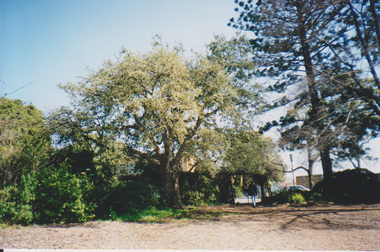
Album, Sandra Pullman, National Estate/Heritage Register Photographs, 2001
... Photograph Album sent in with the National Estate/Heritage Register by Sandi Pullman. (1) Old car park (Bull Paddock) with Cork Oak. (2) Main Building front steps. (3) Main Building with Magnolia grandiflora. (4)View of Luffmann Ponds and old willow. (5) View of Ginkgo and Emily Gibson bed. (6) Looking between Emily Gibson beds to English Oak. (7) Summer House. (8) Luffmann Ponds. (9) Bergenia Walk with conifers. (10) View of Pencil Pines around entrance to Sunken garden. (11) Luffmann Ponds and Pinus canariensis. (12) View of entrance to Sunken garden. (13-14) Sunken garden. (15) Original terracing at entrance to Shady Walk. (16) Pears in blossom in Field Station. (17) Agathis robusta from the Herb Garden. (18) Ellis Stones Rock garden newly replanted. (19) james Hitchmough Grasslands. (20) Elm tree with Dairy in the background. (21) Original Red Gum in james Hitchmough Grasslands. (22) Kath Deery Native garden. (23-24) Rose Garden. (25) Sequoiadendron giganteum....national estate heritage register sandi pullman sandra pullman bull paddock cork oak magnolia luffmann ponds willow ginkgo emily gibson bed english oak summer house bergenia walk conifers pencil pines sunken garden pinus canariensis shady walk pears blossoms field station agathis robusta herb garden ellis stones rock garden james hitchmough grasslands elm tree dairy red gum kath deery native garden rose garden sequoiadendron giganteum. ...Photograph Album sent in with the National Estate/Heritage Register by Sandi Pullman. (1) Old car park (Bull Paddock) with Cork Oak. (2) Main Building front steps. (3) Main Building with Magnolia grandiflora. (4)View of Luffmann Ponds and old willow. (5) View of Ginkgo and Emily Gibson bed. (6) Looking between Emily Gibson beds to English Oak. (7) Summer House. (8) Luffmann Ponds. (9) Bergenia Walk with conifers. (10) View of Pencil Pines around entrance to Sunken garden. (11) Luffmann Ponds and Pinus canariensis. (12) View of entrance to Sunken garden. (13-14) Sunken garden. (15) Original terracing at entrance to Shady Walk. (16) Pears in blossom in Field Station. (17) Agathis robusta from the Herb Garden. (18) Ellis Stones Rock garden newly replanted. (19) james Hitchmough Grasslands. (20) Elm tree with Dairy in the background. (21) Original Red Gum in james Hitchmough Grasslands. (22) Kath Deery Native garden. (23-24) Rose Garden. (25) Sequoiadendron giganteum.national estate, heritage register, sandi pullman, sandra pullman, bull paddock, cork oak, magnolia, luffmann ponds, willow, ginkgo, emily gibson bed, english oak, summer house, bergenia walk, conifers, pencil pines, sunken garden, pinus canariensis, shady walk, pears, blossoms, field station, agathis robusta, herb garden, ellis stones rock garden, james hitchmough grasslands, elm tree, dairy, red gum, kath deery native garden, rose garden, sequoiadendron giganteum. -
 Wimmera Mallee Pioneer Museum, Jeparit
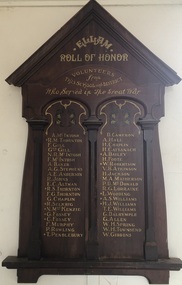
Honour Board - Ellam State School World War 1 Honor Roll, Post-1918
... Small depictions of eucalyptus leaves and gum nuts or wattle blossom....Small depictions of eucalyptus leaves and gum nuts or wattle blossom. Wooden World War 1 Honour Board housed in the Detpa School Museum, Wimmera Mallee Pioneer Museum, Honour Board Ellam State School World War 1 Honor Roll ...This board was originally held in the Ellam School, north of Jeparit, and transferred to the Wimmera Mallee Pioneer Museum most likely in the early 1970s.Highly significant to the Ellam community post World War 1.Wooden World War 1 Honour Board housed in the Detpa School Museum, Wimmera Mallee Pioneer Museum, Jeparit. Inscription in gold lettering reads "Volunteers from this school and district who servied in The Great War' along with 42 names of enlistees including 12 who were killed. Small depictions of eucalyptus leaves and gum nuts or wattle blossom.ww1, ellam, honour rolls
