
Showing 6 items matching "h.m.s. prince of wales"
-
 Waverley RSL Sub Branch
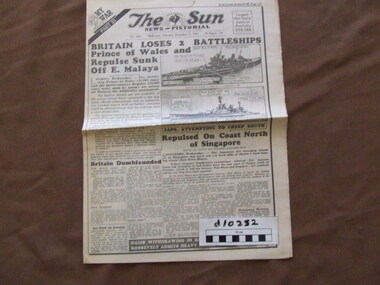
News Paper, The Sun News Pictorial, Dec 11 1941
... H.M.S. Prince of Wales...Reprint of the front page of the Melbourne "Sun News Pictorial'" Headline news Loss of H.M.S. Prince of Wales and Repulse...Reprint of the front page of the Melbourne "Sun News Pictorial'" Headline news Loss of H.M.S. Prince of Wales and Repulse...Reprint of the front page of the Melbourne "Sun News Pictorial'" Headline news Loss of H.M.S. Prince of Wales and Repulse H.M.S. Prince of Wales H.M.S. ...Reprint of the front page of the Melbourne "Sun News Pictorial'" Headline news Loss of H.M.S. Prince of Wales and RepulseReprint of the front page of the Melbourne "Sun News Pictorial'" Headline news Loss of H.M.S. Prince of Wales and RepulseSun News Pictorialh.m.s. prince of wales, h.m.s. repulse -
 Mission to Seafarers Victoria
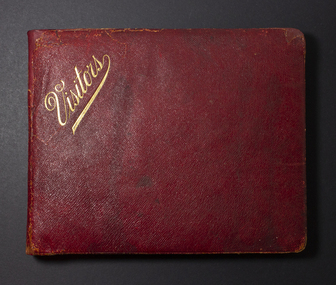
Administrative record (item) - Visitor logbook, Visitors, 1907 - 1951
... h.m.s-renown...duke of gloucester...chaplain conferences...catherine florence aviss nee frampton...martin frampton...elizabeth frampton...herbert aviss...prince of wales...The book also documents a visit from Edward, Prince of Wales in 1920, travelling on the H.M.S "Renown". Significant national and international visitors throughout the first half of the 20th Century range from the royal, Vice regal and political through to international Members of the Mission to Seafarers, participants in diocesan conferences and AGMs. signatures handwriting 1907-1951 h.m.s-renown duke of gloucester chaplain conferences catherine florence aviss nee frampton martin frampton elizabeth frampton herbert aviss prince of wales duchess of gloucester seafarers sailors seamen prince edward opening ceremony edward northcote (1854-1926) Printed in gold on the front cover: VISITORS; First name registered and handwritten: "Northcote" in black ink ; Last name entered "Paul Morra" A small book with padded covers are red faux or very thin morrocco leather, stamped in gold across upper left corner with the word "Visitors"' . ...The book was used as a visitors book for the early Mission to Seafarers. The first date in the book is the 13th of December, 1907, although there are almost six pages of signatures before this. The last signature is dated the 28th of June, 1951. The book documents some of the most significant moments of the Central Institute: - the Opening Ceremony of the "new" Mission to Seafarers building in September 1917. - the signature of HRH Edward, then Prince of Wales, and a newspaper clipping, detailing his visit, during has Australian tour in 1920. - the visit by the Governors General including HRH the Duke and Duchess of Gloucester in 1945. Also registered: the Australian Chaplains conference attendees of both 1936 and 1949. Many supporters, ladies from the Guild and seafarers signed the book.The book is a significant record of VIP visitors to the Mission to Seafarers 1907 to 1951. It records respective Opening Ceremonies for Mission Buildings of both 1907 and 1917 and attendees. The book also documents a visit from Edward, Prince of Wales in 1920, travelling on the H.M.S "Renown". Significant national and international visitors throughout the first half of the 20th Century range from the royal, Vice regal and political through to international Members of the Mission to Seafarers, participants in diocesan conferences and AGMs.Printed in gold on the front cover: VISITORS; First name registered and handwritten: "Northcote" in black ink ; Last name entered "Paul Morra"signatures, handwriting, 1907-1951, h.m.s-renown, duke of gloucester, chaplain conferences, catherine florence aviss nee frampton, martin frampton, elizabeth frampton, herbert aviss, prince of wales, duchess of gloucester, seafarers, sailors, seamen, prince edward, opening ceremony, edward northcote (1854-1926) -
 4th/19th Prince of Wales's Light Horse Regiment Unit History Room
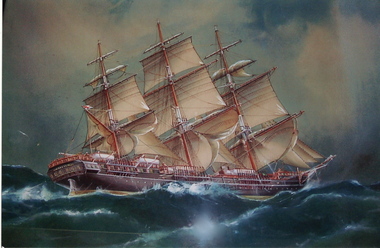
Print, A V Gregory, HMS Susan, 1934 (exact)
... Prince of Wales’s Light Horse Regiment Museum. In 1862 the whole of the Victorian Horse was amalgamated into one Regiment: The Prince of Wales Light Horse. Samuel Windridge rose to the rank of Lieutenant Colonel in the Kyneton Troop of the regiment. He died in 1896, aged 79 years, This painting is a gift from his Great Grand-daughters Mrs Mary Hopper and Miss Jean Baldwin. paintings kyneton prints hms susan samuel windridge a v gregory A V Gregory on proper left bottom corner of print On bottom right of print: H.M.S Susan 'Southward of the Cape' Arrived in Sydney Feby 1836 Framed reproduction of painting of HMS Susan. ...HMS Susan sailed from the Port of London on the 23rd September 1835. She carried 394 male convicts and a guard of officers and 30 rank and file of the 28th (North Gloucestershire) regiment, arriving in Sydney on 8th February 1836. Samuel Windridge, who was born in Warwickshire in 1817, was a Private in the Regiment on board the ‘Susan’. He served in various places: Sydney, Moreton Bay (Brisbane) and Port Phillip (Melbourne). He was discharged from the Regiment in 1842 with the rank of Sergeant. After his marriage he settled in Victoria and by 1852 he was often in charge of the gold escort from Bendigo. In 1854 he retired from the Gold Commission and settled in Kyneton. In 1860 the Kyneton Mounted Rifle Corps was formed with Samuel Windridge as one of its earliest members. In 1862 the ladies of Kyneton presented a standard to the Rifle Corps. In 1976 the Shire of Kyneton presented the Kyneton Colours to the 4th/19th Prince of Wales’s Light Horse Regiment Museum. In 1862 the whole of the Victorian Horse was amalgamated into one Regiment: The Prince of Wales Light Horse. Samuel Windridge rose to the rank of Lieutenant Colonel in the Kyneton Troop of the regiment. He died in 1896, aged 79 years, This painting is a gift from his Great Grand-daughters Mrs Mary Hopper and Miss Jean Baldwin. Framed reproduction of painting of HMS Susan. Wood frame, glass frontA V Gregory on proper left bottom corner of print On bottom right of print: H.M.S Susan 'Southward of the Cape' Arrived in Sydney Feby 1836paintings, kyneton, prints, hms susan, samuel windridge, a v gregory -
 Alfred Hospital Nurses League - Nursing History Collection
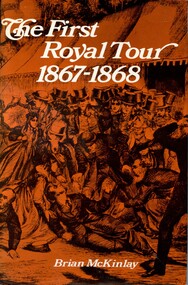
Book - Illustrated book, Rigby Limited, The first royal tour 1867-1868, 1970
... Prince Alfred, Duke of Edinburgh, second son of Queen Victoria and commander of H.M.S. Galatea, was en route from Europe. He landed in South Australia on a blazing November day, and he was welcomed with an exuberant Colonial loyalty which, as one of his equerries sniffly remarked "seemed ignorant of protocol." During his visits to South Australia, Victoria, Tasmania, New South Wales ...In July, 1867, the Australian colonies were electrified by the news that they were to be visited by royalty. Prince Alfred, Duke of Edinburgh, second son of Queen Victoria and commander of H.M.S. Galatea, was en route from Europe. He landed in South Australia on a blazing November day, and he was welcomed with an exuberant Colonial loyalty which, as one of his equerries sniffly remarked "seemed ignorant of protocol." During his visits to South Australia, Victoria, Tasmania, New South Wales, and Queensland, the Prince was swept along on a tide of frenzied enthusiasm. Each State tried to outdo the others in the splendour of its receptions and the garishness of its decorations. In Melbourne, a Free Banquet in honour of the Prince turned into a drunken fiasco. On the goldfields, he lunched down a mine and "helped himself rather liberally from a selection of nuggets. He was cheered by convicts in Tasmania, wrangled over by Queensland politicians and bombarded with bouquets, Declarations of Loyalty, and innumerable speeches. Surrounded by city fathers, Bishops, brass bands, fireworks and uproarious multitudes, he went from one triumph to another. Finally, he was shot in Sydney, and his recovery was accompanied by even more passionate demonstrations of loyalty. These were inflamed by revulsion against the would-be assassin, who was hurried to the gallows as the Prince sailed for home. His departure closed a colourful chapter in Australian history, of which the author writes with humour and gustoIllustrated book with dustjacket. Book has a blue cloth binding with title, author and publisher's name stamped in gilt on spine. Dustjacket has an orange and black print of the assassination attempt on Prince Alfred, Duke of Edinburgh in Sydney 1868. Title and author's name overprinted in white on front and spinenon-fictionIn July, 1867, the Australian colonies were electrified by the news that they were to be visited by royalty. Prince Alfred, Duke of Edinburgh, second son of Queen Victoria and commander of H.M.S. Galatea, was en route from Europe. He landed in South Australia on a blazing November day, and he was welcomed with an exuberant Colonial loyalty which, as one of his equerries sniffly remarked "seemed ignorant of protocol." During his visits to South Australia, Victoria, Tasmania, New South Wales, and Queensland, the Prince was swept along on a tide of frenzied enthusiasm. Each State tried to outdo the others in the splendour of its receptions and the garishness of its decorations. In Melbourne, a Free Banquet in honour of the Prince turned into a drunken fiasco. On the goldfields, he lunched down a mine and "helped himself rather liberally from a selection of nuggets. He was cheered by convicts in Tasmania, wrangled over by Queensland politicians and bombarded with bouquets, Declarations of Loyalty, and innumerable speeches. Surrounded by city fathers, Bishops, brass bands, fireworks and uproarious multitudes, he went from one triumph to another. Finally, he was shot in Sydney, and his recovery was accompanied by even more passionate demonstrations of loyalty. These were inflamed by revulsion against the would-be assassin, who was hurried to the gallows as the Prince sailed for home. His departure closed a colourful chapter in Australian history, of which the author writes with humour and gustohrh prince alfred duke of edinburgh, australia - description - travel 1860's, south africa - description - travel -1860's, voyages around the world -
 Bayside Gallery - Bayside City Council Art & Heritage Collection
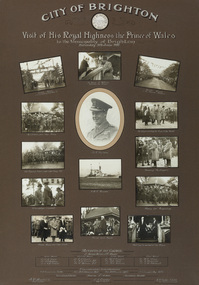
Photograph - gelatin silver photograph, Visit of His Royal Highness the Prince of Wales to the Municipality of Brighton, 1920
... prince of wales...his royal highness...hrh...royal tour...anzac hostel...brighton...mayor...cr. thomas wilson...j.h. taylor...town clerk...soldiers...diggers...crowd...guard of honour...captain grieve...h.m.s...Prince of Wales to City of Brighton on 5 June 1920. 13 photographs are rectangular and one portrait is oval, each with handwritten inscription below. The photographs from top to bottom, L to R: North Road looking easterly from New Street; The Mayor, Cr. Wilson, welcomes the Prince; North Road at the Anzac Hostel; The Children greet their Prince; H.R. Highness; The Mayor escorting the Prince to the Hostel; The Guard of Honor under Capt. Grieve, V.C.; H.M.S...Wales, nine days in Victoria, four days in Tasmania, eleven days in Western Australia, six days in South Australia and eight days in Queensland. On Saturday 5 June 1920, following a morning at the races in Flemington, the Prince spent the afternoon at ANZAC Hostel in Brighton, where he chatted to wounded soldiers and, according to the newspaper reports at the time, "won the hearts of all present." prince of wales his royal highness hrh royal tour anzac hostel brighton mayor cr. thomas wilson j.h. taylor town clerk soldiers diggers crowd guard of honour captain grieve h.m.s. renown north road kamesborough bayside Compilation of 14 gelatin silver photographs relating to the visit of HRH Prince of Wales to City of Brighton on 5 June 1920. 13 photographs are rectangular and one portrait is oval, each with handwritten inscription below. ...In 1920 the Prince of Wales embarked on a journey to Australia on behalf of his father, King George V. While the visit was intended to strengthen the relationship between Australia and the Empire, the main objective was to offer thanks to the Australian men and women for the sacrifices and contributions that they had made during World War I. The Royal Tour began in April 1920 and covered 110 cities and towns across the country. The Prince spent eleven days in New South Wales, nine days in Victoria, four days in Tasmania, eleven days in Western Australia, six days in South Australia and eight days in Queensland. On Saturday 5 June 1920, following a morning at the races in Flemington, the Prince spent the afternoon at ANZAC Hostel in Brighton, where he chatted to wounded soldiers and, according to the newspaper reports at the time, "won the hearts of all present."prince of wales, his royal highness, hrh, royal tour, anzac hostel, brighton, mayor, cr. thomas wilson, j.h. taylor, town clerk, soldiers, diggers, crowd, guard of honour, captain grieve, h.m.s. renown, north road, kamesborough, bayside -
 Whitehorse Historical Society Inc.
Document, Letter from 'H.M.S Renown', 16/08/1920 12:00:00 AM
... A letter from Edward, Prince of Wales addressed to Girls and Boys from H.M.S. Renown, Sydney....Addressed to Girls and Boys from H.M.S. Renown, Sydney. Edward Prince of Wales A letter from Edward, Prince of Wales. ...A letter from Edward, Prince of Wales.A letter from Edward, Prince of Wales addressed to Girls and Boys from H.M.S. Renown, Sydney.A letter from Edward, Prince of Wales. edward, prince of wales
