
Showing 7 items matching "haig family"
-
 Rutherglen Historical Society
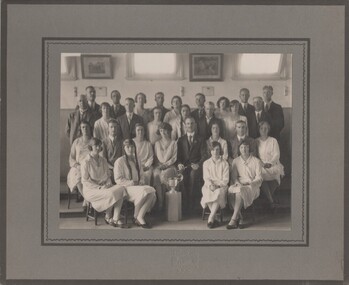
Image, Alf L. Bowden, The Studio, 1932
... ...haig family...steel family uren family heard family smith family small family edmondson family burch family campbell family quon family haig family denehy family backman family mudd family fern fullerton charles denehy bonwick family iggsten family ring family knowles family ready family Embossed on mount below photo: "Alf L. ...Black and white photograph, mounted on cardboard, of a group of men and women posing with a trophy.Embossed on mount below photo: "Alf L. Bowden, The Studio, Corowa, N.S.W." Written on back of mount: "Coral Society 1932 | From left back - W. Steel, F. Uren, Mrs Heard, Miss P Smith, J. Small, Miss J. Smith, ---, ---, second back row: Mr Edmondson, Miss L Burch, ---, Miss N Campbell, Miss A. Quon, Mr Haig, Miss M. Denehy, W. Backman: second row: Miss Mudd, ---, ---, Mrs P. Fullerton (accompanist), Col. C. Denehy (conductor), Miss K. Denehy, Dr Banwick, Mrs C. A. Iggsten; Front, ---, Miss M. Ring, Miss A Knowles, Miss M. Ready"steel family, uren family, heard family, smith family, small family, edmondson family, burch family, campbell family, quon family, haig family, denehy family, backman family, mudd family, fern fullerton, charles denehy, bonwick family, iggsten family, ring family, knowles family, ready family -
 Ringwood and District Historical Society
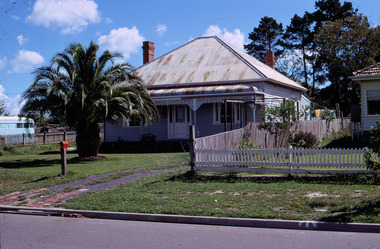
Photograph, North side of City Road, Ringwood 1969
... family at no. 17, which is on the corner of Regina St. From then on, City Rd, was a bush block down to Greenwood Ave, and the bush continued up Greenwood Ave to the Williams house, one house block from Haig St. ...family at no. 17, which is on the corner of Regina St. From then on, City Rd, was a bush block down to Greenwood Ave, and the bush continued up Greenwood Ave to the Williams house, one house block from Haig St. ...Written by Michael Anderson on RDHS Facebook on March 2016 CITY ROAD, RINGWOOD 1959 My family moved to City Road in 1959. At that time, it was a narrow rutted dirt road, with a large drain running on the northern side, and a wide nature strip complete with big wattle trees on the southern side, ideal for playing cricket and other games. There was no Salvation Army Citadel, nor was there a Lutheran Church. As you proceed from Wantirna Road towards Jubilee Park, there were no houses on the right hand side at all until you reached our house, 14 City Road, which at the time was Lot 51. On the corner where the Lutheran Church now stands, there was an old rusty farm gate, attached to a very weathered wooden post. This indicated that at some stage, City Road had been a private road. This rusty old gate was never closed, but it was a remnant of bygone days. Ireland St, Regina St, and Greenwood Avenue south of Haig Street were all narrow dirt roads as well. Jubilee Park Oval was fairly new, and there was no grandstand. The players and staff had to make do with a small wooden building that looked like a garden shed. Just beyond the southern end of the oval were growing many wild pumpkins, and I understand that the land had been a rubbish tip in the not so distant past. The park also had a couple of tennis courts. There was no road from Jubilee Park to Reilly St, and Reilly St didn't go all the way through from Wantirna Road to Great Ryrie St. It was broken by a creek. Aquinas College was an orchard. As you proceed up City Road from Wantirna Road, The Salvation Army church is on the left corner. The Hobbs family lived on that corner, in an old house on a block which was bordered by a huge hedge. The house next door in Wantirna Road, which is also Salvation Army land now, was owned by the Bayliss family. Mrs Bayliss was a teacher at Ringwood High. The first house in City Rd proper was at no. 1 to 5. The Roberts family lived there in an old weatherboard house on an acre of land. Mr Roberts was a carpenter who had built our house at No. 14, and he lived there with his wife and two sons, Graeme and Max. Eventually, they wanted more space, so they moved to the acre. Next door to the Roberts was Ted O'Regan at no. 7 to no. 9. He appears to have been a widower, and he lived by himself in an old wooden house which was surrounded by a large veranda on about 2/3 acre. Next door to Ted O'Regan lived his brother Jack O'Regan at no. 11 on about 1/2 acre, with his wife Edna, his son Alan, and his Daughter Judith. Barney Meadows lived on about 1/2 acre at no. 13. Barney was an old widower, and his front garden had a huge palm tree in it. Next to Barney lived the Reeves at no. 15, and finally there was the McDonald family at no. 17, which is on the corner of Regina St. From then on, City Rd, was a bush block down to Greenwood Ave, and the bush continued up Greenwood Ave to the Williams house, one house block from Haig St. On the right hand side of City Road it was all paddock to Ireland St, and another paddock which ended at our house was over the other side of Ireland St. Both paddocks were developed in about 1961/62, and there are about 12 houses there now, plus the Lutheran Church. When we first moved there, there was a horse and a cow grazing in the paddock beside our house. For the first couple of years, there was a huge bonfire in "our" paddock to mark Guy Fawkes day. It was a lot of fun, although I concede that it might have been a tad dangerous, with 3d. bungers and all that! Next door to us at no. 16 was the Goessling family. From now on the house blocks were normal sized. The Goesslings had one baby girl who was about 9 months old when we first moved in, but they ended up with 4 kids, all of whom would be middle aged now. They were observant Lutherans, but they were there before the church. Next door to the Goesslings at no. 18 was the Weir family on the corner of Regina St. On the other side of Regina St. at no. 20 was the Gowland family, and the last house in the street at no. 22 was owned by Arthur Johnston and his family. Arthur was an Ambulance Driver. Of course, many other people moved in and moved out in all those years. There was one particularly bad week for the street in June 1969. My brother Peter was killed in a work accident on Saturday 7th June. The next Wednesday 11th June Ted O'Regan, who lived diagonally opposite us died. Then on the next Saturday the 14th June, Ted Bell, who lived next door to us at no. 12 died from a heart attack at the age of 47. Three deaths in one week was a bit too much. It was eerie! Our old house is still standing, but I doubt for much longer. It was bought by people who wanted to develop it. Their plans were knocked back, so they sold it again. I would bet that in the not too distant future the house will be a piece of history. City Road was a paradise for kids when we moved in. We had lived in the inner suburbs, so the space and freedom were amazing for us "city slickers." I don't know where you could move to now if you wanted to bring up your children in a similar environment. Somehow, I don't think it would be possible. -
 Ringwood and District Historical Society
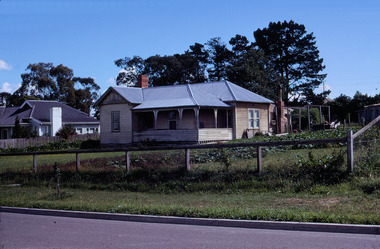
Photograph, City Road – North Side. Owned by E A (Ted) O’Regan on 23 March 1969
... family at no. 17, which is on the corner of Regina St. From then on, City Rd, was a bush block down to Greenwood Ave, and the bush continued up Greenwood Ave to the Williams house, one house block from Haig St. ...family at no. 17, which is on the corner of Regina St. From then on, City Rd, was a bush block down to Greenwood Ave, and the bush continued up Greenwood Ave to the Williams house, one house block from Haig St. ...Written by Michael Anderson on RDHS Facebook on March 2016 CITY ROAD, RINGWOOD 1959 My family moved to City Road in 1959. At that time, it was a narrow rutted dirt road, with a large drain running on the northern side, and a wide nature strip complete with big wattle trees on the southern side, ideal for playing cricket and other games. There was no Salvation Army Citadel, nor was there a Lutheran Church. As you proceed from Wantirna Road towards Jubilee Park, there were no houses on the right hand side at all until you reached our house, 14 City Road, which at the time was Lot 51. On the corner where the Lutheran Church now stands, there was an old rusty farm gate, attached to a very weathered wooden post. This indicated that at some stage, City Road had been a private road. This rusty old gate was never closed, but it was a remnant of bygone days. Ireland St, Regina St, and Greenwood Avenue south of Haig Street were all narrow dirt roads as well. Jubilee Park Oval was fairly new, and there was no grandstand. The players and staff had to make do with a small wooden building that looked like a garden shed. Just beyond the southern end of the oval were growing many wild pumpkins, and I understand that the land had been a rubbish tip in the not so distant past. The park also had a couple of tennis courts. There was no road from Jubilee Park to Reilly St, and Reilly St didn't go all the way through from Wantirna Road to Great Ryrie St. It was broken by a creek. Aquinas College was an orchard. As you proceed up City Road from Wantirna Road, The Salvation Army church is on the left corner. The Hobbs family lived on that corner, in an old house on a block which was bordered by a huge hedge. The house next door in Wantirna Road, which is also Salvation Army land now, was owned by the Bayliss family. Mrs Bayliss was a teacher at Ringwood High. The first house in City Rd proper was at no. 1 to 5. The Roberts family lived there in an old weatherboard house on an acre of land. Mr Roberts was a carpenter who had built our house at No. 14, and he lived there with his wife and two sons, Graeme and Max. Eventually, they wanted more space, so they moved to the acre. Next door to the Roberts was Ted O'Regan at no. 7 to no. 9. He appears to have been a widower, and he lived by himself in an old wooden house which was surrounded by a large veranda on about 2/3 acre. Next door to Ted O'Regan lived his brother Jack O'Regan at no. 11 on about 1/2 acre, with his wife Edna, his son Alan, and his Daughter Judith. Barney Meadows lived on about 1/2 acre at no. 13. Barney was an old widower, and his front garden had a huge palm tree in it. Next to Barney lived the Reeves at no. 15, and finally there was the McDonald family at no. 17, which is on the corner of Regina St. From then on, City Rd, was a bush block down to Greenwood Ave, and the bush continued up Greenwood Ave to the Williams house, one house block from Haig St. On the right hand side of City Road it was all paddock to Ireland St, and another paddock which ended at our house was over the other side of Ireland St. Both paddocks were developed in about 1961/62, and there are about 12 houses there now, plus the Lutheran Church. When we first moved there, there was a horse and a cow grazing in the paddock beside our house. For the first couple of years, there was a huge bonfire in "our" paddock to mark Guy Fawkes day. It was a lot of fun, although I concede that it might have been a tad dangerous, with 3d. bungers and all that! Next door to us at no. 16 was the Goessling family. From now on the house blocks were normal sized. The Goesslings had one baby girl who was about 9 months old when we first moved in, but they ended up with 4 kids, all of whom would be middle aged now. They were observant Lutherans, but they were there before the church. Next door to the Goesslings at no. 18 was the Weir family on the corner of Regina St. On the other side of Regina St. at no. 20 was the Gowland family, and the last house in the street at no. 22 was owned by Arthur Johnston and his family. Arthur was an Ambulance Driver. Of course, many other people moved in and moved out in all those years. There was one particularly bad week for the street in June 1969. My brother Peter was killed in a work accident on Saturday 7th June. The next Wednesday 11th June Ted O'Regan, who lived diagonally opposite us died. Then on the next Saturday the 14th June, Ted Bell, who lived next door to us at no. 12 died from a heart attack at the age of 47. Three deaths in one week was a bit too much. It was eerie! Our old house is still standing, but I doubt for much longer. It was bought by people who wanted to develop it. Their plans were knocked back, so they sold it again. I would bet that in the not too distant future the house will be a piece of history. City Road was a paradise for kids when we moved in. We had lived in the inner suburbs, so the space and freedom were amazing for us "city slickers." I don't know where you could move to now if you wanted to bring up your children in a similar environment. Somehow, I don't think it would be possible. -
 Brighton Historical Society
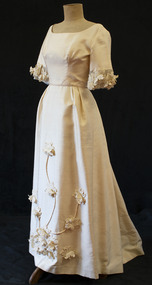
Dress, Wedding dress, 1964
... She brought with her an original Singer sewing machine, which remains in the family to this day. wedding dress rayleen haig rayleen janetzki donald haig deon's of melbourne brighton council mayor ivana marcuzzi ivana andrighetto Cream silk dress with boat neck, short sleeves and back zip. ...This wedding dress belonged to Rayleen Haig OAM, nee Janetzki, who married Donald Haig in Geelong on 15 August 1964. The dress was designed for Rayleen and made by Deon's of Melbourne, which specialised in wedding gowns (she believes it was above Sportsgirl in Collins Street). It cost about one hundred pounds. The reception was held in the Carlton Hotel, Geelong. A longtime local resident, Rayleen was a Brighton councillor (1983-92) and mayor (1989-90). She was awarded the OAM in 2007 for "service to local government and to the community through health, historical and aged care organisations, particularly within the City of Bayside, and to the National Council of Women of Australia". The dress was made by Ivana Marcuzzi, nee Andrighetto, a dressmaker at Deon's who emigrated to Australia from Vicenza, Italy in 1950. She brought with her an original Singer sewing machine, which remains in the family to this day.Cream silk dress with boat neck, short sleeves and back zip. Guipure lace flowers on sleeves and skirt.wedding dress, rayleen haig, rayleen janetzki, donald haig, deon's of melbourne, brighton council, mayor, ivana marcuzzi, ivana andrighetto -
 Surrey Hills Historical Society Collection
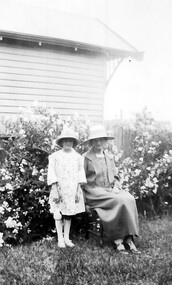
Photograph, Mary Sneddon with daughter Jean
... Haig b 1918, Surrey Hills. Additional information from Robin da Costa-Adams, who is related to the Sneddon family through her first marriage. ...Haig b 1918, Surrey Hills. Additional information from Robin da Costa-Adams, who is related to the Sneddon family through her first marriage. cliburn suffolk road, (miss) jean sneddon, william sneddon, (mrs) mary sneddon, (miss) mary bird "Jean Sneddon / Mary Sneddon/ (in grey lead pencil by Robin da Costa-Adams. 1050 in blue biro crossed out in top RH corner. ...The photo was taken in the garden of of 'Cliburn', 14 Suffolk Avenue, Surrey Hills, the home of William and Mary (nee Bird) Sneddon. It was named after Cliburn, Westmorland (later Cumbria) where Mary's mother was born and the name was given to all their homes. Mary Bird, daughter of John Bird and Mary Coulston, b 1878 Bethanga, Victoria; died 1948, Surrey Hills. They were married on 12/11/1903 in Surrey Hills at the home of James Sneddon. William Sneddon was a postman in Surrey Hills for many years. His father James had an estate agency in Surrey Hills from the 1880s. Born in1875, Sandhurst (Bendigo); died in 1957, Deepdene. Buried Box Hill Cemetery: P-061-0033. They had the following children: Jim (James 3rd) b 1905, Balwyn Jack (John William) b. 1908, Camberwell Norman Alexander b 1910, Camberwell Alan Coulson b 1914 Surrey Hills Jean Isabel b 1916, Surrey Hills Douglas Haig b 1918, Surrey Hills. Additional information from Robin da Costa-Adams, who is related to the Sneddon family through her first marriage. Sepia photo of Mary Sneddon with daughter Jean wearing hats and taken in a garden. Mary is seated and Jean stands beside her. Part of the house next door can be seen in the background. It is an Edwardian timber home"Jean Sneddon / Mary Sneddon/ (in grey lead pencil by Robin da Costa-Adams. 1050 in blue biro crossed out in top RH corner. KODAK PRINT - black stamp in centre. "Jean dau of Mary - / Will. Sneddon" in black ink in Jocelyn Hall's hand. cliburn, suffolk road, (miss) jean sneddon, william sneddon, (mrs) mary sneddon, (miss) mary bird -
 Surrey Hills Historical Society Collection
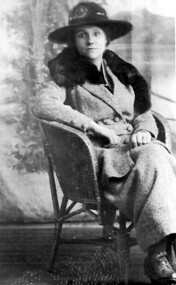
Photograph, Mary Sneddon
... Haig b 1918, Surrey Hills. William and Mary are buried in Box Hill Cemetery: P-061-0033. The donor Robin da Costa-Adams is related to the Sneddon family through her first marriage. ...Haig b 1918, Surrey Hills. William and Mary are buried in Box Hill Cemetery: P-061-0033. The donor Robin da Costa-Adams is related to the Sneddon family through her first marriage. ...Mary was married to William Sneddon who was a postman in Surrey Hills for many years. His father James ran an estate agency in Surrey Hills which had been established by his father, also James, in the 1880s. William married Mary nee Bird in 1903 at his father's home. They lived at 'Cliburn' 14 Suffolk Road, named after Cliburn, Westmorland (later Cumbria) where Mary's mother, Mary Coulston came from. According to the donor, all their homes were given this name. WIlliam and Mary had the following children: Jim (James 3rd) b 1905, Balwyn Jack (John William) b. 1908, Camberwell Norman Alexander b 1910, Camberwell Alan Coulson b 1914, Surrey Hills Jean Isabel b 1916, Surrey Hills Douglas Haig b 1918, Surrey Hills. William and Mary are buried in Box Hill Cemetery: P-061-0033. The donor Robin da Costa-Adams is related to the Sneddon family through her first marriage. Formal sepia photo of Mary Sneddon seated in a studio or against a backdrop provided by a travelling photographer. "Mary Sneddon" - Robin da Costa-Adams' hand in grey lead pencil. "nee Bird) / (wife of Wm Sneddon" in black ink in Jocelyn Hall's hand.(miss) mary bird, (mrs) mary sneddon, william sneddon -
 Surrey Hills Historical Society Collection
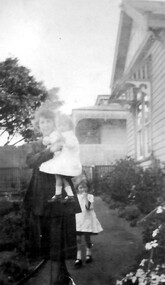
Photograph, Douglas and Jean Sneddon with Alice Keane, 14 Suffolk Road, Surrey Hills
... family: Netta Sneddon was correct in that Alice Keane was likely a relative. The exact relationship is yet to be fully established. Alice's mother's name is given as Sarah Ann Bird (1873-1952) with birth at Tarrawingee; father John Bird and mother Sarah Ann Coburn (REF: Victorian BDM index). Her notice of marriage in The Age in 1894 states she is "the eldest dau of John Bird of Drouin, late of Box Hill and Talgarno." Has her mother's surname been misspelt? Is it Coulston? suffolk road 'cliburn' jean isobel sneddon mrs jean isobel jenkin douglas haig ...The property was named 'Cliburn' after Cliburn in Westmorland (later Cumbria) where Mary Sneddon's mother, Mary Bird (nee Coulston) came from. According to the donor all their houses were given this name. William Sneddon (b.1875, Sandhurst - d. 1957, Deepdene) was a postman in Surrey Hills for many years. His father James (1833 - 1901) ran an estate agency in Surrey Hills started in the 1880s by his father, also James. William's wife was Mary Sneddon, nee Bird, (b. 1878 Bethunga; d. 1948, Surrey Hills); they married in Surrey Hills in James Sneddon's house on 12 November 1903. They had 5 sons and 1 daughter: John William 'Jack' Sneddon (b.1908 - d. 1957); married Mabel Creek. Norman Alexander Sneddon (b. 1910 - d 1989); married Eva Pearl Sampson. Alan Coulston Sneddon (b. 1914 - d. 1985); married Netta May Clow in 1941. Jean Isobel Sneddon (b. 1916 - d. 1976); married Clifford James Jenkin. Douglas Haig Sneddon (b.1918, Surrey Hills - d. 1973, Blackburn); married Myra Marjorie Clewett in 1945. Relationship with Alice Keane: According to the donor, Alice Ruby Dore married Herbert Keane. She was born 21/9/1901 and died 14/4/1926. Her entries in the Victorian BDM index give that her father was Henry Dore and her mother Sarah Ann Bird and that she was born in Neerim. She married Herbert Henry Keane in 1922; her death at the age of 24 years was registered in Heidelberg. According to the donor her young children Wallace and Phyllis were embraced by William and Mary Sneddon. William and Mary Sneddon are buried in Box Hill Cemetery. The donor Robin da Costa-Adams is related by her first marriage to the Sneddon family. Relationship with Bird family: Netta Sneddon was correct in that Alice Keane was likely a relative. The exact relationship is yet to be fully established. Alice's mother's name is given as Sarah Ann Bird (1873-1952) with birth at Tarrawingee; father John Bird and mother Sarah Ann Coburn (REF: Victorian BDM index). Her notice of marriage in The Age in 1894 states she is "the eldest dau of John Bird of Drouin, late of Box Hill and Talgarno." Has her mother's surname been misspelt? Is it Coulston? Sepia photo of Douglas Sneddon and his sister Jean Sneddon taken in the garden of 'Cliburn', the home of their parents William and Mary Sneddon. With them is with Alice Keane. Part of the house is seen on the RHS of the photo. It is an Edwardian timber home. The profile of the house next door can also be seen in the background."Alice Keane / at / Doug & Jean Sneddon / taken at Sneddons / Surrey Hills" in grey lead pencil in Robin da Costa-Adams' writing. "Children of Mary & / William" "An Alice Keane may be an Aunt (crossing out) - Netta / was not sure" in ink in Jocelyn Hall's hand.suffolk road, 'cliburn', jean isobel sneddon, mrs jean isobel jenkin, douglas haig sneddon, william sneddon, miss mary bird, mrs mary sneddon, box hill cemetery, children, clothing and dress, mrs alice keane, mrs alice ruby keane, miss alice ruby dore
