
Showing 6 items matching "hampden council"
-
 Eltham District Historical Society Inc
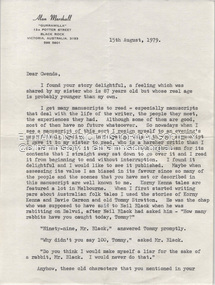
Document - Folder, Alan Marshall (1902-1984), Correspondence from Alan Marshall to Gwenda Sanderson, 1979-1983
... ...Hampden Council...Ltd Chatsworth homestead Russia I can jump puddles (book) Nat Gould Race horses Ethell Dell Gertrude Page Geoffrey Farnell East Driscoll (story) Shamrock Smith The Catholic Ball (story) Lance Skuthorpe The blood of Johnny Meagher (story) Winter-Irving Sarah Midgeley Richard Skilbeck Miss Edith (story) Sun Competition Mandeville Hall Hampden Council Alan Marshall Commemorative Plaque Noorat Russian theatrical troupe Noorat Show Eliza Sturgess Sam Johnson the baker Elsie Johnson crupper martingale A.J. ...Alan Marshall AM, (2 May 1902 – 21 January 1984) was an Australian writer, story teller, humanist and social documenter. Personal correspondence between Gwenda Sanderson and Alan Marshall, dated between 1979 and 1983. There are 21 letters in all, the last 3 of which were dictated from the Hurlingham Nursing Home in Brighton. Background information for the letters (daugher Merrilyn Sanderson 10 October 2025): My mother, Gwenda Sanderson ( nee White ) grew up in the western district and knew Alan Marshall's sister. Gwenda was an aspiring author, and reached out to Alan for support and advice regarding her writing. Alan proved to be a generous and inspiring mentor and as you will see, they established a rapport. In 1966 Gwenda moved from Mortlake to Montmorency (quite a culture shock!) and around 1983 she and her husband, Stan moved to Diamond Creek. Letters: 1. Alan Marshall to Gwenda Sanderson, 15 August 1979 2. Alan Marshall to Gwenda Sanderson, 22 August 1979 3. Alan Marshall to Gwenda Sanderson, 28 August 1979 4. Alan Marshall to Gwenda Sanderson, 7 September 1979 5. Alan Marshall to Gwenda Sanderson, 19 September 1979 6. Alan Marshall to Gwenda Sanderson, 11 October 1979 7. Alan Marshall to Gwenda Sanderson, 18 October 1979 8. Alan Marshall to Gwenda Sanderson, 1 November 1979 9. Alan Marshall to Gwenda Sanderson, 10 January 1980 10. Alan Marshall to Gwenda Sanderson, 24 January 1980 11. Alan Marshall to Gwenda Sanderson, 15 February 1980 12. Gwen Hardisty on behalf of Alan Marshall to Gwenda Sanderson, 27 May 1980 13. Alan Marshall to Gwenda Sanderson, 17 June 1980 14. Alan Marshall to Gwenda Sanderson, 29 July 1980 15. Alan Marshall to Gwenda Sanderson, 4 August 1980 16. Alan Marshall to Gwenda Sanderson, 22 August 1980 17. Alan Marshall to Gwenda Sanderson, 5 February 1981 18. Alan Marshall to Gwenda Sanderson, 5 August 1981 19. Gwen Hardisty on behalf of Alan Marshall to Gwenda Sanderson, 11 May 1982 20. Alan Marshall to Gwenda Sanderson, 27 Octopber 1982 21. Alan Marshall to Gwenda Sanderson, 21 February 1983 alan marshall, gwenda sanderson, gurrawilla, elsie louise mcconnell, black rock (vic.), korny kenna, folk tales, australian folk tales, davie carson, tommy stratton, neil black, black emily, noorat, purnim encampment, pompey austin, aboriginal characters, john manifold, john hooker, collins publishers, eltham history, alan marshall (pioneers and painters), james bonwick, mount shadwell, mount noorat, john smith, blacksmith, mary turner-shaw, on mount emu creek (book), wooiwyrite, western district victoria, merrilyn sanderson, mortlake, the land (poem), collected verse (book), austin family, hammers over the anvil (book), eeyeuk, dennis family, peg dennis, noorat church, jim smith, miss dennis, mrs polly, mrs angus gillies, mental health, frank smith, country life (english paper), field (english paper), peter mcleod, bill beechey, angus gillies, mag dennis, east driscoll, camperdown, bill white, alec irvine, jack irvine, staughton's stable, cumming family, jallalabad, miss baird, private catholic school, jack peoples, shaw's, weatherley, miss ann gordon, ballangeich, writer, author, sun (newspaper), william collins (aust.) ltd, chatsworth homestead, russia, i can jump puddles (book), nat gould, race horses, ethell dell, gertrude page, geoffrey farnell, east driscoll (story), shamrock smith, the catholic ball (story), lance skuthorpe, the blood of johnny meagher (story), winter-irving, sarah midgeley, richard skilbeck, miss edith (story), sun competition, mandeville hall, hampden council, alan marshall commemorative plaque noorat, russian theatrical troupe, noorat show, eliza sturgess, sam johnson the baker, elsie johnson, crupper, martingale, a.j. black, shaw women, miss laura, squatter, duke of edinburgh, royal family, 'texas' green, member for kalgoorlie, duke of gloucestor, the girl in pink, prince of wales, may creedie (story), mrs scott of mortlake, smouldering fires (book), lindsay russell, mary murray of our valley (book), the fellowship of australian writers, jim hamilton, journey to aboriginal victoria (book), mary gilmore, peter mcallum institute, may creedie (book), gwen hardisty, heart attack, bulletin (magazine), stephenson, gloria swanson, jennifer marshall, daniel (grandson), cathy (daughter), sandringham hospithal, east brighton nursing home, alan marshall writes alone (review) -
 Flagstaff Hill Maritime Museum and Village
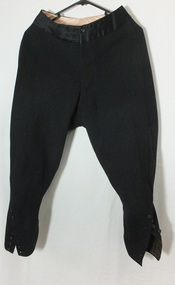
Clothing - Riding Habit, Jodhpurs, 1920s
... Edward was a member of Hampden Shire Council in 1909-31 and three times president at Camperdown. ...Edward was a member of Hampden Shire Council in 1909-31 and three times president at Camperdown. ...The Manifolds were a significant pioneering pastoral family in Western Victoria. The donated riding jodhpurs originally belonged to Mrs Edward Manifold, formally Beatrice Mary Synnot Anderson. Beatrice was Edward Manifold’s cousin once removed whom he married in 1900. Edward, the son of John Manifold, was born on 15 November 1868 and educated at Geelong and Melbourne Grammar schools and at Trinity Hall, Cambridge (B.A., 1891). He chose the Danedite portion of land at Purrumbete, and on the death of his bachelor brother Thomas Peter (1863-1895), after a hunting accident, he took over his allocation, Wiridgil. He also owned Boortkoi, near Hexham and on these properties, he ran merino sheep, a Lincoln stud which dated back to 1870, and Shorthorn cattle. 3000 acres were also leased to dairy farmers. Edward was a member of Hampden Shire Council in 1909-31 and three times president at Camperdown. The town was largely bordered by Manifold land and partly dependent upon the local pastoral dynasties, which benefited the local area from the families’ various business interests. Though an offer to build public baths to commemorate the Queen Victoria Jubilee in 1897 was not proceeded with, the town acquired a hospital, a reserve on Mount Leura, a clock tower and a cricket pavilion, as well as notable donations from the Manifolds to St Paul's Church and the grammar school. Edward was a keen polo player and racing man. He was also a successful owner of steeplechasers and a committeeman of the Victoria Racing Club for many years. He was also a member of many Western District racing clubs. On the 16 July 1900, Edward had married his sixteen-year-old cousin Beatrice Mary Synnot Anderson by whom he had three sons Thomas Peter, Andrew and Robert Edward Manifold. Edwards's estate at his death was valued for probate at nearly £500,000. Edward died following an operation on 14 February 1931 at a private hospital in Yarra Vale Melbourne. Beatrice passed away in 1954, aged 79 in Ballarat where she was born in 1874. Contextual historic Family background: The Manifold brothers Thomas (1809-1875), John (1811-1877) and Peter (1817-1885) were the fourth, fifth and sixth sons of William Manifold and Mary, nee Barnes, of Courthouse Farm, Bromborough, Cheshire, England. The family had decided to emigrate to Van Diemen's Land. Thomas was sent ahead, arriving in Hobart Town on 23rd January 1828 with £1500 and a letter of recommendation from the Colonial Office. Thomas acquired 1280 acres on the west bank of the Tamar River. John and Peter, with their parents and three sisters, arrived on 8th July 1831. Land grants by then had finished but William brought ninety acres next to his son Thomas’ land and on the combined properties the family built Kelso House. The Manifolds’ properties were comparatively poor and when news of the Port Phillip District, in Victoria reached Thomas, he lost no time in coming to see for himself in February 1836. He was impressed with what he saw and hurried back to Tasmania to buy lambs and ewes. With one of his brothers, on July 9th he landed his stores at Point Henry and proceeded to occupy both sides of the Moorabool River. Thomas, at the end of the year, returned to Tasmania and left Peter and John to run the new property. Thomas, however, returned to Victoria for several visits and on one of these visits he, along with his brothers, examined the country near Ballarat. In December 1838 they managed to penetrate the Stony Rises, and Peter and John reached Lake Purrumbete and the Mount Leura country. During this time, on 4th July 1838, Thomas married Jane Elizabeth, eldest daughter of Captain Walter Synnot, formerly of Ballinate, County Armagh, Ireland, and then of Van Diemen's Land. Thomas joined his brothers, and they occupied the Purrumbete run in January 1839. On the journey to Purrumbete they could not take their stock and drays through the Stony Rises, so went north of Lake Corangamite, to the neck of land between it and Lake Gnarpurt. By April the move from Moorabool area was complete. As yet they had no hut and were working day and night, but their delight in their new run was unbounded. John wrote to his mother: “We are at last got to the land we wished for it is a beautiful place, and cannot be surpassed by any I have ever seen”. The three brothers occupied Purrumbete together, breeding both sheep and cattle until Thomas went to Grassmere run on the Merri River near Warrnambool in 1844. John and Peter soon gave up breeding sheep but retained the well-known '3M' brand for the cattle. These were Shorthorns, derived from four bulls originally imported by the Boldon brothers and later improved by further importations, and were renowned for size and quality. By the time of the gold rush in 1851, John and Peter were breeding over 1000 head a year, as well as fattening stores. The diggings at this time had disorganised Grassmere by drawing away Thomas's men, and his wife decided to take her two sons and two daughters to Europe for their education. Thomas gave up the property next year, went to England to join his family, and eventually brought the family back to live in Melbourne. At Purrumbete things were different. The brothers, John and Peter, preferred black stockmen to white, so the discovery of gold upset them very little while providing the very market they required. John was on his second visit to England when the rush started, and Peter went in his turn soon after John returned. On 2 September 1856 John married Marion Thomson, at Cormiston, Van Diemen's Land. They had four daughters and five sons, from three of whom, William Thomson, James Chester and Edward, the later generations of the family descend. Through the years the brothers had to contend with the scab, fluke and footrot, depression, rabbits, bush fires and pleuro-pneumonia. In 1861 they appointed as manager Henry Manifold Matson, their nephew, who had already been with them for five years. Thomas died in Melbourne on 7 November 1875, John at Purrumbete on 3 January 1877 and Peter at Purrumbete on 31 July 1885. Devout members of the Church of England, John and Peter, during their lives, gave generously towards building St Paul's Church, Camperdown, and guaranteed part of the vicar's stipend. Peter was a member of the Hampden and Heytesbury Roads Board from 1859 and carried on into the Hampden Shire Council when it was formed in 1864. However, it was not for public works that they were known, but for their personal example. In a new land where speculators and adventurers were all too common, the Manifold brothers were among those who intended it to be their home and their children's home. Industrious, unpretentious and hospitable, they were respected in their community as men of the highest integrity. This riding habit is a characteristic example of the type and style of riding clothes that well-dressed ladies wore in the 1920s. It highlights the changes that were beginning in society for women. Prior to 1918 ladies still had to ride side-saddle with skirts over Jodhpurs. Society of the time regarded women riding astride as unseemly and just not done. This riding habit is particularly significant on a number of levels, it shows the beginnings of change in society's attitudes through women's fashion after the First World War. A change that was to bring a start to a more liberating societal attitude towards women after the successful establishment of the Representation of People Act 1918 that gave women the right to vote. This garments provenance is linked to one of Victoria's important pioneering families the Manifolds, one of the first families that came from Van Diemen's land to settle the Western District of Victoria in 1844. Originally the garment belonged to the wife of the great-grandson of pioneer William Manifold, Edward Manifold who married Beatrice May Synnot Anderson, Edwards Cousin in 1900. The garment was made by the Mayfair tailors J. Busvine & Co. in the early to mid-1920s (estimate) who at the turn of the century were tailors to the Courts of Europe. Their clothing is highly collectible today and examples can be found in a number of significant museum collections around the world, notably the Metropolitan Museum of Art in New York and the FIDM in Los Angeles. Jodhpurs, part of a three-piece, side saddle riding habit tailored for Mrs Edward Manifold, with four buttons to the front material black woolen twill the legs are cuffed below the knee with 8 buttons holes which are reinforced to the inside with fabric. Cream Satin waistband and removable chamois lining to the seat makers label Busvines Co. tailored for Mrs Edward Manifold.Embroidered in blue on a Satin Cream label to Jodhpurs "Busvine Ltd / 4, Brook St, London. W. No." Hand written in black ink script "523/ Mrs Edward Manifold"flagstaff hill, warrnambool, shipwrecked coast, flagstaff hill maritime museum, maritime museum, side saddle riding habit, side saddle riding outfit, breeches, mrs edward manifold, beatrice manifold, shipwreck coast, flagstaff hill maritime village, great ocean road -
 Flagstaff Hill Maritime Museum and Village
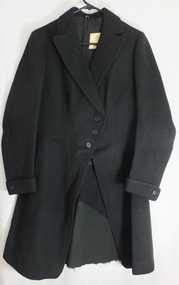
Clothing - Riding Habit, jacket, Early 20th Century
... Edward was a member of Hampden Shire Council in 1909-31 and three times president at Camperdown. ...Edward was a member of Hampden Shire Council in 1909-31 and three times president at Camperdown. ...The Manifolds were a significant pioneering pastoral family in Western Victoria. The donated riding jacket originally belonged to Mrs Edward Manifold, formally Beatrice Mary Synnot Anderson. Beatrice was Edward Manifold’s cousin once removed whom he married in 1900. Edward, the son of John Manifold, was born on 15 November 1868 and educated at Geelong and Melbourne Grammar schools and at Trinity Hall, Cambridge (B.A., 1891). He chose the Danedite portion of land at Purrumbete, and on the death of his bachelor brother Thomas Peter (1863-1895), after a hunting accident, he took over his allocation, Wiridgil. He also owned Boortkoi, near Hexham and on these properties, he ran merino sheep, a Lincoln stud which dated back to 1870, and Shorthorn cattle. 3000 acres were also leased to dairy farmers. Edward was a member of Hampden Shire Council in 1909-31 and three times president at Camperdown. The town was largely bordered by Manifold land and partly dependent upon the local pastoral dynasties, which benefited the local area from the families’ various business interests. Though an offer to build public baths to commemorate the Queen Victoria Jubilee in 1897 was not proceeded with, the town acquired a hospital, a reserve on Mount Leura, a clock tower and a cricket pavilion, as well as notable donations from the Manifolds to St Paul's Church and the grammar school. Edward was a keen polo player and racing man. He was also a successful owner of steeplechasers and a committeeman of the Victoria Racing Club for many years. He was also a member of many Western District racing clubs. On the 16 July 1900, Edward had married his sixteen-year-old cousin Beatrice Mary Synnot Anderson by whom he had three sons Thomas Peter, Andrew and Robert Edward Manifold. Edwards's estate at his death was valued for probate at nearly £500,000. Edward died following an operation on 14 February 1931 at a private hospital in Yarra Vale Melbourne. Beatrice passed away in 1954, aged 79 in Ballarat where she was born in 1874. Contextual historic Family background: The Manifold brothers Thomas (1809-1875), John (1811-1877) and Peter (1817-1885) were the fourth, fifth and sixth sons of William Manifold and Mary, nee Barnes, of Courthouse Farm, Bromborough, Cheshire, England. The family had decided to emigrate to Van Diemen's Land. Thomas was sent ahead, arriving in Hobart Town on 23rd January 1828 with £1500 and a letter of recommendation from the Colonial Office. Thomas acquired 1280 acres on the west bank of the Tamar River. John and Peter, with their parents and three sisters, arrived on 8th July 1831. Land grants by then had finished but William brought ninety acres next to his son Thomas’ land and on the combined properties the family built Kelso House. The Manifolds’ properties were comparatively poor and when news of the Port Phillip District, in Victoria reached Thomas, he lost no time in coming to see for himself in February 1836. He was impressed with what he saw and hurried back to Tasmania to buy lambs and ewes. With one of his brothers, on July 9th he landed his stores at Point Henry and proceeded to occupy both sides of the Moorabool River. Thomas, at the end of the year, returned to Tasmania and left Peter and John to run the new property. Thomas, however, returned to Victoria for several visits and on one of these visits he, along with his brothers, examined the country near Ballarat. In December 1838 they managed to penetrate the Stony Rises, and Peter and John reached Lake Purrumbete and the Mount Leura country. During this time, on 4th July 1838, Thomas married Jane Elizabeth, eldest daughter of Captain Walter Synnot, formerly of Ballinate, County Armagh, Ireland, and then of Van Diemen's Land. Thomas joined his brothers, and they occupied the Purrumbete run in January 1839. On the journey to Purrumbete they could not take their stock and drays through the Stony Rises, so went north of Lake Corangamite, to the neck of land between it and Lake Gnarpurt. By April the move from Moorabool area was complete. As yet they had no hut and were working day and night, but their delight in their new run was unbounded. John wrote to his mother: “We are at last got to the land we wished for it is a beautiful place, and cannot be surpassed by any I have ever seen”. The three brothers occupied Purrumbete together, breeding both sheep and cattle until Thomas went to Grassmere run on the Merri River near Warrnambool in 1844. John and Peter soon gave up breeding sheep but retained the well-known '3M' brand for the cattle. These were Shorthorns, derived from four bulls originally imported by the Boldon brothers and later improved by further importations, and were renowned for size and quality. By the time of the gold rush in 1851, John and Peter were breeding over 1000 head a year, as well as fattening stores. The diggings at this time had disorganised Grassmere by drawing away Thomas's men, and his wife decided to take her two sons and two daughters to Europe for their education. Thomas gave up the property next year, went to England to join his family, and eventually brought the family back to live in Melbourne. At Purrumbete things were different. The brothers, John and Peter, preferred black stockmen to white, so the discovery of gold upset them very little while providing the very market they required. John was on his second visit to England when the rush started, and Peter went in his turn soon after John returned. On 2 September 1856 John married Marion Thomson, at Cormiston, Van Diemen's Land. They had four daughters and five sons, from three of whom, William Thomson, James Chester and Edward, the later generations of the family descend. Through the years the brothers had to contend with the scab, fluke and footrot, depression, rabbits, bush fires and pleuro-pneumonia. In 1861 they appointed as manager Henry Manifold Matson, their nephew, who had already been with them for five years. Thomas died in Melbourne on 7 November 1875, John at Purrumbete on 3 January 1877 and Peter at Purrumbete on 31 July 1885. Devout members of the Church of England, John and Peter, during their lives, gave generously towards building St Paul's Church, Camperdown, and guaranteed part of the vicar's stipend. Peter was a member of the Hampden and Heytesbury Roads Board from 1859 and carried on into the Hampden Shire Council when it was formed in 1864. However, it was not for public works that they were known, but for their personal example. In a new land where speculators and adventurers were all too common, the Manifold brothers were among those who intended it to be their home and their children's home. Industrious, unpretentious and hospitable, they were respected in their community as men of the highest integrity. This riding habit is a characteristic example of the type and style of riding clothes that well-dressed ladies wore in the 1920s. It highlights the changes that were beginning in society for women. Prior to 1918 ladies still had to ride side-saddle with skirts over Jodhpurs. Society of the time regarded women riding astride as unseemly and just not done. This riding habit is particularly significant on a number of levels, it shows the beginnings of change in society's attitudes through women's fashion after the First World War. A change that was to bring a start to a more liberating societal attitude towards women after the successful establishment of the Representation of People Act 1918 that gave women the right to vote. This garments provenance is linked to one of Victoria's important pioneering families the Manifolds, one of the first families that came from Van Diemen's land to settle the Western District of Victoria in 1844. Originally the garment belonged to the wife of the great-grandson of pioneer William Manifold, Edward Manifold who married Beatrice May Synnot Anderson, Edwards Cousin in 1900. The garment was made by the Mayfair tailors J. Busvine & Co. in the early to mid-1920s (estimate) who at the turn of the century were tailors to the Courts of Europe. Their clothing is highly collectible today and examples can be found in a number of significant museum collections around the world, notably the Metropolitan Museum of Art in New York and the FIDM in Los Angeles. A riding jacket, part of a three-piece, side saddle riding habit tailored for Mrs Edward Manifold. Knee length English woolen jacket black in colour, seamed and fitted to the female client's figure, fastening from the waist with three bone buttons to rather high lapels. The sleeves are long with closely fitted cuffs and one button and lined with cream satin. The jacket is fitted to the waist and flared to below the hips with a 35 cm vent to the back. Lower back to the jacket is reinforced with removable fabric and the jacket is lined with black twill cotton, there is a cream satin label, with makers' emblem Busvine. Circa 1920s Label to Jacket Embroidered in gold with a Royal logo on a Cream Satin label “By Special /Appointment” “To Her Majesty/The Queen”, “Busvine / Ltd / London 4 Brook St. W. / No” “hand written in purple ink 315 / Mrs Edward Manifold”flagstaff hill, warrnambool, shipwrecked coast, flagstaff hill maritime museum, maritime museum, side saddle riding habit, mrs edward manifold, edward manifold, busvines, shipwreck coast, flagstaff hill maritime village, great ocean road -
 Flagstaff Hill Maritime Museum and Village
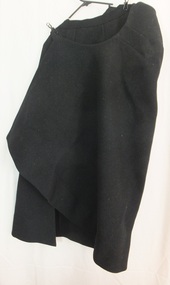
Clothing - Riding Habit, Skirt, 1920s
... Edward was a member of Hampden Shire Council in 1909-31 and three times president at Camperdown. ...Edward was a member of Hampden Shire Council in 1909-31 and three times president at Camperdown. ...The Manifolds were a significant pioneering pastoral family in Western Victoria. The donated riding skirt originally belonged to Mrs Edward Manifold, formally Beatrice Mary Synnot Anderson. Beatrice was Edward Manifold’s cousin once removed whom he married in 1900. Edward, the son of John Manifold, was born on 15 November 1868 and educated at Geelong and Melbourne Grammar schools and at Trinity Hall, Cambridge (B.A., 1891). He chose the Danedite portion of land at Purrumbete, and on the death of his bachelor brother Thomas Peter (1863-1895), after a hunting accident, he took over his allocation, Wiridgil. He also owned Boortkoi, near Hexham and on these properties, he ran merino sheep, a Lincoln stud which dated back to 1870, and Shorthorn cattle. 3000 acres were also leased to dairy farmers. Edward was a member of Hampden Shire Council in 1909-31 and three times president at Camperdown. The town was largely bordered by Manifold land and partly dependent upon the local pastoral dynasties, which benefited the local area from the families’ various business interests. Though an offer to build public baths to commemorate the Queen Victoria Jubilee in 1897 was not proceeded with, the town acquired a hospital, a reserve on Mount Leura, a clock tower and a cricket pavilion, as well as notable donations from the Manifolds to St Paul's Church and the grammar school. Edward was a keen polo player and racing man. He was also a successful owner of steeplechasers and a committeeman of the Victoria Racing Club for many years. He was also a member of many Western District racing clubs. On the 16 July 1900, Edward had married his sixteen-year-old cousin Beatrice Mary Synnot Anderson by whom he had three sons Thomas Peter, Andrew and Robert Edward Manifold. Edwards's estate at his death was valued for probate at nearly £500,000. Edward died following an operation on 14 February 1931 at a private hospital in Yarra Vale Melbourne. Beatrice passed away in 1954, aged 79 in Ballarat where she was born in 1874. Contextual historic Family background: The Manifold brothers Thomas (1809-1875), John (1811-1877) and Peter (1817-1885) were the fourth, fifth and sixth sons of William Manifold and Mary, nee Barnes, of Courthouse Farm, Bromborough, Cheshire, England. The family had decided to emigrate to Van Diemen's Land. Thomas was sent ahead, arriving in Hobart Town on 23rd January 1828 with £1500 and a letter of recommendation from the Colonial Office. Thomas acquired 1280 acres on the west bank of the Tamar River. John and Peter, with their parents and three sisters, arrived on 8th July 1831. Land grants by then had finished but William brought ninety acres next to his son Thomas’ land and on the combined properties the family built Kelso House. The Manifolds’ properties were comparatively poor and when news of the Port Phillip District, in Victoria reached Thomas, he lost no time in coming to see for himself in February 1836. He was impressed with what he saw and hurried back to Tasmania to buy lambs and ewes. With one of his brothers, on July 9th he landed his stores at Point Henry and proceeded to occupy both sides of the Moorabool River. Thomas, at the end of the year, returned to Tasmania and left Peter and John to run the new property. Thomas, however, returned to Victoria for several visits and on one of these visits he, along with his brothers, examined the country near Ballarat. In December 1838 they managed to penetrate the Stony Rises, and Peter and John reached Lake Purrumbete and the Mount Leura country. During this time, on 4th July 1838, Thomas married Jane Elizabeth, eldest daughter of Captain Walter Synnot, formerly of Ballinate, County Armagh, Ireland, and then of Van Diemen's Land. Thomas joined his brothers, and they occupied the Purrumbete run in January 1839. On the journey to Purrumbete they could not take their stock and drays through the Stony Rises, so went north of Lake Corangamite, to the neck of land between it and Lake Gnarpurt. By April the move from Moorabool area was complete. As yet they had no hut and were working day and night, but their delight in their new run was unbounded. John wrote to his mother: “We are at last got to the land we wished for it is a beautiful place, and cannot be surpassed by any I have ever seen”. The three brothers occupied Purrumbete together, breeding both sheep and cattle until Thomas went to Grassmere run on the Merri River near Warrnambool in 1844. John and Peter soon gave up breeding sheep but retained the well-known '3M' brand for the cattle. These were Shorthorns, derived from four bulls originally imported by the Boldon brothers and later improved by further importations, and were renowned for size and quality. By the time of the gold rush in 1851, John and Peter were breeding over 1000 head a year, as well as fattening stores. The diggings at this time had disorganised Grassmere by drawing away Thomas's men, and his wife decided to take her two sons and two daughters to Europe for their education. Thomas gave up the property next year, went to England to join his family, and eventually brought the family back to live in Melbourne. At Purrumbete things were different. The brothers, John and Peter, preferred black stockmen to white, so the discovery of gold upset them very little while providing the very market they required. John was on his second visit to England when the rush started, and Peter went in his turn soon after John returned. On 2 September 1856 John married Marion Thomson, at Cormiston, Van Diemen's Land. They had four daughters and five sons, from three of whom, William Thomson, James Chester and Edward, the later generations of the family descend. Through the years the brothers had to contend with the scab, fluke and footrot, depression, rabbits, bush fires and pleuro-pneumonia. In 1861 they appointed as manager Henry Manifold Matson, their nephew, who had already been with them for five years. Thomas died in Melbourne on 7 November 1875, John at Purrumbete on 3 January 1877 and Peter at Purrumbete on 31 July 1885. Devout members of the Church of England, John and Peter, during their lives, gave generously towards building St Paul's Church, Camperdown, and guaranteed part of the vicar's stipend. Peter was a member of the Hampden and Heytesbury Roads Board from 1859 and carried on into the Hampden Shire Council when it was formed in 1864. However, it was not for public works that they were known, but for their personal example. In a new land where speculators and adventurers were all too common, the Manifold brothers were among those who intended it to be their home and their children's home. Industrious, unpretentious and hospitable, they were respected in their community as men of the highest integrity. This riding habit is a characteristic example of the type and style of riding clothes that well-dressed ladies wore in the 1920s. It highlights the changes that were beginning in society for women. Prior to 1918 ladies still had to ride side-saddle with skirts over Jodhpurs. Society of the time regarded women riding astride as unseemly and just not done. This riding habit is particularly significant on a number of levels, it shows the beginnings of change in society's attitudes through women's fashion after the First World War. A change that was to bring a start to a more liberating societal attitude towards women after the successful establishment of the Representation of People Act 1918 that gave women the right to vote. This garments provenance is linked to one of Victoria's important pioneering families the Manifolds, one of the first families that came from Van Diemen's land to settle the Western District of Victoria in 1844. Originally the garment belonged to the wife of the great-grandson of pioneer William Manifold, Edward Manifold who married Beatrice May Synnot Anderson, Edwards Cousin in 1900. The garment was made by the Mayfair tailors J. Busvine & Co. in the early to mid-1920s (estimate) who at the turn of the century were tailors to the Courts of Europe. Their clothing is highly collectible today and examples can be found in a number of significant museum collections around the world, notably the Metropolitan Museum of Art in New York and the FIDM in Los Angeles. Safety skirt/apron, part of a three-piece, side saddle riding habit tailored for Mrs Edward Manifold. This side saddle skirt is made from black woolen material fixing at the waist with two metal hooks and three buttons to the front opening. One internal concealed pocket lining to the top part of the apron made of cotton the seat is shaped for side saddle riding and the skirt wraps around the body the longer side draped over the leg that is in the stirrup. flagstaff hill, warrnambool, shipwrecked coast, flagstaff hill maritime museum, maritime museum, side saddle riding habit, side saddle safety skirt, side saddle apron, mrs edward manifold, beatrice manifold, female riding habit 1920s, shipwreck coast, flagstaff hill maritime village, great ocean road -
 Sunshine and District Historical Society Incorporated
Photograph - Braybrook Photographs 2021, John Alchin, 2021
... council amalgamations, which resulted in Braybrook being incorporated into the City of Maribyrnong. The suburb of Braybrook continues to attract considerable attention from the residents of City of Brimbank, particularly its historical features, the old buildings and distinctive streetscapes that characterise the area. To capture the essence of Braybrook in 2021, a series of photographs were taken. These images document a range of buildings, street scenes, and other notable points of interest throughout the suburb, providing a visual record of its unique character. Ballarat Road Ashley Street Beachkey Street Cranwell Street Darnley Street Duke Street Evans Street Gilbert Street Hampden ...Braybrook was originally part of the former Shire of Braybrook and later the City of Sunshine. However, in 1994, Victoria underwent council amalgamations, which resulted in Braybrook being incorporated into the City of Maribyrnong. The suburb of Braybrook continues to attract considerable attention from the residents of City of Brimbank, particularly its historical features, the old buildings and distinctive streetscapes that characterise the area.To capture the essence of Braybrook in 2021, a series of photographs were taken. These images document a range of buildings, street scenes, and other notable points of interest throughout the suburb, providing a visual record of its unique character.5580.01 - Ashley St - Former 3LO - AWA Frequency changing building 2021 Photo 01.JPG 5580.02 - Ashley St 65- 67 Braybrook - Central West Shopping Centre 2021 Photo 02.JPG 5580.03 - Ashley St 185 - 195 Braybrook - Former National Springs 2021 Photo 01.JPG 5580.04 - Ballarat Rd 226 Braybrook - Ashley Hotel Ballarat Rd 2021 Photo 01.JPG 5580.05 - Ballarat Rd 234 Braybrook 2021 Photo 01.JPG 5580.06 - Ballarat Rd 234 Braybrook 2021 Photo 02.JPG 5580.07 - Ballarat Rd 244 - 246 Braybrook 2021 Photo 01.JPG 5580.08 - Ballarat Rd 256 Braybrook - ETA Factory Facade 2021 Photo 02.JPG 5580.09 - Ballarat Rd 256 Braybrook - ETA Factory Facade 2021 Photo 04.JPG 5580.10 - Ballarat Rd 261 Braybrook - La Porchetta 2021 Photo 01.JPG 5580.11 - Ballarat Rd 272 Braybrook - Former Holden Car Dealership 2021 Photo 01.JPG 5580.12 - Ballarat Rd 282 Braybrook 2021 Photo 02.JPG 5580.13 - Ballarat Rd 286 - 288 Braybrook 2021 Photo 01.JPG 5580.14 - Ballarat Rd 288 - 290 Braybrook 2021 Photo 01.JPG 5580.15 - Ballarat Rd 290 - 292 Braybrook 2021 Photo 01.JPG 5580.16 - Ballarat Rd 306 - 308 Braybrook 2021 Photo 01.JPG 5580.17 - Ballarat Rd 353 Braybrook - Braybrook Hotel 2021 Photo 01.JPG 5580.18 - Ballarat Rd 353 Braybrook - Braybrook Hotel 2021 Photo 02.JPG 5580.19 - Ballarat Rd 353 Braybrook - Braybrook Hotel 2021 Photo 03.JPG 5580.20 - Ballarat Rd 353 Braybrook - Braybrook Hotel Blue Stone Bar Sign 2021 Photo 01.JPG 5580.21 - Beachley St 23 - 33 Braybrook - Shops 2021 Photo 01.JPG 5580.22 - Beachley St 23 - 33 Braybrook - Shops 2021 Photo 02.JPG 5580.23 - Braybrook Commons Community Gardens Skinner Reserve 2021 Photo 01.JPG 5580.24 - Cranwell St 40 Braybrook - Klipspringer 2021 Photo 02.JPG 5580.25 - Darnley St 83 Braybrook 2021 Photo 01.JPG 5580.26 - Duke St 144 Braybrook 2021 Photo 01.JPG 5580.27 - Evans St 1 Braybrook - Harkrome Quality Electroplaters 2021 Photo 01.JPG 5580.28 - Evans St 9 Braybrook 2021 Photo 01.JPG 5580.29 - Gilbert St 8 Braybrrok - Steeden Engineering Co Pty Ltd 2021 Photo 01.JPG 5580.30 - Hampden St Factory Demolishment 2021 Photo 01.JPG 5580.31 - Kent St Braybrook - Sunshine VRI Bowling Club 2021 Photo 01.JPG 5580.32 - Kent St Braybrook - Sunshine VRI Bowling Club 2021 Photo 02.JPG 5580.33 - Kent St Braybrook - Sunshine VRI Bowling Club 2021 Photo 03.JPG 5580.34 - Lily st Braybrook - RecWest 2021 Photo 01.JPG 5580.35 - Maribyrnong River Temple to Temple Trail Sign 2021 Photo 01.JPG 5580.36 - Maribyrnong River Braybrook 2021 Photo 01.JPG 5580.37 - Marj Laffin Scoreboard Kinder Smith Reserve Lily St Braybrook 2021 Photo 01.JPG 5580.38 - Myalla St 40 Braybrook - Salvation Army Hall 2021 Photo 01.JPG 5580.39 - Myalla St 40 Braybrook - Salvation Army Hall 2021 Photo 02.JPG 5580.40 - Quang Minh Buddhist Temple Burke St Braybrook 2021 Photo 01.JPG 5580.41 - Quang Minh Buddhist Temple Gardens Braybrook 2021 Photo 04.JPG 5580.42 - Ramon Vila Pavilion Kinder Smith Reserve Lily St Braybrook 2021 Photo 01.JPG 5580.43 - Solomon Ford Maribyrnong River 2021 Photo 01.JPG 5580.44 - South Rd 204 Braybrook - Caroline Chisholm College Braybrook 2021 Photo 01.JPG 5580.45 - South Rd 204 Braybrook - Caroline Chisholm College Quinn Auditorium Braybrook 2021 Photo 01.JPG 5580.46 - William Barak Sign Duke St Reserve Braybrook 2021 Photo 01.JPG ballarat road, ashley street, beachkey street, cranwell street, darnley street, duke street, evans street, gilbert street, hampden street, kent street, lily street, maribyrnong river, myalla street, south road, 3lo radio transmitter, central west shopping centre, national springs, ashley hotel, eta factory, la porchetta, braybrook hotel, klipspringer, harkrome, steeden engineering, sunshine vri bowling club, recwest, kinder smith reserve, marj laffin, salvation army hall, quang minh buddhist temple, burke street, ramon vila pavilion, solomon ford, caroline chisholm college, william barak, aboriginal, aborigine, first nation, braybrook -
 Moorabbin Air Museum
Booklet - Pilot’s Notes The Hampden 1 Aeroplane Two Pegasus XV111 Engines, Air Council Air Publication 1579A
... Air Council Air Publication 1579A Booklet Pilot’s Notes The Hampden 1 Aeroplane Two Pegasus XV111 Engines ...
