
Showing 8 items matching "handloom"
-
 Bright & District Historical Society operating the Bright Museum
Bobbin (part of Handloom
... ...Handloom...Bobbin, part of Handloom...Bobbin Handloom Weaving Bobbin, part of Handloom Bobbin (part of Handloom ...Bobbin, part of Handloombobbin, handloom, weaving -
 National Wool Museum
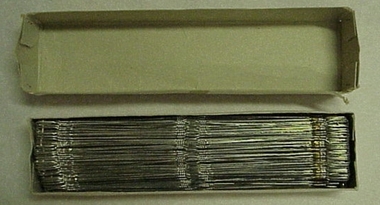
Heddle, White cardboard box containing approximately 144 heddles (heddle wires)
... Box containing approximately 144 heddles (heddle wires), suitable for a handloom....Box containing approximately 144 heddles (heddle wires), suitable for a handloom....Box containing approximately 144 heddles (heddle wires), suitable for a handloom. Textile Machinery Weaving Weaving Looms Textile Machinery Weaving Box containing approximately 144 heddles (heddle wires), suitable for a handloom. ...Box containing approximately 144 heddles (heddle wires), suitable for a handloom.Box containing approximately 144 heddles (heddle wires), suitable for a handloom.textile machinery weaving, weaving looms, textile machinery, weaving -
Bright & District Historical Society operating the Bright Museum
Hand Loom and Bobbin
... handloom...handloom weaving Hand Loom and Bobbin ...handloom, weaving -
Bright & District Historical Society operating the Bright Museum
Handloom and Bobbin
... ...Handloom...Wooden Handloom Weaving Wooden with metal plates Handloom and Bobbin ...Wooden with metal plateswooden, handloom, weaving -
 Mission to Seafarers Victoria
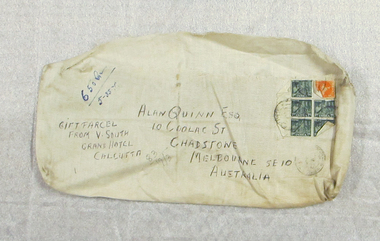
Functional object - Empty material postal bag from Calcutta to Melbourne
... Customs declaration: Handloom tablemats. No commercial value. RM South, Grand Hotel, Calcutta. ...Customs declaration: Handloom tablemats. No commercial value. RM South, Grand Hotel, Calcutta. ...This was a gift sent to Alan QuinnThis is of historical significance as it paints a picture of what Quinn had sent back home from India.This bag was posted in Calcutta, possibly in 1952 though the date is indecipherable. On one side: Alan Quinn, Coolac St, Chadstone, Melbourne, Australia. Customs declaration: Handloom tablemats. No commercial value. RM South, Grand Hotel, Calcutta. On the reverse: the address is repeated and: Gift parcel, from V. South, Grand Hotel, Calcutta. There are six stamps with an indecipherable franking stamp on them. -
 Ararat Gallery TAMA
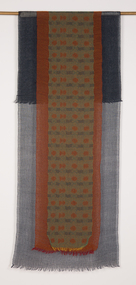
Jennifer Robertson, Forest near Norseman, 2005
... In the 1990s, Robertson received Australia Council funding to design and build a unique 32-shaft handloom. This complex loom has since become central to her internationally recognised practice, enabling her to explore the relationships between the natural environment, human experience, and the expressive possibilities of textile materiality. ...In the 1990s, Robertson received Australia Council funding to design and build a unique 32-shaft handloom. This complex loom has since become central to her internationally recognised practice, enabling her to explore the relationships between the natural environment, human experience, and the expressive possibilities of textile materiality. ...Jennifer Robertson obtained a BA Hons degree in Woven Textiles at West Surrey College and Art and Design. After migrating to Australia in 1986, she began researching the plant life in her new home to develop a language to present her experience of the Australian landscape. In the 1990s, Robertson received Australia Council funding to design and build a unique 32-shaft handloom. This complex loom has since become central to her internationally recognised practice, enabling her to explore the relationships between the natural environment, human experience, and the expressive possibilities of textile materiality. At the time this work was made, Robertson was working with Australian fine merino wool, often with contrasting spun qualities, to develop a form of weaving in three layers simultaneously, creating different woven patterns on both sides of the cloth. The artist said of this triple-layered cloth: “Metaphorically the three layers are the landscape, fine wool and the body.” -
 Ararat Gallery TAMA
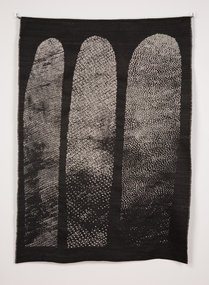
Jennifer Robertson, The Three Cones, 2004
... In the 1990s, Robertson received Australia Council funding to design and build a unique 32-shaft handloom. This complex loom has since become central to her internationally recognised practice, enabling her to explore the relationships between the natural environment, human experience, and the expressive possibilities of textile materiality. ...In the 1990s, Robertson received Australia Council funding to design and build a unique 32-shaft handloom. This complex loom has since become central to her internationally recognised practice, enabling her to explore the relationships between the natural environment, human experience, and the expressive possibilities of textile materiality. ...Jennifer Robertson obtained a BA Hons degree in Woven Textiles at West Surrey College and Art and Design. After migrating to Australia in 1986, she began researching the plant life in her new home to develop a language to present her experience of the Australian landscape. In the 1990s, Robertson received Australia Council funding to design and build a unique 32-shaft handloom. This complex loom has since become central to her internationally recognised practice, enabling her to explore the relationships between the natural environment, human experience, and the expressive possibilities of textile materiality. At the time this work was made, Robertson was working with Australian fine merino wool, often with contrasting spun qualities, to develop a form of weaving in three layers simultaneously, creating different woven patterns on both sides of the cloth. The artist said of this triple-layered cloth: “Metaphorically the three layers are the landscape, fine wool and the body.” -
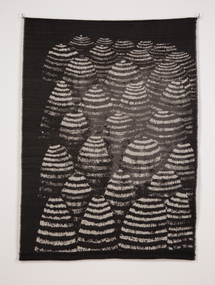 Ararat Gallery TAMA
Jennifer Robertson, Landforms, Kimberley, 2004
... In the 1990s, Robertson received Australia Council funding to design and build a unique 32-shaft handloom. This complex loom has since become central to her internationally recognised practice, enabling her to explore the relationships between the natural environment, human experience, and the expressive possibilities of textile materiality. ...In the 1990s, Robertson received Australia Council funding to design and build a unique 32-shaft handloom. This complex loom has since become central to her internationally recognised practice, enabling her to explore the relationships between the natural environment, human experience, and the expressive possibilities of textile materiality. ...Jennifer Robertson obtained a BA Hons degree in Woven Textiles at West Surrey College and Art and Design. After migrating to Australia in 1986, she began researching the plant life in her new home to develop a language to present her experience of the Australian landscape. In the 1990s, Robertson received Australia Council funding to design and build a unique 32-shaft handloom. This complex loom has since become central to her internationally recognised practice, enabling her to explore the relationships between the natural environment, human experience, and the expressive possibilities of textile materiality. At the time this work was made, Robertson was working with Australian fine merino wool, often with contrasting spun qualities, to develop a form of weaving in three layers simultaneously, creating different woven patterns on both sides of the cloth. The artist said of this triple-layered cloth: “Metaphorically the three layers are the landscape, fine wool and the body.”
