
Showing 201 items matching "handmade accessories"
-
 Whitehorse Historical Society Inc.
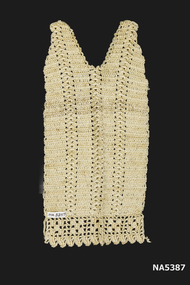
Clothing - Crochet false front (Dicky front), Unknown
... Handmade accessories...Part of Mcnamara collection Handmade accessories crochet clothing Nil - Crochet in ecru cotton - false front to be worn under ladies' suit for modesty Clothing Crochet false front (Dicky front) NcNamara family ...Part of Mcnamara collection- Crochet in ecru cotton - false front to be worn under ladies' suit for modestyNilhandmade accessories, crochet, clothing -
 Whitehorse Historical Society Inc.
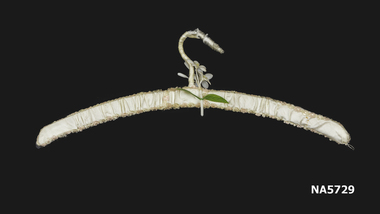
Accessory - Wedding dress coat hanger, 1991
... Clothing accessories...Handmade...Hanger was purchased to accompany wedding dress Clothing accessories Handmade Nil C 1991 - Cream satin with cream & pink floral lace trim - hanger hook bound in satin to resemble swan - Spray of 'orange blossom' at base of hanger Accessory Wedding dress coat hanger ...Hanger was purchased to accompany wedding dressC 1991 - Cream satin with cream & pink floral lace trim - hanger hook bound in satin to resemble swan - Spray of 'orange blossom' at base of hangerNilclothing accessories, handmade -
 Kew Historical Society Inc
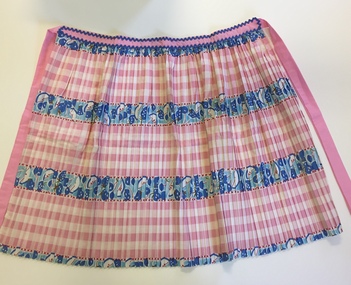
Clothing - Protective Wear, Apron, 1950s
... handmade clothing...costume accessories...While generally utilitarian, women found means of gracing these items by the use brightly coloured fabric or patterns, the positioning of pockets and the use of contrasting fabrics to provide visual interest. aprons protective clothing handmade clothing costume accessories lisa sylvan Pleated pink and white striped cotton apron interspersed with bands of a separate blue and white fabric. ...One of a collection of fourteen items of protective wear and household textiles donated by Lisa Sylvan, a long-term resident of Kew, Five of the items are homemade aprons made and worn by her mother. Of the seven pinafores, three identical but differently sized pinafores were made in her parents' factory, while the other three are handmade. The handmade aprons and pinafores are representative samples of women's work, possibly from published patterns, using fabrics originally deigned for dresses. Typically, contrasting fabrics and colours were selected to provide visual interest. The donation also includes a hand embroidered linen supper cloth and a commercially produced 'birds of Australia' printed table cloth. Most of the collection derives from the 1950s.Although not uncommon, hand-made protective clothing in the form of aprons and pinafores often represents samples and styles of 'women's work' using remnant fabrics often designed for other purposes. While generally utilitarian, women found means of gracing these items by the use brightly coloured fabric or patterns, the positioning of pockets and the use of contrasting fabrics to provide visual interest.Pleated pink and white striped cotton apron interspersed with bands of a separate blue and white fabric.aprons, protective clothing, handmade clothing, costume accessories, lisa sylvan -
 Kew Historical Society Inc
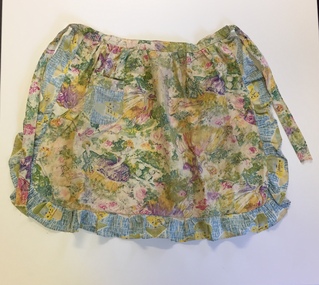
Clothing - Protective Wear, Apron, 1950s
... handmade clothing...costume accessories...While generally utilitarian, women found means of gracing these items by the use brightly coloured fabric or patterns, the positioning of pockets and the use of contrasting fabrics to provide visual interest. aprons protective clothing handmade clothing costume accessories lisa sylvan Multicoloured cotton apron using a fabric design employing floral emblems and figurative detail. ...One of a collection of fourteen items of protective wear and household textiles donated by Lisa Sylvan, a long-term resident of Kew, Five of the items are homemade aprons made and worn by her mother. Of the seven pinafores, three identical but differently sized pinafores were made in her parents' factory, while the other three are handmade. The handmade aprons and pinafores are representative samples of women's work, possibly from published patterns, using fabrics originally deigned for dresses. Typically, contrasting fabrics and colours were selected to provide visual interest. The donation also includes a hand embroidered linen supper cloth and a commercially produced 'birds of Australia' printed table cloth. Most of the collection derives from the 1950s.Although not uncommon, hand-made protective clothing in the form of aprons and pinafores often represents samples and styles of 'women's work' using remnant fabrics often designed for other purposes. While generally utilitarian, women found means of gracing these items by the use brightly coloured fabric or patterns, the positioning of pockets and the use of contrasting fabrics to provide visual interest.Multicoloured cotton apron using a fabric design employing floral emblems and figurative detail. The apron is hemmed with a pleated fabric of a different colouraprons, protective clothing, handmade clothing, costume accessories, lisa sylvan -
 Kew Historical Society Inc
Clothing - Protective Wear, Apron, 1950s
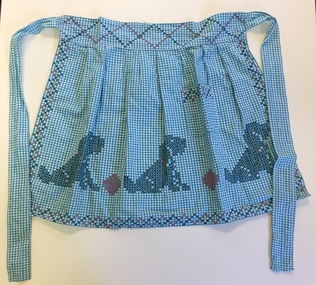
... handmade clothing...costume accessories...While generally utilitarian, women found means of gracing these items by the use brightly coloured fabric or patterns, the positioning of pockets and the use of contrasting fabrics to provide visual interest. aprons protective clothing handmade clothing costume accessories lisa sylvan Simple blue and white apron embroidered with a border in cross stitch, the same stitch used to create a repeated pattern of dogs and balls in profile. ...One of a collection of fourteen items of protective wear and household textiles donated by Lisa Sylvan, a long-term resident of Kew, Five of the items are homemade aprons made and worn by her mother. Of the seven pinafores, three identical but differently sized pinafores were made in her parents' factory, while the other three are handmade. The handmade aprons and pinafores are representative samples of women's work, possibly from published patterns, using fabrics originally deigned for dresses. Typically, contrasting fabrics and colours were selected to provide visual interest. The donation also includes a hand embroidered linen supper cloth and a commercially produced 'birds of Australia' printed table cloth. Most of the collection derives from the 1950s.Although not uncommon, hand-made protective clothing in the form of aprons and pinafores often represents samples and styles of 'women's work' using remnant fabrics often designed for other purposes. While generally utilitarian, women found means of gracing these items by the use brightly coloured fabric or patterns, the positioning of pockets and the use of contrasting fabrics to provide visual interest.Simple blue and white apron embroidered with a border in cross stitch, the same stitch used to create a repeated pattern of dogs and balls in profile.aprons, protective clothing, handmade clothing, costume accessories, lisa sylvan -
 Kew Historical Society Inc
Clothing - Protective Wear, Apron, 1950s
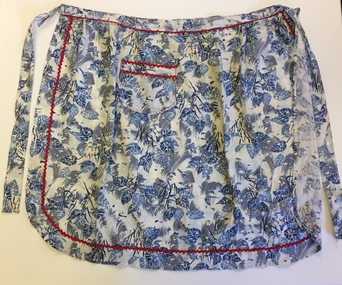
... handmade clothing...costume accessories...While generally utilitarian, women found means of gracing these items by the use brightly coloured fabric or patterns, the positioning of pockets and the use of contrasting fabrics to provide visual interest. aprons protective clothing handmade clothing costume accessories lisa sylvan fashion design women's clothing -- 1950s fashion 1950s Handmade apron created out of a blue and white dress fabric that has a pattern of leaves. ...One of a collection of fourteen items of protective wear and household textiles donated by Lisa Sylvan, a long-term resident of Kew, Five of the items are homemade aprons made and worn by her mother. Of the seven pinafores, three identical but differently sized pinafores were made in her parents' factory, while the other three are handmade. The handmade aprons and pinafores are representative samples of women's work, possibly from published patterns, using fabrics originally deigned for dresses. Typically, contrasting fabrics and colours were selected to provide visual interest. The donation also includes a hand embroidered linen supper cloth and a commercially produced 'birds of Australia' printed table cloth. Most of the collection derives from the 1950s.Although not uncommon, hand-made protective clothing in the form of aprons and pinafores often represents samples and styles of 'women's work' using remnant fabrics often designed for other purposes. While generally utilitarian, women found means of gracing these items by the use brightly coloured fabric or patterns, the positioning of pockets and the use of contrasting fabrics to provide visual interest.Handmade apron created out of a blue and white dress fabric that has a pattern of leaves. The apron is highlighted with red braid.aprons, protective clothing, handmade clothing, costume accessories, lisa sylvan, fashion design, women's clothing -- 1950s, fashion 1950s -
 Kew Historical Society Inc
Clothing - Protective Wear, Apron, 1950s
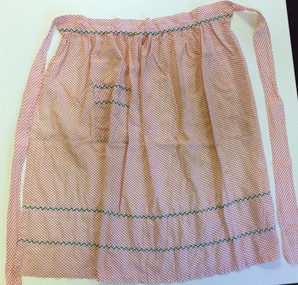
... handmade clothing...costume accessories...While generally utilitarian, women found means of gracing these items by the use brightly coloured fabric or patterns, the positioning of pockets and the use of contrasting fabrics to provide visual interest. aprons protective clothing handmade clothing costume accessories lisa sylvan fashion design women's clothing -- 1950s fashion -- 1950s Pink and white cotton apron highted with blue braid. ...One of a collection of fourteen items of protective wear and household textiles donated by Lisa Sylvan, a long-term resident of Kew, Five of the items are homemade aprons made and worn by her mother. Of the seven pinafores, three identical but differently sized pinafores were made in her parents' factory, while the other three are handmade. The handmade aprons and pinafores are representative samples of women's work, possibly from published patterns, using fabrics originally deigned for dresses. Typically, contrasting fabrics and colours were selected to provide visual interest. The donation also includes a hand embroidered linen supper cloth and a commercially produced 'birds of Australia' printed table cloth. Most of the collection derives from the 1950s.Although not uncommon, hand-made protective clothing in the form of aprons and pinafores often represents samples and styles of 'women's work' using remnant fabrics often designed for other purposes. While generally utilitarian, women found means of gracing these items by the use brightly coloured fabric or patterns, the positioning of pockets and the use of contrasting fabrics to provide visual interest.Pink and white cotton apron highted with blue braid.aprons, protective clothing, handmade clothing, costume accessories, lisa sylvan, fashion design, women's clothing -- 1950s, fashion -- 1950s -
 Kew Historical Society Inc
Clothing - Pinafore, 1950s
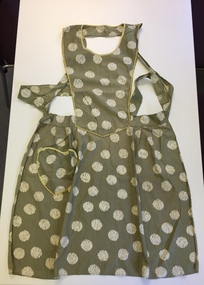
... handmade clothing...costume accessories...While generally utilitarian, women found means of gracing these items by the use brightly coloured fabric or patterns, the positioning of pockets and the use of contrasting fabrics to provide visual interest. protective clothing handmade clothing costume accessories lisa sylvan pinafores fashion design women's clothing -- 1950s fashion -- 1950s Olive green and white pinafore decorated on the bodice with yellow braid. ...One of a collection of fourteen items of protective wear and household textiles donated by Lisa Sylvan, a long-term resident of Kew, Five of the items are homemade aprons made and worn by her mother. Of the seven pinafores, three identical but differently sized pinafores were made in her parents' factory, while the other three are handmade. The handmade aprons and pinafores are representative samples of women's work, possibly from published patterns, using fabrics originally deigned for dresses. Typically, contrasting fabrics and colours were selected to provide visual interest. The donation also includes a hand embroidered linen supper cloth and a commercially produced 'birds of Australia' printed table cloth. Most of the collection derives from the 1950s.Although not uncommon, hand-made protective clothing in the form of aprons and pinafores often represents samples and styles of 'women's work' using remnant fabrics often designed for other purposes. While generally utilitarian, women found means of gracing these items by the use brightly coloured fabric or patterns, the positioning of pockets and the use of contrasting fabrics to provide visual interest.Olive green and white pinafore decorated on the bodice with yellow braid. protective clothing, handmade clothing, costume accessories, lisa sylvan, pinafores, fashion design, women's clothing -- 1950s, fashion -- 1950s -
 Kew Historical Society Inc
Clothing - Pinafore, 1950s
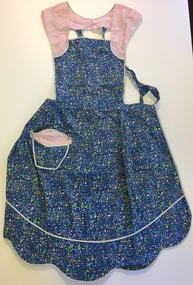
... handmade clothing...costume accessories...While generally utilitarian, women found means of gracing these items by the use brightly coloured fabric or patterns, the positioning of pockets and the use of contrasting fabrics to provide visual interest. protective clothing handmade clothing costume accessories lisa sylvan pinafores fashion design women's clothing -- 1950s fashion -- 1950s Label: "Admiration / All Cotton" Pinafore using a fabric coverd with an abstract design in bue, pink and yellow. ...One of a collection of fourteen items of protective wear and household textiles donated by Lisa Sylvan, a long-term resident of Kew, Five of the items are homemade aprons made and worn by her mother. Of the seven pinafores, three identical but differently sized pinafores were made in her parents' factory, while the other three are handmade. The handmade aprons and pinafores are representative samples of women's work, possibly from published patterns, using fabrics originally deigned for dresses. Typically, contrasting fabrics and colours were selected to provide visual interest. The donation also includes a hand embroidered linen supper cloth and a commercially produced 'birds of Australia' printed table cloth. Most of the collection derives from the 1950s.Although not uncommon, hand-made protective clothing in the form of aprons and pinafores often represents samples and styles of 'women's work' using remnant fabrics often designed for other purposes. While generally utilitarian, women found means of gracing these items by the use brightly coloured fabric or patterns, the positioning of pockets and the use of contrasting fabrics to provide visual interest.Pinafore using a fabric coverd with an abstract design in bue, pink and yellow. A plain pink cotton fabric is used to decorate the pocket and the shoulders.Label: "Admiration / All Cotton"protective clothing, handmade clothing, costume accessories, lisa sylvan, pinafores, fashion design, women's clothing -- 1950s, fashion -- 1950s -
 Kew Historical Society Inc
Clothing - Protective Wear, Pinafore, 1950s
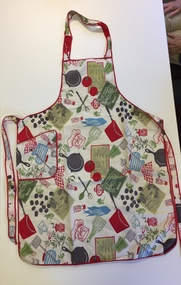
... handmade clothing...costume accessories...While generally utilitarian, women found means of gracing these items by the use brightly coloured fabric or patterns, the positioning of pockets and the use of contrasting fabrics to provide visual interest. protective clothing handmade clothing costume accessories lisa sylvan pinafores fashion design women's clothing -- 1950s fashion 1950s Brigtly coloured pinfaore using a representative 1950s fabric with a design of kitchen items in different colours Pinafore Clothing Protective Wear ...One of a collection of fourteen items of protective wear and household textiles donated by Lisa Sylvan, a long-term resident of Kew, Five of the items are homemade aprons made and worn by her mother. Of the seven pinafores, three identical but differently sized pinafores were made in her parents' factory, while the other three are handmade. The handmade aprons and pinafores are representative samples of women's work, possibly from published patterns, using fabrics originally deigned for dresses. Typically, contrasting fabrics and colours were selected to provide visual interest. The donation also includes a hand embroidered linen supper cloth and a commercially produced 'birds of Australia' printed table cloth. Most of the collection derives from the 1950s.Although not uncommon, hand-made protective clothing in the form of aprons and pinafores often represents samples and styles of 'women's work' using remnant fabrics often designed for other purposes. While generally utilitarian, women found means of gracing these items by the use brightly coloured fabric or patterns, the positioning of pockets and the use of contrasting fabrics to provide visual interest.Brigtly coloured pinfaore using a representative 1950s fabric with a design of kitchen items in different coloursprotective clothing, handmade clothing, costume accessories, lisa sylvan, pinafores, fashion design, women's clothing -- 1950s, fashion 1950s -
 Kew Historical Society Inc
Clothing - Protective Wear, Pinafore, 1950s
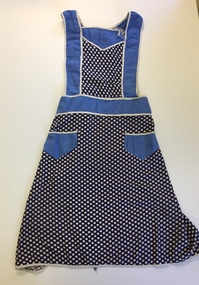
... handmade clothing...costume accessories...While generally utilitarian, women found means of gracing these items by the use brightly coloured fabric or patterns, the positioning of pockets and the use of contrasting fabrics to provide visual interest. protective clothing handmade clothing costume accessories lisa sylvan pinafores fashion design women's clothing -- 1960s fashion -- 1960s Label: "Taniwha / Quality Will Tell" Navy blue and white pinafore picked out with sections of plain blue fabric on the pocket, waist and bodice. ...One of a collection of fourteen items of protective wear and household textiles donated by Lisa Sylvan, a long-term resident of Kew, Five of the items are homemade aprons made and worn by her mother. Of the seven pinafores, three identical but differently sized pinafores were made in her parents' factory, while the other three are handmade. The handmade aprons and pinafores are representative samples of women's work, possibly from published patterns, using fabrics originally deigned for dresses. Typically, contrasting fabrics and colours were selected to provide visual interest. The donation also includes a hand embroidered linen supper cloth and a commercially produced 'birds of Australia' printed table cloth. Most of the collection derives from the 1950s.Although not uncommon, hand-made protective clothing in the form of aprons and pinafores often represents samples and styles of 'women's work' using remnant fabrics often designed for other purposes. While generally utilitarian, women found means of gracing these items by the use brightly coloured fabric or patterns, the positioning of pockets and the use of contrasting fabrics to provide visual interest.Navy blue and white pinafore picked out with sections of plain blue fabric on the pocket, waist and bodice.Label: "Taniwha / Quality Will Tell"protective clothing, handmade clothing, costume accessories, lisa sylvan, pinafores, fashion design, women's clothing -- 1960s, fashion -- 1960s -
 Kew Historical Society Inc
Clothing, Hand Beaded Purple Evening Dress, 1970s
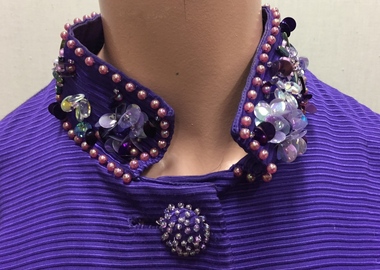
... Items in the collection were largely produced for, or purchased by women in Melbourne, and includes examples of outerwear, protective wear, nightwear, underwear and costume accessories. This handmade evening dress, worn by Kaye Cole, former mayor of Kew in 1979-80, has strong local provenance to the district....Items in the collection were largely produced for, or purchased by women in Melbourne, and includes examples of outerwear, protective wear, nightwear, underwear and costume accessories. This handmade evening dress, worn by Kaye Cole, former mayor of Kew in 1979-80, has strong local provenance to the district. kaye cole mayor of kew 1979-1980 evening dresses fashion - melbourne - 1970s Purple caftan with embroidery and beading at the neck and on the sleeves, given to the donor by Kaye Cole, former councillor and Mayor of Kew 1979-80. ...The Fashion & Design collection of the Kew Historical Society includes examples of women’s, men’s, children’s and infants’ clothing from the 18th, 19th and 20th centuries. Items in the collection were largely produced for, or purchased by women in Melbourne, and includes examples of outerwear, protective wear, nightwear, underwear and costume accessories. This handmade evening dress, worn by Kaye Cole, former mayor of Kew in 1979-80, has strong local provenance to the district.Purple caftan with embroidery and beading at the neck and on the sleeves, given to the donor by Kaye Cole, former councillor and Mayor of Kew 1979-80. The costume is believed to have been worn at various civic functions.kaye cole, mayor of kew 1979-1980, evening dresses, fashion - melbourne - 1970s -
 Flagstaff Hill Maritime Museum and Village
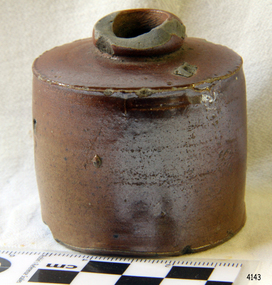
Container - Ink Bottle, 19th to early-20th century
... This ink well is historically significant as it represents methods of hand written communication that were still common up until the mid-20th century, when fountain pens and ballpoint pens took over in popularity and convenience. flagstaff hill warrnambool shipwreck coast flagstaff hill maritime museum flagstaff hill maritime village maritime museum great ocean road shipwreck artefact writing equipment writing accessory office equipment stationery domestic stoneware clay ceramic pottery ink well inkwell ink bottle penny ink well nib pen dip pen ink hand writing record keeping household business vintage blotting paper dwarf bottle Ink bottle or ink well, sometimes called a Penny Ink Well. Cylindrical body, salt-glazed, brown ceramic stoneware bottle, handmade ...This design of ink bottle or ink well was commonly referred to as a ‘penny ink well’ because it was very inexpensive to produce. It is also known as a dwarf bottle. Pen and ink has been in use for hand writing from about the seventh century up until the mid-20th century. Up until around the mid-19th century a quill pen made from a bird’s feather was used. In the 1850s the steel point pen was invented and could be manufactured on machines in large quantities. In the 1880s a successful portable fountain pen was designed, giving a smooth flowing ink and ease of use. Ink wells, used with steel nib dip pens, were commonly used up until the mid-20th century. The pens only held a small amount of ink so users had to frequently dip the nib of the pen into an ink well for more ink. Hand writing with pen and ink left wet writing on the paper, so blotting paper was carefully used to absorb the excess ink and prevent smudging. Ink could be purchased, ready to use, or in the powdered form, which needed to be mixed with water. After the invention of fountain pens, which had a reservoir of ink, and then ballpoint pens, which also had ink that flowed freely, the dip pen was slowly replaced. However, artisans continue to use nib pens to create beautiful calligraphy.This ink well is historically significant as it represents methods of hand written communication that were still common up until the mid-20th century, when fountain pens and ballpoint pens took over in popularity and convenience.Ink bottle or ink well, sometimes called a Penny Ink Well. Cylindrical body, salt-glazed, brown ceramic stoneware bottle, handmade. Stoneware bottle. flagstaff hill, warrnambool, shipwreck coast, flagstaff hill maritime museum, flagstaff hill maritime village, maritime museum, great ocean road, shipwreck artefact, writing equipment, writing accessory, office equipment, stationery, domestic, stoneware, clay, ceramic, pottery, ink well, inkwell, ink bottle, penny ink well, nib pen, dip pen, ink, hand writing, record keeping, household, business, vintage, blotting paper, dwarf bottle -
 Flagstaff Hill Maritime Museum and Village
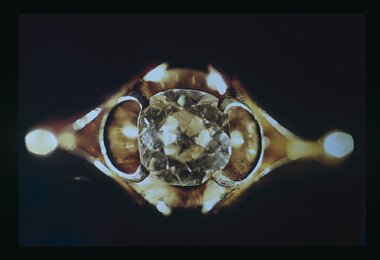
Accessory - Diamond ring, about 1855
... The setting is handmade. Accessory Diamond ring Europe ...In 1975, 120 years after the sailing ship Schomberg was wrecked, Flagstaff Hill divers (Peter Ronald, Colin Goodall and Gary Hayden) found an ornate communion set amongst the wreckage. The set comprised a jug, ciborium, lid, chalice and plate. The items, apart from the lid, were then displayed at Flagstaff Hill Maritime Village. The lid had etchings that did not match the chalice and sat in storage for several years. Then in 1978, while the marine concretion inside the lid was being examined, a surface layer came loose and revealed a glint of gold that was assumed to be a piece of brass. The layers of concretion were carefully removed and a ring-like band emerged. Further treatment exposed a 'large faceted stone in an intricate gold setting. Weeks later a detailed examination estimated the value of the ring, known as the Schomberg Diamond, to be $7000. When the Schomberg was launched in 1855, she was considered the "Noblest” ship that ever floated on the water. Schomberg's owners, the Black Ball Line had commissioned the ship for their fleet of passenger liners. She was built by Alexander Hall of Aberdeen at a cost of £43,103 and constructed with 3 skins. One planked fore and aft and two diagonally planked, fastened together with screw-threaded trunnels (wooden rails). Her First Class accommodation was simply luxurious with velvet pile carpets, large mirrors, rosewood, birds-eye maple and mahogany timbers throughout, soft furnishings of satin damask, an oak-lined library with a piano. Overall she had accommodation for 1000 passengers. At the launch, the Schomberg's 34-year-old master, Captain 'Bully' Forbes, had promised to reach Melbourne in sixty days stating, "with or without the help of God." Captain James Nicol Forbes was born in Aberdeen in 1821 and rose to fame with his record-breaking voyages on the famous Black Ball Line ships; Marco Polo and Lightning. In 1852 in the Marco Polo, he made the record passage from London to Melbourne in 68 days. Unfortunately there were 53 deaths on the voyage, but the great news was off the record passage by Captain Forbes. In 1854 he took the clipper “Lighting” to Melbourne in 76 days and back in 63 days, this record was never beaten by a sailing ship. He often drove his crew and ship to breaking point to beat his previous records. He cared little for the comfort of the passengers. On this, the Schomberg's maiden voyage, he was determined to break existing records. Schomberg departed Liverpool on her maiden voyage on 6th October 1855 flying a sign that read "Sixty Days to Melbourne". She departed with 430 passengers and 3000 tons cargo including iron rails and equipment intended to build the Melbourne to Geelong Railway and a bridge over the Yarra from Melbourne to Hawthorn. She also carried a cow for fresh milk, pens for fowls and pigs, 90,000 gallons of water for washing and drinking. She also carried 17,000 letters and 31,800 newspapers. The ship and cargo were insured for $300,000 a fortune for the time. The winds were poor as she sailed across the equator, slowing Schomberg's journey considerably. Land was first sighted on Christmas Day, at Cape Bridgewater near Portland, Captain Forbes followed the coastline towards Melbourne. Forbes was said to be playing cards when called by the third mate Henry Keen, who reported land about 3 miles off. Due in large part to the captain's regarding a card game as more important than his ship, it eventually ran aground on a sand spit near Curdie's Inlet (about 56 km west of Cape Otway) on 26th December 1855, 78 days after leaving Liverpool. The sand spit and the currents were not marked on Forbes's map. Overnight, the crew launched a lifeboat to find a safe place to land the ship’s passengers. The scouting party returned to Schomberg and advised Forbes that it was best to wait until morning because the rough seas could easily overturn the small lifeboats. The ship’s Chief Officer spotted the SS Queen at dawn and signaled the steamer. The master of the Queen approached the stranded vessel and all of Schomberg’s passengers and crew disembarked safely. The Black Ball Line's Melbourne agent sent a steamer to retrieve the passengers' baggage from the Schomberg. Other steamers helped unload her cargo until the weather changed and prevented the salvage teams from accessing the ship. Later one plunderer found a case of Wellington boots, but alas, all were for the left foot. Local merchants Manifold & Bostock bought the wreck and cargo but did not attempt to salvage the cargo still on board the ship. They eventually sold it on to a Melbourne businessman and two seafarers. In 1864 after two of the men drowned when they tried to reach Schomberg, salvage efforts were abandoned. In 1870, nearly 15 years after the wreck parts of the Schomberg had washed ashore on the south island of New Zealand. The wreck now lies in almost 9 meters of water and although the woodwork is mostly disintegrated the shape of the ship can still be determined due to the remaining railway irons, girders and the ship’s frame. A variety of goods and materials can be seen scattered about nearby. The actual lid in which the ring was found has not yet been completely identified and could belong to a coffee pot, sugar bowl or maybe a jug or something similar. Although all survived the wreck no-one came forward to claim the valuable diamond. The Schomberg Diamond is currently on display in the Great Circle Gallery. Flagstaff Hill Maritime Village along with the rest of the communion set. Other artefacts salvaged from the wreck include ship fittings and equipment, personal effects, a lithograph, tickets and photographs from the Schomberg. One of the Schomberg bells is in the Warrnambool Library.The Schomberg Diamond is particularly significant in that it played a crucial part in having the legislation changed to protect shipwrecks, with far tighter control over the salvaging of items from wreck sites. This ring is registered as Artefact S/105 in the Schomberg collection, the Schomberg collection as a whole is of historical and archaeological significance at a State level. Flagstaff Hill’s collection of artefacts from the Schomberg is also significant for its association with the Victorian Heritage Registered shipwreck (VHR S 612). The collection is of prime significant because of the relationship between the objects salvaged, as together they help us to interpret the story of the Schomberg. The collection as a whole is historically significant for representing aspects of Victoria's maritime history and its potential to interpret social and historical themes. A mid-Victorian gentleman's solitaire diamond dress ring with a Brazilian cut diamond (cushion cut), one and one-third carat set within an 18 carat yellow gold ring consisting of four claws within an open scroll setting and a divided scroll shank. Colour is classified as 'J', clarity SII. The setting is handmade. warrnambool, shipwrecked-coast, flagstaff-hill, flagstaff-hill-maritime-museum, maritime-museum, shipwreck-coast, flagstaff-hill-maritime-village, schomberg, shipwrecked-artefact, clipper ship, black ball line, 1855 shipwreck, aberdeen clipper ship, captain forbes, peterborough shipwreck, ss queen, ciborium, ring, schomberg-diamond, schomberg-ring, gentleman's ring, dress ring -
 Bright & District Historical Society operating the Bright Museum
Collar, Ladies lace, c1875
... Handmade, belonged to Mrs. Weston, Porepunkah lace tie bow collar ladies accessories taffeta Black lace and taffeta with taffeta ties in front Collar, Ladies lace ...Handmade, belonged to Mrs. Weston, PorepunkahBlack lace and taffeta with taffeta ties in frontlace, tie, bow, collar, ladies accessories, taffeta -
 Federation University Historical Collection
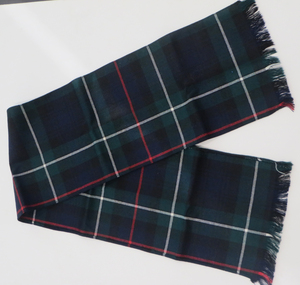
Clothing - Costume Accessories, Mackenzie Tartan Scarf, c1953
... She was also the set and costume designer for Junior Light Opera Company. margaret bennett ballarat ladies' pipe band alumni highland pipe band margaret reynolds tartan scarf mackenzie tartan City of Ballaarat Pipe Band, Life Member on the front Inscribed on the back is Drum Major Margaret Bennett A handmade Mackenzie Tartan Scarf, with a red, white, green and dark blue pattern and fringed ends Mackenzie Tartan Scarf Clothing Costume Accessories ...Margaret Bennett was a student at Ballarat Teachers' College in 1949. She attended the Ballarat School of Mines as a full-time day student for three years, gaining her Diploma of Art in 1972. She was Drum Major of the Ballarat Ladies' Pipe Band from c1954-1955. She was also the set and costume designer for Junior Light Opera Company. A handmade Mackenzie Tartan Scarf, with a red, white, green and dark blue pattern and fringed endsCity of Ballaarat Pipe Band, Life Member on the front Inscribed on the back is Drum Major Margaret Bennettmargaret bennett, ballarat ladies' pipe band, alumni, highland pipe band, margaret reynolds, tartan, scarf, mackenzie tartan -
 Federation University Historical Collection
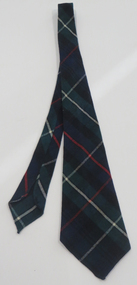
Clothing - Costume Accessories, Mackenzie Tartan Tie
... handmade tie in Mackenzie Tartan. Gift of Margaret Bennett, 2019 Mackenzie Tartan Tie Clothing Costume Accessories ...Margaret Bennett was a student at Ballarat Teachers' College in 1949. She attended the Ballarat School of Mines as a full-time day student for three years, gaining her Diploma of Art in 1972. She was Drum Major of the Ballarat Ladies' Pipe Band from c1954-1955. She was also the set and costume designer for Junior Light Opera Company. A handmade tie in Mackenzie Tartan. Gift of Margaret Bennett, 2019margaret bennett, ballarat ladies' pipe band, alumni, highland pipe band, tie, mackenzie tartan, tartan, wool -
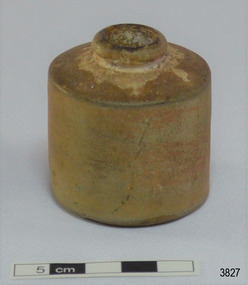 Flagstaff Hill Maritime Museum and Village
Container - Ink Bottle, 1890s to 1902
... It is valuable for an insight into Victorian era of shipping and maritime history. flagstaff hill warrnambool flagstaff hill maritime museum maritime museum shipwreck coast flagstaff hill maritime village great ocean road john chance inverlochy scotland captain e.r. kendrick melbourne tramway company tramway cable ingoldsby reef point addis anglesea thompson’s creek barwon heads ink bottle writing equipment writing accessory office equipment stationery domestic stoneware clay ceramic pottery ink well inkwell penny ink well nib pen dip pen ink hand writing record keeping household business vintage blotting paper dwarf ink Ink bottle or ink well; cylindrical shaped, salt-glazed, mid-brown ceramic bottle. It has a small round mouth, rounded lip that extend past the short neck, wide shoulders, straight sides, flat bottom. Handmade ...This design of ink bottle or ink well was commonly referred to as a ‘penny ink well’ because it was very inexpensive to produce. It is also known as a dwarf ink bottle. It was recovered from the wreck of the 1895-1902 ship Inverlochy and is part of the John Chance Collection. Pen and ink has been in use for hand writing from about the seventh century up until the mid-20th century. Up until around the mid-19th century a quill pen made from a bird’s feather was used. In the 1850s the steel point pen was invented and could be manufactured on machines in large quantities. In the 1880s a successful portable fountain pen was designed, giving a smooth flowing ink and ease of use. Ink wells, used with steel nib dip pens, were commonly used up until the mid-20th century. The pens only held a small amount of ink so users had to frequently dip the nib of the pen into an ink well for more ink. Hand writing with pen and ink left wet writing on the paper, so blotting paper was carefully used to absorb the excess ink and prevent smudging. Ink could be purchased, ready to use, or in the powdered form, which needed to be mixed with water. After the invention of fountain pens, which had a reservoir of ink, and then ballpoint pens, which also had ink that flowed freely, the dip pen was slowly replaced. However, artisans continue to use nib pens to create beautiful calligraphy. INVERLOCHY 1895-1902 - The Inverlochy was a steel sailing barque built in Scotland in 1895 for international trade. In 1902 the Inverlochy left Liverpool under the command of Captain E.R. Kendrick. There were 21 officers and crew and the captain’s wife Mrs Kendrick, on board, bound for Australia with cargo that included tools, chemicals, liquor (beer, whisky, stout, rum, and brandy), steel, iron, wire netting, hoop iron, tinplate and pig iron), and steel wire for the Melbourne Tramway Company, tiles, soap, soft goods and earthenware. On December 18 almost at their destination, the Inverlochy ran aground on Ingoldsby Reef at Point Addis, near Anglesea. The crew and passengers left the ship via lifeboat and landed at Thompson’s Creek, then walked about 20 kilometres to Barwon Heads. Salvagers were interested in the 10 miles of cable in the hold. Mrs Kendrick’s ‘high grade’ bicycle was amongst the items salvaged but she lost her jewellery and two pianos. By February 1903 the ship had broken up and objects such as bottles and casks of liquor were washed ashore. Bad weather shook the wreck in June 1903, causing the ship’s spars and figurehead to be washed ashore. This ink bottle is historically significant as it represents methods of hand written communication that were still common up until the mid-20th century, when fountain pens and ballpoint pens took over in popularity and convenience. The Ink bottle also has significant as it was recovered by John Chance, a diver from the wreck of the Inverlochy in the late 1960s to early 1970s. Items that come from several wrecks along Victoria's coast have since been donated to the Flagstaff Hill Maritime Village’s museum collection by his family, illustrating this item’s level of historical value. This Ink bottle is significant because of its historical connection to the barque Inverlochy, which is an example of a commercial international steel sailing barque and is listed on the Victorian Heritage Database VHR S338. The Inverlochy is significant for its cargo, which is a snapshot of the kind of goods imported into Australia at the turn of the 19th century, including cable for the Melbourne Tramway Company. The wreck of the Inverlochy is important as an accessible dive site that shows the remains of a large international trading vessel and its contents. It is valuable for an insight into Victorian era of shipping and maritime history.Ink bottle or ink well; cylindrical shaped, salt-glazed, mid-brown ceramic bottle. It has a small round mouth, rounded lip that extend past the short neck, wide shoulders, straight sides, flat bottom. Handmade. Also called a Penny Ink Well.flagstaff hill, warrnambool, flagstaff hill maritime museum, maritime museum, shipwreck coast, flagstaff hill maritime village, great ocean road, john chance, inverlochy, scotland, captain e.r. kendrick, melbourne tramway company, tramway cable, ingoldsby reef, point addis, anglesea, thompson’s creek, barwon heads, ink bottle, writing equipment, writing accessory, office equipment, stationery, domestic, stoneware, clay, ceramic, pottery, ink well, inkwell, penny ink well, nib pen, dip pen, ink, hand writing, record keeping, household, business, vintage, blotting paper, dwarf ink -
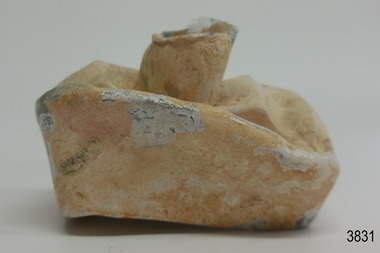 Flagstaff Hill Maritime Museum and Village
Container - Ink Bottle, from mid-19th century to 1902
... accessory...victorian...antique...ink well...sheer lip...distorted body...handmade...It is valuable for an insight into Victorian era of shipping and maritime history. flagstaff hill warrnambool flagstaff hill maritime museum maritime museum shipwreck coast flagstaff hill maritime village great ocean road john chance inverlochy scotland captain e.r. kendrick melbourne tramway company tramway cable ingoldsby reef point addis anglesea thompson’s creek barwon heads boat ink bottle cottage ink penny ink glass ink bottle pen rest writing accessory victorian antique ink well sheer lip distorted body handmade mould blown statoionery Ink bottle, thick clear glass, rectangular base with small round mouth, long sides have have a U shaped groove along the shoulders (used for resting pen handles). ...This ink bottle is ‘boat’ shaped, which was a common design from the mid-1840s. It was crudely made; maybe it was rejected as a practice bottle or perhaps heat or pressure has distorted it. The bottle was recovered from the wreck of the Inverlochy and is part of the John Chance collection. Ink in the 1700s ink could be purchased in powdered or block form from apothecary shops, to be mixed with water as needed. Then in the mid-1800s chemists began selling ink in liquid form, in small, inexpensive and often attractive bottles. The small glass ink bottles were handmade, blown into a cup shaped mould, and sharply broken off from the blow-pipe at the neck, referred to as the English-made ‘burst-off’ finish. The neck was then filed, filled with liquid ink and sealed with a cork or wax. It was a quick, affordable container and made pen and ink writing available to the public. The name ‘penny ink’ bottles was a common title due to their low cost. INVERLOCHY 1895-1902 - The Inverlochy was a steel sailing barque built in Scotland in 1895 for international trade. In 1902 the Inverlochy left Liverpool under the command of Captain E.R. Kendrick. There were 21 officers and crew and the captain’s wife Mrs Kendrick, on board, bound for Australia with cargo that included tools, chemicals, liquor (beer, whisky, stout, rum, and brandy), steel, iron, wire netting, hoop iron, tinplate and pig iron), and steel wire for the Melbourne Tramway Company, tiles, soap, soft goods and earthenware. On December 18 almost at their destination, the Inverlochy ran aground on Ingoldsby Reef at Point Addis, near Anglesea. The crew and passengers left the ship via lifeboat and landed at Thompson’s Creek, then walked about 20 kilometres to Barwon Heads. Salvagers were interested in the 10 miles of cable in the hold. Mrs Kendrick’s ‘high grade’ bicycle was amongst the items salvaged but she lost her jewellery and two pianos. By February 1903 the ship had broken up and objects such as bottles and casks of liquor were washed ashore. Bad weather shook the wreck in June 1903, causing the ship’s spars and figurehead to be washed ashore. This boat shaped handmade ink bottle is historically significant for its association with communications and record keeping in the mid-to-late 19th century. The bottle is socially significant as an example of making a useful product affordable to every day people. This handmade glass ink bottle is significant for its connection with the John Chance Collection, which is historically significant as an example of artefacts from wrecks that had been lost in the coastal waters of Victoria from thirty to over one hundred years before John Chance and others discovered them. These artefacts are a sample of goods carried as cargo or personal possessions, and of ship hardware of that era. The ink bottle is significant through its connection with the barque, Inverlochy, The Inverlochy is significant for its cargo, which is a snapshot of the array of goods imported into Australia at the turn of the 19th century, including cable for the Melbourne Tramway Company. The Inverlochy is historically significant and is registered on the Victorian Heritage Database, VHR S338. The wreck of the Inverlochy is important as an accessible dive site that shows the remains of a large international trading vessel and its contents. It is valuable for an insight into Victorian era of shipping and maritime history.Ink bottle, thick clear glass, rectangular base with small round mouth, long sides have have a U shaped groove along the shoulders (used for resting pen handles). The outside surface has a white clay-type reside over it. Bottle is very bent and distorted. flagstaff hill, warrnambool, flagstaff hill maritime museum, maritime museum, shipwreck coast, flagstaff hill maritime village, great ocean road, john chance, inverlochy, scotland, captain e.r. kendrick, melbourne tramway company, tramway cable, ingoldsby reef, point addis, anglesea, thompson’s creek, barwon heads, boat ink bottle, cottage ink, penny ink, glass ink bottle, pen rest, writing accessory, victorian, antique, ink well, sheer lip, distorted body, handmade, mould blown, statoionery -
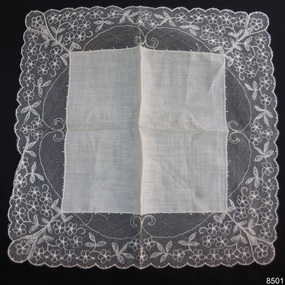 Flagstaff Hill Maritime Museum and Village
Accessory - Handkerchief, c. 19th century
... This handkerchief is an example of fine handmade needlework. It is also an example of women's fashion accessories in the late 19th and early 20th century. flagstaff hill warrnambool shipwrecked coast flagstaff hill maritime museum maritime museum shipwreck coast flagstaff hill maritime village great ocean road handkerchief lace handkerchief woman's handkerchief women's accessory silk handkerchief fine handcraft needlecraft ladies' handkerchief 1900s White starched silk handkerchief, square shape, very soft fabric edged with 5cm embroidered net lace. ...The handkerchief was on display at Flagstaff Hill reception area from 2008-2105 as an example of fine needlework with a lace pattern typical of the early 1900's. During that era the house mistress would often carry two handkerchiefs, one for blowing her nose and one out on show, perhaps in an apron pocket.This handkerchief is an example of fine handmade needlework. It is also an example of women's fashion accessories in the late 19th and early 20th century.White starched silk handkerchief, square shape, very soft fabric edged with 5cm embroidered net lace. Net was embroidered as a strip then joined at corners. The design is backstitched then the lace has been joined to the fabric using blanket stitch. flagstaff hill, warrnambool, shipwrecked coast, flagstaff hill maritime museum, maritime museum, shipwreck coast, flagstaff hill maritime village, great ocean road, handkerchief, lace handkerchief, woman's handkerchief, women's accessory, silk handkerchief, fine handcraft, needlecraft, ladies' handkerchief, 1900s -
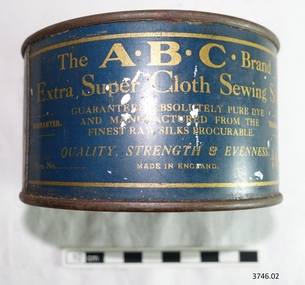 Flagstaff Hill Maritime Museum and Village
Container - Tin, 1930-1955's
... accessories used by Jim Williams from about 1930-1955 to hand craft the ship model “HMS Sovereign of the Seas”. It is part of a collection of objects used by Jim Williams, maker of fine ship models from about 1930-1955. Most of the components for the models, as well as many of the tools, were handmade...accessories used by Jim Williams from about 1930-1955 to hand craft the ship model “HMS Sovereign of the Seas”. It is part of a collection of objects used by Jim Williams, maker of fine ship models from about 1930-1955. Most of the components for the models, as well as many of the tools, were handmade ...This metal tin once contained sewing silk thread, and was later used for storing 'B' hinges used in the making of the ship model, Sovereign of the Seas. Natural silk thread used in the model has elasticity and can also be teased out for making fine line for rigging on ship models. This object is one of the tools and accessories used by Jim Williams from about 1930-1955 to hand craft the ship model “HMS Sovereign of the Seas”. It is part of a collection of objects used by Jim Williams, maker of fine ship models from about 1930-1955. Most of the components for the models, as well as many of the tools, were handmade by Jim Williams. Ship model of HMS Sovereign of the Seas, scale model of 17th Century English war ship, was handmade and carved from plans, enclosed in airtight glass case. All components of that model, including even the smallest pulleys, were hand crafted using tools designed and made by Jim. Outstanding details include functional rigging and moving cannons. Please see our record 3732 of the mode Sovereign of the Seas for further details of the ship and the maker. This tailor’s silk container, and its later used as storage for hinges, was used in the hobby and skill of ship model making that has been carried as a leisure activity out for generations. The hobby is often chosen by serving and retired mariners who appreciate the connection with maritime history. This tin was used by local Warrnambool man, Jim Williams, who was employed at Cramond and Dickson clothing store, and then at Fletcher Jones menswear for 27 years. It was used in making components for the model of the historic ship, the Sovereign of the Seas. The Sovereign of the Seas was a historic 17th century English war ship with important maritime heritage. Tin, round, with lid. Red label reads “The "A.B.C" Brand Tailors Sewing Silk (Raven) Color Fast. Dyed by a new process. Manufactured from the best raw silks procurable. Warranted. Made in England. Size No. 1/4 LB” .The container has no contents. This tin is part of a collection of tools and accessories once used by Jim Williams, maker of a series of ship models 1930-1955 including “HMS Sovereign of the Seas”. “The "A.B.C" Brand Tailors Sewing Silk (Raven) Color Fast. Dyed by a new process. Manufactured from the best raw silks procurable. Warranted. Made in England. Size No. 1/4 LB”, Logo on lid is the intertwined letters of “A.B.C.”flagstaff hill, warrnambool, flagstaff hill maritime museum, maritime museum, flagstaff hill maritime village, great ocean road, jim williams, james bernard williams, ship model tools, ship model making, ship model making accessories, "a.b.c" brand tailors sewing silk, b hinges, textile, silk thread, sewing silk, shipwreck coast, ship model, hobby, ship model tool, english war ship -
 Flagstaff Hill Maritime Museum and Village
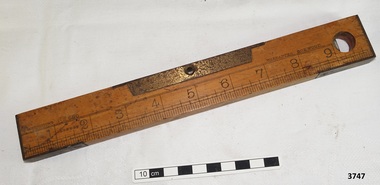
Instrument - Spirit Level, Barringtons, 1930-1955's
... handmade by Jim Williams. Jim’s family has donated the ship model “Sovereign of the Seas” and many tools, accessories and documents used in the making of this and other ship models have been donated to Flagstaff Hill Maritime Village. ...handmade by Jim Williams. Jim’s family has donated the ship model “Sovereign of the Seas” and many tools, accessories and documents used in the making of this and other ship models have been donated to Flagstaff Hill Maritime Village. ...This 10” (ten inch) spirit level was made from boxwood by Barringtons of London. It was used in the making of ship model Sovereign of the Seas. It is part of a collection of objects used by Jim Williams, maker of fine ship models from about 1930-1955. Most of the components for the models, as well as many of the tools, were handmade by Jim Williams. Jim’s family has donated the ship model “Sovereign of the Seas” and many tools, accessories and documents used in the making of this and other ship models have been donated to Flagstaff Hill Maritime Village. Ship model of HMS Sovereign of the Seas, scale model of 17th Century English war ship, was handmade and carved from plans, enclosed in airtight glass case. All components of that model, including even the smallest pulleys, were hand crafted using tools designed and made by Jim. Outstanding details include functional rigging and moving cannons. Please see our record 3732 of the mode Sovereign of the Seas for further details of the ship and the maker. This spirit level is connected with the hobby and skill of ship model making that has been crafted as a leisure activity for many generations. The hobby is often chosen by serving and retired mariners who appreciate the connection with maritime history. This spirit level was used by local Warrnambool man, Jim Williams, who was employed at Cramond and Dickson clothing store, and then at Fletcher Jones menswear for 27 years. It was used in making components for the model of the historic ship, the Sovereign of the Seas. The Sovereign of the Seas was a historic 17th century English war ship with important maritime heritage. Wooden spirit level. Barringtons Spirit level No 650, Warranted boxwood. Made in London. Length 10" (10 inches). Bottom corners are reinforced with metal protection. It has two levels. The vertical level is within a round cut-out in one end. The horizontal level is on the top edge, surrounded by a metal plate with two cut-outs. One side of the spirit level has a ruler marked at 1/16 inch intervals, the other side is marked at 1/8 inch intervals. There is a large circle cut-out in the end that holds the vertical level. Both sides have the manufacturer’s name, the level’s model number and the material it is made of. One side also has the city of manufacture – England. This spirit level is part of a collection of tools and accessories once used by Jim Williams, maker of a series of ship models 1930-1955 including “HMS Sovereign of the Seas”. 2x “WARRANTED BOXWOOD”, 2x “BARRINGTON’S No 650”, “LONDON”flagstaff hill, warrnambool, flagstaff hill maritime museum, shipwreck coast, flagstaff hill maritime village, great ocean road, jim williams, james bernard williams, ship model hobby, ship model tools, ship model making equipment, ship model making accessories, barringtons spirit level, barringtons london, 10” spirit level, sovereign of the sea, ship model, hobby, ship model tool, english war ship, measuring instrument -
 Flagstaff Hill Maritime Museum and Village
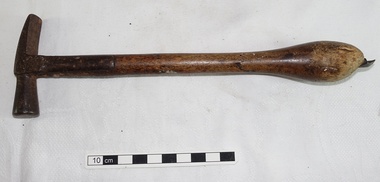
Tool - Hammer, 1930-1955's
... handmade by Jim Williams. Jim’s family has donated the ship model “Sovereign of the Seas” and many tools, accessories and documents used in the making of this and other ship models have been donated to Flagstaff Hill Maritime Village. ...handmade by Jim Williams. Jim’s family has donated the ship model “Sovereign of the Seas” and many tools, accessories and documents used in the making of this and other ship models have been donated to Flagstaff Hill Maritime Village. ...This double headed hammer seems to be modified for a particular use, with the addition of a one-pronged claw on one end. It was used in the making of ship model Sovereign of the Seas. It is part of a collection of objects used by Jim Williams, maker of fine ship models from about 1930-1955. Most of the components for the models, as well as many of the tools, were handmade by Jim Williams. Jim’s family has donated the ship model “Sovereign of the Seas” and many tools, accessories and documents used in the making of this and other ship models have been donated to Flagstaff Hill Maritime Village. Ship model of HMS Sovereign of the Seas, scale model of 17th Century English war ship, was handmade and carved from plans, enclosed in airtight glass case. All components of that model, including even the smallest pulleys, were hand crafted using tools designed and made by Jim. Outstanding details include functional rigging and moving cannons. Please see our record 3732 of the mode Sovereign of the Seas for further details of the ship and the maker. This hammer is connected with the hobby and skill of ship model making that has been crafted as a leisure activity for many generations. The hobby is often chosen by serving and retired mariners who appreciate the connection with maritime history. This hammer was modified and was used by local Warrnambool man, Jim Williams, who was employed at Cramond and Dickson clothing store, and then at Fletcher Jones menswear for 27 years. It was used in making components for the model of the historic ship, the Sovereign of the Seas. The Sovereign of the Seas was a historic 17th century English war ship with important maritime heritage. Hammer, small, double ended; metal hammer one end, wooden bulbous handle, metal claw hook at the end. This hook is part of a claw hammer with one prong broken off, perhaps to serve a particular purpose. The claw end has remnants of red paint. This hammer is part of a collection of tools and accessories once used by Jim Williams, maker of a series of ship models 1930-1955 including “HMS Sovereign of the Seas”. flagstaff hill, warrnambool, flagstaff hill maritime museum, shipwreck coast, flagstaff hill maritime village, great ocean road, ship model sovereign of the seas, jim williams, james bernard williams, ship model hobby, ship model tools, ship model making equipment, ship model making accessories, double ended hammer, modified hammer, sovereign of the sea, ship model, hobby, ship model tool, english war ship -
 Flagstaff Hill Maritime Museum and Village
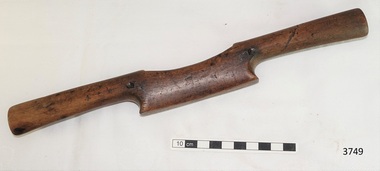
Tool - Spokeshave, 1930-1955's
... handmade by Jim Williams. Jim’s family has donated the ship model “Sovereign of the Seas” and many tools, accessories and documents used in the making of this and other ship models have been donated to Flagstaff Hill Maritime Village. ...handmade by Jim Williams. Jim’s family has donated the ship model “Sovereign of the Seas” and many tools, accessories and documents used in the making of this and other ship models have been donated to Flagstaff Hill Maritime Village. ...This wooden spokeshave was used in the making of ship model Sovereign of the Seas. It would have been used to shave and shape wood in a similar way that a plane would be used. Its name comes from its use for shaping curved objects such as wheel spokes, oars, paddles, chair legs and bows. It is part of a collection of objects used by Jim Williams, maker of fine ship models from about 1930-1955. Most of the components for the models, as well as many of the tools, were handmade by Jim Williams. Jim’s family has donated the ship model “Sovereign of the Seas” and many tools, accessories and documents used in the making of this and other ship models have been donated to Flagstaff Hill Maritime Village. Ship model of HMS Sovereign of the Seas, scale model of 17th Century English war ship, was handmade and carved from plans, enclosed in airtight glass case. All components of that model, including even the smallest pulleys, were hand crafted using tools designed and made by Jim. Outstanding details include functional rigging and moving cannons. Please see our record 3732 of the mode Sovereign of the Seas for further details of the ship and the maker.This spokeshave is connected with the hobby and skill of ship model making that has been crafted as a leisure activity for many generations. The hobby is often chosen by serving and retired mariners who appreciate the connection with maritime history. This spokeshave was used by local Warrnambool man, Jim Williams, who was employed at Cramond and Dickson clothing store, and then at Fletcher Jones menswear for 27 years. It was used in making components for the model of the historic ship, the Sovereign of the Seas. The Sovereign of the Seas was a historic 17th century English war ship with important maritime heritage. Spokeshave; two-handled, medium coloured wood tool, slightly curved centre. The front has two blade screws protruding from it, the back has a flat ‘sole’ with removable brass blade attached by screws. This spokeshave is part of a collection of tools and accessories once used by Jim Williams, maker of a series of ship models 1930-1955 including “HMS Sovereign of the Seas”. (Illegible text is pressed into the top side of the spoke shave.)flagstaff hill, warrnambool, flagstaff hill maritime museum, shipwreck coast, flagstaff hill maritime village, great ocean road, jim williams, james bernard williams, ship model hobby, ship model tools, ship model making equipment, ship model making accessories, spokeshave, spoke shave, sovereign of the sea, ship model, hobby, ship model tool, english war ship -
 Flagstaff Hill Maritime Museum and Village
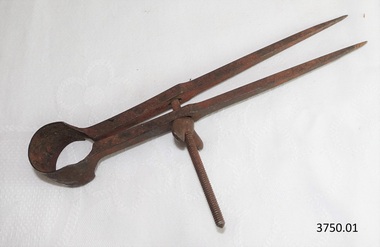
Instrument - Dividers, 1930-1955's
... handmade by Jim Williams. Jim’s family has donated the ship model “Sovereign of the Seas” and many tools, accessories and documents used in the making of this and other ship models have been donated to Flagstaff Hill Maritime Village. ...handmade by Jim Williams. Jim’s family has donated the ship model “Sovereign of the Seas” and many tools, accessories and documents used in the making of this and other ship models have been donated to Flagstaff Hill Maritime Village. ...This set of dividers was used for measuring and marking details in the planning making of components for the ship model Sovereign of the Seas. It is part of a collection of objects used by Jim Williams, maker of fine ship models from about 1930-1955. Most of the components for the models, as well as many of the tools, were handmade by Jim Williams. Jim’s family has donated the ship model “Sovereign of the Seas” and many tools, accessories and documents used in the making of this and other ship models have been donated to Flagstaff Hill Maritime Village. Ship model of HMS Sovereign of the Seas, scale model of 17th Century English war ship, was handmade and carved from plans, enclosed in airtight glass case. All components of that model, including even the smallest pulleys, were hand crafted using tools designed and made by Jim. Outstanding details include functional rigging and moving cannons. Please see our record 3732 of the mode Sovereign of the Seas for further details of the ship and the maker.This set of dividers is connected with the hobby and skill of ship model making that has been crafted as a leisure activity for many generations. The hobby is often chosen by serving and retired mariners who appreciate the connection with maritime history. These dividers were used by local Warrnambool man, Jim Williams, who was employed at Cramond and Dickson clothing store, and then at Fletcher Jones menswear for 27 years. It was used in making components for the model of the historic ship, the Sovereign of the Seas. The Sovereign of the Seas was a historic 17th century English war ship with important maritime heritage. Dividers, metal, adjustable with wingnut to hold in place. Used to measure and mark reoccurring distances. This set of dividers is part of a collection of tools and accessories once used by Jim Williams, maker of a series of ship models 1930-1955 including “HMS Sovereign of the Seas”.flagstaff hill, warrnambool, flagstaff hill maritime museum, maritime museum, shipwreck coast, flagstaff hill maritime village, great ocean road, jim williams, james bernard williams, ship model hobby, ship model tools, ship model making equipment, ship model making accessories, technical drawing instrument, dividers for drawing and measuring, set of dividers, sovereign of the sea, ship model, hobby, ship model tool, english war ship, measuring instrument -
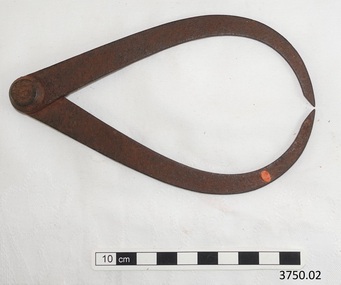 Flagstaff Hill Maritime Museum and Village
Instrument - Calipers, 1930-1955's
... handmade by Jim Williams. Jim’s family has donated the ship model “Sovereign of the Seas” and many tools, accessories and documents used in the making of this and other ship models have been donated to Flagstaff Hill Maritime Village. ...handmade by Jim Williams. Jim’s family has donated the ship model “Sovereign of the Seas” and many tools, accessories and documents used in the making of this and other ship models have been donated to Flagstaff Hill Maritime Village. ...This set of calipers was used for measuring widths or thicknesses in the planning and making of components for the ship model Sovereign of the Seas. It is part of a collection of objects used by Jim Williams, maker of fine ship models from about 1930-1955. Most of the components for the models, as well as many of the tools, were handmade by Jim Williams. Jim’s family has donated the ship model “Sovereign of the Seas” and many tools, accessories and documents used in the making of this and other ship models have been donated to Flagstaff Hill Maritime Village. Ship model of HMS Sovereign of the Seas, scale model of 17th Century English war ship, was handmade and carved from plans, enclosed in airtight glass case. All components of that model, including even the smallest pulleys, were hand crafted using tools designed and made by Jim. Outstanding details include functional rigging and moving cannons. Please see our record 3732 of the mode Sovereign of the Seas for further details of the ship and the maker. This calliper is connected with the hobby and skill of ship model making that has been crafted as a leisure activity for many generations. The hobby is often chosen by serving and retired mariners who appreciate the connection with maritime history. This calliper was used by local Warrnambool man, Jim Williams, who was employed at Cramond and Dickson clothing store, and then at Fletcher Jones menswear for 27 years. It was used in making components for the model of the historic ship, the Sovereign of the Seas. The Sovereign of the Seas was a historic 17th century English war ship with important maritime heritage.Calipers, metal, two curved arms joined at the top to open and close. Spot of orange paint on one arm. Used to measure thickness of materials. This set of calipers is part of a collection of tools and accessories once used by Jim Williams, maker of a series of ship models 1930-1955 including “HMS Sovereign of the Seas”.flagstaff hill, warrnambool, flagstaff hill maritime museum, maritime museum, shipwreck coast, flagstaff hill maritime village, great ocean road, jim williams, james bernard williams, ship model hobby, ship model tools, ship model making equipment, ship model making accessories, technical drawing instrument, calipers for drawing and measuring, measuring instrument, sovereign of the sea, ship model, hobby, ship model tool, english war ship, calliper, callipers -
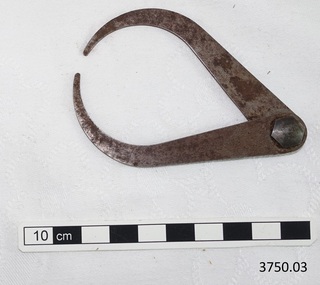 Flagstaff Hill Maritime Museum and Village
Instrument - Calipers, 1930-1955's
... handmade by Jim Williams. Jim’s family has donated the ship model “Sovereign of the Seas” and many tools, accessories and documents used in the making of this and other ship models have been donated to Flagstaff Hill Maritime Village. ...handmade by Jim Williams. Jim’s family has donated the ship model “Sovereign of the Seas” and many tools, accessories and documents used in the making of this and other ship models have been donated to Flagstaff Hill Maritime Village. ...This set of calipers was used for measuring and marking in the planning and making of components for the ship model Sovereign of the Seas. It is part of a collection of objects used by Jim Williams, maker of fine ship models from about 1930-1955. Most of the components for the models, as well as many of the tools, were handmade by Jim Williams. Jim’s family has donated the ship model “Sovereign of the Seas” and many tools, accessories and documents used in the making of this and other ship models have been donated to Flagstaff Hill Maritime Village. Ship model of HMS Sovereign of the Seas, scale model of 17th Century English war ship, was handmade and carved from plans, enclosed in airtight glass case. All components of that model, including even the smallest pulleys, were hand crafted using tools designed and made by Jim. Outstanding details include functional rigging and moving cannons. Please see our record 3732 of the mode Sovereign of the Seas for further details of the ship and the maker. This calliper is connected with the hobby and skill of ship model making that has been crafted as a leisure activity for many generations. The hobby is often chosen by serving and retired mariners who appreciate the connection with maritime history. This calliper was used by local Warrnambool man, Jim Williams, who was employed at Cramond and Dickson clothing store, and then at Fletcher Jones menswear for 27 years. It was used in making components for the model of the historic ship, the Sovereign of the Seas. The Sovereign of the Seas was a historic 17th century English war ship with important maritime heritage. Calipers, metal, two arms joined by hexagonal bolt. Made by Moore & Wright, Sheffield, England. Maker’s name pressed into metal on arm. Use to measure thickness of materials. This set of calipers is part of a collection of tools and accessories once used by Jim Williams, maker of a series of ship models 1930-1955 including “HMS Sovereign of the Seas”. “MOORE & WRIGHT / SHEFFIELD ENGLAND”flagstaff hill, warrnambool, flagstaff hill maritime museum, maritime museum, shipwreck coast, flagstaff hill maritime village, great ocean road, ship model sovereign of the seas, jim williams, james bernard williams, ship model hobby, ship model tools, ship model making equipment, ship model making accessories, technical drawing instrument, calipers for drawing and measuring, moore & wright of sheffield england, sovereign of the sea, ship model, hobby, ship model tool, english war ship, measuring instrument -
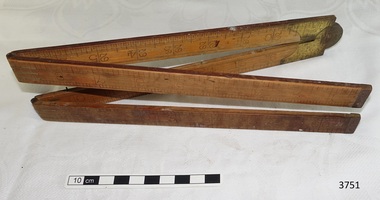 Flagstaff Hill Maritime Museum and Village
Instrument - Ruler, 1930-1955's
... handmade by Jim Williams. Jim’s family has donated the ship model “Sovereign of the Seas” and many tools, accessories and documents used in the making of this and other ship models have been donated to Flagstaff Hill Maritime Village. ...handmade by Jim Williams. Jim’s family has donated the ship model “Sovereign of the Seas” and many tools, accessories and documents used in the making of this and other ship models have been donated to Flagstaff Hill Maritime Village. ...This measuring ruler was used in the planning and making of components for the ship model Sovereign of the Seas. It is part of a collection of objects used by Jim Williams, maker of fine ship models from about 1930-1955. Most of the components for the models, as well as many of the tools, were handmade by Jim Williams. Jim’s family has donated the ship model “Sovereign of the Seas” and many tools, accessories and documents used in the making of this and other ship models have been donated to Flagstaff Hill Maritime Village. Ship model of HMS Sovereign of the Seas, scale model of 17th Century English war ship, was handmade and carved from plans, enclosed in airtight glass case. All components of that model, including even the smallest pulleys, were hand crafted using tools designed and made by Jim. Outstanding details include functional rigging and moving cannons. Please see our record 3732 of the mode Sovereign of the Seas for further details of the ship and the maker. This ruler is connected with the hobby and skill of ship model making that has been crafted as a leisure activity for many generations. The hobby is often chosen by serving and retired mariners who appreciate the connection with maritime history. This ruler was used by local Warrnambool man, Jim Williams, who was employed at Cramond and Dickson clothing store, and then at Fletcher Jones menswear for 27 years. It was used in making components for the model of the historic ship, the Sovereign of the Seas. The Sovereign of the Seas was a historic 17th century English war ship with important maritime heritage. Ruler; folding wooden ruler, 36 inches long. Two small notches match with tiny pins when folded. This ruler is part of a collection of tools and accessories once used by Jim Williams, maker of a series of ship models 1930-1955 including “HMS Sovereign of the Seas”. flagstaff hill, warrnambool, flagstaff hill maritime museum, maritime museum, shipwreck coast, flagstaff hill maritime village, great ocean road, ship model sovereign of the seas, jim williams, james bernard williams, ship model hobby, ship model tools, ship model making equipment, ship model making accessories, measuring instrument, ruler, folding ruler, sovereign of the sea, ship model, hobby, ship model tool, english war ship -
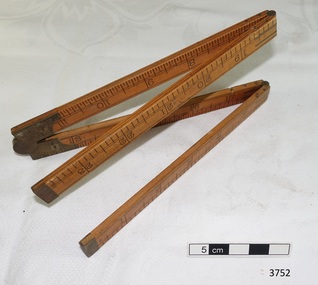 Flagstaff Hill Maritime Museum and Village
Instrument - Ruler, 1930-1955's
... handmade by Jim Williams. Jim’s family has donated the ship model “Sovereign of the Seas” and many tools, accessories and documents used in the making of this and other ship models have been donated to Flagstaff Hill Maritime Village. ...handmade by Jim Williams. Jim’s family has donated the ship model “Sovereign of the Seas” and many tools, accessories and documents used in the making of this and other ship models have been donated to Flagstaff Hill Maritime Village. ...This measuring ruler was used in the planning and making of components for the ship model Sovereign of the Seas. It is part of a collection of objects used by Jim Williams, maker of fine ship models from about 1930-1955. Most of the components for the models, as well as many of the tools, were handmade by Jim Williams. Jim’s family has donated the ship model “Sovereign of the Seas” and many tools, accessories and documents used in the making of this and other ship models have been donated to Flagstaff Hill Maritime Village. Ship model of HMS Sovereign of the Seas, scale model of 17th Century English war ship, was handmade and carved from plans, enclosed in airtight glass case. All components of that model, including even the smallest pulleys, were hand crafted using tools designed and made by Jim. Outstanding details include functional rigging and moving cannons. Please see our record 3732 of the mode Sovereign of the Seas for further details of the ship and the maker. This ruler made by instrument makers J Rabone and Sons of Birmingham, is connected with the hobby and skill of ship model making that has been crafted as a leisure activity for many generations. The hobby is often chosen by serving and retired mariners who appreciate the connection with maritime history. This ruler was used by local Warrnambool man, Jim Williams, who was employed at Cramond and Dickson clothing store, and then at Fletcher Jones menswear for 27 years. It was used in making components for the model of the historic ship, the Sovereign of the Seas. The Sovereign of the Seas was a historic 17th century English war ship with important maritime heritage. Ruler, folding, wooden with brass hinges. Maker J. Rabone & Sons, Birmingham. Model No. 1375. It is warranted to be made of Boxwood. Length is 24 inches, divided into 1/8th inches on one side and 1/16th inches on the other side. This ruler is part of a collection of tools and accessories once used by Jim Williams, maker of a series of ship models 1930-1955 including “HMS Sovereign of the Seas”.“J RABONE & SONS / BIRMINGHAM”, “WARAND BOXWOOD”, “NO 1375”flagstaff hill, warrnambool, flagstaff hill maritime museum, maritime museum, shipwreck coast, flagstaff hill maritime village, great ocean road, ship model sovereign of the seas, jim williams, james bernard williams, ship model hobby, ship model tools, ship model making equipment, ship model making accessories, measuring instrument, ruler, folding ruler, j rabone and sons of birmingham england, ruler model 1375, sovereign of the sea, ship model, hobby, ship model tool, english war ship, j rabone and sons -
 Flagstaff Hill Maritime Museum and Village
Instrument - Set Square, 1930-1955's
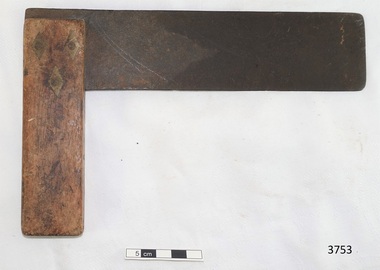
... handmade by Jim Williams. Jim’s family has donated the ship model “Sovereign of the Seas” and many tools, accessories and documents used in the making of this and other ship models have been donated to Flagstaff Hill Maritime Village. ...handmade by Jim Williams. Jim’s family has donated the ship model “Sovereign of the Seas” and many tools, accessories and documents used in the making of this and other ship models have been donated to Flagstaff Hill Maritime Village. ...This set square was used in the planning and making of components for the ship model Sovereign of the Seas. It is part of a collection of objects used by Jim Williams, maker of fine ship models from about 1930-1955. Most of the components for the models, as well as many of the tools, were handmade by Jim Williams. Jim’s family has donated the ship model “Sovereign of the Seas” and many tools, accessories and documents used in the making of this and other ship models have been donated to Flagstaff Hill Maritime Village. Ship model of HMS Sovereign of the Seas, scale model of 17th Century English war ship, was handmade and carved from plans, enclosed in airtight glass case. All components of that model, including even the smallest pulleys, were hand crafted using tools designed and made by Jim. Outstanding details include functional rigging and moving cannons. Please see our record 3732 of the mode Sovereign of the Seas for further details of the ship and the maker. James Bernard Williams was known as Jim Williams, born 1888 at The Forth and died 1959 in Warrnambool. He was a passionate ship model builder. Jim left school at the age of 14 years to work at the Don Store in Ulverstone, Tasmania. He played piano at the silent pictures. He enlisted and fought in France along with his two brothers and was wounded there. On return to Tasmania he found it difficult to get employment. He moved to Warrnambool and worked in the menswear department at Cramond & Dickson clothing store, corner of Timor and Liebig streets, until the Depression, when he lost his job. After some time unemployed and working part time until 1932, Jim was employed at Fletcher Jones Menswear in Warrnambool. In 1957 Fletcher Jones invited Jim to write out a list of the most interesting details of the ship model Sovereign of the Seas, with the view of displaying the model and the information for a short time in the factory and then move it to the display window of the Fletcher Jones shop in Warrnambool. Jim worked there for 27 years until just before he died in 1959. His Retirement Speech letter and a Staff Photo from Fletcher Jones are included with the donation. ABOUT JIM’S MODEL MAKING For many years Jim worked on his model ships, including The Endeavour and The Sovereign of the Seas. He had a table set up in a bay window and worked on them on and off using a jeweller's eye glass on the finer pieces. He was a real perfectionist and would re-carve pieces many times until he was happy with the results. This set square is connected with the hobby and skill of ship model making that has been crafted as a leisure activity for many generations. The hobby is often chosen by serving and retired mariners who appreciate the connection with maritime history. This set square was used by local Warrnambool man, Jim Williams, who was employed at Cramond and Dickson clothing store, and then at Fletcher Jones menswear for 27 years. It was used in making components for the model of the historic ship, the Sovereign of the Seas. The Sovereign of the Seas was a historic 17th century English war ship with important maritime heritage. Set square; thin, flat metal blade with rounded corners set at a right-angle into timber stock using three rivets, each with a diamond shaped surround. There is a remnant of red paint on the timber and signs that the set square has been well used. This set square is part of a collection of tools and accessories once used by Jim Williams, maker of a series of ship models 1930-1955 including “HMS Sovereign of the Seas”. flagstaff hill, warrnambool, flagstaff hill maritime museum, maritime museum, shipwreck coast, flagstaff hill maritime village, great ocean road, ship model sovereign of the seas, jim williams, james bernard williams, ship model hobby, ship model tools, ship model making equipment, ship model making accessories, measuring instrument, technical drawing instrument, set square, carpenter’s square, drawing instrument, drawing tool, technical drawing tool, sovereign of the sea, ship model, hobby, ship model tool, english war ship
