
Showing 2 items matching "hardelot"
-
 Returned Nurses RSL Sub-branch
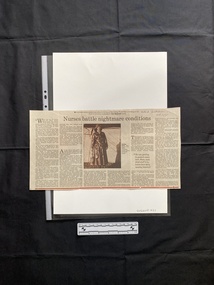
Newspaper - Newspaper clipping, [Weekend Australian], Nurses battle nightmare conditions, [November 1993]
... ...Hardelot...WWII World War Two WW2 WWI WW1 World War One Korea Vietnam Pacific War Evelyn Davies Alice Davies Healesville Armistice Salonika Luna Park Cairo Melbourne Nellie Gould Jane Bell Evelyn Conyers No. 1 AGH Lemnos Spanish Influenza India British Peshawar Carrel-Dakin method Abbeville AG Butler Hardelot Mimie Proctor No. 2 Australian Casualty Clearing Station Messines Elsie Tranter ACCS Alice Ross King Alice Ross-King University of Melbourne 'Weekend Australian. / Nov. 1993' [blue ink, top right] A large newspaper clipping consisting of a title, six columns of text and a black and white photo of a woman in the winter nurse's uniform of the AIF. ...Book review of "Guns and brooches: Australian Army Nursing from the Boer War to the Gulf War" by Jan Bassett Australia's army nurses were often in the line of fire during World War 1, working at the front in atrocious conditions. About 2300 members of the Australian Army Nursing Service (AANS) were the only women to serve overseas in an official capacity with the Australian Imperial Forces (AIF). They nursed in hospitals in Egypt, Greece, England, France, Italy and Belgium. They were all qualified nurses and virtually all were single or widowed, between twenty-five and forty years old. The nurses were subject to clumsy attempts to impose military way upon them, such as having a group of nurses from No. 3 Australian General Hospital (AGH), wearing ankle-length dresses and bonnets, led by a piper, marching several kilometres to their hospital site on the island of Lemnos, Greece. Only to find hundreds of sick and wounded patients from Gallipoli lying on the ground waiting for them, but no equipment.A large newspaper clipping consisting of a title, six columns of text and a black and white photo of a woman in the winter nurse's uniform of the AIF.'Weekend Australian. / Nov. 1993' [blue ink, top right]wwii, world war two, ww2, wwi, ww1, world war one, korea, vietnam, pacific war, evelyn davies, alice davies, healesville, armistice, salonika, luna park, cairo, melbourne, nellie gould, jane bell, evelyn conyers, no. 1 agh, lemnos, spanish influenza, india, british, peshawar, carrel-dakin method, abbeville, ag butler, hardelot, mimie proctor, no. 2 australian casualty clearing station, messines, elsie tranter, accs, alice ross king, alice ross-king, university of melbourne -
 Melbourne Legacy
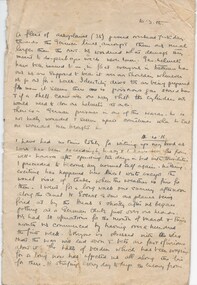
Document, Diary of Priscilla Wardle, a nurse in France 1916, 1916
... She had a period of rest at Hardelot, a convalescent home for nurses, and also a trip to England and Scotland. ...She had a period of rest at Hardelot, a convalescent home for nurses, and also a trip to England and Scotland. ...An incomplete diary of an Australian nurse serving in France in 1916. The author is unidentified in the document but after extensive research it is concluded that is by Priscilla Wardle, who left Melbourne on 14 April 1915 on RMS Orontes and served with Queen Alexandra's Imperial Military Nursing Service (QAIMNS) in France. A larger portion of her diary is available from the Ballarat Base Hospital Trained Nurses League entries on Victorian Collections. The contents of the diary has been retyped and is in the Word document. The diary shows she was serving at a Casualty Clearing Station (CCS) in Bethune, France in March 1916. She goes on to serve at Wimereux, at the No 8 Stationary hospital. Also possibly at Boulogne. She had a period of rest at Hardelot, a convalescent home for nurses, and also a trip to England and Scotland. She tried to visit the graves of ancestors, such as relatives of 'Grandfather Allan', in the church yard at East Kilbride church. During her nursing experience she mentions being gassed by 'weeping' gas and hearing the sounds of shelling. Also the numbers of operations per month, such as 311 in March 1916. And another day when there were 29 operations in one day. She talks of POWs coming to the hospital. They are treated after the Allied soldiers are looked after. So operations often continued into the night to take care of the Germans. She also mentions removing a piece of shrapnel herself in one operation. She appears to be of a senior rank as she is asked to meet with senior hospital officials and high ranking officers that visit. In particular she mentions a staff surgeon from Admiral Jellicoe's ship the 'Iron Duke'. He visited just after the Battle of Jutland, which was a naval battle fought between Britain's Royal Navy Grand Fleet, under Admiral Sir John Jellicoe, and the Imperial German Navy's High Seas Fleet, under Vice-Admiral Reinhard Scheer, during the First World War (31 May – 1 June 1916). Also being visited by Stan Walker (also from Ballarat) and Lt Brough who was ADC to General Legge. It is possible Stan Walker is Lt (later Captain) Edward Stanley Walker. Lt Brough is believed to be Charles Anthony Brough. She also mentions meeting a Lady Gifford and Madam O'Gorman. She mentions travelling with Captain Newton to London in early December 1916 - she calls him Sauchiehall and Sauchie, both could be nicknames. Capt Newton later becomes Sir Wilberforce Newton, who was serving in the Royal Army Medical Corps on the Western Front between 1915 and 1917. His diaries are held in the University of Melbourne archive. He also left Melbourne on the RMS Orontes on 14 April 1915 (source Trove) and would have known the 14 Victorian nurses that went on to serve with QAIMNS. On 11 December 1915 he mentions trying to see a Sister Loughran at the No. 7 Stationary hospital - which was in Boulogne. Sister Loughran was also on the RMS Orontes. When he was ill he mentions receiving a parcel from two other nurses that were on the Orontes and served with QAIMNS (Madge Donnellan and Margaret Donaldson). Other things that indicate it might be Priscilla Wardle is that from Births Deaths and Marriages Victoria (BDM) she was born in Ballarat, her mother's maiden name was Allan, she had a sister Janet that went by the name of Jean who was married at the time mentioned in the diary (BDM and Trove), Priscilla's mother also died during the time of diary and coincides with the diary entry of the 'death of dear mother'. An article in Trove after Priscilla's return to Australia mentions she was in the areas mentioned in the diary. Also that Priscilla went on to be trained as an anaesthetist to help in the surgeries. It matches the comment in the diary that she was involved in many operations and even allowed to perform a bullet extraction. Finally on seeing the diary held by Ballarat Base Hospital Trained Nurses League - it was determined the handwriting matched and this diary is part of the larger diary held there, so is definitely Priscilla Wardle. After the war Priscilla Wardle married Cyril Terrence (Terry) Charles Kirby, an English soldier and they settled in Ballarat and later Melbourne. Terry Kirby became a Legatee in 1929 and transferred to Melbourne Legacy in 1935. He was a well liked, hard working Legatee and worked at Legacy House up to his death in 1967. That is probably how the diary ended up in the building. In May 2021 the pages were returned to descendants of Priscilla so now only electronic copies are in our archive.A valuable first hand account of life as a nurse in World War One. The founders of Legacy all served in World War One and may have known this nurse or been in situations similar to her.Handwritten diary of a nurse from 1916 on 10 pages of notepaper.memoir, world war one, nurse
