
Showing 4 items matching "has matching waistcoat."
-
 Bendigo Historical Society Inc.
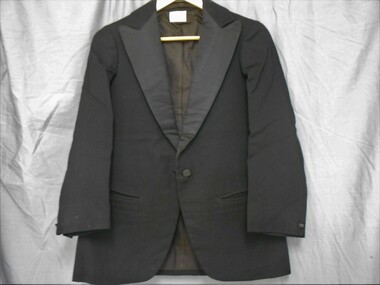
Clothing - MEN'S BLACK DINNER JACKET, 1921
... ...Has matching waistcoat....COSTUME Male men's black dinner jacket Has matching waistcoat. Woods & Manson 48-50 Elizabeth St., Melbourne. ...Men's black woollen dinner jacket with black polished cotton lapels. Single breasted fastened with one X 2cm black fabric covered button, with another button attached to the back. Body of jacket lined with black self stripe cotton fabric. Long sleeves lined with cream coloured polished cotton fabric with fine black stripes. Front pockets below waist have slit openings lined with black cotton fabric. Slits at wrists of sleeves (5cm) fastened with 1 X 1cm black fabric covered buttons. Found inside pocket, cotton button hole tab two black fabric covered 2 cm buttons. Hanging tape across inside back of neck (11cm X .7cm) cotton tape. Owner; Samuel John Tongway 1894-1988. Australian Dictionary of Biography. www.adb.anu.edu.au/biography/tong-way-samuel-john-14875Woods & Manson 48-50 Elizabeth St., Melbourne. Date 1/10/21. No.1542. S.J.Tongway.costume, male, men's black dinner jacket, has matching waistcoat. -
 Flagstaff Hill Maritime Museum and Village
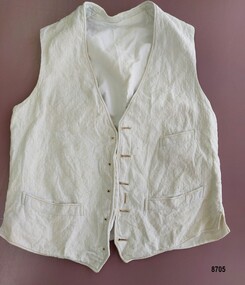
Textile - Waistcoat, circa 1910
... matching fabrics. Some men liked to wear a watch attached to their waistcoat with a fob chain. This item is an example of clothing worn by men on special occasions, in the late 19th and early 20th century. Flagstaff Hill Maritime Museum and Village Great Ocean Road Shipwreck Coast Warrnambool vest waistcoat needlework sewing Stephenson family man's waistcoat A man's waistcoat with cream cotton weave front pieces and cream cotton lining and back. The left front features five machine worked horizontal buttonholes and one vertical buttonhole (for a fob watch) and two inset pockets. The right hand side has ...This item is one of a collection of clothing items that belonged to the Stephenson family who lived at 22 McCracken Street, Kensington, Melbourne. Matthew Stephenson (1861 – 1943) who had grown up on the Bendigo goldfields and shifted to Melbourne in the early 1900’s was a train driver and later, a fireman with the railways. His wife Elizabeth Jane (Betsy) Wigley (1865 – 1953) also grew up on the goldfields around Majorca and Bendigo. They married in 1885 in Bendigo. They had two daughters – Ethel Evelyn Stephenson (1886 – 1956) and Lillian or Lila (1891 – 1977) who were milliners and dressmakers and who continued to live in the family home after the death of their parents. The family are recorded as living at 22 McCracken Street, Kensington, as early as 1914. It is not known who made or owned the clothing that makes up this collection but as it appears to be from the late Victorian and early Edwardian era however the vest was probably made by one of the three ladies of the house, for their husband and father, Matthew Stephenson. During W.W.2, a local Warrnambool couple (Meryl and Tony Everard) boarded with them – Tony was in the airforce training paratroopers to jump into (and survive) enemy territory and his wife Meryl worked in the Methodist baby Home. The Everards developed a close friendship with the Stephensons and were responsible for clearing out the house (and finding this clothing collection) after Lila died in 1977. Although by 1916, men's "ready to wear" clothing were widely available, this waistcoat was handmade (possibly by Matthew's wife or daughters). Men's suits in the early part of the twentieth century were predominantly three piece, consisting of a jacket, vest (or waistcoat) and trousers made from matching fabrics. Some men liked to wear a watch attached to their waistcoat with a fob chain. This item is an example of clothing worn by men on special occasions, in the late 19th and early 20th century.A man's waistcoat with cream cotton weave front pieces and cream cotton lining and back. The left front features five machine worked horizontal buttonholes and one vertical buttonhole (for a fob watch) and two inset pockets. The right hand side has five corresponding stud holes and one inset pocket. The studs or buttons are missing. The lining and back of the waistcoat are made from a plain cream cotton fabric. The back also features a cotton strap with a two pronged metal buckle.flagstaff hill maritime museum and village, great ocean road, shipwreck coast, warrnambool, vest, waistcoat, needlework, sewing, stephenson family, man's waistcoat -
 Whitehorse Historical Society Inc.
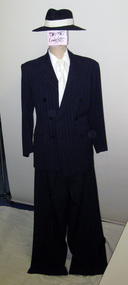
Clothing - Male Suit
... has six buttons for braces. Four buttonhole fly front. Leg is 30cm wide with a turn up cuff 4cm. Matching waistcoat is lined and has 6 buttons. ...has six buttons for braces. Four buttonhole fly front. Leg is 30cm wide with a turn up cuff 4cm. Matching waistcoat is lined and has 6 buttons. ...The donor purchased this suit from a small town in the Adelaide Hill, to wear at a classic Car Rally and to go with his 1935 Buick. It was worn at the Adelaide, Noosa, Bribie Island, Tasmania and Victoria Classic Car Rallies.This outfit won The Best Dressed Male at the RACV Great Australian Rally 1999. The owner has since moved into a retirement village and sold his Buick.Navy blue pin stripe double breasted three piece suit. Trousers lined. Waistband has six buttons for braces. Four buttonhole fly front. Leg is 30cm wide with a turn up cuff 4cm. Matching waistcoat is lined and has 6 buttons. Coat fully lined, also has six buttons and a flower button hole. There are two inside pockets and two outside pockets. One white shirt. One white tie and one navy blue striped tie. One black velour trilby hat with white hat band.costume accessories, male -
 Flagstaff Hill Maritime Museum and Village
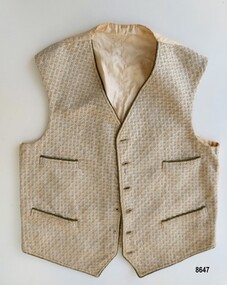
Textile - Man's vest, 1916
... Although by 1916, men's "ready to wear" clothing were widely available, this waistcoat was handmade (possibly by his mother or sister or future wife) and has been preserved by his family for almost one hundred years. Men's suits in the early part of the twentieth century were predomininantly three piece, consisting of a jacket, vest ( or waistcoat) and trousers made from matching fabrics. ...Although by 1916, men's "ready to wear" clothing were widely available, this waistcoat was handmade (possibly by his mother or sister or future wife) and has been preserved by his family for almost one hundred years. Men's suits in the early part of the twentieth century were predomininantly three piece, consisting of a jacket, vest ( or waistcoat) and trousers made from matching fabrics. ...This cream and green patterned vest is said to have been made for William Herbert Teal as part of his "trouseau" on the occasion of his marriage to Daisy Edith Davis on April 14th 1916 at St. Peter's Church, Merino, Victoria, Australia. It is a handmade waistcoat but it is not known who made it. William Teal was born in 1889 to Elijah Teal and Isabella Campbell Reid in Camperdown, Victoria and after marrying, William and Daisy also lived (and worked as farmers) in the Camperdown area. They had seven children. Daisy died in 1962 and William died in 1975. A wedding portrait of William and Daisy shows William wearing a dark suit consisting of a single breasted coat, trousers, good shoes, gloves and a shirt with a stiff, high collar, however if he is wearing this vest, it is unfortunately hidden under his coat. Although by 1916, men's "ready to wear" clothing were widely available, this waistcoat was handmade (possibly by his mother or sister or future wife) and has been preserved by his family for almost one hundred years. Men's suits in the early part of the twentieth century were predomininantly three piece, consisting of a jacket, vest ( or waistcoat) and trousers made from matching fabrics. On special occasions (such as a marriage) the groom might also wear gloves and have a flower in his buttonhole. Some men liked to wear a watch attached to their waistcoat with a fob chain.This item is of significance as a rare example of a man's vest that was made for a special occasion (William Teal's marriage in 1916) and preserved by his family for several generations.Man's handmade vest with a green and cream patterned brocade front, trimmed with green cord around the edges and featuring four inset pockets (also trimmed with the green cord). It has six buttonholes down the left front edge (plus a hand embroidered buttonhole to hold a fob chain) and six corresponding holes for shank buttons (which are missing) down the right front edge. The back and lining are made from cream cotton fabric. The back has a centre seam and a strap with a metal buckle with prongs (to allow for adjusting the length). The cream lining and back display some discolouration and brown marks.flagstaff hill maritime museum and village, great ocean road, warrnambool, camperdown, merino, teal family, william herbert teal, daisy teal, daisy davis, waistcoat, man's waistcoat, vest, wedding, handmade vest, wedding clothes
