
Showing 10 items matching "hearing loss"
-
 Expression Australia
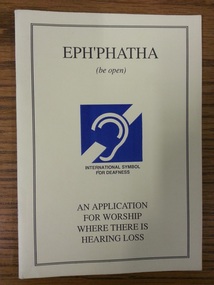
Booklet, Eph'phatha (be open) An Application For Worship Where There Is Hearing Loss
... Eph'phatha (be open) An Application For Worship Where There Is Hearing Loss...Chaplain for the Deaf and Hearing Impaired of Victoria, Printed by Harrison Print Bendigo 1993 Significant as a guide for conducting services of worship for the Deaf and hard of hearing. reverend geoffrey sloan, eph'phatha, 21cmHx14.5cmW, 24 pages, 2 copies Eph'phatha (be open) An Application For Worship Where There Is Hearing Loss Booklet ...Published by Reverend Geoffrey Sloan (Hon.) Chaplain for the Deaf and Hearing Impaired of Victoria, Printed by Harrison Print Bendigo 1993Significant as a guide for conducting services of worship for the Deaf and hard of hearing.21cmHx14.5cmW, 24 pages, 2 copiesreverend geoffrey sloan, eph'phatha, -
 Expression Australia
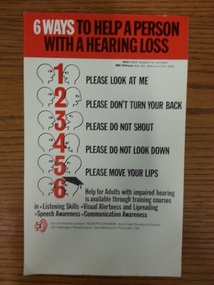
Poster, 6 Ways To Help A Person With A Hearing Loss
... 6 Ways To Help A Person With A Hearing Loss...Information produced for the Hear Programme of the Adult Deaf Society of Victoria Hear programme, Adult Deaf Society of Victoria 33cmHx20.5cmW, single sheet 6 Ways To Help A Person With A Hearing Loss Poster ...Information produced for the Hear Programme of the Adult Deaf Society of Victoria33cmHx20.5cmW, single sheethear programme, adult deaf society of victoria -
 Federation University Historical Collection
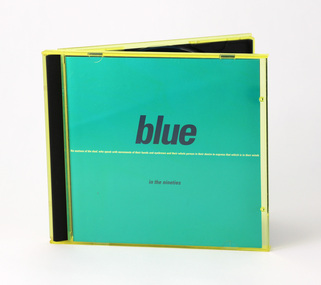
Article - Compact Disc, Blue in the Nineties, 1999
... ...hearing loss...Electronic, visual arts, research publication around "hearing loss and deafness", interactive CD Rom. ...University of Ballarat Federation University Graphic Design Drawing Research HDR Mt Helen School of Arts hearing loss deafness Loris Button Ross Morgan Amanda George Electronic, visual arts, research publication around "hearing loss and deafness", interactive CD Rom. ...Electronic, visual arts, research publication around "hearing loss and deafness", interactive CD Rom.Electronic, visual arts, research publication around "hearing loss and deafness", interactive CD Rom. Blue paper sleeve housed in yellow plastic case. CD printed black and blue.non-fictionElectronic, visual arts, research publication around "hearing loss and deafness", interactive CD Rom.university of ballarat, federation university, graphic design, drawing, research, hdr, mt helen, school of arts, hearing loss, deafness, loris button, ross morgan, amanda george -
 Federation University Historical Collection
Article - Compact Disc, Blue in the Nineties, 1999
... ...hearing loss...Electronic, visual arts, research publication around "hearing loss and deafness", interactive CD Rom. ...University of Ballarat Federation University Graphic Design Drawing Research HDR Mt Helen School of Arts hearing loss deafness Loris Button Ross Morgan Amanda George Electronic, visual arts, research publication around "hearing loss and deafness", interactive CD Rom. ...A collaboration between Loris Button (Lecturer in Drawing, Artworks), Ross Morgan (Tutor in Graphic Design/Multimedia, Design & visual concept) and Amanda George (Ceramics student, Research assistant).Electronic, visual arts, research publication around "hearing loss and deafness", interactive CD Rom. Blue paper sleeve housed in yellow plastic case. CD printed black and blue.non-fictionuniversity of ballarat, federation university, graphic design, drawing, research, hdr, mt helen, school of arts, hearing loss, deafness, loris button, ross morgan, amanda george -
 Federation University Historical Collection
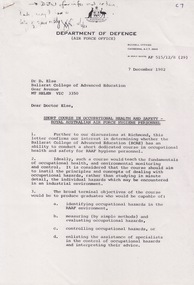
Document - Document - Correspondence, VIOSH: Department of Defence - Air Force Office, Canberra, December 1982
... ...hearing loss...Noise induced hearing loss is the most widespread occupational health risk in the RAAF. ...Noise induced hearing loss is the most widespread occupational health risk in the RAAF. ...Victorian Institute of Occupational Safety and Health (VIOSH) Australia is the Asia-Pacific centre for teaching and research in occupational health and safety (OHS) and is known as one of Australia's leaders on the field. VIOSH has a global reputation for its innovative approach within the field of OHS management. VIOSH had its first intake of students in 1979. At that time the Institution was known as the Ballarat College of Advanced Education. In 1990 it became known as Ballarat University College, then in 1994 as University of Ballarat. It was 2014 that it became Federation University. VIOSH Australia students are safety managers, senior advisors and experienced OHS professionals. They come from all over Australia and industry. Students are taught active research and enquiry; rather than textbook learning and a one-size fits all approach. VIOSH accepts people into the Graduate Diploma of Occupational Hazard Management who have no undergraduate degree - on the basis of extensive work experience and knowledge Letter from the Department of Defence to Dennis Else looking at the possibility of Ballarat College of Advanced Education conducting a short course in occupational health and safety for RAAF hygiene personnel. It would teach the fundamentals of occupational health and environmental monitoring and control. Better use of the practical time allocated is needed. Noise induced hearing loss is the most widespread occupational health risk in the RAAF. Industrial chemicals used and hazardous industrial procedures in the repair and maintenance of aircraft are an issue needing resolution. Existing terminal objectives for basic hygiene inspectors course in occupational health and safety are provided for comment. Information provided by K R Stone, Flight Lieutenant for Director General of Air Force Health Services. Eight A4 pages,typed. Handwritten note top left cornerLetterhead of Department of Defence - Air Force Office.Signature of K R Stoneviosh, victorian institute of occupational safety and health, department of defence, air force office, raaf, ballarat college of advanced education, dennis else, k r stone, flight lieutenant, director general of air force health services, short course in occupational health and safety, raaf hygiene personnel, hearing loss, industrial chemicals, hazardous industrial procedures -
 Deaf Children Australia
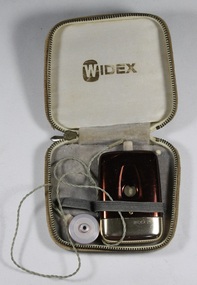
Hearing Aid, Widex P/L, Widex Hearing aid, 1950s
... ...hearing aid...loss...Ear level hearing aids consisted of eyeglass, behind the ear (BTE), in the ear (ITE), and in the canal (ITC, CIC) hearing aids. device hearing aid loss hard of hearing deaf children australia victorian school for deaf children vsdc denmark widex "DENMARK" inscribed on gold front. ...The first all transistor hearing aids appeared in 1953. They were created to replace vacuum tubes; they were small, required less battery power and had less distortion and heat than their predecessor. The vacuum tubes were typically hot and fragile, so the transistor was the ideal replacement. The size of these transistors led to developments in miniature, carbon microphones. These microphones could be mounted on various items. There were body hearing aids where the earpiece was connected to the hearing aid and battery pack worn on the body. Ear level hearing aids consisted of eyeglass, behind the ear (BTE), in the ear (ITE), and in the canal (ITC, CIC) hearing aids. A Widex 25 hearing aid from the 1950's made in Denmark. Brown and gold metallic casing with a volume control dial and an on/off switch. The curly wire runs to a circular outer disc. Although not present the disc would normally connect to an ear mould which is individually fitted to the wearer. The item comes in a soft leather case."DENMARK" inscribed on gold front. "WIDEX 25" inscribed on back. "WIDEX" on inside cover of case. "W" on outside cover of case device, hearing aid, loss, hard of hearing, deaf children australia, victorian school for deaf children, vsdc, denmark, widex -
 Expression Australia
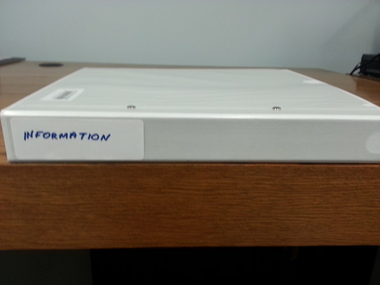
Papaers, Information (Relating to the Deaf)
... This binders contains a collection of papers with information on a range of Deaf related subjects: Hearing Loss In Paget's Disease of Bone, Hearing Aids, Access Issues (for the Deaf), Hearing Aids and Mobile Phones, Audio-Psycho-Phonology, Medications used in treatment of Meniere's Disease, Perfect Pitch, Musicians earplugs and Monitors, etc...This binders contains a collection of papers with information on a range of Deaf related subjects: Hearing Loss In Paget's Disease of Bone, Hearing Aids, Access Issues (for the Deaf), Hearing Aids and Mobile Phones, Audio-Psycho-Phonology, Medications used in treatment of Meniere's Disease, Perfect Pitch, Musicians earplugs and Monitors, etc White A4 Binder containing papers Information (Relating to the Deaf) Papaers ...This binders contains a collection of papers with information on a range of Deaf related subjects: Hearing Loss In Paget's Disease of Bone, Hearing Aids, Access Issues (for the Deaf), Hearing Aids and Mobile Phones, Audio-Psycho-Phonology, Medications used in treatment of Meniere's Disease, Perfect Pitch, Musicians earplugs and Monitors, etcWhite A4 Binder containing papers -
Northern District School of Nursing. Managed by Bendigo Historical Society Inc.
Administrative record - Northern District School of Nursing Graduates Association - Assignment on Otosclerosis and Stapedectomy, 1980s
... Otosclerosis is a disease of unknown cause affecting the middle ear, leading to progressive conductive hearing loss....Otosclerosis is a disease of unknown cause affecting the middle ear, leading to progressive conductive hearing loss. Administrative record Northern District School of Nursing Graduates Association - Assignment on Otosclerosis and Stapedectomy ...The Northern District School of Nursing in Victoria, Australia Graduates Association: History of the School Managed by a committee including hospital administrators, medical professionals, and nursing leaders from several regional hospitals. Associated with major hospitals in the Northern District, including Bendigo Base, Mildura Base, Castlemaine, Echuca, Swan Hill, St. Arnaud, and Kyneton District Hospitals. Provide high-quality theoretical and practical nursing training. Raise the standard of nursing education in the region. Maintain the highest principles of nursing practice. Applicants must be at least 17 years old and hold a Proficiency Certificate or higher educational qualification. Application involves submitting forms, certificates, an interview, an aptitude test, and a medical examination. A three-month probationary period follows initial acceptance. Preliminary Training School: Four-week introductory course covering basic nursing, anatomy, hygiene, and practical skills. Practical experience in various hospital departments, guided by senior staff. Study Block Plan: Includes several blocks of theoretical and practical instruction throughout the three-year program. Regular school exams and two state exams (First Professional and Final State) are required for progression and graduation. Nurses work a 40-hour week with at least one or two days off per week and three weeks of annual leave. Accommodation is provided in comfortable hostels with good facilities. Uniforms are supplied free; nurses provide their own shoes and stockings. Salaries and allowances are regulated, with deductions for board and free medical care. Additional Information Post-Graduate Opportunities. Senior positions require further experience and additional certificates (e.g., Midwifery, Infant Welfare).Diploma courses available in administration, teaching, and specialized nursing fields. Bursaries are available for advanced study.Career Prospects: Graduates can pursue roles in administration, teaching, ward and departmental leadership, district and visiting nursing, industrial and school nursing, and more. Opportunities existed both within hospitals and in community or specialized settings.FAQs and Practical Details. Minimal training costs (mainly exam fees and personal items).Living out allowances and travel expenses are covered. Four training intakes per year; waiting periods are short if qualifications are met.Northern District School of Nursing Graduates Association - Assignment on Otosclerosis and Stapedectomy by Leanne Pyke School 91 - 15 pages Phase two block three. This item contains the following documents: 3793.3a Assignment on Otosclerosis and Stapedectomy by Leanne Pyke School 91 - 15 pages This document provides a comprehensive overview of otosclerosis and its surgical management via stapedectomy, Illustrated through a detailed patient case. Otosclerosis is a disease of unknown cause affecting the middle ear, leading to progressive conductive hearing loss.nurse training, lister house, leanne pyke -
 Flagstaff Hill Maritime Museum and Village
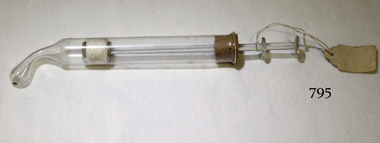
Equipment - Syringe
... Otology also includes surgical treatment of conductive hearing loss, such as stapedectomy surgery for otosclerosis. ...Otology also includes surgical treatment of conductive hearing loss, such as stapedectomy surgery for otosclerosis. ...In 1821 the French otologist Jean Marc Itard irrigated the ear canal to remove hard wax, by using a syringe prototype designed for enemas which was made from tin and brass. This glass and cork ear syringe was manufactured by the Ambson Company in the United Kingdom, about eighty years afterwards. Its lightweight properties would have been ideal for application to the sensitive regions of the ear canal. https://www.racgp.org.au/the-racgp/history/the-racgp-museum-collection/syringes/ambson-ear-syringe Otology is a branch of medicine which studies normal and pathological anatomy and physiology of the ear (hearing and vestibular sensory systems and related structures and functions) as well as their diseases, diagnosis and treatment. Otologic surgery generally refers to surgery of the middle ear and mastoid related to chronic otitis media, such as tympanoplasty, or ear drum surgery, ossiculoplasty, or surgery of the hearing bones, and mastoidectomy. Otology also includes surgical treatment of conductive hearing loss, such as stapedectomy surgery for otosclerosis. https://en.wikipedia.org/wiki/Otology The ear syringe was donated to Flagstaff Hill Maritime Village by the family of Doctor William Roy Angus, Surgeon and Oculist. It is part of the “W.R. Angus Collection” includes historical medical equipment, surgical instruments and material once belonging to Dr Edward Ryan and Dr Thomas Francis Ryan, (both of Nhill, Victoria) as well as Dr Angus’ own belongings. The Collection’s history spans the medical practices of the two Doctors Ryan, from 1885-1926 plus that of Dr Angus, up until 1969. ABOUT THE “W.R.ANGUS COLLECTION” Doctor William Roy Angus M.B., B.S., Adel., 1923, F.R.C.S. Edin.,1928 (also known as Dr Roy Angus) was born in Murrumbeena, Victoria in 1901 and lived until 1970. He qualified as a doctor in 1923 at University of Adelaide, was Resident Medical Officer at the Royal Adelaide Hospital in 1924 and for a period was house surgeon to Sir (then Mr.) Henry Simpson Newland. Dr Angus was briefly an Assistant to Dr Riddell of Kapunda, then commenced private practice at Curramulka, Yorke Peninsula, SA, where he was physician, surgeon and chemist. In 1926, he was appointed as new Medical Assistant to Dr Thomas Francis Ryan (T.F. Ryan, or Tom), in Nhill, Victoria, where his experiences included radiology and pharmacy. In 1927 he was Acting House Surgeon in Dr Tom Ryan’s absence. Dr Angus had become engaged to Gladys Forsyth and they decided he further his studies overseas in the UK in 1927. He studied at London University College Hospital and at Edinburgh Royal Infirmary and in 1928, was awarded FRCS (Fellow from the Royal College of Surgeons), Edinburgh. He worked his passage back to Australia as a Ship’s Surgeon on the on the Australian Commonwealth Line’s T.S.S. Largs Bay. Dr Angus married Gladys in 1929, in Ballarat. (They went on to have one son (Graham 1932, born in SA) and two daughters (Helen (died 12/07/1996) and Berenice (Berry), both born at Mira, Nhill ) According to Berry, her mother Gladys made a lot of their clothes. She was very talented and did some lovely embroidery including lingerie for her trousseau and beautifully handmade baby clothes. Dr Angus was a ‘flying doctor’ for the A.I.M. (Australian Inland Ministry) Aerial Medical Service in 1928 . Its first station was in the remote town of Oodnadatta, where Dr Angus was stationed. He was locum tenens there on North-South Railway at 21 Mile Camp. He took up this ‘flying doctor’ position in response to a call from Dr John Flynn; the organisation was later known as the Flying Doctor Service, then the Royal Flying Doctor Service. A lot of his work during this time involved dental surgery also. Between 1928-1932 he was surgeon at the Curramulka Hospital, Yorke Peninsula, South Australia. In 1933 Dr Angus returned to Nhill and purchased a share of the Nelson Street practice and Mira hospital (a 2 bed ward at the Nelson Street Practice) from Dr Les Middleton one of the Middleton Brothers, the current owners of what previously once Dr Tom Ryan’s practice. Dr Tom and his brother had worked as surgeons included eye surgery. Dr Tom Ryan performed many of his operations in the Mira private hospital on his premises. He had been House Surgeon at the Nhill Hospital 1902-1926. Dr Tom Ryan had one of the only two pieces of radiology equipment in Victoria during his practicing years – The Royal Melbourne Hospital had the other one. Over the years Dr Tom Ryan had gradually set up what was effectively a training school for country general-practitioner-surgeons. Each patient was carefully examined, including using the X-ray machine, and any surgery was discussed and planned with Dr Ryan’s assistants several days in advance. Dr Angus gained experience in using the X-ray machine there during his time as assistant to Dr Ryan. When Dr Angus bought into the Nelson Street premises in Nhill he was also appointed as the Nhill Hospital’s Honorary House Surgeon 1933-1938. His practitioner’s plate from his Nhill surgery is now mounted on the doorway to the Port Medical Office at Flagstaff Hill Maritime Village, Warrnambool. When Dr Angus took up practice in the Dr Edward and Dr Tom Ryan’s old premises he obtained their extensive collection of historical medical equipment and materials spanning 1884-1926. A large part of this collection is now on display at the Port Medical Office at Flagstaff Hill Maritime Village in Warrnambool. In 1939 Dr Angus and his family moved to Warrnambool where he purchased “Birchwood,” the 1852 home and medical practice of Dr John Hunter Henderson, at 214 Koroit Street. (This property was sold in1965 to the State Government and is now the site of the Warrnambool Police Station. and an ALDI sore is on the land that was once their tennis court). The Angus family was able to afford gardeners, cooks and maids; their home was a popular place for visiting dignitaries to stay whilst visiting Warrnambool. Dr Angus had his own silk worm farm at home in a Mulberry tree. His young daughter used his centrifuge for spinning the silk. Dr Angus was appointed on a part-time basis as Port Medical Officer (Health Officer) in Warrnambool and held this position until the 1940’s when the government no longer required the service of a Port Medical Officer in Warrnambool; he was thus Warrnambool’s last serving Port Medical Officer. (Masters of immigrant ships arriving in port reported incidents of diseases, illness and death and the Port Medical Officer made a decision on whether the ship required Quarantine and for how long, in this way preventing contagious illness from spreading from new immigrants to the residents already in the colony.) Dr Angus was a member of the Australian Medical Association, for 35 years and surgeon at the Warrnambool Base Hospital 1939-1942, He served with the Australian Department of Defence as a Surgeon Captain during WWII 1942-45, in Ballarat, Victoria, and in Bonegilla, N.S.W., completing his service just before the end of the war due to suffering from a heart attack. During his convalescence he carved an intricate and ‘most artistic’ chess set from the material that dentures were made from. He then studied ophthalmology at the Royal Melbourne Eye and Ear Hospital and created cosmetically superior artificial eyes by pioneering using the intrascleral cartilage. Angus received accolades from the Ophthalmological Society of Australasia for this work. He returned to Warrnambool to commence practice as an ophthalmologist, pioneering in artificial eye improvements. He was Honorary Consultant Ophthalmologist to Warrnambool Base Hospital for 31 years. He made monthly visits to Portland as a visiting surgeon, to perform eye surgery. He represented the Victorian South-West subdivision of the Australian Medical Association as its secretary between 1949 and 1956 and as chairman from 1956 to 1958. In 1968 Dr Angus was elected member of Spain’s Barraquer Institute of Barcelona after his research work in Intrasclearal cartilage grafting, becoming one of the few Australian ophthalmologists to receive this honour, and in the following year presented his final paper on Living Intrasclearal Cartilage Implants at the Inaugural Meeting of the Australian College of Ophthalmologists in Melbourne In his personal life Dr Angus was a Presbyterian and treated Sunday as a Sabbath, a day of rest. He would visit 3 or 4 country patients on a Sunday, taking his children along ‘for the ride’ and to visit with him. Sunday evenings he would play the pianola and sing Scottish songs to his family. One of Dr Angus’ patients was Margaret MacKenzie, author of a book on local shipwrecks that she’d seen as an eye witness from the late 1880’s in Peterborough, Victoria. In the early 1950’s Dr Angus, painted a picture of a shipwreck for the cover jacket of Margaret’s book, Shipwrecks and More Shipwrecks. She was blind in later life and her daughter wrote the actual book for her. Dr Angus and his wife Gladys were very involved in Warrnambool’s society with a strong interest in civic affairs. He had an interest in people and the community They were both involved in the creation of Flagstaff Hill, including the layout of the gardens. After his death (28th March 1970) his family requested his practitioner’s plate, medical instruments and some personal belongings be displayed in the Port Medical Office surgery at Flagstaff Hill Maritime Village, and be called the “W. R. Angus Collection”.The W.R. Angus Collection is significant for still being located at the site it is connected with, Doctor Angus being the last Port Medical Officer in Warrnambool. The collection of medical instruments and other equipment is culturally significant, being an historical example of medicine from late 19th to mid-20th century. Dr Angus assisted Dr Tom Ryan, a pioneer in the use of X-rays and in ocular surgery.Glass ear syringe. Has cork stopper at top and cotton wrapped at base of plunger. Has a curved end.None.flagstaff hill, warrnambool, shipwrecked-coast, flagstaff-hill, flagstaff-hill-maritime-museum, maritime-museum, shipwreck-coast, flagstaff-hill-maritime-village, otology, ears, ear syringe, deafness, ear wax -
 Deaf Children Australia
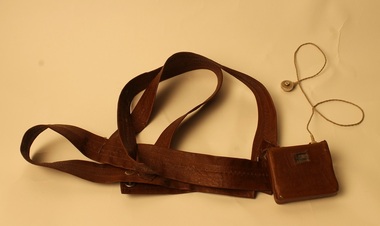
Calaid T Hearing Aid with body straps and case, National Acoustic Laboratories, up to 1955
... Brown leather case containing silver CALAID T hearing aid with body straps, forming a harness with press studs for adjustment, probably a childs hearing aid as the harness would have helped to prevent the loss of the hearing aid. ...HIA / LEFT VOL 2" Brown leather case containing silver CALAID T hearing aid with body straps, forming a harness with press studs for adjustment, probably a childs hearing aid as the harness would have helped to prevent the loss of the hearing aid. ...Brown leather case containing silver CALAID T hearing aid with body straps, forming a harness with press studs for adjustment, probably a childs hearing aid as the harness would have helped to prevent the loss of the hearing aid. Has two wires, one with the ear piece, the other with a different attachment Inside leather case "------ ------" ? Maybe imprint from tape? On case: "C OF A/CALAID/116506" On other side in sticky tape "STEVEN CAO (?)HIA / LEFT VOL 2"
