
Showing 17 items matching "hem measurements"
-
 Wodonga & District Historical Society Inc
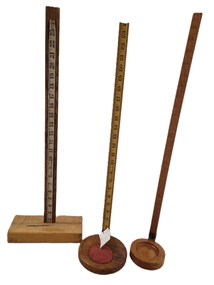
Functional object - Dressmaker's Hem Measuring Stick, 1920s
... ...Hem Measurements...Dean Tape Measures Dressmaking tools Hem Measurements On tape - DEAN - MADE IN ENGLAND Three measures on varying size bases. ...These dressmaker hem measures were widely used universally from the mid-nineteenth century both commercially and domestically. They were used to enable the dressmaker to carefully measure and height of a hemline to ensure they were even. This implement became particularly important with changing fashions which saw the rising hemlines. The measure could also be used when completing home furnishing tasks check regular and even length of curtains. The Dean Tape Measure company was started by Edward Dean in 1850. He started working with his father who was a carpenter making builder's measures and then became a "measure maker". The company was taken over by Stanley in the 1980s. The production of Dean brand tape measures ceased in 1989.These items are significant because they were widely used for domestic and commercial use from the 1850s onwards.Three measures on varying size bases. The two measures with circular bases include a pin cushion or receptacle for pins. The measure on the rectangular base has been home-made.On tape - DEAN - MADE IN ENGLANDdean tape measures, dressmaking tools, hem measurements -
 Flagstaff Hill Maritime Museum and Village
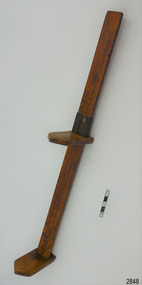
Tool - Hem marker stand, 1900s
... Flagstaff Hill Warrnambool Maritime Village Maritime Museum Shipwreck coast Great Ocean Road hem marker dressmaker dressmaking alterations tailor dressmaker's tool sewing marker sewing gauge seamstress domestic use dress fitting curtain hemming Birmingham freestanding chalk hem marker stand home craft "- - - - / - - - - - / -BIRMINGHAM" On end of arm "2*4' Ham marking stand with a wooden ruler, stand and a sliding adjustable arm on a brass sleeve. The arm has a metal pin on the end. Measurements ...This hem marker stand is a measuring tool for gauging the height of a hem, such as on a dress or curtain. The adjustable arm slides along the ruler and its snug fit ensures that it stays at the right height. The end of the arm has a metal pin inserted into it to hold a piece of chalk, which would be used to mark the fabric. The hem marker would be used by professional dressmakers, seamstresses, and tailors as well as by crafts people at home. The hem marker was made in Birmingham.The hem marking stand is an example of tools used during the 1900s in the garments and furnishings trades as well as for domestic purposes. Since that time the tool has evolved into a more efficient design that makes home sewing easier.Ham marking stand with a wooden ruler, stand and a sliding adjustable arm on a brass sleeve. The arm has a metal pin on the end. Measurements are marked on both sides, inches on one side and centimetres on the other. Inscriptions are stamped into the wood. Made in Birmingham."- - - - / - - - - - / -BIRMINGHAM" On end of arm "2*4'flagstaff hill, warrnambool, maritime village, maritime museum, shipwreck coast, great ocean road, hem marker, dressmaker, dressmaking, alterations, tailor, dressmaker's tool, sewing marker, sewing gauge, seamstress, domestic use, dress fitting, curtain hemming, birmingham, freestanding, chalk hem marker, stand, home craft -
 National Wool Museum
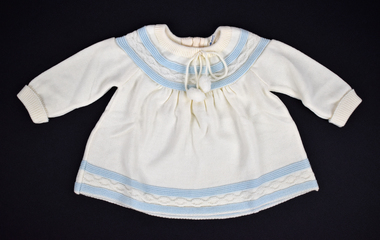
Textile - Children's Dress, Kathryn Knitwear, c.1960
... Their legacy forms an integral part of both Australian social and manufacturing history. clothing children's clothing knitwear children's knitwear manufacturing fashion textile production colourwork pom-pom pom poms [label stitched into back neck] KATHRYN 100% Orlon .2 [sample label] [Obverse] 802/F – BABIES ORLON FROCK. 16” – LENGTH 24/6 BLUE/WHT LEMON/WHT PINK/WHT WHT/BLUE WHT/LEMON WHT/PINK .3 [Obverse] KATHRYN Children’s Knitwear STYLE [handwritten] 802/F SIZE PRICE [reverse] KATHRYN Garments are •PRE-SHRUNK •STANDARD MEASUREMENTS •FIT EXACTLY •LAUNDER PERFECTLY Cream baby dress with long sleeves, blue stripe and cream faux cable textured details at yoke and hem. ...Kathryn Knitwear, founded by Robert Blake, manufactured high quality children’s knitwear in Melbourne from the 1940s – 1980s. Robert Blake began manufacturing children’s knitwear in his bedroom in Strathmore using a hand powered machine in the late 1940s. The operation moved to Ascot Vale and Essendon, before eventually establishing a factory in Moonee Ponds in the early 1950s. The business continued to expand, necessitating a move to a new factory in Broadmeadows. By 1962, the Broadmeadows factory was producing an average of 20,000 garments per month, which increased to 24,000 by 1964. Robert Blake’s Son, Brendan recalls that “The Kathryn brand was famous around Australia, anywhere children needed to keep warm and dress smartly. It also won a number of wool fashion awards”, including the 1969 Wool Awards, which was held by the Australian Wool Bureau and published in Women’s Weekly. The Kathryn range was designed for durability, comfort and care, without sacrificing style. They used patterning techniques that increase stretchiness, comfort and fit, as well as integrating decorative elements into the fabric to prevent them from being bulky, uncomfortable or tight. Making longevity of style a priority, Brendan Blake remembers that “there was one particular garment that was in the range for at least thirty years”. He also recalls “In the past, when women have found out that I was associated with Kathryn Knitwear, they would often relate to me the story of a garment they had purchased or received as a gift and, when their child had grown out of it, they would hand it on to another child. Several ladies have told me of purchasing garments for their daughters’ glory box, or saving a particular garment after their daughter had grown out of it. Brendan Blake: “At the peak of their operation they employed approximately two hundred people, mainly women and girls. A family would often seek to send their daughter to work in this company because they knew they would be looked after and safe. One lady wrote to me telling me that working at the Moonee Ponds Factory prior to getting married was the happiest time of her life.” In 1963, workers at the Kathryn factory earned £13 per week, which was 8 shillings and 8 pence higher than the minimum weekly wage for female workers in the textile manufacturing industry (£12 11s 4d). By 1970, the Kathryn Knitwear brand expanded from children’s knitwear into womenswear under the brand name ‘Lady Kathryn’, and for boys and men under ‘Robert Blake’. Continuing to diversify their distribution, they also began exporting ‘Kathryn’ garments to New Zealand, the Pacific Islands, and Japan. ‘Kathryn Knitwear’ was well-known for their early adoption of modern materials and techniques that had broad appeal to their customer base. This is shown in their early use of the acrylic fibre ‘Orlon’ in the 50s and 60s and ‘Superwash’ wool in the 1970s. Many of Kathryn Knitwear’s styles, particularly those that were long running staples of the brand, were available in both wool and Orlon to suit the consumer’s preference. Orlon was developed by DuPont in the 1940s and became the first commercially successful acrylic fibre in the 1950s and 1960s. The development of Orlon coincided with an increase in availability of washing machines in everyday Australian homes. The great appeal of Orlon was that while wool garments still had to be hand-washed, Orlon’s shrink-resistant nature made it machine washable and dryable. This was a very appealing prospect, especially for the seemingly unending task of cleaning active children’s clothing. Machine washable wool would not be available until the development of the ‘Superwash’ treatment by the Australian Wool Board and CSIRO in 1970. Far from the humble origins of one man in his bedroom with a hand-cranked machine; at its closure in 1980, the Broadmeadows factory of ‘Kathryn’ housed more than 100 machines, including 53 sewing machines and 45 knitting machines. Robert Blake was “a passionate advocate for wool and Australian Made” throughout his whole life. A strong thread that ties through the lifespan of Robert Blake and Kathryn Knitwear is a balance between adopting new innovations without sacrificing the core values of durability, comfort, care and style that had made the brand so well known. Their legacy forms an integral part of both Australian social and manufacturing history.Cream baby dress with long sleeves, blue stripe and cream faux cable textured details at yoke and hem. Body is gathered and attaches at yoke. Dress has a drawstring tie at neck accented with cream pompoms and closes at centre back with three pearlescent plastic buttons. Back opening is reinforced with grosgrain ribbon. .2 is a sample tag with manufacturing information, including sizes and colours available .3 is a retail tag with style, care instructions and brand marketing[label stitched into back neck] KATHRYN 100% Orlon .2 [sample label] [Obverse] 802/F – BABIES ORLON FROCK. 16” – LENGTH 24/6 BLUE/WHT LEMON/WHT PINK/WHT WHT/BLUE WHT/LEMON WHT/PINK .3 [Obverse] KATHRYN Children’s Knitwear STYLE [handwritten] 802/F SIZE PRICE [reverse] KATHRYN Garments are •PRE-SHRUNK •STANDARD MEASUREMENTS •FIT EXACTLY •LAUNDER PERFECTLYclothing, children's clothing, knitwear, children's knitwear, manufacturing, fashion textile production, colourwork, pom-pom, pom poms -
 Brighton Historical Society
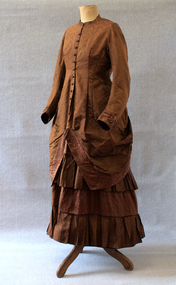
Clothing - Dress, Day dress, circa 1875-1876
... measurements indicates it may have been made as a maternity dress. It is lined with beige leaf pattern cotton fabric. The princess line fitted bodice of herringbone pattern brocade has a high round neck with small 'mandarin' style collar and buttons down the front to below the waist where it forms an overskirt which is bordered with a band of coffee bean patterned brocade. The overskirt drops down to hem...measurements indicates it may have been made as a maternity dress. It is lined with beige leaf pattern cotton fabric. The princess line fitted bodice of herringbone pattern brocade has a high round neck with small 'mandarin' style collar and buttons down the front to below the waist where it forms an overskirt which is bordered with a band of coffee bean patterned brocade. The overskirt drops down to hem ...This dress belonged to Ethel Nina Blundell (1876-1949), having been first made for her mother Jane Blundell (nee Burkitt, 1845-1878). Born in Dublin, Jane married James John Blundell Jr at the Black Street Congregational Church in Brighton on 16 March 1874. The Blundells were a socially prominent Brighton family who played an important role in the development of the area. James' father, publisher and bookseller James John Blundell Sr, served as a Brighton Borough Councillor between 1862 and 1867 when the local government was still in its formative years, including holding the position of Mayor in 1864. He was involved in the foundation of the Brighton Volunteer Rifle Corps and was also a strong supporter of the Brighton Ladies Benevolent Society. The Blundell family were active members of the Brighton Congregational Church and supported the construction of the Black Street church, where James Jr served as a deacon for sixty years, in addition to his work in the Crown Land and Survey Department. The dress is believed to have been made for Jane in 1875 or 1876 during her early pregnancy, likely by a local dressmaker. Jane died in 1878 when Ethel was very young, and Ethel was then raised by her father and paternal grandmother. As she never married, Ethel remained living in the family home of 'Eumana', 164 Church Street, and as an adult she assumed the role of hostess whenever she or her father had guests. On these occasions, she reportedly wore her mother's dress. The family home was sold on James Jr’s death in 1924 and Ethel was living at 52 Black Street Brighton when she died in 1949. In the 1930s, Ethel gifted the dress to a close family friend, Dr Jean Kelly. She told Jean that the garment held precious memories, perhaps due to the connection it provided to the mother she had never known. Jean donated the dress to the Merimbula Old School Museum in NSW in 1987, where it was on display for many years. The Museum donated the dress to Brighton Historical Society in 2023.This is a good example of a late nineteenth century day dress, made from two different patterns of russet brown silk brocade and featuring a lobster tail style bustle. The lack of boning combined with waist and hip measurements indicates it may have been made as a maternity dress. It is lined with beige leaf pattern cotton fabric. The princess line fitted bodice of herringbone pattern brocade has a high round neck with small 'mandarin' style collar and buttons down the front to below the waist where it forms an overskirt which is bordered with a band of coffee bean patterned brocade. The overskirt drops down to hem length at the back but from the centre front it is draped up to the back to a point below the waist level. Here it is sewn to the edge of the lobster tail style bustle which is also bordered by the coffee bean fabric. There is a concealed pocket with the opening under the right edge of the bustle. The buttons on the front of the dress have a decorative circlet of small blue flowers around a russet silk covered dome. The long sleeves are set in and slightly full with a contrasting three pleat band of coffee bean fabric with an ornamental turn back from the pleats sewn just above the wrist. The skirt section of the dress is in four 20 cm bands of alternate fabric patterns with the top and third band of coffee bean pattern slightly gathered and the second and fourth bands of herringbone forming pleated ruffles.1870s, ethel nina blundell, jane blundell, jane burkitt, eumana -
 Whitehorse Historical Society Inc.
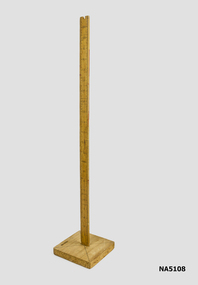
Equipment - Ruler to measure hems, Ruler for hem measurement, unknown
... Ruler for hem measurement...Wooden ruler with stand used to dressmaking to measure hems. Ruler for hem measurement Equipment Ruler to measure hems ...Came from Giselda Bannister's mother's (Estelle Bannister) home.Wooden ruler with stand used to dressmaking to measure hems.Ruler marked with 1-29 inch markings.dressmaking, ruler -
 Kew Historical Society Inc
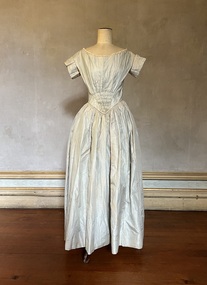
Clothing - Grey silk wedding dress, 1842
... MEASUREMENTS (MM): GIRTH - Neck 914, Chest 812.8, Waist 660.4, Cuff 330.2, Hem circumference 3200.4. ...MEASUREMENTS (MM): GIRTH - Neck 914, Chest 812.8, Waist 660.4, Cuff 330.2, Hem circumference 3200.4. ...This wedding gown was worn by Mary Ann Lawrence at 8.00am on 5 January 1842 at St John's Church, Launceston, when she married Francis Henty. The couple were to catch the tide on their way to Portland two hours later. Francis Henty was the youngest son of Thomas Henty, who with his family, their retainers and property moved to the Australian colonies between 1829 and 1832. In 1834, Francis’ older brother, Edward, sailed from Launceston in Van Diemen’s Land to what was to become Portland in the western part of Port Phillip District [Victoria]. Francis, together with the first flock of Merino sheep [in Victoria], followed some months later. The first and second generations of the Henty family established vast pastoral properties in the Western part of the Port Phillip District. Francis Henty managed ‘Merino Downs’ near Casterton, while also living in his retirement at ‘Field Place' in Kew. The Henty Collection of nineteenth and twentieth century clothing, including outerwear and underwear, was collected, stored and exhibited over time by female family members descended from Francis and Mary Ann Henty. During the twentieth century, items from the collection were modelled in two fashion parades by various descendants [1937, 1959]. The items in the collection are historically and aesthetically significant, with provenance provided by oral and written tradition within or held by the family. A number of the items in the collection are very rare survivors, and provide researchers with the evidence needed to reconstruct the lives of notable women in the Port Phillip District [later Victoria] during the nineteenth and early twentieth century.Mary Ann Lawrence's grey silk wedding gown has a v-line waist and a partly smocked bodice. It is lined with muslin throughout. It has hand-tatted cotton lace and handmade piping around the neck and bodice and pleated short sleeves. There was originally trimming on the skirt which was removed at a later date. Orange blossom made of chamois and tiny coiled springs originally decorated the neckline. The outfit was complemented by a bonnet to which a Limerick lace veil was attached. MEASUREMENTS (MM): GIRTH - Neck 914, Chest 812.8, Waist 660.4, Cuff 330.2, Hem circumference 3200.4. VERTICAL - Front neck to hem 1270, Front waist to hem 1016, Back neck to hem 1320.8, Back waist to hem 1041.4, Sleeve length 114.3. HORIZONTAL - Neck to sleeve head 50.8, Chest back 406.4, Underarm to underarm 406.4.mary ann lawrence, francis henty, wedding dresses, fashion -- 1840s, women's clothing -
 Kew Historical Society Inc
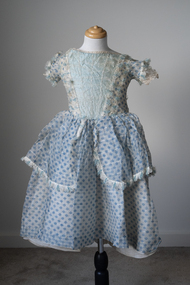
Clothing - Girl's dress, 1858
... Measurements (mm): Girth - Neck 609.6, Chest 635, Waist 558.8, Cuff 203.2, Hem circumference 2108.2. ...Measurements (mm): Girth - Neck 609.6, Chest 635, Waist 558.8, Cuff 203.2, Hem circumference 2108.2. ...This dress belonged to Alice Frances Henty (1852-1932) the youngest daughter of Francis Henty (1815-89) and his wife Mary Ann Henty [nee Lawrence] (1821-81). It is recorded that Alice wore the dress at the age of six. Alice's father, Francis Henty, was the youngest son of Thomas Henty, who with his family, their retainers and property moved to the Australian colonies between 1829 and 1832. In 1834, Francis’ older brother, Edward, sailed from Launceston in Van Diemen’s Land to what was to become Portland in the western part of Port Phillip District [Victoria]. Francis, together with the first flock of Merino sheep [in Victoria], followed some months later. The first and second generations of the Henty family established vast pastoral properties in the Western part of the Port Phillip District. Francis Henty managed ‘Merino Downs’ near Casterton, while also living in his retirement at ‘Field Place' in Kew. The Henty Collection of nineteenth and twentieth century clothing, including outerwear and underwear, was collected, stored and exhibited over time by female family members descended from Francis and Mary Ann Henty. During the twentieth century, items from the collection were modelled in two fashion parades by various descendants [1937, 1959]. The items in the collection are historically and aesthetically significant, with provenance provided by oral and written tradition within or held by the family. A number of the items in the collection are very rare survivors, and provide researchers with the evidence needed to reconstruct the lives of notable women in the Port Phillip District [later Victoria] during the nineteenth and early twentieth century.Girl's two-tone, one-piece cotton voile dress from the 1850s has a high round neck and short sleeves has a lace insert on the front of the bodice and matching lace at the rear. The layered skirt is bordered with lace. Measurements (mm): Girth - Neck 609.6, Chest 635, Waist 558.8, Cuff 203.2, Hem circumference 2108.2. Vertical - Front neck to hem 685.8, Front waist to hem 508, Back neck to hem 723.9, Back waist to hem 534.4, Sleeve length 63.5. Horizontal - Neck to sleeve head 38.1, Cross back 304.8, Underarm to underarm 406.4.fashion -- 1850s, children's clothing, alice frances henty -
 Kew Historical Society Inc
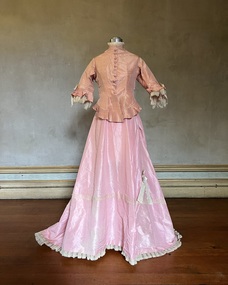
Clothing - Two-piece pink silk afternoon outfit, 1875
... Measurements (mm): BODICE: Girth - Neck 355.6, Chest 863.6, Waist 685.8, Hip 787.4, Cuff 304.8, Hem circumference 1422.4. ...Measurements (mm): BODICE: Girth - Neck 355.6, Chest 863.6, Waist 685.8, Hip 787.4, Cuff 304.8, Hem circumference 1422.4. ...This afternoon dress was owned and first worn in 1875 by Alice (Henty) Hindson, the daughter of Francis Henty and Mary Ann (Lawrence) Henty. The outfit was worn in the same year as Alice's marriage to John Hindson at Trinity Church, East Melbourne, and may have formed part of her trousseau. Alice's father, Francis Henty, was the youngest son of Thomas Henty, who with his family, their retainers and property moved to the Australian colonies between 1829 and 1832. In 1834, Francis’ older brother, Edward, sailed from Launceston in Van Diemen’s Land to what was to become Portland in the western part of Port Phillip District [Victoria]. Francis, together with the first flock of Merino sheep [in Victoria], followed some months later. The first and second generations of the Henty family established vast pastoral properties in the Western part of the Port Phillip District. Francis Henty managed ‘Merino Downs’ near Casterton, while also living in his retirement at ‘Field Place' in Kew. The Henty Collection of nineteenth and twentieth century clothing, including outerwear and underwear, was collected, stored and exhibited over time by female family members descended from Francis and Mary Ann Henty. During the twentieth century, items from the collection were modelled in two fashion parades by various descendants [1937, 1959]. The items in the collection are historically and aesthetically significant, with provenance provided by oral and written tradition within or held by the family. A number of the items in the collection are very rare survivors, and provide researchers with the evidence needed to reconstruct the lives of notable women in the Port Phillip District [later Victoria] during the nineteenth and early twentieth century.Alice (Henty) Hindson's afternoon dress is a two-piece, two-toned pink ensemble made of silk taffeta. The detailing is done with fine knife-pleated trims piped in ivory satin and decorated with ivory silk moiré bows on the bodice and skirt. The panelled peplum jacket is boned and the front button closure has hand-embroidered buttonholes with handmade covered buttons. The gathered full buttoned skirt falls into a train. The skirt is decorated with rows of ivory tulle corded lace and the hemline is edged with crisp fluted organza and tatted lace. Measurements (mm): BODICE: Girth - Neck 355.6, Chest 863.6, Waist 685.8, Hip 787.4, Cuff 304.8, Hem circumference 1422.4. Vertical - From neck to hem 546.1, Front waist to hem 241.3, Back neck to hem 609.6, Back waist to hem 355.6, Sleeve length 330.2. Horizontal - Neck to sleeve head 60, Underarm to underarm 419.1. SKIRT Girth - Waist 558.8, Hip 1473.2, Hem circumference 3911.6. Vertical - Front waist to hem 1092.2, Back waist to hem 1524. fashion -- 1870s, afternoon dresses, alice (henty) hindson, women's clothing -
 Kew Historical Society Inc
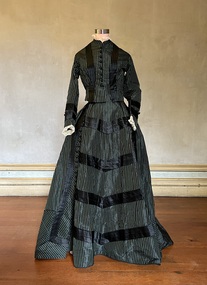
Clothing - Black chalk-striped outfit, 1870
... Measurements (mm): BODICE: Girth - Neck 355.6, Chest 889, Waist 736.6, Hip 863.6, Cuff 254, Hem circumference 2032. ...Measurements (mm): BODICE: Girth - Neck 355.6, Chest 889, Waist 736.6, Hip 863.6, Cuff 254, Hem circumference 2032. ...This outfit belonged to Mary Ann Henty [nee Lawrence] (1821-81), the wife of Francis Henty (1815-89). Her husband, Francis Henty, was the youngest son of Thomas Henty, who with his family, their retainers and property moved to the Australian colonies between 1829 and 1832. In 1834, Francis’ older brother, Edward, sailed from Launceston in Van Diemen’s Land to what was to become Portland in the western part of Port Phillip District [Victoria]. Francis, together with the first flock of Merino sheep [in Victoria], followed some months later. The first and second generations of the Henty family established vast pastoral properties in the Western part of the Port Phillip District. Francis Henty managed ‘Merino Downs’ near Casterton, while also living in his retirement at ‘Field Place' in Kew.The Henty Collection of nineteenth and twentieth century clothing, including outerwear and underwear, was collected, stored and exhibited over time by female family members descended from Francis and Mary Ann Henty. During the twentieth century, items from the collection were modelled in two fashion parades by various descendants [1937, 1959]. The items in the collection are historically and aesthetically significant, with provenance provided by oral and written tradition within or held by the family. A number of the items in the collection are very rare survivors, and provide researchers with the evidence needed to reconstruct the lives of notable women in the Port Phillip District [later Victoria] during the nineteenth and early twentieth century.A two-piece silk taffeta chalk-striped afternoon dress worn by Mary Ann Henty, aged 49, in the period when she lived at Merino Downs near Portland. The outfit has bands of black silk and rows of fabric covered buttons on the bodice and skirt. Measurements (mm): BODICE: Girth - Neck 355.6, Chest 889, Waist 736.6, Hip 863.6, Cuff 254, Hem circumference 2032. Vertical - Front neck to hem 419.1, Front waist to hem 152.4, Back neck to hem 558.8, Back waist to hem190.5 , Sleeve length 584.2. Horizontal - Neck to sleeve head 165.1, Chest back 330.2, Underarm to underarm 406.4. SKIRT Girth - Waist 609.6, Hip 1270, Hem circumference 4064. Vertical - Front waist to hem 1117.6, Back waist to hem 1371.6.francis henty, fashion -- 1870s, women's clothing, afternoon dresses, mary ann (lawrence) henty -
 Kew Historical Society Inc
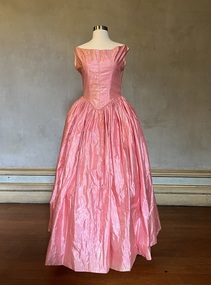
Clothing - Pink silk evening dress, c.1842
... Measurements (mm): BODICE: Girth - Neck 914.4, Chest 863.6, Waist 685.8, Hip 863.6, Hem circumference 3302. ...Measurements (mm): BODICE: Girth - Neck 914.4, Chest 863.6, Waist 685.8, Hip 863.6, Hem circumference 3302. ...This dress is believed to have belonged to Mary Ann Henty [nee Lawrence] (1821-81), the wife of Francis Henty (1815-89). Her husband, Francis Henty, was the youngest son of Thomas Henty, who with his family, their retainers and property moved to the Australian colonies between 1829 and 1832. In 1834, Francis’ older brother, Edward, sailed from Launceston in Van Diemen’s Land to what was to become Portland in the western part of Port Phillip District [Victoria]. Francis, together with the first flock of Merino sheep [in Victoria], followed some months later. The first and second generations of the Henty family established vast pastoral properties in the Western part of the Port Phillip District. Francis Henty managed ‘Merino Downs’ near Casterton, while also living in his retirement at ‘Field Place' in Kew. The Henty Collection of nineteenth and twentieth century clothing, including outerwear and underwear, was collected, stored and exhibited over time by female family members descended from Francis and Mary Ann Henty. During the twentieth century, items from the collection were modelled in two fashion parades by various descendants [1937, 1959]. The items in the collection are historically and aesthetically significant, with provenance provided by oral and written tradition within or held by the family. A number of the items in the collection are very rare survivors, and provide researchers with the evidence needed to reconstruct the lives of notable women in the Port Phillip District [later Victoria] during the nineteenth and early twentieth century.A one-piece, lustrous silk taffeta evening dress, lined with polished cotton, probably owned by Mary Ann Henty, and later by her daughter, Alice. The V-waist line of the dress and the dimensions of the skirt are comparable to Mary Ann’s wedding dress. The bodice in contrast is less structured. At a later stage, the sleeves were removed. Measurements (mm): BODICE: Girth - Neck 914.4, Chest 863.6, Waist 685.8, Hip 863.6, Hem circumference 3302. Vertical - Front neck to hem 1371.6, Front waist to hem 1092.2, Back neck to hem 1384.3, Back waist to hem 1079.5 Horizontal - Neck to sleeve head 44.45, Chest back 431.8, Underarm to underarm 431.8.mary ann lawrence, francis henty, evening dresses, henty collection, fashion -- 1840s -
 Kew Historical Society Inc
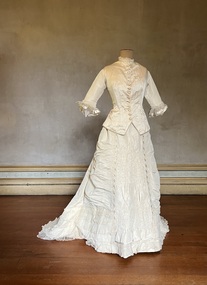
Clothing - Ivory silk and tulle bridesmaid's outfit, 1874
... Measurements (mm): PEPLUM JACKET Girth - Neck 317.5, Chest 914.4, Waist 698.5, Hip 965.2, Cuff 279.4, Hem circumference 1168.4. ...Measurements (mm): PEPLUM JACKET Girth - Neck 317.5, Chest 914.4, Waist 698.5, Hip 965.2, Cuff 279.4, Hem circumference 1168.4. ...This bridesmaid's dress was owned and first worn by Alice Frances Henty, the daughter of Francis Henty and Mary Ann (Lawrence) Henty. The outfit was worn at the marriage of her friend Miss Hopkins to Mr ST Staughnton in 1874. Alice's father, Francis Henty, was the youngest son of Thomas Henty, who with his family, their retainers and property moved to the Australian colonies between 1829 and 1832. In 1834, Francis’ older brother, Edward, sailed from Launceston in Van Diemen’s Land to what was to become Portland in the western part of Port Phillip District [Victoria]. Francis, together with the first flock of Merino sheep [in Victoria], followed some months later. The first and second generations of the Henty family established vast pastoral properties in the Western part of the Port Phillip District. Francis Henty managed ‘Merino Downs’ near Casterton, while also living in his retirement at ‘Field Place' in Kew. The Henty Collection of nineteenth and twentieth century clothing, including outerwear and underwear, was collected, stored and exhibited over time by female family members descended from Francis and Mary Ann Henty. During the twentieth century, items from the collection were modelled in two fashion parades by various descendants [1937, 1959]. The items in the collection are historically and aesthetically significant, with provenance provided by oral and written tradition within or held by the family. A number of the items in the collection are very rare survivors, and provide researchers with the evidence needed to reconstruct the lives of notable women in the Port Phillip District [later Victoria] during the nineteenth and early twentieth century.An ivory silk skirt and matching jacket worn by Alice Henty, aged 22, at the marriage of her friend Lizzie Hopkins and S.T. Staugnton in 1874. The ivory silk satin peplum jacket is boned, tailored, and fitted with many princess line panels. The front closure has handmade embroidered buttonholes and covered buttons. The collar and sleeves are decorated with gathered silk tulle frills. The peplum back features a silk cord bow decoration. The skirt with bustle and train features a central panel with hand ruching and silk satin piping. It is decorated with five rows of pleated silk tulle frills. Measurements (mm): PEPLUM JACKET Girth - Neck 317.5, Chest 914.4, Waist 698.5, Hip 965.2, Cuff 279.4, Hem circumference 1168.4. Vertical - From neck to hem 558.8, Front waist to hem 254, Back neck to hem 838.2, Back waist to hem 241.3, Sleeve length 279.4. Horizontal - Neck to sleeve head 165.1,Cross back 292.1, Underarm to underarm 393.7. SKIRT Girth - Waist 635, Hip 914.4, Hem circumference 3810. Vertical - Front waist to hem 1092.2, Back waist to hem 1701.8. fashion -- 1870s, alice frances (henty) hindson, women's clothing, bridesmaid's dresses -
 Kew Historical Society Inc
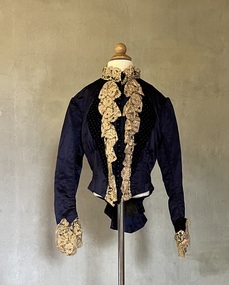
Clothing - Midnight blue silk and velvet bodice
... Measurements (mm): BODICE: Girth - Neck 355.6, Chest 812.8, Waist 660.4, Hip 685.8, Cuff 228.6 Vertical - From neck to hem 406.4, Front waist to hem 152.4, Back neck to hem 546.1, Back waist to hem 228.6, Sleeve length 533.4. ...Measurements (mm): BODICE: Girth - Neck 355.6, Chest 812.8, Waist 660.4, Hip 685.8, Cuff 228.6 Vertical - From neck to hem 406.4, Front waist to hem 152.4, Back neck to hem 546.1, Back waist to hem 228.6, Sleeve length 533.4. ...This bodice, belonging to Alice (Henty) Hindson has traditionally been identified as a travelling jacket by her descendants. Alice Hindson was the youngest daughter of Francis Henty and Mary Ann (Lawrence) Henty. Alice's father, Francis Henty, was the youngest son of Thomas Henty, who with his family, their retainers and property moved to the Australian colonies between 1829 and 1832. In 1834, Francis’ older brother, Edward, sailed from Launceston in Van Diemen’s Land to what was to become Portland in the western part of Port Phillip District [Victoria]. Francis, together with the first flock of Merino sheep [in Victoria], followed some months later. The first and second generations of the Henty family established vast pastoral properties in the Western part of the Port Phillip District. Francis Henty managed ‘Merino Downs’ near Casterton, while also living in his retirement at ‘Field Place' in Kew. The Henty Collection of nineteenth and twentieth century clothing, including outerwear and underwear, was collected, stored and exhibited over time by female family members descended from Francis and Mary Ann Henty. During the twentieth century, items from the collection were modelled in two fashion parades by various descendants [1937, 1959]. The items in the collection are historically and aesthetically significant, with provenance provided by oral and written tradition within or held by the family. A number of the items in the collection are very rare survivors, and provide researchers with the evidence needed to reconstruct the lives of notable women in the Port Phillip District [later Victoria] during the nineteenth and early twentieth century.Alice (Henty) Hindson's midnight blue sateen bodice is highlighted using velvet lapels, cuffs, and a rear bow. The velvet, in contrast to the plain midnight blue sateen, is embellished [in the weave] with pink and navy spots. Joined at the front with 23 round domed buttons, hooks and eyes are used to close the neckline. The bodice also features coffee-coloured lace at the front and on the cuffs, which may have been added later. The bodice has some condition issues, missing one cuff and the lace on the cuffs needing re-attaching. The inside of the bodice is heavily boned, complete with a floral chintz lining. Measurements (mm): BODICE: Girth - Neck 355.6, Chest 812.8, Waist 660.4, Hip 685.8, Cuff 228.6 Vertical - From neck to hem 406.4, Front waist to hem 152.4, Back neck to hem 546.1, Back waist to hem 228.6, Sleeve length 533.4. Horizontal - Neck to sleeve head 114.3, Cross back 266.7, Underarm to underarm 368.3.alice hindson, alice henty, bodices, women's clothing, alice (henty) hindson -
 Kew Historical Society Inc
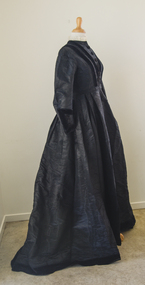
Clothing - Black moiré silk faille day dress, 1880
... Measurements (mm): DRESS: Girth - Neck 355.6, Chest 889, Waist 673.1, Cuff 279.4, Hem circumference 4292.6. ...Measurements (mm): DRESS: Girth - Neck 355.6, Chest 889, Waist 673.1, Cuff 279.4, Hem circumference 4292.6. ...This dress belonged to Mary Ann Henty [nee Lawrence] (1821-81), the wife of Francis Henty (1815-89). Her husband, Francis Henty, was the youngest son of Thomas Henty, who with his family, their retainers and property moved to the Australian colonies between 1829 and 1832. In 1834, Francis’ older brother, Edward, sailed from Launceston in Van Diemen’s Land to what was to become Portland in the western part of Port Phillip District [Victoria]. Francis, together with the first flock of Merino sheep [in Victoria], followed some months later. The first and second generations of the Henty family established vast pastoral properties in the Western part of the Port Phillip District. Francis Henty managed ‘Merino Downs’ near Casterton, while also living in his retirement at ‘Field Place' in Kew. The Henty Collection of nineteenth and twentieth century clothing, including outerwear and underwear, was collected, stored and exhibited over time by female family members descended from Francis and Mary Ann Henty. During the twentieth century, items from the collection were modelled in two fashion parades by various descendants [1937, 1959]. The items in the collection are historically and aesthetically significant, with provenance provided by oral and written tradition within or held by the family. A number of the items in the collection are very rare survivors, and provide researchers with the evidence needed to reconstruct the lives of notable women in the Port Phillip District [later Victoria] during the nineteenth and early twentieth century.A two-piece, moiré silk faille day dress, owned and worn by Mary Ann Henty, aged 59, while resident at Field Place, Kew. The fitted and panelled bodice on the day dress features wide velvet ribbon, hand sewn to form ‘V’ detailing at front and back. The front bodice hook and eye closure is decorated with handmade velvet covered buttons. The high round neckline is trimmed with pleated ivory fine tulle lace. The wide long sleeves of the bodice are also trimmed with velvet ribbon and buttons forming exquisite cuff detailing. The full length skirt and train are tucked into a fitted waistline band. The hemline is hand finished with wide velvet ribbon. A separate attached peplum is worn over the full bustle of the skirt. Measurements (mm): DRESS: Girth - Neck 355.6, Chest 889, Waist 673.1, Cuff 279.4, Hem circumference 4292.6. Vertical - Front neck to hem 1447.8, Front waist to hem 1117.6, Back neck to hem 1765.3, Back waist to hem 1346.2 , Sleeve length 590.55. Horizontal - Neck to sleeve head 196.85, Chest back 469.9, Underarm to underarm 457.2. PEPLUM Girth - Waist 711.2, Hem circumference 1066.8. Vertical - Back waist to hem 406.4.mary ann lawrence, francis henty, fashion -- 1880s, day dresses, women's clothing -
 Kew Historical Society Inc
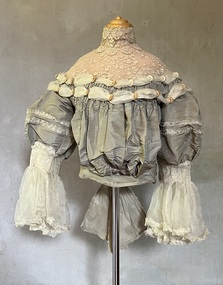
Clothing - Grey silk and lace bodice, 1875
... Measurements (mm): BODICE: Girth - Neck 304.8, Chest 762, Waist 571.5, Cuff 127 Vertical - From neck to hem 381, Front waist to hem 152.4, Back neck to hem 419.1, Back waist to hem 228.6, Sleeve length 254. ...Measurements (mm): BODICE: Girth - Neck 304.8, Chest 762, Waist 571.5, Cuff 127 Vertical - From neck to hem 381, Front waist to hem 152.4, Back neck to hem 419.1, Back waist to hem 228.6, Sleeve length 254. ...Alice Frances (Henty) Hindson's grey silk bodice is believed to be part of her 'going-away' outfit after her wedding to John Hindson on 15 April 1875. The bodice must have been a family favourite as it was used and amended over the years. Alice was the youngest daughter of Francis Henty and Mary Ann (Lawrence) Henty. Alice's father, Francis Henty, was the youngest son of Thomas Henty, who with his family, their retainers and property moved to the Australian colonies between 1829 and 1832. In 1834, Francis’ older brother, Edward, sailed from Launceston in Van Diemen’s Land to what was to become Portland in the western part of Port Phillip District [Victoria]. Francis, together with the first flock of Merino sheep [in Victoria], followed some months later. The first and second generations of the Henty family established vast pastoral properties in the Western part of the Port Phillip District. Francis Henty managed ‘Merino Downs’ near Casterton, while also living in his retirement at ‘Field Place' in Kew. The Henty Collection of nineteenth and twentieth century clothing, including outerwear and underwear, was collected, stored and exhibited over time by female family members descended from Francis and Mary Ann Henty. During the twentieth century, items from the collection were modelled in two fashion parades by various descendants [1937, 1959]. The items in the collection are historically and aesthetically significant, with provenance provided by oral and written tradition within or held by the family. A number of the items in the collection are very rare survivors, and provide researchers with the evidence needed to reconstruct the lives of notable women in the Port Phillip District [later Victoria] during the nineteenth and early twentieth century.The yoke is a bustier bodice, made of silk and silk organza with an insert of hand-tatted lace. The bodice is carefully boned and has a little padding in the bust line. It includes the name of the maker of the bodice as ‘Madame Jay, Brighton, 38 London Road’. The silk organza sleeves have hand shirring, trim, and frilled cuffs. The bodice is finished with a large, frilled bow at the back. Believed by the Henty family to be part of the ‘going away’ outfit worn by Alice Henty in 1875. Measurements (mm): BODICE: Girth - Neck 304.8, Chest 762, Waist 571.5, Cuff 127 Vertical - From neck to hem 381, Front waist to hem 152.4, Back neck to hem 419.1, Back waist to hem 228.6, Sleeve length 254. Horizontal - Neck to sleeve head 165.1, Cross back 457.2, Underarm to underarm 431.8.Mme Jay, Brighton Road, London [dressmaker]bodices, women's clothing, alice (henty) hindson, alice francés henty -
 Kew Historical Society Inc
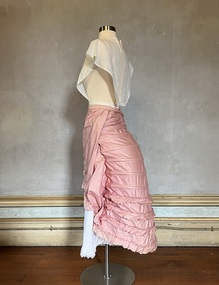
Clothing - Pink lobster-tail bustle, c. 1875
... Measurements (mm): BUSTLE: Girth - Waist 660 Vertical - Front waist to hem 914, Back waist to hem 965....Measurements (mm): BUSTLE: Girth - Waist 660 Vertical - Front waist to hem 914, Back waist to hem 965. ...This full length lobster tail bustle was owned and worn by Alice Frances Henty, the daughter of Francis Henty and Mary Ann (Lawrence) Henty. Bustles of this form date from the mid-1860s however this example probably dates from the mid 1870s, and perhaps from before her marriage to John Hindson in 1876. Alice's father, Francis Henty, was the youngest son of Thomas Henty, who with his family, their retainers and property moved to the Australian colonies between 1829 and 1832. In 1834, Francis’ older brother, Edward, sailed from Launceston in Van Diemen’s Land to what was to become Portland in the western part of Port Phillip District [Victoria]. Francis, together with the first flock of Merino sheep [in Victoria], followed some months later. The first and second generations of the Henty family established vast pastoral properties in the Western part of the Port Phillip District. Francis Henty managed ‘Merino Downs’ near Casterton, while also living in his retirement at ‘Field Place' in Kew.The Henty Collection of nineteenth and twentieth century clothing, including outerwear and underwear, was collected, stored and exhibited over time by female family members descended from Francis and Mary Ann Henty. During the twentieth century, items from the collection were modelled in two fashion parades by various descendants [1937, 1959]. The items in the collection are historically and aesthetically significant, with provenance provided by oral and written tradition within or held by the family. A number of the items in the collection are very rare survivors, and provide researchers with the evidence needed to reconstruct the lives of notable women in the Port Phillip District [later Victoria] during the nineteenth and early twentieth century.An exceptionally rare and fine, floor length, 'lobster tail' bustle that belonged to Alice Henty possibly worn with her two-piece pink silk gown but also with other dresses that she owned that required a bustle of this shape. The structure of the bustle includes an outer layer of polished cotton with inserted steel hoops and ties at the front. The lower four hoops have flounces of the same fabric. Overall, the bustle contains 12 hoops, crossed nearer the waist and semi-circular for the remainder of the undergarment. [One of the tapes of the bustle is imprinted with the word lockstitch. Elias Howe invented the lockstitch sewing machine in 1846.] Measurements (mm): BUSTLE: Girth - Waist 660 Vertical - Front waist to hem 914, Back waist to hem 965.fashion -- 1870s, alice frances (henty) hindson, women's clothing, bustles, underwear -
 Kew Historical Society Inc
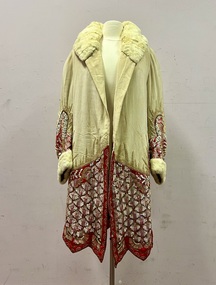
Clothing - Evening Coat, 1920–1930
... The sleeves are shaped above the embroidered sections while the hem features a zig-zag profile. MEASUREMENTS - Neck to hem front 93cm; Neck to hem back 100cm; Circumference 126cm; Shoulder to cuff 72cm; Shoulder width 36cm....The sleeves are shaped above the embroidered sections while the hem features a zig-zag profile. MEASUREMENTS - Neck to hem front 93cm; Neck to hem back 100cm; Circumference 126cm; Shoulder to cuff 72cm; Shoulder width 36cm. ...The donor, whose parents owned an antique shop believed that the evening coat was owned by the family of Cr Morris Nathan and his wife Margaret Frances, nee MacKay. Maurice Nathan was born in Kew in 1914 and died in East Melbourne in 1982. He was a student of Trinity Grammar School, Kew. He was Lord Mayor, and his wife Lady Mayoress, of the City of Melbourne for two terms between 1961 and 1963. The age of the coat, created in a design typical of the 1920s would suggest that it is of an earlier vintage, almost certainly dating from the 1920s, but perhaps earlier. The opulence of the sequinned and beaded embroidery have led to the supposition that it may be an opera coat inherited from an earlier generation.Three quarter length, red and cream silk, padded evening coat highlighted on the cuffs and hem with iridescent sequins, beading and pearls of different shapes and sizes. These decorative features are arranged in a formal design, particularly at centre back. Above the beaded sections are sunbursts outlined in gold beads.Trimmed rabbit fur at collar and cuffs. The sleeves are shaped above the embroidered sections while the hem features a zig-zag profile. MEASUREMENTS - Neck to hem front 93cm; Neck to hem back 100cm; Circumference 126cm; Shoulder to cuff 72cm; Shoulder width 36cm.Traditionally, pre acquisition, stored in brown suitcase embossed in gilt with the name R. NATHANevening jackets, opera coats, fashion -- 1920s -
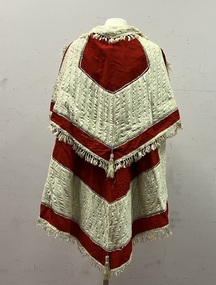 Kew Historical Society Inc
Clothing - Cape
... Measurements - Inner panel: Length neck to hem front 81cm; Neck to hem back 100cm; Circumference 158cm; Shoulder width 29cm. ...Measurements - Inner panel: Length neck to hem front 81cm; Neck to hem back 100cm; Circumference 158cm; Shoulder width 29cm. ...Off white quilted silk cape, with bands of red wool. The shoulderless cape is tied at the neck by a simple cord. The overall shape of the cape includes two- triangular panels, one overlaying the other. Each panel is fringed. There is one tassel hanging from the outer cape from centre back. The cape is lined with a cream cotton fabric. Measurements - Inner panel: Length neck to hem front 81cm; Neck to hem back 100cm; Circumference 158cm; Shoulder width 29cm. Outer panel: Neck to hem front 43cm; Neck to hem back 55cm; Circumference 114cmName in ink on lining at neck: capes, clothing
