
Showing 406 items matching "henderson street"
-
 Sunshine and District Historical Society Incorporated
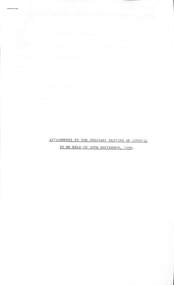
Administrative record - City of Sunshine - Commissioner Mr Alexander Alex George Gillon Collection 1976 - 1982 - Attachments for the ordinary meeting 30th September 1980, City of Sunshine, 30th September 1980
... ...Henderson Street...Albans Town Planning Appeal Tribunal 15 Market Road Sunshine Town Planning Appeal Tribunal Lot 14 McIntyre Road Sunshine North Town Planning Appeal Tribunal Lots 1, 3 and 86 Henderson Street and Berkshire Road Sunshine North...Albans Market Road Sunshine McIntyre Road Sunshine North Henderson Street Berkshire Road St. Albans Continental Hotel Attachments for the Ordinary Meeting 30th September 1980 Town Planning Appeal Tribunal St. ...Attachments for the Ordinary Meeting 30th September 1980 Town Planning Appeal Tribunal St. Albans Continental Hotel McKechnie Street St. Albans Town Planning Appeal Tribunal 15 Market Road Sunshine Town Planning Appeal Tribunal Lot 14 McIntyre Road Sunshine North Town Planning Appeal Tribunal Lots 1, 3 and 86 Henderson Street and Berkshire Road Sunshine Northst. albans hotel, mckechnie street, st. albans, market road, sunshine, mcintyre road, sunshine north, henderson street, berkshire road, st. albans continental hotel -
 Sunshine and District Historical Society Incorporated
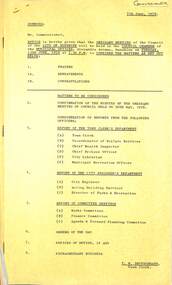
Administrative record - City of Sunshine - Commissioner Mr Alexander "Alex" George Gillon Collection 1976 - 1982 - Notice of Ordinary Meeting of the City of Sunshine on 13th June 1978, City of Sunshine, 7th June 1978
... ...Henderson Street...Albans Hotel McKechnie Street Plan of Subdivision Gladstone Street and Garfield Street Strata Subdivision 11 Yarmouth Avenue Consolidation of Title Somers Street and Henderson Street Plan of Subdivision Geelong Road and Francis Street Tenders for Surplus Equipment Mowers Contract Construction of Neale Road Somerville Road Outfall Drain Subsidy for Victoria S.E.S. ...Albans Hotel McKechnie Street Gladstone Street Garfield Street Yarmouth Avenue Somers Street Henderson Street Sunshine North Geelong Road Francis Street Brooklyn McIntyre Road Sunshine Avenue Wright Street Bridge Wright Street Commercial Street St. ...Notice of Ordinary Meeting of the City of Sunshine on 13th June 1978 Report of the Town Clerk's Department Report of the Town Clerk Increased Crime Request for Royal Commission Loan Programme Increased Borrowing Allocation for 1978/79 Pre-Natal Clinic Sunshine Infant Welfare Centre Land Transfer Discontinued Road Between Verdun Street and Mitchell Street Crown Lands Adjoining Kororoit Creek / Anderson Road / Graham Street Proposed Committee of Management Lease Italo-Australian Co-Operative Social Club Ltd Separate Rate Off Street Parking Scheme Melbourne Metropolitan Board of Works Representation Report of the Co-Ordinator of Welfare Services Family and Community Service Programme State Grants (Home Care) Act Welfare Officers Subsidies Proposal for Funding for Emergency Relief in the Western Region Caretaker / Cleaner Lions House of Sunshine Senior Citizens Club Howard Kingham Lodge Hostel for the Frail Aged Proposal for Upgrading Housing Commission Areas Report of the Acting Chief Health Inspector Prosecution Proceedings Sunshine Magistrates Court Quarterly Return of Food Samples Infant Welfare Immunisation St. Albans Deer Park Infant Welfare Centre Gas fired Toilet "Destroilet" Report of the By-Lawa Officer Court Proceedings Parking Infringements Report of the City Librarian Second Bookmobile School Holiday Programme 15th to 26th May Children's Literature Second National Seminar September 1st to 5th 1978 Report of the Municipal Recreation Officer Proposed Formation of Western Region Commission Municipal Recreation Officers' Sub Committee Ground Allocations Winter Seasons 1978 Report of the City Engineer Proposed Amendment No 81 to the Melbourne Metropolitan Planning Scheme Land Acquisition Maribyrnong Valley Land Use Permit Application Extensions to Marian College Secondary School Lots 590 & 591 Glengala Road Land Use Permit Application Flats Lot 31 Bardsley Street Land Use Permit Application Take Away Foods Lot 8 Market Place Land Use Permit Application Advertising Sign A.C. Sheeting Pty Ltd 1 Fourth Avenue Land Use Permit Application Drive In Bottle Shop and Extension to St. Albans Hotel McKechnie Street Plan of Subdivision Gladstone Street and Garfield Street Strata Subdivision 11 Yarmouth Avenue Consolidation of Title Somers Street and Henderson Street Plan of Subdivision Geelong Road and Francis Street Tenders for Surplus Equipment Mowers Contract Construction of Neale Road Somerville Road Outfall Drain Subsidy for Victoria S.E.S. Local Unit McIntyre Road / Sunshine Avenue Construction Construction of Wright Street Bridge Account for Reinstatement 11 Commercial Street Allocation of Funds Joint Works Main and Unclassified Roads Proposed Intersection Signals St. Albans Road / Main Road East / East Esplanade Give Way to Right Signs Western Highway Fitzgerald Road / Boundary Road Funds Street Lighting Western Highway (Ballarat Road, Ashley Street and Mitchell Street Intersection Princess Highway West Old Geelong Road to McDonald Road Northern Service Road Replacement of Plant Nos 51 & 58 Chamberlin Front End Loaders Sunshine Swimming Pool Progress Report Relocation of Steel Framed Steel Clad Sheds to Errington Reserve and Robert Bruce Reserve Fairbairn Road Pre-School Centre Toilet Blocks Various Reserves Scovell Reserve Proposal by Maidstone Junior Sporting Club to Construct a Recreation Hall Report of the Acting Building surveyor Outbuilding 19 Charlotte Street Sunshine West Outbuilding 34 Bent Street St. Albans Outbuilding 2 Lynch Street Sunshine Outbuilding 18 Hertford Road Sunshine Outbuilding 16 Baynton Avenue Sunshine North Dangerous and Ruinous Building Van Ness Avenue (Former Rock Crushing Plant) Report of the Director Parks & Recreation Summer School Park Management 1979 Children's Playgrounds Burnley Horticultural College Nursery Trends and Development Bon Thomas Reserve Development Main Pavilion House McKay Gardens Demolition Bon Thomas Reserve Development Tender Tree Surgery Maintenance Seminar Royal Australian Institute of Parks & Recreations Victoria Region city of sunshine, alexander "alex" george gillon, sunshine infant welfare centre, verdun street, mitchell street, maidstone, kororoit creek, anderson road, graham street, sunshine, italo-australian co-operative social club, furlong road, st. albans, lions house of sunshine senior citizens club, watt street, corio street, howard kingham lodge hostel, darnley street, braybrook, deer park infant welfare centre, maribyrnong valley, marian college, glengala road, bardsley street, sunshine west, market place, fourth avenue, st. albans hotel, mckechnie street, gladstone street, garfield street, yarmouth avenue, somers street, henderson street, sunshine north, geelong road, francis street, brooklyn, mcintyre road, sunshine avenue, wright street bridge, wright street, commercial street, st. albans road, main road east, east esplanade, western highway, fitzgerald road, boundary road, ballarat road, ashley street, princess highway, old geelong road, mcdonald road, sunshine swimming pool, kennedy street, errington reserve, robert bruce reserve, station road, deer park, scovell reserve, maidstone junior sporting club, charlotte street, bent street, lynch street, hertford road, baynton avenue, van ness avenue, maribyrnong, bon thomas reserve, quinn street -
 Sunshine and District Historical Society Incorporated
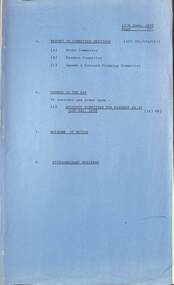
Administrative record - City of Sunshine - Commissioner Mr Alexander Alex George Gillon Collection 1976 - 1982 - Minutes of the Ordinary Meeting of Council Held on 13th June 1978, City of Sunshine, 13th June 1978
... ...Henderson Street...Albans Hotel McKechnie Street Plan of Subdivision Gladstone Street and Garfield Street Strata Subdivision 11 Yarmouth Avenue Consolidation of Title Somers Street and Henderson Street Plan of Subdivision Geelong Road and Francis Street Tenders for Surplus Equipment Mowers Contract Construction of Neale Road Somerville Road Outfall Drain Subsidy for Victoria S.E.S. ...Albans Hotel McKechnie Street Gladstone Street Garfield Street Yarmouth Avenue Somers Street Henderson Street Sunshine North Geelong Road Francis Street Brooklyn Neale Road Deer Park Wright Street Bridge Wright Street Commercial Street St. ...Report of the Town Clerk's Department Report of the Town Clerk Increased Crime Request for Royal Commission Loan Programme Increased Borrowing Allocation for 1978/79 Pre-Natal Clinic Sunshine Infant Welfare Centre Land Transfer Discontinued Road Between Verdun Street and Mitchell Street Crown Lands Adjoining Kororoit Creek / Anderson Road / Graham Street Proposed Committee of Management Lease Italo-Australian Co-Operative Social Club Ltd Separate Rate Off Street Parking Scheme Melbourne Metropolitan Board of Works Representation Report of the Co-Ordinator of Welfare Services Family and Community Service Programme State Grants (Home Care) Act Welfare Officers Subsidies Proposal for Funding for Emergency Relief in the Western Region Caretaker / Cleaner Lions House of Sunshine Senior Citizens Club Howard Kingham Lodge Hostel for the Frail Aged Proposal for Upgrading Housing Commission Areas Report of the Acting Chief Health Inspector Prosecution Proceedings Sunshine Magistrates Court Quarterly Return of Food Samples Infant Welfare Immunisation St. Albans Deer Park Infant Welfare Centre Gas Fired Toilet "Destroilet" Report of the By-Lawa Officer Court Proceedings Parking Infringements Report of the City Librarian Second Bookmobile School Holiday Programme 15th to 26th May Children's Literature Second National Seminar September 1st to 5th 1978 Report of the Municipal Recreation Officer Proposed Formation of Western Region Commission Municipal Recreation Officers' Sub Committee Ground Allocations Winter Seasons 1978 Report of the City Engineer Proposed Amendment No 81 to the Melbourne Metropolitan Planning Scheme Land Acquisition Maribyrnong Valley Land Use Permit Application Extensions to Marian College Secondary School Lots 590 & 591 Glengala Road Land Use Permit Application Flats Lot 31 Bardsley Street Land Use Permit Application Take Away Foods Lot 8 Market Place Land Use Permit Application Advertising Sign A.C. Sheeting Pty Ltd 1 Fourth Avenue Land Use Permit Application Drive In Bottle Shop and Extension to St. Albans Hotel McKechnie Street Plan of Subdivision Gladstone Street and Garfield Street Strata Subdivision 11 Yarmouth Avenue Consolidation of Title Somers Street and Henderson Street Plan of Subdivision Geelong Road and Francis Street Tenders for Surplus Equipment Mowers Contract Construction of Neale Road Somerville Road Outfall Drain Subsidy for Victoria S.E.S. Local Unit McIntyre Road / Sunshine Avenue Construction Construction of Wright Street Bridge Account for Reinstatement 11 Commercial Street Allocation of Funds Joint Works Main and Unclassified Roads Proposed Intersection Signals St. Albans Road / Main Road East / East Esplanade Give Way to Right Signs Western Highway Fitzgerald Road / Boundary Road Funds Street Lighting Western Highway (Ballarat Road, Ashley Street and Mitchell Street Intersection Princess Highway West Old Geelong Road to McDonald Road Northern Service Road Replacement of Plant Nos 51 & 58 Chamberlin Front End Loaders Sunshine Swimming Pool Progress Report Relocation of Steel Framed Steel Clad Sheds to Errington Reserve and Robert Bruce Reserve Fairbairn Road Pre-School Centre Toilet Blocks Various Reserves Scovell Reserve Proposal by Maidstone Junior Sporting Club to Construct a Recreation Hall Report of the Acting Building surveyor Outbuilding 19 Charlotte Street Sunshine West Outbuilding 34 Bent Street St. Albans Outbuilding 2 Lynch Street Sunshine Outbuilding 18 Hertford Road Sunshine Outbuilding 16 Baynton Avenue Sunshine North Dangerous and Ruinous Building Van Ness Avenue (Former Rock Crushing Plant) Report of the Director Parks & Recreation Summer School Park Management 1979 Children's Playgrounds Burnley Horticultural College Nursery Trends and Development Bon Thomas Reserve Development Main Pavilion House McKay Gardens Demolition Bon Thomas Reserve Development Tender Tree Surgery Maintenance Seminar Royal Australian Institute of Parks & Recreations Victoria Region Orders of the Day Accounts Submitted for Payment as at 31st May 1978 Extraordinary Business Report of the Town Clerk Meals on Wheels Report of the City Engineet Child Care Buildings Bon Thomas Reserve, Diamond Reserve, Orama Street & Highpoint West city of sunshine, alexander "alex" george gillon, sunshine infant welfare centre, verdun street, mitchell street, maidstone, kororoit creek, anderson road, graham street, italo-australian co-operative social club, furlong road, st. albans, lions house of sunshine senior citizens club, howard kingham lodge hostel, darnley street, braybrook, deer park infant welfare centre, maribyrnong valley, glengala road, marian college, sunshine west, bardsley street, market place, fourth avenue, sunshine, st. albans hotel, mckechnie street, gladstone street, garfield street, yarmouth avenue, somers street, henderson street, sunshine north, geelong road, francis street, brooklyn, neale road, deer park, wright street bridge, wright street, commercial street, st. albans road, main road east, east esplanade, fitzgerald road, boundary road, western highway, ballarat road, princess highway, old geelong road, mcdonald road, sunshine swimming pool, errington reserve, robert bruce reserve, station road, fairbairn road pre-school centre, fairbairn road, maidstone junior sporting club, scovell crescent, charlotte street, bent street, lynch street, hertford road, baynton avenue, van ness avenue, maribyrnong, bon thomas reserve, quinn street, diamond reserve, albanvale, orama street, highpoint west, rosamond road, scovell reserve -
 Sunshine and District Historical Society Incorporated
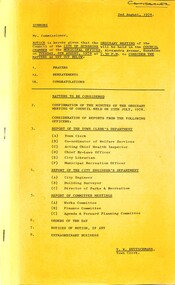
Administrative record - City of Sunshine - Commissioner Mr Alexander "Alex" George Gillon Collection 1976 - 1982 - Notice of ordinary meeting of the Council of the City of Sunshine on 8th August 1978, City of Sunshine, 2nd August 1978
... ...Henderson Street...Albans Planning Permit Application Advertising Sign 123 Rosamond Road Maidstone Planning Permit Application 6 Villa Units Lot 7 Ballarat Road Deer Park Amendment No 77 Part 1 to the Melbourne Metropolitan Planning Scheme Amendment No 81 Part 1 to the Melbourne Metropolitan Planning Scheme Planning Permit Application 3 Factories Lots 77, 78 & 79 Somers Street South East Corner of Henderson Street Planning Permit Application Factory Lot 71 Whitehill Avenue Consolidation of Title Cromer Avenue and McIntyre Road Strata Subdivision 18 Forrest Street Creation of Easement Evergreen Avenue Cleaning Contract Annual Supply Contract Annual Supply Contract Concrete Annual Supply Contract Kerb & Channel Berkshire Road Industrial and other Waste Collection Imposition of Load Limits Westmoreland Road and Northumberland Road Flooding of Station Road Approximately Midway Between Middle Road and Boundary Road Proposed Intersection Signals St. ...Albans Sun Crescent Gregory Street South Road Braybrook Diamond Avenue Reserve Diamond Avenue Albanvale Primary School Albanvale Football Club Albanvale Albion Rovers Soccer Club Killara Street Sydney Street Albion Geelong Road Holmwood Road Tottenham Parade Footscray West Cumberland Street Wiltshire Street Essex Street Ballarat Road Princess Street Rosamond Road Maidstone Deer Park Somers Street Henderson Street Whitehill Avenue Cromer Avenue McIntyre Road Forrest Street Evergreen Avenue Berkshire Road Westmoreland Road Northumberland Road Middle Road Boundary Road Derrimut St. ...Notice of ordinary meeting of the Council of the City of Sunshine on 8th August 1978 Report of the Town Clerk's Department Report of the Town Clerk Street Construction Schemes Sheffield Estate, Bedser Street Scheme Settlement Land at Dalton Street Adjoining Council Reserve Possible Purchase Discontinued Roads Railway Land Corner of Alexandra Avenue and Service Street Municipal Accounting Regulations Review Report of the Co-Ordinator of Welfare Service Subsidies under State Grants (Home Care) Act Community Youth Support Scheme Volunteer Training Western Region Committee for the Ageing Report of the Acting Chief Health Inspector Application for Septic Tank Mantoux Testing & B.C.G. Vaccination Programme Infant Welfare Furlong Road Centre Albion North Nuisance Condition at 177 Ridgeway Parade Health Act Registrations Application to Transfer Proprietorship of Premise under the Health Act Municipal Saleyards Association (Vic) Smoking in Public Buildings Western Region Environment Committee Report of Sub-Committee on Litter Control in the Western Regions Health Act Registration Bakery 59 Main Road West Smallpox Vaccination Report of the Medical Officer of Health Report of the Chief By-Laws Officer Court Proceedings Parking Infringements Prohibited Parking Sun Crescent Prohibited Parking Gregory Street School Crossing Supervision South Road Report of City Librarian Sunshine - Melton Regional Library Service Greek Week Report of the Municipal Recreation Officer Development of Oval Diamond Avenue Reserve Albanvale Primary School & Albanvale Football Club Albion Rovers Soccer Club Department of Youth, Sport & Recreation Soccer Ground Development Plan Use of Swimming Pool for Vicswim Programme Report of City Engineer Planning Permit Application Flats Killara Street Town Planning Appeal Planning Permit Application Store Addition to Existing Shops and Dwelling Sydney Street Town Planning Appeal Planning Permit Application Flats 28 Sydney Street Planning Permit Application Sale of Motor Vehicles and Parts, and Motor Vehicle Repair Lot 20 Geelong Road Bounded by Holmwood Road, Geelong Road and Tottenham Parade Brooklyn Planning Permit Medical and Surgical Hospital Cumberland Street Bounded by Wiltshire Street to the North and Essex Street to the South Planning Permit Application Additions to Service Premise and Caretaker's Dwelling Ballarat Road Planning Permit Application Advertising Sign Lot 3 Princess Street St. Albans Planning Permit Application Advertising Sign 123 Rosamond Road Maidstone Planning Permit Application 6 Villa Units Lot 7 Ballarat Road Deer Park Amendment No 77 Part 1 to the Melbourne Metropolitan Planning Scheme Amendment No 81 Part 1 to the Melbourne Metropolitan Planning Scheme Planning Permit Application 3 Factories Lots 77, 78 & 79 Somers Street South East Corner of Henderson Street Planning Permit Application Factory Lot 71 Whitehill Avenue Consolidation of Title Cromer Avenue and McIntyre Road Strata Subdivision 18 Forrest Street Creation of Easement Evergreen Avenue Cleaning Contract Annual Supply Contract Annual Supply Contract Concrete Annual Supply Contract Kerb & Channel Berkshire Road Industrial and other Waste Collection Imposition of Load Limits Westmoreland Road and Northumberland Road Flooding of Station Road Approximately Midway Between Middle Road and Boundary Road Proposed Intersection Signals St. Albans Road / Main Road East / East Esplanade Detailed City Plans Hampshire Road / Wright Street Remodel of Traffic Signals Kororoit Creek & Maribyrnong River Catchments Disposal of Old Garbage Dumpers Replacement of Bookmobile Plant No 42 Tenders for Covering Material at Sunshine Tip Traffic Signals Tariffs Bituminous Concrete Paramount Road Private Street Scheme Warrs Road (Northern Section) Plan of Subdivision Robinsons Road Toilet Blocks Various Reserves Demolition of House McKay Gardens Alterations to Grandstand Skinner Reserve Rosamond Bowling Club Report of the Building Surveyor Application to Build Over Easement 47 Lachlan Road Sunshine West Application to Build Over Easement 18 Stevenson Street Deer Park Application to Build Over Easement 44 Birchwood Avenue Deer Park Application to Build Over Easement 173 Wright Street Sunshine Siting of Building 8 Calder Court Sunshine Siting of Building 16 Collenso Street Sunshine West Siting of Building 23 Patterson Avenue Sunshine Breaches of Regulations Lot 20 Belmore Road Sunshine North Condition of Flats 28 - 30 Ridley Street Albion Report of the Director of Parks & Recreation Royal Australian institute of Parks & Recreation Annual Conference Bon Thomas Reserve Development Provision of Main Drainage Facilities Proposed Subdivision of Land Quinn Estate All That Land Bounded by Robinsons Road, Ballarat Road, Orama Road & Quinn Street Orders of the Day Accounts Submitted for Payment as at 15th July 1978 city of sunshine, alexander "alex" george gillon, bedser street, sunshine north, dalton street, sunshine west, alexandra avenue, service street, sunshine, furlong road infant welfare centre, furlong road, ridgeway parade, main road west, st. albans, sun crescent, gregory street, south road, braybrook, diamond avenue reserve, diamond avenue, albanvale primary school, albanvale football club, albanvale, albion rovers soccer club, killara street, sydney street, albion, geelong road, holmwood road, tottenham parade, footscray west, cumberland street, wiltshire street, essex street, ballarat road, princess street, rosamond road, maidstone, deer park, somers street, henderson street, whitehill avenue, cromer avenue, mcintyre road, forrest street, evergreen avenue, berkshire road, westmoreland road, northumberland road, middle road, boundary road, derrimut, st. albans road, main road east, east esplanade, hampshire road, wright street, kororoit creek, maribyrnong river, sunshine tip, paramount road, tottenham, warrs road, maribyrnong, robinsons road, h.v. mckay gardens, anderson road, skinner reserve, churchill avenue, rosamond bowling club, lachlan road, stevenson street, birchwood avenue, calder court, collenso street, patterson avenue, belmore road, ridley street, bon thomas reserve, quinn street, orama road -
 Sunshine and District Historical Society Incorporated
Administrative record - City of Sunshine - Commissioner Mr Alexander "Alex" George Gillon Collection 1976 - 1982 - Minute of the Ordinary Meeting of Council held on 8th August 1978, City of Sunshine, 8th August 1978
... ...Henderson Street...Albans Planning Permit Application Advertising Sign 123 Rosamond Road Maidstone Planning Permit Application 6 Villa Units Lot 7 Ballarat Road Deer Park Amendment No 77 Part 1 to the Melbourne Metropolitan Planning Scheme Amendment No 81 Part 1 to the Melbourne Metropolitan Planning Scheme Planning Permit Application 3 Factories Lots 77, 78 & 79 Somers Street South East Corner of Henderson Street Planning Permit Application Factory Lot 71 Whitehill Avenue Consolidation of Title Cromer Avenue and McIntyre Road Strata Subdivision 18 Forrest Street Creation of Easement Evergreen Avenue Cleaning Contract Annual Supply Contract Annual Supply Contract Concrete Annual Supply Contract Kerb & Channel Berkshire Road Industrial and other Waste Collection Imposition of Load Limits Westmoreland Road and Northumberland Road Flooding of Station Road Approximately Midway Between Middle Road and Boundary Road Proposed Intersection Signals St. ...Albans Sun Crescent Gregory Street South Road Braybrook Diamond Avenue Reserve Diamond Avenue Albanvale Primary School Albanvale Football Club Albanvale Albion Rovers Soccer Club Sydney Street Albion Geelong Road Holmwood Road Tottenham Parade Footscray West Cumberland Street Wiltshire Street Essex Street Ballarat Road Princess Street Rosamond Road Maidstone Somers Street Henderson Street Whitehill Avenue Cromer Avenue McIntyre Road Forrest Street Evergreen Avenue Berkshire Road Westmoreland Road Northumberland Road Station Road Middle Road Boundary Road Derrimut St. ...Notice of ordinary meeting of the Council of the City of Sunshine on 8th August 1978 Report of the Town Clerk's Department Report of the Town Clerk Street Construction Schemes Sheffield Estate, Bedser Street Scheme Settlement Land at Dalton Street Adjoining Council Reserve Possible Purchase Discontinued Roads Railway Land Corner of Alexandra Avenue and Service Street Municipal Accounting Regulations Review Report of the Co-Ordinator of Welfare Service Subsidies under State Grants (Home Care) Act Community Youth Support Scheme Volunteer Training Western Region Committee for the Ageing Report of the Acting Chief Health Inspector Application for Septic Tank Mantoux Testing & B.C.G. Vaccination Programme Infant Welfare Furlong Road Centre Albion North Nuisance Condition at 177 Ridgeway Parade Health Act Registrations Application to Transfer Proprietorship of Premise under the Health Act Municipal Saleyards Association (Vic) Smoking in Public Buildings Western Region Environment Committee Report of Sub-Committee on Litter Control in the Western Regions Health Act Registration Bakery 59 Main Road West Smallpox Vaccination Report of the Medical Officer of Health Report of the Chief By-Laws Officer Court Proceedings Parking Infringements Prohibited Parking Sun Crescent Prohibited Parking Gregory Street School Crossing Supervision South Road Report of City Librarian Sunshine - Melton Regional Library Service Greek Week Report of the Municipal Recreation Officer Development of Oval Diamond Avenue Reserve Albanvale Primary School & Albanvale Football Club Albion Rovers Soccer Club Department of Youth, Sport & Recreation Soccer Ground Development Plan Use of Swimming Pool for Vicswim Programme Report of City Engineer Planning Permit Application Flats Killara Street Town Planning Appeal Planning Permit Application Store Addition to Existing Shops and Dwelling Sydney Street Town Planning Appeal Planning Permit Application Flats 28 Sydney Street Planning Permit Application Sale of Motor Vehicles and Parts, and Motor Vehicle Repair Lot 20 Geelong Road Bounded by Holmwood Road, Geelong Road and Tottenham Parade Brooklyn Planning Permit Medical and Surgical Hospital Cumberland Street Bounded by Wiltshire Street to the North and Essex Street to the South Planning Permit Application Additions to Service Premise and Caretaker's Dwelling Ballarat Road Planning Permit Application Advertising Sign Lot 3 Princess Street St. Albans Planning Permit Application Advertising Sign 123 Rosamond Road Maidstone Planning Permit Application 6 Villa Units Lot 7 Ballarat Road Deer Park Amendment No 77 Part 1 to the Melbourne Metropolitan Planning Scheme Amendment No 81 Part 1 to the Melbourne Metropolitan Planning Scheme Planning Permit Application 3 Factories Lots 77, 78 & 79 Somers Street South East Corner of Henderson Street Planning Permit Application Factory Lot 71 Whitehill Avenue Consolidation of Title Cromer Avenue and McIntyre Road Strata Subdivision 18 Forrest Street Creation of Easement Evergreen Avenue Cleaning Contract Annual Supply Contract Annual Supply Contract Concrete Annual Supply Contract Kerb & Channel Berkshire Road Industrial and other Waste Collection Imposition of Load Limits Westmoreland Road and Northumberland Road Flooding of Station Road Approximately Midway Between Middle Road and Boundary Road Proposed Intersection Signals St. Albans Road / Main Road East / East Esplanade Detailed City Plans Hampshire Road / Wright Street Remodel of Traffic Signals Kororoit Creek & Maribyrnong River Catchments Disposal of Old Garbage Dumpers Replacement of Bookmobile Plant No 42 Tenders for Covering Material at Sunshine Tip Traffic Signals Tariffs Bituminous Concrete Paramount Road Private Street Scheme Warrs Road (Northern Section) Plan of Subdivision Robinsons Road Toilet Blocks Various Reserves Demolition of House McKay Gardens Alterations to Grandstand Skinner Reserve Rosamond Bowling Club Report of the Building Surveyor Application to Build Over Easement 47 Lachlan Road Sunshine West Application to Build Over Easement 18 Stevenson Street Deer Park Application to Build Over Easement 44 Birchwood Avenue Deer Park Application to Build Over Easement 173 Wright Street Sunshine Siting of Building 8 Calder Court Sunshine Siting of Building 16 Collenso Street Sunshine West Siting of Building 23 Patterson Avenue Sunshine Breaches of Regulations Lot 20 Belmore Road Sunshine North Condition of Flats 28 - 30 Ridley Street Albion Report of the Director of Parks & Recreation Royal Australian institute of Parks & Recreation Annual Conference Bon Thomas Reserve Development Provision of Main Drainage Facilities Proposed Subdivision of Land Quinn Estate All That Land Bounded by Robinsons Road, Ballarat Road, Orama Road & Quinn Street Orders of the Day Accounts Submitted for Payment as at 15th July 1978 Extraordinary Business Sunshine Ladies Benevolent Society City Engineer's Report Disposal of Vehicle Fleet No 424 Enforcement 17 Disraeli Street Motor Repairs. Electrical Repairs and Servicing city of sunshine, alexander "alex" george gillon, bedser street, sunshine north, dalton street, sunshine west, alexandra avenue, service street, sunshine, furlong road infant welfare centre, furlong road, ridgeway parade, main road west, st. albans, sun crescent, gregory street, south road, braybrook, diamond avenue reserve, diamond avenue, albanvale primary school, albanvale football club, albanvale, albion rovers soccer club, sydney street, albion, geelong road, holmwood road, tottenham parade, footscray west, cumberland street, wiltshire street, essex street, ballarat road, princess street, rosamond road, maidstone, somers street, henderson street, whitehill avenue, cromer avenue, mcintyre road, forrest street, evergreen avenue, berkshire road, westmoreland road, northumberland road, station road, middle road, boundary road, derrimut, st. albans road, main road east, east esplanade, hampshire road, wright street, kororoit creek, maribyrnong, sunshine tip, paramount road, tottenham, warrs road, robinsons road, h.v. mckay gardens, anderson road, skinner reserve, churchill avenue, rosamond bowling club, lachlan road, stevenson street, birchwood avenue, calder court, collenso street, patterson avenue, belmore road, ridley street, bon thomas reserve, quinn street, orama road, sunshine ladies benevolent society, disraeli street -
 Sunshine and District Historical Society Incorporated
Administrative record - City of Sunshine - Commissioner Mr Alexander Alex George Gillon Collection 1976 - 1982 - Minutes of the ordinary meeting of council held on 10th June 1980, City of Sunshine, 4th June 1980
... ...Henderson Street...Albans Planning Permit Application Radio Tower Somerville Road Brooklyn Planning Permit Application Extension to Bridge Platform Within Existing Industrial Complex Somerville Road Brooklyn Planning Permit Application Factory Extension Lots 1, 2 & 86 Berkshire Road North West Corner Henderson Street Sunshine North Planning Permit Application Extension to Existing Deer Park Fire Station North East Corner of Ballarat Road and Glencairn Avenue Deer Park Planning Permit Application Detached House 17 Carroll Street Deer Park Planning Permit Application Display Home Centre Lot 16 to 19 Furlong Road Corner of St. ...Albans East Sunshine North Rosamond Road Maidstone Beaver Street Mulhall Drive Clover Avenue Somerville Road Berkshire Road Henderson Street Deer Park Fire Station Ballarat Road Glencairn Avenue Deer Park Carroll Street Furlong Road St. ...Minutes of the Ordinary Meeting of Council held on 10th June 1980 Report of the Town Clerk's Department Report of the Town Clerk Revaluation Payment by Melbourne and Metropolitan Board of Works Expenditure of Money From Public Resort & Recreation Fund Use of the facilities at The Hub Proposed Lease of Premises by the Albion Tennis Club Request for Financial Assistance for the St. Albans Community Youth Club Request for Financial Assistance for the Western Region Arts Council The Community Arts Conference 19th to 22nd July 1980 Financial Statement for the Year Ended 30th September 1979 and Auditor's Report Report of the Co-Ordinator of Welfare Service Western region Advancement Programme Fuel for Pensioners Scheme Repatriation Benefits for Allied Veterans Special Youth Development Programme Department of Youth, Sport & Recreation Sunshine CYSS Refunding Report of the Chief Health Officer Charge for Police Witness Attendance at Sunshine Court in Litter Case Offensive Trades Werribee Area Nufarm Chemicals Pty Ltd, J.L. McTaggart (Vic) Pty Ltd J.H. Ralph & Sons Pty Ltd V's City of Sunshine Court Case Health Act registrations for 1980 Application for Transfer of Proprietorship of Premises Under the Health Act Health Act 1958 Section 44(1) Nuisance Report of the Medical Officer of Health Report of the Superintendent of Traffic & By-Laws Court Proceedings Parking & Traffic Infringements Dog Act Report of the City Librarian May 1980 School Holidays Programme Bookmobile Seminar 17th - 18th May 1980 Report of the City Engineer & Planner Planning Permit Application Subdivision and Detached House on Each Created Allotment Main Road West Rezoning Corner of Raleigh Road and Burton Crescent Maribyrnong Planning Permit Application Hore Agistment via Fairbairn Road Sunshine West Planning Permit Application Extractive Industry McIntyre Road St. Albans East Planning Permit Application Extension to Milk Bar 123 Rosamond Road Maidstone Planning Permit Application Radio Mast 3 Beaver Street St. Albans Planning Permit Application Internally Illuminated Sign South West Corner of Mulhall Drive and Clover Avenue St. Albans Planning Permit Application Radio Tower Somerville Road Brooklyn Planning Permit Application Extension to Bridge Platform Within Existing Industrial Complex Somerville Road Brooklyn Planning Permit Application Factory Extension Lots 1, 2 & 86 Berkshire Road North West Corner Henderson Street Sunshine North Planning Permit Application Extension to Existing Deer Park Fire Station North East Corner of Ballarat Road and Glencairn Avenue Deer Park Planning Permit Application Detached House 17 Carroll Street Deer Park Planning Permit Application Display Home Centre Lot 16 to 19 Furlong Road Corner of St. Albans Road St. Albans Planning Permit Application Amateur Radio Mast Lot 51 Glencairn Avenue Deer Park Planning Permit Application Residential Subdivision and Industrial Use South East Corner St. Albans Road and Furlong Road St. Albans Planning Permit Application Internally Illuminated Signs McDonalds 396 - 402 Ballarat Road Sunshine North Planning Permit Application Three Flats Lots 3 & 4 Cooper Street Sunshine Planning Permit Application Commercial Display Area Lot 19 Geelong Road Corner of Francis Street Brooklyn Planning Permit Application Cafe 77 Main Road West St. Albans Street Construction Nickson Estate Stage 3 & 4 Furlong Road St. Albans Consolidation of Title The Olympic Tyre & Rubber Co. Pty Ltd Emu Road, Mitchell Street & Richards Street Maidstone Consolidation of Title Emu Road Self Service Wholesaler Pty Ltd Consolidation of Title Lots 41. 42 & 43 Cromer Avenue Street Construction Albanvale Estate Stage 23 Consolidation of Title Lots 1034 & 1035 Delamare Drive Albanvale Contracts Construction of Concrete Works Allocation of Funds 1980/81 Country Road Board Jones Creek Western Highway to Albion Explosive Factory Concrete Channel Along the Western Boundary of the Old Sunshine Tip 10th Australian Road Research Board Conference University of Sydney 25th to 29th August 1980 City of Sunshine Award Amendments Professional Engineers Federal Funding for Roads Depot Workshop Tenders Kinder Smith Reserve Pavilion Extension Tenders Report of the Building Surveyor Building Over Easement 49 Mawson Avenue Deer Park Building Over Easement 66 Mawson Avenue Deer Park Building Over Easement Lot 10 Neale Road Deer Park Building Over Easement 43 Sunhill Court Ardeer Building on Land Liable to Flooding Lot 5 Oakland Street Maribyrnong Orama Street Pre-School Centre Landscaping Schedule for Authorising of Affixing the Common Seal of the Municipality to Documents Orders of the Day Accounts Submitted for Payment as at 31st May 1980 Statement of Accounts for the Year Ended 30th September 1979 Extraordinary Business Report of the City Engineer & Planner Planning Permit Application Clothing Factory Main Road East St. Albans Planning Permit Application Factory Cromer Avenue Sunshine North Report of Building Surveyor Building Over Easement Municipal Offices Alexandra Avenue Sunshine Building on Land Liable to Flooding Lot 1 Wright Street Sunshinealbion tennis club, selwyn park, selwyn street, albion, the hub, sun crescent, sunshine, st. albans community youth club, nufarm chemicals, j.l. mctaggart, j.h. ralph & sons, geelong road, brooklyn, main road west, st. albans, raleigh road, burton crescent, maribyrnong, fairbairn road, sunshine west, mcintyre road, st. albans east, sunshine north, rosamond road, maidstone, beaver street, mulhall drive, clover avenue, somerville road, berkshire road, henderson street, deer park fire station, ballarat road, glencairn avenue, deer park, carroll street, furlong road, st. albans road, mcdonalds, cooper street, francis street, the olympic tyre & rubber co, emu road, mitchell street, richards street, cromer avenue, delamare drive, albanvale, jones creek, western highway, albion explosive factory, sunshine tip, kinder smith reserve, lily street, braybrook, mawson avenue, neale road, sunhill court, ardeer, oakland street, orama street pre-school centre, orama street, main road east, alexandra avenue, wright street -
 Sunshine and District Historical Society Incorporated
Administrative record - City of Sunshine - Commissioner Mr Alexander Alex George Gillon Collection 1976 - 1982 - Notice of ordinary meeting of the council 10th June 1980, City of Sunshine, 4th June 1980
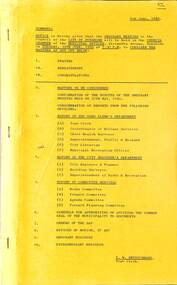
... ...Henderson Street...Albans Planning Permit Application Radio Tower Somerville Road Brooklyn Planning Permit Application Extension to Bridge Platform Within Existing Industrial Complex Somerville Road Brooklyn Planning Permit Application Factory Extension Lots 1, 2 & 86 Berkshire Road North West Corner Henderson Street Sunshine North Planning Permit Application Extension to Existing Deer Park Fire Station North East Corner of Ballarat Road and Glencairn Avenue Deer Park Planning Permit Application Detached House 17 Carroll Street Deer Park Planning Permit Application Display Home Centre Lot 16 to 19 Furlong Road Corner of St. ...Albans East Sunshine North Rosamond Road Maidstone Beaver Street Mulhall Drive Clover Avenue Somerville Road Berkshire Road Henderson Street Deer Park Fire Station Ballarat Road Glencairn Avenue Deer Park Carroll Street Furlong Road St. ...Notice of Ordinary Meeting of the Council 10th June 1980 Report of the Town Clerk's Department Report of the Town Clerk Revaluation Payment by Melbourne and Metropolitan Board of Works Expenditure of Money From Public Resort & Recreation Fund Use of the facilities at The Hub Proposed Lease of Premises by the Albion Tennis Club Request for Financial Assistance for the St. Albans Community Youth Club Request for Financial Assistance for the Western Region Arts Council The Community Arts Conference 19th to 22nd July 1980 Financial Statement for the Year Ended 30th September 1979 and Auditor's Report Report of the Co-Ordinator of Welfare Service Western region Advancement Programme Fuel for Pensioners Scheme Repatriation Benefits for Allied Veterans Special Youth Development Programme Department of Youth, Sport & Recreation Sunshine CYSS Refunding Report of the Chief Health Officer Charge for Police Witness Attendance at Sunshine Court in Litter Case Offensive Trades Werribee Area Nufarm Chemicals Pty Ltd, J.L. McTaggart (Vic) Pty Ltd J.H. Ralph & Sons Pty Ltd V's City of Sunshine Court Case Health Act registrations for 1980 Application for Transfer of Proprietorship of Premises Under the Health Act Health Act 1958 Section 44(1) Nuisance Report of the Medical Officer of Health Report of the Superintendent of Traffic & By-Laws Court Proceedings Parking & Traffic Infringements Dog Act Report of the City Librarian May 1980 School Holidays Programme Bookmobile Seminar 17th - 18th May 1980 Report of the City Engineer & Planner Planning Permit Application Subdivision and Detached House on Each Created Allotment Main Road West Rezoning Corner of Raleigh Road and Burton Crescent Maribyrnong Planning Permit Application Hore Agistment via Fairbairn Road Sunshine West Planning Permit Application Extractive Industry McIntyre Road St. Albans East Planning Permit Application Extension to Milk Bar 123 Rosamond Road Maidstone Planning Permit Application Radio Mast 3 Beaver Street St. Albans Planning Permit Application Internally Illuminated Sign South West Corner of Mulhall Drive and Clover Avenue St. Albans Planning Permit Application Radio Tower Somerville Road Brooklyn Planning Permit Application Extension to Bridge Platform Within Existing Industrial Complex Somerville Road Brooklyn Planning Permit Application Factory Extension Lots 1, 2 & 86 Berkshire Road North West Corner Henderson Street Sunshine North Planning Permit Application Extension to Existing Deer Park Fire Station North East Corner of Ballarat Road and Glencairn Avenue Deer Park Planning Permit Application Detached House 17 Carroll Street Deer Park Planning Permit Application Display Home Centre Lot 16 to 19 Furlong Road Corner of St. Albans Road St. Albans Planning Permit Application Amateur Radio Mast Lot 51 Glencairn Avenue Deer Park Planning Permit Application Residential Subdivision and Industrial Use South East Corner St. Albans Road and Furlong Road St. Albans Planning Permit Application Internally Illuminated Signs McDonalds 396 - 402 Ballarat Road Sunshine North Planning Permit Application Three Flats Lots 3 & 4 Cooper Street Sunshine Planning Permit Application Commercial Display Area Lot 19 Geelong Road Corner of Francis Street Brooklyn Planning Permit Application Cafe 77 Main Road West St. Albans Street Construction Nickson Estate Stage 3 & 4 Furlong Road St. Albans Consolidation of Title The Olympic Tyre & Rubber Co. Pty Ltd Emu Road, Mitchell Street & Richards Street Maidstone Consolidation of Title Emu Road Self Service Wholesaler Pty Ltd Consolidation of Title Lots 41. 42 & 43 Cromer Avenue Street Construction Albanvale Estate Stage 23 Consolidation of Title Lots 1034 & 1035 Delamare Drive Albanvale Contracts Construction of Concrete Works Allocation of Funds 1980/81 Country Road Board Jones Creek Western Highway to Albion Explosive Factory Concrete Channel Along the Western Boundary of the Old Sunshine Tip 10th Australian Road Research Board Conference University of Sydney 25th to 29th August 1980 City of Sunshine Award Amendments Professional Engineers Federal Funding for Roads Depot Workshop Tenders Kinder Smith Reserve Pavilion Extension Tenders Report of the Building Surveyor Building Over Easement 49 Mawson Avenue Deer Park Building Over Easement 66 Mawson Avenue Deer Park Building Over Easement Lot 10 Neale Road Deer Park Building Over Easement 43 Sunhill Court Ardeer Building on Land Liable to Flooding Lot 5 Oakland Street Maribyrnong Orama Street Pre-School Centre Landscaping Schedule for Authorising of Affixing the Common Seal of the Municipality to Documents Orders of the Day Accounts Submitted for Payment as at 31st May 1980 Statement of Accounts for the Year Ended 30th September 1979albion tennis club, selwyn park, selwyn street, albion, the hub, sun crescent, sunshine, st. albans community youth club, nufarm chemicals, j.l. mctaggart, j.h. ralph & sons, geelong road, brooklyn, main road west, st. albans, raleigh road, burton crescent, maribyrnong, fairbairn road, sunshine west, mcintyre road, st. albans east, sunshine north, rosamond road, maidstone, beaver street, mulhall drive, clover avenue, somerville road, berkshire road, henderson street, deer park fire station, ballarat road, glencairn avenue, deer park, carroll street, furlong road, st. albans road, mcdonalds, cooper street, francis street, the olympic tyre & rubber co, emu road, mitchell street, richards street, cromer avenue, delamare drive, albanvale, jones creek, western highway, albion explosive factory, sunshine tip, kinder smith reserve, lily street, braybrook, mawson avenue, neale road, sunhill court, ardeer, oakland street, orama street pre-school centre, orama street -
 Sunshine and District Historical Society Incorporated
Administrative record - City of Sunshine - Commissioner Mr Alexander Alex George Gillon Collection 1976 - 1982 - Extraordinary business 25th November 1980, City of Sunshine, 25th November 1980
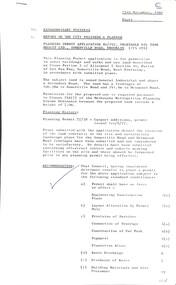
... ...Henderson Street...Meggit Ltd Somerville Road Brooklyn Bell Street Sunshine West Glengala Road McDonald Road McIntyre Road Sunshine North McGrath Duke Street Frederick Street Monsanto Footscray West Tasman UEB Geelong Road Justin Street Mark Street Henderson Street Berkshire Road Willow Avenue St. ...Extraordinary Business Report of the City Engineer & Planner Planning Permit Application Vegetable Oil Tank Meggit Ltd Somerville Road Brooklyn Planning Permit Application Construction of Garage Bell Street Sunshine West Planning Permit Application Extensions for Cafe Glengala Road Sunshine West Planning Permit Application Offices McDonald Road Brooklyn Planning Permit Application Promotion Sign McIntyre Road Sunshine North Planning Permit Application Amenities Block J.J. McGrath Duke Street Sunshine North Planning Permit Application L.P. Gas Storage Frederick Street Tottenham Planning Permit Application Polyester Plant Extension Monsanto Australia Ltd Somerville Road Footscray West Planning Permit Application Factory Alterations Tasman U.E.B. Geelong Road Brooklyn Planning Permit Application Factory and Office Corner Frederick Street and Justin Road Tottenham Planning Permit Application Four Flats Mark Street Sunshine West Planning Permit Application Transport Depot Somerville Road Brooklyn Planning Permit Application Factory Frederick Street Tottenham Planning Permit Application Extensions to Factory Amended Plan Berkshire Road Sunshine North Planning Permit Application Transport Depot Calleja Transport Pty Ltd Geelong Road Brooklyn Introduction of Rolling Programmes Allocation of Funds by R.C.B. Report of the Building Surveyor Location of Building 2 Willow Avenue St. Albansmeggit ltd, somerville road, brooklyn, bell street, sunshine west, glengala road, mcdonald road, mcintyre road, sunshine north, mcgrath, duke street, frederick street, monsanto, footscray west, tasman ueb, geelong road, justin street, mark street, henderson street, berkshire road, willow avenue, st. albans -
 Bendigo Historical Society Inc.
Document - R.O. HENDERSON INVOICE, 20/08/1929
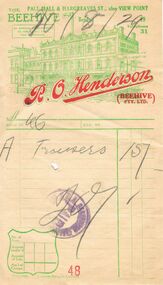
... R.O. Henderson. Beehive. Hargreaves Street...BHS Collection BUSINESS Retail general R.O. Henderson. Beehive. Hargreaves Street Copyright Lamson Paragon Limited. ...BHS CollectionR. O. Henderson Invoice; Cream paper with green print. Printed on the invoice . * The Pall Mall & Hargreaves St., also View Point Beehive. By Special Appointment To his Excellency The Governor. Bendigo .....19. Telephone 31. Underneath is a drawing of the R. O. Henderson building, with R.O.Henderson (Beehive) Pty Ltd printed in red across the building. The invoice was for a pair of Trousers at 15/-, has a Paid stand in blue and signed. Docket no. 48. A hole in the paper where it has been spiked. Box 625Copyright Lamson Paragon Limited.business, retail, general, r.o. henderson. beehive. hargreaves street -
 Tatura Irrigation & Wartime Camps Museum
Magazine Article, Your Garden, Nov-91
... henderson...roses...your garden...service street...tatura relationship folder linda henderson roses your garden service street henderson documents newspapers 4 pages of A4 size magazine entitled "Your Garden" dated November 1991, featuring Linda Henderson's roses. ...4 pages of A4 size magazine entitled "Your Garden" dated November 1991, featuring Linda Henderson's roses.tatura, relationship folder, linda henderson, roses, your garden, service street, henderson, documents, newspapers -
Canterbury History Group
Letter - Golding Street Canterbury, 1989
... Street... Henderson Family...Canterbury Golding Street Henderson Family Cottell Family Goldberg family Canterbury Mansions Dairies Auctions Copies of documents relating to 8 Golding Street Canterbury with a covering letter. includes copies of auction and sales notices for 21 May 1988 and a list of names for some of the residents of Golding Street from 1892-1974 Letter Golding Street Canterbury ...Copies of documents relating to 8 Golding Street Canterbury with a covering letter. includes copies of auction and sales notices for 21 May 1988 and a list of names for some of the residents of Golding Street from 1892-1974canterbury, golding street, henderson family, cottell family, goldberg family, canterbury mansions, dairies, auctions -
 Sunshine and District Historical Society Incorporated
Administrative record - City of Sunshine - Commissioner Mr Alexander Alex George Gillon Collection 1976 - 1982 - Notice of ordinary meeting of the council 25th September 1979, City of Sunshine, 19th September 1979
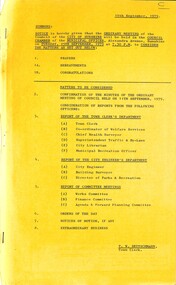
... Street...St. Albans...Porter Road...Deer Park...Ballarat Road...Kororoit Creek...Deer Park Hotel...Glengala Road...St. Andrews Drive...Hampshire Road...Henderson...Andrews Drive Sunshine West Planning Permit Application Two Service Premises and Consulting Rooms Lots 2, 3 & 4 Glengala Road Sunshine West Amendment No 91 Part 1 to the Melbourne Metropolitan Planning Scheme Amendment No 127 to the Melbourne Metropolitan Planning Scheme Planning Permit Application Sky Sign 248 Hampshire Road Sunshine Planning Permit Application Toilet Block Extension to Existing Factory Development 2 - 4 Henderson Road Sunshine North Enforcement 17 Disraeli Street Motor Repairs, Electrical Repairs and Servicing Planning Permit Application Amusement Parlour Highpoint West Shopping Centre Rosamond Road Maribyrnong Amendment No 115 to the Melbourne Metropolitan Planning Scheme Albanvale Estate Stage 6A Strata Subdivision 128 - 130 Suffolk Road Sunshine North Tenders for Annual Supplies Proposed Traffic Signals Market Road / Wright Street / Sunshine Road School Crossing Main Road West Near Kate Street St. ...Street St. Albans Porter Road Deer Park Ballarat Road Kororoit Creek Deer Park Hotel Glengala Road St. Andrews Drive Hampshire Road Henderson Road Disraeli Street Highpoint West Shopping Centre Suffolk Road Market Road Wright Street Sunshine Road Main Road West Kate Street Anderson Road McIntyre Road Fairbairn Road Bennett Street Killeen Street Western Highway Ashley Street Maidstone Forrest Street Tower Street Yallourn Street Holmes Street Ardeer River Street Fisher Street Montasell Avenue Princess Street Watt Street Furlong Road Pengally Court Antioch Court Fairfax Circuit Neale Road Albanvale Diamond Avenue Pre-School Centre Diamond Avenue Maribyrnong River New Anglers Hotel Anglers Hotel Notice of Ordinary Meeting of the Council 25th September 1979 Report of the Town Clerk's Department Report of the Town Clerk Supplementary Valuations Worker's Compensation Payment Extension of Make-Up Time Excise Duty Low Alcohol Products Road Reservation North of Robert Barrett Reserve Garbage By-Law 123 Amendment By-Law 127 Land Duke street Proposed Lease and Development Council Functions The Sunshine Swimming Pool Complex Opening by The Hon. ...Notice of Ordinary Meeting of the Council 25th September 1979 Report of the Town Clerk's Department Report of the Town Clerk Supplementary Valuations Worker's Compensation Payment Extension of Make-Up Time Excise Duty Low Alcohol Products Road Reservation North of Robert Barrett Reserve Garbage By-Law 123 Amendment By-Law 127 Land Duke street Proposed Lease and Development Council Functions The Sunshine Swimming Pool Complex Opening by The Hon. Alan Hunt Minister of Education General Revenue Grants to Municipalities Melbourne Tourism Authority Request for Financial Assistance Report of the Co-Ordinator of Welfare Services Combined Pensioners Association of Deer Park School Leavers Project Maribyrnong Senior Citizens' Club Summer School for Under Privileged H.S.C. Students Multi-Cultural Senior Citizens' Club Sunshine West & Multi-Cultural Senior Citizens' Club Sunshine North Community Youth Support Scheme Tenants Advice Service Brooklyn Playgroup Report of the Chief Health Surveyor Sewer Blockage Mullenger Street Prosecution Proceedings Sunshine Magistrates Court Application for Transfer of Proprietorship of Premises Under the Health Act Health Act Registrations for 1979 Sanitary Service Report of the Superintendent Traffic & By-Laws School Crossing Supervisors Report of the City Librarian Library Association of Australia 20th Biennial Conference 26th to 30th August 1979 August School holiday Programme Report of the Municipal Recreation Officer Victoria Olympic Appeal and Olympic Games Week Holiday Programme Grant Report of the City Engineer & Planner Selwyn Park Planning Permit Application Appeals Planning Permit Application Community Health Centre Andrea Street St. Albans Planning Permit Application Service Industry Lot 80 Porter Road Deer Park Planning Permit Application Kororoit Creek 760 Ballarat Road Deer Park (Deer Park Hotel) Planning Permit Application Alterations to Petrol Filling Station Glengala Road North East Corner St. Andrews Drive Sunshine West Planning Permit Application Two Service Premises and Consulting Rooms Lots 2, 3 & 4 Glengala Road Sunshine West Amendment No 91 Part 1 to the Melbourne Metropolitan Planning Scheme Amendment No 127 to the Melbourne Metropolitan Planning Scheme Planning Permit Application Sky Sign 248 Hampshire Road Sunshine Planning Permit Application Toilet Block Extension to Existing Factory Development 2 - 4 Henderson Road Sunshine North Enforcement 17 Disraeli Street Motor Repairs, Electrical Repairs and Servicing Planning Permit Application Amusement Parlour Highpoint West Shopping Centre Rosamond Road Maribyrnong Amendment No 115 to the Melbourne Metropolitan Planning Scheme Albanvale Estate Stage 6A Strata Subdivision 128 - 130 Suffolk Road Sunshine North Tenders for Annual Supplies Proposed Traffic Signals Market Road / Wright Street / Sunshine Road School Crossing Main Road West Near Kate Street St. Albans Proposed School Crossing Anderson Road Installation of Traffic Signals Under Statcon Programme Ballarat Road / McIntyre Road / Anderson Road Remodelling of Existing Signals Proposed School Crossing Fairbairn Road Between Bennett Street and Killeen Street Sunshine West Traffic Signals Intersection of Western Highway (Ballarat Road) and Ashley Street Maidstone Replacement of Bus Shelter Forrest Street West of Tower Street Ardeer Replacement of Bus Shelter Forrest Street East of Yallourn Street Ardeer Replacement of Bus Shelter Forrest Street East of Holmes Street Ardeer Pedestrian Operated Signals in Rosamond Road Between River Street and Fisher Street Deferred Payment Scheme Berkshire Road Parking in Front of Rockwell Axles Reflectorized House Numbering Montasell Avenue Deer Park Parking Princess Street Arcade St. Albans Traffic Parkside Subdisivion Sunshine West Installation of Traffic Signs Watt Street Sunshine Installation of Traffic Signs Duke Street Sunshine Installation of Traffic Signs Furlong Road Sunshine North Installation of Traffic Signs Berkshire Road Sunshine North Installation of Traffic Signs Pengally Court Sunshine Sewerage Facilities Deer Park Declaration of Sewerage Area No 3848 Antioch Court, Fairfax Circuit & Neale Road Albanvale Toilet Blocks Various Reserves Report of the Director of Parks & Recreation Hire of Plants for Decoration Diamond Avenue Pre-School Centre Landscaping Maribyrnong River Beautification New Anglers Hotel Orders of the Day Accounts Submitted for Payment as at 15th September 1979 Special Order for Making By-Law No 127 with respect to the provision, use and control of receptacles for the deposit and collection of refuse and rubbish (whether temporary or otherwise) and prescribing the size and shape of and material to be used in the construction of such receptacles.robert barrett reserve, rosamond road, maribyrnong, duke street, sunshine north, sunshine swimming pool, kennedy street, sunshine, maribyrnong senior citizens' club, multi-cultural senior citizens' club sunshine west, multi-cultural senior citizens' club sunshine north, brooklyn playgroup, mullenger street, braybrook, selwyn park, selwyn street, albion, andrea street, st. albans, porter road, deer park, ballarat road, kororoit creek, deer park hotel, glengala road, st. andrews drive, hampshire road, henderson road, disraeli street, highpoint west shopping centre, suffolk road, market road, wright street, sunshine road, main road west, kate street, anderson road, mcintyre road, fairbairn road, bennett street, killeen street, western highway, ashley street, maidstone, forrest street, tower street, yallourn street, holmes street, ardeer, river street, fisher street, montasell avenue, princess street, watt street, furlong road, pengally court, antioch court, fairfax circuit, neale road, albanvale, diamond avenue pre-school centre, diamond avenue, maribyrnong river, new anglers hotel, anglers hotel -
 Stawell Historical Society Inc
Photograph, Henderson Family's Wooden Home in Walker Street Stawell
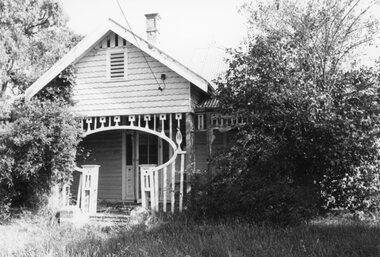
... Henderson Family's Wooden Home in Walker Street Stawell...Wooden Home Walker Street (Henderson)...Wooden Home Walker Street (Henderson) Stawell Henderson Family's Wooden Home in Walker Street Stawell Photograph ...Wooden Home Walker Street (Henderson)stawell -
 Stawell Historical Society Inc
Photograph, Henderson Family's Home's Wooden Gate in Walker Street Stawell
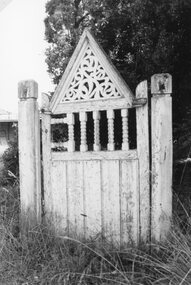
... Henderson Family's Home's Wooden Gate in Walker Street Stawell ...Wooden gate on Home Walker Street (Henderson)...Wooden gate on Home Walker Street (Henderson) Stawell Henderson Family's Home's Wooden Gate in Walker Street Stawell Photograph ...Wooden gate on Home Walker Street (Henderson)stawell -
 Phillip Island and District Historical Society Inc.
Photograph - Post Card, Early 1900's
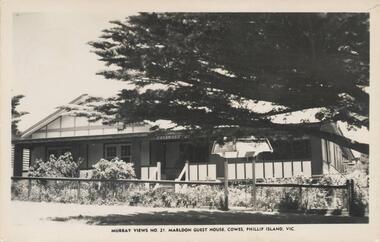
... Addressed to: Mrs C. Henderson,17 Woodmason Street, Malvern, Melbourne."...Addressed to: Mrs C. Henderson,17 Woodmason Street, Malvern, Melbourne." Black & White postacrd of Marldon Guest House. ...One of a collection of photographs purchased by the Society from Jack Day of Mornington.Black & White postacrd of Marldon Guest House. Situated in an elevated position over looking bay in Thompson Avenue, Cowes. House has verandah with garden behind a fence and a pine tree providing shade in the street outside."Murray Views No. 21" "Marldon Guest House, Cowes, Phillip Island, Vic." On Back: "Dear Matre, We are having a nice time here. It is my birthday today and we had a cake with three candles and I got 2 ribbons and some sweeties and some hankies. Will see you on Sat. Love Lyn. Addressed to: Mrs C. Henderson,17 Woodmason Street, Malvern, Melbourne."marldon guest house, cowes, phillip island, jack day collection -
 Flagstaff Hill Maritime Museum and Village
Instrument - Sphygmomanometer, Riester, 1948 -1969
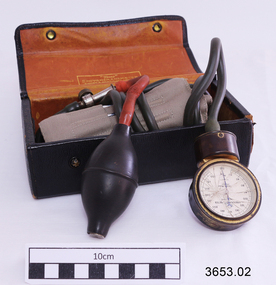
... In 1939 Dr Angus and his family moved to Warrnambool where he purchased “Birchwood,” the 1852 home and medical practice of Dr John Hunter Henderson, at 214 Koroit Street. (This property was sold in1965 to the State Government and is now the site of the Warrnambool Police Station.). ...In 1939 Dr Angus and his family moved to Warrnambool where he purchased “Birchwood,” the 1852 home and medical practice of Dr John Hunter Henderson, at 214 Koroit Street. (This property was sold in1965 to the State Government and is now the site of the Warrnambool Police Station.). ...This blood pressure monitor (sphygmomanometer) belonged to Dr William Roy Angus, surgeon and oculist. It was donated to Flagstaff Hill Maritime Village by his daughter, Berry McDade in January 2015. . It is part of the “W.R. Angus Collection” that includes historical medical equipment, surgical instruments and material once belonging to Dr Edward Ryan and Dr Thomas Francis Ryan, (both of Nhill, Victoria) as well as Dr Angus’ own belongings. The Collection’s history spans the medical practices of the two Doctors Ryan, from 1885-1926 plus that of Dr Angus, up until 1969. The approximate manufacture date of the blood pressure monitor coincides with the time when Doctor William Roy Angus had his practice in Warrnambool. The company Short & Mason Ltd. London used the brand name TYCOS between 1907-1969 and Rudolf Riester (the brand on the cuff) formed the company ‘Riester” in Germany in 1948, where he developed and produced the first mercury blood pressure monitors. In 1939 Dr Angus and his family moved to Warrnambool where he purchased “Birchwood,” the 1852 home and medical practice of Dr John Hunter Henderson, at 214 Koroit Street. (This property was sold in1965 to the State Government and is now the site of the Warrnambool Police Station.). Dr Angus was appointed on a part-time basis as Port Medical Officer (Health Officer) in Warrnambool and held this position until the 1940’s when the government no longer required the service of a Port Medical Officer in Warrnambool; he was thus Warrnambool’s last serving Port Medical Officer. (The duties of a Port Medical Officer were outlined by the Colonial Secretary on 21st June, 1839 under the terms of the Quarantine Act. Masters of immigrant ships arriving in port reported incidents of diseases, illness and death and the Port Medical Officer made a decision on whether the ship required Quarantine and for how long, in this way preventing contagious illness from spreading from new immigrants to the residents already in the colony.) Dr Angus was a member of the Australian Medical Association, for 35 years and surgeon at the Warrnambool Base Hospital 1939-1942, He served as a Surgeon Captain during WWII1942-45, in Ballarat, Victoria, and in Bonegilla, N.S.W., completing his service just before the end of the war due to suffering from a heart attack. During his convalescence he carved an intricate and ‘most artistic’ chess set from the material that dentures were made from. He then studied ophthalmology at the Royal Melbourne Eye and Ear Hospital and created cosmetically superior artificial eyes by pioneering using the intrascleral cartilage. Angus received accolades from the Ophthalmological Society of Australasia for this work. He returned to Warrnambool to commence practice as an ophthalmologist, pioneering in artificial eye improvements. He was Honorary Consultant Ophthalmologist to Warrnambool Base Hospital for 31 years. He made monthly visits to Portland as a visiting surgeon, to perform eye surgery. He represented the Victorian South-West subdivision of the Australian Medical Association as its secretary between 1949 and 1956 and as chairman from 1956 to 1958. In 1968 Dr Angus was elected member of Spain’s Barraquer Institute of Barcelona after his research work in Intrasclearal cartilage grafting, becoming one of the few Australian ophthalmologists to receive this honour, and in the following year presented his final paper on Living Intrasclearal Cartilage Implants at the Inaugural Meeting of the Australian College of Ophthalmologists in Melbourne. In his personal life Dr Angus was a Presbyterian and treated Sunday as a Sabbath, a day of rest. He would visit 3 or 4 country patients on a Sunday, taking his children along ‘for the ride’ and to visit with him. Sunday evenings he would play the pianola and sing Scottish songs to his family. One of Dr Angus’ patients was Margaret MacKenzie, author of a book on local shipwrecks that she’d seen as an eye witness from the late 1880’s in Peterborough, Victoria. In the early 1950’s Dr Angus, painted a picture of a shipwreck for the cover jacket of Margaret’s book, Shipwrecks and More Shipwrecks. She was blind in later life and her daughter wrote the actual book for her. Dr Angus and his wife Gladys were very involved in Warrnambool’s society with a strong interest in civic affairs. Their interests included organisations such as Red Cross, Rostrum, Warrnambool and District Historical Society (founding members), Wine and Food Society, Steering Committee for Tertiary Education in Warrnambool, Local National Trust, Good Neighbour Council, Housing Commission Advisory Board, United Services Institute, Legion of Ex-Servicemen, Olympic Pool Committee, Food for Britain Organisation, Warrnambool Hospital, Anti-Cancer Council, Boys’ Club, Charitable Council, National Fitness Council and Air Raid Precautions Group. He was also a member of the Steam Preservation Society and derived much pleasure from a steam traction engine on his farm. He had an interest in people and the community. He and his wife Gladys were both involved in the creation of Flagstaff Hill, including the layout of the gardens. After his death (28th March 1970) his family requested his practitioner’s plate, medical instruments and some personal belongings be displayed in the Port Medical Office surgery at Flagstaff Hill Maritime Village, and be called the “W. R. Angus Collection”. The W.R. Angus Collection is significant for still being located at the site it is connected with, Doctor Angus being the last Port Medical Officer in Warrnambool.. The collection of medical instruments and other equipment is culturally significant, being an historical example of medicine from late 19th to mid-20th century. Dr Angus assisted Dr Tom Ryan, a pioneer in the use of X-rays and in ocular surgery. Sphygmomanometer (blood pressure meter), from the collection of W.R. Angus. Brand TYCOS by Short & Mason Ltd, London. The case is of black leather with press-stud closure, lined in brown leather with gilded maker's embossing inside lid. The meter has a grey fabric cuff attached to two black rubber tubes, one tube has a pump bulb on a short brown extension tube on the end, the other has a round meter with glass covered dial on the end. Dial registers 20 – 300. There are maker's details on both meter and box."Patent 9535. No. 39370". Gold maker's stamp " "TYCOS" "SPHYGMOMANOMETER / SHORT & MASON LTD. LONDON / company’s logo”. Cloth label sewn on cuff "GERMANY / RIESTER"flagstaff hill, flagstaff hill warrnambool, maritime museum, shipwreck coast, flagstaff hill maritime village, great ocean road, sphygmomanometer, chemist equipment, dr w.r. angus, medical instrument, warrnambool base hospital, medical treatment, medical history -
 Flagstaff Hill Maritime Museum and Village
Textile - Bedspread, early 20th century
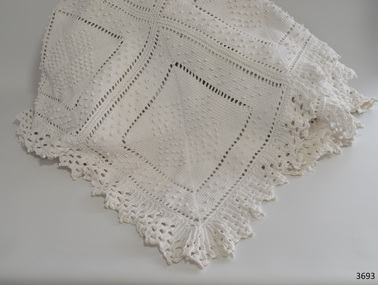
... John Hunter Henderson, at 214 Koroit Street. (This property was sold in1965 to the State Government and is now the site of the Warrnambool Police Station.) ...John Hunter Henderson, at 214 Koroit Street. (This property was sold in1965 to the State Government and is now the site of the Warrnambool Police Station.) ...This crocheted bedspread was used by Dr. and Mrs. Angus in their home in "Birchwood" Warrnambool. It was donated to Flagstaff Hill Maritime Village by the family of Doctor William Roy Angus, Surgeon and Oculist. It is part of the "W.R. Angus Collection" that includes historical medical equipment, surgical instruments, and material once belonging to Dr. Edward Ryan and Dr. Thomas Francis Ryan, (both of Nhill, Victoria) as well as Dr. Angus's belongings. The Collection's history spans the medical practices of the two Doctors Ryan, from 1885-1926 plus that of Dr. Angus, up until 1969. WR Angus Collection: Doctor William Roy Angus qualified as a doctor from Adelaide University in 1923. Dr. Angus was born in Murrumbeena, Victoria in 1901 until he died in 1970. He qualified as a doctor in 1923 at the University of Adelaide and was a Resident Medical Officer at the Royal Adelaide Hospital in 1924 and for a period house surgeon to Sir Henry Simpson Newland. Dr. Angus was also briefly an Assistant to Dr. Riddell of Kapunda SA, then commenced private practice at Curramulka, Yorke Peninsula, SA, where he was a physician, surgeon, and chemist. In 1926, he was appointed as new Medical Assistant to Dr. Thomas Francis Ryan (T.F. Ryan), in Nhill, Victoria, where his experiences included radiology and pharmacy. In 1927 he was Acting House Surgeon in Dr. Tom Ryan's absence. Dr. Angus had become engaged to Gladys Forsyth and it was decided he would take time to further his studies overseas in the UK. in 1927 He studied at London University College Hospital and at Edinburgh Royal Infirmary and in 1928, was awarded FRCS (Fellow from the Royal College of Surgeons), Edinburgh. He worked his passage back to Australia as a Ship's Surgeon on the Australian Commonwealth Line's T.S.S. Largs Bay. Dr. Angus married Gladys in 1929, in Ballarat and had one son Graham born in 1932, and two daughters (Helen and Bernice, both were born at Mira, Nhill SA Dr. Angus was a 'flying doctor' for the A.I.M. (Australian Inland Ministry) Aerial Medical Service in 1928. The Organisation began in South Australia through the Presbyterian Church that year, with its first station being in the remote town of Oodnadatta, where Dr. Angus was stationed. He was locum there on North-South Railway at 21 Mile Camp taking up the position of 'flying doctor' in response to a call from Dr. John Flynn; the Organisation later became known as the Flying Doctor Service. Between 1928-1932 he was a surgeon at the Curramulka Hospital, Yorke Peninsula, South Australia but in1933 he returned to Nhill where he'd previously worked as a Medical Assistant and purchased a share of the Nelson Street practice and Mira hospital from Dr. Les Middleton the current owners of what was once Dr. Tom Ryan's practice. When Dr. Angus bought into the Nelson Street premises in Nhill he was also appointed as the Nhill Hospital's Honorary House Surgeon 1933-1938. His practitioner's plate from his Nhill surgery states "Hours Daily, except Tuesdays, Fridays and Saturday afternoons, 9-10 am, 2-4 pm, 7-8 pm. Sundays by appointment". This plate is now mounted on the doorway to the Port Medical Office at Flagstaff Hill Maritime Village, Warrnambool. Dr. Edward Ryan and Dr. Tom Ryan had an extensive collection of historical medical equipment and materials spanning 1884-1926 and when Dr. Angus took up practice in their old premises he obtained this collection, a large part of which is now on display at the Port Medical Office at Flagstaff Hill Maritime Village in Warrnambool. During his time in Nhill, Dr. Angus was involved in the merging of the Mira Hospital and Nhill Public Hospital into one public hospital and the property titles passed on to Nhill Hospital in 1939. In 1939 Dr. Angus and his family moved to Warrnambool where he purchased "Birchwood," the 1852 home and medical practice of Dr. John Hunter Henderson, at 214 Koroit Street. (This property was sold in1965 to the State Government and is now the site of the Warrnambool Police Station.) The Angus family were able to afford gardeners, cooks, and maids with their home becoming a popular place for visiting dignitaries to stay whilst visiting Warrnambool. Dr. Angus had his silkworm farm at home in a Mulberry tree. His young daughter used his centrifuge for spinning the silk. Dr. Angus was appointed on a part-time basis as Port Medical Officer in Warrnambool and held this position until the 1940's when the government no longer required the service of a medical officer he then became Warrnambools last serving Port Medical Officer. Dr. Angus was a member of the Australian Medical Association, for 35 years and surgeon at the Warrnambool Base Hospital from 1939 to 1942, He served as a Surgeon Captain during WWII from 1942 to 1945, in Ballarat, Victoria, and in Bonegilla, N.S.W., he completed his service just before the end of the war as he suffered a heart attack. It was during his convalescence he carved an intricate and 'most artistic' chess set from the material that dentures were made from. He then studied ophthalmology at the Royal Melbourne Eye and Ear Hospital and created cosmetically superior artificial eyes by pioneering using the intrascleral cartilage. Angus received accolades from the Ophthalmological Society of Australasia for this work. He returned to Warrnambool to commence practice as an ophthalmologist, pioneering in artificial eye improvements. He was an Honorary Consultant Ophthalmologist to Warrnambool Base Hospital for 31 years. He represented the Victorian South-West subdivision of the Australian Medical Association as its secretary between 1949 and 1956 and as chairman from 1956 to 1958. In 1968 Dr. Angus was elected member of Spain's Barraquer Institute of Barcelona after his research work in Intrasclearal cartilage grafting, becoming one of the few Australian ophthalmologists to receive this accolade, and in the following year presented his final paper on Living Intrasclearal Cartilage Implants at the Inaugural Meeting of the Australian College of Ophthalmologists in Melbourne. In his personal life, Dr. Angus was a Presbyterian and treated Sunday as a Sabbath, a day of rest. He would visit 3 or 4 country patients on a Sunday, taking his children along 'for the ride' and to visit with him. Sunday evenings he would play the pianola and sing Scottish songs to his family. One of Dr. Angus' patients was Margaret MacKenzie, author of a book on local shipwrecks that she'd seen as an eye witness from the late 1880s in Peterborough, Victoria. In the early 1950's Dr. Angus, painted a picture of a shipwreck for the cover jacket of Margaret's book, Shipwrecks, and More Shipwrecks. Dr. Angus and his wife Gladys were very involved in Warrnambool society with a strong interest in civic affairs. Their interests included organisations such as Red Cross, Rostrum, Warrnambool and District Historical Society (founding members), Wine and Food Society, Steering Committee for Tertiary Education in Warrnambool, Local National Trust, Good Neighbour Council, Housing Commission Advisory Board, United Services Institute, Legion of Ex-Servicemen, Olympic Pool Committee, Food for Britain Organisation, Warrnambool Hospital, Anti-Cancer Council, Boys' Club, Charitable Council, National Fitness Council, and Air Raid Precautions Group. He was also a member of the Steam Preservation Society and derived much pleasure from a steam traction engine on his farm. He had an interest in people and the community He and his wife Gladys were both involved in the creation of Flagstaff Hill, including the layout of the gardens. After his death on 28th March 1970, his family requested his practitioner's plate, medical instruments, and some personal belongings be displayed in the Port Medical Office surgery at Flagstaff Hill Maritime Village, and be called the "W. R. Angus Collection". The W.R. Angus Collection is significant for the social and medical achievement's that Dr. William Roy Angus had accomplished in his lifetime and the collection of equipment that he and his predecessors had used to treat patients give an insight into the working lives of early colonial medical practices in rural Australia. This collection of medical artefacts is on display located at Flagstaff Hill Village and the Port Medical Officers building where Doctor Angus had practice as the last Port Medical Officer for Warrnambool.Crocheted double bedspread, from the W.R. Angus Collection. White cotton, hand crocheted 30 squares joined as patchwork then a border crocheted around edge. Each square is 41cm square.Noneflagstaff hill, warrnambool, shipwrecked coast, flagstaff hill maritime museum, shipwreck coast, great ocean road, hand crafted manchester, crocheted bedspread, patchwork bedspread, household linen, early 20th century bedspread, dr. w r angus -
 Flagstaff Hill Maritime Museum and Village
Book, The British Encyclopaedia of Medical Practice 1950
... In 1939 Dr Angus and his family moved to Warrnambool where he purchased “Birchwood,” the 1852 home and medical practice of Dr John Hunter Henderson, at 214 Koroit Street. (This property was sold in1965 to the State Government and is now the site of the Warrnambool Police Station and an ALDI sore is on the land that was once their tennis court). ...In 1939 Dr Angus and his family moved to Warrnambool where he purchased “Birchwood,” the 1852 home and medical practice of Dr John Hunter Henderson, at 214 Koroit Street. (This property was sold in1965 to the State Government and is now the site of the Warrnambool Police Station and an ALDI sore is on the land that was once their tennis court). ...This Book was donated to Flagstaff Hill Maritime Village by the family of Doctor William Roy Angus, Surgeon and Oculist. It is part of the “W.R. Angus Collection” that includes historical medical equipment, surgical instruments and material once belonging to Dr Edward Ryan and Dr Thomas Francis Ryan, (both of Nhill, Victoria) as well as Dr Angus’ own belongings. The Collection’s history spans the medical practices of the two Doctors Ryan, from 1885-1926 plus that of Dr Angus, up until 1969. ABOUT THE “W.R.ANGUS COLLECTION” Doctor William Roy Angus M.B., B.S., Adel., 1923, F.R.C.S. Edin.,1928 (also known as Dr Roy Angus) was born in Murrumbeena, Victoria in 1901 and lived until 1970. He qualified as a doctor in 1923 at University of Adelaide, was Resident Medical Officer at the Royal Adelaide Hospital in 1924 and for a period was house surgeon to Sir (then Mr.) Henry Simpson Newland. Dr Angus was briefly an Assistant to Dr Riddell of Kapunda, then commenced private practice at Curramulka, Yorke Peninsula, SA, where he was physician, surgeon and chemist. In 1926, he was appointed as new Medical Assistant to Dr Thomas Francis Ryan (T.F. Ryan, or Tom), in Nhill, Victoria, where his experiences included radiology and pharmacy. In 1927 he was Acting House Surgeon in Dr Tom Ryan’s absence. Dr Angus had become engaged to Gladys Forsyth and they decided he further his studies overseas in the UK in 1927. He studied at London University College Hospital and at Edinburgh Royal Infirmary and in 1928, was awarded FRCS (Fellow from the Royal College of Surgeons), Edinburgh. He worked his passage back to Australia as a Ship’s Surgeon on the on the Australian Commonwealth Line’s T.S.S. Largs Bay. Dr Angus married Gladys in 1929, in Ballarat. (They went on to have one son (Graham 1932, born in SA) and two daughters (Helen (died 12/07/1996) and Berenice (Berry), both born at Mira, Nhill According to Berry, her mother Gladys made a lot of their clothes. She was very talented and did some lovely embroidery including lingerie for her trousseau and beautifully handmade baby clothes. Dr Angus was a ‘flying doctor’ for the A.I.M. (Australian Inland Ministry) Aerial Medical Service in 1928. Its first station was in the remote town of Oodnadatta, where Dr Angus was stationed. He was locum tenens there on North-South Railway at 21 Mile Camp. He took up this ‘flying doctor’ position in response to a call from Dr John Flynn; the organisation was later known as the Flying Doctor Service, then the Royal Flying Doctor Service. A lot of his work during this time involved dental surgery also. Between 1928-1932 he was surgeon at the Curramulka Hospital, Yorke Peninsula, South Australia. In 1933 Dr Angus returned to Nhill and purchased a share of the Nelson Street practice and Mira hospital (a 2 bed ward at the Nelson Street Practice) from Dr Les Middleton one of the Middleton Brothers, the current owners of what previously once Dr Tom Ryan’s practice. Dr Tom and his brother had worked as surgeons included eye surgery. Dr Tom Ryan performed many of his operations in the Mira private hospital on his premises. He had been House Surgeon at the Nhill Hospital 1902-1926. Dr Tom Ryan had one of the only two pieces of radiology equipment in Victoria during his practicing years – The Royal Melbourne Hospital had the other one. Over the years Dr Tom Ryan had gradually set up what was effectively a training school for country general-practitioner-surgeons. Each patient was carefully examined, including using the X-ray machine, and any surgery was discussed and planned with Dr Ryan’s assistants several days in advance. Dr Angus gained experience in using the X-ray machine there during his time as assistant to Dr Ryan. When Dr Angus bought into the Nelson Street premises in Nhill he was also appointed as the Nhill Hospital’s Honorary House Surgeon 1933-1938. His practitioner’s plate from his Nhill surgery is now mounted on the doorway to the Port Medical Office at Flagstaff Hill Maritime Village, Warrnambool. When Dr Angus took up practice in the Dr Edward and Dr Tom Ryan’s old premises he obtained their extensive collection of historical medical equipment and materials spanning 1884-1926. A large part of this collection is now on display at the Port Medical Office at Flagstaff Hill Maritime Village in Warrnambool. In 1939 Dr Angus and his family moved to Warrnambool where he purchased “Birchwood,” the 1852 home and medical practice of Dr John Hunter Henderson, at 214 Koroit Street. (This property was sold in1965 to the State Government and is now the site of the Warrnambool Police Station and an ALDI sore is on the land that was once their tennis court). The Angus family was able to afford gardeners, cooks and maids; their home was a popular place for visiting dignitaries to stay whilst visiting Warrnambool. Dr Angus had his own silk worm farm at home in a Mulberry tree. His young daughter used his centrifuge for spinning the silk. Dr Angus was appointed on a part-time basis as Port Medical Officer (Health Officer) in Warrnambool and held this position until the 1940’s when the government no longer required the service of a Port Medical Officer in Warrnambool; he was thus Warrnambool’s last serving Port Medical Officer. (Masters of immigrant ships arriving in port reported incidents of diseases, illness and death and the Port Medical Officer made a decision on whether the ship required Quarantine and for how long, in this way preventing contagious illness from spreading from new immigrants to the residents already in the colony.) Dr Angus was a member of the Australian Medical Association, for 35 years and surgeon at the Warrnambool Base Hospital 1939-1942, He served as a Surgeon Captain during WWII 1942-45, in Ballarat, Victoria, and in Bonegilla, N.S.W., completing his service just before the end of the war due to suffering from a heart attack. During his convalescence he carved an intricate and ‘most artistic’ chess set from the material that dentures were made from. He then studied ophthalmology at the Royal Melbourne Eye and Ear Hospital and created cosmetically superior artificial eyes by pioneering using the intrascleral cartilage. Angus received accolades from the Ophthalmological Society of Australasia for this work. He returned to Warrnambool to commence practice as an ophthalmologist, pioneering in artificial eye improvements. He was Honorary Consultant Ophthalmologist to Warrnambool Base Hospital for 31 years. He made monthly visits to Portland as a visiting surgeon, to perform eye surgery. He represented the Victorian South-West subdivision of the Australian Medical Association as its secretary between 1949 and 1956 and as chairman from 1956 to 1958. In 1968 Dr Angus was elected member of Spain’s Barraquer Institute of Barcelona after his research work in Intrasclearal cartilage grafting, becoming one of the few Australian ophthalmologists to receive this honour, and in the following year presented his final paper on Living Intrasclearal Cartilage Implants at the Inaugural Meeting of the Australian College of Ophthalmologists in Melbourne In his personal life Dr Angus was a Presbyterian and treated Sunday as a Sabbath, a day of rest. He would visit 3 or 4 country patients on a Sunday, taking his children along ‘for the ride’ and to visit with him. Sunday evenings he would play the pianola and sing Scottish songs to his family. One of Dr Angus’ patients was Margaret MacKenzie, author of a book on local shipwrecks that she’d seen as an eye witness from the late 1880’s in Peterborough, Victoria. In the early 1950’s Dr Angus, painted a picture of a shipwreck for the cover jacket of Margaret’s book, Shipwrecks and More Shipwrecks. She was blind in later life and her daughter wrote the actual book for her. Dr Angus and his wife Gladys were very involved in Warrnambool’s society with a strong interest in civic affairs. He had an interest in people and the community. They were both involved in the creation of Flagstaff Hill, including the layout of the gardens. After his death (28th March 1970) his family requested his practitioner’s plate, medical instruments and some personal belongings be displayed in the Port Medical Office surgery at Flagstaff Hill Maritime Village, and be called the “W. R. Angus Collection”. The W.R. Angus Collection is significant for still being located at the site it is connected with, Doctor Angus being the last Port Medical Officer in Warrnambool. The collection of medical instruments and other equipment is culturally significant, being an historical example of medicine, administration, household equipment and clothing from late 19th to mid-20th century. Dr Angus assisted Dr Tom Ryan, a pioneer in the use of X-rays and in ocular surgery. The British Encyclopaedia of Medical Practice 1950 Author: Rt. Hon. Lord Horder Publisher: Butterworth & Company Date: 1950Pastedown front endpaper has sticker that reads "W. R. Angus, 309 Koroit Street, Warrnambool"flagstaff hill, warrnambool, shipwrecked-coast, flagstaff-hill, flagstaff-hill-maritime-museum, maritime-museum, shipwreck-coast, flagstaff-hill-maritime-village, the british encyclopaedia of medical practice 1950, book, dr. w.r. angus, dr ryan, t.s.s. largs bay, warrnambool base hospital, nhill base hospital, mira hospital, flying doctor, medical treatment, medical history, medical education -
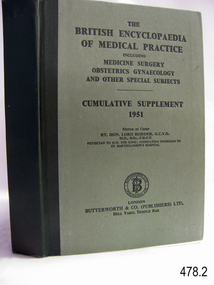 Flagstaff Hill Maritime Museum and Village
Book, The British Encyclopaedia of Medical Practice 1951
... In 1939 Dr Angus and his family moved to Warrnambool where he purchased “Birchwood,” the 1852 home and medical practice of Dr John Hunter Henderson, at 214 Koroit Street. (This property was sold in1965 to the State Government and is now the site of the Warrnambool Police Station and an ALDI sore is on the land that was once their tennis court). ...In 1939 Dr Angus and his family moved to Warrnambool where he purchased “Birchwood,” the 1852 home and medical practice of Dr John Hunter Henderson, at 214 Koroit Street. (This property was sold in1965 to the State Government and is now the site of the Warrnambool Police Station and an ALDI sore is on the land that was once their tennis court). ...This Book was donated to Flagstaff Hill Maritime Village by the family of Doctor William Roy Angus, Surgeon and Oculist. It is part of the “W.R. Angus Collection” that includes historical medical equipment, surgical instruments and material once belonging to Dr Edward Ryan and Dr Thomas Francis Ryan, (both of Nhill, Victoria) as well as Dr Angus’ own belongings. The Collection’s history spans the medical practices of the two Doctors Ryan, from 1885-1926 plus that of Dr Angus, up until 1969. ABOUT THE “W.R.ANGUS COLLECTION” Doctor William Roy Angus M.B., B.S., Adel., 1923, F.R.C.S. Edin.,1928 (also known as Dr Roy Angus) was born in Murrumbeena, Victoria in 1901 and lived until 1970. He qualified as a doctor in 1923 at University of Adelaide, was Resident Medical Officer at the Royal Adelaide Hospital in 1924 and for a period was house surgeon to Sir (then Mr.) Henry Simpson Newland. Dr Angus was briefly an Assistant to Dr Riddell of Kapunda, then commenced private practice at Curramulka, Yorke Peninsula, SA, where he was physician, surgeon and chemist. In 1926, he was appointed as new Medical Assistant to Dr Thomas Francis Ryan (T.F. Ryan, or Tom), in Nhill, Victoria, where his experiences included radiology and pharmacy. In 1927 he was Acting House Surgeon in Dr Tom Ryan’s absence. Dr Angus had become engaged to Gladys Forsyth and they decided he further his studies overseas in the UK in 1927. He studied at London University College Hospital and at Edinburgh Royal Infirmary and in 1928, was awarded FRCS (Fellow from the Royal College of Surgeons), Edinburgh. He worked his passage back to Australia as a Ship’s Surgeon on the on the Australian Commonwealth Line’s T.S.S. Largs Bay. Dr Angus married Gladys in 1929, in Ballarat. (They went on to have one son (Graham 1932, born in SA) and two daughters (Helen (died 12/07/1996) and Berenice (Berry), both born at Mira, Nhill According to Berry, her mother Gladys made a lot of their clothes. She was very talented and did some lovely embroidery including lingerie for her trousseau and beautifully handmade baby clothes. Dr Angus was a ‘flying doctor’ for the A.I.M. (Australian Inland Ministry) Aerial Medical Service in 1928. Its first station was in the remote town of Oodnadatta, where Dr Angus was stationed. He was locum tenens there on North-South Railway at 21 Mile Camp. He took up this ‘flying doctor’ position in response to a call from Dr John Flynn; the organisation was later known as the Flying Doctor Service, then the Royal Flying Doctor Service. A lot of his work during this time involved dental surgery also. Between 1928-1932 he was surgeon at the Curramulka Hospital, Yorke Peninsula, South Australia. In 1933 Dr Angus returned to Nhill and purchased a share of the Nelson Street practice and Mira hospital (a 2 bed ward at the Nelson Street Practice) from Dr Les Middleton one of the Middleton Brothers, the current owners of what previously once Dr Tom Ryan’s practice. Dr Tom and his brother had worked as surgeons included eye surgery. Dr Tom Ryan performed many of his operations in the Mira private hospital on his premises. He had been House Surgeon at the Nhill Hospital 1902-1926. Dr Tom Ryan had one of the only two pieces of radiology equipment in Victoria during his practicing years – The Royal Melbourne Hospital had the other one. Over the years Dr Tom Ryan had gradually set up what was effectively a training school for country general-practitioner-surgeons. Each patient was carefully examined, including using the X-ray machine, and any surgery was discussed and planned with Dr Ryan’s assistants several days in advance. Dr Angus gained experience in using the X-ray machine there during his time as assistant to Dr Ryan. When Dr Angus bought into the Nelson Street premises in Nhill he was also appointed as the Nhill Hospital’s Honorary House Surgeon 1933-1938. His practitioner’s plate from his Nhill surgery is now mounted on the doorway to the Port Medical Office at Flagstaff Hill Maritime Village, Warrnambool. When Dr Angus took up practice in the Dr Edward and Dr Tom Ryan’s old premises he obtained their extensive collection of historical medical equipment and materials spanning 1884-1926. A large part of this collection is now on display at the Port Medical Office at Flagstaff Hill Maritime Village in Warrnambool. In 1939 Dr Angus and his family moved to Warrnambool where he purchased “Birchwood,” the 1852 home and medical practice of Dr John Hunter Henderson, at 214 Koroit Street. (This property was sold in1965 to the State Government and is now the site of the Warrnambool Police Station and an ALDI sore is on the land that was once their tennis court). The Angus family was able to afford gardeners, cooks and maids; their home was a popular place for visiting dignitaries to stay whilst visiting Warrnambool. Dr Angus had his own silk worm farm at home in a Mulberry tree. His young daughter used his centrifuge for spinning the silk. Dr Angus was appointed on a part-time basis as Port Medical Officer (Health Officer) in Warrnambool and held this position until the 1940’s when the government no longer required the service of a Port Medical Officer in Warrnambool; he was thus Warrnambool’s last serving Port Medical Officer. (Masters of immigrant ships arriving in port reported incidents of diseases, illness and death and the Port Medical Officer made a decision on whether the ship required Quarantine and for how long, in this way preventing contagious illness from spreading from new immigrants to the residents already in the colony.) Dr Angus was a member of the Australian Medical Association, for 35 years and surgeon at the Warrnambool Base Hospital 1939-1942, He served as a Surgeon Captain during WWII 1942-45, in Ballarat, Victoria, and in Bonegilla, N.S.W., completing his service just before the end of the war due to suffering from a heart attack. During his convalescence he carved an intricate and ‘most artistic’ chess set from the material that dentures were made from. He then studied ophthalmology at the Royal Melbourne Eye and Ear Hospital and created cosmetically superior artificial eyes by pioneering using the intrascleral cartilage. Angus received accolades from the Ophthalmological Society of Australasia for this work. He returned to Warrnambool to commence practice as an ophthalmologist, pioneering in artificial eye improvements. He was Honorary Consultant Ophthalmologist to Warrnambool Base Hospital for 31 years. He made monthly visits to Portland as a visiting surgeon, to perform eye surgery. He represented the Victorian South-West subdivision of the Australian Medical Association as its secretary between 1949 and 1956 and as chairman from 1956 to 1958. In 1968 Dr Angus was elected member of Spain’s Barraquer Institute of Barcelona after his research work in Intrasclearal cartilage grafting, becoming one of the few Australian ophthalmologists to receive this honour, and in the following year presented his final paper on Living Intrasclearal Cartilage Implants at the Inaugural Meeting of the Australian College of Ophthalmologists in Melbourne In his personal life Dr Angus was a Presbyterian and treated Sunday as a Sabbath, a day of rest. He would visit 3 or 4 country patients on a Sunday, taking his children along ‘for the ride’ and to visit with him. Sunday evenings he would play the pianola and sing Scottish songs to his family. One of Dr Angus’ patients was Margaret MacKenzie, author of a book on local shipwrecks that she’d seen as an eye witness from the late 1880’s in Peterborough, Victoria. In the early 1950’s Dr Angus, painted a picture of a shipwreck for the cover jacket of Margaret’s book, Shipwrecks and More Shipwrecks. She was blind in later life and her daughter wrote the actual book for her. Dr Angus and his wife Gladys were very involved in Warrnambool’s society with a strong interest in civic affairs. He had an interest in people and the community. They were both involved in the creation of Flagstaff Hill, including the layout of the gardens. After his death (28th March 1970) his family requested his practitioner’s plate, medical instruments and some personal belongings be displayed in the Port Medical Office surgery at Flagstaff Hill Maritime Village, and be called the “W. R. Angus Collection”. The W.R. Angus Collection is significant for still being located at the site it is connected with, Doctor Angus being the last Port Medical Officer in Warrnambool. The collection of medical instruments and other equipment is culturally significant, being an historical example of medicine, administration, household equipment and clothing from late 19th to mid-20th century. Dr Angus assisted Dr Tom Ryan, a pioneer in the use of X-rays and in ocular surgery. The British Encyclopaedia of Medical Practice 1951 Author: Rt. Hon. Lord Horder Publisher: Butterworth & Company Date: 1952Pastedown front endpaper has sticker that reads W. R. Angus, 309 kroit Street, Warrnamboolflagstaff hill, warrnambool, shipwrecked-coast, flagstaff-hill, flagstaff-hill-maritime-museum, maritime-museum, shipwreck-coast, flagstaff-hill-maritime-village, the british encyclopaedia of medical practice 1951, book, dr w r angus, dr ryan, surgical instrument, t.s.s. largs bay, warrnambool base hospital, nhill base hospital, mira hospital, flying doctor, medical treatment, medical history, medical education -
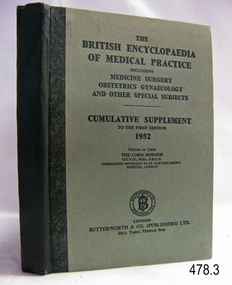 Flagstaff Hill Maritime Museum and Village
Book, The British Encyclopaedia of Medical Practice 1952
... In 1939 Dr Angus and his family moved to Warrnambool where he purchased “Birchwood,” the 1852 home and medical practice of Dr John Hunter Henderson, at 214 Koroit Street. (This property was sold in1965 to the State Government and is now the site of the Warrnambool Police Station and an ALDI sore is on the land that was once their tennis court). ...In 1939 Dr Angus and his family moved to Warrnambool where he purchased “Birchwood,” the 1852 home and medical practice of Dr John Hunter Henderson, at 214 Koroit Street. (This property was sold in1965 to the State Government and is now the site of the Warrnambool Police Station and an ALDI sore is on the land that was once their tennis court). ...This Book was donated to Flagstaff Hill Maritime Village by the family of Doctor William Roy Angus, Surgeon and Oculist. It is part of the “W.R. Angus Collection” that includes historical medical equipment, surgical instruments and material once belonging to Dr Edward Ryan and Dr Thomas Francis Ryan, (both of Nhill, Victoria) as well as Dr Angus’ own belongings. The Collection’s history spans the medical practices of the two Doctors Ryan, from 1885-1926 plus that of Dr Angus, up until 1969. ABOUT THE “W.R.ANGUS COLLECTION” Doctor William Roy Angus M.B., B.S., Adel., 1923, F.R.C.S. Edin.,1928 (also known as Dr Roy Angus) was born in Murrumbeena, Victoria in 1901 and lived until 1970. He qualified as a doctor in 1923 at University of Adelaide, was Resident Medical Officer at the Royal Adelaide Hospital in 1924 and for a period was house surgeon to Sir (then Mr.) Henry Simpson Newland. Dr Angus was briefly an Assistant to Dr Riddell of Kapunda, then commenced private practice at Curramulka, Yorke Peninsula, SA, where he was physician, surgeon and chemist. In 1926, he was appointed as new Medical Assistant to Dr Thomas Francis Ryan (T.F. Ryan, or Tom), in Nhill, Victoria, where his experiences included radiology and pharmacy. In 1927 he was Acting House Surgeon in Dr Tom Ryan’s absence. Dr Angus had become engaged to Gladys Forsyth and they decided he further his studies overseas in the UK in 1927. He studied at London University College Hospital and at Edinburgh Royal Infirmary and in 1928, was awarded FRCS (Fellow from the Royal College of Surgeons), Edinburgh. He worked his passage back to Australia as a Ship’s Surgeon on the on the Australian Commonwealth Line’s T.S.S. Largs Bay. Dr Angus married Gladys in 1929, in Ballarat. (They went on to have one son (Graham 1932, born in SA) and two daughters (Helen (died 12/07/1996) and Berenice (Berry), both born at Mira, Nhill According to Berry, her mother Gladys made a lot of their clothes. She was very talented and did some lovely embroidery including lingerie for her trousseau and beautifully handmade baby clothes. Dr Angus was a ‘flying doctor’ for the A.I.M. (Australian Inland Ministry) Aerial Medical Service in 1928. Its first station was in the remote town of Oodnadatta, where Dr Angus was stationed. He was locum tenens there on North-South Railway at 21 Mile Camp. He took up this ‘flying doctor’ position in response to a call from Dr John Flynn; the organisation was later known as the Flying Doctor Service, then the Royal Flying Doctor Service. A lot of his work during this time involved dental surgery also. Between 1928-1932 he was surgeon at the Curramulka Hospital, Yorke Peninsula, South Australia. In 1933 Dr Angus returned to Nhill and purchased a share of the Nelson Street practice and Mira hospital (a 2 bed ward at the Nelson Street Practice) from Dr Les Middleton one of the Middleton Brothers, the current owners of what previously once Dr Tom Ryan’s practice. Dr Tom and his brother had worked as surgeons included eye surgery. Dr Tom Ryan performed many of his operations in the Mira private hospital on his premises. He had been House Surgeon at the Nhill Hospital 1902-1926. Dr Tom Ryan had one of the only two pieces of radiology equipment in Victoria during his practicing years – The Royal Melbourne Hospital had the other one. Over the years Dr Tom Ryan had gradually set up what was effectively a training school for country general-practitioner-surgeons. Each patient was carefully examined, including using the X-ray machine, and any surgery was discussed and planned with Dr Ryan’s assistants several days in advance. Dr Angus gained experience in using the X-ray machine there during his time as assistant to Dr Ryan. When Dr Angus bought into the Nelson Street premises in Nhill he was also appointed as the Nhill Hospital’s Honorary House Surgeon 1933-1938. His practitioner’s plate from his Nhill surgery is now mounted on the doorway to the Port Medical Office at Flagstaff Hill Maritime Village, Warrnambool. When Dr Angus took up practice in the Dr Edward and Dr Tom Ryan’s old premises he obtained their extensive collection of historical medical equipment and materials spanning 1884-1926. A large part of this collection is now on display at the Port Medical Office at Flagstaff Hill Maritime Village in Warrnambool. In 1939 Dr Angus and his family moved to Warrnambool where he purchased “Birchwood,” the 1852 home and medical practice of Dr John Hunter Henderson, at 214 Koroit Street. (This property was sold in1965 to the State Government and is now the site of the Warrnambool Police Station and an ALDI sore is on the land that was once their tennis court). The Angus family was able to afford gardeners, cooks and maids; their home was a popular place for visiting dignitaries to stay whilst visiting Warrnambool. Dr Angus had his own silk worm farm at home in a Mulberry tree. His young daughter used his centrifuge for spinning the silk. Dr Angus was appointed on a part-time basis as Port Medical Officer (Health Officer) in Warrnambool and held this position until the 1940’s when the government no longer required the service of a Port Medical Officer in Warrnambool; he was thus Warrnambool’s last serving Port Medical Officer. (Masters of immigrant ships arriving in port reported incidents of diseases, illness and death and the Port Medical Officer made a decision on whether the ship required Quarantine and for how long, in this way preventing contagious illness from spreading from new immigrants to the residents already in the colony.) Dr Angus was a member of the Australian Medical Association, for 35 years and surgeon at the Warrnambool Base Hospital 1939-1942, He served as a Surgeon Captain during WWII 1942-45, in Ballarat, Victoria, and in Bonegilla, N.S.W., completing his service just before the end of the war due to suffering from a heart attack. During his convalescence he carved an intricate and ‘most artistic’ chess set from the material that dentures were made from. He then studied ophthalmology at the Royal Melbourne Eye and Ear Hospital and created cosmetically superior artificial eyes by pioneering using the intrascleral cartilage. Angus received accolades from the Ophthalmological Society of Australasia for this work. He returned to Warrnambool to commence practice as an ophthalmologist, pioneering in artificial eye improvements. He was Honorary Consultant Ophthalmologist to Warrnambool Base Hospital for 31 years. He made monthly visits to Portland as a visiting surgeon, to perform eye surgery. He represented the Victorian South-West subdivision of the Australian Medical Association as its secretary between 1949 and 1956 and as chairman from 1956 to 1958. In 1968 Dr Angus was elected member of Spain’s Barraquer Institute of Barcelona after his research work in Intrasclearal cartilage grafting, becoming one of the few Australian ophthalmologists to receive this honour, and in the following year presented his final paper on Living Intrasclearal Cartilage Implants at the Inaugural Meeting of the Australian College of Ophthalmologists in Melbourne In his personal life Dr Angus was a Presbyterian and treated Sunday as a Sabbath, a day of rest. He would visit 3 or 4 country patients on a Sunday, taking his children along ‘for the ride’ and to visit with him. Sunday evenings he would play the pianola and sing Scottish songs to his family. One of Dr Angus’ patients was Margaret MacKenzie, author of a book on local shipwrecks that she’d seen as an eye witness from the late 1880’s in Peterborough, Victoria. In the early 1950’s Dr Angus, painted a picture of a shipwreck for the cover jacket of Margaret’s book, Shipwrecks and More Shipwrecks. She was blind in later life and her daughter wrote the actual book for her. Dr Angus and his wife Gladys were very involved in Warrnambool’s society with a strong interest in civic affairs. He had an interest in people and the community. They were both involved in the creation of Flagstaff Hill, including the layout of the gardens. After his death (28th March 1970) his family requested his practitioner’s plate, medical instruments and some personal belongings be displayed in the Port Medical Office surgery at Flagstaff Hill Maritime Village, and be called the “W. R. Angus Collection”. The British Encyclopaedia of Medical Practice 1952 Author: Rt. Hon. Lord Horder Publisher: Butterworth & Company Date: 1952Pastedown front endpaper has sticker that reads "W.R.Angus, 309 Koroit Street, Warrnambool"flagstaff hill, warrnambool, shipwrecked-coast, flagstaff-hill, flagstaff-hill-maritime-museum, maritime-museum, shipwreck-coast, flagstaff-hill-maritime-village, the british encyclopaedia of medical practice 1952, book, dr w r angus, dr ryan, t.s.s. largs bay, warrnambool base hospital, nhill base hospital, mira hospital, flying doctor, medical treatment, medical history, medical education -
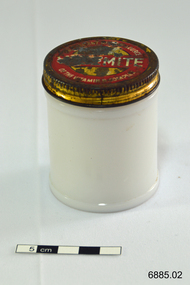 Flagstaff Hill Maritime Museum and Village
Jar, c. 1930's
... In 1939 Dr Angus and his family moved to Warrnambool where he purchased “Birchwood,” the 1852 home and medical practice of Dr John Hunter Henderson, at 214 Koroit Street. (This property was sold in1965 to the State Government and is now the site of the Warrnambool Police Station. ...In 1939 Dr Angus and his family moved to Warrnambool where he purchased “Birchwood,” the 1852 home and medical practice of Dr John Hunter Henderson, at 214 Koroit Street. (This property was sold in1965 to the State Government and is now the site of the Warrnambool Police Station. and an ALDI sore is on the land that was once their tennis court). ...This empty Vegemite jar was donated to Flagstaff Hill Maritime Village by the family of Doctor William Roy Angus, Surgeon and Oculist. It is part of the “W.R. Angus Collection” that includes historical medical equipment, surgical instruments and material once belonging to Dr Edward Ryan and Dr Thomas Francis Ryan, (both of Nhill, Victoria) as well as Dr Angus’ own belongings. The Collection’s history spans the medical practices of the two Doctors Ryan, from 1885-1926 plus that of Dr Angus, up until 1969. ABOUT THE “W.R.ANGUS COLLECTION” Doctor William Roy Angus M.B., B.S., Adel., 1923, F.R.C.S. Edin.,1928 (also known as Dr Roy Angus) was born in Murrumbeena, Victoria in 1901 and lived until 1970. He qualified as a doctor in 1923 at University of Adelaide, was Resident Medical Officer at the Royal Adelaide Hospital in 1924 and for a period was house surgeon to Sir (then Mr.) Henry Simpson Newland. Dr Angus was briefly an Assistant to Dr Riddell of Kapunda, then commenced private practice at Curramulka, Yorke Peninsula, SA, where he was physician, surgeon and chemist. In 1926, he was appointed as new Medical Assistant to Dr Thomas Francis Ryan (T.F. Ryan, or Tom), in Nhill, Victoria, where his experiences included radiology and pharmacy. In 1927 he was Acting House Surgeon in Dr Tom Ryan’s absence. Dr Angus had become engaged to Gladys Forsyth and they decided he further his studies overseas in the UK in 1927. He studied at London University College Hospital and at Edinburgh Royal Infirmary and in 1928, was awarded FRCS (Fellow from the Royal College of Surgeons), Edinburgh. He worked his passage back to Australia as a Ship’s Surgeon on the on the Australian Commonwealth Line’s T.S.S. Largs Bay. Dr Angus married Gladys in 1929, in Ballarat. (They went on to have one son (Graham 1932, born in SA) and two daughters (Helen (died 12/07/1996) and Berenice (Berry), both born at Mira, Nhill ) According to Berry, her mother Gladys made a lot of their clothes. She was very talented and did some lovely embroidery including lingerie for her trousseau and beautifully handmade baby clothes. Dr Angus was a ‘flying doctor’ for the A.I.M. (Australian Inland Ministry) Aerial Medical Service in 1928 . Its first station was in the remote town of Oodnadatta, where Dr Angus was stationed. He was locum tenens there on North-South Railway at 21 Mile Camp. He took up this ‘flying doctor’ position in response to a call from Dr John Flynn; the organisation was later known as the Flying Doctor Service, then the Royal Flying Doctor Service. A lot of his work during this time involved dental surgery also. Between 1928-1932 he was surgeon at the Curramulka Hospital, Yorke Peninsula, South Australia. In 1933 Dr Angus returned to Nhill and purchased a share of the Nelson Street practice and Mira hospital (a 2 bed ward at the Nelson Street Practice) from Dr Les Middleton one of the Middleton Brothers, the current owners of what previously once Dr Tom Ryan’s practice. Dr Tom and his brother had worked as surgeons included eye surgery. Dr Tom Ryan performed many of his operations in the Mira private hospital on his premises. He had been House Surgeon at the Nhill Hospital 1902-1926. Dr Tom Ryan had one of the only two pieces of radiology equipment in Victoria during his practicing years – The Royal Melbourne Hospital had the other one. Over the years Dr Tom Ryan had gradually set up what was effectively a training school for country general-practitioner-surgeons. Each patient was carefully examined, including using the X-ray machine, and any surgery was discussed and planned with Dr Ryan’s assistants several days in advance. Dr Angus gained experience in using the X-ray machine there during his time as assistant to Dr Ryan. When Dr Angus bought into the Nelson Street premises in Nhill he was also appointed as the Nhill Hospital’s Honorary House Surgeon 1933-1938. His practitioner’s plate from his Nhill surgery is now mounted on the doorway to the Port Medical Office at Flagstaff Hill Maritime Village, Warrnambool. When Dr Angus took up practice in the Dr Edward and Dr Tom Ryan’s old premises he obtained their extensive collection of historical medical equipment and materials spanning 1884-1926. A large part of this collection is now on display at the Port Medical Office at Flagstaff Hill Maritime Village in Warrnambool. In 1939 Dr Angus and his family moved to Warrnambool where he purchased “Birchwood,” the 1852 home and medical practice of Dr John Hunter Henderson, at 214 Koroit Street. (This property was sold in1965 to the State Government and is now the site of the Warrnambool Police Station. and an ALDI sore is on the land that was once their tennis court). The Angus family was able to afford gardeners, cooks and maids; their home was a popular place for visiting dignitaries to stay whilst visiting Warrnambool. Dr Angus had his own silk worm farm at home in a Mulberry tree. His young daughter used his centrifuge for spinning the silk. Dr Angus was appointed on a part-time basis as Port Medical Officer (Health Officer) in Warrnambool and held this position until the 1940’s when the government no longer required the service of a Port Medical Officer in Warrnambool; he was thus Warrnambool’s last serving Port Medical Officer. (Masters of immigrant ships arriving in port reported incidents of diseases, illness and death and the Port Medical Officer made a decision on whether the ship required Quarantine and for how long, in this way preventing contagious illness from spreading from new immigrants to the residents already in the colony.) Dr Angus was a member of the Australian Medical Association, for 35 years and surgeon at the Warrnambool Base Hospital 1939-1942, He served as a Surgeon Captain during WWII 1942-45, in Ballarat, Victoria, and in Bonegilla, N.S.W., completing his service just before the end of the war due to suffering from a heart attack. During his convalescence he carved an intricate and ‘most artistic’ chess set from the material that dentures were made from. He then studied ophthalmology at the Royal Melbourne Eye and Ear Hospital and created cosmetically superior artificial eyes by pioneering using the intrascleral cartilage. Angus received accolades from the Ophthalmological Society of Australasia for this work. He returned to Warrnambool to commence practice as an ophthalmologist, pioneering in artificial eye improvements. He was Honorary Consultant Ophthalmologist to Warrnambool Base Hospital for 31 years. He made monthly visits to Portland as a visiting surgeon, to perform eye surgery. He represented the Victorian South-West subdivision of the Australian Medical Association as its secretary between 1949 and 1956 and as chairman from 1956 to 1958. In 1968 Dr Angus was elected member of Spain’s Barraquer Institute of Barcelona after his research work in Intrasclearal cartilage grafting, becoming one of the few Australian ophthalmologists to receive this honour, and in the following year presented his final paper on Living Intrasclearal Cartilage Implants at the Inaugural Meeting of the Australian College of Ophthalmologists in Melbourne In his personal life Dr Angus was a Presbyterian and treated Sunday as a Sabbath, a day of rest. He would visit 3 or 4 country patients on a Sunday, taking his children along ‘for the ride’ and to visit with him. Sunday evenings he would play the pianola and sing Scottish songs to his family. One of Dr Angus’ patients was Margaret MacKenzie, author of a book on local shipwrecks that she’d seen as an eye witness from the late 1880’s in Peterborough, Victoria. In the early 1950’s Dr Angus, painted a picture of a shipwreck for the cover jacket of Margaret’s book, Shipwrecks and More Shipwrecks. She was blind in later life and her daughter wrote the actual book for her. Dr Angus and his wife Gladys were very involved in Warrnambool’s society with a strong interest in civic affairs. He had an interest in people and the community They were both involved in the creation of Flagstaff Hill, including the layout of the gardens. After his death (28th March 1970) his family requested his practitioner’s plate, medical instruments and some personal belongings be displayed in the Port Medical Office surgery at Flagstaff Hill Maritime Village, and be called the “W. R. Angus Collection”. The W.R. Angus Collection is significant for still being located at the site it is connected with, Doctor Angus being the last Port Medical Officer in Warrnambool. The collection of medical instruments and other equipment is culturally significant, being an historical example of medicine, administration, household equipment and clothing from late 19th to mid-20th century. Dr Angus assisted Dr Tom Ryan, a pioneer in the use of X-rays and in ocular surgery. Vegemite jar, empty. White glass base with metal lid. Part of the W.R. Angus Collection. Jar is dated c.1930’s. Lid has remnants of words "Vegemite - source of vitamin B comples". Base has logo of Vegemite and numeric code stamped into glass.Lid has remnants of words “VEGEMITE - - - source of vitamin B comples". Base stamped into glass "[logo] / VEGEMITE / v 906 / 19” flagstaff hill, warrnambool, shipwrecked coast, flagstaff hill maritime museum, maritime museum, shipwreck coast, flagstaff hill maritime village, great ocean road, dr w r angus, warrnambool base hospital, nhill base hospital, mira hospital, flying doctor, vegemite jar, australian food manufacturer, fred walker company -
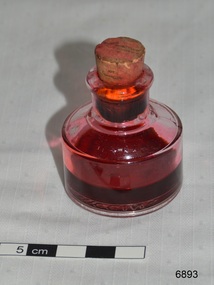 Flagstaff Hill Maritime Museum and Village
Container - Ink Bottle, Early to mid 20th century
... In 1939 Dr Angus and his family moved to Warrnambool where he purchased “Birchwood,” the 1852 home and medical practice of Dr John Hunter Henderson, at 214 Koroit Street. (This property was sold in1965 to the State Government and is now the site of the Warrnambool Police Station. ...In 1939 Dr Angus and his family moved to Warrnambool where he purchased “Birchwood,” the 1852 home and medical practice of Dr John Hunter Henderson, at 214 Koroit Street. (This property was sold in1965 to the State Government and is now the site of the Warrnambool Police Station. and an ALDI sore is on the land that was once their tennis court). ...This ink bottle was donated to Flagstaff Hill Maritime Village by the family of Doctor William Roy Angus, Surgeon and Oculist. It is part of the “W.R. Angus Collection” includes historical medical equipment, surgical instruments and material once belonging to Dr Edward Ryan and Dr Thomas Francis Ryan, (both of Nhill, Victoria) as well as Dr Angus’ own belongings. The Collection’s history spans the medical practices of the two Doctors Ryan, from 1885-1926 plus that of Dr Angus, up until 1969. ABOUT THE “W.R.ANGUS COLLECTION” Doctor William Roy Angus M.B., B.S., Adel., 1923, F.R.C.S. Edin.,1928 (also known as Dr Roy Angus) was born in Murrumbeena, Victoria in 1901 and lived until 1970. He qualified as a doctor in 1923 at University of Adelaide, was Resident Medical Officer at the Royal Adelaide Hospital in 1924 and for a period was house surgeon to Sir (then Mr.) Henry Simpson Newland. Dr Angus was briefly an Assistant to Dr Riddell of Kapunda, then commenced private practice at Curramulka, Yorke Peninsula, SA, where he was physician, surgeon and chemist. In 1926, he was appointed as new Medical Assistant to Dr Thomas Francis Ryan (T.F. Ryan, or Tom), in Nhill, Victoria, where his experiences included radiology and pharmacy. In 1927 he was Acting House Surgeon in Dr Tom Ryan’s absence. Dr Angus had become engaged to Gladys Forsyth and they decided he further his studies overseas in the UK in 1927. He studied at London University College Hospital and at Edinburgh Royal Infirmary and in 1928, was awarded FRCS (Fellow from the Royal College of Surgeons), Edinburgh. He worked his passage back to Australia as a Ship’s Surgeon on the on the Australian Commonwealth Line’s T.S.S. Largs Bay. Dr Angus married Gladys in 1929, in Ballarat. (They went on to have one son (Graham 1932, born in SA) and two daughters (Helen (died 12/07/1996) and Berenice (Berry), both born at Mira, Nhill ) According to Berry, her mother Gladys made a lot of their clothes. She was very talented and did some lovely embroidery including lingerie for her trousseau and beautifully handmade baby clothes. Dr Angus was a ‘flying doctor’ for the A.I.M. (Australian Inland Ministry) Aerial Medical Service in 1928 . Its first station was in the remote town of Oodnadatta, where Dr Angus was stationed. He was locum tenens there on North-South Railway at 21 Mile Camp. He took up this ‘flying doctor’ position in response to a call from Dr John Flynn; the organisation was later known as the Flying Doctor Service, then the Royal Flying Doctor Service. A lot of his work during this time involved dental surgery also. Between 1928-1932 he was surgeon at the Curramulka Hospital, Yorke Peninsula, South Australia. In 1933 Dr Angus returned to Nhill and purchased a share of the Nelson Street practice and Mira hospital (a 2 bed ward at the Nelson Street Practice) from Dr Les Middleton one of the Middleton Brothers, the current owners of what previously once Dr Tom Ryan’s practice. Dr Tom and his brother had worked as surgeons included eye surgery. Dr Tom Ryan performed many of his operations in the Mira private hospital on his premises. He had been House Surgeon at the Nhill Hospital 1902-1926. Dr Tom Ryan had one of the only two pieces of radiology equipment in Victoria during his practicing years – The Royal Melbourne Hospital had the other one. Over the years Dr Tom Ryan had gradually set up what was effectively a training school for country general-practitioner-surgeons. Each patient was carefully examined, including using the X-ray machine, and any surgery was discussed and planned with Dr Ryan’s assistants several days in advance. Dr Angus gained experience in using the X-ray machine there during his time as assistant to Dr Ryan. When Dr Angus bought into the Nelson Street premises in Nhill he was also appointed as the Nhill Hospital’s Honorary House Surgeon 1933-1938. His practitioner’s plate from his Nhill surgery is now mounted on the doorway to the Port Medical Office at Flagstaff Hill Maritime Village, Warrnambool. When Dr Angus took up practice in the Dr Edward and Dr Tom Ryan’s old premises he obtained their extensive collection of historical medical equipment and materials spanning 1884-1926. A large part of this collection is now on display at the Port Medical Office at Flagstaff Hill Maritime Village in Warrnambool. In 1939 Dr Angus and his family moved to Warrnambool where he purchased “Birchwood,” the 1852 home and medical practice of Dr John Hunter Henderson, at 214 Koroit Street. (This property was sold in1965 to the State Government and is now the site of the Warrnambool Police Station. and an ALDI sore is on the land that was once their tennis court). The Angus family was able to afford gardeners, cooks and maids; their home was a popular place for visiting dignitaries to stay whilst visiting Warrnambool. Dr Angus had his own silk worm farm at home in a Mulberry tree. His young daughter used his centrifuge for spinning the silk. Dr Angus was appointed on a part-time basis as Port Medical Officer (Health Officer) in Warrnambool and held this position until the 1940’s when the government no longer required the service of a Port Medical Officer in Warrnambool; he was thus Warrnambool’s last serving Port Medical Officer. (Masters of immigrant ships arriving in port reported incidents of diseases, illness and death and the Port Medical Officer made a decision on whether the ship required Quarantine and for how long, in this way preventing contagious illness from spreading from new immigrants to the residents already in the colony.) Dr Angus was a member of the Australian Medical Association, for 35 years and surgeon at the Warrnambool Base Hospital 1939-1942, He served with the Australian Department of Defence as a Surgeon Captain during WWII 1942-45, in Ballarat, Victoria, and in Bonegilla, N.S.W., completing his service just before the end of the war due to suffering from a heart attack. During his convalescence he carved an intricate and ‘most artistic’ chess set from the material that dentures were made from. He then studied ophthalmology at the Royal Melbourne Eye and Ear Hospital and created cosmetically superior artificial eyes by pioneering using the intrascleral cartilage. Angus received accolades from the Ophthalmological Society of Australasia for this work. He returned to Warrnambool to commence practice as an ophthalmologist, pioneering in artificial eye improvements. He was Honorary Consultant Ophthalmologist to Warrnambool Base Hospital for 31 years. He made monthly visits to Portland as a visiting surgeon, to perform eye surgery. He represented the Victorian South-West subdivision of the Australian Medical Association as its secretary between 1949 and 1956 and as chairman from 1956 to 1958. In 1968 Dr Angus was elected member of Spain’s Barraquer Institute of Barcelona after his research work in Intrasclearal cartilage grafting, becoming one of the few Australian ophthalmologists to receive this honour, and in the following year presented his final paper on Living Intrasclearal Cartilage Implants at the Inaugural Meeting of the Australian College of Ophthalmologists in Melbourne In his personal life Dr Angus was a Presbyterian and treated Sunday as a Sabbath, a day of rest. He would visit 3 or 4 country patients on a Sunday, taking his children along ‘for the ride’ and to visit with him. Sunday evenings he would play the pianola and sing Scottish songs to his family. One of Dr Angus’ patients was Margaret MacKenzie, author of a book on local shipwrecks that she’d seen as an eye witness from the late 1880’s in Peterborough, Victoria. In the early 1950’s Dr Angus, painted a picture of a shipwreck for the cover jacket of Margaret’s book, Shipwrecks and More Shipwrecks. She was blind in later life and her daughter wrote the actual book for her. Dr Angus and his wife Gladys were very involved in Warrnambool’s society with a strong interest in civic affairs. He had an interest in people and the community They were both involved in the creation of Flagstaff Hill, including the layout of the gardens. After his death (28th March 1970) his family requested his practitioner’s plate, medical instruments and some personal belongings be displayed in the Port Medical Office surgery at Flagstaff Hill Maritime Village, and be called the “W. R. Angus Collection”. The company was founded by Charles Michael Higgins (born Ireland) in New York in partnership with his brother-in-law John Gianella Snr. in 1885. It began as just Charles M Higgins in 1880. It produced a range of popular inks including India, indelible, and laundry ink, later expanding into adhesive manufacture; originally based in Brooklyn the company expanded with offices in New York, Chicago and London (106 Charing Cross Road) selling products world wide; Charles Higgins died 1929 and was succeeded by his son Tracy. It became an incorporated company in 1930. The W.R. Angus Collection is significant for still being located at the site it is connected with, Doctor Angus being the last Port Medical Officer in Warrnambool. The collection of medical instruments and other equipment is culturally significant, being an historical example of medicine from late 19th to mid-20th century. Dr Angus assisted Dr Tom Ryan, a pioneer in the use of X-rays and in ocular surgery. Clear glass ink bottle with cork stopper, containing small quantity of red ink.Part of the W.R. Angus Collection. Made by Higgins of Brooklyn, New York. Impressed into base "HIGGINS BROOKLYN N.Y. INKS" flagstaff hill, warrnambool, shipwrecked coast, flagstaff hill maritime museum, maritime museum, shipwreck coast, flagstaff hill maritime village, great ocean road, dr w r angus, dr ryan, surgical instrument, t.s.s. largs bay, warrnambool base hospital, nhill base hospital, mira hospital, flying doctor, ink bottle, ink bottle containing red ink, higgins & co brooklyn n.y., stationery, writing equipment, pen and ink -
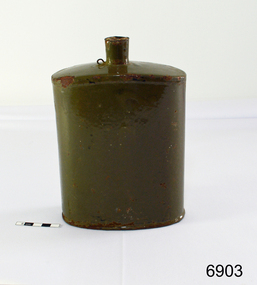 Flagstaff Hill Maritime Museum and Village
Water Canteen, mid 20th century
... In 1939 Dr Angus and his family moved to Warrnambool where he purchased “Birchwood,” the 1852 home and medical practice of Dr John Hunter Henderson, at 214 Koroit Street. (This property was sold in1965 to the State Government and is now the site of the Warrnambool Police Station. ...In 1939 Dr Angus and his family moved to Warrnambool where he purchased “Birchwood,” the 1852 home and medical practice of Dr John Hunter Henderson, at 214 Koroit Street. (This property was sold in1965 to the State Government and is now the site of the Warrnambool Police Station. and an ALDI sore is on the land that was once their tennis court). ...This water canteen was donated to Flagstaff Hill Maritime Village by the family of Doctor William Roy Angus, Surgeon and Oculist. It is part of the “W.R. Angus Collection” includes historical medical equipment, surgical instruments and material once belonging to Dr Edward Ryan and Dr Thomas Francis Ryan, (both of Nhill, Victoria) as well as Dr Angus’ own belongings. The Collection’s history spans the medical practices of the two Doctors Ryan, from 1885-1926 plus that of Dr Angus, up until 1969. ABOUT THE “W.R.ANGUS COLLECTION” Doctor William Roy Angus M.B., B.S., Adel., 1923, F.R.C.S. Edin.,1928 (also known as Dr Roy Angus) was born in Murrumbeena, Victoria in 1901 and lived until 1970. He qualified as a doctor in 1923 at University of Adelaide, was Resident Medical Officer at the Royal Adelaide Hospital in 1924 and for a period was house surgeon to Sir (then Mr.) Henry Simpson Newland. Dr Angus was briefly an Assistant to Dr Riddell of Kapunda, then commenced private practice at Curramulka, Yorke Peninsula, SA, where he was physician, surgeon and chemist. In 1926, he was appointed as new Medical Assistant to Dr Thomas Francis Ryan (T.F. Ryan, or Tom), in Nhill, Victoria, where his experiences included radiology and pharmacy. In 1927 he was Acting House Surgeon in Dr Tom Ryan’s absence. Dr Angus had become engaged to Gladys Forsyth and they decided he further his studies overseas in the UK in 1927. He studied at London University College Hospital and at Edinburgh Royal Infirmary and in 1928, was awarded FRCS (Fellow from the Royal College of Surgeons), Edinburgh. He worked his passage back to Australia as a Ship’s Surgeon on the on the Australian Commonwealth Line’s T.S.S. Largs Bay. Dr Angus married Gladys in 1929, in Ballarat. (They went on to have one son (Graham 1932, born in SA) and two daughters (Helen (died 12/07/1996) and Berenice (Berry), both born at Mira, Nhill ) According to Berry, her mother Gladys made a lot of their clothes. She was very talented and did some lovely embroidery including lingerie for her trousseau and beautifully handmade baby clothes. Dr Angus was a ‘flying doctor’ for the A.I.M. (Australian Inland Ministry) Aerial Medical Service in 1928 . Its first station was in the remote town of Oodnadatta, where Dr Angus was stationed. He was locum tenens there on North-South Railway at 21 Mile Camp. He took up this ‘flying doctor’ position in response to a call from Dr John Flynn; the organisation was later known as the Flying Doctor Service, then the Royal Flying Doctor Service. A lot of his work during this time involved dental surgery also. Between 1928-1932 he was surgeon at the Curramulka Hospital, Yorke Peninsula, South Australia. In 1933 Dr Angus returned to Nhill and purchased a share of the Nelson Street practice and Mira hospital (a 2 bed ward at the Nelson Street Practice) from Dr Les Middleton one of the Middleton Brothers, the current owners of what previously once Dr Tom Ryan’s practice. Dr Tom and his brother had worked as surgeons included eye surgery. Dr Tom Ryan performed many of his operations in the Mira private hospital on his premises. He had been House Surgeon at the Nhill Hospital 1902-1926. Dr Tom Ryan had one of the only two pieces of radiology equipment in Victoria during his practicing years – The Royal Melbourne Hospital had the other one. Over the years Dr Tom Ryan had gradually set up what was effectively a training school for country general-practitioner-surgeons. Each patient was carefully examined, including using the X-ray machine, and any surgery was discussed and planned with Dr Ryan’s assistants several days in advance. Dr Angus gained experience in using the X-ray machine there during his time as assistant to Dr Ryan. When Dr Angus bought into the Nelson Street premises in Nhill he was also appointed as the Nhill Hospital’s Honorary House Surgeon 1933-1938. His practitioner’s plate from his Nhill surgery is now mounted on the doorway to the Port Medical Office at Flagstaff Hill Maritime Village, Warrnambool. When Dr Angus took up practice in the Dr Edward and Dr Tom Ryan’s old premises he obtained their extensive collection of historical medical equipment and materials spanning 1884-1926. A large part of this collection is now on display at the Port Medical Office at Flagstaff Hill Maritime Village in Warrnambool. In 1939 Dr Angus and his family moved to Warrnambool where he purchased “Birchwood,” the 1852 home and medical practice of Dr John Hunter Henderson, at 214 Koroit Street. (This property was sold in1965 to the State Government and is now the site of the Warrnambool Police Station. and an ALDI sore is on the land that was once their tennis court). The Angus family was able to afford gardeners, cooks and maids; their home was a popular place for visiting dignitaries to stay whilst visiting Warrnambool. Dr Angus had his own silk worm farm at home in a Mulberry tree. His young daughter used his centrifuge for spinning the silk. Dr Angus was appointed on a part-time basis as Port Medical Officer (Health Officer) in Warrnambool and held this position until the 1940’s when the government no longer required the service of a Port Medical Officer in Warrnambool; he was thus Warrnambool’s last serving Port Medical Officer. (Masters of immigrant ships arriving in port reported incidents of diseases, illness and death and the Port Medical Officer made a decision on whether the ship required Quarantine and for how long, in this way preventing contagious illness from spreading from new immigrants to the residents already in the colony.) Dr Angus was a member of the Australian Medical Association, for 35 years and surgeon at the Warrnambool Base Hospital 1939-1942, He served as a Surgeon Captain during WWII1942-45, in Ballarat, Victoria, and in Bonegilla, N.S.W., completing his service just before the end of the war due to suffering from a heart attack. During his convalescence he carved an intricate and ‘most artistic’ chess set from the material that dentures were made from. He then studied ophthalmology at the Royal Melbourne Eye and Ear Hospital and created cosmetically superior artificial eyes by pioneering using the intrascleral cartilage. Angus received accolades from the Ophthalmological Society of Australasia for this work. He returned to Warrnambool to commence practice as an ophthalmologist, pioneering in artificial eye improvements. He was Honorary Consultant Ophthalmologist to Warrnambool Base Hospital for 31 years. He made monthly visits to Portland as a visiting surgeon, to perform eye surgery. He represented the Victorian South-West subdivision of the Australian Medical Association as its secretary between 1949 and 1956 and as chairman from 1956 to 1958. In 1968 Dr Angus was elected member of Spain’s Barraquer Institute of Barcelona after his research work in Intrasclearal cartilage grafting, becoming one of the few Australian ophthalmologists to receive this honour, and in the following year presented his final paper on Living Intrasclearal Cartilage Implants at the Inaugural Meeting of the Australian College of Ophthalmologists in Melbourne In his personal life Dr Angus was a Presbyterian and treated Sunday as a Sabbath, a day of rest. He would visit 3 or 4 country patients on a Sunday, taking his children along ‘for the ride’ and to visit with him. Sunday evenings he would play the pianola and sing Scottish songs to his family. One of Dr Angus’ patients was Margaret MacKenzie, author of a book on local shipwrecks that she’d seen as an eye witness from the late 1880’s in Peterborough, Victoria. In the early 1950’s Dr Angus, painted a picture of a shipwreck for the cover jacket of Margaret’s book, Shipwrecks and More Shipwrecks. She was blind in later life and her daughter wrote the actual book for her. Dr Angus and his wife Gladys were very involved in Warrnambool’s society with a strong interest in civic affairs. He had an interest in people and the community They were both involved in the creation of Flagstaff Hill, including the layout of the gardens. After his death (28th March 1970) his family requested his practitioner’s plate, medical instruments and some personal belongings be displayed in the Port Medical Office surgery at Flagstaff Hill Maritime Village, and be called the “W. R. Angus Collection”. The W.R. Angus Collection is significant for still being located at the site it is connected with, Doctor Angus being the last Port Medical Officer in Warrnambool. The collection of medical instruments and other equipment is culturally significant, being an historical example of medicine from late 19th to mid-20th century. Dr Angus assisted Dr Tom Ryan, a pioneer in the use of X-rays and in ocular surgery. Water canteen, Part of the W.R.Angus Collection. Metal, painted khaki, cork stuck in opening, back is slightly concave shape. Loop next to opening for attaching lid. flagstaff hill, warrnambool, shipwrecked coast, flagstaff hill maritime museum, maritime museum, shipwreck coast, flagstaff hill maritime village, great ocean road, dr w r angus, dr ryan, surgical instrument, t.s.s. largs bay, warrnambool base hospital, nhill base hospital, mira hospital, flying doctor, water canteen, drinking bottle -
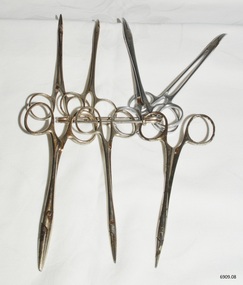 Flagstaff Hill Maritime Museum and Village
Surgical Instrument, early 20th century
... In 1939 Dr Angus and his family moved to Warrnambool where he purchased “Birchwood,” the 1852 home and medical practice of Dr John Hunter Henderson, at 214 Koroit Street. (This property was sold in1965 to the State Government and is now the site of the Warrnambool Police Station. ...In 1939 Dr Angus and his family moved to Warrnambool where he purchased “Birchwood,” the 1852 home and medical practice of Dr John Hunter Henderson, at 214 Koroit Street. (This property was sold in1965 to the State Government and is now the site of the Warrnambool Police Station. and an ALDI sore is on the land that was once their tennis court). ...This set of clamps was donated to Flagstaff Hill Maritime Village by the family of Doctor William Roy Angus, Surgeon and Oculist. It is part of the “W.R. Angus Collection” that includes historical medical equipment, surgical instruments and material once belonging to Dr Edward Ryan and Dr Thomas Francis Ryan, (both of Nhill, Victoria) as well as Dr Angus’ own belongings. The Collection’s history spans the medical practices of the two Doctors Ryan, from 1885-1926 plus that of Dr Angus, up until 1969. ABOUT THE “W.R.ANGUS COLLECTION” Doctor William Roy Angus M.B., B.S., Adel., 1923, F.R.C.S. Edin.,1928 (also known as Dr Roy Angus) was born in Murrumbeena, Victoria in 1901 and lived until 1970. He qualified as a doctor in 1923 at University of Adelaide, was Resident Medical Officer at the Royal Adelaide Hospital in 1924 and for a period was house surgeon to Sir (then Mr.) Henry Simpson Newland. Dr Angus was briefly an Assistant to Dr Riddell of Kapunda, then commenced private practice at Curramulka, Yorke Peninsula, SA, where he was physician, surgeon and chemist. In 1926, he was appointed as new Medical Assistant to Dr Thomas Francis Ryan (T.F. Ryan, or Tom), in Nhill, Victoria, where his experiences included radiology and pharmacy. In 1927 he was Acting House Surgeon in Dr Tom Ryan’s absence. Dr Angus had become engaged to Gladys Forsyth and they decided he further his studies overseas in the UK in 1927. He studied at London University College Hospital and at Edinburgh Royal Infirmary and in 1928, was awarded FRCS (Fellow from the Royal College of Surgeons), Edinburgh. He worked his passage back to Australia as a Ship’s Surgeon on the on the Australian Commonwealth Line’s T.S.S. Largs Bay. Dr Angus married Gladys in 1929, in Ballarat. (They went on to have one son (Graham 1932, born in SA) and two daughters (Helen (died 12/07/1996) and Berenice (Berry), both born at Mira, Nhill ) According to Berry, her mother Gladys made a lot of their clothes. She was very talented and did some lovely embroidery including lingerie for her trousseau and beautifully handmade baby clothes. Dr Angus was a ‘flying doctor’ for the A.I.M. (Australian Inland Ministry) Aerial Medical Service in 1928 . Its first station was in the remote town of Oodnadatta, where Dr Angus was stationed. He was locum tenens there on North-South Railway at 21 Mile Camp. He took up this ‘flying doctor’ position in response to a call from Dr John Flynn; the organisation was later known as the Flying Doctor Service, then the Royal Flying Doctor Service. A lot of his work during this time involved dental surgery also. Between 1928-1932 he was surgeon at the Curramulka Hospital, Yorke Peninsula, South Australia. In 1933 Dr Angus returned to Nhill and purchased a share of the Nelson Street practice and Mira hospital (a 2 bed ward at the Nelson Street Practice) from Dr Les Middleton one of the Middleton Brothers, the current owners of what previously once Dr Tom Ryan’s practice. Dr Tom and his brother had worked as surgeons included eye surgery. Dr Tom Ryan performed many of his operations in the Mira private hospital on his premises. He had been House Surgeon at the Nhill Hospital 1902-1926. Dr Tom Ryan had one of the only two pieces of radiology equipment in Victoria during his practicing years – The Royal Melbourne Hospital had the other one. Over the years Dr Tom Ryan had gradually set up what was effectively a training school for country general-practitioner-surgeons. Each patient was carefully examined, including using the X-ray machine, and any surgery was discussed and planned with Dr Ryan’s assistants several days in advance. Dr Angus gained experience in using the X-ray machine there during his time as assistant to Dr Ryan. When Dr Angus bought into the Nelson Street premises in Nhill he was also appointed as the Nhill Hospital’s Honorary House Surgeon 1933-1938. His practitioner’s plate from his Nhill surgery is now mounted on the doorway to the Port Medical Office at Flagstaff Hill Maritime Village, Warrnambool. When Dr Angus took up practice in the Dr Edward and Dr Tom Ryan’s old premises he obtained their extensive collection of historical medical equipment and materials spanning 1884-1926. A large part of this collection is now on display at the Port Medical Office at Flagstaff Hill Maritime Village in Warrnambool. In 1939 Dr Angus and his family moved to Warrnambool where he purchased “Birchwood,” the 1852 home and medical practice of Dr John Hunter Henderson, at 214 Koroit Street. (This property was sold in1965 to the State Government and is now the site of the Warrnambool Police Station. and an ALDI sore is on the land that was once their tennis court). The Angus family was able to afford gardeners, cooks and maids; their home was a popular place for visiting dignitaries to stay whilst visiting Warrnambool. Dr Angus had his own silk worm farm at home in a Mulberry tree. His young daughter used his centrifuge for spinning the silk. Dr Angus was appointed on a part-time basis as Port Medical Officer (Health Officer) in Warrnambool and held this position until the 1940’s when the government no longer required the service of a Port Medical Officer in Warrnambool; he was thus Warrnambool’s last serving Port Medical Officer. (Masters of immigrant ships arriving in port reported incidents of diseases, illness and death and the Port Medical Officer made a decision on whether the ship required Quarantine and for how long, in this way preventing contagious illness from spreading from new immigrants to the residents already in the colony.) Dr Angus was a member of the Australian Medical Association, for 35 years and surgeon at the Warrnambool Base Hospital 1939-1942, He served with the Australian Department of Defence as a Surgeon Captain during WWII 1942-45, in Ballarat, Victoria, and in Bonegilla, N.S.W., completing his service just before the end of the war due to suffering from a heart attack. During his convalescence he carved an intricate and ‘most artistic’ chess set from the material that dentures were made from. He then studied ophthalmology at the Royal Melbourne Eye and Ear Hospital and created cosmetically superior artificial eyes by pioneering using the intrascleral cartilage. Angus received accolades from the Ophthalmological Society of Australasia for this work. He returned to Warrnambool to commence practice as an ophthalmologist, pioneering in artificial eye improvements. He was Honorary Consultant Ophthalmologist to Warrnambool Base Hospital for 31 years. He made monthly visits to Portland as a visiting surgeon, to perform eye surgery. He represented the Victorian South-West subdivision of the Australian Medical Association as its secretary between 1949 and 1956 and as chairman from 1956 to 1958. In 1968 Dr Angus was elected member of Spain’s Barraquer Institute of Barcelona after his research work in Intrasclearal cartilage grafting, becoming one of the few Australian ophthalmologists to receive this honour, and in the following year presented his final paper on Living Intrasclearal Cartilage Implants at the Inaugural Meeting of the Australian College of Ophthalmologists in Melbourne In his personal life Dr Angus was a Presbyterian and treated Sunday as a Sabbath, a day of rest. He would visit 3 or 4 country patients on a Sunday, taking his children along ‘for the ride’ and to visit with him. Sunday evenings he would play the pianola and sing Scottish songs to his family. One of Dr Angus’ patients was Margaret MacKenzie, author of a book on local shipwrecks that she’d seen as an eye witness from the late 1880’s in Peterborough, Victoria. In the early 1950’s Dr Angus, painted a picture of a shipwreck for the cover jacket of Margaret’s book, Shipwrecks and More Shipwrecks. She was blind in later life and her daughter wrote the actual book for her. Dr Angus and his wife Gladys were very involved in Warrnambool’s society with a strong interest in civic affairs. He had an interest in people and the community They were both involved in the creation of Flagstaff Hill, including the layout of the gardens. After his death (28th March 1970) his family requested his practitioner’s plate, medical instruments and some personal belongings be displayed in the Port Medical Office surgery at Flagstaff Hill Maritime Village, and be called the “W. R. Angus Collection”. The W.R. Angus Collection is significant for still being located at the site it is connected with, Doctor Angus being the last Port Medical Officer in Warrnambool. The collection of medical instruments and other equipment is culturally significant, being an historical example of medicine, administration, household equipment and clothing from late 19th to mid-20th century. Dr Angus assisted Dr Tom Ryan, a pioneer in the use of X-rays and in ocular surgery. Surgical instrument, set of 7 clamps, part of the W.R. Angus Collection. Stainless steel clamps, points have various shapes, 4 with straight ends, 3 with curved ends, all stored on a steel pin.flagstaff hill, warrnambool, shipwrecked coast, flagstaff hill maritime museum, maritime museum, shipwreck coast, flagstaff hill maritime village, great ocean road, dr w r angus, dr ryan, surgical instrument, t.s.s. largs bay, warrnambool base hospital, nhill base hospital, mira hospital, flying doctor, medical treatment, surgical instruments, surgical clamps, operation equipment -
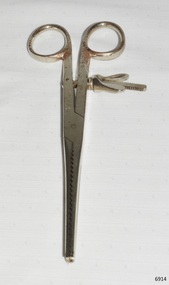 Flagstaff Hill Maritime Museum and Village
Equipment - Surgical Instrument, early 20th century
... In 1939 Dr Angus and his family moved to Warrnambool where he purchased “Birchwood,” the 1852 home and medical practice of Dr John Hunter Henderson, at 214 Koroit Street. (This property was sold in1965 to the State Government and is now the site of the Warrnambool Police Station. ...In 1939 Dr Angus and his family moved to Warrnambool where he purchased “Birchwood,” the 1852 home and medical practice of Dr John Hunter Henderson, at 214 Koroit Street. (This property was sold in1965 to the State Government and is now the site of the Warrnambool Police Station. and an ALDI sore is on the land that was once their tennis court). ...This stomach clamp was donated to Flagstaff Hill Maritime Village by the family of Doctor William Roy Angus, Surgeon and Oculist. It is part of the “W.R. Angus Collection” that includes historical medical equipment, surgical instruments and material once belonging to Dr Edward Ryan and Dr Thomas Francis Ryan, (both of Nhill, Victoria) as well as Dr Angus’ own belongings. The Collection’s history spans the medical practices of the two Doctors Ryan, from 1885-1926 plus that of Dr Angus, up until 1969. ABOUT THE “W.R.ANGUS COLLECTION” Doctor William Roy Angus M.B., B.S., Adel., 1923, F.R.C.S. Edin.,1928 (also known as Dr Roy Angus) was born in Murrumbeena, Victoria in 1901 and lived until 1970. He qualified as a doctor in 1923 at University of Adelaide, was Resident Medical Officer at the Royal Adelaide Hospital in 1924 and for a period was house surgeon to Sir (then Mr.) Henry Simpson Newland. Dr Angus was briefly an Assistant to Dr Riddell of Kapunda, then commenced private practice at Curramulka, Yorke Peninsula, SA, where he was physician, surgeon and chemist. In 1926, he was appointed as new Medical Assistant to Dr Thomas Francis Ryan (T.F. Ryan, or Tom), in Nhill, Victoria, where his experiences included radiology and pharmacy. In 1927 he was Acting House Surgeon in Dr Tom Ryan’s absence. Dr Angus had become engaged to Gladys Forsyth and they decided he further his studies overseas in the UK in 1927. He studied at London University College Hospital and at Edinburgh Royal Infirmary and in 1928, was awarded FRCS (Fellow from the Royal College of Surgeons), Edinburgh. He worked his passage back to Australia as a Ship’s Surgeon on the on the Australian Commonwealth Line’s T.S.S. Largs Bay. Dr Angus married Gladys in 1929, in Ballarat. (They went on to have one son (Graham 1932, born in SA) and two daughters (Helen (died 12/07/1996) and Berenice (Berry), both born at Mira, Nhill ) According to Berry, her mother Gladys made a lot of their clothes. She was very talented and did some lovely embroidery including lingerie for her trousseau and beautifully handmade baby clothes. Dr Angus was a ‘flying doctor’ for the A.I.M. (Australian Inland Ministry) Aerial Medical Service in 1928 . Its first station was in the remote town of Oodnadatta, where Dr Angus was stationed. He was locum tenens there on North-South Railway at 21 Mile Camp. He took up this ‘flying doctor’ position in response to a call from Dr John Flynn; the organisation was later known as the Flying Doctor Service, then the Royal Flying Doctor Service. A lot of his work during this time involved dental surgery also. Between 1928-1932 he was surgeon at the Curramulka Hospital, Yorke Peninsula, South Australia. In 1933 Dr Angus returned to Nhill and purchased a share of the Nelson Street practice and Mira hospital (a 2 bed ward at the Nelson Street Practice) from Dr Les Middleton one of the Middleton Brothers, the current owners of what previously once Dr Tom Ryan’s practice. Dr Tom and his brother had worked as surgeons included eye surgery. Dr Tom Ryan performed many of his operations in the Mira private hospital on his premises. He had been House Surgeon at the Nhill Hospital 1902-1926. Dr Tom Ryan had one of the only two pieces of radiology equipment in Victoria during his practicing years – The Royal Melbourne Hospital had the other one. Over the years Dr Tom Ryan had gradually set up what was effectively a training school for country general-practitioner-surgeons. Each patient was carefully examined, including using the X-ray machine, and any surgery was discussed and planned with Dr Ryan’s assistants several days in advance. Dr Angus gained experience in using the X-ray machine there during his time as assistant to Dr Ryan. When Dr Angus bought into the Nelson Street premises in Nhill he was also appointed as the Nhill Hospital’s Honorary House Surgeon 1933-1938. His practitioner’s plate from his Nhill surgery is now mounted on the doorway to the Port Medical Office at Flagstaff Hill Maritime Village, Warrnambool. When Dr Angus took up practice in the Dr Edward and Dr Tom Ryan’s old premises he obtained their extensive collection of historical medical equipment and materials spanning 1884-1926. A large part of this collection is now on display at the Port Medical Office at Flagstaff Hill Maritime Village in Warrnambool. In 1939 Dr Angus and his family moved to Warrnambool where he purchased “Birchwood,” the 1852 home and medical practice of Dr John Hunter Henderson, at 214 Koroit Street. (This property was sold in1965 to the State Government and is now the site of the Warrnambool Police Station. and an ALDI sore is on the land that was once their tennis court). The Angus family was able to afford gardeners, cooks and maids; their home was a popular place for visiting dignitaries to stay whilst visiting Warrnambool. Dr Angus had his own silk worm farm at home in a Mulberry tree. His young daughter used his centrifuge for spinning the silk. Dr Angus was appointed on a part-time basis as Port Medical Officer (Health Officer) in Warrnambool and held this position until the 1940’s when the government no longer required the service of a Port Medical Officer in Warrnambool; he was thus Warrnambool’s last serving Port Medical Officer. (Masters of immigrant ships arriving in port reported incidents of diseases, illness and death and the Port Medical Officer made a decision on whether the ship required Quarantine and for how long, in this way preventing contagious illness from spreading from new immigrants to the residents already in the colony.) Dr Angus was a member of the Australian Medical Association, for 35 years and surgeon at the Warrnambool Base Hospital 1939-1942, He served with the Australian Department of Defence as a Surgeon Captain during WWII 1942-45, in Ballarat, Victoria, and in Bonegilla, N.S.W., completing his service just before the end of the war due to suffering from a heart attack. During his convalescence he carved an intricate and ‘most artistic’ chess set from the material that dentures were made from. He then studied ophthalmology at the Royal Melbourne Eye and Ear Hospital and created cosmetically superior artificial eyes by pioneering using the intrascleral cartilage. Angus received accolades from the Ophthalmological Society of Australasia for this work. He returned to Warrnambool to commence practice as an ophthalmologist, pioneering in artificial eye improvements. He was Honorary Consultant Ophthalmologist to Warrnambool Base Hospital for 31 years. He made monthly visits to Portland as a visiting surgeon, to perform eye surgery. He represented the Victorian South-West subdivision of the Australian Medical Association as its secretary between 1949 and 1956 and as chairman from 1956 to 1958. In 1968 Dr Angus was elected member of Spain’s Barraquer Institute of Barcelona after his research work in Intrasclearal cartilage grafting, becoming one of the few Australian ophthalmologists to receive this honour, and in the following year presented his final paper on Living Intrasclearal Cartilage Implants at the Inaugural Meeting of the Australian College of Ophthalmologists in Melbourne In his personal life Dr Angus was a Presbyterian and treated Sunday as a Sabbath, a day of rest. He would visit 3 or 4 country patients on a Sunday, taking his children along ‘for the ride’ and to visit with him. Sunday evenings he would play the pianola and sing Scottish songs to his family. One of Dr Angus’ patients was Margaret MacKenzie, author of a book on local shipwrecks that she’d seen as an eye witness from the late 1880’s in Peterborough, Victoria. In the early 1950’s Dr Angus, painted a picture of a shipwreck for the cover jacket of Margaret’s book, Shipwrecks and More Shipwrecks. She was blind in later life and her daughter wrote the actual book for her. Dr Angus and his wife Gladys were very involved in Warrnambool’s society with a strong interest in civic affairs. He had an interest in people and the community They were both involved in the creation of Flagstaff Hill, including the layout of the gardens. After his death (28th March 1970) his family requested his practitioner’s plate, medical instruments and some personal belongings be displayed in the Port Medical Office surgery at Flagstaff Hill Maritime Village, and be called the “W. R. Angus Collection”. The W.R. Angus Collection is significant for still being located at the site it is connected with, Doctor Angus being the last Port Medical Officer in Warrnambool. The collection of medical instruments and other equipment is culturally significant, being an historical example of medicine, administration, household equipment and clothing from late 19th to mid-20th century. Dr Angus assisted Dr Tom Ryan, a pioneer in the use of X-rays and in ocular surgery. Surgical instrument, stomach clamp with screw clamp and pointed teeth along jaws, part of the W.R. Angus Collection. Stainless steel forceps. Made by Holborn, London. Maker's mark is impressed into metal.Impressed "HOLBORN LONDON" and "2"flagstaff hill, warrnambool, shipwrecked coast, flagstaff hill maritime museum, maritime museum, shipwreck coast, flagstaff hill maritime village, great ocean road, dr w r angus, dr ryan, surgical instrument, t.s.s. largs bay, warrnambool base hospital, nhill base hospital, mira hospital, flying doctor, medical treatment, holborn london, stomach clamp, surgical instrument -
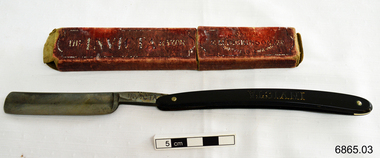 Flagstaff Hill Maritime Museum and Village
Razor, E.M. Dickinson, early 1900's
... In 1939 Dr Angus and his family moved to Warrnambool where he purchased “Birchwood,” the 1852 home and medical practice of Dr John Hunter Henderson, at 214 Koroit Street. (This property was sold in1965 to the State Government and is now the site of the Warrnambool Police Station. ...In 1939 Dr Angus and his family moved to Warrnambool where he purchased “Birchwood,” the 1852 home and medical practice of Dr John Hunter Henderson, at 214 Koroit Street. (This property was sold in1965 to the State Government and is now the site of the Warrnambool Police Station. and an ALDI sore is on the land that was once their tennis court). ...This cut-throat razor was donated to Flagstaff Hill Maritime Village by the family of Doctor William Roy Angus, Surgeon and Oculist. It is part of the “W.R. Angus Collection” , which includes historical medical equipment, surgical instruments and material once belonging to Dr Edward Ryan and Dr Thomas Francis Ryan, (both of Nhill, Victoria) as well as Dr Angus’ own belongings. The Collection’s history spans the medical practices of the two Doctors Ryan, from 1885-1926 plus that of Dr Angus, up until 1969. ABOUT THE “W.R.ANGUS COLLECTION” Doctor William Roy Angus M.B., B.S., Adel., 1923, F.R.C.S. Edin.,1928 (also known as Dr Roy Angus) was born in Murrumbeena, Victoria in 1901 and lived until 1970. He qualified as a doctor in 1923 at University of Adelaide, was Resident Medical Officer at the Royal Adelaide Hospital in 1924 and for a period was house surgeon to Sir (then Mr.) Henry Simpson Newland. Dr Angus was briefly an Assistant to Dr Riddell of Kapunda, then commenced private practice at Curramulka, Yorke Peninsula, SA, where he was physician, surgeon and chemist. In 1926, he was appointed as new Medical Assistant to Dr Thomas Francis Ryan (T.F. Ryan, or Tom), in Nhill, Victoria, where his experiences included radiology and pharmacy. In 1927 he was Acting House Surgeon in Dr Tom Ryan’s absence. Dr Angus had become engaged to Gladys Forsyth and they decided he further his studies overseas in the UK in 1927. He studied at London University College Hospital and at Edinburgh Royal Infirmary and in 1928, was awarded FRCS (Fellow from the Royal College of Surgeons), Edinburgh. He worked his passage back to Australia as a Ship’s Surgeon on the on the Australian Commonwealth Line’s T.S.S. Largs Bay. Dr Angus married Gladys in 1929, in Ballarat. (They went on to have one son (Graham 1932, born in SA) and two daughters (Helen (died 12/07/1996) and Berenice (Berry), both born at Mira, Nhill ) According to Berry, her mother Gladys made a lot of their clothes. She was very talented and did some lovely embroidery including lingerie for her trousseau and beautifully handmade baby clothes. Dr Angus was a ‘flying doctor’ for the A.I.M. (Australian Inland Ministry) Aerial Medical Service in 1928 . Its first station was in the remote town of Oodnadatta, where Dr Angus was stationed. He was locum tenens there on North-South Railway at 21 Mile Camp. He took up this ‘flying doctor’ position in response to a call from Dr John Flynn; the organisation was later known as the Flying Doctor Service, then the Royal Flying Doctor Service. A lot of his work during this time involved dental surgery also. Between 1928-1932 he was surgeon at the Curramulka Hospital, Yorke Peninsula, South Australia. In 1933 Dr Angus returned to Nhill and purchased a share of the Nelson Street practice and Mira hospital (a 2 bed ward at the Nelson Street Practice) from Dr Les Middleton one of the Middleton Brothers, the current owners of what previously once Dr Tom Ryan’s practice. Dr Tom and his brother had worked as surgeons included eye surgery. Dr Tom Ryan performed many of his operations in the Mira private hospital on his premises. He had been House Surgeon at the Nhill Hospital 1902-1926. Dr Tom Ryan had one of the only two pieces of radiology equipment in Victoria during his practicing years – The Royal Melbourne Hospital had the other one. Over the years Dr Tom Ryan had gradually set up what was effectively a training school for country general-practitioner-surgeons. Each patient was carefully examined, including using the X-ray machine, and any surgery was discussed and planned with Dr Ryan’s assistants several days in advance. Dr Angus gained experience in using the X-ray machine there during his time as assistant to Dr Ryan. When Dr Angus bought into the Nelson Street premises in Nhill he was also appointed as the Nhill Hospital’s Honorary House Surgeon 1933-1938. His practitioner’s plate from his Nhill surgery is now mounted on the doorway to the Port Medical Office at Flagstaff Hill Maritime Village, Warrnambool. When Dr Angus took up practice in the Dr Edward and Dr Tom Ryan’s old premises he obtained their extensive collection of historical medical equipment and materials spanning 1884-1926. A large part of this collection is now on display at the Port Medical Office at Flagstaff Hill Maritime Village in Warrnambool. In 1939 Dr Angus and his family moved to Warrnambool where he purchased “Birchwood,” the 1852 home and medical practice of Dr John Hunter Henderson, at 214 Koroit Street. (This property was sold in1965 to the State Government and is now the site of the Warrnambool Police Station. and an ALDI sore is on the land that was once their tennis court). The Angus family was able to afford gardeners, cooks and maids; their home was a popular place for visiting dignitaries to stay whilst visiting Warrnambool. Dr Angus had his own silk worm farm at home in a Mulberry tree. His young daughter used his centrifuge for spinning the silk. Dr Angus was appointed on a part-time basis as Port Medical Officer (Health Officer) in Warrnambool and held this position until the 1940’s when the government no longer required the service of a Port Medical Officer in Warrnambool; he was thus Warrnambool’s last serving Port Medical Officer. (Masters of immigrant ships arriving in port reported incidents of diseases, illness and death and the Port Medical Officer made a decision on whether the ship required Quarantine and for how long, in this way preventing contagious illness from spreading from new immigrants to the residents already in the colony.) Dr Angus was a member of the Australian Medical Association, for 35 years and surgeon at the Warrnambool Base Hospital 1939-1942, He served as a Surgeon Captain during WWII1942-45, in Ballarat, Victoria, and in Bonegilla, N.S.W., completing his service just before the end of the war due to suffering from a heart attack. During his convalescence he carved an intricate and ‘most artistic’ chess set from the material that dentures were made from. He then studied ophthalmology at the Royal Melbourne Eye and Ear Hospital and created cosmetically superior artificial eyes by pioneering using the intrascleral cartilage. Angus received accolades from the Ophthalmological Society of Australasia for this work. He returned to Warrnambool to commence practice as an ophthalmologist, pioneering in artificial eye improvements. He was Honorary Consultant Ophthalmologist to Warrnambool Base Hospital for 31 years. He made monthly visits to Portland as a visiting surgeon, to perform eye surgery. He represented the Victorian South-West subdivision of the Australian Medical Association as its secretary between 1949 and 1956 and as chairman from 1956 to 1958. In 1968 Dr Angus was elected member of Spain’s Barraquer Institute of Barcelona after his research work in Intrasclearal cartilage grafting, becoming one of the few Australian ophthalmologists to receive this honour, and in the following year presented his final paper on Living Intrasclearal Cartilage Implants at the Inaugural Meeting of the Australian College of Ophthalmologists in Melbourne In his personal life Dr Angus was a Presbyterian and treated Sunday as a Sabbath, a day of rest. He would visit 3 or 4 country patients on a Sunday, taking his children along ‘for the ride’ and to visit with him. Sunday evenings he would play the pianola and sing Scottish songs to his family. One of Dr Angus’ patients was Margaret MacKenzie, author of a book on local shipwrecks that she’d seen as an eye witness from the late 1880’s in Peterborough, Victoria. In the early 1950’s Dr Angus, painted a picture of a shipwreck for the cover jacket of Margaret’s book, Shipwrecks and More Shipwrecks. She was blind in later life and her daughter wrote the actual book for her. Dr Angus and his wife Gladys were very involved in Warrnambool’s society with a strong interest in civic affairs. He had an interest in people and the community They were both involved in the creation of Flagstaff Hill, including the layout of the gardens. After his death (28th March 1970) his family requested his practitioner’s plate, medical instruments and some personal belongings be displayed in the Port Medical Office surgery at Flagstaff Hill Maritime Village, and be called the “W. R. Angus Collection”. The W.R. Angus Collection is significant for still being located at the site it is connected with, Doctor Angus being the last Port Medical Officer in Warrnambool. The collection of medical instruments and other equipment is culturally significant, being an historical example of medicine from late 19th to mid-20th century. Dr Angus assisted Dr Tom Ryan, a pioneer in the use of X-rays and in ocular surgery. Cut-throat razor, part of the W.R. Angus Collection. ‘The Invicta’ model razor, in red cardboard box with silver embossed text, has black Bakelite handle with rounded end; blade swings inside the handle. Made by E.W. Dickinson in Sheffield, England in the early 1900’s. Box embossed in silver "The Invicta Razor", "Manufactured by E.W. DICKINSON LTD / SHEFFIELD ENGLAND" Embossed on handle "INVICTA". On blade "INVICTA" and "E.M. DICKINSON / SHEFFIELD ENGLAND"flagstaff hill, warrnambool, shipwrecked coast, flagstaff hill maritime museum, maritime museum, shipwreck coast, flagstaff hill maritime village, great ocean road, dr w r angus, dr ryan, cut-throat razor, e.w. dickinson sheffield england, personal effects 1900's, grooming equipment 1900's -
 Flagstaff Hill Maritime Museum and Village
Domestic object - Razor, 1900's
... In 1939 Dr Angus and his family moved to Warrnambool where he purchased “Birchwood,” the 1852 home and medical practice of Dr John Hunter Henderson, at 214 Koroit Street. (This property was sold in1965 to the State Government and is now the site of the Warrnambool Police Station. ...In 1939 Dr Angus and his family moved to Warrnambool where he purchased “Birchwood,” the 1852 home and medical practice of Dr John Hunter Henderson, at 214 Koroit Street. (This property was sold in1965 to the State Government and is now the site of the Warrnambool Police Station. and an ALDI sore is on the land that was once their tennis court). ...This cut-throat razor was donated to Flagstaff Hill Maritime Village by the family of Doctor William Roy Angus, Surgeon and Oculist. It is part of the “W.R. Angus Collection” includes historical medical equipment, surgical instruments and material once belonging to Dr Edward Ryan and Dr Thomas Francis Ryan, (both of Nhill, Victoria) as well as Dr Angus’ own belongings. The Collection’s history spans the medical practices of the two Doctors Ryan, from 1885-1926 plus that of Dr Angus, up until 1969. ABOUT THE “W.R.ANGUS COLLECTION” Doctor William Roy Angus M.B., B.S., Adel., 1923, F.R.C.S. Edin.,1928 (also known as Dr Roy Angus) was born in Murrumbeena, Victoria in 1901 and lived until 1970. He qualified as a doctor in 1923 at University of Adelaide, was Resident Medical Officer at the Royal Adelaide Hospital in 1924 and for a period was house surgeon to Sir (then Mr.) Henry Simpson Newland. Dr Angus was briefly an Assistant to Dr Riddell of Kapunda, then commenced private practice at Curramulka, Yorke Peninsula, SA, where he was physician, surgeon and chemist. In 1926, he was appointed as new Medical Assistant to Dr Thomas Francis Ryan (T.F. Ryan, or Tom), in Nhill, Victoria, where his experiences included radiology and pharmacy. In 1927 he was Acting House Surgeon in Dr Tom Ryan’s absence. Dr Angus had become engaged to Gladys Forsyth and they decided he further his studies overseas in the UK in 1927. He studied at London University College Hospital and at Edinburgh Royal Infirmary and in 1928, was awarded FRCS (Fellow from the Royal College of Surgeons), Edinburgh. He worked his passage back to Australia as a Ship’s Surgeon on the on the Australian Commonwealth Line’s T.S.S. Largs Bay. Dr Angus married Gladys in 1929, in Ballarat. (They went on to have one son (Graham 1932, born in SA) and two daughters (Helen (died 12/07/1996) and Berenice (Berry), both born at Mira, Nhill ) According to Berry, her mother Gladys made a lot of their clothes. She was very talented and did some lovely embroidery including lingerie for her trousseau and beautifully handmade baby clothes. Dr Angus was a ‘flying doctor’ for the A.I.M. (Australian Inland Ministry) Aerial Medical Service in 1928 . Its first station was in the remote town of Oodnadatta, where Dr Angus was stationed. He was locum tenens there on North-South Railway at 21 Mile Camp. He took up this ‘flying doctor’ position in response to a call from Dr John Flynn; the organisation was later known as the Flying Doctor Service, then the Royal Flying Doctor Service. A lot of his work during this time involved dental surgery also. Between 1928-1932 he was surgeon at the Curramulka Hospital, Yorke Peninsula, South Australia. In 1933 Dr Angus returned to Nhill and purchased a share of the Nelson Street practice and Mira hospital (a 2 bed ward at the Nelson Street Practice) from Dr Les Middleton one of the Middleton Brothers, the current owners of what previously once Dr Tom Ryan’s practice. Dr Tom and his brother had worked as surgeons included eye surgery. Dr Tom Ryan performed many of his operations in the Mira private hospital on his premises. He had been House Surgeon at the Nhill Hospital 1902-1926. Dr Tom Ryan had one of the only two pieces of radiology equipment in Victoria during his practicing years – The Royal Melbourne Hospital had the other one. Over the years Dr Tom Ryan had gradually set up what was effectively a training school for country general-practitioner-surgeons. Each patient was carefully examined, including using the X-ray machine, and any surgery was discussed and planned with Dr Ryan’s assistants several days in advance. Dr Angus gained experience in using the X-ray machine there during his time as assistant to Dr Ryan. When Dr Angus bought into the Nelson Street premises in Nhill he was also appointed as the Nhill Hospital’s Honorary House Surgeon 1933-1938. His practitioner’s plate from his Nhill surgery is now mounted on the doorway to the Port Medical Office at Flagstaff Hill Maritime Village, Warrnambool. When Dr Angus took up practice in the Dr Edward and Dr Tom Ryan’s old premises he obtained their extensive collection of historical medical equipment and materials spanning 1884-1926. A large part of this collection is now on display at the Port Medical Office at Flagstaff Hill Maritime Village in Warrnambool. In 1939 Dr Angus and his family moved to Warrnambool where he purchased “Birchwood,” the 1852 home and medical practice of Dr John Hunter Henderson, at 214 Koroit Street. (This property was sold in1965 to the State Government and is now the site of the Warrnambool Police Station. and an ALDI sore is on the land that was once their tennis court). The Angus family was able to afford gardeners, cooks and maids; their home was a popular place for visiting dignitaries to stay whilst visiting Warrnambool. Dr Angus had his own silk worm farm at home in a Mulberry tree. His young daughter used his centrifuge for spinning the silk. Dr Angus was appointed on a part-time basis as Port Medical Officer (Health Officer) in Warrnambool and held this position until the 1940’s when the government no longer required the service of a Port Medical Officer in Warrnambool; he was thus Warrnambool’s last serving Port Medical Officer. (Masters of immigrant ships arriving in port reported incidents of diseases, illness and death and the Port Medical Officer made a decision on whether the ship required Quarantine and for how long, in this way preventing contagious illness from spreading from new immigrants to the residents already in the colony.) Dr Angus was a member of the Australian Medical Association, for 35 years and surgeon at the Warrnambool Base Hospital 1939-1942, He served as a Surgeon Captain during WWII1942-45, in Ballarat, Victoria, and in Bonegilla, N.S.W., completing his service just before the end of the war due to suffering from a heart attack. During his convalescence he carved an intricate and ‘most artistic’ chess set from the material that dentures were made from. He then studied ophthalmology at the Royal Melbourne Eye and Ear Hospital and created cosmetically superior artificial eyes by pioneering using the intrascleral cartilage. Angus received accolades from the Ophthalmological Society of Australasia for this work. He returned to Warrnambool to commence practice as an ophthalmologist, pioneering in artificial eye improvements. He was Honorary Consultant Ophthalmologist to Warrnambool Base Hospital for 31 years. He made monthly visits to Portland as a visiting surgeon, to perform eye surgery. He represented the Victorian South-West subdivision of the Australian Medical Association as its secretary between 1949 and 1956 and as chairman from 1956 to 1958. In 1968 Dr Angus was elected member of Spain’s Barraquer Institute of Barcelona after his research work in Intrasclearal cartilage grafting, becoming one of the few Australian ophthalmologists to receive this honour, and in the following year presented his final paper on Living Intrasclearal Cartilage Implants at the Inaugural Meeting of the Australian College of Ophthalmologists in Melbourne In his personal life Dr Angus was a Presbyterian and treated Sunday as a Sabbath, a day of rest. He would visit 3 or 4 country patients on a Sunday, taking his children along ‘for the ride’ and to visit with him. Sunday evenings he would play the pianola and sing Scottish songs to his family. One of Dr Angus’ patients was Margaret MacKenzie, author of a book on local shipwrecks that she’d seen as an eye witness from the late 1880’s in Peterborough, Victoria. In the early 1950’s Dr Angus, painted a picture of a shipwreck for the cover jacket of Margaret’s book, Shipwrecks and More Shipwrecks. She was blind in later life and her daughter wrote the actual book for her. Dr Angus and his wife Gladys were very involved in Warrnambool’s society with a strong interest in civic affairs. He had an interest in people and the community They were both involved in the creation of Flagstaff Hill, including the layout of the gardens. After his death (28th March 1970) his family requested his practitioner’s plate, medical instruments and some personal belongings be displayed in the Port Medical Office surgery at Flagstaff Hill Maritime Village, and be called the “W. R. Angus Collection”. The W.R. Angus Collection is significant for still being located at the site it is connected with, Doctor Angus being the last Port Medical Officer in Warrnambool. The collection of medical instruments and other equipment is culturally significant, being an historical example of medicine from late 19th to mid-20th century. Dr Angus assisted Dr Tom Ryan, a pioneer in the use of X-rays and in ocular surgery. Cut-throat razor, part of the W.R. Angus Collection. Razor model No. 42, steel blade, in dark cardboard box, with bone handle, arrow shaped end; blade swings inside the handle. Razor made in Germany with blade made in Sheffield, England, in early 1900’s.Embossed on box "No. 42 / DES GERMAN MANUFACTURE", on handle "GOTTA", on blade "HAMBURG RING / REG. GOTTA REG. / SUPER FINE" and "FINEST SHEFFIELD STEEL / FORGED AND - - - HOLLOW / GROUND IN GERMANY" flagstaff hill, warrnambool, shipwrecked coast, flagstaff hill maritime museum, maritime museum, shipwreck coast, flagstaff hill maritime village, great ocean road, dr w r angus, dr ryan, cut-throat razor, gotta razor, german made razor, personal effects 1900's, grooming equipment 1900's -
 Flagstaff Hill Maritime Museum and Village
Needle, 19th and 20th century
... In 1939 Dr Angus and his family moved to Warrnambool where he purchased “Birchwood,” the 1852 home and medical practice of Dr John Hunter Henderson, at 214 Koroit Street. (This property was sold in1965 to the State Government and is now the site of the Warrnambool Police Station. ...In 1939 Dr Angus and his family moved to Warrnambool where he purchased “Birchwood,” the 1852 home and medical practice of Dr John Hunter Henderson, at 214 Koroit Street. (This property was sold in1965 to the State Government and is now the site of the Warrnambool Police Station. and an ALDI sore is on the land that was once their tennis court). ...This was donated to Flagstaff Hill Maritime Village by the family of Doctor William Roy Angus, Surgeon and Oculist. It is part of the “W.R. Angus Collection” includes historical medical equipment, surgical instruments and material once belonging to Dr Edward Ryan and Dr Thomas Francis Ryan, (both of Nhill, Victoria) as well as Dr Angus’ own belongings. The Collection’s history spans the medical practices of the two Doctors Ryan, from 1885-1926 plus that of Dr Angus, up until 1969. ABOUT THE “W.R.ANGUS COLLECTION” Doctor William Roy Angus M.B., B.S., Adel., 1923, F.R.C.S. Edin.,1928 (also known as Dr Roy Angus) was born in Murrumbeena, Victoria in 1901 and lived until 1970. He qualified as a doctor in 1923 at University of Adelaide, was Resident Medical Officer at the Royal Adelaide Hospital in 1924 and for a period was house surgeon to Sir (then Mr.) Henry Simpson Newland. Dr Angus was briefly an Assistant to Dr Riddell of Kapunda, then commenced private practice at Curramulka, Yorke Peninsula, SA, where he was physician, surgeon and chemist. In 1926, he was appointed as new Medical Assistant to Dr Thomas Francis Ryan (T.F. Ryan, or Tom), in Nhill, Victoria, where his experiences included radiology and pharmacy. In 1927 he was Acting House Surgeon in Dr Tom Ryan’s absence. Dr Angus had become engaged to Gladys Forsyth and they decided he further his studies overseas in the UK in 1927. He studied at London University College Hospital and at Edinburgh Royal Infirmary and in 1928, was awarded FRCS (Fellow from the Royal College of Surgeons), Edinburgh. He worked his passage back to Australia as a Ship’s Surgeon on the on the Australian Commonwealth Line’s T.S.S. Largs Bay. Dr Angus married Gladys in 1929, in Ballarat. (They went on to have one son (Graham 1932, born in SA) and two daughters (Helen (died 12/07/1996) and Berenice (Berry), both born at Mira, Nhill ) According to Berry, her mother Gladys made a lot of their clothes. She was very talented and did some lovely embroidery including lingerie for her trousseau and beautifully handmade baby clothes. Dr Angus was a ‘flying doctor’ for the A.I.M. (Australian Inland Ministry) Aerial Medical Service in 1928 . Its first station was in the remote town of Oodnadatta, where Dr Angus was stationed. He was locum tenens there on North-South Railway at 21 Mile Camp. He took up this ‘flying doctor’ position in response to a call from Dr John Flynn; the organisation was later known as the Flying Doctor Service, then the Royal Flying Doctor Service. A lot of his work during this time involved dental surgery also. Between 1928-1932 he was surgeon at the Curramulka Hospital, Yorke Peninsula, South Australia. In 1933 Dr Angus returned to Nhill and purchased a share of the Nelson Street practice and Mira hospital (a 2 bed ward at the Nelson Street Practice) from Dr Les Middleton one of the Middleton Brothers, the current owners of what previously once Dr Tom Ryan’s practice. Dr Tom and his brother had worked as surgeons included eye surgery. Dr Tom Ryan performed many of his operations in the Mira private hospital on his premises. He had been House Surgeon at the Nhill Hospital 1902-1926. Dr Tom Ryan had one of the only two pieces of radiology equipment in Victoria during his practicing years – The Royal Melbourne Hospital had the other one. Over the years Dr Tom Ryan had gradually set up what was effectively a training school for country general-practitioner-surgeons. Each patient was carefully examined, including using the X-ray machine, and any surgery was discussed and planned with Dr Ryan’s assistants several days in advance. Dr Angus gained experience in using the X-ray machine there during his time as assistant to Dr Ryan. When Dr Angus bought into the Nelson Street premises in Nhill he was also appointed as the Nhill Hospital’s Honorary House Surgeon 1933-1938. His practitioner’s plate from his Nhill surgery is now mounted on the doorway to the Port Medical Office at Flagstaff Hill Maritime Village, Warrnambool. When Dr Angus took up practice in the Dr Edward and Dr Tom Ryan’s old premises he obtained their extensive collection of historical medical equipment and materials spanning 1884-1926. A large part of this collection is now on display at the Port Medical Office at Flagstaff Hill Maritime Village in Warrnambool. In 1939 Dr Angus and his family moved to Warrnambool where he purchased “Birchwood,” the 1852 home and medical practice of Dr John Hunter Henderson, at 214 Koroit Street. (This property was sold in1965 to the State Government and is now the site of the Warrnambool Police Station. and an ALDI sore is on the land that was once their tennis court). The Angus family was able to afford gardeners, cooks and maids; their home was a popular place for visiting dignitaries to stay whilst visiting Warrnambool. Dr Angus had his own silk worm farm at home in a Mulberry tree. His young daughter used his centrifuge for spinning the silk. Dr Angus was appointed on a part-time basis as Port Medical Officer (Health Officer) in Warrnambool and held this position until the 1940’s when the government no longer required the service of a Port Medical Officer in Warrnambool; he was thus Warrnambool’s last serving Port Medical Officer. (Masters of immigrant ships arriving in port reported incidents of diseases, illness and death and the Port Medical Officer made a decision on whether the ship required Quarantine and for how long, in this way preventing contagious illness from spreading from new immigrants to the residents already in the colony.) Dr Angus was a member of the Australian Medical Association, for 35 years and surgeon at the Warrnambool Base Hospital 1939-1942, He served as a Surgeon Captain during WWII1942-45, in Ballarat, Victoria, and in Bonegilla, N.S.W., completing his service just before the end of the war due to suffering from a heart attack. During his convalescence he carved an intricate and ‘most artistic’ chess set from the material that dentures were made from. He then studied ophthalmology at the Royal Melbourne Eye and Ear Hospital and created cosmetically superior artificial eyes by pioneering using the intrascleral cartilage. Angus received accolades from the Ophthalmological Society of Australasia for this work. He returned to Warrnambool to commence practice as an ophthalmologist, pioneering in artificial eye improvements. He was Honorary Consultant Ophthalmologist to Warrnambool Base Hospital for 31 years. He made monthly visits to Portland as a visiting surgeon, to perform eye surgery. He represented the Victorian South-West subdivision of the Australian Medical Association as its secretary between 1949 and 1956 and as chairman from 1956 to 1958. In 1968 Dr Angus was elected member of Spain’s Barraquer Institute of Barcelona after his research work in Intrasclearal cartilage grafting, becoming one of the few Australian ophthalmologists to receive this honour, and in the following year presented his final paper on Living Intrasclearal Cartilage Implants at the Inaugural Meeting of the Australian College of Ophthalmologists in Melbourne In his personal life Dr Angus was a Presbyterian and treated Sunday as a Sabbath, a day of rest. He would visit 3 or 4 country patients on a Sunday, taking his children along ‘for the ride’ and to visit with him. Sunday evenings he would play the pianola and sing Scottish songs to his family. One of Dr Angus’ patients was Margaret MacKenzie, author of a book on local shipwrecks that she’d seen as an eye witness from the late 1880’s in Peterborough, Victoria. In the early 1950’s Dr Angus, painted a picture of a shipwreck for the cover jacket of Margaret’s book, Shipwrecks and More Shipwrecks. She was blind in later life and her daughter wrote the actual book for her. Dr Angus and his wife Gladys were very involved in Warrnambool’s society with a strong interest in civic affairs. He had an interest in people and the community They were both involved in the creation of Flagstaff Hill, including the layout of the gardens. After his death (28th March 1970) his family requested his practitioner’s plate, medical instruments and some personal belongings be displayed in the Port Medical Office surgery at Flagstaff Hill Maritime Village, and be called the “W. R. Angus Collection”. W.R. Angus Collection is significant for still being located at the site it is connected with, Doctor Angus being the last Port Medical Officer in Warrnambool. The collection of medical instruments and other equipment is culturally significant, being an historical example of medicine from late 19th to mid-20th century. Dr Angus assisted Dr Tom Ryan, a pioneer in the use of X-rays and in ocular surgery. Bag needle, from W.R. Angus Collection. Steel needle with slightly bent end, used for sewing the tops of wheat bags and other similar bags to close them.flagstaff hill, warrnambool, shipwrecked coast, flagstaff hill maritime museum, maritime museum, shipwreck coast, flagstaff hill maritime village, great ocean road, dr w r angus, dr ryan, surgical instrument, t.s.s. largs bay, warrnambool base hospital, nhill base hospital, mira hospital, flying doctor, bag needle, wheat bag needle -
 Flagstaff Hill Maritime Museum and Village
Awl, 19th and 20th century
... In 1939 Dr Angus and his family moved to Warrnambool where he purchased “Birchwood,” the 1852 home and medical practice of Dr John Hunter Henderson, at 214 Koroit Street. (This property was sold in1965 to the State Government and is now the site of the Warrnambool Police Station. ...In 1939 Dr Angus and his family moved to Warrnambool where he purchased “Birchwood,” the 1852 home and medical practice of Dr John Hunter Henderson, at 214 Koroit Street. (This property was sold in1965 to the State Government and is now the site of the Warrnambool Police Station. and an ALDI sore is on the land that was once their tennis court). ...This awl donated to Flagstaff Hill Maritime Village by the family of Doctor William Roy Angus, Surgeon and Oculist. It is part of the “W.R. Angus Collection” includes historical medical equipment, surgical instruments and material once belonging to Dr Edward Ryan and Dr Thomas Francis Ryan, (both of Nhill, Victoria) as well as Dr Angus’ own belongings. The Collection’s history spans the medical practices of the two Doctors Ryan, from 1885-1926 plus that of Dr Angus, up until 1969. ABOUT THE “W.R.ANGUS COLLECTION” Doctor William Roy Angus M.B., B.S., Adel., 1923, F.R.C.S. Edin.,1928 (also known as Dr Roy Angus) was born in Murrumbeena, Victoria in 1901 and lived until 1970. He qualified as a doctor in 1923 at University of Adelaide, was Resident Medical Officer at the Royal Adelaide Hospital in 1924 and for a period was house surgeon to Sir (then Mr.) Henry Simpson Newland. Dr Angus was briefly an Assistant to Dr Riddell of Kapunda, then commenced private practice at Curramulka, Yorke Peninsula, SA, where he was physician, surgeon and chemist. In 1926, he was appointed as new Medical Assistant to Dr Thomas Francis Ryan (T.F. Ryan, or Tom), in Nhill, Victoria, where his experiences included radiology and pharmacy. In 1927 he was Acting House Surgeon in Dr Tom Ryan’s absence. Dr Angus had become engaged to Gladys Forsyth and they decided he further his studies overseas in the UK in 1927. He studied at London University College Hospital and at Edinburgh Royal Infirmary and in 1928, was awarded FRCS (Fellow from the Royal College of Surgeons), Edinburgh. He worked his passage back to Australia as a Ship’s Surgeon on the on the Australian Commonwealth Line’s T.S.S. Largs Bay. Dr Angus married Gladys in 1929, in Ballarat. (They went on to have one son (Graham 1932, born in SA) and two daughters (Helen (died 12/07/1996) and Berenice (Berry), both born at Mira, Nhill ) According to Berry, her mother Gladys made a lot of their clothes. She was very talented and did some lovely embroidery including lingerie for her trousseau and beautifully handmade baby clothes. Dr Angus was a ‘flying doctor’ for the A.I.M. (Australian Inland Ministry) Aerial Medical Service in 1928 . Its first station was in the remote town of Oodnadatta, where Dr Angus was stationed. He was locum tenens there on North-South Railway at 21 Mile Camp. He took up this ‘flying doctor’ position in response to a call from Dr John Flynn; the organisation was later known as the Flying Doctor Service, then the Royal Flying Doctor Service. A lot of his work during this time involved dental surgery also. Between 1928-1932 he was surgeon at the Curramulka Hospital, Yorke Peninsula, South Australia. In 1933 Dr Angus returned to Nhill and purchased a share of the Nelson Street practice and Mira hospital (a 2 bed ward at the Nelson Street Practice) from Dr Les Middleton one of the Middleton Brothers, the current owners of what previously once Dr Tom Ryan’s practice. Dr Tom and his brother had worked as surgeons included eye surgery. Dr Tom Ryan performed many of his operations in the Mira private hospital on his premises. He had been House Surgeon at the Nhill Hospital 1902-1926. Dr Tom Ryan had one of the only two pieces of radiology equipment in Victoria during his practicing years – The Royal Melbourne Hospital had the other one. Over the years Dr Tom Ryan had gradually set up what was effectively a training school for country general-practitioner-surgeons. Each patient was carefully examined, including using the X-ray machine, and any surgery was discussed and planned with Dr Ryan’s assistants several days in advance. Dr Angus gained experience in using the X-ray machine there during his time as assistant to Dr Ryan. When Dr Angus bought into the Nelson Street premises in Nhill he was also appointed as the Nhill Hospital’s Honorary House Surgeon 1933-1938. His practitioner’s plate from his Nhill surgery is now mounted on the doorway to the Port Medical Office at Flagstaff Hill Maritime Village, Warrnambool. When Dr Angus took up practice in the Dr Edward and Dr Tom Ryan’s old premises he obtained their extensive collection of historical medical equipment and materials spanning 1884-1926. A large part of this collection is now on display at the Port Medical Office at Flagstaff Hill Maritime Village in Warrnambool. In 1939 Dr Angus and his family moved to Warrnambool where he purchased “Birchwood,” the 1852 home and medical practice of Dr John Hunter Henderson, at 214 Koroit Street. (This property was sold in1965 to the State Government and is now the site of the Warrnambool Police Station. and an ALDI sore is on the land that was once their tennis court). The Angus family was able to afford gardeners, cooks and maids; their home was a popular place for visiting dignitaries to stay whilst visiting Warrnambool. Dr Angus had his own silk worm farm at home in a Mulberry tree. His young daughter used his centrifuge for spinning the silk. Dr Angus was appointed on a part-time basis as Port Medical Officer (Health Officer) in Warrnambool and held this position until the 1940’s when the government no longer required the service of a Port Medical Officer in Warrnambool; he was thus Warrnambool’s last serving Port Medical Officer. (Masters of immigrant ships arriving in port reported incidents of diseases, illness and death and the Port Medical Officer made a decision on whether the ship required Quarantine and for how long, in this way preventing contagious illness from spreading from new immigrants to the residents already in the colony.) Dr Angus was a member of the Australian Medical Association, for 35 years and surgeon at the Warrnambool Base Hospital 1939-1942, He served as a Surgeon Captain during WWII1942-45, in Ballarat, Victoria, and in Bonegilla, N.S.W., completing his service just before the end of the war due to suffering from a heart attack. During his convalescence he carved an intricate and ‘most artistic’ chess set from the material that dentures were made from. He then studied ophthalmology at the Royal Melbourne Eye and Ear Hospital and created cosmetically superior artificial eyes by pioneering using the intrascleral cartilage. Angus received accolades from the Ophthalmological Society of Australasia for this work. He returned to Warrnambool to commence practice as an ophthalmologist, pioneering in artificial eye improvements. He was Honorary Consultant Ophthalmologist to Warrnambool Base Hospital for 31 years. He made monthly visits to Portland as a visiting surgeon, to perform eye surgery. He represented the Victorian South-West subdivision of the Australian Medical Association as its secretary between 1949 and 1956 and as chairman from 1956 to 1958. In 1968 Dr Angus was elected member of Spain’s Barraquer Institute of Barcelona after his research work in Intrasclearal cartilage grafting, becoming one of the few Australian ophthalmologists to receive this honour, and in the following year presented his final paper on Living Intrasclearal Cartilage Implants at the Inaugural Meeting of the Australian College of Ophthalmologists in Melbourne In his personal life Dr Angus was a Presbyterian and treated Sunday as a Sabbath, a day of rest. He would visit 3 or 4 country patients on a Sunday, taking his children along ‘for the ride’ and to visit with him. Sunday evenings he would play the pianola and sing Scottish songs to his family. One of Dr Angus’ patients was Margaret MacKenzie, author of a book on local shipwrecks that she’d seen as an eye witness from the late 1880’s in Peterborough, Victoria. In the early 1950’s Dr Angus, painted a picture of a shipwreck for the cover jacket of Margaret’s book, Shipwrecks and More Shipwrecks. She was blind in later life and her daughter wrote the actual book for her. Dr Angus and his wife Gladys were very involved in Warrnambool’s society with a strong interest in civic affairs. He had an interest in people and the community They were both involved in the creation of Flagstaff Hill, including the layout of the gardens. After his death (28th March 1970) his family requested his practitioner’s plate, medical instruments and some personal belongings be displayed in the Port Medical Office surgery at Flagstaff Hill Maritime Village, and be called the “W. R. Angus Collection”. W.R. Angus Collection is significant for still being located at the site it is connected with, Doctor Angus being the last Port Medical Officer in Warrnambool. The collection of medical instruments and other equipment is culturally significant, being an historical example of medicine from late 19th to mid-20th century. Dr Angus assisted Dr Tom Ryan, a pioneer in the use of X-rays and in ocular surgery. Awl, part of the W.R. Angus Collection. Wooden handle, metal locking device that is holding a drill bit in place. Used to make a 'pilot hole' for inserting screws and nails.flagstaff hill, warrnambool, shipwrecked coast, flagstaff hill maritime museum, maritime museum, shipwreck coast, flagstaff hill maritime village, great ocean road, dr w r angus, dr ryan, awl, woodworking tool, tool -
 Flagstaff Hill Maritime Museum and Village
Awl, 19th-20th century
... In 1939 Dr Angus and his family moved to Warrnambool where he purchased “Birchwood,” the 1852 home and medical practice of Dr John Hunter Henderson, at 214 Koroit Street. (This property was sold in1965 to the State Government and is now the site of the Warrnambool Police Station. ...In 1939 Dr Angus and his family moved to Warrnambool where he purchased “Birchwood,” the 1852 home and medical practice of Dr John Hunter Henderson, at 214 Koroit Street. (This property was sold in1965 to the State Government and is now the site of the Warrnambool Police Station. and an ALDI sore is on the land that was once their tennis court). ...This awl was donated to Flagstaff Hill Maritime Village by the family of Doctor William Roy Angus, Surgeon and Oculist. It is part of the “W.R. Angus Collection” includes historical medical equipment, surgical instruments and material once belonging to Dr Edward Ryan and Dr Thomas Francis Ryan, (both of Nhill, Victoria) as well as Dr Angus’ own belongings. The Collection’s history spans the medical practices of the two Doctors Ryan, from 1885-1926 plus that of Dr Angus, up until 1969. ABOUT THE “W.R.ANGUS COLLECTION” Doctor William Roy Angus M.B., B.S., Adel., 1923, F.R.C.S. Edin.,1928 (also known as Dr Roy Angus) was born in Murrumbeena, Victoria in 1901 and lived until 1970. He qualified as a doctor in 1923 at University of Adelaide, was Resident Medical Officer at the Royal Adelaide Hospital in 1924 and for a period was house surgeon to Sir (then Mr.) Henry Simpson Newland. Dr Angus was briefly an Assistant to Dr Riddell of Kapunda, then commenced private practice at Curramulka, Yorke Peninsula, SA, where he was physician, surgeon and chemist. In 1926, he was appointed as new Medical Assistant to Dr Thomas Francis Ryan (T.F. Ryan, or Tom), in Nhill, Victoria, where his experiences included radiology and pharmacy. In 1927 he was Acting House Surgeon in Dr Tom Ryan’s absence. Dr Angus had become engaged to Gladys Forsyth and they decided he further his studies overseas in the UK in 1927. He studied at London University College Hospital and at Edinburgh Royal Infirmary and in 1928, was awarded FRCS (Fellow from the Royal College of Surgeons), Edinburgh. He worked his passage back to Australia as a Ship’s Surgeon on the on the Australian Commonwealth Line’s T.S.S. Largs Bay. Dr Angus married Gladys in 1929, in Ballarat. (They went on to have one son (Graham 1932, born in SA) and two daughters (Helen (died 12/07/1996) and Berenice (Berry), both born at Mira, Nhill ) According to Berry, her mother Gladys made a lot of their clothes. She was very talented and did some lovely embroidery including lingerie for her trousseau and beautifully handmade baby clothes. Dr Angus was a ‘flying doctor’ for the A.I.M. (Australian Inland Ministry) Aerial Medical Service in 1928 . Its first station was in the remote town of Oodnadatta, where Dr Angus was stationed. He was locum tenens there on North-South Railway at 21 Mile Camp. He took up this ‘flying doctor’ position in response to a call from Dr John Flynn; the organisation was later known as the Flying Doctor Service, then the Royal Flying Doctor Service. A lot of his work during this time involved dental surgery also. Between 1928-1932 he was surgeon at the Curramulka Hospital, Yorke Peninsula, South Australia. In 1933 Dr Angus returned to Nhill and purchased a share of the Nelson Street practice and Mira hospital (a 2 bed ward at the Nelson Street Practice) from Dr Les Middleton one of the Middleton Brothers, the current owners of what previously once Dr Tom Ryan’s practice. Dr Tom and his brother had worked as surgeons included eye surgery. Dr Tom Ryan performed many of his operations in the Mira private hospital on his premises. He had been House Surgeon at the Nhill Hospital 1902-1926. Dr Tom Ryan had one of the only two pieces of radiology equipment in Victoria during his practicing years – The Royal Melbourne Hospital had the other one. Over the years Dr Tom Ryan had gradually set up what was effectively a training school for country general-practitioner-surgeons. Each patient was carefully examined, including using the X-ray machine, and any surgery was discussed and planned with Dr Ryan’s assistants several days in advance. Dr Angus gained experience in using the X-ray machine there during his time as assistant to Dr Ryan. When Dr Angus bought into the Nelson Street premises in Nhill he was also appointed as the Nhill Hospital’s Honorary House Surgeon 1933-1938. His practitioner’s plate from his Nhill surgery is now mounted on the doorway to the Port Medical Office at Flagstaff Hill Maritime Village, Warrnambool. When Dr Angus took up practice in the Dr Edward and Dr Tom Ryan’s old premises he obtained their extensive collection of historical medical equipment and materials spanning 1884-1926. A large part of this collection is now on display at the Port Medical Office at Flagstaff Hill Maritime Village in Warrnambool. In 1939 Dr Angus and his family moved to Warrnambool where he purchased “Birchwood,” the 1852 home and medical practice of Dr John Hunter Henderson, at 214 Koroit Street. (This property was sold in1965 to the State Government and is now the site of the Warrnambool Police Station. and an ALDI sore is on the land that was once their tennis court). The Angus family was able to afford gardeners, cooks and maids; their home was a popular place for visiting dignitaries to stay whilst visiting Warrnambool. Dr Angus had his own silk worm farm at home in a Mulberry tree. His young daughter used his centrifuge for spinning the silk. Dr Angus was appointed on a part-time basis as Port Medical Officer (Health Officer) in Warrnambool and held this position until the 1940’s when the government no longer required the service of a Port Medical Officer in Warrnambool; he was thus Warrnambool’s last serving Port Medical Officer. (Masters of immigrant ships arriving in port reported incidents of diseases, illness and death and the Port Medical Officer made a decision on whether the ship required Quarantine and for how long, in this way preventing contagious illness from spreading from new immigrants to the residents already in the colony.) Dr Angus was a member of the Australian Medical Association, for 35 years and surgeon at the Warrnambool Base Hospital 1939-1942, He served as a Surgeon Captain during WWII1942-45, in Ballarat, Victoria, and in Bonegilla, N.S.W., completing his service just before the end of the war due to suffering from a heart attack. During his convalescence he carved an intricate and ‘most artistic’ chess set from the material that dentures were made from. He then studied ophthalmology at the Royal Melbourne Eye and Ear Hospital and created cosmetically superior artificial eyes by pioneering using the intrascleral cartilage. Angus received accolades from the Ophthalmological Society of Australasia for this work. He returned to Warrnambool to commence practice as an ophthalmologist, pioneering in artificial eye improvements. He was Honorary Consultant Ophthalmologist to Warrnambool Base Hospital for 31 years. He made monthly visits to Portland as a visiting surgeon, to perform eye surgery. He represented the Victorian South-West subdivision of the Australian Medical Association as its secretary between 1949 and 1956 and as chairman from 1956 to 1958. In 1968 Dr Angus was elected member of Spain’s Barraquer Institute of Barcelona after his research work in Intrasclearal cartilage grafting, becoming one of the few Australian ophthalmologists to receive this honour, and in the following year presented his final paper on Living Intrasclearal Cartilage Implants at the Inaugural Meeting of the Australian College of Ophthalmologists in Melbourne In his personal life Dr Angus was a Presbyterian and treated Sunday as a Sabbath, a day of rest. He would visit 3 or 4 country patients on a Sunday, taking his children along ‘for the ride’ and to visit with him. Sunday evenings he would play the pianola and sing Scottish songs to his family. One of Dr Angus’ patients was Margaret MacKenzie, author of a book on local shipwrecks that she’d seen as an eye witness from the late 1880’s in Peterborough, Victoria. In the early 1950’s Dr Angus, painted a picture of a shipwreck for the cover jacket of Margaret’s book, Shipwrecks and More Shipwrecks. She was blind in later life and her daughter wrote the actual book for her. Dr Angus and his wife Gladys were very involved in Warrnambool’s society with a strong interest in civic affairs. He had an interest in people and the community They were both involved in the creation of Flagstaff Hill, including the layout of the gardens. After his death (28th March 1970) his family requested his practitioner’s plate, medical instruments and some personal belongings be displayed in the Port Medical Office surgery at Flagstaff Hill Maritime Village, and be called the “W. R. Angus Collection”. W.R. Angus Collection is significant for still being located at the site it is connected with, Doctor Angus being the last Port Medical Officer in Warrnambool. The collection of medical instruments and other equipment is culturally significant, being an historical example of medicine from late 19th to mid-20th century. Dr Angus assisted Dr Tom Ryan, a pioneer in the use of X-rays and in ocular surgery. Awl, part of the W.R. Angus Collection. Wooden handle, metal spiral spike. Used to make a 'pilot hole' for inserting screws and nails. Letters and numbers are stamped into the handle. Stamped into handle "D.R.P. 58012"flagstaff hill, warrnambool, shipwrecked coast, flagstaff hill maritime museum, maritime museum, shipwreck coast, flagstaff hill maritime village, great ocean road, dr w r angus, dr ryan, awl, tool, wood working tool
