
Showing 4 items matching "henry james jr"
-
 Flagstaff Hill Maritime Museum and Village
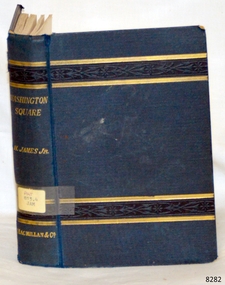
Book - Fictional Stories, Henry James Jr, Washington Square, 1881
... ...Henry James Jr...The author Henry James Jr (1843–1916) is widely considered one of the greatest novelists of the English language. ...Washington Square Author: Henry James Jr Publisher: MacMillian & Co Date: 1881 Further Information: Blue cloth hardcover and spine with spine lettering in gilt. ... Henry James Jr...The author Henry James Jr (1843–1916) is widely considered one of the greatest novelists of the English language. ...This volume compiles three distinct early works by Henry James that explore his signature theme of the clash of social manners, money, and personal integrity. Set in 1840s New York City, the masterpiece Washington Square follows Catherine Sloper, a plain, introverted heiress. She is caught between her cold, brilliant father, Dr Austin Sloper, who often views his daughter with disappointment and contempt, and Morris Townsend, a charming but penniless suitor whom the doctor rightly suspects is a mercenary fortune-hunter. It is a devastating, brilliantly controlled story about emotional manipulation and dignity. The second story, The Pension Beaurepas, is a comic yet biting sketch set at a boarding house in Geneva, Switzerland. It satirizes the 'American abroad', focusing on wealthy American tourists and the stark cultural differences between the Old World and the New. The third story, A Bundle of Letters, is an epistolary short story told entirely through letters, featuring a cast of international guests staying at a Paris hotel. Each letter writer reveals their own cultural biases, blind spots, and vanity.Washington Square Author: Henry James Jr Publisher: MacMillian & Co Date: 1881 Further Information: Blue cloth hardcover and spine with spine lettering in gilt. Cover & spine have black patterned strip edged with gilt. The spine has a Library label with inscription. Book has 3 parts 1. Washington Square 2. The Pension Beaurepas 3. A Bundle of LettersfictionThis volume compiles three distinct early works by Henry James that explore his signature theme of the clash of social manners, money, and personal integrity. Set in 1840s New York City, the masterpiece Washington Square follows Catherine Sloper, a plain, introverted heiress. She is caught between her cold, brilliant father, Dr Austin Sloper, who often views his daughter with disappointment and contempt, and Morris Townsend, a charming but penniless suitor whom the doctor rightly suspects is a mercenary fortune-hunter. It is a devastating, brilliantly controlled story about emotional manipulation and dignity. The second story, The Pension Beaurepas, is a comic yet biting sketch set at a boarding house in Geneva, Switzerland. It satirizes the 'American abroad', focusing on wealthy American tourists and the stark cultural differences between the Old World and the New. The third story, A Bundle of Letters, is an epistolary short story told entirely through letters, featuring a cast of international guests staying at a Paris hotel. Each letter writer reveals their own cultural biases, blind spots, and vanity.flagstaff hill, warrnambool, shipwrecked coast, flagstaff hill maritime museum, maritime museum, shipwreck coast, flagstaff hill maritime village, great ocean road, book, pattison collection, warrnambool library, warrnambool mechanics’ institute, ralph eric pattison, corangamite regional library service, warrnambool city librarian, mechanics’ institute library, victorian library board, warrnambool books and records, warrnambool children’s library, washington square, henry james jr -
 Flagstaff Hill Maritime Museum and Village
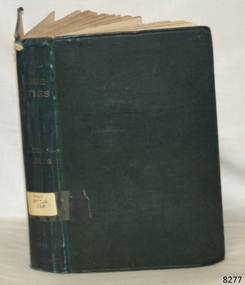
Book - Fictional Novel, Henry James Jr, Tales of Three Cities, 1884
... Henry James Jr...The label on the spine cover with typed text PAT 813.4 JAM Paste down front end paper has a sticker from Warrnambool Mechanics Institute and Free Library Front loose end paper has a sticker from Corangamite Regional Library Service Front loose end paper has a stamp from Corangamite Regional Library Service Flyleaf has a stamp from Warrnambool Mechanics Institute and Free Library Hard cover book, Tales of Three Cities Author: Henry James Publisher: Macmillan And Co Date: 1884 Blue cloth hardcover and spine with spine lettering in black texter. The spine has a Library label with inscription. Tales of Three Cities Book Fictional Novel Henry James Jr ...The novel Tales of Three Cities (1884) is not a single narrative, but rather a collection of three distinct novellas inspired by Henry James’s travels and his deep fascination with regional and transatlantic cultural clashes. The first novella, ‘Lady Barberina’, is a classic exploration of James’s famous ‘international theme’. It focuses on the marriage between a wealthy American doctor and an aristocratic Englishwoman, exposing the rigid social expectations of British high society. The second, ‘A New England Winter’, is a witty, satirical look at the distinct social nuances, manners, and artistic attitudes dividing New York and Boston. The third, ‘The Impressions of a Cousin’, is a story structured around a young woman’s personal journal, detailing a complex web of family relationships, trust, and art.Hard cover book, Tales of Three Cities Author: Henry James Publisher: Macmillan And Co Date: 1884 Blue cloth hardcover and spine with spine lettering in black texter. The spine has a Library label with inscription.fictionThe novel Tales of Three Cities (1884) is not a single narrative, but rather a collection of three distinct novellas inspired by Henry James’s travels and his deep fascination with regional and transatlantic cultural clashes. The first novella, ‘Lady Barberina’, is a classic exploration of James’s famous ‘international theme’. It focuses on the marriage between a wealthy American doctor and an aristocratic Englishwoman, exposing the rigid social expectations of British high society. The second, ‘A New England Winter’, is a witty, satirical look at the distinct social nuances, manners, and artistic attitudes dividing New York and Boston. The third, ‘The Impressions of a Cousin’, is a story structured around a young woman’s personal journal, detailing a complex web of family relationships, trust, and art.flagstaff hill, warrnambool, shipwrecked coast, flagstaff hill maritime museum, maritime museum, shipwreck coast, flagstaff hill maritime village, great ocean road, book, pattison collection, warrnambool library, warrnambool mechanics’ institute, ralph eric pattison, corangamite regional library service, warrnambool city librarian, mechanics’ institute library, victorian library board, warrnambool books and records, warrnambool children’s library, tales of three cities, henry james -
 Flagstaff Hill Maritime Museum and Village
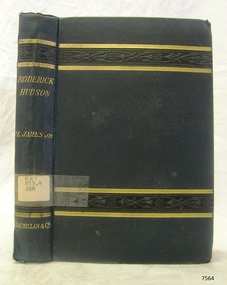
Book, Roderick Hudson
... Roderick Hudson Author: Henry James Jr Publisher: MacMillian & Co Dated: 1880 ...Label on spine has typed text PAT 813.4 JAM Pastedown front endpaper has sticker from Warrnambool Mechanics Institute and Free Library Front loose endpaper has a sticker from Corangamite Regional Library Service Roderick Hudson Author: Henry James Jr Publisher: MacMillian & Co Dated: 1880 Roderick Hudson Book ...This item is from the ‘Pattison Collection’, a collection of books and records that was originally owned by the Warrnambool Mechanics’ Institute, which was founded in Warrnambool in 1853. By 1886 the Warrnambool Mechanics’ Institute (WMI) had grown to have a Library, Museum and Fine Arts Gallery, with a collection of “… choice productions of art, and valuable specimens in almost every branch and many wonderful national curiosities are now to be seen there, including historic relics of the town and district.” It later included a School of Design. Although it was very well patronised, the lack of financial support led the WMI in 1911 to ask the City Council to take it over. In 1935 Ralph Pattison was appointed as City Librarian to establish and organise the Warrnambool Library as it was then called. When the WMI building was pulled down in 1963 a new civic building was erected on the site and the new Warrnambool Library, on behalf of the City Council, took over all the holdings of the WMI. At this time some of the items were separated and identified as the ‘Pattison Collection’, named after Ralph Pattison. Eventually the components of the WMI were distributed from the Warrnambool Library to various places, including the Art Gallery, Historical Society and Flagstaff Hill. Later some were even distributed to other regional branches of Corangamite Regional Library and passed to and fro. It is difficult now to trace just where all of the items have ended up. The books at Flagstaff Hill Maritime Village generally display stamps and markings from Pattison as well as a variety of other institutions including the Mechanics’ Institute itself. RALPH ERIC PATTISON Ralph Eric Pattison was born in Rockhampton, Queensland, in 1891. He married Maude Swan from Warrnambool in 1920 and they set up home in Warrnambool. In 1935 Pattison accepted a position as City Librarian for the Warrnambool City Council. His huge challenge was to make a functional library within two rooms of the Mechanics’ Institute. He tirelessly cleaned, cleared and sorted a disarrayed collection of old books, jars of preserved specimens and other items reserved for exhibition in the city’s museum. He developed and updated the library with a wide variety of books for all tastes, including reference books for students; a difficult task to fulfil during the years following the Depression. He converted all of the lower area of the building into a library, reference room and reading room for members and the public. The books were sorted and stored using a cataloguing and card index system that he had developed himself. He also prepared the upper floor of the building and established the Art Gallery and later the Museum, a place to exhibit the many old relics that had been stored for years for this purpose. One of the treasures he found was a beautiful ancient clock, which he repaired, restored and enjoyed using in his office during the years of his service there. Ralph Pattison was described as “a meticulous gentleman whose punctuality, floorless courtesy and distinctive neat dress were hallmarks of his character, and ‘his’ clock controlled his daily routine, and his opening and closing of the library’s large heavy doors to the minute.” Pattison took leave during 1942 to 1942 to serve in the Royal Australian Navy, Volunteer Reserve as Lieutenant. A few years later he converted one of the Museum’s rooms into a Children’s Library, stocking it with suitable books for the younger generation. This was an instant success. In the 1950’s he had the honour of being appointed to the Victorian Library Board and received more inspiration from the monthly conferences in Melbourne. He was sadly retired in 1959 after over 23 years of service, due to the fact that he had gone over the working age of council officers. However he continued to take a very keen interest in the continual development of the Library until his death in 1969. The Pattison Collection, along with other items at Flagstaff Hill Maritime Village, was originally part of the Warrnambool Mechanics' Institute’s collection. The Warrnambool Mechanics’ Institute Collection is primarily significant in its totality, rather than for the individual objects it contains. Its contents are highly representative of the development of Mechanics' Institute libraries across Australia, particularly Victoria. A diversity of publications and themes has been amassed, and these provide clues to our understanding of the nature of and changes in the reading habits of Victorians from the 1850s to the middle of the 20th century. The collection also highlights the Warrnambool community’s commitment to the Mechanics’ Institute, reading, literacy and learning in the regions, and proves that access to knowledge was not impeded by distance. These items help to provide a more complete picture of our community’s ideals and aspirations. The Warrnambool Mechanics Institute book collection has historical and social significance for its strong association with the Mechanics Institute movement and the important role it played in the intellectual, cultural and social development of people throughout the latter part of the nineteenth century and the early twentieth century. The collection of books is a rare example of an early lending library and its significance is enhanced by the survival of an original collection of many volumes. The Warrnambool Mechanics' Institute’s publication collection is of both local and state significance. Roderick Hudson Author: Henry James Jr Publisher: MacMillian & Co Dated: 1880 Label on spine has typed text PAT 813.4 JAM Pastedown front endpaper has sticker from Warrnambool Mechanics Institute and Free Library Front loose endpaper has a sticker from Corangamite Regional Library Service -
 Flagstaff Hill Maritime Museum and Village
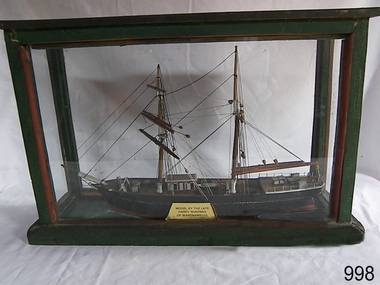
Craft - Ship Model, Mary Campbell, circa 1940
... James and Helen had ten children: James Arthur (Jnr), Henry William, Nellie Jessie, Alfred Albert, Rubena Nellie, De Jersy Norman, Clifford Beckett, Olive Ida, Frances Ridley Havergal and Nellie Elvie, all born in Victoria. THE MARY CAMPBELL The ship “Mary Campbell” was built by Alexander Newton Jr...James and Helen had ten children: James Arthur (Jnr), Henry William, Nellie Jessie, Alfred Albert, Rubena Nellie, De Jersy Norman, Clifford Beckett, Olive Ida, Frances Ridley Havergal and Nellie Elvie, all born in Victoria. THE MARY CAMPBELL The ship “Mary Campbell” was built by Alexander Newton Jr ...This ship model is of the sailing brigantine MARY CAMPBELL, which once belonged to Captain James Arthur Robilliard. The model was made by Harry McKenna, a well-known ship model maker and Warrnambool resident. CAPTAIN ROBILLIARD James Arthur Robilliard, sea captain and tent maker, was born in 19th April 1843 in St. Helier, Jersey, Channel Islands. He trained there in his father’s sail loft as a sailmaker. He later became a skipper. His first job was as a sailor in Liverpool, England. In 1875, James Robilliard migrated to Australia as a mate on the “E.M. Young”. Captain Robilliard and his family were amongst the early settlers along the Curdies River in the Heytesbury district. In 1877, he became a Captain. On 14th November 1879, Captain Robilliard married Helen Beckett. James and Helen had ten children: James Arthur (Jnr), Henry William, Nellie Jessie, Alfred Albert, Rubena Nellie, De Jersy Norman, Clifford Beckett, Olive Ida, Frances Ridley Havergal and Nellie Elvie, all born in Victoria. THE MARY CAMPBELL The ship “Mary Campbell” was built by Alexander Newton Jr. She was carvel-planked, of iron bark and blue gum timber. The family shipyard was at Pelican, on the Manning River, NSW, and “Mary Campbell” was first launched by her builder in 1869 as “The Son”. Three months later, she was renamed “Mary Campbell’ by her purchaser J. Campbell in Sydney. She was used to carry equipment for the Sydney Sugar Refinery’s Mill in Southgate, NSW. She then traded for the next 20 years between Australian ports and rivers along the east coast, as well as regular ports in New Zealand. She was “recognised as one of the best carrying little vessels in the timber trade” (Sydney Morning Herald). She had several owners over this time, the last one being Captain James A. Robilliard. On 29th April 1889, “Mary Campbell”, in the charge of her owner, Captain James A Robilliard, was on her way from Clarence River, NSW to Melbourne, Victoria with a cargo of railway girders for the Melbourne Harbour Trust. Captain Robilliard encountered a storm off Port Macquarie. He sailed the vessel south to 25 miles (about 40km) east of Cape Hawke, near Tuncurry and Forster. At 7 pm, he discovered that the cargo had shifted during the stormy seas and the heavy girders had damaged the hull, causing a leak. The pumps were inadequate to stem the fast-flowing leak, and over a meter of water filled the hull during the next 2 hours. Some of the crew began throwing the cargo overboard to lighten the vessel, hoping to keep it afloat until daylight. When the water reached over 2 meters in the hull, they realised their efforts were in vain. At 1:30 am on 30th April 1889, the crew left the vessel. They stood by in the lifeboat until 3 am. The ship was sinking fast, so they left for the shore, looking for a safe place to beach their boat. While still miles off Cape Hawke, all 7 crew members, including the Captain, were rescued by the Government Tug “Rhea” and taken to Port Macquarie hospital, then returned to Sydney in the “Wellington”. Captain Robilliard managed to rescue his ship’s compass, but no cargo was saved from the vessel. It had been under-insured, only covered for half its value, due to a lack of funds. Many years later, in 1976, an anchor was caught up in the net of a trawler south of Forster and thought to be from the “Mary Campbell”. It was donated and installed in the Great Lakes Museum, Tuncurry, NSW. (The same museum also has a half-model of the hull of “Mary Campbell”.) The name of the last ship Captain Robilliard sailed is currently unknown; however, he sailed that ship from the port of Marlborough, Queensland, carting steel railway girders for the Geelong-to-Camperdown line. On one trip, it hit a storm, the cargo shifted, and the ship was wrecked along the NSW coast. After this, Captain Robilliard exchanged sea life for farming in Peterborough. In about 1897, verging on retirement, Capt. Robiilliard superintended the Melbourne Sailors’ Home in Spencer Street, Melbourne, before being asked to leave this position in 1902 for trying to shut down the local hotel! At this time, the Melbourne Sailors’ Home was about to change its location. On 6th May 191,7, Captain James Arthur Robilliard J.P. died at Blackwood Park, in the Cobden district of Brucknell, which is now considered the first official Robilliard family homestead in Australia. He was buried in the Melbourne General Cemetery, Victoria. His wife, Helen, passed away in 1947. The Becket and Robilliard family names continue to be well known in the Western District. Flagstaff Hill Maritime Village also has a ship’s compass in the collection that was owned by Capt. J. Robilliard and used on the ship Mary Campbell.This ship model of the MARY CAMPBELL is of local significance for its association with well well-known Warrnambool resident and ship model maker. The model is also significant for its association with the brigantine MARY CAMPBELL, a trading vessel that brought railway girders to the Melbourne Harbour Trust.Ship model "Mary Campbell": a two-masted vessel with black hull, brown masts and black rigging, displayed in a glass case with a timber frame painted green. Made by Harry McKenna.Painted on the bow in white “MARY CAMPBELL” Gold label with black print attached to display case “MODEL BY THE LATE HARRY McKENNA OF WARRNAMBOOL”flagstaff hill, warrnambool, shipwrecked coast, flagstaff hill maritime museum, maritime museum, shipwreck coast, flagstaff hill maritime village, great ocean road, marine artwork, model making, captain james arthur robilliard, j.a. robilliard, vessel mary campbell, ship mary campbell, melbourne sailors home, vessels, harry mckenna, mary campbell
