Showing 10 items matching "heritage breed"
-
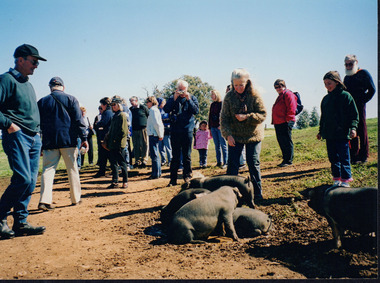
Wooragee Landcare GroupPhotograph, 5 September 2004
... ...Heritage breed...The Large Black Pig breed is a traditional, heritage breed that was first imported to Australia from the UK in the early 1900's. ...The Large Black Pig breed is a traditional, heritage breed that was first imported to Australia from the UK in the early 1900's. ...This photograph was taken at Samaria Farm on Sunday the 5th of September when Wooragee Landcare Group took a bus trip to the Tatong area (near Benalla) to look at land use on small farms. The day trip was organised to observe land use on small farms as well as a social event for the Group. Samaria Farm at the time was a nine-hectare property located in northeast Victoria, near Mount Samaria, 130 km Northeast of Melbourne. The photograph features several pigs believed to be the breed called Large Black. The Large Black Pig breed is a traditional, heritage breed that was first imported to Australia from the UK in the early 1900's. It is believed to have originated from the Old English Hog of the 16th and 17th Centuries. The first reference to them in the Australian Pure Bred Pig Herd Book was in 1912. They are a black pig with lop ears and were prized for their superior milking and mothering abilities and soon became popular with early Dairy Farmers who fed them whey from separated milk as part of their butter making process. They proved economical to keep and, being excellent grazing pigs, were also used to pick up windfall fruit in orchards. Their black colouring also enabled them to withstand the hot Australian summers and avoid sunburn which combined with their hardiness and docile temperament made them highly suitable for free-range pork production, however Large Black pigs tend to get very fat and were not suitable for intensive farming so were often crossed with other breeds for pork production. They are now quite rare as a pure breed having been on the edge of extinction for some time. They were rescued in the early 1990s by a rare breeds farmer in the Yarra Ranges. These days they are also the focus of a small conversation effort with six registered breeders currently in Australia. For biosecurity reasons there are no imports of live pigs or pig semen permitted into Australia. This photograph shows a group of people attending one of the events that Wooragee Landcare Group has organized within the educational framework of promoting best land management practices for all types of land uses and ensuring sustainability, in addition to encouraging community interaction via social events. The Large Black pig breed is significant because of their role in early Victorian farming. They are now quite rare as a pure breed having been on the edge of extinction for some time. These days they are the focus of a small conversation effort with six registered breeders currently in Australia. For biosecurity reasons there are no imports of live pigs or pig semen permitted into Australia. Wooragee Landcare Group is important to local community landcare and environmental management practices.Colour rectangular photograph printed on paperObverse: WAN NA EONA2N2. ANN+ 3 4240/ (No. 17) 370samaria farm, wooragee landcare, wooragee landcare group, tatong, benalla, black pigs, large black, traditional breed, heritage breed, pigs, lop ears, free range pork production, early victorian farming -

Emerald Museum & Nobelius Heritage ParkMachine - Chaff cutter, Nourrisseur Japy, c1920s-1940s
... Emerald Museum & Nobelius Heritage Park 5 Crichton Rd Emerald yarra-valley-and-the-dandenong-ranges This small hand-operated chaff cutter was designed for generating feed for poultry. It was owned by Dr Murphy, Emerald's first and much-loved doctor, who moved to Emerald in the 1940s planning to breed turkeys. ...This small hand-operated chaff cutter was designed for generating feed for poultry. It was owned by Dr Murphy, Emerald's first and much-loved doctor, who moved to Emerald in the 1940s planning to breed turkeys.This chaff cutter is significant because it recalls some early farming practices and because it was owned by a well-known Emerald doctor.Small iron chaff cutter consisting of two toothed wheels to grip and feed grasses etc. to the cutter blades by means of toothed cogs connected to a screw threaded central shaft. On outer frame: 'NOURRISEUR JAPY'chaff cutter, nourrisseur japy, dr murphy, 1940s -
Emerald Museum & Nobelius Heritage ParkPhotograph - Photograph of Dr Ian Stephen MacLeod Murphy
... Emerald Museum & Nobelius Heritage Park 5 Crichton Rd Emerald yarra-valley-and-the-dandenong-ranges This is a copy of a photograph of Dr Ian 'Spud' MacLeod Murphy c1960s. Dr Murphy retired to Clematis in 1947 intending to breed ...This is a copy of a photograph of Dr Ian 'Spud' MacLeod Murphy c1960s. Dr Murphy retired to Clematis in 1947 intending to breed turkeys but instead responded to the community need for a GP. For the next 34 years, he was Emerald's GP working seven days a week and travelling all over the hills without assistance.Dr Murphy was Emerald's first and much-loved GP. His work for the community over 34 years was of immense benefit. He was awarded the British Empire Medal in 1977 for his service to the health of the community.Black and white photograph of Dr Murphy - head and shoulders - wearing suit and tiedr ian macleod murphy, spud murphy, doctor, emerald, 1960s -
Emerald Museum & Nobelius Heritage ParkPhotograph - Photograph of Dr Ian Stephen MacLeod Murphy at age 21
... Emerald Museum & Nobelius Heritage Park 5 Crichton Rd Emerald yarra-valley-and-the-dandenong-ranges This is a copy of a photograph of Dr Ian 'Spud' MacLeod Murphy aged 21 years old. Dr Murphy retired to Clematis in 1947 intending to breed ...This is a copy of a photograph of Dr Ian 'Spud' MacLeod Murphy aged 21 years old. Dr Murphy retired to Clematis in 1947 intending to breed turkeys but instead responded to the community need for a GP. For the next 34 years, he was Emerald's GP working seven days a week without assistance and travelling all over the hills.Dr Murphy was Emerald's first and much-loved GP. His work for the community over 34 years was of immense benefit. He was awarded the British Empire Medal in 1977 for his service to the health of the community.Black and white photograph of headshot of Dr Murphy, wearing a suit and tieOn back of image, printed: "NIKOLAI ROSS / STUDIOS / ARTIST - PHOTOGRAPHER / LYCEUM HOUSE / 214 PITT ST. SYDNEY"dr ian macleod murphy, spud murphy, doctor, emerald -
Emerald Museum & Nobelius Heritage ParkAward - Wooden shield commemorating rowing regatta wins
... Emerald Museum & Nobelius Heritage Park 5 Crichton Rd Emerald yarra-valley-and-the-dandenong-ranges This shield belonged to Dr Ian 'Spud' MacLeod Murphy (1905 - 1981) and was presumably awarded to him when he was the cox of the winning Geelong College team in the Head of the River competitions (rowing regattas) in 1921 and 1922. He attended Geelong College 1919-1922 and later, Melbourne University (1929-1937). Dr Murphy retired to Emerald in 1947 intending to breed ...This shield belonged to Dr Ian 'Spud' MacLeod Murphy (1905 - 1981) and was presumably awarded to him when he was the cox of the winning Geelong College team in the Head of the River competitions (rowing regattas) in 1921 and 1922. He attended Geelong College 1919-1922 and later, Melbourne University (1929-1937). Dr Murphy retired to Emerald in 1947 intending to breed turkeys but instead responded to the community need for a GP. For the next 34 years, he was Emerald's GP working seven days a week without assistance and travelling all over the hills. He was awarded the British Empire Medal in 1977 for devotion to the health of the community. He died in 1981 at the age of 76 years and a Memorial Fund was set up in his name to provide support for local students studying Medicine.Dr Murphy was Emerald's first and much-loved GP. His work for the community over 34 years was of immense benefit to Emerald and surrounding districts. Wooden shield with green and white stripes painted around edges and green and white crossed oars in the centre. A partly torn off sticker of Pegasus (Greek mythological winged horse and motif of Geelong College) is above the crossed oars. On front below crossed oars is handwritten two lists of team members of winning teams of 1921 and 1922. On back handwritten 'Murphy'dr ian macleod murphy, spud murphy, doctor, emerald, geelong college -
Emerald Museum & Nobelius Heritage ParkProgramme - Menu for Boat Race Night at Scott's Hotel 1926, 1926
... Heritage Park 5 Crichton Rd Emerald yarra-valley-and-the-dandenong-ranges This programme belonged to Dr Ian 'Spud' MacLeod Murphy (1905-1981). It is dated 8 May 1926 and relates to a celebration dinner for a rowing regatta - when Dr Murphy was a young man. He had been the cox of two Premier rowing teams in 1921 and 1922 and also later when he was at Melbourne University. Dr Murphy retired to Clematis in 1947 intending to breed ...This programme belonged to Dr Ian 'Spud' MacLeod Murphy (1905-1981). It is dated 8 May 1926 and relates to a celebration dinner for a rowing regatta - when Dr Murphy was a young man. He had been the cox of two Premier rowing teams in 1921 and 1922 and also later when he was at Melbourne University. Dr Murphy retired to Clematis in 1947 intending to breed turkeys but instead responded to the community need for a GP and worked for 34 years seven days a week without assistance providing medical services throughout the district. He was awarded the British Empire Medal in 1977 for his service to the health of the community.Dr Murphy was Emerald's first and much-loved GP. His work for the community over 34 years was of immense benefit to Emerald and surrounding districts. Programme for a Boat Race Dinner (1926) consisting of a folder with a red tie, an image of two oarsmen on the front and inside the menu for the occasion.On front below crossed oars is handwritten two lists of team members of winning teams of 1921 and 1922. On back handwritten 'Murphy'dr ian macleod murphy, spud murphy, doctor, emerald, boat race -
Emerald Museum & Nobelius Heritage ParkBadge - Hospital Badge, 1930s
... Emerald Museum & Nobelius Heritage Park 5 Crichton Rd Emerald yarra-valley-and-the-dandenong-ranges This badge belonged to Dr Ian 'Spud' MacLeod Murphy (1905-1981) when he was a doctor at the Royal Melbourne Hospital in the 1930s. R.M.H.S.C. stands for 'Royal Melbourne Hospital Surgeons College'. (This RMH logo was not modernised until 2023.) Dr Murphy retired to Emerald in 1947 intending to breed ...This badge belonged to Dr Ian 'Spud' MacLeod Murphy (1905-1981) when he was a doctor at the Royal Melbourne Hospital in the 1930s. R.M.H.S.C. stands for 'Royal Melbourne Hospital Surgeons College'. (This RMH logo was not modernised until 2023.) Dr Murphy retired to Emerald in 1947 intending to breed turkeys but instead responded to the community need for a GP. For the next 34 years, he was Emerald's GP working seven days a week and travelling all over the hills without assistance. He was awarded the British Empire Medal in 1977 for devotion to the health of the community. He died in 1981 at the age of 76 years and a Memorial Fund was set up in his name to provide support for local students studying Medicine.Dr Murphy's work for the community over 34 years as a GP was of immense benefit to Emerald and surrounding districts. Hospital badge - navy felt background - Royal Melbourne Hospital logo embroidered with (Latin) mottoOn front of badge embroidered: 'Miseris Succurrere Disco / R.M.H.S.C.'dr ian macleod murphy, spud murphy, doctor, emerald, royal melbourne hospital -
Healesville Sanctuary Heritage Centreframed car sticker, Lynette Kennedy
... Heritage Centre A promotional car sticker of Healesville Sanctuary specialising in Australian Fauna and Flora. This item was displayed at the front entrance to encourage visitors to purchase and promote the Sanctuary. This car sticker was a very popular and sought after souvenir selling for 25 cents contributing to the Sanctuary's income. Healesville Sanctuary was the first institution to breed ...A promotional car sticker of Healesville Sanctuary specialising in Australian Fauna and Flora. This item was displayed at the front entrance to encourage visitors to purchase and promote the Sanctuary. This car sticker was a very popular and sought after souvenir selling for 25 cents contributing to the Sanctuary's income. Healesville Sanctuary was the first institution to breed platypus in a total captive situation.and is also the only institution in the world to breed LyrebirdsA promotional circular car sticker depicting a lyrebird tail in full display above a platypus side on. Has dark green border at ouside edge of sticker; colours are black, gold and green. Sticker is in a wooden glass frame and has a dynamo label glued to upper edge of glass. There are 2 eye hooks screwed into the upper edge of frame. Inscription on car sticker is "Sir Colin MacKenzie Sanctuary" on the bottom half of the perimeter circle. With "Healesville" at top of perimeter of circle. At the top of the inner circle the word "Victoria" is placed above a green horizontal band which reads "The Wild-life Sanctuary".healesville-sanctuary, first-institution, breeding, platypus, lyrebird -
Healesville Sanctuary Heritage CentreNewspaper - Newspaper Cutting, Report, The Herald Melbourne, Sanctuary needs more land, 8 October 1945
... Healesville Sanctuary Heritage Centre 1940s Present area of the Sanctuary is only 78 acres. Requires more land not only to breed our familiar animals but those which are threatened with extinction. ...Present area of the Sanctuary is only 78 acres. Requires more land not only to breed our familiar animals but those which are threatened with extinction.photocopyPresent area of the Sanctuary is only 78 acres. Requires more land not only to breed our familiar animals but those which are threatened with extinction. 1940s -
Healesville Sanctuary Heritage CentreNewspaper, 1953
... Healesville Sanctuary Heritage Centre 1950s Bronx Zoo found platypus had not breed when they excavated burrow original Newspaper ...Bronx Zoo found platypus had not breed when they excavated burroworiginalnon-fictionBronx Zoo found platypus had not breed when they excavated burrow1950s