
Showing 20 items matching "heritage mosaic"
-
 Bendigo Historical Society Inc.
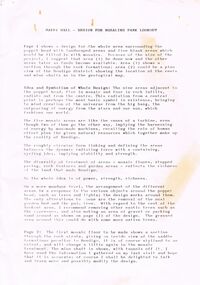
Document - MERLE HALL COLLECTION: DOCUMENTS RELATING TO HERITAGE MOSAIC
... MERLE HALL COLLECTION: DOCUMENTS RELATING TO HERITAGE MOSAIC......Heritage Mosaic...Various documents relating to Heritage Mosaic project Bi-fold A4 flyer : Bendigo Heritage Mosaic - Rosalind Park Lookout includes description, background and illustrative sketch of Mosaic area; List of contacts re possible Mosaic Project 7/3/01 a list of Bendigo facilities contacted and agreed to letters of support; form letter dated 3/8/2001to agencies/organizations re support for submission for series of small mosaic pieces along the Linear Pathway adjacent to the Bendigo Creek; memo to Bernard Smith from Judy MacDonald (BRAC) re plans for Lookout Mosaic (with the attached design details from Maery Hall (3 sheets of sketches and photograph are said to be attached but not now)....Document MERLE HALL COLLECTION: DOCUMENTS RELATING TO HERITAGE MOSAIC ...Various documents relating to Heritage Mosaic project Bi-fold A4 flyer : Bendigo Heritage Mosaic - Rosalind Park Lookout includes description, background and illustrative sketch of Mosaic area; List of contacts re possible Mosaic Project 7/3/01 a list of Bendigo facilities contacted and agreed to letters of support; form letter dated 3/8/2001to agencies/organizations re support for submission for series of small mosaic pieces along the Linear Pathway adjacent to the Bendigo Creek; memo to Bernard Smith from Judy MacDonald (BRAC) re plans for Lookout Mosaic (with the attached design details from Maery Hall (3 sheets of sketches and photograph are said to be attached but not now).merle hall collection, rosalind park, heritage mosaic -
 Bendigo Historical Society Inc.
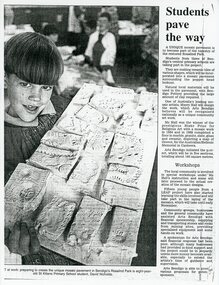
Article - MERLE HALL COLLECTION: ROSALIND PARK CREATIVE VILLAGE BENDIGO NEWSPAPER ARTICLES, 1997
... Opening paragraphs of the article: Arts Bendigo and the City of Greater Bendigo are paving the way to an improved Rosalind Park with the official opening of the 'Bendigo Heritage Mosaic'. The mosaic is more than 100 square meters of decorated pavement sections surrounding the poppet head lookout at the park. ...Opening paragraphs of the article: Arts Bendigo and the City of Greater Bendigo are paving the way to an improved Rosalind Park with the official opening of the 'Bendigo Heritage Mosaic'. The mosaic is more than 100 square meters of decorated pavement sections surrounding the poppet head lookout at the park. ...MERLE HALL COLLECTION: ROSALIND PARK CREATIVE VILLAGE BENDIGO NEWSPAPER ARTICLES 3858.9a Young boy holding a board of mosaic tiles probably at a workshop. Article begins: A unique mosaic pavement is to become part of the tapestry of the restored Rosalind Park. Students from three of Bendigo's central primary schools are taking part in the project. Photo Caption reads ART at work: preparing to create the unique mosaic pavement in Bendigo's Rosalind Park is eight-year-old St Killians Primary School student, David Nicholds. 3858.9b A newspaper coloured photo from the poppet head of two young people standing on and looking down on the mosaic at the lookout. Caption reads: Passing students take a keen interest in the new-look base of the Rosalind Park poppet head. The mosaic was created through an Art Bendigo project. LEAP workers helped install the five sections using stone tiles made by local primary school students. Depicting the saddle reef formations in the area the work has been designed and created by Bendigo artist Maery Hall. Picture: Peter Hyett. 3858.9c A photo from the poppet head lookout looking down at a worker with a broom, sweeping the mosaic. 3858.9d Two women crouching on the ground viewing the work done on the mosaic. One woman holds books and papers; in the far background over the carpark is the Sacred Heart Cathedral, the Bendigo Art Gallery and the Capital Theatre. 3858.9e Newspaper article along with coloured photo of the poppet head lookout in Bendigo's Rosalind Park. In the foreground are two young people arranging the mosaics. The article begins: Mosaic pavements began taking shape at the base of the Rosalind Park poppet head lookout yesterday. The pavement will cover about 130 square meters, in five sections, and have been designed as a memorial to Bendigo's mining history and traditions. 3858.9f Newspaper article July 29, 1997 entitled 'Bendigo Paving the Way' - photo of artist Maery Gabriel at the official opening of the heritage mosaic. Pictures: Tania Bond. Photo of Maery taken from the poppet head looking down on the mosaic. Als a smaller photo with details of the mosaic design. Opening paragraphs of the article: Arts Bendigo and the City of Greater Bendigo are paving the way to an improved Rosalind Park with the official opening of the 'Bendigo Heritage Mosaic'. The mosaic is more than 100 square meters of decorated pavement sections surrounding the poppet head lookout at the park. The paving was designed by mosaic artist Mary Gabriel and depicts Bendigo's mining history and colour throughout.bendigo creative village, rosalind park -
 Bendigo Historical Society Inc.
Document - SPECIMEN COTTAGE COLLECTION: VARIOUS DOCUMENTS
... Royal Flying Doctor Service 1963 coach run and the 1963 coach run itinerary. 4028.21 Various newspaper clippings on Rosalind Park. 4028.22 Rosalind Park discovery walk brochure and heritage mosaic Rosalind Park lookout brochure. 4028.23 Camp Reserve, Rosalind Park, used and abused by James Lerk, also newspaper articles by James Lerk about Rosalind Park and various other documents relating to the Park. 4028.24 Rotary Club History - A bulletin from 1971 and two cards in the name of Albert Richardson. 4028.25 History Lives: Bendigo east's Anzac Avenue photographs and documents. 4028.26 Short biography of John Walker. 4028.27 Restoring our heritage - The Beehive story. 4028.28 Documents about the Bendigo Advertiser, including historical notes by Carol Holsworth and notes given in 2005 by Leanne Younes. 4028.29 Document - National Trust of Australia: City of Bendigo abattoirs (form, 47 Lansell Street. 4028.30 The Alexandra Fountain by Lucy Williams also newspaper clippings and a document from the RHSV. 4028.31 Newspaper clippings and correspondence on the demolition of the A.N.A. building....Royal Flying Doctor Service 1963 coach run and the 1963 coach run itinerary. 4028.21 Various newspaper clippings on Rosalind Park. 4028.22 Rosalind Park discovery walk brochure and heritage mosaic Rosalind Park lookout brochure. 4028.23 Camp Reserve, Rosalind Park, used and abused by James Lerk, also newspaper articles by James Lerk about Rosalind Park and various other documents relating to the Park. 4028.24 Rotary Club History - A bulletin from 1971 and two cards in the name of Albert Richardson. 4028.25 History Lives: Bendigo east's Anzac Avenue photographs and documents. 4028.26 Short biography of John Walker. 4028.27 Restoring our heritage - The Beehive story. 4028.28 Documents about the Bendigo Advertiser, including historical notes by Carol Holsworth and notes given in 2005 by Leanne Younes. 4028.29 Document - National Trust of Australia: City of Bendigo abattoirs (form, 47 Lansell Street. 4028.30 The Alexandra Fountain by Lucy Williams also newspaper clippings and a document from the RHSV. 4028.31 Newspaper clippings and correspondence on the demolition of the A.N.A. building. ...Various documents in plastic folders. The topics are: 4028.1. The Myer story - articles on the history of the Myer family and business. 4028.2 The history of the Bendigo Railway and memoirs of early train travel by Bob Carr. 4028.3 Victorian history of railway and Bendigo, linking a state. 4028.4 A brief history of steam locomotives R711 and R766. 4028.5 Bendigo Advertiser article: coming of the railway with 4 photos. 4028.6 Celebrating 150 years of rail in Bendigo brochure plus postcard and Bendigo Railway Museum newsletter. 4028.7 Phoenix FM radio interview 13th September 2011. interviewer John Hall, guest: Garry Long, Convenor friends of the Bendigo-Kilmore rail trail. 4028.8 Mail by rail by Tom Luke and Railway history Leo Hogan. 4028.9 Document on the Red Ribbon Movement. 4028.10 Document - Sport in Bendigo in the early days. 4028.11 History of the Girton Church of England Girls' Grammar School with a list of prominent students. 4028.12 Bendigo's loss-Chinese secret society's gain? Talk given by Carol Holsworth. 4028.13 Document - Bendigo in the fifties. 4028.14 Jones, Miller & Co. history. 4028.15 Transcript of an audio tape by Cyril Michelsen, black and white photo and newspaper article. 4028.16 A garden history by Ken Maes. 4028.17 Document - Marsh and Scholten Coach builders. 4028.18 Notes from the diary of Thomas Ninnes, newspaper articles on the restoration of the Ninnes grave. 4028.19 Sandhurst 1853-54 The Southern world Rev. Robert Young. 4028.20 Correspondence from Cobb & Co. Royal Flying Doctor Service 1963 coach run and the 1963 coach run itinerary. 4028.21 Various newspaper clippings on Rosalind Park. 4028.22 Rosalind Park discovery walk brochure and heritage mosaic Rosalind Park lookout brochure. 4028.23 Camp Reserve, Rosalind Park, used and abused by James Lerk, also newspaper articles by James Lerk about Rosalind Park and various other documents relating to the Park. 4028.24 Rotary Club History - A bulletin from 1971 and two cards in the name of Albert Richardson. 4028.25 History Lives: Bendigo east's Anzac Avenue photographs and documents. 4028.26 Short biography of John Walker. 4028.27 Restoring our heritage - The Beehive story. 4028.28 Documents about the Bendigo Advertiser, including historical notes by Carol Holsworth and notes given in 2005 by Leanne Younes. 4028.29 Document - National Trust of Australia: City of Bendigo abattoirs (form, 47 Lansell Street. 4028.30 The Alexandra Fountain by Lucy Williams also newspaper clippings and a document from the RHSV. 4028.31 Newspaper clippings and correspondence on the demolition of the A.N.A. building.bendigo, businesses, buildings, heritage -
 Bendigo Historical Society Inc.
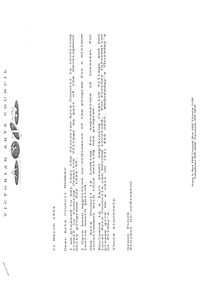
Letter - MERLE HALL COLLECTION: ROSALIND PARK CREATIVE VILLAGE BENDIGO PROJECT LETTERS, 1994
... Content: LEAP Project Proposal - Mining Heritage Mosaic outlining the benefits of using LEAP Trainees to undertake the project. ...Content: LEAP Project Proposal - Mining Heritage Mosaic outlining the benefits of using LEAP Trainees to undertake the project. ...Merle Hall Collection: Rosalind Park Creative Village Bendigo Project Letters 31 March 1994 To: Victorian Arts Council Members From Grant Finck Project Coordinator Content: Introduces himself as the coordinator for 12 months; to members looking for expression of interest, includes Information Sheet 1994 on what the Creative Village is. 27 October 1995 To: Mrs. Mearle Hall From: City of Greater Bendigo, Bernard Smith (Director Environmental Services) Content: Granting access to the Victoria Hill site for small quantities of geological material. 10 January 1996 To: Mrs. Mearle Hall From: City of Greater Bendigo, Bernard Smith (Director Environmental Services) Content: Endorsement of the project by the Council and confirmation that the Council will provide preliminary site work to allow the project to be enabled. Also advised the Arts Bendigo Mosaic Project makes contact with the Salvation Army (New Work Opportunity Project) 27 February 1996 To: Mrs. Mearle Hall From: Ken Beasley Manager Project Development The Smith Read Training Group. Content: LEAP Project Proposal - Mining Heritage Mosaic outlining the benefits of using LEAP Trainees to undertake the project. Proposed Scope of work outlining responsibilities of each participant. Bendigo Mining NL Environmental Trust Fund (Perseverance Exploration and Department of Energy and Minerals Victoria representatives) 27 June 1996 To: Mrs. Mearle Hall From: City of Greater Bendigo, Bernard Smith (Director Environmental Services) Content: Advising that the Council will match dollar for dollar funding for the engagement of an artist to supervise the construction of the Mosaic in Upper Rosalind Park up to $3,500. 22 July 1996 To: Anne Buzza From Geof Brown Camp Hill Primary School Content: Thanks for using and managing the school students to help create tiles. 9 October 1996 To: Mrs. Mearle Hall From: City of Greater Bendigo, Bernard Smith (Director Environmental Services) Content: Enclosed cheque for matching grant of $3500 15 October 1996 To: Mrs. Mearle Hall From: City of Greater Bendigo, Bernard Smith (Director Environmental Services) Content: Agreement to relocate the project facilities to the car park and to maintain a close liaison between the Council and Arts Bendigo. 13 November 1996 To: Mrs. Mearle Hall From: The Sidney Myer Fund Helen Morris Research Officer Content: Remittance advice for $1000 22 April 1997 To: Mrs. Mearle Hall From: John Little Administrator Victorian Arts Council Content: Remittance advice for $500 towards the project and enclosing 12 VAC Annual reports. 20 October 1998 To: Mrs. Mearle Hall From: City of Greater Bendigo, Andrew Hall (Director Community Development) Content: Advising that the Council will make a grant of $1090 for the purpose of printing of Brochures for Bendigo Heritage Mosaic. A service agreement to be signed before the issue of the grant, 21 March 2001 To: Mrs. Mearle Hall From: City of Greater Bendigo, Justin Hanney (Director Community Services) Content: A reference from Council supporting the project application to Vic Health for the development of a series of small mosaic pieces along the linear pathway asjacent to the Bendigo Creek. 12 November 1996 To: Mrs. Mearle Hall From: Arts Bendigo Inc. Content: Cheque for $2000 being first payment as under contract two for mosaic project. 4 December 1996 To: Mrs. Mearle Hall From: Arts Bendigo Inc. Content: Cheque for $2000 being second payment as under contract two for mosaic project. 27 July 1997 To: Maery Gabriel Mosaic Artist From: Arts Bendigo Inc. Content: Cheque for $2000 being final payment as under contract two for mosaic project. 12 June 1997 - Two copies To: Maery Gabriel Mosaic Artist From: Arts Bendigo Inc. Content: Agreement between Maery Gabriel (The artist) and Arts Bendigo Inc. to complete the final two sections of the Bendigo Heritage Mosaic at the base of the Rosalin Park Poppet Head, Bendigo with a design of approximately two square meters within each section. The work to be completed by the endo of July 1997, unless severe weather conditions make the laying impossible. Agreement for two lots of $2000. 14 June 1996 From: Maery Gabriel Mosaic Artist To: Arts Bendigo Inc. Content: receipt for 50% payment for two weeks and $60 Travelling expenses. 21 May 1996 Agreement between Arts Bendigo of P.O Box 563, Bendigo in the State of Victoria (hereinafter referred to as the ‘AB’ of the first part AND Meary Hall of Morningswood, Petersons Road, Ellinbank, 3821 in the State of Victoria (hereinafter referred to as ‘the artist’) of the second part. ENGAGEMENT: (a) AB engages the Artist to provide her services as Mosaic Artist for the design and creation of a Mosaic pavement surround to the poppet head lookout in Rosalind Park, Bendigo and matters incidental thereto at such schools, halls and any other places as required from time to time by AB and the Artist accepts the engagement upon the term and conditions hereinafter appearing. (b) Services to be provided by the artist include community consultation and design work in association with AB Co-Ordinator and Arts Bendigo, a minimum of six weeks of the artist’s time within the six months of the project. Completion of section one of the whole design with further work on the other sections to depend on available funding. The agreed fee was $5400 and $60 per visit to Bendigo with living away to be provided by Arts Bendigo 1 November 1996 Agreement between Arts Bendigo of P.O Box 563, Bendigo in the State of Victoria (hereinafter referred to as the ‘AB’ of the first part AND Meary Hall of Morningswood, Petersons Road, Ellinbank, 3821 in the State of Victoria (hereinafter referred to as ‘the artist’) of the second part. ENGAGEMENT: (a) AB engages the Artist to provide her services as Mosaic Artist for the design and creation of a Mosaic pavement surround to the poppet head lookout in Rosalind Park, Bendigo and matters incidental thereto at such schools, halls and any other places as required from time to time by AB and the Artist accepts the engagement upon the term and conditions hereinafter appearing. (b) Services to be provided by the artist include community consultation and design work in association with AB Co-Ordinator and Arts Bendigo, a minimum of six weeks of the artist’s time within the six months of the project. Completion of section one of the whole design with further work on the other sections to depend on available funding. The agreed fee was $5000 and $60 per visit to Bendigo with living away to be provided by Arts Bendigo, plus transfer of the diamond saw purchased by AB 28 August 1996 Memorial to Bendigo’s Mining Heritage and Traditions financial and other support as at August 128th Arts Bendigo Financial contribution: $7000 Local Busine Sponsors: $2800 City of Greater Bendigo Matching Above: $2800 City of Greater Bendigo Site works: Equiv, $12000 Local Businesses and institutions supplying goods and services to total value of: Equiv: $7600 Expenditure: Purchase of equipment, including diamond saw: $2000 Purchase of materials: $800 Artists design fees: $3000 Artists on site work, travel and accommodation: $12000 insurance, administration etc.: $700 31 May 1996 List of possible donors' checklist Undated Budget Sheet 21 September 1995 From: The Victorian Arts Council To: City of Greater Bendigo Content: Invoice for $5000 10 December 1995 From: Maery Gabriel artist To: Arts Bendigo Content: Invoice $1575 for design of Rosalind Park Lookout. 45 hours @ $35/hour 1 October 1996 Historic mining Mosaic Pavement, Rosalind Park Poppet Head Financial Statement as a October 1st, 1996 28 October 1996 From: Maery Gabriel To: Ann Buzza (representing Arts Bendigo) Report on project of Rosalind Park Mosaic as at October 1996. The report lists the difficulties faced with the weather, unsuitable facilities on site and problems with the LEAP team labour.victorian arts council, city of greater bendigo -
Bendigo Historical Society Inc.
Document - MERLE HALL COLLECTION: ROSALIND PARK CREATIVE VILLAGE BENDIGO PROJECT AND FINAL REPORTS, 1995
... June 1997 To: Public Content: A copy of Bendigo Heritage Mosaic City of Greater Bendigo plaque. 2nd September To: Attention Leanne McDonnell, Bendigo Advertiser From Arts Bendigo Merle Hall. ...June 1997 To: Public Content: A copy of Bendigo Heritage Mosaic City of Greater Bendigo plaque. 2nd September To: Attention Leanne McDonnell, Bendigo Advertiser From Arts Bendigo Merle Hall. ...MERLE HALL COLLECTION: ROSALIND PARK CREATIVE VILLAGE BENDIGO Project and Final Reports 11th August 1997 - three pages From: Merle Hall, Secretary Arts Bendigo To: Mike (final Media Release probably the Bendigo Advertiser) Content: Media Release two pages and a poem read out by Mosaic Artist Maery Gabriel (Hall) 'Reflections from Rosalind Park' Date Unknown: First invitation mail-out for C.V.T. Presentation and notes. Invitations to Felicity Kingerlee, Rod, Orr, Jane Cleary, Ian Stewart (Flora Hill Secondary College), Marion Stewart (White Hills Secondary College), Marion Wright, G. Maddams (& staff), Frank Ham, Tony Morris (Astronomy chap), Trevor Tonking (Cont. Ed.), Bernard smith and others at City of Bendigo, All A.B. Committee. Included are handwritten notes. Date Unknown: Two page document entitled: Enhancing the livable environment. Document contains details of the project, aims etc. 14th March 1995 To: The Greater City of Bendigo From Arts Bendigo Content: Two pages, a formal proposal for the involvement of the City of Greater Bendigo in the Creative Village project of the V.A.C. It contains information on Background, Concept, Implementation, Expected outcomes, Summary, Appendix 1 and 2 (Examples of the work of the artist). Date Unknown From John L. Content: one page of notes on similar projects and involvement by Arts Bendigo. The title of the document is Creative Village - Enhancing the Livable Environment. 5th September 1995 To: Members of the community who contributed ideas and suggestions From Arts Bendigo Ann Buzza and Merle Hall. Content: Invitation to attend a meeting with the Creative Village Team to view the Team's full report and explanation of designs etc. 9-10 June To: Participants in the Maery Hall Workshop From Arts Bendigo Ann Buzza and Merle Hall. Content: Location - ceramic department, Fine Arts building, Latrobe University Bendigo; access information and what to bring to the workshop. Date Unknown To: City of Greater Bendigo Content: Arts Bendigo commitment to the guidelines discussed with the relevant Council officers. Date Unknown To: City of Greater Bendigo From Arts Bendigo Content: Title - Historic Mining Mosaic Pavement at Rosalind Park Poppet Head. A report on the project so far. Typed and written notes. 28 July To: Public From Arts Bendigo Merle Hall. Content: Public invite to mark the completion of the project. June 1997 To: Public Content: A copy of Bendigo Heritage Mosaic City of Greater Bendigo plaque. 2nd September To: Attention Leanne McDonnell, Bendigo Advertiser From Arts Bendigo Merle Hall. Content: Media Release on 'The Laying Begins' Date Unknown To: Potential Donors From Arts Bendigo Merle Hall, sponsorship committee. Content: Description of the project titled 'Exciting Addition to Bendigo's Central Area. Date Unknown To: Potential Donors From Arts Bendigo Merle Hall, sponsorship committee. Content: Description of the project titled 'Exciting Addition to Bendigo's Central Area. Date Unknown List of LEAP team members for the project. Date Unknown To: Emma Power From Arts Bendigo Secretary Merle Hall. Content: three pages of information on the project (1. Intoduction 2. Small leaflet, prepared for visitors to the team 3. General outline of the project and the background on the Creative Village Team. 19-21 July To: All schools of the Bendigo area From: Merle Hall Secretary Arts Bendigo Content: An invitation for staff and students to visit the Creative Village Team during their time in Bendigo, at the Central Library on 19-21 July 19-21 July To: The Public From: Merle Hall Secretary Arts Bendigo Content: An invitation for staff and students to visit the Creative Village Team during their time in Bendigo, at the Central Library on 19-21 July 5th October 1995 To: Mr. Peter Seamer, Chief Executive Officer, City of Greater Bendigo. From Merle Hall Secretary Arts Bendigo Content: RE 'Creative village team report and ongoing plans' 14 March 1996 To: Committee of Arts Bendigo From: Ann Buzza Content: Two pages hand-written report on visit of Maery Hall ot Bendigo 14/3/96 Date Unknown To: Bernard Smith, City of Greater Bendigo From: Merle Hall, Secretary Arts Bendigo Content: A list of urgent requirements needed by May 24th, material list from council stock. 27 June 1996 To: The Professionals, 54 Mitchell Street Bendigo, Attention Stephen Carter From: Merle Hall, Secretary Arts Bendigo Content: Account for use of shop in Allan's walk and cheque. 2nd July 1996 To: Cr Megan Weston Mayor, city of Greater Bendigo, copy to Bernard Smith. From: Merle Hall, Secretary Arts Bendigo Content: Thank you for $3500 to match the Arts Bendigo sponsorship. 2 June 1996 To: James C Donnelly and associates, 5 School Lane, Wangi Wangi. From: Merle Hall, Secretary Arts Bendigo Content: Draft cover letter including a one page draft letter and a two page submission. James Donnelly was a parent of one of the LEAP workers who were helping on the project. James Donnelly had suggestions for approaching mining companies for potential sponsorship. 1st October 1996 To: Mr. D. Goldsworthy, City of Greater Bendigo From: Merle Hall, Secretary Arts Bendigo Content: Historic mining Mosaic Project, Rosalind Park Poppet Head. A formal submission for the council for some essential provisions for the extension of work on this project. 1st October 1996 To: Cr M. Weston, Mayor, City of Greater Bendigo. From: Merle Hall, secretary arts Bendigo Content: Three pages including a listing of income and costs to the project. 28th October 1996 To: Arts Bendigo From: Maery Hall Artist Content: two-page report on the status of the project and problems that have been faced. 19th To: Leanne (maybe the Bendigo Advertiser) From: Merle Hall, secretary arts Bendigo Content: two pages on the finished project (Bendigo's Newest attraction) 19th March 1997 To: Steve From: Merle Hall, secretary arts Bendigo Content: Asking for rough quotes for printing of brochures. Date Unknown To: The Bendigo Bank From: Merle Hall, secretary arts Bendigo Content: two pages seeking a sum of $1000 to complete the project. 28th April 1997 To: Suzi Birthisel, Sponsorship Coordinator, Bendigo bank, Fountain Court, Bendigo From: Merle Hall, secretary arts Bendigo Content: Asking for a small sum for production of coloured brochures Date Unknown To: Committee From: Merle Hall, secretary arts Bendigo Content: Suggested invitation list from 'Arts Victoria' to the Committee re the opening on 28th July of the Bendigo Heritage Mosaic. 28 July 1997 From: City of Greater Bendigo and Arts Bendigo to public Content: Invitation to a brief ceremony to mark the occasion of the completion of The Bendigo Heritage Mosaic at the Poppet Head Lookout, Rosalind Park on Monday 28 July 1997. 5th August 1999 From: Merle Hall, Secretary Arts Bendigo To: Cr. B. Ackerman, Mayor, City of Greater Bendigo. Content: A brief note from the committee of Arts Bendigo, in appreciation of your attendance and speech at the 'completion ceremony, last week. 30th October 1997 From Merle Hall, Secretary Arts Bendigo To: The National Community Links Awards, Category 1 - Arts and Culture Content: Included were Nomination Form, Written Statement as required under (5), a written reference from the mayor of the City of Greater Bendigo, two pages of photographs of the project, and five copies of a brochure printed to publicise the project. 2nd Feb 1998 From Merle Hall, Secretary Arts Bendigo To: Mrs. S. Parain, President, Regional Arts Fund Content: Regional Arts Fund Application, Sections 1 to 4 requesting a grant of $5197.00bendigo creative village, bendigo arts -
 Eltham District Historical Society Inc
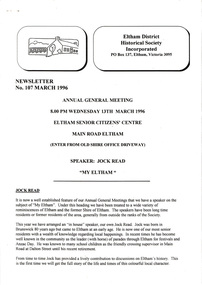
Newsletter, Newsletter, No. 107 March 1996
... Contents: • Next meeting, guest speaker; Jock Read: My Eltham • Jock Read • Montmorency Footpath Mosaics • Annual General Meeting • The Eltham Society • Alan Marshall Festival • High School Birthday • Society Program • Notice to Members 19th April 1996 o Furphy Festival o Victorian Heritage Festival ...Eltham District Historical Society Inc 728 Main Rd Eltham melbourne Contents: • Next meeting, guest speaker; Jock Read: My Eltham • Jock Read • Montmorency Footpath Mosaics • Annual General Meeting • The Eltham Society • Alan Marshall Festival • High School Birthday • Society Program • Notice to Members 19th April 1996 o Furphy Festival o Victorian Heritage Festival The Shire of Eltham Historical Society was formed in October 1967. ...Contents: • Next meeting, guest speaker; Jock Read: My Eltham • Jock Read • Montmorency Footpath Mosaics • Annual General Meeting • The Eltham Society • Alan Marshall Festival • High School Birthday • Society Program • Notice to Members 19th April 1996 o Furphy Festival o Victorian Heritage Festival The Shire of Eltham Historical Society was formed in October 1967. The first newsletter of the Society was issued May 1978 and has been published continuously ever since on a bi-monthly basis. With the cessation of the Shire of Eltham in late 1994, the Society's name was revised to Eltham District Historical Society and this name first appeared with issue No. 103, July 1995. The collection of the Society's newsletters provides a valuable resource on the history of the Society's activities, office bearers and committee members, guest speakers and subjects of historical interest pertinent to the former Shire of Eltham and the Eltham District.A4 photocopied newsletter distributed to membersnewsletter, eltham district historical society, shire of eltham historical society -
 City of Melbourne Libraries
Photograph, Bull, Hugh Jones, 1897-1993, Commercial Travellers' Association, Victoria, Board Room
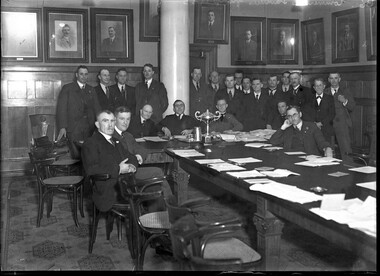
... In 1992, the CTA building at 328 Flinders Street was placed on the Victorian Heritage Register in recognition of its architectural and cultural significance. The building has been meticulously restored with many of the original fittings, decorative plasterwork, mosaic flooring, stained glass windows, columns, chandeliers and the panelling made from Australian timbers retained. ...In 1992, the CTA building at 328 Flinders Street was placed on the Victorian Heritage Register in recognition of its architectural and cultural significance. The building has been meticulously restored with many of the original fittings, decorative plasterwork, mosaic flooring, stained glass windows, columns, chandeliers and the panelling made from Australian timbers retained. ...Seven seated and fifteen standing men dressed in suits around a long table in a panelled room hung with formal portraits of men. A trophy sits on the long table amongst loose paper sheets. Research by project volunteer, Fiona Collyer: The Commercial Travellers’ Association of Victoria (CTA) was formed at a meeting of 40 commercial travellers held at the Duke of Rothesay Hotel, 24 Elizabeth Street on 1 December 1880. Their charter was to advocate for better working conditions for commercial travelling salesmen, including improved accommodation at discounted rates and travel concession fares. At first by locomotive, horse and buggy, steamers and horseback, later also by motor car and motorcycle, “The Man on the Road” went into the back-blocks of the country to extend the interests of commerce to the stores and households of Australian regional towns and isolated settlements. Affiliated organisations existed in all states and New Zealand and in 1895 they integrated to form the United Commercial Travellers’ Association of Australasia (UCTAA). By the turn of the 20th century, the Victorian branch of the CTA had 421 Association Members and 520 Club members. The CTA continued to hold meetings in leased rooms in hotels and offices until 1898 when they commissioned purpose-built premises at 190-192 Flinders Street (extant, now the Macstore, next to former Metropolitan Gas Company Buildings). Designed by leading architectural firm of brothers H.W. & F.B.Tompkins (Dimmey’s Model Store, Swan Street, London Stores, Herald and Weekly Times, Myer building, Diamond House, Centreway Arcade, Manton’s Store) in the Queen Anne Revival style at the cost of £20,000, the four storey building had a facade of red Northcote bricks and an entrance of Pyrmont stone. It was very modern for the time, featuring elevators, offices, bars, kitchen, dining, card and billiard rooms and 31 bedrooms with shared bathrooms for the footsore travellers. However, despite adding two storeys in 1901, and another storey and a basement in 1905, they soon outgrew their premises, and in 1912 the CTA commissioned a new building at 328 Flinders Street. At this time, buildings in Melbourne were constrained by the city height limit of 132 feet (40 metres)- the maximum height of firefighting ladders. The new CTA building was the tallest building in Melbourne until 1932 when regulations changed allowing the Manchester Unity Building to be built. The new CTA headquarters was the epitome of comfort and luxury with cutting edge facilities to ease the fatigued salesman and prepare him for another stint on the road. General Secretary, James Davies travelled to Britain and America to acquire the very best and latest innovations. After visiting the new premises, Punch magazine 11 June 1914 reported “furnishings, appliances, and labour-saving conveniences which were more than up to date- they were up to-morrow.” The Edwardian Baroque style building was again designed by architects H.W. & F.B. Tompkins at the cost of £100,000 and built by contractors F.E. Shillabeer and Sons (Nicholas Building, Kellow-Falkiner Pty Ltd car showroom). The nine storey plus basement building is of steel frame construction with concrete floors. The ground floor facade is of grey granite and above that it is faced with cream glazed bricks chosen to combat discolouration from the pollution emitted by Flinders Street Station trains across the road. The facade is decorated with mascarons, gum leaf trim and balconies with classical style balustrade. The club was entered through revolving doors into a two storey high, circular, domed lobby with white columns, American oak panelled walls and intricate mosaic flooring. The ceiling is festooned with plaster gum leaf and gum nut detail, a theme that is repeated throughout the building. The basement kitchen had modern, labour saving appliances that would be the envy of any Edwardian housewife, including an electric toaster, a potato peeling machine, heated dumb waiter, dishwashing machine and electric refrigeration and cooking. It serviced the commodious second floor dining room which seated 200 people and the cafe/breakfast room, 80 people. Members were permitted to entertain their lady friends there for afternoon tea between the hours of 3 and 5 pm every day, except Sunday. The members’ facilities included a barbershop, clothes pressing machine, boot cleaning chair, pipe and cigar stall with electric humidor, public telephones, lockers and safe deposit. The building was serviced with five elevators, a built in vacuum cleaning plant, hot water radiators and linen and postal chutes. The first floor was devoted to business and relaxing, containing the Board, Writing, Reading and four Business Rooms. The board room had Queensland maple panelling with huge blackwood tables topped with blue morocco and golden tortoise-shell trim and cane bottomed chairs. Large framed photographs of past presidents since 1884 lined the walls. The Reading Room ran the whole width of the building. Arthur Streeton’s painting “Between the Lights, Princes Bridge 1888” and Frederick McCubbin’s “Looking North from Mount Macedon” were hung there, as well as paintings by renowned Australian artists Hans Heysen, Walter Withers, John Mather, Jan Hendrik Scheltema. The Argus 30 May 1914 quipped “Around the walls hang evidences that the commercial traveller's soul has not been killed in his pursuit of commerce”. The blackwood panelled room was furnished with Queen Anne style tables and chairs and green leather armchairs with inviting rocker foot rests allowing weary travellers to relax after traversing the railways and dusty roads of Victoria while planning their next sales trip. “The Australasia Traveller” Volume 10, Number 2, April 1914 page 35 noted “An attendant will be constantly employed on this floor to take care of the stationary supply, to tidy up newspapers, and generally study the convenience of members.” The third floor was for amusements with billiards, a bar and four rooms for playing cards, dominoes and chess. The huge billiard room had seven Alcock billiard tables including a table in a partitioned match-room for tournaments, exhibitions and matches. The walls were lined with members’ cues and for spectators, comfortable lounges with marble topped tables and electric bell pushes for drinks service. There were 150 bedrooms over five floors, each with their own telephone and wash basin and five suites with a private sitting room attached. There were four bathrooms per bedroom floor and capacious, well-lighted shaving rooms. Top rate club tariff for bed and breakfast - 6 shillings, if called for a country train leaving Melbourne before 8am - 4 shillings, suite and breakfast- 9 shillings, sixpence. “The Australasia Traveller” Volume 10, Number 2, April 1914 page 35 reported “All “early calls” will be made from the Club Office to Bedrooms by means of the Telephone, so that instead of waking everybody else up on the corridor, only the member concerned will know that it is his unpleasant duty to get up.” The new CTA premises was widely regarded as the finest club in the Southern Hemisphere. The CTA also built the adjacent six storey Commerce House with 52 sample rooms for travellers to display their wares with the remainder rented to retail businesses and a post and telegraph office. After the CTA moved into their new, larger premises in 1914, neighbouring department store Ball & Welch expanded into the former CTA. The CTA saw themselves in a nation building role and were an influential lobby group to the Government. They advocated for inter city trunk telephone lines, standard gauge railway lines between NSW and Victoria, improved roads and highways, the Murray River water scheme and maintaining the White Australia Policy. They were very active in fund raising for the war efforts. The CTA offered its members support in other ways with benevolent funds for widows and orphans, mortuary, accident, sickness and an annuities fund for members over 65 years. There were scholarships for members’ children and home purchase scheme to assist with home ownership. A secondary membership scheme provided access to non commercial travellers (men only) to its exclusive club premises. They also organised social events and activities such as billiard tourneys, golf tournaments, dances and an annual “Smoke Social” which was a social event where men gathered for a formal dinner, community singing, lectures, speeches and of course, to smoke! Daylesford born James Davies OBE, (1865-1931) worked at the CTA for 50 years, starting as an office boy and working his way up to General Secretary and editor of the monthly trade journal for UCTAA members, “The Traveller” (1890-1905, later “The Australasian Traveller” 1905-1924 and then “The Australian Traveller” 1925-1976) and the annual colour supplement magazine “Australia To-Day” (1904-1973). “The Australasia Traveller” featured commentary on the issues of the day like wars, tariffs and trade, articles on new products and hotel recommendations and their rates and lots of advertising, especially alcohol, tobacco and accommodation in regional hotels. There were regular columns, each illustrated with a line drawing and these included “Our Immigration Record” a state by state summary of arrivals of “desirable immigrants” to Australia, while bemoaning the declining (white) birth rate. The column followed the arrival of British boys sent to Australia as agricultural apprentices to work on rural properties which were short of labour. Between 1913-1928, 1750 “Barwell Boys”, some as young as 14 years of age arrived in South Australia to work. NSW had a similar program known as the Dreadnaught Boys Scheme where 5595 boys immigrated between 1911-1939. The boys were considered of “good British stock”. There was a “Home Page For The Ladies” showcasing the latest fashions in women’s clothing, millinery and hairstyles and tips and trends in home furnishings.“Children’s Corner for Dear Little Folks” which featured puzzles, jokes and stories and members could send in photographs of their children. “Road Echoes” devoted to “The Man On The Road” and his doings. “Face Massage, Smiling is the Best Face Massage”, the humour page full of jokes and funny stories. “Railway Rumbles” news of innovations, timetables, tickets and grumbles about lavatories, food and drinking water on trains and at railway stations. And in case we forget that members had a home away from their CTA home, gardening tips with “The C.T. as Gardener”column. The annual magazine “Australia To-Day” was a vehicle to promote Australia here and overseas as a modern, prosperous country with abundant opportunities and pleasant climate. It sought to showcase its manufacturing, agriculture and tourism and encourage British immigration to Australia. The magazine featured articles about recently arrived migrants at work, quirky native flora and fauna, beach culture, recreation and the Australian way of life in the settler nation. Many of the articles were written by politicians of the day, including Robert Menzies. The UCTAA commissioned original artwork for the front covers and feature articles of “Australia To-day” from leading Australian artists. These included Norman Lindsay, Frederick McCubbin, Napier Waller, Lionel Lindsay, Hans Heysen, C Dudley Wood, Louis McCubbin, Penleigh Boyd, Louis Buvelot, Christian Waller and Ellis Rowan and her Australian wildflowers. Some of the photographs in “Australia To-Day” were provided by state and federal government departments as well as manufacturers, newspapers and mining companies. Amongst of the credited photographers was Helmut Newton who later earned world acclaim as a fashion photographer and architectural and industrial photographer Wolfgang Sievers (unfortunately their photographs remain in copyright and aren’t available online). Also featured was Richard C. Strangman, a professional photographer from Canberra, William Howieson of Melbourne, who has 22 photographs in the collection of NGV, Tasmanian wilderness photographer Frederick Smithies, Athol Shmith, portrait photographer and educator from Melbourne, Gordon de Lisle, a Melbourne commercial, industrial, aerial and society portrait photographer. (One of Gordon’s assignments was as the stills photographer for the 1959 movie “On The Beach” filmed in Melbourne). Photographs taken by acclaimed Antarctic and official war photographer Captain Frank Hurley OBE for Adelaide’s Centenary were also featured. The Australian Government was keenly aware of the influence and quality of the UCTAA publications. On 1 June 1914 The Age reported that to advertise Australia in Great Britain and elsewhere, the Department of External Affairs purchased 6500 copies of “Australia To-Day” magazine for £515 to distribute free to “places where they are most likely to come under the notice of a desirable class of immigrants.” In 1950, the office of Prime Minister Robert Menzies ordered 2550 copies of that year’s issue of “Australia To-Day” for the Department of Commerce and Information to distribute. The CTA donated their archives to University of Melbourne Archives which includes original artworks and photos used in “Australia To-Day” (Melbourne University has digitised 1114 photos) and sundry items including trophies, ashtrays, commemorative souvenirs, menus, a rare “Safechek” sovereign changer, a bust of James Davies and even a CTA embossed wash bowl and chamber pot. After the death of General Secretary James Davies in 1931, the CTA held the annual “James Davies Memorial Cup” golf tournament at various Melbourne golf courses, the winner receiving a splendid silver cup. “Table Talk” magazine photographs from 29 June 1933 depict the travellers beautifully (and I would say correctly) attired in tweedy plus fours, Fair Isle knitwear, flat caps and of course fringed brogues. I have been unable to ascertain whether the trophy in our photo is for golf or another CTA social activity. The CTA Victoria membership peaked in 1951 with 4,672 Aassociation members and 3,693 Club members. In 1959, Hollywood came to Melbourne when film stars Gregory Peck, Ava Gardner, Anthony Perkins and Fred Astaire descended to film ‘On the Beach,’ directed by Stanley Kramer. The film is based on the bestselling Neville Shute novel about the aftermath of World War Three, a nuclear war that has obliterated most of the Northern Hemisphere. Radioactive dust is heading toward Australia and everyone is preparing for death. Scenes with Anthony Perkins were filmed in the CTA billiards room as the exclusive Pastoral Club. Anthony Perkins’ character, Lieutenant Commander Peter Holmes of RAN tells Gregory Peck’s character, Commander Dwight Lionel, that The Pastoral Club is…”A mahogany and polished brass sort of place-some people claim it was the stuffiest club in the Commonwealth” before assuring him that despite shortages, the club is likely to have some Scotch left. In a scene at the Pastoral Club two, old (probably red faced) codgers discuss the challenge of drinking all of the 400 bottles of Gould Campbell vintage port in the club wine cellar before they succumb to radiation sickness in five months time. The NGV has 12 photographs in their collection of wardrobe stills of Ava Gardner modelling costumes designed by the Fontana Sisters of Rome for “On The Beach”, taken by Italian photographer G.B.Poletto. During the filming, Gregory Peck and his family stayed at “Kurneh” 206 Domain Road, South Yarra, the former home of three times Grand Slam winner Norman Brookes. Through the decades, Australian society was changing and in order to stay relevant, the CTA had to change too. In 1971, two women were elected for club membership, although they were only granted limited access to the club’s facilities and in 1972, women were invited for the first time to participate in the previously men only annual “Smoke Social”. In 1975, dwindling membership forced the closure of The Commercial Travellers’ Association building and in 1977, the building was sold, with the CTA ceasing to operate in 2014. It was the end of the road for the “Knights of the Road”. In 1992, the CTA building at 328 Flinders Street was placed on the Victorian Heritage Register in recognition of its architectural and cultural significance. The building has been meticulously restored with many of the original fittings, decorative plasterwork, mosaic flooring, stained glass windows, columns, chandeliers and the panelling made from Australian timbers retained. After renovations the building became first the Euro Asia Hotel, then the Duxton Hotel and in 2005 The Rendezvous Hotel, Melbourne. In tribute to the history of the building and the film “On The Beach”, the Rendezvous Hotel has the Ms Ava Bar, Perkins room, Mr Tompkins restaurant, Commerce Room and the Davies Room. References: COMMERCIAL TRAVELLERS' ASSOCIATION OF VICTORIA. (1899, May 27). The Australasian (Melbourne, Vic. : 1864 - 1946), p. 25. Retrieved February 21, 2025, from http://nla.gov.au/nla.news-article138615498 COMMERCIAL TRAVELLERS. (1914, May 30). The Argus (Melbourne, Vic. : 1848 - 1957), p. 8. Retrieved February 13, 2025, from http://nla.gov.au/nla.news-article7272511 NEWS OF THE DAY. (1914, June 1). The Age (Melbourne, Vic. : 1854 - 1954), p. 8. Retrieved February 19, 2025, from http://nla.gov.au/nla.news-article189414314 COMMERCIAL TRAVELLERS' "AT HOME." (1914, June 11). Punch (Melbourne, Vic. : 1900 - 1918; 1925), p. 32. Retrieved March 19, 2025, from http://nla.gov.au/nla.news-article129699692 https://archives.library.unimelb.edu.au/nodes/view/69669 https://vhd.heritagecouncil.vic.gov.au/places/757 http://www.pikitiapress.com/blog/2015/1/26/australia-today Commercial Travellers at Yarra Yarra (1933, June 29). Table Talk (Melbourne, Vic. : 1885 - 1939), p. 6. Retrieved February 28, 2025, from http://nla.gov.au/nla.news-article149547845 https://archives.library.unimelb.edu.au/nodes/view/537460 https://viewer.slv.vic.gov.au/?entity=IE7420895&file=FL19171568&mode=browse https://www.history.sa.gov.au/wp-content/uploads/2021/03/Barwell_Boys_Catalogue-compressed-compressed-compressed.pdf Australia Today," 1927 (1926, December 11). Weekly Times (Melbourne, Vic. : 1869 - 1954), p. 15. Retrieved March 17, 2025, from http://nla.gov.au/nla.news-article223844810 https://blogs.unimelb.edu.au/librarycollections/2020/12/19/an-inhabited-space-helmut-newtons-lovers/ https://www.ngv.vic.gov.au/explore/collection/artist/2075/ https://www.ngv.vic.gov.au/?s=Poletto+&type=collection https://rendezvousmelbourne.com.au/digital-history-tour/Photographer notations on slide: "Commercial Travellers Group B6".clubs, department stores, 1930-1939, commerce, manufacturing, federation/edwardian style architecture, railways, tourism, games, agriculture -
 Sunshine and District Historical Society Incorporated
Photograph - Maribyrnong River and Valley
... The Melbourne Meat Preserving Works|Typed report Historic Workplace Humes Site Van Ness Avenue Maribyrnong|Typed letter 1 December 1967 Explosives Factory Maribyrnong|Typed report Racing colours Rose and Black|Newspaper article The Age 28 April 1982 The western maze|Typed Minutes 4 July 1983 Meeting of the Lower Maribyrnong Conservation Group|Typed Constitution of the Lower Maribyrnong Valley Conservation Group|Typed Submission 29 April 1982 To City of Sunshine for Historic buildings preservation council classifications sub committee|Typed Minutes of Lower Maribyrnong Valley Conservation Group 26 August 1982|Typed Application for Membership form Lower Maribyrnong Valley Conservation Group|Typed Submission for a Financial Grant to the Charles Grimes 175th Anniversary Re enactment Committee|Typed Annual General Meeting 5 July 1984 Lower Maribyrnong Valley Conservation Group|Typed letter 30 July 1980 Humes Site|Typed Proposal Bluestone building|Typed Letter from University of Melbourne 11 December 1980 Meat Preserving companys works|Brochure Pipemakers Park|Typed notes Elizabeth McKinnon Mosaic mural artist|Newspaper article Sunshine Advocate 10 November 1993 Heritage site rediscovered|Newspaper article The Age 7 September 1996 Dreamtime in an industrial garden|Newspaper article The Western Times 6 December 1989 The peoples historiian|Typed report The Saltwater River Powder Magazine Jacks Magazine|Typed letter from Henry Laskowski Sunshine City Council Engineer / Planner to Gwen Goedecke Re: Melbourne Metropolitan Planning Scheme Amendment No 157 Maribyrnong Valley 26th November 1981|Newspaper article The Advocate 13th September Council to buy vital river land|Newspaper article The Age 4th September 1978 Tight controls urged over Maribyrnong|Newspaper article The Age 27th April 1988 Metropolitan Region Planning Scheme Amendment RL11|Melbourne Metropolitan Board of Works M.M.B.W. ...The Melbourne Meat Preserving Works|Typed report Historic Workplace Humes Site Van Ness Avenue Maribyrnong|Typed letter 1 December 1967 Explosives Factory Maribyrnong|Typed report Racing colours Rose and Black|Newspaper article The Age 28 April 1982 The western maze|Typed Minutes 4 July 1983 Meeting of the Lower Maribyrnong Conservation Group|Typed Constitution of the Lower Maribyrnong Valley Conservation Group|Typed Submission 29 April 1982 To City of Sunshine for Historic buildings preservation council classifications sub committee|Typed Minutes of Lower Maribyrnong Valley Conservation Group 26 August 1982|Typed Application for Membership form Lower Maribyrnong Valley Conservation Group|Typed Submission for a Financial Grant to the Charles Grimes 175th Anniversary Re enactment Committee|Typed Annual General Meeting 5 July 1984 Lower Maribyrnong Valley Conservation Group|Typed letter 30 July 1980 Humes Site|Typed Proposal Bluestone building|Typed Letter from University of Melbourne 11 December 1980 Meat Preserving companys works|Brochure Pipemakers Park|Typed notes Elizabeth McKinnon Mosaic mural artist|Newspaper article Sunshine Advocate 10 November 1993 Heritage site rediscovered|Newspaper article The Age 7 September 1996 Dreamtime in an industrial garden|Newspaper article The Western Times 6 December 1989 The peoples historiian|Typed report The Saltwater River Powder Magazine Jacks Magazine|Typed letter from Henry Laskowski Sunshine City Council Engineer / Planner to Gwen Goedecke Re: Melbourne Metropolitan Planning Scheme Amendment No 157 Maribyrnong Valley 26th November 1981|Newspaper article The Advocate 13th September Council to buy vital river land|Newspaper article The Age 4th September 1978 Tight controls urged over Maribyrnong|Newspaper article The Age 27th April 1988 Metropolitan Region Planning Scheme Amendment RL11|Melbourne Metropolitan Board of Works M.M.B.W. ...Photocopy of Photograph Maribyrnong Munitions Factory 1938|Newspaper article Brimbank Messenger 29 October 2002 Our bond with the Maltese|Newspaper article The Herald Friday 24 February 1989 Yes Melbourne does have another river|Typed report History of Maribyrnong Steering Committee Reports|Typed notes of Steering Committee History of Maribyrnong Meeting held 7 June 1989|Typed notes 27 April 1989 History of Maribyrnong Steering Committtee Meeting|Typed notes of Steering Committee 5 April 1989|Typed notes of Steering Committee 1 March 1989|Typed notes of Steering Committee 11 January 1989|Typed notes 23 August 1988 Local History|Typed notes of Steering Committee 28 Febuary 1989|Typed report 17 November 1988 A History of Maribyrnong|Extract First Contacts I Primi Contenti|Extract Chapter 2 Maribyrnong on the map|Typed Report Migrant impact The early settlement of Maribyrnong|Photocopy of photographs Your family's photos are Maribyrnong's heritage|Typed report Maribyrnong A pictorial history|Typed report Maribyrnong History Outline|Typed report A History of Maribyrnong General Brief for the Author|Handwritten notes Research for Sunshine Council Project|Letter 18 August 1988 The History Institute|Typed report Copyright|Newspaper article Star 7 December 2004 Council moves to avert disaster|Newspaper article Brimbank Messenger 4 July 2000 Platypus potential|Newspaper article |Advocate 7 July 1993 New river bridge|Letter to Waterways and Parks division Metropolitan Parks 11 April 1985 Potential uses of Bluestone buildings|Typed Memorandum 21 January 1985 History of the Site of the Marie Hill Centre|Typed report The Ford Maribyrnong River|Typed letter from Legislative Council 6 January 1982 regarded rezoning|Extract of Poem The Haunted Castle at Maribyrnong by Martha Coxhead|Handwritten note Evan Crick Hotel dates|Brochure Historic Parkland Van Ness Avenue Sunshine|Typed notes Maribyrnong River Valley Braybrook February 1992|Typed letter 1 June 1983 Humes Site from Melbourne and Metropolitan Board of Works|Typed l etter 31 May 1982 from Historic Buildings Preservation Council re the fomer Melbourne Meat Preserving Company buildings and former Humes Pipes Site Van Ness Avenue Maribyrnong|Flyer 3 February 1803 Charles Grimes 175th Anniversary 5 February 1978|Newspaper articles Melbourne must not forget its other river|Newspaper article Sunshine Advocatge 24 February 1982 Hearing on Humes rezoning|Newspaper article Public Meeting on Future Development Plans for the former Humes site|Huge Banner Development Plan for Maribyrnong River|Newspaper article Advocate 22 February 2000 Greedy developers|Newspaper article Advocate 17 April 1996 River estate plan set for amendment|Newspaper article Advocate 8 February 2000 Bridging concern|Newspaper article Western Times 1 March 2000 Developers plan riles river residents|Newspaper article Advocate 20 February 1974 Maribyrnong a paradise|Newspaper article Messenger 15 February 2000 Plan rushed residents|Newspaper article Advocate 1 June 1983 Get tough policy on Valley|Newspaper article The Herald 11 December 1981 A community is up in arms over a threat to Victoria's heritage The battle over the bluestone. The Melbourne Meat Preserving Works|Typed report Historic Workplace Humes Site Van Ness Avenue Maribyrnong|Typed letter 1 December 1967 Explosives Factory Maribyrnong|Typed report Racing colours Rose and Black|Newspaper article The Age 28 April 1982 The western maze|Typed Minutes 4 July 1983 Meeting of the Lower Maribyrnong Conservation Group|Typed Constitution of the Lower Maribyrnong Valley Conservation Group|Typed Submission 29 April 1982 To City of Sunshine for Historic buildings preservation council classifications sub committee|Typed Minutes of Lower Maribyrnong Valley Conservation Group 26 August 1982|Typed Application for Membership form Lower Maribyrnong Valley Conservation Group|Typed Submission for a Financial Grant to the Charles Grimes 175th Anniversary Re enactment Committee|Typed Annual General Meeting 5 July 1984 Lower Maribyrnong Valley Conservation Group|Typed letter 30 July 1980 Humes Site|Typed Proposal Bluestone building|Typed Letter from University of Melbourne 11 December 1980 Meat Preserving companys works|Brochure Pipemakers Park|Typed notes Elizabeth McKinnon Mosaic mural artist|Newspaper article Sunshine Advocate 10 November 1993 Heritage site rediscovered|Newspaper article The Age 7 September 1996 Dreamtime in an industrial garden|Newspaper article The Western Times 6 December 1989 The peoples historiian|Typed report The Saltwater River Powder Magazine Jacks Magazine|Typed letter from Henry Laskowski Sunshine City Council Engineer / Planner to Gwen Goedecke Re: Melbourne Metropolitan Planning Scheme Amendment No 157 Maribyrnong Valley 26th November 1981|Newspaper article The Advocate 13th September Council to buy vital river land|Newspaper article The Age 4th September 1978 Tight controls urged over Maribyrnong|Newspaper article The Age 27th April 1988 Metropolitan Region Planning Scheme Amendment RL11|Melbourne Metropolitan Board of Works M.M.B.W. Concept plan for Maribyrnong River Development Media Release 25th January 1984|City of Sunshine The Maribyrnong River Ideas for the River Valley|Newspaper Article The Advocate 14 March 1979 River Valley Land Purchasemaribyrnong river, maribyrnong valley -
 Tatura Irrigation & Wartime Camps Museum
Document - Tatura Town Square
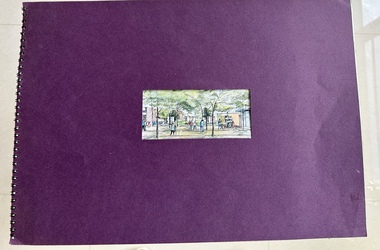
... The initial design work for the pedestrian precinct, renovation of the existing fountain, landscaping and the installation of the Tatura Heritage Mosaics was done with the assistance of a Victorian Government Price of Place Grant. ...A proposal by the Tatura Revitalisation Committee for the development of the Tatura Town Square precinct. The initial design work for the pedestrian precinct, renovation of the existing fountain, landscaping and the installation of the Tatura Heritage Mosaics was done with the assistance of a Victorian Government Price of Place Grant. See L1059, L0764Spiral A3 folio with purple cover. A cut out in the centre of the cover shows a concept drawing of the Tatura Town Square. non-fictionA proposal by the Tatura Revitalisation Committee for the development of the Tatura Town Square precinct. The initial design work for the pedestrian precinct, renovation of the existing fountain, landscaping and the installation of the Tatura Heritage Mosaics was done with the assistance of a Victorian Government Price of Place Grant. See L1059, L0764mural, tatura, mosaic, town square, 1998 -
 Tatura Irrigation & Wartime Camps Museum
Document - Tatura Town Square
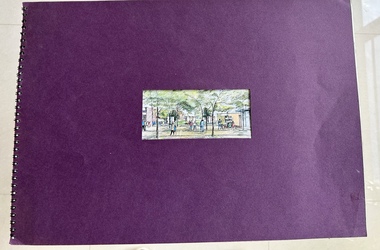
... The initial design work for the pedestrian precinct, renovation of the existing fountain, landscaping and the installation of the Tatura Heritage Mosaics was done with the assistance of a Victorian Government Price of Place Grant. ...A proposal by the Tatura Revitalisation Committee for the development of the Tatura Town Square precinct. The initial design work for the pedestrian precinct, renovation of the existing fountain, landscaping and the installation of the Tatura Heritage Mosaics was done with the assistance of a Victorian Government Price of Place Grant. See L1058, L0764Spiral A3 folio with purple cover. A cut out in the centre of the cover shows a concept drawing of the Tatura Town Squarenon-fictionA proposal by the Tatura Revitalisation Committee for the development of the Tatura Town Square precinct. The initial design work for the pedestrian precinct, renovation of the existing fountain, landscaping and the installation of the Tatura Heritage Mosaics was done with the assistance of a Victorian Government Price of Place Grant. See L1058, L0764tatura, town square, mural, mosaic -
Tatura Irrigation & Wartime Camps Museum
Folder, Tatura Revitalisation Committee, The Tatura Heritage Mosaics Art Work, 2010
... Includes colour photographs and notes on some of the people pictured. The Tatura Heritage Mosaics Art Work Folder Tatura Revitalisation Committee ...Information on the Mosaics artwork in Francis Street, Tatura. Ref. L1058, L105918 x A4 pages describing the content of the mosaics in Francis Street. Includes colour photographs and notes on some of the people pictured.Colour pictures of the mosaic art. History of its implementation. Some brief biographies of those pictured.tatura art work, tatura mosaics, francis street tatura victoria -
 Nillumbik Shire Council
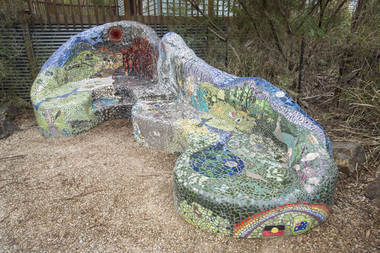
Public Art: Lasting Memories Mosaic GROUP, Lasting Memories Mosaic Seat (Location: St.Andrews Hall, 1 Proctor Street, St. Andrews), 2012
... Mosaic group began this piece just after the Black Saturday fires in 2009. After the horrific fires ravaged through St Andrews and the surrounding areas, a group of bushfire affected ladies bravely came back to St Andrews to begin their healing in an artistic way. Each woman created something beautiful and meaningful, using remnants of crockery, glass, tiles and bricks salvaged from their own properties. This artworks identifies who they are and tells their personal 'life journey' and family heritage ...The 'Black Saturday' bushfires were a series of bushfires that ignited across the Australian state of Victoria on and around Saturday, 7 February 2009. It was Australia's worst ever natural disaster. The fires occurred during extreme bushfire-weather conditions and resulted in Australia's highest ever loss of life from a bushfire: 173 people died and 414 were injured as a result of the fires. For most women being part of the Lasting Memories Mosaic Group was a way of reconnecting to the area, friends and neighbours. As the months went by, the idea of creating a gift to the community together was born. The women wanted to artistically express their memories of what they had experienced. Creating a mosaic seat in the heart of St Andrews allowed the group to be 'in control' of building something from the ground up - a symbol of hope, recovery and renewal. All of their experiences and memories have been included into the seat design, which makes it so special. This mosaic seat is proudly positioned outside the St Andrews Hall, which is also the site for the St Andrews market held every Saturday throughout the year.The Lasting Memories Mosaic group began this piece just after the Black Saturday fires in 2009. After the horrific fires ravaged through St Andrews and the surrounding areas, a group of bushfire affected ladies bravely came back to St Andrews to begin their healing in an artistic way. Each woman created something beautiful and meaningful, using remnants of crockery, glass, tiles and bricks salvaged from their own properties. This artworks identifies who they are and tells their personal 'life journey' and family heritage and memories of what they had experienced before, during and beyond Black Saturday. It is also an expression of their love for the St. Andrews area and the nature and people within it. A large concrete seat in the style of an organic chaise lounge covered in mosaic (broken tiles, glass, crockery and ceramics of all shapes and colour). The pieces have been placed to form pictures, words and patterns that tell and recount stories and memories of reflection, hope and love of a group of people who experienced the Black Saturday bushfires. (Click on links to view details of the seat) black saturday, mosaic, art, lasting memories, st andrews, tiles, glass, fire, concrete, cement, chris reade, ekphrasis2017 -
 Sunbury Family History and Heritage Society Inc.
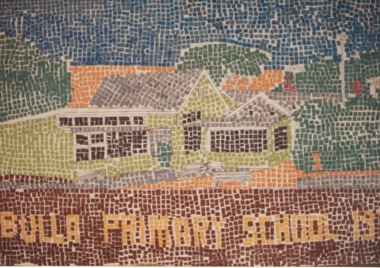
Photograph, Bulla Primary School, 1988
... Heritage Society Inc. Sunbury Global Learning Centre Macedon Street Sunbury melbourne The mosaic image of the school building was set in the outdoor garden of Bulla Primary School. schools bulla bulla primary school A non-digital coloured photograph of a mosaic image of the Bulla Primary School. ...The mosaic image of the school building was set in the outdoor garden of Bulla Primary School.A non-digital coloured photograph of a mosaic image of the Bulla Primary School.schools, bulla, bulla primary school -
Ballarat Heritage Services
Ceramic, Platters by Bern Emmerichs
... Heritage Services PO Box 2209 Bakery Hill Post Office goldfields Bern EMMERICHS (1961 - ) Bern Emmerichs is a trained painter who has adopted clay surface as her canvas. She completed a Diploma of Fine Art at Phillip Institute of Technology, Melbourne in 1982. She became interested in clay as a medium while renovating her house and now paints on tiles, vessels and platters, as well as working in mosaic ...Bern EMMERICHS (1961 - ) Bern Emmerichs is a trained painter who has adopted clay surface as her canvas. She completed a Diploma of Fine Art at Phillip Institute of Technology, Melbourne in 1982. She became interested in clay as a medium while renovating her house and now paints on tiles, vessels and platters, as well as working in mosaic. A founding member of 'Whitehall Enterprises', a group of about six artists who together rented an old factory in Whitehall Street, Footscray from 1987 to 1990. In 2000-2002, Bern spent two-years travelling, working and exhibiting in Europe, based for most of the time in Kamp-Lintfort, Germany. Recently she has been exploring imagery related to Australian colonial history. Her works are signed with a painted 'Bern Emmerichs'. Two platters decorated by Bern Emmerichsbern emmerichs -
 Ballarat Heritage Services
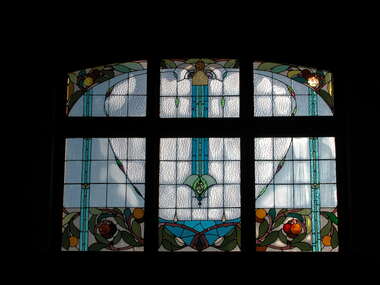
Photograph - Photographs - Colour, Amalie Feild, World War One Memorial Hall at Ballarat High School, 2012, 20/08/2012
... Heritage Services PO Box 2209 Bakery Hill Post Office goldfields Peacock Hall was opened by Premier Alexander Peacock. Stained glass windows by Amalie Feild (later Colquhoun).are located across both ends of the hall, as well as Honour boards listing students' war service in both World Wars. Boards along the side walls also list School Captains, Council Members, the Dux of the School as well as University graduates. The memorial mural tablet for the hall was designed by George Dancey. The tablet was unveiled by Major Baird on 9 April 1920 and features a finely executed mosaic ...Peacock Hall was opened by Premier Alexander Peacock. Stained glass windows by Amalie Feild (later Colquhoun).are located across both ends of the hall, as well as Honour boards listing students' war service in both World Wars. Boards along the side walls also list School Captains, Council Members, the Dux of the School as well as University graduates. The memorial mural tablet for the hall was designed by George Dancey. The tablet was unveiled by Major Baird on 9 April 1920 and features a finely executed mosaic mural symbolising the triumph of Good over Evil. world war one, ballarat high school memorial hall, stained glass, amalie feild, amalie colquhoun -
 Ballarat Heritage Services
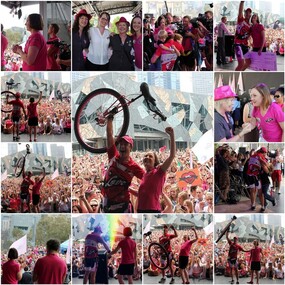
Photograph - Digital photographs, L.J. Gervasoni, RIP Connie Johnson mosaic of Love Your Sister, c2017
... Ballarat Heritage Services PO Box 2209 Bakery Hill Post Office goldfields Love Your Sister cancer breast cancer Connie Johnson Constance Johnson charity unicycle Federation Square Digital images of Connie Johnson of Love Your Sister. RIP Connie Johnson mosaic ...Digital images of Connie Johnson of Love Your Sister. love your sister, cancer, breast cancer, connie johnson, constance johnson, charity, unicycle, federation square -
 Ballarat Heritage Services
Pamphlet - Architecture, Old Curiosity Shop, Ballarat
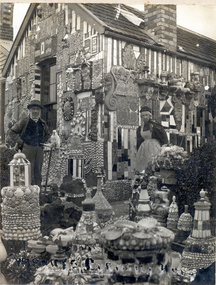
... Ballarat Heritage Services PO Box 2209 Bakery Hill Post Office goldfields A building in Ballarat East old curiosity shop ballarat mosaic architecture Ballarat East Back and white photograph of Ballarat's Old Curiosity Shop. ...A building in Ballarat East Back and white photograph of Ballarat's Old Curiosity Shop. old curiosity shop, ballarat, mosaic, architecture, ballarat east -
 Ballarat Heritage Services
Photograph - Photograph - Colour, Clunes Returned Soldiers' League Mosaic by Arthur Pickford, 30/04/2016
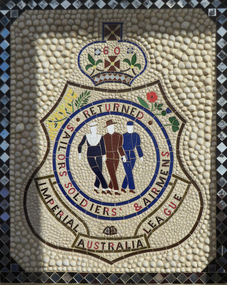
... Ballarat Heritage Services PO Box 2209 Bakery Hill Post Office goldfields arthur pickford mosaic clunes rsl returned soldiers league shells world war one A shell mosaic in Clunes by returned soldier Arthur Pickford. ...A shell mosaic in Clunes by returned soldier Arthur Pickford.arthur pickford, mosaic, clunes rsl, returned soldiers league, shells, world war one -
 Ballarat Heritage Services
Digital copy, Jack Gervasoni football scrapbook mosaics, 1950s
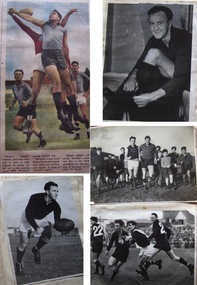
... Ballarat Heritage Services PO Box 2209 Bakery Hill Post Office goldfields football scrapbook fitzroy football club northcote football club daylesford football club ballarat football club jack gervasoni jack gervasoni Digital copies of photos in a football scrapbook. Jack Gervasoni football scrapbook mosaics ...Digital copies of photos in a football scrapbook.football, scrapbook, fitzroy football club, northcote football club, daylesford football club, ballarat football club, jack, gervasoni, jack gervasoni -
 Villa Alba Museum
Wallpaper sample - 'Sanitary' simulated tile design, c.1900
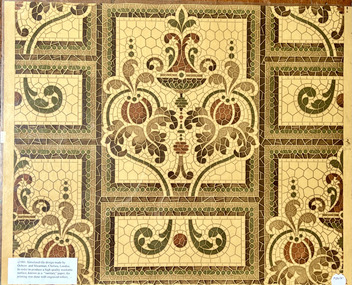
... Heritage interiors Wallpapers 20th century interior design sanitary wallpapers P.I2 (f) c.1900 Simulated tile design made by Osborn and Shearman, Chelsea, London. In order to produce a high-quality washable surface, known as a "sanitary" paper, the printing was done with engraved rollers. Features intricate floral and geometric motifs, including a prominent central urn-like structure and repeating mosaic ...Part of a collection of historic wallpapers collected by Phyllis Murphy, most of whose wallpapers were donated to the collection of Historic Houses Sydney. This wallpaper sample, annotated and encased in mylar was used by Phyllis for educational purposes, and donated by her son to Villa Alba Museum's collection in 2025.c.1900 Simulated tile design made by Osborn and Shearman, Chelsea, London. In order to produce a high-quality washable surface, known as a "sanitary" paper, the printing was done with engraved rollers. Features intricate floral and geometric motifs, including a prominent central urn-like structure and repeating mosaic-style segments.P.I2 (f)heritage interiors, wallpapers, 20th century interior design, sanitary wallpapers
