
Showing 14 items matching "hettie collett"
-
 Emerald Museum & Nobelius Heritage Park
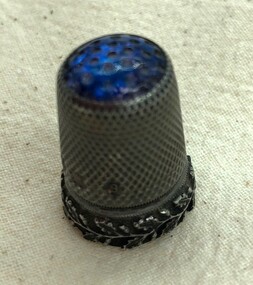
Domestic object - Thimble, Early 20th century
... ...Hettie Collett...Some may have originally belonged to her mother (Hettie Collett nee Thorn) who was a talented milliner and from whom Beryl first learnt her considerable handicraft skills. ...Beryl Collett Hettie Collett thimbles On the body imprinted: 'STERLING GERMANY 9'. ...Thimbles have long been used as a shield for the fingertip when hand sewing. In the Victorian period, an ornate silver thimble would be given as an engagement gift. The thimble collection was owned by Kallista woman, Beryl Collett (1925-2018). Some may have originally belonged to her mother (Hettie Collett nee Thorn) who was a talented milliner and from whom Beryl first learnt her considerable handicraft skills. These thimbles form part of a large and varied range of objects which were either collected by or made by Beryl and which have been donated to the Museum. This varied thimble collection has been collected during the long lifetime of a local woman who enjoyed needlework and lacemaking.Silver thimble with a honeycomb pattern on the side and a raised leaf pattern around the rim. Decorative blue glass top. On the body imprinted: 'STERLING GERMANY 9'. beryl collett, hettie collett, thimbles -
 Emerald Museum & Nobelius Heritage Park
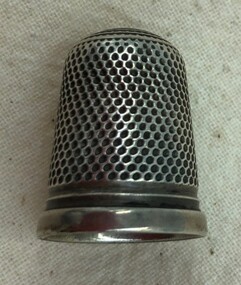
Domestic object - Thimble, Early 20th century
... ...Hettie Collett...This thimble was owned by Kallista woman, Beryl Collett (1925-2018) and may have originally belonged to her mother (Hettie Collett nee Thorn) who was a talented milliner and from whom Beryl first learnt her considerable handicraft skills. ...Beryl Collett Hettie Collett thimbles Honeycomb pattern on the side of the thimble and a spiral honeycomb pattern on the raised top. ...Thimbles have long been used as a shield for the fingertip when hand sewing. In the Victorian period, an ornate silver thimble would be given as an engagement gift. This thimble was owned by Kallista woman, Beryl Collett (1925-2018) and may have originally belonged to her mother (Hettie Collett nee Thorn) who was a talented milliner and from whom Beryl first learnt her considerable handicraft skills. These thimbles form part of a large and varied range of objects which were either collected by or hand-made by Beryl and which have been donated to the Museum. This varied thimble collection has been collected during the long lifetime of a local woman who enjoyed needlework and lacemaking.Honeycomb pattern on the side of the thimble and a spiral honeycomb pattern on the raised top. Below the honeycomb pattern are two rows of plain bands with a groove between the bands. Silver. No visible hallmarks.beryl collett, hettie collett, thimbles -
 Emerald Museum & Nobelius Heritage Park
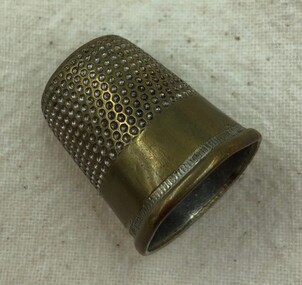
Domestic object - Thimble, Early 20th century
... ...Hettie Collett...This thimble was owned by Kallista woman, Beryl Collett (1925-2018) and may have originally belonged to her mother (Hettie Collett nee Thorn) who was a talented milliner and from whom Beryl first learnt her considerable handicraft skills. ...Beryl Collett Hettie Collett thimbles Honeycomb pattern on the side of the thimble and a spiral honeycomb pattern on the top. ...Thimbles have long been used as a shield for the fingertip when hand sewing. In the Victorian period, an ornate silver thimble would be given as an engagement gift. This thimble was owned by Kallista woman, Beryl Collett (1925-2018) and may have originally belonged to her mother (Hettie Collett nee Thorn) who was a talented milliner and from whom Beryl first learnt her considerable handicraft skills. These thimbles form part of a large and varied range of objects which were either collected by or hand-made by Beryl and which have been donated to the Museum. This varied thimble collection has been collected during the long lifetime of a local woman who enjoyed needlework and lacemaking.Honeycomb pattern on the side of the thimble and a spiral honeycomb pattern on the top. Plain wide band around the turned-up rim. Brass. No visible markings.beryl collett, hettie collett, thimbles -
 Emerald Museum & Nobelius Heritage Park
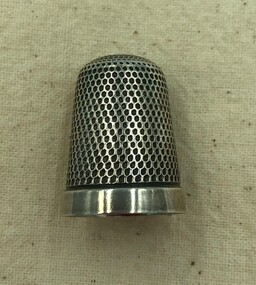
Domestic object - Thimble, Early 20th century
... ...Hettie Collett...This thimble is part of a thimble collection which was owned by Kallista woman, Beryl Collett (1925-2018) and may have originally belonged to her mother (Hettie Collett nee Thorn) who was a talented milliner and from whom Beryl first learnt her considerable handicraft skills. ...Beryl Collett Hettie Collett thimbles On the outside of the band: '6' and (?)' ...Thimbles have long been used as a shield for the fingertip when hand sewing. In the Victorian period, an ornate silver thimble would be given as an engagement gift. This thimble is part of a thimble collection which was owned by Kallista woman, Beryl Collett (1925-2018) and may have originally belonged to her mother (Hettie Collett nee Thorn) who was a talented milliner and from whom Beryl first learnt her considerable handicraft skills. These thimbles form part of a large and varied range of objects which were either collected by or hand-made by Beryl, and which have been donated to the Museum. This varied thimble collection has been collected during the long lifetime of a local woman who enjoyed needlework and lacemaking.Honeycomb pattern on the side of the thimble and a spiral honeycomb pattern on the top. Plain narrow band around the rim. Silver.On the outside of the band: '6' and (?)'CM' and three (?)hallmarks. The first one is of an animal. beryl collett, hettie collett, thimbles -
 Emerald Museum & Nobelius Heritage Park
Functional object - Lace Maker, 1900s
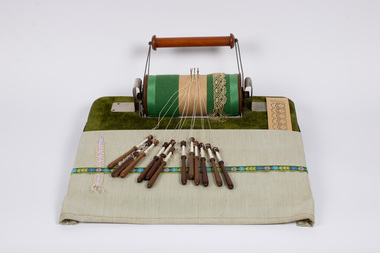
... ...Hettie Collett...It may have first belonged to her mother (Hettie Collett nee Thorn) who was a very talented milliner and from whom Beryl first learnt her handicraft skills. ...Beryl Collett 1900s Hettie Collett lacemaker Inside bodice opening, hand-written: 'H. ...This lacemaker was owned by Kallista woman, Beryl Collett (1925-2018) who was a skilled lacemaker from her youth and who used this lacemaker most of her life. It may have first belonged to her mother (Hettie Collett nee Thorn) who was a very talented milliner and from whom Beryl first learnt her handicraft skills. This lacemaker is part of a large and varied range of objects relating to Beryl which has been donated to the Museum. The Dandenongs have been the chosen home of many creative people who, like Beryl, have found inspiration in the natural beauty of the area. Much of Beryl's own handiwork held by the Museum was created by her following her retirement from her accountancy job in 1980 and so epitomises the potential of the retirement phase of people's lives.This hand operated lacemaker enabled women like Beryl and her mother to create beautiful lacework.This lacemaker consists of twelve bobbins which are a tool for carrying the thread which gradually uncoils from the bobbin as it is handled and is then interlocked manually with surrounding threads to create a lacy structure. The bobbins are thin wooden cylinders. At their top, the shaft has been carved away to leave an even thinner cylinder where thread can be stored to be gradually unwound.Inside bodice opening, hand-written: 'H. Collett' which has had a line struck through it. Underneath that inscription is hand-written 'Thorn' beryl collett, 1900s, hettie collett, lacemaker -
 Emerald Museum & Nobelius Heritage Park
Domestic object - Thimbles, c.1900s - 1950s
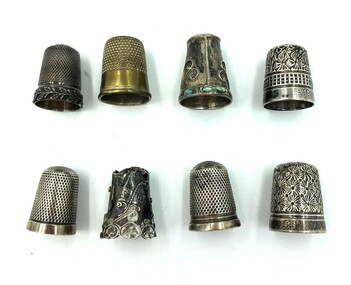
... ...Hettie Collett...Some may have originally belonged to her mother (Hettie Collett nee Thorn) who was a talented milliner and from whom Beryl first learnt her considerable handicraft skills. ...Beryl Collett Hettie Collett thimbles This is a collection of eight thimbles. ...Thimbles have long been used as a shield for the fingertip when hand sewing. In the Victorian period, an ornate silver thimble would be given as an engagement gift, but silver proved too soft for withstanding pins. In 1885, Charles Horner patented a new silver thimble with a steel core which became the Dorcas thimble and enabled a functional but still decorative thimble. This particular thimble collection includes two Charles Horner thimbles. The collection was owned by Kallista woman, Beryl Collett (1925-2018). Some may have originally belonged to her mother (Hettie Collett nee Thorn) who was a talented milliner and from whom Beryl first learnt her considerable handicraft skills. These thimbles form part of a large and varied range of objects which were either collected by or hand-made by Beryl and which have been donated to the Museum. This varied thimble collection has been collected during the long lifetime of a local woman who enjoyed needlework and lacemaking.This is a collection of eight thimbles. Most are ornately decorated with raised detail. All are silver except for one made of brass. Two are Dorcas thimbles manufactured by Charles Horner and two are made by silversmiths in Taxco (Mexico). A German-made thimble has glass in its cap. The thimbles vary in age from c. early to mid-20th century.beryl collett, hettie collett, thimbles -
 Emerald Museum & Nobelius Heritage Park
Domestic object - Thimble, Charles Horner, Early 20th century
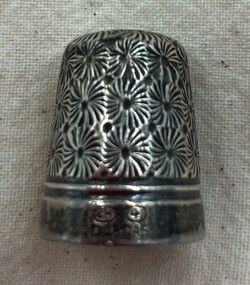
... ...Hettie Collett...Some may have originally belonged to her mother (Hettie Collett nee Thorn) who was a talented milliner and from whom Beryl first learnt her considerable handicraft skills. ...Beryl Collett Hettie Collett thimbles Charles Horner Bottom band imprinted: 'CH 4 / DORCAS'. ...Thimbles have long been used as a shield for the fingertip when hand sewing In the Victorian period, an ornate silver thimble would be given as an engagement gift, but silver proved too soft for withstanding pins. In 1885, Charles Horner patented a new silver thimble with a steel core which became the Dorcas thimble and enabled a functional but still decorative thimble. This particular thimble was made by Charles Horner post 1905 and is part of a thimble collection which was owned by Kallista woman, Beryl Collett (1925-2018). Some may have originally belonged to her mother (Hettie Collett nee Thorn) who was a talented milliner and from whom Beryl first learnt her considerable handicraft skills. These thimbles form part of a large and varied range of objects which were either collected by or made by Beryl. This varied thimble collection has been collected during the long lifetime of a local woman who enjoyed needlework and lacemaking.Silver thimble with a dense floral design on the side and top of thimble. Plain band around rim of thimble. Markings indicate it is a Size 4, Charles Horner thimble.Bottom band imprinted: 'CH 4 / DORCAS'. beryl collett, hettie collett, thimbles, charles horner -
 Emerald Museum & Nobelius Heritage Park
Domestic object - Thimble, Charles Horner, Early 20th century
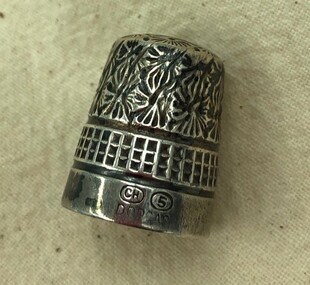
... ...Hettie Collett...Some may have originally belonged to her mother (Hettie Collett nee Thorn) who was a talented milliner and from whom Beryl first learnt her considerable handicraft skills. ...Beryl Collett Hettie Collett thimbles Charles Horner On bottom band imprinted: 'CH 5 / DORCAS'. ...Thimbles have long been used as a shield for the fingertip when hand sewing In the Victorian period, an ornate silver thimble would be given as an engagement gift, but silver proved too soft for withstanding pins. In 1885, Charles Horner patented a new silver thimble with a steel core which became the Dorcas thimble and enabled a functional but still decorative thimble. This particular thimble was made by Charles Horner post 1905. The thimble collection was owned by Kallista woman, Beryl Collett (1925-2018). Some may have originally belonged to her mother (Hettie Collett nee Thorn) who was a talented milliner and from whom Beryl first learnt her considerable handicraft skills. These thimbles form part of a large and varied range of objects which were either collected by or hand-made by Beryl and which have been donated to the Museum. This varied thimble collection has been collected during the long lifetime of a local woman who enjoyed needlework and lacemaking.Silver thimble with a floral decorative design on top and side of thimble. Underneath that is a band of a pattern of repeated squares. Around the rim is a plain band with manufacturer's imprint. Markings indicate it is a Size 5, Charles Horner thimble.On bottom band imprinted: 'CH 5 / DORCAS'. beryl collett, hettie collett, thimbles, charles horner -
 Emerald Museum & Nobelius Heritage Park
Functional object - Lace Maker Instruction Booklet, 1900s
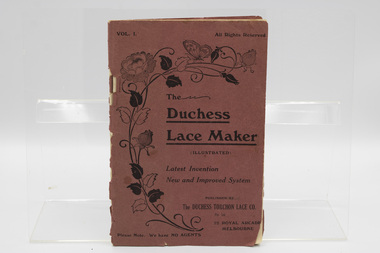
... ...Hettie Collett...Both of these may have first belonged to her mother (Hettie Collett nee Thorn) who was a very talented milliner and from whom Beryl first learnt her handicraft skills. ...Both of these may have first belonged to her mother (Hettie Collett nee Thorn) who was a very talented milliner and from whom Beryl first learnt her handicraft skills. ...This lacemaker instruction booklet together with the lacemaker was owned by Kallista woman, Beryl Collett (1925-2018) who was a skilled lacemaker from her youth and who used the lacemaker (and presumably this booklet) most of her life. Both of these may have first belonged to her mother (Hettie Collett nee Thorn) who was a very talented milliner and from whom Beryl first learnt her handicraft skills. This lacemaker and accompanying booklet are part of a large and varied range of objects relating to Beryl which has been donated to the Museum. The Dandenongs have been the chosen home of many creative people who, like Beryl, have found inspiration in the natural beauty of the area. Much of Beryl's own handiwork held by the Museum was created by her following her retirement from her accountancy job in 1980 and so epitomises the potential of the retirement phase of people's lives.This lacemaker and manual enabled women like Beryl and her mother before her to create beautiful lacework.This booklet has a maroon-color soft cover. Inside is mainly text with some black and white drawn illustrations.On front cover printed: 'Vol. 1 / The / Duchess / Lace Maker / Published by / The Duchess Torchon Lace Co. / 22 Royal Arcade / Melbourne' On back cover in bottom right corner: 'Wilke, Mitchell & Co. / Printers / 7 Flinders Court / Melbourne' beryl collett, 1900s, hettie collett, lacemaker, instruction booklet -
 Emerald Museum & Nobelius Heritage Park
Clothing - Dress, Beryl Collett, 1980s-1990s
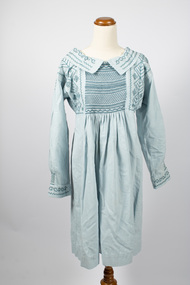
... Beryl learnt handicraft skills as a young person from her mother Hettie Collett (Thorn) who was a skilled milliner. ...Beryl learnt handicraft skills as a young person from her mother Hettie Collett (Thorn) who was a skilled milliner. ...This dress was created by Kallista woman, Beryl Collett (1925-2018). Beryl learnt handicraft skills as a young person from her mother Hettie Collett (Thorn) who was a skilled milliner. Beryl created many textile objects following her retirement from her accountancy job in 1980. This dress appears to have been created to showcase Beryl's smocking skills. That much of Beryl's own handiwork was created following her retirement epitomises the potential of the retirement phase of people's lives.This apron is an example of the handiwork of a skilled local dressmaker.Medium length light blue heavy cotton dress with extensive smocking on bodice and back of dress and collar and cuffs. Long sleeves. Front and back of dress appear identical and there are no buttons or other fasteners. Dress does not appear to be of a particular fashion style.beryl collett, clothing -
 Emerald Museum & Nobelius Heritage Park
Clothing - Apron, Beryl Collett, 1980s-1990s
... Beryl learnt handicraft skills as a young person from her mother Hettie Collett (Thorn) who was a skilled milliner. ...Beryl learnt handicraft skills as a young person from her mother Hettie Collett (Thorn) who was a skilled milliner. ...This apron was probably created in the 1980s or 1990s. As the apron is pure white, it was probably not intended to be used but rather as a demonstration of sewing technique. It was created by Kallista woman, Beryl Collett (1925-2018). Beryl learnt handicraft skills as a young person from her mother Hettie Collett (Thorn) who was a skilled milliner. Beryl created many textile objects and items of clothing following her retirement from her accountancy job in 1980 and often won prizes for them. That much of Beryl's own handiwork was created following her retirement epitomises the potential of the retirement phase of people's lives.This apron is an example of sewing technique by a local seamstress.White apron with bib with a strap around the neck, a waistband which ties at the back, and a pocket on the lower left of the skirt. White trim around the hem. Floral motif on right front of skirt and a smaller floral motif on the pocket.beryl collett, clothing -
Emerald Museum & Nobelius Heritage Park
Textile - Patchwork quilt, Beryl Collett, 1990s
... Beryl learnt handicraft skills as a young person from her mother Hettie Collett (Thorn) who was a skilled milliner. ...Beryl learnt handicraft skills as a young person from her mother Hettie Collett (Thorn) who was a skilled milliner. ...This patchwork quilt was probably created in the1990s perhaps as a demonstration of technique. However, unlike some of its maker's work, it also appears to have been used. It was created by Kallista woman, Beryl Collett (1925-2018). Beryl learnt handicraft skills as a young person from her mother Hettie Collett (Thorn) who was a skilled milliner. Beryl created many textile objects and items of clothing following her retirement from her accountancy job in 1980 and often won prizes for them. That much of Beryl's own handiwork was created following her retirement epitomises the potential of the retirement phase of people's lives.This patchwork quilt is an example of sewing technique by a local artist.A square patchwork quilt featuring a star pattern combining solid royal blue fabric with floral printed fabrics. It has a blue and white checkered border and a blue and white checkered back.beryl collett, patchwork -
 Emerald Museum & Nobelius Heritage Park
Clothing - Nightgown, 1900s
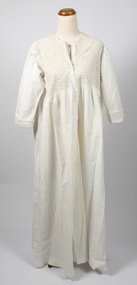
... It first belonged to her mother (Hettie Collett nee Thorn) who was a very talented milliner and from whom Beryl learnt handicraft skills as a young person. ...It first belonged to her mother (Hettie Collett nee Thorn) who was a very talented milliner and from whom Beryl learnt handicraft skills as a young person. ...This nightgown was owned by Kallista woman, Beryl Collett (1925-2018) who was a skilled lacemaker from her youth. It first belonged to her mother (Hettie Collett nee Thorn) who was a very talented milliner and from whom Beryl learnt handicraft skills as a young person. The nightgown is part of a large and varied range of objects relating to Beryl which has been donated to the Museum. The Dandenongs have been the chosen home of many creative people who, like Beryl, have found inspiration in the natural beauty of the area. Much of Beryl's own handiwork was created by her following her retirement from her accountancy job in 1980 and so epitomises the potential of the retirement phase of people's lives.This nightgown is a lovely example of women's sleepwear in the early 20th century.Long, white cotton nightgown. Empire line with round neckline, lace inserts in bodice and 4 concealed buttons at bodice. Buttons have been covered with white fabric. Three-quarter length sleeves with lace cuffs. Made with a sewing machine.Inside bodice opening, hand-written: 'H. Collett' which has had a line struck through it. Underneath that first inscription is hand-written 'Thorn' beryl collett, clothing, 1900s -
 Emerald Museum & Nobelius Heritage Park
Textile - Patchwork quilt, Beryl Collett, Sunshine and Shadow, c.1990s
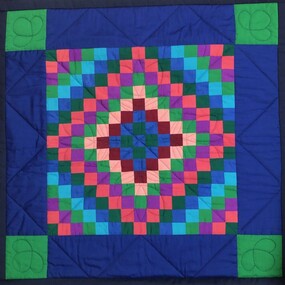
... Beryl learnt handicraft skills as a young person from her mother Hettie Collett (Thorn) who was a skilled milliner. ...Beryl learnt handicraft skills as a young person from her mother Hettie Collett (Thorn) who was a skilled milliner. ...This wall hanging was created by Kallista woman, Beryl Collett (1925-2018). Beryl learnt handicraft skills as a young person from her mother Hettie Collett (Thorn) who was a skilled milliner. Beryl created many textile objects following her retirement from her accountancy job in 1980. She often won prizes in handicraft competitions, and she was generous in sharing her skills with others. This wall hanging was entered in a competition, possibly in the 1990s. The Dandenongs have been the chosen home of many creative people who, like Beryl, have found inspiration in the natural beauty of the area. That much of Beryl's own handiwork was created following her retirement epitomises the potential of the retirement phase of people's lives.This wall hanging is an exhibition of the maker's patchwork skills.Decorative patchwork quilt attached to a wooden dowel at the top so that it can be hung for display. Blue background. Green squares at each corner. A star pattern comprised of multiple small squares in the centre.Handwritten on paper attached to the top right front corner: 'Sunshine and Shadow' Handwritten on small white tag on bottom right front corner: 'B Collett' beryl collett, textile
