
Showing 4 items matching "higham family"
-
 Williamstown Historical Society Inc
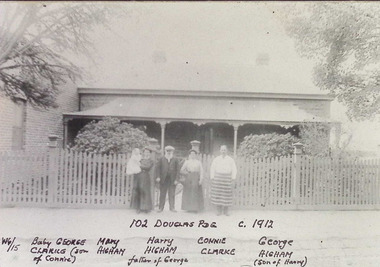
Photograph - Higham family, 1912
... Higham family, 1912...Higham family...Higham family outside 102 Douglas Parade, baby George Clarke (son of Connie), Mary Higham, Harry Higham (father of George), Connie Clarke, George Higham (son of Harry) ...Higham family 1912 Higham family outside 102 Douglas Parade, baby George Clarke (son of Connie), Mary Higham, Harry Higham (father of George), Connie Clarke, George Higham (son of Harry) Photograph Higham family, 1912 ...Higham family outside 102 Douglas Parade, baby George Clarke (son of Connie), Mary Higham, Harry Higham (father of George), Connie Clarke, George Higham (son of Harry) higham family, 1912 -
 Port Melbourne Historical & Preservation Society
Book, Dinah Higham, "Dazzle Flash . the Account of an Exile", 1997
... Dinah Higham, great-great-granddaughter of James, put this book together after much research by her father (in New Zealand where the family now lives)...Dinah Higham, great-great-granddaughter of James, put this book together after much research by her father (in New Zealand where the family now lives) Sandridge Families Publishing - Newspapers James HIGHAM The Record The Sandridge Reporter and Hobsons Bay Advertiser The Telegraph and St Kilda Prahran and South Yarra Guardian 28 pages in newspaper format originally published Feb 1997. ...Dinah Higham, great-great-granddaughter of James, put this book together after much research by her father (in New Zealand where the family now lives)28 pages in newspaper format originally published Feb 1997. This book gives an account of the life of James Higham, his background and particularly his life in Australia after banishment from England, 1865 to 1875, as a reporter on local papers. .01 is in A4 sizesandridge, families, publishing - newspapers, james higham, the record, the sandridge reporter and hobsons bay advertiser, the telegraph and st kilda, prahran and south yarra guardian -
Port Melbourne Historical & Preservation Society
Book, Dinah Higham, "Dazzle Flash . the Account of an Exile", 1997
... Dinah Higham, great-great-granddaughter of James, put this book together after much research by her father (in New Zealand where the family now lives)...Dinah Higham, great-great-granddaughter of James, put this book together after much research by her father (in New Zealand where the family now lives) Sandridge Families Publishing - Newspapers James HIGHAM The Record The Sandridge Reporter and Hobsons Bay Advertiser The Telegraph and St Kilda Prahran and South Yarra Guardian 28 pages in newspaper format originally published Feb 1997. ...Dinah Higham, great-great-granddaughter of James, put this book together after much research by her father (in New Zealand where the family now lives)28 pages in newspaper format originally published Feb 1997. This book gives an account of the life of James Higham, his background and particularly his life in Australia after banishment from England, 1865 to 1875, as a reporter on local papers. .02 is A3 sizesandridge, families, publishing - newspapers, james higham, the record, the sandridge reporter and hobsons bay advertiser, the telegraph and st kilda, prahran and south yarra guardian -
 Wodonga & District Historical Society Inc
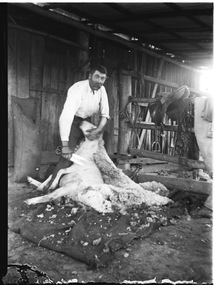
Negative - Haeusler Glass Negatives Collection - Harry Schuster blade shearing
... family on arrival from South Australia. Shearing - Although the first mechanised sheep shearing machine was created by James Higham, from Melbourne in 1868, the use of blade shears were more common well into the early 20th century. ...family on arrival from South Australia. Shearing - Although the first mechanised sheep shearing machine was created by James Higham, from Melbourne in 1868, the use of blade shears were more common well into the early 20th century. ...The Wodonga Historical Society Haeusler Collection provides invaluable insight into life in late nineteenth and early twentieth century north east Victoria. The collection comprises manuscripts, personal artefacts used by the Haeusler family on their farm in Wodonga, and a set of glass negatives which offer a unique visual snapshot of the domestic and social lives of the Haeusler family and local Wodonga community. The Haeusler family migrated from Prussia (Germany) to South Australia in the 1840s and 1850s, before purchasing 100 acres of Crown Land made available under the Victorian Lands Act 1862 (also known as ‘Duffy’s Land Act’) in 1866 in what is now Wodonga West. The Haeusler family were one of several German families to migrate from South Australia to Wodonga in the 1860s. The Schuster family were also of German migrant background. Johannes Edward Schuster was born in Hoyles Plains, South Australia and with his wife Johanna and young family moved to Victoria circa 1882. He took up farming land in Wodonga West. The St John’s Lutheran Church Sunday school hall was erected from part of the proceeds of the sale of some 41 acres of land at Wodonga West, which had been bequeathed to the Wodonga congregation by the late Johannes Edward Schuster. This land was the original home site of the Schuster family on arrival from South Australia. Shearing - Although the first mechanised sheep shearing machine was created by James Higham, from Melbourne in 1868, the use of blade shears were more common well into the early 20th century. Pastoralists on smaller holdings continued to either shear their own sheep or employ blade shearers rather than outlay the cost of machines. In large sheds, professional shearers worked as they travelled the country. They would earn around 17 to 20 shillings per day in the early days of the wool industry. However mechanisation continued and by 1915 most sheep shearing sheds in Australia contained sheep shearing machines. The original machines were powered by steam and later combustion engines were used. This digital image was produced from one of the glass negatives that form part of the collection, probably taken by Louis Haeusler (b.1887) with the photographic equipment in the Wodonga Historical Society Haeusler Collection.This item is unique and has well documented provenance and a known owner. It forms part of a significant and representative historical collection which reflects the local history of Wodonga. It contributes to our understanding of domestic and family life in early twentieth century Wodonga, as well as providing interpretative capacity for themes including local history and social history.Digital image created from the Haeusler Glass negative collection. Harry Schuster shearing sheep using blade shears. wodonga pioneers, haeusler family, glass negatives, dry plate photography, blade shearing, schuster family
