
Showing 79 items matching "hill gregory"
-
 Whitehorse Historical Society Inc.
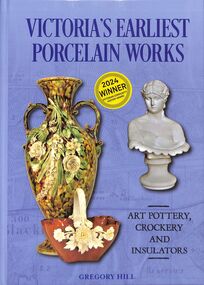
Book - Historical Reference, Gregory HILL, Victoria's Earliest Porcelain Works, 2023
... ...HILL Gregory...Gregory Hill has been a collector of Australian pottery for 50 years and is recognised as the leading authority on both Australian Colonial Pottery and Australian Art Pottery. ...Gregory HILL...Victoria's Earliest Porcelain Works Book Historical Reference Gregory HILL ...This book covers the formative years of Victoria's porcelain industry from 1857 to the late 20th century.With a glossy cover, this book details the history of Victorian Potteries illustrated by color photographs, maps, diagrams. non-fictionThis book covers the formative years of Victoria's porcelain industry from 1857 to the late 20th century.pottery, dahlke, crockery, hill gregory, springfield pottery, white brothers, commonwealth art pottery and insulator company, springfield road -
 Sunshine and District Historical Society Incorporated
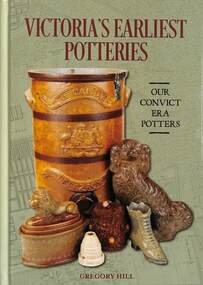
Book - Victoria's Earliest Potteries - Our Convict Era Potters, Gregory Hill, 2019
... Gregory Hill...Pottery Potteries Drayton Convict Edward "Ted" Henry Martin Drayton Victoria's Earliest Potteries - Our Convict Era Potters Hard cover book Book Victoria's Earliest Potteries - Our Convict Era Potters Gregory Hill ...Hard cover bookpottery, potteries, drayton, convict, edward "ted" henry martin drayton -
 Sunshine and District Historical Society Incorporated
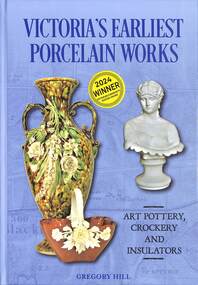
Book - Victoria's Earliest Porcelain Works, Gregory Hill, 2023
... Gregory Hill...Victoria's Earliest Porcelain Works Art Pottery, Crockery And Insulators|Sunshine Porcelian Works|Drayton|Lederbach|Maribyrnonog Ammunition Works|Permasite Pottery Maribyrnong Hard cover book Victoria's Earliest Porcelain Works Book Victoria's Earliest Porcelain Works Gregory Hill ...Hard cover bookVictoria's Earliest Porcelain Works Art Pottery, Crockery And Insulators|Sunshine Porcelian Works|Drayton|Lederbach|Maribyrnonog Ammunition Works|Permasite Pottery Maribyrnong -
 Glen Eira Historical Society
Book - Glen Huntly State School No.3703 Grange Road
... ... Hill Gregory...Eve Cooper Anne Saunders Bruce Yeaman Peter Wilkinson Dawn Armstrong Jeffrey Hill Gregory Morris Steven Suttie Richard Silverman Judy King Jenny Silverman Sharon Broadmore Janine Martin Dean Smith Robert Frommer Ruth Saxon Rosemary Justus Heidi O'Keefe Sue-Ellen Robertson Angela Young Natalia Pigounis Anthony Brodie Anthony Henkul Roland Duncan Neil Cooper Tania Brodie Joanne Meerkin Naomi Henham Rowena Moulds Adam Butterworth Richard Kellis Nick Tapai Michael Goodwin Sonia Clift Debbie Hannagan Shannon Marley Kara Ceki Tibor Ellis Shaun Charleworth Stewart can Bergeijk Richard Schroor Briony Leticq Jeanette Davidson Angela Kakos Vicki Collins Darren McFarlane Matthew Adley Hassan Agar James Rakonjac Mileva Lowndes Nereida Grimster Jane ? ...A 190 page book called The Story So Far 1914-2009 – The History of Glen Huntly Primary School No.3703, by Shirley A. Mirams. The book gives a very detailed history of the school’s early history. It includes head teachers/principals and the school’s progress through each decade to 2009. The remaining chapters give 2009 student roll call, citizenship awards, house competition awards, music awards, sporting awards, encouragement, swimming and musical productions, notable past students and teachers, bibliography and sponsors. There are many photos and school plans as well.glen huntly, glen huntly primary school, glenhuntly primary school, mirams shirley a., glenhuntly printing works, printing industry, from the earth fruit and veg., glenhuntly state school, greengrocers, king stephen, king design, alessi libby, principals, mcgowan keith, radio broadcasting, hunt sydney, forbes c., ramsay m., primary schools, glenhuntly state school, jenkin william, bryant a., orames mr, morrison r., christensen t., doggett j., rogers a., fink r., terrill f., mitchell j., cravine e., mcrae w., cooper l., chernside c., silva a.j., dolphin w., crampton colin, wilson wendy mrs, glenhuntly road, glen huntly, clerk's estate, subdivisions, glen huntly clerk's settlement, carnegie school no. 2897, world war 1914-1918, gardens, mothers clubs, world war 1939-1945, poliomylitis, rural training school, traffic signals, films, 'slow bike race', parents and friends association, after school program, fires, 'links' magazine, choirs, disadvantaged schools program, school plays, 'germs', 'garden folk', festivals and celebrations, japanese internship program, 'kids in space', 'dragon girl', 'fish 'n' ships', murals, wendy wilson music award, fetes, lord reserve, carnegie, australian natives association, congregational chuch sunday school hall, martell e miss, garden avenue, grange road, salvation army halls, halls, glenhuntly road, wanalta road, williamson alex, williamson jean, williamson gordon mccrae, school rolls, le brocq john, cockfield douglas r., grogan allen, mathiesson edward, johnston ronald frank, harris george, money neil robert, fraser eric, munro john, hyland hector thos., gibson wilfred john, eliason francis, scarles john robert, wallace andrew, henning george frederick, maryson sydney, petherbridge c., whitfield j., edward lee, queen alexander, carnegie state school, madden frank sir, parliamentary representatives, bank of new south wales, charles ernest, wallace andrew james, hunt chas. hogarth, williams stanley f., tester thomas george, henstridge john, henstridge reginald, johnston travis andrew, nixon alexander, lewis victor, dalton john, arthurs violet grace, browning leslie george, carroll eric harry, dobson keith george, evans george w.m., eyres annie may, hogg lillian, hunt alfred w.m., johnson henry, jones dorothy minnie, love helvic agnes, lyons gordon, lyons vera, parsons eric robert, dickens gordon percy, smith elva beatrice, harry david, westcott harold norton, westcott ormond chs., bremner marie, entertainers, williamson alex mccrae, ransay albert, caulfield town hall, green ethel, hawthorn alice, reynolds emma a., potter thelma, potter phyllis, anderson elsie m., girdwood stella, bastin may, murphy dorothy g., southern mary, mcleod gwen, ezard gladys m., hood emily vera, thorne eileen isobel, robinson noel, monckton marjorie, mrs hannigan's tuckshop, foley children, lord mr., bladin francis, tomlinson jean, jenkins vern, williamson jean, forty alan, rhinefield mr, bennett mary, brabham laurel, swain george, reynolds mille, gill harry, williamson g., cockfield winifred, baird beth, king elsie, challman miss, glen huntly 'drum and file' school band, larkin aircraft supply company, sugarworks swamp, lemans swamp, lyons streets, morgan streets, miller street, lizars linda, brown allan sir, hurie gladys, simpson peggy, royal ave., garden ave., tennis courts, lander h.j., castledine f.r., henning a.s., glen huntly progress association, harboard joan, mullins mr, pountney dorothy, daley beryl, marching clubs, findlay joyce, green lionel, charles ern, bennett mary, shelter sheds, blanchfield mr bakers, donoald mr grocers, walburn rhoda, harris shirley, treyvaud mr, hale maxwell, painter ken, allan mr ('fatty'), proven mr, ross mrs, nye margaret, nally ware beaker, monuments and memorials, graham bruce, 'bulldog drummond', learmonth mary, bullock margaret, o'shea annie, tattersall dawn, jenkins betty, lighton robert, bruce peter, love grace, love family, judd margery, gardiner elsie, gardiner sadie, glen eira dairy, vanston dorothy, barton cynthia, tipping mr, drummond mr, hambly chrissy, shrives kathleen, hutton beverly, miller kenneth deering, callender mr bakers, cook miss, nunn john athlete, andrews ailsa (nee mcgregor), fraser wally, vickers madeline, vickers john, scanlon mr, malcolm miss, brown barbara (nee holland), pepper miss, burns miss, mclaren miss, beadman jim athletics, robinson noel, crompton neal sportsperson, wilkinson graham, neilson ray, byers barry, bryant tony referee, murray bob, burton pam, pappas george, burke b. mrs, neville street, smith harvey, o'donnell mrs, kivlighon mr, grierson wendy, evans yvonne, squires doreen, squires kathy, jenvey stewart, baxter john, coenen eddie maintenance workers, byrne carol, williams pamela, zari austin (nee coenen), furney janet, dodds mrs, mitchell j., bell r., forsyth e. miss, mitchell neil, radio broadcasting, burke m., boatman r., garfield d., harris e. mrs, sherman m. mrs, carolan e., gunthorp b., barnes john, barnes joan, ellis christine, kossatz mr, black miss, lader mrs, franghis peter, parnell dennis, revens ester, young vivian, mclean bernice, tattersal lorna, geddes rae, hocking malcolm, cusworth peter, christie glenn, watt richard, conway gred, hand graham, mcgowan e., parnell j., mcguire n, hare john, prest margaret, forrester david, mitchell eric, cordingley mrs, waterworth mr, cohen mr, rankin fiona, christiansen mr, boatman mr, dougan mrs milkbars, dougan barry, suttie richard, parnell bruce, silverman judy, king jenny, saxon sally, king nicolette, maxwell heather, saxon jill, vincent russell, saxon rosemary, murray bob, saxon david, miller bill, hill sally-ann, hesline sandra, raspberger cynthia, nightingale mrs district remedial centre, smith mrs, district language consultant, robertson gabrielle, mclennan matthew, goloub kin lyn, jarrett mavis, schafer dianne, commerford pip, mcdougall carlene, anderson jack, hawthorne russell, callahan evelyn, zagami maria, bremner elizabeth, braun tiki, berman claudine, briggs margaret, brady sue, shaw melissa, henham ravena, cooper tania, de abrev connie, brodie joanne, macdonald leighan, mccallum margaret, beddoe john, mcdonald mr council employee, clift andrew, ash steven, lowndes nerida, wysocki b., drough h., grossbard j., locke j., cox l., morey l., clifton p., short b., herszberg n., clift debbie, fuk michael, theodosopoulos haria, shrives jean (nee tomlison), forty alan, geiger irit, roach sally, hillis rachael, roache donna, dixon wendy, bayliss curtis, pregnall joy mrs, slocum mrs, nelson glenda, rubinstein morrie, lurkey dianne, mcminn michael, arneil barbara, mick rose, mell and alice, brayton andrea, moorhead k. rev, brownhill e., lolas heather mrs, regan bernie cleaner, hopkins a. mrs, dewar leon, school crossings, darak diana, eddey diana, pregnall max, eppinger rosy, stacy paul, douvitsas chris, maycock kelly, bunyan liza, johansen eva, siaosi jackie, don kerrie, smyth ruth, bruce julie, mcgregor lorraine, mcallister peter, nelson g., knight sue, mackey s., mackinnon julie, mccallum margaret, johannsen j., herzberg n., hall k, jarrett m., johns w., beddoe john, wilson w., dayble l., thomas helen, ogura etsuko, coxon diane, guttman emmy, garg sangeeto, kennedy robyn, coleman heidi, thompson vic, currie sioux, arnold eve mrs, beddoe mr, mckay sara, skilney tamara, zent mandy, sassos eugenia, manvel bill, lewis pam, rothstadt kaye, clerehan jane, watson simon, daw josie, strong helen, craig caroline, devasagayam kenny, bell peter, palanarezuk fiona, suttie mitchell, mirians shirley, prest marg, condon gabrielle, pitkin sigrid, wilson heather, don paul, thursfield william, footballers, ormond junior football club, rothstadt david, bruce julie, fallu jackie, patterson denise, trantor debbie, nakamura nozomi, christensen tanya, james-clark spencer, eppinger rosy, matsumoto minako, osborne cheryle, john beddoe meritorious sporting student award, sunderland pippa, schleiger emma, paulusz chris, hollingworth kyle, griffiths david, cooper cameron, jewel andrew, nannegaril (nick) abhishek, marshall joel, hodden leigh, meyer tony, te hennepe michael, zimbachs trent, chavili praveen, listmangof mark, sampson tim, sayfer daniel, mest jack, crampton colin, crampton andrew, hemming beth, dean deirdre, wong melissa, arneil christopher, friedman adam, sonnberger leonie, mackey suzanne, clarke heather, fernando gyan, horvath eva, horvath melissa, horvath natalie, rowe rebecca, taylor yani, robinson tess, nolan rebecca, hollingworth mamie, trigellis-smith anna, zhou cindy, jenvey olivia, smith yasminka, hemming caitlin, gale elke, johnson christopher, dalton lyndsay, perish james, seddon anna, webster teagan, stratford sachi, zhuang yvette, taylor katherine, tettennepe simon, hu kevin, thursfield oliver, beycher sonny, gavland angelene, fotopoulos daisy, mcclelland letty, king sierra, sargeant kolly, hodden melissa, picking kate, brasic lisa, mcclelland cassie, cummins alexandra, jamieson laura, cashen lanaya, rowe angela, georgiou jonathon, pejovic maja, luv aileen, hoskin yumika, bishop amy, tweed jacqueline, corrales mariana, williams kendall, jewell bethany, friedman sara, golden phoebe, mellios lauren, sayfer charlene, bell daniel, glagovski anton, ring hannah, aldred jasmin, sisson laura, king janine, allen robbie, taylor xavier, trigellis-smith colin, italia paula, tamura naoko, eddy diane, paterson denise, clarke heather, hemming beth, wilson wendy, wallace gaye, moore denis, plumb rochellee, schmauder debra, taylor kathrine, gale elke, taylor yani, sisson laura, fotopoulos daisy, zuccala lyn, smith phyllis, katz lily, sonnberger leonie, quail janine, prest margaret, zhang karen, indukuri gita, prest duncan, prest julieann, dureau sally, hopkins anna, baligod imelda, fallon kerry, bjelanovic danijela, james-clark laura, magnani lisa, phillips kathy, bell hilary, bakshi jasmeet, james-clark spencer, james-clark mason, james-clark stella, fitzgerald kerrie, krawze kamila, czech jon, lee maria, boell jacqueline, schmauder debra, georgiou martha, randles yvonne, smyth ruth, florrimell sean, ryan patrick, rossjohn sian, eppinger rosy, melenhurst bradley, melenhurst ashley, melenhurst christopher, silva katie, richards michael, garner jenny, bucher peter, gleitzman morris author, zhou jun, cook andrew, memorial services, funerals, wendy wilson hall, rossjohn jamie, earls tom, nicholls stephanie, vagner natasha, anderson pam, hall aileen, grose jenny, dalton sue, bejers maya, paterson denise, witte david, lath natalie, dalmau jessica, darras irene, miljus max, moritmitsu ran, zhou yida, barns sue, varbaro bianco, howell alan, lath miss, jacobs john, tinetti amy, maloney matthew, petrovic vida, bruce julie, bonner angie, porter ros, hill andrea, hocking hazel, jozsa zara, wishart jan, guyer noeline, powell bruce, hopkinson judy, mccrae glenys, mccrae beverly, james margot, barns tony, barns joan, ryan ann artist, jenek alex, jozsa olivia, woods caitlin, ledda daniel, cook andrew, rossjohn bevan, aunavarapu ashray, loveas paul, beiers mariel, allan gemma, squires rhoda, squires garry, squires terry, squires lesley, squires rhonda, squires doreen, squires peter, squires kathy, king sierra, king tynan, king mackenzie, king harrison, king shuyler, allen robbie, allen jessica, allen samantha, dale sheridan, dale caroline, dale elliot, dale taylor, dale clark, woodards carnegie auctioneers, roberts ruth, mckenzie's ward, glenhuntly fruit supply, ceudet and kubeyde, subway glenhuntly, alessi libby mrs, manuel bill mr, bruce julie ms, jacobs john mr, paterson denise mrs, thompson vic mr, sonnberger leonie mrs, sassos eugenia mrs, witte david mr, krauze maila ms, tinetti amy ms, bower jessica mrs, fitzgerald kerrie mrs, eppinger rosie mrs, vagner natasha mrs, zent mandy mrs, james-clark laura mrs, fallon kerry mrs, grose jenny mrs, bonner angie mrs, miriams shirley mrs, petrovic vida mrs, maloney matthew mr, bakshi jameet mr, smyth-kinyua ruth mrs, fitzpatrick tom mr, watson scott mr, theodore kate ms, porter ros ms, hill andrea ms, howell alan mr, schauder emma mrs, jozsa george mr, bitmead claire mrs, bader linda ms, jacobs john mr, bhuteja raza, rossjohn bevan, christensen lara, dale clark, chong aldwin, barns-dunne genevieve, guy cleo, georgiou demetrius, allen gemma, arunachalam elanthendral thiruavani, chau samantha, foldvari miro, gade saathvika, ghafari mohid, jones alvin, korres johnny, margaritis evan, pickering finley, schauder daniel, shah hisha, shermis-fox dalvin, thorat sahil, zhong emma, arunkumar mitali, baxi vaasu, bhadra rushil, chevalier stefanie, bitmead rose, cooper brittany, jozsa zara, croes sonny, gil harnoor, koika akito, gitein iris, matthews benjamin, moses lior, gupta anushka, nematy keanu, jaiswal sanjana, makwana yash max milius, o'donoghue romy, patel vishesh, nalamati anushka, paul aaron, obsioma jarred, pavlich nicola, rizk taran, schauder ben, shah vansh, stuart isobel, yadavalli sriprada, sharma shreya, tut nyajania, zhao max, abeyesekerea gail, attanayake nikeesha, behl shaurya, desai noopur ankoor, espinosa daphne, kansara kesha, kantheti sai rithvik, malakar ishan, manion freya, mohammed zoheb, morimitsu ran, moshe sarit, peri varsha, reutskiy yael, ryan harrison, shah jahanvi, wallis hannah, woods liam, bhuteja raza, belyuga lachlan, chen linda, bikovsky alexander, das sanchali, bitmead william, ghafari malaika, cherukuihota ritish, jenek alex, chintala aditi, lvovsky jeremy, dumnounkan nicky, mazzocchi ashleigh, el shorbagy hanna, mohammed zeeshan, foldvari phoebe, nekkadapu prava, gill armann, obsioma joseph, harper tyler, pickering jasper, kanapathippillai noah, pronina anja, kat jemma, pudikova veronika, king schuyler, reutskiy nicole, nikitin daniel, rossjohn bevan, o'connor finnian, schauder hannah, parsons zoe, shaked natalie, shang alexander, sharmila ajit aaditya arya, shulz david, siah sunny, singh gab, woods caitlin, wallis eliza, yang jee, zhong michelle, zhang alan, zhou stella, zhang betty, arjuna vicknan, arunachalam thirumagal, bahambhani yog, christensen lara, dale clark, hoenig tess, jozsa olivia, knelle louise, kwon minchol, lin angelina, milyus sophie, modi dhriti, morimitsu rin, moses nikol, noh yuhan, raghav devrath, rule darcy, tran cindy, trivedi namit, vayenas christina, vaz adonis, vortman david, allan liam, annavarapu ashrey, attanayake akeshi, capicchiano rose, chilakamarri nikhil, davis oliver, forti kate, guo maggie, guy cleo, james zoe, jenek ada, kalra pravav, king harrison, lin angelo, lin anita, melenhorst bradley, melenhorst christopher, metzler jessica, moses tomer, perelman michael, ryan patrick, wheatley nathaniel, allen gemma, bailey crystal-lee, gan tina, georgiou demetrius, ghafari kainat, grigorian nick, hackshaw chris, howell benjamin, kuznetsov ilya, luo eileen, luo elaine, margaritis mary-anne, melenhorst ashley, morimitsu rui, omer-cooper james, ozgur batuhan, salathiel matthew, vayenas paulina, wang qi wei, ward monica, arabena. brittany, bader-mcdowell alexander, barns-dunne genevieve, beiers mariel, chilcott rose, chong aldwin, cook andrew, dale taylor, dalton eamon, durant demeke, horn jade, iker korkhan, kat mariana, kwon so hyun, ledda daniel, loucas paul, panchal rajvi, ragozin vadim, reyer emma, song alex, varbara sovan, zhou james, robertson angela, henkul roland, hannagan cassie, rice elizabeth, ryan tammy, stacey paul, mason rebecca, ammendola marcella, moore m., copey n., priesner m., cotterell d., cohn adam, don paul, don kerrie, hanley alison, mckechnie brian, gowland rebecca, te hennepe daniel, schleiger emma, zimbachs trent, rowe rebecca, taylor katherine, beycher sonny, halliburton andrew, dureau thomas, dureau nicole, thursfield alexandra, allen courtney, willis isabelle, zhou jun, james-clark stella, melky michelle, willis ruby, earls tom, srinivasan lakshmi, zhou yida, te hennepe daniel, meyer tony, leiken nikita, thompson alex, te hennepe simon, johnson christopher, vassilopoulos michael, irwin christopher, asaturov gary, rossjohn sian, sangangum watsana, varbaro bianca, mitchell, hume, batman, brown robyn, maxwell jennifer, mclean jill, culpin howard, jones dennis, archer ?, lester phillip, taylor jennifer, anderson judith, ? bronwyn, hall robyn, powlett john, clark ross, taylor christine, booth peter, turner ian, porter larry, turner diane, anderson diane, scott megan, mclean david, christie donald, wishart philip, mottrim joan, christie coleen, travis bicki, watt elizabeth, richards michael, peet marily, sutherland fiona, ziegenbien kay, lester judith, kostamarkis con, yeoman keith, hastings ronald, ? mark, coenen zari, young vivian, young carolyn, weber elizabeth, child gary, cooper stephen, robertson james, ross dean, ? eve, cooper anne, saunders bruce, yeaman peter, wilkinson dawn, armstrong jeffrey, hill gregory, morris steven, suttie richard, silverman judy, king jenny, silverman sharon, broadmore janine, martin dean, smith robert, frommer ruth, saxon rosemary, justus heidi, o'keefe sue-ellen, robertson angela, young natalia, pigounis anthony, brodie anthony, henkul roland, duncan neil, cooper tania, brodie joanne, meerkin naomi, henham rowena, moulds adam, butterworth richard, kellis nick, tapai michael, goodwin sonia, clift debbie, hannagan shannon, marley kara, ceki tibor, ellis shaun, charleworth stewart, can bergeijk richard, schroor briony, leticq jeanette, davidson angela, kakos vicki, collins darren, mcfarlane matthew, adley hassan, agar james, rakonjac mileva, lowndes nereida, grimster jane, ? laurenne, mcdonell terry, clift andrew, perry timothy, rice martin, weir lisa, devasagayam briony, chatila nancy, melland alice, rakonjac nik, mcdonald brett, collins michael, rose darren, ryan tammy, rice elizabeth, hannagan cassie, mason rebecca, douvitasa chris, chivers scott, siaosi jack, stacey paul, moore matthew, coles lisa, diggins sebastian, barboussas costa, moulds johanna, brett travis, mcminn johanna, soloma tim, copey nicole, kakos peter, rontoyannis evan, mcdonald scott, pregnell ian, lowndes jared, kapetanos diane, ivkov srdjan, palamarczuk rosemary, cotterell diane, tonta amelia, craig caroline, yeun joseph, yusuf alham, quon kane, fiek peter, pitkin meryl, yarovsky julie, mckay sara, koger saskia, slocum tom, meyer sean, dunn nathan, vickers anthony, don paul, mason lulu, stanton bronwyn, hanley alison, don kerrie, kennedy chad, callaghan matthew, ghosh suvro, teteira jay, sargent kelly, hollingworth marnie, lack orry, wheeler ashley, trigellis-smith anna, hoskin tim, barda david, nolan rebecca, kulikov simon, kirkpatrick ryan, schleiger rudi, becker thomas, de lisle justin, taylor katherine, gale elke, te hennepe simon, ring hannah, stratford sachi, taylor yani, parish james, aldred jasmin, sisson laura, thursfield oliver, fotopoulos daisy, hoskin yumika, trigellis-smith colin, corrales mariana, soyfer charlene, moore vanessa, halliburton andrew, glagovski anton, johnson christopher, wheeler joel, taylor xavier, chapman jessica, ledda alexander, rowe angela, jewell bethany, goluguri pradeepthi, bell daniel, golightly callum, graham emily, mckechnie ellen, james-cark spencer, byrne david, parker natalie-lee, loucas david, pappas michael, gamble laurence, dureau thomas, loriot christina, drinozcky chloe, ring caitlin, robertson mitchell, pleysier yvonne, boghikian emie, sisson matthew, sanchez zanetta, rowe daniel, saunders john, cox josh, barda nick, dureau nicole, lenkiewicz justine, jamieson emily, mclaughlan kate, carpenter tess, vassilopoulos michael, jewell clare, gavnoudias james, matthews laura, georgiou costa, dale caroline, gamble kate, beiers hannah, james-clark mason, richardson zoe, thursfield alexandra, hosking kenta-neville, dounias theodore, annavaparu ramya, sinclair chloe, nolan megan, king tynan, tomlinson michael, allen courtnay, florrimell sean, ong kenny, foley patrick, gale emily, saunders alice, rowe michelle, willis isabelle, vassilopoulos alexandra, johnson bradley, borley genevieve, irwin christopher, earls thomas, matthews jessica, mudumbi venkatesh, lenkiewicz alice, king mackenzie, dounias christopher, beiers maya, dick alastair, levy matthew, srinivasan lakshmi, adams joshua, singh mia, borley natalie, varbaro bianca, christensen jade, willis ruby, sinclair emma, allen samantha, rossjohn sian, borley morgan, bader-mcdowell jeremy, chettimadda gopala kr yashas, anguswamy manoj, nekkadapu sankeerth, dalton kieran, allan tristan, gandham anoohya, arabena brittany, melenhorst ashley, vayenas paulina, dale taylor, bader-mcdowell alexander, omer-cooper james, reyer emma, kuznetsov ilya, metzler jessica, beiers mariel, forti kate, james zoe, annavarapu ashrey, ryan patrick, davis oliver, ilker korkhan, mcgowan keith, thursfield william, gribbin andrew, walsh-howling damien, scanlon alan, mitchell neil, brown allan, bruce peter, murray robert (bob), christensen tanya, de kretser jan, bremner marie, bayliss curtis, wheeler reece, symons red, de zilwa nick, byers gary, crompton neil, wilkinson graham, nilsson ray, bryant tony -
Whitehorse Historical Society Inc.
Article, The Kind days at 'Gregory's', 1970?
... forest hill residential kindergarten...gregory...Award presented to Miss Marie (Kathleen) Gregory, Director of the Forest Hill Residential Kindergarten for Emergency Care. ...child care forest hill residential kindergarten gregory kathleen maie Award presented to Miss Marie (Kathleen) Gregory, Director of the Forest Hill Residential Kindergarten for Emergency Care. ...Award presented to Miss Marie (Kathleen) Gregory, Director of the Forest Hill Residential Kindergarten for Emergency Care. With photo.Award presented to Miss Marie (Kathleen) Gregory, Director of the Forest Hill Residential Kindergarten for Emergency Care. With photo.Award presented to Miss Marie (Kathleen) Gregory, Director of the Forest Hill Residential Kindergarten for Emergency Care. With photo.child care, forest hill residential kindergarten, gregory, kathleen maie -
Whitehorse Historical Society Inc.
Article, The Passing of an era
... forest hill residential kindergarten...gregory...child care forest hill residential kindergarten gregory kathleen maie holder audrey syme wendy lark diana curtain carmel Article traces the colorful life of a unique piece of Melbourne's history, the Forest Hill Residential Kindergarten for Emergency Care. ...Article traces the colorful life of a unique piece of Melbourne's history, the Forest Hill Residential Kindergarten for Emergency Care. With photo.Article traces the colorful life of a unique piece of Melbourne's history, the Forest Hill Residential Kindergarten for Emergency Care. With photo.Article traces the colorful life of a unique piece of Melbourne's history, the Forest Hill Residential Kindergarten for Emergency Care. With photo.child care, forest hill residential kindergarten, gregory, kathleen maie, holder, audrey, syme, wendy, lark, diana, curtain, carmel -
 Bendigo Historical Society Inc.
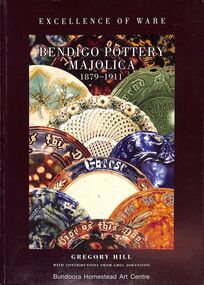
Book - "Bendigo Pottery Majolica. 1879-1911.", 2008
... "Bendigo Pottery Majolica. 1879-1911" by Gregory Hill with contributions from Greg Johansson. ..."Bendigo Pottery Majolica. 1879-1911" by Gregory Hill with contributions from Greg Johansson. ...In the late nineteenth century, Bendigo Pottery was the largest operating pottery in the Australian colonies. There are regular reports of the volume of pottery they produced and sent by the train-load to the Melbourne distribution warehouse. Bendigo Pottery's founder, George Guthrie, was very proud of his pottery and was an active participant in the popular nineteenth-century international exhibitions. Bendigo Pottery was established in 1857. Bendigo Pottery was often at risk of closure but faced its greatest threat in the late 1960's when Hume's Pipes, then owners of the pottery, instructed that it be closed down. However, this did not happen and it is open to this day. Majolica Ware was introduced into Bendigo Pottery's range in 1879, ultimately with a wide range of products made, ranging from water filters, and garden urns through to common household wares. "Bendigo Pottery Majolica. 1879-1911" by Gregory Hill with contributions from Greg Johansson. Soft cover. Published and distributed by Bundoora Homestead Art Centre. pp 74. Has a separate addendum of 10 pages inside back cover. Spine and front and back covers are brown in color. Title on spine and front cover are in white text. Front cover has colored insert of majolica plates, and back cover has insert of Toby jug. Colored and Black and white images throughout. Notes on authors are on the back page. No index. Signed by author on front page with year of 2011.majolica, bendigo pottery, george guthrie -
 Flagstaff Hill Maritime Museum and Village
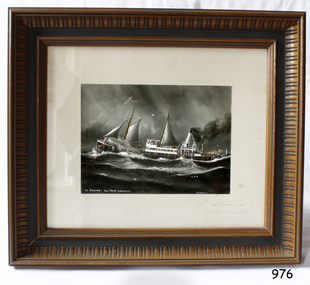
Print - Vessel, Steamship, A.V. Gregory, SS Casino off Point Lonsdale, ca. 1899-1932
... Hill Maritime Museum and Village...Warrnambool...Maritime Museum...Maritime Village...Great Ocean Road...Shipwreck Coast...newcastle and hunter river steam navigation company...belfast and koroit steam navigation company...h. sautau and sons...s.s. casino...west coast trader s.s. casino...victorian coastal trader...captain boyd...captain w. robertson...captain chapman...captain middleton...apollo bay shipwreck...s.s. casino at lady bay warrnambool...saltau and osburne...a v gregory...The detailed image of the vessel depicted in this print shows one of the many sail and steam vessels painted by the renowned Victorian marine artist A V Gregory, whose original works are highly valued today by marine collectors. Flagstaff Hill Flagstaff Hill Maritime Museum and Village Warrnambool Maritime Museum Maritime Village Great Ocean Road Shipwreck Coast newcastle and hunter river steam navigation company belfast and koroit steam navigation company h. sautau and sons s.s. casino west coast trader s.s. casino victorian coastal trader captain boyd captain w. robertson captain chapman captain middleton apollo bay shipwreck s.s. casino at lady bay warrnambool saltau and osburne a v gregory arthur victor gregory Melbourne artist Signed "A V Gregory" Hand painted title "SS Casino off Point Lonsdale" Print with hand-painted watercolour highlights depicting the port side steamship SS Casinounderway in a heavy sea, merchant flag flying at the stern. ...Print of a picture of the S.S. Casino, This print is from an original painting by the Australian marine artist A V Gregory (1867-1957), also known as Arthur Victor Gregory. Gregory lived and worked in South Melbourne. He took over the Gregory Studio owned by his father, George Frederick Gregory, painting actively between 1899 and 1932. He usually signed his works as ‘A V Gregory’. Some of his original works have been sold for thousands of dollars. The S.S. Casino was a passenger and freight steamer built in Dundee, Scotland, in 1882 for the Newcastle and Hunter River Steam Navigation Company of N.S.W. She weighed 425 tons gross with a length of 160.4 feet, beam of 24.1 feet and a depth of 10.2 feet. She had saloon accommodation for 35 people, a fore cabin for 25 more people, and she carried 300 tons of cargo. While on her delivery journey on May 30th 1882 the S.S. Casino called in at the Port of Warrnambool for coal ., narrowly escaping going ashore in gale force winds due to the quick action of the pilot. At that time, still at anchor, she impressed the directors of the Belfast and Koroit Steam Navigation Company so much that they bought her immediately; she was ideal for trade along the West Coast of Victoria. (The Belfast and Koroit Steam Navigation Company was first managed by Messers. Saltau and Osburne and after the passing of Mr. Osburne, by produce merchants Messers H. Sautau and Sons, who had a hay and corn store and shipping agency on the corner of Liebig and Koroit Streets in Warrnambool. ) The S.S. Casino became “the most famous steamer to operate in Victorian waters along the West Coast” by author Jack Loney. Captain Boyd was her first Master, followed by Captain Chapman, who stayed with her from 1890 until 1924. Captain W. Robertson followed for a short term, and then Captain Middleton then took command from 1925 - 1932. The S.S. Casino had several mishaps during her life. One was on 3rd January 1898 when she collided with the S.S. Flinders in Apollo Bay with minor damage. Another was on 24th October 1924 when she grounded on a reef at Point Hawdon near Grey River and most of her cargo (of Christmas goods) had to be dumped into the sea. Then in February 1929 she was ‘holed’ when she struck a submerged object as she entered Lady Bay, Warrnambool. On the morning of 10th July 1932, after attempting to berth at Apollo Bay jetty in heavy seas, Captain Middleton decided to take her out into the bay and wait until the seas abated. It was not realised that the anchor used to steady her as she manoeuvred to her berth had pierced her hull. She put about and headed for the beach but sank. Captain Middleton and nine others lost their lives; nine people were rescued including the two female passengers. Captain Middleton had been in charge of the S.S. Casino for seven years. He was the first ship’s Master to lose his life in a shipwreck in the West Coast trade. In the years following the turn of the century, the S.S. Casino remained the only regular trader with normal passenger accommodation along the West Coast. From 1882 she had made at least 2,500 voyages on the one run. Flagstaff Hill’s collection has a photograph of a portrait of Captain Chapman, , a ship model of the S.S. Casino that shows both forms of power under which she sailed, steam and sail. The ship is painted green and flies three flags. The inscription across the case of the ship model, incorrectly dated, tells the sad story of the wreck of the ship and the loss of lives on July 10th 1932 at Apollo Bay. A print in the Collection shows S.S. Casino underway in the heavy sea off Point Lonsdale, another two photographs show her at the Port of Warrnambool, leaving from the Breakwater in Lady Bay and another identifies the S.S. Casino as a ship from the Belfast and Koroit Steam Navigation Company. (Belfast is the original name for the township of Port Fairy).This print of the S.S. Casino is of significance for its association with the coastal trader S.S. Casino. The wreck of the S.S. Casino is considered an important part of Victorian and Australian cultural heritage and as such has been declared and protected as an Historic Shipwreck under State and Commonwealth Law in the Commonwealth Historic Shipwrecks Act (1976). The detailed image of the vessel depicted in this print shows one of the many sail and steam vessels painted by the renowned Victorian marine artist A V Gregory, whose original works are highly valued today by marine collectors.Print with hand-painted watercolour highlights depicting the port side steamship SS Casinounderway in a heavy sea, merchant flag flying at the stern. Mounted in a decorative wooden frame behind glass. The original painting was by A V Gregory. The title of the picture is repeated in handwritten words on the matte below the artist's signature on the print.Signed "A V Gregory" Hand painted title "SS Casino off Point Lonsdale"flagstaff hill, flagstaff hill maritime museum and village, warrnambool, maritime museum, maritime village, great ocean road, shipwreck coast, newcastle and hunter river steam navigation company, belfast and koroit steam navigation company, h. sautau and sons, s.s. casino, west coast trader s.s. casino, victorian coastal trader, captain boyd, captain w. robertson, captain chapman, captain middleton, apollo bay shipwreck, s.s. casino at lady bay warrnambool, saltau and osburne, a v gregory, arthur victor gregory, melbourne artist -
 Federation University Historical Collection
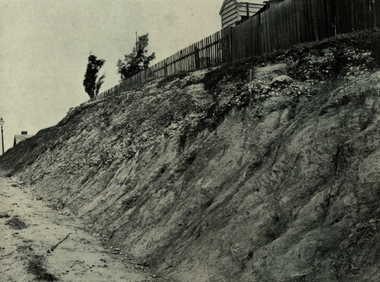
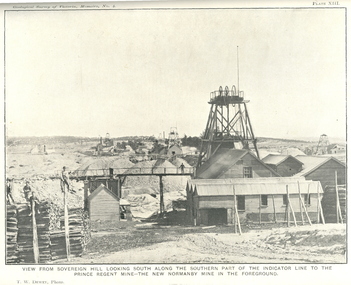
Book, Report on the Ballarat East Gold-Field, 1894 and Ballarat East Gold-Field, 1907, 1894
... Hill, Golden Point gold discovery site. Report on the Ballarat East Gold-Field, 1894 and Ballarat East Gold-Field, 1907 Book Book Robert Brain, Government Printer Ernest Lidgey J.W. Gregory ...The Ballarat Ironworkers' and Polytechnic Association was at the Ballarat School of Mines. In 1907 J.W. Gregory Professor of Geology at Glasgow University, Late Director of the geological Survey of Victoria and Professor of Geology at Melbourne University. W. Dickson was Secretary for Mines and Donald McLeod was the Minister of Mines. in 1894 Ernest Lidgey was the Assistant Geological Surveyor for the Victorian Department of Mines. A.W. Howitt was Secretary for Mines and Henry Foster was the Minister of Mines. Charcoal hard covered report on the Ballarat East Goldfield. The book combines two reports from the Victorian Department of Mines. The 1894 report is 52 pages and includes images and plans. The 1907 Report is number 4 in the Memoirs of the Geological Survey of Victoria. Photographs include Looking South from the Britannia Mullock Heap, View from Sovereign Hill, Golden Point gold discovery site.Stamped "Ballarat Ironworkers' Association School of Mines" Bookplate of the Ballarat Ironworkers' and Polytechnic Association. Written inside front cover: "S.J. Miller, 115 Ascot Street, Ballarat"ballarat ironworkers' and polytechnic association, ballarat school of mines, ironworkers, geology, mining, ballarat east, llanberris, victoria united mine, normanby, north woah hawp, bookplate, s.j. miller, library plate, golden point, gold discovery at golden point, new normanby mine, william baragwanath, new speedwell, britannia united, llanberris co, sulieman pasha, prince regent, dalzell-cum-prince regent, north prince extended, eastern star, f. gray, victoria united gold mine, sovereign hill mine, prince regent mine, britannia mine -
Flagstaff Hill Maritime Museum and Village
Domestic object - Colander, Kande Kitchenware, Circa 1924
... Hills. Kavanagh and English, a subsidiary of Kande Kitchenware, became a limited company in 1924, with both founders as directors. Another director was Test cricketer Jack Gregory...Hills. Kavanagh and English, a subsidiary of Kande Kitchenware, became a limited company in 1924, with both founders as directors. Another director was Test cricketer Jack Gregory ...Kande Kitchenware was established by Patrick Kavanagh and William English (the name Kande was formed from their initials, K and E) in 1922 and had its Sydney factory in Little Collins Street, Surrey Hills. Kavanagh and English, a subsidiary of Kande Kitchenware, became a limited company in 1924, with both founders as directors. Another director was Test cricketer Jack Gregory, an all-rounder who slipped easily into the role of businessman. Gregory enjoyed success in business as on the cricket field, helping the company grow from a tiny operation to a major manufacturer and exporter that employed 80 people in 1931. They managed to survive the Depression and kept manufacturing at least until the late 1960s.An appliance made by an early and successful Australian company that manufactured metal kitchen items during the first half of the 20th century. Colander enamel rusty holes in base of bowls, 2 handles, bowl shape.flagstaff hill, warrnambool, shipwrecked-coast, flagstaff-hill-maritime-museum, shipwreck-coast, flagstaff-hill-maritime-village, colander, kitchen item, domestic item, kitchen strainer -
 Flagstaff Hill Maritime Museum and Village
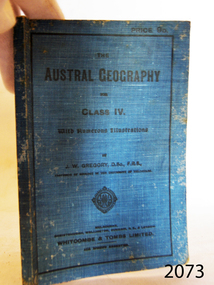
Book, The Austral Geography
... flagstaff hill warrnambool shipwrecked-coast flagstaff-hill flagstaff-hill-maritime-museum maritime-museum shipwreck-coast flagstaff-hill-maritime-village the austral geography book The Austral Geography Author: J W Gregory Publisher: Whitcombe & Tombs Pty Ltd The Austral Geography Book ...The Austral Geography Author: J W Gregory Publisher: Whitcombe & Tombs Pty Ltd flagstaff hill, warrnambool, shipwrecked-coast, flagstaff-hill, flagstaff-hill-maritime-museum, maritime-museum, shipwreck-coast, flagstaff-hill-maritime-village, the austral geography, book -
 Flagstaff Hill Maritime Museum and Village
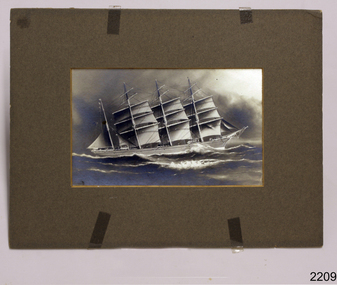
Print - Vessel, Sailing Ship, A.V. Gregory, ca. 1899-1922
... hill-maritime-village...Photograph...Photograph of Rowena...Gregory...The detailed image of the vessel depicted in this print shows one of the many sail and steam vessels painted by the renowned Victorian marine artist A V Gregory, whose original works are highly valued today by marine collectors. flagstaff hill warrnambool shipwrecked-coast flagstaff-hill flagstaff-hill-maritime-museum maritime-museum shipwreck-coast flagstaff-hill-maritime-village Photograph Photograph of Rowena Gregory Cluny Castle a v gregory rowena iron baque rowena ship co. ...This photograph is a print from an original painting by the Australian marine artist A V Gregory (1867-1957), also known as Arthur Victor Gregory. Gregory lived and worked in South Melbourne. He took over the Gregory Studio owned by his father, George Frederick Gregory, painting actively between 1899 and 1932. He usually signed his works as ‘A V Gregory’. Some of his original works have been sold for thousands of dollars. The four-masted iron barque 'Rowena' was built in 1883 by Barclay, Curle & Co. of Glasgow as the 'Cluny Castle', and renamed about 1890 as 'Rowena' by owners Rowena Ship Co.. After consequent owners, the ship was converted to a hulk in 1922 at Port Adelaide. The detailed image of the vessel depicted in this print shows one of the many sail and steam vessels painted by the renowned Victorian marine artist A V Gregory, whose original works are highly valued today by marine collectors.Photograph of a print, black and white, mounted onto card. It depicts the four-masted iron barque ship 'Rowena', originally named 'Cluny Castle'. The original painting was by marine artist A V Gregory.Painted on bow "ROWENA"flagstaff hill, warrnambool, shipwrecked-coast, flagstaff-hill, flagstaff-hill-maritime-museum, maritime-museum, shipwreck-coast, flagstaff-hill-maritime-village, photograph, photograph of rowena, gregory, cluny castle, a v gregory, rowena, iron baque, rowena ship co., barclay, curle & co, glasgow -
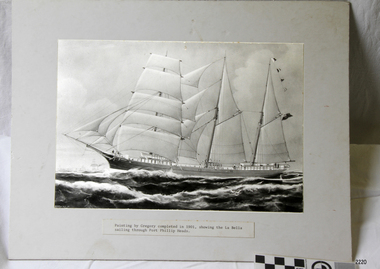 Flagstaff Hill Maritime Museum and Village
Photograph - Vessel, Sailing Ship, A.V. Gregory, 1901
... The detailed image of the vessel depicted in this photograph shows one of the many sail and steam vessels painted by the renowned Victorian marine artist A V Gregory, whose original works are highly valued today by marine collectors. Flagstaff Hill Flagstaff Hill Maritime Museum and Village Warrnambool Maritime Museum Maritime Village Great Ocean Road Shipwreck Coast La Bella D C Turnbull Warrnambool Harbour Lady Bay Signed "GREGORY-01" Painted on the ship's bow "LA BELLA" Typed label "Painted by Gregory completed in 1901, showing the La Bella sailing through Port Phillip Heads'. ...This photograph is a copy of an original painting by the Australian marine artist A V Gregory (1867-1957), also known as Arthur Victor Gregory. Gregory lived and worked in South Melbourne. He took over the Gregory Studio owned by his father, George Frederick Gregory, painting actively between 1899 and 1932. He usually signed his works as ‘A V Gregory’. Some of his original works have been sold for thousands of dollars. The barque "La Bella" was built in 1893 in Norway. On 31st October she commenced her maiden voyage. After six voyages, the vessel was offered for sale in Hamburg. After much negotiation, she was sold on December 1900 for £3,600 to Mr D C Turnbull and sailed back to New Zealand. The "La Bella" was primarily used on the Australian-New Zealand run, her cargo being timber, coal and produce. In October 1904, she ran aground at Owhira bay, New Zealand. The vessel was subsequently refloated. In November 1904, the "La Bella" attempted to enter Warrnambool Harbour without a pilot aboard. The vessel struck Annabella reef and many members of the crew perished. The "La Bella" captain was later charged and found guilty of negligence. In 1905 he was charged and tried for manslaughter. He died of a heart attack later that year and is buried in an unmarked grave at Melbourne General Cemetery.The detailed image of the vessel depicted in this photograph shows one of the many sail and steam vessels painted by the renowned Victorian marine artist A V Gregory, whose original works are highly valued today by marine collectors.Photograph of a painting of the three-masted sailing ship "La Bella" sailing through Port Phillip Heads. The original painting is by marine artist A V Gregory. A label is pasted below the photograph. The artist's signature is visible.Signed "GREGORY-01" Painted on the ship's bow "LA BELLA" Typed label "Painted by Gregory completed in 1901, showing the La Bella sailing through Port Phillip Heads'.flagstaff hill, flagstaff hill maritime museum and village, warrnambool, maritime museum, maritime village, great ocean road, shipwreck coast, la bella, d c turnbull, warrnambool harbour, lady bay -
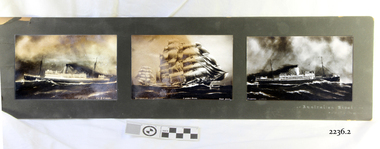 Flagstaff Hill Maritime Museum and Village
Photograph - Vessels, Sail and Steam Ships, A.V. Gregory, Australian Rivals - Past and Present, 1899-1932
... Hill Maritime Museum and Village...Warrnambool...Maritime Museum...Maritime Village...Great Ocean Road...Shipwreck Coast...ss katoomba...thermopylae...cutty sark...tea race...tea race china to london 1872...canberra...tea clippers...a v gregory...Gregory, whose original works are highly valued today by marine collectors. The pictures and document are significant for their association with the Tea Clippers, famous for racing across the world to arrive in Australia with the fastest time. Flagstaff Hill ...These photographs are copies of original paintings by the Australian marine artist A V Gregory (1867-1957), also known as Arthur Victor Gregory. Gregory lived and worked in South Melbourne. He took over the Gregory Studio owned by his father, George Frederick Gregory, painting actively between 1899 and 1932. He usually signed his works as ‘A V Gregory’. Some of his original works have been sold for thousands of dollars. These mounted photographs, by A.V. Gregory, show both steam and sailing ships sailing in the Tea Race from China to London in 1872. The information included with the photographs has the following text: “Tea Clippers “ Well done Cutty Sark, by Bobbie Burns The CUTTY SARK and THERMOPYLAE. The start of the 1872 Tea Race from China to London. The “Cutty Sark” first away, followed closely by the “Thermopylae”, finally parting after several days’ company. On this race the “Cutty Sark” lost her rudder in the Indian Ocean, putting her hopelessly out of the race, and enabling the “Thermopylae” to pass her and reach London on 11th October, 115 days out, the “Cutty Sark” limping home seven days later. The credit of the race was given to the “Cutty Sark” by the shipping world. Copies of the pictures may be had from A.V. Gregory, 326 Albert Road, South Melbourne."The detailed images of the vessels depicted in this photographs shows some of the many sail and steam vessels painted by the renowned Victorian marine artist A V Gregory, whose original works are highly valued today by marine collectors. The pictures and document are significant for their association with the Tea Clippers, famous for racing across the world to arrive in Australia with the fastest time.Photographs of paintings of sail and steamships, three photographs mounted together side by side, titled "Australian Rivals - Past and Present". The centre shows the sailing ships Thermopylae and Cutty Sark. It is flanked on each side by a photograph of a steamship. The document with the photographs gives the history of the famous Tea Race from China to London in 1872.Title: "Australian Rivals - Past and Present". Handwritten on Left photograph "A.V. GREGORY - SS KATOOMBA" Handwritten on Centre photograph; "THERMOPLAE - A.V. GREGORY - CUTTY SARK - FIRST AWAY" Handwritten on Right photograph; "CANBERRA - A/V/ GREGORY" Handwritten on accompanying card is the story of the Tea Clippers.flagstaff hill, flagstaff hill maritime museum and village, warrnambool, maritime museum, maritime village, great ocean road, shipwreck coast, ss katoomba, thermopylae, cutty sark, tea race, tea race china to london 1872, canberra, tea clippers, a v gregory, commercial trading vessel, cargo vessel, sailing vessel, steam vessel, clipper races, australian export, china tea trade -
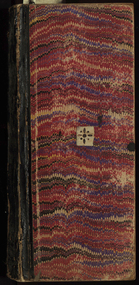 Federation University Historical Collection
Book - Ledger, Ballarat School of Mines Rough Cash Book, 1901-1907, 1901-1907
... hill...r.r. mitchell...a. phillipson...thomas davies...l. lewin...william gilbert...a.e. loveland...c.r. mccracken...george lawri...h.b. cooke...john usher...d.m. lilley...james holt...j. kenna...charles lund...j. o'dwyer...charles quaddock...william e. figgis...j.k. sim...w. heinz...willis franklin...roy booth...f. herman...george christie...g. davenport...edward richards...j.f. murphy...i. holmes...f. sior...i sim...w. caldwell...james leggo...g. nightingale...rupert king...h.j. semmens...h.r. kofoed...theo holmes...h.b. waldron...w. bell...j. curnow...j.f. d'oliveyra...w. bolitho...m. bade...e. gregory...cash book ballarat school of mines cash book assay fees guage testing treatment of ores gold selling student fees a.p.wood c. craddock l. craddock w.h. callister c. fleahy j.friend edward horwood james leckie a. peacock hilary dowling f. horsfall frank dalton arthur howard charles fryer henry clark r. allan w. barton r. mckay wolliam albert patrick anderson joseph rickard n. kavanagh percy miller h.e. gronow david hamilton andrew hamilton cyril mctaggart ernest lumley fred bicknell herbert bicknell charles fleay d.c. urquhart r. clark victor mckay ralph mckay j.b. robinson r. mann thomas de gruchy j.r.m. blight h. valentine james galbally a. mcd. ritchie j. sutherland h. herbert p.a. pratt w.m. williams g. cornell d. lilley elsie cutter g. bicknell john g. brittain f.l. cooper g.s. hepburn karl noone a. hugelmann h. heath w.a. mason thomas bradley charles e. hill r.r. mitchell a. phillipson thomas davies l. lewin william gilbert a.e. loveland c.r. mccracken george lawri h.b. cooke john usher d.m. lilley james holt j. kenna charles lund j. o'dwyer charles quaddock william e. figgis j.k. sim w. heinz willis franklin roy booth f. herman george christie g. davenport edward richards j.f. murphy i. holmes f. sior i sim w. caldwell james leggo g. nightingale rupert king h.j. semmens h.r. kofoed theo holmes h.b. waldron w. bell j. curnow j.f. d'oliveyra w. bolitho m. bade e. gregory g. hopwood j. o'bern a. robin a.e. tandy a.d. galloway j.f. boyce n. buley f.w. calaby a. elshang a.e. ebbels j. leggo r.e. holdsworth k. thiessen m. metz l. bult w. clift e. bonwick h. koefed h.j. saw j.l. sim e. wardle n.c. le gerche e. crossley b. humffray l. blick a.e. burgess g. lides p.f. browne f.a. richardson h. dahlenburg miles webster l. nott j.d. brokenshire beet wai n. la gerche e.m. boyer h.g. hawkesworth o. williams f. abel w.e. eyres c. rawlings a.j. robin p. grenfell f. eustice j. brokenshire w. mccartney herbert stephenson g. ditchburn c. steele f.j. webb h.o.e. bieske o. mccabe art library ballarat east school fees a. miles m. growcott a. gent arthur gates ida farmer gertrude bailey d. brigstiche d. bonan a.a. buley a.h. lilburne a.b. benoit l.e. waldie i. dilena harold herbert Ballarat Technical Art School Large ledger with marbled cover. ...Large ledger with marbled cover. It is a Ballarat School of Mines Rough Cash Book. The books list payments of students fees, assay fees, salaries and wages, guage testing, treatment of ores. Some student names outlined in keywords. cash book, ballarat school of mines cash book, assay fees, guage testing, treatment of ores, gold selling, student fees, a.p.wood, c. craddock, l. craddock, w.h. callister, c. fleahy, j.friend, edward horwood, james leckie, a. peacock, hilary dowling, f. horsfall, frank dalton, arthur howard, charles fryer, henry clark, r. allan, w. barton, r. mckay, wolliam albert, patrick anderson, joseph rickard, n. kavanagh, percy miller, h.e. gronow, david hamilton, andrew hamilton, cyril mctaggart, ernest lumley, fred bicknell, herbert bicknell, charles fleay, d.c. urquhart, r. clark, victor mckay, ralph mckay, j.b. robinson, r. mann, thomas de gruchy, j.r.m. blight, h. valentine, james galbally, a. mcd. ritchie, j. sutherland, h. herbert, p.a. pratt, w.m. williams, g. cornell, d. lilley, elsie cutter, g. bicknell, john g. brittain, f.l. cooper, g.s. hepburn, karl noone, a. hugelmann, h. heath, w.a. mason, thomas bradley, charles e. hill, r.r. mitchell, a. phillipson, thomas davies, l. lewin, william gilbert, a.e. loveland, c.r. mccracken, george lawri, h.b. cooke, john usher, d.m. lilley, james holt, j. kenna, charles lund, j. o'dwyer, charles quaddock, william e. figgis, j.k. sim, w. heinz, willis franklin, roy booth, f. herman, george christie, g. davenport, edward richards, j.f. murphy, i. holmes, f. sior, i sim, w. caldwell, james leggo, g. nightingale, rupert king, h.j. semmens, h.r. kofoed, theo holmes, h.b. waldron, w. bell, j. curnow, j.f. d'oliveyra, w. bolitho, m. bade, e. gregory, g. hopwood, j. o'bern, a. robin, a.e. tandy, a.d. galloway, j.f. boyce, n. buley, f.w. calaby, a. elshang, a.e. ebbels, j. leggo, r.e. holdsworth, k. thiessen, m. metz, l. bult, w. clift, e. bonwick, h. koefed, h.j. saw, j.l. sim, e. wardle, n.c. le gerche, e. crossley, b. humffray, l. blick, a.e. burgess, g. lides, p.f. browne, f.a. richardson, h. dahlenburg, miles webster, l. nott, j.d. brokenshire, beet wai, n. la gerche, e.m. boyer, h.g. hawkesworth, o. williams, f. abel, w.e. eyres, c. rawlings, a.j. robin, p. grenfell, f. eustice, j. brokenshire, w. mccartney, herbert stephenson, g. ditchburn, c. steele, f.j. webb, h.o.e. bieske, o. mccabe, art library, ballarat east school fees, a. miles, m. growcott, a. gent, arthur gates, ida farmer, gertrude bailey, d. brigstiche, d. bonan, a.a. buley, a.h. lilburne, a.b. benoit, l.e. waldie, i. dilena, harold herbert, ballarat technical art school -
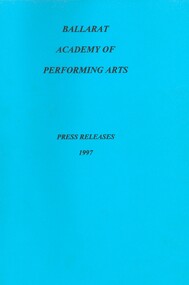 Federation University Historical Collection
Book - Copies of newspaper articles, Ballarat Academy of Performing Arts Press Releases 1997, 1997
... Gregory...Colette Bruggeman...Luke Doxey...Gavin Fenech...Dennis Marinovic...Nadia Andary...Narelle Werner...The Importance of Being Ernest...Maureen Edwards...Andrew Arney...Tim Haymes...Mark Gambino...Heather Kent...Performing Arts Courses 1997...The Man From Muckinupin...Dorothy Hewett...Chris Dickins...Linda Judd...James McLaverty...Jamie Robertson...Natalia Rose...Steven Kerr...Jon Catanzariti...Grant Hickory...Sarah Griffin...Laura Hill...Hill. 'Secrets' - Sarah Griffin, Linda Jude, Steven Kerr, Angela Coad, Natalie Zappulla. Staged at University of Ballarat's Studio Theatre. Bookings MajesTix - $10 or $7.5 *Euripide's, 'The Bacchae', a tale of revenge, directed by Bruce Widdop and performed by 2nd year students from the University of Ballarat Performing Arts Department and the BAPA. Assistant directors' Tim Haymes and Derren Jackson. Cast members: Richard DiGregorio (Dionysus), Chris Stipic (Cadmus), Colette Brugman (Agaue), Denis Marinovic (Pentheus), Mark Gambino (Teiresias) and Ross Larkin as the messenger. Other supporting performers are Luke Doxey, Brendan Mayne, Heather Kent, Kevin Dee, Gavin Fenech, Nadia Andary, Karissa Clarke, Adelle Gregory...Hill. 'Secrets' - Sarah Griffin, Linda Jude, Steven Kerr, Angela Coad, Natalie Zappulla. Staged at University of Ballarat's Studio Theatre. Bookings MajesTix - $10 or $7.5 *Euripide's, 'The Bacchae', a tale of revenge, directed by Bruce Widdop and performed by 2nd year students from the University of Ballarat Performing Arts Department and the BAPA. Assistant directors' Tim Haymes and Derren Jackson. Cast members: Richard DiGregorio (Dionysus), Chris Stipic (Cadmus), Colette Brugman (Agaue), Denis Marinovic (Pentheus), Mark Gambino (Teiresias) and Ross Larkin as the messenger. Other supporting performers are Luke Doxey, Brendan Mayne, Heather Kent, Kevin Dee, Gavin Fenech, Nadia Andary, Karissa Clarke, Adelle Gregory ...Reports published in The Courier newspaper of performances by Ballarat Academy of Performing Arts, including items naming students past and present of the University of Ballarat during 1997 plus articles of people and events connected to the Arts Academy. Also contains information about Ballarat University courses for performing arts. Articles are mostly from the Ballarat Courier newspaper in chronology year (1997) order with no page numbers. Two items are from December 1996 and three articles in October 2001. PRODUCTIONS : *' Pericles' performed by Ballarat's Ozact Theatre Company at Port Fairy's Battery Point. *'Maelstrom' written by Chris Dickens and directed by Peter Tulloch performed by BAPA third year students.(Oct. 28th - Nov 1st) Some cast members were: James McLaverty, Melissa Casey, Linda Judd, Angela Coad, Sarah Griffin, Kathy Lucas, Melissa Casey, Laura Hill, Grant Hickey, Jamie Robertson, Jon Catanzariti, Steve Kerr, Jeff Parker Natalie Zappulla. Performed at Ballarat University Studio Theatre (Nov 4th -8th) and also at Melbourne's CUB Malthouse (Nov. 25th-29th) *"7 Deadly" directed by Chris Dickens and performed in The Chapel at the Academy's Victoria Street campus by 1st year Ballarat University students. Some cast members were: Ash Abdou, Niniane Le Page, Alex Meerbach, Adam Davies and Elicia Bolger. *"Sounds of Broadway and Off' (Oct 9th - 11th) directed and choreographed by Judith Roberts and performed at the Studio Theatre , University of Ballarat, by 1st year students of Musical Theatre at BAPA. Some cast members were Paul Thomas, Shannon Palmer, Aakash Andrews, Justine Schnellbeck, Erica Chestnut,, Rebecca McGuinness, Matthew Heyward, Kellie Rode. Tickets cost $5.00 *'Bewitched" "a parody of the original television series" directed and produced by Ballarat performing arts graduates Adam Turnbull and Claire O'Sullivan. Most of the cast and crew were graduates from the University of Ballarat. Some cast members were: Katherine Evans as Samantha and Martin Cole as Darren. Simon Buckle was responsible for his original music, songs and special effects. *Concert: Featuring pianist Slavomir Zumis and cellist Robert Ekselman (Oct. 3rd) *"Charley's Aunt" by Brandon Thomas, performed by 2nd year Ballarat Academy of the Arts 2nd Year Company at The Venue Studio Theatre, University of Ballarat (Sept. 23rd-27th). Cast members: Derren Jackson, Ross Larkin, Kevin Dee, Adelle Gregory, Colette Bruggeman, Luke Doxey, Gavin Fenech, Dennis Marinovic, Nadia Andary, Narelle Werner. Cost: Adults $10, Concession $7.50, Bookings at Majestix. *'The Importance of Being Ernest' (by Oscar Wilde), performed by second year theatre company of the University of Ballarat, directed by Maureen Edwards, designed by Andrew Arney. Cast members included Narrell Werner as Gwendolen, Tim Haymes as Jack, Mark Gambino as Algermon, Adelle Gregory as Cecily and Heather Kent as Lady Bracknell. The production was at the Studio Theatre, University of Ballarat, September 16th-20th , 8pm. Ticket costs: $10 Adult, $7.50 Pensioners/students. Double bill tickets for The Importance of Being Ernest and Charley's Aunt (Sept.23-27) costs: $15 Adults,$10 Concession. *"The Man From Muckinupin' (by Dorothy Hewett), directed by Chris Dickens and performed by University of Ballarat 3rd Year Performing Arts at Studio Theatre, University of Ballarat from Aug 26th - Aug 30th 1997. Cast members: Lisa Judd as Polly, James McLaverty as Jack, Jamie Robertson, Natalia Rose, Steven Kerr, Jon Catanzariti, Melissa Casey, Grant Hickey, Sarah Griffin, Laura Hill, Kathy Lucas, Angela Coad, and Jeff Parker. Ticket costs: $10 Adults, $7.50 Concession from MajesTix *'The Inspector' (by John Cousins) director Bruce Widdop, performed by the Third Year Graduating Company, University of Ballarat, Ballarat Academy of Performing Arts; at Studio Theatre, University of Ballarat, Aug 19th-23rd, 1997. Cast: Jamie Robertson as the mayor, Jeff Parker as the supposed government inspector, Grant Hickey as Sidney, Melissa Carey as Rose, and Sarah Griffin as Rose's daughter, Laura Hill as the postmaster and Linda Judd as the headmistress. Some 1st year students had cameo roles - Adam Parsons and Adam Davies. *'Cosi' directed by Andrew Seeary and performed by Theatre Movement at the Grainery Lane Theatre, Doveton Street, Balarat. The story has a young, nervous director Lewis, played by Brett Edginton, arrive in a mental home to produce a play with the inmates. Other cast members are Karl Hatton (Roy), Miranda Crellin (Cherry), Rob MacLeod (Henry), Ray Craven (Zac), Narrell Werner (Julie), Nadia Andary (Ruth), Mark Gambino (Doug), Elizabet Stewart and Michael Cooper (Lewis' unsympathetic friends) and Bob House (the Social Worker). Nadia, Mark and Narelle are Ballarat University performing arts students. Season: July 24th,25th 26th and 31st and August 1st and 2nd, 1997. Tickets at the door or through Majestix. Cost: Adults $16; Concession $11. Reviewer: Barry Breen, a Ballarat author, poet and performance artist. *'New Works' involves two plays - 'The Inside Out', director Melissa Casey and 'Secrets'. director Jeff Parker, presented by Ballarat Academy of Performing Arts Third Year Company, both written and directed by third year students. All production areas handled by students of BAPA. Cast members: 'The Inside Out' - Jamie Robertson, Laura Hill. 'Secrets' - Sarah Griffin, Linda Jude, Steven Kerr, Angela Coad, Natalie Zappulla. Staged at University of Ballarat's Studio Theatre. Bookings MajesTix - $10 or $7.5 *Euripide's, 'The Bacchae', a tale of revenge, directed by Bruce Widdop and performed by 2nd year students from the University of Ballarat Performing Arts Department and the BAPA. Assistant directors' Tim Haymes and Derren Jackson. Cast members: Richard DiGregorio (Dionysus), Chris Stipic (Cadmus), Colette Brugman (Agaue), Denis Marinovic (Pentheus), Mark Gambino (Teiresias) and Ross Larkin as the messenger. Other supporting performers are Luke Doxey, Brendan Mayne, Heather Kent, Kevin Dee, Gavin Fenech, Nadia Andary, Karissa Clarke, Adelle Gregory and Narrell Werner. The play was performed at the Studio Theatre, Ballarat University, June 3rd-6th, 1997.Tickets MajesTix or at the door - $10 Adult, $7.50 Concession. *'Back to the Tivoli' School of Performing Arts - June 10th -14th. Venue: Academy of Performing Arts, Victoria Street, 8pm *Aristophane's 'Lysistrata', an anti-war comedy. Performed by first year drama students from the University of Ballarat and BAPA at the Studio Theatre, University of Ballarat, Mount Helen, on May 27th-30th, 1997. Cast members: Niniane Le Page (Lysistrata), Fiona Russell (Calonice), Anne Winter (Myhrrine), Dominic Phelan (Cinesias), Alex Meerbach (Stratyllis), Michael Rafferty (Leader), Melissa Lowndes (Lampito), Renee Francis (Ismenia), Kathryn Martin (Corinthian), Geoffrey Spink (doorman), Adam Parsons (magistrate), Adrian Dart (policeman), David Kambouris (policeman two), Max Grarock (negotiator), Phol Crompton (ambassador) and Ross Farrell (herald). Male chorus members: Paul Thomas, Adam Davies, Ashraf Abdou, Karan Khanna. Female chorus members: Lauren Oliver, Suzie, Lewis and Lindy Kerr. Tickets MajesTix - $10 Adults, $7.50 Concession; or $12 special double bill price including The Bacchae. *Roger Woodward Recital - a piano recital by the internationally acclaimed Australian pianist to launch the Ballarat Academy of the Arts asset drive. He performed on the University's historic Erard Grand Concert piano on stage in Founders Hall, describing it as "absolutely amazing.' The instrument was 93 years old and hadn't been played for more than eighty years. An audience of 500 were entertained with pieces by Schubert and Bach for the first half of the program and Waltzes, Mazurkas, and Polonaises by Chopin after the interval. Fittingly an encore of the Minuet in G by Paderewski was played on the very piano the composer had brought from England for his Australian tour in 1906. *'The Merry Wives of Windsor' by William Shakespeare; directed by Beth Child; designer Damian Muller; Production by Third Year Graduating Company, University of Ballarat Performing Arts Department. This play is a comedy not performed very frequently. Cast members: Angela Coad (Mistress Page), Laura Hil (Mistress Quickly), Gavin Fenech (Falstaff), Kathy Lucus (Justice Shallow), Melissa Casey (Mistress Ford), Jeff Parker (Mr Ford), Jamie Robertson ( Mr Page) and Karrissa Clarke (Simple). Staged at the Studio Theatre, University of Ballarat, May 6th-10th 1997 at 8pm. Tickets $10. Concession $7.50. *"Ship of Fools" SMB Performing Arts. Grainery Lane Theatre, 9th-10th May 1997 Cast members: Chris Lytas (Mac & Convinso), Kate Edwards (Mayor & Rachel), Ruth Sheridan (numerous characters) *'Lola Montez - The Musical' author Alan Burke; director Peter Tulloch; choreographer Fred Fargher; designer Damian Muller, musical director Graeme Vendy. Performed by twenty-eight second year Performing Arts students with Nadia Andary in the lead role of Lola,, Grant Hickey as Henry Seekamp the Ballarat Times editor who receives a whipping from Lola for his criticism of her. Tim Haymes is the character Smith, Karissa Clarke plays nurse Jane Oliver and Ross Larkin plays soldier Daniel Brady. Other cast members were Luke Doxey, Richard Di Gregorio, Chris Stipic and Brendan Mayne. A feature of the show is Lola's celebrated Spider Dance which was acknowledged many years ago by the crowd throwing gold nuggets onto the stage. Presented by the Hugh Williamson Foundation in association with the Begonia Festival organizers the performance was at Her Majesty's Theatre, Ballarat nightly from 12th-15th March at 8pm with a matinee at 2pm on the 15th. Tickets at Majestic: Adult $18.50, Concession $13.50, Group Adult $15.50, Group Concession $10.50, Culture Vulture $12.00 Family $46 Season 97. *' 2001- 'On The Town' a musical comedy performed by graduating Ballarat Academy of Performing Arts and directed by course coordinator Kim Durban from the Victorian Theatre Company; and BAPA assistant production manager Jo Pearson. It features a cast of 30 and music from a 15 piece band. Photo depicts three cast members: Keith Miles, Adam Lubicz and Glenn Quinn. It was performed in America in 1944 and tells the story of three sailors who arrive in New York on 24-hour shore leave. It was performed at Founder's Hall, University of Ballarat, Mount Helen campus. Tickets $15 adults, $10 concession and $7 for children and students. Family tickets were available. Bookings MajesTix. *'Play With Your Food' a new theatre restaurant show performed by SMB Performing Arts students at Craig's Cellar, Lydiard Street, Ballarat. It was an original show devised and written by Second Year SMB Performing Arts students. following their sold-out touring show 'unplugged' and Book Week play 'SapceDust'. There are also articles about people involved with the University of Ballarat Performing Arts course and the courses in the Arts. Lady Lush's world of unusual characters presented jokes, songs, music whisked together into a bizarre story for audiences to enjoy and even be tie up. Cast members: Melissa Porritt, Loenne Whitecross, Jess Matthews, Kristie Glab and Julia McNamee. It was performed over five nights, 7th-8th-9th-15th and 16th November, 2001. Cost $20. NEWSPAPER ARTICLES: Directors for University of Ballarat 2nd Year Performing Arts Maureen Edwards (photo) An advertisement for BA Visual Arts - Studio Studies available for Ceramics / Drawing / Graphic Design / Print Making /Painting / Multi-Discipline - Undergraduate and Post Graduate Studies. Also for BA Performing Arts - Major Studies available: Performance Acting, Theatre Production, Performance Music Theatre. Ballarat Academy of Performing Arts - New lecturers 1997: Lecturer in Design and theatre crafts - Damian Muller; lecturer in production and stage management - Leonard Bauska; and lecturer in theatre technology - Matthew Heenan. Ballarat Academy of Performing Arts - 1 st article in 'The Flag' Alumni Newsletter, University of Ballarat, Issue June, 1997 re 1st intake of students in February, 1997. 2nd article 'Where Are They Now' - Amanda Sandwith. Event - 'Lydiard Street Alive' : firebreathing act 'David and Goliath' performed by David Patullo. Article with information (includes advertisment for course) about the 3 year performing arts degree at Ballarat consisting of performance acting, theatre production and performance music theatre which are part of Ballarat Academy of Performi8ng Arts which resources from three institutions - University of Ballarat, Australian Catholic University and the School of Mines. BAPA launch: Photos of some attendees - June 3rd 1997 Ballarat Courier. Performers featured Erica Chestnut and Sue-Ann Thomas. Amy Young - Up Close and Personal article - Ballarat Courier - Saturday June 14 1997. Amy Young was the director and conductress of Ballarat 'Y" Choir for 45 years. In 1996 she donated her husband's (Dr Keith Young) Steinway grand piano and musical collection to BAPA. This article is about her life. Events calendar for the Month of May, 1997. Peter Tulloch ( University of Ballarat Performing Arts Co-ordinator 1997) Newspaper article - interview by Elise Sullivan that appeared in The Ballarat Courier Saturday May 3rd 1997 Weekend Edition . Many articles on Roger Woodward and a $3 million asset drive for the Ballarat Academy of Performing Arts. Advertisement for 3 Arts positions at the University of Ballarat - Lecturers in Theatre for Movement/Dance; Design, Theory and Craft; and Theatre Technology Article: 'Who's Who at the Academy' - A list of First Year, Second Year, Third Year, Performing Arts Staff (University of Ballarat and Australian Catholic University). Article about the Erard Concert Grande piano and its acquisition by the University of Ballarat. There are several articles linked to the production of "Lola Montez the Musical' including: *Lola Montez's life in a timeline -1818 to 1861 compiled by Peter Freund, Her Majesty's Theatre historian on behalf of Ballarat Begonia Festival. * A radio show in 1952 performed by Ballarat's "Y" Drama Group featuring 16 year old Joy Brehaut as Lola Montez and directed by 3BA's Ted Furling *Ballarat's Most Famous Scandal Advertising Poster for Lola Montez *Lola Whips In * Lola to Tread the Boards Again * Lola to Return to Ballarat - The "Minister for Purity, The Reverend John Potter" - (actor Jamie Robertson) * Veteran Takes His First Look at Lola * First Stage Lola meets the New Lola - Nadia Andary meets 1967 Lola, Nancy Brauer. * Lola Returns Home An article listing the 12th Annual Encore Awards held at Ballarat Village on Wednesday 5th March 1997. * Advertisement for major studies available in 1998 -Theatre Performance; Music Theatre Performance and Theatre Production plus upcoming productions - Aug - The Inspector and The Man From Muckinup; Sept - The Importance of Being Ernest and Charley's Aunt; Oct- The London Blitz Show and They Shot Horses Don't They? Nov - Graduate Exhibition * Article 3/12/1996: Amy Young donates her husband Dr. W. H. Keith Young's Steinway grand piano and studio stacked with historic documents to the jointly run Performing Arts Academy following his death. The book consists of A4 paper sheets, heat bound with blue card front and back cover with a plastic overlay. The pages contain photocopied articles printed in the Ballarat Courier during 1997. Two articles are from December 1996.bapa, pericles, ozact theatre company, ozact, maelstrom, chris dickens, joan petering, peter tulloch, 7 deadly, ballarat academy of performing arts, bpca, ballarat college of performing arts, sounds of broadway and off, judith roberts, graeme vendy, bewitched, adam turnbull, claire o'sullivan, katherine evans, martin cole, simon buckle, charley's aunt, brandon thomas, derren jackson, ross larkin, kevin dee, adelle gregory, colette bruggeman, luke doxey, gavin fenech, dennis marinovic, nadia andary, narelle werner, the importance of being ernest, maureen edwards, andrew arney, tim haymes, mark gambino, heather kent, performing arts courses 1997, the man from muckinupin, dorothy hewett, chris dickins, linda judd, james mclaverty, jamie robertson, natalia rose, steven kerr, jon catanzariti, grant hickory, sarah griffin, laura hill, kathy lucas, angela coad, jeff parker, john cousins, bruce widdop, melissa carey, adam parsons, adam davies, damian muller, leonard bauska, matthew heenan, cosi, grainery lane theatre, andrew seeary, brett edginton, karl hatton, miranda crellin, rob macleod, ray craven, elizabeth stewart, michael cooper, bob house, barry breen, the flag, performing arts academy - ballarat, bert labont'e, lydiard stree alive, david and goliath, david patullo, amanda sandwith, bapa launch, erica chestnut, sue-ann thomas, amy young, dr keith young, ballarat "y" choir, the bacchae, richard digregorio, chris stipic, colette brugman, denis marinovic, brendan mayne, karissa clarke, narrell werner, niniane le page, fiona russell, anne winters, melissa lownds, renee francis, kathryn martin, michael rafferty, dominic phelan, geoffrey spink, paul thomas, ashraf abdou, karan khanna, alex meerbach, lauren oliver, suzie lewis, lindy kerr, adrian dart, david kambouris, max grarock, phil crompton, ross farrell, roger woodward, erard grand concert piano, karrissa clarke, beth child, chris lytas, kate edwards, ruth sheridan, ballarat academy of performing arts asset drive, positions - school of arts, erard concert grande piano, ignace paderewski, professor david james, david james, robert allen, bapa opening, gabrielle mcmullen, dr ron wild, graham clarke, michael faulkner, sacred heart convent of mercy ballarat, lola montez the musical, spider dance, lola montez, grant hickey, fred fargher, peter freund, ballarat begonia festival, nancy brauer, james robertson, jo pearson, on the town, keith miles, adam lubicz, glenn quinn, play with your food, melissa porritt, loenne whitecross, jess matthews, kristie glab, julia mcnamee, smb performing arts students, the london blitz show, they shoot horses don't they?, graduate exhibition -
 Federation University Historical Collection
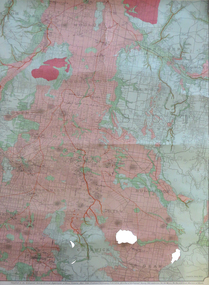
Map, Creswick, Clunes, Smeaton, Newstead, Yandoit and District, 1904, 06/1904
... hill...mt cameron...strangways...avoca forest...stanley hunter...j.w. gregory...ascot creswick clunes franklinford miners rest sandon smeaton tourello yandoit mt moorookyle powlett's hill woodhouse's hill smeaton hill mcdonald's hill green hill spring hill horse shoe hill mt cameron strangways avoca forest stanley hunter j.w. gregory d. mcleod donald mcleod daruel A coloured geological map with green and pink predominating. ...A coloured geological map with green and pink predominating. The shows Ascot, Creswick, Clunes, Franklinford, Miners Rest, Sandon, Smeaton, Tourello, Yandoitascot, creswick, clunes, franklinford, miners rest, sandon, smeaton, tourello, yandoit, mt moorookyle, powlett's hill, woodhouse's hill, smeaton hill, mcdonald's hill, green hill, spring hill, horse shoe hill, mt cameron, strangways, avoca forest, stanley hunter, j.w. gregory, d. mcleod, donald mcleod, daruel -
 Federation University Historical Collection
Book, J.W. Gregory, Memoirs of the Geological Survey of Victoria No. 4: The Ballarat East Gold-Field, 1907, 1907
... Hill, The place in Learmonth Street Golden Point where gold was first discovered at Ballarat. Memoirs of the Geological Survey of Victoria No. 4: The Ballarat East Gold-Field, 1907 Book Book J. Kemp, Acting Government Printer J.W. Gregory ...Blue soft covered report with 40 plates and plans. Inciudes Geology of Ballarat. Little Bendigo Goldfield, Ballarat West Goldfield, Ballarat East Goldfield, history, nuggets, indicators, faults, microscopic structure of Ballarat Rocks and ores, general type of the Ballarat East Mines and the genesis of their ores. Mines include New Zealand Trust, Llanberris No. 1, Llanberris No 2, Victoria United, Britannia United, New Britannia, Last Chance, Exchange, Normanby North, New Normanby, North Woah Hawp. Photpgraphic plates include: Victoria United Mine, Llanberres No. 1, Normanby North, North Woah Hawp Mine, View looking south from the Britannia Mullock Heap, View from Sovereign Hill, The place in Learmonth Street Golden Point where gold was first discovered at Ballarat. j.w. gregory, ballarat east, ballarat east goldfield, e.j. dunn, geolological survey of victoria, new zealand trust, llanberris no. 1, llanberris no 2, victoria united, britannia united, new britannia, last chance, exchange, normanby north, new normanby, north woah hawp, mining, indicators, gold mining, poppet head -
Federation University Historical Collection
Document, Apprenticeship Commission of Victoria Enrolment Forms, 1969
... Hill...John Bennett...Lindsay I Litchfield...Collin W Ludbrook...Rodney J Page...Alexander F R Lloyd...Vashti A F Lloyd...Robert L. Rowe...James H. Jolly & Patricia M Jolly...Jacobus T Weyers...G. Irish and Sons Pty Ltd...Peter J. Slater...Louis O Deutscher...Edward H. Fairhall...Geoffrey R. Pfeiffer...Gary J. Lorensene...Gregory...Hill John Bennett Lindsay I Litchfield Collin W Ludbrook Rodney J Page Alexander F R Lloyd Vashti A F Lloyd Robert L. Rowe James H. Jolly & Patricia M Jolly Jacobus T Weyers G. Irish and Sons Pty Ltd Peter J. Slater Louis O Deutscher Edward H. Fairhall Geoffrey R. Pfeiffer Gary J. Lorensene Gregory ...Blue enrolment formstrades, fitting and turning, carpentry, machining, albert l. ferrara, m.b john & hattersley ltd, bruce m. schulz, colin h jennings, victorian railways department, richard j. stewart, villiers australia pty ltd, jeffrey h. jenkins, humes limited, hans gram, concrete industries (monier) ltd, terence w. glazner, john w. berriman, ian g. butson, christopher brand, norman l. plover, burton & co pty ltd, eddo dellore, barry e. harrison, john g. flynn, firth & cleveland pty ltd, geoffrey p. gladman, james d. hutchins, burridges agricultural development pty ltd, devan w mcphan, john l. dolan, t.j. coutts pty ltd, philip j. ritchie, david j. douglas, colin a. hill, john bennett, lindsay i litchfield, collin w ludbrook, rodney j page, alexander f r lloyd, vashti a f lloyd, robert l. rowe, james h. jolly & patricia m jolly, jacobus t weyers, g. irish and sons pty ltd, peter j. slater, louis o deutscher, edward h. fairhall, geoffrey r. pfeiffer, gary j. lorensene, gregory r tingate, ronaldson bros & tippett pty ltd., peter c. isaac, chris p. molenkamp, john l. mcniece, russell g harbour, barry r. ward, michael i. kennedy -
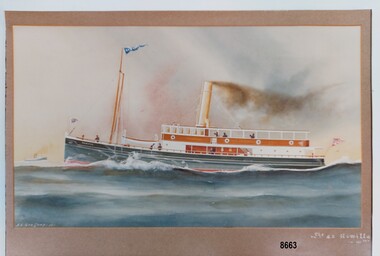 Flagstaff Hill Maritime Museum and Village
Photograph - Print of S. S. Rowitta, A.V. Gregory, 1912
... Hill Maritime Museum and Village...Warrnambool...Great Ocean Road...Shipwreck Coast...S. S. Rowitta...Rowitta...A. V. Gregory...Flagstaff Hill Maritime Museum and Village Warrnambool Great Ocean Road Shipwreck Coast S. S. Rowitta Rowitta A. V. Gregory ...S. S. ROWITTA: - The 1909 steam ferry, S. S. Rowitta, was installed as an exhibit at Flagstaff Hill in 1975 and was enjoyed by many visitors for 40 years. S. S. Rowitta was a timber steam ferry built in Hobart in 1909 using planks of Huon and Karri wood. She was a favourite of sightseeing passengers along Tasmania’s Tamar and Derwent rivers for 30 years. The Rowitta was also known as Tarkarri and Sorrento and had worked as a coastal trading vessel between Devonport and Melbourne, and Melbourne Queenscliff and Sorrento. In 1974 the S. S. Rowitta was purchased by Flagstaff Hill to convert into a representation of the Speculant, a historic and locally significant sailing ship listed on the Victorian Heritage Database. (The Speculant was built in Scotland in 1895 and traded timber between the United Kingdom and Russia. Warrnambool’s P J McGennan & Co. then bought the vessel to trade pine timber from New Zealand to Victorian ports and cargo to Melbourne. She was the largest ship registered with Warrnambool as her home port, playing a key role in the early 1900s in the Port of Warrnambool. In 1911, on her way to Melbourne, she was wrecked near Cape Otway. None of the nine crew lost their lives.) The promised funds for converting the S. S. Rowitta into the Speculant were no longer available, so she was restored back to her original configuration. She represented the importance of coastal traders to transport, trade and communication in Australia times before rail and motor vehicles. Sadly, in 2015 the time had come to demolish the Rowitta due to her excessive deterioration and the high cost of on-going repairs. She had given over 100 years of service and pleasure to those who knew her. Arthur Victor Gregory (known as A. V. Gregory) was born in Melbourne in 1867. He was the son of George Frederick Gregory who was an established marine painter with a studio in South Melbourne. A. V. Gregory worked with his father and his elder half-brother (George Frederick Junior). They made numerous photographic reproductions of their ships' portraits, selling the originals to captains and owners and the photographic prints to the crews. A. V. Gregory inherited the business on the death of his father in 1890 and continued to paint until World War 2 when he stopped for wartime security reasons. Gregory worked mainly in watercolour and gouache. He kept all his working sketches so he could repeat earlier paintings and make more copies of the same ship. His carefully detailed portraits of every kind of vessels seen on Port Phillip Bay created a body of work regarded as a valuable record of the maritime traffic of that period.This print is a significant example of the work of the well-known and well-respected marine painter A. V. Gregory who created a detailed record of shipping in the Port Phillip Bay area in the years before W.W. 2. It is also significant as it connects the history of the S. S. Rowitta, which was a large exhibit on display at Flagstaff Hill Maritime Village from the museum’s early beginnings until the vessel’s end of life 40 years later. The S. S. Rowitta represents the importance of coastal traders to transport, trade and communication along the coast of Victoria, between states, and in Australia before rail and motor vehicles and is significant for its association with Tasmanian history from the early to mid-1900s. The vessel was an example of a ferry built in the early 20th century that served many different roles over its lifetime of over 100 years.This is a photograph of a watercolour painting of the S. S. Rowitta. It shows a steamer moving through the water. The ship has a blue, metal hull, a wooden lower and upper deck, a lifeboat and smoke coming out of a chimney. Flags are flying from the bow, the stern and the mast. Seven figures can be seen on the decks. A second boat can be seen in the distance in the far left of the picture. It has the signature "A. V. Gregory - 12" in the bottom left corner and the title "S. S. Rowitta - 121 tns" in the lower right corner.Signed "A. V. Gregory -12-" Titled "The S. S. Rowitta / -121 tns" Printed on the ships' bow - "ROWITTA"flagstaff hill maritime museum and village, warrnambool, great ocean road, shipwreck coast, s. s. rowitta, rowitta, a. v. gregory, painting, marine painting, marine painter, steamer, steam ferry, passenger ferry, alfred gregory, tarkarri, sorrento, speculant, print, photograph -
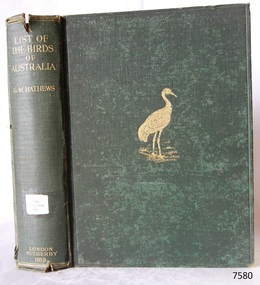 Flagstaff Hill Maritime Museum and Village
Book, A List of The Birds of Australia
... Hill-Maritime-Village...Shipwrecked-artefact...Book...Warrnambool Mechanics’ Institute...Warrnambool Public Museum...A List of The Birds of Australia...Gregory...Warrnambool Shipwrecked-coast Flagstaff-Hill Flagstaff-Hill-Maritime-Museum Maritime-Museum Shipwreck-coast Flagstaff-Hill-Maritime-Village Shipwrecked-artefact Book Warrnambool Mechanics’ Institute Warrnambool Public Museum A List of The Birds of Australia Gregory M. ...A List of The Birds of Australia Author: Gregory M. Mathews, F.R. S. E. Publisher: Witherby & Co Date: 1913Label on spine cover with typed text RA 598.2994 MAT Pastedown front endpaper has sticker from Warrnambool Mechanics Institute and Free Library Front loose endpaper has a stamp from Warrnambool Public Museum warrnambool, shipwrecked-coast, flagstaff-hill, flagstaff-hill-maritime-museum, maritime-museum, shipwreck-coast, flagstaff-hill-maritime-village, shipwrecked-artefact, book, warrnambool mechanics’ institute, warrnambool public museum, a list of the birds of australia, gregory m. mathews -
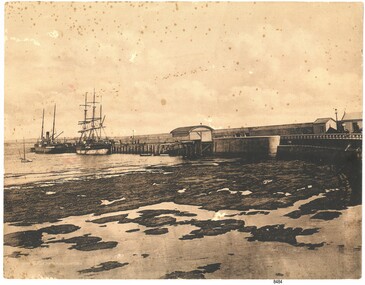 Flagstaff Hill Maritime Museum and Village
Photograph - Coastal Scene, Joseph Jordan Photographic Studio, Lady Bay and Breakwater, Warrnambool, circa 1907
... Flagstaff Hill Flagstaff Hill Maritime Museum Warrnambool Warrnambool Harbour Port of Warrnambool Tramway jetty Breakwater Lifeboat and Rocket Shed Steamship barque Photograph of Lady Bay Rocket House shipping Joseph Jordan Lady Bay Views of Warrnambool Jordan photography Front of photo - BREAKWATER, WARRNAMBOOL, VICTORIA Back of photo - "From: P Gregory / 365 Beach Road / BLACK ROCK 3193" Sepia photograph showing the beach and the Breakwater in Lady Bay Warrnambool, two ships (a steamship and a barque), a small sailboat, and the Lifeboat and Rocket House plus two smaller sheds. ...The Port of Warrnambool - In the early years the Port of Warrnambool was a busy port. Steamships and sailing ships were frequent visitors to the port. Steam navigation companies were plentiful, carrying passengers and freighting cargo such as coal, timber, food, livestock, furniture, hardware and haberdashery between Melbourne and the ports along the southwest coast of Victoria, including Warrnambool. The carts would take their loads into the township for distribution. The Breakwater was built (using 32 ton blocks of concrete) between 1874 and 1890 to provide ships with greater protection from the Southern Ocean. The Lifeboat and Rocket House - The coastline of South West Victoria has had over 600 shipwrecks and many lost lives; even in Warrnambool’s Lady Bay there were around 16 known shipwrecks between 1850 and 1905, with eight lives lost. In 1859 the first Government-built lifeboat arrived at Warrnambool Harbour and a shed was soon built to house it, followed in 1864 by a rocket house to safely store the Rocket Rescue equipment. In 1878 the buildings were moved to the Breakwater area, and in 1910 the new Lifeboat Warrnambool arrived with its ‘self-righting’ design. For almost one hundred years the lifeboat and rocket crews, mostly local volunteers, trained regularly to maintain and improve their skills, summoned when needed by alarms, gunshots, ringing bells and foghorns. Some became local heroes but all served an important role. By the end of the 1950s the lifeboat and rescue equipment had become obsolete. Joseph Jordan - Joseph Jordan was born in 1841 in Leicester England. When he was 16 he joined the 7th Queen's Own Hussars and was sent to India at the outbreak of the mutiny. He took part in the relief of Lucknow and remained in India for eleven years. It was during this time, he became interested in photography. He was posted to New Zealand and later came to Victoria, becoming a sergeant major of the Mounted Rifles. In the mid 1880s he came to the Western district where he was responsible for establishing units of the Mounted Rifles in various country towns such as Dunkeld, Mortlake, Panmure, Bushfield, Koroit etc. He resigned from the army in 1889 and set up a professional photography studio in Liebig Street, Warrnambool. He became very well known in the Western District for family photographs, official photographs of local councillors and groups as well as views of local scenery. In 1891 he photographed the wrecked barque "Fiji" at "Wrecks Beach" near Princetown. His business was taken over by his son Arthur around 1917. Joseph was a keen rifle shot and in 1924 he donated the "Jordan Shield" as a prize to the Victorian Rifle Association. He was made a "Life Honorary Member" of the Warrnambool Returned Soldiers League and in 1933 he was recognised as being the oldest living soldier in Victoria. Joseph died in 1935 aged 95.This photograph is significant for its association with the Port of Warrnambool and the Warrnambool Breakwater as it shows a point in time when shipping activities were an important part of Warrnambool's commerce and social development. It is also a record of the Warrnambool Lifeboat and Rocket house which was important in aiding ordinary citizens, harbour employees and the volunteer boat and rescue crew in saving the lives of sailors and passengers due to the high number of shipwrecks that occurred along the coastline. Joseph Jordan is a significant figure in Warrnambool history as he helped to establish early units of the Mounted Rifles (G Company) in local towns during the late 1880's and later, photographed local scenes, groups and citizens of early Warrnambool. Sepia photograph showing the beach and the Breakwater in Lady Bay Warrnambool, two ships (a steamship and a barque), a small sailboat, and the Lifeboat and Rocket House plus two smaller sheds.Front of photo - BREAKWATER, WARRNAMBOOL, VICTORIA Back of photo - "From: P Gregory / 365 Beach Road / BLACK ROCK 3193"flagstaff hill, flagstaff hill maritime museum, warrnambool, warrnambool harbour, port of warrnambool, tramway jetty, breakwater, lifeboat and rocket shed, steamship, barque, photograph of lady bay, rocket house, shipping, joseph jordan, lady bay, views of warrnambool, jordan photography -
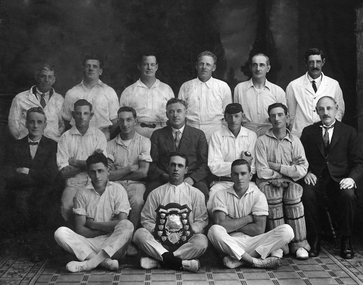 Murrumbeena Cricket Club
Photograph, 1926-27 B Team Premiership Photograph, c. 1927
... Hill...Wally Grant...Lew Bristowe...Joe Jackson...J P? (umpire)...Jim Watson (Treas)...Tom Walker...Edmund Forscutt (vc)...T J Riley (Pres)...Wal Bristowe (Capt)...Albert Forscutt...Peter Robertson (Sec)...Len Gregory...Hill Wally Grant Lew Bristowe Joe Jackson J P? (umpire) Jim Watson (Treas) Tom Walker Edmund Forscutt (vc) T J Riley (Pres) Wal Bristowe (Capt) Albert Forscutt Peter Robertson (Sec) Len Gregory Eddie Cove Albert Bristowe Photograph of 1926-27 B Team premiership team 1926-27 B Team Premiership Photograph Photograph Photograph ...Photograph of 1926-27 B Team premiership teammurrumbeena, murrumbeena cricket club, cricket, cricket clubs, cricketers, w mitchell (umpire), l hill, wally grant, lew bristowe, joe jackson, j p? (umpire), jim watson (treas), tom walker, edmund forscutt (vc), t j riley (pres), wal bristowe (capt), albert forscutt, peter robertson (sec), len gregory, eddie cove, albert bristowe -
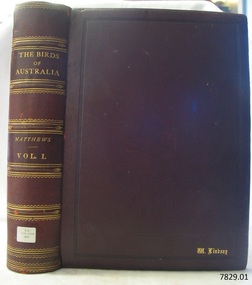 Flagstaff Hill Maritime Museum and Village
Book - Reference, The Birds of Australia Vol 1
... hill maritime village...great ocean road...the birds of australia...gregory...The Warrnambool Mechanics' Institute’s publication collection is of both local and state significance. flagstaff hill warrnambool shipwrecked coast flagstaff hill maritime museum maritime museum shipwreck coast flagstaff hill maritime village great ocean road the birds of australia gregory m. matthews witherby & co. h.f. & g. witherby w lindsay william lindsay pattison collection the birds of australia vol 1 union station woolsthrope quamby station Warrnambool Mechanics’ Institute and Free Library Label on spine cover with typed text RA 598.2994 MAT Pastedown front endpaper has sticker from Warrnambool Mechanics Institute that reads Presented by W Lindsay Esq, “Union”, Woolsthorpe. ...The Birds of Australia is a 12 volume work, in a total of 14 books. The books were used as an ornithological handbook. They contain scientific text as well as over 600 hand-coloured lithographed plates by J.G. Keulemans, H. Grönvold, Roland Green, H. Goodchild and G.E. Lodge. The work was written, sponsored and organised by Gregory M. Matthews, F.R.S.C. Erc. who were a wealthy Australian and an amateur ornithologist? His titles included – -Fellow of the Linnean and Zoological Societies of London -Member of the British Ornithologists’ Union -Corresponding Fellow of the American Ornithologists’ Union The volumes in our collection were originally donated to the Warrnambool Mechanics’ Institute and Free Library by William Lindsay. THE LINDSAYS (quoted from the book Of Many Things – A History of Warrnambool Shire by C.E. Sayers) The Lindsays were amongst the most prominent families in the Shire of Warrnambool, as pastoralists, sportsmen, municipal councillors, community leaders. The first of the family William arrived in Melbourne in 1841 and started a business as a livestock agent. The gold rushes sent him to the central Victoria diggings dealing in cattle. This was a business that boomed in the early 1850s, and he prospered. In 1859 he took over the Quamby run near Woolsthrope from Paul de Castella, the Yarra Valley Swiss vigneron who had brought the leasehold and improvements in 1853 from George You, who had pioneered the run. Quamby was originally 25,000 acres. It was heavily timbered, rough country, much of it swampy, a characteristic of the district. Lindsay used it to fatten cattle which gave large returns with the booming gold diggings towns paying high prices for beef. In 1862 purchases at auction made Quamby a freehold. In the next six years, a further 20,000 acres of Crown land were brought at auction to make the run one of the largest in the south-west district. The great profits from his cattle trading enabled Lindsay to make improvements to the holding, and to Union which was added in 1864. Much of the thick timber was cleared and the worst of the swamps drained. Union was 15,000 acres of freehold land when Kennedy sold it to Lindsay. It was heavily timbered, mostly blackwood, with large belts of wattle and honeysuckle. Much of the heavy native was ringbarked and cleared; much more was swept away by bushfire. It was expensive work, but Lindsay’s bank passbook was heavy with credit, and he did not spare money to make both Quamby and Union heavily developed stock runs. He was as lavish in social living; the bluestone Quamby homestead was one of the most hospitable in the district when William Lindsay was host there; its paddocks carried high-quality thoroughbreds: its stables housed steeplechasers and flat racers which won many races on Warrnambool and other courses; its coach houses were filled with carriages which took his guests to the great racing carnivals of the district. After William Lindsay died in 1897, in his eighty-fifth year, his two sons, William and James, managed Union and Quamby as a joint venture. This partnership ended in 1906 when William took over Union and James kept Quamby. The following year 10,000 acres of Union was subdivided and sold in lots of 100 acres to 700 acres for dairying and general farming. It was well-improved country, much of it alluvial flats. By then many of the paddocks were sheltered with blue gum belts, and they carried good pastures. The three Lindsays, father and two sons, gave many years of service to the Shire, and to many charitable, sporting, social and community organisations in the Warrnambool district. William Lindsay senior, was a Shire councillor for 15 years, and President several times. James Lindsay followed his father as a north riding councillor. He served nineteen years, from 1887 until his death in March 1908. He was President four times. Jimmy Lindsay was one of the most popular men in the south-west of Victoria. He was a fine sportsman: horse breeder, owner and a dashing amateur rider. He lived lavishly and played hard. For many years he guarded a herd of kangaroos, as many as 100 head, at Quamby. Descendants of the Lindsay kangaroos are still in the district. James Lindsay’s wife, Margaret Esther was a daughter of Samuel Shaw Parker, the first engineer of the Shire. Nell Lindsay, a daughter, lives in the Bluestone Quamby homestead. Only a little more than 60 acres of the original run still belongs to the property. William Lindsay junior succeeded his brother as a Shire councillor. He served for 25 years from 1908 until his death in 1934. So, the Lindsays, father and two sons, served as Shite councillors for an unbroken period of sixth-five years. William Lindsay junior had a life-long interest in horse racing, as breeder, owner and enthusiastic amateur steeplechase rider. He was elected a member of the Warrnambool racing club in 1901 and was president of the club for thirty-two years. He raced and rode horses for the love of the sport. He won the Villiers and Heytesbury Hunt Cup in the 1870s on his own horse, Ventura. In the year he died his horse Flavedo won the Warrnambool Grand Annual steeplechase. It was a sensational race. All of the contestants fell or lost their riders. When Flavedo baulked at a jump, its jockey R. Sweetman, remounted and completed the course to win the race. All of the Lindsays were passionately fond of the thoroughbred horse. Nell Lindsay talking to the author in the drawing-room of Quamby homestead - with many memories for her of its lavish years – said of a brother that he was put on a horse when he was two years old and never got off. William Lindsay junior made Union into a fine, high-producing property, breeding cattle and horses. He added to the bluestone house that David Kennedy started, established plantations of pines and gums, and made an attractive garden. WARRNAMBOOL MECHANICS’ INSTITUTE Warrnambool's Mechanics' Institute (or Institution as it was sometimes called) was one of the earliest in Victoria. On 17th October 1853, a meeting was held where it was resolved to request the Lieutenant Governor of the Colony to grant land for the erection of a Mechanics' Institutes building. A committee was formed at the meeting and Richard Osburne chaired the first meeting of this committee. The land on the North West corner of Banyan and Merri Streets was granted but there were no funds to erect the building. The Formal Rights of the Warrnambool Mechanics' Institute's encompassed its aims and these were officially adopted in1859; "This Institution has for its object the diffusion of literary, scientific, and other useful knowledge amongst its members, excluding all controversial subjects, religious or political. These objects are sought to be obtained by means of a circulating library, a reading room, the establishment of classes, debates, and the occasional delivery of lectures on natural and experimental philosophy, mechanics, astronomy, chemistry, natural history, literature, and the useful and ornamental arts, particularly those which have a more immediate reference to the colony." The Warrnambool Mechanics' Institute opened its first meeting room in November 1854 in the National School building at the corner of Banyan and Timor Streets. The Institute was funded by member subscription, payable on a quarterly, half-yearly or yearly basis. Samuel Hannaford, the Manager of the Warrnambool Bank of Australasia, was the first Honorary Secretary of the Mechanics' Institutes, and an early President and Vice-President. He also gave several of the early lectures in the Reading Room. Another early Secretary, Librarian and lecturer was Marmaduke Fisher, the teacher at the National School. Lecture topics included The Poets and Poetry of Ireland', 'The Birth and Development of the Earth', 'The Vertebrae - with Remarks on the pleasures resulting from the study of Natural History' and 'Architecture'. In 1856 the Reading Room was moved to James Hider's shop in Timor Street, and by 1864 it was located in the bookshop of Davies and Read. In the 1860's the Mechanics' Institute struggled as membership waned but in 1866, after a series of fund raising efforts, the committee was able to purchase land in Liebig Street, on a site then called Market Square, between the weighbridge and the fire station. A Mechanics' Institute building was opened at this site in August 1871. The following year four more rooms were added to the main Reading Room and in 1873 the Artisan School of Design was incorporated into the Institute. The same year Joseph Archibald established a Museum; however, it deteriorated when he was transferred to Bendigo in 1877. In 1880, with Archibald's return to Warrnambool, the Museum was re-established, and in 1885 a new building was built at the back of the Institute to accommodate the re-created School of Design, the Art Gallery and the Museum. In 1887 the Museum section was moved to the former court house in Timor Street (for some time the walls of the building formed part of the TAFE cafeteria but all is now demolished)). In 1911 the Museum was transferred back to the original building and the management of the Mechanics' Institute was handed over to the Warrnambool City Council. The Museum and Art Gallery became one and housed many fine works of art, and the Library continued to grow. The building was well patronised, with records showing that at the beginning of the 20th century there were between 500 and 800 visitors. During World War One the monthly figures were in the thousands, with 3,400 people visiting in January 1915. The Museum was a much-loved Institution in Warrnambool until the contents of the Museum and Art Gallery were removed to make room for the Warrnambool City Council Engineers' Department. The contents were stored but many of the items were scattered or lost. When the original building was demolished the site became occupied by the Civic Centre, which included the new City Library. (The library was temporarily located in the old Palais building in Koroit Street.) In the process of reorganisation the Collection was distributed amongst the community groups: -The new City Library took some of the historic books and some important documents, historic photographs and newspapers. -The Art Gallery kept the 19th Century art collection and some of the artefacts from the museum. -The Historic Society has some items -The State Museum has some items -Some items were destroyed -Flagstaff Hill Maritime Village has old newspapers, Government Gazettes, most of the Mechanics' Institute Library, ledgers and documents connected to the Mechanics' Institute Library, some framed and unframed artworks and some photographs. The Warrnambool Mechanics' Institute Library book collection is deemed to be of great importance because it is one of the few collections in an almost intact state, and many of the books are now very rare and of great value. THE PATTISON COLLECTION This book is also part of the ‘Pattison Collection’, a collection of books and records that was originally owned by the Warrnambool Mechanics’ Institute, which was founded in Warrnambool in 1853. In 1935 Ralph Pattison was appointed as City Librarian to establish and organise the Warrnambool Library, as the Warrnambool Mechanics’ Institute was then called. When the Warrnambool Mechanics’ Institute building was pulled down in 1963 a new civic building was erected on the site and the new Warrnambool Library, on behalf of the City Council, took over all the holdings of the Warrnambool Mechanics’ Institute. At this time some of the items were separated and identified as the ‘Pattison Collection’, named after Ralph Pattison. Eventually, the components of the Warrnambool Mechanics’ Institute were distributed from the Warrnambool Library to various places, including the Art Gallery, Historical Society and Flagstaff Hill. Later some were even distributed to other regional branches of Corangamite Regional Library and passed to and fro. It is difficult now to trace just where all of the items have ended up. The books at Flagstaff Hill Maritime Village generally display stamps and markings from Pattison as well as a variety of other institutions including the Mechanics’ Institute itself. RALPH ERIC PATTISON Ralph Eric Pattison was born in Rockhampton, Queensland, in 1891. He married Maude Swan from Warrnambool in 1920 and they set up home in Warrnambool. In 1935 Pattison accepted a position as City Librarian for the Warrnambool City Council. His huge challenge was to make a functional library within two rooms of the Mechanics’ Institute. He tirelessly cleaned, cleared and sorted a disarrayed collection of old books, jars of preserved specimens and other items reserved for exhibition in the city’s museum. He developed and updated the library with a wide variety of books for all tastes, including reference books for students; a difficult task to fulfil during the years following the Depression. He converted all of the lower areas of the building into a library, reference room and reading room for members and the public. The books were sorted and stored using a cataloguing and card index system that he had developed himself. He also prepared the upper floor of the building and established the Art Gallery and later the Museum, a place to exhibit the many old relics that had been stored for years for this purpose. One of the treasures he found was a beautiful ancient clock, which he repaired, restored and enjoyed using in his office during the years of his service there. Ralph Pattison was described as “a meticulous gentleman whose punctuality, floorless courtesy and distinctive neat dress were hallmarks of his character, and ‘his’ clock controlled his daily routine and his opening and closing of the library’s large heavy doors to the minute.” Pattison took leave from 1942 to 1945 to serve in the Royal Australian Navy, Volunteer Reserve as Lieutenant. A few years later he converted one of the Museum’s rooms into a Children’s Library, stocking it with suitable books for the younger generation. This was an instant success. In the 1950’s he had the honour of being appointed to the Victorian Library Board and received more inspiration from the monthly conferences in Melbourne. He was sadly retired in 1959 after over 23 years of service, due to the fact that he had gone over the working age of council officers. However, he continued to take a very keen interest in the continual development of the Library until his death in 1969. The Birds of Australia by Gregory M. Matthews is now considered a rare and valuable scientific and historic work on its own. These 12 volumes were donated in 1934 to The Warrnambool Mechanics’ Institute and were included as part of the Pattison Collection. The Warrnambool Mechanics’ Institute Collection is primarily significant in its totality, rather than for the individual objects it contains. Its contents are highly representative of the development of Mechanics' Institute libraries across Australia, particularly Victoria. A diversity of publications and themes has been amassed, and these provide clues to our understanding of the nature of and changes in the reading habits of Victorians from the 1850s to the middle of the 20th century. The collection also highlights the Warrnambool community’s commitment to the Mechanics’ Institute, reading, literacy and learning in the regions, and proves that access to knowledge was not impeded by distance. These items help to provide a more complete picture of our community’s ideals and aspirations. The Warrnambool Mechanics Institute book collection has historical and social significance for its strong association with the Mechanics Institute movement and the important role it played in the intellectual, cultural and social development of people throughout the latter part of the nineteenth century and the early twentieth century. The collection of books is a rare example of an early lending library and its significance is enhanced by the survival of an original collection of many volumes. The Warrnambool Mechanics' Institute’s publication collection is of both local and state significance. The Birds of Australia Vol 1 Author: Gregory M Mathews Publisher: Witherby & Co, 326 HIGH HOLBORN LONDON Date: 1910-1911 Tan, leather bound illustrated workLabel on spine cover with typed text RA 598.2994 MAT Pastedown front endpaper has sticker from Warrnambool Mechanics Institute that reads Presented by W Lindsay Esq, “Union”, Woolsthorpe. Accession Number 15232 Date Received: 3-34 “W. Lindsay” embossed in gold on front cover, bottom right of bookflagstaff hill, warrnambool, shipwrecked coast, flagstaff hill maritime museum, maritime museum, shipwreck coast, flagstaff hill maritime village, great ocean road, the birds of australia, gregory m. matthews, witherby & co., h.f. & g. witherby, w lindsay, william lindsay, pattison collection, the birds of australia vol 1, union station, woolsthrope, quamby station, warrnambool mechanics’ institute and free library -
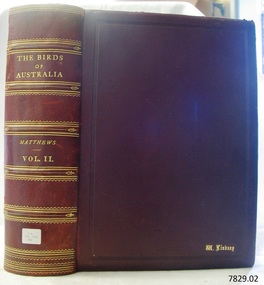 Flagstaff Hill Maritime Museum and Village
Book - Reference, The Birds of Australia Vol 2
... hill maritime village...great ocean road...the birds of australia...gregory...The Warrnambool Mechanics' Institute’s publication collection is of both local and state significance. flagstaff hill warrnambool shipwrecked coast flagstaff hill maritime museum maritime museum shipwreck coast flagstaff hill maritime village great ocean road the birds of australia gregory m. matthews witherby & co. h.f. & g. witherby w lindsay william lindsay quamby woolsthorpe union woolsthorpe pattison collection warrnambool library warrnambool art gallery joseph archibald warrnambool mechanics’ institute and free library ralph eric pattison warrnambool city librarian mechanics’ institute library victorian library board warrnambool books and records warrnambool children’s library the birds of australia vol 2 quamby Station Union Station woolsthrope Label on spine cover with typed text RA 598.2994 MAT Pastedown front endpaper has sticker from Warrnambool Mechanics Institute and Free Library that reads “Presented by W. ...The Birds of Australia is a 12 volume work, in a total of 14 books. The books were used as an ornithological handbook. They contain scientific text as well as over 600 hand-coloured lithographed plates by J.G. Keulemans, H. Grönvold, Roland Green, H. Goodchild and G.E. Lodge. The work was written, sponsored and organised by Gregory M. Matthews, F.R.S.C. Erc. who was a wealthy Australian and an amateur ornithologist. His titles included – -Fellow of the Linnean and Zoological Societies of London -Member of the British Ornithologists’ Union -Corresponding Fellow of the American Ornithologists’ Union The volumes in our collection were originally donated to the Warrnambool Mechanics’ Institute and Free Library by William Lindsay. THE LINDSAYS (quoted from the book Of Many Things – A History of Warrnambool Shire by C.E. Sayers) The Lindsays were amongst the most prominent families in the Shire of Warrnambool, as pastoralists, sportsmen, municipal councillors, community leaders. The first of the family William arrived in Melbourne in 1841 and started business as a livestock agent. The gold rushes sent him to the central Victoria diggings dealing in cattle. This was a business that boomed in the early 1850s, and he prospered. In 1859 he took over the Quamby run near Woolsthrope from Paul de Castella, the Yarra Valley Swiss vigneron who had brought the leasehold and improvements in 1853 from George Youl, who had pioneered the run. Quamby was originally 25,000 acres. It was heavily timbered, rough country, much of it swampy, a characteristic of the district. Lindsay used it to fatten cattle which gave large returns with the booming gold diggings towns paying high prices for beef. In 1862 purchases at auction made Quamby a freehold. In the next six years a further 20,000 acres of Crown land were brought at auction to make the run one of the largest in the south-west district. The great profits from his cattle trading enabled Lindsay to make improvements to the holding, and to Union which was added in 1864. Much of the thick timber was cleared and the worst of the swamps drained. Union was 15,000 acres of freehold when Kennedy sold it to Lindsay. It was heavily timbered, mostly blackwood, with large belts of wattle and honeysuckle. Much of the heavy native was ringbarked and cleared; much more was swept away by bushfire. It was expensive work, but Lindsay’s bank passbook was heavy with credit, and he did not spare money to make both Quamby and Union heavily developed stock runs. He was as lavish in social living; the bluestone Quamby homestead was one of the most hospitable in the district when William Lindsay was host there; its paddocks carried high quality thoroughbreds: its stables housed steeplechasers and flat racers which won many races on Warrnambool and other courses; its coach houses were filled with carriages which took his guests to the great racing carnivals of the district. After William Lindsay died in 1897, in his eighty-fifth year, his two sons, William and James, managed Union and Quamby as a joint venture. This partnership ended in 1906 when William took over Union and James kept Quamby. The following year 10,000 acres of Union were subdivided and sold in lots of 100 acres to 700 acres for dairying and general farming. It was well improved country, much of it alluvial flats. By then many of the paddocks were sheltered with blue gum belts, and they carried good pastures. The three Lindsays, father and two sons, gave many years of service to the Shire, and to many charitable, sporting, social and community organisations in the Warrnambool district. William Lindsay senior, was a Shire councillor for 15 years, and President several times. James Lindsay followed his father as a north riding councillor. He served nineteen years, from 1887 until his death in March 1908. He was President four times. Jimmy Lindsay was one of the most popular men in the south-west of Victoria. He was a fine sportsman: horse breeder, owner and a dashing amateur rider. He lived lavishly and played hard. For many years he guarded a herd of kangaroos, as many as 100 head, at Quamby. Descendants of the Lindsay kangaroos are still in the district. James Lindsay’s wife, Margaret Esther was a daughter of Samuel Shaw Parker, the first engineer of the Shire. Nell Lindsay, a daughter, lives in the Bluestone Quamby homestead. Only a little more than 60 acres of the original run still belongs to the property. William Lindsay junior succeeded his brother as a Shire councillor. He served for 25 years from 1908 until his death in 1934. So, the Lindsays, father and two sons, served as Shite councillors for an unbroken period of sixth-five years. William Lindsay junior had a life-long interest in horse racing, as breeder, owner and enthusiastic amateur steeplechase rider. He was elected a member of the Warrnambool racing club in 1901 and was president of the club for thirty-two years. He raced and rode horses for the love of the sport. He won the Villiers and Heytesbury Hunt Cup in the 1870s on his own horse, Ventura. In the year he died his horse Flavedo won the Warrnambool Grand Annual steeplechase. It was a sensational race. All of the contestants fell, or lost their riders. When Flavedo baulked at a jump, its jockey R. Sweetman, remounted and completed the course to win the race. All of the Lindsays were passionately fond of the thoroughbred horse. Nell Lindsay talking to the author in the drawing room of Quamby homestead - with many memories for her of its lavish years – said of a brother that he was put on a horse when he was two years old and never got off. William Lindsay junior made Union into a fine, high-producing property, breeding cattle and horses. He added to the bluestone house that David Kennedy started, established plantations of pines and gums, and made an attractive garden. WARRNAMBOOL MECHANICS’ INSTITUTE Warrnambool's Mechanics' Institute (or Institution as it was sometimes called) was one of the earliest in Victoria. On 17th October 1853 a meeting was held where it was resolved to request the Lieutenant Governor of the Colony to grant land for the erection of a Mechanics' Institutes building. A committee was formed at the meeting and Richard Osburne chaired the first meeting of this committee. The land on the North West corner of Banyan and Merri Streets was granted but there were no funds to erect the building. The Formal Rights of the Warrnambool Mechanics' Institute's encompassed its aims and these were officially adopted in1859; "This Institution has for its object the diffusion of literary, scientific, and other useful knowledge amongst its members, excluding all controversial subjects, religious or political. These objects are sought to be obtained by means of a circulating library, a reading room, the establishment of classes, debates, and the occasional delivery of lectures on natural and experimental philosophy, mechanics, astronomy, chemistry, natural history, literature, and the useful and ornamental arts, particularly those which have a more immediate reference to the colony." The Warrnambool Mechanics' Institute opened its first meeting room in November1854 in the National School building at the corner of Banyan and Timor Streets. The Institute was funded by member subscription, payable on a quarterly, half yearly or yearly basis. Samuel Hannaford, the Manager of the Warrnambool Bank of Australasia, was the first Honorary Secretary of the Mechanics' Institutes, and an early President and Vice-President. He also gave several of the early lectures in the Reading Room. Another early Secretary, Librarian and lecturer was Marmaduke Fisher, the teacher at the National School. Lecture topics included The Poets and Poetry of Ireland', 'The Birth and Development of the Earth', 'The Vertebrae - with Remarks on the pleasures resulting from the study of Natural History' and 'Architecture'. In 1856 the Reading Room was moved to James Hider's shop in Timor Street, and by 1864 it was located in the bookshop of Davies and Read. In the 1860's the Mechanics' Institute struggled as membership waned but in 1866, after a series of fund raising efforts, the committee was able to purchase land in Liebig Street, on a site then called Market Square, between the weighbridge and the fire station. A Mechanics' Institute building was opened at this site in August 1871. The following year four more rooms were added to the main Reading Room and in 1873 the Artisan School of Design was incorporated into the Institute. The same year Joseph Archibald established a Museum; however it deteriorated when he was transferred to Bendigo in 1877. In 1880, with Archibald's return to Warrnambool, the Museum was re-established, and in 1885 a new building was built at the back of the Institute to accommodate the re-created School of Design, the Art Gallery and the Museum. In 1887 the Museum section was moved to the former court house in Timor Street (for some time the walls of the building formed part of the TAFE cafeteria but all is now demolished)). In 1911 the Museum was transferred back to the original building and the management of the Mechanics' Institute was handed over to the Warrnambool City Council. The Museum and Art Gallery became one and housed many fine works of art, and the Library continued to grow. The building was well patronised, with records showing that at the beginning of the 20th century there were between 500 and 800 visitors. During World War One the monthly figures were in the thousands, with 3,400 people visiting in January 1915. The Museum was a much loved Institution in Warrnambool until the contents of the Museum and Art Gallery were removed to make room for the Warrnambool City Council Engineers' Department. The contents were stored but many of the items were scattered or lost. When the original building was demolished the site became occupied by the Civic Centre, which included the new City Library. (The library was temporarily located in the old Palais building in Koroit Street.) In the process of reorganisation the Collection was distributed amongst the community groups: -The new City Library took some of the historic books and some important documents, historic photographs and newspapers. -The Art Gallery kept the 19th Century art collection and some of the artefacts from the museum. -The Historic Society has some items -The State Museum has some items -Some items were destroyed -Flagstaff Hill Maritime Village has old newspapers, Government Gazettes, most of the Mechanics' Institute Library, ledgers and documents connected to the Mechanics' Institute Library, some framed and unframed art works and some photographs. The Warrnambool Mechanics' Institute Library book collection is deemed to be of great importance because it is one of the few collections in an almost intact state, and many of the books are now very rare and of great value. THE PATTISON COLLECTION This book is also part of the ‘Pattison Collection’, a collection of books and records that was originally owned by the Warrnambool Mechanics’ Institute, which was founded in Warrnambool in 1853. In 1935 Ralph Pattison was appointed as City Librarian to establish and organise the Warrnambool Library, as the Warrnambool Mechanics’ Institute was then called. When the Warrnambool Mechanics’ Institute building was pulled down in 1963 a new civic building was erected on the site and the new Warrnambool Library, on behalf of the City Council, took over all the holdings of the Warrnambool Mechanics’ Institute. At this time some of the items were separated and identified as the ‘Pattison Collection’, named after Ralph Pattison. Eventually the components of the Warrnambool Mechanics’ Institute were distributed from the Warrnambool Library to various places, including the Art Gallery, Historical Society and Flagstaff Hill. Later some were even distributed to other regional branches of Corangamite Regional Library and passed to and fro. It is difficult now to trace just where all of the items have ended up. The books at Flagstaff Hill Maritime Village generally display stamps and markings from Pattison as well as a variety of other institutions including the Mechanics’ Institute itself. RALPH ERIC PATTISON Ralph Eric Pattison was born in Rockhampton, Queensland, in 1891. He married Maude Swan from Warrnambool in 1920 and they set up home in Warrnambool. In 1935 Pattison accepted a position as City Librarian for the Warrnambool City Council. His huge challenge was to make a functional library within two rooms of the Mechanics’ Institute. He tirelessly cleaned, cleared and sorted a disarrayed collection of old books, jars of preserved specimens and other items reserved for exhibition in the city’s museum. He developed and updated the library with a wide variety of books for all tastes, including reference books for students; a difficult task to fulfil during the years following the Depression. He converted all of the lower area of the building into a library, reference room and reading room for members and the public. The books were sorted and stored using a cataloguing and card index system that he had developed himself. He also prepared the upper floor of the building and established the Art Gallery and later the Museum, a place to exhibit the many old relics that had been stored for years for this purpose. One of the treasures he found was a beautiful ancient clock, which he repaired, restored and enjoyed using in his office during the years of his service there. Ralph Pattison was described as “a meticulous gentleman whose punctuality, floorless courtesy and distinctive neat dress were hallmarks of his character, and ‘his’ clock controlled his daily routine, and his opening and closing of the library’s large heavy doors to the minute.” Pattison took leave during 1942 to 1945 to serve in the Royal Australian Navy, Volunteer Reserve as Lieutenant. A few years later he converted one of the Museum’s rooms into a Children’s Library, stocking it with suitable books for the younger generation. This was an instant success. In the 1950’s he had the honour of being appointed to the Victorian Library Board and received more inspiration from the monthly conferences in Melbourne. He was sadly retired in 1959 after over 23 years of service, due to the fact that he had gone over the working age of council officers. However he continued to take a very keen interest in the continual development of the Library until his death in 1969.The Birds of Australia by Gregory M. Matthews is now considered a rare and valuable scientific and historic work on its own. These 12 volumes were donated in 1934 to The Warrnambool Mechanics’ Institute and were included as part of the Pattison Collection. The Warrnambool Mechanics’ Institute Collection is primarily significant in its totality, rather than for the individual objects it contains. Its contents are highly representative of the development of Mechanics' Institute libraries across Australia, particularly Victoria. A diversity of publications and themes has been amassed, and these provide clues to our understanding of the nature of and changes in the reading habits of Victorians from the 1850s to the middle of the 20th century. The collection also highlights the Warrnambool community’s commitment to the Mechanics’ Institute, reading, literacy and learning in the regions, and proves that access to knowledge was not impeded by distance. These items help to provide a more complete picture of our community’s ideals and aspirations. The Warrnambool Mechanics Institute book collection has historical and social significance for its strong association with the Mechanics Institute movement and the important role it played in the intellectual, cultural and social development of people throughout the latter part of the nineteenth century and the early twentieth century. The collection of books is a rare example of an early lending library and its significance is enhanced by the survival of an original collection of many volumes. The Warrnambool Mechanics' Institute’s publication collection is of both local and state significance. The Birds of Australia Vol 2 Author: Gregory M Mathews Publisher: Witherby & Co 326 HIGH HOLBORN LONDON Date: 1912-1913 Tan leather bound illustrated work. Label on spine cover with typed text RA 598.2994 MAT Pastedown front endpaper has sticker from Warrnambool Mechanics Institute and Free Library that reads “Presented by W. Lindsay Esq. ‘Union’ Woolsthrope” Accession Number: 15233 Date Received: 3-34 “W. Lindsay” embossed in gold on front cover, bottom right of book flagstaff hill, warrnambool, shipwrecked coast, flagstaff hill maritime museum, maritime museum, shipwreck coast, flagstaff hill maritime village, great ocean road, the birds of australia, gregory m. matthews, witherby & co., h.f. & g. witherby, w lindsay, william lindsay, quamby woolsthorpe, union woolsthorpe, pattison collection, warrnambool library, warrnambool art gallery, joseph archibald, warrnambool mechanics’ institute and free library, ralph eric pattison, warrnambool city librarian, mechanics’ institute library, victorian library board, warrnambool books and records, warrnambool children’s library, the birds of australia vol 2, quamby station, union station, woolsthrope -
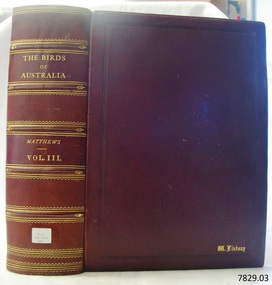 Flagstaff Hill Maritime Museum and Village
Book - Reference, The Birds of Australia Vol 3
... hill maritime village...great ocean road...the birds of australia...gregory...The Warrnambool Mechanics' Institute’s publication collection is of both local and state significance. flagstaff hill warrnambool shipwrecked coast flagstaff hill maritime museum maritime museum shipwreck coast flagstaff hill maritime village great ocean road the birds of australia gregory m. matthews witherby & co. h.f. & g. witherby w lindsay william lindsay quamby woolsthorpe union woolsthorpe pattison collection warrnambool library warrnambool art gallery joseph archibald warrnambool mechanics’ institute and free library ralph eric pattison warrnambool city librarian mechanics’ institute library victorian library board warrnambool books and records warrnambool children’s library the birds of australia vol 3 Quamby Station Union Station woolsthrope Label on spine cover with typed text RA 598.2994 MAT Pastedown front endpaper has sticker from Warrnambool Mechanics Institute and Free Library that reads “Presented by W. ...The Birds of Australia is a 12 volume work, in a total of 14 books. The books were used as an ornithological handbook. They contain scientific text as well as over 600 hand-coloured lithographed plates by J.G. Keulemans, H. Grönvold, Roland Green, H. Goodchild and G.E. Lodge. The work was written, sponsored and organised by Gregory M. Matthews, F.R.S.C. Erc. who was a wealthy Australian and an amateur ornithologist. His titles included – -Fellow of the Linnean and Zoological Societies of London -Member of the British Ornithologists’ Union -Corresponding Fellow of the American Ornithologists’ Union The volumes in our collection were originally donated to the Warrnambool Mechanics’ Institute and Free Library by William Lindsay. THE LINDSAYS (quoted from the book Of Many Things – A History of Warrnambool Shire by C.E. Sayers) The Lindsays were amongst the most prominent families in the Shire of Warrnambool, as pastoralists, sportsmen, municipal councillors, community leaders. The first of the family William arrived in Melbourne in 1841 and started business as a livestock agent. The gold rushes sent him to the central Victoria diggings dealing in cattle. This was a business that boomed in the early 1850s, and he prospered. In 1859 he took over the Quamby run near Woolsthrope from Paul de Castella, the Yarra Valley Swiss vigneron who had brought the leasehold and improvements in 1853 from George Youl, who had pioneered the run. Quamby was originally 25,000 acres. It was heavily timbered, rough country, much of it swampy, a characteristic of the district. Lindsay used it to fatten cattle which gave large returns with the booming gold diggings towns paying high prices for beef. In 1862 purchases at auction made Quamby a freehold. In the next six years a further 20,000 acres of Crown land were brought at auction to make the run one of the largest in the south-west district. The great profits from his cattle trading enabled Lindsay to make improvements to the holding, and to Union which was added in 1864. Much of the thick timber was cleared and the worst of the swamps drained. Union was 15,000 acres of freehold when Kennedy sold it to Lindsay. It was heavily timbered, mostly blackwood, with large belts of wattle and honeysuckle. Much of the heavy native was ringbarked and cleared; much more was swept away by bushfire. It was expensive work, but Lindsay’s bank passbook was heavy with credit, and he did not spare money to make both Quamby and Union heavily developed stock runs. He was as lavish in social living; the bluestone Quamby homestead was one of the most hospitable in the district when William Lindsay was host there; its paddocks carried high quality thoroughbreds: its stables housed steeplechasers and flat racers which won many races on Warrnambool and other courses; its coach houses were filled with carriages which took his guests to the great racing carnivals of the district. After William Lindsay died in 1897, in his eighty-fifth year, his two sons, William and James, managed Union and Quamby as a joint venture. This partnership ended in 1906 when William took over Union and James kept Quamby. The following year 10,000 acres of Union were subdivided and sold in lots of 100 acres to 700 acres for dairying and general farming. It was well improved country, much of it alluvial flats. By then many of the paddocks were sheltered with blue gum belts, and they carried good pastures. The three Lindsays, father and two sons, gave many years of service to the Shire, and to many charitable, sporting, social and community organisations in the Warrnambool district. William Lindsay senior, was a Shire councillor for 15 years, and President several times. James Lindsay followed his father as a north riding councillor. He served nineteen years, from 1887 until his death in March 1908. He was President four times. Jimmy Lindsay was one of the most popular men in the south-west of Victoria. He was a fine sportsman: horse breeder, owner and a dashing amateur rider. He lived lavishly and played hard. For many years he guarded a herd of kangaroos, as many as 100 head, at Quamby. Descendants of the Lindsay kangaroos are still in the district. James Lindsay’s wife, Margaret Esther was a daughter of Samuel Shaw Parker, the first engineer of the Shire. Nell Lindsay, a daughter, lives in the Bluestone Quamby homestead. Only a little more than 60 acres of the original run still belongs to the property. William Lindsay junior succeeded his brother as a Shire councillor. He served for 25 years from 1908 until his death in 1934. So, the Lindsays, father and two sons, served as Shite councillors for an unbroken period of sixth-five years. William Lindsay junior had a life-long interest in horse racing, as breeder, owner and enthusiastic amateur steeplechase rider. He was elected a member of the Warrnambool racing club in 1901 and was president of the club for thirty-two years. He raced and rode horses for the love of the sport. He won the Villiers and Heytesbury Hunt Cup in the 1870s on his own horse, Ventura. In the year he died his horse Flavedo won the Warrnambool Grand Annual steeplechase. It was a sensational race. All of the contestants fell, or lost their riders. When Flavedo baulked at a jump, its jockey R. Sweetman, remounted and completed the course to win the race. All of the Lindsays were passionately fond of the thoroughbred horse. Nell Lindsay talking to the author in the drawing room of Quamby homestead - with many memories for her of its lavish years – said of a brother that he was put on a horse when he was two years old and never got off. William Lindsay junior made Union into a fine, high-producing property, breeding cattle and horses. He added to the bluestone house that David Kennedy started, established plantations of pines and gums, and made an attractive garden. WARRNAMBOOL MECHANICS’ INSTITUTE Warrnambool's Mechanics' Institute (or Institution as it was sometimes called) was one of the earliest in Victoria. On 17th October 1853 a meeting was held where it was resolved to request the Lieutenant Governor of the Colony to grant land for the erection of a Mechanics' Institutes building. A committee was formed at the meeting and Richard Osburne chaired the first meeting of this committee. The land on the North West corner of Banyan and Merri Streets was granted but there were no funds to erect the building. The Formal Rights of the Warrnambool Mechanics' Institute's encompassed its aims and these were officially adopted in1859; "This Institution has for its object the diffusion of literary, scientific, and other useful knowledge amongst its members, excluding all controversial subjects, religious or political. These objects are sought to be obtained by means of a circulating library, a reading room, the establishment of classes, debates, and the occasional delivery of lectures on natural and experimental philosophy, mechanics, astronomy, chemistry, natural history, literature, and the useful and ornamental arts, particularly those which have a more immediate reference to the colony." The Warrnambool Mechanics' Institute opened its first meeting room in November1854 in the National School building at the corner of Banyan and Timor Streets. The Institute was funded by member subscription, payable on a quarterly, half yearly or yearly basis. Samuel Hannaford, the Manager of the Warrnambool Bank of Australasia, was the first Honorary Secretary of the Mechanics' Institutes, and an early President and Vice-President. He also gave several of the early lectures in the Reading Room. Another early Secretary, Librarian and lecturer was Marmaduke Fisher, the teacher at the National School. Lecture topics included The Poets and Poetry of Ireland', 'The Birth and Development of the Earth', 'The Vertebrae - with Remarks on the pleasures resulting from the study of Natural History' and 'Architecture'. In 1856 the Reading Room was moved to James Hider's shop in Timor Street, and by 1864 it was located in the bookshop of Davies and Read. In the 1860's the Mechanics' Institute struggled as membership waned but in 1866, after a series of fund raising efforts, the committee was able to purchase land in Liebig Street, on a site then called Market Square, between the weighbridge and the fire station. A Mechanics' Institute building was opened at this site in August 1871. The following year four more rooms were added to the main Reading Room and in 1873 the Artisan School of Design was incorporated into the Institute. The same year Joseph Archibald established a Museum; however it deteriorated when he was transferred to Bendigo in 1877. In 1880, with Archibald's return to Warrnambool, the Museum was re-established, and in 1885 a new building was built at the back of the Institute to accommodate the re-created School of Design, the Art Gallery and the Museum. In 1887 the Museum section was moved to the former court house in Timor Street (for some time the walls of the building formed part of the TAFE cafeteria but all is now demolished)). In 1911 the Museum was transferred back to the original building and the management of the Mechanics' Institute was handed over to the Warrnambool City Council. The Museum and Art Gallery became one and housed many fine works of art, and the Library continued to grow. The building was well patronised, with records showing that at the beginning of the 20th century there were between 500 and 800 visitors. During World War One the monthly figures were in the thousands, with 3,400 people visiting in January 1915. The Museum was a much loved Institution in Warrnambool until the contents of the Museum and Art Gallery were removed to make room for the Warrnambool City Council Engineers' Department. The contents were stored but many of the items were scattered or lost. When the original building was demolished the site became occupied by the Civic Centre, which included the new City Library. (The library was temporarily located in the old Palais building in Koroit Street.) In the process of reorganisation the Collection was distributed amongst the community groups: -The new City Library took some of the historic books and some important documents, historic photographs and newspapers. -The Art Gallery kept the 19th Century art collection and some of the artefacts from the museum. -The Historic Society has some items -The State Museum has some items -Some items were destroyed -Flagstaff Hill Maritime Village has old newspapers, Government Gazettes, most of the Mechanics' Institute Library, ledgers and documents connected to the Mechanics' Institute Library, some framed and unframed art works and some photographs. The Warrnambool Mechanics' Institute Library book collection is deemed to be of great importance because it is one of the few collections in an almost intact state, and many of the books are now very rare and of great value. THE PATTISON COLLECTION This book is also part of the ‘Pattison Collection’, a collection of books and records that was originally owned by the Warrnambool Mechanics’ Institute, which was founded in Warrnambool in 1853. In 1935 Ralph Pattison was appointed as City Librarian to establish and organise the Warrnambool Library, as the Warrnambool Mechanics’ Institute was then called. When the Warrnambool Mechanics’ Institute building was pulled down in 1963 a new civic building was erected on the site and the new Warrnambool Library, on behalf of the City Council, took over all the holdings of the Warrnambool Mechanics’ Institute. At this time some of the items were separated and identified as the ‘Pattison Collection’, named after Ralph Pattison. Eventually the components of the Warrnambool Mechanics’ Institute were distributed from the Warrnambool Library to various places, including the Art Gallery, Historical Society and Flagstaff Hill. Later some were even distributed to other regional branches of Corangamite Regional Library and passed to and fro. It is difficult now to trace just where all of the items have ended up. The books at Flagstaff Hill Maritime Village generally display stamps and markings from Pattison as well as a variety of other institutions including the Mechanics’ Institute itself. RALPH ERIC PATTISON Ralph Eric Pattison was born in Rockhampton, Queensland, in 1891. He married Maude Swan from Warrnambool in 1920 and they set up home in Warrnambool. In 1935 Pattison accepted a position as City Librarian for the Warrnambool City Council. His huge challenge was to make a functional library within two rooms of the Mechanics’ Institute. He tirelessly cleaned, cleared and sorted a disarrayed collection of old books, jars of preserved specimens and other items reserved for exhibition in the city’s museum. He developed and updated the library with a wide variety of books for all tastes, including reference books for students; a difficult task to fulfil during the years following the Depression. He converted all of the lower area of the building into a library, reference room and reading room for members and the public. The books were sorted and stored using a cataloguing and card index system that he had developed himself. He also prepared the upper floor of the building and established the Art Gallery and later the Museum, a place to exhibit the many old relics that had been stored for years for this purpose. One of the treasures he found was a beautiful ancient clock, which he repaired, restored and enjoyed using in his office during the years of his service there. Ralph Pattison was described as “a meticulous gentleman whose punctuality, floorless courtesy and distinctive neat dress were hallmarks of his character, and ‘his’ clock controlled his daily routine, and his opening and closing of the library’s large heavy doors to the minute.” Pattison took leave during 1942 to 1945 to serve in the Royal Australian Navy, Volunteer Reserve as Lieutenant. A few years later he converted one of the Museum’s rooms into a Children’s Library, stocking it with suitable books for the younger generation. This was an instant success. In the 1950’s he had the honour of being appointed to the Victorian Library Board and received more inspiration from the monthly conferences in Melbourne. He was sadly retired in 1959 after over 23 years of service, due to the fact that he had gone over the working age of council officers. However he continued to take a very keen interest in the continual development of the Library until his death in 1969. The Birds of Australia by Gregory M. Matthews is now considered a rare and valuable scientific and historic work on its own. These 12 volumes were donated in 1934 to The Warrnambool Mechanics’ Institute and were included as part of the Pattison Collection. The Warrnambool Mechanics’ Institute Collection is primarily significant in its totality, rather than for the individual objects it contains. Its contents are highly representative of the development of Mechanics' Institute libraries across Australia, particularly Victoria. A diversity of publications and themes has been amassed, and these provide clues to our understanding of the nature of and changes in the reading habits of Victorians from the 1850s to the middle of the 20th century. The collection also highlights the Warrnambool community’s commitment to the Mechanics’ Institute, reading, literacy and learning in the regions, and proves that access to knowledge was not impeded by distance. These items help to provide a more complete picture of our community’s ideals and aspirations. The Warrnambool Mechanics Institute book collection has historical and social significance for its strong association with the Mechanics Institute movement and the important role it played in the intellectual, cultural and social development of people throughout the latter part of the nineteenth century and the early twentieth century. The collection of books is a rare example of an early lending library and its significance is enhanced by the survival of an original collection of many volumes. The Warrnambool Mechanics' Institute’s publication collection is of both local and state significance. The Birds of Australia Vol 3 Author: Gregory M Mathews Publisher: Witherby & Co 326 HIGH HOLBORN LONDON Date: 1913-1914 Label on spine cover with typed text RA 598.2994 MAT Pastedown front endpaper has sticker from Warrnambool Mechanics Institute and Free Library that reads “Presented by W. Lindsay Esq. ‘Union’ Woolsthrope” Accession Number: 15234 Date Received: 3-34 “W. Lindsay” embossed in gold on front cover, bottom right of book flagstaff hill, warrnambool, shipwrecked coast, flagstaff hill maritime museum, maritime museum, shipwreck coast, flagstaff hill maritime village, great ocean road, the birds of australia, gregory m. matthews, witherby & co., h.f. & g. witherby, w lindsay, william lindsay, quamby woolsthorpe, union woolsthorpe, pattison collection, warrnambool library, warrnambool art gallery, joseph archibald, warrnambool mechanics’ institute and free library, ralph eric pattison, warrnambool city librarian, mechanics’ institute library, victorian library board, warrnambool books and records, warrnambool children’s library, the birds of australia vol 3, quamby station, union station, woolsthrope -
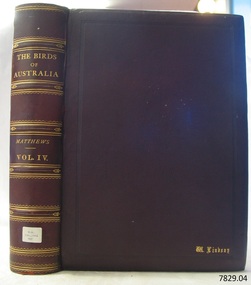 Flagstaff Hill Maritime Museum and Village
Book - Reference, The Birds of Australia Vol 4
... hill maritime village...great ocean road...the birds of australia...gregory...The Warrnambool Mechanics' Institute’s publication collection is of both local and state significance. flagstaff hill warrnambool shipwrecked coast flagstaff hill maritime museum maritime museum shipwreck coast flagstaff hill maritime village great ocean road the birds of australia gregory m. matthews witherby & co. h.f. & g. witherby w lindsay william lindsay quamby woolsthorpe union woolsthorpe pattison collection warrnambool library warrnambool art gallery joseph archibald warrnambool mechanics’ institute and free library ralph eric pattison warrnambool city librarian mechanics’ institute library victorian library board warrnambool books and records warrnambool children’s library the birds of australia vol 4 Quamby Station Union Station woolsthrope Label on spine cover with typed text RA 598.2994 MAT Pastedown front endpaper has sticker from Warrnambool Mechanics Institute and Free Library that reads “Presented by W. ...The Birds of Australia is a 12 volume work, in a total of 14 books. The books were used as an ornithological handbook. They contain scientific text as well as over 600 hand-coloured lithographed plates by J.G. Keulemans, H. Grönvold, Roland Green, H. Goodchild and G.E. Lodge. The work was written, sponsored and organised by Gregory M. Matthews, F.R.S.C. Erc. who was a wealthy Australian and an amateur ornithologist. His titles included – -Fellow of the Linnean and Zoological Societies of London -Member of the British Ornithologists’ Union -Corresponding Fellow of the American Ornithologists’ Union The volumes in our collection were originally donated to the Warrnambool Mechanics’ Institute and Free Library by William Lindsay. THE LINDSAYS (quoted from the book Of Many Things – A History of Warrnambool Shire by C.E. Sayers) The Lindsays were amongst the most prominent families in the Shire of Warrnambool, as pastoralists, sportsmen, municipal councillors, community leaders. The first of the family William arrived in Melbourne in 1841 and started business as a livestock agent. The gold rushes sent him to the central Victoria diggings dealing in cattle. This was a business that boomed in the early 1850s, and he prospered. In 1859 he took over the Quamby run near Woolsthrope from Paul de Castella, the Yarra Valley Swiss vigneron who had brought the leasehold and improvements in 1853 from George Youl, who had pioneered the run. Quamby was originally 25,000 acres. It was heavily timbered, rough country, much of it swampy, a characteristic of the district. Lindsay used it to fatten cattle which gave large returns with the booming gold diggings towns paying high prices for beef. In 1862 purchases at auction made Quamby a freehold. In the next six years a further 20,000 acres of Crown land were brought at auction to make the run one of the largest in the south-west district. The great profits from his cattle trading enabled Lindsay to make improvements to the holding, and to Union which was added in 1864. Much of the thick timber was cleared and the worst of the swamps drained. Union was 15,000 acres of freehold when Kennedy sold it to Lindsay. It was heavily timbered, mostly blackwood, with large belts of wattle and honeysuckle. Much of the heavy native was ringbarked and cleared; much more was swept away by bushfire. It was expensive work, but Lindsay’s bank passbook was heavy with credit, and he did not spare money to make both Quamby and Union heavily developed stock runs. He was as lavish in social living; the bluestone Quamby homestead was one of the most hospitable in the district when William Lindsay was host there; its paddocks carried high quality thoroughbreds: its stables housed steeplechasers and flat racers which won many races on Warrnambool and other courses; its coach houses were filled with carriages which took his guests to the great racing carnivals of the district. After William Lindsay died in 1897, in his eighty-fifth year, his two sons, William and James, managed Union and Quamby as a joint venture. This partnership ended in 1906 when William took over Union and James kept Quamby. The following year 10,000 acres of Union were subdivided and sold in lots of 100 acres to 700 acres for dairying and general farming. It was well improved country, much of it alluvial flats. By then many of the paddocks were sheltered with blue gum belts, and they carried good pastures. The three Lindsays, father and two sons, gave many years of service to the Shire, and to many charitable, sporting, social and community organisations in the Warrnambool district. William Lindsay senior, was a Shire councillor for 15 years, and President several times. James Lindsay followed his father as a north riding councillor. He served nineteen years, from 1887 until his death in March 1908. He was President four times. Jimmy Lindsay was one of the most popular men in the south-west of Victoria. He was a fine sportsman: horse breeder, owner and a dashing amateur rider. He lived lavishly and played hard. For many years he guarded a herd of kangaroos, as many as 100 head, at Quamby. Descendants of the Lindsay kangaroos are still in the district. James Lindsay’s wife, Margaret Esther was a daughter of Samuel Shaw Parker, the first engineer of the Shire. Nell Lindsay, a daughter, lives in the Bluestone Quamby homestead. Only a little more than 60 acres of the original run still belongs to the property. William Lindsay junior succeeded his brother as a Shire councillor. He served for 25 years from 1908 until his death in 1934. So, the Lindsays, father and two sons, served as Shite councillors for an unbroken period of sixth-five years. William Lindsay junior had a life-long interest in horse racing, as breeder, owner and enthusiastic amateur steeplechase rider. He was elected a member of the Warrnambool racing club in 1901 and was president of the club for thirty-two years. He raced and rode horses for the love of the sport. He won the Villiers and Heytesbury Hunt Cup in the 1870s on his own horse, Ventura. In the year he died his horse Flavedo won the Warrnambool Grand Annual steeplechase. It was a sensational race. All of the contestants fell, or lost their riders. When Flavedo baulked at a jump, its jockey R. Sweetman, remounted and completed the course to win the race. All of the Lindsays were passionately fond of the thoroughbred horse. Nell Lindsay talking to the author in the drawing room of Quamby homestead - with many memories for her of its lavish years – said of a brother that he was put on a horse when he was two years old and never got off. William Lindsay junior made Union into a fine, high-producing property, breeding cattle and horses. He added to the bluestone house that David Kennedy started, established plantations of pines and gums, and made an attractive garden. WARRNAMBOOL MECHANICS’ INSTITUTE Warrnambool's Mechanics' Institute (or Institution as it was sometimes called) was one of the earliest in Victoria. On 17th October 1853 a meeting was held where it was resolved to request the Lieutenant Governor of the Colony to grant land for the erection of a Mechanics' Institutes building. A committee was formed at the meeting and Richard Osburne chaired the first meeting of this committee. The land on the North West corner of Banyan and Merri Streets was granted but there were no funds to erect the building. The Formal Rights of the Warrnambool Mechanics' Institute's encompassed its aims and these were officially adopted in1859; "This Institution has for its object the diffusion of literary, scientific, and other useful knowledge amongst its members, excluding all controversial subjects, religious or political. These objects are sought to be obtained by means of a circulating library, a reading room, the establishment of classes, debates, and the occasional delivery of lectures on natural and experimental philosophy, mechanics, astronomy, chemistry, natural history, literature, and the useful and ornamental arts, particularly those which have a more immediate reference to the colony." The Warrnambool Mechanics' Institute opened its first meeting room in November1854 in the National School building at the corner of Banyan and Timor Streets. The Institute was funded by member subscription, payable on a quarterly, half yearly or yearly basis. Samuel Hannaford, the Manager of the Warrnambool Bank of Australasia, was the first Honorary Secretary of the Mechanics' Institutes, and an early President and Vice-President. He also gave several of the early lectures in the Reading Room. Another early Secretary, Librarian and lecturer was Marmaduke Fisher, the teacher at the National School. Lecture topics included The Poets and Poetry of Ireland', 'The Birth and Development of the Earth', 'The Vertebrae - with Remarks on the pleasures resulting from the study of Natural History' and 'Architecture'. In 1856 the Reading Room was moved to James Hider's shop in Timor Street, and by 1864 it was located in the bookshop of Davies and Read. In the 1860's the Mechanics' Institute struggled as membership waned but in 1866, after a series of fund raising efforts, the committee was able to purchase land in Liebig Street, on a site then called Market Square, between the weighbridge and the fire station. A Mechanics' Institute building was opened at this site in August 1871. The following year four more rooms were added to the main Reading Room and in 1873 the Artisan School of Design was incorporated into the Institute. The same year Joseph Archibald established a Museum; however it deteriorated when he was transferred to Bendigo in 1877. In 1880, with Archibald's return to Warrnambool, the Museum was re-established, and in 1885 a new building was built at the back of the Institute to accommodate the re-created School of Design, the Art Gallery and the Museum. In 1887 the Museum section was moved to the former court house in Timor Street (for some time the walls of the building formed part of the TAFE cafeteria but all is now demolished)). In 1911 the Museum was transferred back to the original building and the management of the Mechanics' Institute was handed over to the Warrnambool City Council. The Museum and Art Gallery became one and housed many fine works of art, and the Library continued to grow. The building was well patronised, with records showing that at the beginning of the 20th century there were between 500 and 800 visitors. During World War One the monthly figures were in the thousands, with 3,400 people visiting in January 1915. The Museum was a much loved Institution in Warrnambool until the contents of the Museum and Art Gallery were removed to make room for the Warrnambool City Council Engineers' Department. The contents were stored but many of the items were scattered or lost. When the original building was demolished the site became occupied by the Civic Centre, which included the new City Library. (The library was temporarily located in the old Palais building in Koroit Street.) In the process of reorganisation the Collection was distributed amongst the community groups: -The new City Library took some of the historic books and some important documents, historic photographs and newspapers. -The Art Gallery kept the 19th Century art collection and some of the artefacts from the museum. -The Historic Society has some items -The State Museum has some items -Some items were destroyed -Flagstaff Hill Maritime Village has old newspapers, Government Gazettes, most of the Mechanics' Institute Library, ledgers and documents connected to the Mechanics' Institute Library, some framed and unframed art works and some photographs. The Warrnambool Mechanics' Institute Library book collection is deemed to be of great importance because it is one of the few collections in an almost intact state, and many of the books are now very rare and of great value. THE PATTISON COLLECTION This book is also part of the ‘Pattison Collection’, a collection of books and records that was originally owned by the Warrnambool Mechanics’ Institute, which was founded in Warrnambool in 1853. In 1935 Ralph Pattison was appointed as City Librarian to establish and organise the Warrnambool Library, as the Warrnambool Mechanics’ Institute was then called. When the Warrnambool Mechanics’ Institute building was pulled down in 1963 a new civic building was erected on the site and the new Warrnambool Library, on behalf of the City Council, took over all the holdings of the Warrnambool Mechanics’ Institute. At this time some of the items were separated and identified as the ‘Pattison Collection’, named after Ralph Pattison. Eventually the components of the Warrnambool Mechanics’ Institute were distributed from the Warrnambool Library to various places, including the Art Gallery, Historical Society and Flagstaff Hill. Later some were even distributed to other regional branches of Corangamite Regional Library and passed to and fro. It is difficult now to trace just where all of the items have ended up. The books at Flagstaff Hill Maritime Village generally display stamps and markings from Pattison as well as a variety of other institutions including the Mechanics’ Institute itself. RALPH ERIC PATTISON Ralph Eric Pattison was born in Rockhampton, Queensland, in 1891. He married Maude Swan from Warrnambool in 1920 and they set up home in Warrnambool. In 1935 Pattison accepted a position as City Librarian for the Warrnambool City Council. His huge challenge was to make a functional library within two rooms of the Mechanics’ Institute. He tirelessly cleaned, cleared and sorted a disarrayed collection of old books, jars of preserved specimens and other items reserved for exhibition in the city’s museum. He developed and updated the library with a wide variety of books for all tastes, including reference books for students; a difficult task to fulfil during the years following the Depression. He converted all of the lower area of the building into a library, reference room and reading room for members and the public. The books were sorted and stored using a cataloguing and card index system that he had developed himself. He also prepared the upper floor of the building and established the Art Gallery and later the Museum, a place to exhibit the many old relics that had been stored for years for this purpose. One of the treasures he found was a beautiful ancient clock, which he repaired, restored and enjoyed using in his office during the years of his service there. Ralph Pattison was described as “a meticulous gentleman whose punctuality, floorless courtesy and distinctive neat dress were hallmarks of his character, and ‘his’ clock controlled his daily routine, and his opening and closing of the library’s large heavy doors to the minute.” Pattison took leave during 1942 to 1945 to serve in the Royal Australian Navy, Volunteer Reserve as Lieutenant. A few years later he converted one of the Museum’s rooms into a Children’s Library, stocking it with suitable books for the younger generation. This was an instant success. In the 1950’s he had the honour of being appointed to the Victorian Library Board and received more inspiration from the monthly conferences in Melbourne. He was sadly retired in 1959 after over 23 years of service, due to the fact that he had gone over the working age of council officers. However he continued to take a very keen interest in the continual development of the Library until his death in 1969. The Birds of Australia by Gregory M. Matthews is now considered a rare and valuable scientific and historic work on its own. These 12 volumes were donated in 1934 to The Warrnambool Mechanics’ Institute and were included as part of the Pattison Collection. The Warrnambool Mechanics’ Institute Collection is primarily significant in its totality, rather than for the individual objects it contains. Its contents are highly representative of the development of Mechanics' Institute libraries across Australia, particularly Victoria. A diversity of publications and themes has been amassed, and these provide clues to our understanding of the nature of and changes in the reading habits of Victorians from the 1850s to the middle of the 20th century. The collection also highlights the Warrnambool community’s commitment to the Mechanics’ Institute, reading, literacy and learning in the regions, and proves that access to knowledge was not impeded by distance. These items help to provide a more complete picture of our community’s ideals and aspirations. The Warrnambool Mechanics Institute book collection has historical and social significance for its strong association with the Mechanics Institute movement and the important role it played in the intellectual, cultural and social development of people throughout the latter part of the nineteenth century and the early twentieth century. The collection of books is a rare example of an early lending library and its significance is enhanced by the survival of an original collection of many volumes. The Warrnambool Mechanics' Institute’s publication collection is of both local and state significance. The Birds of Australia Vol 4 Author: Gregory M Mathews Publisher: Witherby & Co 326 HIGH HOLBORN LONDON Date: 1914-1915 Tan leather bound illustrated work.Label on spine cover with typed text RA 598.2994 MAT Pastedown front endpaper has sticker from Warrnambool Mechanics Institute and Free Library that reads “Presented by W. Lindsay Esq. ‘Union’ Woolsthrope” Accession Number: 15235 Date Received: 3-34 “W. Lindsay” embossed in gold on front cover, bottom right of book flagstaff hill, warrnambool, shipwrecked coast, flagstaff hill maritime museum, maritime museum, shipwreck coast, flagstaff hill maritime village, great ocean road, the birds of australia, gregory m. matthews, witherby & co., h.f. & g. witherby, w lindsay, william lindsay, quamby woolsthorpe, union woolsthorpe, pattison collection, warrnambool library, warrnambool art gallery, joseph archibald, warrnambool mechanics’ institute and free library, ralph eric pattison, warrnambool city librarian, mechanics’ institute library, victorian library board, warrnambool books and records, warrnambool children’s library, the birds of australia vol 4, quamby station, union station, woolsthrope -
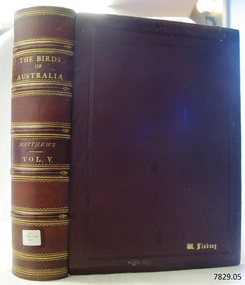 Flagstaff Hill Maritime Museum and Village
Book - Reference, The Birds of Australia Vol 5
... hill maritime village...great ocean road...the birds of australia...gregory...The Warrnambool Mechanics' Institute’s publication collection is of both local and state significance. flagstaff hill warrnambool shipwrecked coast flagstaff hill maritime museum maritime museum shipwreck coast flagstaff hill maritime village great ocean road the birds of australia gregory m. matthews witherby & co. h.f. & g. witherby w lindsay william lindsay quamby woolsthorpe union woolsthorpe pattison collection warrnambool library warrnambool art gallery joseph archibald warrnambool mechanics’ institute and free library ralph eric pattison warrnambool city librarian mechanics’ institute library victorian library board warrnambool books and records warrnambool children’s library the birds of australia vol 5 Quamby Station Union Station woolsthrope Label on spine cover with typed text RA 598.2994 MAT Pastedown front endpaper has sticker from Warrnambool Mechanics Institute and Free Library that reads “Presented by W. ...The Birds of Australia is a 12 volume work, in a total of 14 books. The books were used as an ornithological handbook. They contain scientific text as well as over 600 hand-coloured lithographed plates by J.G. Keulemans, H. Grönvold, Roland Green, H. Goodchild and G.E. Lodge. The work was written, sponsored and organised by Gregory M. Matthews, F.R.S.C. Erc. who was a wealthy Australian and an amateur ornithologist. His titles included – -Fellow of the Linnean and Zoological Societies of London -Member of the British Ornithologists’ Union -Corresponding Fellow of the American Ornithologists’ Union The volumes in our collection were originally donated to the Warrnambool Mechanics’ Institute and Free Library by William Lindsay. THE LINDSAYS (quoted from the book Of Many Things – A History of Warrnambool Shire by C.E. Sayers) The Lindsays were amongst the most prominent families in the Shire of Warrnambool, as pastoralists, sportsmen, municipal councillors, community leaders. The first of the family William arrived in Melbourne in 1841 and started business as a livestock agent. The gold rushes sent him to the central Victoria diggings dealing in cattle. This was a business that boomed in the early 1850s, and he prospered. In 1859 he took over the Quamby run near Woolsthrope from Paul de Castella, the Yarra Valley Swiss vigneron who had brought the leasehold and improvements in 1853 from George Youl, who had pioneered the run. Quamby was originally 25,000 acres. It was heavily timbered, rough country, much of it swampy, a characteristic of the district. Lindsay used it to fatten cattle which gave large returns with the booming gold diggings towns paying high prices for beef. In 1862 purchases at auction made Quamby a freehold. In the next six years a further 20,000 acres of Crown land were brought at auction to make the run one of the largest in the south-west district. The great profits from his cattle trading enabled Lindsay to make improvements to the holding, and to Union which was added in 1864. Much of the thick timber was cleared and the worst of the swamps drained. Union was 15,000 acres of freehold when Kennedy sold it to Lindsay. It was heavily timbered, mostly blackwood, with large belts of wattle and honeysuckle. Much of the heavy native was ringbarked and cleared; much more was swept away by bushfire. It was expensive work, but Lindsay’s bank passbook was heavy with credit, and he did not spare money to make both Quamby and Union heavily developed stock runs. He was as lavish in social living; the bluestone Quamby homestead was one of the most hospitable in the district when William Lindsay was host there; its paddocks carried high quality thoroughbreds: its stables housed steeplechasers and flat racers which won many races on Warrnambool and other courses; its coach houses were filled with carriages which took his guests to the great racing carnivals of the district. After William Lindsay died in 1897, in his eighty-fifth year, his two sons, William and James, managed Union and Quamby as a joint venture. This partnership ended in 1906 when William took over Union and James kept Quamby. The following year 10,000 acres of Union were subdivided and sold in lots of 100 acres to 700 acres for dairying and general farming. It was well improved country, much of it alluvial flats. By then many of the paddocks were sheltered with blue gum belts, and they carried good pastures. The three Lindsays, father and two sons, gave many years of service to the Shire, and to many charitable, sporting, social and community organisations in the Warrnambool district. William Lindsay senior, was a Shire councillor for 15 years, and President several times. James Lindsay followed his father as a north riding councillor. He served nineteen years, from 1887 until his death in March 1908. He was President four times. Jimmy Lindsay was one of the most popular men in the south-west of Victoria. He was a fine sportsman: horse breeder, owner and a dashing amateur rider. He lived lavishly and played hard. For many years he guarded a herd of kangaroos, as many as 100 head, at Quamby. Descendants of the Lindsay kangaroos are still in the district. James Lindsay’s wife, Margaret Esther was a daughter of Samuel Shaw Parker, the first engineer of the Shire. Nell Lindsay, a daughter, lives in the Bluestone Quamby homestead. Only a little more than 60 acres of the original run still belongs to the property. William Lindsay junior succeeded his brother as a Shire councillor. He served for 25 years from 1908 until his death in 1934. So, the Lindsays, father and two sons, served as Shite councillors for an unbroken period of sixth-five years. William Lindsay junior had a life-long interest in horse racing, as breeder, owner and enthusiastic amateur steeplechase rider. He was elected a member of the Warrnambool racing club in 1901 and was president of the club for thirty-two years. He raced and rode horses for the love of the sport. He won the Villiers and Heytesbury Hunt Cup in the 1870s on his own horse, Ventura. In the year he died his horse Flavedo won the Warrnambool Grand Annual steeplechase. It was a sensational race. All of the contestants fell, or lost their riders. When Flavedo baulked at a jump, its jockey R. Sweetman, remounted and completed the course to win the race. All of the Lindsays were passionately fond of the thoroughbred horse. Nell Lindsay talking to the author in the drawing room of Quamby homestead - with many memories for her of its lavish years – said of a brother that he was put on a horse when he was two years old and never got off. William Lindsay junior made Union into a fine, high-producing property, breeding cattle and horses. He added to the bluestone house that David Kennedy started, established plantations of pines and gums, and made an attractive garden. WARRNAMBOOL MECHANICS’ INSTITUTE Warrnambool's Mechanics' Institute (or Institution as it was sometimes called) was one of the earliest in Victoria. On 17th October 1853 a meeting was held where it was resolved to request the Lieutenant Governor of the Colony to grant land for the erection of a Mechanics' Institutes building. A committee was formed at the meeting and Richard Osburne chaired the first meeting of this committee. The land on the North West corner of Banyan and Merri Streets was granted but there were no funds to erect the building. The Formal Rights of the Warrnambool Mechanics' Institute's encompassed its aims and these were officially adopted in1859; "This Institution has for its object the diffusion of literary, scientific, and other useful knowledge amongst its members, excluding all controversial subjects, religious or political. These objects are sought to be obtained by means of a circulating library, a reading room, the establishment of classes, debates, and the occasional delivery of lectures on natural and experimental philosophy, mechanics, astronomy, chemistry, natural history, literature, and the useful and ornamental arts, particularly those which have a more immediate reference to the colony." The Warrnambool Mechanics' Institute opened its first meeting room in November1854 in the National School building at the corner of Banyan and Timor Streets. The Institute was funded by member subscription, payable on a quarterly, half yearly or yearly basis. Samuel Hannaford, the Manager of the Warrnambool Bank of Australasia, was the first Honorary Secretary of the Mechanics' Institutes, and an early President and Vice-President. He also gave several of the early lectures in the Reading Room. Another early Secretary, Librarian and lecturer was Marmaduke Fisher, the teacher at the National School. Lecture topics included The Poets and Poetry of Ireland', 'The Birth and Development of the Earth', 'The Vertebrae - with Remarks on the pleasures resulting from the study of Natural History' and 'Architecture'. In 1856 the Reading Room was moved to James Hider's shop in Timor Street, and by 1864 it was located in the bookshop of Davies and Read. In the 1860's the Mechanics' Institute struggled as membership waned but in 1866, after a series of fund raising efforts, the committee was able to purchase land in Liebig Street, on a site then called Market Square, between the weighbridge and the fire station. A Mechanics' Institute building was opened at this site in August 1871. The following year four more rooms were added to the main Reading Room and in 1873 the Artisan School of Design was incorporated into the Institute. The same year Joseph Archibald established a Museum; however it deteriorated when he was transferred to Bendigo in 1877. In 1880, with Archibald's return to Warrnambool, the Museum was re-established, and in 1885 a new building was built at the back of the Institute to accommodate the re-created School of Design, the Art Gallery and the Museum. In 1887 the Museum section was moved to the former court house in Timor Street (for some time the walls of the building formed part of the TAFE cafeteria but all is now demolished)). In 1911 the Museum was transferred back to the original building and the management of the Mechanics' Institute was handed over to the Warrnambool City Council. The Museum and Art Gallery became one and housed many fine works of art, and the Library continued to grow. The building was well patronised, with records showing that at the beginning of the 20th century there were between 500 and 800 visitors. During World War One the monthly figures were in the thousands, with 3,400 people visiting in January 1915. The Museum was a much loved Institution in Warrnambool until the contents of the Museum and Art Gallery were removed to make room for the Warrnambool City Council Engineers' Department. The contents were stored but many of the items were scattered or lost. When the original building was demolished the site became occupied by the Civic Centre, which included the new City Library. (The library was temporarily located in the old Palais building in Koroit Street.) In the process of reorganisation the Collection was distributed amongst the community groups: -The new City Library took some of the historic books and some important documents, historic photographs and newspapers. -The Art Gallery kept the 19th Century art collection and some of the artefacts from the museum. -The Historic Society has some items -The State Museum has some items -Some items were destroyed -Flagstaff Hill Maritime Village has old newspapers, Government Gazettes, most of the Mechanics' Institute Library, ledgers and documents connected to the Mechanics' Institute Library, some framed and unframed art works and some photographs. The Warrnambool Mechanics' Institute Library book collection is deemed to be of great importance because it is one of the few collections in an almost intact state, and many of the books are now very rare and of great value. THE PATTISON COLLECTION This book is also part of the ‘Pattison Collection’, a collection of books and records that was originally owned by the Warrnambool Mechanics’ Institute, which was founded in Warrnambool in 1853. In 1935 Ralph Pattison was appointed as City Librarian to establish and organise the Warrnambool Library, as the Warrnambool Mechanics’ Institute was then called. When the Warrnambool Mechanics’ Institute building was pulled down in 1963 a new civic building was erected on the site and the new Warrnambool Library, on behalf of the City Council, took over all the holdings of the Warrnambool Mechanics’ Institute. At this time some of the items were separated and identified as the ‘Pattison Collection’, named after Ralph Pattison. Eventually the components of the Warrnambool Mechanics’ Institute were distributed from the Warrnambool Library to various places, including the Art Gallery, Historical Society and Flagstaff Hill. Later some were even distributed to other regional branches of Corangamite Regional Library and passed to and fro. It is difficult now to trace just where all of the items have ended up. The books at Flagstaff Hill Maritime Village generally display stamps and markings from Pattison as well as a variety of other institutions including the Mechanics’ Institute itself. RALPH ERIC PATTISON Ralph Eric Pattison was born in Rockhampton, Queensland, in 1891. He married Maude Swan from Warrnambool in 1920 and they set up home in Warrnambool. In 1935 Pattison accepted a position as City Librarian for the Warrnambool City Council. His huge challenge was to make a functional library within two rooms of the Mechanics’ Institute. He tirelessly cleaned, cleared and sorted a disarrayed collection of old books, jars of preserved specimens and other items reserved for exhibition in the city’s museum. He developed and updated the library with a wide variety of books for all tastes, including reference books for students; a difficult task to fulfil during the years following the Depression. He converted all of the lower area of the building into a library, reference room and reading room for members and the public. The books were sorted and stored using a cataloguing and card index system that he had developed himself. He also prepared the upper floor of the building and established the Art Gallery and later the Museum, a place to exhibit the many old relics that had been stored for years for this purpose. One of the treasures he found was a beautiful ancient clock, which he repaired, restored and enjoyed using in his office during the years of his service there. Ralph Pattison was described as “a meticulous gentleman whose punctuality, floorless courtesy and distinctive neat dress were hallmarks of his character, and ‘his’ clock controlled his daily routine, and his opening and closing of the library’s large heavy doors to the minute.” Pattison took leave during 1942 to 1945 to serve in the Royal Australian Navy, Volunteer Reserve as Lieutenant. A few years later he converted one of the Museum’s rooms into a Children’s Library, stocking it with suitable books for the younger generation. This was an instant success. In the 1950’s he had the honour of being appointed to the Victorian Library Board and received more inspiration from the monthly conferences in Melbourne. He was sadly retired in 1959 after over 23 years of service, due to the fact that he had gone over the working age of council officers. However he continued to take a very keen interest in the continual development of the Library until his death in 1969. The Birds of Australia by Gregory M. Matthews is now considered a rare and valuable scientific and historic work on its own. These 12 volumes were donated in 1934 to The Warrnambool Mechanics’ Institute and were included as part of the Pattison Collection. The Warrnambool Mechanics’ Institute Collection is primarily significant in its totality, rather than for the individual objects it contains. Its contents are highly representative of the development of Mechanics' Institute libraries across Australia, particularly Victoria. A diversity of publications and themes has been amassed, and these provide clues to our understanding of the nature of and changes in the reading habits of Victorians from the 1850s to the middle of the 20th century. The collection also highlights the Warrnambool community’s commitment to the Mechanics’ Institute, reading, literacy and learning in the regions, and proves that access to knowledge was not impeded by distance. These items help to provide a more complete picture of our community’s ideals and aspirations. The Warrnambool Mechanics Institute book collection has historical and social significance for its strong association with the Mechanics Institute movement and the important role it played in the intellectual, cultural and social development of people throughout the latter part of the nineteenth century and the early twentieth century. The collection of books is a rare example of an early lending library and its significance is enhanced by the survival of an original collection of many volumes. The Warrnambool Mechanics' Institute’s publication collection is of both local and state significance. The Birds of Australia Vol 5 Author: Gregory M Mathews Publisher: Witherby & Co 326 HIGH HOLBORN LONDON Date: 1915-1916 Tan leather bound illustrated workLabel on spine cover with typed text RA 598.2994 MAT Pastedown front endpaper has sticker from Warrnambool Mechanics Institute and Free Library that reads “Presented by W. Lindsay Esq. ‘Union’ Woolsthrope” Accession Number: 15236 Date Received: 3-34 “W. Lindsay” embossed in gold on front cover, bottom right of book flagstaff hill, warrnambool, shipwrecked coast, flagstaff hill maritime museum, maritime museum, shipwreck coast, flagstaff hill maritime village, great ocean road, the birds of australia, gregory m. matthews, witherby & co., h.f. & g. witherby, w lindsay, william lindsay, quamby woolsthorpe, union woolsthorpe, pattison collection, warrnambool library, warrnambool art gallery, joseph archibald, warrnambool mechanics’ institute and free library, ralph eric pattison, warrnambool city librarian, mechanics’ institute library, victorian library board, warrnambool books and records, warrnambool children’s library, the birds of australia vol 5, quamby station, union station, woolsthrope -
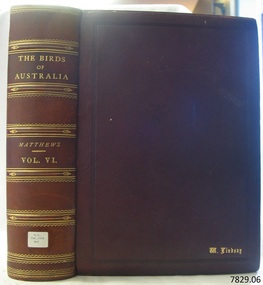 Flagstaff Hill Maritime Museum and Village
Book - Reference, The Birds of Australia Vol 6
... hill maritime village...great ocean road...the birds of australia...gregory...The Warrnambool Mechanics' Institute’s publication collection is of both local and state significance. flagstaff hill warrnambool shipwrecked coast flagstaff hill maritime museum maritime museum shipwreck coast flagstaff hill maritime village great ocean road the birds of australia gregory m. matthews witherby & co. h.f. & g. witherby w lindsay william lindsay quamby woolsthorpe union woolsthorpe pattison collection warrnambool library warrnambool art gallery joseph archibald warrnambool mechanics’ institute and free library ralph eric pattison warrnambool city librarian mechanics’ institute library victorian library board warrnambool books and records warrnambool children’s library the birds of australia vol 6 Quamby Station Union Station Woolsthorpe Label on spine cover with typed text RA 598.2994 MAT Pastedown front endpaper has sticker from Warrnambool Mechanics Institute and Free Library that reads “Presented by W. ...The Birds of Australia is a 12 volume work, in a total of 14 books. The books were used as an ornithological handbook. They contain scientific text as well as over 600 hand-coloured lithographed plates by J.G. Keulemans, H. Grönvold, Roland Green, H. Goodchild and G.E. Lodge. The work was written, sponsored and organised by Gregory M. Matthews, F.R.S.C. Erc. who was a wealthy Australian and an amateur ornithologist. His titles included – -Fellow of the Linnean and Zoological Societies of London -Member of the British Ornithologists’ Union -Corresponding Fellow of the American Ornithologists’ Union The volumes in our collection were originally donated to the Warrnambool Mechanics’ Institute and Free Library by William Lindsay. THE LINDSAYS (quoted from the book Of Many Things – A History of Warrnambool Shire by C.E. Sayers) The Lindsays were amongst the most prominent families in the Shire of Warrnambool, as pastoralists, sportsmen, municipal councillors, community leaders. The first of the family William arrived in Melbourne in 1841 and started business as a livestock agent. The gold rushes sent him to the central Victoria diggings dealing in cattle. This was a business that boomed in the early 1850s, and he prospered. In 1859 he took over the Quamby run near Woolsthrope from Paul de Castella, the Yarra Valley Swiss vigneron who had brought the leasehold and improvements in 1853 from George Youl, who had pioneered the run. Quamby was originally 25,000 acres. It was heavily timbered, rough country, much of it swampy, a characteristic of the district. Lindsay used it to fatten cattle which gave large returns with the booming gold diggings towns paying high prices for beef. In 1862 purchases at auction made Quamby a freehold. In the next six years a further 20,000 acres of Crown land were brought at auction to make the run one of the largest in the south-west district. The great profits from his cattle trading enabled Lindsay to make improvements to the holding, and to Union which was added in 1864. Much of the thick timber was cleared and the worst of the swamps drained. Union was 15,000 acres of freehold when Kennedy sold it to Lindsay. It was heavily timbered, mostly blackwood, with large belts of wattle and honeysuckle. Much of the heavy native was ringbarked and cleared; much more was swept away by bushfire. It was expensive work, but Lindsay’s bank passbook was heavy with credit, and he did not spare money to make both Quamby and Union heavily developed stock runs. He was as lavish in social living; the bluestone Quamby homestead was one of the most hospitable in the district when William Lindsay was host there; its paddocks carried high quality thoroughbreds: its stables housed steeplechasers and flat racers which won many races on Warrnambool and other courses; its coach houses were filled with carriages which took his guests to the great racing carnivals of the district. After William Lindsay died in 1897, in his eighty-fifth year, his two sons, William and James, managed Union and Quamby as a joint venture. This partnership ended in 1906 when William took over Union and James kept Quamby. The following year 10,000 acres of Union were subdivided and sold in lots of 100 acres to 700 acres for dairying and general farming. It was well improved country, much of it alluvial flats. By then many of the paddocks were sheltered with blue gum belts, and they carried good pastures. The three Lindsays, father and two sons, gave many years of service to the Shire, and to many charitable, sporting, social and community organisations in the Warrnambool district. William Lindsay senior, was a Shire councillor for 15 years, and President several times. James Lindsay followed his father as a north riding councillor. He served nineteen years, from 1887 until his death in March 1908. He was President four times. Jimmy Lindsay was one of the most popular men in the south-west of Victoria. He was a fine sportsman: horse breeder, owner and a dashing amateur rider. He lived lavishly and played hard. For many years he guarded a herd of kangaroos, as many as 100 head, at Quamby. Descendants of the Lindsay kangaroos are still in the district. James Lindsay’s wife, Margaret Esther was a daughter of Samuel Shaw Parker, the first engineer of the Shire. Nell Lindsay, a daughter, lives in the Bluestone Quamby homestead. Only a little more than 60 acres of the original run still belongs to the property. William Lindsay junior succeeded his brother as a Shire councillor. He served for 25 years from 1908 until his death in 1934. So, the Lindsays, father and two sons, served as Shite councillors for an unbroken period of sixth-five years. William Lindsay junior had a life-long interest in horse racing, as breeder, owner and enthusiastic amateur steeplechase rider. He was elected a member of the Warrnambool racing club in 1901 and was president of the club for thirty-two years. He raced and rode horses for the love of the sport. He won the Villiers and Heytesbury Hunt Cup in the 1870s on his own horse, Ventura. In the year he died his horse Flavedo won the Warrnambool Grand Annual steeplechase. It was a sensational race. All of the contestants fell, or lost their riders. When Flavedo baulked at a jump, its jockey R. Sweetman, remounted and completed the course to win the race. All of the Lindsays were passionately fond of the thoroughbred horse. Nell Lindsay talking to the author in the drawing room of Quamby homestead - with many memories for her of its lavish years – said of a brother that he was put on a horse when he was two years old and never got off. William Lindsay junior made Union into a fine, high-producing property, breeding cattle and horses. He added to the bluestone house that David Kennedy started, established plantations of pines and gums, and made an attractive garden. WARRNAMBOOL MECHANICS’ INSTITUTE Warrnambool's Mechanics' Institute (or Institution as it was sometimes called) was one of the earliest in Victoria. On 17th October 1853 a meeting was held where it was resolved to request the Lieutenant Governor of the Colony to grant land for the erection of a Mechanics' Institutes building. A committee was formed at the meeting and Richard Osburne chaired the first meeting of this committee. The land on the North West corner of Banyan and Merri Streets was granted but there were no funds to erect the building. The Formal Rights of the Warrnambool Mechanics' Institute's encompassed its aims and these were officially adopted in1859; "This Institution has for its object the diffusion of literary, scientific, and other useful knowledge amongst its members, excluding all controversial subjects, religious or political. These objects are sought to be obtained by means of a circulating library, a reading room, the establishment of classes, debates, and the occasional delivery of lectures on natural and experimental philosophy, mechanics, astronomy, chemistry, natural history, literature, and the useful and ornamental arts, particularly those which have a more immediate reference to the colony." The Warrnambool Mechanics' Institute opened its first meeting room in November1854 in the National School building at the corner of Banyan and Timor Streets. The Institute was funded by member subscription, payable on a quarterly, half yearly or yearly basis. Samuel Hannaford, the Manager of the Warrnambool Bank of Australasia, was the first Honorary Secretary of the Mechanics' Institutes, and an early President and Vice-President. He also gave several of the early lectures in the Reading Room. Another early Secretary, Librarian and lecturer was Marmaduke Fisher, the teacher at the National School. Lecture topics included The Poets and Poetry of Ireland', 'The Birth and Development of the Earth', 'The Vertebrae - with Remarks on the pleasures resulting from the study of Natural History' and 'Architecture'. In 1856 the Reading Room was moved to James Hider's shop in Timor Street, and by 1864 it was located in the bookshop of Davies and Read. In the 1860's the Mechanics' Institute struggled as membership waned but in 1866, after a series of fund raising efforts, the committee was able to purchase land in Liebig Street, on a site then called Market Square, between the weighbridge and the fire station. A Mechanics' Institute building was opened at this site in August 1871. The following year four more rooms were added to the main Reading Room and in 1873 the Artisan School of Design was incorporated into the Institute. The same year Joseph Archibald established a Museum; however it deteriorated when he was transferred to Bendigo in 1877. In 1880, with Archibald's return to Warrnambool, the Museum was re-established, and in 1885 a new building was built at the back of the Institute to accommodate the re-created School of Design, the Art Gallery and the Museum. In 1887 the Museum section was moved to the former court house in Timor Street (for some time the walls of the building formed part of the TAFE cafeteria but all is now demolished)). In 1911 the Museum was transferred back to the original building and the management of the Mechanics' Institute was handed over to the Warrnambool City Council. The Museum and Art Gallery became one and housed many fine works of art, and the Library continued to grow. The building was well patronised, with records showing that at the beginning of the 20th century there were between 500 and 800 visitors. During World War One the monthly figures were in the thousands, with 3,400 people visiting in January 1915. The Museum was a much loved Institution in Warrnambool until the contents of the Museum and Art Gallery were removed to make room for the Warrnambool City Council Engineers' Department. The contents were stored but many of the items were scattered or lost. When the original building was demolished the site became occupied by the Civic Centre, which included the new City Library. (The library was temporarily located in the old Palais building in Koroit Street.) In the process of reorganisation the Collection was distributed amongst the community groups: -The new City Library took some of the historic books and some important documents, historic photographs and newspapers. -The Art Gallery kept the 19th Century art collection and some of the artefacts from the museum. -The Historic Society has some items -The State Museum has some items -Some items were destroyed -Flagstaff Hill Maritime Village has old newspapers, Government Gazettes, most of the Mechanics' Institute Library, ledgers and documents connected to the Mechanics' Institute Library, some framed and unframed art works and some photographs. The Warrnambool Mechanics' Institute Library book collection is deemed to be of great importance because it is one of the few collections in an almost intact state, and many of the books are now very rare and of great value. THE PATTISON COLLECTION This book is also part of the ‘Pattison Collection’, a collection of books and records that was originally owned by the Warrnambool Mechanics’ Institute, which was founded in Warrnambool in 1853. In 1935 Ralph Pattison was appointed as City Librarian to establish and organise the Warrnambool Library, as the Warrnambool Mechanics’ Institute was then called. When the Warrnambool Mechanics’ Institute building was pulled down in 1963 a new civic building was erected on the site and the new Warrnambool Library, on behalf of the City Council, took over all the holdings of the Warrnambool Mechanics’ Institute. At this time some of the items were separated and identified as the ‘Pattison Collection’, named after Ralph Pattison. Eventually the components of the Warrnambool Mechanics’ Institute were distributed from the Warrnambool Library to various places, including the Art Gallery, Historical Society and Flagstaff Hill. Later some were even distributed to other regional branches of Corangamite Regional Library and passed to and fro. It is difficult now to trace just where all of the items have ended up. The books at Flagstaff Hill Maritime Village generally display stamps and markings from Pattison as well as a variety of other institutions including the Mechanics’ Institute itself. RALPH ERIC PATTISON Ralph Eric Pattison was born in Rockhampton, Queensland, in 1891. He married Maude Swan from Warrnambool in 1920 and they set up home in Warrnambool. In 1935 Pattison accepted a position as City Librarian for the Warrnambool City Council. His huge challenge was to make a functional library within two rooms of the Mechanics’ Institute. He tirelessly cleaned, cleared and sorted a disarrayed collection of old books, jars of preserved specimens and other items reserved for exhibition in the city’s museum. He developed and updated the library with a wide variety of books for all tastes, including reference books for students; a difficult task to fulfil during the years following the Depression. He converted all of the lower area of the building into a library, reference room and reading room for members and the public. The books were sorted and stored using a cataloguing and card index system that he had developed himself. He also prepared the upper floor of the building and established the Art Gallery and later the Museum, a place to exhibit the many old relics that had been stored for years for this purpose. One of the treasures he found was a beautiful ancient clock, which he repaired, restored and enjoyed using in his office during the years of his service there. Ralph Pattison was described as “a meticulous gentleman whose punctuality, floorless courtesy and distinctive neat dress were hallmarks of his character, and ‘his’ clock controlled his daily routine, and his opening and closing of the library’s large heavy doors to the minute.” Pattison took leave during 1942 to 1945 to serve in the Royal Australian Navy, Volunteer Reserve as Lieutenant. A few years later he converted one of the Museum’s rooms into a Children’s Library, stocking it with suitable books for the younger generation. This was an instant success. In the 1950’s he had the honour of being appointed to the Victorian Library Board and received more inspiration from the monthly conferences in Melbourne. He was sadly retired in 1959 after over 23 years of service, due to the fact that he had gone over the working age of council officers. However he continued to take a very keen interest in the continual development of the Library until his death in 1969. The Birds of Australia by Gregory M. Matthews is now considered a rare and valuable scientific and historic work on its own. These 12 volumes were donated in 1934 to The Warrnambool Mechanics’ Institute and were included as part of the Pattison Collection. The Warrnambool Mechanics’ Institute Collection is primarily significant in its totality, rather than for the individual objects it contains. Its contents are highly representative of the development of Mechanics' Institute libraries across Australia, particularly Victoria. A diversity of publications and themes has been amassed, and these provide clues to our understanding of the nature of and changes in the reading habits of Victorians from the 1850s to the middle of the 20th century. The collection also highlights the Warrnambool community’s commitment to the Mechanics’ Institute, reading, literacy and learning in the regions, and proves that access to knowledge was not impeded by distance. These items help to provide a more complete picture of our community’s ideals and aspirations. The Warrnambool Mechanics Institute book collection has historical and social significance for its strong association with the Mechanics Institute movement and the important role it played in the intellectual, cultural and social development of people throughout the latter part of the nineteenth century and the early twentieth century. The collection of books is a rare example of an early lending library and its significance is enhanced by the survival of an original collection of many volumes. The Warrnambool Mechanics' Institute’s publication collection is of both local and state significance. The Birds of Australia Vol 6 Author: Gregory M Mathews Publisher: Witherby & Co 326 HIGH HOLBORN LONDON Date: 1916-1917 Tan leather bound illustrated work.Label on spine cover with typed text RA 598.2994 MAT Pastedown front endpaper has sticker from Warrnambool Mechanics Institute and Free Library that reads “Presented by W. Lindsay Esq. ‘Union’ Woolsthrope” Accession Number: 15237 Date Received: 3-34 “W. Lindsay” embossed in gold on front cover, bottom right of book flagstaff hill, warrnambool, shipwrecked coast, flagstaff hill maritime museum, maritime museum, shipwreck coast, flagstaff hill maritime village, great ocean road, the birds of australia, gregory m. matthews, witherby & co., h.f. & g. witherby, w lindsay, william lindsay, quamby woolsthorpe, union woolsthorpe, pattison collection, warrnambool library, warrnambool art gallery, joseph archibald, warrnambool mechanics’ institute and free library, ralph eric pattison, warrnambool city librarian, mechanics’ institute library, victorian library board, warrnambool books and records, warrnambool children’s library, the birds of australia vol 6, quamby station, union station, woolsthorpe -
 Flagstaff Hill Maritime Museum and Village
Book - Reference, The Birds of Australia Vol 7
... hill maritime village...great ocean road...the birds of australia...gregory...The Warrnambool Mechanics' Institute’s publication collection is of both local and state significance. flagstaff hill warrnambool shipwrecked coast flagstaff hill maritime museum maritime museum shipwreck coast flagstaff hill maritime village great ocean road the birds of australia gregory m. matthews witherby & co. h.f. & g. witherby w lindsay william lindsay quamby woolsthorpe union woolsthorpe pattison collection warrnambool library warrnambool art gallery joseph archibald warrnambool mechanics’ institute and free library ralph eric pattison warrnambool city librarian mechanics’ institute library victorian library board warrnambool books and records warrnambool children’s library the birds of australia vol 7 Quamby Station Union Station woolsthrope Label on spine cover with typed text RA 598.2994 MAT Pastedown front endpaper has sticker from Warrnambool Mechanics Institute and Free Library that reads “Presented by W. ...The Birds of Australia is a 12 volume work, in a total of 14 books. The books were used as an ornithological handbook. They contain scientific text as well as over 600 hand-coloured lithographed plates by J.G. Keulemans, H. Grönvold, Roland Green, H. Goodchild and G.E. Lodge. The work was written, sponsored and organised by Gregory M. Matthews, F.R.S.C. Erc. who was a wealthy Australian and an amateur ornithologist. His titles included – -Fellow of the Linnean and Zoological Societies of London -Member of the British Ornithologists’ Union -Corresponding Fellow of the American Ornithologists’ Union The volumes in our collection were originally donated to the Warrnambool Mechanics’ Institute and Free Library by William Lindsay. THE LINDSAYS (quoted from the book Of Many Things – A History of Warrnambool Shire by C.E. Sayers) The Lindsays were amongst the most prominent families in the Shire of Warrnambool, as pastoralists, sportsmen, municipal councillors, community leaders. The first of the family William arrived in Melbourne in 1841 and started business as a livestock agent. The gold rushes sent him to the central Victoria diggings dealing in cattle. This was a business that boomed in the early 1850s, and he prospered. In 1859 he took over the Quamby run near Woolsthrope from Paul de Castella, the Yarra Valley Swiss vigneron who had brought the leasehold and improvements in 1853 from George Youl, who had pioneered the run. Quamby was originally 25,000 acres. It was heavily timbered, rough country, much of it swampy, a characteristic of the district. Lindsay used it to fatten cattle which gave large returns with the booming gold diggings towns paying high prices for beef. In 1862 purchases at auction made Quamby a freehold. In the next six years a further 20,000 acres of Crown land were brought at auction to make the run one of the largest in the south-west district. The great profits from his cattle trading enabled Lindsay to make improvements to the holding, and to Union which was added in 1864. Much of the thick timber was cleared and the worst of the swamps drained. Union was 15,000 acres of freehold when Kennedy sold it to Lindsay. It was heavily timbered, mostly blackwood, with large belts of wattle and honeysuckle. Much of the heavy native was ringbarked and cleared; much more was swept away by bushfire. It was expensive work, but Lindsay’s bank passbook was heavy with credit, and he did not spare money to make both Quamby and Union heavily developed stock runs. He was as lavish in social living; the bluestone Quamby homestead was one of the most hospitable in the district when William Lindsay was host there; its paddocks carried high quality thoroughbreds: its stables housed steeplechasers and flat racers which won many races on Warrnambool and other courses; its coach houses were filled with carriages which took his guests to the great racing carnivals of the district. After William Lindsay died in 1897, in his eighty-fifth year, his two sons, William and James, managed Union and Quamby as a joint venture. This partnership ended in 1906 when William took over Union and James kept Quamby. The following year 10,000 acres of Union were subdivided and sold in lots of 100 acres to 700 acres for dairying and general farming. It was well improved country, much of it alluvial flats. By then many of the paddocks were sheltered with blue gum belts, and they carried good pastures. The three Lindsays, father and two sons, gave many years of service to the Shire, and to many charitable, sporting, social and community organisations in the Warrnambool district. William Lindsay senior, was a Shire councillor for 15 years, and President several times. James Lindsay followed his father as a north riding councillor. He served nineteen years, from 1887 until his death in March 1908. He was President four times. Jimmy Lindsay was one of the most popular men in the south-west of Victoria. He was a fine sportsman: horse breeder, owner and a dashing amateur rider. He lived lavishly and played hard. For many years he guarded a herd of kangaroos, as many as 100 head, at Quamby. Descendants of the Lindsay kangaroos are still in the district. James Lindsay’s wife, Margaret Esther was a daughter of Samuel Shaw Parker, the first engineer of the Shire. Nell Lindsay, a daughter, lives in the Bluestone Quamby homestead. Only a little more than 60 acres of the original run still belongs to the property. William Lindsay junior succeeded his brother as a Shire councillor. He served for 25 years from 1908 until his death in 1934. So, the Lindsays, father and two sons, served as Shite councillors for an unbroken period of sixth-five years. William Lindsay junior had a life-long interest in horse racing, as breeder, owner and enthusiastic amateur steeplechase rider. He was elected a member of the Warrnambool racing club in 1901 and was president of the club for thirty-two years. He raced and rode horses for the love of the sport. He won the Villiers and Heytesbury Hunt Cup in the 1870s on his own horse, Ventura. In the year he died his horse Flavedo won the Warrnambool Grand Annual steeplechase. It was a sensational race. All of the contestants fell, or lost their riders. When Flavedo baulked at a jump, its jockey R. Sweetman, remounted and completed the course to win the race. All of the Lindsays were passionately fond of the thoroughbred horse. Nell Lindsay talking to the author in the drawing room of Quamby homestead - with many memories for her of its lavish years – said of a brother that he was put on a horse when he was two years old and never got off. William Lindsay junior made Union into a fine, high-producing property, breeding cattle and horses. He added to the bluestone house that David Kennedy started, established plantations of pines and gums, and made an attractive garden. WARRNAMBOOL MECHANICS’ INSTITUTE Warrnambool's Mechanics' Institute (or Institution as it was sometimes called) was one of the earliest in Victoria. On 17th October 1853 a meeting was held where it was resolved to request the Lieutenant Governor of the Colony to grant land for the erection of a Mechanics' Institutes building. A committee was formed at the meeting and Richard Osburne chaired the first meeting of this committee. The land on the North West corner of Banyan and Merri Streets was granted but there were no funds to erect the building. The Formal Rights of the Warrnambool Mechanics' Institute's encompassed its aims and these were officially adopted in1859; "This Institution has for its object the diffusion of literary, scientific, and other useful knowledge amongst its members, excluding all controversial subjects, religious or political. These objects are sought to be obtained by means of a circulating library, a reading room, the establishment of classes, debates, and the occasional delivery of lectures on natural and experimental philosophy, mechanics, astronomy, chemistry, natural history, literature, and the useful and ornamental arts, particularly those which have a more immediate reference to the colony." The Warrnambool Mechanics' Institute opened its first meeting room in November1854 in the National School building at the corner of Banyan and Timor Streets. The Institute was funded by member subscription, payable on a quarterly, half yearly or yearly basis. Samuel Hannaford, the Manager of the Warrnambool Bank of Australasia, was the first Honorary Secretary of the Mechanics' Institutes, and an early President and Vice-President. He also gave several of the early lectures in the Reading Room. Another early Secretary, Librarian and lecturer was Marmaduke Fisher, the teacher at the National School. Lecture topics included The Poets and Poetry of Ireland', 'The Birth and Development of the Earth', 'The Vertebrae - with Remarks on the pleasures resulting from the study of Natural History' and 'Architecture'. In 1856 the Reading Room was moved to James Hider's shop in Timor Street, and by 1864 it was located in the bookshop of Davies and Read. In the 1860's the Mechanics' Institute struggled as membership waned but in 1866, after a series of fund raising efforts, the committee was able to purchase land in Liebig Street, on a site then called Market Square, between the weighbridge and the fire station. A Mechanics' Institute building was opened at this site in August 1871. The following year four more rooms were added to the main Reading Room and in 1873 the Artisan School of Design was incorporated into the Institute. The same year Joseph Archibald established a Museum; however it deteriorated when he was transferred to Bendigo in 1877. In 1880, with Archibald's return to Warrnambool, the Museum was re-established, and in 1885 a new building was built at the back of the Institute to accommodate the re-created School of Design, the Art Gallery and the Museum. In 1887 the Museum section was moved to the former court house in Timor Street (for some time the walls of the building formed part of the TAFE cafeteria but all is now demolished)). In 1911 the Museum was transferred back to the original building and the management of the Mechanics' Institute was handed over to the Warrnambool City Council. The Museum and Art Gallery became one and housed many fine works of art, and the Library continued to grow. The building was well patronised, with records showing that at the beginning of the 20th century there were between 500 and 800 visitors. During World War One the monthly figures were in the thousands, with 3,400 people visiting in January 1915. The Museum was a much loved Institution in Warrnambool until the contents of the Museum and Art Gallery were removed to make room for the Warrnambool City Council Engineers' Department. The contents were stored but many of the items were scattered or lost. When the original building was demolished the site became occupied by the Civic Centre, which included the new City Library. (The library was temporarily located in the old Palais building in Koroit Street.) In the process of reorganisation the Collection was distributed amongst the community groups: -The new City Library took some of the historic books and some important documents, historic photographs and newspapers. -The Art Gallery kept the 19th Century art collection and some of the artefacts from the museum. -The Historic Society has some items -The State Museum has some items -Some items were destroyed -Flagstaff Hill Maritime Village has old newspapers, Government Gazettes, most of the Mechanics' Institute Library, ledgers and documents connected to the Mechanics' Institute Library, some framed and unframed art works and some photographs. The Warrnambool Mechanics' Institute Library book collection is deemed to be of great importance because it is one of the few collections in an almost intact state, and many of the books are now very rare and of great value. THE PATTISON COLLECTION This book is also part of the ‘Pattison Collection’, a collection of books and records that was originally owned by the Warrnambool Mechanics’ Institute, which was founded in Warrnambool in 1853. In 1935 Ralph Pattison was appointed as City Librarian to establish and organise the Warrnambool Library, as the Warrnambool Mechanics’ Institute was then called. When the Warrnambool Mechanics’ Institute building was pulled down in 1963 a new civic building was erected on the site and the new Warrnambool Library, on behalf of the City Council, took over all the holdings of the Warrnambool Mechanics’ Institute. At this time some of the items were separated and identified as the ‘Pattison Collection’, named after Ralph Pattison. Eventually the components of the Warrnambool Mechanics’ Institute were distributed from the Warrnambool Library to various places, including the Art Gallery, Historical Society and Flagstaff Hill. Later some were even distributed to other regional branches of Corangamite Regional Library and passed to and fro. It is difficult now to trace just where all of the items have ended up. The books at Flagstaff Hill Maritime Village generally display stamps and markings from Pattison as well as a variety of other institutions including the Mechanics’ Institute itself. RALPH ERIC PATTISON Ralph Eric Pattison was born in Rockhampton, Queensland, in 1891. He married Maude Swan from Warrnambool in 1920 and they set up home in Warrnambool. In 1935 Pattison accepted a position as City Librarian for the Warrnambool City Council. His huge challenge was to make a functional library within two rooms of the Mechanics’ Institute. He tirelessly cleaned, cleared and sorted a disarrayed collection of old books, jars of preserved specimens and other items reserved for exhibition in the city’s museum. He developed and updated the library with a wide variety of books for all tastes, including reference books for students; a difficult task to fulfil during the years following the Depression. He converted all of the lower area of the building into a library, reference room and reading room for members and the public. The books were sorted and stored using a cataloguing and card index system that he had developed himself. He also prepared the upper floor of the building and established the Art Gallery and later the Museum, a place to exhibit the many old relics that had been stored for years for this purpose. One of the treasures he found was a beautiful ancient clock, which he repaired, restored and enjoyed using in his office during the years of his service there. Ralph Pattison was described as “a meticulous gentleman whose punctuality, floorless courtesy and distinctive neat dress were hallmarks of his character, and ‘his’ clock controlled his daily routine, and his opening and closing of the library’s large heavy doors to the minute.” Pattison took leave during 1942 to 1945 to serve in the Royal Australian Navy, Volunteer Reserve as Lieutenant. A few years later he converted one of the Museum’s rooms into a Children’s Library, stocking it with suitable books for the younger generation. This was an instant success. In the 1950’s he had the honour of being appointed to the Victorian Library Board and received more inspiration from the monthly conferences in Melbourne. He was sadly retired in 1959 after over 23 years of service, due to the fact that he had gone over the working age of council officers. However he continued to take a very keen interest in the continual development of the Library until his death in 1969. The Birds of Australia by Gregory M. Matthews is now considered a rare and valuable scientific and historic work on its own. These 12 volumes were donated in 1934 to The Warrnambool Mechanics’ Institute and were included as part of the Pattison Collection. The Warrnambool Mechanics’ Institute Collection is primarily significant in its totality, rather than for the individual objects it contains. Its contents are highly representative of the development of Mechanics' Institute libraries across Australia, particularly Victoria. A diversity of publications and themes has been amassed, and these provide clues to our understanding of the nature of and changes in the reading habits of Victorians from the 1850s to the middle of the 20th century. The collection also highlights the Warrnambool community’s commitment to the Mechanics’ Institute, reading, literacy and learning in the regions, and proves that access to knowledge was not impeded by distance. These items help to provide a more complete picture of our community’s ideals and aspirations. The Warrnambool Mechanics Institute book collection has historical and social significance for its strong association with the Mechanics Institute movement and the important role it played in the intellectual, cultural and social development of people throughout the latter part of the nineteenth century and the early twentieth century. The collection of books is a rare example of an early lending library and its significance is enhanced by the survival of an original collection of many volumes. The Warrnambool Mechanics' Institute’s publication collection is of both local and state significance. The Birds of Australia Vol 7 Author: Gregory M Mathews Publisher: Witherby & Co Date: 1918-1919 Tan leather bound illustrated work.Label on spine cover with typed text RA 598.2994 MAT Pastedown front endpaper has sticker from Warrnambool Mechanics Institute and Free Library that reads “Presented by W. Lindsay Esq. ‘Union’ Woolsthrope” Accession Number: 15238 Date Received: 3-34 “W. Lindsay” embossed in gold on front cover, bottom right of book flagstaff hill, warrnambool, shipwrecked coast, flagstaff hill maritime museum, maritime museum, shipwreck coast, flagstaff hill maritime village, great ocean road, the birds of australia, gregory m. matthews, witherby & co., h.f. & g. witherby, w lindsay, william lindsay, quamby woolsthorpe, union woolsthorpe, pattison collection, warrnambool library, warrnambool art gallery, joseph archibald, warrnambool mechanics’ institute and free library, ralph eric pattison, warrnambool city librarian, mechanics’ institute library, victorian library board, warrnambool books and records, warrnambool children’s library, the birds of australia vol 7, quamby station, union station, woolsthrope
