
Showing 17 items matching "hills hoist"
-
 National Wool Museum
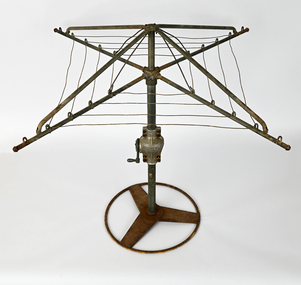
Model - Hills Hoist Clothesline, 1950s
... Hills Hoist Clothesline......Hills Hoist...This model of a Hills Hoist was used for marketing purposes in the 1950s. ...Hills / Hills Hoist...Model Hills Hoist Clothesline ...This model of a Hills Hoist was used for marketing purposes in the 1950s. The Hills Hoist is an Australian cultural icon. The original rotary clothes hoist that became the iconic Hills Hoist was invented and patented in Geelong by blacksmith Gilbert Toyne in 1911, Toyne, along with his friend Lambert Downey, launched the Aeroplane Clothes Hoist at Melbourne's 1911 Royal Agricultural Show. His business plan was interrupted when he served in World War I, but he returned and refined the idea to include a wind-up mechanism. In 1945, when Toyne's patent had collapsed, Adelaide's Lance Hill adapted the design and with his brother-in-law Harold Ling, began mass producing the iconic Hills Hoist.Model of a rotary clothesline, featuring a central steel pole with radiating arms that hold multiple lines.Hills / Hills Hoistinventions, clothesline, hills hoist, rotary clothesline, domestic life, geelong, lance hill, gilbert toyne, war, 1911 royal agricultural show melbourne, aeroplane clothes hoist, harold ling -
 Whitehorse Historical Society Inc.
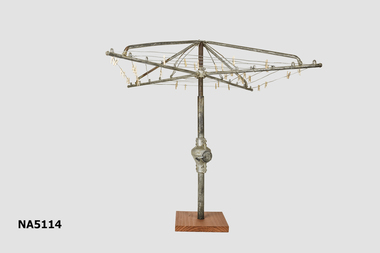
Leisure object - Miniature rotary clothesline
... Hills Hoist - Australian domestic design....Used as a child's toy. possibly produced as sample for Hills Hoists Company....Hills Hoists...Hills Hoist - Australian domestic design. Hills Hoists Miniature rotary clothesline Leisure object Miniature rotary clothesline. ...Used as a child's toy. possibly produced as sample for Hills Hoists Company.Example of Australian domestic design c 1940's / 1950's.Miniature rotary clotheslineHills Hoistshills hoist - australian domestic design. -
 Port Melbourne Historical & Preservation Society
Photograph - Joe and Tony Cannatelli swinging on Hills Hoist clothes line on top of Bay Bakery, 389 Bay Street, Port Melbourne, 1969
... Joe and Tony Cannatelli swinging on Hills Hoist clothes line on top of Bay Bakery, 389 Bay Street, Port Melbourne...B&W photo of Joe and Tony Cannatelli swinging on a Hills Hoist clothes line on top of Bay Bakery, 389 Bay Street Port Melbourne, looking over Heath Street, 1969...built environment antonio cannatelli B&W photo of Joe and Tony Cannatelli swinging on a Hills Hoist clothes line on top of Bay Bakery, 389 Bay Street Port Melbourne, looking over Heath Street, 1969 Photograph Joe and Tony Cannatelli swinging on Hills Hoist clothes line on top of Bay Bakery, 389 Bay Street, Port Melbourne ...B&W photo of Joe and Tony Cannatelli swinging on a Hills Hoist clothes line on top of Bay Bakery, 389 Bay Street Port Melbourne, looking over Heath Street, 1969built environment, antonio cannatelli -
Port Melbourne Historical & Preservation Society
Photograph - Hills Hoist, Mission Arts Centre, Missions to Seamen buiding, Port Melbourne, Alison Kelly, c. 1988
... Hills Hoist, Mission Arts Centre, Missions to Seamen buiding, Port Melbourne...Many have copies already in collection. View of hills hoist in back yard from roof of mission....Many have copies already in collection. View of hills hoist in back yard from roof of mission. ...One of thirty photos taken by Alison Kelly at the Mission Arts Centre, late 1980s, early 1990s. Some with captions. Many have copies already in collection. View of hills hoist in back yard from roof of mission.missions to seamen, mission arts centre -
 Latrobe Regional Gallery
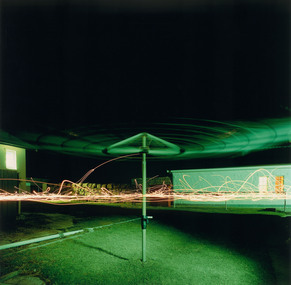
Photograph, BENNETTS, Peter & ROBBINS, Cameron, Hills Hoist light drawing, 2003
... Hills Hoist light drawing...- Type C Pegasus print Hills Hoist light drawing Photograph Photograph BENNETTS, Peter & ROBBINS, Cameron ...Type C Pegasus print- -
Whitehorse Historical Society Inc.
Article, Daze of our lives, 2013
... In their show 'Hanging off the Hills Hoist', O'Neil stars with fellow comedians Glen Robbins and matt Hardy in a Carnival of Suburbia....In their show 'Hanging off the Hills Hoist', O'Neil stars with fellow comedians Glen Robbins and matt Hardy in a Carnival of Suburbia....In their show 'Hanging off the Hills Hoist', O'Neil stars with fellow comedians Glen Robbins and matt Hardy in a Carnival of Suburbia. ...Dave O'Neil, raised in Mitcham, becomes nostalgic when paying tribute to the suburb where he grew up.Dave O'Neil, raised in Mitcham, becomes nostalgic when paying tribute to the suburb where he grew up. In their show 'Hanging off the Hills Hoist', O'Neil stars with fellow comedians Glen Robbins and matt Hardy in a Carnival of Suburbia.Dave O'Neil, raised in Mitcham, becomes nostalgic when paying tribute to the suburb where he grew up. o'neil, dave, robbins, glen, hardy, matt, carnival of suburbia, mitcham -
 Royal Australian and New Zealand College of Obstetricians & Gynaecologists (RANZCOG)
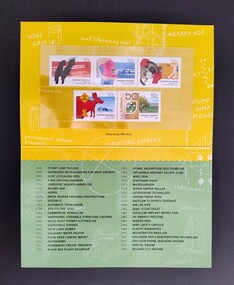
Domestic object - Set of five 'Australian Innovations' postal stamps in cardboard folder, 2004
... The cover of the folder is printed with an illustration of a Hills Hoist clothesline on a green and yellow background. ...The cover of the folder is printed with an illustration of a Hills Hoist clothesline on a green and yellow background. ...These stamps were produced in 2004 to coincide with the centenary of IP Australia.Five postage stamps contained within a cardboard folder. Folder is in landscape format. The cover of the folder is printed with an illustration of a Hills Hoist clothesline on a green and yellow background. The words 'AUSTRALIAN/INNOVATIONS' are printed at centre atop the image of the clothesline, with each letter depicted as 'pinned' to the clothesline with clothes pegs. 'Australian Innovations' is printed again on the front of the folder at bottom right. Back of folder is printed with a blurb explaining the idea behind the commemorative stamp issue contained within. The inside top of the folder carries five stamps in two rows, contained within a protective plastic sleeve. The top row of stamps contains three stamps, and the lower row contains two stamps. Subjects featured on top row from left to right are: 'Black Box/ Flight Recorder 1961', 'Ultrasound Imaging/Equipment 1976', 'Racecam TV/Sport Coverage 1979'. Subjects featured on bottom row from left to right are: 'Baby Safety/ Capsule 1984', 'Polymer Banknotes/1988'. Bottom section of inside of folder is printed with a list of Australian innovations alongside the year in which they were patented. Background illustrations on the inside of folder feature sketches and words relating to other Australian innovations. ultrasound, infant care -
 Flagstaff Hill Maritime Museum and Village
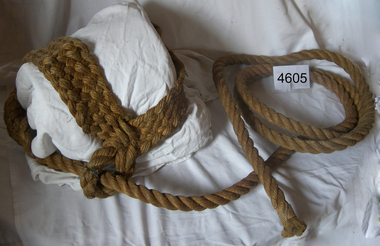
Equipment - Barrel Sling, 20th century
... hoisting barrels onto ships. This handcrafted barrel sling is an example of the ropework that sailmakers are skilled in. It is typical of the equipment carried on ships in the 19th and 20th centuries and used at docks for loading and unloading the cargo. Flagstaff Hill ...This handmade barrel sling has been crafted and used for hoisting barrels onto ships.This handcrafted barrel sling is an example of the ropework that sailmakers are skilled in. It is typical of the equipment carried on ships in the 19th and 20th centuries and used at docks for loading and unloading the cargo.Barrel sling; handmade hemp fibre ropework formed into a sling to support and carry a barrel or cask.flagstaff hill, warrnambool, maritime museum, maritime village, great ocean road, shipwreck coast, barrel sling, ropework, cargo handling, loading sihps, dockside handling, freight handling -
 Flagstaff Hill Maritime Museum and Village
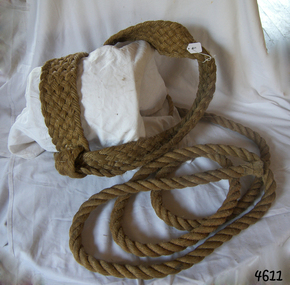
Equipment - Barrel Sling
... hoisting barrels onto ships. It is made from hemp fibre and is part of the equipment carried on 19th and early 20th century vessels for loading and unloading barrels and casks at the docks. This barrel sling is significant as equipment typically carried on board sailing ships for use in port when loading and unloading cargo. Flagstaff Hill ...This handmade barrel sling is used for hoisting barrels onto ships. It is made from hemp fibre and is part of the equipment carried on 19th and early 20th century vessels for loading and unloading barrels and casks at the docks.This barrel sling is significant as equipment typically carried on board sailing ships for use in port when loading and unloading cargo.Barrel sling, handmade from hemp fibre.flagstaff hill, warrnambool, maritime museum, maritime village, great ocean road, shipwreck coast, barrel sling, cask, dock, loading cargo, ship equipment, sailmaker, ropework -
 Flagstaff Hill Maritime Museum and Village
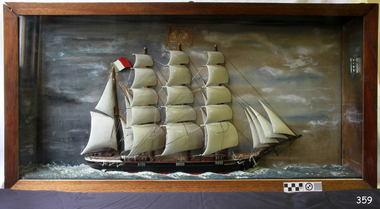
Craft - Ship Model, Hygeia, Bef. 1983
... Flagstaff Hill Maritime Museum and Village Maritime Museum Maritime Village Great Ocean Road Shipwreck Coast ship model ship model hygeia hobby craft maritime model model making Hygeia sailing ship 1863 1877 cargo ship Italian flag square-rigged barque three-masted "HYGEIA" Ship model; diorama with a model of the sailing ship HYGEIA at sea in full sail, in a setting of sky and sea. It displays a tricolour flag with three vertical stripes of equal width, which from the hoist ...This ship model is a representation of the wooden barque Hygeia, which is also the name of the Greek goddess of health, cleanliness and hygiene. The model flies the Italian flag, which was adopted in 1946 but originated in 1797. The colours stand for freedom, solidarity and equality. The three-masted, wooden barque Hygeia was built in 1863 in the UK by J.M. Reed to carry cargo. It was first registered on July 30th, 1863, at Sunderland, UK, by owners Matthew Cay Jr. & Joseph Crisp. In August 1877, the ship was dispatched from Alexandria, Egypt, destined for Fairmouth with a cargo of beans, but mysteriously went missing. The ship diorama exemplifies the popular, centuries-old hobby of ship model making, with the setting of sea and sky giving it depth and context. The model also shows the configuration of a three-masted, fully rigged sailing ship, of the type that carried immigrants to Australia. Ship model; diorama with a model of the sailing ship HYGEIA at sea in full sail, in a setting of sky and sea. It displays a tricolour flag with three vertical stripes of equal width, which from the hoist side are coloured green, white and red. An inscription has the ship's name, Hygeia."HYGEIA"flagstaff hill maritime museum and village, maritime museum, maritime village, great ocean road, shipwreck coast, ship model, ship model hygeia, hobby, craft, maritime model, model making, hygeia, sailing ship, 1863, 1877, cargo ship, italian flag, square-rigged, barque, three-masted -
 Flagstaff Hill Maritime Museum and Village
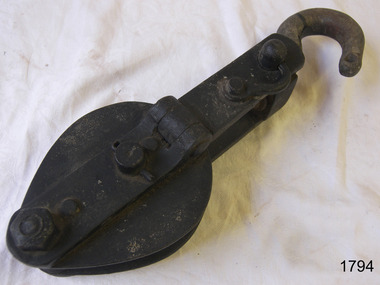
Equipment - Snatch Block, First quarter of the 20th century
... hoists and winches. There is no history or manufacturing provenance currently available. The subject item at this time cannot be associated with an historical event, person or place, provenance is unknown, item is believed to have been produced in the first quarter of the 20th century. flagstaff hill warrnambool flagstaff-hill-maritime-museum maritime-museum shipwreck-coast flagstaff-hill-maritime-village snatch block Metal Snatch Block Lifting Gear Rope Pully marine technology ship rigging Snatch block, metal, one sheave, with a large hook that has a hole drilled through its tip. ...A snatch block is a heavy-duty pulley inside a metal casing. It is primarily designed for handling heavy goods, working as a pulley point that can redirect the course of a winch line. Snatch blocks are also used to increase the lifting or pulling capacity of wire hoists and winches. There is no history or manufacturing provenance currently available.The subject item at this time cannot be associated with an historical event, person or place, provenance is unknown, item is believed to have been produced in the first quarter of the 20th century.Snatch block, metal, one sheave, with a large hook that has a hole drilled through its tip.flagstaff hill, warrnambool, flagstaff-hill-maritime-museum, maritime-museum, shipwreck-coast, flagstaff-hill-maritime-village, snatch block, metal snatch block, lifting gear, rope pully, marine technology, ship rigging -
 Flagstaff Hill Maritime Museum and Village
Plant specimen - Wood Sample, Herbst, 1759-1765
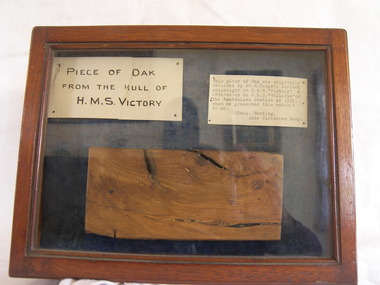
... hoists: “England expects that every man will do his duty”. This wood sample is historically significant for its association with Admiral Lord Nelson and the Battle of Trafalgar. Through Nelson’s leadership and unorthodox battle tactics, he secured not only a victory against the French and Spanish but also reaffirmed Britain's naval supremacy, opening the way for Britain to continue the policy of colonisation of many countries, including Australia. flagstaff hill warrnambool shipwrecked-coast flagstaff-hill flagstaff-hill-maritime-museum maritime-museum shipwreck-coast flagstaff-hill-maritime-village oak hms victory vice-admiral lord nelson horatio nelson lord nelson oak piece piece of oaknelson battle of trafalgar maritime technology ship relics 18th century warship british royal navy h cooper shipwright hms wallaroo herbst hyde park sydney charles harding hmv naval orpedo depot williamstown sir home popham’s telegraphic code admiralty official day signal book Photograph Front: printed- "Herbst" "28 Oxford Street, Hyde Park, Sydney", handwritten - "Mr Cooper", "see back". ...The piece of oak wood sample inside the case was obtained from Mr H. Cooper during the time he served as a shipwright for the British Royal Navy on Nelson’s flagship, HMS Victory, in 1891. By that time, the H.M.S. Victory was around 100 years old, having been built in 1765 and was currently in dry dock undergoing restoration. Cooper’s skills as a shipwright would have been well employed during this period. HMS Victory was, and still is, undergoing continuous restoration to preserve her for display as a museum ship, due to the vessel's significant naval history. It was during that early restoration period that Cooper obtained the piece of Oak from HMS Victory, believed to be from the ship's hull. Cooper was in Australia in September 1891 serving on the HMS Wallaroo, a British Auxiliary Squadron commissioned as part of the British Royal Navy contingent, to serve and operate in Australian waters. The photograph included with the donation of the wood sample is a portrait of Mr H Cooper taken in 1895 in Sydney. The inscription on the photograph describes him as a skilled shipwright from H.M.S. Wallaroo, depicting Cooper as a young man in Royal Navy uniform, with the emblem of a petty officer third class. While Cooper was stationed on the H.M.S. Wallaroo in Sydney, he presented the display case, containing the wood sample from H.M.S. Victory, as well as the exhibit labels, to Charles Harding ("Chas"), late of the Royal Australian Navy. Harding had been based at the H M Naval Torpedo Depot at Williamstown, Victoria. Although not mentioned, it is believed the two men met whilst serving together in Australia in their respective assignments. It could have been a retirement gift from Cooper to Harding, with the photograph of Cooper likely included with the case, and gifted to Harding in 1895, as the date on the photograph indicates. One of the exhibit's labels indicates that Harding had the item on display whilst serving at the Naval Torpedo Depot in Williamstown. The label indicates: "This piece of Oak is part of the hull of H.M.S. 'Victory', Lord Nelson’s renowned flagship, which took such a prominent part in the Battle of Trafalgar. 21st October 1805. Exhibited by Charles Harding, H.M.V. Naval Torpedo Depot, Williamstown.” After Charles Harding died in 1931, the case containing the sample of oak from H.M.S. Victory was donated by his son, Reg Harding, to Mr Murphy in 1962. The display case has since become a treasured item at Flagstaff Hill. A newspaper article dated 1905 included with the donation mentions that the city of Hamilton in Victoria was shortly expecting a mounted piece of the H.M.S. Victory to be included in the city’s commemoration of the centenary of the "Battle of Trafalgar". Battle of Trafalgar: On October 21, 1805, twenty-seven British ships of the line led by Admiral Lord Nelson aboard HMS Victory defeated thirty-three French and Spanish ships of the line under French Admiral Villeneuve. The battle took place in the Atlantic Ocean off the southwest coast of Spain, just west of Cape Trafalgar, near the town of Los Caños de Meca. The victory confirmed the naval supremacy Britain had established during the course of the eighteenth century, and it was achieved in part through Nelson's departure from the prevailing naval tactical orthodoxy of the day. Conventional practice at the time was for opposing fleets to engage each other in single parallel lines, to facilitate signalling and disengagement, and to maximise fields of fire and target areas. Nelson instead arranged his ships into two columns to sail perpendicularly into the enemy fleet's line. During the battle, Nelson was shot by a French musketeer, and he died shortly before the battle ended. Villeneuve was captured, along with his ship Bucentaure. He later attended Nelson's funeral while a captive on parole in Britain. Admiral Federico Gravina, the senior Spanish flag officer, escaped with the remnant of the fleet. He died five months later from wounds sustained during the battle. It was before this battle that Nelson had issued his now-famous final orders to his ships in 12 separate flag-hoists: “England expects that every man will do his duty”. This wood sample is historically significant for its association with Admiral Lord Nelson and the Battle of Trafalgar. Through Nelson’s leadership and unorthodox battle tactics, he secured not only a victory against the French and Spanish but also reaffirmed Britain's naval supremacy, opening the way for Britain to continue the policy of colonisation of many countries, including Australia.Wood sample adhered to the base of a hinged wood and glass display case. Wood is a sample of oak taken from the hull of Vice-Admiral Lord Nelson's flagship, the HMS Victory, built in 1765. The case also contain two exhibit labels pinned above the wood sample. Other items donated with the display case, and relating to the wood sample: an 1895 photograph, a 1905 newspaper clipping, a 1962 donor's letter (two pages), and a handwritten exhibit label with a border of red lines. Photograph Front: printed- "Herbst" "28 Oxford Street, Hyde Park, Sydney", handwritten - "Mr Cooper", "see back". Back: handwritten - "Mr H Cooper, skilled shipwright, H.M.S. Wallaroo 1895" Exhibit labels still in the case: Left: handwritten- “PIECE OF OAK FROM THE HULL OF H.M.S. VICTORY”, Right: typewritten- “This piece of Oak was originally obtained by Mr. H. Cooper, skilled shipwright on H.M.S. “Victory” & afterwards on H.M.S. “Wallaroo” on the Australian Station in 1895, when he presented this exhibit to me. Chas. Harding, Late Victorian Navy.”flagstaff hill, warrnambool, shipwrecked-coast, flagstaff-hill, flagstaff-hill-maritime-museum, maritime-museum, shipwreck-coast, flagstaff-hill-maritime-village, oak, hms victory, vice-admiral lord nelson, horatio nelson, lord nelson, oak piece, piece of oaknelson, battle of trafalgar, maritime technology, ship relics, 18th century warship, british royal navy, h cooper shipwright, hms wallaroo, herbst hyde park sydney, charles harding, hmv naval orpedo depot williamstown, sir home popham’s telegraphic code, admiralty official day signal book -
 Federation University Historical Collection
Book, Irrigation Practice and Engineering Volume 2: Conveyance of Water and Volume 3: Irrigation Structures and Distribution System by B.A. Etchevery, 1915 and 1916
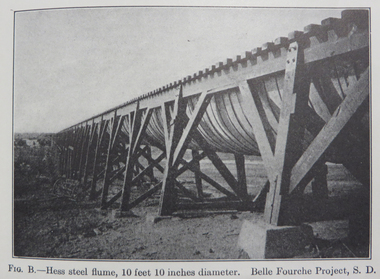
... Etcherverry was Head of Department or Irrigation, University of California irrigation water canals tunnels flumes pipes concrete pipes wrought iron and steel pipes wooden pipes california diversion works weirs spillways canals check gates railroad crossing america united states of america university of california yellowstone river colorado arizona windlass hoist twin falls idaho arkansas valley truckee-carson salmon river umatilla cippoletti weir box Blue hard covered books. .2) Volume III Irrrigation Structures and Distrubution System Irrigation Practice and Engineering Volume 2: Conveyance of Water and Volume 3: Irrigation Structures and Distribution System by B.A. Etchevery Book Book McGraw-Hill ...Blue hard covered books. .2) Volume III Irrrigation Structures and Distrubution Systemirrigation, water canals, tunnels, flumes, pipes, concrete pipes, wrought iron and steel pipes, wooden pipes, california, diversion works, weirs, spillways, canals, check gates, railroad crossing, america, united states of america, university of california, yellowstone river, colorado, arizona, windlass hoist, twin falls, idaho, arkansas valley, truckee-carson, salmon river, umatilla, cippoletti weir box -
 Flagstaff Hill Maritime Museum and Village
Postcard - Vessel, Sailing Ship, after October 1805
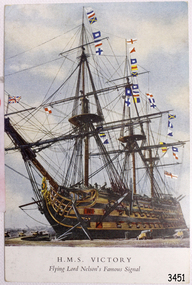
... hoists “England expects that every man will do his duty”. This wood sample is historically significant for its association with Admiral Lord Nelson the Battle of Trafalgar. Through Nelson’s leadership and unorthodox battle tactics, he secured not only a victory against the French and Spanish but reaffirmed Britain's naval supremacy opening the way for Britain to continuing the policy of colonisation of many countries including Australia. flagstaff hill warrnambool shipwrecked-coast flagstaff-hill flagstaff-hill-maritime-museum maritime-museum shipwreck-coast flagstaff-hill-maritime-village post card postcard sailing ship vice-admiral lord nelson horatio nelson lord nelson oak piece piece of oak nelson battle of trafalgar maritime technology ship relics 18th century warship british royal navy sir home popham’s telegraphic code admiralty official day signal book october 21, 1805 admiral lord nelson french and spanish navies nelson's famous signal england expects that every man will do his duty hms victory nelson collection at lloyd's lloyd’s of london lloyd’s patriotic fund napoleonic battles british naval history 18th century warship 18th century battleship Printed on the front "H.M.S. ...The British Royal Navy’s warship HMS Victory was once Lord Nelson’s flagship. The HMS Victory was built in 1765 and after serving active duty is now, in 2019, still a ship of the Royal Navy, in dry dock undergoing continuous restoration to preserve her for display as a museum ship, due to the vessel’s significant naval history. Battle of Trafalgar: On October 21, 1805, twenty-seven British ships of the line, led by Admiral Lord Nelson aboard HMS Victory, defeated thirty-three French and Spanish ships of the line under French Admiral Villeneuve. The battle took place in the Atlantic Ocean off the southwest coast of Spain, just west of Cape Trafalgar, near the town of Los Caños de Meca. The victory confirmed the naval supremacy Britain had established during the course of the eighteenth century and it was achieved in part through Nelson's departure from the prevailing naval tactical orthodoxy of the day. Conventional practice at the time was for opposing fleets to engage each other in single parallel lines, in order to facilitate signalling and disengagement and to maximise fields of fire and target areas. Nelson instead arranged his ships into two columns to sail perpendicularly into the enemy fleet's line. During the battle, Nelson was shot by a French musketeer and he died shortly before the battle ended. Villeneuve was captured, along with his ship Bucentaure. He later attended Nelson's funeral while a captive on parole in Britain. Admiral Federico Gravina, the senior Spanish flag officer, escaped with the remnant of the fleet. He died five months later from wounds sustained during the battle. It was prior to this battle that Nelson had issued his now-famous final orders to his ships in 12 separate flag-hoists “England expects that every man will do his duty”. This wood sample is historically significant for its association with Admiral Lord Nelson the Battle of Trafalgar. Through Nelson’s leadership and unorthodox battle tactics, he secured not only a victory against the French and Spanish but reaffirmed Britain's naval supremacy opening the way for Britain to continuing the policy of colonisation of many countries including Australia.A coloured postcard of a sailing ship, warship or battleship, deck cannons on the ship and in the foreground, many signal flags flying from the masts. Printed on the front "H.M.S. Victory Flying Lord Nelson Famous Signal". The signal was given by Lord Nelson in 1805.Printed on the front "H.M.S. Victory / Flying Lord Nelson Famous Signal"flagstaff hill, warrnambool, shipwrecked-coast, flagstaff-hill, flagstaff-hill-maritime-museum, maritime-museum, shipwreck-coast, flagstaff-hill-maritime-village, post card, postcard, sailing ship, vice-admiral lord nelson, horatio nelson, lord nelson, oak piece, piece of oak, nelson, battle of trafalgar, maritime technology, ship relics, 18th century warship, british royal navy, sir home popham’s telegraphic code, admiralty official day signal book, october 21, 1805, admiral lord nelson, french and spanish navies, nelson's famous signal, england expects that every man will do his duty, hms victory, nelson collection at lloyd's, lloyd’s of london, lloyd’s patriotic fund, napoleonic battles, british naval history, 18th century warship, 18th century battleship -
 Yarra City Council
Artwork, other - Installation/Sculpture, Troy Innocent, Joel Collins, Indae Hwang, Yun Tae Nam, Drop Zone, 2011
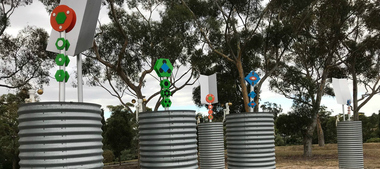
... The water tank is becoming a contemporary symbol of the Australian household, much like the Hills Hoist clothesline once was. The work incorporates this identity, using ready-made water tanks arranged on a site marked out as a resource drop zone much like those seen in real time strategy games. ...'Drop Zone', is set in an imagined future where decreasing water availability has affected us more dramatically than anyone predicted. The water shortage has become so severe that we have to access water on a first-come first-serve basis, from military-like water ‘drop zones’, like this one, made from modified rain water tanks. These tanks function on three levels: Collected rain water causes the totem sculptures to rise and bloom; evaporation causes the totem sculptures to fall; and an anemometer (device that measures wind speed) drives a process that plays the tank like a giant drum, tuned by the amount of water contained within. This artwork envisions a future for Australia where the impact of decreasing water availability has had a more dramatic effect than any of the predictions. The shortage is so severe that military-like water ‘drop zones’, constructed of modified rainfall storage tanks have been established across the public parks of the City of Yarra for access on a first come, first serve basis. However, as the water is only replenished through rain catchment the tanks may only offer infrequent relief for the City of Yarra residents, standing as hollow reminders of the effects of inaction on the shaping of sustainable national water use.'Drop Zone' was one of three public art works installed in Yarra, in 2011, under the banner of The Environmental Public Arts Project which responded to key features of Council's Environment Strategy: 'Towards Local Sustainability 2008-2020.' The aims of this project included activating public spaces in new and creative ways through the creation of artworks which act as catalysts for further engagement and discussion around environmental themes and issues.Copyright the Artists. Ready-made corrugated water tanks arranged on a site. Situated within the tanks are small totemic sculptures that float on top of the water within the tank.Accompanying plaquesustainability, water, environment, climate change -
 Surrey Hills Historical Society Collection
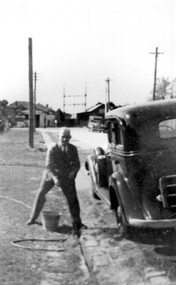
Photograph, Mr Perc Whitelaw outside his home, 1937
... The man is identified as Mr Perc Whitelaw outside his home at 23 Leopold Crescent, 1939 leopold crescent surrey hills mont albert road toynes rotary clothes hoists percy whitelaw (mr) 1937 A black and white photograph of a man with a hose and a bucket standing beside his car, presumably washing it. ...The man is identified as Mr Perc Whitelaw outside his home at 23 Leopold Crescent, 1939A black and white photograph of a man with a hose and a bucket standing beside his car, presumably washing it. leopold crescent, surrey hills, mont albert road, toynes rotary clothes hoists, percy whitelaw (mr), 1937 -
 Surrey Hills Historical Society Collection
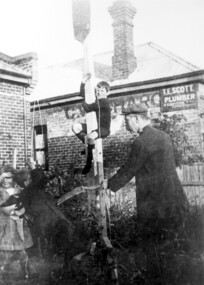
Photograph, George Jackson hoisting the flag at 'Handsworth', 7 Russell Street, Surrey Hills, 1918
... George Jackson hoisting the flag at 'Handsworth', 7 Russell Street, Surrey Hills Photograph ...Date is approximate. George James Jackson and family lived at 7-9 Russell Street from 1900-1950s. He and his wife were manufacturing jewellers and had a workshop adjacent to the house. Their son assisted in the business. George Jackson was very patriotic and hoisted the flag every day. His grandchildren, who lived nearby, were expected to attend on their way to school. On the occasion of the photo, the flag was being hoisted for the return of George's son - also George - from the 1914-1918 war.Black and white photo taken in the front yard of a brick house with another brick building to its right. There is a timber flag pole in the centre with a young boy climbing it. A man wearing a suit and cloth cap is holding a garden fork near a boy holding onto the ropes of the flag. On the left is a young girl. A sign on the wall of the brick building at the rear reads: " T. E. Scott / Plumber / & Gasfitter / Estimates given".handsworth, world war 1, jewellers, mr george jackson, miss eleanor jackson, miss lena jackson, mrs lena dawson
