
Showing 15 items matching "hirst street"
-
 Whitehorse Historical Society Inc.
Document, Extracts from Nunawading Council minutes, 1949
... ...Hirst Street...:(1) June 1949 Ambulance station requested (2) 24 June War service homes will be erected on land acquired by the Commonwealth Government, bordered by Duckman Street, Amery Avenue, Hirst Street & Middleborough Road (3) 1 July Proposal to build Infant Welfare Centre at Nunawading on land at rear of Municipal Chambers....Extracts from Nunawading Council minutes: (1) June 1949 Ambulance station requested (2) 24 June War service homes will be erected on land acquired by the Commonwealth Government, bordered by Duckman Street, Amery Avenue, Hirst Street & Middleborough Road (3) 1 July Proposal to build Infant Welfare Centre at Nunawading on land at rear of Municipal Chambers....:(1) June 1949 Ambulance station requested (2) 24 June War service homes will be erected on land acquired by the Commonwealth Government, bordered by Duckman Street, Amery Avenue, Hirst Street & Middleborough Road (3) 1 July Proposal to build Infant Welfare Centre at Nunawading on land at rear of Municipal Chambers. ...Extracts from Nunawading Council minutesExtracts from Nunawading Council minutes: (1) June 1949 Ambulance station requested (2) 24 June War service homes will be erected on land acquired by the Commonwealth Government, bordered by Duckman Street, Amery Avenue, Hirst Street & Middleborough Road (3) 1 July Proposal to build Infant Welfare Centre at Nunawading on land at rear of Municipal Chambers.Extracts from Nunawading Council minutescity of nunawading, war service homes, duckham street, blackburn, amery avenue, blackburn, hirst street, blackburn, middleborough road, blackburn, infant welfare centres, mitcham scout group, mitcham guide group, charlotte street, blackburn south, ayr street, blackburn south -
 Whitehorse Historical Society Inc.
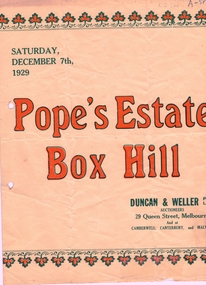
Pamphlet, Auction - Pope's Estate
... ...hirst street...duncan & weller auctioneers duckham street blackburn hirst street middleborough road canterbury road amery avenue Physical description Pope's Estate, Box Hill Pope's Estate, Box Hill subdivisional auction, 7/12/1929 Auction - Pope's Estate Pamphlet Pamphlet ...Physical description Pope's Estate, Box HillPope's Estate, Box Hill subdivisional auction, 7/12/1929Physical description Pope's Estate, Box Hill duncan & weller, auctioneers, duckham street, blackburn, hirst street, middleborough road, canterbury road, amery avenue -
Whitehorse Historical Society Inc.
Map, Blackburn Heights Estate, 1923
... ...Hirst Street Blackburn North...Springfield Road Blackburn North Surrey Road Blackburn North Gordon Street Blackburn North Koonung Road Blackburn North Harris Street Blackburn North Hirst Street Blackburn North Deane Street Blackburn North Blackburn Heights estate Blackburn North Auction plans of sub-division for Blackburn heights Estate. ...Auction plans of sub-division for Blackburn heights Estate.Auction plans of sub-division for Blackburn heights Estate, 130 sites, 8th December 1923Auction plans of sub-division for Blackburn heights Estate.springfield road blackburn north, surrey road blackburn north, gordon street blackburn north, koonung road blackburn north, harris street blackburn north, hirst street blackburn north, deane street blackburn north, blackburn heights estate, blackburn north -
Whitehorse Historical Society Inc.
Map, Canterbury Road, Blackburn, 1972
... ...Hirst Street...Canterbury Road Blackburn Middleborough Road Blackburn Box Hill Craig Street Blackburn Hirst Street Blackburn Aerial photographs Enlarged aerial photograph of area around the intersection of Canterbury and Middleborough Roads, Blackburn. ...Enlarged aerial photograph of area around the intersection of Canterbury and Middleborough Roads, Blackburn.Enlarged aerial photograph of area around the intersection of Canterbury and Middleborough Roads, Blackburn.Enlarged aerial photograph of area around the intersection of Canterbury and Middleborough Roads, Blackburn.canterbury road, blackburn, middleborough road, blackburn, box hill, craig street, blackburn, hirst street, blackburn, aerial photographs -
 National Wool Museum
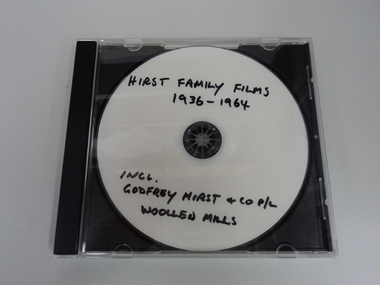
Film - Hirst Family Films, Cedric L Hirst, 1950s
... All video content filmed at Godfrey Hirst Woollen Mill, Swanston Street, South Geelong. Godfrey Hirst's children. ...Two of the men are holding pipes. 1:42 – 1:57 – Interior factory setting showing men operating machinery. 1:57 – 2:05 – Exterior factory setting showing a man driving machinery carting wool bales. 2:05 – 3:14 - Flood scenes, showing the exterior of the Godfrey Hirst building with a man rowing a boat down the street, and a horse and cart in flood waters. ...All video content filmed at Godfrey Hirst Woollen Mill, Swanston Street, South Geelong. Godfrey Hirst's children. ...Copy of Godfrey Hirst family videos/photograph on CD. Including 1951 floods at Mill. All video content filmed at Godfrey Hirst Woollen Mill, Swanston Street, South Geelong. Godfrey Hirst's children. Family home in Newtown and holiday home in Eastern View.Compact disc (CD) containing colour video footage. Film has no audio content. Visual content outlined below: 00:00 – 00:05 – External view of brick building – Godfrey Hirst & Co. Pty. Ltd. 00:05 – 00:10 – Exterior garden setting, three men in suits with fabrics and object 00:10 – 00:28 – Exterior garden setting showing eight women, most likely on a break from working at the Godfrey Hirst factory. The footage shows them all getting up and walking back towards the building at the end. 00:28 – 00:38 – Exterior garden setting, showing seven men in white shirts and ties seated and standing around a table, turning pages on a folder on the table. 00:38 – 00:52 – Interior factory setting, showing four men in coats handling green and red wool. 00:52 – 1:08 – Three men in suits in an exterior garden setting looking at paperwork. 1:08 – 1:23 – Four men in coats in a garden handling coloured wool samples. 1:23 – 1:42 – Four men in suits in a garden setting handling woven fabric. Two of the men are holding pipes. 1:42 – 1:57 – Interior factory setting showing men operating machinery. 1:57 – 2:05 – Exterior factory setting showing a man driving machinery carting wool bales. 2:05 – 3:14 - Flood scenes, showing the exterior of the Godfrey Hirst building with a man rowing a boat down the street, and a horse and cart in flood waters. There are scenes of flooded streets, exterior of flooded buildings and people standing in flood waters. 3:14 – 3:40 - Interior building views of flood waters in factory with people, machinery, equipment and textiles in flood waters. 3:40 – 4:03 - Exterior views showing a tractor, boat, horse and people in flood waters. 4:03 – 7:02 Exterior setting showing crowds of people watching a fashion parade. The fashion parade is of women in various clothing, including suits jackets, skirts, coats and hats. 7.02 - END"Hirst family films 1936-1964 Incl. Godfrey Hirst and co P/L Woollen mills"geelong, godfrey hirst & co. pty. ltd., family films, factory, flooding, 1950s, wool processing, fashion, textiles, horse and cart, wool bales, transport, machinery, fashion parade, working life -
 Surrey Hills Historical Society Collection
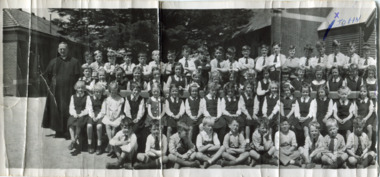
Digital photo, Our Holy Redeemer school photo, late 1950s, 1950s
... Personal history: Although they lived in Prospect Street, Box Hill, John and Mary Turnbull attended Our Holy Redeemer School, as did Susan Hirst who lived across the road from the Turnbull family with her parents Ray and Shirley Hirst at 29 Prospect Street....Personal history: Although they lived in Prospect Street, Box Hill, John and Mary Turnbull attended Our Holy Redeemer School, as did Susan Hirst who lived across the road from the Turnbull family with her parents Ray and Shirley Hirst at 29 Prospect Street. schools, our holy redeemer school, fr tim fitzpatrick, john turnbull, mary turnbull susan hirst On front 'x' in blue biro is believed by the donor to have been made by Hughn Turnbull, his father. ...School history - ref https://ourholyredeemer.cam.org.au/history In 1904 Fr. George Robinson erected a weatherboard school-hall where the present hall now stands. It was blessed and opened by Archbishop Carr on 20th November of that year. In January 1905, the Sisters of St Joseph took charge of the school. Archbishop Mannix opened and blessed the new brick school on 10th November 1918. From 1941-1972, Fr Tim Fitzpatrick was parish priest and head of the school. He is the priest on the LHS of this large school photo. Personal history: Although they lived in Prospect Street, Box Hill, John and Mary Turnbull attended Our Holy Redeemer School, as did Susan Hirst who lived across the road from the Turnbull family with her parents Ray and Shirley Hirst at 29 Prospect Street.Part of a large landscape black and white photo of a priest with a large group of children grouped as follows: Back row: 20 boys Second back row: 21 girls Second row: 16 girls Front row: 10 boys. Behind the group is a large cypress tree and to either side the church and (?) school building. The boy 4th from the right in the back row is marked with an 'x' in blue biro. This is part of a large landscape photo. The 2 pieces should be viewed as one. On front 'x' in blue biro is believed by the donor to have been made by Hughn Turnbull, his father. On rear in blue biro: "X JOHN" and " T MARY" plus in black in John Turnbull's hand "(MY SISTER)"; "SUSAN HIRST / SH (crossed out) / 3rd from RIGHT END" The donor has indicated that his father made the markings on the front of the photo. schools, our holy redeemer school, fr tim fitzpatrick, john turnbull, mary turnbull, susan hirst -
 Surrey Hills Historical Society Collection
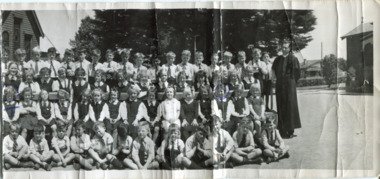
Digital photo, Our Holy Redeemer school photo, late 1950s (Part 2), 1950s
... Personal history: Although they lived in Prospect Street, Box Hill, John and Mary Turnbull attended Our Holy Redeemer School, as did Susan Hirst who lived across the road from the Turnbull family with her parents Ray and Shirley Hirst at 29 Prospect Street....Personal history: Although they lived in Prospect Street, Box Hill, John and Mary Turnbull attended Our Holy Redeemer School, as did Susan Hirst who lived across the road from the Turnbull family with her parents Ray and Shirley Hirst at 29 Prospect Street. schools, our holy redeemer school, fr tim fitzpatrick, john turnbull, mary turnbull susan hirst On front 'T' and a circle in blue biro are believed by the donor to have been made by Hugh Turnbull, his father. ...School history - ref https://ourholyredeemer.cam.org.au/history In 1904 Fr. George Robinson erected a weatherboard school-hall where the present hall now stands. It was blessed and opened by Archbishop Carr on 20th November of that year. In January 1905, the Sisters of St Joseph took charge of the school. Archbishop Mannix opened and blessed the new brick school on 10th November 1918. From 1941-1972, Fr Tim Fitzpatrick was parish priest and head of the school. Personal history: Although they lived in Prospect Street, Box Hill, John and Mary Turnbull attended Our Holy Redeemer School, as did Susan Hirst who lived across the road from the Turnbull family with her parents Ray and Shirley Hirst at 29 Prospect Street.Part of a large landscape black and white photo of a priest with a large group of children grouped as follows: Back row: 19 boys Second back row: 14 girls Second row: 15 girls Front row: 12 boys. Behind the group is a large cypress tree and to either side the church and (?) school building. The girl in the 2nd row, first on the left is marked with an 'T' in blue biro; the girl 3rd from the right in the same row is circled in blue biro. There is a Californian bungalow in the background. This is half of a large landscape photo and the 2 pieces should be viewed together. On front 'T' and a circle in blue biro are believed by the donor to have been made by Hugh Turnbull, his father. On rear in black: "OUR HOLY REDEEMER - SURREY HILLS / PROBABLY 1950's" schools, our holy redeemer school, fr tim fitzpatrick, john turnbull, mary turnbull, susan hirst -
 Flagstaff Hill Maritime Museum and Village
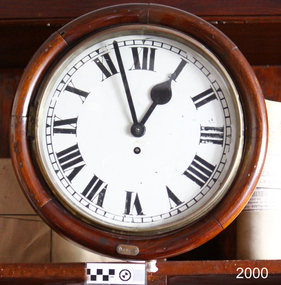
Instrument - Clock, 1900's
... In August 1884, Alfred Hirst who had started his trade as a watch repairer and was described as a watchmaker extraordinaire established Hirst Brothers and Company, on Union Street in Oldham Manchester. ...In August 1884, Alfred Hirst who had started his trade as a watch repairer and was described as a watchmaker extraordinaire established Hirst Brothers and Company, on Union Street in Oldham Manchester. ...In August 1884, Alfred Hirst who had started his trade as a watch repairer and was described as a watchmaker extraordinaire established Hirst Brothers and Company, on Union Street in Oldham Manchester. He took his two stepbrothers into the business and the company was set up to produce timepieces and jewellery as well as importing “Limit company” Swiss watches and precision machine tools for the watch and clock trade. By 1902 Hirst Brothers. had become a limited company and was still growing, adding other businesses in Manchester in 1904 and at Birmingham in 1907. The quality of the clocks and watches was such that Alfred Hirst realised his greatest ambition in 1912 with a range of watches which carried the "Limit" trademark. These watch movements had originally been made in Switzerland and shipped to Hirst Bros. to be put into British made “Dennison” cases. This trade brought even more growth with additional sales offices opening in London and Glasgow. At the outbreak of the First World War in 1914 found them manufacturing aircraft parts including revolution counters and optical instruments. The firm had been tasked by the Ministry of Munitions to solve the problem of pilots dropping bombs by hand and as a result, they effectively created the first bomb rack. After the war, the company once again began to prosper and with the demand for their products increasing they looked to build a new purpose-built factory to manufacture their products. In 1917 they purchased a seven-acre field site at Tame Side Dobcross, the designing of the new factory was passed onto local architect AJ Howcroft. His brief for the design of the clockworks would have been prompted by Alfred Hirst who having visited modern factories in the United States was inspired by the latest factory designs providing as much daylight as possible during working hours. The factory was eventually completed in 1920, by the mid-1920s there were cheap clock imports from Germany and production turned to radio sets and other components as well as counter and gas meters for the "Parkinson and Cowan" company who was later to take over the business. In 1926 came the cotton crash and the District Bank who had loans with the company foreclosed on the Hirst loan. The company did survive and throughout the second World, War II were involved in munitions work at the factory as well as making instruments for various aircraft. In the 1950’s they were producing meters and high grade measuring equipment but by the 1970's the business had closed and the factory was demolished in the mid-1980 "s The item is a good example of the later use of an early mechanism “Fusee” that was originally invented around 1525 in Prague. This type of clock mechanism was replaced as watchmakers looked for mechanisms that could reduce the size of clocks and watches, it appears England was the only country to continue making clocks with a Fusee device until around 1900,s of which our clock is an example. The use of a Fusee movement eventually became obsolete in 1970,s. The item is significant for the collection as it is a clock with a movement that has long since been made obsolete. Fusee type gallery wall clock made by Tame Side with an 8-day mechanical fusee movement. The white enamel dial is a little crazed and some of the Roman Numeral numbers are fading due to over-cleaning. The movement has a hexagonal iron pendulum bob hooking onto a pendulum rod with a spring-wound anchor escapement.Only mark is stamped on the movement believed to be a production number "13490" and made in Tame Side. (If the clock had been made after 1912 it would have had a trade mark "Limit")flagstaff hill, warrnambool, shipwrecked-coast, flagstaff-hill, flagstaff-hill-maritime-museum, maritime-museum, shipwreck-coast, flagstaff-hill-maritime-village, clock, wall clock, fusee, gallery clock, alfred hirst, tame side -
 National Wool Museum
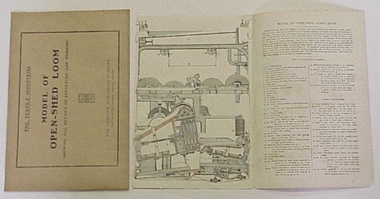
Model, Model of Open-Shed Loom
... Hirst. This model was not part of the set donated in 2001, but may possibly have come into the collection with the 1989 donation. It may also have come seperately via another, unknown donor.) Weaving Looms THE TEXTILE INDUSTRIES / MODEL OF / OPEN-SHED LOOM / SHOWING ALL DETAILS OF STRUCTURE AND WORKING / THE GRESHAM PUBLISHING COMPANY / SOUTHAMPTON STREET, STRAND, LONDON This paper model of an open-shed loom was produced by the Gresham Publishing Company and was part of the eight volume set of books titled: "The Textile Industries" by William S. ...This paper model of an open-shed loom was produced by the Gresham Publishing Company and was part of the eight volume set of books titled: "The Textile Industries" by William S. Murphy and first published by Gresham in 1911. (The NWM holds two sets of these books; one donated in 2001 and the other donated in 1989 by Godfrey Hirst. This model was not part of the set donated in 2001, but may possibly have come into the collection with the 1989 donation. It may also have come seperately via another, unknown donor.)This paper model of an open-shed loom was produced by the Gresham Publishing Company and was part of the eight volume set of books titled: "The Textile Industries" by William S. Murphy and first published by Gresham in 1911.THE TEXTILE INDUSTRIES / MODEL OF / OPEN-SHED LOOM / SHOWING ALL DETAILS OF STRUCTURE AND WORKING / THE GRESHAM PUBLISHING COMPANY / SOUTHAMPTON STREET, STRAND, LONDONweaving looms -
 National Wool Museum
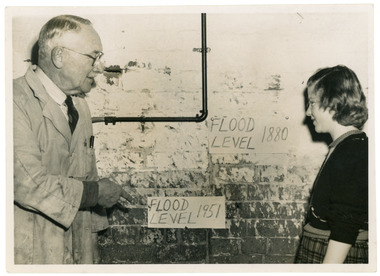
Photograph
... Hirst and Co. Pty Ltd Excelsior Woollen and Worsted Mills Textile Mills - history Textile Mills - staff W C Meyer Photographer/ 233 Myers Street/ East Geelong. ...Photograph, of two people looking at the flood levels 1880 and 1951, marked on a wall. The photograph is possibly of the Godfrey Hirst and Co Pty Ltd mill c1951Photograph, of two people looking at the flood levels 1880 and 1951, marked on a wall. The photograph is possibly of the Godfrey Hirst and Co Pty Ltd mill c1951.W C Meyer Photographer/ 233 Myers Street/ East Geelong. Phone 3289textile mills - history textile mills - staff, godfrey hirst and co. pty ltd excelsior woollen and worsted mills, textile mills - history, textile mills - staff -
 National Wool Museum
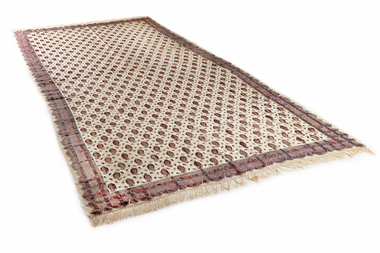
Clothing - Paisley Shawl, 1800 - 1830
... Street; Ada and Myrtle Downie in 1884. Jane’s youngest son William (1848-1932) was a spinning master, timekeeper and pay clerk at the Victorian Woollen Mill (later the Godfrey Hirst Excelsior Number Two mill) and together with William Cook owned a wool scour on the Barwon River at Marnockvale. ...Street; Ada and Myrtle Downie in 1884. Jane’s youngest son William (1848-1932) was a spinning master, timekeeper and pay clerk at the Victorian Woollen Mill (later the Godfrey Hirst Excelsior Number Two mill) and together with William Cook owned a wool scour on the Barwon River at Marnockvale. ...Shawl of Jane Francis (nee Piper) 1809-1891 This fine woven silk and woollen shawl is from Shetland, Scotland and belonged orginally to Jane Francis. Jane was born in Devon near the village of Bradworthy. She married Joseph Francis (1803-1878) in 1830 in the Bradworthy Parish, Devon, England and wore the shawl over her wedding dress on her wedding day. Jane and Joseph came to Geelong in 1853 with their family. Jane’s sister and brother were in Geelong and their eldest daughter Elizabeth had arrived in 1849. They arrived on the ship 'Euphemus' at Point Henry, Geelong, on July 20, 1853 and travelled across the bay in the steamer Duncan Hoyle. Jane was wearing the shawl on her arrival in Geelong. They went to live in Sharp Street Chilwell in a house owned by their son in law, John Price, which they later purchased. Jane became well known as a ‘midwife’ having had 10 children of her own. She is known to have delivered twin girls in Fyans Street; Ada and Myrtle Downie in 1884. Jane’s youngest son William (1848-1932) was a spinning master, timekeeper and pay clerk at the Victorian Woollen Mill (later the Godfrey Hirst Excelsior Number Two mill) and together with William Cook owned a wool scour on the Barwon River at Marnockvale. William’s grandson Arthur (1917-1992) was a wool classer undertaking his course at the Gordon Institute and became a wool valuer at Strachan & Co. For a time he taught part time in the Gordon course. Arthur’s son Robert was also a wool classer and worked at the Australian Wool Testing Authority. The shawl was used as a bed spread at 'Woodstock' by Jane's son William and then by his two children Laura and Eve. After their deaths, Eve in 1947 and Laura in 1963, the shawl was passed to their youngest sister Ethel (Effie) Frier (nee Francis). She had no children and it was passed on to grandniece Pat Norman (nee Hughan). Pat then passed the shawl to cousin Carollyn Williams (nee Francis) who donated the shawl to the National Wool Museum. - Donor, 2026 The Francis family were tenant farmers, and the donor speculated that the shawl could potentially have been a wedding gift from the land owners.Wool and silk fringed cream coloured shawl featuring a paisley pattern in tones of maroon, green, blue, brown and cream.shawl, 19th century, fashion, clothing, design, paisley, migration, geelong, point henry -
 Melbourne Athenaeum Archives
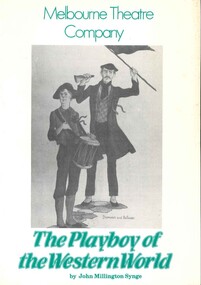
Theatre Program, The Playboy of the Western World (play) by John Millington Synge, performed by the Melbourne Theatre Company at the Athenaeum Theatre commencing 25 July 1978, 1978
... Street, such as in 1843, a year after the building was completed: "The first election for the Melbourne seat in 1843 turned into a sectarian battle between a Catholic and a Presbyterian candidate." Supporters of the losing candidate "massed outside the Mechanics Institution where the official declaration of the poll was to occur, and tried to storm the building. The police arrived and did disperse them but only to send them on a rampage throughout the town, ...("Building a Free Australia : Places of Democracy" by John Hirst ...John Millington Synge's plays were produced by the Irish National Theatre Society in 1905. Program notes reveal that the first performances "were the focus of some of the bitterest scenes ever witnessed in a theatre. Audience unrest ... grew to full-scale riots, and Yeats claimed that by the end of the week's run 70 police were keeping order inside the theatre, while 500 patrolled the streets outside".Unruly gatherings have been witnessed in the Athenaeum Theatre and Collins Street, such as in 1843, a year after the building was completed: "The first election for the Melbourne seat in 1843 turned into a sectarian battle between a Catholic and a Presbyterian candidate." Supporters of the losing candidate "massed outside the Mechanics Institution where the official declaration of the poll was to occur, and tried to storm the building. The police arrived and did disperse them but only to send them on a rampage throughout the town, ...("Building a Free Australia : Places of Democracy" by John Hirst, 2009)Paper program; coloured cover; 16 p. includes articles about the play and the actors.melbourne theatre company, the playboy of the western world, john millington synge, athenaeum theatre, katy wild, riots -
Kew Historical Society Inc
Archive (sub-series) - Printed Civic Ephemera, Town of Kew et al, 1913-1981
... Hirst) Harrison (1868-1955) and W. D. (William Dickie) Birrell (1899-1974). Harrison was appointed to the position in 1901 and retired in 1938 after 37 years. Birrell, appointed Acting Town Clerk in 1921, became Town Clerk in 1938, following Harrison's retirement. He continued in this role until his retirement in 1966. His home address was 18 Wellington Street...Hirst) Harrison (1868-1955) and W. D. (William Dickie) Birrell (1899-1974). Harrison was appointed to the position in 1901 and retired in 1938 after 37 years. Birrell, appointed Acting Town Clerk in 1921, became Town Clerk in 1938, following Harrison's retirement. He continued in this role until his retirement in 1966. His home address was 18 Wellington Street ...Town Clerk's Office, City of KewPrinted cardsDate orderItems relating to civic events, typically held by mayors of the City of Kew, or invitations from other cities to Council officers or councillors. h h harrison -- town clerk -- borough of kew -- town of kew -- city of kew, w d birrell -- town clerk -- city of kew, civic ephemera - city of kewh h harrison -- town clerk -- borough of kew -- town of kew -- city of kew, w d birrell -- town clerk -- city of kew, civic ephemera - city of kew -
Whitehorse Historical Society Inc.
Document, Certificate of Title, 1923 - 1934
... Hirst...William Arthur...Shire of Nunawading...Thomas Street...Land Titles Shire of Blackburn and Mitcham Hirst William Arthur Shire of Nunawading Thomas Street Mitcham Certificate of Title, William Arthur Hirst. ...Certificate of Title, William Arthur Hirst.Certificate of Title, William Arthur Hirst. Lot 20 Subdivision 6626, part of crown allotment 127A at Mitcham, Parish of Nunawading, Count of Bourke. Vol 4671, fol 934063. Also correspondence re rates enforcement charge, 1933-34.Certificate of Title, William Arthur Hirst.land titles, shire of blackburn and mitcham, hirst, william arthur, shire of nunawading, thomas street, mitcham -
 Emerald Museum & Nobelius Heritage Park
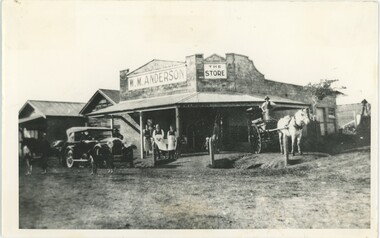
Photograph - W. M. Anderson Store, 1920s-40s
... Hirst - employees of Anderson - in the center-left, and George Davey standing in the cart. This photograph captures a now-unfamiliar store in a familiar part of old Emerald, documenting the changes to the commercial landscape over the past century. Emerald Commerce 1920s 1930s 1940s Reverse: "Built in 1921 / Cr [illegible] & Kilvington / Cross reference 56" Obverse: In Photograph Sign, Left: "W. M. ANDERSON" In Photograph Sign, Right: "THE / STORE" In Photograph, Porch: "W.M.ANDERSON [illegible]" This black and white photograph depicts a store on a street ...This photograph depicts W. M. Anderson's store on the corner of what is now Kilvington Drive and Heroes Avenue. At the time, these may have respectively been Beaconsfield Road and, according to the label, Avenue of Honor. Anderson's store is believed to have been built by the Stillwell family in 1921, but Anderson had his store at least from 1923 and therefore likely owned it from the point of its first construction. By the late 1940s, Anderson's had become Legge's General Store. It is difficult to determine precisely when within that range this photograph was taken. We believe Anderson's store was on the corner now occupied by Grace and Louie Booksellers. Some of the people in the photograph include Bill Anderson with Albert Legge, and Leo Hirst - employees of Anderson - in the center-left, and George Davey standing in the cart.This photograph captures a now-unfamiliar store in a familiar part of old Emerald, documenting the changes to the commercial landscape over the past century.This black and white photograph depicts a store on a street corner, with a porch covering the walkway outside and several signs on the building, along with writing on the end of the porch covering. In the left of the frame is a car, with two dogs, a horse, and a man surrounding it; in the right, a man strands on a horsecart drawn by a white horse. In the center-left are three men wearing aprons with a child besides them, while in the center a woman and child stand in the doorway. In the background, other buildings continue down both streets. The reverse is annotated, and has six rectangular artefacts where adhesive was once applied. A section of handwriting is illegible due to damage, but likely read 'Heroes Avenue' or 'Avenue of Honour'.Reverse: "Built in 1921 / Cr [illegible] & Kilvington / Cross reference 56" Obverse: In Photograph Sign, Left: "W. M. ANDERSON" In Photograph Sign, Right: "THE / STORE" In Photograph, Porch: "W.M.ANDERSON [illegible]"emerald, commerce, 1920s, 1930s, 1940s
