Flagstaff Hill Maritime Museum and Village
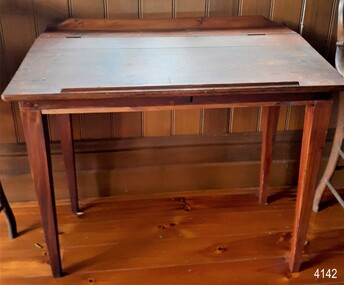
Furniture - Prayer Desk, Circa 1890
... ...HMHS CENTAUR...An note quotes: "from HMHS Centaur "- the original missal, which was donated to the church as a memorial to those who lost their lives when the HS Centaur was sunk. ...It has been referred to as a prayer desk, missal desk or writing desk and was previously used on the Australian ship, HMHS Centaur.
This desk is part of the St. Nicholas Seamen's Church Collection. ...An note quotes: "from HMHS Centaur "- the original missal, which was donated to the church as a memorial to those who lost their lives when the HS Centaur was sunk. ...
This small desk was donated to the St. Nicholas' Mission to Seamen's Church by Mrs R Hidgekiss. It was used as a prayer desk or missal desk and was part of the original furnishings of the church at 139 Nelson Place, Williamstown, Victoria. Previously, it was used on the Australian Hospital Ship, H.M.A.S. Centaur.
A reference to the desk's association is mentioned on the Framed Document that lists those who donated items to the St Nicholas Missions to Cemen church in Williamstown. An note quotes: "from HMHS Centaur "- the original missal, which was donated to the church as a memorial to those who lost their lives when the HS Centaur was sunk. (Of the 368 onboard, only two crew members survived.)"
THE MISSIONS TO SEAMEN (Brief History): -
The Missions to Seamen was an Anglican charity that has served seafarers of the world since 1856 in Great Britain. Its symbol is a Flying Angel, inspired by a Bible verse. Today, there are centres in over 200 ports worldwide where seamen of all backgrounds are offered a warm welcome and provided with a wide range of facilities.
In Victoria, the organisation began in Williamstown in 1857 as a Sailors’ Church, also known as ‘Bethel’ or the ‘Floating Church’ in an old hulk floating in Hobson’s Bay, Port of Melbourne. It soon became part of the Missions to Seamen, Victoria. In the year 2000, the organisation, now named Mission to Seafarers, still operated locally in Melbourne, Portland, Geelong and Hastings.
The Ladies’ Harbour Lights Guild was formed in 1906 to support the Missions to Seamen in Melbourne and other centres, such as Williamstown. Two of the most significant ladies of the Guild were founder Ethel Augusta Godfrey and foundation member Alice Sibthorpe Tracy (who established a branch of the Guild in Warrnambool in 1920). The Guild continued its work until the 1960s.
In 1943, a former Williamstown bank was purchased for the Missions to Seaman Club. The chapel was named St Nicholas’ Seamen’s Church and was supported by the Ladies’ Harbour Lights Guild, the Williamstown Lightkeepers’ Auxiliary and the League of Soldiers’ and Sailors’ Friends. It ceased operation in 1966.
A Missions to Seamen Chapel and Recreation Room was a significant feature of ports during the late 1800s and into the 1900s. It seemed appropriate for Flagstaff Hill to include such a representation within the new Maritime Village, so the Melbourne Board of Management of Missions to Seamen Victoria gave its permission on 21st May 1979 for the entire furnishings of the Williamstown chapel to be transferred to Flagstaff Hill. The St Nicholas Seamen’s Church was officially opened on October 11, 1981, and closely resembles the Williamstown chapel.
This prayer disk is significant historically for its origin in the St. Nicholas Mission to Seamen's Church in Williamstown, established in 1857 to cater for the physical, social, and spiritual needs of seafarers. The organisation originated in Bristol, England when a Seamen's Mission was formed in 1837.
The desk is also significant as a memorial to the many who lost their lives at sea for their country.Desk: Cedar wood desk of plain design with a sloped top. It has plain tapered legs, a hinged lid, a keyhole at the front, and raised edges at the front and back. Storage space under the lid has a tongue and groove wooden base. It has been referred to as a prayer desk, missal desk or writing desk and was previously used on the Australian ship, HMHS Centaur.
This desk is part of the St. Nicholas Seamen's Church Collection. flagstaff hill, warrnambool, shipwrecked-coast, flagstaff-hill, flagstaff-hill-maritime-museum, maritime-museum, shipwreck-coast, flagstaff-hill-maritime-village, desk, writing desk, office furniture, domestic furniture, writing slope, clerk's desk, flagstaff hill maritime museum and village, maritime museum, maritime village, shipwreck coast, great ocean road, religion, religious service, religious worship, worship service, st nicholas seamen’s church, williamstown, missions to seamen victoria, mission to seafarers, st nicholas missions to seamen’s church williamstown, missions to seamen, st nicholas missions to seamen’s church flagstaff hill, 139 nelson place williamstown, anglican church, prayer accessory, church furniture, religious furniture, prayer desk, missal desk, mrs r hidgekiss, centaur, hmhs centaur, h.m.h.s. centaur, hospital ship, missal

 Flagstaff Hill Maritime Museum and Village
 Flagstaff Hill Maritime Museum and Village