
Showing 50 items matching "home dyed"
-
 National Wool Museum
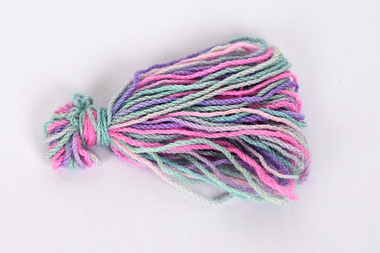
Textile - Dyed Wool Sample, Robin Walker, 1999
... ...Home Dyed...This sample is one of five donated by Mrs Walker who dyed her own yarns to knit into hats which she felted herself (in a washing machine) to sell at craft shops. She ran workshops and also taught home dyeing. ...Small hank of home dyed woollen yarn. In light shades of pink, mauve, blue and green....Handicrafts Robin Walker Textiles Felting Wool Yarn Home Dyed Craft Small hank of home dyed woollen yarn. ...This sample is one of five donated by Mrs Walker who dyed her own yarns to knit into hats which she felted herself (in a washing machine) to sell at craft shops. She ran workshops and also taught home dyeing. She used a Landscape and Earth Palette and also used food colouring, jelly and cake decorating colours.Small hank of home dyed woollen yarn. In light shades of pink, mauve, blue and green.handicrafts, robin walker, textiles, felting, wool, yarn, home dyed, craft -
 National Wool Museum
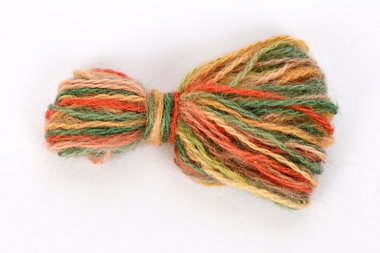
Textile - Dyed Wool Sample, Robin Walker, 1999
... This sample is one of five donated by Mrs Walker who dyed her own yarns to knit into hats which she felted herself (in a washing machine) to sell at craft shops. She ran workshops and also taught home dyeing. ...Small hank of home dyed woollen yarn. In shades of yellow, orange, green and brown....Handicrafts Robin Walker Hand Dyed Wool Yarn Felting Craft Colour Small hank of home dyed woollen yarn. In shades of yellow, orange, green and brown. ...This sample is one of five donated by Mrs Walker who dyed her own yarns to knit into hats which she felted herself (in a washing machine) to sell at craft shops. She ran workshops and also taught home dyeing. She used a Landscape and Earth Palette and also used food colouring, jelly and cake decorating colours.Small hank of home dyed woollen yarn. In shades of yellow, orange, green and brown.handicrafts, robin walker, hand dyed, wool, yarn, felting, craft, colour -
 National Wool Museum
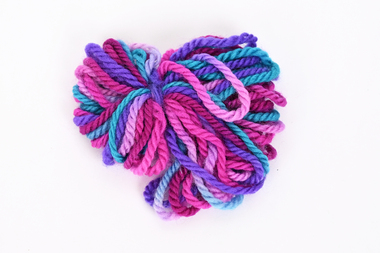
Textile - Dyed Wool Sample, Robin Walker, 1999
... This sample is one of five donated by Mrs Walker who dyed her own yarns to knit into hats which she felted herself (in a washing machine) to sell at craft shops. She ran workshops and also taught home dyeing. ...Small hank of home dyed woollen yarn. In dark shades of pink, mauve, blue and green....Handicrafts Robin Walker Craft Wool Hand Dyed Yarn Felting Small hank of home dyed woollen yarn. In dark shades of pink, mauve, blue and green. ...This sample is one of five donated by Mrs Walker who dyed her own yarns to knit into hats which she felted herself (in a washing machine) to sell at craft shops. She ran workshops and also taught home dyeing. She used a Landscape and Earth Palette and also used food colouring, jelly and cake decorating colours.Small hank of home dyed woollen yarn. In dark shades of pink, mauve, blue and green.handicrafts, robin walker, craft, wool, hand dyed, yarn, felting -
 National Wool Museum
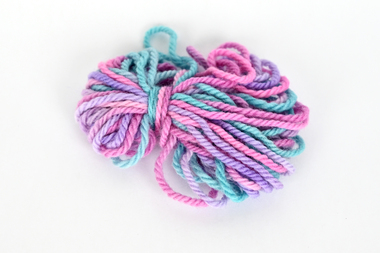
Textile - Dyed Wool Sample, Robin Walker, 1999
... This sample is one of five donated by Mrs Walker who dyed her own yarns to knit into hats which she felted herself (in a washing machine) to sell at craft shops. She ran workshops and also taught home dyeing. ...Small hank of home dyed thick woollen yarn. In light shades of pink, mauve, blue and green....Handicrafts Robin Walker Craft Felting Hand Dyed Wool Yarn Small hank of home dyed thick woollen yarn. In light shades of pink, mauve, blue and green. ...This sample is one of five donated by Mrs Walker who dyed her own yarns to knit into hats which she felted herself (in a washing machine) to sell at craft shops. She ran workshops and also taught home dyeing. She used a Landscape and Earth Palette and also used food colouring, jelly and cake decorating colours.Small hank of home dyed thick woollen yarn. In light shades of pink, mauve, blue and green.handicrafts, robin walker, craft, felting, hand dyed, wool, yarn -
 National Wool Museum
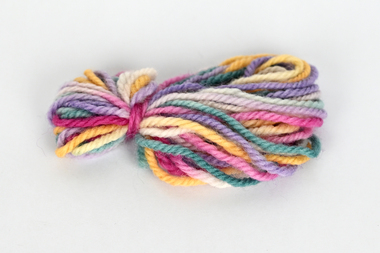
Textile - Dyed Wool Sample, Robin Walker, 1999
... This sample is one of five donated by Mrs Walker who dyed her own yarns to knit into hats which she felted herself (in a washing machine) to sell at craft shops. She ran workshops and also taught home dyeing. ...Small hank of home dyed woollen yarn. In light shades of pink, mauve, yellow, blue and green....Handicrafts Walker Mrs Robin Dying Hand Dyed Wool Craft Felting Small hank of home dyed woollen yarn. In light shades of pink, mauve, yellow, blue and green. ...This sample is one of five donated by Mrs Walker who dyed her own yarns to knit into hats which she felted herself (in a washing machine) to sell at craft shops. She ran workshops and also taught home dyeing. She used a Landscape and Earth Palette and also used food colouring, jelly and cake decorating colours.Small hank of home dyed woollen yarn. In light shades of pink, mauve, yellow, blue and green.handicrafts, walker, mrs robin, dying, hand dyed, wool, craft, felting -
 Orbost & District Historical Society
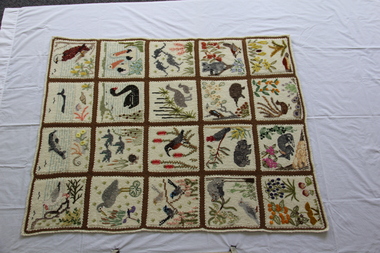
Textile - Handmade quilt, Elsa Williams, late1980s
... dyed the wool, and crafted this quilt. For about 20 years, Elsa was a member of a weaving group started by Gwenda Bland at Lake Tyers. Elsa wove carpets for her own home...dyed the wool, and crafted this quilt. For about 20 years, Elsa was a member of a weaving group started by Gwenda Bland at Lake Tyers. Elsa wove carpets for her own home ...This quilt or wall hanging is entirely hand-made by noted Orbost district craftsperson, Elsa Williams (nee Elsa Beavis, b 27-5-1924, d 22-6-2007) who lived on a property at Wombat Creek near Orbost in the 1980s. Elsa had her own sheep, spun and dyed the wool, and crafted this quilt. For about 20 years, Elsa was a member of a weaving group started by Gwenda Bland at Lake Tyers. Elsa wove carpets for her own home at Wombat Creek. Gwenda Beavis was given this quilt by Elsa in 2007 and it was often displayed around the district, receiving many comments due to the quality of the workmanship and design. This quilt has been made from hand-spun and hand-dyed wool. The background is Tricot crochet squares, and the coloured decorations of Australian animals and plants have been embroidered onto the tricot squares. This items is significant because it shows excellent creativity and quality of workmanship. It also represents an era in Australia when hand-weaving, spinning, and dying wool became very popular as hand-crafts. A hand-made woollen quilt, cream background, with images of Australian flowers, plants, birds, and animals embroidered onto the cream background. elsa williams, handcrafted quilt, australiana design, spinning and weaving -
 Orbost & District Historical Society
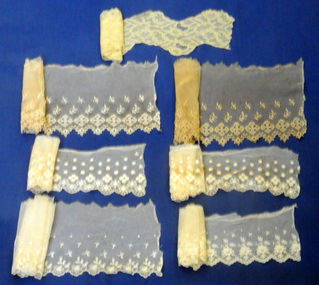
lace, late 19th-early 20th century
... homes, decorating or protecting furniture. Embroidery and crochet work provided a much needed creative outlet for some lace handcraft crochet needlework Seven pieces of lace of fine cotton possibly dyed or stained. ...Australian women of the late 19th to mid 20th century focused on the home and its decoration was important. Embroidery and crochet work was an affordable way to personalise and add aesthetic value, and examples of embroidered and crocheted pieces could be found in most Australian homes, decorating or protecting furniture. Embroidery and crochet work provided a much needed creative outlet for someSeven pieces of lace of fine cotton possibly dyed or stained. All but one are straight edged. .1 is scalloped.lace handcraft crochet needlework -
 National Wool Museum
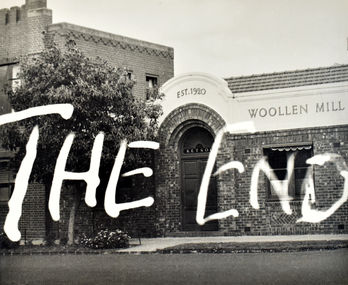
Photograph - Returned Sailors and Soldiers Mill, Norm Holroyd, 1960's - 1970's
... home for private viewing. The Returned Sailors and Soldiers Woollen Mill operated as a self-sufficient co-operative, funded and run by World War I veterans using their War Gratuity Bonds. The facility functioned as a complete raw-to-finished assembly line where raw fleece was brought on-site to be scoured, carded, dyed, spun into yarn and woven. ...home for private viewing. The Returned Sailors and Soldiers Woollen Mill operated as a self-sufficient co-operative, funded and run by World War I veterans using their War Gratuity Bonds. The facility functioned as a complete raw-to-finished assembly line where raw fleece was brought on-site to be scoured, carded, dyed, spun into yarn and woven. ...One of thirty eight photographs from a photo album featuring images of the Returned Sailors and Soldiers Woollen Mill in Newtown, Geelong. The images were taken between the 1960's-1970's by Norm Holroyd who worked at the mills. They were developed in his own private dark room and kept at his home for private viewing. The Returned Sailors and Soldiers Woollen Mill operated as a self-sufficient co-operative, funded and run by World War I veterans using their War Gratuity Bonds. The facility functioned as a complete raw-to-finished assembly line where raw fleece was brought on-site to be scoured, carded, dyed, spun into yarn and woven. It specialised in heavy worsted cloths, high-quality tweed, and its signature "Retsol" and "Monarch" pure-wool travelling rugs, later adapting its machinery to blend natural wool with artificial fibres as mid-century market demands shifted.Black and white photograph attached to cardboard backing with sticky tape. Image shows a building exterior with text. Backing card has four holes in left side.back: [handwritten] 45r. s. & s mill, returned sailors and soldiers mill, newtown, geelong, world war i, soldiers, veterans, co-operative, textile industry, woollen mills, wool, worsted cloth, tweed, retsol, monarch, travel rugs, machinery, factory, working life, norm holroyd, photo album, photography, design, fabric -
 National Wool Museum
Photograph - Returned Sailors and Soldiers Mill, Norm Holroyd, 1960's - 1970's
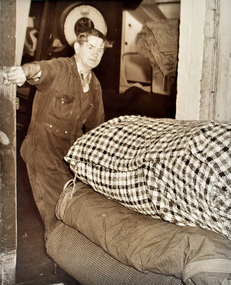
... home for private viewing. The Returned Sailors and Soldiers Woollen Mill operated as a self-sufficient co-operative, funded and run by World War I veterans using their War Gratuity Bonds. The facility functioned as a complete raw-to-finished assembly line where raw fleece was brought on-site to be scoured, carded, dyed, spun into yarn and woven. ...home for private viewing. The Returned Sailors and Soldiers Woollen Mill operated as a self-sufficient co-operative, funded and run by World War I veterans using their War Gratuity Bonds. The facility functioned as a complete raw-to-finished assembly line where raw fleece was brought on-site to be scoured, carded, dyed, spun into yarn and woven. ...One of thirty eight photographs from a photo album featuring images of the Returned Sailors and Soldiers Woollen Mill in Newtown, Geelong. The images were taken between the 1960's-1970's by Norm Holroyd who worked at the mills. They were developed in his own private dark room and kept at his home for private viewing. The Returned Sailors and Soldiers Woollen Mill operated as a self-sufficient co-operative, funded and run by World War I veterans using their War Gratuity Bonds. The facility functioned as a complete raw-to-finished assembly line where raw fleece was brought on-site to be scoured, carded, dyed, spun into yarn and woven. It specialised in heavy worsted cloths, high-quality tweed, and its signature "Retsol" and "Monarch" pure-wool travelling rugs, later adapting its machinery to blend natural wool with artificial fibres as mid-century market demands shifted.Black and white photograph attached to cardboard backing with sticky tape. Image shows a man moving woollen fabrics on a trolley through a doorway. Backing card has four holes in left side.back: [handwritten] 34r. s. & s mill, returned sailors and soldiers mill, newtown, geelong, world war i, soldiers, veterans, co-operative, textile industry, woollen mills, wool, worsted cloth, tweed, retsol, monarch, travel rugs, machinery, factory, working life, norm holroyd, photo album, photography, design, fabric -
 National Wool Museum
Photograph - Loom, Returned Sailors and Soldiers Mill, Norm Holroyd, 1960's - 1970's
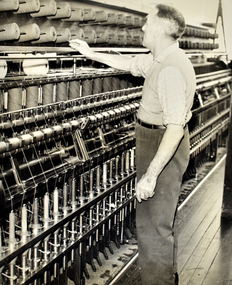
... home for private viewing. The Returned Sailors and Soldiers Woollen Mill operated as a self-sufficient co-operative, funded and run by World War I veterans using their War Gratuity Bonds. The facility functioned as a complete raw-to-finished assembly line where raw fleece was brought on-site to be scoured, carded, dyed, spun into yarn and woven. ...home for private viewing. The Returned Sailors and Soldiers Woollen Mill operated as a self-sufficient co-operative, funded and run by World War I veterans using their War Gratuity Bonds. The facility functioned as a complete raw-to-finished assembly line where raw fleece was brought on-site to be scoured, carded, dyed, spun into yarn and woven. ...One of thirty eight photographs from a photo album featuring images of the Returned Sailors and Soldiers Woollen Mill in Newtown, Geelong. The images were taken between the 1960's-1970's by Norm Holroyd who worked at the mills. They were developed in his own private dark room and kept at his home for private viewing. The Returned Sailors and Soldiers Woollen Mill operated as a self-sufficient co-operative, funded and run by World War I veterans using their War Gratuity Bonds. The facility functioned as a complete raw-to-finished assembly line where raw fleece was brought on-site to be scoured, carded, dyed, spun into yarn and woven. It specialised in heavy worsted cloths, high-quality tweed, and its signature "Retsol" and "Monarch" pure-wool travelling rugs, later adapting its machinery to blend natural wool with artificial fibres as mid-century market demands shifted.Black and white photograph attached to cardboard backing with sticky tape. Image shows a man standing at a loom. Backing card has four holes in left side.back: [handwritten] 19r. s. & s mill, returned sailors and soldiers mill, newtown, geelong, world war i, soldiers, veterans, co-operative, textile industry, woollen mills, wool, worsted cloth, tweed, retsol, monarch, travel rugs, machinery, factory, working life, norm holroyd, photo album, photography, design, fabric -
 National Wool Museum
Photograph - Returned Sailors and Soldiers Mill, Norm Holroyd, 1960's - 1970's
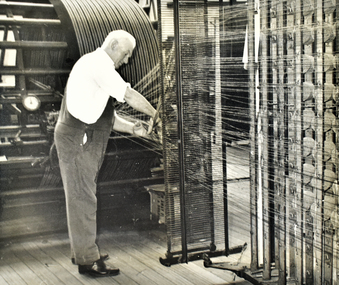
... home for private viewing. The Returned Sailors and Soldiers Woollen Mill operated as a self-sufficient co-operative, funded and run by World War I veterans using their War Gratuity Bonds. The facility functioned as a complete raw-to-finished assembly line where raw fleece was brought on-site to be scoured, carded, dyed, spun into yarn and woven. ...home for private viewing. The Returned Sailors and Soldiers Woollen Mill operated as a self-sufficient co-operative, funded and run by World War I veterans using their War Gratuity Bonds. The facility functioned as a complete raw-to-finished assembly line where raw fleece was brought on-site to be scoured, carded, dyed, spun into yarn and woven. ...One of thirty eight photographs from a photo album featuring images of the Returned Sailors and Soldiers Woollen Mill in Newtown, Geelong. The images were taken between the 1960's-1970's by Norm Holroyd who worked at the mills. They were developed in his own private dark room and kept at his home for private viewing. The Returned Sailors and Soldiers Woollen Mill operated as a self-sufficient co-operative, funded and run by World War I veterans using their War Gratuity Bonds. The facility functioned as a complete raw-to-finished assembly line where raw fleece was brought on-site to be scoured, carded, dyed, spun into yarn and woven. It specialised in heavy worsted cloths, high-quality tweed, and its signature "Retsol" and "Monarch" pure-wool travelling rugs, later adapting its machinery to blend natural wool with artificial fibres as mid-century market demands shifted.Black and white photograph attached to cardboard backing with sticky tape. Image shows a man operating wool processing machinery. Backing card has four holes in left side.back: [handwritten] 21r. s. & s mill, returned sailors and soldiers mill, newtown, geelong, world war i, soldiers, veterans, co-operative, textile industry, woollen mills, wool, worsted cloth, tweed, retsol, monarch, travel rugs, machinery, factory, working life, norm holroyd, photo album, photography, design, fabric -
 National Wool Museum
Photograph - Returned Sailors and Soldiers Mill, Norm Holroyd, 1960's - 1970's
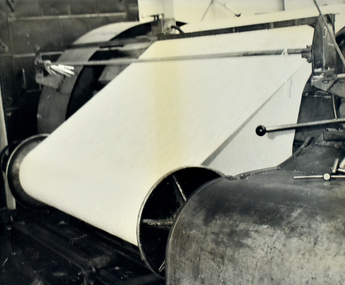
... home for private viewing. The Returned Sailors and Soldiers Woollen Mill operated as a self-sufficient co-operative, funded and run by World War I veterans using their War Gratuity Bonds. The facility functioned as a complete raw-to-finished assembly line where raw fleece was brought on-site to be scoured, carded, dyed, spun into yarn and woven. ...home for private viewing. The Returned Sailors and Soldiers Woollen Mill operated as a self-sufficient co-operative, funded and run by World War I veterans using their War Gratuity Bonds. The facility functioned as a complete raw-to-finished assembly line where raw fleece was brought on-site to be scoured, carded, dyed, spun into yarn and woven. ...One of thirty eight photographs from a photo album featuring images of the Returned Sailors and Soldiers Woollen Mill in Newtown, Geelong. The images were taken between the 1960's-1970's by Norm Holroyd who worked at the mills. They were developed in his own private dark room and kept at his home for private viewing. The Returned Sailors and Soldiers Woollen Mill operated as a self-sufficient co-operative, funded and run by World War I veterans using their War Gratuity Bonds. The facility functioned as a complete raw-to-finished assembly line where raw fleece was brought on-site to be scoured, carded, dyed, spun into yarn and woven. It specialised in heavy worsted cloths, high-quality tweed, and its signature "Retsol" and "Monarch" pure-wool travelling rugs, later adapting its machinery to blend natural wool with artificial fibres as mid-century market demands shifted.Black and white photograph attached to cardboard backing with sticky tape. Image shows wool processing machinery. Backing card has four holes in left side.back: [handwritten] 22r. s. & s mill, returned sailors and soldiers mill, newtown, geelong, world war i, soldiers, veterans, co-operative, textile industry, woollen mills, wool, worsted cloth, tweed, retsol, monarch, travel rugs, machinery, factory, working life, norm holroyd, photo album, photography, design, fabric -
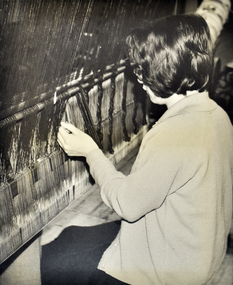 National Wool Museum
Photograph - Loom, Returned Sailors and Soldiers Mill, Norm Holroyd, 1960's - 1970's
... home for private viewing. The Returned Sailors and Soldiers Woollen Mill operated as a self-sufficient co-operative, funded and run by World War I veterans using their War Gratuity Bonds. The facility functioned as a complete raw-to-finished assembly line where raw fleece was brought on-site to be scoured, carded, dyed, spun into yarn and woven. ...home for private viewing. The Returned Sailors and Soldiers Woollen Mill operated as a self-sufficient co-operative, funded and run by World War I veterans using their War Gratuity Bonds. The facility functioned as a complete raw-to-finished assembly line where raw fleece was brought on-site to be scoured, carded, dyed, spun into yarn and woven. ...One of thirty eight photographs from a photo album featuring images of the Returned Sailors and Soldiers Woollen Mill in Newtown, Geelong. The images were taken between the 1960's-1970's by Norm Holroyd who worked at the mills. They were developed in his own private dark room and kept at his home for private viewing. The Returned Sailors and Soldiers Woollen Mill operated as a self-sufficient co-operative, funded and run by World War I veterans using their War Gratuity Bonds. The facility functioned as a complete raw-to-finished assembly line where raw fleece was brought on-site to be scoured, carded, dyed, spun into yarn and woven. It specialised in heavy worsted cloths, high-quality tweed, and its signature "Retsol" and "Monarch" pure-wool travelling rugs, later adapting its machinery to blend natural wool with artificial fibres as mid-century market demands shifted.Black and white photograph attached to cardboard backing with sticky tape. Image shows a woman working at a loom. Backing card has four holes in left side.back: [handwritten] 25r. s. & s mill, returned sailors and soldiers mill, newtown, geelong, world war i, soldiers, veterans, co-operative, textile industry, woollen mills, wool, worsted cloth, tweed, retsol, monarch, travel rugs, machinery, factory, working life, norm holroyd, photo album, photography, design, fabric -
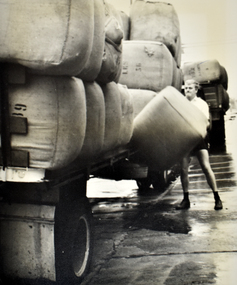 National Wool Museum
Photograph - Returned Sailors and Soldiers Mill, Norm Holroyd, 1960's - 1970's
... home for private viewing. The Returned Sailors and Soldiers Woollen Mill operated as a self-sufficient co-operative, funded and run by World War I veterans using their War Gratuity Bonds. The facility functioned as a complete raw-to-finished assembly line where raw fleece was brought on-site to be scoured, carded, dyed, spun into yarn and woven. ...home for private viewing. The Returned Sailors and Soldiers Woollen Mill operated as a self-sufficient co-operative, funded and run by World War I veterans using their War Gratuity Bonds. The facility functioned as a complete raw-to-finished assembly line where raw fleece was brought on-site to be scoured, carded, dyed, spun into yarn and woven. ...One of thirty eight photographs from a photo album featuring images of the Returned Sailors and Soldiers Woollen Mill in Newtown, Geelong. The images were taken between the 1960's-1970's by Norm Holroyd who worked at the mills. They were developed in his own private dark room and kept at his home for private viewing. The Returned Sailors and Soldiers Woollen Mill operated as a self-sufficient co-operative, funded and run by World War I veterans using their War Gratuity Bonds. The facility functioned as a complete raw-to-finished assembly line where raw fleece was brought on-site to be scoured, carded, dyed, spun into yarn and woven. It specialised in heavy worsted cloths, high-quality tweed, and its signature "Retsol" and "Monarch" pure-wool travelling rugs, later adapting its machinery to blend natural wool with artificial fibres as mid-century market demands shifted.Black and white photograph attached to cardboard backing with sticky tape. Image shows a man loading a wool bale onto a trailer for transport. Backing card has four holes in left side.back: [handwritten] 1r. s. & s mill, returned sailors and soldiers mill, newtown, geelong, world war i, soldiers, veterans, co-operative, textile industry, woollen mills, wool, worsted cloth, tweed, retsol, monarch, travel rugs, machinery, factory, working life, norm holroyd, photo album, photography, design, fabric -
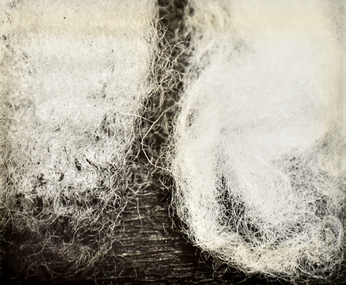 National Wool Museum
Photograph - Returned Sailors and Soldiers Mill, Norm Holroyd, 1960's - 1970's
... home for private viewing. The Returned Sailors and Soldiers Woollen Mill operated as a self-sufficient co-operative, funded and run by World War I veterans using their War Gratuity Bonds. The facility functioned as a complete raw-to-finished assembly line where raw fleece was brought on-site to be scoured, carded, dyed, spun into yarn and woven. ...home for private viewing. The Returned Sailors and Soldiers Woollen Mill operated as a self-sufficient co-operative, funded and run by World War I veterans using their War Gratuity Bonds. The facility functioned as a complete raw-to-finished assembly line where raw fleece was brought on-site to be scoured, carded, dyed, spun into yarn and woven. ...One of thirty eight photographs from a photo album featuring images of the Returned Sailors and Soldiers Woollen Mill in Newtown, Geelong. The images were taken between the 1960's-1970's by Norm Holroyd who worked at the mills. They were developed in his own private dark room and kept at his home for private viewing. The Returned Sailors and Soldiers Woollen Mill operated as a self-sufficient co-operative, funded and run by World War I veterans using their War Gratuity Bonds. The facility functioned as a complete raw-to-finished assembly line where raw fleece was brought on-site to be scoured, carded, dyed, spun into yarn and woven. It specialised in heavy worsted cloths, high-quality tweed, and its signature "Retsol" and "Monarch" pure-wool travelling rugs, later adapting its machinery to blend natural wool with artificial fibres as mid-century market demands shifted.Black and white photograph showing wool fibres in detail.r. s. & s mill, returned sailors and soldiers mill, newtown, geelong, world war i, soldiers, veterans, co-operative, textile industry, woollen mills, wool, worsted cloth, tweed, retsol, monarch, travel rugs, machinery, factory, working life, norm holroyd, photo album, photography, design, fabric -
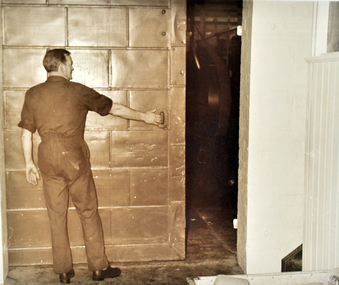 National Wool Museum
Photograph - Returned Sailors and Soldiers Mill, Norm Holroyd, 1960's - 1970's
... home for private viewing. The Returned Sailors and Soldiers Woollen Mill operated as a self-sufficient co-operative, funded and run by World War I veterans using their War Gratuity Bonds. The facility functioned as a complete raw-to-finished assembly line where raw fleece was brought on-site to be scoured, carded, dyed, spun into yarn and woven. ...home for private viewing. The Returned Sailors and Soldiers Woollen Mill operated as a self-sufficient co-operative, funded and run by World War I veterans using their War Gratuity Bonds. The facility functioned as a complete raw-to-finished assembly line where raw fleece was brought on-site to be scoured, carded, dyed, spun into yarn and woven. ...One of thirty eight photographs from a photo album featuring images of the Returned Sailors and Soldiers Woollen Mill in Newtown, Geelong. The images were taken between the 1960's-1970's by Norm Holroyd who worked at the mills. They were developed in his own private dark room and kept at his home for private viewing. The Returned Sailors and Soldiers Woollen Mill operated as a self-sufficient co-operative, funded and run by World War I veterans using their War Gratuity Bonds. The facility functioned as a complete raw-to-finished assembly line where raw fleece was brought on-site to be scoured, carded, dyed, spun into yarn and woven. It specialised in heavy worsted cloths, high-quality tweed, and its signature "Retsol" and "Monarch" pure-wool travelling rugs, later adapting its machinery to blend natural wool with artificial fibres as mid-century market demands shifted.Black and white photograph attached to cardboard backing with sticky tape. Image shows a man opening a sliding door inside a factory. Backing card has four holes in left side.r. s. & s mill, returned sailors and soldiers mill, newtown, geelong, world war i, soldiers, veterans, co-operative, textile industry, woollen mills, wool, worsted cloth, tweed, retsol, monarch, travel rugs, machinery, factory, working life, norm holroyd, photo album, photography, design, fabric -
 National Wool Museum
Photograph - Wool Processing, Returned Sailors and Soldiers Mill, Norm Holroyd, 1960's - 1970's
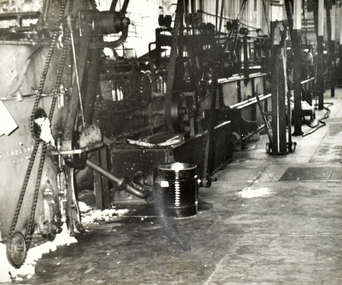
... home for private viewing. The Returned Sailors and Soldiers Woollen Mill operated as a self-sufficient co-operative, funded and run by World War I veterans using their War Gratuity Bonds. The facility functioned as a complete raw-to-finished assembly line where raw fleece was brought on-site to be scoured, carded, dyed, spun into yarn and woven. ...home for private viewing. The Returned Sailors and Soldiers Woollen Mill operated as a self-sufficient co-operative, funded and run by World War I veterans using their War Gratuity Bonds. The facility functioned as a complete raw-to-finished assembly line where raw fleece was brought on-site to be scoured, carded, dyed, spun into yarn and woven. ...One of thirty eight photographs from a photo album featuring images of the Returned Sailors and Soldiers Woollen Mill in Newtown, Geelong. The images were taken between the 1960's-1970's by Norm Holroyd who worked at the mills. They were developed in his own private dark room and kept at his home for private viewing. The Returned Sailors and Soldiers Woollen Mill operated as a self-sufficient co-operative, funded and run by World War I veterans using their War Gratuity Bonds. The facility functioned as a complete raw-to-finished assembly line where raw fleece was brought on-site to be scoured, carded, dyed, spun into yarn and woven. It specialised in heavy worsted cloths, high-quality tweed, and its signature "Retsol" and "Monarch" pure-wool travelling rugs, later adapting its machinery to blend natural wool with artificial fibres as mid-century market demands shifted.Black and white photograph attached to cardboard backing with sticky tape. Image shows wool processing machinery. Backing card has four holes in left side.back: [handwritten] 4r. s. & s mill, returned sailors and soldiers mill, newtown, geelong, world war i, soldiers, veterans, co-operative, textile industry, woollen mills, wool, worsted cloth, tweed, retsol, monarch, travel rugs, machinery, factory, working life, norm holroyd, photo album, photography, design, fabric -
 National Wool Museum
Photograph - Returned Sailors and Soldiers Mill, Norm Holroyd, 1960's - 1970's
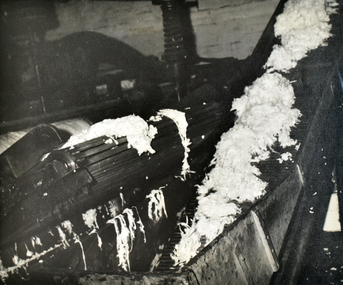
... home for private viewing. The Returned Sailors and Soldiers Woollen Mill operated as a self-sufficient co-operative, funded and run by World War I veterans using their War Gratuity Bonds. The facility functioned as a complete raw-to-finished assembly line where raw fleece was brought on-site to be scoured, carded, dyed, spun into yarn and woven. ...home for private viewing. The Returned Sailors and Soldiers Woollen Mill operated as a self-sufficient co-operative, funded and run by World War I veterans using their War Gratuity Bonds. The facility functioned as a complete raw-to-finished assembly line where raw fleece was brought on-site to be scoured, carded, dyed, spun into yarn and woven. ...One of thirty eight photographs from a photo album featuring images of the Returned Sailors and Soldiers Woollen Mill in Newtown, Geelong. The images were taken between the 1960's-1970's by Norm Holroyd who worked at the mills. They were developed in his own private dark room and kept at his home for private viewing. The Returned Sailors and Soldiers Woollen Mill operated as a self-sufficient co-operative, funded and run by World War I veterans using their War Gratuity Bonds. The facility functioned as a complete raw-to-finished assembly line where raw fleece was brought on-site to be scoured, carded, dyed, spun into yarn and woven. It specialised in heavy worsted cloths, high-quality tweed, and its signature "Retsol" and "Monarch" pure-wool travelling rugs, later adapting its machinery to blend natural wool with artificial fibres as mid-century market demands shifted.Black and white photograph showing machinery processing wool.r. s. & s mill, returned sailors and soldiers mill, newtown, geelong, world war i, soldiers, veterans, co-operative, textile industry, woollen mills, wool, worsted cloth, tweed, retsol, monarch, travel rugs, machinery, factory, working life, norm holroyd, photo album, photography, design, fabric -
 National Wool Museum
Photograph - Wool Processing, Returned Sailors and Soldiers Mill, Norm Holroyd, 1960's - 1970's
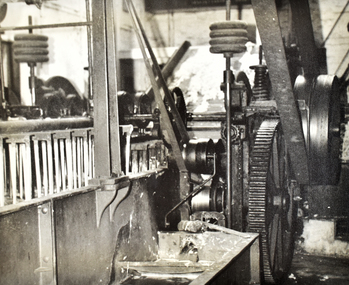
... home for private viewing. The Returned Sailors and Soldiers Woollen Mill operated as a self-sufficient co-operative, funded and run by World War I veterans using their War Gratuity Bonds. The facility functioned as a complete raw-to-finished assembly line where raw fleece was brought on-site to be scoured, carded, dyed, spun into yarn and woven. ...home for private viewing. The Returned Sailors and Soldiers Woollen Mill operated as a self-sufficient co-operative, funded and run by World War I veterans using their War Gratuity Bonds. The facility functioned as a complete raw-to-finished assembly line where raw fleece was brought on-site to be scoured, carded, dyed, spun into yarn and woven. ...One of thirty eight photographs from a photo album featuring images of the Returned Sailors and Soldiers Woollen Mill in Newtown, Geelong. The images were taken between the 1960's-1970's by Norm Holroyd who worked at the mills. They were developed in his own private dark room and kept at his home for private viewing. The Returned Sailors and Soldiers Woollen Mill operated as a self-sufficient co-operative, funded and run by World War I veterans using their War Gratuity Bonds. The facility functioned as a complete raw-to-finished assembly line where raw fleece was brought on-site to be scoured, carded, dyed, spun into yarn and woven. It specialised in heavy worsted cloths, high-quality tweed, and its signature "Retsol" and "Monarch" pure-wool travelling rugs, later adapting its machinery to blend natural wool with artificial fibres as mid-century market demands shifted.Black and white photograph attached to cardboard backing with sticky tape. Image shows a close up of wool processing machinery. Backing card has four holes in left side.back: [handwritten] 6r. s. & s mill, returned sailors and soldiers mill, newtown, geelong, world war i, soldiers, veterans, co-operative, textile industry, woollen mills, wool, worsted cloth, tweed, retsol, monarch, travel rugs, machinery, factory, working life, norm holroyd, photo album, photography, design, fabric -
 National Wool Museum
Photograph - Returned Sailors and Soldiers Mill, Norm Holroyd, 1960's - 1970's
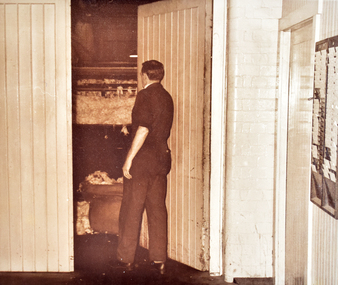
... home for private viewing. The Returned Sailors and Soldiers Woollen Mill operated as a self-sufficient co-operative, funded and run by World War I veterans using their War Gratuity Bonds. The facility functioned as a complete raw-to-finished assembly line where raw fleece was brought on-site to be scoured, carded, dyed, spun into yarn and woven. ...home for private viewing. The Returned Sailors and Soldiers Woollen Mill operated as a self-sufficient co-operative, funded and run by World War I veterans using their War Gratuity Bonds. The facility functioned as a complete raw-to-finished assembly line where raw fleece was brought on-site to be scoured, carded, dyed, spun into yarn and woven. ...One of thirty eight photographs from a photo album featuring images of the Returned Sailors and Soldiers Woollen Mill in Newtown, Geelong. The images were taken between the 1960's-1970's by Norm Holroyd who worked at the mills. They were developed in his own private dark room and kept at his home for private viewing. The Returned Sailors and Soldiers Woollen Mill operated as a self-sufficient co-operative, funded and run by World War I veterans using their War Gratuity Bonds. The facility functioned as a complete raw-to-finished assembly line where raw fleece was brought on-site to be scoured, carded, dyed, spun into yarn and woven. It specialised in heavy worsted cloths, high-quality tweed, and its signature "Retsol" and "Monarch" pure-wool travelling rugs, later adapting its machinery to blend natural wool with artificial fibres as mid-century market demands shifted.Black and white photograph attached to cardboard backing with sticky tape. Image shows a man walking through a doorway inside a factory with time card racks to the right, and wool processing machinery in the background. Backing card has four holes in left side.back: [handwritten] 7r. s. & s mill, returned sailors and soldiers mill, newtown, geelong, world war i, soldiers, veterans, co-operative, textile industry, woollen mills, wool, worsted cloth, tweed, retsol, monarch, travel rugs, machinery, factory, working life, norm holroyd, photo album, photography, design, fabric -
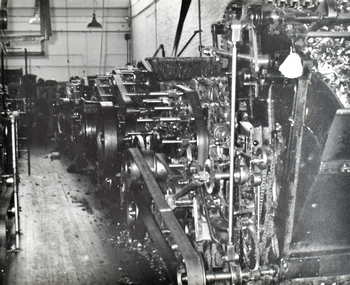 National Wool Museum
Photograph - Machinery, Returned Sailors and Soldiers Mill, Norm Holroyd, 1960's - 1970's
... home for private viewing. The Returned Sailors and Soldiers Woollen Mill operated as a self-sufficient co-operative, funded and run by World War I veterans using their War Gratuity Bonds. The facility functioned as a complete raw-to-finished assembly line where raw fleece was brought on-site to be scoured, carded, dyed, spun into yarn and woven. ...home for private viewing. The Returned Sailors and Soldiers Woollen Mill operated as a self-sufficient co-operative, funded and run by World War I veterans using their War Gratuity Bonds. The facility functioned as a complete raw-to-finished assembly line where raw fleece was brought on-site to be scoured, carded, dyed, spun into yarn and woven. ...One of thirty eight photographs from a photo album featuring images of the Returned Sailors and Soldiers Woollen Mill in Newtown, Geelong. The images were taken between the 1960's-1970's by Norm Holroyd who worked at the mills. They were developed in his own private dark room and kept at his home for private viewing. The Returned Sailors and Soldiers Woollen Mill operated as a self-sufficient co-operative, funded and run by World War I veterans using their War Gratuity Bonds. The facility functioned as a complete raw-to-finished assembly line where raw fleece was brought on-site to be scoured, carded, dyed, spun into yarn and woven. It specialised in heavy worsted cloths, high-quality tweed, and its signature "Retsol" and "Monarch" pure-wool travelling rugs, later adapting its machinery to blend natural wool with artificial fibres as mid-century market demands shifted.Black and white photograph attached to cardboard backing with sticky tape. Image shows wool processing machinery inside a factory. Backing card has four holes in left side.back: [handwritten] 8r. s. & s mill, returned sailors and soldiers mill, newtown, geelong, world war i, soldiers, veterans, co-operative, textile industry, woollen mills, wool, worsted cloth, tweed, retsol, monarch, travel rugs, machinery, factory, working life, norm holroyd, photo album, photography, design, fabric -
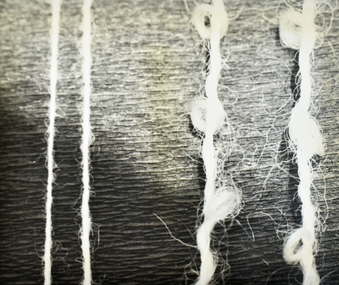 National Wool Museum
Photograph - Returned Sailors and Soldiers Mill, Norm Holroyd, 1960's - 1970's
... home for private viewing. The Returned Sailors and Soldiers Woollen Mill operated as a self-sufficient co-operative, funded and run by World War I veterans using their War Gratuity Bonds. The facility functioned as a complete raw-to-finished assembly line where raw fleece was brought on-site to be scoured, carded, dyed, spun into yarn and woven. ...home for private viewing. The Returned Sailors and Soldiers Woollen Mill operated as a self-sufficient co-operative, funded and run by World War I veterans using their War Gratuity Bonds. The facility functioned as a complete raw-to-finished assembly line where raw fleece was brought on-site to be scoured, carded, dyed, spun into yarn and woven. ...One of thirty eight photographs from a photo album featuring images of the Returned Sailors and Soldiers Woollen Mill in Newtown, Geelong. The images were taken between the 1960's-1970's by Norm Holroyd who worked at the mills. They were developed in his own private dark room and kept at his home for private viewing. The Returned Sailors and Soldiers Woollen Mill operated as a self-sufficient co-operative, funded and run by World War I veterans using their War Gratuity Bonds. The facility functioned as a complete raw-to-finished assembly line where raw fleece was brought on-site to be scoured, carded, dyed, spun into yarn and woven. It specialised in heavy worsted cloths, high-quality tweed, and its signature "Retsol" and "Monarch" pure-wool travelling rugs, later adapting its machinery to blend natural wool with artificial fibres as mid-century market demands shifted.Black and white photograph attached to cardboard backing with sticky tape. Image shows detail of woollen thread. Backing card has four holes in left side.back: [handwritten] 17r. s. & s mill, returned sailors and soldiers mill, newtown, geelong, world war i, soldiers, veterans, co-operative, textile industry, woollen mills, wool, worsted cloth, tweed, retsol, monarch, travel rugs, machinery, factory, working life, norm holroyd, photo album, photography, design, fabric -
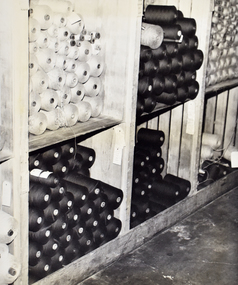 National Wool Museum
Photograph - Returned Sailors and Soldiers Mill, Norm Holroyd, 1960's - 1970's
... home for private viewing. The Returned Sailors and Soldiers Woollen Mill operated as a self-sufficient co-operative, funded and run by World War I veterans using their War Gratuity Bonds. The facility functioned as a complete raw-to-finished assembly line where raw fleece was brought on-site to be scoured, carded, dyed, spun into yarn and woven. ...home for private viewing. The Returned Sailors and Soldiers Woollen Mill operated as a self-sufficient co-operative, funded and run by World War I veterans using their War Gratuity Bonds. The facility functioned as a complete raw-to-finished assembly line where raw fleece was brought on-site to be scoured, carded, dyed, spun into yarn and woven. ...One of thirty eight photographs from a photo album featuring images of the Returned Sailors and Soldiers Woollen Mill in Newtown, Geelong. The images were taken between the 1960's-1970's by Norm Holroyd who worked at the mills. They were developed in his own private dark room and kept at his home for private viewing. The Returned Sailors and Soldiers Woollen Mill operated as a self-sufficient co-operative, funded and run by World War I veterans using their War Gratuity Bonds. The facility functioned as a complete raw-to-finished assembly line where raw fleece was brought on-site to be scoured, carded, dyed, spun into yarn and woven. It specialised in heavy worsted cloths, high-quality tweed, and its signature "Retsol" and "Monarch" pure-wool travelling rugs, later adapting its machinery to blend natural wool with artificial fibres as mid-century market demands shifted.Black and white photograph attached to cardboard backing with sticky tape. Image shows wool on spools in storage compartments. Backing card has four holes in left side.back: [handwritten] 16r. s. & s mill, returned sailors and soldiers mill, newtown, geelong, world war i, soldiers, veterans, co-operative, textile industry, woollen mills, wool, worsted cloth, tweed, retsol, monarch, travel rugs, machinery, factory, working life, norm holroyd, photo album, photography, design, fabric -
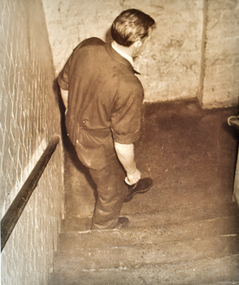 National Wool Museum
Photograph - Returned Sailors and Soldiers Mill, Norm Holroyd, 1960's - 1970's
... home for private viewing. The Returned Sailors and Soldiers Woollen Mill operated as a self-sufficient co-operative, funded and run by World War I veterans using their War Gratuity Bonds. The facility functioned as a complete raw-to-finished assembly line where raw fleece was brought on-site to be scoured, carded, dyed, spun into yarn and woven. ...home for private viewing. The Returned Sailors and Soldiers Woollen Mill operated as a self-sufficient co-operative, funded and run by World War I veterans using their War Gratuity Bonds. The facility functioned as a complete raw-to-finished assembly line where raw fleece was brought on-site to be scoured, carded, dyed, spun into yarn and woven. ...One of thirty eight photographs from a photo album featuring images of the Returned Sailors and Soldiers Woollen Mill in Newtown, Geelong. The images were taken between the 1960's-1970's by Norm Holroyd who worked at the mills. They were developed in his own private dark room and kept at his home for private viewing. The Returned Sailors and Soldiers Woollen Mill operated as a self-sufficient co-operative, funded and run by World War I veterans using their War Gratuity Bonds. The facility functioned as a complete raw-to-finished assembly line where raw fleece was brought on-site to be scoured, carded, dyed, spun into yarn and woven. It specialised in heavy worsted cloths, high-quality tweed, and its signature "Retsol" and "Monarch" pure-wool travelling rugs, later adapting its machinery to blend natural wool with artificial fibres as mid-century market demands shifted.Black and white photograph attached to cardboard backing with sticky tape. Image shows a man walking down a stairwell. Backing card has four holes in left side.back: [handwritten] 15r. s. & s mill, returned sailors and soldiers mill, newtown, geelong, world war i, soldiers, veterans, co-operative, textile industry, woollen mills, wool, worsted cloth, tweed, retsol, monarch, travel rugs, machinery, factory, working life, norm holroyd, photo album, photography, design, fabric -
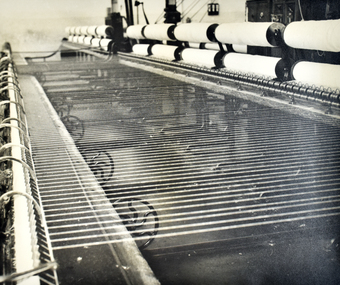 National Wool Museum
Photograph - Loom, Returned Sailors and Soldiers Mill, Norm Holroyd, 1960's - 1970's
... home for private viewing. The Returned Sailors and Soldiers Woollen Mill operated as a self-sufficient co-operative, funded and run by World War I veterans using their War Gratuity Bonds. The facility functioned as a complete raw-to-finished assembly line where raw fleece was brought on-site to be scoured, carded, dyed, spun into yarn and woven. ...home for private viewing. The Returned Sailors and Soldiers Woollen Mill operated as a self-sufficient co-operative, funded and run by World War I veterans using their War Gratuity Bonds. The facility functioned as a complete raw-to-finished assembly line where raw fleece was brought on-site to be scoured, carded, dyed, spun into yarn and woven. ...One of thirty eight photographs from a photo album featuring images of the Returned Sailors and Soldiers Woollen Mill in Newtown, Geelong. The images were taken between the 1960's-1970's by Norm Holroyd who worked at the mills. They were developed in his own private dark room and kept at his home for private viewing. The Returned Sailors and Soldiers Woollen Mill operated as a self-sufficient co-operative, funded and run by World War I veterans using their War Gratuity Bonds. The facility functioned as a complete raw-to-finished assembly line where raw fleece was brought on-site to be scoured, carded, dyed, spun into yarn and woven. It specialised in heavy worsted cloths, high-quality tweed, and its signature "Retsol" and "Monarch" pure-wool travelling rugs, later adapting its machinery to blend natural wool with artificial fibres as mid-century market demands shifted.Black and white photograph attached to cardboard backing with sticky tape. Image shows detail of a loom. Backing card has four holes in left side.back: [handwritten] 13r. s. & s mill, returned sailors and soldiers mill, newtown, geelong, world war i, soldiers, veterans, co-operative, textile industry, woollen mills, wool, worsted cloth, tweed, retsol, monarch, travel rugs, machinery, factory, working life, norm holroyd, photo album, photography, design, fabric -
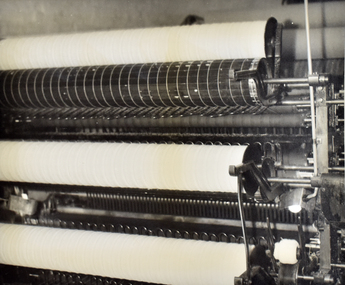 National Wool Museum
Photograph - Wool Processing, Returned Sailors and Soldiers Mill, Norm Holroyd, 1960's - 1970's
... home for private viewing. The Returned Sailors and Soldiers Woollen Mill operated as a self-sufficient co-operative, funded and run by World War I veterans using their War Gratuity Bonds. The facility functioned as a complete raw-to-finished assembly line where raw fleece was brought on-site to be scoured, carded, dyed, spun into yarn and woven. ...home for private viewing. The Returned Sailors and Soldiers Woollen Mill operated as a self-sufficient co-operative, funded and run by World War I veterans using their War Gratuity Bonds. The facility functioned as a complete raw-to-finished assembly line where raw fleece was brought on-site to be scoured, carded, dyed, spun into yarn and woven. ...One of thirty eight photographs from a photo album featuring images of the Returned Sailors and Soldiers Woollen Mill in Newtown, Geelong. The images were taken between the 1960's-1970's by Norm Holroyd who worked at the mills. They were developed in his own private dark room and kept at his home for private viewing. The Returned Sailors and Soldiers Woollen Mill operated as a self-sufficient co-operative, funded and run by World War I veterans using their War Gratuity Bonds. The facility functioned as a complete raw-to-finished assembly line where raw fleece was brought on-site to be scoured, carded, dyed, spun into yarn and woven. It specialised in heavy worsted cloths, high-quality tweed, and its signature "Retsol" and "Monarch" pure-wool travelling rugs, later adapting its machinery to blend natural wool with artificial fibres as mid-century market demands shifted.Black and white photograph attached to cardboard backing with sticky tape. Image shows detail of wool processing machinery. Backing card has four holes in left side.back: [handwritten] 12r. s. & s mill, returned sailors and soldiers mill, newtown, geelong, world war i, soldiers, veterans, co-operative, textile industry, woollen mills, wool, worsted cloth, tweed, retsol, monarch, travel rugs, machinery, factory, working life, norm holroyd, photo album, photography, design, fabric -
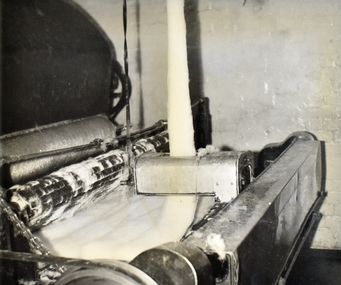 National Wool Museum
Photograph - Wool Processing, Returned Sailors and Soldiers Mill, Norm Holroyd, 1960's - 1970's
... home for private viewing. The Returned Sailors and Soldiers Woollen Mill operated as a self-sufficient co-operative, funded and run by World War I veterans using their War Gratuity Bonds. The facility functioned as a complete raw-to-finished assembly line where raw fleece was brought on-site to be scoured, carded, dyed, spun into yarn and woven. ...home for private viewing. The Returned Sailors and Soldiers Woollen Mill operated as a self-sufficient co-operative, funded and run by World War I veterans using their War Gratuity Bonds. The facility functioned as a complete raw-to-finished assembly line where raw fleece was brought on-site to be scoured, carded, dyed, spun into yarn and woven. ...One of thirty eight photographs from a photo album featuring images of the Returned Sailors and Soldiers Woollen Mill in Newtown, Geelong. The images were taken between the 1960's-1970's by Norm Holroyd who worked at the mills. They were developed in his own private dark room and kept at his home for private viewing. The Returned Sailors and Soldiers Woollen Mill operated as a self-sufficient co-operative, funded and run by World War I veterans using their War Gratuity Bonds. The facility functioned as a complete raw-to-finished assembly line where raw fleece was brought on-site to be scoured, carded, dyed, spun into yarn and woven. It specialised in heavy worsted cloths, high-quality tweed, and its signature "Retsol" and "Monarch" pure-wool travelling rugs, later adapting its machinery to blend natural wool with artificial fibres as mid-century market demands shifted.Black and white photograph attached to cardboard backing with sticky tape. Image shows detail of wool processing machinery. Backing card has four holes in left side.back: [handwritten] 11r. s. & s mill, returned sailors and soldiers mill, newtown, geelong, world war i, soldiers, veterans, co-operative, textile industry, woollen mills, wool, worsted cloth, tweed, retsol, monarch, travel rugs, machinery, factory, working life, norm holroyd, photo album, photography, design, fabric -
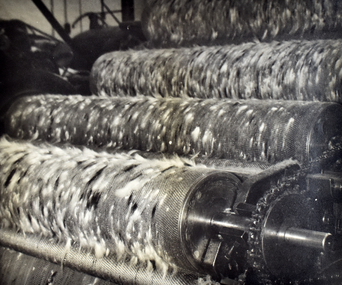 National Wool Museum
Photograph - Wool Processing, Returned Sailors and Soldiers Mill, Norm Holroyd, 1960's - 1970's
... home for private viewing. The Returned Sailors and Soldiers Woollen Mill operated as a self-sufficient co-operative, funded and run by World War I veterans using their War Gratuity Bonds. The facility functioned as a complete raw-to-finished assembly line where raw fleece was brought on-site to be scoured, carded, dyed, spun into yarn and woven. ...home for private viewing. The Returned Sailors and Soldiers Woollen Mill operated as a self-sufficient co-operative, funded and run by World War I veterans using their War Gratuity Bonds. The facility functioned as a complete raw-to-finished assembly line where raw fleece was brought on-site to be scoured, carded, dyed, spun into yarn and woven. ...One of thirty eight photographs from a photo album featuring images of the Returned Sailors and Soldiers Woollen Mill in Newtown, Geelong. The images were taken between the 1960's-1970's by Norm Holroyd who worked at the mills. They were developed in his own private dark room and kept at his home for private viewing. The Returned Sailors and Soldiers Woollen Mill operated as a self-sufficient co-operative, funded and run by World War I veterans using their War Gratuity Bonds. The facility functioned as a complete raw-to-finished assembly line where raw fleece was brought on-site to be scoured, carded, dyed, spun into yarn and woven. It specialised in heavy worsted cloths, high-quality tweed, and its signature "Retsol" and "Monarch" pure-wool travelling rugs, later adapting its machinery to blend natural wool with artificial fibres as mid-century market demands shifted.Black and white photograph attached to cardboard backing with sticky tape. Image shows detail of wool processing machinery. Backing card has four holes in left side.back: [handwritten] 10r. s. & s mill, returned sailors and soldiers mill, newtown, geelong, world war i, soldiers, veterans, co-operative, textile industry, woollen mills, wool, worsted cloth, tweed, retsol, monarch, travel rugs, machinery, factory, working life, norm holroyd, photo album, photography, design, fabric -
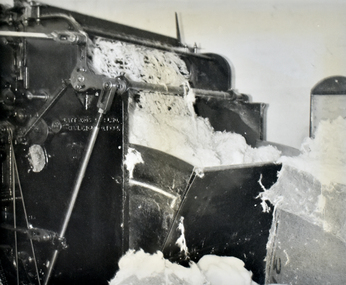 National Wool Museum
Photograph - Returned Sailors and Soldiers Mill, Norm Holroyd, 1960's - 1970's
... home for private viewing. The Returned Sailors and Soldiers Woollen Mill operated as a self-sufficient co-operative, funded and run by World War I veterans using their War Gratuity Bonds. The facility functioned as a complete raw-to-finished assembly line where raw fleece was brought on-site to be scoured, carded, dyed, spun into yarn and woven. ...home for private viewing. The Returned Sailors and Soldiers Woollen Mill operated as a self-sufficient co-operative, funded and run by World War I veterans using their War Gratuity Bonds. The facility functioned as a complete raw-to-finished assembly line where raw fleece was brought on-site to be scoured, carded, dyed, spun into yarn and woven. ...One of thirty eight photographs from a photo album featuring images of the Returned Sailors and Soldiers Woollen Mill in Newtown, Geelong. The images were taken between the 1960's-1970's by Norm Holroyd who worked at the mills. They were developed in his own private dark room and kept at his home for private viewing. The Returned Sailors and Soldiers Woollen Mill operated as a self-sufficient co-operative, funded and run by World War I veterans using their War Gratuity Bonds. The facility functioned as a complete raw-to-finished assembly line where raw fleece was brought on-site to be scoured, carded, dyed, spun into yarn and woven. It specialised in heavy worsted cloths, high-quality tweed, and its signature "Retsol" and "Monarch" pure-wool travelling rugs, later adapting its machinery to blend natural wool with artificial fibres as mid-century market demands shifted.Black and white photograph showing machinery processing wool.r. s. & s mill, returned sailors and soldiers mill, newtown, geelong, world war i, soldiers, veterans, co-operative, textile industry, woollen mills, wool, worsted cloth, tweed, retsol, monarch, travel rugs, machinery, factory, working life, norm holroyd, photo album, photography, design, fabric -
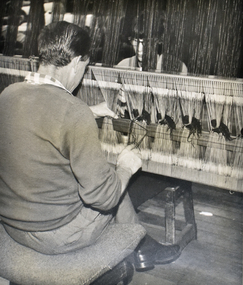 National Wool Museum
Photograph - Loom, Returned Sailors and Soldiers Mill, Norm Holroyd, 1960's - 1970's
... home for private viewing. The Returned Sailors and Soldiers Woollen Mill operated as a self-sufficient co-operative, funded and run by World War I veterans using their War Gratuity Bonds. The facility functioned as a complete raw-to-finished assembly line where raw fleece was brought on-site to be scoured, carded, dyed, spun into yarn and woven. ...home for private viewing. The Returned Sailors and Soldiers Woollen Mill operated as a self-sufficient co-operative, funded and run by World War I veterans using their War Gratuity Bonds. The facility functioned as a complete raw-to-finished assembly line where raw fleece was brought on-site to be scoured, carded, dyed, spun into yarn and woven. ...One of thirty eight photographs from a photo album featuring images of the Returned Sailors and Soldiers Woollen Mill in Newtown, Geelong. The images were taken between the 1960's-1970's by Norm Holroyd who worked at the mills. They were developed in his own private dark room and kept at his home for private viewing. The Returned Sailors and Soldiers Woollen Mill operated as a self-sufficient co-operative, funded and run by World War I veterans using their War Gratuity Bonds. The facility functioned as a complete raw-to-finished assembly line where raw fleece was brought on-site to be scoured, carded, dyed, spun into yarn and woven. It specialised in heavy worsted cloths, high-quality tweed, and its signature "Retsol" and "Monarch" pure-wool travelling rugs, later adapting its machinery to blend natural wool with artificial fibres as mid-century market demands shifted.Black and white photograph attached to cardboard backing with sticky tape. Image shows a man working at a loom. Backing card has four holes in left side.back: [handwritten] 23r. s. & s mill, returned sailors and soldiers mill, newtown, geelong, world war i, soldiers, veterans, co-operative, textile industry, woollen mills, wool, worsted cloth, tweed, retsol, monarch, travel rugs, machinery, factory, working life, norm holroyd, photo album, photography, design, fabric
