
Showing 26 items matching "honours system"
-
 The Beechworth Burke Museum
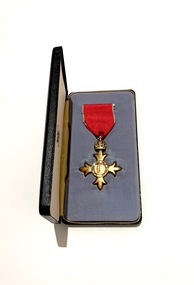
Medal - Order of the British Empire Medal, 01/01/1976
... ...british honours system...Together, they were a formidable asset to the Beechworth community over many years The British honours system has various orders, usually relating to the monarchy, military and colonial officials. ...Together, they were a formidable asset to the Beechworth community over many years The British honours system has various orders, usually relating to the monarchy, military and colonial officials. ...David Aloysius Patrick McKenzie-McHarg, L.I.B, O.B.E was born on 20th June 1918 in Albury, NSW to Hugh Patrick McKenzie-McHarg and Laura May (Dunne) McKenzie-McHarg. McKenzie-McHarg served on the Council of the United Shire of Beechworth for more than a decade during the 1960s-70s, including seven years as president. He was renowned as a public speaker and played a significant role in the community. In recognition for his outstanding achievements and services rendered to the Beechworth community he was awarded an Order of the British Empire (OBE) in 1976. David McKenzie-McHarg died on 6th June 1992 and is buried in Beechworth Cemetery. David McKenzie-McHarg’s wife, Marjorie Jean McKenzie McHarg, was well known to the Beechworth community as a brilliant pianist and played at all the balls and house parties. Apparently, she could play without sheet-music and would only have to hear a tune once to play it to near perfection. Together, they were a formidable asset to the Beechworth community over many years The British honours system has various orders, usually relating to the monarchy, military and colonial officials. An OBE (or order of the British Empire) is given for an outstanding achievement or service to the community. This will have had a long-term, significant impact and stand out as an example to others. This Order was established by George V in 1917 in response to recognising the thousands of men and women who served in a variety of non-combatant roles during the First world war who didn’t otherwise receive any formal recognition but were certainly worthy of acknowledgement. Recommendations for appointments to this Order were originally made on the nomination of the United Kingdom, however this soon became available to Commonwealth countries as well. However, Australia officially ceased to recommend the Order of the British Empire in 1989 with the establishment of the Order of Australia. Silver badge suspended from red ribbon with pearl-grey edges. The badge is in the form of a cross patonce (having the arms growing broader and floriated toward the end), the obverse of which bears the same field as the star pictures George V and Queen Mary. The reverse bears George V's Royal and Imperial Cypher. Both are within a ring bearing the motto of the Order: FOR GOD AND THE EMPIRE. The presentation case in which the medal is housed is of a black outer boarder edge leatherette finishing, block letters in gold OBE. The inside has a cream velvet base with a silk padded liner to the roof with the full set of Royal Mint Crest Mark. Obverse: FOR GOD AND THE EMPIRE / burke museum, obe, obe medal, beechworth, david mckenzie-mcharg, british honours system, george v, beechworth community, order of australia., order of the british empire, marjorie jean mckenzie mcharg -
 Box Hill Historical Society
Book, Information Australia, Who's Who in Australia - 1993, 1993
... ...Honours System...List of honours recipients and background information on decoration and honours systems. Photographs of Australian decorations. ...An Australian biographical dictionary and register of prominent people, including state and federal members of parliament and top research and teaching professionals. List of honours recipients and background information on decoration and honours systems. Photographs of Australian decorations.An Australian biographical dictionary and register of prominent people, including state and federal members of parliament and top research and teaching professionals. List of honours recipients and background information on decoration and honours systems. Photographs of Australian decorations.biographies, honours system, peerage, baronetage, parliament, awards, armed forces -
Box Hill Historical Society
Book, Information Australia, Who's Who in Australia - 1994, 1994
... ...Honours System...List of honours recipients and background information on decoration and honours systems. Photographs of Australian decorations. ...An Australian biographical dictionary and register of prominent people, including state and federal members of parliament and top research and teaching professionals. List of honours recipients and background information on decoration and honours systems. Photographs of Australian decorations.An Australian biographical dictionary and register of prominent people, including state and federal members of parliament and top research and teaching professionals. List of honours recipients and background information on decoration and honours systems. Photographs of Australian decorations.biographies, honours system, peerage, baronetage, parliament, awards, armed forces -
Box Hill Historical Society
Book, Information Australia, Who's Who in Australia - 1995, 1995
... ...Honours System...List of honours recipients and background information on decoration and honours systems. Photographs of Australian decorations. ...An Australian biographical dictionary and register of prominent people, including state and federal members of parliament and top research and teaching professionals. List of honours recipients and background information on decoration and honours systems. Photographs of Australian decorations.An Australian biographical dictionary and register of prominent people, including state and federal members of parliament and top research and teaching professionals. List of honours recipients and background information on decoration and honours systems. Photographs of Australian decorations.biographies, honours system, peerage, baronetage, parliament, awards, armed forces -
Box Hill Historical Society
Book, Information Australia, Who's Who in Australia - 1996, 1996
... ...Honours System...List of honours recipients and background information on decoration and honours systems. Photographs of Australian decorations. ...An Australian biographical dictionary and register of prominent people, including state and federal members of parliament and top research and teaching professionals. List of honours recipients and background information on decoration and honours systems. Photographs of Australian decorations.An Australian biographical dictionary and register of prominent people, including state and federal members of parliament and top research and teaching professionals. List of honours recipients and background information on decoration and honours systems. Photographs of Australian decorations.biographies, honours system, peerage, baronetage, parliament, awards, armed forces -
Box Hill Historical Society
Book, Information Australia, Who's Who in Australia - 1997, 1997
... ...Honours System...List of honours recipients and background information on decoration and honours systems. Photographs of Australian decorations. ...An Australian biographical dictionary and register of prominent people, including state and federal members of parliament and top research and teaching professionals. List of honours recipients and background information on decoration and honours systems. Photographs of Australian decorations.An Australian biographical dictionary and register of prominent people, including state and federal members of parliament and top research and teaching professionals. List of honours recipients and background information on decoration and honours systems. Photographs of Australian decorations.biographies, honours system, peerage, baronetage, parliament, awards, armed forces -
Box Hill Historical Society
Book, Information Australia, Who's Who in Australia - 1962, 1962
... ...Honours System...Biographies Honours System Peerage Baronetage Parliament Awards Armed forces An Australian biographical dictionary and register of prominent people, including state and federal members of parliament and top research and teaching professionals. ...An Australian biographical dictionary and register of prominent people, including state and federal members of parliament and top research and teaching professionals. List of honours recipients and background information on decoration and honours systems. Photographs of Australian decorations.959p; includes photosAn Australian biographical dictionary and register of prominent people, including state and federal members of parliament and top research and teaching professionals. List of honours recipients and background information on decoration and honours systems. Photographs of Australian decorations.biographies, honours system, peerage, baronetage, parliament, awards, armed forces -
Box Hill Historical Society
Book, Information Australia, Who's Who in Australia - 1985, 1985
... ...Honours System...List of honours recipients and background information on decoration and honours systems. Photographs of Australian decorations. ...An Australian biographical dictionary and register of prominent people, including state and federal members of parliament and top research and teaching professionals. List of honours recipients and background information on decoration and honours systems. Photographs of Australian decorations.An Australian biographical dictionary and register of prominent people, including state and federal members of parliament and top research and teaching professionals. List of honours recipients and background information on decoration and honours systems. Photographs of Australian decorations.biographies, honours system, peerage, baronetage, parliament, awards, armed forces -
Box Hill Historical Society
Book, Information Australia, Who's Who in Australia - 1991, 1991
... ...Honours System...List of honours recipients and background information on decoration and honours systems. Photographs of Australian decorations. ...An Australian biographical dictionary and register of prominent people, including state and federal members of parliament and top research and teaching professionals. List of honours recipients and background information on decoration and honours systems. Photographs of Australian decorations.An Australian biographical dictionary and register of prominent people, including state and federal members of parliament and top research and teaching professionals. List of honours recipients and background information on decoration and honours systems. Photographs of Australian decorations.biographies, honours system, peerage, baronetage, parliament, awards, armed forces -
Box Hill Historical Society
Book, Information Australia, Who's Who in Australia - 1992, 1992
... ...Honours System...List of honours recipients and background information on decoration and honours systems. Photographs of Australian decorations. ...An Australian biographical dictionary and register of prominent people, including state and federal members of parliament and top research and teaching professionals. List of honours recipients and background information on decoration and honours systems. Photographs of Australian decorations.An Australian biographical dictionary and register of prominent people, including state and federal members of parliament and top research and teaching professionals. List of honours recipients and background information on decoration and honours systems. Photographs of Australian decorations.biographies, honours system, peerage, baronetage, parliament, awards, armed forces -
 Vision Australia
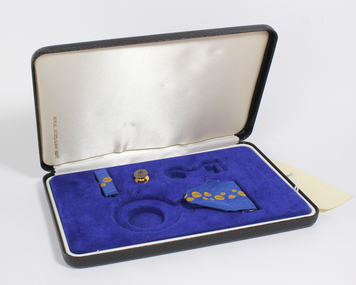
Medal - Object, Order of Australia medal : Member, 1981, 1995
... In 1975 the Australian Honours System was established, with the Member of the Order of Australia (AM) created to recognise the contribution for Australian citizens for outstanding service or achievement. ...In 1975 the Australian Honours System was established, with the Member of the Order of Australia (AM) created to recognise the contribution for Australian citizens for outstanding service or achievement. ...In 1975 the Australian Honours System was established, with the Member of the Order of Australia (AM) created to recognise the contribution for Australian citizens for outstanding service or achievement. It consists of a round medallion with gold-plated silver insignia with the word 'Australia' inscribed and surrounded by two sprigs of mimosa. Above the medallion sits the red Crown of St Edward which hangs from a royal blue band, with gold mimosa blossoms running down the middle. The box contains spaces for the ribbon, medal, a epaulette bar, a pin and a smaller medallion.1 illustrated ribbon, medal, a epaulette bar, a pin and a smaller medallion.Rear of medal is inscribed with recipient's name: John Oswald WICKING HAROLD HUGH JEFFREYmedals, john wicking, hugh jeffrey -
 Wangaratta RSL Sub Branch
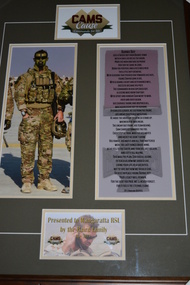
Mixed media - Framed Photograph, CAMS Cause
... Cameron Stewart Baird, VC, MG was a soldier in the Australian Army who was posthumously awarded the Victoria Cross for Australia, the highest award in the Australian honours system. Cameron enlisted on 4/1/2000 and was posted to the 4th Battalion (Commando) RAR now known as the 2nd Commando Regiment. ...Cameron Stewart Baird, VC, MG was a soldier in the Australian Army who was posthumously awarded the Victoria Cross for Australia, the highest award in the Australian honours system. Cameron enlisted on 4/1/2000 and was posted to the 4th Battalion (Commando) RAR now known as the 2nd Commando Regiment. ...Cameron Stewart Baird, VC, MG was a soldier in the Australian Army who was posthumously awarded the Victoria Cross for Australia, the highest award in the Australian honours system. Cameron enlisted on 4/1/2000 and was posted to the 4th Battalion (Commando) RAR now known as the 2nd Commando Regiment. He was deployed on 7 operations including Operation TANAGER - Timor Leste in 2001 Operation BASTILLE and FALCONER - Iraq in 2003. Cameron resigned from the ADF in 2004 re enlisting in 2006 and again posted to 2nd Commando Regiment. In 2007 he was promoted to Lance Corporal and deployed on Operation SLIPPER - Afghanistan. He was awarded the Medal for Gallantry. In 2008 he was promoted to Corporal and deployed again on Operation SLIPPER in 2009 2011 and 2013. He was killed in action on 22 June 2013 and was posthumously awarded the VC for his actions in the Khod Valley Uruzgan province AfghanistanCorporal Baird is the 100th Australian to receive a VC since the award was first created by Queen Victoria in 1856. Brown timber frame and dark green mount containing photograph of soldier alongside poem with image of Victoria Cross medal in backgroundCAMS Cause - Commando for Lifecameron baird, victoria cross, medal for gallantry -
 Lara RSL Sub Branch
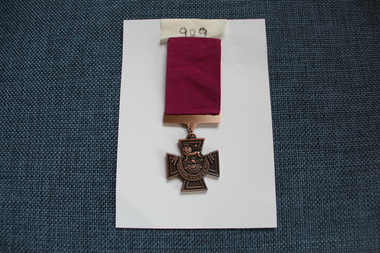
Medal VC (Copy), Victorian Cross Medal (Copy of), 2020
... The Victoria Cross for Australia is the highest award in the Australian Honours System, superseding the British Victoria Cross for issue to Australians. ...The Victoria Cross for Australia is the highest award in the Australian Honours System, superseding the British Victoria Cross for issue to Australians. ...A Copy of the Victoria Cross for display only purpose.Copy of Victoria Cross for Lara R.S.L. Display purposes only.Victoria Cross Medal with Red RibbonOn Reverse it a marking stating COPY. The Victoria Cross for Australia is the highest award in the Australian Honours System, superseding the British Victoria Cross for issue to Australians. The Victoria Cross for Australia is the "decoration for according recognition to persons who in the presence of the enemy, perform acts of the most conspicuous gallantry, or daring or pre-eminent acts of valour or self-sacrifice or display extreme devotion to duty. The Victoria Cross for Australia was created by letters patent signed by Elizabeth II, Queen of Australia, on 15 January 1991. It is listed equal first with the British Victoria Cross on the Australian Order of Wear with precedence in Australia over all orders, decorations and medals. The decoration may be awarded to members of the Australian Defence Force and to other persons determined by the Australian Minister for Defence.] A person to whom the Victoria Cross for Australia has been awarded is entitled to the post nominals VC placed after the person's name.copy of victoria cross -
 Ballarat RSL Sub-Branch Inc.
Australian Service Medal 1939-1945
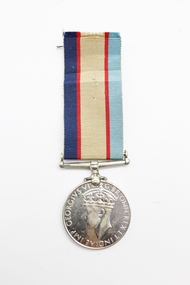
... Created by King Geroge IV, this was the first distinctive Australian medal in the British system of honours and awards....Created by King Geroge IV, this was the first distinctive Australian medal in the British system of honours and awards. medallion medal australian service medal service medal ww2 world war two Medallion attached to a navy blue, light blue, red and beige striped ribbon. ...The Australian Service Medal 1939-1945 was awarded to armed Australian forces and volunteer defence corps for their service during WWII. Created by King Geroge IV, this was the first distinctive Australian medal in the British system of honours and awards.Medallion attached to a navy blue, light blue, red and beige striped ribbon. The medallion depicts an effigy of King George IV of Great Britain and the commonwealth with the words: "GEORGE IV S VI (obscured component) G. BR. OMN. REX ET INDIAE IMP" in relief on one side. The others side depicts the Australian Coat of Arms and the words: "The AUSTRALIA SERVICE MEDAL 1939-1945".medallion, medal, australian service medal, service medal, ww2, world war two -
 Bendigo Historical Society Inc.
Document - PETER ELLIS COLLECTION: LETTER TO PETER ELLIS
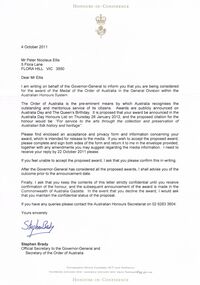
... Dear Mr Ellis I am writing on behalf of the Governor-General to inform you that you are being considered for the award of the Medal of the Order of Australia in the General Division within the Australian Honours System. The Order of Australia is the pre-eminent means by which Australia recognises the outstanding and meritorious service of its citizens. ...Dear Mr Ellis I am writing on behalf of the Governor-General to inform you that you are being considered for the award of the Medal of the Order of Australia in the General Division within the Australian Honours System. The Order of Australia is the pre-eminent means by which Australia recognises the outstanding and meritorious service of its citizens. ...Letter written to Peter Ellis from Stephen Brady Official Secretary to the Governor-General and Secretary of the Order of Australia. Dated 4 October 2011. Honours-in-Confidence. Mr Peter Nicolaus Ellis 5 Flora Lane Flora Hill Vic 3550. Dear Mr Ellis I am writing on behalf of the Governor-General to inform you that you are being considered for the award of the Medal of the Order of Australia in the General Division within the Australian Honours System. The Order of Australia is the pre-eminent means by which Australia recognises the outstanding and meritorious service of its citizens. Awards are publicly announced on Australia Day and The Queen's Birthday. It is proposed that your award be announced in the Australia Day Honours List on Thursday 26 January 2012, and the proposed citation for the honour would be: 'For service to the arts through the collection and preservation of Australian folk history and heritage'. Please find enclosed an acceptance and privacy form and information concerning your award, which is intended for release to the media. If you wish to accept the proposed award, please complete and sign both sides of the form and return it to me in the envelope provided, together with any amendments you may suggest regarding the media information. I need to receive your reply by 22 October 2011 please. If you feel unable to accept the proposed award, I ask that you please confirm this in writing. After the Governor-General has considered all the proposed awards, I shall advise you of the outcome prior to the announcement date. Finally, I ask that you keep the contents of this letter strictly confidential until you receive confirmation of the honour, and the subsequent announcement of the award is made in the Commonwealth of Australia Gazette. In the event that you decline the award, I would ask that you maintain the confidential status of the proposal. If you have any queries please contact the Australian Honours Secretariat on 02 6283 3604. Yours sincerely Stephen Brady Official Secretary to the Governor-General and Secretary of the Order of Australia. Government House Canberra, ACT 2600 Australia telephone (02) 6283 3533 Facsimile (02) 62833620 Email [email protected] Honours-in-confidenceperson, individual, peter ellis oam -
 Waverley RSL Sub Branch
R.A.A.F. Long Service Medal
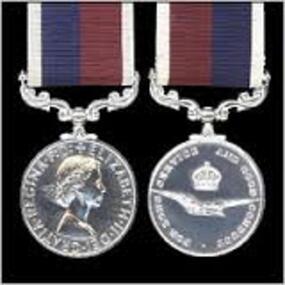
... This medal ceased to be awarded in Australia in 1975 when it was replaced by the National Medal (and sbsequently the DFSM and DLSM) in the Australian system of honours and awards. http://www.heritagemedals.com.au/medals-1/service-long-service/air-force-long-service-and-good-conduct-medal.html ...This medal ceased to be awarded in Australia in 1975 when it was replaced by the National Medal (and sbsequently the DFSM and DLSM) in the Australian system of honours and awards. http://www.heritagemedals.com.au/medals-1/service-long-service/air-force-long-service-and-good-conduct-medal.html History of the RAAF Dental Branch It took six years following the formation of the RAAF in 1921 for the first Dental Clinic to be established at Point Cook, Victoria. ...Awarded to Alan Bowers (A236814) who was a R.A.A.F. dental mechanic who serverd during WWII including service in Darwin, and then continued in the R.A.A.F. for some years after the end of WWII The Royal Australian Air Force (and all Commonwealth Air Forces) Long Service and Good Conduct Medal: Awarded to NCOs and ORs of the RAAF (RAF, RCAF etc) for 15 years service. A cupro-nickel plated medal, the obverse features the sovereign's head, the reverse features the crown and eagle emblem of the RAAF (and RAF). Officers are eligible for the award provided they have served a minimum 12 years in the ranks. The riband is dark blue and maroon with white edges. This medal ceased to be awarded in Australia in 1975 when it was replaced by the National Medal (and sbsequently the DFSM and DLSM) in the Australian system of honours and awards. http://www.heritagemedals.com.au/medals-1/service-long-service/air-force-long-service-and-good-conduct-medal.html History of the RAAF Dental Branch It took six years following the formation of the RAAF in 1921 for the first Dental Clinic to be established at Point Cook, Victoria. On 10th June 1927 Flying Officer James Carl Rosenbrock commenced work as an RAAF Dental Officer for the FlyingTraining School at Point Cook. As personnel numbers were still relatively small, Rosenbrock was also responsible for the dental care of all Victorian RAAF units, which involved treating members at 1AD Laverton, as well as Air Force Headquarters at Victoria Barracks in Melbourne. As Army Dental Officers were currently caring for RAAF personnel at Richmond, NSW, the Senior Dental Officer of the 3rd Military District in Victoria (SDO 3MD) requested through the military board that a similar arrangement be established, where that the newly appointed RAAF Dentist provide part time dental services to the Army units stationed at Queenscliff. This was seen as an effective reciprocal arrangement, with both units having a Dental Officer in attendance for, in total, around 3-4 weeks a year. Rosenbrock continued to serve as the sole RAAF Dental Officer until the middle of 1933, when the Air Board asked for his service to be terminated following ‘behaviour unbecoming of a RAAF officer'. He had borrowed several sums of money, of around 40 Pounds or so, from junior ranks on base (as well as from the Regimental Sergeant Major) and had failed to pay the money back. He was replaced by a fellow Victorian, FLGOFF Norman Henry Andrews, on the 18th Sep 1933, who went on to become our first Director of Dental Services, and was instrumental in establishing the organisations and conditions of the Branch that are still present today. Through a fair amount of persistence and hard work on the part of Norman Andrews, the RAAF Dental Branch began to expand from 1937, with the introduction of 2 additional positions, at RAAF station Richmond, and at the FlyingTraining School at Point Cook. This gave the RAAF 3 uniformed Dental Officers, which was expanded to 5 in the months leading up to WW2. 4 of these Dental Officers were based in Victoria and 1 at Richmond, with the other two RAAF units being cared for by the Army (as in the case of Pearce in WA) or by civilians (as in Darwin). With the sudden increase in RAAF personnel required at the outbreak of WW2, the number of RAAF Dental Officers increased dramatically, from 5 in 1939, 28 in 1940, 64 in 1941, 147 in 1942, 193 in 1943, 219 in 1944, and peaking at 227 in 1945. RAAF Dental Officers were required to work in a variety of locations, both in and out of Australia. Between 1940 and 1942 a massive construction programme occurred, with new dental clinics being established around Australia. Priority was given to aircrew training units in order to get these personnel dentally fit for operational deployment, but Dental Officers could equally find themselves posted to recruit depots, fixed stations, medical clearance stations, mobile dental sections, and RAAF and civilian hospitals. RAAF Dental Officers were posted to the large dental centres at Ascot Vale (Vic) and Bradfield Park (NSW) when first appointed, where they received military and clinical training, before being deployed to their needed location. Mobile Dental Units When Japan entered the war in 1941, the rapid deployment of troops to northern operational areas with less than ideal dental fitness was extremely high. As a result, the RAAF deployed a range of mobile dental units, either alone or with medical sections, to support the increasing number of isolated deployed personnel within Australia and overseas. There were three types of mobile unit used: a. Mobile Dental Unit – relied on using either a semi-trailer to get around or by building a surgery directly on to the truck chassis, and installing hydraulic chairs, units, x-rays, and laboratory equipment. They were able to move around between small units, such as RAAF radar stations, where they could plug into the local power supply and work immediately. b. Transportable Dental Units – used for stops of longer duration, where field equipment was carried in panniers from one unit to another by road or rail and housed in whatever accommodation was available at the destination. They were often carried within Australia on Tiger Moths and Dakota aircraft. c. Itinerant Dental Units – in some areas, the dental equipment was installed at the RAAF unit and the Dental Officer and their staff would travel from unit to unit, using the equipment available at each location. RAAF Dental BadgeAs the war developed in Europe, it soon became obvious that the RAF Dental support was not capable of supporting the increasing numbers of RAAF aircrew that were being sent for service with the RAF, with only enough Dental Officers available to provide one to every 2000 men ( instead of the preferred 1 to 600). As a result, the RAAF provided a mobile dental unit, fitted out in a caravan and pulled by a Ford V8 Coupe, to travel around England in support of RAAF personnel at various squadrons. Some degree of tact was needed to ensure that the RAF did not take this as a comment on the treatment they were providing, but it proved successful in maintaining a satisfactory state of dental fitness in RAAF personnel, and a second mobile unit was soon dispatched. They were also set up with a laboratory on board as well as the surgery, which was a major difference between the RAF and RAAF, as the RAF did not provide dentures for their troops (the RAAF would, providing they had served for 6 years). In 1943 the RAF was no longer able to provide Dental support to Australian troops in the Middle East, which resulted in the need for a transportable dental unit to be deployed from Australia. It functioned in a similar manner to the RAF, by moving from one squadron to another. It served in the Middle East and Africa, from Cairo across North Africa, to Italy, and eventually back to England to treat returned prisoners of war. GPCAPT Norman Andrews The growth and development of the RAAF Dental Branch owes a debt to one man in particular, GPCAPT Norman Andrews. As the second RAAF Dental Officer to enlist on 18 Sep 1933, Andrews became the principal architect of the structure and organisation of the RAAF Dental Branch leading up to and during WW2. Until early 1940, the RAAF Dental Branch was administered by the Director of Medical Services (Air), which placed it under the control of the Army Medical staff. The Army would provide their Inspector of Dental Services for advice whenever needed. In April 1940, the RAAF Medical service separated from the Army, resulting in the control of the RAAF Dental Branch shifting back to the RAAF. Andrews became the first Director of Dental Services, when the position was created in 1943 as recognition of the higher profile the Dental Branch was now playing in the RAAF Medical service. Until this time, Andrews's title had been as the Dental Staff Officer to the RAAF Medical Service. Andrews was responsible for the establishment of the war-time structure of the Dental service, establishing new dental centres at all major bases, creating mobile and transportable dental units, ensuring the continual growth of the Branch, maintaining professional development of staff through the establishment of a professional journal, and by organising renowned lecturers to speak at RAAF bases. He also believed in visiting as many dental units as possible to see for himself what conditions were like and to talk first-hand to staff in remote units. His itinerary during the war years, both in and out of Australia, shows a large number of trips in a variety of modes of transport in order to reach remote areas where units were serving. He was promoted to GPCAPT in July 1944, as the numbers of Dental Officers soon peaked at 227 towards the end of the war (1 GPCAPT, 9 WGCDRs, 60 SQNLDRs, and 157 FLTLTs). After the war, with the reduction in RAAF personnel required in uniform, the Dental Branch also reduced its numbers significantly. By 1947 there were only 18 Dental Officers serving (many part-time), with 1 GPCAPT, 1 WGCDR, 10 SQNLDRs, and 6 FLTLTs, and only 13 by 1950. With the decrease in Branch personnel numbers, the ‘powers to be' saw fit to reduce the Director of Dental Service rank to WGCDR, and as a result Norman Andrews found that in order to continue serving in the RAAF he would have to wear a reduced rank. This appears to have been a contributing factor in his decision to discharge at the relatively early age of 43 and accept an administrative job as Director of the Victorian Government's School Dental Service. Norman Andrews holds the proud honour of being the founder of the RAAF Dental Branch, which during the war was instrumental in educating servicemen of the importance of dental health and maintaining the dental fitness of troops in a variety of areas. Dental Orderlies (Assistants) The dental orderly mustering was first introduced in 1937. Until that time, medical orderlies were assigned to assist the Dental officer with their duties. As early as 1931 it had been noted by both RAAF and Army Dental Officers working in Victoria and Richmond that a lot of the troubles they were having would be solved by appointing a permanent Dental Orderly. Often they would find that the medical orderly they were assigned was a different one each day, and as a result the administration and work in general was very inefficient. By 1937, with the increase in Dental Officers to 3, it was realised that a Dental Orderly mustering needed to be created. Dental Mechanics/Technicians Before WW2, dental laboratory work was provided by civilian laboratories, as most RAAF units were stationed around metropolitan areas. At this time, service personnel were still required to pay for their own dentures, unless they had served for six years or had their dentures damaged during performance of their duties. In July 1940, mainly in response to the development of more remote RAAF dental units and the increasing demand for dental prostheses, the Dental Mechanic mustering was established. Unfortunately there was a very limited pool of civilian dental mechanics to recruit from, and as a result the RAAF set up a training school at Laverton (which was later moved to Ascot Vale) in June 1941 which conducted an intensive 6 month course in Dental mechanics. Dental mechanics were quickly in demand. In all fixed and mobile dental units at least 1 Mechanic was supplied for each Dental Officer, and indeed the RAAF supplied Dental Mechanics throughout all its deployments, something the RAF were unwilling, or unable, to do. Two grades of dental mechanic existed: the Senior Mechanic (with the rank of NCO), who was competent in all phases of laboratory work; and the Junior Mechanic, who could only handle routine work and not more advanced denture work. The progression to Senior required a further trade test in techniques including setting up, clasp-forming, casting and backing teeth. During the course of the War, two special courses were held for Mechanics. The first, directed at senior mechanics so that they could instruct others, was in 1942 when Acrylic Resin was first introduced as a denture base material, as an alternative to the current option of vulcanite. Later, towards the end of the War, a ‘refresher' course was provided for those that had served for the greatest period of time in order to allow them retraining in techniques that they had not practised during their service and which were common in civilian life. This included cast base dentures, crowns and bridges, partial dentures, and retainers. Towards the end of the War, a course was held with WAAAF trainees to train them as Mechanics. However, as the War was soon to end they never had the opportunity to progress within the mustering to become Senior Mechanics. The RAAF Dental Branch has survived 75 years of turbulence, with reviews of its viability occurring regularly every few years from as early as 1937. The Branch continues to provide excellent service to the ADF community and, despite reduced manpower, will continue to play an important role in Air Force Health operations. http://www.defence.gov.au/health/about/docs/RAAFDental.pdf40cm cupro-nickel plated medal, the obverse features the sovereign's head, the reverse features the crown and eagle emblem of the RAAF (and RAF). A23814 BOWERS.A. A. F.r.a.a.f long service medal, r.a.a.f good conduct, r.a.a.f. dental service medal -
 Mission to Seafarers Victoria
Book, Landers Publishing, The Significance of Ribbon Colours On Medals Worn Since 1815 by Australians, 2007
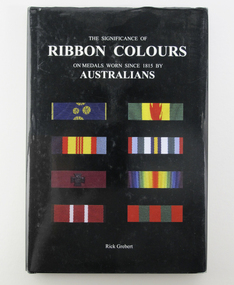
... This is the first publication that documents the significance of the colours chosen in the design of the ribbon supporting the medal. medals badges decorations australian army armed forces australia rick grebert ribbons This book covers British Orders, Decorations and Medals awarded to Australians, the Australian Honours system, United Nations and NATO Medals awarded to Australians, Foreign Orders, Decorations and Medals awarded to Australians, Association and other Unofficial Medals worn by Australians, and the Order of Wearing Australian Honours and Awards. ...This book covers British Orders, Decorations and Medals awarded to Australians, the Australian Honours system, United Nations and NATO Medals awarded to Australians, Foreign Orders, Decorations and Medals awarded to Australians, Association and other Unofficial Medals worn by Australians, and the Order of Wearing Australian Honours and Awards.This 136-page hard cover book with identical dust cover, written by Rick Grebert. The cover is black with the title and author's name printed in white and features a selection of eight medals worn by Australians. Includes bibliographical references (p. 127-129) and index. Back cover features a coloured photograph of Field Marshal Sir Thomas Blameynon-fictionThis book covers British Orders, Decorations and Medals awarded to Australians, the Australian Honours system, United Nations and NATO Medals awarded to Australians, Foreign Orders, Decorations and Medals awarded to Australians, Association and other Unofficial Medals worn by Australians, and the Order of Wearing Australian Honours and Awards.medals, badges, decorations, australian army, armed forces, australia, rick grebert, ribbons -
 Eltham District Historical Society Inc
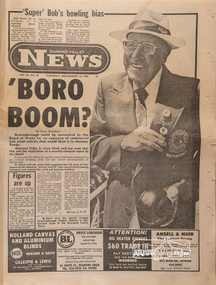
Newspaper, Diamond Valley News, 25 Nov 1980, 25 Nov 1980
... Possible explosion of commercial and retail activity at Greensborough Montmorency Bowling Club Rates Saturation limit When land values are a sore point Garbage Truck service – birds Lonie report on public transport recommended closing Eltham -Hurstbridge link Briar Hill Pre-School – vandalism Bills Up – Timber firm may close – Briar Hill Timber Company Controversy over DV tennis club lights Hurstbridge Primary School pets on parade Eltham District Cubs Yarrambat Plenty Waterworks Trust Plans for indoor pool complex at Hurstbridge Salvation Army Fair Montmorency Primary School Eltham Little Theatre Re-Zone application for shopping centre at Grimshaw St Greensborough 1st Grimshaw Cub pack (photo) Big sketch of and add for Greensborough Hotel p. 36 Green Valley – special section Carl Jensen – spiritualist and healer St Andrews Co-op – painter, potter, leather, woodwork and silver and paintings 10 years on after the introduction of the metric system New release – Diamond Hills Estate Greensborough Sewerage treatment plan Diamond Creek School honours its Olympian – Watsonia Primary School – Ian Campbell triple jump at Moscow Olympics ...Possible explosion of commercial and retail activity at Greensborough Montmorency Bowling Club Rates Saturation limit When land values are a sore point Garbage Truck service – birds Lonie report on public transport recommended closing Eltham -Hurstbridge link Briar Hill Pre-School – vandalism Bills Up – Timber firm may close – Briar Hill Timber Company Controversy over DV tennis club lights Hurstbridge Primary School pets on parade Eltham District Cubs Yarrambat Plenty Waterworks Trust Plans for indoor pool complex at Hurstbridge Salvation Army Fair Montmorency Primary School Eltham Little Theatre Re-Zone application for shopping centre at Grimshaw St Greensborough 1st Grimshaw Cub pack (photo) Big sketch of and add for Greensborough Hotel p. 36 Green Valley – special section Carl Jensen – spiritualist and healer St Andrews Co-op – painter, potter, leather, woodwork and silver and paintings 10 years on after the introduction of the metric system New release – Diamond Hills Estate Greensborough Sewerage treatment plan Diamond Creek School honours its Olympian – Watsonia Primary School – Ian Campbell triple jump at Moscow Olympics newspaper local newspapers diamond valley news Local newspaper (complete); 80 pages Diamond Valley News, 25 Nov 1980 Newspaper ...Possible explosion of commercial and retail activity at Greensborough Montmorency Bowling Club Rates Saturation limit When land values are a sore point Garbage Truck service – birds Lonie report on public transport recommended closing Eltham -Hurstbridge link Briar Hill Pre-School – vandalism Bills Up – Timber firm may close – Briar Hill Timber Company Controversy over DV tennis club lights Hurstbridge Primary School pets on parade Eltham District Cubs Yarrambat Plenty Waterworks Trust Plans for indoor pool complex at Hurstbridge Salvation Army Fair Montmorency Primary School Eltham Little Theatre Re-Zone application for shopping centre at Grimshaw St Greensborough 1st Grimshaw Cub pack (photo) Big sketch of and add for Greensborough Hotel p. 36 Green Valley – special section Carl Jensen – spiritualist and healer St Andrews Co-op – painter, potter, leather, woodwork and silver and paintings 10 years on after the introduction of the metric system New release – Diamond Hills Estate Greensborough Sewerage treatment plan Diamond Creek School honours its Olympian – Watsonia Primary School – Ian Campbell triple jump at Moscow Olympics Local newspaper (complete); 80 pagesnewspaper, local newspapers, diamond valley news -
 National Vietnam Veterans Museum (NVVM)
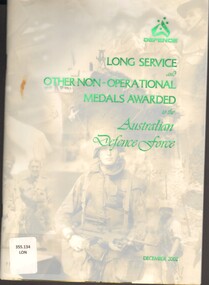
Book, Australia. Department of Defence, Long Service and Other Non-operational Medals Award
... This book contains a brief summary of the medals awarded under the Imperial Honours System or, since 14 February 1975, under the Australian Honours System. ...This book contains a brief summary of the medals awarded under the Imperial Honours System or, since 14 February 1975, under the Australian Honours System.This book contains a brief summary of the medals awarded under the Imperial Honours System or, since 14 February 1975, under the Australian Honours System.australia. australian defence force - medals, badges, decorations etc. -
 Australian Army Museum of Western Australia
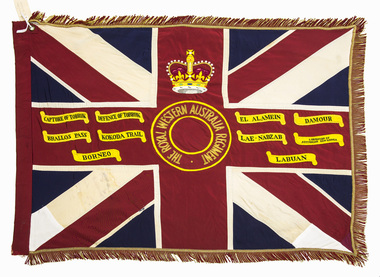
Queen's Colour - 16th Battalion, The Royal Western Australia Regiment
... (Refer to Items 4-12 for individual records of these colours) 1st Battalion, The Royal Western Australia Regiment was renumbered 16th Battalion effective from 1st January 1966 as part of a move to reintroduce the old battalion numbers back into the State Regimental system. 16th Battalion, The Royal Western Australia Regiment was presented with a new set of Colours on 27 October 2002. The original 1962 Colours were formally handed over for safe keeping to the Army Museum of Western Australia on 3 November 2002. Battle Honours...(Refer to Items 4-12 for individual records of these colours) 1st Battalion, The Royal Western Australia Regiment was renumbered 16th Battalion effective from 1st January 1966 as part of a move to reintroduce the old battalion numbers back into the State Regimental system. 16th Battalion, The Royal Western Australia Regiment was presented with a new set of Colours on 27 October 2002. The original 1962 Colours were formally handed over for safe keeping to the Army Museum of Western Australia on 3 November 2002. Battle Honours ...Presented to 1st Battalion, The Royal Western Australia Regiment by Field Marshall HRH The Prince Phillip, Duke of Edinburgh at a parade held at the Western Australian Cricket Association Ground, East Perth on 25 November 1962. The Royal Western Australia Regiment was formed on 1 July 1960 from the amalgamation of all existing infantry battalions in the State at the time :- • 11th/44th Infantry Battalion (The City of Perth Regiment) • 16th Infantry Battalion (The Cameron Highlanders of Western Australia) • 28th Infantry Battalion (The Swan Regiment) At the above presentation of colours to the new battalion, the Colours of the former battalions (four sets of Queen's and Regimental colours) were trooped through the ranks of the battalion and marched off the parade for the last time. These former colours were subsequently laid up in the undercroft at the State War Memorial, King's Park on 29 November 1964. These were transferred to the Army Museum of WA in 1988 as part of the Bicentenary Colours Project. (Refer to Items 4-12 for individual records of these colours) 1st Battalion, The Royal Western Australia Regiment was renumbered 16th Battalion effective from 1st January 1966 as part of a move to reintroduce the old battalion numbers back into the State Regimental system. 16th Battalion, The Royal Western Australia Regiment was presented with a new set of Colours on 27 October 2002. The original 1962 Colours were formally handed over for safe keeping to the Army Museum of Western Australia on 3 November 2002. Battle Honours allocated to the State Infantry Regiments created under the CMF reorganisation in July 1960 were promulgated in Australian Army Order 85/1962. These were a consolidation of the battle honours awarded to the various individual battalions that were amalgamated to form the new regiments. Union flag with gold fringes. In the centre a circle inscribed "THE ROYAL WESTERN AUSTRALIA REGIMENT", surmounted by the Crown. Battle honours emblazoned on the colour : CAPTURE OF TOBRUK, DEFENCE OF TOBRUK, EL ALAMEIN, DAMOUR, BRALLOS PASS, KOKODA TRAIL, LAE-NADZAB, LIBERATION OF AUSTRALIAN NEW GUINEA, BORNEO, LABUAN -
 Australian Army Museum of Western Australia
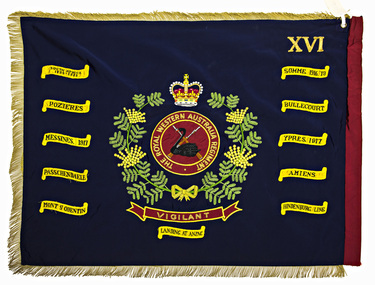
Regimental Colour - 16th Battalion, The Royal Western Australia Regiment
... (Refer to Items 4-12 for individual records of these colours) 1st Battalion, The Royal Western Australia Regiment was renumbered 16th Battalion effective from 1st January 1966 as part of a move to reintroduce the old battalion numbers back into the State Regimental system 16th Battalion, The Royal Western Australia Regiment was presented with a new set of Colours on 27 October 2002. The original 1962 Colours were formally handed over for safe keeping to the Army Museum of Western Australia on 3 November 2002. Battle Honours...(Refer to Items 4-12 for individual records of these colours) 1st Battalion, The Royal Western Australia Regiment was renumbered 16th Battalion effective from 1st January 1966 as part of a move to reintroduce the old battalion numbers back into the State Regimental system 16th Battalion, The Royal Western Australia Regiment was presented with a new set of Colours on 27 October 2002. The original 1962 Colours were formally handed over for safe keeping to the Army Museum of Western Australia on 3 November 2002. Battle Honours ...Presented to 1st Battalion, The Royal Western Australia Regiment by Field Marshall HRH The Prince Phillip, Duke of Edinburgh at a parade held at the Western Australian Cricket Association Ground, East Perth on 25 November 1962. The Royal Western Australia Regiment was formed on 1 July 1960 from the amalgamation of the following existing infantry battalions in the State at the time :- • 11th/44th Infantry Battalion (The City of Perth Regiment) • 16th Infantry Battalion (The Cameron Highlanders of Western Australia) • 28th Infantry Battalion (The Swan Regiment) At the above presentation of colours to the new battalion, the Colours of the former battalions (four sets of Queen's and Regimental colours) were trooped through the ranks of the battalion and marched off the parade for the last time. These former colours were subsequently laid up in the undercroft at the State War Memorial, King's Park on 29 November 1964. These were transferred to the Army Museum of WA in 1988 as part of the Bicentenary Colours Project. (Refer to Items 4-12 for individual records of these colours) 1st Battalion, The Royal Western Australia Regiment was renumbered 16th Battalion effective from 1st January 1966 as part of a move to reintroduce the old battalion numbers back into the State Regimental system 16th Battalion, The Royal Western Australia Regiment was presented with a new set of Colours on 27 October 2002. The original 1962 Colours were formally handed over for safe keeping to the Army Museum of Western Australia on 3 November 2002. Battle Honours allocated to the State Infantry Regiments created under the CMF reorganisation in July 1960 were promulgated in Australian Army Order 85/1962. These were a consolidation of the battle honours awarded to the various individual battalions that were amalgamated to form the new regiments. Royal blue with gold and red fringes. In the centre the main device from the regimental badge consisting of a black swan upon a pair of crossed rifles on a red background, within a circle inscribed "THE ROYAL WESTERN AUSTRALIA REGIMENT". The whole enclosed within a wreath of Australian wattle and surmounted by the Crown. Across the lower portion of the wreath a scroll inscribed with the regimental motto "VIGILANT". In the upper canton the Roman numeral "XVI" (Originally this was the numeral "I" - changed to "XVI" in 1966 - see Historical Background details below) Battle honours emblazoned on the colour : SOUTH AFRICA 1899-1902, SOMME 1916-18, POZIERES, BULLECOURT, MESSINES 1917, YPRES 1917, PASSCHENDAELE, AMIENS, MONT ST QUENTIN, HINDENBURG LINE, LANDING AT ANZAC -
Federation University Art Collection
Work on paper - Digital Prints, Gilson, Deanne, 'Wadawurrung Axe Heads 1-4' by Deanne Gilson, 2011
... systems of class, race and representation in historical photographs that were imposed on her Ancestors. Her work also explores the matriarchal role through her feminist perspectives, looking at the history of marriage and the oppressive function it has played within her family. Deanne has completed the following educationala achievements. 2014 – 2015 Masters by Research (Visual Art), Deakin University Geelong 2013 Graduate Diploma in Education Secondary, Federation University 2011 Certificate IV in Aboriginal Contemporary Art & Craft 2010 Cultural Heritage Management Course, Lakes Entrance 1 Week 2007 – 2010 Graduated, Bachelor of Visual Arts with Honours, University of Ballarat 1984 Diploma of Art, School of Mines & Industries TAFE This item is part of the Federation University Art Collection. ...systems of class, race and representation in historical photographs that were imposed on her Ancestors. Her work also explores the matriarchal role through her feminist perspectives, looking at the history of marriage and the oppressive function it has played within her family. Deanne has completed the following educationala achievements. 2014 – 2015 Masters by Research (Visual Art), Deakin University Geelong 2013 Graduate Diploma in Education Secondary, Federation University 2011 Certificate IV in Aboriginal Contemporary Art & Craft 2010 Cultural Heritage Management Course, Lakes Entrance 1 Week 2007 – 2010 Graduated, Bachelor of Visual Arts with Honours, University of Ballarat 1984 Diploma of Art, School of Mines & Industries TAFE This item is part of the Federation University Art Collection. ...Dr Deanne GILSON (1967- ) Country: Wadawurrung Deanne Gilson is a Federation University alumni, and an award-winning multi-disciplinary artist. Her practice draws its inspiration from ‘Ancestral marks’ and design on cultural objects found in museum archives and family oral histories. Deanne’s practice seeks to interrogate the colonial legacy of settlement and the western hegemonic systems of class, race and representation in historical photographs that were imposed on her Ancestors. Her work also explores the matriarchal role through her feminist perspectives, looking at the history of marriage and the oppressive function it has played within her family. Deanne has completed the following educationala achievements. 2014 – 2015 Masters by Research (Visual Art), Deakin University Geelong 2013 Graduate Diploma in Education Secondary, Federation University 2011 Certificate IV in Aboriginal Contemporary Art & Craft 2010 Cultural Heritage Management Course, Lakes Entrance 1 Week 2007 – 2010 Graduated, Bachelor of Visual Arts with Honours, University of Ballarat 1984 Diploma of Art, School of Mines & Industries TAFE This item is part of the Federation University Art Collection. The Art Collection features over 2000 works and was listed as a 'Ballarat Treasure' in 2007.This work depicts an axehead found on Wadawurrung country and is a responce to workign alongside archeologists untertaking land surveys of her ancestral lands and the visual documentaiton of artefcts.art, artwork, deanne gilson, gilson, wadawurrung, stone axe, aboriginal, alumni -
 The 5th/6th Battalion Royal Victoria Regiment Historical Collection
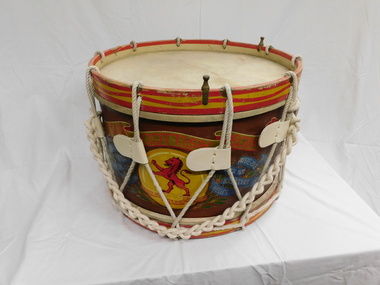
Instrument - Drum, Tenor Drum Rope tension VSR
... system. Drum is hand painted with VSR title, Rampart lion with VSR battle honours...system. Drum is hand painted with VSR title, Rampart lion with VSR battle honours Tenor Drum Rope tension VSR Instrument Drum ...Used by VSR pipes and drumsUsed by VSR pipes and drumsDrum is of wooden construction with rope tention system. Drum is hand painted with VSR title, Rampart lion with VSR battle honours5/6 rvr pipes and drums, vsr, 5/6rvr bhq -
 The 5th/6th Battalion Royal Victoria Regiment Historical Collection
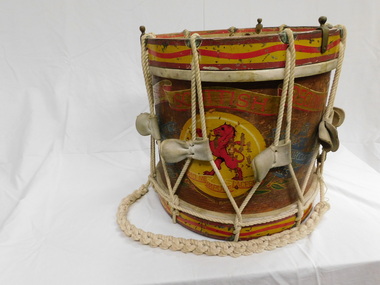
Instrument - Drum, Drum - Side Tension VSR
... system. Drum is hand painted with VSR title rampant lion eith VSR battle honours....system. Drum is hand painted with VSR title rampant lion eith VSR battle honours. ...Used by VSR Pipes and drumsSide Drum is of wooden construction with rope tension system. Drum is hand painted with VSR title rampant lion eith VSR battle honours.5/6 rvr pipes and drums, vsr, instrument, side tension drum, 5/6 rvr bhq -
 Merri-bek City Council
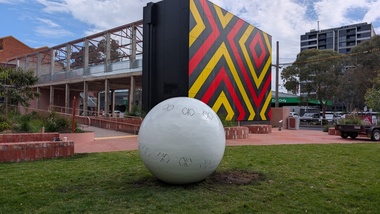
Sculpture - Aluminium, Aunty Kim Wandin et al, Balam Balam, 2025
... system. They are indicator species for healthy environments. Grounded in a deep relationship with Country and a commitment to creating culturally rich artwork, Murrup Biik's 'Balam Balam' honours Aboriginal knowledge, ceremony, and community connection....system. They are indicator species for healthy environments. Grounded in a deep relationship with Country and a commitment to creating culturally rich artwork, Murrup Biik's 'Balam Balam' honours Aboriginal knowledge, ceremony, and community connection. ...'Balam Balam', by Aunty Kim Wandin and Christine Joy’s (Murrup Biik) is located at Balam Balam Place. This artwork responds to the name of the site and represents the earth and the extraordinary migratory journeys that butterflies make around our planet, referencing their resilience and strength. It recognises that butterflies as pollinators are an important food source for birds and other vertebrates, and are a part of a living, interconnected planetary system. They are indicator species for healthy environments. Grounded in a deep relationship with Country and a commitment to creating culturally rich artwork, Murrup Biik's 'Balam Balam' honours Aboriginal knowledge, ceremony, and community connection.merri-bek public art collection -
 Returned Nurses RSL Sub-branch
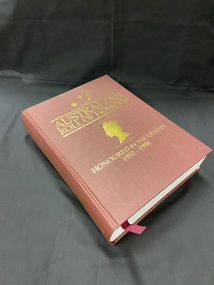
Book - Hardback book, Alister Taylor, The Australian roll of honour: honoured by the Queen 1952-1998, including recipients of national honours 1997 and 1998, 1999
... This book also provides information on the national honours system with detailed descriptions on each medal, order, award and decoration. ...A large volume that lists the individuals who received royal honours during 1952-1998 and national honours in 1997 and 1998 in Australia. This book also provides information on the national honours system with detailed descriptions on each medal, order, award and decoration.Hardcover book with a burgundy cover and gold writing.non-fictionA large volume that lists the individuals who received royal honours during 1952-1998 and national honours in 1997 and 1998 in Australia. This book also provides information on the national honours system with detailed descriptions on each medal, order, award and decoration. decorations of honour australia, medals, awards, order of australia
