
Showing 38 items matching "household textiles, table linen"
-
 Mont De Lancey
Domestic object - Table runner
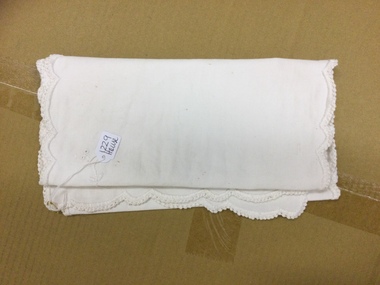
... Household Textiles...Table Linen...Household Textiles Table Linen White cotton table runner, with a white embroidered butterfly amongst white stems, flowers and leaves at each end. ...White cotton table runner, with a white embroidered butterfly amongst white stems, flowers and leaves at each end. The runner has white, scalloped, embroidered and crocheted edges.household textiles, table linen -
 Mont De Lancey
Textile - Tablecloth, Unknown
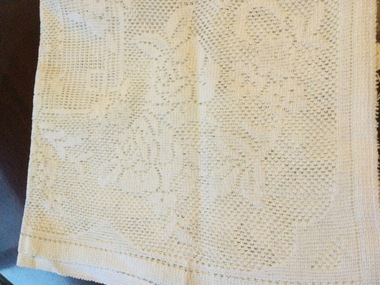
... ...Household textiles...Table linen...table clean and from being scratched, through use of tableware and sopping up spills. Later ones were a display of elegance to match the ornate furniture, especially white ones as they indicated the household could employ staff to keep them white. Tablecloths Household textiles Table linen ...Tablecloths were used as they are today for protecting and keeping a table clean and from being scratched, through use of tableware and sopping up spills. Later ones were a display of elegance to match the ornate furniture, especially white ones as they indicated the household could employ staff to keep them white.A white rectangular lace tablecloth, with floral and rectangular lace or crotchet style overall pattern.tablecloths, household textiles, table linen, cloths -
 Mont De Lancey
Textile - Doily, Unknown
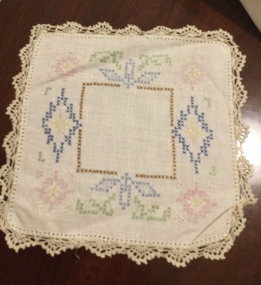
... ...Household textiles...Table linen...tables or furniture from items which may scratch or damage the surface. Often they were homemade and the more contemporary ones were machine made. Doilies textiles Household textiles Table linen ...Doilies were used to protect tables or furniture from items which may scratch or damage the surface. Often they were homemade and the more contemporary ones were machine made.A small square cotton embroidered doily with brown, green, blue, pink, white and navy cross stitch pattern. Crocheted scalloped edging.doilies, textiles, household textiles, table linen, furniture accessories, soft furnishings -
 Mont De Lancey
Textile - Doily, Unknown
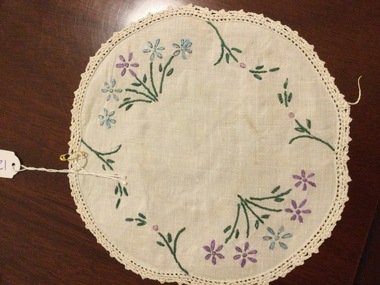
... ...Household textiles...Table linen...Doilies Household textiles Table linen Furniture accessories Soft furnishings A small round floral embroidered doily in blue, purple and green. ...Doilies were used to protect tables or furniture from items which may scratch or damage the surface. Often they were homemade and the more contemporary ones were machine made.A small round floral embroidered doily in blue, purple and green. It has a white scalloped embroidered edge.doilies, household textiles, table linen, furniture accessories, soft furnishings -
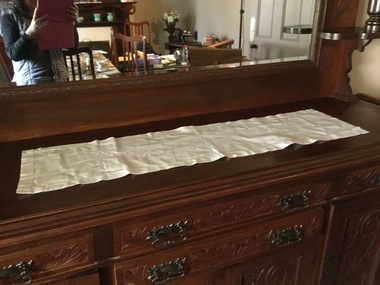 Mont De Lancey
Textile - Table runner, Unknown
... ...Household textiles...Table linen...Table runners Runners Household textiles Table linen A long white cotton embroidered table runner with a floral pattern. ...Table runners were used to protect furniture such as tables or sideboards from objects placed on the furniture to stop scratching occurring.A long white cotton embroidered table runner with a floral pattern.table runners, runners, household textiles, table linen -
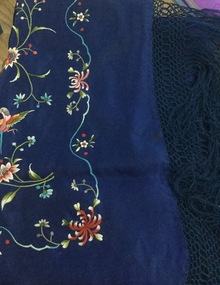 Mont De Lancey
Tablecloth
... household textiles, table linen...household textiles, table linen tablecloths shawls Royal blue, square, satin tablecloth/shawl with 27 cm. crocheted and fringed border. ...Royal blue, square, satin tablecloth/shawl with 27 cm. crocheted and fringed border. It is heavily embroidered with multiple flowers and leaves in many different colours.household textiles, table linen, tablecloths, shawls -
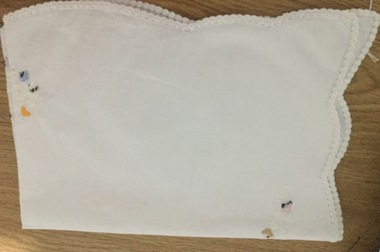 Mont De Lancey
Tray cloth
... household textiles, table linen....household textiles, table linen. tray cloths White linen, rectangular tray cloth with crocheted, scallopped edge and 4 embroidered flower patterns, one on each side Tray cloth ...White linen, rectangular tray cloth with crocheted, scallopped edge and 4 embroidered flower patterns, one on each sidehousehold textiles, table linen., tray cloths -
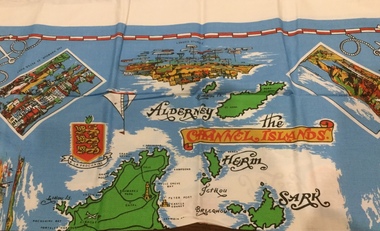 Mont De Lancey
Functional object - Tablecloth
... ...household textiles....table linen...table ware. household textiles. table linen. Names of places, beaches and bays on the Channel islands. ...A square, souvenir tablecloth from the Channel Islands. On an azure background, all the islands are printed and named on the tablecloth, as well as the names of the towns, villages and the bays of both Jersey and Guernsey. There are four rectangular pictures, surrounded by a white border, representing significant places and buildings, as well as others, without borders, depicting old and modern ships, a compass, a coat of arms and the distinctive Jersey and Guernsey cow.There is a red and white border, almost at the edge of the azure background and in each corner is printed a white anchor and rope. There is also a 3 cm. plain white outer border around the tablecloth.Names of places, beaches and bays on the Channel islands. Pictorial representations of significant places and buildings and a white anchor and rope in each of the four corners. "Exclusive to Creaseys of Guernsey" is printed at the bottom left hand corner of the tablecloth.table ware., household textiles., table linen. -
 Mont De Lancey
Doily
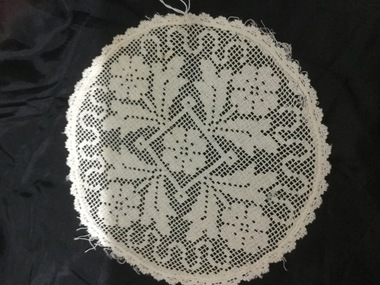
... household textiles....doilies...table linen...household textiles. doilies table linen. Cream-coloured, circular doily with machine lace and a floral pattern throughout. ...Cream-coloured, circular doily with machine lace and a floral pattern throughout. There is a single flower in the centre with a square border around it.household textiles., doilies, table linen. -
 Mont De Lancey
Doily
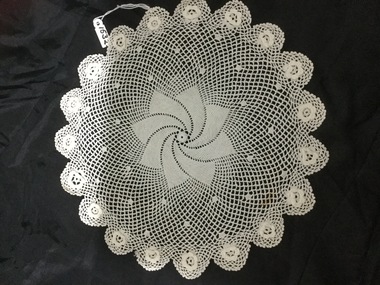
... household textiles....doilies...table linen...household textiles. doilies table linen. Circular, white crocheted doily with a whirlygig pattern in the centre and stumpwork embroidered flower heads in each of the scallops forming the edges. ...Circular, white crocheted doily with a whirlygig pattern in the centre and stumpwork embroidered flower heads in each of the scallops forming the edges.household textiles., doilies, table linen. -
 Mont De Lancey
Textile - Doiley
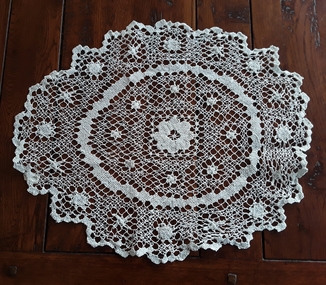
... household textiles...soft furnishings...table linen...doileys household textiles soft furnishings table linen tableware table accessories A large white handmade open patterned crotched doiley used to protect furniture. ...A large white handmade open patterned crotched doiley used to protect furniture. It has a floral pattern and scalloped edge.doileys, household textiles, soft furnishings, table linen, tableware, table accessories -
 Flagstaff Hill Maritime Museum and Village
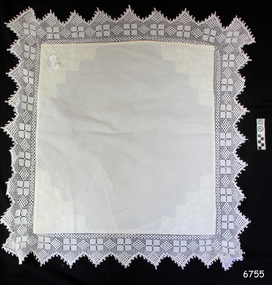
Textile - Tablecloth, late 19th century
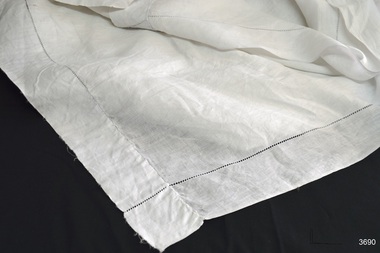
... The Giles family collection has social significance at a local level, because it illustrates the level of material support the Warrnambool community gave to Flagstaff Hill when the Museum was established. flagstaff hill warrnambool shipwrecked coast flagstaff hill maritime museum maritime museum shipwreck coast flagstaff hill maritime village great ocean road giles family cooramook 19th century linen 19th century household goods 19th century handcraft 19th century manchester 19th century table linen 19th century tablecloth giles family collection 19th century household linen warrnambool breakwater construction Iron-on label, hand written in black pen "LHK B22". Tablecloth, white linen, part of the Giles Collection. Large white rectangular tablecloth, hand embroidered using white thread. Floral design in satin stitch and drawn threadwork. Cloth has additional white cloth iron-on label. Textile ...The linen tablecloth has been hand worked using satin stitch embroidery and drawn thread work. This tablecloth is one of many 19th century items of furniture, linen and crockery donated to Flagstaff Hill Maritime Village by, Vera and Aurelin Giles. The items are associated with the Giles Family and are known as the “Giles Collection”. Most of the items in this Collection are in the Lighthouse Keeper’s Cottage at Flagstaff Hill. The majority came from the simple home of Vera’s Giles’ parents, Henry Giles and his wife Mary Jane (nee Freckleton), whose photographs are in the parlour. They married in 1880. Henry Giles was born at Tower Hill, Victoria in 1858 and worked as a labourer on the construction of the Warrnambool Breakwater. His wife, Mary Jane, was born in 1860 at Cooramook. She attended Mailor’s Flat State School, and later worked there as a student teacher, before (as family legend has it) she became a governess at “Injemira” where her grandfather, Francis Freckleton, owned the land. The Giles family of six, some of whom were born at Mailor’s Flat and the younger at Purnim West, lived at “The Maam”, Wangoom before moving to New South Wales in 1895, where Henry built bridges for about 7 years. Henry died in 1933 and Mary Jane died in 1940. The Giles family collection has social significance at a local level, because it illustrates the level of material support the Warrnambool community gave to Flagstaff Hill when the Museum was established.Tablecloth, white linen, part of the Giles Collection. Large white rectangular tablecloth, hand embroidered using white thread. Floral design in satin stitch and drawn threadwork. Cloth has additional white cloth iron-on label.Iron-on label, hand written in black pen "LHK B22". flagstaff hill, warrnambool, shipwrecked coast, flagstaff hill maritime museum, maritime museum, shipwreck coast, flagstaff hill maritime village, great ocean road, giles family, cooramook, 19th century linen, 19th century household goods, 19th century handcraft, 19th century manchester, 19th century table linen, 19th century tablecloth, giles family collection, 19th century household linen, warrnambool breakwater construction -
 Flagstaff Hill Maritime Museum and Village
Textile - Tablecloth, Mary Jane Giles (Mrs Harry Giles), Late 19th to Early 20th Century
... But the Giles collection also gives us today a snapshot into what domestic life was like in early colonial times prior to Federation. warrnambool shipwrecked-coast flagstaff-hill flagstaff-hill-maritime-museum shipwreck-coast flagstaff-hill-maritime-village tablecloth manchester table linen giles collection henry giles tower hill cooramook warrnambool breakwater mailor’s flat wangoom 19th century household goods None Tablecloth, white with lace fringe, for a small table. Textile ...This small table cloth is one of many 19th century items of furniture, linen and crockery donated to Flagstaff Hill Maritime Village by, Vera and Aurelin Giles. The items are associated with Warrnambool and the Giles Family history. Items donated by the family have come to be known as the “Giles Collection”. Many items in the Lighthouse Keeper’s Cottage were donated by Vera and Aurelin Giles and mostly came from the home of Vera’s parents-in-law, Henry Giles and his wife Mary Jane (nee Freckleton) who married in 1880 and whose photos are on display in the parlour. Henry was born at Tower Hill in 1858, and was a labourer on the construction of the Warrnambool Breakwater before leaving in 1895 for around seven years to build bridges in NSW. Mary Jane was born in 1860 at Cooramook and she attended Mailor’s Flat State School and where she eventually was to become a student teacher. After which she became a governess at “Injemiara” where her grandfather, Francis Freckleton, had once owned land. Henry and Mary’s family consisted of six, some of the children were born at Mailor’s Flat and later some children at Wangoom. They lived with their parents at Wangoom and Purnim west, and this is where Henry died in 1933 and Mary Jane in 1940.The Giles family collection is of social significance at a local level, because it not only illustrates the level of material support the Warrnambool community gave to Flagstaff Hill during it’s establishment. But the Giles collection also gives us today a snapshot into what domestic life was like in early colonial times prior to Federation.Tablecloth, white with lace fringe, for a small table.Nonewarrnambool, shipwrecked-coast, flagstaff-hill, flagstaff-hill-maritime-museum, shipwreck-coast, flagstaff-hill-maritime-village, tablecloth, manchester, table linen, giles collection, henry giles, tower hill, cooramook, warrnambool breakwater, mailor’s flat, wangoom, 19th century household goods -
 Flagstaff Hill Maritime Museum and Village
Textile - Dollies & table runner set, Vera and Aurelia Giles, Late 19th to Early 20th century
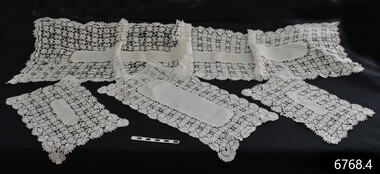
... But the Giles collection also gives us today a snapshot into what domestic life was like in early colonial times prior to Federation. warrnambool shipwrecked-coast flagstaff-hill flagstaff-hill-maritime-museum shipwreck-coast flagstaff-hill-maritime-village giles collection henry giles tower hill warrnambool breakwater mailor’s flat wangoom textiles victorian household items None Set of three lace doilies & a table runner white, rectangular pieces, hand crocheted wide borders with white linen hand stitched into the centre. ...These hand crafted, crocheted table linen items are part of the many 19th century items of furniture, linen and crockery donated to Flagstaff Hill Maritime Village by, Vera and Aurelin Giles. The items are associated with Warrnambool and the Giles Family history. Items donated by the family have come to be known as the “Giles Collection”. Many items in the Lighthouse Keeper’s Cottage were donated by Vera and Aurelin Giles and mostly came from the home of Vera’s parents-in-law, Henry Giles and his wife Mary Jane (nee Freckleton) who married in 1880 and whose photos are on display in the parlour. Henry was born at Tower Hill in 1858, and was a labourer on the construction of the Warrnambool Breakwater before leaving in 1895 for around seven years to build bridges in NSW. Mary Jane was born in 1860 at Cooramook and she attended Mailor’s Flat State School and where she eventually was to become a student teacher. After which she became a governess at “Injemiara” where her grandfather, Francis Freckleton, had once owned land. Henry and Mary’s family consisted of six, some of the children were born at Mailor’s Flat and later some children at Wangoom. They lived with their parents at Wangoom and Purnim west, and this is where Henry died in 1933 and Mary Jane in 1940.The Giles family collection is of social significance at a local level, because it not only illustrates the level of material support the Warrnambool community gave to Flagstaff Hill during it’s establishment. But the Giles collection also gives us today a snapshot into what domestic life was like in early colonial times prior to Federation.Set of three lace doilies & a table runner white, rectangular pieces, hand crocheted wide borders with white linen hand stitched into the centre. (Part of the Giles Collection)Nonewarrnambool, shipwrecked-coast, flagstaff-hill, flagstaff-hill-maritime-museum, shipwreck-coast, flagstaff-hill-maritime-village, giles collection, henry giles, tower hill, warrnambool breakwater, mailor’s flat, wangoom, textiles, victorian household items -
 Flagstaff Hill Maritime Museum and Village
Textile - Tablecloth, Mary Jane Giles (Mrs Harry Giles), Late 19th to Early 20th Century
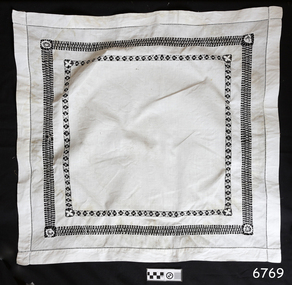
... But the Giles collection also gives us today a snapshot into what domestic life was like in early colonial times prior to Federation. warrnambool shipwrecked-coast flagstaff-hill flagstaff-hill-maritime-museum shipwreck-coast flagstaff-hill-maritime-village tablecloth table linen manchester giles collection henry giles tower hill cooramook mailor’s flat wangoom 19th century household goods Textiles None Small Tablecloth, white Textile Tablecloth Mary Jane Giles (Mrs Harry Giles) ...This table cloth is one of many 19th century items of furniture, linen and crockery donated to Flagstaff Hill Maritime Village by, Vera and Aurelin Giles. The items are associated with Warrnambool and the Giles Family history. Items donated by the family have come to be known as the “Giles Collection”. Many items in the Lighthouse Keeper’s Cottage were donated by Vera and Aurelin Giles and mostly came from the home of Vera’s parents-in-law, Henry Giles and his wife Mary Jane (nee Freckleton) who married in 1880 and whose photos are on display in the parlour. Henry was born at Tower Hill in 1858, and was a labourer on the construction of the Warrnambool Breakwater before leaving in 1895 for around seven years to build bridges in NSW. Mary Jane was born in 1860 at Cooramook and she attended Mailor’s Flat State School and where she eventually was to become a student teacher. After which she became a governess at “Injemiara” where her grandfather, Francis Freckleton, had once owned land. Henry and Mary’s family consisted of six, some of the children were born at Mailor’s Flat and later some children at Wangoom. They lived with their parents at Wangoom and Purnim west, and this is where Henry died in 1933 and Mary Jane in 1940.The Giles family collection is of social significance at a local level, because it not only illustrates the level of material support the Warrnambool community gave to Flagstaff Hill during it’s establishment. But the Giles collection also gives us today a snapshot into what domestic life was like in early colonial times prior to Federation.Small Tablecloth, whiteNonewarrnambool, shipwrecked-coast, flagstaff-hill, flagstaff-hill-maritime-museum, shipwreck-coast, flagstaff-hill-maritime-village, tablecloth, table linen, manchester, giles collection, henry giles, tower hill, cooramook, mailor’s flat, wangoom, 19th century household goods, textiles -
 Mont De Lancey
Textile - Table runner
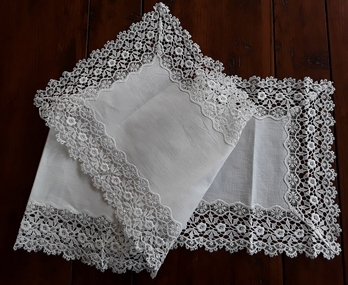
... table runners table linen table accessories tableware household textiles A long white lace embroidered patterned cotton table runner for use on a table or sideboard. ...A long white lace embroidered patterned cotton table runner for use on a table or sideboard. It has scalloped edging.table runners, table linen, table accessories, tableware, household textiles -
 Mont De Lancey
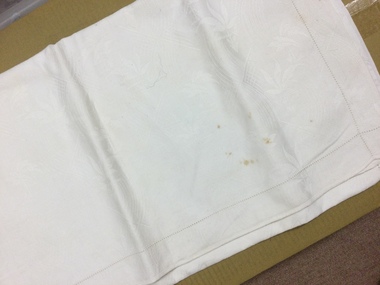
Domestic object - Tablecloth
... Tableware Table Linen Household Textiles Square, white damask tablecloth, with leaf design and a spoke stiched edge. ...Square, white damask tablecloth, with leaf design and a spoke stiched edge.tableware, table linen, household textiles -
 Mont De Lancey
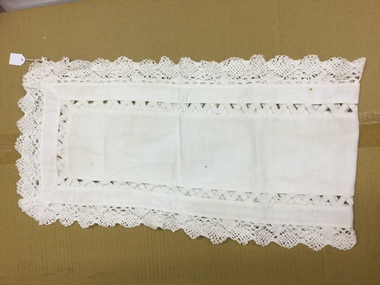
Domestic object - Table runner
... Table runner Table linen household textiles White, cotton table runner with a central strip flanked by cotton zig-zag strips, 2 cm cotton strips and then outer, scalloped, crocheted edges all around. ...White, cotton table runner with a central strip flanked by cotton zig-zag strips, 2 cm cotton strips and then outer, scalloped, crocheted edges all around.table runner, table linen, household textiles -
 Mont De Lancey
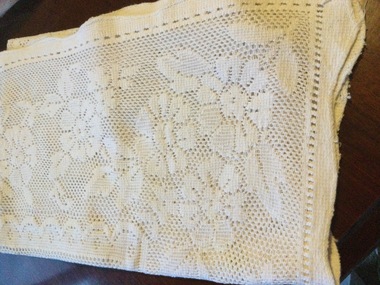
Textile - Tablecloth, Unknown
... table from damage when in use with cutlery, chinaware and general use. More decorative white cloths were used for special occasions and to show general position in society or wealth. The trousseau of a young woman in the 1900's consisted essentially of how many tablecloths she had collected - her dowry in many ways showed the more linen she had the wealthier she was. Included were napkins, bed linens, tea towels and various cloths for every household function and were to sustain the bride and her future family throughout their lifetime together. tablecloths Cloths Table linen Household textiles ...Tablecloths were used to protect the table from damage when in use with cutlery, chinaware and general use. More decorative white cloths were used for special occasions and to show general position in society or wealth. The trousseau of a young woman in the 1900's consisted essentially of how many tablecloths she had collected - her dowry in many ways showed the more linen she had the wealthier she was. Included were napkins, bed linens, tea towels and various cloths for every household function and were to sustain the bride and her future family throughout their lifetime together.A white lace rectangular tablecloth with a floral pattern and wide scalloped edge.tablecloths, cloths, table linen, household textiles -
 Mont De Lancey
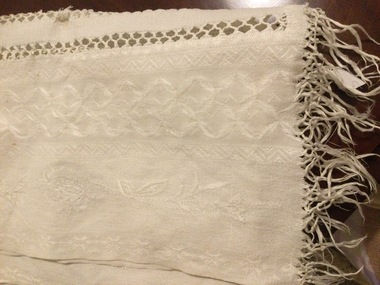
Functional object - Table runner
... Table runners Textiles Table linen Household textiles A long white patterned cotton table runner, which has two lines of open stitched pattern down the middle of the runner. ...A long white patterned cotton table runner, which has two lines of open stitched pattern down the middle of the runner. Knotted cotton tassels at each end.table runners, textiles, table linen, household textiles -
 Mont De Lancey
Table linen
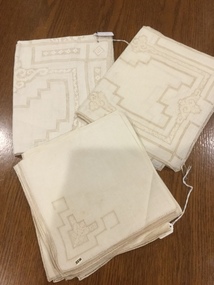
... table linen. household textiles. A set of cream linen table linen comprising: one rectangular centro piece or runner, four rectangular place mats and eight square serviettes. ...A set of cream linen table linen comprising: one rectangular centro piece or runner, four rectangular place mats and eight square serviettes. All pieces have pulled thread, or drawn fabric, as well as embroidered detailing, patterns and edging.table linen., household textiles. -
 Mont De Lancey
Serviettes, 1971
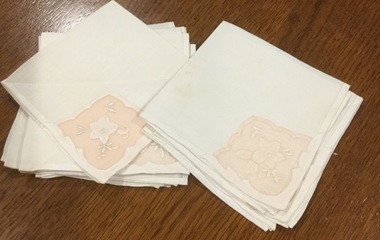
... table linen. table ware. household textiles Set of ten cream, linen serviettes, each with a pink applique'd and embroidered flower in one corner. ...Set of ten cream, linen serviettes, each with a pink applique'd and embroidered flower in one corner.table linen., table ware., household textiles -
 Mont De Lancey
Tablecloth and pillow slip
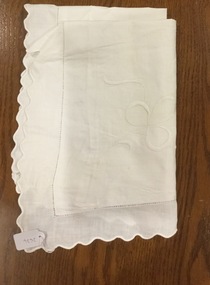
... table ware. bed linen. household textiles. White, nylon tablecloth with lace star in the centre, surrounded by lace lines, with embroidered crystal shapes within lace in each corner. ...White, nylon tablecloth with lace star in the centre, surrounded by lace lines, with embroidered crystal shapes within lace in each corner. White, linen pillow slip with an embroidered flower and leaves in each corner. It has a pulled thread and embroidered, scalloped border, (Torn)table ware., bed linen., household textiles. -
 Mont De Lancey
Sideboard cloth
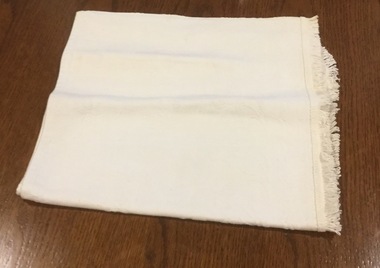
... table linen. household textiles. Three White, damask sideboard cloths with fringed edges along the front and two ends of the cloth. ...Three White, damask sideboard cloths with fringed edges along the front and two ends of the cloth. The back edge is hemmed.table linen., household textiles. -
 Mont De Lancey
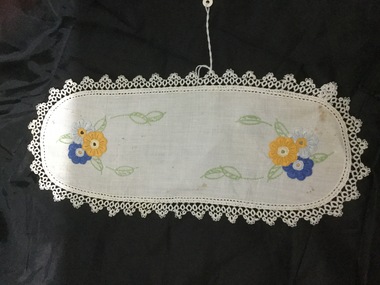
Doily
... table linen. household textiles Cream, linen sandwich tray doily, embroidered with royal and pale blue and yellow flowers with tatting around the edges. ...Cream, linen sandwich tray doily, embroidered with royal and pale blue and yellow flowers with tatting around the edges.table linen., household textiles -
 Mont De Lancey
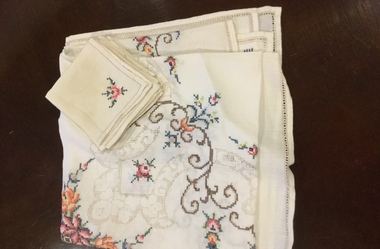
Supper cloth and serviettes, 1960
... 1960 table linen. household textiles Square, cream linen supper cloth with a multi-coloured, floral embroidery, cross stitch and drawn thread pattern stretching across the entire cloth. ...1960Square, cream linen supper cloth with a multi-coloured, floral embroidery, cross stitch and drawn thread pattern stretching across the entire cloth. It has drawn thread and embroidered edging all around the cloth. There are 6 matching serviettes each with a floral, embroidered pattern in one corner and drawn thread and embroidered edging all around.table linen., household textiles -
 Kew Historical Society Inc
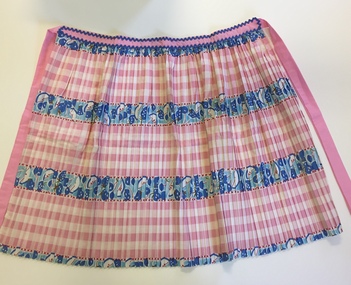
Clothing - Protective Wear, Apron, 1950s
... household textiles donated by Lisa Sylvan, a long-term resident of Kew, Five of the items are homemade aprons made and worn by her mother. Of the seven pinafores, three identical but differently sized pinafores were made in her parents' factory, while the other three are handmade. The handmade aprons and pinafores are representative samples of women's work, possibly from published patterns, using fabrics originally deigned for dresses. Typically, contrasting fabrics and colours were selected to provide visual interest. The donation also includes a hand embroidered linen supper cloth and a commercially produced 'birds of Australia' printed table...household textiles donated by Lisa Sylvan, a long-term resident of Kew, Five of the items are homemade aprons made and worn by her mother. Of the seven pinafores, three identical but differently sized pinafores were made in her parents' factory, while the other three are handmade. The handmade aprons and pinafores are representative samples of women's work, possibly from published patterns, using fabrics originally deigned for dresses. Typically, contrasting fabrics and colours were selected to provide visual interest. The donation also includes a hand embroidered linen supper cloth and a commercially produced 'birds of Australia' printed table ...One of a collection of fourteen items of protective wear and household textiles donated by Lisa Sylvan, a long-term resident of Kew, Five of the items are homemade aprons made and worn by her mother. Of the seven pinafores, three identical but differently sized pinafores were made in her parents' factory, while the other three are handmade. The handmade aprons and pinafores are representative samples of women's work, possibly from published patterns, using fabrics originally deigned for dresses. Typically, contrasting fabrics and colours were selected to provide visual interest. The donation also includes a hand embroidered linen supper cloth and a commercially produced 'birds of Australia' printed table cloth. Most of the collection derives from the 1950s.Although not uncommon, hand-made protective clothing in the form of aprons and pinafores often represents samples and styles of 'women's work' using remnant fabrics often designed for other purposes. While generally utilitarian, women found means of gracing these items by the use brightly coloured fabric or patterns, the positioning of pockets and the use of contrasting fabrics to provide visual interest.Pleated pink and white striped cotton apron interspersed with bands of a separate blue and white fabric.aprons, protective clothing, handmade clothing, costume accessories, lisa sylvan -
 Kew Historical Society Inc
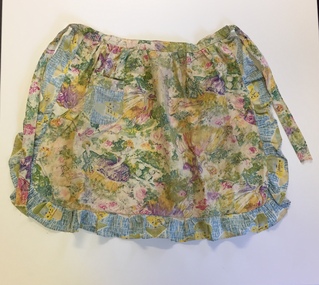
Clothing - Protective Wear, Apron, 1950s
... household textiles donated by Lisa Sylvan, a long-term resident of Kew, Five of the items are homemade aprons made and worn by her mother. Of the seven pinafores, three identical but differently sized pinafores were made in her parents' factory, while the other three are handmade. The handmade aprons and pinafores are representative samples of women's work, possibly from published patterns, using fabrics originally deigned for dresses. Typically, contrasting fabrics and colours were selected to provide visual interest. The donation also includes a hand embroidered linen supper cloth and a commercially produced 'birds of Australia' printed table...household textiles donated by Lisa Sylvan, a long-term resident of Kew, Five of the items are homemade aprons made and worn by her mother. Of the seven pinafores, three identical but differently sized pinafores were made in her parents' factory, while the other three are handmade. The handmade aprons and pinafores are representative samples of women's work, possibly from published patterns, using fabrics originally deigned for dresses. Typically, contrasting fabrics and colours were selected to provide visual interest. The donation also includes a hand embroidered linen supper cloth and a commercially produced 'birds of Australia' printed table ...One of a collection of fourteen items of protective wear and household textiles donated by Lisa Sylvan, a long-term resident of Kew, Five of the items are homemade aprons made and worn by her mother. Of the seven pinafores, three identical but differently sized pinafores were made in her parents' factory, while the other three are handmade. The handmade aprons and pinafores are representative samples of women's work, possibly from published patterns, using fabrics originally deigned for dresses. Typically, contrasting fabrics and colours were selected to provide visual interest. The donation also includes a hand embroidered linen supper cloth and a commercially produced 'birds of Australia' printed table cloth. Most of the collection derives from the 1950s.Although not uncommon, hand-made protective clothing in the form of aprons and pinafores often represents samples and styles of 'women's work' using remnant fabrics often designed for other purposes. While generally utilitarian, women found means of gracing these items by the use brightly coloured fabric or patterns, the positioning of pockets and the use of contrasting fabrics to provide visual interest.Multicoloured cotton apron using a fabric design employing floral emblems and figurative detail. The apron is hemmed with a pleated fabric of a different colouraprons, protective clothing, handmade clothing, costume accessories, lisa sylvan -
 Kew Historical Society Inc
Clothing - Protective Wear, Apron, 1950s
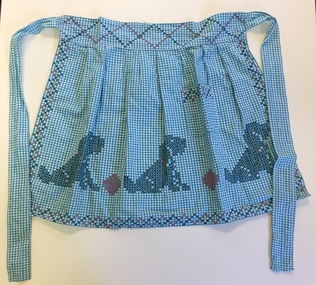
... household textiles donated by Lisa Sylvan, a long-term resident of Kew, Five of the items are homemade aprons made and worn by her mother. Of the seven pinafores, three identical but differently sized pinafores were made in her parents' factory, while the other three are handmade. The handmade aprons and pinafores are representative samples of women's work, possibly from published patterns, using fabrics originally deigned for dresses. Typically, contrasting fabrics and colours were selected to provide visual interest. The donation also includes a hand embroidered linen supper cloth and a commercially produced 'birds of Australia' printed table...household textiles donated by Lisa Sylvan, a long-term resident of Kew, Five of the items are homemade aprons made and worn by her mother. Of the seven pinafores, three identical but differently sized pinafores were made in her parents' factory, while the other three are handmade. The handmade aprons and pinafores are representative samples of women's work, possibly from published patterns, using fabrics originally deigned for dresses. Typically, contrasting fabrics and colours were selected to provide visual interest. The donation also includes a hand embroidered linen supper cloth and a commercially produced 'birds of Australia' printed table ...One of a collection of fourteen items of protective wear and household textiles donated by Lisa Sylvan, a long-term resident of Kew, Five of the items are homemade aprons made and worn by her mother. Of the seven pinafores, three identical but differently sized pinafores were made in her parents' factory, while the other three are handmade. The handmade aprons and pinafores are representative samples of women's work, possibly from published patterns, using fabrics originally deigned for dresses. Typically, contrasting fabrics and colours were selected to provide visual interest. The donation also includes a hand embroidered linen supper cloth and a commercially produced 'birds of Australia' printed table cloth. Most of the collection derives from the 1950s.Although not uncommon, hand-made protective clothing in the form of aprons and pinafores often represents samples and styles of 'women's work' using remnant fabrics often designed for other purposes. While generally utilitarian, women found means of gracing these items by the use brightly coloured fabric or patterns, the positioning of pockets and the use of contrasting fabrics to provide visual interest.Simple blue and white apron embroidered with a border in cross stitch, the same stitch used to create a repeated pattern of dogs and balls in profile.aprons, protective clothing, handmade clothing, costume accessories, lisa sylvan -
 Kew Historical Society Inc
Clothing - Protective Wear, Apron, 1950s
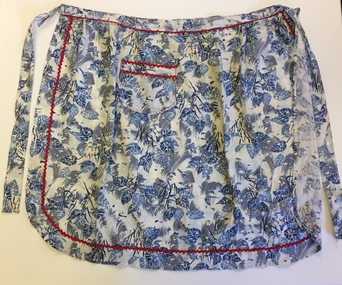
... household textiles donated by Lisa Sylvan, a long-term resident of Kew, Five of the items are homemade aprons made and worn by her mother. Of the seven pinafores, three identical but differently sized pinafores were made in her parents' factory, while the other three are handmade. The handmade aprons and pinafores are representative samples of women's work, possibly from published patterns, using fabrics originally deigned for dresses. Typically, contrasting fabrics and colours were selected to provide visual interest. The donation also includes a hand embroidered linen supper cloth and a commercially produced 'birds of Australia' printed table...household textiles donated by Lisa Sylvan, a long-term resident of Kew, Five of the items are homemade aprons made and worn by her mother. Of the seven pinafores, three identical but differently sized pinafores were made in her parents' factory, while the other three are handmade. The handmade aprons and pinafores are representative samples of women's work, possibly from published patterns, using fabrics originally deigned for dresses. Typically, contrasting fabrics and colours were selected to provide visual interest. The donation also includes a hand embroidered linen supper cloth and a commercially produced 'birds of Australia' printed table ...One of a collection of fourteen items of protective wear and household textiles donated by Lisa Sylvan, a long-term resident of Kew, Five of the items are homemade aprons made and worn by her mother. Of the seven pinafores, three identical but differently sized pinafores were made in her parents' factory, while the other three are handmade. The handmade aprons and pinafores are representative samples of women's work, possibly from published patterns, using fabrics originally deigned for dresses. Typically, contrasting fabrics and colours were selected to provide visual interest. The donation also includes a hand embroidered linen supper cloth and a commercially produced 'birds of Australia' printed table cloth. Most of the collection derives from the 1950s.Although not uncommon, hand-made protective clothing in the form of aprons and pinafores often represents samples and styles of 'women's work' using remnant fabrics often designed for other purposes. While generally utilitarian, women found means of gracing these items by the use brightly coloured fabric or patterns, the positioning of pockets and the use of contrasting fabrics to provide visual interest.Handmade apron created out of a blue and white dress fabric that has a pattern of leaves. The apron is highlighted with red braid.aprons, protective clothing, handmade clothing, costume accessories, lisa sylvan, fashion design, women's clothing -- 1950s, fashion 1950s
