
Showing 31 items matching "houses -- pakington street (kew)"
-
 Kew Historical Society Inc
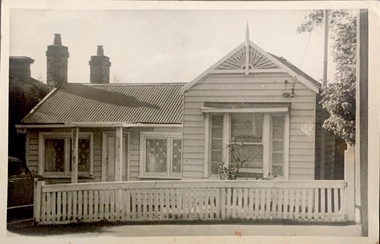
Photograph, J E & B L Rogers, Cottage, Pakington Street, 1950s
... ...houses -- pakington street -- kew (vic.)...Together it forms the largest privately-donated collection within the archives of the Kew Historical Society. historic houses -- kew (vic.) houses -- pakington street -- kew (vic.) f barton -- bootmaker "F Barton bootmaker / Cottage Pakington Street / Bootmaker to E.J. ...This work forms part of the collection assembled by the historian Dorothy Rogers, that was donated to the Kew Historical Society by her son John Rogers in 2015. The manuscripts, photographs, maps, and documents were sourced by her from both family and local collections or produced as references for her print publications. Many were directly used by Rogers in writing ‘Lovely Old Homes of Kew’ (1961) and 'A History of Kew' (1973), or the numerous articles on local history that she produced for suburban newspapers. Most of the photographs in the collection include detailed annotations in her hand.The Rogers Collection provides a comprehensive insight into the working habits of a historian in the 1960s and 1970s. Together it forms the largest privately-donated collection within the archives of the Kew Historical Society.Black and white photograph of a double-fronted Victorian weatherboard cottage. The projecting section was once a shop."F Barton bootmaker / Cottage Pakington Street / Bootmaker to E.J. Dunne 'Roseneath'." "25"historic houses -- kew (vic.), houses -- pakington street -- kew (vic.), f barton -- bootmaker -
 Kew Historical Society Inc
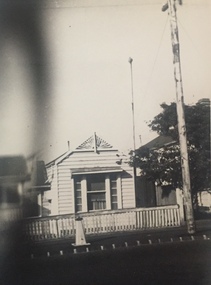
Photograph, J E & B L Rogers, Mr Twiss's House, Pakington Street, 1950s
... houses -- pakington street -- kew (vic.)...Together it forms the largest privately-donated collection within the archives of the Kew Historical Society. houses -- pakington street -- kew (vic.) f barton -- bootmaker mr twiss "Mr Twiss's house ' Pakington St / Was F Bartons House / This part was the show stop" Small black and white snapshot of a cottage in Pakington Street, Kew. ...This work forms part of the collection assembled by the historian Dorothy Rogers, that was donated to the Kew Historical Society by her son John Rogers in 2015. The manuscripts, photographs, maps, and documents were sourced by her from both family and local collections or produced as references for her print publications. Many were directly used by Rogers in writing ‘Lovely Old Homes of Kew’ (1961) and 'A History of Kew' (1973), or the numerous articles on local history that she produced for suburban newspapers. Most of the photographs in the collection include detailed annotations in her hand.The Rogers Collection provides a comprehensive insight into the working habits of a historian in the 1960s and 1970s. Together it forms the largest privately-donated collection within the archives of the Kew Historical Society.Small black and white snapshot of a cottage in Pakington Street, Kew."Mr Twiss's house ' Pakington St / Was F Bartons House / This part was the show stop"houses -- pakington street -- kew (vic.), f barton -- bootmaker, mr twiss -
![Schoolmaster's house, Pakington Street [Kew]](/media/collectors/550653872162f11fb04854aa/items/658f92059239cf6fd4375312/item-media/658f92439239cf6fd43754a9/item-fit-380x285.jpg?cb=6) Kew Historical Society Inc
Kew Historical Society IncPhotograph - Schoolmaster's house, Pakington Street [Kew], c. 1965
... Schoolmaster's house, Pakington Street [Kew]......Houses -- Pakington Street (Kew)...Pakington Street, Kew. The villa has a slate roof, two bay windows and a verandah. Photograph Schoolmaster's house, Pakington Street [Kew] ...This work forms part of the collection assembled by the historian Dorothy Rogers (1905-1973), donated to the Kew Historical Society by her son in 2015. The manuscripts, photographs, maps, and documents were sourced by her from both family and local collections or produced as references for her print publications. Many were directly used by Rogers in writing ‘Lovely Old Homes of Kew’ (1961) and 'A History of Kew' (1973), or the numerous articles on local history that she produced for suburban newspapers. Most of the photographs in the collection include detailed annotations in her hand. The Rogers Collection provides a comprehensive insight into the working habits of a historian from the 1960s to the 1970s. Original monochrome photograph of the exterior of a polychrome brick Victorian villa in Pakington Street, Kew. The villa has a slate roof, two bay windows and a verandah.Inscribed verso: "ca. 1860 home of the 1st state school master (back of house only seen from Peel Street now)".dorothy rogers, houses -- pakington street (kew) -
![72 Pakington St., Kew / [by] Amethyst Moon Enterprises](/media/collectors/550653872162f11fb04854aa/items/5ebc8e26a9d32b09e4a49e1a/item-media/5ebc8f0aa9d32b09e4a4a9bb/item-fit-380x285.jpg?cb=6) Kew Historical Society Inc
Kew Historical Society IncBook, Amethyst Moon Publishing, 72 Pakington St., Kew, 2017
... 72 pakington street - kew (vic.)...house...House history. 72 Pakington Street, Kew, Victoria. Book in presentation box with title....72 pakington street - kew (vic.) house histories - kew (vic.) heritage reports - houses - kew (vic.) ...House historyHouse history. 72 Pakington Street, Kew, Victoria. Book in presentation box with title.non-fictionHouse history72 pakington street - kew (vic.), house histories - kew (vic.), heritage reports - houses - kew (vic.) -
 Kew Historical Society Inc
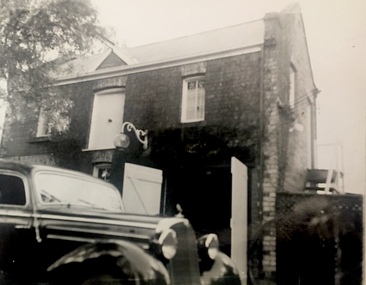
Photograph, J E & B L Rogers, Stables, 'Roseneath', Pakington Street, c.1959
... houses -- kew (vic.)...roseneath -- pakington street -- kew (vic.)...Together it forms the largest privately-donated collection within the archives of the Kew Historical Society. historic houses -- kew (vic.) roseneath -- pakington street -- kew (vic.) "32" 'Roseneath' was constructed in stages in the I850s by John Ambrose Kitchen, a soap-maker. ...This work forms part of the collection assembled by the historian Dorothy Rogers, that was donated to the Kew Historical Society by her son John Rogers in 2015. The manuscripts, photographs, maps, and documents were sourced by her from both family and local collections or produced as references for her print publications. Many were directly used by Rogers in writing ‘Lovely Old Homes of Kew’ (1961) and 'A History of Kew' (1973), or the numerous articles on local history that she produced for suburban newspapers. Most of the photographs in the collection include detailed annotations in her hand.The Rogers Collection provides a comprehensive insight into the working habits of a historian in the 1960s and 1970s. Together it forms the largest privately-donated collection within the archives of the Kew Historical Society.'Roseneath' was constructed in stages in the I850s by John Ambrose Kitchen, a soap-maker. In 1870 the brick house received an N.A.V. of £60 while in 1885 it was purchased by Edward John Dunn, a geologist. A new wing was built at the right side of the house and several rooms as well as the coach house, loft and groom's quarters were added. In 1903, during Dunn's ownership, the property was described as having eight roorns. The garden is recorded as having been designed by Baron von Mueller who was the Government Botanist from 1853. Source: City of Kew Urban Conservation Study, 1988"32"historic houses -- kew (vic.), roseneath -- pakington street -- kew (vic.) -
 Kew Historical Society Inc
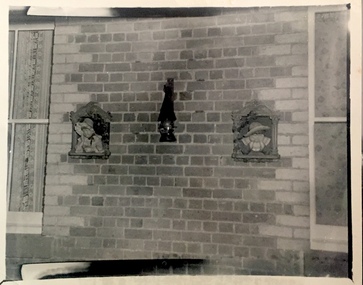
Photograph, J E & B L Rogers, German Plaques, 'Roseneath', Pakington Street, 1950s
... Together it forms the largest privately-donated collection within the archives of the Kew Historical Society. roseneath -- pakington street -- kew (vic.) historic houses -- kew (vic) "German Plaques. ...This work forms part of the collection assembled by the historian Dorothy Rogers, that was donated to the Kew Historical Society by her son John Rogers in 2015. The manuscripts, photographs, maps, and documents were sourced by her from both family and local collections or produced as references for her print publications. Many were directly used by Rogers in writing ‘Lovely Old Homes of Kew’ (1961) and 'A History of Kew' (1973), or the numerous articles on local history that she produced for suburban newspapers. Most of the photographs in the collection include detailed annotations in her hand.The Rogers Collection provides a comprehensive insight into the working habits of a historian in the 1960s and 1970s. Together it forms the largest privately-donated collection within the archives of the Kew Historical Society.Small, black and white photo of the front of 'Turinville' in Barnard Grove, Kew. "German Plaques. Back wall of Roseneath. 30"roseneath -- pakington street -- kew (vic.), historic houses -- kew (vic) -
 Kew Historical Society Inc
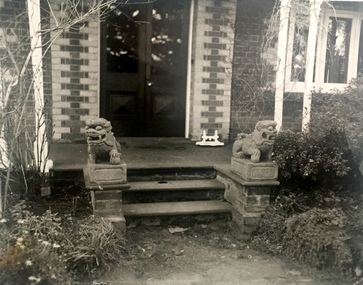
Photograph, Lions, 'Roseneath', Pakington Street, c.1959
... Together it forms the largest privately-donated collection within the archives of the Kew Historical Society. roseneath -- pakington street -- kew (vic.) historic houses -- kew (vic.) Small black and white photograph of the entrance with guardian lions at Roseneath, Pakington Street, Kew. ...This work forms part of the collection assembled by the historian Dorothy Rogers, that was donated to the Kew Historical Society by her son John Rogers in 2015. The manuscripts, photographs, maps, and documents were sourced by her from both family and local collections or produced as references for her print publications. Many were directly used by Rogers in writing ‘Lovely Old Homes of Kew’ (1961) and 'A History of Kew' (1973), or the numerous articles on local history that she produced for suburban newspapers. Most of the photographs in the collection include detailed annotations in her hand.The Rogers Collection provides a comprehensive insight into the working habits of a historian in the 1960s and 1970s. Together it forms the largest privately-donated collection within the archives of the Kew Historical Society.Small black and white photograph of the entrance with guardian lions at Roseneath, Pakington Street, Kew.roseneath -- pakington street -- kew (vic.), historic houses -- kew (vic.) -
 Kew Historical Society Inc
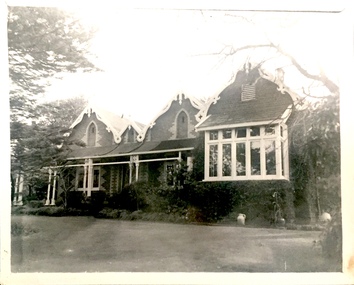
Photograph, 'Roseneath', Pakington Street, c.1959
... Together it forms the largest privately-donated collection within the archives of the Kew Historical Society. roseneath -- pakington street -- kew (vic.) historic houses -- kew (vic.) Small black and white photograph of Roseneath in Pakington Street, Kew. ...This work forms part of the collection assembled by the historian Dorothy Rogers, that was donated to the Kew Historical Society by her son John Rogers in 2015. The manuscripts, photographs, maps, and documents were sourced by her from both family and local collections or produced as references for her print publications. Many were directly used by Rogers in writing ‘Lovely Old Homes of Kew’ (1961) and 'A History of Kew' (1973), or the numerous articles on local history that she produced for suburban newspapers. Most of the photographs in the collection include detailed annotations in her hand.The Rogers Collection provides a comprehensive insight into the working habits of a historian in the 1960s and 1970s. Together it forms the largest privately-donated collection within the archives of the Kew Historical Society.Small black and white photograph of Roseneath in Pakington Street, Kew.roseneath -- pakington street -- kew (vic.), historic houses -- kew (vic.) -
 Kew Historical Society Inc
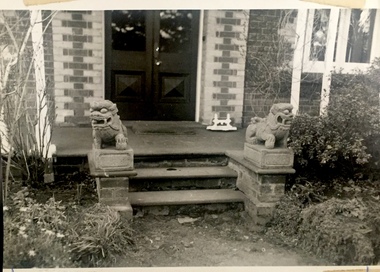
Photograph, Guardian Lions, 'Roseneath', Pakington Street, c.1959
... Together it forms the largest privately-donated collection within the archives of the Kew Historical Society. roseneath -- pakington street -- kew (vic.) historic houses -- kew (vic.) "Chinese lions at Roseneath" Small black and white photograph of the guardian lions at the entrance to Roseneath in Pakington Street, Kew. ...This work forms part of the collection assembled by the historian Dorothy Rogers, that was donated to the Kew Historical Society by her son John Rogers in 2015. The manuscripts, photographs, maps, and documents were sourced by her from both family and local collections or produced as references for her print publications. Many were directly used by Rogers in writing ‘Lovely Old Homes of Kew’ (1961) and 'A History of Kew' (1973), or the numerous articles on local history that she produced for suburban newspapers. Most of the photographs in the collection include detailed annotations in her hand.The Rogers Collection provides a comprehensive insight into the working habits of a historian in the 1960s and 1970s. Together it forms the largest privately-donated collection within the archives of the Kew Historical Society.Small black and white photograph of the guardian lions at the entrance to Roseneath in Pakington Street, Kew."Chinese lions at Roseneath"roseneath -- pakington street -- kew (vic.), historic houses -- kew (vic.) -
 Kew Historical Society Inc
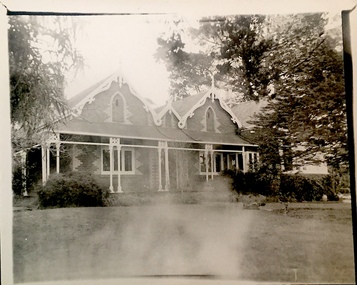
Photograph, 'Roseneath', Pakington Street, c.1959
... Together it forms the largest privately-donated collection within the archives of the Kew Historical Society. roseneath -- pakington street -- kew (vic.) historic houses -- kew (vic.) "15" Small black and white faded photograph of Roseneath in Pakington Street, Kew. ...This work forms part of the collection assembled by the historian Dorothy Rogers, that was donated to the Kew Historical Society by her son John Rogers in 2015. The manuscripts, photographs, maps, and documents were sourced by her from both family and local collections or produced as references for her print publications. Many were directly used by Rogers in writing ‘Lovely Old Homes of Kew’ (1961) and 'A History of Kew' (1973), or the numerous articles on local history that she produced for suburban newspapers. Most of the photographs in the collection include detailed annotations in her hand.The Rogers Collection provides a comprehensive insight into the working habits of a historian in the 1960s and 1970s. Together it forms the largest privately-donated collection within the archives of the Kew Historical Society.Small black and white faded photograph of Roseneath in Pakington Street, Kew."15"roseneath -- pakington street -- kew (vic.), historic houses -- kew (vic.) -
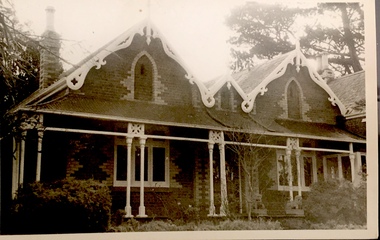 Kew Historical Society Inc
Photograph, 'Roseneath', Pakington Street, c.1959
... Together it forms the largest privately-donated collection within the archives of the Kew Historical Society. roseneath -- pakington street -- kew (vic.) historic houses -- kew (vic.) "14" Small black and white faded photograph of Roseneath in Pakington Street, Kew. ...This work forms part of the collection assembled by the historian Dorothy Rogers, that was donated to the Kew Historical Society by her son John Rogers in 2015. The manuscripts, photographs, maps, and documents were sourced by her from both family and local collections or produced as references for her print publications. Many were directly used by Rogers in writing ‘Lovely Old Homes of Kew’ (1961) and 'A History of Kew' (1973), or the numerous articles on local history that she produced for suburban newspapers. Most of the photographs in the collection include detailed annotations in her hand.The Rogers Collection provides a comprehensive insight into the working habits of a historian in the 1960s and 1970s. Together it forms the largest privately-donated collection within the archives of the Kew Historical Society.Small black and white faded photograph of Roseneath in Pakington Street, Kew."14"roseneath -- pakington street -- kew (vic.), historic houses -- kew (vic.) -
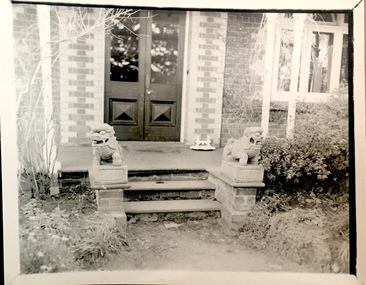 Kew Historical Society Inc
Photograph, Guardian Lions, 'Roseneath', Pakington Street, c.1959
... Together it forms the largest privately-donated collection within the archives of the Kew Historical Society. roseneath -- pakington street -- kew (vic.) historic houses -- kew (vic.) "26" Small black and white photograph of the guardian lions at the entrance to Roseneath in Pakington Street, Kew. ...This work forms part of the collection assembled by the historian Dorothy Rogers, that was donated to the Kew Historical Society by her son John Rogers in 2015. The manuscripts, photographs, maps, and documents were sourced by her from both family and local collections or produced as references for her print publications. Many were directly used by Rogers in writing ‘Lovely Old Homes of Kew’ (1961) and 'A History of Kew' (1973), or the numerous articles on local history that she produced for suburban newspapers. Most of the photographs in the collection include detailed annotations in her hand.The Rogers Collection provides a comprehensive insight into the working habits of a historian in the 1960s and 1970s. Together it forms the largest privately-donated collection within the archives of the Kew Historical Society.Small black and white photograph of the guardian lions at the entrance to Roseneath in Pakington Street, Kew."26"roseneath -- pakington street -- kew (vic.), historic houses -- kew (vic.) -
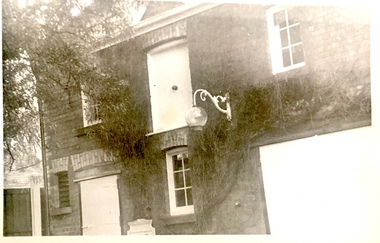 Kew Historical Society Inc
Photograph, Stables, 'Roseneath', Pakington Street, c.1960
... houses -- kew (vic.)...roseneath -- pakington street -- kew (vic.)...Together it forms the largest privately-donated collection within the archives of the Kew Historical Society. historic houses -- kew (vic.) roseneath -- pakington street -- kew (vic.) "33" Small black and white photograph of the stables at the rear of Roseneath in Pakington Street, Kew. ...This work forms part of the collection assembled by the historian Dorothy Rogers, that was donated to the Kew Historical Society by her son John Rogers in 2015. The manuscripts, photographs, maps, and documents were sourced by her from both family and local collections or produced as references for her print publications. Many were directly used by Rogers in writing ‘Lovely Old Homes of Kew’ (1961) and 'A History of Kew' (1973), or the numerous articles on local history that she produced for suburban newspapers. Most of the photographs in the collection include detailed annotations in her hand.The Rogers Collection provides a comprehensive insight into the working habits of a historian in the 1960s and 1970s. Together it forms the largest privately-donated collection within the archives of the Kew Historical Society.Small black and white photograph of the stables at the rear of Roseneath in Pakington Street, Kew."33"historic houses -- kew (vic.), roseneath -- pakington street -- kew (vic.) -
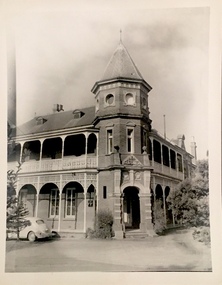 Kew Historical Society Inc
Photograph, 'Ramornie', Pakington Street, c.1960
... houses -- kew (vic.)...ramornie -- pakington street -- kew (vic.)...Together it forms the largest privately-donated collection within the archives of the Kew Historical Society. historic houses -- kew (vic.) ramornie -- pakington street -- kew (vic.) the towers -- pakington street -- kew (vic) james maitland campbell "Commenced 1890 by J.M. ...This work forms part of the collection assembled by the historian Dorothy Rogers, that was donated to the Kew Historical Society by her son John Rogers in 2015. The manuscripts, photographs, maps, and documents were sourced by her from both family and local collections or produced as references for her print publications. Many were directly used by Rogers in writing ‘Lovely Old Homes of Kew’ (1961) and 'A History of Kew' (1973), or the numerous articles on local history that she produced for suburban newspapers. Most of the photographs in the collection include detailed annotations in her hand.The Rogers Collection provides a comprehensive insight into the working habits of a historian in the 1960s and 1970s. Together it forms the largest privately-donated collection within the archives of the Kew Historical Society.Small black and white photograph of the tower and verandas of Ramornie in Pakington Street, Kew.."Commenced 1890 by J.M. Campbell / Ramornie now The Towers / 18"historic houses -- kew (vic.), ramornie -- pakington street -- kew (vic.), the towers -- pakington street -- kew (vic), james maitland campbell -
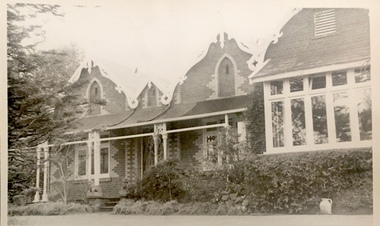 Kew Historical Society Inc
Photograph, 'Roseneath', Pakington Street, c.1960
... houses -- kew (vic.)...roseneath -- pakington street -- kew (vic.)...Together it forms the largest privately-donated collection within the archives of the Kew Historical Society. historic houses -- kew (vic.) roseneath -- pakington street -- kew (vic.) "34" Small black and white photograph of 'Roseneath' in Pakington Street, Kew. ...This work forms part of the collection assembled by the historian Dorothy Rogers, that was donated to the Kew Historical Society by her son John Rogers in 2015. The manuscripts, photographs, maps, and documents were sourced by her from both family and local collections or produced as references for her print publications. Many were directly used by Rogers in writing ‘Lovely Old Homes of Kew’ (1961) and 'A History of Kew' (1973), or the numerous articles on local history that she produced for suburban newspapers. Most of the photographs in the collection include detailed annotations in her hand.The Rogers Collection provides a comprehensive insight into the working habits of a historian in the 1960s and 1970s. Together it forms the largest privately-donated collection within the archives of the Kew Historical Society.Small black and white photograph of 'Roseneath' in Pakington Street, Kew."34"historic houses -- kew (vic.), roseneath -- pakington street -- kew (vic.) -
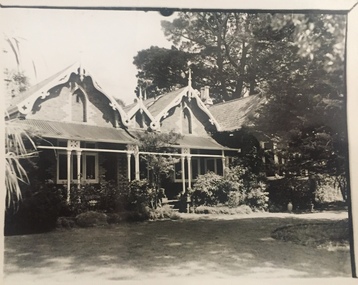 Kew Historical Society Inc
Photograph, 'Roseneath', Pakington Street, c.1960
... houses -- kew (vic.)...roseneath -- pakington street -- kew (vic.)...Together it forms the largest privately-donated collection within the archives of the Kew Historical Society. historic houses -- kew (vic.) roseneath -- pakington street -- kew (vic.) "Roseneath - C. 1858. ...This work forms part of the collection assembled by the historian Dorothy Rogers, that was donated to the Kew Historical Society by her son John Rogers in 2015. The manuscripts, photographs, maps, and documents were sourced by her from both family and local collections or produced as references for her print publications. Many were directly used by Rogers in writing ‘Lovely Old Homes of Kew’ (1961) and 'A History of Kew' (1973), or the numerous articles on local history that she produced for suburban newspapers. Most of the photographs in the collection include detailed annotations in her hand.The Rogers Collection provides a comprehensive insight into the working habits of a historian in the 1960s and 1970s. Together it forms the largest privately-donated collection within the archives of the Kew Historical Society.Small black and white photograph of 'Roseneath' in Pakington Street, Kew."Roseneath - C. 1858. North wing built by E.J. Dunn / 2 of this house print either one"historic houses -- kew (vic.), roseneath -- pakington street -- kew (vic.) -
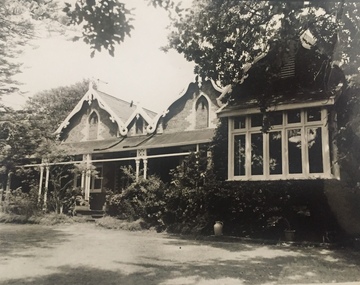 Kew Historical Society Inc
Photograph, 'Roseneath', Pakington Street, c.1960
... houses -- kew (vic.)...roseneath -- pakington street -- kew(vic.)...Together it forms the largest privately-donated collection within the archives of the Kew Historical Society. historic houses -- kew (vic.) roseneath -- pakington street -- kew(vic.) "Roseneath. ...This work forms part of the collection assembled by the historian Dorothy Rogers, that was donated to the Kew Historical Society by her son John Rogers in 2015. The manuscripts, photographs, maps, and documents were sourced by her from both family and local collections or produced as references for her print publications. Many were directly used by Rogers in writing ‘Lovely Old Homes of Kew’ (1961) and 'A History of Kew' (1973), or the numerous articles on local history that she produced for suburban newspapers. Most of the photographs in the collection include detailed annotations in her hand.The Rogers Collection provides a comprehensive insight into the working habits of a historian in the 1960s and 1970s. Together it forms the largest privately-donated collection within the archives of the Kew Historical Society.Small black and white photograph of 'Roseneath', Pakington Street, Kew."Roseneath. Ca.1858. North Wing added by E.J. Dunn"historic houses -- kew (vic.), roseneath -- pakington street -- kew(vic.) -
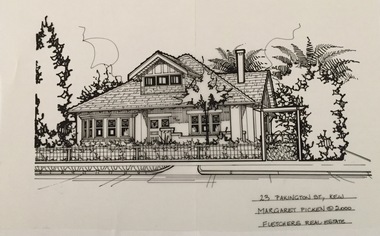 Kew Historical Society Inc
Drawing - Property Illustration, Margaret Picken, 23 Pakington Street, Kew, 2000
... houses -- kew (vic.)...23 pakington street - kew (vic)...The year in which the drawing was created is also a valuable record for house historians, as a number of the properties depicted have either been altered since that date or demolished. artist -- margaret picken 1950- architectural drawings -- houses -- kew (vic.) 23 pakington street - kew (vic) 23 PAKINGTON ST., KEW / MARGARET PICKEN © 2000 / FLETCHERS REAL ESTATE Pen and ink architectural drawing on drafting film of 23 Pakington Street, Kew by Margaret Picken. 23 Pakington Street, Kew Drawing Property Illustration Margaret Picken Fletchers Real Estate ...After training as a Cartographic Draftsman within the mining industry, I worked as a property illustrator for real estate firms in the eastern suburbs of Melbourne for 23 years from 1983. I initially photographed houses with a Polaroid camera and made a 'thumbnail' sketch while there. The photos were used to scale off a sketch in pencil and then that sketch was overlaid with drafting film and the 'pen and ink' completed. The pens I used were the Rotring ‘Rapidigraph’ drafting pens. The ink was also made by Rotring (German).The film was ‘Rapidraw’, polyester drafting film, double matte. It takes a very fine line and doesn’t bleed. As well as house sketches, there were often floor plans and site plans ordered. Aerial sketches were ordered when the property needed an overall view. (Margaret Picken, 2020)This drawing is one of a series created by Margaret Picken for a number of real estate agents in Melbourne between 1983 and 2005. Each work is signed and dated by the artist.Gift of Margaret Picken, 2020Pen and ink architectural drawing on drafting film of 23 Pakington Street, Kew by Margaret Picken.23 PAKINGTON ST., KEW / MARGARET PICKEN © 2000 / FLETCHERS REAL ESTATEartist -- margaret picken 1950-, architectural drawings -- houses -- kew (vic.), 23 pakington street - kew (vic) -
 Kew Historical Society Inc
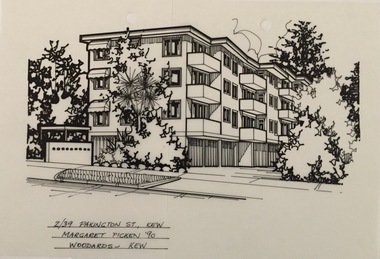
Drawing - Property Illustration, Margaret Picken, 2/39 Pakington Street, Kew, 1990
... The year in which the drawing was created is also a valuable record for house historians, as a number of the properties depicted have either been altered since that date or demolished. artist -- margaret picken 1950- architectural drawings -- houses -- kew (vic.) 2/39 pakington street - kew (vic) 2/39 PAKINGTON ST., KEW / MARGARET PICKEN '90 / WOODARDS ~ KEW Pen and ink architectural drawing on drafting film of 2/39 Pakington Street, Kew by Margaret Picken. 2/39 Pakington Street, Kew Drawing Property Illustration Margaret Picken Woodards (Kew) ...After training as a Cartographic Draftsman within the mining industry, I worked as a property illustrator for real estate firms in the eastern suburbs of Melbourne for 23 years from 1983. I initially photographed houses with a Polaroid camera and made a 'thumbnail' sketch while there. The photos were used to scale off a sketch in pencil and then that sketch was overlaid with drafting film and the 'pen and ink' completed. The pens I used were the Rotring ‘Rapidigraph’ drafting pens. The ink was also made by Rotring (German).The film was ‘Rapidraw’, polyester drafting film, double matte. It takes a very fine line and doesn’t bleed. As well as house sketches, there were often floor plans and site plans ordered. Aerial sketches were ordered when the property needed an overall view. (Margaret Picken, 2020)This drawing is one of a series created by Margaret Picken for a number of real estate agents in Melbourne between 1983 and 2005. Each work is signed and dated by the artist.Gift of Margaret Picken, 2020Pen and ink architectural drawing on drafting film of 2/39 Pakington Street, Kew by Margaret Picken.2/39 PAKINGTON ST., KEW / MARGARET PICKEN '90 / WOODARDS ~ KEWartist -- margaret picken 1950-, architectural drawings -- houses -- kew (vic.), 2/39 pakington street - kew (vic) -
 Kew Historical Society Inc
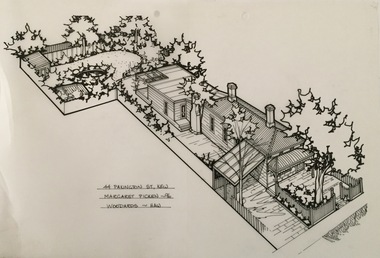
Drawing - Property Illustration, Margaret Picken, 44 Pakington Street, Kew, 1996
... houses -- kew (vic.)...44 pakington street - kew (vic)...The year in which the drawing was created is also a valuable record for house historians, as a number of the properties depicted have either been altered since that date or demolished. artist -- margaret picken 1950- architectural drawings -- houses -- kew (vic.) 44 pakington street - kew (vic) 44 PAKINGTON ST., KEW / MARGARET PICKEN ~96 / WOODARDS ~ HAW Pen and ink architectural drawing on drafting film of 44 Pakington Street, Kew by Margaret Picken. 44 Pakington Street, Kew Drawing Property Illustration Margaret Picken Woodards (Hawthorn) ...After training as a Cartographic Draftsman within the mining industry, I worked as a property illustrator for real estate firms in the eastern suburbs of Melbourne for 23 years from 1983. I initially photographed houses with a Polaroid camera and made a 'thumbnail' sketch while there. The photos were used to scale off a sketch in pencil and then that sketch was overlaid with drafting film and the 'pen and ink' completed. The pens I used were the Rotring ‘Rapidigraph’ drafting pens. The ink was also made by Rotring (German).The film was ‘Rapidraw’, polyester drafting film, double matte. It takes a very fine line and doesn’t bleed. As well as house sketches, there were often floor plans and site plans ordered. Aerial sketches were ordered when the property needed an overall view. (Margaret Picken, 2020)This drawing is one of a series created by Margaret Picken for a number of real estate agents in Melbourne between 1983 and 2005. Each work is signed and dated by the artist.Gift of Margaret Picken, 2020Pen and ink architectural drawing on drafting film of 44 Pakington Street, Kew by Margaret Picken.44 PAKINGTON ST., KEW / MARGARET PICKEN ~96 / WOODARDS ~ HAWartist -- margaret picken 1950-, architectural drawings -- houses -- kew (vic.), 44 pakington street - kew (vic) -
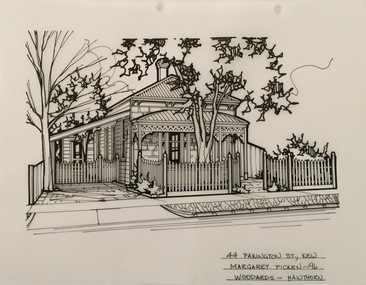 Kew Historical Society Inc
Drawing - Property Illustration, Margaret Picken, 44 Pakington Street, Kew, 1996
... houses -- kew (vic.)...44 pakington street -- kew (vic.)...The year in which the drawing was created is also a valuable record for house historians, as a number of the properties depicted have either been altered since that date or demolished. artist -- margaret picken 1950- architectural drawings -- houses -- kew (vic.) 44 pakington street -- kew (vic.) 44 PAKINGTON ST., KEW / MARGARET PICKEN '~96 / WOODARDS ~ HAWTHORN Pen and ink architectural drawing on drafting film of 44 Pakington Street, Kew by Margaret Picken. 44 Pakington Street, Kew Drawing Property Illustration Margaret Picken Woodards (Hawthorn) ...After training as a Cartographic Draftsman within the mining industry, I worked as a property illustrator for real estate firms in the eastern suburbs of Melbourne for 23 years from 1983. I initially photographed houses with a Polaroid camera and made a 'thumbnail' sketch while there. The photos were used to scale off a sketch in pencil and then that sketch was overlaid with drafting film and the 'pen and ink' completed. The pens I used were the Rotring ‘Rapidigraph’ drafting pens. The ink was also made by Rotring (German).The film was ‘Rapidraw’, polyester drafting film, double matte. It takes a very fine line and doesn’t bleed. As well as house sketches, there were often floor plans and site plans ordered. Aerial sketches were ordered when the property needed an overall view. (Margaret Picken, 2020)This drawing is one of a series created by Margaret Picken for a number of real estate agents in Melbourne between 1983 and 2005. Each work is signed and dated by the artist.Gift of Margaret Picken, 2020Pen and ink architectural drawing on drafting film of 44 Pakington Street, Kew by Margaret Picken.44 PAKINGTON ST., KEW / MARGARET PICKEN '~96 / WOODARDS ~ HAWTHORNartist -- margaret picken 1950-, architectural drawings -- houses -- kew (vic.), 44 pakington street -- kew (vic.) -
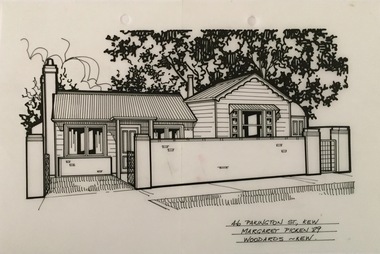 Kew Historical Society Inc
Drawing - Property Illustration, Margaret Picken, 46 Pakington Street, Kew, 1989
... houses -- kew (vic.)...46 pakington street - kew (vic)...The year in which the drawing was created is also a valuable record for house historians, as a number of the properties depicted have either been altered since that date or demolished. artist -- margaret picken 1950- architectural drawings -- houses -- kew (vic.) 46 pakington street - kew (vic) 46 PAKINGTON ST., KEW / MARGARET PICKEN '89 / WOODARDS ~ KEW Pen and ink architectural drawing on drafting film of 46 Pakington Street, Kew by Margaret Picken. 46 Pakington Street, Kew Drawing Property Illustration Margaret Picken Woodards (Kew) ...After training as a Cartographic Draftsman within the mining industry, I worked as a property illustrator for real estate firms in the eastern suburbs of Melbourne for 23 years from 1983. I initially photographed houses with a Polaroid camera and made a 'thumbnail' sketch while there. The photos were used to scale off a sketch in pencil and then that sketch was overlaid with drafting film and the 'pen and ink' completed. The pens I used were the Rotring ‘Rapidigraph’ drafting pens. The ink was also made by Rotring (German).The film was ‘Rapidraw’, polyester drafting film, double matte. It takes a very fine line and doesn’t bleed. As well as house sketches, there were often floor plans and site plans ordered. Aerial sketches were ordered when the property needed an overall view. (Margaret Picken, 2020)This drawing is one of a series created by Margaret Picken for a number of real estate agents in Melbourne between 1983 and 2005. Each work is signed and dated by the artist.Gift of Margaret Picken, 2020Pen and ink architectural drawing on drafting film of 46 Pakington Street, Kew by Margaret Picken.46 PAKINGTON ST., KEW / MARGARET PICKEN '89 / WOODARDS ~ KEWartist -- margaret picken 1950-, architectural drawings -- houses -- kew (vic.), 46 pakington street - kew (vic) -
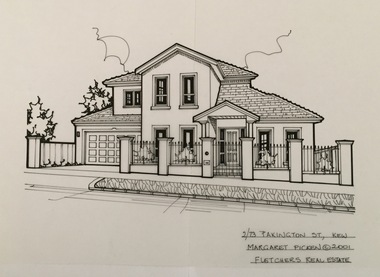 Kew Historical Society Inc
Drawing - Property Illustration, Margaret Picken, 2/73 Pakington Street, Kew, 2001
... The year in which the drawing was created is also a valuable record for house historians, as a number of the properties depicted have either been altered since that date or demolished. artist -- margaret picken 1950- architectural drawings -- houses -- kew (vic.) 2/73 pakington street - kew (vic) 2/73 PAKINGTON ST., KEW / MARGARET PICKEN ©2001 / FLETCHERS REAL ESTATE Pen and ink architectural drawing on drafting film of 2/73 Pakington Street, Kew by Margaret Picken. 2/73 Pakington Street, Kew Drawing Property Illustration Margaret Picken Fletchers Real Estate ...After training as a Cartographic Draftsman within the mining industry, I worked as a property illustrator for real estate firms in the eastern suburbs of Melbourne for 23 years from 1983. I initially photographed houses with a Polaroid camera and made a 'thumbnail' sketch while there. The photos were used to scale off a sketch in pencil and then that sketch was overlaid with drafting film and the 'pen and ink' completed. The pens I used were the Rotring ‘Rapidigraph’ drafting pens. The ink was also made by Rotring (German).The film was ‘Rapidraw’, polyester drafting film, double matte. It takes a very fine line and doesn’t bleed. As well as house sketches, there were often floor plans and site plans ordered. Aerial sketches were ordered when the property needed an overall view. (Margaret Picken, 2020)This drawing is one of a series created by Margaret Picken for a number of real estate agents in Melbourne between 1983 and 2005. Each work is signed and dated by the artist.Gift of Margaret Picken, 2020Pen and ink architectural drawing on drafting film of 2/73 Pakington Street, Kew by Margaret Picken.2/73 PAKINGTON ST., KEW / MARGARET PICKEN ©2001 / FLETCHERS REAL ESTATEartist -- margaret picken 1950-, architectural drawings -- houses -- kew (vic.), 2/73 pakington street - kew (vic) -
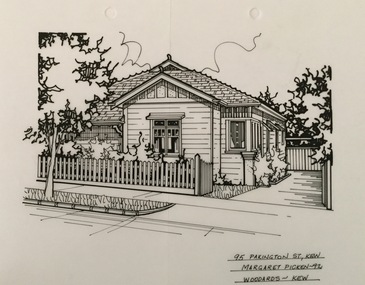 Kew Historical Society Inc
Drawing - Property Illustration, Margaret Picken, 95 Pakington Street, Kew, 1992
... houses -- kew (vic.)...95 pakington street - kew (vic)...The year in which the drawing was created is also a valuable record for house historians, as a number of the properties depicted have either been altered since that date or demolished. artist -- margaret picken 1950- architectural drawings -- houses -- kew (vic.) 95 pakington street - kew (vic) 95 PAKINGTON ST., KEW / MARGARET PICKEN '92 / WOODARDS ~ KEW Pen and ink architectural drawing on drafting film of 95 Pakington Street, Kew by Margaret Picken. 95 Pakington Street, Kew Drawing Property Illustration Margaret Picken Woodards (Kew) ...After training as a Cartographic Draftsman within the mining industry, I worked as a property illustrator for real estate firms in the eastern suburbs of Melbourne for 23 years from 1983. I initially photographed houses with a Polaroid camera and made a 'thumbnail' sketch while there. The photos were used to scale off a sketch in pencil and then that sketch was overlaid with drafting film and the 'pen and ink' completed. The pens I used were the Rotring ‘Rapidigraph’ drafting pens. The ink was also made by Rotring (German).The film was ‘Rapidraw’, polyester drafting film, double matte. It takes a very fine line and doesn’t bleed. As well as house sketches, there were often floor plans and site plans ordered. Aerial sketches were ordered when the property needed an overall view. (Margaret Picken, 2020)This drawing is one of a series created by Margaret Picken for a number of real estate agents in Melbourne between 1983 and 2005. Each work is signed and dated by the artist.Gift of Margaret Picken, 2020Pen and ink architectural drawing on drafting film of 95 Pakington Street, Kew by Margaret Picken.95 PAKINGTON ST., KEW / MARGARET PICKEN '92 / WOODARDS ~ KEWartist -- margaret picken 1950-, architectural drawings -- houses -- kew (vic.), 95 pakington street - kew (vic) -
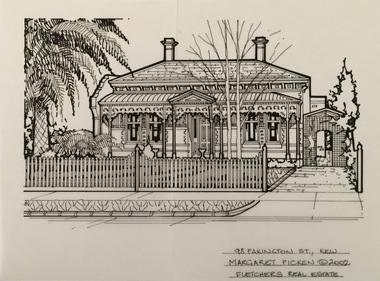 Kew Historical Society Inc
Drawing - Property Illustration, Margaret Picken, 98 Pakington Street, Kew, 2002
... houses -- kew (vic.)...98 pakington street - kew (vic)...The year in which the drawing was created is also a valuable record for house historians, as a number of the properties depicted have either been altered since that date or demolished. artist -- margaret picken 1950- architectural drawings -- houses -- kew (vic.) 98 pakington street - kew (vic) 98 PAKINGTON ST., KEW / MARGARET PICKEN ©2002 / FLETCHERS REAL ESTATE Pen and ink architectural drawing on drafting film of 98 Pakington Street, Kew by Margaret Picken. 98 Pakington Street, Kew Drawing Property Illustration Margaret Picken Fletchers Real Estate ...After training as a Cartographic Draftsman within the mining industry, I worked as a property illustrator for real estate firms in the eastern suburbs of Melbourne for 23 years from 1983. I initially photographed houses with a Polaroid camera and made a 'thumbnail' sketch while there. The photos were used to scale off a sketch in pencil and then that sketch was overlaid with drafting film and the 'pen and ink' completed. The pens I used were the Rotring ‘Rapidigraph’ drafting pens. The ink was also made by Rotring (German).The film was ‘Rapidraw’, polyester drafting film, double matte. It takes a very fine line and doesn’t bleed. As well as house sketches, there were often floor plans and site plans ordered. Aerial sketches were ordered when the property needed an overall view. (Margaret Picken, 2020)This drawing is one of a series created by Margaret Picken for a number of real estate agents in Melbourne between 1983 and 2005. Each work is signed and dated by the artist.Gift of Margaret Picken, 2020Pen and ink architectural drawing on drafting film of 98 Pakington Street, Kew by Margaret Picken.98 PAKINGTON ST., KEW / MARGARET PICKEN ©2002 / FLETCHERS REAL ESTATEartist -- margaret picken 1950-, architectural drawings -- houses -- kew (vic.), 98 pakington street - kew (vic) -
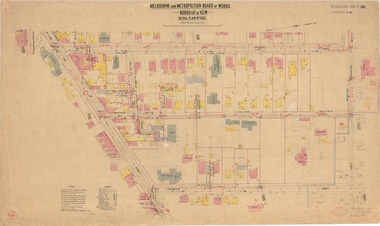 Kew Historical Society Inc
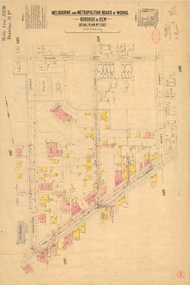
Plan, Melbourne & Metropolitan Board of Works : Borough of Kew : Detail Plan No.1582, 1904
... Kew Fire Brigade in the centre of the north side of Walton Street is shown but not named on the plan. Further down Pakington Street stood the two-storey Italianate mansion ‘Overton’. The home of Stanford Chapman, it was to be featured in the Imperial Institute series of bromide photographs of Victoria, Vol. 1: Homes and scenery. It was later to become a boarding house...Kew Fire Brigade in the centre of the north side of Walton Street is shown but not named on the plan. Further down Pakington Street stood the two-storey Italianate mansion ‘Overton’. The home of Stanford Chapman, it was to be featured in the Imperial Institute series of bromide photographs of Victoria, Vol. 1: Homes and scenery. It was later to become a boarding house ...The Melbourne and Metropolitan Board of Works (MMBW) plans were produced from the 1890s to the 1950s. They were crucial to the design and development of Melbourne's sewerage and drainage system. The plans, at a scale of 40 feet to 1 inch (1:480), provide a detailed historical record of Melbourne streetscapes and environmental features. Each plan covers one or two street blocks (roughly six streets), showing details of buildings, including garden layouts and ownership boundaries, and features such as laneways, drains, bridges, parks, municipal boundaries and other prominent landmarks as they existed at the time each plan was produced. (Source: State Library of Victoria)This plan forms part of a large group of MMBW plans and maps that was donated to the Society by the Mr Poulter, City Engineer of the City of Kew in 1989. Within this collection, thirty-five hand-coloured plans, backed with linen, are of statewide significance as they include annotations that provide details of construction materials used in buildings in the first decade of the 20th century as well as additional information about land ownership and usage. The copies in the Public Record Office Victoria and the State Library of Victoria are monochrome versions which do not denote building materials so that the maps in this collection are invaluable and unique tools for researchers and heritage consultants. A number of the plans are not held in the collection of the State Library of Victoria so they have the additional attribute of rarity.Original survey plan, issued by the MMBW to a contractor with responsibility for constructing sewers in the area identified on the plan within the Borough of Kew. The plan was at some stage hand-coloured, possibly by the contractor, but more likely by officers working in the Engineering Department of the Borough and later Town, then City of Kew. The hand-coloured sections of buildings on the plan were used to denote masonry or brick constructions (pink), weatherboard constructions (yellow), and public buildings (grey). Public buildings, coloured grey on the Plan 1582 include the police station and post office, churches and schools. The earliest church school, Common School No.356 was located at the rear of the Congregational Church in Peel Street. It was constructed in 1859. The first buildings of Kew Primary School No.1075 on the other side of Peel Street were constructed in 1871. The school in 1903 only occupied a small fraction of its current site. In 1903, where the rear playground is now located, were two weatherboard and one brick villa. Trinity Grammar School was founded in 1902 and opened in the Parish Hall at the rear of Holy Trinity Anglican Church. It was not to move to its current site until 1906. The outline of the building housing the Kew Fire Brigade in the centre of the north side of Walton Street is shown but not named on the plan. Further down Pakington Street stood the two-storey Italianate mansion ‘Overton’. The home of Stanford Chapman, it was to be featured in the Imperial Institute series of bromide photographs of Victoria, Vol. 1: Homes and scenery. It was later to become a boarding house before it was later demolished.melbourne and metropolitan board of works, detail plans, maps - borough of kew, mmbw 1582, cartography -
 Kew Historical Society Inc
Plan, Melbourne & Metropolitan Board of Works : Borough of Kew : Detail Plan No.1585, 1904
... Kew. The hand-coloured sections of buildings on the plan were used to denote masonry or brick constructions (pink), weatherboard constructions (yellow), and public buildings (grey). This plan, which covers parts of High Street, Pakington Street and Derby Street is dominated by two historic Kew mansions: ‘Konetta’ and ‘Ramornie’. Ramornie was constructed in 1890 for James Maitland Campbell, three times Mayor of Kew. Sold in 1940, it became a boarding house...Kew. The hand-coloured sections of buildings on the plan were used to denote masonry or brick constructions (pink), weatherboard constructions (yellow), and public buildings (grey). This plan, which covers parts of High Street, Pakington Street and Derby Street is dominated by two historic Kew mansions: ‘Konetta’ and ‘Ramornie’. Ramornie was constructed in 1890 for James Maitland Campbell, three times Mayor of Kew. Sold in 1940, it became a boarding house ...The Melbourne and Metropolitan Board of Works (MMBW) plans were produced from the 1890s to the 1950s. They were crucial to the design and development of Melbourne's sewerage and drainage system. The plans, at a scale of 40 feet to 1 inch (1:480), provide a detailed historical record of Melbourne streetscapes and environmental features. Each plan covers one or two street blocks (roughly six streets), showing details of buildings, including garden layouts and ownership boundaries, and features such as laneways, drains, bridges, parks, municipal boundaries and other prominent landmarks as they existed at the time each plan was produced. (Source: State Library of Victoria)This plan forms part of a large group of MMBW plans and maps that was donated to the Society by the Mr Poulter, City Engineer of the City of Kew in 1989. Within this collection, thirty-five hand-coloured plans, backed with linen, are of statewide significance as they include annotations that provide details of construction materials used in buildings in the first decade of the 20th century as well as additional information about land ownership and usage. The copies in the Public Record Office Victoria and the State Library of Victoria are monochrome versions which do not denote building materials so that the maps in this collection are invaluable and unique tools for researchers and heritage consultants. A number of the plans are not held in the collection of the State Library of Victoria so they have the additional attribute of rarity.Original survey plan, issued by the MMBW to a contractor with responsibility for constructing sewers in the area identified on the plan within the Borough of Kew. The plan was at some stage hand-coloured, possibly by the contractor, but more likely by officers working in the Engineering Department of the Borough and later Town, then City of Kew. The hand-coloured sections of buildings on the plan were used to denote masonry or brick constructions (pink), weatherboard constructions (yellow), and public buildings (grey). This plan, which covers parts of High Street, Pakington Street and Derby Street is dominated by two historic Kew mansions: ‘Konetta’ and ‘Ramornie’. Ramornie was constructed in 1890 for James Maitland Campbell, three times Mayor of Kew. Sold in 1940, it became a boarding house known as ‘The Towers’. Now a private residence again, it has only one of its three balconies remaining. The location of the missing two balconies can be seen on the plan. In 1903, the grounds of Ramornie included a large tennis court fronting Pakington Street. The rear of the property is shown as extending to Cobden Street. One of Kew’s oldest hotels, the Prospect Hill Hotel on the corner of High and Cobden Street was established in 1858. The outline of the hotel shown on the plan represents the second building on the site. During the 19th century it was often used for electoral meetings. The Prospect Hill Hotel was to be redeveloped again in 1928, by the local architect Robert McIntyre. Since the 1980s, the hotel has been a live music venue, the home of the Melbourne Jazz Club, a restaurant and a liquor outlet.melbourne and metropolitan board of works, detail plans, maps - borough of kew, mmbw 1585, cartography -
 Kew Historical Society Inc
Journal, Kewriosity : July 1987
... Kew Council elections] / p3. Traffic Plans / p3. Streetscapes [Derby Street, Pakington Street, Mawson Street, Ridgeway Avenue upgrades] / p3. Living by faith and prudence Carmelite Sisters say / p4. Mothers mark day [Nursing Mothering Week] / p4. Volunteers [Royal Talbot Hospital Auxiliary] / p4. Kew President [Janet Stearn, Victorian Penguin Club] / p5. Art ideas/ / p5. [Kew] Library re-opens / p5. Kew [Community] Bus / p5. Kew Community House ...Kew needs more caregivers [Kew Family Day Care Service] / p1. Aquatic Centre go ahead [Kew Recreation Centre] / p1. Dates for July / p2. Holiday Program [activities] / p2. Commentary - Rewarding year almost over / Cr Joe Ormando, Mayor of Kew p3. Nominations close [Kew Council elections] / p3. Traffic Plans / p3. Streetscapes [Derby Street, Pakington Street, Mawson Street, Ridgeway Avenue upgrades] / p3. Living by faith and prudence Carmelite Sisters say / p4. Mothers mark day [Nursing Mothering Week] / p4. Volunteers [Royal Talbot Hospital Auxiliary] / p4. Kew President [Janet Stearn, Victorian Penguin Club] / p5. Art ideas/ / p5. [Kew] Library re-opens / p5. Kew [Community] Bus / p5. Kew Community House - Drop-in Centre / Janet Price / p6. Rec[reation] Program / p6. Dance class [Susan Crouch, Naomi Aitchison] / p6. [Kew Community] Action Group / Rhonda McCaw p6. Integration a two way street [Wheelchair basketball, Victorian Netball Association] / p7. Opera for Kew [Ian Lowe] / p7. Bicentennial plans [Kew Bicentennial Committee] / Gerard Petrie p7. Dance therapy [Dance Therapy Development Group] / p7. Footy news [Kew Football Club] / p8. Keeping you informed [Kew Citizens' Advice Bureau] / p8. Cheque for Red Cross [Kew Red Cross Appeal Committee] / p8. Preparing [garden] beds for Spring / Peter Davies p8.Kewriosity was a local newsletter combining Kew Council and community news. It was published between November 1983 and June 1994, replacing an earlier Kewriosity [broad] Sheet (1979-84). In producing Kewriosity, Council aimed to provide a range of interesting and informative articles covering its deliberations and decision making, together with items of general interest and importance to the Kew community and information not generally available through daily media outlets.non-fictionKew needs more caregivers [Kew Family Day Care Service] / p1. Aquatic Centre go ahead [Kew Recreation Centre] / p1. Dates for July / p2. Holiday Program [activities] / p2. Commentary - Rewarding year almost over / Cr Joe Ormando, Mayor of Kew p3. Nominations close [Kew Council elections] / p3. Traffic Plans / p3. Streetscapes [Derby Street, Pakington Street, Mawson Street, Ridgeway Avenue upgrades] / p3. Living by faith and prudence Carmelite Sisters say / p4. Mothers mark day [Nursing Mothering Week] / p4. Volunteers [Royal Talbot Hospital Auxiliary] / p4. Kew President [Janet Stearn, Victorian Penguin Club] / p5. Art ideas/ / p5. [Kew] Library re-opens / p5. Kew [Community] Bus / p5. Kew Community House - Drop-in Centre / Janet Price / p6. Rec[reation] Program / p6. Dance class [Susan Crouch, Naomi Aitchison] / p6. [Kew Community] Action Group / Rhonda McCaw p6. Integration a two way street [Wheelchair basketball, Victorian Netball Association] / p7. Opera for Kew [Ian Lowe] / p7. Bicentennial plans [Kew Bicentennial Committee] / Gerard Petrie p7. Dance therapy [Dance Therapy Development Group] / p7. Footy news [Kew Football Club] / p8. Keeping you informed [Kew Citizens' Advice Bureau] / p8. Cheque for Red Cross [Kew Red Cross Appeal Committee] / p8. Preparing [garden] beds for Spring / Peter Davies p8. publications -- city of kew (vic.), kewriosity, council newsletters, community newsletters -
Kew Historical Society Inc
Journal, Kewriosity : February 1987
... street] trees / p1. Dates for February / p2. [Community] Notices / p2&8. Commentary - a challenging year ahead / Cr Joe Ormando, Mayor of Kew p3. Good gardening / Peter Davies p2. Kew Festival - eat your way through Fun Day / p3. Profile - Cr David Timms / p4. Calling artisans and craft persons [Senior Citizens' Week] / p3. After School program for Kew Primary School / p5. A gentle reminder about Kew's By-Laws [Mini bike riding] / p5. Get your entry in! [Images of Kew competition and exhibition] / p5. Kinder for there year olds [North Kew Municipal Kindergarten, 152 Pakington Street] / p5. Kew Community House ...Kew's Premier Youth Theatre in performance / p1. SEC act threatens [street] trees / p1. Dates for February / p2. [Community] Notices / p2&8. Commentary - a challenging year ahead / Cr Joe Ormando, Mayor of Kew p3. Good gardening / Peter Davies p2. Kew Festival - eat your way through Fun Day / p3. Profile - Cr David Timms / p4. Calling artisans and craft persons [Senior Citizens' Week] / p3. After School program for Kew Primary School / p5. A gentle reminder about Kew's By-Laws [Mini bike riding] / p5. Get your entry in! [Images of Kew competition and exhibition] / p5. Kinder for there year olds [North Kew Municipal Kindergarten, 152 Pakington Street] / p5. Kew Community House [A new year starts; Volunteer tutoring for adult literacy; 1st semester pamphlet; Now open on Wednesdays] / Rhonda McCaw p6. Gymbaroo offers early learning / p6. Hassle free apprenticeship training [Inner Eastern Group Apprenticeship Training Scheme] / p7. Children's Services update [Kew Children's Services Consultative Committee] / p7. Care-Force needs volunteers [Care-Force Family Support Services] / p7. Footy news [Kew Football Club] / p8. Keeping you informed [Citizens' Advice Bureau] / p8. Babysitting? [Babysitting clubs] / p8.Kewriosity was a local newsletter combining Kew Council and community news. It was published between November 1983 and June 1994, replacing an earlier Kewriosity [broad] Sheet (1979-84). In producing Kewriosity, Council aimed to provide a range of interesting and informative articles covering its deliberations and decision making, together with items of general interest and importance to the Kew community and information not generally available through daily media outlets.non-fictionKew's Premier Youth Theatre in performance / p1. SEC act threatens [street] trees / p1. Dates for February / p2. [Community] Notices / p2&8. Commentary - a challenging year ahead / Cr Joe Ormando, Mayor of Kew p3. Good gardening / Peter Davies p2. Kew Festival - eat your way through Fun Day / p3. Profile - Cr David Timms / p4. Calling artisans and craft persons [Senior Citizens' Week] / p3. After School program for Kew Primary School / p5. A gentle reminder about Kew's By-Laws [Mini bike riding] / p5. Get your entry in! [Images of Kew competition and exhibition] / p5. Kinder for there year olds [North Kew Municipal Kindergarten, 152 Pakington Street] / p5. Kew Community House [A new year starts; Volunteer tutoring for adult literacy; 1st semester pamphlet; Now open on Wednesdays] / Rhonda McCaw p6. Gymbaroo offers early learning / p6. Hassle free apprenticeship training [Inner Eastern Group Apprenticeship Training Scheme] / p7. Children's Services update [Kew Children's Services Consultative Committee] / p7. Care-Force needs volunteers [Care-Force Family Support Services] / p7. Footy news [Kew Football Club] / p8. Keeping you informed [Citizens' Advice Bureau] / p8. Babysitting? [Babysitting clubs] / p8. publications -- city of kew (vic.), kewriosity, council newsletters, community newsletters -
 Kew Historical Society Inc
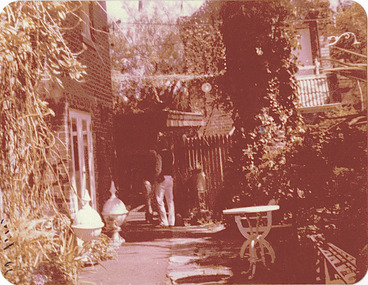
Photograph - 'Roseneath', 37 Pakington Street, 1979
... Original colour (degraded) positive photograph of the coach house of 'Roseneath', 37 Pakington Street Street, Kew....Pakington Street -- kew (Vic.) roseneath Annotated in ink reverse: "Coach House Roseneath / Peter Watts National Trust Historic Gardens Coordinator / Donated by Mavis Rolley" Original colour (degraded) positive photograph of the coach house of 'Roseneath', 37 Pakington Street Street, Kew. ...In 1979, a series of photographs of significant gardens in Kew (Victoria) were taken during a tour by Peter Watts, Historic Gardens Coordinator of National Trust Victoria. These were later purchased to add to the collection. In the case of each photo the colour had badly degraded over time. Original colour (degraded) positive photograph of the coach house of 'Roseneath', 37 Pakington Street Street, Kew.Annotated in ink reverse: "Coach House Roseneath / Peter Watts National Trust Historic Gardens Coordinator / Donated by Mavis Rolley"gardens -- kew (vic.), pakington street -- kew (vic.), roseneath
