
Showing 155 items matching "hugh jones"
-
 City of Melbourne Libraries
Bull, Hugh Jones, 1897-1993, McKenzie Collection of glass plate negatives
... Bull, Hugh Jones, 1897-1993...Above all, the McKenzie Collection project has brought about a powerful and sustained sense of engagement, connection and celebration between people across decades and places. glass plate negatives The Age newspaper photography Melbourne 1930-1939 McKenzie Collection of glass plate negatives Bull, Hugh Jones, 1897-1993 The Age (Melbourne, Vic. : 1854 - 1954) McKenzie, Ian, 1939-2012 McKenzie, Ian, 1939-2012 ...In the 1990s, renowned architectural photographer Ian McKenzie OAM (1939-2014) picked up 240 glass plate negatives at a local market. Believed to be from a Victorian news archive, they dated back to the 1930s. The slides lay dormant in a dusty garage until 2020 when Ian’s wife Louise decided it was time to bring them back into the light.Digital reproductionThe McKenzie Collection of glass plate negatives unlocks glimpses of our city not seen for almost 100 years. In the 1990s, renowned architectural photographer Ian McKenzie (1939-2014) picked up 240 glass plate negatives at a local market. Believed to be from a Victorian news archive, they dated back to the 1930s. The slides lay dormant in a dusty garage until 2020 when Ian’s wife Louise decided it was time to bring them back into the light.glass plate negatives, the age newspaper, photography, melbourne, 1930-1939glass plate negatives, the age newspaper, photography, melbourne, 1930-1939 -
 City of Melbourne Libraries
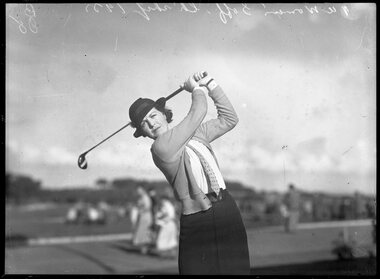
Photograph, Bull, Hugh Jones, 1897-1993, Miss Katherine Rymill
... Bull, Hugh Jones, 1897-1993...Glass plate negative Miss Katherine Rymill Photograph Bull, Hugh Jones, 1897-1993 ...Stylishly dressed in trilby, neck-tie and leather belt, champion Adelaidian golfer Katherine Rymill practises her drive at Royal Melbourne Golf Course. Katherine Rymill (1913-2008) won the Royal Adelaide championships in 1934, 1935 and 1937. Commenting on the NSW “no stockings” controversy of 1935, she said, “In England, players are allowed to appear without stockings in summer and to wear “slacks” in the winter… Playing without stockings makes no difference to one’s performance and it is certainly cooler...” Katherine worked for the Red Cross during WWII and continued to play golf throughout her life. MCK116 Published The Age 29 August 1935 Featured in "Newsworthy: Melbourne in photographs 1933-1936" exhibition at East Melbourne Library, October to December 2023. Exhibition caption by project volunteer, Fiona Collyer. Published: The Age 29 August 1935 p. 11 Published title: SIX STATE CHAMPIONS IN NATIONAL GOLF CHAMPIONSHIP. Published caption: Six State champions for the first time in the history of women’s golf are competing in the matches for the Australian title. — 1. Miss B. Sale (Tas.). 2. Miss J. Hood-Hammond (N.S.W.). 3. Miss J. Gardiner (Qld,) 4. Miss K. Rymill (S.A.). 5. Mrs. O. J. Negus (W.A.). 6. Mrs. S. Morpeth (Vic.) RESEARCHER'S NOTE: The Age listed Golfer 1 as Miss B. Sale and Golfer 4 as Miss K. Rymill. We verified that these should in fact be the other way around: 1 is Miss K. Rymill, 4 is Miss B. Sale. Description: Action shot of woman driving golf ball Research by project volunteer, Fiona Collyer: MISS KATHERINE LUCY RYMILL (1913–2008) Katherine was a champion South Australian golfer. She won the Royal Adelaide championships in 1934, 1935 and 1937. She competed in the Australian Women’s Golf Championships at Royal Melbourne in 1935 against British women golfers and was eliminated by Mrs T S McKay nee Odette Lebebvre. Katherine was from a prominent and wealthy Adelaide family and her social activities and golfing career was closely followed in the local papers. Her mother, Shylee Rymill, was the S.A. Girl Guides’ Commissioner from 1935-1950. Her father H.L. (Cargie) Rymill grew up in a Dutch Renaissance style mansion called “The Firs” in East Terrace, Adelaide (now called Rymill House and State heritage listed), and designed Kooyonga, Seaton, Grange, Glenelg and Mount Lofty golf courses. Both parents were champion golfers and have tournaments named after them. Katherine worked for the Red Cross during WWII. In 1935, for the first time in NSW, the Ladies Golf Union (L.G.V.) enforced their rule regarding the wearing of stockings in official associates’ golf matches. Though the Long Reef competitor’s long skirt and golf socks almost hid her sun-tanned legs from view, an eagle-eyed official had noticed the absence of regulation covering and she and her partner were disqualified. Commenting on the Long Reef “no stockings” controversy, Katherine said “In England, players are allowed to appear without stockings in summer and to wear “slacks” in the winter.” “Playing without stockings makes no difference to one’s performance and it is certainly cooler. However, rules which are formed must be obeyed and that seems all there is to say about it.” Katherine continued to play golf throughout her life and died in 2008.Photographer notations on slide: "Vic Womens Golf Ch'ship 1935 B98".golf, women golfers, royal melbourne golf club -
 City of Melbourne Libraries
Australian Women's Golf Championship at Royal Melbourne Golf Club, Aug-Sep 1935, Bull, Hugh Jones, 1897-1993
... Bull, Hugh Jones, 1897-1993...Golf Royal Melbourne Golf Club Women golfers 1930-1939 Australian Women's Golf Championship at Royal Melbourne Golf Club, Aug-Sep 1935 Bull, Hugh Jones, 1897-1993 ...The first international Australian Women's Golf Championship was held August to September 1935 at Royal Melbourne Golf Club in Black Rock, Victoria. Visiting players from England, Scotland and Ireland dominated the competition. British golfers included Pamela Barton, Phyllis Wade, Jessie Anderson, Mrs Walter Greenlees and Mrs J B Walker. Australian competitors included Katherine Rymill, Betty Nankivell, Betty Sale (MBE), Janet Gardiner, Leonora Wray (MBE), Mrs Sloan Morpeth (née Susie Tolhurst), Mrs Clive Robinson (née Christina “Nin” McMaster), Joan Hood Hammond (DBE CMG), Mrs T S McKay (née Odette Lefebvre) and Mona Macleod. Mrs J B Walker of Britain defeated Mrs Sloan Morpeth of Victoria in the final, before a gallery of 2,000, mostly women. golf, royal melbourne golf club, women golfers, 1930-1939golf, royal melbourne golf club, women golfers, 1930-1939 -
 City of Melbourne Libraries
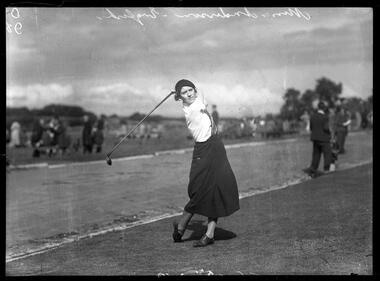
Photograph, Bull, Hugh Jones, 1897-1993, Miss Jessie Anderson
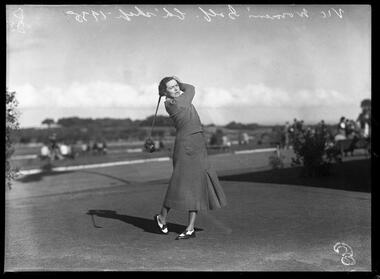
... Bull, Hugh Jones, 1897-1993...Golf Women golfers Royal Melbourne Golf Club Photographer notations on slide: "Miss Anderson - English B98" Glass plate negative Miss Jessie Anderson Photograph Bull, Hugh Jones, 1897-1993 ...In 1937, Miss Jessie Anderson (1915-2006) was the world’s number one ranking women’s golfer. She had been playing golf since she was five years old and designed golf clubs especially for women. During WWII, Jessie enlisted in the Auxiliary Territorial Service (ATS) driving army ambulances, and her fiancée George Valentine, was a POW in Eichstat, Germany. They married once he was freed, in 1945. Jessie was awarded the MBE for services to golf in 1959. Featured in "Newsworthy: Melbourne in photographs 1933-1936" exhibition at East Melbourne Library, October to December 2023. Exhibition caption by project volunteer, Fiona Collyer. Research by project volunteer, Fiona Collyer: Janet "Jessie" Anderson (1915-2006) was a Scottish golf champion, nicknamed “Wee Jessie” for her small stature. She was also nicknamed “Fairway Maid of Perth”, a play on Sir Walter Scott’s “Fair Maid of Perth”. In 1937, Jessie was the world’s number one ranking woman golfer. Her main wins included the British Women's Amateur Championship (1937, 1955, 1958), the Scottish Women's Amateur Championship (1938, 1939, 1951, 1953, 1955, 1958), the New Zealand Women's Golf Championship (1935) and the French Women's Golf Tournament (1936). Jessie was part of the British golf team who competed in the Australian Women’s Golf Championship against an Australian team at Royal Melbourne Golf Club in 1935, which the British team won. The Australian press said, “Hats off to the British women, sparkle, sportsmanship and the fighting spirit that thrills, they had the last word.” Jessie’s father, Joe, a pro-golfer, owned a sports equipment store in St John’s Street, Perth and he designed and manufactured golf clubs under the OK brand. Jessie designed golf clubs especially for women. In 1939 Jessie became engaged to George Valentine. In 1940, George enlisted in the British army and Jessie in the Auxiliary Territorial Service (ATS), the women’s branch of the British Army, driving army ambulances. George was a POW at Eichstat, Germany, and they were unable to marry until he was freed in 1945. Jessie continued to play championship golf until 1960. They had one son, Francis Iain, born 1948. Jessie was awarded the MBE for services to golf in 1959. She was inducted into the Scottish Sports Hall of Fame in 2003. In 2019, Perth Museum and Art Gallery held a retrospective exhibition of her life and career. A biography, “Wee Jessie: Jessie Valentine, whose golf swing lasted a lifetime” by Dr Eve Soulsby, was published in 2019.Photographer notations on slide: "Miss Anderson - English B98"golf, women golfers, royal melbourne golf club -
 City of Melbourne Libraries
Photograph, Bull, Hugh Jones, 1897-1993, Miss Betty Sale
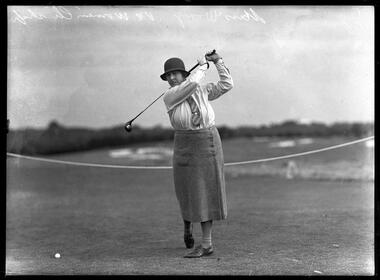
... Bull, Hugh Jones, 1897-1993...Glass plate negative Miss Betty Sale Photograph Bull, Hugh Jones, 1897-1993 ...Betty Sale (1905-1976) won the Tasmanian State Championship in 1934, 1935 and 1936. She also worked as a car saleswoman in Hobart. In 1939, London reported: “Betty Sale, pretty Tasmanian brunette, will soon leave England for Finland, where she will drive an ambulance behind the Mannerheim Line. With twenty-three English society girls, she volunteered for the job because she wanted to do something for the brave Finns.” Betty volunteered for First Aid Nursing Yeomanry Service (F.A.N.Y.), conveying refugees and casualties to hospitals by ambulance in Finland’s harsh weather. Back in England, as a corporal, she worked during bombings in Plymouth, writing to her brother: “Bombs were dropping all around us, fires are raging, debris everywhere and huge holes around us. When we had got all the live ones, we went and collected dead bodies.” Betty was awarded an MBE and the Winter War Medal for Civilians from Finland Government 1939-40. MCK142 Published The Age 29 August 1935 Featured in "Newsworthy: Melbourne in photographs 1933-1936" exhibition at East Melbourne Library, October to December 2023. Exhibition caption by project volunteer, Fiona Collyer. Photographer notations on slide: "Vic. Women's Golf Ch'ship 1935 B98" Published: The Age 29 August 1935 p. 11 Published title: SIX STATE CHAMPIONS IN NATIONAL GOLF CHAMPIONSHIP. Published caption: Six State champions for the first time in the history of women’s golf are competing in the matches for the Australian title. — 1. Miss B. Sale (Tas.). 2. Miss J. Hood-Hammond (N.S.W.). 3. Miss J. Gardiner (Qld,) 4. Miss K. Rymill (S.A.). 5. Mrs. O. J. Negus (W.A.). 6. Mrs. S. Morpeth (Vic.) RESEARCHER'S NOTE: The Age listed Golfer 1 as Miss B. Sale and Golfer 4 as Miss K. Rymill. We verified that these should in fact be the other way around: 1 is Miss K. Rymill, 4 is Miss B. Sale. Description: Action shot of woman driving golf ball Research by project volunteer, Fiona Collyer: MISS BETTY SALE Mrs Margaret Elizabeth Scott Rigg (1905-1976) MBE Betty Sale grew up in Hobart and attended St Michael’s Collegiate School. She was a champion Tasmania golfer and won the State Championship in 1934, 1935, 1936. Betty competed in the Australian Women’s Golf Championship at Royal Melbourne against the British Women’s Team in 1935. Betty worked as a car saleswoman at Robert Nettleford Pty Ltd at 113 Macquarie Street, Hobart. They were the agent for Austin, Buick, Chevrolet and Vauxhall. In April 1939, Betty sailed on the RMS Orford to London where she worked in sales for Henley’s, an exclusive motor sales firm. In November 1939 she volunteered for the Woman’s Transport Arm of the First Aid Nursing Yeomanry Service (F.A.N.Y.) and was part of the team delivering 10 ambulances to Finland, which had been invaded by the Soviet Union. Betty worked conveying refugees and military casualties to military hospitals, often over tracks with only sleigh marks to guide them. Despite contracting measles she continued to work tirelessly, often for 22-hour shifts. She was awarded the Finland Winter War medal 1939-1940 for civilians by Field-Marshall Mannerheim (later President of Finland). Betty was quoted in the Australian Women’s Weekly 17/1/1940: “I joined the ambulance corp for Finland because I was filled with admiration for the courage and determination of the Finns. I don’t think that there has ever been anything so dramatic in history as the manner in which Finland, a land of 4,000,000 people has resisted the aggression of the teeming millions of Russians.” After six months working in Finland, the FANYs found themselves held up unable to get aid from Britain to escape and they felt a burden on the Finns. Eventually money was sent privately from a neutral country and the 17 FANYs determined to get away. They set off from Helsinki with only the civilian clothes they were wearing and travelled by train and bus to a northern port where they boarded a cargo vessel. For a fortnight they did not change their clothes and slept under tarpaulins in the hatchway. The only choice of food was porridge or pea soup. After two weeks aboard the cargo vessel, a palatial liner approached the ship and in mid-ocean the FANYs were transhipped by rope ladders. The women enjoyed three course meals and other luxuries for three days before arriving back in England. Betty, now a corporal, worked for two years transporting civilian and military casualties during bombings in Plymouth. In a letter to her brother, Mr J Sale of Gerogery NSW, Betty wrote, “We have had a very lively time here as we have been blitzed for two nights. There is literally nothing of Plymouth left. We were out all the first night with the ambulance collecting casualties and have never seen such injuries. Bombs were dropping all around us, fires were raging, debris everywhere, and huge holes in the roads. When we had got all the live ones, we went and collected dead bodies. The people are marvellous.” “Next night, we had a worse blitz. We were not out so long but it was not a pleasant party. I didn’t know I was so brave but could not stand it too long. Mr Menzies was here for the second night’s blitz. We have adopted a homeless and hurt dog – a raid victim – and the poor fellow is completely exhausted.” In 1942, Betty worked in Algeria in charge of 100 specialists and technicians - the first servicewomen to arrive in North Africa. In 1945, she was awarded an MBE in recognition and on behalf of the work this unit was involved in. In 1945, Betty was promoted to Captain and posted to Australia to establish a Signal Station. In 1946, she married Lt-Col H. Henry O. Rigg of the Royal Artillery in Tasmania. The couple had first met in Algeria in 1943. The Australian press closely followed Betty’s wartime activities praising her courage, capability, driving and mechanical knowledge and of course Australian women’s hardiness. After the war, Betty lived in Sheffield, England with her husband, working as an office manager. She continued to play golf until her death aged 71 in 1976.Photographer notations on slide: "Vic. Women's Golf Ch'ship 1935 B98".golf, women golfers, royal melbourne golf club -
 City of Melbourne Libraries
Photograph, Bull, Hugh Jones, 1897-1993, Miss Leonora Wray
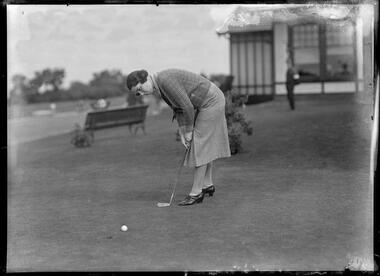
... Bull, Hugh Jones, 1897-1993...Glass plate negative Miss Leonora Wray Photograph Bull, Hugh Jones, 1897-1993 ...Miss Leonora “Leo” Wray MBE Leonora “Leo” Wray (1886-1979) was a champion NSW golfer, regarded as the “mother” of Australian golf. She won state and national titles multiple times across three decades. The Leonora Wray Trophy is awarded to the No. 1 player in Australia in national stroke average. Regarding her golf game Leo remarked, “Never a chance thrown away, or a single shot played without a definite object.” She was said to be commanding in “stature and mien” – a raconteur with a deep, booming voice who inspired in young players “a mixture of fear and awe, respect and affection”. In 1909 she contracted typhoid fever and was unable to play for 10 years. She was awarded an MBE in 1968 for her services to golf and inducted into the Sport Australian Hall of Fame in 1985. Featured in "Newsworthy: Melbourne in photographs 1933-1936" exhibition at East Melbourne Library, October to December 2023. Exhibition caption by project volunteer, Fiona Collyer. Photographer notations on slide: "Miss Wray. Vic Women's Ch'ship B98" Description: Golfer Leonora Wray swings her driver. She is wearing a tiepin and cufflinks. Research by project volunteer, Fiona Collyer: Leonora Wray AKA “Leo” was a champion NSW golfer who is regarded as the “Mother” of Australian women’s golf. She won the NSW State Championships (1906, 1907, 1908) and the Australian title (1907, 1908). In 1909 she contracted typhoid fever and was unable to play for 10 years. Leonora regained the national title in 1929 and the NSW Championship in 1930. She was the champion women’s player of the Australian club ten times between 1907 and 1938 and five times champion at the Royal Sydney Golf Club between 1924 and 1933. She competed in the Australian Women’s Golf Championship at Royal Melbourne against the British team in 1935. During WWII, Leonora worked for the ANZAC Buffet Ladies Auxiliary in Hyde Park, Sydney. Regarding her golf game, she remarked, “Never a chance thrown away, or a single shot played without a definite object.” Leo was said to be commanding in “stature and mien” – a raconteur with a deep, booming voice who inspired in young players “a mixture of fear and awe, respect and affection.” Her portrait by Henry Hanke is held by the Australian Golf Club. Women’s Golf NSW holds its annual Leonora Wray Scratch Teams event and the Leonora Wray Trophy is awarded to the No. 1 player in Australia in national stroke average. In 1968 she was awarded an MBE for her services to women’s golf. In 1985 Leo was inducted into the Sport Australia Hall of Fame.Photographer notations on slide: "Miss Wray. Vic Women's Ch'ship B98".golf, women golfers, royal melbourne golf club -
 City of Melbourne Libraries
Photograph, Bull, Hugh Jones, 1897-1993, Miss Betty Nankivell
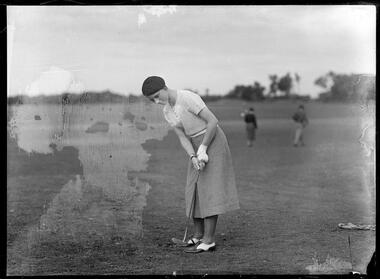
... Bull, Hugh Jones, 1897-1993...Glass plate negative Miss Betty Nankivell Photograph Bull, Hugh Jones, 1897-1993 ...Dr Elizabeth “Betty” Nankivell (1907-2003), later Mrs Forward, graduated in 1937 from Melbourne University with a degree in medicine. She worked at Queen Victoria and Royal Adelaide Hospitals. During WWII, she practised medicine in Morwell, and in 1945 joined the Royal Australian Army Medical Corp (R.A.A.M.C.). Betty lived and worked in many South East Asian countries, including 10 years of private practise in Kuala Lumpur, before retiring in 1970 to live in Melbourne. Photographer notations on slide: "Vic Women's Golf Ch'ship B98" Published: The Age 3 September 1935 p. 7 Published title: "EXCITING GOLF DUEL." Published caption: MISS B. NANKIVELL, whose victory over Miss Pam Barton was the outstanding feature of the play in the Australian Championship yesterday. Trove article identifier: http://nla.gov.au/nla.news-article203852987 Description: Action shot of golfer Betty Nankivell putting on golf course. She wears a checked cardigan, straight skirt, stockings, heeled shoes and a tie, no hat. The clubhouse structure is blurred in the background. Research by project volunteer, Fiona Collyer: Dr Elizabeth “Betty” Nankivell, Mrs Forward Betty Nankivell (1907 – 2003) was a champion Victorian golfer and medical doctor. She competed in the Australian Women’s Golf Championship at Royal Melbourne in 1935 against the visiting British Team. She eliminated 18 year old British champion Pam Barton, but was defeated by the eventual winner of the tournament, Mrs J B Walker in the semi finals. In 1938, Betty won the SA Golf Championships at Kooyonga SA. Betty graduated from Melbourne University with a degree in medicine in 1937 and worked at Queen Victoria Hospital and at Royal Adelaide Hospital as R.M.O. (Resident Medical Officer). During the war years, Betty practised medicine in Morwell, Victoria, and in 1945 joined the R.A.A.M.C. (Royal Australian Army Medical Corp) for the Malaya Medical Service. In 1946, she married Alan Forward OBE, a Colonel in the British Army and later the Commissioner of Road Transport in Malaya, and lived and worked in many S E Asian countries including 10 years in private practice in Kuala Lumpur. Betty continued to play golf throughout her life, retiring in 1970, and died in Melbourne in 2003. Sources: Melbourne University: Journal of the University of Melbourne Medical Society: vol. 2, no. 1Photographer notations on slide: "Miss Nankivell B98".golf, women golfers, royal melbourne golf club -
 City of Melbourne Libraries
Photograph, Bull, Hugh Jones, 1897-1993, Miss Jessie Anderson with bandaged wrist
... Bull, Hugh Jones, 1897-1993...Glass plate negative Miss Jessie Anderson with bandaged wrist Photograph Bull, Hugh Jones, 1897-1993 ...20 year old Scot, Jessie Anderson, practises her putting at Royal Melbourne Golf Course. The press speculated that her heavily bandaged wrist was “a sprained wrist, occasioned through an argument with her luggage”, “a poisoned hand” and, the most likely reason, “sprained at practise”. Featured in "Newsworthy: Melbourne in photographs 1933-1936" exhibition at East Melbourne Library, October to December 2023. Exhibition caption by project volunteer, Fiona Collyer. Photographer notations on slide: "England Anderson Miss B98" Description: Female golfer putting. She is wearing two-tone brogue shoes, a hand-knitted cardigan, beret and skirt. Her left wrist is bandaged. Research by project volunteer, Fiona Collyer: 20 year old Jessie Anderson photographed at the Royal Melbourne Golf Club with a heavily bandaged left wrist. She was part of the British golf team who competed in the Australian Women’s Golf Championship at Royal Melbourne Golf Club in 1935. The press speculated that Jessie had a “sprained wrist, occasioned through an argument with her luggage”, “a poisoned hand” and the most likely reason – “sprained her wrist at practise”. She was defeated in the first round by Victorian, Miss Mona MacLeod. Janet "Jessie" Anderson (1915-2006) was a Scottish golf champion, nicknamed “Wee Jessie” for her small stature. She was also nicknamed “Fairway Maid of Perth”, a play on Sir Walter Scott’s “Fair Maid of Perth”. In 1937, Jessie was the world’s number one ranking woman golfer. Her main wins included the British Women's Amateur Championship (1937, 1955, 1958), the Scottish Women's Amateur Championship (1938, 1939, 1951, 1953, 1955, 1958), the New Zealand Women's Golf Championship (1935) and the French Women's Golf Tournament (1936). Jessie was part of the British golf team who competed in the Australian Women’s Golf Championship against an Australian team at Royal Melbourne Golf Club in 1935, which the British team won. The Australian press said, “Hats off to the British women, sparkle, sportsmanship and the fighting spirit that thrills, they had the last word.” Jessie’s father, Joe, a pro-golfer, owned a sports equipment store in St John’s Street, Perth and he designed and manufactured golf clubs under the OK brand. Jessie designed golf clubs especially for women. In 1939 Jessie became engaged to George Valentine. In 1940, George enlisted in the British army and Jessie in the Auxiliary Territorial Service (ATS), the women’s branch of the British Army, driving army ambulances. George was a POW at Eichstat, Germany, and they were unable to marry until he was freed in 1945. Jessie continued to play championship golf until 1960. They had one son, Francis Iain, born 1948. Jessie was awarded the MBE for services to golf in 1959. She was inducted into the Scottish Sports Hall of Fame in 2003. In 2019, Perth Museum and Art Gallery held a retrospective exhibition of her life and career. A biography, “Wee Jessie: Jessie Valentine, whose golf swing lasted a lifetime” by Dr Eve Soulsby, was published in 2019. Photographer notations on slide: "England Anderson Miss B98".golf, women golfers, royal melbourne golf club -
 City of Melbourne Libraries
Photograph, Bull, Hugh Jones, 1897-1993, Mrs Clive Robinson, née Christina “Nin” McMaster
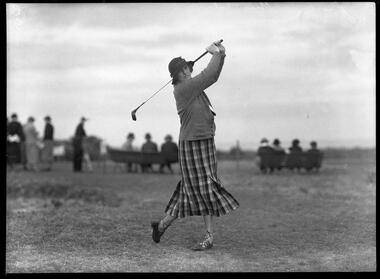
... Bull, Hugh Jones, 1897-1993...Glass plate negative Mrs Clive Robinson, née Christina “Nin” McMaster Photograph Bull, Hugh Jones, 1897-1993 ...Mrs Clive Robinson, née Christina “Nin” McMaster Smartly attired in fedora and lace-up highland dancing style shoes, Australian Team Captain Mrs Clive Robinson’s tartan kick pleat skirt flies up as she practises her swing. Mrs Clive “Nin” Robinson (1985-1971) was a NSW golf champion. Raised on a 5,000 acre sheep station, during WWII she drove a charcoal burning truck and cooked for the forces at Air Force House. Featured in "Newsworthy: Melbourne in photographs 1933-1936" exhibition at East Melbourne Library, October to December 2023. Exhibition caption by project volunteer, Fiona Collyer. Photographer notations on slide: "Mrs Robinson B98" Published: The Age 27 August 1935 p. 6 Published title: Golf Championships Begin. Published caption: A galaxy of champions will take part in the Australian Women's Golf Championship tomorrow. Three are shown here. Below — Mrs. C. Robinson, national champion. On the right — Miss J. Hood Hammond, champion of New South Wales and Miss Gardiner, Queensland champion. Trove article identifier: http://nla.gov.au/nla.news-article203984927 Description: Female golfer teeing off. She is wearing a hat, cardigan, tartan skirt and "Highland dancing" style shoes. Blurred spectators can be seen in the background. Research by project volunteer, Fiona Collyer: Mrs Clive Robinson née Christina Jeanie McMaster, known as "Nin" Mrs Clive Robinson (1895-1971) was a NSW golf champion. She won the Australian Women's amateur golf championship in 1934. Nin was captain of the team who won the Tasman Cup against New Zealand in 1934. She was the captain of the Australian team who competed against the visiting British women’s team in the Australian Women's Golf Championship in 1935 at Royal Melbourne. In 1936 Nin won the NSW Ladies Championship. Nin was raised by parents Mr and Mrs John McMaster on an 8000 acre sheep station called "Weetalabah” near Coolah, 135 kilometres northeast of Dubbo NSW. In 1923 she married Dr. Clive Robinson, a Macquarie Street specialist, and they lived in Point Piper with their daughter Diana. During WWII Nin drove a charcoal burning truck and cooked for the forces at Air Force House. She died of leukemia in 1971. Note: Highland dancing style of shoesPhotographer notations on slide: "Mrs Robinson B98".golf, women golfers, royal melbourne golf club -
 City of Melbourne Libraries
Photograph, Bull, Hugh Jones, 1897-1993, Mrs Sloan Morpeth (Miss Susie Tolhurst)
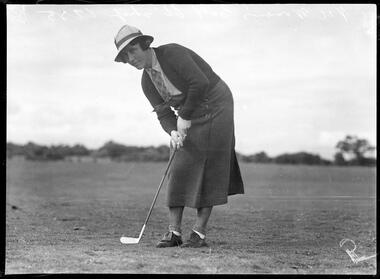
... Bull, Hugh Jones, 1897-1993...Glass plate negative Mrs Sloan Morpeth (Miss Susie Tolhurst) Photograph Bull, Hugh Jones, 1897-1993 ...Mrs Sloan Morpeth, née Claire “Susie” Tolhurst From her trilby with golf tee sensibly tucked in the brim, to her hand knitted socks and fringed brogues, Susie looks the golf champion she was. Susie (1905-1999) won the Victorian Ladies' Amateur Championship five times between 1919 and 1936. She was defeated in the 1935 Women’s Golf Championship final by Mrs J B Walker of Britain. In 2012, Golf Victoria introduced the Women’s Champions Trophy, renamed in 2016 to the Susie Tolhurst Trophy. Her husband, Mr Sloan Morpeth, designed the Commonwealth, Peninsula Kingswood Country Club and Portsea Golf Clubs. Featured in "Newsworthy: Melbourne in photographs 1933-1936" exhibition at East Melbourne Library, October to December 2023. Exhibition caption by project volunteer, Fiona Collyer. Photographer notations on slide: "Vic Women's Golf Ch'ship B98" Description: Golfer Susie Tolhurst putting. She wears a hat, tie, skirt, cardigan, handknitted socks and brogues. She also has a golf tee tucked into her hatband. Research by project volunteer, Fiona Collyer: Mrs Sloan Morpeth née Claire Helene Susie Tolhurst (known as Susie) Susie Tolhurst (1905-1999) was a champion Victorian golfer. Susie was the winner of the Ladies Amateur Championships five times between 1915 and 1936. She held the Australian title in 1930, 1931. Susie competed in the Australian Women’s Golf Championship at Royal Melbourne in 1935 against the British Women’s Team. She made the final but was defeated by Mrs J B Walker of Britain. The Golf Victoria competition for women held the Susie Tolhurst Trophy. In 1934 Susie Tolhurst married NZ Open Championship golfer Mr Sloan Morpeth. He later designed Peninsula - Kingswood Country Golf Course, Portsea Golf Course and Commonwealth Golf Course. They had one daughter, Simone.Photographer notations on slide: "Vic Women's Golf Ch'ship 1935 B98".golf, women golfers, royal melbourne golf club -
 City of Melbourne Libraries
Photograph, Bull, Hugh Jones, 1897-1993, Mrs T S McKay (Miss Odette Lefebvre)
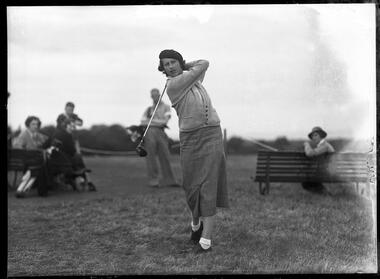
... Bull, Hugh Jones, 1897-1993...Glass slide Mrs T S McKay (Miss Odette Lefebvre) Photograph Bull, Hugh Jones, 1897-1993 ...Mrs T S McKay, née Odette Lefebvre “Killara Amazon who drives like a man, smiles like a school girl and dresses like a picture” – Smiths Weekly 22 July 1933 In 1934, the Ladies Golf Union of NSW introduced a rule forbidding women not wearing stockings from competing in games under their control. Rather than wear stockings, Odette Lefebvre (1910-1991) withdrew from her team causing a media stir. She subsequently agreed to wear stockings for any NSW game she wished to play in. She said that a player had every right to dress as she wished, providing it did not offend modesty. She found it more comfortable to play without stockings. Featured in "Newsworthy: Melbourne in photographs 1933-1936" exhibition at East Melbourne Library, October to December 2023. Exhibition caption by project volunteer, Fiona Collyer. Photographer notations on slide: "Golf Ch'ship Mrs McKay B98" Description: Female golfer teeing off with 3 wood, wearing beret, cardigan, straight skirt, ankle socks, sensible shoes. Blurred spectators are visible in the background. Research by project volunteer, Fiona Collyer: Mrs T S McKay, née Odette Lefebvre (1910-1991), was a NSW champion golfer. She won the NSW Women’s Championship 1931, 1933. Odette competed in the Australian Women’s Golf Championship at Royal Melbourne against the British Women’s Team in 1935. She was defeated by Mrs Sloan Morpeth nee Susie Tolhurst in the semifinals. A tall, willowy, beautiful brunette with a winning smile and sparkly blue eyes and exotically of French origin, the press reported the outdoor sports loving young woman’s social and golf activities closely. In 1933 (27/7/1933), the Smith’s Weekly headline ran “Drives like a man but is a real girl – always”. The article called her the “Killara Amazon who drives like a man, smiles like a school girl and dresses like a picture”. In 1934, the Ladies Golf Union of NSW introduced a rule forbidding women without stockings to compete in games within their control. Rather than wear stockings, Odette withdrew from her team, causing a media stir. She subsequently agreed to wear stockings for any game she was keen to play in. She said that a player had every right to dress as she wished, providing it did not offend modesty. She found it more comfortable to play without stockings. Fellow women golfers were sympathetic to the non-stocking brigade. Mrs J J Hollywood, president of the Maitland Golf Club Associates said, “What a storm in a teacup over nothing! As if a pair of stockings could possibly make all the difference to a person’s game. However, I think the mosquitoes settle that question for the L.G.V. in the North”, she added with a laugh. (Newcastle Sun 5/5/1934) Acting president of the Victorian Women’s Golf Union, Mrs J B Bellair, said, “It is much warmer in Sydney than here and must be more comfortable without stockings. Miss Lefebvre too, has such beautiful legs and they are so brown, that she can afford to dispense with stockings. Women in Victoria are not likely to play without stockings, however, it is much too cold here. I have never seen any of them on the links in bare legs.” (Newcastle Sun 5/5/1934) Mrs L Griffiths, president of the Steelworks Associate Club in Newcastle said, “It appears to be an unnecessary rule that the L.G.V. has enforced. Why, if they started laying down laws like that, where would we end? What about ties etc being compulsory for men?” (Newcastle Sun 5/5/1934) The L.G.V. insisted that the dignity of the game should not be impaired by players who dared to show any originality in clothes, even if they did add comfort. (The Sun, Sydney 5/5/1934) Even in 1941, despite wartime shortages, the L.G.V. NSW was insisting that – “no player may play in open L.G.V. competitions without stockings.” (Yass Tribune-Courier 6/11/1941) In 1934, Odette married champion golfer and barrister Thomas McKay who later became a NSW Liberal Party politician. They had two children before divorcing in 1946. Sources: Drives Like A Man, But Is A Real Girl--Always (1933, July 22). Smith's Weekly (Sydney, NSW : 1919 - 1950), p. 6. Retrieved September 18, 2023, from http://nla.gov.au/nla.news-article235071983 Woman Golfer Will Not Play In Stockings (1934, May 5). The Daily Telegraph (Sydney, NSW : 1931 - 1954), p. 1. Retrieved September 18, 2023, from http://nla.gov.au/nla.news-article246443596 GOLF WITHOUT STOCKINGS (1934, May 5). The Herald (Melbourne, Vic. : 1861 - 1954), p. 23. Retrieved September 18, 2023, from http://nla.gov.au/nla.news-article243259621Photographer notations on slide: "G Ch'ship Mrs McKay B98".golf, women golfers, royal melbourne golf club -
 City of Melbourne Libraries
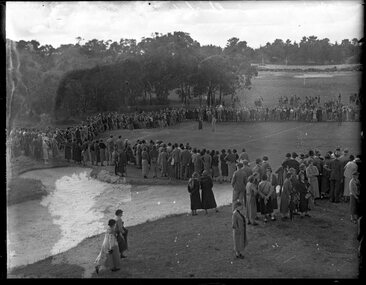
Photograph, Bull, Hugh Jones, 1897-1993, Spectators at Australian Women's Championship 1935
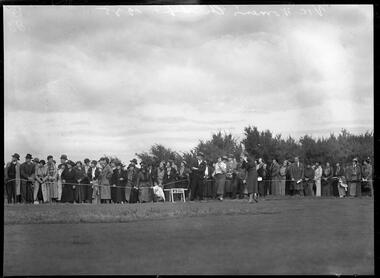
... Bull, Hugh Jones, 1897-1993...Glass plate negative Spectators at Australian Women's Championship 1935 Photograph Bull, Hugh Jones, 1897-1993 ...Women’s Golf Championship In August 1935, the Australian Women’s Golf Championship was held at Royal Melbourne Golf Club, Black Rock, featuring visiting British golfers Pamela Barton, Phyllis Wade, Jessie Anderson, Mrs Walter Greenlees and Mrs J B Walker. Australian competitors included Katherine Rymill, Betty Nankivell, Betty Sale (MBE), Janet Gardiner, Leonora Wray (MBE), Mrs Sloan Morpeth (née Susie Tolhurst), Mrs Clive Robinson (née Christina “Nin” McMaster), Joan Hood Hammond (DBE CMG), Mrs T S McKay (née Odette Lefebvre) and Mona Macleod. Mrs J B Walker of Britain defeated Mrs Sloan Morpeth of Victoria in the final, before a gallery of 2,000, mostly women. The women watch on… 18 year-old Miss Pamela Barton of England is teeing off at the ninth hole, watched by her competitor Miss Janet Gardiner of Queensland and a gallery of intensely focussed spectators. Both women went on to have diverse, non-sporting careers. During the Blitz and the Battle of Britain, Pam Barton (1917-1943) drove ambulances before joining the WAAF as a radio operator. Later she gained a commission as a Flight Officer in command of a staff of 600. In 1943, Pam was killed instantly when the RAF plane piloted by her unofficial fiancée crashed in heavy weather. The Pam Barton Memorial Salver is awarded to the winner of the British Ladies Amateur Golf Championship. The inscription reads “In Affectionate Memory of Pam Barton”. During WWII, Janet Gardiner (Mrs Jobson-Scott, 1907-1987) began manufacturing liquid hosiery at the Red Cross Link rooms as a fundraiser. Donated oyster bottles were used and they charged 2/6 for four ounces. However, in April 1942, in a broadcast to the women of Australia, the Minister for War Organisation of Industry, Mr Dedman, announced that leg make-up preparations were now a prohibited item. They contained titanium oxide, an essential ingredient in the manufacture of paints used for camouflaging military equipment. Other items of a woman’s “battle array” such as nail lacquer, some creams and suntan lotions were also banned as they contained ingredients used in munitions and medical supplies. Featured in "Newsworthy: Melbourne in photographs 1933-1936" exhibition at East Melbourne Library, October to December 2023. Exhibition caption by project volunteer, Fiona Collyer. Published: The Age 30 August 1935 WOMEN’S CHAMPIONSHIP GOLF AT ROYAL MELBOURNE (1935, August 30). The Sun News-Pictorial (Melbourne, Vic. : 1922 - 1954; 1956), p. 35. Retrieved October 10, 2025, from http://nla.gov.au/nla.news-article277093639Photographer notations on slide: "Vic Women's Ch'ship 1935 B98".golf, women golfers, royal melbourne golf club -
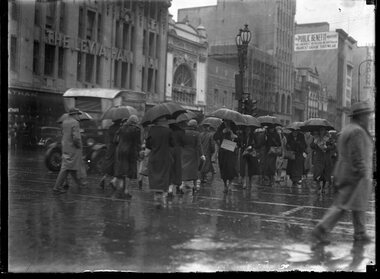 City of Melbourne Libraries
Bull, Hugh Jones, 1897-1993, Christmas 1933, Dec 1933
... Bull, Hugh Jones, 1897-1993...Glass plate negatives Christmas 1933 Bull, Hugh Jones, 1897-1993 The Age (Melbourne, Vic. : 1854 - 1954) ...A series of five Christmas-themed photographs taken in December 1933. -
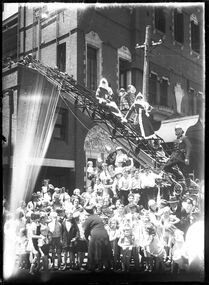 City of Melbourne Libraries
Photograph, Bull, Hugh Jones, 1897-1993, Important Visitors at the Children's Hospital
... Bull, Hugh Jones, 1897-1993...Glass plate negative Important Visitors at the Children's Hospital Photograph Bull, Hugh Jones, 1897-1993 ...Published: The Age 26 Dec 1933 page 9 Published title: "IMPORTANT VISITORS AT THE CHILDREN'S HOSPITAL." Published caption: “Father Christmas accompanied by his twin brother arrived at the Children’s Hospital on a Fire Engine driven by real firemen yesterday, the extension ladder enabled them to reach the top balcony of the hospital very easily.” Description: Two Father Christmas characters visit the Children's Hospital, with the help of the Fire Brigade. Photographer notations on slide: "Important People at Children's Hospital B9". -
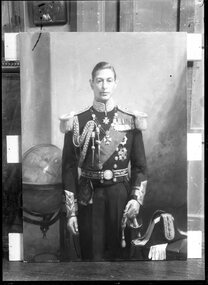 City of Melbourne Libraries
Photograph, Bull, Hugh Jones, 1897-1993, "A Royal Portrait" (Duke of York), 1933
... Bull, Hugh Jones, 1897-1993...Glass plate negative "A Royal Portrait" (Duke of York) Photograph Bull, Hugh Jones, 1897-1993 McKenzie, Ian, 1939-2012 ...Published: The Age, Sat 14 October 1933 Published title: A Royal Portrait Published caption: "Seen at his studio, Alphington, Mr. W. B. Mclnnes's portrait of the Duke of York, which he painted recently on commission from the trustees of the Castlemaine Gallery, at St. John’s Wood, London, impresses as a vital record of one whose natural habitat is a palace, and whose place in life is one of near relationship to the throne of England. The Duke is painted in the uniform of the admiral of the fleet, a highly ornate vesture entailing much elaboration of gold and numerous medals, in dealing with which the artist has not failed to centre his attention on the head, and has succeeded in producing what is undoubtedly a soundly painted portrait and a good likeness. During the five fittings Mr. Mclnnes, apart from the ordinary social amenities, found his Royal sitter little inclined to talk, though he spoke feelingly of his trip to Australia and the pleasure it had given him: but with the Duchess the tendency to be sociable was much more clearly pronounced. She took, and expressed, a keen interest in the social and political matters of the day with a special concern for the supremacy of England and Australia in all questions relating to sport, such as cricket, tennis and golf. She spoke well of her portrait painted by Quinn, and regretted that she would not see the two hung side by side at the Castlemaine Gallery." Description: An unframed painting of a standing, middle-aged man dressed in the uniform of a Royal Navy admiral of the Fleet with medals, sash, ornate belt, cuffs and epaulettes. His left hand rests on the handle of a sword in its scabbard and his bicorn hat and white gloves are on a table beside him. To his right is a globe of the world showing Australia. Research by project volunteer, Fiona Collyer: In 1933, Castlemaine Art Gallery trustees commissioned artist W.B. McInnes (1889-1939) to paint a portrait of Prince Albert, Duke of York as a companion piece to the portrait of his wife, the Duchess of York, that the gallery had commissioned Australian official war artist James Quinn (1869-1951) to paint in 1930. During the First World War, the Duchess’s childhood home, Glamis Castle in Scotland was used as a makeshift military hospital and convalescence home for wounded soldiers. Many servicemen from the Castlemaine area recuperated there and had fond memories of the kindness of the teenage Lady Elizabeth Bowes-Lyon (1900-2002, later Duchess of York) who spent the war years running errands and aiding in the welfare and morale of the patients. In 1927, the Duke and Duchess of York (later King George VI and Queen Elizabeth) came to Australia to formally open the newly built Parliament House in Canberra and to tour the country. While visiting Victoria in April, they embarked on a whistle-stop train journey to Bendigo, stopping at Kyneton for ten minutes and Castlemaine for 15 minutes. At Kyneton, an excited crowd of 10,000 people welcomed the couple with “three cheers and three cheers for Baby Betty” before the Duchess was presented with a bouquet of locally grown roses and the Duke a bound album of photographs of noted beauty spots of the district. Next the Royal Couple stopped at Castlemaine to the cheers of 15,000 people. There the couple were presented with a basket of prime quality Harcourt apples and a pair of cot blankets, manufactured at Castlemaine Woollen Mills, a birthday gift for baby Princess Betty. The Duchess recognised Colonel W.E. James, of the Seventh Battalion, who had convalesced at Glamis Castle in 1917, and they chatted before the train departed, while the Duke shook hands with returned soldiers. Last stop was the town of Bendigo which was colourfully decorated with bunting and flags, arches and flowers. 3000 pigeons were released on their arrival and the liberated birds circled overhead for several minutes as if to welcome the Royal Couple. A crowd of 50,000 cheering people lined the streets in bright sunshine as the couple drove by. From an arch over Hargreaves Street, pretty girls showered the pair with rose petals. The Duke was presented with a gold nugget and an album, handsomely bound in morocco, of a history of the Bendigo mining industry, while the Duchess received a bouquet of prize winning white chrysanthemums. After 75 minutes in Bendigo they journeyed back to Melbourne for a State reception. While the couple were in Melbourne, the Duke often played lawn tennis at the Government House courts with three times Grand Slam champion Norman Brookes, who declared that while he considered the Duke a second class player whose serve lacked sting, he had a fine backhand and with time and practice he could become a first class player. The federal Parliament had previously been situated in Melbourne, but Canberra was chosen as the location for Australia’s capital as a compromise between fierce rival states, Victoria and NSW. It is written in the Constitution that the federal capital would be in “the State of NSW... distant not less than one hundred miles from Sydney.” The word Canberra is thought to derive from the local Ngunnawal word “Kanbarra” meaning “meeting place”. The Provisional Parliament House was a large, white, three storey building facetiously dubbed “The Wedding Cake”, plonked down in a bare, former sheep paddock. It was decorated for the event with Union Jacks and Australian red ensign flags. On 9 May, the day of the opening, the expectant crowd assembled in front of the building. Only two of the spectators were Aboriginal. One was Jimmy Clements (1847-1927, aka Nangar or Yangar, but popularly known as “King Billy”), accompanied by his three dogs. (The title “King” or “Queen” was often given by white settlers to Aborigines who were seen as allies and could maintain good relations between First Nations groups and the colonists. Some were given inscribed brass breastplates or gorgets to wear.) Jimmy was an excellent horse breaker and expert tracker for the police. He was also the nephew of “Queen” Nellie Hamilton (1842-1897) of the Canberra-Queanbeyan region, home of the Ngambri and Ngunnawal people. Nellie was the oldest surviving full-blooded Aboriginal woman in the district. The other was George John Noble (1840s-1928, aka Ooloogan, also “Marvellous” due to his regular use of the word). Both were initiated Wiradjuri walamira elders: “clever men” believed to have the ability to heal physical and spiritual ailments. They were also travelling showmen, skilled at boomerang and spear throwing and often performed at country agricultural shows and football matches. They had walked barefoot for three days from the Brungle Mission, near Gundagai. 11 May 1927, The Argus reported that “King Billy... claims sovereign rights to the Federal Territory” which the National Archives of Australia describes as “possibly the first recorded instance of Aboriginal protest at Parliament House in Canberra.” 10 May 1927, The Argus reported on Jimmy Clements: “During the wait great interest was taken in the appearance near the east stand of an aborigine, a member of the Gundagai tribe, and a well known character in the district. He was very old and grey and ruggedly picturesque. He was determined to go his own way in spite of the arguments of two inspectors and one sergeant of police. Immediately and instinctively the crowd in the stands rallied to his side. There were choruses of advice and encouragement for him to do as he pleased. A well-known clergyman stood up and called out that the aborigine had a better right than any man present to a place on the steps of the House of Parliament and in the Senate during the ceremony. The old man’s persistence and the sympathy of the crowd won him an excellent position and also a shower of small change that must have amounted to 30/ or 40/ [shillings].” At 10.30 am, Australia’s eighth Prime Minister, Mr Stanley Bruce (1923-1929) welcomed the Royal couple onto the crimson carpeted portico. Unfortunately, Dame Nellie Melba’s rendition of “God Save the King” and the greater part of the Duke’s reply was drowned out by the roar of squadrons of aeroplanes circling overhead. A brief religious service followed, conducted by leaders of the Methodist, Presbyterian and Anglican churches. Interestingly, there was no Roman Catholic representation at the ceremony even though around one quarter of Australians were Catholic at the time. The Duke unlocked the front doors with a golden key, then unveiled a statue of his father King George V by sculptor Sir Bertram Mackennal in the King’s Hall. Then the official party, Senators, members of the House of Representatives and invited guests entered the Senate chamber where the Duke read a message from the King, establishing Canberra as the seat of the Federal Government, watched on by Australia’s elite. The conclusion of the ceremony was announced by a gay fanfare of trumpets from the entrance of Parliament House and a 21 gun salute and answered by cheers from the crowd. The dignitaries then feasted on a luncheon of turtle soup, poached schnapper, fillets of beef, roast chicken and ham, straw potatoes, green peas, Canberra Pudding (a pudding made with dripping, dried fruit and jam), fruit, ices, coffee and cheese. They toasted the King with non-alcoholic fruit punch as the Federal Capital Territory (later ACT) was a “dry” area and no speeches were made. The diary entry that day of Ethel Baird, Lady Stonehaven, the wife of the Governor-General, is brief and to the point: “To P.H. & waited for Yorks. Ceremony went off without a hitch. Ghastly Banquet Lunch.” Later that day, the Duke mounted a coal black mare, police horse Number 303 which had been hastily re-named “Black Bess” for the occasion, to receive the final salute from the assembled troops and returned soldiers dressed in mufti. The RAAF squadron were flying overhead in “V” formations when suddenly, one of the planes, piloted by Flying Officer Francis Charles Ewen, left the formation, nose-diving 900 metres from Parliament House and landing behind the Y.W.C.A. refreshment marquee. Francis, aged only 28, tragically died of his wounds later that day. The Federal Capital Commission contracted Sargent’s Pies of Sydney to supply 5000 meals for the event. They supplied pies, sausage rolls, scones and sandwiches with the agreed price of 3 shillings a head. Only 1200 meals were served and the uneaten remainder dumped, with the Commission bearing the cost of the unsold food. An estimated crowd of 20,000 attended the opening, far fewer than the expected 100,000. Many visitors travelled long distances, bringing their own hampers of food and camping in tents as there was very limited accommodation available. Thousands of people around Australia listened to the ceremony broadcast on the wireless, with receiving sets installed in schools, public halls and workplaces and it was also filmed for posterity. The next morning, the Royal couple, along with Prime Minister Bruce and Mrs Bruce held an informal public reception on the steps of Parliament House where early settlers, residents and visitors to Canberra filed past them. The Press widely reported Jimmy Clements’ encounter with the Duke and Duchess. The Sun-Pictorial reported 11 May 1927: "MET THE DUKE. ABORIGINE KING HE APPROVED Sugarbag: Sports Suit. John Clements, otherwise King Billy, a full blooded aborigine king, aged 86, was among the 2000 who filed past the Duke and the Duchess at the public reception at Canberra to day. “How you likem Duke and Duchess Billy?” he was asked afterwards. “I think they are both very nice.” he replied in good English. King Billy was a very bedraggled figure, with tangled locks and a beard which almost hid his wrinkled and black face. He wore an old sports suit and carried a sugarbag. Passing the Duke and Duchess he turned full towards them. The crowd cheered, and the Duke and Duchess smiled. The Duke was particularly amused.” The Canberra Times reported 13 May 1927: "A REAL AUSTRALIAN. A quaint but pathetic figure stood in broad relief in the queue of ranks at the reception. Where his dusky forbears have gathered in native ceremonial for centuries past, a lone representative of a fast vanishing race saluted visiting Royalty. Despite the grotesque garb and untamed mane the aborigine comported himself not without dignity. With his three faithful dogs, he made an immediate target for a battery of cameras.” "The Argus reported 11 May 1927: "...an ancient aborigine who calls himself King Billy and who claims sovereign rights to the federal Territory walked slowly forward alone and saluted the Duke and Duchess. They cheerily acknowledged his greeting. The old aborigine, with his long, matted beard and nondescript clothing, is a popular identity of Canberra, and must be one of the most extraordinary figures who has received a Royal salute.” The Sun (Sydney) reported 10 May 1927: “Suddenly, in the midst of the forest of green and white colored hats of women, appeared a head with a shaggy leonine mane and a patriarchal beard. Jacky, the aboriginal, an identity of the district, who is also known as the King of Canberra, had arrived to testify to his loyalty. He saluted the Duke with an excellent dash, and shambled past with his faithful sheep dog aide-de-camp at his heels. The Duke and Duchess were highly amused at this quaint figure moving along with a sort of bodyguard of shrieking young boys and girls.” The Sydney Morning Herald 11 May 1927 mistook Jimmy for his friend “Marvellous”: “...the appearance of an aged aboriginal widely known in the district as “Marvellous, the uncrowned king of Queanbeyan." His beaming black countenance was almost hidden beneath a shock of hair and beard. Bare-footed and carrying a sugar bag in one hand and a tiny Australian flag in the other, he at first mistook a policeman at the foot of the steps for the Duke. To his great embarrassment and to the vast amusement of the onlookers, the policeman became the object of a hearty salutation. However, "Marvellous" was quickly shepherded back to a position in the procession and as he passed along brought his hand up to an approved military salute for the benefit of their Royal Highnesses. The Duke returned it with a special wave.” The Labor Daily 11 May 1927 irreverently reported on the scene: "People March Past. Some 400 people, old identities of Canberra marched past. They were mostly aged ladies with memories faithfully preserving the traditions of other days and curtsied reverently. The younger generations, who speedily joined the procession, behaved differently however. Surely it was the most motley collection that ever passed before Royalty. Men without collars jostled others well dressed. Fat women, young women, children of all heights and ages were there. The oldest inhabitants, in the persons of the abo, "Marbly", and his companion were present. The poor old fellows evidently were keen to get closer to the Duke than the procession dared go, but they were overawed by the stern glances of military men.” The Canberra Times reported 13 May 1927: "...and towards the end of the procession, a full-blooded aboriginal, bareheaded and barefooted, and carrying an old swag on his back, made a picturesque figure as he several times saluted the Royal couple, his old eyes beaming inexpressible delight.” The Register reported 11 May 1927: "PUBLIC MARCH PAST. Old “Jacky”, an aboriginal identity of the district, who has been following the proceedings of the various ceremonies with apparently great interest, appeared in the march past. He halted in front of the steps and raised his hand to his shaggy grey locks in an attempt at a salute. Smiling, the Duke returned the salute, and the Duchess bestowed a charming smile on the figure of mingled pathos and comedy.” Tweed Daily reported 12 May 1927: “King Billy” WAS THERE. Appropriately enough, the inevitable “King Billy” with his refreshing impression of possum and gum-leaves, was present at the dedication of the Federal capital at Canberra. Bare-footed, in a dingy old suit and battered felt hat, he wandered on to the empty stand after the illustrious assemblage had passed into Parliament House. A desolate figure in all that he stood for, he proved, an amiable representative of the dispossessed race. He cheerfully waved a Union Jack for the camera man, and grinned into the very eye of a movie man’s camera without flinching.” Footage of Jimmy filmed that day features in the film “The Birth Of White Australia” produced in 1928 and shows him enthusiastically waving a small Union Jack flag in front of Parliament House with his three dogs at his feet. The caption reads " "King Billy" calls for cheers for the son of the great white King across the seas. “Mine tinkit that pfellers father budgeree King liket me” supposedly says Jimmy." Jimmy told the Daily Telegraph, 13 May 1927 “I have opened your Parliament House on my own ground, now you can go and look at it." Jimmy died on 28 August 1927, aged 80. The Herald newspaper on 30 August 1927, published an illustration depicting Jimmy’s dog standing on his grave, his customary chimney pot hat leaning on his headstone. The caption reads: “The Dead King — His Only Mourner. Drawn by Will Dyson (King Billy, last of the Canberra aborigines, lived just long enough to see the Duke of York open Australia’s capital on the site where his tribe once roamed. He died in the Queanbeyan Hospital yesterday morning.)” A letter published in the Sydney Morning Herald, 19 September 1927 reported: "Old King Billy... Sir, ...I would like to mention... the passing away of one, if not the last remaining aboriginal chieftains. He may be called “Old King Billy,” and his death occurred here in Queanbeyan a few weeks ago. The removal of this well-known black has left another big gap in all that remains distinctively Australian in character. He was one of the last remaining tribe of the Monaro district, and one of the most predominant personalities throughout the Commonwealth. ...he had lived through 80 years all told. He was on many occasions sought by artists for his splendid physique and personality as a model, and many a journey he has had to make to Sydney on that account. A more striking and pronounced type could not be found. ...A very fine cast in lifelike form is to be seen in the Australian Museum, Sydney ...his last important appearance in public was at the Commonwealth celebrations at Canberra, to which territory he partly belonged. ...we have no aborigine statue chiselled to the memory of their race, a more fitting and lasting memorial could not be undertaken than to have one modelled from this fine figure and erected to the memory of his race at Canberra... It would be a fitting adornment if planted with the Australian gumtrees for any avenue or garden. [King Billy] ...a very intelligent fellow, responding readily to kindness and common sense. Hoping yet to see a befitting testimonial and a lasting memorial to a race that is rapidly and I may say, unfortunately, disappearing, I am etc., SYDNEY R.OAKLEY, Queanbeyan." The “lifelike form” referred to by the correspondent was a sculpture that Jimmy Clements had posed for: “The Wunderlich Aboriginal Group” for The Australian Museum in Sydney. In 1925, Mr Ernest Wunderlich, director of Wunderlich Limited, manufacturer of building materials and President of the Board of Trustees at The Australian Museum, commissioned renowned sculptor George Rayner Hoff (sculptor of the Anzac Memorial in Hyde Park, Sydney, National War Memorial in Adelaide, and “Lion” the original Holden Motor Company car emblem) to sculpt a life sized Aboriginal family group diorama as a gift to the Museum. There was much concern at this time that the Aboriginal population and especially the “full blooded” were fading into oblivion so fast that they may soon become extinct. Three “full blooded” Aborigines were chosen for models. An article in The Australian Museum magazine, July/September 1926 about The Wunderlich Aboriginal Group explained “...it will not be many years before the aborigine, in New South Wales and Victoria at least, will be an entity of the past. Every year sees a shrinkage in their number, and the coastal tribes that once roamed the Sydney district are, unfortunately, no longer with us. ...the man, who is hurling a boomerang, is Yangar, or “Jimmy Clements,” son of Gayan-Bleuet-Galoom, the late “King of Orange,” western New South Wales. “Jimmy” is an old man, but well preserved. He has a very retentive memory and recollects the various tribal customs and initiation ceremonies, but regarding these he is extremely reticent and will not communicate his “honoured secrets.” The female figure is “Nellie Walker,” a daughter of Geri-Bungel, and a native of Bombala, Monaro district, southern New South Wales. The boy is Harold Marsh, aged nine years, who was born at Kinchela, Macleay River, northern New South Wales. He is now living at the Brewarrina settlement... In the selection of aborigines great care had to be taken to ensure that the individuals were pure bloods, and to the Aborigines’ Protection Board and the Police Department of this State thanks are due for the valuable assistance rendered by them.” Ngarigo woman, Nellie Bungil Walker (1867-1932) had five children, two died as babies and her remaining children were taken from her. She worked as a domestic and was living at La Perouse Aboriginal Community, Sydney at the time of her sculpture’s creation. In the years after the sculpture was made, Nellie and Rayner remained friends. Yaegl boy Harold “Harry” Marsh was from the Kinchela Aboriginal Training Home for boys near Kempsey, (1924-1970), an agricultural training institution under the jurisdiction of the Aboriginal Protection Board to house Aboriginal boys forcibly removed from their families “in the interest of the moral or physical welfare” of the boys. The boys at Kinchela were aged 5-15 years old and referred to as numbers, not names and any connection to Aboriginal culture or language was forbidden. Brutal and cruel physical punishment and sexual assaults were rampant. Survivors recall being flogged and chained naked to a huge Morton Bay fig tree overnight or “sent down the line” where every boy was ordered to punch the “wrong doer” as hard as possible for fear that they would be next. The Kinchela children are acknowledged as part of the Stolen Generation. In 1925, Rayner Hoff created a terracotta bust “Harry Marsh” which is in the collection of the Art Gallery of New South Wales. The figures of the trio were modelled in clay before being cast in plaster and hand-coloured by Museum artist Miss Ethel A. King. The finished figures were completed with wigs and fur pelts and with Jimmy hurling a boomerang and Nellie holding a dilly-bag. They were placed in a glass cabinet in the Australian Ethnology Gallery. The subjects were not named. The Sydney Morning Herald 1 July 1926 critiqued the sculptures. "A GROUP OF STATUARY. MUSEUM’S ACQUISITION. Artistically the group is very fine, for the sculptor has caught his subjects in attitudes that reveal all the stalwart athletic lines of their bodies... The man, who is depicted as about 60 years of age, is bearded, immense, and savagely primitive-is throwing a boomerang, and beside him a boy, aged about 11 years is following beneath a shading hand, the flight of birds at which the hunter aims. Behind them, patient, obedient, stand(s) the woman waiting with her dilly bag to gather the spoils.” In 1996, Nellie’s daughter, Victoria Kempsey née Walker, happened to visit The Australian Museum and saw the sculpture of her mother, displayed semi-naked in a glass cabinet, alongside glass cabinets of taxidermied animals. She had last seen her mother 62 years previously when Nellie was dying from tuberculosis. Greatly distressed, Victoria wrote to the Museum requesting that they remove the sculpture, which they did. In 2023, a documentary was produced called “Her Name Is Nanny Nellie” which follows the journey of Nellie Walker’s great-granddaughter Auntie Irene Ridgeway discovering Nellie’s story, honouring her life and restoring her sculpture. Irene told Refinery29 Australia that “It was about reclaiming her life, reclaiming her history and who she really was as a real person. She was not a naked and unnamed lady standing in a museum. It's giving them back their families, they weren't just there to be looked at as flora and fauna or as 'natives'." The documentary was written and directed by Irene’s son Daniel King and premiered at the 2023 Adelaide Film Festival and broadcast on NITV. The restored sculpture of Nellie, dressed in 1920s style clothing was displayed at The Australian Museum, Sydney in The Bayala Nura Gallery in 2023. Irene wanted Nellie to be depicted in the way she actually was when she posed for the sculpture in 1925. The other two sculptures were not displayed due to ongoing conversations with family members and the fragility of the sculptures. It is anticipated that they may be displayed in the future. Melbourne born William Beckwith (Bill) McInnes (1889-1939) studied drawing at National Gallery School in Melbourne from the age of 14 under the tuition of artist Frederick McCubbin before succeeding his former teacher as Master of Drawing at the School from 1916-1934. He was acting Director of the NGV and Head of the National Gallery School from 1934. In 1927, Bill and official war artist H. Septimus Power were commissioned to paint the opening of the new federal Parliament House in Canberra. Septimus painted the general scene of the arrival of the Royal entourage in front of Parliament House, while Bill depicted the ceremony inside the Senate chamber. Bill was widely acclaimed for his landscapes and lauded as the heir to great Australian landscape artist Arthur Streeton. He won the Archibald Prize seven times (including the inaugural, a portrait of architect Desbrowe Annear) which made him a highly sought after portrait painter and he earned kudos for his commission to paint the Duke of York. During the breaks in painting the portrait, the pair chatted and Bill was surprised by the Duke’s wide knowledge of Australian affairs. The Duke was particularly interested to hear how the rabbit crisis was being handled. Bill’s work is held in major Australian galleries including the NGV, which has 12 of his paintings in their collection. Bill was married to fellow artist Violet McInnes and they lived at “The Poplars” in Alphington with their six children. Violet painted still life of flowers and portraits. In 1941, she entered her portrait of fellow artist Sybil Craig into the Archibald Prize and in 1945 Violet was appointed an official war artist. Defending his traditional style Bill said “...we in Australia have not been bitten by Cubism or Futurism or other of the “isms”...and I am glad of it”. References: THE DUCHESS OF YORK. (1931, December 7). The Argus (Melbourne, Vic. : 1848 - 1957), p. 8. Retrieved April 3, 2025, from http://nla.gov.au/nla.news-article4427568 WAR NURSE (1930, March 11). The Sun (Sydney, NSW : 1910 - 1954), p. 1. Retrieved April 3, 2025, from http://nla.gov.au/nla.news-article223714728 The Royal Visit. (1927, April 29). The Age (Melbourne, Vic. : 1854 - 1954), p. 9. Retrieved April 4, 2025, from http://nla.gov.au/nla.news-article205813465 Canberra. (1927, April 30). Advocate (Burnie, Tas. : 1890 - 1954), p. 5. Retrieved January 10, 2025, from http://nla.gov.au/nla.news-article68233606 Australian Dictionary of Biography, Nangar, https://adb.anu.edu.au/biography/nangar-33736 Australian Dictionary of Biography, Jimmy Clements, https://en.wikipedia.org/wiki/Jimmy_Clements Wikipedia, George John Noble, https://en.wikipedia.org/wiki/George_John_Noble PARLIAMENT AT CANBERRA. (1927, May 14). The Australasian (Melbourne, Vic. : 1864 - 1946), p. 37 (METROPOLITAN EDITION). Retrieved December 25, 2024, from http://nla.gov.au/nla.news-article140733921 CANBERRA CEREMONY (1927, May 10). The Argus (Melbourne, Vic. : 1848 - 1957), p. 19. Retrieved November 3, 2024, from http://nla.gov.au/nla.news-article3853643 CANBERRA. (1927, May 11). The Argus (Melbourne, Vic. : 1848 - 1957), p. 20. Retrieved November 24, 2024, from http://nla.gov.au/nla.news-article3853897 THE FINAL SCENES (1927, May 11). The Labor Daily (Sydney, NSW : 1924 - 1938), p. 5. Retrieved January 10, 2025, from http://nla.gov.au/nla.news-article236614453 TWIN SONS (1927, May 10). The Sun (Sydney, NSW : 1910 - 1954), p. 11. Retrieved April 4, 2025, from http://nla.gov.au/nla.news-article223616143 National Archives of Australia, Aboriginal [Jimmy Clements, a Wiradjuri elder] on steps of Parliament House (King Billy), https://recordsearch.naa.gov.au/SearchNRetrieve/Interface/ViewImage.aspx?B=3050026 Sydney Morning Herald, The chant of Jimmy Clements: I’ll do the honours on my ground, thanks, https://www.smh.com.au/national/the-chant-of-jimmy-clements-i-ll-do-the-honours-on-my-ground-thanks-20241023-p5kkt5.html MET THE DUKE (1927, May 11). The Sun News-Pictorial (Melbourne, Vic. : 1922 - 1954; 1956), p. 14. Retrieved November 3, 2024, from http://nla.gov.au/nla.news-article275177101 PUBLIC MARCH PAST. (1927, May 11). The Register (Adelaide, SA : 1901 - 1929), p. 11. Retrieved April 2, 2025, from http://nla.gov.au/nla.news-article54271512 A REAL AUSTRALIAN (1927, May 13). The Canberra Times (ACT : 1926 - 1995), p. 12. Retrieved December 18, 2024, from http://nla.gov.au/nla.news-article1213124 THE PEOPLE'S DAY (1927, May 13). The Canberra Times (ACT : 1926 - 1995), p. 3. Retrieved April 3, 2025, from http://nla.gov.au/nla.news-article1213105 KING BILLY" WAS THERE. (1927, May 12). Tweed Daily (Murwillumbah, NSW : 1914 - 1949), p. 2. Retrieved November 27, 2024, from http://nla.gov.au/nla.news-article190193273 A BUSY DAY. (1927, May 11). The Sydney Morning Herald (NSW : 1842 - 1954), p. 15. Retrieved November 3, 2024, from http://nla.gov.au/nla.news-article16374845 Nothing Wrong With Canberra Opening, Says "King Billy" (1927, May 13). The Daily Telegraph (Sydney, NSW : 1883 - 1930), p. 2. Retrieved November 3, 2024, from http://nla.gov.au/nla.news-article245750627 THIS IS MARVELLOUS! (1927, May 11). The Sun News-Pictorial (Melbourne, Vic. : 1922 - 1954; 1956), p. 16. Retrieved December 9, 2024, from http://nla.gov.au/nla.news-article275177155 Mildenhall's Canberra, Royal Visit, May 1927. Canberra citizens passing the Royal Party on the front steps of Parliament House at the Civic Reception 1927 [photograph], https://mildenhall.moadoph.gov.au/rephoto/62 Australian Dictionary of Biography, 1927 - Jimmy Clements, John Noble, and the Opening of Parliament House, https://adb.anu.edu.au/the-quest-for-indigenous-recognition/jimmy-clements YouTube, The Birth of White Australia (1928), amateurish racism on the big screen [Jimmy Clements at 11.12 minutes in], https://www.youtube.com/watch?v=OByX4iPsTgo YouTube, We Were Just Little Boys, https://m.youtube.com/watch?v=u4Hw9d91k2E WASTE AT CANBERRA. (1927, May 20). The South Eastern Times (Millicent, SA : 1906 - 1954), p. 1. Retrieved April 4, 2025, from http://nla.gov.au/nla.news-article200058308 YouTube, Museum of Australian Democracy at Old Parliament House, Whispers in the Corridors-An Aboriginal Presence, https://www.youtube.com/watch?v=fwifXP61M5Y History Snoop, Air Fatality in Canberra Scars an Historic Day in Australia, https://www.historysnoop.com/air-fatality-in-canberra/ YouTube, NFSA Films, The Opening Of Canberra, Australia's Capital City, https://www.youtube.com/watch?v=pOA8llA0iE0 Pauline Conolly, Pudding & Pies at Parliament House, https://paulineconolly.com/2022/pudding-and-pies-at-parliament-house/ THE MENU (1927, May 5). The Sun (Sydney, NSW : 1910 - 1954), p. 13 (FINAL EXTRA). Retrieved April 2, 2025, from http://nla.gov.au/nla.news-article223623278 PROMISING (1927, May 7). The Sun (Sydney, NSW : 1910 - 1954), p. 2. Retrieved December 15, 2024, from http://nla.gov.au/nla.news-article223616208 The Dead King -- His Only Mourner (1927, August 30). The Herald (Melbourne, Vic. : 1861 - 1954), p. 6. Retrieved November 3, 2024, from http://nla.gov.au/nla.news-article244196114 The VOICE of the CITY (1927, August 31). The Daily Telegraph (Sydney, NSW : 1883 - 1930), p. 4. Retrieved December 26, 2024, from http://nla.gov.au/nla.news-article246406061 THE LAST OF HIS TRIBE. (1927, September 2). Bairnsdale Advertiser and Tambo and Omeo Chronicle (Vic. : 1882 - 1946), p. 6. Retrieved December 24, 2024, from http://nla.gov.au/nla.news-article269318935 GONE WEST. (1927, September 17). The Irwin Index (Mingenew, WA : 1926 - 1956), p. 1. Retrieved December 23, 2024, from http://nla.gov.au/nla.news-article251554113 King Billy Dead. (1927, September 10). The Port Macquarie News and Hastings River Advocate (NSW : 1882 - 1950), p. 5. Retrieved December 1, 2024, from http://nla.gov.au/nla.news-article112534982 DEATH OF KING BILLY OF CANBERRA. (1927, September 16). Huon Times (Franklin, Tas. : 1910 - 1933), p. 5. Retrieved December 23, 2024, from http://nla.gov.au/nla.news-article136428435 OLD KING BILLY. (1927, September 19). The Sydney Morning Herald (NSW : 1842 - 1954), p. 5. Retrieved November 19, 2024, from http://nla.gov.au/nla.news-article16404722 "Marvellous" is Dead. (1928, March 30). The Gundagai Times and Tumut, Adelong and Murrumbidgee District Advertiser (NSW : 1868 - 1931), p. 2. Retrieved December 8, 2024, from http://nla.gov.au/nla.news-article122748136 LAST OF LACHLAN RIVER TRIBE (1926, May 3). Evening News (Sydney, NSW : 1869 - 1931), p. 7. Retrieved December 18, 2024, from http://nla.gov.au/nla.news-article117289515 Coal Strike Effects (1926, June 11). The Daily Telegraph (Sydney, NSW : 1883 - 1930), p. 14. Retrieved November 30, 2024, from http://nla.gov.au/nla.news-article245759732 SBS On Demand, Her name is Nanny Nellie, https://www.sbs.com.au/ondemand/movie/her-name-is-nanny-nellie/2300137539512 The Australian Museum Magazine, Vol. 2, No. 11, July-Sept 1926, The Wunderlich Aboriginal Group, https://shorturl.at/uViTe ABC News, King Billy and Marvellous were not invited to the 1927 opening of Parliament House — but that didn't stop their fight for sovereignty, https://shorturl.at/HGpjC Museum of Australian Democracy at Old Parliament House, The thieving diva: behind the scenes of the opening ceremony at Parliament House, https://www.moadoph.gov.au/explore/stories/heritage/the-thieving-diva-behind-the-scenes-of-the-opening-ceremony-at-parliament Refinery29, Beyond a museum glass case: one First Nations woman's quest to reclaim her ancestors' story, https://www.refinery29.com/en-au/my-name-is-nelly-documentary-irene-ridgeway-interview Sydney Morning Herald, Why it took 100 years to restore the dignity of Nanny Nellie, https://www.smh.com.au/national/why-it-took-100-years-to-restore-the-dignity-of-nanny-nellie-20230719-p5dpjo.html Australian Museum, Meeting Nanny Nellie, https://australian.museum/publications/explore_summer2024/nanny-nellie/ ABORIGINES. (1926, July 1). The Sydney Morning Herald (NSW : 1842 - 1954), p. 14. Retrieved November 29, 2024, from http://nla.gov.au/nla.news-article16302447 Wikipedia, Kinchela Aboriginal Boys Training Home, https://en.wikipedia.org/wiki/Kinchela_Aboriginal_Boys%27_Training_Home Art Gallery NSW, Harry Marsh by Rayner Hoff, https://www.artgallery.nsw.gov.au/collection/works/59.2000/ Art Gallery of South Australia, Lion (produced for the Holden Motor Company) by Rayner Hoff, https://www.agsa.sa.gov.au/collection-publications/collection/works/lion-produced-for-the-holden-motor-company/27253/ Wikipedia, William Beckwith McInnes, https://en.wikipedia.org/wiki/William_Beckwith_McInnes DUKE OF YORK PORTRAIT UNIVEILED IN CASTLEMAINE GALLERY (1933, December 4). The Sun News-Pictorial (Melbourne, Vic. : 1922 - 1954; 1956), p. 18. Retrieved April 4, 2025, from http://nla.gov.au/nla.news-article276125581 Castlemaine Art Museum, Portrait of His Royal Majesty the Duke of York, https://collection.castlemaineartmuseum.org.au/objects/181/portrait-of-his-royal-majesty-the-duke-of-yorkPhotographer notations on slide: "Portrait of Duke of York by W.B. McInnes 1933 B4".1930-1939, aboriginal culture, royal visits, openings (events), sculpture, land rights, museums, museum displays -
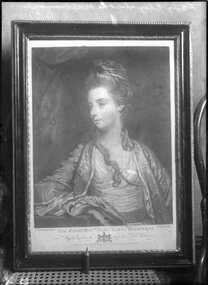 City of Melbourne Libraries
Photograph, Bull, Hugh Jones, 1897-1993, Photo of portrait of Lady Elizabeth Melbourne, 1934
... Bull, Hugh Jones, 1897-1993...Glass plate negative Photo of portrait of Lady Elizabeth Melbourne Photograph Bull, Hugh Jones, 1897-1993 McKenzie, Ian, 1939-2012 ...Published: The Age, 3 October 1934 Published title: CENTENARY GIFT PORTRAIT. Published caption: A reproduction of the attractive portrait of Lady Melbourne, the mother of Lord Melbourne, which has been presented to the City of Melbourne, and will hang in the Lady Mayoress’s room at the Town Hall. Trove article identifier: https://trove.nla.gov.au/newspaper/article/205879945 Description: A framed mezzotint portrait of a young woman gazing towards her right, with her right arm resting on a table. She is wearing an 18th century style dress and jacket trimmed with ermine tails. A string of pearls is entwined in her upswept hair and through a long lock of hair falling over her shoulder then draping across her bodice. The portrait rests on a cane bottomed chair and a pencil holds it in place. Research by project volunteer, Fiona Collyer: In 1934, Mr Roger Dolbey of London donated to the City of Melbourne a mezzotint engraving of Lady Melbourne, mother of the British Prime Minister after whom the Victorian capital city of Melbourne was named in 1837. The engraving was created in 1771 by John Finlayson after Sir Joshua Reynolds. The gift commemorates the centenary of Melbourne. Elizabeth Milbank, Viscountess Melbourne, 1751-1818 was the wife of wealthy Whig politician, Peniston Lamb, 1st Viscount Melbourne. Lady Melbourne was an ambitious political hostess of the Regency period who cultivated beneficial relationships for her husband’s career. She was beautiful and vibrant and men found her easy going, good humoured company. She had many lovers and it is believed that of her nine children, (three of which did not survive childhood) only her first born, Peniston was fathered by her husband. One of her lovers was George, Prince of Wales, later George IV, believed to be the father of her fourth son George and who was his godfather. Lady Melbourne’s second son William Lamb, 2nd Viscount Melbourne, 1779-1848, was British Prime Minister and a close political confidant and father figure to the young Queen Victoria in the early years of her reign. In 1812, his wife Lady Caroline Lamb, 1785-1828, had a torrid and very public affair with poet Lord Bryon who she described as “Mad, bad and dangerous to know”. As a child, Caroline considered being able to wash a dog as one of her most satisfying accomplishments! The portrait hung in the Lady Mayoress’s room at Melbourne Town Hall. References: CENTENARY GIFT PORTRAIT. (1934, October 3). The Age (Melbourne, Vic. : 1854 - 1954), p. 11. Retrieved June 14, 2024, from http://nla.gov.au/nla.news-article205879945 Presentation of Mezzotint of Lady Melbourne (1934, October 2). The Argus (Melbourne, Vic. : 1848 - 1957), p. 10. Retrieved June 14, 2024, from http://nla.gov.au/nla.news-article10961120 NEWS OF THE DAY. (1934, October 2). The Age (Melbourne, Vic. : 1854 - 1954), p. 8. Retrieved June 14, 2024, from http://nla.gov.au/nla.news-article205883518 https://en.wikipedia.org/wiki/Lady_Caroline_LambPhotographer notations on slide: "Lady Elizabeth Melbourne B57".city of melbourne, melbourne town hall, 1930-1939, portraits -
 City of Melbourne Libraries
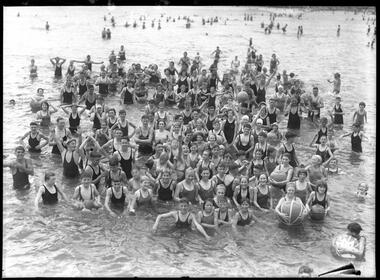
Photograph, Bull, Hugh Jones, 1897-1993, "On Christmas morning -- Bathing at St Kilda", 1933
... Bull, Hugh Jones, 1897-1993...Glass plate negative "On Christmas morning -- Bathing at St Kilda" Photograph Bull, Hugh Jones, 1897-1993 ...Published: 26 Dec 1933 The Age p9 Published title: "ON CHRISTMAS MORNING--BATHING AT ST. KILDA." Published caption: "Yesterday morning everyone who was near the bay seized the opportunity for a cooling dip. St. Kilda foreshore was particularly well patronised, as this picture shows." Trove article identifier: http://nla.gov.au/nla.news-article203364944 Description: Large group of swimmers at St Kilda Beach on Christmas morning. Research by project volunteer, Louise McKenzie: Approximately 150 men, women and children grouped in front of the photographer in the shallows of St Kilda Beach on Christmas morning 1933. All are wearing one piece bathing suits, some have bathing caps, some hold beach balls, and one boy has a model boat. They are happy and exuberant. Their swimming attire is traditional and conservative for the time. However at this time the bathing attire was undergoing a substantial change, as Wikipedia’s History of Swimwear attests. The English practice of men swimming in the nude was banned in the United Kingdom in 1860. In the first half of the 19th century the top became knee-length while an ankle-length drawer was added as a bottom. By the second half of the 19th century, in France, the sleeves started to vanish, the bottom became shorter to reach only the knees and the top became hip-length and both became more form fitting. In the West, in the 19th century women wore a bathing gown in the water. These were loose ankle-length full-sleeve chemise-type gown made of wool or flannel, so that modesty or decency was not threatened. They were long dresses of fabrics that would not become transparent when wet, with weights sewn into the hems so that they would not rise up in the water. The men's swim suit, a rather form-fitting wool garment with long sleeves and legs similar to long underwear, was developed and would change little for a century. By the second half of the 19th century, in France, the sleeves started to vanish, the bottom became shorter to reach only the knees and the top became hip-length and both became more form fitting. In the 1900s women wore wool dresses on the beach that were In the Victorian era, Western cultures deplored nudity of any degree, and people took great pains to cover themselves, even bare chested male swimmers at ocean beaches. In the 1910s despite opposition from some groups, the form-fitting style proved popular. It was not long before swimwear started to shrink further. At first arms were exposed and then legs up to mid-thigh. Necklines receded from around the neck down to around the top of the bosom. The development of new fabrics allowed for new varieties of more comfortable and practical swimwear. The name "swim suit" was coined in 1915 by Jantzen Knitting Mills, a sweater manufacturer who launched a swimwear brand named the "Red Diving Girl”. During the 1920s and 1930s, people began to shift from "taking in the water" to "taking in the sun", at bathhouses and spas, and swimsuit designs shifted from functional considerations to incorporate more decorative features. By the 1930s men began to go without shirts for swimming and barechestedness in male swimwear became the norm by the end of the 1940s, including in competitive swimming events. Following a fire in 1925, the nearby St Kilda Baths were reopened in 1931 – with separate “enclosures” for men and women. But here in the Bay just a few years later, everyone is happily enjoying the refreshing seaside event. References: History of Swimwear, Wikipedia, https://en.wikipedia.org/wiki/History_of_swimwear Jantzen Red Diving Girl, Oregon History Project, https://www.oregonhistoryproject.org/articles/historical-records/jantzen-red-diving-girl/ European History 1900-1950, St Kilda Historical Society, https://stkildahistory.org.au/about/timeline-1900-1950Photographer notations on slide: "Christmas morning St Kilda Age B9". -
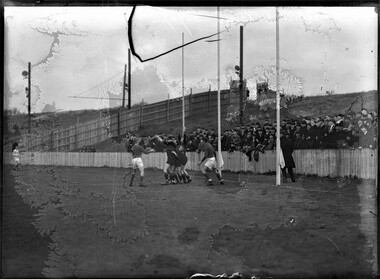 City of Melbourne Libraries
Photograph, Bull, Hugh Jones, 1897-1993, Photograph, Scotch College v. Xavier College football match, 1934
... Bull, Hugh Jones, 1897-1993...Xavier College football match, 1934 Photograph Bull, Hugh Jones, 1897-1993 ...At the first match of the 1934 Public Schools Premiership and Championships at Olympic Park (where AAMI Park is now) between Scotch College (white shorts) and Xavier College, (black shorts) a mark is missed by Xavier players and then taken by a Scotch player. Research by project volunteer, Fiona Collyer: A crowd of schoolboys standing behind a picket fence, watch with anticipation as two teams contest a football at the goalposts. The Public Schools Premiership and Championship was an Australian Rules football tournament held every winter over five weeks between six schools- Scotch College, Xavier College, Melbourne Grammar, Wesley College and traditional rivals Geelong Grammar and Geelong College. The school that won the most games out of the five played, won the competition. As the 1933 Premiers, Xavier College had the honour of playing the opening match of the season on 28 June against runners-up Scotch College at Olympic Park (where AAMI Park is now). The Public Schools Premiership matches were widely reported in Melbourne’s daily newspapers with photographs and commentary of every game. Weekly society magazine “Table Talk” featured reports and seven photographs of the first games of the season. Australian Broadcasting Commission (ABC) wireless station 3AR interspersed their afternoon program of reproduced music with detailed descriptions of the matches. Also reporting the matches was “Forty-Years-On”, presumably a student in the 1890s, whose regular column in The Herald newspaper “Activities In The Public Schools” published all the latest news on Victoria’s public (private) schools. In his column for The Australasian 7 July 1934, “Old Boy” writes about the Scotch versus Xavier match: “For more than half the game last week, Scotch was outplayed, but took the lead early in the last term and kept it. Scotch surprised even its own supporters by its dash in the last 25 minutes. Xavier, who became over confident by the prospects of victory, could not withstand the final onslaught. In the last quarter Scotch was the better side and won by seven points.” The final score was Scotch 11.11 (77 points) and Xavier 10.10 (70 points). At the end of this exciting match the overjoyed Scotch boys swarmed over the Olympic Park fences to chair their captain, Stanley Steele and carry him shoulder high, to the pavilion. The first documented game of a variation of Australian Rules football was played at Richmond Paddock (now Yarra Park) from 7 August 1858. Australian Rules football writer Hugh Buggy of The Argus 16 April 1952 explains: “It began when boys and masters of Scotch College and Melbourne Grammar School decided to play a 40-a-side game, with the first team to score two goals to be the winner. Goal posts were pitched more than a mile apart, one set on the Jolimont Hill and the other at Punt road Richmond. Nobody defined the boundary, and the play swung over the broad acres of the park and around the gum trees. It went on and on like a Test match, from noon till dusk. After 15 hours of play on three Saturdays the score was one goal all, and the game was abandoned for that season.” Rules of the game hadn’t been decided at this time - the earliest known rules were codified a year later in 1859. A sculpture and plaque located outside the Melbourne Cricket Ground (MCG), created by sculptor Louis Laumen in 2001, commemorates this game. It depicts two school boys chasing a ball along with umpire Tom Wills, a co-writer of the rules and promoter of Australian Rules football. A medley of Gaelic football, an Aboriginal game called marngrook as well as football played in English public (that is private) schools have been cited as inspiration for Australian Rules football. The word “Marngrook” meaning “game ball”, comes from the language of the Gunditjmara, First Nations people of southwestern Victoria. Marngrook was played at gatherings and celebrations and involved players competing to jump and catch the ball after it was kicked high into the air. The player that catches the ball then gets to kick it. The ball was made from possum skin, filled with pounded charcoal and tied with kangaroo sinews. Protector of Aborigines in Victoria, William Thomas (1794-1867) observed in 1841- “The men and boys joyfully assemble when this game is to be played. One makes a ball of possum skin, somewhat elastic, but firm and strong… The players of this game do not throw the ball as a white man might do, but drop it and at the same time kick it with their feet, using the instep for that purpose. The tallest men have the best chances in this game. Some of them will leap as high as five feet from the ground to catch the ball. The person who secures the ball kicks it. This continues for hours and the natives never seem to tire of the exercise.” The Victorian Football League (VFL), was founded in 1897 with eight teams playing Australian Rules football and held its first Grand Final at the MCG in 1902. From the start the games attracted large enthusiastic crowds, which included women. “Viva” writing in the Supplement to The Weekly Times - 3 July 1886 LADIES COLUMN (By Viva) FOOTBALL. A Social Sketch. “…Of the popularity of football and footballers among women, there can be no doubt. Young, soft hearted girls, who would not “tread upon a worm," avow that football matches are "awfully jolly," and seem to regard accidents as a necessary part of the amusement…a great proportion of the spectators were ladies.” “Minetta” writing for Punch Magazine - “Ladies Letter, Holmby House, Toorak” 22 June 1905 “The "Football Girl" is a feminine genus at present much to the fore in Melbourne. Not that she plays football—at least not beyond a kick in the backyard or paddock—oh, dear, no! Her interest in the game is purely from a spectacular point of view. "Football Girls" usually hunt in couples, with two male barrackers attached. They know all about So-and-So's form, and whether he is a trier or has been bought. They go to each match of their particular club, and watch the play intently, their faces wearing a decidedly strained expression when their club is getting the worst of it. They are not ashamed to barrack either, when matters are progressing successfully… Yours ever, MINETTA.” The Herald 2 July 1909 published a cartoon by Ambrose Dyson depicting women football fans, which asked- “THE QUESTION OF THE DAY. Should Girls Go To Football Matches? Should they? The sex made up their mind about the matter very early on.” The resounding answer was- “Well, I’d like to see the man that would stop me!” At the final match of the 1934 tournament on August 2, Melbourne Grammar finished the season unbeaten, winning their tenth Public Schools premiership in 16 years. The Weekly Times 11 August 1934 reported-“Melbourne Grammar…had a rather lucky escape against Xavier…Had a Xavier player not touched a shot, kicked by a team-mate, as it was going through goal Grammar would have been beaten.” Final score - Melbourne Grammar 13.7 (85 points) defeated Xavier College 12.9 (81 points). Ladder for the 1934 Season- Melbourne Grammar-5 wins Wesley College- 4 wins Scotch College- 3 wins Xavier College- 2 wins Geelong Grammar- 1 win Geelong College- 0 wins The Associated Public Schools of Victoria (APS) exists today where eleven member (private) schools, including co-educational schools, participate in 21 sporting competitions throughout the year. (The descriptor “Public School” references the historical usage of the term and the model of the British public). PUBLIC SCHOOLS FOOTBALL BEGINS WITH SCOTCH--XAVIER MATCH. (1934, June 29). The Age (Melbourne, Vic. : 1854 - 1954), p. 11. Retrieved June 23, 2025, from http://nla.gov.au/nla.news-article204824484 PUBLIC SCHOOLS FOOTBALL AT OLYMPIC PARK (1934, July 5). Table Talk (Melbourne, Vic. : 1885 - 1939), p. 5. Retrieved May 30, 2025, from http://nla.gov.au/nla.news-article149682433 PUBLIC SCHOOLS FOOTBALL. (1936, July 3). The Argus (Melbourne, Vic. : 1848 - 1957), p. 18. Retrieved May 30, 2025, from http://nla.gov.au/nla.news-article11888301 PUBLIC SCHOOLS. (1934, June 29). The Age (Melbourne, Vic. : 1854 - 1954), p. 5. Retrieved August 6, 2025, from http://nla.gov.au/nla.news-article204824486 https://en.m.wikipedia.org/wiki/History_of_Australian_rules_football COLLEGE SPORTS (1934, July 7). The Australasian (Melbourne, Vic. : 1864 - 1946), p. 48 (METROPOLITAN EDITION). Retrieved August 6, 2025, from http://nla.gov.au/nla.news-article145238393 GRAMMAR CHAMPIONS (1934, August 11). Weekly Times (Melbourne, Vic. : 1869 - 1954), p. 72. Retrieved August 6, 2025, from http://nla.gov.au/nla.news-article224562842 LETS LOOK AT FOOTBALL with HUGH BUGGY (1952, April 16). The Argus (Melbourne, Vic. : 1848 - 1957), p. 9. Retrieved August 6, 2025, from http://nla.gov.au/nla.news-article23174340 FOR YOUNG PEOPLE AMONG THE SCHOOLS. (1934, August 7). The Age (Melbourne, Vic. : 1854 - 1954), p. 4. Retrieved August 6, 2025, from http://nla.gov.au/nla.news-article205521661 https://www.nma.gov.au/defining-moments/resources/australian-rules-football#:~:text=In%20the%20winter%20of%201858,games%20of%20Australian%20Rules%20football. https://apssport.org.au/about/ http://lindsaymagazine.co/from-marngrook-to-australian-rules-football/ https://collection.australiansportsmuseum.org.au/objects/70993/possum-skin-ball FOOTBALL. (1886, July 3). Weekly Times (Melbourne, Vic. : 1869 - 1954), p. 6 (SUPPLEMENT TO THE STORY TELLER). Retrieved September 7, 2025, from http://nla.gov.au/nla.news-article221741193 Ladies' Letter. (1905, June 22). Punch (Melbourne, Vic. : 1900 - 1918; 1925), p. 28. Retrieved September 22, 2025, from http://nla.gov.au/nla.news-article175410975 THE QUESTION OF THE DAY. (1909, July 2). The Herald (Melbourne, Vic. : 1861 - 1954), p. 9. Retrieved September 22, 2025, from http://nla.gov.au/nla.news-article242062970Photographer notations on slide: "Scotch v. Xavier - Olympic Park B42".football, schools -
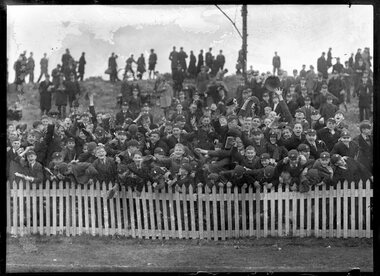 City of Melbourne Libraries
Photograph, Bull, Hugh Jones, 1897-1993, Scotch College v. Xavier College football match
... Bull, Hugh Jones, 1897-1993...Xavier College football match Photograph Bull, Hugh Jones, 1897-1993 ...Published: 29 June 1934 Published title: PUBLIC SCHOOLS FOOTBALL BEGINS WITH SCOTCH--XAVIER MATCH. Published caption: “The Public Schools 1934 Football season began yesterday when Scotch met Xavier on the Olympic Park ground, and after a wonderful recovery in the third term, Scotch registered a narrow win. Pictured above is the crowd of Scotch boys who congregated behind the goal after the addition of another goal to their score.” Description: Scotch College pupils exuberantly cheer their team’s goal at the first football match of the Public Schools Premiership and Championship for 1934 between Scotch College and Xavier College at Olympic Park, Melbourne (where AAMI Park is now). Research by project volunteer, Fiona Collyer: The Public Schools Premiership and Championship was an Australian Rules football tournament held every winter, over five weeks between six schools- Scotch College, Xavier College, Melbourne Grammar, Wesley College and traditional rivals Geelong Grammar and Geelong College. The school that won the most games out of the five played, won the competition. As the 1933 Premiers, Xavier College had the honour of playing the opening match of the season on 28 June against runners-up Scotch College at Olympic Park (where AAMI Park is now). The Public Schools Premiership matches were widely reported in Melbourne’s daily newspapers with photographs and commentary of every game. Weekly society magazine “Table Talk” featured reports and seven photographs of the first games of the season. Australian Broadcasting Commission (ABC) wireless station 3AR interspersed their afternoon program of reproduced music with detailed descriptions of the matches. Also reporting the matches was “Forty-Years-On”, presumably a student in the 1890s, whose regular column in The Herald newspaper “Activities In The Public Schools” published all the latest news on Victoria’s public (private) schools. In his column for The Australasian 7 July 1934, “Old Boy” writes about the Scotch versus Xavier match- “For more than half the game last week, Scotch was outplayed, but took the lead early in the last term and kept it. Scotch surprised even its own supporters by its dash in the last 25 minutes. Xavier, who became over confident by the prospects of victory, could not withstand the final onslaught. In the last quarter Scotch was the better side and won by seven points.” The final score was Scotch 11.11 (77 points) and Xavier 10.10 (70 points). At the end of this exciting match the overjoyed Scotch boys swarmed over the Olympic Park fences to chair their captain, Stanley Steele and carry him shoulder high, to the pavilion. The first documented game of a variation of Australian Rules football was played at Richmond Paddock (now Yarra Park) from 7 August 1858. Australian Rules football writer Hugh Buggy of The Argus 16 April 1952 explains- “It began when boys and masters of Scotch College and Melbourne Grammar School decided to play a 40-a-side game, with the first team to score two goals to be the winner. Goal posts were pitched more than a mile apart, one set on the Jolimont Hill and the other at Punt road Richmond. Nobody defined the boundary, and the play swung over the broad acres of the park and around the gum trees. It went on and on like a Test match, from noon till dusk. After 15 hours of play on three Saturdays the score was one goal all, and the game was abandoned for that season.” Rules of the game hadn’t been decided at this time - the earliest known rules were codified a year later in 1859. A sculpture and plaque located outside the Melbourne Cricket Ground (MCG), created by sculptor Louis Laumen in 2001, commemorates this game. It depicts two school boys chasing a ball along with umpire Tom Wills, a co-writer of the rules and promoter of Australian Rules football. A medley of Gaelic football, an Aboriginal game called marngrook as well as football played in English public (that is private) schools have been cited as inspiration for Australian Rules football. The word “Marngrook” meaning “game ball”, comes from the language of the Gunditjmara, First Nations people of southwestern Victoria. Marngrook was played at gatherings and celebrations and involved players competing to jump and catch the ball after it is kicked high into the air. The player that catches the ball then gets to kick it. The ball was made from possum skin, filled with pounded charcoal and tied with kangaroo sinews. Protector of Aborigines in Victoria, William Thomas (1794-1867) observed in 1841- “The men and boys joyfully assemble when this game is to be played. One makes a ball of possum skin, somewhat elastic, but firm and strong… The players of this game do not throw the ball as a white man might do, but drop it and at the same time kick it with their feet, using the instep for that purpose. The tallest men have the best chances in this game. Some of them will leap as high as five feet from the ground to catch the ball. The person who secures the ball kicks it. This continues for hours and the natives never seem to tire of the exercise.” The Victorian Football League (VFL), was founded in 1897 with eight teams playing Australian Rules football and held its first Grand Final at the MCG in 1902. From the start the games attracted large enthusiastic crowds, which included women. “Viva” writing in the Supplement to The Weekly Times-3 July 1886- LADIES COLUMN (By Viva) FOOTBALL. A Social Sketch. “…Of the popularity of football and footballers among women, there can be no doubt. Young, soft hearted girls, who would not “tread upon a worm," avow that football matches are "awfully jolly," and seem to regard accidents as a necessary part of the amusement…a great proportion of the spectators were ladies.” “Minetta” writing for Punch Magazine - “Ladies Letter, Holmby House, Toorak” 22 June 1905 “The "Football Girl" is a feminine genus at present much to the fore in Melbourne. Not that she plays football—at least not beyond a kick in the backyard or paddock—oh, dear, no! Her interest in the game is purely from a spectacular point of view. "Football Girls" usually hunt in couples, with two male barrackers attached. They know all about So-and-So's form, and whether he is a trier or has been bought. They go to each match of their particular club, and watch the play intently, their faces wearing a decidedly strained expression when their club is getting the worst of it. They are not ashamed to barrack either, when matters are progressing successfully… Yours ever, MINETTA.” The Herald 2 July 1909 published a cartoon by Ambrose Dyson depicting women football fans, which asked- “THE QUESTION OF THE DAY. Should Girls Go To Football Matches? Should they? The sex made up their mind about the matter very early on.” The resounding answer was- “Well, I’d like to see the man that would stop me!” At the final match of the 1934 tournament on August 2, Melbourne Grammar finished the season unbeaten, winning their tenth Public Schools premiership in 16 years. The Weekly Times 11 August 1934 reported-“Melbourne Grammar…had a rather lucky escape against Xavier…Had a Xavier player not touched a shot, kicked by a team-mate, as it was going through goal Grammar would have been beaten.” Final score - Melbourne Grammar 13.7 (85 points) defeated Xavier College 12.9 (81 points). Ladder for the 1934 Season- Melbourne Grammar-5 wins Wesley College- 4 wins Scotch College- 3 wins Xavier College- 2 wins Geelong Grammar- 1 win Geelong College- 0 wins The Associated Public Schools of Victoria (APS) exists today where eleven member (private) schools, including co-educational schools, participate in 21 sporting competitions throughout the year. (The descriptor “Public School” references the historical usage of the term and the model of the British public school). PUBLIC SCHOOLS FOOTBALL BEGINS WITH SCOTCH--XAVIER MATCH. (1934, June 29). The Age (Melbourne, Vic. : 1854 - 1954), p. 11. Retrieved June 18, 2025, from http://nla.gov.au/nla.news-article204824484 PUBLIC SCHOOLS FOOTBALL AT OLYMPIC PARK (1934, July 5). Table Talk (Melbourne, Vic. : 1885 - 1939), p. 5. Retrieved June 18, 2025, from http://nla.gov.au/nla.news-article149682433 PUBLIC SCHOOLS. (1934, June 29). The Age (Melbourne, Vic. : 1854 - 1954), p. 5. Retrieved June 3, 2025, from http://nla.gov.au/nla.news-article204824486 PUBLIC SCHOOLS FOOTBALL. (1936, July 3). The Argus (Melbourne, Vic. : 1848 - 1957), p. 18. Retrieved August 6, 2025, from http://nla.gov.au/nla.news-article11888301 https://en.m.wikipedia.org/wiki/History_of_Australian_rules_football COLLEGE SPORTS (1934, July 7). The Australasian (Melbourne, Vic. : 1864 - 1946), p. 48 (METROPOLITAN EDITION). Retrieved May 30, 2025, from http://nla.gov.au/nla.news-article145238393 GRAMMAR CHAMPIONS (1934, August 11). Weekly Times (Melbourne, Vic. : 1869 - 1954), p. 72. Retrieved June 1, 2025, from http://nla.gov.au/nla.news-article224562842 LETS LOOK AT FOOTBALL with HUGH BUGGY (1952, April 16). The Argus (Melbourne, Vic. : 1848 - 1957), p. 9. Retrieved June 15, 2025, from http://nla.gov.au/nla.news-article23174340 FOR YOUNG PEOPLE AMONG THE SCHOOLS. (1934, August 7). The Age (Melbourne, Vic. : 1854 - 1954), p. 4. Retrieved June 14, 2025, from http://nla.gov.au/nla.news-article205521661 https://www.nma.gov.au/defining-moments/resources/australian-rules-football#:~:text=In%20the%20winter%20of%201858,games%20of%20Australian%20Rules%20football. https://apssport.org.au/about/ http://lindsaymagazine.co/from-marngrook-to-australian-rules-football/ https://collection.australiansportsmuseum.org.au/objects/70993/possum-skin-ball FOOTBALL. (1886, July 3). Weekly Times (Melbourne, Vic. : 1869 - 1954), p. 6 (SUPPLEMENT TO THE STORY TELLER). Retrieved September 7, 2025, from http://nla.gov.au/nla.news-article221741193 Ladies' Letter. (1905, June 22). Punch (Melbourne, Vic. : 1900 - 1918; 1925), p. 28. Retrieved September 11, 2025, from http://nla.gov.au/nla.news-article175410975 THE QUESTION OF THE DAY. (1909, July 2). The Herald (Melbourne, Vic. : 1861 - 1954), p. 9. Retrieved September 17, 2025, from http://nla.gov.au/nla.news-article242062970 Photographer notations on slide: "Scotch v Xavier - Olympic Park B42".schools, football -
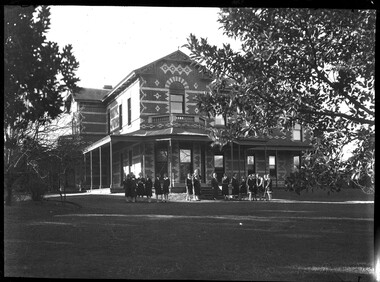 City of Melbourne Libraries
Photograph, Bull, Hugh Jones, 1897-1993, Ruyton Girls School 1933
... Bull, Hugh Jones, 1897-1993...Glass plate negative Ruyton Girls School 1933 Photograph Bull, Hugh Jones, 1897-1993 ...Published: Age (Melbourne, Vic.: 1854- ), 4 August 1933, page 3 Published title: GIRLS’ SCHOOLS – MODEL YACHTING - FOOTBALL Published caption: The headmistress, Miss H. Daniell, and girls at Ruyton, Selbourne Road, Kew, snapped after school hours. Trove article identifier: http://nla.gov.au/nla.news-article204381763 Research by Project Volunteer, Louise McKenzie: Rather than the people, this charming building takes the eye! Originally named “Tarring”, it was built in 1872 by Mr Henry Henty and his wife Mrs Marion Anne Henty (nee McKellar) for their family. Located at 82 Selbourne Road, Kew, it is described by Melbourne’s Open House organisation as “… a two-storey, polychrome brick mansion built for them by prominent Melbourne architect Albert Purchas. The house and nearly four acres of grounds served as their family home until the death of Marian Henty in 1919. “ (See below for further information on Albert Purchas.) In 1920 it was sold to Ruyton Girls School. Ruyton was established in 1878 by its first principal, Charlotte Anderson (1838-1906), who named it in honour of the parish in Shropshire, England, Ruyton-XI-Towns, where her great-great-grandfather David Evans had been vicar. Its motto is Recte et Fideliter, meaning "Upright and Faithful", which is also the name of the school song. The original school, one of Victoria’s oldest independent schools for girls, was located at the home of Mrs Anderson at 63 High Street South, Kew. In 1882 she moved the school to Edgecombe in Studley Park Road. Mrs Anderson retired due to ill health and sold the school to her friend Miss Eliza Bromby. One of Ruyton's four Houses, Anderson, is named for Charlotte Anderson. When Ruyton Girls School was moved to the site in 1920 it established the building as a Boarding House, and renamed the building “Henty House” in honour of its original owners. Today the school remains an all girls’ school, and pays tribute to its founder and the historic significance of Henty House and its magnificent Moreton Bay Fig tree, which still stands today. The building retains many original, Victorian-era features, while also showing the layers of change, made over the decades in order to meet the evolving needs of one of Melbourne’s leading schools. The headmistress mentioned in the caption for MCK016 is Miss Hilda Daniell, shown standing in front of Henty House in the midst of a group of Ruyton girls in their school uniforms, some holding hockey sticks. Miss Daniell was the longest serving Principal of Ruyton 1913-1952. She was originally a student in 1893, then joined the teaching staff in 1898. It was under her leadership that the School purchased and moved to “Tarring”. The boarding house included a flat for Hilda to live onsite. An article in the Ruyton Heritage Collection – Bedford Series, dated 21 May 2021 cites that Miss Daniell “was affectionately known as “Dream” by Ruytonians of her era” apparently due to a tendency to quiet reflection. The article continues, “After her retirement in 1952 Miss Daniell was awarded an Order of the British Empire for her many services to education, an award she received from the hands of the Queen during the 1954 Royal Tour. Also in 1952, the Kew Council honoured her by renaming Brougham Place as ‘Daniell Place’.” Arthur Purchas, architect: The architect responsible for the design of “Tarring”. Arthur Purchas, was extremely active and highly regarded at this time. Born in Wales in 1825, he emigrated to Melbourne in 1851 and soon established a private practice as a surveyor and architect, with offices variously in Little Collins, Queen Street, Chancery Lane, and finally 462 Little Collins Street. Wikipedia notes in an early reference to Purchas that “An early story is that one of his first jobs, when he would have been about 25 years old, was a position under Surveyor-General Robert Hoddle, and disagreeing with him over the line for St Kilda Road, appealed to Governor La Trobe, and successfully got the road diverted around the hill which eventually became the site of the Shrine of Remembrance. There may not be much truth to this, since by 1851 St Kilda Road was already a well worn track running around the hill, the top of which La Trobe had reserved for a Government House in 1840.” The timing of Purchas’s arrival in Melbourne was perfect. The Victorian gold rush of the 1850’s generated enormous wealth in Melbourne, and a building boom followed. The Wikipedia entry continues … that alone, or with his brother in law Charles R Swyer, “Purchas is said to have designed over 140 houses, offices, churches, banks and cemetery buildings in Victoria in his long career. Berkely Hall, St Kilda dating from 1854 is one of his first buildings, and still exists, though the original house is obscured by an early C20th verandah. Another notable early design was the head office of the Melbourne Savings Bank, built on the corner Flinders Lane and Market Street in 1857-58, in an elaborately detailed Renaissance Revival style. His churches were mostly Gothic Revival, built for the Anglican Church, along with some parsonages, while most of the bank buildings were Renaissance Revival designs for the Bank of Australasia. He also designed city buildings in the 1860s and 70s, such as the Mutual Insurance Co, Northern Insurance Co, and the first premises for George & George, destroyed by fire in 1889. One of his most outstanding designs is St George's Presbyterian Church in Chapel Street, St Kilda (1877–80), in a striking polychrome brick Gothic Revival style, unusually carried on through to the interior. Purchas produced one of the few published maps and compilations of the early pastoral settlers runs in Victoria in 1853. In the same year he designed the layout of the Melbourne General Cemetery, the first 'garden' cemetery in Victoria, a curvilinear layout with extensive plantings, as well as the gate lodge and gates (the gates lodge were demolished and the gates relocated to their present position in the 1930s). He was a long time member of the Cemetery Trust, serving as secretary from 1876-1886. He was also Chairman of the Boroondara General Cemetery Board of Trustees 1867 to 1909, and designed many aspects of the cemetery, including the landscape, the cast iron entrance gates (1889), the rotunda (1890) and the surrounding brick wall (1895–6). Purchas was a keen inventor having applied for a patent for an invention for lighting a railway carriage with gas in 1861, and won a competition for a model farm complex, in 1862. This unusual design had the dairy either underground or half underground, to keep it cool, with a 'dry lining' around the outside of the sunken portions. In 1883, with fellow architect Alfred Smith, he took out a patent for fire-proof floors, arches, staircases and other parts of buildings.” Purchas died in his home in Kew in 1909 and, not surprisingly, was buried at Boroondara Cemetery. Henty family history in Australia: Henry Henty (b.1833-d.1912) was a successful businessman, and briefly a MLA for the seat of Grenville, Victoria in 1866. He was one of three sons of James Henty, and nephew of Edward Henty who is considered to be the first permanent European colonist to take up residence in Victoria. The Australian Dictionary of Biography provides a riveting overview of the complex and enthusiastic activities of the Henty family, and its entanglement in the development of mercantile life in WA, Tasmania, SA and Victoria from 1828 onwards. The family had a focussed commitment to creating thriving businesses in Australia, despite being regularly thwarted by legislative pushbacks and law changes, instigated in Britain as the Australian colony developed. Areas of greatest influence were merino sheep, beef and horse breeding, whaling, farm establishment, membership of the legal and political fraternities, sporting prowess, and board directorships in banking and railways. The Dictionary of Biography summarises: “As settlers the Henty men were notable not merely for being the first to settle in Victoria but also for their number and quality: a father and seven educated sons experienced in farming and trading, occupations of prime importance to a new colony, and importers of unusually substantial capital in money, skilled workers and thoroughbred stock.” As well as Tarring, the Henty family Melbourne residences included Findon (in Kew, overlooking Studley Park), Offington (St Kilda Road overlooking Albert Park) and Field Place (Henty Court, Kew), and descriptions of the houses in Wikipedia –Melbourne Architecture 1870s - reflect the development of Melbourne society. References RUYTON (1934, December 15). The Argus (Melbourne, Vic. : 1848 - 1957), p. 18. Retrieved March 12, 2025, from http://nla.gov.au/nla.news-article11001092 https://en.wikipedia.org/wiki/Ruyton_Girls%27_School#:~:text=Ruyton%20Girls'%20School%2C%20commonly%20referred,of%20Melbourne%2C%20Victoria%2C%20Australia. https://www.ruyton.vic.edu.au/our-school#:~:text=With%20an%20international%20reputation%20as,opportunity%20and%20challenge%20for%20girls. https://victoriancollections.net.au/items/5bea06b121ea690bf4eb08ed https://www.ruyton.vic.edu.au/our-school/campus-and-facilities Biography of Edward Henty and family: https://adb.anu.edu.au/biography/henty-edward-2247 Article on Offington House: http://nla.gov.au/nla.news-article196554993 Article on Field Place House : https://vhd.heritagecouncil.vic.gov.au/places/64881 Article on Findon: https://www.facebook.com/KewHistoryGroup/posts/in-the-book-jubilee-history-of-kew-1803-1910-by-fga-barnard-there-is-a-photo-of-/4389837914376555/ Charlotte Anderson/Ruyton: https://victoriancollections.net.au/items/5be4b8c821ea6a039c7a13e3 https://victoriancollections.net.au/items/6179e90da912eb195970bdf8 https://victoriancollections.net.au/items/5bea06b121ea690bf4eb08ed https://victoriancollections.net.au/items/65d3e05c5b5e5c61346420a2 Photo of Charlotte Anderson: https://viewer.slv.vic.gov.au/?entity=IE1515776&mode=browse Photo of Charlotte Anderson: https://victoriancollections.net.au/items/6179e90da912eb195970bdf8 https://victoriancollections.net.au/items/5be4b8c821ea6a039c7a13e3 Wikipedia: Architecture of Melbourne: https://en.wikipedia.org/wiki/Architecture_of_Melbourne Open House Melbourne: Henty House: https://www.universe.com/events/henty-house-ruyton-girls-school-tickets-Z45LYH Albert Purchas: https://en.wikipedia.org/wiki/Albert_Purchas Leader (Melbourne, Vic. : 1862 - 1918, 1935), Saturday 3 June 1876, page 9 – Article on Offington http://www.ohta.org.au/organs/organs/BoxHillUC.html Melb Architecture 1870s - Wikipedia Victorian Collections: Letters of Hilda Daniell https://victoriancollections.net.au/items/65d3e05c5b5e5c61346420a2 Photographer notations on slide: "Ruyton Girls School 1933".schools, 1930-1939, architecture, victorian architecture, trees, architects -
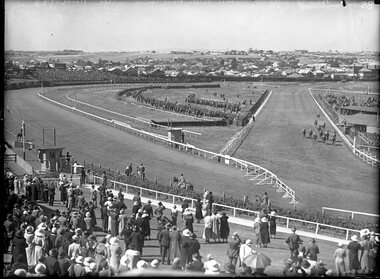 City of Melbourne Libraries
Photograph, Bull, Hugh Jones, 1897-1993, The new straight at Moonee Valley Race Course
... Bull, Hugh Jones, 1897-1993...Glass plate negative The new straight at Moonee Valley Race Course Photograph Bull, Hugh Jones, 1897-1993 ...Published: Age (Melbourne, Vic.: 1854- ), 11 December 1933 Published title: The New Straight Moonee Valley Published caption: Age (Melbourne, Vic. : 1854 - 1954), Monday 11 December 1933, page 6 The finish of the Koombahla Trial Handicap, the first race run on the new and longer straight across the flat at Moonee Valley racecourse. Magoot won, with Affability second and Great Bear third. This picture, taken from the members' reserve, shows the new straight in relation to the old one (the latter will continue to be used for races of less than seven furlongs), with the finishing post on the right and the new Judge's box in front of the old one. In the distance can be seen the starting points for races over nine furlongs and eight furlongs and a half on another course track. Trove article identifier: http://nla.gov.au/nla.news-article203362672 Research by Project Volunteer, Louise McKenzie: This photo, taken from the elevation of the stand in the Members’ Reserve at Moonee Valley Racecourse, has been framed in order to highlight the new straight, the finishing post, and a new Judge’s Box. In the foreground is a crowd of racegoers in the Members area, showing significantly more women in attendance than men. It is a bright, sunny Tuesday afternoon. The women are wearing small or large brimmed hats and are mostly swathed in generously cut coats with long sleeves that are mid calf length. Some women carry umbrellas to protect them from the sun. The men are wearing suits and hats. The women and men are mostly standing in discrete, rather than mixed groups. More spectators are standing on a banked area in the centre of the track, a large crowd is trackside on the left and another crowd is located to the right of the photo along the final straight. There are stewards on horses in front of the members reserve, and a field of 12 horses approaches the winning post. On a slope at the rear of the photo is evidence of a fairly new housing development, evidenced by the small number of trees. Beyond this there is some vacant land to the left and then more dense housing is evidenced to the right. In the photo the white fencing delineating the course and spectator areas creates wonderful lines and curves. It is a very sharp and clear image. The race underway is the Koombahla Trial Handicap, which was won by Magoot by a length from Affability, with half a length back to Great Bear. At this juncture, Magoot won 3 of 4 starts, and subsequently on Saturday 30 December 1933, with a new up and coming young Flemington trainer J M Murphy, and popular mount Harold Skidmore, Magoot was the favourite and winner of the day’s principal event at Moonee Valley. The Weekly Times that day reported that Magoot had been sold to Launceston sportsman Mr W C Learoyd. The winnings from this race, 400 Pounds , was apparently sufficient to offset the cost of the horse, and would be the equivalent of approximately $9,500 in today’s money. The same article describes Magoot as a “Magpie” gelding as his bloodline was Magpie Tullalah from New Zealand. Sadly, on 9 October 1935, the Examiner (Launceston) reported that Magoot had to be destroyed after falling and breaking her shoulder while running in the Grovedale Handicap in Geelong, but such was her reputation that she warranted an accompanying photograph. Moonee Valley Racecourse was established in 1883 on private land by its owner WS (Sam) Cox – after whom the prestigious horserace, the WS Cox Plate is named. It is located 6 km from the Melbourne CBD in the suburb of Moonee Ponds. It became a non-proprietary property in 1935, and today the Cox Plate, run over 2040 m. each October, is the richest weight-for-age race in Australia for 3 year old and over, under Weight for Age conditions.” According to the Austadiums website, Moonee Valley has a “unique amphitheatre track and was the first Australian metropolitan track to conduct night racing.” This amphitheatre style is evident in Hugh Bull’s photo. THE NEW STRAIGHT AT MOONEE VALLEY. (1933, December 11). The Age (Melbourne, Vic. : 1854 - 1954), p. 6. Retrieved July 23, 2025, from http://nla.gov.au/nla.news-article203362672 Age (Melbourne, Vic. : 1854 - 1954), Monday 11 December 1933, page 6 THE NEW MOONEE VALLEY TRACK (1933, December 11). The Argus (Melbourne, Vic. : 1848 - 1957), p. 7. Retrieved September 1, 2025, from http://nla.gov.au/nla.news-article11719604 Argus (Melbourne, Vic. : 1848 - 1957), Monday 11 December 1933, page 7 MAGOOT SOLD (1933, December 23). The Australasian (Melbourne, Vic. : 1864 - 1946), p. 22 (METROPOLITAN EDITION). Retrieved September 1, 2025, from http://nla.gov.au/nla.news-article141384672 Australasian (Melbourne, Vic. : 1864 - 1946), Saturday 23 December 1933, page 22 SMALL BUT GOOD (1933, December 30). Weekly Times (Melbourne, Vic. : 1869 - 1954), p. 48 (FIRST EDITION). Retrieved September 1, 2025, from http://nla.gov.au/nla.news-article223210074 Weekly Times (Melbourne, Vic. : 1869 - 1954), Saturday 30 December 1933, page 48 MOONEE VALLEY RACES. (1933, December 11). The Sydney Morning Herald (NSW : 1842 - 1954), p. 13. Retrieved September 1, 2025, from http://nla.gov.au/nla.news-article17031425 Sydney Morning Herald (NSW : 1842 - 1954), Monday 11 December 1933, p. 13 ACCIDENTS AT GEELONG MAGOOT DESTROYED (1935, October 10). Examiner (Launceston, Tas. : 1900 - 1954), p. 3 (DAILY). Retrieved September 1, 2025, from http://nla.gov.au/nla.news-article51958216 Examiner (Launceston, Tas. : 1900 - 1954), Thursday 10 October 1935, p. 3 Wikipedia, Moonee Valley Racecourse, https://en.wikipedia.org/wiki/Moonee_Valley_Racecourse eMelbourne, the city past and present, https://www.emelbourne.net.au/biogs/EM01003b.htm Wikipedia, Cox Plate, https://en.wikipedia.org/wiki/W._S._Cox_Plate Austadiums, Moonee Valley, https://www.austadiums.com/stadiums/moonee-valleyPhotographer notations on slide: "New straight at Moonee Valley Race Course - Age 11 Dec 1933 B8".horseracing, race courses, moonee valley, 1930-1939 -
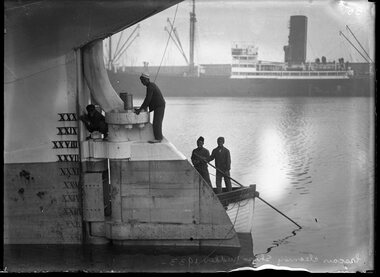 City of Melbourne Libraries
Photograph, Bull, Hugh Jones, 1897-1993, Lascars cleaning ship's rudder
... Bull, Hugh Jones, 1897-1993...Glass plate negative Lascars cleaning ship's rudder Photograph Bull, Hugh Jones, 1897-1993 ...Published: unknown, however, on 26 June 1935 a similar, but not the exact photo in the McKenzie Collection, was published in The Age: Published title: Shipping Victorian Flour to the East Published Caption: Flour and wheat figure prominently in all cargoes carried by ships trading to Chinese, Japanese and Eastern ports. Victorian millers are eager to extend lids outlet for their produce, and every opportunity is grasped. The pictures show Australian labourers unloading from railway trucks some of the 2300 tons of flour which will go into the hold of the Burns, Philp motor ship Neptuna for shipment to Hong Kong, while Chinese seamen are busy cleaning and painting the rudder post of the ship. Hard by the Neptuna, other ships are taking on flour for the East. Research by Project Volunteer, Louise McKenzie: The image was described by Hugh Bull on the rear of the glass plate as – “Lascars cleaning ships rudder 1933”. Basically, a “lascar” is a seaman. Image No. 032 in the McKenzie Collection shows two lascars perched on the rudder of a ship, with two others standing in a rowboat along side. They are dressed in baggy trousers and jackets and wearing caps. Across a very calm dock area is a single funnel ship with on-deck derricks. The rudder of the ship being cleaned is white, with large black roman numbering denoting the depth at which the ship is sitting, depending on whether it is loaded or empty. Whilst the exact photo in the McKenzie Collection has yet to be located in The Age in 1933, the date when it was taken, there is a photo published in The Age on 25 June 1935 which appears to be one of a series of photos taken on the same day, featuring lascars cleaning a ship’s rudder. It bears a striking resemblance to MCK 032, but it is taken from a slightly different angle. The 1935 published photo is a close up of a ship’s rudder being cleaned, with same style of roman numerals in black on the white of the rudder. One lascar is standing on the rudder, one is standing in a small clinker style rowboat, with its characteristic wooden overlapping hull planks, holding a broom; two more lascars are sitting in the bow and stern of the rowboat. The ship being cleaned is in a dock, as a wharf and warehouses can be seen in the background, the water is very calm, and there are two other ships moored nearby – one across the other side of the dock with a black and white hull and derricks on its deck, and one adjacent, with its mooring lines clearly visible. The lascars are wearing caps, baggy trousers and jackets. Compelling similarities therefore exist between the two images. Whilst it is difficult to positively identify the cultural background of these particular lascars in either photo, the newspaper article dated June 1935 advises they are “Chinese”. This is possibly because the ship they are associated with, the Neptuna, is reported to have sailed from Melbourne on this date, bound for Hong Kong. However, the men are probably from South East Asia. Wikipedia describes the term “Southeast Asia” as covering ” … the people of Southeast Asia from prehistory to the present in two distinct sub-regions: Mainland Southeast Asia (or Indochina) and Maritime Southeast Asia (or Insular Southeast Asia). Mainland Southeast Asia comprises Cambodia, Laos, Myanmar (or Burma), Peninsular Malaysia, Thailand and Vietnam whereas Maritime Southeast Asia comprises Brunei, Cocos (Keeling) Islands, Christmas Island, East Malaysia, East Timor, Indonesia, Philippines and Singapore. Additionally, Wikipedia “Lascars” states that “Lascars were sailors from the Indian subcontinent, South East Asia, the Arab world, British Somaliland and lands east of the Cape of Good Hope, who were employed to work on colonial merchant ships. The practice ran from the 16th century to the mid 20th century”. Indian seamen were used as early as the 16th century by Portuguese explorer Vasgo da Gama in his successful voyage to India, and subsequently by Portuguese ships in the 16th and 17th centuries. “Through the Portuguese and Spanish maritime world empires, some Indian lascars found their way onto English merchant ships, and were among the sailors on the first English East India Company (EIC) ships to sail to India.” In the 17th Century “When the English adopted the term "lascar", they initially used it for all Asian sailors on English-flagged ships, but after 1661 and the Portuguese ceded Bombay to England, the term was used mainly to describe Indian sailors specifically. The term "topaze" was used to describe Indo-Portuguese personnel, especially those from Bombay, Thana, Diu, Dammam and Cochin. The term "sepoy" was used to describe Indian soldiers in European service. The number of lascars employed on EIC East Indiamen was so great that the Parliament of England restricted their employment via the Navigation Acts (in force from 1660 onwards) which required that 75% of the crew onboard English-flagged ships importing goods from Asia be English subjects. The restriction arose due to the high rates of illnesses and death among European sailors on East Indiamen, and their frequent desertions in Asia, which left such ships short of crew for the return voyage. Another reason was the frequent impressment of European sailors from EIC East Indiamen by the Royal Navy in times of war“. The term “impressment” colloquially refers to “the “press gang” …”a type of conscription of people into a military force, especially a naval force, via intimidation and physical coercion, conducted by an organized group (hence “gang”). .. The large size of the British Royal Navy in the Age of Sail meant impressment was most commonly associated with Great Britain.”. (Wikipedia – Impressment). By the 20th century these sailors served on British ships under "lascar agreements", which allowed shipowners more control than was the case in ordinary articles of agreement. The sailors could be transferred from one ship to another and retained in service for up to three years at one time. “Lascars served all over the world in the period leading up to the First World War. Lascars were barred from landing at some ports, such as in British Columbia. At the beginning of World War I, there were 51,616 lascars working on British merchant ships in and around the British Empire. In World War II thousands of lascars served in the war and died on vessels throughout the world, especially those of the British India Steam Navigation Company, P&O and other British shipping companies. The lack of Canadian naval manpower led to the employment of a total of 121 Catholic Goans and 530 Muslim British Indians on the Empress vessels of the Canadian Pacific Railway, such as the Empress of Asia and Empress of Japan. These ships served in the Indian Ocean both as ANZAC convoy ships and in actions at Aden. The ships were placed under the British Admiralty as part of Canada's contribution to the war effort and all of the Indian men were awarded medals by the Admiralty, though none of them were delivered. In the 1950s the use of the term "lascar" declined with the ending of the British Empire. The Indian “Lascar Act” of 1832 was finally repealed in 1963. However, "traditional" Indian deck and Pakistani engine crews continued to be used in Australia until 1986 when the last crew was discharged from the P&O and replaced by a general-purpose crew of Pakistanis. The term lascar has been widely used to engender an element of exoticism in literature eg “Sir Arthur Conan Doyle created a Lascar foil to Sherlock Holmes in "The Man with the Twisted Lip" in 1891. Lascars aboard the ship Patna figure prominently in the early chapters of Joseph Conrad's novel Lord Jim. Frances Hodgson Burnett's novel A Little Princess features a lascar named Ram Dass. Also, Caleb Carr portrays two lascars as bodyguards for a Spanish diplomat near the end of The Angel of Darkness. In Wuthering Heights, it is speculated that Heathcliff, the main character, may be of lascar origin." (Wikipedia – Lascar) And what has become of these “forgotten heroes of the World Wars”? The South Asian Heritage Trust, which seeks to commemorate, mark and celebrate South Asian cultures, stories, and communities, published an article in July 2025 entitled – The Lascars: Seafaring Roots of Modern Britain. It particularly honours the role of the 80,000 lascars who served Britain in WWI, and the over 100,000 who served in the British Merchant Navy in WWII, and concludes: “The hardships faced by Lascars were profound. They were often assigned the most dangerous tasks, lived in substandard conditions aboard ships and, even after their immense contributions to the war efforts, many veterans found it difficult to secure the recognition, pensions and rights afforded to other veterans. Many were employed under ‘Asiatic Articles’, which offered less protection and lower pay than their European counterparts. Yet, their legacy endures. The multicultural fabric of areas like East London owes much to these early seafarers and settlers. The East London Mosque, established in 1910, became an important spiritual and community hub. Today, efforts to bring their stories out of the shadows are growing. The Museum of London Docklands features exhibits on their history. Memorials, such as the P&O headstone in Dover for the 22 Lascar crew members of the SS Maloja sunk in 1916 and the careful restoration of the Lascar War Memorial in Kolkata, serve as important reminders of the sacrifices. The journey of the Lascars – from their homelands, along dangerous wartime shipping routes, to the docklands of Britain – is a story of personal courage and of a rich contribution to Britain’s history and identity.” The ship MV Neptuna, mentioned in the 1935 article, had that year been purchased from a German company by Australian-owned Burns Philp, with Australian Government assistance, and it was instrumental in ensuring the shipment of rice from Vietnam to Papua New Guinea. Rice is still a household staple in PNG. Despite it being introduced into PNG more than 100 years ago, the crop has not been sufficiently integrated into the country’s traditional agricultural production system, and today PNG imports still account for nearly 98% of rice. (Spotlight Magazine Sept. 2016) The 1935 newspaper article states that the Neptuna is involved in moving flour for the East. Australian wheat exports began in 1845, but were not regular until the 1870s. New land clearing methods in Australia allowed large tracts of land to be cleared more efficiently – this included the invention of the iconic ‘stump jump’ plough. With the success of the wheat harvests, flour mills began to spring up around the country. By the 1870s, many large country towns had their own mills, with around 500 mills producing flour across the country. Flour exports were an important part of the wheat industry until around the 1930s. After the Second World War, many of Australia’s export partners (which were mainly in the developing nations of Asia) began setting up their own flour industries and the Australian product was no longer in demand. In 1942 MV Neptuna was being utilised for the war effort, and carrying depth charges and other armaments for Australia, when on 19 February it was sunk in a bombing raid on Darwin, and where part of her hull still lies. References: SHIPPING VICTORIAN FLOUR TO THE EAST. (1935, June 25). The Age (Melbourne, Vic. : 1854 - 1954), p. 11. Retrieved July 23, 2025, from http://nla.gov.au/nla.news-article204357218 Age (Melbourne, Vic. : 1854 - 1954), Tuesday 25 June 1935, page 11 Wikipedia, Clinker (boat building), https://en.wikipedia.org/wiki/Clinker_(boat_building) Wikipedia, Lascar, https://en.wikipedia.org/wiki/Lascar Wikipedia, History of Southeast Asia, https://en.wikipedia.org/wiki/History_of_Southeast_Asia Wikipedia, Impressment, https://en.wikipedia.org/wiki/Impressment NEPTUNA LEAVES FOR CHINA WITH TOURISTS (1935, June 25). The Herald (Melbourne, Vic. : 1861 - 1954), p. 5. Retrieved July 23, 2025, from http://nla.gov.au/nla.news-article244841163 National Research Institute SPOTLIGHT paper Vol 9, Issue 7, https://pngnri.org/images/Publications/Spotlight_No_9_Vol_7_-_201609_-_Sofe__Odhuno_-_Rice_Import_Quota1.pdf South Asian Heritage Trust, The Lascars: Seafaring Roots of Modern Britain, July 11,2025 : Royal British Legion. https://southasianheritage.org.uk/royal-british-legion/the-lascars-seafaring-roots-of-modern-britain/ Photographer notations on slide: "Lascars cleaning ships rudder 1933".lascars, ships, 1930-1939, employment, ethnic communities -
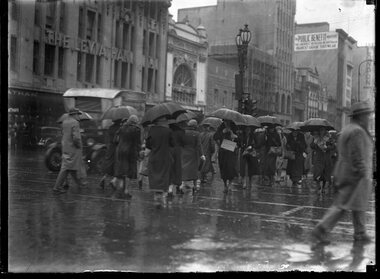 City of Melbourne Libraries
Photograph, Bull, Hugh Jones, 1897-1993, Christmas shopping in the wind and rain, Bourke Street, Melbourne
... Bull, Hugh Jones, 1897-1993...Glass plate negative Christmas shopping in the wind and rain, Bourke Street, Melbourne Photograph Bull, Hugh Jones, 1897-1993 ...Published: (1933, December 15). The Age (Melbourne, Vic. : 1854 - 1954), p. 13. Published title: SHOPPING CONTINUED AMID RAIN AND STORM IN THE CITY. Published caption: Battling against the rain and wind, Christmas shoppers had an unpleasant time in Melbourne yesterday as they made their way from shop to shop; but still, they made their purchases, and with parcels and shopping bags clutched close, and with umbrellas held against the wind, they made their way to trains and trams for the homeward journey. A picture in Bourke-street yesterday. Trove article identifier: http://nla.gov.au/nla.news-article203353770 Description: Crowd of men and women in winter clothing, in the rain, carrying umbrellas, crossing at the intersection of Bourke and Swanston streets. “Xmas shopping in wind and rain. When we first saw the rain, umbrellas, long coats and fox stoles, we naturally assumed this photo was taken in mid-winter. Some months later, we noticed the photographer’s pencil “scritchings” at the slide’s edge, and the truth was revealed: mid-December Melbourne in Bourke Street!" Featured in "Newsworthy: Melbourne in photographs 1933-1936" exhibition at East Melbourne Library, October to December 2023. Exhibition caption by project team. Research by project volunteers: Visible buildings include Leviathan Men's Clothing Store in Beaux Arts style, Melba Theatre and London Stores, together with signage for Public Benefit Footwear (later to become PBs). Leviathan was an Australian clothing brand established 1865, producing garments for sailing and watersports. Melba Theatre, opened in 1911, was a long narrow theatre of only 17 seats across. Adjacent to the Melba Theatre are a Woolworths and a Coles. The Public Bootery, a shoe shop established 1908, moved to this site 1924. Double headed decorative street lights (now called "Collins Street lights") were installed in 1929, inspired by the street lighting style of San Francisco. References: SHOPPING CONTINUED AMID RAIN AND STORM IN THE CITY. (1933, December 15). The Age (Melbourne, Vic. : 1854 - 1954), p. 13. Retrieved October 14, 2024, from http://nla.gov.au/nla.news-article203353770 Photographer notations on slide: "Xmas shopping in wind and rain Age B9". -
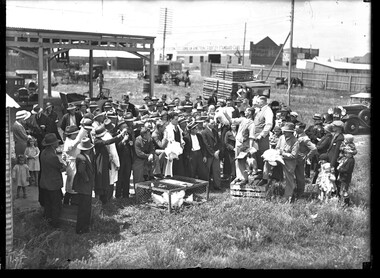 City of Melbourne Libraries
Photograph, Bull, Hugh Jones, 1897-1993, Poultry auction for Christmas dinners, Bentleigh Poultry Market
... Bull, Hugh Jones, 1897-1993...Glass plate negative Poultry auction for Christmas dinners, Bentleigh Poultry Market Photograph Bull, Hugh Jones, 1897-1993 ...Published: Age (Melbourne, Vic.: 1854- ), Thursday 21 December 1933, page 11 Published title: : POULTRY FOR CHRISTMAS DINNERS Published caption: With the approach of the Festive Season, the demand for poultry of all descriptions tends to harden and good clearances of many thousands of birds have been effected at recent auctions. The above picture was taken yesterday at the sale conducted by Messrs. Parnham and Carter of Bentleigh, whose auctions are the largest in Melbourne on the basis of individual sales. The auctioneer's assistant is holding up a prime goose for the appraisement of bidders preparing for Christmas fare. Trove article identifier: http://nla.gov.au/nla.news-article203351699 Research by project volunteer, Louise McKenzie: This photo is full of action! A poultry auction is in full flight. The serious-looking auctioneer and his assistant stand on a Parnham & Carter wooden box so that the auctioneer can make eye contact with the bidding crowd. The auctioneer is wearing a waistcoat and tie and has his pencil and paper ready to record the winning bids. The assistant in overalls is holding a live white duck in each hand. Two other assistants also hold live birds. A wire cage on the ground holds a few white chickens – presumably the next auction items. The majority of the substantial crowd is male, mostly wearing Fedora hats and jackets or suits and ties. Some women are present, wearing hats and coats, and at least seven children are visible, some dressed up, others dressed more casually. The auction is taking place in a rural setting, possibly on the site where the birds are farmed. It is an informal, rather rough, grassed area next to a large shed with a high verandah. Two horse drawn vehicles are visible in the background, as well as five motorised vehicles. There are stacks of wooden boxes or crates which look as if they transport birds, and two cows are grazing by the fence. There are two telegraph poles with many lines. In the adjacent block is a very large car business comprising two large brick warehouse style buildings, plus outbuildings. The signage on one brick warehouse mentions Standard Cars. Both a man and a woman have their arms raised to bid. It is an occasion – but a serious one. We cannot be sure if these birds are for breeding or the table, but buying poultry for the Christmas meal was a tradition in Melbourne with purchasers going either to the auctions, or perhaps the Queen Victoria Market. The Argus in its article “Christmas Dinner” on 6 December 1932 advised of increased demand for turkeys and chickens ahead of a possible Christmas shortage. Part of this shortage would be because of the outbreak of Newcastle disease which resulted in a quarantine around Melbourne within which all killing must be under supervision and bear the Government brand. They believed this would result in smaller producers not bothering to get such a permit as "for many of them the poultry cheque is only pin money for their wives.” Interestingly, an article in the Sun News Pictorial of 26 January 1934 reported a strong market, and “One auctioneer stated that buyers were taking up chickens freely now for the Centenary celebrations because they would probably never be as plentiful at the present levels of prices until next season.” That same article quoted officials of the Department of Agriculture stating that "…they had received a fair number of inquiries from farmers recently on the possibilities of table poultry breeding for local and export markets. The good prices being paid for poultry were attracting interest.” In fact, on 29 December 1933, the Sun News-Pictorial had reported that for the first time, the innovation of holding poultry sales in Melbourne between the Christmas and New Year holidays had been trialled the day before, and had proved successful. The Bentleigh area had a long history of poultry farming. The Seal of the Municipality of Moorabbin has a cockerel featured in the top right quadrant, and according to its local history website, “Writers in the local press gave advice on breeding, feeding, marketing and other matters of concern to anyone keeping fowls. In 1914 poultry farms were spread from Ormond, through Cheltenham and Mentone to Mordialloc.” The Encyclopedia of Melbourne online advises that the Shire of Moorabbin once covered an extensive area of the south-eastern suburbs, land where the Boon wurrung people had hunted, fished and collected water from the natural springs near Beaumaris and Cheltenham. The Boon wurrung reputedly called this district Mooroobin, a name that Richard and John King adapted to Moorabbin for the cattle run they established in the mid-1840s. The sandy soil of much of the district proved suitable for market gardening which flourished in Moorabbin from the 1850s. Some districts, such as Highett, remained largely devoted to cattle, while fishing was a major activity in the coastal villages. Moorabbin's population remained tiny throughout the 19th and much of the early 20th century with less than 1000 ratepayers in the shire. When the more popular coastal resort areas of the shire seceded after World War I, Moorabbin was left as an under-serviced, still largely rural area. It was not until the 1930s that the population rose above 20,000. By the late 1930s poultry farming had been added to market gardening as a local industry. But northern sections of the city, such as Bentleigh and McKinnon, were beginning to develop as residential areas. The local council took steps to attract industry and new residents to the city by erecting reputedly the largest neon sign in Melbourne at the time on the Point Nepean Road (later Nepean Highway), pointing out that plentiful residential and industrial land was available. The era of gardeners’ picnics, the formation of the Market Gardeners’ & Fruit Growers’ Association, and the Moorabbin Horticultural, Poultry & Dog Society Spring Shows was over. References: POULTRY SALES HELD (1933, December 29). The Sun News-Pictorial (Melbourne, Vic. : 1922 - 1954; 1956), p. 20. Retrieved July 30, 2024, from http://nla.gov.au/nla.news-article276124760 MUCH INTEREST IN POULTRY (1934, January 26). The Sun News-Pictorial (Melbourne, Vic. : 1922 - 1954; 1956), p. 30. Retrieved July 30, 2024, from http://nla.gov.au/nla.news-article277292695 Christmas Dinner. (1932, December 6). The Argus (Melbourne, Vic. : 1848 - 1957), p. 6. Retrieved July 30, 2024, from http://nla.gov.au/nla.news-article4512606 'Moorabin', eMelbourne, https://www.emelbourne.net.au/biogs/EM01004b.htm 'City of Glen Eira Thematic Environmental History [Refresh] 2020', prepared for The City of Glen Eira by Built Heritage P/L, https://www.gleneira.vic.gov.au/media/7583/glen-eira-c214glen-city-of-glen-eira-thematic-environmentla-history-refresh-2020.pdf Photographer notations on slide: "Poultry for Christmas Dinners Age 21-12-33 B9".christmas, poultry -
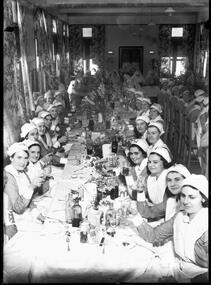 City of Melbourne Libraries
Photograph, Bull, Hugh Jones, 1897-1993, The Nurses' Christmas, Alfred Hospital
... Bull, Hugh Jones, 1897-1993...Glass plate negative The Nurses' Christmas, Alfred Hospital Photograph Bull, Hugh Jones, 1897-1993 ...Published: The Age 26 Dec 1933 page 9 Published title: "THE NURSES' CHRISTMAS." Trove article identifier: http://nla.gov.au/nla.news-article203364946 Description: Group of nurses in uniform enjoying Christmas dinner at the Alfred Hospital. Research by project volunteer Ernie Ward: Alfred Hospital nurses enjoy their Christmas Lunch: The hierarchical system of Nursing and Nurse Training (as indicated by the headwear, armbands and seating positions) is on full display as Alfred Hospital nurses propose a Christmas Lunch toast (strictly non-alcoholic) to The Age photographer, Hugh Bull. Some of the bolder nurses have decorated their headwear in a festive way that would be frowned upon the other 364 days of the year. The soft drinks are Marchants and Elliotts, the flower arrangements feature the highly fashionable gladioli, and the floral patterned curtains have been pulled aside so the summer sunshine can stream in. The sunshine would, in a couple of hours, be replaced by flooding rainstorms which caused havoc on Christmas night. This very Melbourne weather phenomenon was the focus of The Age Boxing Day edition pictorial. At the rear of the room is Matron Grace Wilson C.B.E, already a World War One heroine for setting up and working at Australian military hospitals in Greece, Egypt and France (as seen on the second episode of the 2014 television series Anzac Girls). As Australia’s most highly-ranked peacetime military nurse, Matron Wilson also appears as the only woman in any official capacity at the Dedication of the Shrine of Remembrance in 1934. She can be seen in the grand panorama documenting this occasion (also featured in this exhibition).Photographer notations on slide: "The Nurses' Christmas Alfred Hospital Age 1933 B9".nurses, christmas, 1930-1939 -
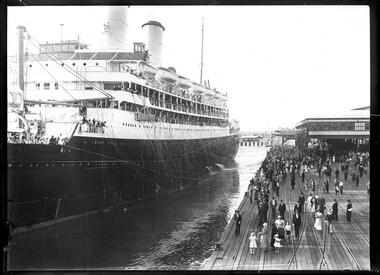 City of Melbourne Libraries
Photograph, Bull, Hugh Jones, 1897-1993, RMS Orford departing from Station Pier, Port Melbourne
... Bull, Hugh Jones, 1897-1993...Glass plate negative RMS Orford departing from Station Pier, Port Melbourne Photograph Bull, Hugh Jones, 1897-1993 ...Published: 21 March 1934 The Age p11 Published title: CROWDED TOURIST SHIP WILL CARRY TEST AND DAVIS CUP TEAMS. Published caption: Carrying an exceptionally large number of tourists, business men and prominent sporting personalities, R.M.S. Orford sailed for London yesterday. Over two hundred passengers embarked at Melbourne, and on leaving the Australian coast there will be two thousand persons on board. The Australian Test team will join the vessel at Fremantle and the remaining two Davis Cup representatives will embark at Adelaide. A picture of the Orford taken just as she moved out from Station Pier, Port Melbourne, under her own steam. Trove article identifier: http://nla.gov.au/nla.news-article203826897 Description: Passenger ship about to depart Station Pier, Port Melbourne. Research by project volunteer, Fiona Collyer: The RMS Orford was built by Vickers-Armstrong Shipyard Barrow-in-Furness, Cumbria, England and launched in 1927 by Lady Ryrie, the wife of Sir Granville Ryrie, the Australian Ambassador to the UK. The Orford was owned by the Orient Steam Navigation Ltd and was designed for the mail and passenger service between England and Australia. She was 20,000 tons, 658 ft long, 75 ft across and 80 ft high from water-line to deck. She had eight decks, a swimming pool and cost more than £1,000,000. She could travel at 20 knots – 480 miles a day, a 5 week voyage between Australia and England. There were enough lifeboats to accommodate every person on board. Promoted as a ship of comfort, luxury, speed and grace with spacious, beautifully decorated lounges, smoking-rooms and writing rooms, the SMH 23/11/1928 review said “sitting-rooms where the furniture recreates the air of quiet, exquisite, safe luxury; suites where you may retire from other people, and on a sea voyage other people, even the most charming other people, often begin to resemble one’s worst enemies towards the end of several weeks sea voyaging together”. “Travel like a human being. This is what the great liners give you today. The Orford dining room is enormous (it seated 350 people) the walls sweep up to a white, cool roof supported on decorative pillars. Panels of grey scagliola and carved designs remove the bleak, comfortless air which used to cling to dining-rooms of ships. Everything about them was so wretchedly temporary that you could not enter them without wishing that you stayed at home. They gave you the creeps and indigestion. This room is gay, bright, sunlit, like a luxurious café overlooking the sea.” “You really feel in here that you are a human being and not a piece of cargo endowed with sensation.” The Orford had the punkah louvre system of ventilation which forced draughts through every part of the ship, ensuring “No Ship Smells!!” and avoiding - “… a mayonnaise of all the unpleasant odours generated under heaven. From the hot oil of the engines, from those overheated, bottomless pits below the water-line, from new paint and food, from people perspiring at work, from rope and tar and grease and fruit and wet clothes and tobacco, rises a deplorable incense that lingers unsettlingly in the nostril long after one has left the ship. Those dreadful odours will never rise to torture the senses of passengers who feel that all is over with them.” The modern electric kitchen had a roll making machine capable of producing 2000 rolls for the table an hour and a bread and butter machine which cut the bread into slices and spread the butter in one operation. (The Week – Brisbane 30/11/1928) On 13/10/1928, the Orford made its first voyage to Australia with 520 first class and 1100 3rd class passengers. The name of the passengers embarking and disembarking and their reason for visiting were published in newspapers and the number of migrants for the New Settlers Scheme and the Dreadnought Boys Co program to promote and assist the migration of British youths willing to become farm workers in Australia 1911-1939 were noted too. On the 19th March 1932, RMS Orford featured in the “Parade of Ships” celebrating the official opening of the Sydney Harbour Bridge. Only country people were allowed to book a ticket as a guest on board. The Post Office issued commemorative postage stamps showing the Orford sailing under the bridge. In March 1934, the Orford sailed from Australia to London, via Colombo, Aden, Port Said, Naples, Villefranche, Toulon, Parma, Gibraltar and Channel Port. Amongst the 2000 passengers on board was the Davis Cup Tennis team, tennis champions Joan Hartigan and Nell Hopman, the Australian Test cricket team and British champion swimmer Joyce Cooper. Every day tennis player Harry Hopman and an Australian Press Association reporter radioed through reports on their activities, which included – - Test cricket batsman Len Darling having spend 4 days in his cabin after straining his groin when he slipped over while playing ball tennis in his slippers. - Batsman Bill Brown dancing the fox-trot, displaying footwork similar to the grace he showed at the wicket. - Alluding to the seasickness of Don Bradman and Stan McCabe and how they were making up for meals lost on the Great (very choppy) Australian Bight. - Miss Joan Hartigan discarding her bright blue shorts for brighter blue bathers and being first into the pool. - Bowler Bill O’Reilly being tripped by a passenger on the deck and spending the voyage with bandaged wrists with daily updates of his progress in the press. - Wicketkeeper Ben Barnett’s conjuring tricks and constant whirring movie camera. - Results of the quoits, ball tennis and bridge tournaments. A fancy dress ball was held one night and the cricketers dressed as sheiks and sang “The Riff Song” from the pre-code 1929 operetta film “The Desert Song” starring John Bates as the Red Shadow and Myrna Lay as a native dancing girl. Alan Kippax’s beard blew overboard! Joan Hartigan dressed as Burlington Bertie from the music hall song and Nell Hopman a doll in a box wearing a crinkled paper dress. On arrival at Southampton, while they waited for the gangway to be lowered, Bradman entertained the team at the piano playing popular tunes while the cricketers sang. . In 1935, RMS Orford’s third class accommodation was converted to tourist class. Her passenger capacity was now 468 First Class, 515 tourist class and 440 crew. First saloon from Sydney fares cost for single £76, £82, £88 and Third Class fares were £21, £23, £25. Less than a penny a mile. . In 1936, the Orford embarked the exiled Emperor of Ethiopia, Haile Selassie at Gibraltar on his way to the UK. In 1939, she was requisitioned for Australian government service and on 7/1/1940 she conveyed the first Australian troops to Egypt and was then used to carry French troops from Tamatave, Madagascar to Marseilles. On 1/6/1940 RMS Orford was bombed and set on fire at Marseilles by German aircraft. 14 crew were killed, 25 wounded. In 1947, the wreck was re-floated and broken up at Savona. . . References: R.M.S. ORFORD. (1928, November 23). The Sydney Morning Herald (NSW : 1842 - 1954), p. 14. Retrieved September 15, 2023, from http://nla.gov.au/nla.news-article16511535 ARRIVAL OF THE ORFORD (1928, November 30). The Week (Brisbane, Qld. : 1876 - 1934), p. 21. Retrieved September 15, 2023, from http://nla.gov.au/nla.news-article181126802 CROWDED TOURIST SHIP WILL CARRY TEST AND DAVIS CUP TEAMS. (1934, March 21). The Age (Melbourne, Vic. : 1854 - 1954), p. 11. Retrieved October 5, 2023, from http://nla.gov.au/nla.news-article203826897 Photographer notations on slide: "B19".tennis, ships -
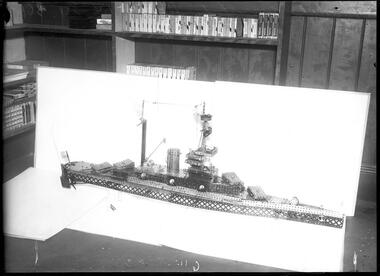 City of Melbourne Libraries
Photograph, Bull, Hugh Jones, 1897-1993, Window display: model warship YiPi
... Bull, Hugh Jones, 1897-1993...Glass plate negative Window display: model warship YiPi Photograph Bull, Hugh Jones, 1897-1993 ...Teenager’s Meccano model in The Age window Whilst Barry’s model is interesting, and he himself is more than interesting – renowned for his lifelong harmonica playing, vaudeville and stand-up comedy as “Mr Versatility” – it is the location of the photo which intrigued us. Was this the photographer’s office, and would it give us a clue to his identity? We thought he might be “Mr Duke” as some boxes of Kodak slides were so named! But we later deduced they were most likely related to the Duke’s Centenary visit to Melbourne. However, they did lead us to The Age archivist Michelle Stillman, who held the key to unlock the photographer’s identity. Louise McKenzie. Photographer notations on slide: "Model warship YiPi 14-12-34 B61" Published: 14 September 1934 The Age p15 Published title: MECCANO CRUISER Published caption: Barry Sandford (17) of Richmond, recently completed this splendid Meccano model of a modern cruiser. It is fitted with four swivelling turret guns, six quick-firers, searchlight, movable anchor rudder and propeller. This model is on view in "The Age" office window, Collins-street. Trove article identifier: http://nla.gov.au/nla.news-article205072014 Description: Meccano model of cruiser. Wood panelled office walls and boxes of glass slides can be seen in the background. Research by project volunteer, Louise McKenzie: The second slide we scanned, this photo of Barry Sandford’s Meccano model of a cruiser was of particular interest because it appeared to have been taken in the photographer's studio/office. For the bulk of our project, the identity of the photographer was not known, and we delighted in imagining who they were, whether they were amateur or professional, and what else might be stored in those neatly labelled boxes in the background. But the photo had its own story regardless. A photo of Barry Sandford’s meccano model appeared in the Melbourne AGE on Friday 14 December 1934; it was probably the same photo as the one in our collection – now cropped to remove the background office environment. This background shows shelves of Kodak Panochromatic, and archived boxes labelled “DUKE” with various references: D1 – D23, and one labelled ‘DUKE Not Used’. On a shelf there is a stack of wooden glass plate holders. It wasn't until early 2023 that the photographer's identity was revealed with the help of archivist/librarian at The Age, Michelle Stillman. As for young Barry – what a talent! Meccano was hugely popular at this time. The Melbourne Meccano Club met on a Tuesday at the YMCA building. On 18 August 1933 The Age reported that at their upcoming meeting the model builders “will gain an insight into the oil industry from a lecturer and moving pictures supplied by the Vacuum Oil Co.” Models reflected an interest in rapid technological developments of the time, and also key activities. On 2 November 1934 The Age showed Barry with a model of Sir Charles Kingsford Smith’s Lockheed Altair, “Lady Southern Cross”, which Kingsford Smith purchased with the intent to compete in the MacRobertson Air Race as part of the Melbourne Centenary celebrations. He did not participate, but in late 1935 he and co-pilot John Thompson “Tommy” Pethybridge flew Lady Southern Cross from India to Singapore in an attempt to break the England-Australia speed record. Sadly, on the night of 8 November, they disappeared over the Andaman Sea and were never found. The Harmonica Riff Raff blog provides an amazing and comprehensive commentary on Barry Sandford's life. He is described as a Richmond boy of many talents – model making, archery, comedy, kite making, magic and juggling, as well as a harmonica virtuoso. He was particularly renowned for his harmonica playing and the creation of a two-foot long harmonica, and a tiny, hands-free organ which he played fully enclosed in his mouth. He promoted himself as Mr. Versatility and often featured in Melbourne news articles in the 1930s and 1940s. He remained very active in the entertainment business throughout his life, including as a member of the Four Octaves harmonica group, on the Tivoli circuit, and in vaudeville and stand up comedy. He successfully made the move from stage and radio into television. He died in 1992, still saluted by his peers as the gentleman, Mr Versatility. References: MECCANO CRUISER. (1934, December 14). The Age (Melbourne, Vic. : 1854 - 1954), p. 3. Retrieved January 22, 2024, from http://nla.gov.au/nla.news-article205072014 MIMIC MECCANO WARFARE. (1933, July 21). The Age (Melbourne, Vic. : 1854 - 1954), p. 2 (This Supplement is Published Every Friday). Retrieved September 19, 2023, from http://nla.gov.au/nla.news-article204368610 MELBOURNE MECCANO CLUB. (1933, August 18). The Age (Melbourne, Vic. : 1854 - 1954), p. 1 (This Supplement is Published Every Friday). Retrieved September 19, 2023, from http://nla.gov.au/nla.news-article204367564 MECCANO MODEL OF LADY SOUTHERN CROSS. (1934, November 2). The Age (Melbourne, Vic. : 1854 - 1954), p. 3. Retrieved September 19, 2023, from http://nla.gov.au/nla.news-article205083196 Charles Kingsford Smith, Wikipedia, https://en.wikipedia.org/wiki/Charles_Kingsford_Smith 'Mr. Versatility', Harmonica Riff Raff, https://harmonicariffraff.blog/2022/09/05/mr-versatility/ Photographer notations on slide: "Model warship YiPi 14-12-34 B61".ships, models, the age, harmonicas, meccano -
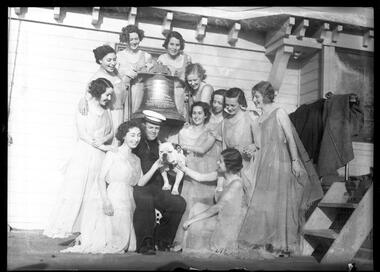 City of Melbourne Libraries
Photograph, Bull, Hugh Jones, 1897-1993, Naval Tattoo: girl dancers with sailor and naval mascot, Bruce of Woodside
... Bull, Hugh Jones, 1897-1993...Glass plate negative Naval Tattoo: girl dancers with sailor and naval mascot, Bruce of Woodside Photograph Bull, Hugh Jones, 1897-1993 ...A group of eleven dancers dressed in diaphanous gowns surround Cerberus mascot, Bruce of Woodside, and his sailor handler. Also visible is a large commemorative bell inscribed thus: "Bell presented HMAS Melbourne by the Chairman & Court of Directors of the Royal Mail Steam Packet Company in commemoration of the invaluable services rendered by the SS "TAFF", St Lucia April 1916" “Bruce of Woodside” and The Society Girls September 1934: During a break in rehearsals for the Naval Pageant at HMAS Cerberus Flinders Naval Depot, King Neptune’s sea nymphs were photographed in their diaphanous sea-green draperies. The sea nymphs were a “who’s who” of Melbourne’s high society young women who often featured in Table Talk, a weekly social magazine with articles about local and overseas notables, their fashions, social engagements and relationships. Pet HMAS Cerberus bulldog mascot “Bruce of Woodside”, accompanied by his sailor handler, led naval parades and events wearing a Cerberus sailor hat, and achieved the rank of three badge Petty Officer. Every day at three bells (13:00 hours), Bruce ate a pound and half of raw steak and two raw eggs. Later, Bruce was demoted to Leading Seaman for “eating a goldfish out of the fish pond at the captain’s residence”. Bruce was demoted again for urinating on the wheels of the Captain’s car. On 28 July 1935, when Bruce collapsed and died of a chill after his customary swim, the papers declared it “to the sorrow of every man in the depot”. Featured in "Newsworthy : Melbourne in photographs 1933-1936" exhibition held at East Melbourne Library from October to December 2023. Research by project volunteer, Fiona Collyer: The names of the sea nymphs: Miss Maisie Cooper, Miss Lorna Dawson, Mrs W. Catanach, Mrs Wallace Smith, Misses Valerie Wallace Smith, Beth Paxton, Elizabeth Darling, Barbara and Joyce Hayden Smith, Alison Mein, Valerie Pratt, Shirley Pratt, Brenda Payne, Elaine Knox-Knight, Betty Matear, Joan Ramsay, Ann Outhwaite [daughter of artist Ida Rentoul Outhwaite], Iris Connolly, Carmen Burridge, Dora Tait. The Naval Pageant, held at the Melbourne Show Ground, 31 October - 3 November 1934, was arranged as part of the Navy's contribution to the Victorian Centenary Celebrations. It was produced and acted by officers and men from the Navy Office, Flinders Naval Depot, H.M.A.S. Squadron, R.A.N.R. Depot, Williamstown, and R.A.N.R. Depot, Port Melbourne. Included were songs and marches, episodes from the life of Captain Cook, drill in honour of Nelson, Drake, Neptune's Court, and episodes from 1914. This was essentially family entertainment - advertisements in the souvenir programme are for ice creams, chocolates and engagement rings. A note about the episode in Cook's life in Tahiti reads 'The dresses worn by Tahitian dancing girls at this period were not considered suitable for the pageant, and historical accuracy has been sacrificed for attractiveness in choosing the raffia skirts of Hawaii.' References: Cerberus Shipmates (2002, December 5). Royal Australian Navy News (National : 1958 - 2021), p. 16. Retrieved July 10, 2023, from http://nla.gov.au/nla.news-article267342311 NAVAL PAGEANT (1934, June 25). The Herald (Melbourne, Vic. : 1861 - 1954), p. 13. Retrieved September 15, 2023, from http://nla.gov.au/nla.news-article243171504 BRUCE WILL PARADE NO MORE (1935, July 29). The Herald (Melbourne, Vic. : 1861 - 1954), p. 5. Retrieved January 23, 2024, from http://nla.gov.au/nla.news-article244930224 Souvenir Programme, 'Victorian Centenary Celebrations Naval Pageant', Ramsay Publishing, Melbourne, 1934. Source: Museums Victoria https://collections.museumsvictoria.com.au/items/264023Photographer notations on slide: "Naval tattoo Girl dancers with sailors and naval mascot 1934".dancers, dogs, navy, events -
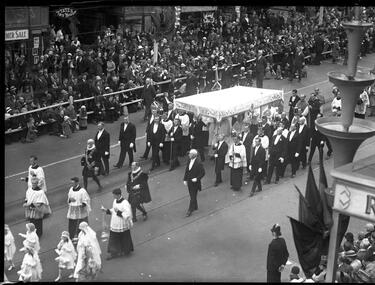 City of Melbourne Libraries
Photograph, Bull, Hugh Jones, 1897-1993, Eucharistic Congress Procession, Collins Street, Melbourne
... Bull, Hugh Jones, 1897-1993...Glass plate negative Eucharistic Congress Procession, Collins Street, Melbourne Photograph Bull, Hugh Jones, 1897-1993 ...Published: The Age 10 December 1934 Published title: RELIGIOUS PAGEANTRY AND FERVOR MARKED CLOSE OF EUCHARISTIC CONGRESS. Published caption: Thousands of men and women marched in the Eucharistic procession yesterday which brought the Congress to a close. The picture above shows the procession headed by the Children of Mary in Bourke-street and turning into Spring-street, in front of Parlia ment House. Right (top) — The procession leaving the starting point at St. Patrick's Cathedral and below, the Papal Legate carrying the Host under a canopy borne by a guard of laymen and preceded by white-clad girls scattering rose leaves, incense bearers and the Papal Chamberlains in their Spanish uniforms. The end of the procession in front of Mount St. Evin’s Hospital from which the final benediction was given by Cardi nal MacRory from an altar on the bal cony. The Papal Legate carrying the Host is passing through the assemblage of surpliced priests. On the left is an aerial picture taken just as the Children of Mary at the head of the procession are taking up their places for the final assembling. In the left top corner of the picture is St Patrick's Cathedral, from which the procession started, and in the right lower corner is Mount St. Evin’s Hospital. The space immediately in front of the hospital was reserved for the processionists while on either side is the crowd that assembled to take part in the final service. Trove article identifier: http://nla.gov.au/nla.news-article205067634 Religious pageantry and fervour The National Eucharistic Congress took place from Sunday 2 to Sunday 9 December 1934. An initiative of the Roman Catholic Church, it was their contribution to Melbourne’s Centenary Celebrations. 200,000 Catholics resided in Melbourne at this time – one quarter of the city’s population. While the Congress was aimed at Catholics, and acted as an opportunity to reinforce their living faith and homage, it contained a variety of events of splendour, solemnity and significance designed to appeal to Melbournians, and would additionally provide incentive for people to travel to Victoria, thereby creating an economic benefit to the state. The Procession of the Blessed Sacrament concluded the week-long Congress. Commencing at St Patrick’s Cathedral, it covered a two-mile route via Gisborne, Collins, Elizabeth and Bourke streets, then to Victoria Parade, where a final benediction was pronounced by Cardinal MacRory from the balcony of Mount St. Evin’s Hospital (today the site of St Vincent’s Private Hospital). An estimated 100,000 took part. Onlookers line Swanston Street, some standing at the entrance to Tate’s Tea House – a well-known Melbourne landmark located in the basement of the Manchester Unity Building. The white-veiled Children of Mary Sodalists strew rose petals in the path of the canopy, covering the jewelled Monstrance containing the Blessed Sacrament of consecrated Host (bread) and carried by the Cardinal. Church hierarchy in scarlet robes walk alongside, followed by incense bearers, the Papal Chamberlains in their Spanish uniforms, and a guard of honour of laymen of the city and country parishes. In the foreground is a tiered pole. This is one of 800 “Venetian Lights” specifically installed for the Centenary along all principal thoroughfares. “The poles are painted white, the superstructure resembling three trumpet lilies are made of durable fibro-cement, and their colour scheme deepens from clear yellow on the top cone to orange on the lowest, with slender rims of vermilion and white. Each cone is flooded with light externally from three lamps concealed in the one below it. There is also a painted coat of arms from which spring a trophy of flags.” – Australian Home Beautiful Featured in "Newsworthy: Melbourne in photographs 1933-1936" exhibition at East Melbourne Library, October to December 2023. Exhibition caption by project volunteer, Louise McKenzie. Research by project volunteer, Louise McKenzie: This photo was taken on Sunday 9 December 1934, looking from the Melbourne Town Hall (corner of Swanston and Collins streets) across the road to the Manchester Unity Building. This is the afternoon procession concluding the Catholic Church’s National Eucharistic Congress in Melbourne - a procession of the Blessed Eucharist through the Melbourne city. It commenced at St Patrick’s Cathedral, and covered a two mile route via Gisborne, Collins, Elizabeth and Bourke streets, then to Victoria Parade where a final benediction was pronounced by the Cardinal from the balcony of Mount St. Evin’s Hospital (present day St Vincent’s Private Hospital). An estimated 100,000 took part in the march. The people lining the streets a men in suits and hats, women in coats and hats, and children in their “Sunday best”, kneeling beside the road, many with their hands clasped in front of them. The small girls ahead of the canopy covering the Host are pale-blue clad, white veiled Children of Mary Sodalists, who strew rose petals to pave the way of the Cardinal carrying the jewelled Monstrance (Blessed Sacrament of consecrated Host (bread)), together with church heirarchy wearing scarlet robes. Behind came incense bearers and the Papal Chamberlains in their Spanish uniforms, followed by a guard of honour of laymen of the city and country parishes. The Children of Mary Sodalities was a religious body which aimed at fostering in its members an ardent devotion, reverence, and filial love towards the Blessed Virgin Mary, initially embracing the pupils and orphans of the schools and institutions of the Sisters of Charity of St Vincent de Paul. In 1847, Blessed Pius IX affiliated them to the Jesuit Roman Sodality. They were distinguished by a medal suspended from a blue ribbon, and once a fully-fledged a Child of Mary wore a distinctive blue cape. On the extreme right foreground of the photo can be seen an intriguing piece of artistic design – a tiered pole. This is one of the 800 “Venetian Lights” specifically installed for Melbourne’s Centenary along all principal thoroughfares. “The poles are painted white, the superstructure resembling three trumpet lilies are made of durable fibro-cement, and their colour scheme deepens from clear yellow on the top cone to orange on the lowest, with slender rims of vermilion and white. Each cone is flooded with light externally from three lamps concealed in the one below it. There is also a painted coat of arms from which spring a trophy of flags.” Note the sign for Tates Tea House - a well-known Melbourne landmark, located in the basement of the Manchester Unity Building. References: RELIGIOUS PAGEANTRY AND FERVOR MARKED CLOSE OF EUCHARISTIC CONGRESS. (1934, December 10). The Age (Melbourne, Vic. : 1854 - 1954), p. 11. Retrieved September 14, 2023, from http://nla.gov.au/nla.news-article205067634 Eucharistic Congress (1934, December 1). The Argus (Melbourne, Vic. : 1848 - 1957), p. 11. Retrieved January 23, 2024, from http://nla.gov.au/nla.news-article10997817 National Eucharistic Congress, Melbourne. (1934, December 6). The Catholic Press (Sydney, NSW : 1895 - 1942), p. 28. Retrieved January 23, 2024, from http://nla.gov.au/nla.news-article104371824 'The year of the Melbourne Eucharistic Congress: 1934.' The Campion Society, https://campion.australiancardijninstitute.org/ch-7-the-year-of-the-melbourne-eucharistic-congress-1934/ 'Melbourne Eucharistic Congress 1934.' Panoramic photograph, https://emhs.org.au/catalogue/emdf0123 The National Eucharistic Congress, Melbourne, Australia December 2nd-9th, 1934. Edited by Rev. J.M. Murphy and Rev. F. Moynihan, The Advocate Press, Melbourne. 'Children of Mary Sodalists', Wikipedia, https://en.wikipedia.org/wiki/Sodality_of_Our_Lady 'Dressing Melbourne for the Duke' (1934, October 1). The Australian home beautiful : a journal for the home builder, p. 21, 58. Retrieved September 14, 2023, from http://nla.gov.au/nla.obj-2950922209 Photographer notations on slide: "Eucharistic Congress Procession on Swanston St B61" [sic - actually Collins Street].events, religion, parades, catholic church -
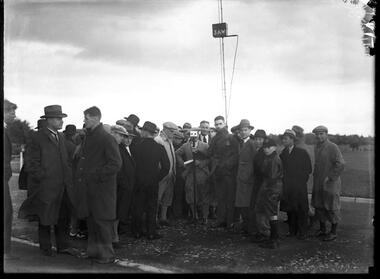 City of Melbourne Libraries
Photograph, Bull, Hugh Jones, 1897-1993, 3AW portable transmitter at Royal Melbourne Golf Links, 1933
... Bull, Hugh Jones, 1897-1993...Glass plate negative 3AW portable transmitter at Royal Melbourne Golf Links, 1933 Photograph Bull, Hugh Jones, 1897-1993 ...The 3AW portable transmitter “Wirelessing from the Golf Links. An interesting test was made by 3AW yesterday when this portable transmitting set was successfully tried out at Royal Melbourne. Mr JB Ferrier, the father of the NSW champion, who is taking part in the Men’s Australian Open Championship meeting, is seen (on the left) speaking into the microphone and announcing the scores. The transmitter will be in action today to describe the play in the final rounds for the benefit of listeners.” – The Age Melbourne-based talkback radio station 3AW began transmission in February 1932 as Melbourne’s fifth commercial station. The 1930s were a time of rapid change and significant improvement in the development of microphones, supporting the shift from the visual world of newspapers to the auditory world of radio. MCK021 Inkjet print by John Gollings on Canson Platine Fibre Rag Published: The Age 9 September 1933 Featured in "Newsworthy: Melbourne in photographs 1933-1936" exhibition at East Melbourne Library, October to December 2023. Exhibition caption by project volunteer, Louise McKenzie. Photographer notations on slide: "3AW portable transmitter at R Melb Golf Links 1933 B5" Published: 9 September 1933 The Age p15 Published title: WIRELESSING FROM THE GOLF LINKS. Published caption: An interesting test was by 3AW yesterday when this portable transmitting set was successfully tried out at Royal Melbourne. Mr. J. B. Ferrier, the father of the New South Wales champion, who is, taking part in the Australian open championship meeting, is seen (on the left) speaking into the microphone and announcing the scores. The transmitter will be in action today to describe the play in the final rounds of the open championship for the benefit of listeners. Trove article identifier: http://nla.gov.au/nla.news-article205106453 Note: Interestingly, the published image is a composite of the two images in our collection. See related material, MCK077. Description: Group of men conducting outdoor radio broadcast at golf course. The 3AW sign is visible on a pole above the group. Research by project volunteer, Louise McKenzie: In this photo a group of men cluster around a tall bamboo pole with a 3AW sign. The male radio interviewer holds a pole topped with a square shaped microphone held in front of the face of another man. It is a bleak day and the men are wearing suits, coats and hats, or plus fours and caps. There is one schoolboy in the group. This was 3AW's first outside broadcast, undertaken at Royal Melbourne golf course on the occasion of the Australian Open. The 1933 Australian Open was held at the Royal Melbourne Golf Club (West Course), 8-9 September, and won by M L Kelly, from Goulburn, aged 20; J Ferrier (aged 19 from Sydney) came third equal with A W Jackson. The man being interviewed was Mr J B Ferrier, father of James (Jim) Ferrier, a professional golfer from Sydney. Encouraged by his father (who had a golfing background in Scotland) Jim Ferrier commenced playing at age four and a half, and was playing off scratch by his mid-teens. He was the NSW Amateur Champion in 1931, and was runner up in the Australian Open in 1931 and 1933. He won many Australian and overseas amateur and professional titles, moved to the US where he served in the army in WWII, and continued to prolifically compete and have significant golf victories into the 1950s. Sport Australia Hall of Fame says his “... may well be the best all round amateur professional record of any Australian golfer”. There is a statue of Jim Ferrier in the National Portrait Gallery. 3AW is a talkback radio station based in Melbourne, which began transmission on 22 February 1932 as Melbourne’s fifth commercial radio station. It was established when a company formed by Allans Music (established in Melbourne in 1850 and by 1877 was the largest musical warehouse in the southern hemisphere), JC Williamson’s (a theatrical management company and theatre owner) and David Syme (then publishers of The Age newspaper) was granted a radio broadcasting licence. 3AW originally broadcast from a makeshift studio in the front part of His Majesty’s Theatre, Exhibition Street, Melbourne, and is still in operation today. The 1930s were a time of rapid change and significant improvement in the development of microphones, accelerated by the move from the visual world of newspapers, to the auditory world of radio. The BBC had only been formed in May 1923, and their first outside broadcast was in May 1924. It is interesting to note that 3AW was owned by those intimately involved in the music, arts and newspaper world who had a good eye for future developments in these areas. The microphone in use in this photo may have been a USA-developed condenser microphone – still a fairly experimental concept, and whose design may have been influenced by the American film industry. References: WIRELESSING FROM THE GOLF LINKS. (1933, September 9). The Age (Melbourne, Vic. : 1854 - 1954), p. 15. Retrieved September 14, 2023, from http://nla.gov.au/nla.news-article205106453 J.C. Williamsons’s, Wikipedia, https://en.wikipedia.org/wiki/J._C._Williamson%27s Allans Music, Wikipedia, https://en.wikipedia.org/wiki/Allans_Music Jim Ferrier, Wikipedia, https://en.wikipedia.org/wiki/Jim_Ferrier Jim Ferrier sculpture by John Frith, National Portrait Gallery, https://www.portrait.gov.au/portraits/2013.79/jim-ferrier '3AW is 90 today (22/2/22)', 3AW, https://www.3aw.com.au/3aw-is-turning-90-take-a-look-back-through-the-decades-with-us1/ Her Majesty’s Theatre Melbourne, Wikipedia, https://en.wikipedia.org/wiki/Her_Majesty%27s_Theatre,_Melbourne Jim Ferrier, Sport Australia Hall of Fame, https://sahof.org.au/hall-of-fame-member/jim-ferrier/ 'From Nightingale to Narcissus: capturing the first ever live otudoor radio broadcast', Iain Baird, 2013, Science and Media Museum UK, https://blog.scienceandmediamuseum.org.uk/from-nightingale-to-narcissus/ 'The BBC-STC ‘Bomb' Condenser Microphone: a curatorial perspective', Ian Logie Baird, 2021, Baird Television, https://www.bairdtelevision.com/the-bbc-stc-bomb-condenser-microphone.htmlPhotographer notations on slide: "3AW portable transmitter at R Melb Golf Links 1933 B5".golf, radio
