
Showing 6 items matching "humanism"
-
 Women's Art Register
Archive (Collection) - Kari Henriksen Artist Archive
... Humanism...1950- Humanism Painting Archive Kari Henriksen Artist Archive ...humanism, paintinghumanism, painting -
Women's Art Register
Archive (Series) - Henriksen, Kari. Artist File 1
... Humanism...Humanism Painting Foolscap white archival 4 flap folder or document wallet Archive Henriksen, Kari. ...CV, Photographshumanism, paintinghumanism, painting -
Women's Art Register
Archive (Series) - Kari Henriksen. Duplicate File 1
... ... Humanism...Painting Humanism Foolscap manilla file Archive Kari Henriksen. ...CV, Photographspainting, humanismpainting, humanism -
 Flagstaff Hill Maritime Museum and Village
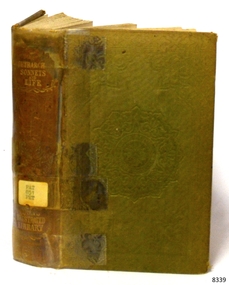
Book - Book of Poetry, Thomas Campbell, The Sonnets Triumphs and Other Poems of Petrarch, 1873
... The Author (Francesco Petrarca / Petrarch, 1304–1374): An Italian scholar, poet, and early humanist, Petrarch is often called the "Father of Humanism." His recovery of classical Latin texts and his profound Italian poetry helped spark the Renaissance. ...The Author (Francesco Petrarca / Petrarch, 1304–1374): An Italian scholar, poet, and early humanist, Petrarch is often called the "Father of Humanism." His recovery of classical Latin texts and his profound Italian poetry helped spark the Renaissance. ...This volume compiles the core poetic works of Petrarch. It is anchored by his Canzoniere (Songbook), which features his famous sonnets and poems dedicated to his unrequited muse, Laura. It also includes his Triumphs (Trionfi), an allegorical series of poems exploring human life, love, death, and time. Collectively, these works shaped the course of Renaissance literature and popularized the "Petrarchan sonnet" structure across Europe.The Sonnets Triumphs and Other Poems of Petrarch Author: Francesco Petrarca (Petrarch) Publisher: Bell & Daldy Date: 1873 Olive hardcover with a brown spine and lettering in gold. The spine has a label with an inscription. Further Information: First completely Translated into English Verse by various hands, with a life of the poet by Thomas CampbellfictionThis volume compiles the core poetic works of Petrarch. It is anchored by his Canzoniere (Songbook), which features his famous sonnets and poems dedicated to his unrequited muse, Laura. It also includes his Triumphs (Trionfi), an allegorical series of poems exploring human life, love, death, and time. Collectively, these works shaped the course of Renaissance literature and popularized the "Petrarchan sonnet" structure across Europe.flagstaff hill, warrnambool, shipwrecked coast, flagstaff hill maritime museum, maritime museum, shipwreck coast, flagstaff hill maritime village, great ocean road, book, pattison collection, warrnambool library, warrnambool mechanics’ institute, ralph eric pattison, corangamite regional library service, warrnambool city librarian, mechanics’ institute library, victorian library board, warrnambool books and records, warrnambool children’s library, the sonnets triumphs and other poems of petrarch, petrarch, thomas campbell -
 Flagstaff Hill Maritime Museum and Village
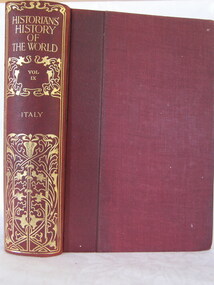
Book - Reference Book/History, Henry Smith Williams, The Historians History of the World Vol 9 set 1 - Edited by Henry Smith Williams L.L.D. Published by “The Times” 1908, 1908
... It examines the explosion of art, science, and humanism, looking at the era not just as a political history, but as a cultural revolution. ...It examines the explosion of art, science, and humanism, looking at the era not just as a political history, but as a cultural revolution. ...The 1908 edition of The Historians' History of the World is a monumental work of Edwardian scholarship, representing a specific era of "universal history" where the goal was to synthesise all human knowledge into a single narrative. While previous volumes dealt with the Roman Empire, Volume 9 picks up the story after the "Fall of Rome" and tracks the peninsula’s evolution through the dawn of the 20th century.The Book is part of a 25 volume set with red cloth bindings and gold filigree design to ribnon-fictionThe 1908 edition of The Historians' History of the World is a monumental work of Edwardian scholarship, representing a specific era of "universal history" where the goal was to synthesise all human knowledge into a single narrative. While previous volumes dealt with the Roman Empire, Volume 9 picks up the story after the "Fall of Rome" and tracks the peninsula’s evolution through the dawn of the 20th century. warrnambool, shipwrecked-coast, flagstaff-hill, flagstaff-hill-maritime-museum, maritime-museum, book, the historians history of the world vol 9 set 1, henry smith williams -
Beechworth RSL Sub-Branch
Print - Print AND THE BAND PLAYED WALTZING MATIDA, TOP CAT CALLIGRAPHICS - 1998 / from the original by Vanessa Crisp. Eric Bogle - Larrikin Music, 1998 - the original by Vanesa Crisp honours Roderick 'George' McLennon - fixed forever in his time
... Appropriately, Bogle was named Australian Humanist of the Year in 2001 for capturing “the ethos of humanism through his perceptive and individualistic song writing with its exposure of racism, bigotry, war mongering and injustice of all kinds”. ...Print was purchased because of the popularity of the song that was written by Eric Bogle in 1971 following his attendance at an ANZAC Parade in CanberraABSTRACT The anti-war song “And the Band Played Waltzing Matilda” has become a cultural icon in Australia, and elsewhere has been recorded over 130 times in 10 different languages. The song was written in 1971 by Eric Bogle, a Scottish immigrant to Australia, who has penned more than 250 powerful compositions, which, among other things, focus on the failure of history to impress upon youth the futility of war. Appropriately, Bogle was named Australian Humanist of the Year in 2001 for capturing “the ethos of humanism through his perceptive and individualistic song writing with its exposure of racism, bigotry, war mongering and injustice of all kinds”. Additionally, he was awarded the United Nations Peace Medal (1986), and was made Member of the Order of Australia (1987). This article asks why a song written by a Scot in Australia, fifty-six years after the Dardanelles campaign, feels as if it has “always existed. That it belongs to culture and country”. It questions what the appeal imbued within the lyrics of those five short verses might be and recounts the story behind the creation of what Pete Seeger referred to as “one of the world’s greatest songs”. Through interviews with the writer, and an examination of the relevant historiography, this article presents a study of “the most potent ballad of the age”. It also examines what Bogle meant when he said that it was a song that “came into its time” Wooden framed glass front print - The Band Played Waltzing MatildaPrint contain the lyrics of the song
