
Showing 5 items matching "huon's lagoon"
-
 Wodonga & District Historical Society Inc
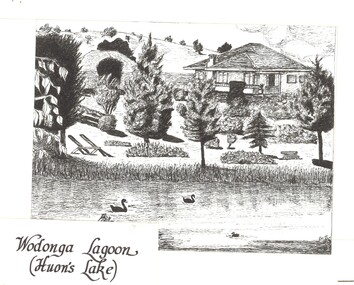
Work on paper - Wodonga Lagoon (Huon's Lake), Des Martin, 1987
... Wodonga Lagoon (Huon's Lake)...Wodonga Lagoon (Huon's Lake)...Huon Family...Belvoir Park Wodonga...Huon's Lagoon...However, the residents wanted their own choice of a name for the town. Huon’s first home overlooked a lagoon which was often referred to as Huon’s Lagoon. ...Wodonga Lagoon (Huon's Lake) Work on paper Wodonga Lagoon (Huon's Lake) Des Martin ...Gabriel Louis Marie Huon de Kerilleau was born to a French aristocratic family in 1769. He escaped to England during the French Revolution and enlisted in the New South Wales Corps. He married in Parramatta to Louisa Emmanuel Le Sage. They had five children who took the name of Huon – Elizabeth, Paul, Jean Francois, Aime Augustus and Charles. Paul and Charles were to become the “founders’ of the Wodonga District. In 1824 Hamilton Hume and William Hovell discovered the Hume River, later renamed to the Murray River and the rich land surrounding it. By 1835, squatters began arriving at the Hume River. During the following year, Paul Huon arrived at the Hume (Murray) River, then "taking up" 40,000 acres on the south side of the river bank. To this property he gave the name WOODONGA RUN. Charles Huon, younger brother of Paul, was sent to manage the "Run" until Paul's son, William, became old enough to take over management. Charles Huon built a mud brick home on the eastern side of a rise south of the now Wodonga Creek. Thus was Charles the first permanent settler in the district. He was a great admirer of the English Lord Belvoir hence "Belvoir" was the name Charles Huon gave to the first permanent home on Woodonga Run. By the 1857, residents numbered fifty, and the Government had surveyed a township area, proclaiming it "Belvoir" in the new State of Victoria. However, the residents wanted their own choice of a name for the town. Huon’s first home overlooked a lagoon which was often referred to as Huon’s Lagoon. It has borne several names since then including Lake Huon and Belvoir Lagoon. After much redevelopment and many roles including the location of sporting fields and the Wodonga Golf Course, it is now known as Belvoir Park, a major parkland and recreation area in Wodonga.Donated by Des Martin & Rosemary BoyesPart of a set of original sketches by Des Martin for "A Record of the 150th Anniversary" Celebrations of the Rural City of Wodonga held on 30th October 1986.huon family, belvoir park wodonga, huon's lagoon -
 Wodonga & District Historical Society Inc
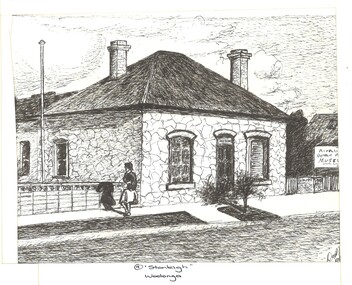
Work on paper - Stonleigh, Wodonga - Home of Paul Huon, Des Martin, 1987
... The name "Belvoir" is used today by organisations and locations in Wodonga including Belvoir Park formerly known as Huon’s Lagoon. On 3rd October 1986 the Wodonga community celebrated the 150th anniversary of the first settlement by Charles Huon of the district that was to become Wodonga. ...The name "Belvoir" is used today by organisations and locations in Wodonga including Belvoir Park formerly known as Huon’s Lagoon. On 3rd October 1986 the Wodonga community celebrated the 150th anniversary of the first settlement by Charles Huon of the district that was to become Wodonga. ...Gabriel Louis Marie Huon de Kerilleau was born to a French aristocratic family in 1769. He escaped to England during the French Revolution and enlisted in the New South Wales Corps. He married in Parramatta to Louisa Emmanuel Le Sage. They had five children who took the name of Huon – Elizabeth, Paul, Jean Francois, Aime Augustus and Charles. Paul and Charles were to become the “founders’ of the Wodonga District. In 1824 Hamilton Hume and William Hovell discovered the Hume River, later renamed to the Murray River and the rich land surrounding it. By 1835, squatters began arriving at the Hume River. During the following year, Paul Huon arrived at the Hume (Murray) River, then "taking up" 40,000 acres on the south side of the river bank. To this property he gave the name WOODONGA RUN. Charles Huon, younger brother of Paul, was sent to manage the "Run" until Paul's son, William, became old enough to take over management. Charles Huon built a mud brick home on the eastern side of a rise south of the now Wodonga Creek. Thus was Charles the first permanent settler in the district. He was a great admirer of the English Lord Belvoir hence "Belvoir" was the name Charles Huon gave to the first permanent home on Woodonga Run. By the 1857, residents numbered fifty, and the Government had surveyed a township area, proclaiming it "Belvoir" in the new State of Victoria. However, the residents wanted their own choice of a name for the town. A battle lasting thirteen years followed over the name of the town until the residents won in 1874 when the Victorian Government dropped the name "Belvoir" and proclaimed the town's name as "Wodonga." A local government Shire formed two years later became the Shire of Wodonga. The Huon name features in the town today including Huon Hill, Huon Creek, Huon Street and the former township and railway siding at Huon. The name "Belvoir" is used today by organisations and locations in Wodonga including Belvoir Park formerly known as Huon’s Lagoon. On 3rd October 1986 the Wodonga community celebrated the 150th anniversary of the first settlement by Charles Huon of the district that was to become Wodonga. These drawings were completed by Desmond Martin as part of a booklet produced to record the event. Stonleigh in Wodonga was once owned by Paul Huon.Donated by Des Martin & Rosemary BoyesPart of a set of original sketches by Des Martin for "A Record of the 150th Anniversary" Celebrations of the Rural City of Wodonga held on 30th October 1986.150th anniversary celebrations, huon family, early wodonga, stonleigh wodonga -
 Wodonga & District Historical Society Inc
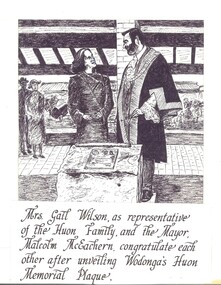
Work on paper - 150th Anniversary Celebrations of the Rural City of Wodonga, Des Martin, 1987
... The name "Belvoir" is used today by organisations and locations in Wodonga including Belvoir Park formerly known as Huon’s Lagoon. On 3rd October 1986 the Wodonga community celebrated the 150th anniversary of the first settlement by Charles Huon of the district that was to become Wodonga. ...The name "Belvoir" is used today by organisations and locations in Wodonga including Belvoir Park formerly known as Huon’s Lagoon. On 3rd October 1986 the Wodonga community celebrated the 150th anniversary of the first settlement by Charles Huon of the district that was to become Wodonga. ...Gabriel Louis Marie Huon de Kerilleau was born to a French aristocratic family in 1769. He escaped to England during the French Revolution and enlisted in the New South Wales Corps. He married in Parramatta to Louisa Emmanuel Le Sage. They had five children who took the name of Huon – Elizabeth, Paul, Jean Francois, Aime Augustus and Charles. Paul and Charles were to become the “founders’ of the Wodonga District. In 1824 Hamilton Hume and William Hovell discovered the Hume River, later renamed to the Murray River and the rich land surrounding it. By 1835, squatters began arriving at the Hume River. During the following year, Paul Huon arrived at the Hume (Murray) River, then "taking up" 40,000 acres on the south side of the river bank. To this property he gave the name WOODONGA RUN. Charles Huon, younger brother of Paul, was sent to manage the "Run" until Paul's son, William, became old enough to take over management. Charles Huon built a mud brick home on the eastern side of a rise south of the now Wodonga Creek. Thus was Charles the first permanent settler in the district. He was a great admirer of the English Lord Belvoir hence "Belvoir" was the name Charles Huon gave to the first permanent home on Woodonga Run. By the 1857, residents numbered fifty, and the Government had surveyed a township area, proclaiming it "Belvoir" in the new State of Victoria. However, the residents wanted their own choice of a name for the town. A battle lasting thirteen years followed over the name of the town until the residents won in 1874 when the Victorian Government dropped the name "Belvoir" and proclaimed the town's name as "Wodonga." A local government Shire formed two years later became the Shire of Wodonga. The Huon name features in the town today including Huon Hill, Huon Creek, Huon Street and the former township and railway siding at Huon. The name "Belvoir" is used today by organisations and locations in Wodonga including Belvoir Park formerly known as Huon’s Lagoon. On 3rd October 1986 the Wodonga community celebrated the 150th anniversary of the first settlement by Charles Huon of the district that was to become Wodonga. These drawings were completed by Desmond Martin as part of a booklet produced to record the event. Donated by Des Martin & Rosemary BoyesPart of a set of original sketches by Des Martin for "A Record of the 150th Anniversary" Celebrations of the Rural City of Wodonga held on 30th October 1986.150th anniversary celebrations, huon family -
 Wodonga & District Historical Society Inc
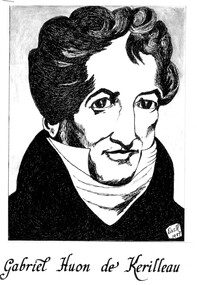
Work on paper - Huon Family Portraits, Des Martin, 1987
... The name "Belvoir" is used today by organisations and locations in Wodonga including Belvoir Park formerly known as Huon’s Lagoon. On 3rd October 1986 the Wodonga community celebrated the 150th anniversary of the first settlement by Charles Huon of the district that was to become Wodonga. ...The name "Belvoir" is used today by organisations and locations in Wodonga including Belvoir Park formerly known as Huon’s Lagoon. On 3rd October 1986 the Wodonga community celebrated the 150th anniversary of the first settlement by Charles Huon of the district that was to become Wodonga. ...Gabriel Louis Marie Huon de Kerilleau was born to a French aristocratic family in 1769. He escaped to England during the French Revolution and enlisted in the New South Wales Corps. He married in Parramatta to Louisa Emmanuel Le Sage. They had five children who took the name of Huon – Elizabeth, Paul, Jean Francois, Aime Augustus and Charles. Paul and Charles were to become the “founders’ of the Wodonga District. In 1824 Hamilton Hume and William Hovell discovered the Hume River, later renamed to the Murray River and the rich land surrounding it. By 1835, squatters began arriving at the Hume River. During the following year, Paul Huon arrived at the Hume (Murray) River, then "taking up" 40,000 acres on the south side of the river bank. To this property he gave the name WOODONGA RUN. Charles Huon, younger brother of Paul, was sent to manage the "Run" until Paul's son, William, became old enough to take over management. Charles Huon built a mud brick home on the eastern side of a rise south of the now Wodonga Creek. Thus was Charles the first permanent settler in the district. He was a great admirer of the English Lord Belvoir hence "Belvoir" was the name Charles Huon gave to the first permanent home on Woodonga Run. By the 1857, residents numbered fifty, and the Government had surveyed a township area, proclaiming it "Belvoir" in the new State of Victoria. However, the residents wanted their own choice of a name for the town. A battle lasting thirteen years followed over the name of the town until the residents won in 1874 when the Victorian Government dropped the name "Belvoir" and proclaimed the town's name as "Wodonga." A local government Shire formed two years later became the Shire of Wodonga. The Huon name features in the town today including Huon Hill, Huon Creek, Huon Street and the former township and railway siding at Huon. The name "Belvoir" is used today by organisations and locations in Wodonga including Belvoir Park formerly known as Huon’s Lagoon. On 3rd October 1986 the Wodonga community celebrated the 150th anniversary of the first settlement by Charles Huon of the district that was to become Wodonga. These drawings were completed by Desmond Martin as part of a booklet produced to record the event.Donated by Des Martin & Rosemary BoyesThree portraits of members of the Huon De Kerilleau Family, pioneers of Wodonga in Victoria. charles huon, huon de kerilleau, wodonga pioneers -
 Wodonga & District Historical Society Inc
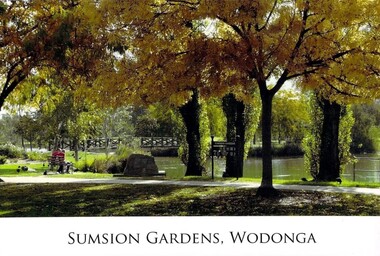
Photograph - Eric Sumsion Gardens
... He eventually purchased a house adjoining the area giving him more time and easy access to work on it. The Lagoon, Lake Huon, Belvoir Lagoon, Belvoir Park and Sumsion Gardens are all names used over time for what is today one of Wodonga’s favourite recreation and picnic spots. ...He eventually purchased a house adjoining the area giving him more time and easy access to work on it. The Lagoon, Lake Huon, Belvoir Lagoon, Belvoir Park and Sumsion Gardens are all names used over time for what is today one of Wodonga’s favourite recreation and picnic spots. ...Mr Eric Sumsion was the gardening curator for Wodonga Shire in 1956. He had previously operated a bootmaker’s shop in High Street, Wodonga for many years. Eric saw the potential of the area in Wodonga now known as Belvoir Park and asked permission to work on part of the area. He eventually purchased a house adjoining the area giving him more time and easy access to work on it. The Lagoon, Lake Huon, Belvoir Lagoon, Belvoir Park and Sumsion Gardens are all names used over time for what is today one of Wodonga’s favourite recreation and picnic spots. In the 1800s river boats could enter Lake Huon from Wodonga Creek. There was a jetty south of where the water fountain is today. In later years, this jetty was used by the Clay Bird Shooting Club. From the early 1900s football and cricket were played there, and some mining leases were also allowed. At one time there were open gravel pits between House Creek and the main lagoon, and these were subsequently filled with town garbage collected by the Council. In the late 1940s, Wodonga Golf Club took over part of Belvoir Park for a 9-hole golf course with sand greens. The Golf Club House was built in 1946. The Club extended the course to 12-holes when the football ground moved to Martin Park and the course later extended to 18 holes. Under Eric Sumsion’s care the area became a magnificent area of parkland and curated gardens. After he had retired in 1961 his work was acknowledged by the Shire Engineer, Mr Bill Page, when the Sumsion Gardens were named in his honour. He was also responsible for the design and curating of many other gardens in Wodonga, including those at Sarah Coventry and Richardson Park. Eric Sumsion died in July 1988, aged 85.This item is significant because it acknowledges the dedication and commitment of Eric Sumsion to the Wodonga Community.A collection of photographic images and an advertisement related to the work of Eric Sumsion in Wodonga.eric sumsion, parks and gardens wodonga
