
Showing 17 items matching "huon de kerilleau"
-
 Wodonga & District Historical Society Inc
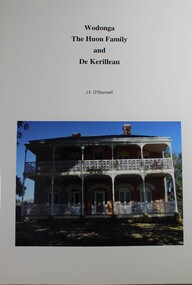
Book - Wodonga The Huon Family and De Kerilleau, J. F. O'Donnell, 2014
... Wodonga The Huon Family and De Kerilleau... Wodonga The Huon Family and De Kerilleau...huon family....de kerilleau...huon family. de kerilleau homestead wodonga victoria A study of the Huon family, early pastoralists in the Wodonga area, and the mansion, De Kerilleau, which they built in 1870. ...A study of the Huon family, early pastoralists in the Wodonga area, and the mansion, De Kerilleau, which they built in 1870. The original lease of Wodonga Run was granted to Paul Huon as No. 202 on 7th February 1837, about a year after his cousin Charles Huon had squatted on the land. In August 1849, this run was transferred to Paul's son, William. Paul Huon was one of the children of Gabriel Louis Marie Huon de Kerilleau, a French nobleman who fled France during the French Revolution and travelled under a false identity with the Second Fleet in 1794. The mansion, De Kerilleau was built by William Huon in 1870.non-fictionA study of the Huon family, early pastoralists in the Wodonga area, and the mansion, De Kerilleau, which they built in 1870. The original lease of Wodonga Run was granted to Paul Huon as No. 202 on 7th February 1837, about a year after his cousin Charles Huon had squatted on the land. In August 1849, this run was transferred to Paul's son, William. Paul Huon was one of the children of Gabriel Louis Marie Huon de Kerilleau, a French nobleman who fled France during the French Revolution and travelled under a false identity with the Second Fleet in 1794. The mansion, De Kerilleau was built by William Huon in 1870.huon family., de kerilleau homestead, wodonga victoria -
 Wodonga & District Historical Society Inc
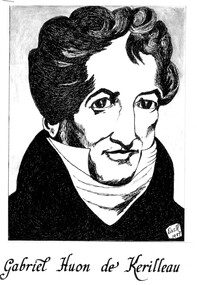
Work on paper - Huon Family Portraits, Des Martin, 1987
... ...Huon de Kerilleau...Gabriel Louis Marie Huon de Kerilleau was born to a French aristocratic family in 1769. ...Three portraits of members of the Huon De Kerilleau Family, pioneers of Wodonga in Victoria. ...Gabriel Louis Marie Huon de Kerilleau was born to a French aristocratic family in 1769. ...Gabriel Louis Marie Huon de Kerilleau was born to a French aristocratic family in 1769. He escaped to England during the French Revolution and enlisted in the New South Wales Corps. He married in Parramatta to Louisa Emmanuel Le Sage. They had five children who took the name of Huon – Elizabeth, Paul, Jean Francois, Aime Augustus and Charles. Paul and Charles were to become the “founders’ of the Wodonga District. In 1824 Hamilton Hume and William Hovell discovered the Hume River, later renamed to the Murray River and the rich land surrounding it. By 1835, squatters began arriving at the Hume River. During the following year, Paul Huon arrived at the Hume (Murray) River, then "taking up" 40,000 acres on the south side of the river bank. To this property he gave the name WOODONGA RUN. Charles Huon, younger brother of Paul, was sent to manage the "Run" until Paul's son, William, became old enough to take over management. Charles Huon built a mud brick home on the eastern side of a rise south of the now Wodonga Creek. Thus was Charles the first permanent settler in the district. He was a great admirer of the English Lord Belvoir hence "Belvoir" was the name Charles Huon gave to the first permanent home on Woodonga Run. By the 1857, residents numbered fifty, and the Government had surveyed a township area, proclaiming it "Belvoir" in the new State of Victoria. However, the residents wanted their own choice of a name for the town. A battle lasting thirteen years followed over the name of the town until the residents won in 1874 when the Victorian Government dropped the name "Belvoir" and proclaimed the town's name as "Wodonga." A local government Shire formed two years later became the Shire of Wodonga. The Huon name features in the town today including Huon Hill, Huon Creek, Huon Street and the former township and railway siding at Huon. The name "Belvoir" is used today by organisations and locations in Wodonga including Belvoir Park formerly known as Huon’s Lagoon. On 3rd October 1986 the Wodonga community celebrated the 150th anniversary of the first settlement by Charles Huon of the district that was to become Wodonga. These drawings were completed by Desmond Martin as part of a booklet produced to record the event.Donated by Des Martin & Rosemary BoyesThree portraits of members of the Huon De Kerilleau Family, pioneers of Wodonga in Victoria. charles huon, huon de kerilleau, wodonga pioneers -
 Wodonga & District Historical Society Inc
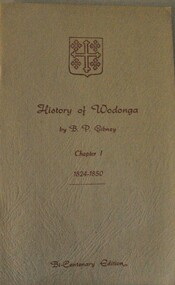
Booklet - History of Wodonga : Chapter 1 1824 - 1850, B. P. Gibney, Exploration and Settlement, 1970
... huon family...De Kerilleau...The text is printed in red print and bears the coat of arms of the Australian branch of the Huon and De Kerilleau family....Wodonga History Early settlement Wodonga huon family De Kerilleau This booklet is an imprint of written by Bernie Gibney on behalf of the Wodonga Branch of the North Eastern Historical Society to commemorate the Cook Bicentenary. ...This booklet is an imprint of written by Bernie Gibney on behalf of the Wodonga Branch of the North Eastern Historical Society to commemorate the Cook Bicentenary. It tells the story of the early years of European settlement of the Wodonga area. It focuses on exploration and settlement from the arrival of Hume and Hovell in 1824 and outlines the different families who took up squatting runs in the district.A small buff coloured booklet of 16 pages. The text is printed in red print and bears the coat of arms of the Australian branch of the Huon and De Kerilleau family.non-fictionThis booklet is an imprint of written by Bernie Gibney on behalf of the Wodonga Branch of the North Eastern Historical Society to commemorate the Cook Bicentenary. It tells the story of the early years of European settlement of the Wodonga area. It focuses on exploration and settlement from the arrival of Hume and Hovell in 1824 and outlines the different families who took up squatting runs in the district.wodonga history, early settlement wodonga, huon family, de kerilleau -
 Wodonga & District Historical Society Inc
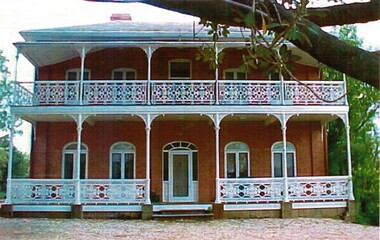
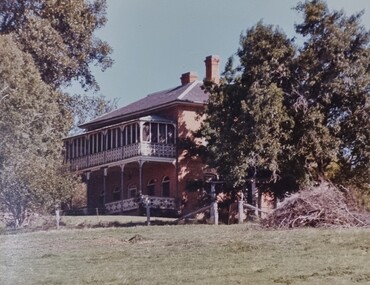
Photograph - de Kerilleau Homestead
... Huon Family...De Kerilleau...Paul Huon was one of the children of Gabriel Louis Marie Huon de Kerilleau, a French nobleman who fled France during the French Revolution and travelled under a false identity with the Second Fleet in 1794. ...Paul Huon was one of the children of Gabriel Louis Marie Huon de Kerilleau, a French nobleman who fled France during the French Revolution and travelled under a false identity with the Second Fleet in 1794. ...The Huon family were early pastoralists in the Wodonga area. They built the mansion, de Kerilleau in 1870 and named after the family's ancestral estate in France. The original lease of the Wodonga Run was granted to Paul Huon as No. 202 on 7th February 1837, about a year after his cousin Charles Huon had squatted on the land. In August 1849, this run was transferred to Paul's son, William. Paul Huon was one of the children of Gabriel Louis Marie Huon de Kerilleau, a French nobleman who fled France during the French Revolution and travelled under a false identity with the Second Fleet in 1794. The mansion, De Kerilleau was built by William Huon in 1870. It is a solid two storey red brick building with cream brick flat window arches. The main feature of the house is its two-storey cast-iron verandah which has been restored to its original condition. When the Governor, Sir George Bowen, his wife and two daughters needed accommodation overnight after having taken part in the celebration of the railway in Wodonga in 1873, they stayed at de Kerilleau. Sir George planted a Moreton Bay fig tree in the grounds and it still stands today. de Kerilleau is a significant building in Wodonga which has been classified by the National Trust.Coloured photographs showing a variety of features of de Kerilleau homestead.huon family, de kerilleau, de kerilleau homestead -
 Wodonga & District Historical Society Inc
Album - Ringer's River by Des Martin - Settings
... Image 1: "de KERILLEAU" - Alongside Wodonga, home of the Watson family, was built by Charles Huon de Kerilleau, founder of the Wodonga Run. ...Image 1: "de KERILLEAU" - Alongside Wodonga, home of the Watson family, was built by Charles Huon de Kerilleau, founder of the Wodonga Run. ...Image 1: "de KERILLEAU" - Alongside Wodonga, home of the Watson family, was built by Charles Huon de Kerilleau, founder of the Wodonga Run. Huon took up his country in 1836, living then about 13 miles from the present homestead, the front portion of which was built about 1870. The actual age of an earlier portion is not known. Excellent for "Barmagulla". Image 2: "THE HERMITAGE" - Home of the Taylor family, is 13 miles from Wodonga. It was begun in 1852 and finished in 1854, and is the oldest occupied home in the area. The original atmosphere of the interior is maintained. As "Gooloora" its little balcony would provide a splendid vantage point for MacLough's speech. Image 3: Murray River Country above Granya, Victoria Image 4: Looking over Murmungee from the Buckland Gap near Beechworth, VictoriaThe album and images are significant because they document literature written by a prominent member of the Wodonga community. The presentation of this precis was supported by several significant district families and individuals.Coloured photos of venues suggested as settings for filming of the series. des martin, many a mile, ringer's river, northeast victoria stories -
 Wodonga & District Historical Society Inc
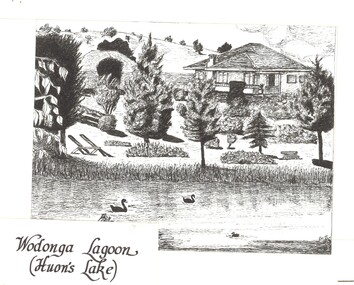
Work on paper - Wodonga Lagoon (Huon's Lake), Des Martin, 1987
... Gabriel Louis Marie Huon de Kerilleau was born to a French aristocratic family in 1769. ...Gabriel Louis Marie Huon de Kerilleau was born to a French aristocratic family in 1769. ...Gabriel Louis Marie Huon de Kerilleau was born to a French aristocratic family in 1769. He escaped to England during the French Revolution and enlisted in the New South Wales Corps. He married in Parramatta to Louisa Emmanuel Le Sage. They had five children who took the name of Huon – Elizabeth, Paul, Jean Francois, Aime Augustus and Charles. Paul and Charles were to become the “founders’ of the Wodonga District. In 1824 Hamilton Hume and William Hovell discovered the Hume River, later renamed to the Murray River and the rich land surrounding it. By 1835, squatters began arriving at the Hume River. During the following year, Paul Huon arrived at the Hume (Murray) River, then "taking up" 40,000 acres on the south side of the river bank. To this property he gave the name WOODONGA RUN. Charles Huon, younger brother of Paul, was sent to manage the "Run" until Paul's son, William, became old enough to take over management. Charles Huon built a mud brick home on the eastern side of a rise south of the now Wodonga Creek. Thus was Charles the first permanent settler in the district. He was a great admirer of the English Lord Belvoir hence "Belvoir" was the name Charles Huon gave to the first permanent home on Woodonga Run. By the 1857, residents numbered fifty, and the Government had surveyed a township area, proclaiming it "Belvoir" in the new State of Victoria. However, the residents wanted their own choice of a name for the town. Huon’s first home overlooked a lagoon which was often referred to as Huon’s Lagoon. It has borne several names since then including Lake Huon and Belvoir Lagoon. After much redevelopment and many roles including the location of sporting fields and the Wodonga Golf Course, it is now known as Belvoir Park, a major parkland and recreation area in Wodonga.Donated by Des Martin & Rosemary BoyesPart of a set of original sketches by Des Martin for "A Record of the 150th Anniversary" Celebrations of the Rural City of Wodonga held on 30th October 1986.huon family, belvoir park wodonga, huon's lagoon -
 Wodonga & District Historical Society Inc
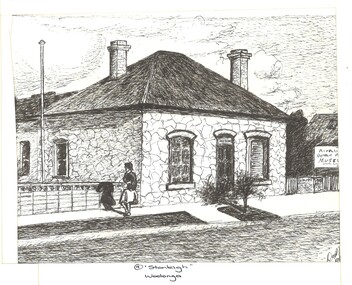
Work on paper - Stonleigh, Wodonga - Home of Paul Huon, Des Martin, 1987
... Gabriel Louis Marie Huon de Kerilleau was born to a French aristocratic family in 1769. ...Gabriel Louis Marie Huon de Kerilleau was born to a French aristocratic family in 1769. ...Gabriel Louis Marie Huon de Kerilleau was born to a French aristocratic family in 1769. He escaped to England during the French Revolution and enlisted in the New South Wales Corps. He married in Parramatta to Louisa Emmanuel Le Sage. They had five children who took the name of Huon – Elizabeth, Paul, Jean Francois, Aime Augustus and Charles. Paul and Charles were to become the “founders’ of the Wodonga District. In 1824 Hamilton Hume and William Hovell discovered the Hume River, later renamed to the Murray River and the rich land surrounding it. By 1835, squatters began arriving at the Hume River. During the following year, Paul Huon arrived at the Hume (Murray) River, then "taking up" 40,000 acres on the south side of the river bank. To this property he gave the name WOODONGA RUN. Charles Huon, younger brother of Paul, was sent to manage the "Run" until Paul's son, William, became old enough to take over management. Charles Huon built a mud brick home on the eastern side of a rise south of the now Wodonga Creek. Thus was Charles the first permanent settler in the district. He was a great admirer of the English Lord Belvoir hence "Belvoir" was the name Charles Huon gave to the first permanent home on Woodonga Run. By the 1857, residents numbered fifty, and the Government had surveyed a township area, proclaiming it "Belvoir" in the new State of Victoria. However, the residents wanted their own choice of a name for the town. A battle lasting thirteen years followed over the name of the town until the residents won in 1874 when the Victorian Government dropped the name "Belvoir" and proclaimed the town's name as "Wodonga." A local government Shire formed two years later became the Shire of Wodonga. The Huon name features in the town today including Huon Hill, Huon Creek, Huon Street and the former township and railway siding at Huon. The name "Belvoir" is used today by organisations and locations in Wodonga including Belvoir Park formerly known as Huon’s Lagoon. On 3rd October 1986 the Wodonga community celebrated the 150th anniversary of the first settlement by Charles Huon of the district that was to become Wodonga. These drawings were completed by Desmond Martin as part of a booklet produced to record the event. Stonleigh in Wodonga was once owned by Paul Huon.Donated by Des Martin & Rosemary BoyesPart of a set of original sketches by Des Martin for "A Record of the 150th Anniversary" Celebrations of the Rural City of Wodonga held on 30th October 1986.150th anniversary celebrations, huon family, early wodonga, stonleigh wodonga -
 Wodonga & District Historical Society Inc
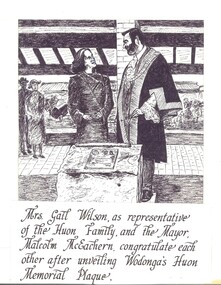
Work on paper - 150th Anniversary Celebrations of the Rural City of Wodonga, Des Martin, 1987
... Gabriel Louis Marie Huon de Kerilleau was born to a French aristocratic family in 1769. ...Gabriel Louis Marie Huon de Kerilleau was born to a French aristocratic family in 1769. ...Gabriel Louis Marie Huon de Kerilleau was born to a French aristocratic family in 1769. He escaped to England during the French Revolution and enlisted in the New South Wales Corps. He married in Parramatta to Louisa Emmanuel Le Sage. They had five children who took the name of Huon – Elizabeth, Paul, Jean Francois, Aime Augustus and Charles. Paul and Charles were to become the “founders’ of the Wodonga District. In 1824 Hamilton Hume and William Hovell discovered the Hume River, later renamed to the Murray River and the rich land surrounding it. By 1835, squatters began arriving at the Hume River. During the following year, Paul Huon arrived at the Hume (Murray) River, then "taking up" 40,000 acres on the south side of the river bank. To this property he gave the name WOODONGA RUN. Charles Huon, younger brother of Paul, was sent to manage the "Run" until Paul's son, William, became old enough to take over management. Charles Huon built a mud brick home on the eastern side of a rise south of the now Wodonga Creek. Thus was Charles the first permanent settler in the district. He was a great admirer of the English Lord Belvoir hence "Belvoir" was the name Charles Huon gave to the first permanent home on Woodonga Run. By the 1857, residents numbered fifty, and the Government had surveyed a township area, proclaiming it "Belvoir" in the new State of Victoria. However, the residents wanted their own choice of a name for the town. A battle lasting thirteen years followed over the name of the town until the residents won in 1874 when the Victorian Government dropped the name "Belvoir" and proclaimed the town's name as "Wodonga." A local government Shire formed two years later became the Shire of Wodonga. The Huon name features in the town today including Huon Hill, Huon Creek, Huon Street and the former township and railway siding at Huon. The name "Belvoir" is used today by organisations and locations in Wodonga including Belvoir Park formerly known as Huon’s Lagoon. On 3rd October 1986 the Wodonga community celebrated the 150th anniversary of the first settlement by Charles Huon of the district that was to become Wodonga. These drawings were completed by Desmond Martin as part of a booklet produced to record the event. Donated by Des Martin & Rosemary BoyesPart of a set of original sketches by Des Martin for "A Record of the 150th Anniversary" Celebrations of the Rural City of Wodonga held on 30th October 1986.150th anniversary celebrations, huon family -
 Wodonga & District Historical Society Inc
Photograph - Bank of New South Wales, Wodonga
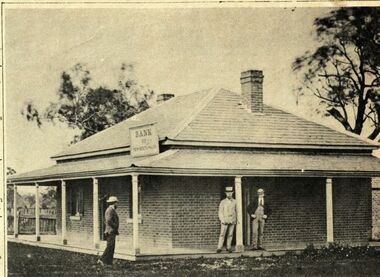
... Another early account was in the name of William Huon, squatter of de Kerilleau, Wodonga. On 9 July 1873, the agency was converted into full branch under the management of Mr. ...Another early account was in the name of William Huon, squatter of de Kerilleau, Wodonga. On 9 July 1873, the agency was converted into full branch under the management of Mr. ...The first Bank of New South Wales building in Wodonga was located in a small cottage. The branch opened on 7 May 1872. At first it was conducted as an agency of the Beechworth branch. In October 1872 premises in Sydney road were purchased from Mr P. L. M. S. Chauncy for £650. When the bank commenced in the cottage the first account was opened in the name of Hillerman & Co, storekeepers, Wodonga. Another early account was in the name of William Huon, squatter of de Kerilleau, Wodonga. On 9 July 1873, the agency was converted into full branch under the management of Mr. Joseph Belcher. Other early accounts included Cronin & Callaghan, storekeepers; John Bassett Jnr, shoemaker; John Jennings, contractor; Ah Soon, tobacco grower, Kergunyah; John de Corney Ireland, collector of customs; Andrew Kyle, fellmonger; Rowan Lockhead, accountant; Alexander McKay, publican; George Pollard, farmer; Thomas Street, farmer; and Edmund Uren, gentleman, Buninyong. Organisations banking at the branch included Wodonga Building Society, 1873; Wodonga Mechanics Institute 1875; Wodonga Band Fund 1882; Talgarno Athenaeum, 1888; Talgarno Butter & Cheese Factory 1892; Wodonga Federation League 1893; Wodonga Brass Band 1895; Wodonga Benevolent Society 1895; Wodonga Fire Brigade 1897; Wodonga Rifle Club and Wodonga Racing Club in 1899 and Kiewa Polo Club in 1900. There were also numerous lodge and church accounts. The cottage was later renovated with a porch added in 1889 and an extension to the residence in 1898. The original house was eventually demolished to make way for a new bank and manager’s residence in Sydney Road in 1906. That building was again remodelled in 1969. It became a branch of the WESTPAC bank when the Bank of NSW and CBA Bank joined to become the Westpac Banking Corporation in 1982. After the building ceased operation as a bank, it has been the home to several businesses including a video store, a travel agency and a clothing store.These images have local significance as they record changes to a building which filled an important role in the commercial life of Wodonga.A series of photos both black and white and coloured which document changes in the former Bank of New South Wales building in Wodonga over time.Photo 1: On sign above verandah "BANK of NEW SOUTH WALES" Photo 2: On sides of building and above door: "BANK OF NEW SOUTH WALES" Photo 3: Above door: "HIRE/ VIDEO MADNESS/ SALES" Photo 4: Above door: "WODONGA TRAVEL"wodonga businesses, banking wodonga, bank nsw wodonga, businesses high street wodonga -
 Wodonga & District Historical Society Inc
Photograph - Henry Beardmore - Wodonga Shire Councillor and Member for Benambra
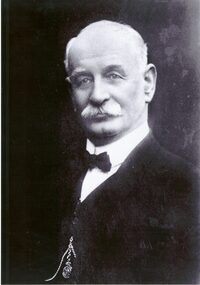
... From 1905-1915, Henry Beardmore leased “De Kerilleau” homestead with the exception of 1907, when Mr W. Huon was in residence, and after he died there in 1907, the Beardmore family returned. ...From 1905-1915, Henry Beardmore leased “De Kerilleau” homestead with the exception of 1907, when Mr W. Huon was in residence, and after he died there in 1907, the Beardmore family returned. ...Henry Beardmore was a significant contributor to Wodonga and the state of Victoria. He was born in Melton on 7th February 1863 to Edwin James Beardmore and Flora McDonald. He grew up in Benalla and became a butcher at Glenrowan before taking up land at Leneva near Wodonga, Victoria. On 15 July 1885 Henry married his first wife, Agnes Annie Lee and they had two sons and two daughters. Agnes died in 1892. In 23 August 1893, Henry married Jessie Muirhead and they had six sons and four daughters. Henry represented the Green Hills riding on Wodonga Shire Council from 1898 to 1922, including terms as President from 1900-01, 1903-4, 1908-10, 1911-12, 1914-17. In 1922 Mr. Beardmore retired from the Wodonga Council due to his increased workload in State politics. Henry Beardmore was a Freemason including Master of the Wodonga Lodge from 1906 to 1907, and was an active member up until his death. From 1905-1915, Henry Beardmore leased “De Kerilleau” homestead with the exception of 1907, when Mr W. Huon was in residence, and after he died there in 1907, the Beardmore family returned. Henry Beardmore won the seat of Benambra in the Victorian Legislative Assembly at a by-election on 20th April 1917. He continuously represented the Benambra electorate as a Nationalist and United Australia Party member for more than 15 years. He was a strong advocate for country development and decentralisation, but he declined to join the Country Party. He held the seat of Benambra, up to the date of his death, and was returned unopposed on four occasions. He was an Honorary Minister in 1924 and for a short time in 1929, Minister of Railways, Minister in-charge of Electrical Undertakings and Minister of Labour. He was a leading supporter of Kiewa Hydro-Electric Project and opponent of Yallourn coalfield. Henry Beardmore died in Wodonga on 29 August 1932. His last residence was on the corner Elm Street and Beechworth Road.This photo is significant because it depicts an important local and State politician and member of the Wodonga Community.A black and white formal portrait of Henry Beardmore.henry beardmore, wodonga council, benambra - victorian politics -
 Wodonga & District Historical Society Inc
Furniture - Secretaire with Bookcase - the Watson Family of Wodonga
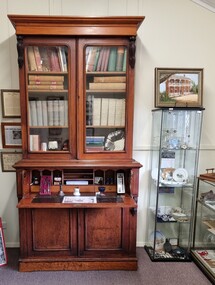
... This secretaire once stood proudly in the de Kerilleau homestead at Wodonga. The homestead had been built for William Huon, son of the early pastoralist Paul Huon, in 1870 and named after the family's ancestral estate in France. ...This secretaire once stood proudly in the de Kerilleau homestead at Wodonga. The homestead had been built for William Huon, son of the early pastoralist Paul Huon, in 1870 and named after the family's ancestral estate in France. ...This secretaire once stood proudly in the de Kerilleau homestead at Wodonga. The homestead had been built for William Huon, son of the early pastoralist Paul Huon, in 1870 and named after the family's ancestral estate in France. The original lease of the Wodonga Run was granted to Paul Huon as No. 202 on 7th February 1837, about a year after his cousin Charles Huon had squatted on the land. Kenneth Darnton Watson bought de Kerilleau homestead in 1922 where the Watson family lived for three generations, caring for the land and serving the Wodonga community. Kenneth, his son Ian Darnton Watson and his grandson John Kenneth Darnton Watson all served on the Wodonga Council. John Kenneth Darnton Watson was born on 28 August 1960 in Wodonga. After completing his primary schooling locally, he boarded at Geelong College from 1973. John joined the rowing crews, starting in the 8th VIII crew and reaching the 1st VIII crew in 1978. He received multiple House colours awards for cross country, athletics and rowing and received School colours for rowing. On completion of his schooling, John spent some time jackarooing before studying farm management at Marcus Oldham College. He then returned home to de Kerilleau, Wodonga to manage the family property. In 1984 John married Christine Honybun, daughter of David Lewis Honybun and Marian Josephine Edkins. John and Christine had three sons. John was community minded and involved in a number of local organisations such as Apex and agricultural societies. He was elected to Wodonga City Council in 1997, serving until 2004. Due to increased pressure on available land to cater for the growth of Wodonga, some of the property was sold and in 2003 John donated 200 ha of Huon Hill ‘s western slopes to the City of Wodonga. After this time, he moved away from farming to become a Hungry Jack's franchisee. In 2009, the hard decision was made to sell de Kerilleau and John and his family moved into Wodonga. After sadly losing Christine to cancer in 2017, John became a member and Deputy Chairperson of the Albury Wodonga Regional Cancer Centre Trust Fund Board and Ambassador for the Sunshine Walk. Tragically after his own cancer battle, John Kenneth Darnton Watson passed away on 24 August 2023, aged 62 years following a life of service to the Wodonga community.This item is significant because it was owned by a prominent Wodonga family and came from a Historic Homestead in WodongaA secretaire with bookcase made of cedar. The bottom section has two cupboards with shelves. These doors support the desk when it is fully opened. Above this section is one large drawer, the front of which opens by pressing a small internal button on each side. The open drawer reveals a desk with a leather writing mat and several compartments. The desk is topped by a book shelf with 3 adjustable shelves. It has lockable glass doors.watson family wodonga, de kerilleau homestead, john watson -
 Wodonga & District Historical Society Inc
Photograph - Kenneth Darnton Watson - Community Leader
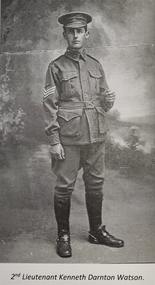
... In 1922, Kenneth Darnton Watson came to Wodonga where he purchased de Kerilleau, consisting of 2,500 acres, from Mr George Gordon. The two storey brick homestead had been built by William Huon in 1870. ...In 1922, Kenneth Darnton Watson came to Wodonga where he purchased de Kerilleau, consisting of 2,500 acres, from Mr George Gordon. The two storey brick homestead had been built by William Huon in 1870. ...Kenneth Darnton Watson was born at Bendigo on 24 May 1893 to George Darnton Watson and Adelaide Nora Holmes. He was educated at Melbourne Church of England Grammar School, being selected as School Captain in 1913 and a member of the Head of the River rowing team. After finishing school, he worked as a jackaroo on Wanganella Station and later at Mt. Widderin, Skipton, Victoria. When WW1 was declared, Kenneth enlisted and after initial training at Maribyrnong, Victoria he left Australia as 2nd Lieutenant with 7th Australian Field Artillery Brigade, to disembark at Plymouth on July 10, 1916. He took part in the Battles of Messines, Menin Road, Polygon Wood and Passchendaele Ridge in 1917. For his efforts in Passchendaele Ridge on 17th December he was awarded the Military Cross "for conspicuous gallantry and devotion to duty." In 1918 he took part in the Battles of Villers-Bretonneux, Hamel and Amiens. He returned to Australia in November 1919 and was discharged on 20th January 1920. In 1922, Kenneth Darnton Watson came to Wodonga where he purchased de Kerilleau, consisting of 2,500 acres, from Mr George Gordon. The two storey brick homestead had been built by William Huon in 1870. On 30th May 1924, he married Phyllis Emily Lenore Austin and they had four children, Ian Darnton 1925, Robert Darnton 1926 Rosemary McPherson 1929 and Faith Holmes 1931. On the land he worked hard, building fences, cattle, sheep and horse yards, and farmed Corriedale sheep, Shorthorn cattle and horses. Mr Watson was an innovative farmer, introducing modern methods of top dressing at de Kerilleau by means of an aircraft. He was also a dedicated community man. He was a member of both Albury and Wodonga Show Committees, Murray Valley Development League, No.1 Region, Graziers' Association of Southern Riverina, Albury Legacy Club, Wodonga RSL, and Wodonga Turf Club including terms as President on several of these organisations. Kenneth was also a Warden of St. Luke's Church of England, Wodonga. Kenneth served as Wodonga Shire President from 1929 to 1931, and was again elected to Council from 1943 to 1945. A most respected and valued member of the local community, Kenneth Darnton Watson died on the 4th of October 1951, aged 58. Lenore Watson lived at de Kerilleau until her death on 15th June 1984. Both are buried in Wodonga.These images are significant because they record the service of a prominent member of the Wodonga community.A collection of black of white images of Kenneth Darnton Watson of Wodonga.kenneth darnton watson, watson family wodonga, wodonga community members -
 Wodonga & District Historical Society Inc
Mixed media - John Kenneth Darnton Watson and de Kerilleau Homestead
... de Kerilleau was built for William Huon, son of the early pastoralist Paul Huon, in 1870 and named after the family's ancestral estate in France. ...de Kerilleau was built for William Huon, son of the early pastoralist Paul Huon, in 1870 and named after the family's ancestral estate in France. ...de Kerilleau was built for William Huon, son of the early pastoralist Paul Huon, in 1870 and named after the family's ancestral estate in France. The original lease of the Wodonga Run was granted to Paul Huon as No. 202 on 7th February 1837, about a year after his cousin Charles Huon had squatted on the land. Kenneth Darnton Watson bought de Kerilleau homestead in 1922 where the Watson family lived for three generations, caring for the land and serving the Wodonga community. Kenneth, his son Ian Darnton Watson and his grandson John Kenneth Darnton Watson all served on the Wodonga Council. The magnificent two storey brick homestead is built on ground above Wodonga Creek. The home of Georgian style consists of eleven rooms and a spacious cellar. At the rear of the main house in a separate single storey building was a large kitchen, pantry and accommodation for a cook and a housemaid. A feature of the homestead is the cast iron lace on the veranda and upper balcony, both supported by caste - iron pillars. The granite foundations of the home were quarried from the hill above the homestead. The enormous Moreton Bay Fig tree which stands to the side of the home was planted when Sir Charles Bowen visited de Kerilleau to mark the opening of the rail line that connects Victoria with New South Wales. Planted in 1873, it is still standing today. This painting was donated to the Wodonga Historical Society by George, Digby & Dugald Watson on behalf of the late John & Chris Watson. John Kenneth Darnton Watson was born on 28 August 1960 in Wodonga. After completing his primary schooling locally, he boarded at Geelong College from 1973. John joined the rowing crews, starting in the 8th VIII crew and reaching the 1st VIII crew in 1978. He received multiple House colours awards for cross country, athletics and rowing and received School colours for rowing. On completion of his schooling, John spent some time jackarooing before studying farm management at Marcus Oldham College in Geelong, Victoria. He then returned home to de Kerilleau, Wodonga to manage the family property. In 1984 John married Christine Honybun, daughter of David Lewis Honybun and Marian Josephine Edkins. John and Christine had three sons. John was community minded and involved in a number of local organisations such as Apex and agricultural societies. He was elected to Wodonga City Council in 1997, serving until 2004. Due to increased pressure on available land to cater for the growth of Wodonga, some of the property was sold and in 2003 John donated 200 ha of Huon Hill ‘s western slopes to the City of Wodonga. After this time, he moved away from farming to become a Hungry Jack's franchisee. In 2009, the hard decision was made to sell de Kerilleau and John and his family moved into Wodonga. After sadly losing Christine to cancer in 2017, John became a member and Deputy Chairperson of the Albury Wodonga Regional Cancer Centre Trust Fund Board and Ambassador for the Sunshine Walk. Tragically after his own cancer battle, John Kenneth Darnton Watson passed away on 24 August 2023, aged 62 years following a life of service to the Wodonga community.This item is significant because it was owned by a prominent Wodonga family and came from a Historic Homestead in WodongaA coloured portrait of John Kenneth Darnton Watson and a painting of de Kerilleau Homestead, the Watson Family home for three generations. The portrait was taken by Peter Charlesworth. The painting is the work of D.K. Ross in 1991.watson family wodonga, de kerilleau homestead, john watson, peter charlesworth -
 Wodonga & District Historical Society Inc
Functional object - Cigarette Case - K. D. Watson, Wodonga
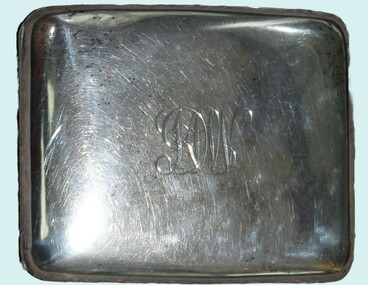
... In 1922, Kenneth Darnton Watson came to Wodonga where he purchased de Kerilleau, consisting of 2,500 acres, from Mr George Gordon. The two storey brick homestead had been built by William Huon in 1870. ...In 1922, Kenneth Darnton Watson came to Wodonga where he purchased de Kerilleau, consisting of 2,500 acres, from Mr George Gordon. The two storey brick homestead had been built by William Huon in 1870. ...This cigarette case was owned by Kenneth Darnton Watson and carried into battle during World War I. Kenneth Darnton Watson was born at Bendigo on 24 May 1893 to George Darnton Watson and Adelaide Nora Holmes. He was educated at Melbourne Church of England Grammar School, being selected as School Captain in 1913 and a member of the Head of the River rowing team. After finishing school, he worked as a jackaroo on Wanganella Station and later at Mt. Widderin, Skipton, Victoria. When WWI was declared, Kenneth enlisted and after initial training at Maribyrnong, Victoria he left Australia as 2nd Lieutenant with 7th Australian Field Artillery Brigade, to disembark at Plymouth on July 10, 1916. He took part in the Battles of Messines, Menin Road, Polygon Wood and Passchendaele Ridge in 1917. For his efforts in Passchendaele Ridge on 17th December he was awarded the Military Cross "for conspicuous gallantry and devotion to duty." In 1918 he took part in the Battles of Villers-Bretonneux, Hamel and Amiens. He returned to Australia in November 1919 and was discharged on 20th January 1920. In 1922, Kenneth Darnton Watson came to Wodonga where he purchased de Kerilleau, consisting of 2,500 acres, from Mr George Gordon. The two storey brick homestead had been built by William Huon in 1870. On 30th May 1924, he married Phyllis Emily Lenore Austin and they had four children, Ian Darnton 1925, Robert Darnton 1926 Rosemary McPherson 1929 and Faith Holmes 1931. On the land he worked hard, building fences, cattle, sheep and horse yards, and farmed Corriedale sheep, Shorthorn cattle and horses. Mr Watson was an innovative farmer, introducing modern methods of top dressing at de Kerilleau by means of an aircraft. He was also a dedicated community man. He was a member of both Albury and Wodonga Show Committees, Murray Valley Development League, No.1 Region, Graziers' Association of Southern Riverina, Albury Legacy Club, Wodonga RSL, and Wodonga Turf Club including terms as President on several of these organisations. Kenneth was also a Warden of St. Luke's Church of England, Wodonga. Kenneth served as Wodonga Shire President from 1929 to 1931, and was again elected to Council from 1943 to 1945. A most respected and valued member of the local community, Kenneth Darnton Watson died on the 4th of October 1951, aged 58. Lenore Watson lived at de Kerilleau until her death on 15th June 1984. Both are buried in Wodonga.This item is significant because it was owned by a decorated Australian serviceman and prominent member of the Wodonga community.A silver cigarette case owned by Kenneth Darnton Watson of Wodonga. The inside contains straps to hold the cigarettes in place. Both the front and back have been engraved.On front: KDW On back: 1919kenneth darnton watson, watson family wodonga, wodonga community members -
 Wodonga & District Historical Society Inc
Functional object - Silver Mug - K. D. Watson, Wodonga
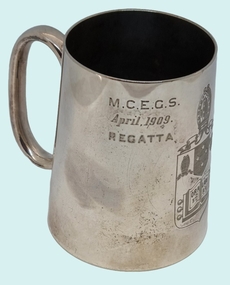
... In 1922, Kenneth Darnton Watson came to Wodonga where he purchased de Kerilleau Homestead, consisting of 2,500 acres, from Mr George Gordon. The two storey brick homestead had been built by William Huon in 1870. ...In 1922, Kenneth Darnton Watson came to Wodonga where he purchased de Kerilleau Homestead, consisting of 2,500 acres, from Mr George Gordon. The two storey brick homestead had been built by William Huon in 1870. ...This cup was awarded to Kenneth Darnton Watson when he was a boarder and competitive rower whilst completing his secondary education. Kenneth Darnton Watson was born at Bendigo on 24 May 1893 to George Darnton Watson and Adelaide Nora Holmes. He was educated at Melbourne Church of England Grammar School, being selected as School Captain in 1913 and a member of the Head of the River rowing team. After finishing school, he worked as a jackaroo on Wanganella Station and later at Mt. Widderin, Skipton, Victoria. When WW1 was declared, Kenneth enlisted and after initial training at Maribyrnong, Victoria he left Australia as 2nd Lieutenant with 7th Australian Field Artillery Brigade, to disembark at Plymouth on July 10, 1916. He took part in the Battles of Messines, Menin Road, Polygon Wood and Passchendaele Ridge in 1917. For his efforts in Passchendaele Ridge on 17th December he was awarded the Military Cross "for conspicuous gallantry and devotion to duty." In 1918 he took part in the Battles of Villers-Bretonneux, Hamel and Amiens. He returned to Australia in November 1919 and was discharged on 20th January 1920. In 1922, Kenneth Darnton Watson came to Wodonga where he purchased de Kerilleau Homestead, consisting of 2,500 acres, from Mr George Gordon. The two storey brick homestead had been built by William Huon in 1870. On 30th May 1924, he married Phyllis Emily Lenore Austin and they had four children, Ian Darnton 1925, Robert Darnton 1926 Rosemary McPherson 1929 and Faith Holmes 1931. On the land Kenneth worked hard, building fences, cattle, sheep and horse yards, and farmed Corriedale sheep, Shorthorn cattle and horses. he was an innovative farmer, introducing modern methods of top dressing at de Kerilleau by means of an aircraft. He was also a dedicated community man. He was a member of both Albury and Wodonga Show Committees, Murray Valley Development League, No.1 Region, Graziers' Association of Southern Riverina, Albury Legacy Club, Wodonga RSL, and Wodonga Turf Club including terms as President on several of these organisations. Kenneth was also a Warden of St. Luke's Church of England, Wodonga. Kenneth served as Wodonga Shire President from 1929 to 1931, and was again elected to Council from 1943 to 1945. A most respected and valued member of the local community, Kenneth Darnton Watson died on the 4th of October 1951, aged 58. Lenore Watson lived at de Kerilleau until her death on 15th June 1984. Both are buried in Wodonga.These images are significant because they record the service of a prominent member of the Wodonga community.A silver mug awarded to K D Watson as a rowing trophy in April 1909. It features the shield of Melbourne Church of England Grammar School (M.C.E.G.S.), as well as his name and the event for which it was awarded.View 1: M.C.E.G.S. April 1909 Regatta View 2: Crest of MECEGS featuring motto "Ora et Labora" View 3: BOARDERS FOUR K. D. WATSON 3kenneth darnton watson, watson family wodonga, wodonga community members -
 Wodonga & District Historical Society Inc
Decorative object - Silver Tray from John Kenneth Darnton Watson, Wodonga
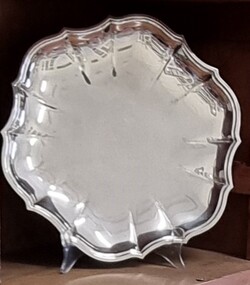
... This silver tray was donated by the family of John Watson and was used when they lived in de Kerilleau Homestead for three generations. de Kerilleau Homestead was built for William Huon, son of the early pastoralist Paul Huon, in 1870 and named after the family's ancestral estate in France. ...This silver tray was donated by the family of John Watson and was used when they lived in de Kerilleau Homestead for three generations. de Kerilleau Homestead was built for William Huon, son of the early pastoralist Paul Huon, in 1870 and named after the family's ancestral estate in France. ...This silver tray was donated by the family of John Watson and was used when they lived in de Kerilleau Homestead for three generations. de Kerilleau Homestead was built for William Huon, son of the early pastoralist Paul Huon, in 1870 and named after the family's ancestral estate in France. The original lease of the Wodonga Run was granted to Paul Huon as No. 202 on 7th February 1837, about a year after his cousin Charles Huon had squatted on the land. Kenneth Darnton Watson bought de Kerilleau homestead in 1922 where the Watson family lived for three generations, caring for the land and serving the Wodonga community. Kenneth, his son Ian Darnton Watson and his grandson John Kenneth Darnton Watson all served on the Wodonga Council. John Kenneth Darnton Watson was born on 28 August 1960 in Wodonga. After completing his primary schooling locally, he boarded at Geelong College from 1973. John joined the rowing crews, starting in the 8th VIII crew and reaching the 1st VIII crew in 1978. He received multiple House colours awards for cross country, athletics and rowing and received School colours for rowing. On completion of his schooling, John spent some time jackarooing before studying farm management at Marcus Oldham College in Geelong, Victoria. He then returned home to de Kerilleau, Wodonga to manage the family property. In 1984 John married Christine Honybun, daughter of David Lewis Honybun and Marian Josephine Edkins. John and Christine had three sons. John was community minded and involved in a number of local organisations such as Apex and agricultural societies. He was elected to Wodonga City Council in 1997, serving until 2004. Due to increased pressure on available land to cater for the growth of Wodonga, some of the property was sold and in 2003 John donated 200 ha of Huon Hill‘s western slopes to the City of Wodonga. After this time, he moved away from farming to become a Hungry Jack's franchisee. In 2009, the hard decision was made to sell de Kerilleau and John and his family moved into Wodonga. After sadly losing Christine to cancer in 2017, John became a member and Deputy Chairperson of the Albury Wodonga Regional Cancer Centre Trust Fund Board and Ambassador for the Sunshine Walk. Tragically after his own cancer battle, John Kenneth Darnton Watson passed away on 24 August 2023, aged 62 years following a life of service to the Wodonga community.This item is significant because it was owned by a prominent Wodonga family and came from a Historic Homestead in WodongaA circular silver tray with an embossed design around the outer edge.watson family wodonga, de kerilleau homestead, john watson, peter charlesworth -
 Wodonga & District Historical Society Inc
Work on paper - de Kerilleau Homestead, Wodonga, Des Martin, 1987
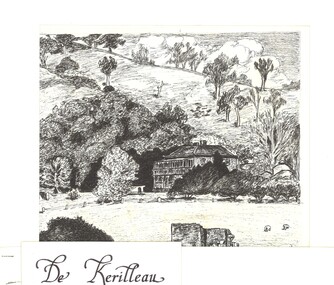
... Huon's Hill. William gave this home the family traditional name " De Kerilleau." ...Huon's Hill. William gave this home the family traditional name " De Kerilleau." ...Paul Huon's son, William, arrived at "Belvoir Homestead" on the Woodonga Run in 1857 to learn the management of the Run so he could take over the role from his Uncle Charles. He spent five years residing at "Belvoir." In 1862 he built a new stone home on Wodonga Creek at the base of Huon's Hill. William gave this home the family traditional name " De Kerilleau." In the 1870s, William built the "de Kerilleau" homestead that still stands today. The first "De Kerilleau" homestead was almost completely demolished in 1907. It is a solid two storey red brick building with cream brick flat window arches. The main feature of the house is its two-storey cast-iron verandah which has been restored to its original condition. When the Governor, Sir George Bowen, his wife and two daughters needed accommodation overnight after having taken part in the celebration of the railway in Wodonga in 1873, they stayed at de Kerilleau. Sir George planted a Moreton Bay fig tree in the grounds and it still stands today. The historic homestead became the property of the Watson family in 1922 and again changed hands in recent years. It is listed by the National Trust.Donated by Des Martin & Rosemary BoyesPart of a set of original sketches by Des Martin for "A Record of the 150th Anniversary" Celebrations of the Rural City of Wodonga held on 30th October 1986.huon family, early wodonga
