
Showing 23 items matching "ice hockey"
-
 St Kilda Historical Society
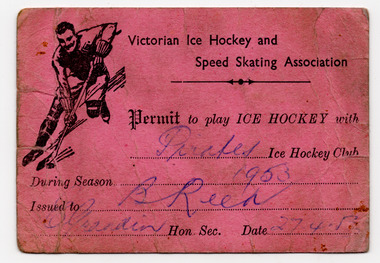
Ephemera - Ticket, Permit to play ice hockey, 1953
... Permit to play ice hockey...Ice hockey...Permit issued by Victorian Ice Hockey and Speed Skating Association to B Reed to play ice hockey with Pirates Club in 1953....Annotated in writing that the permit applies to ice hockey played with the 'Pirates' Ice Hockey Club, during the '1953' season, and was issued to 'B Reed'. ...Permit issued by Victorian Ice Hockey and Speed Skating Association to B Reed to play ice hockey with Pirates Club in 1953. ...Permit issued by Victorian Ice Hockey and Speed Skating Association to B Reed to play ice hockey with Pirates Club in 1953.Pink card printed in black on both sides, with handwritten annotations in black ink and a stamped ticket numberAnnotated in writing that the permit applies to ice hockey played with the 'Pirates' Ice Hockey Club, during the '1953' season, and was issued to 'B Reed'. It was signed by the Secretary (name indecipherable) on '24.4.53'. Stamped on the back 'No. 907'ice hockey, pirates ice hockey club, victorian ice hockey association -
 St Kilda Historical Society
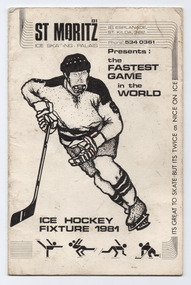
Ephemera - Program, Ice Hockey Fixture 1981, 1966
... Ice Hockey Fixture 1981......Ice hockey...Includes fixtures for the National Ice Hockey League and the Victorian Ice Hockey Association. ...White coloured card, folded into three, printed in black with an illustrations of ice hockey players on the front...Includes fixtures for the National Ice Hockey League and the Victorian Ice Hockey Association. ...Ice hockey fixture for 1981 at St Moritz Ice Skating rink, Upper Esplanade St Kilda. Includes fixtures for the National Ice Hockey League and the Victorian Ice Hockey Association. The St. Moritz Ice-skating Palais (its original name) opened in 1939 and operated until 1981. The building was damaged by fire and demolished soon afterwards. White coloured card, folded into three, printed in black with an illustrations of ice hockey players on the frontst moritz, ice hockey, victorian ice hockey association, national ice hocky league -
 St Kilda Historical Society
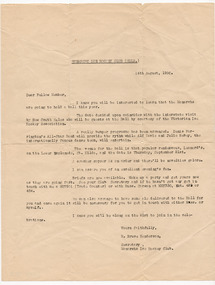
Ephemera - Letter, Monarchs Ice Hockey Club (Melb.), 1950
... Monarchs Ice Hockey Club (Melb.)...Ice hockey...Letter from the Secretary of the Monarchs Ice Hockey Club to club members, dated 14 August 1950, about a ball to be held at Leonard's, Lower Esplanade St Kilda, on 21 September 1950....Ice hockey Monarchs Ice Hockey Club White paper, discoloured with age, typewritten on one side Monarchs Ice Hockey Club (Melb.) ...Letter from the Secretary of the Monarchs Ice Hockey Club to club members, dated 14 August 1950, about a ball to be held at Leonard's, Lower Esplanade St Kilda, on 21 September 1950.White paper, discoloured with age, typewritten on one sideice hockey, monarchs ice hockey club -
 St Kilda Historical Society
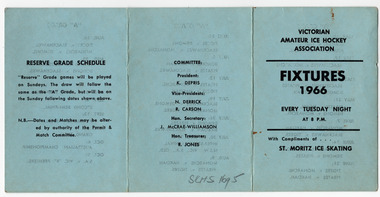
Ephemera - Program, Victorian Amateur Ice Hockey Association Fixtures 1966, 1966
... Victorian Amateur Ice Hockey Association Fixtures 1966......Ice hockey...Victorian Amateur Ice Hockey Association fixtures for 1966 at St Moritz Ice Skating rink, Upper Esplanade St Kilda. ...Victorian Amateur Ice Hockey Association fixtures for 1966 at St Moritz Ice Skating rink, Upper Esplanade St Kilda. ...Victorian Amateur Ice Hockey Association fixtures for 1966 at St Moritz Ice Skating rink, Upper Esplanade St Kilda. The St. Moritz Ice-skating Palais (its original name) opened in 1939 and operated until 1981. The building was damaged by fire and demolished soon afterwards. Blue coloured card, folded into three, printed in black on both sidesst moritz, ice hockey, victorian ice hockey association -
 St Kilda Historical Society
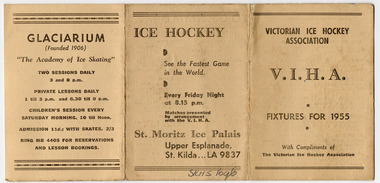
Ephemera - Program, V.I.H.A. Fixtures for 1955, 1955
... ...Ice hockey...Victorian Ice Hockey Association fixtures for 1955 at St Moritz Ice Palais, Upper Esplanade St Kilda, and the Glaciarium (also known as the Glaci), City Road South Melbourne. ...St Moritz Glaciarium Ice hockey Victorian Ice Hockey Association Buff coloured card, folded into three, printed in black on both sides V.I.H.A. ...Victorian Ice Hockey Association fixtures for 1955 at St Moritz Ice Palais, Upper Esplanade St Kilda, and the Glaciarium (also known as the Glaci), City Road South Melbourne. The St. Moritz Ice-skating Palais (its original name) opened in 1939 and operated until 1981. The building was damaged by fire and demolished soon afterwards. The Glaci opened in 1906, at which time it was the 3rd largest indoor ice rink in the world. It hosted the first game of ice hockey played in Australia. It closed in 1957 and the building was destroyed by fire in 1963. Buff coloured card, folded into three, printed in black on both sidesst moritz, glaciarium, ice hockey, victorian ice hockey association -
 St Kilda Historical Society
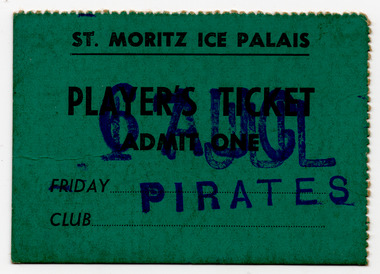
Ephemera - Ticket, St Moritz Ice Palais Player's Ticket
... Ice hockey...Ticket of admission to play ice hockey with the Pirates Hockey Club at St Moritz Ice Palais, Upper Esplanade St Kilda...Ticket of admission to play ice hockey with the Pirates Hockey Club at St Moritz Ice Palais, Upper Esplanade St Kilda Ice hockey St Moritz Two lines of stamped text. ...Ticket of admission to play ice hockey with the Pirates Hockey Club at St Moritz Ice Palais, Upper Esplanade St KildaGreen card printed in black on one side, over-stamped in purpleTwo lines of stamped text. Line one: indecipherable, though appears to be over-stamped dates in July ('Jul') and August ('Aug'). Line two: 'Pirates'ice hockey, st moritz -
 Maccabi Victoria
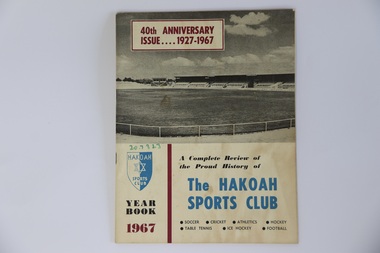
Book, 1967
... Yearbook for Hakoah athletics, hockey, football, ice-hockey, table tennis, soccer, cricket...Yearbook for Hakoah athletics, hockey, football, ice-hockey, table tennis, soccer, cricket Gala or Award Function Athletics Hakoah The Hakoah Sports Club Yearbook 1967, 40th Anniversary Issue 1927-1967 Book ...Yearbook for Hakoah athletics, hockey, football, ice-hockey, table tennis, soccer, cricketThe Hakoah Sports Club Yearbook 1967, 40th Anniversary Issue 1927-1967gala or award function, athletics, hakoah -
 Falls Creek Historical Society
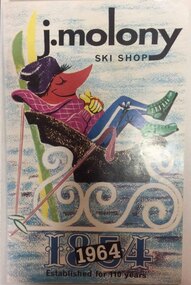
Ephemera - Brochure J. Molony Ski Shop
... Several members of the family were recognised ice hockey and figure skaters who have represented Australia in international winter events including the 1952 Olympic Games in Oslo, Norway and the 1976 Innsbruck Winter Olympics. ...Several members of the family were recognised ice hockey and figure skaters who have represented Australia in international winter events including the 1952 Olympic Games in Oslo, Norway and the 1976 Innsbruck Winter Olympics. ...Established in 1854 in King Street Melbourne by James Molony, the family owned business of J. Molony initially specialised in shoemaking. Several members of the family were recognised ice hockey and figure skaters who have represented Australia in international winter events including the 1952 Olympic Games in Oslo, Norway and the 1976 Innsbruck Winter Olympics. Molony’s in Elizabeth Street expanded their business with a focus on ski equipment, opening new premises in Falls Creek in 1960 This brochure advertises their available lines for 1964.A 1964 Brochure for J Molony Ski Shop. The brochure is printed in colour and the front bears a caricature of a skier with equipment On front cover: j. molony SKI SHOP 1964 / Established for 110 yearsj molony, molony ski shop, skiing, falls creek, ski fashion, winter, snow, snow fashion, 1964 falls creek -
 St Kilda Historical Society
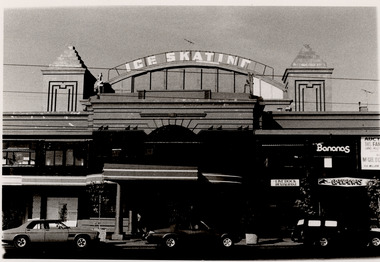
Photograph - Building, St Moritz Ice Skating Rink, c1970s
... As one of only two ice rinks in Melbourne in the 1940s and 1950s, it played a central role to the sport of ice hockey in Australia. Closed in 1982, it soon suffered a major fire and was then demolished, an event later seen as a major blow to the heritage of St Kilda. ...As one of only two ice rinks in Melbourne in the 1940s and 1950s, it played a central role to the sport of ice hockey in Australia. Closed in 1982, it soon suffered a major fire and was then demolished, an event later seen as a major blow to the heritage of St Kilda. ...The St. Moritz Ice Rink was a popular ice skating rink on The Esplanade, St. Kilda, Victoria. It operated between 1939–1981. As one of only two ice rinks in Melbourne in the 1940s and 1950s, it played a central role to the sport of ice hockey in Australia. Closed in 1982, it soon suffered a major fire and was then demolished, an event later seen as a major blow to the heritage of St Kilda. It was first built as the Wattle Path Palais de Danse in 1922, a very large dance hall, designed by architects Beaver & Purnell, The Wattle Path was the venue for the first all-Australian dance championship, and featured some of the best dance bands of Australia, as well as from America. Popular throughout the 1920s, it suffered due to the Great Depression, and closed in the early 1930s. From 1933-1936 the building became a film studio, Efftee Studios, for Frank W. Thring. In 1938, businessman Henry Hans "Harry" Kleiner announced that the Wattle Path would become an ice rink. He was sole proprietor until 1953, when he sold the business to J. Gordon and T. Molony, both champion skaters. Trade declined during the 1970s. The building was sold in 1980 to developers Hudson Conway and trucking magnate Lindsay Fox and was closed in early 1982. It was nominated to the Historic Buildings Preservation Council, but a majority of City of St Kilda councillors voted to oppose this action and uphold a demolition permit already issued. The building infamously suffered a fire later that year, leaving only the facades, which were demolished soon after. The site remained vacant until about 1991, when a mid-price hotel called the St Moritz was constructed. By 1993 it was simply called the Novotel St Kilda. The hotel closed in 2019 and was replaced by an apartment complex.Black and white photograph, unmounteddavid rae collection, st kilda, st moritz -
 St Kilda Historical Society
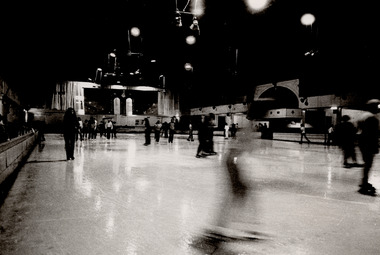
Photograph - Leisure activity, St Kilda Shout Collective, St Moritz Ice Skating Rink, 1980
... As one of only two ice rinks in Melbourne in the 1940s and 1950s, it played a central role to the sport of ice hockey in Australia. Closed in 1982, it soon suffered a major fire and was then demolished, an event later seen as a major blow to the heritage of St Kilda. ...As one of only two ice rinks in Melbourne in the 1940s and 1950s, it played a central role to the sport of ice hockey in Australia. Closed in 1982, it soon suffered a major fire and was then demolished, an event later seen as a major blow to the heritage of St Kilda. ...The St. Moritz Ice Rink was a popular ice skating rink on The Esplanade, St. Kilda, Victoria. It operated between 1939–1981. As one of only two ice rinks in Melbourne in the 1940s and 1950s, it played a central role to the sport of ice hockey in Australia. Closed in 1982, it soon suffered a major fire and was then demolished, an event later seen as a major blow to the heritage of St Kilda. It was first built as the Wattle Path Palais de Danse in 1922, a very large dance hall, designed by architects Beaver & Purnell, The Wattle Path was the venue for the first all-Australian dance championship, and featured some of the best dance bands of Australia, as well as from America. Popular throughout the 1920s, it suffered due to the Great Depression, and closed in the early 1930s. From 1933-1936 the building became a film studio, Efftee Studios, for Frank W. Thring. In 1938, businessman Henry Hans "Harry" Kleiner announced that the Wattle Path would become an ice rink. He was sole proprietor until 1953, when he sold the business to J. Gordon and T. Molony, both champion skaters. Trade declined during the 1970s. The building was sold in 1980 to developers Hudson Conway and trucking magnate Lindsay Fox and was closed in early 1982. It was nominated to the Historic Buildings Preservation Council, but a majority of City of St Kilda councillors voted to oppose this action and uphold a demolition permit already issued. The building infamously suffered a fire later that year, leaving only the facades, which were demolished soon after. The site remained vacant until about 1991, when a mid-price hotel called the St Moritz was constructed. By 1993 it was simply called the Novotel St Kilda. The hotel closed in 2019 and was replaced by an apartment complex.Black and white photograph, unmounteddavid rae collection, st kilda, st moritz -
 St Kilda Historical Society
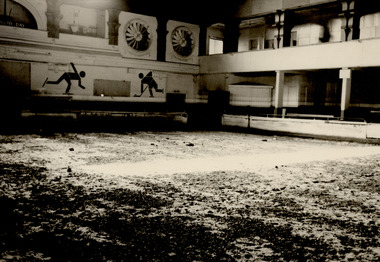
Photograph - Leisure activity, St Moritz Ice Skating Rink, c1980s
... As one of only two ice rinks in Melbourne in the 1940s and 1950s, it played a central role to the sport of ice hockey in Australia. Closed in 1982, it soon suffered a major fire and was then demolished, an event later seen as a major blow to the heritage of St Kilda. ...As one of only two ice rinks in Melbourne in the 1940s and 1950s, it played a central role to the sport of ice hockey in Australia. Closed in 1982, it soon suffered a major fire and was then demolished, an event later seen as a major blow to the heritage of St Kilda. ...The St. Moritz Ice Rink was a popular ice skating rink on The Esplanade, St. Kilda, Victoria. It operated between 1939–1981. As one of only two ice rinks in Melbourne in the 1940s and 1950s, it played a central role to the sport of ice hockey in Australia. Closed in 1982, it soon suffered a major fire and was then demolished, an event later seen as a major blow to the heritage of St Kilda. It was first built as the Wattle Path Palais de Danse in 1922, a very large dance hall, designed by architects Beaver & Purnell, The Wattle Path was the venue for the first all-Australian dance championship, and featured some of the best dance bands of Australia, as well as from America. Popular throughout the 1920s, it suffered due to the Great Depression, and closed in the early 1930s. From 1933-1936 the building became a film studio, Efftee Studios, for Frank W. Thring. In 1938, businessman Henry Hans "Harry" Kleiner announced that the Wattle Path would become an ice rink. He was sole proprietor until 1953, when he sold the business to J. Gordon and T. Molony, both champion skaters. Trade declined during the 1970s. The building was sold in 1980 to developers Hudson Conway and trucking magnate Lindsay Fox and was closed in early 1982. It was nominated to the Historic Buildings Preservation Council, but a majority of City of St Kilda councillors voted to oppose this action and uphold a demolition permit already issued. The building infamously suffered a fire later that year, leaving only the facades, which were demolished soon after. The site remained vacant until about 1991, when a mid-price hotel called the St Moritz was constructed. By 1993 it was simply called the Novotel St Kilda. The hotel closed in 2019 and was replaced by an apartment complex.Black and white photograph, unmounteddavid rae collection, st kilda, st moritz -
 St Kilda Historical Society
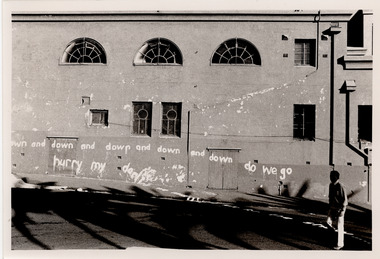
Photograph - Building, St Moritz Ice Skating Rink, c1980s
... As one of only two ice rinks in Melbourne in the 1940s and 1950s, it played a central role to the sport of ice hockey in Australia. Closed in 1982, it soon suffered a major fire and was then demolished, an event later seen as a major blow to the heritage of St Kilda. ...As one of only two ice rinks in Melbourne in the 1940s and 1950s, it played a central role to the sport of ice hockey in Australia. Closed in 1982, it soon suffered a major fire and was then demolished, an event later seen as a major blow to the heritage of St Kilda. ...The St. Moritz Ice Rink was a popular ice skating rink on The Esplanade, St. Kilda, Victoria. It operated between 1939–1981. As one of only two ice rinks in Melbourne in the 1940s and 1950s, it played a central role to the sport of ice hockey in Australia. Closed in 1982, it soon suffered a major fire and was then demolished, an event later seen as a major blow to the heritage of St Kilda. It was first built as the Wattle Path Palais de Danse in 1922, a very large dance hall, designed by architects Beaver & Purnell, The Wattle Path was the venue for the first all-Australian dance championship, and featured some of the best dance bands of Australia, as well as from America. Popular throughout the 1920s, it suffered due to the Great Depression, and closed in the early 1930s. From 1933-1936 the building became a film studio, Efftee Studios, for Frank W. Thring. In 1938, businessman Henry Hans "Harry" Kleiner announced that the Wattle Path would become an ice rink. He was sole proprietor until 1953, when he sold the business to J. Gordon and T. Molony, both champion skaters. Trade declined during the 1970s. The building was sold in 1980 to developers Hudson Conway and trucking magnate Lindsay Fox and was closed in early 1982. It was nominated to the Historic Buildings Preservation Council, but a majority of City of St Kilda councillors voted to oppose this action and uphold a demolition permit already issued. The building infamously suffered a fire later that year, leaving only the facades, which were demolished soon after. The site remained vacant until about 1991, when a mid-price hotel called the St Moritz was constructed. By 1993 it was simply called the Novotel St Kilda. The hotel closed in 2019 and was replaced by an apartment complex.Black and white photograph, unmounteddavid rae collection, st kilda, st moritz -
 St Kilda Historical Society
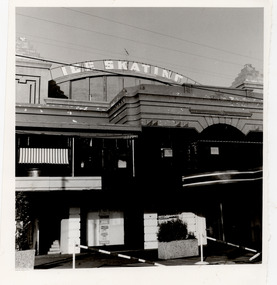
Photograph - Building, St Moritz Ice Skating Rink, c1980s
... As one of only two ice rinks in Melbourne in the 1940s and 1950s, it played a central role to the sport of ice hockey in Australia. Closed in 1982, it soon suffered a major fire and was then demolished, an event later seen as a major blow to the heritage of St Kilda. ...As one of only two ice rinks in Melbourne in the 1940s and 1950s, it played a central role to the sport of ice hockey in Australia. Closed in 1982, it soon suffered a major fire and was then demolished, an event later seen as a major blow to the heritage of St Kilda. ...The St. Moritz Ice Rink was a popular ice skating rink on The Esplanade, St. Kilda, Victoria. It operated between 1939–1981. As one of only two ice rinks in Melbourne in the 1940s and 1950s, it played a central role to the sport of ice hockey in Australia. Closed in 1982, it soon suffered a major fire and was then demolished, an event later seen as a major blow to the heritage of St Kilda. It was first built as the Wattle Path Palais de Danse in 1922, a very large dance hall, designed by architects Beaver & Purnell, The Wattle Path was the venue for the first all-Australian dance championship, and featured some of the best dance bands of Australia, as well as from America. Popular throughout the 1920s, it suffered due to the Great Depression, and closed in the early 1930s. From 1933-1936 the building became a film studio, Efftee Studios, for Frank W. Thring. In 1938, businessman Henry Hans "Harry" Kleiner announced that the Wattle Path would become an ice rink. He was sole proprietor until 1953, when he sold the business to J. Gordon and T. Molony, both champion skaters. Trade declined during the 1970s. The building was sold in 1980 to developers Hudson Conway and trucking magnate Lindsay Fox and was closed in early 1982. It was nominated to the Historic Buildings Preservation Council, but a majority of City of St Kilda councillors voted to oppose this action and uphold a demolition permit already issued. The building infamously suffered a fire later that year, leaving only the facades, which were demolished soon after. The site remained vacant until about 1991, when a mid-price hotel called the St Moritz was constructed. By 1993 it was simply called the Novotel St Kilda. The hotel closed in 2019 and was replaced by an apartment complex.Black and white photograph, unmounteddavid rae collection, st kilda, st moritz -
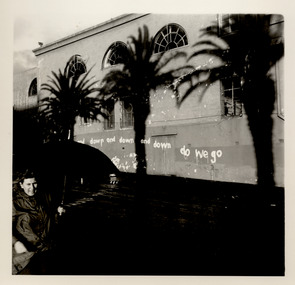 St Kilda Historical Society
Photograph - Photograph Building, St Moritz Ice Skating Rink, c1980s
... As one of only two ice rinks in Melbourne in the 1940s and 1950s, it played a central role to the sport of ice hockey in Australia. Closed in 1982, it soon suffered a major fire and was then demolished, an event later seen as a major blow to the heritage of St Kilda. ...As one of only two ice rinks in Melbourne in the 1940s and 1950s, it played a central role to the sport of ice hockey in Australia. Closed in 1982, it soon suffered a major fire and was then demolished, an event later seen as a major blow to the heritage of St Kilda. ...The St. Moritz Ice Rink was a popular ice skating rink on The Esplanade, St. Kilda, Victoria. It operated between 1939–1981. As one of only two ice rinks in Melbourne in the 1940s and 1950s, it played a central role to the sport of ice hockey in Australia. Closed in 1982, it soon suffered a major fire and was then demolished, an event later seen as a major blow to the heritage of St Kilda. It was first built as the Wattle Path Palais de Danse in 1922, a very large dance hall, designed by architects Beaver & Purnell, The Wattle Path was the venue for the first all-Australian dance championship, and featured some of the best dance bands of Australia, as well as from America. Popular throughout the 1920s, it suffered due to the Great Depression, and closed in the early 1930s. From 1933-1936 the building became a film studio, Efftee Studios, for Frank W. Thring. In 1938, businessman Henry Hans "Harry" Kleiner announced that the Wattle Path would become an ice rink. He was sole proprietor until 1953, when he sold the business to J. Gordon and T. Molony, both champion skaters. Trade declined during the 1970s. The building was sold in 1980 to developers Hudson Conway and trucking magnate Lindsay Fox and was closed in early 1982. It was nominated to the Historic Buildings Preservation Council, but a majority of City of St Kilda councillors voted to oppose this action and uphold a demolition permit already issued. The building infamously suffered a fire later that year, leaving only the facades, which were demolished soon after. The site remained vacant until about 1991, when a mid-price hotel called the St Moritz was constructed. By 1993 it was simply called the Novotel St Kilda. The hotel closed in 2019 and was replaced by an apartment complex.Black and white photograph, unmounteddavid rae collection, st kilda, st moritz -
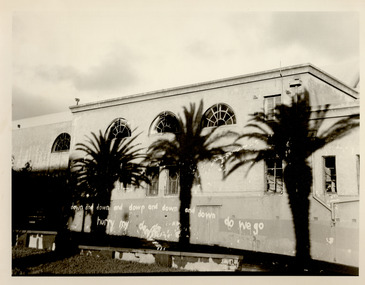 St Kilda Historical Society
Photograph - Building, St Moritz Ice Skating Rink, c1980s
... As one of only two ice rinks in Melbourne in the 1940s and 1950s, it played a central role to the sport of ice hockey in Australia. Closed in 1982, it soon suffered a major fire and was then demolished, an event later seen as a major blow to the heritage of St Kilda. ...As one of only two ice rinks in Melbourne in the 1940s and 1950s, it played a central role to the sport of ice hockey in Australia. Closed in 1982, it soon suffered a major fire and was then demolished, an event later seen as a major blow to the heritage of St Kilda. ...The St. Moritz Ice Rink was a popular ice skating rink on The Esplanade, St. Kilda, Victoria. It operated between 1939–1981. As one of only two ice rinks in Melbourne in the 1940s and 1950s, it played a central role to the sport of ice hockey in Australia. Closed in 1982, it soon suffered a major fire and was then demolished, an event later seen as a major blow to the heritage of St Kilda. It was first built as the Wattle Path Palais de Danse in 1922, a very large dance hall, designed by architects Beaver & Purnell, The Wattle Path was the venue for the first all-Australian dance championship, and featured some of the best dance bands of Australia, as well as from America. Popular throughout the 1920s, it suffered due to the Great Depression, and closed in the early 1930s. From 1933-1936 the building became a film studio, Efftee Studios, for Frank W. Thring. In 1938, businessman Henry Hans "Harry" Kleiner announced that the Wattle Path would become an ice rink. He was sole proprietor until 1953, when he sold the business to J. Gordon and T. Molony, both champion skaters. Trade declined during the 1970s. The building was sold in 1980 to developers Hudson Conway and trucking magnate Lindsay Fox and was closed in early 1982. It was nominated to the Historic Buildings Preservation Council, but a majority of City of St Kilda councillors voted to oppose this action and uphold a demolition permit already issued. The building infamously suffered a fire later that year, leaving only the facades, which were demolished soon after. The site remained vacant until about 1991, when a mid-price hotel called the St Moritz was constructed. By 1993 it was simply called the Novotel St Kilda. The hotel closed in 2019 and was replaced by an apartment complex.Black and white photograph, unmounteddavid rae collection, st kilda, st moritz -
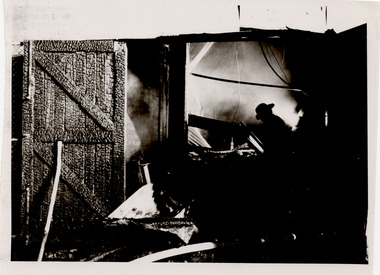 St Kilda Historical Society
Photograph - Building, St Moritz Ice Skating Rink, 1982
... As one of only two ice rinks in Melbourne in the 1940s and 1950s, it played a central role to the sport of ice hockey in Australia. Closed in 1982, it soon suffered a major fire and was then demolished, an event later seen as a major blow to the heritage of St Kilda. ...As one of only two ice rinks in Melbourne in the 1940s and 1950s, it played a central role to the sport of ice hockey in Australia. Closed in 1982, it soon suffered a major fire and was then demolished, an event later seen as a major blow to the heritage of St Kilda. ...The St. Moritz Ice Rink was a popular ice skating rink on The Esplanade, St. Kilda, Victoria. It operated between 1939–1981. As one of only two ice rinks in Melbourne in the 1940s and 1950s, it played a central role to the sport of ice hockey in Australia. Closed in 1982, it soon suffered a major fire and was then demolished, an event later seen as a major blow to the heritage of St Kilda. It was first built as the Wattle Path Palais de Danse in 1922, a very large dance hall, designed by architects Beaver & Purnell, The Wattle Path was the venue for the first all-Australian dance championship, and featured some of the best dance bands of Australia, as well as from America. Popular throughout the 1920s, it suffered due to the Great Depression, and closed in the early 1930s. From 1933-1936 the building became a film studio, Efftee Studios, for Frank W. Thring. In 1938, businessman Henry Hans "Harry" Kleiner announced that the Wattle Path would become an ice rink. He was sole proprietor until 1953, when he sold the business to J. Gordon and T. Molony, both champion skaters. Trade declined during the 1970s. The building was sold in 1980 to developers Hudson Conway and trucking magnate Lindsay Fox and was closed in early 1982. It was nominated to the Historic Buildings Preservation Council, but a majority of City of St Kilda councillors voted to oppose this action and uphold a demolition permit already issued. The building infamously suffered a fire later that year, leaving only the facades, which were demolished soon after. The site remained vacant until about 1991, when a mid-price hotel called the St Moritz was constructed. By 1993 it was simply called the Novotel St Kilda. The hotel closed in 2019 and was replaced by an apartment complex.This photo was taken during the fire in 1982.Black and white photograph, unmounteddavid rae collection, st kilda, st moritz -
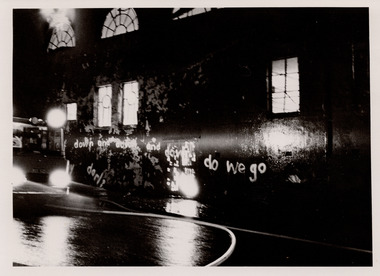 St Kilda Historical Society
Photograph - Building, St Moritz Ice Skating Rink, 1982
... As one of only two ice rinks in Melbourne in the 1940s and 1950s, it played a central role to the sport of ice hockey in Australia. Closed in 1982, it soon suffered a major fire and was then demolished, an event later seen as a major blow to the heritage of St Kilda. ...As one of only two ice rinks in Melbourne in the 1940s and 1950s, it played a central role to the sport of ice hockey in Australia. Closed in 1982, it soon suffered a major fire and was then demolished, an event later seen as a major blow to the heritage of St Kilda. ...The St. Moritz Ice Rink was a popular ice skating rink on The Esplanade, St. Kilda, Victoria. It operated between 1939–1981. As one of only two ice rinks in Melbourne in the 1940s and 1950s, it played a central role to the sport of ice hockey in Australia. Closed in 1982, it soon suffered a major fire and was then demolished, an event later seen as a major blow to the heritage of St Kilda. It was first built as the Wattle Path Palais de Danse in 1922, a very large dance hall, designed by architects Beaver & Purnell, The Wattle Path was the venue for the first all-Australian dance championship, and featured some of the best dance bands of Australia, as well as from America. Popular throughout the 1920s, it suffered due to the Great Depression, and closed in the early 1930s. From 1933-1936 the building became a film studio, Efftee Studios, for Frank W. Thring. In 1938, businessman Henry Hans "Harry" Kleiner announced that the Wattle Path would become an ice rink. He was sole proprietor until 1953, when he sold the business to J. Gordon and T. Molony, both champion skaters. Trade declined during the 1970s. The building was sold in 1980 to developers Hudson Conway and trucking magnate Lindsay Fox and was closed in early 1982. It was nominated to the Historic Buildings Preservation Council, but a majority of City of St Kilda councillors voted to oppose this action and uphold a demolition permit already issued. The building infamously suffered a fire later that year, leaving only the facades, which were demolished soon after. The site remained vacant until about 1991, when a mid-price hotel called the St Moritz was constructed. By 1993 it was simply called the Novotel St Kilda. The hotel closed in 2019 and was replaced by an apartment complex.This photo was taken during the fire in 1982.Black and white photograph, unmounteddavid rae collection, st kilda, st moritz -
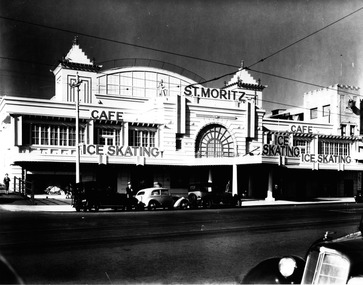 St Kilda Historical Society
Photograph, St Moritz St Kilda - images collection #1, c1940s
... As one of only two ice rinks in Melbourne in the 1940s and 1950s, it played a central role to the sport of ice hockey in Australia. Closed in 1982, it soon suffered a major fire and was then demolished, an event later seen as a major blow to the heritage of St Kilda. ...As one of only two ice rinks in Melbourne in the 1940s and 1950s, it played a central role to the sport of ice hockey in Australia. Closed in 1982, it soon suffered a major fire and was then demolished, an event later seen as a major blow to the heritage of St Kilda. ...The St. Moritz Ice Rink was a popular ice skating rink on The Esplanade, St. Kilda, Victoria. It operated between 1939–1981. As one of only two ice rinks in Melbourne in the 1940s and 1950s, it played a central role to the sport of ice hockey in Australia. Closed in 1982, it soon suffered a major fire and was then demolished, an event later seen as a major blow to the heritage of St Kilda. It was first built as the Wattle Path Palais de Danse in 1922, a very large dance hall, designed by architects Beaver & Purnell, The Wattle Path was the venue for the first all-Australian dance championship, and featured some of the best dance bands of Australia, as well as from America. Popular throughout the 1920s, it suffered due to the Great Depression, and closed in the early 1930s. From 1933-1936 the building became a film studio, Efftee Studios, for Frank W. Thring. In 1938, businessman Henry Hans "Harry" Kleiner announced that the Wattle Path would become an ice rink. He was sole proprietor until 1953, when he sold the business to J. Gordon and T. Molony, both champion skaters. Trade declined during the 1970s. The building was sold in 1980 to developers Hudson Conway and trucking magnate Lindsay Fox and was closed in early 1982. It was nominated to the Historic Buildings Preservation Council, but a majority of City of St Kilda councillors voted to oppose this action and uphold a demolition permit already issued. The building infamously suffered a fire later that year, leaving only the facades, which were demolished soon after. The site remained vacant until about 1991, when a mid-price hotel called the St Moritz was constructed. By 1993 it was simply called the Novotel St Kilda. The hotel closed in 2019 and was replaced by an apartment complex.black and white photographSt Moritz, St Kilda. Ice Skating. Caf�st moritz, st kilda, the esplanade, ice skating -
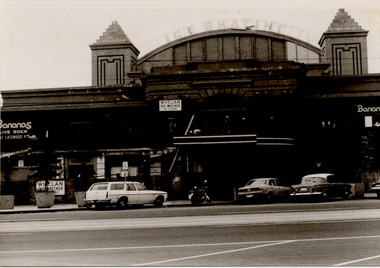 St Kilda Historical Society
Photograph - Building, St Moritz Ice Skating Rink, 1982
... As one of only two ice rinks in Melbourne in the 1940s and 1950s, it played a central role to the sport of ice hockey in Australia. Closed in 1982, it soon suffered a major fire and was then demolished, an event later seen as a major blow to the heritage of St Kilda. ...As one of only two ice rinks in Melbourne in the 1940s and 1950s, it played a central role to the sport of ice hockey in Australia. Closed in 1982, it soon suffered a major fire and was then demolished, an event later seen as a major blow to the heritage of St Kilda. ...The St. Moritz Ice Rink was a popular ice skating rink on The Esplanade, St. Kilda, Victoria. It operated between 1939–1981. As one of only two ice rinks in Melbourne in the 1940s and 1950s, it played a central role to the sport of ice hockey in Australia. Closed in 1982, it soon suffered a major fire and was then demolished, an event later seen as a major blow to the heritage of St Kilda. It was first built as the Wattle Path Palais de Danse in 1922, a very large dance hall, designed by architects Beaver & Purnell, The Wattle Path was the venue for the first all-Australian dance championship, and featured some of the best dance bands of Australia, as well as from America. Popular throughout the 1920s, it suffered due to the Great Depression, and closed in the early 1930s. From 1933-1936 the building became a film studio, Efftee Studios, for Frank W. Thring. In 1938, businessman Henry Hans "Harry" Kleiner announced that the Wattle Path would become an ice rink. He was sole proprietor until 1953, when he sold the business to J. Gordon and T. Molony, both champion skaters. Trade declined during the 1970s. The building was sold in 1980 to developers Hudson Conway and trucking magnate Lindsay Fox and was closed in early 1982. It was nominated to the Historic Buildings Preservation Council, but a majority of City of St Kilda councillors voted to oppose this action and uphold a demolition permit already issued. The building infamously suffered a fire later that year, leaving only the facades, which were demolished soon after. The site remained vacant until about 1991, when a mid-price hotel called the St Moritz was constructed. By 1993 it was simply called the Novotel St Kilda. The hotel closed in 2019 and was replaced by an apartment complex. The photograph shows signs and workers of Whelan the Wrecker team, a well-known demolition company in Melbourne.Black and white photograph, unmounteddavid rae collection, st kilda, st moritz -
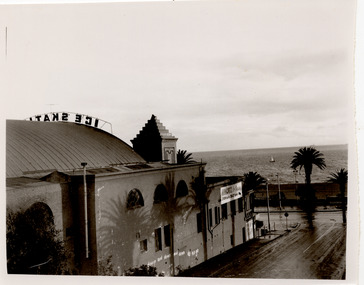 St Kilda Historical Society
Photograph - Building, St Kilda Shout Collective, St Moritz Ice Skating Rink, 1983
... As one of only two ice rinks in Melbourne in the 1940s and 1950s, it played a central role to the sport of ice hockey in Australia. Closed in 1982, it soon suffered a major fire and was then demolished, an event later seen as a major blow to the heritage of St Kilda. ...As one of only two ice rinks in Melbourne in the 1940s and 1950s, it played a central role to the sport of ice hockey in Australia. Closed in 1982, it soon suffered a major fire and was then demolished, an event later seen as a major blow to the heritage of St Kilda. ...The St. Moritz Ice Rink was a popular ice skating rink on The Esplanade, St. Kilda, Victoria. It operated between 1939–1981. As one of only two ice rinks in Melbourne in the 1940s and 1950s, it played a central role to the sport of ice hockey in Australia. Closed in 1982, it soon suffered a major fire and was then demolished, an event later seen as a major blow to the heritage of St Kilda. It was first built as the Wattle Path Palais de Danse in 1922, a very large dance hall, designed by architects Beaver & Purnell, The Wattle Path was the venue for the first all-Australian dance championship, and featured some of the best dance bands of Australia, as well as from America. Popular throughout the 1920s, it suffered due to the Great Depression, and closed in the early 1930s. From 1933-1936 the building became a film studio, Efftee Studios, for Frank W. Thring. In 1938, businessman Henry Hans "Harry" Kleiner announced that the Wattle Path would become an ice rink. He was sole proprietor until 1953, when he sold the business to J. Gordon and T. Molony, both champion skaters. Trade declined during the 1970s. The building was sold in 1980 to developers Hudson Conway and trucking magnate Lindsay Fox and was closed in early 1982. It was nominated to the Historic Buildings Preservation Council, but a majority of City of St Kilda councillors voted to oppose this action and uphold a demolition permit already issued. The building infamously suffered a fire later that year, leaving only the facades, which were demolished soon after. The site remained vacant until about 1991, when a mid-price hotel called the St Moritz was constructed. By 1993 it was simply called the Novotel St Kilda. The hotel closed in 2019 and was replaced by an apartment complex. The image was published with an article about the fire and demolition of the rink in the Mar/Apr 1983 edition of community newspaper Shout.Black and white photograph, unmounteddavid rae collection, st kilda, st moritz -
 St Kilda Historical Society
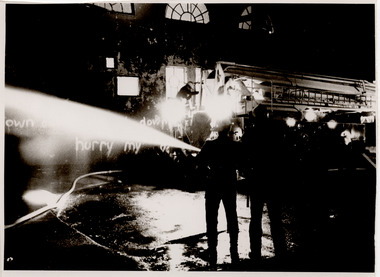
Photograph - Building, St Kilda Shout Collective, St Moritz Ice Skating Rink, 1983
... As one of only two ice rinks in Melbourne in the 1940s and 1950s, it played a central role to the sport of ice hockey in Australia. Closed in 1982, it soon suffered a major fire and was then demolished, an event later seen as a major blow to the heritage of St Kilda. ...As one of only two ice rinks in Melbourne in the 1940s and 1950s, it played a central role to the sport of ice hockey in Australia. Closed in 1982, it soon suffered a major fire and was then demolished, an event later seen as a major blow to the heritage of St Kilda. ...The St. Moritz Ice Rink was a popular ice skating rink on The Esplanade, St. Kilda, Victoria. It operated between 1939–1981. As one of only two ice rinks in Melbourne in the 1940s and 1950s, it played a central role to the sport of ice hockey in Australia. Closed in 1982, it soon suffered a major fire and was then demolished, an event later seen as a major blow to the heritage of St Kilda. It was first built as the Wattle Path Palais de Danse in 1922, a very large dance hall, designed by architects Beaver & Purnell, The Wattle Path was the venue for the first all-Australian dance championship, and featured some of the best dance bands of Australia, as well as from America. Popular throughout the 1920s, it suffered due to the Great Depression, and closed in the early 1930s. From 1933-1936 the building became a film studio, Efftee Studios, for Frank W. Thring. In 1938, businessman Henry Hans "Harry" Kleiner announced that the Wattle Path would become an ice rink. He was sole proprietor until 1953, when he sold the business to J. Gordon and T. Molony, both champion skaters. Trade declined during the 1970s. The building was sold in 1980 to developers Hudson Conway and trucking magnate Lindsay Fox and was closed in early 1982. It was nominated to the Historic Buildings Preservation Council, but a majority of City of St Kilda councillors voted to oppose this action and uphold a demolition permit already issued. The building infamously suffered a fire later that year, leaving only the facades, which were demolished soon after. The site remained vacant until about 1991, when a mid-price hotel called the St Moritz was constructed. By 1993 it was simply called the Novotel St Kilda. The hotel closed in 2019 and was replaced by an apartment complex. The image was published with an article about the fire and demolition of the rink in the Mar/Apr 1983 edition of community newspaper Shout.This photo was taken during the fire in 1982.Black and white photograph, unmounteddavid rae collection, st kilda, st moritz -
 Falls Creek Historical Society
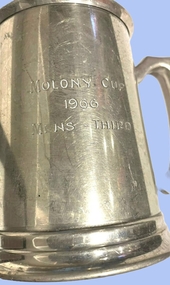
Award - Pewter Mug Trophies - Ross and Malcolm Milne - Molony Cup 1966 - Third
... Several members of the family were recognised ice hockey and figure skaters who have represented Australia in international winter events including the 1952 Olympic Games in Oslo, Norway and the 1976 Innsbruck Winter Olympics. ...Several members of the family were recognised ice hockey and figure skaters who have represented Australia in international winter events including the 1952 Olympic Games in Oslo, Norway and the 1976 Innsbruck Winter Olympics. ...This Pewter Mug Collection is a set of 32 trophies won by Australian Alpine skiers Ross and Malcolm Milne between 1959 and 1964. Ross and Malcolm grew up on their family's tobacco property in Myrtleford, and began skiing at Falls Creek at an early age. They were both taught by Austrian Sigi Haberzettl, who was chief coach at Falls Creek for 17 years. Ross went on to win the North-Eastern District Ski Association (NEDSA) Junior Championships for three years in a row. In 1961 Ross was a member of the Australian team which competed against New Zealand in the Inter-Dominion Championships. In 1963, he won the Downhill and Alpine Combined title at the Australian Championships, while placing second in the Grand Slalom event. Ross Milne was selected in the Australian team that participated in the 1964 Olympic Winter Games at Innsbruck, Austria. A few days before the opening of the Games, on 25 January 1964, he tragically lost his life when he crashed into a tree during a training run for the Men's Downhill. He was only 19 years of age. Malcolm became a member of the Australian Junior Ski Team to Japan at the age of 14. He won all of the NEDSA children’s races and won the State Title in 1966. Malcolm continued to achieve great success, winning the Australian Championships for the next five years. At the end of 1969 he won Gold in the Val d'Isere FIS Alpine Ski World Cup Downhill, Australia's first Alpine Ski World Cup medal. He was on the Australian National Ski Team for eight years, representing his country at the 1968 and 1972 Olympic Games and the 1966 and 1970 World Championships before turning professional in 1972. Malcolm Milne was inducted into the Sport Australia Hall of Fame in 1985. In 2000 he received the Australian Sports Medal for his contribution to skiing. In 2004, Ski & Snowboard Australia granted Milne Life Membership for the contribution he made to the sport by becoming the first World Cup medal winner in Australian winter sports history, and the subsequent impact his performances have had on future athletes. Malcolm Milne was awarded the Medal of the Order of Australia (OAM) for services to skiing in 2016. James Malony originally established his business in 1854 in King Street Melbourne. The family owned business of J. Molony initially specialised in shoemaking. Several members of the family were recognised ice hockey and figure skaters who have represented Australia in international winter events including the 1952 Olympic Games in Oslo, Norway and the 1976 Innsbruck Winter Olympics. Molony’s in Elizabeth Street expanded their business with a focus on ski equipment, opening new premises in Falls Creek in 1960. They sponsored several events included the Malony Cup, a Grand Slalom event held at Falls Creek.This item is significant because it is part of a collection which documents the career of two outstanding Australian sportsmen.A pewter mug awarded for Moloney Cup 1966Engraved on side of mug: Molony Cup 1966 MENS THIRDross milne, malcolm milne, milne brothers, australian alpine skiers, j. malony -
 City of Melbourne Libraries
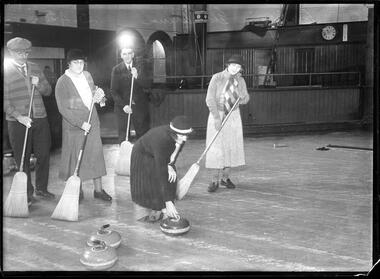
Photograph, Bull, Hugh Jones, 1897-1993, Curling at the Glaciarium, South Melbourne
... ice rink in the world at the time. There was seating for 2000 people which was heated with hot water pipes, and they could hire out 1500 pairs of skates. Up to 5000 people could attend hockey...ice rink in the world at the time. There was seating for 2000 people which was heated with hot water pipes, and they could hire out 1500 pairs of skates. Up to 5000 people could attend hockey ...Curling at the Glaciarium Mr A G Outhwaite, Mrs Lorna Moffatt-Pender and others, play a game of curling at Melbourne’s Glaciarium, c1933. “Game for Women who are “getting on”!” ran The Herald headline reporting that, “Mrs Moffatt-Pender finds curling a delightful game for the woman who is not quite as young as she was and wants something livelier than croquet. “There is no reason why women should not play up to 50 years of age. And there is always the domestic appeal of the broom which accompanies the curler on ice. Accuracy is the great thing in the game.” Arthur Grenby Outhwaite co-wrote popular “fairy” books, illustrated by his wife, Ida Rentoul Outhwaite. Featured in "Newsworthy: Melbourne in photographs 1933-1936" exhibition at East Melbourne Library, October to December 2023. Exhibition caption by project volunteer, Fiona Collyer. Photographer notations on slide: "Curling - Glaciarium B42" Description: Mr A G Outhwaite, Mrs Lorna Moffatt-Pender, Mrs S J Allen and two unidentified people play a game of curling at Melbourne Glaciarium. Research by project volunteer, Fiona Collyer: Mr Arthur Grenby Outhwaite was married to Ida Rentoul Outhwaite, who was regarded as Australia’s greatest children’s book illustrator and they, along with Ida’s sister Annie, collaborated on many books about fairies, elves and koalas. Ida designed four beautiful stained glass windows at St Marks Fitzroy, which are still there. Mrs Lorna Moffatt-Pender née Smith was married to Captain Iain Moffatt-Pender, a former Scottish Rugby Union international player and Seaforth Highlander in WWI, before he emigrated to Australia and became a wealthy sheep farmer. They were both keen curlers and participated in the NZ v Australia bonspiels at Melbourne Glaciarium in 1935. According to The Herald 9/4/1934, Mrs Moffatt-Pender wore fur-lined suede moccasins on the ice and found curling to be "a delightful game for the woman who is not quite as young as she was and wants something livelier than croquet. “There is no reason why women should not play up to 50 years of age. And there is always the domestic appeal of the broom which accompanies the curler on ice. There is a good sprinkling of women among curlers overseas. Accuracy is the great thing in the game.”" The Curling Club of Australia was formed in Melbourne in 1933 with Wimbledon Singles Champion 1907 and 1914, Sir Norman Brookes, the inaugural president. It disbanded in 1939. Curling was invented in Scotland in 1541, where the tradition is that the laird and the crofter are the same on the ice and after bonspiels (curling tournaments) everybody adjourn for a meal of beef and greens. Rocks of granite are sourced from the Scottish island of Ailsa Craig and weigh 20 kg each. Curling is similar to lawn bowls, but on ice. Two teams of four people each take turns to slide granite stones towards a target known as a house. The team with the most rocks closest to the centre of the house, scores points. Curling stones are delivered with a pre-determent rotation so that they curl as they travel – hence “curling”. Opposition teams can throw guards to block the house or take out the opponent’s stone. The sweeping is to gently warm the surface of the ice where the stone will glide, to extend the path of the stone. In 1934, an Australian team which included the Moffatt-Penders, travelled to New Zealand to compete in a bonspiel on frozen Idaburn Dam near Oturehua, Central Otago. New Zealand won. In June 1935, for the Melbourne Centenary, the New Zealand team came to Melbourne to compete for the Silver Fern Trophy. They voyaged on the M.S. Wanganella and the crew nicknamed the curlers the “Ladies Hairdressers”. Australia won two tests and the third test was a draw. At the conclusion of the bonspiel, a secret, centuries old initiation was held at a “curlers’ court” at Anzac House with seven Australian curlers initiated. Afterwards, a dinner was held at the Occidental Hotel (corner of Exhibition and Collins streets, demolished 1950s), where the haggis was carried in under an archway of curling brooms. The “Ode to the Haggis” was recited by “My Lord of the Court”, Captain Moffatt-Pender before he presented each New Zealand team member with a miniature curling stone as a souvenir of their visit. The Melbourne Glaciarium (also known as "The Glaci" or "The Glassy") opened in 1906 at 16 City Road, South Melbourne and was the third largest ice rink in the world at the time. There was seating for 2000 people which was heated with hot water pipes, and they could hire out 1500 pairs of skates. Up to 5000 people could attend hockey matches and ice sports carnivals at any one time. Patrons could watch films in summer or dance to the Glaciarium’s own orchestra conducted by Frank Bladen, who had played with the Pavlova and the Gilbert and Sullivan orchestras. In 1911 John Sousa, creator of the Sousaphone, and his band played a season of concerts. In 1924, the Glaciarium was turned into a makeshift film studio for filming of the interior scenes of "Jewelled Nights", starring Australian actress Louise Lovely, who had achieved success in Hollywood. The basketball and gymnastic competitions for the 1956 Melbourne Olympic Games were held there. Public skating sessions always finished with “Till we Meet Again”, a popular WWI song about the parting of a soldier and his sweetheart, written by Richard A Whiting and Raymond B Egan. The Glaciarium closed in 1959 and was demolished after a fire in 1963. References: WOMAN CURLER RETURNS (1934, April 9). The Herald (Melbourne, Vic. : 1861 - 1954), p. 14. Retrieved September 14, 2023, from http://nla.gov.au/nla.news-article243253779 CURLERS INITIATED (1935, June 24). The Argus (Melbourne, Vic. : 1848 - 1957), p. 4. Retrieved February 2, 2024, from http://nla.gov.au/nla.news-article12251790 Melbourne Glaciarium, Only Melbourne, https://www.onlymelbourne.com.au/melbourne-glaciarium Melbourne Glaciarium, Legends of Australian Ice, https://icelegendsaustralia.com/glaciariums.htmlPhotographer notations on slide: "Curling - Glaciarium B42".curling, 1930-1939, glaciarium, fires
