
Showing 5 items matching "indian immigrant"
-
 Flagstaff Hill Maritime Museum and Village
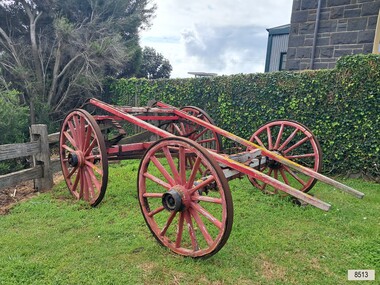
Vehicle - Wagon, Circa 1909
... ...Indian immigrant...This wagon was used in towns across south-west Victoria during the first half of the twentieth century by Pooran Singh, an Indian-born immigrant. Singh arrived in Australia alone in 1899 at the age of 30. ...This wagon was used in towns across south-west Victoria during the first half of the twentieth century by Pooran Singh, an Indian-born immigrant. Singh arrived in Australia alone in 1899 at the age of 30. ...This wagon was used in towns across south-west Victoria during the first half of the twentieth century by Pooran Singh, an Indian-born immigrant. Singh arrived in Australia alone in 1899 at the age of 30. The following year, at the Colac Licensing Court in western Victoria, he was one of 78 hawkers granted a Hawker’s Licence. According to the Colac Herald, all but two of the applicants appeared to be Asian. While some hawkers registered horse-drawn carts, Singh was one of nineteen licensed to trade on foot, selling door to door. Applicants were encouraged to contribute to a collection for the Colac Hospital. Over time, Pooran Singh came to own his own wagon—a top-of-the-range light delivery vehicle—and a horse named Prince. His work often took him along rough country roads, and for a period, he worked in the Corryong district of north-eastern Victoria, an area popular with hawkers. In September 1909, near Thowgla, he was thrown from his wagon while attempting to navigate a deep rut and was run over by one of its wheels. Although he suffered bruising to his chest, his injuries were not serious. The following year, he was granted a Hawker’s Licence in Corryong. By 1916, Singh was living and working at Garvoc in western Victoria, where that year, he lost his paper licence on Cooramook Road, and he placed a notice in The Standard. In 1918, at the Warrnambool Petty Sessions Court, he was one of four applicants granted renewal of their hawkers’ licences, and each donated ten shillings to Warrnambool Hospital. Throughout these years, Singh became well known to farmers and their families as he travelled across Victoria’s Western District, living and working from his covered wagon. In his later years, Pooran Singh formed a close friendship with John Jandes Moore and his wife, Vera, of Russells Creek, Warrnambool. They offered him the use of their property as a base for his travels and cared for him during his final illness. John Moore was later appointed one of the two executors of Singh’s will. Pooran Singh died in Warrnambool on 8 June 1947, aged 77. His final wish was to be cremated and for his ashes to be returned to India for immersion in the Ganges. The cremation was arranged by Guyett’s Funerals in Warrnambool. Having never married, Singh left his estate to his four nephews, enabling them to buy land and build homes; one later installed a memorial plaque in his honour. In the late 1980s, Guyett’s Funerals placed his ashes in the niche wall at Warrnambool Cemetery as a memorial, while continuing to hope that family instructions might eventually arrive. Nearly 63 years after his death, renewed enquiries brought public attention to the long and respectful care given to his ashes. As a result, the renowned Indian cricketer Kapil Dev travelled to Warrnambool to collect them and escort them to India, helping to fulfil Singh’s final wish. He was joined by one of Singh’s grand-nephews, Harmel Uppal, who had travelled from England. At a formal ceremony on 25 July 2010 commemorating Singh’s life, the ashes were handed to Dev and Uppal, and local resident Avis Quarrell, who had known Singh as a child, read a poem she had written in his memory. She still owned a shell necklace that Singh had made for her mother. Some Warrnambool locals who had been closely involved also travelled to India, where they joined Uppal’s family from the village of Uppal Bhopa, near Jalandhar. On 31 July 2010, Pooran Singh’s ashes were immersed in the Ganges, fulfilling the wish he had expressed more than six decades earlier. After Pooran Singh’s death, his horse and wagon remained on John Moore’s property. When Prince died, he was buried on the beach at Warrnambool. The wagon remained with the Moore family and was occasionally used as a cubby house. In about 1997, John Moore, the son of John Jandes Moore, donated it to Flagstaff Hill. After restoration, the wagon became an attraction in the village, where volunteer Pat and his Clydesdale horse, Duke, offered visitors rides around Flagstaff Hill’s lake. This wagon is significant for its association with an Indian emigrant who used it to earn an income in Australia. It also reflects the vital role of hawkers, who travelled through rural and regional communities in the late nineteenth and early twentieth centuries, supplying food, goods and news. The wagon is also historically significant as a former Flagstaff Hill attraction, offering visitors the experience of horse-drawn rides around the lake.Wagon: a light delivery vehicle once used as a hawker's wagon. It is a four-wheel, horse-drawn vehicle with iron tyres, brakes, spoked wheels painted red with decorative yellow strips on the hubs, a timber shaft, and springs on the undercarriage. It was once a covered wagon, fitted with green, wooden sideboards, a front seat with leather-padded backrest and mounting steps. The late-19th to early-20th-century wagon was once owned by Pooran Singh, a local Indian hawker. flagstaff hill, warrnambool, maritime village, maritime museum, flagstaff hill maritime museum and village, shipwreck coast, great ocean road, southwest victoria, northwest victoria, western district, colac, colac hospital, colac licensing court, thowgla, corryong, garvoc, cooramook road, warrnambool petty sessions court, warrnambool hospital, russells creek road, ganges, warrnambool cemetery, uppal bhopa, jalandhar, hawker’s licence, covered wagon, wagon, hawker's wagon, horse-drawn cart, hawker's cart, light delivery vehicle, hawker, travelling salesman, travelling hawker, door-to-door sales, rural salesman, rural commerce, prince, duke, clydesdale horse, 1997, pooran singh, indian immigrant, pat, john james moore, vera moore, john and vera moore, john moore, guyatt’s funerals, kapil dev, harmel uppal, avis quarrell -
 Flagstaff Hill Maritime Museum and Village
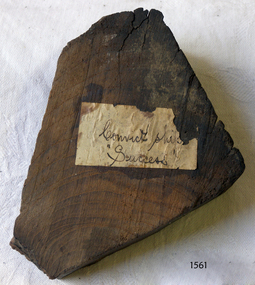
Wood Sample, 1840
... immigrant ship, and later a convict hulk at Melbourne. The sailing ship “Success” was a teakwood vessel built in Natmoo (Natmaw), Tenasserim, Burma (now Myanmar) in 1840 for Cockerell & Co., Calcutta. Over its lifetime of 106 years, it was used to trade in the Indian...immigrant ship, and later a convict hulk at Melbourne. The sailing ship “Success” was a teakwood vessel built in Natmoo (Natmaw), Tenasserim, Burma (now Myanmar) in 1840 for Cockerell & Co., Calcutta. Over its lifetime of 106 years, it was used to trade in the Indian ...This shipwreck artefact is a section of wood from the vessel “Success, a former immigrant ship, and later a convict hulk at Melbourne. The sailing ship “Success” was a teakwood vessel built in Natmoo (Natmaw), Tenasserim, Burma (now Myanmar) in 1840 for Cockerell & Co., Calcutta. Over its lifetime of 106 years, it was used to trade in the Indian subcontinent, to transport free emigrants to Australia, as a prison hulk in the Port of Melbourne for both hardened criminals, and later for women and boys, as a storage vessel for ammunition, a reformatory, and as a floating museum sent around the world to tell the tale of the convict era. During the time “Success” was used as a museum, pamphlets were distributed to paying customers advertising erroneously, that the “Success” was the oldest ship in the world. The “Success” sank and was re-floated twice: the first in Sydney in 1885, the second in the USA in 1918, before it was finally burned and sank July 4, 1946 in Lake Erie, near Sandusky, Ohio in 1946. Although the “Success” was home to prisoners while berthed in the Port of Melbourne, it was not used as convict transport. There has been speculation that Ned Kelly’s infamous armour was displayed on the “Success”, but this cannot be verified. Another link to Ned Kelly is Henry Johnson, an Irish prisoner on the Success, who was implicated in the murder of the ship’s warder, and later Johnson was supposedly a bushranger with Ned Kelly. It is also rumoured that Ned Kelly’s father John was a passenger on the Success, but this is also unverified. There are over 16 other ships named “Success”, although one in particular causes some confusion when researching “Success” in Australia. This other ship – the “HMS Success” was a 28 gun frigate built in1823, which was broken up in 1849. It also sailed to Australia. Statement of Significance: This piece of wood from the “Success” is connected to the ship Success, built in Burma in 1840. The “Success” is connected to the history of Australia because she was used as a merchant ship to transport immigrants to Australia, as a prison ship in Melbourne, a storage vessel, and as a floating “convict” museum, which travelled the world. Section of wood from ship “Success”. Wood appears to have been partially burnt, saw marks faintly visible on wood, remnant of a label with handwriting in black inklabel marked in script handwriting “Convict ship / “Success””flagstaff hill, warrnambool, shipwrecked-coast, flagstaff-hill, flagstaff-hill-maritime-museum, maritime-museum, shipwreck-coast, flagstaff-hill-maritime-village, sailing vessel success, wood sample of sailing ship success, cockerell & co. calcutta -
 Flagstaff Hill Maritime Museum and Village
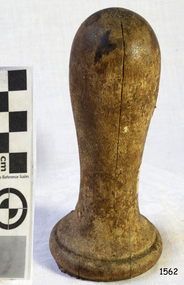
Equipment - Ship's Wheel, 1840
... immigrant ship and later a convict hulk at Melbourne. The sailing ship “Success” was a teakwood vessel built in Natmoo (Natmaw), Tenasserim, Burma (now Myanmar) in 1840 for Cockerell & Co., Calcutta. Over its lifetime of 106 years, it was used to trade in the Indian...immigrant ship and later a convict hulk at Melbourne. The sailing ship “Success” was a teakwood vessel built in Natmoo (Natmaw), Tenasserim, Burma (now Myanmar) in 1840 for Cockerell & Co., Calcutta. Over its lifetime of 106 years, it was used to trade in the Indian ...This wooden spoke handle is from the wheel of the sailing ship “Success”, a former immigrant ship and later a convict hulk at Melbourne. The sailing ship “Success” was a teakwood vessel built in Natmoo (Natmaw), Tenasserim, Burma (now Myanmar) in 1840 for Cockerell & Co., Calcutta. Over its lifetime of 106 years, it was used to trade in the Indian subcontinent, to transport free emigrants to Australia, as a prison hulk in the Port of Melbourne for both hardened criminals, and later for women and boys, as a storage vessel for ammunition, a reformatory, and as a floating museum sent around the world to tell the tale of the convict era. During the time “Success” was used as a museum, pamphlets were distributed to paying customers advertising erroneously, that the “Success” was the oldest ship in the world. The “Success” sank and was re-floated twice: the first in Sydney in 1885, the second in the USA in 1918, before it was finally burned and sank on July 4, 1946 in Lake Erie, near Sandusky, Ohio, in 1946. Although the “Success” was home to prisoners while berthed in the Port of Melbourne, it was not used as convict transport. There has been speculation that Ned Kelly’s infamous armour was displayed on the “Success”, but this cannot be verified. Another link to Ned Kelly is Henry Johnson, an Irish prisoner on the vessel Success, who was implicated in the murder of the ship’s warder. and later, Johnson was supposedly a bushranger with Ned Kelly. It is also rumoured that Ned Kelly’s father John was a passenger on the Success, but this is also unverified. There are over 16 other ships named “Success”, although one in particular causes some confusion when researching “Success” in Australia. This other ship – the “HMS Success” - was a 28 gun frigate built in1823, which was broken up in 1849. It also sailed to Australia.Thiswooden ship's wheel handle was once part of the ship’s wheel of the sailing ship “Success” , which was, built in Burma in 1840. The “Success” is connected to the history of Australia because she was used as a merchant ship to transport immigrants to Australia, and was also used as a prison ship in Melbourne, a storage vessel, and as a floating “convict” museum, which travelled the world. Ship's wheel handle. Hndle from the wheel of sailing ship, the “Success”. The shaped handle is domed at one end, becoming narrower towards the other end, then flattened out into a beveled circle. The handle has an inscription written in pencil."Success"flagstaff hill maritime museum, maritime museum, sailing ship success, ship's wheel spoke, ship's steering wheel, prison ship, prison hulks, convict ship, spoke handle, ship's wheel, navigation equipment, steering wheel -
 Ithacan Historical Society
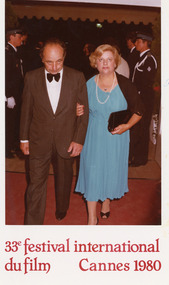
Photograph, Stathi & Kassiani Raftopoulos at Canne Film Festival, 1980
... immigrant population living in inner suburban Melbourne. Stathi's promotion of Greek films in Melbourne helped to establish greater interest in foreign films across the city. Cosmopolitan cinemas were the first to screen Indian ...The photo is of Stathi and Kassiani Raftopoulos arriving at the at 33rd Festival International du Film Cannes in 1980. Stathi was passionate about the motion picture industry and was instrumental in bringing Greek cinema to Australia. At one stage the Cosmopolitan Motion Pictures company, in which he was a partner, operated 12 picture theatres across inner suburban Melbourne screening Greek films. Because of his active interest in the film industry it is no surprise that he attended film festivals.The screening of Greek films at the Cosmopolitan cinemas provided a key source of entertainment to the large post WWII Greek immigrant population living in inner suburban Melbourne. Stathi's promotion of Greek films in Melbourne helped to establish greater interest in foreign films across the city. Cosmopolitan cinemas were the first to screen Indian films in Melbourne.A coloured photograph of a couple in formal attire arriving at an event.33rd. FESTIVAL INTERNATIONAL/ DU FILM CANNES 1980.cannes film festival -
 Ithacan Historical Society
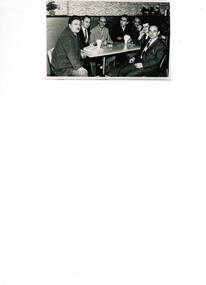
Photograph, Greek film promoters, 1972
... immigrants who settled in Australia were able to enjoy entertainment from Greece. Stathi was a partner in the Cosmopolitan Film company which had a number cinemas in the inner suburbs of Melbourne in the 19600s - early 1980s. Although they screened almost exclusively Greek films, they were the first to bring Indian ...On the right is Stathi Raftopoulos and his business partner Pangiotis (Peter) Giannoudis. The photograph, taken in Sydney in 1972, at a meeting of men involved in the Greek theatre/film industry. One of the men is a Mr. Heliopolis, a member of the Greek Heliopolis Theatre visiting Australia. Stathi Raftopoulos was active in promoting Greek film and live performances in Australia from the 1950s through to the 1970s. As a result of the efforts of Stathi Raftopoulos to bring Greek theatre and films to Australia many of the post WW2 Greek immigrants who settled in Australia were able to enjoy entertainment from Greece. Stathi was a partner in the Cosmopolitan Film company which had a number cinemas in the inner suburbs of Melbourne in the 19600s - early 1980s. Although they screened almost exclusively Greek films, they were the first to bring Indian films to Australia.A black and white photograph of seven men sitting around a table in a cafe.
