
Showing 3 items matching "indigenous australians wodonga"
-
 Wodonga & District Historical Society Inc
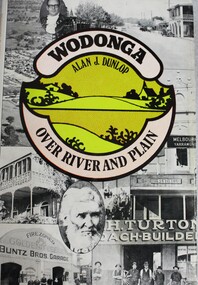
Book - Wodonga Over River and Plain, Alan J. Dunlop, 1976
... ...indigenous australians wodonga...victoria. wodonga settlers wodonga indigenous australians wodonga A great local history of the Wodonga area. ...A great local history of the Wodonga area. Starts with discussion of the Aboriginal inhabitants of the region and early contacts with European explorers and settlers. Explains the establishing of a customs post with its twin city Albury on the other side of the Murray River. The town grew subsequent to the opening of the first bridge across the Murray in 1860. Originally named Wodonga, its name was changed to Belvoir then later back to Wodonga.non-fictionA great local history of the Wodonga area. Starts with discussion of the Aboriginal inhabitants of the region and early contacts with European explorers and settlers. Explains the establishing of a customs post with its twin city Albury on the other side of the Murray River. The town grew subsequent to the opening of the first bridge across the Murray in 1860. Originally named Wodonga, its name was changed to Belvoir then later back to Wodonga.victoria. wodonga, settlers wodonga, indigenous australians wodonga -
 Wodonga & District Historical Society Inc
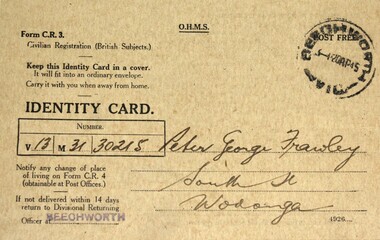
Document - Citizen Identity Cards World War II, Australian Federal Government, 1940s
... indigenous adults born in Australia. The concept of Australian citizenship was only introduced by the Nationality and Citizenship Act of 1948. All adults had personal identity cards and were required to report changes of address to the government. These cards were particularly important in the identification and monitoring of Aliens (non-citizen residents) , particularly non-Europeans and Asian residents. Peter Frawley was a long-time resident of Wodonga ...These cards were issued during World War 11 to British subjects who were civilians. This included all non-indigenous adults born in Australia. The concept of Australian citizenship was only introduced by the Nationality and Citizenship Act of 1948. All adults had personal identity cards and were required to report changes of address to the government. These cards were particularly important in the identification and monitoring of Aliens (non-citizen residents) , particularly non-Europeans and Asian residents.Peter Frawley was a long-time resident of Wodonga. He was a veteran of Gallipoli and Fromelles. For his actions at Fromelles, he was awarded the French Croix de Guerre. After the war Peter became a successful jockey and one of his greatest successes was winning the Australian Steeple Chase at Caulfield in 1922. He was an active member of the Wodonga Turf Club and Bonegilla Race Club and a founding member of the Wodonga Show Society. Peter’s wife Connie was an integral member of the Wodonga Hospital fundraising committee, being awarded a life membership. Nereida Pearl Goyne (nee Emery) lived most of her life in Wodonga. She was actively engaged in the community until 2007 when she moved to Rutherglen where she passed away in January 2009.3 fawn coloured cards with black text, all stamped with the Beechworth Post Office stamp. They are identified as Form C.R.3 Civilian Registration (British Subjects).Written on both sides in ink: Detailed explanation of government regulations. On Card 1 in ink;" V13, M 31 ,30215" Signed "Peter George Frawley, South St Wodonga" Reversed signed by card holder and witness" On Card 2 in ink;" V13, M 02 ,2494" Signed Constance Frawley, South St Wodonga" Reversed signed C Frawley and witnessed P Frawley" Note - Ration book for 3 children" On Card 3 in ink;" V13, M 10 ,12251" Signed "Nereida Pearl Goyne, Bank St Wodonga" Reversed signed by card holder and witnessed by L.C. McCullough" Note Ration book for 2 children"identity cards, civilian registration, world war 2, ww11 -
 Wodonga & District Historical Society Inc
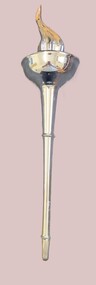
Memorabilia - Melbourne Olympic Torch Bearer's Memento, Organising Committee for the XVIth Olympiad Melbourne, 1956
... Australian Torchbearer was Con Verevis, of Greek-born parents, followed by indigenous athlete Anthony Mark. It was carried by 3,181 torchbearer before the Olympic Flame in Melbourne was lit by a 19-year-old middle-distance runner, who lit the cauldron at the Melbourne Cricket Ground on 22nd November 1956. This item is significant because it donated by a Wodonga ...This torch was donated to the Wodonga & District Historical Society by John Flower. John was a torch bearer in the Torch Relay for the Melbourne Olympic Games of 1956. In order to be selected for the Torch Relay the participants had to be able to run 1 mile (1.61 km) in 7.5 minutes. John was a talented distance runner, winning many distance events in the Wodonga area. He ran his mile of the relay about six miles south of Wodonga on the Hume Highway at 3.00 am on Wednesday 21st November 1956. The relay spanned approximately 20,470 km (including air travel) and involved 3,181 torchbearers across Greece and Australia. The actual Olympic torch left Olympia in Greece on 2nd November 1956 with the first torchbearer being Dionyssios Papathanassopoulos. The relay then covered approximately 20,470 kilometres including air travel and involved 3,181 torchbearers across Greece and Australia. The flame travelled by air to Australia, with stopovers along the way in Istanbul, Basra, Karachi, Calcutta, Bangkok, Singapore, Jakarta arriving in Darwin on 6th November 1956. The flame was the transported by Royal Australian Air Force jet omber to Cairns. The first Australian Torchbearer was Con Verevis, of Greek-born parents, followed by indigenous athlete Anthony Mark. It was carried by 3,181 torchbearer before the Olympic Flame in Melbourne was lit by a 19-year-old middle-distance runner, who lit the cauldron at the Melbourne Cricket Ground on 22nd November 1956.This item is significant because it donated by a Wodonga resident who participated in the Melbourne Olympics Torch Relay near Wodonga.A small replica torch given to participants in the torch relay for the Melbourne Olympic Games of 1956melbourne olympics, john flower wodonga, melbourne olympics torch relay
