
Showing 8 items matching "industrial stone building"
-
 Bendigo Historical Society Inc.
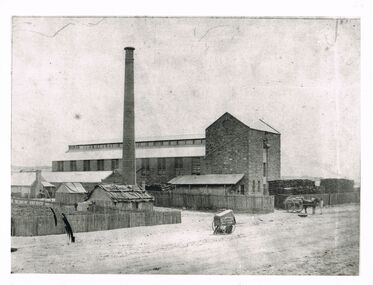
Photograph - WES HARRY COLLECTION: STONE INDUSTRIAL BUILDING, CHIMNEY
... WES HARRY COLLECTION: STONE INDUSTRIAL BUILDING, CHIMNEY...industrial stone building...Black and white photo, image: large stone industrial building, brick chimney, stacks of wood. ...industrial stone building Batchelder Batchelder Black and white photo, image: large stone industrial building, brick chimney, stacks of wood. ...Black and white photo, image: large stone industrial building, brick chimney, stacks of wood. Man standing on top floor operating winch. Horse and wagon beneath, loaded with bags of ( could be wheat ? ) On LH side of image, picket fence surrounds large amount of cut wood - cut to equal length. Slab and bark roof hut on road adjoining large building , various smaller buildings to back of hut. Batchelder carriage in centre of image. Batchelderindustrial stone building, batchelder -
 Mission to Seafarers Victoria
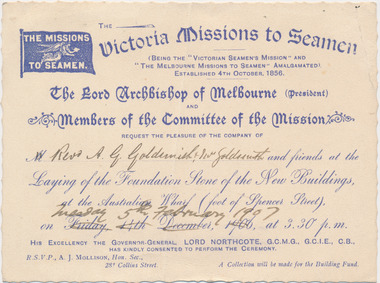
Card - Invitation card, The Victoria Missions to Seamen, 1906
... The original date for the laying of Foundation stone for the first Mission building at Australian Wharf in 1906 had to be changed to the 5th of February 1907 due to industrial action at the Wharves. ...The original date for the laying of Foundation stone for the first Mission building at Australian Wharf in 1906 had to be changed to the 5th of February 1907 due to industrial action at the Wharves. ...The original date for the laying of Foundation stone for the first Mission building at Australian Wharf in 1906 had to be changed to the 5th of February 1907 due to industrial action at the Wharves. See scrapbooks and clippings for details. Lord Northcote the Governor General officiated. The invitation marks the establishment for the first time at the Australian Wharf official recognition of the need to establish a Mission for seafarers in this location, some six years after presentation of the letter in 1897 from 22 Captains urging and requesting a respectable and convenient facility. Just ten years later the Mission would have to move to an adjacent site and raise funds for yet another Mission building in 1916. A heavy card with crimped edge with commercially printed invitation in cursive scripts from the Archbishop of Melbourne and the Members of the Committee of the Mission. A blue flying angel Missions to Seamen flag is printed in the top left corner. The invitee name is written in sepia ink as is an altered date. Ink inscriptions: the Rev A.G. Goldsmith and Mrs Goldsmith // ; printed date of Friday 14th of December 1906 is crossed out and superscribed in handwritten ink as: Tuesday 5th of February 1907 lord northcote, governor general, rev gurney goldsmith, foundation stone, australian wharf, the melbourne missions to seamen, victorian seamen's mission, 1907, siddeley street, alfred gurney goldsmith, walter richmond butler -
 The Beechworth Burke Museum
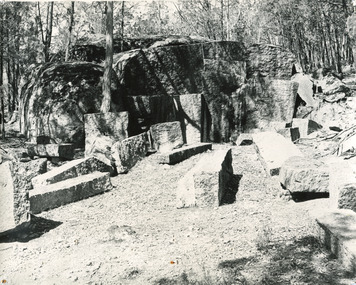
Photograph, Unknown
... Photograph taken in the early 1900s at Fiddes Quarry, a granite quarry used as a source of stone for many of Beechworth's historic buildings. This item is of historic significance as it provides evidence of the type of industrial and mining activities occurring historically around Beechworth as well as providing context to the source of the granite used in local buildings. ...Photograph taken in the early 1900s at Fiddes Quarry, a granite quarry used as a source of stone for many of Beechworth's historic buildings.This item is of historic significance as it provides evidence of the type of industrial and mining activities occurring historically around Beechworth as well as providing context to the source of the granite used in local buildings.Black and white rectangular photograph printed on matte photographic paperquarry, fiddes quarry, granite, industrial, beechworth, stone -
 Sunshine and District Historical Society Incorporated
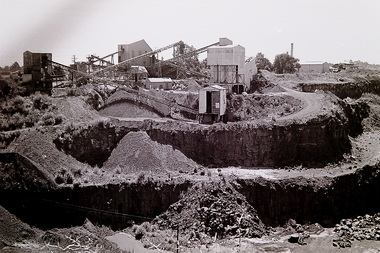
Photograph - Boral Quarry, Adam Ellwood, 5th January 1990
... industrial, chemical, and radioactive waste until 1990. The quarry was one of the largest bluestone quarries in Australia, producing stone for roads, rail ballast, bridges, public buildings, and private homes....industrial, chemical, and radioactive waste until 1990. The quarry was one of the largest bluestone quarries in Australia, producing stone for roads, rail ballast, bridges, public buildings, and private homes. ...Albion Quarry became a Boral site in 1965, operating through the late 1960s–early 1970s before quarrying ceased and the pit was later used as the Sunshine municipal tip, receiving household, industrial, chemical, and radioactive waste until 1990. The quarry was one of the largest bluestone quarries in Australia, producing stone for roads, rail ballast, bridges, public buildings, and private homes.Boral Quarryboral quarry, ballarat road, albion, albion quarry -
 Vision Australia
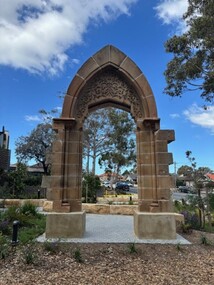
Photograph - Image, Denise Pellow, Archway at Enfield, 2025
... Industrial Blind Institution was built on the corner of Boomerang and William Streets in Sydney. Designed by Edmund Blacket, it was intended to be a workshop, showroom for items produced there and accomodate 10-12 people to live on the premises. The three story building (and subsequent extensions) ended up being used up until 1971, when the need for more space and the limitations of city buildings necessitated the move to Enfield. As part of this transition, and due to the demolition of the old building, a stone...building originally located within the boundaries of the Burwood Council. The developers of the site recognised that it was part of the historic fabric of Sydney however, and placed it within the landscaped front entrance to the site. Sydney Industrial Blind Institution Buildings Royal Blind Society of NSW Edmund Blacket 10 digital images of stone ...In 1878 Sydney Industrial Blind Institution was built on the corner of Boomerang and William Streets in Sydney. Designed by Edmund Blacket, it was intended to be a workshop, showroom for items produced there and accomodate 10-12 people to live on the premises. The three story building (and subsequent extensions) ended up being used up until 1971, when the need for more space and the limitations of city buildings necessitated the move to Enfield. As part of this transition, and due to the demolition of the old building, a stone archway was removed in 1971 and relocated to the new RBS offices in Mitchell Street. Almost half a century later, that site was sold however the archway could not be moved to the various commercial offices that now housed staff. City of Sydney council did not have a suitable location, as the original site was now a private housing complex, NSW Dept of Heritage did not preserve parts of buildings and it was not from a building originally located within the boundaries of the Burwood Council. The developers of the site recognised that it was part of the historic fabric of Sydney however, and placed it within the landscaped front entrance to the site.10 digital images of stone archwaysydney industrial blind institution, buildings, royal blind society of nsw, edmund blacket -
 Wodonga & District Historical Society Inc
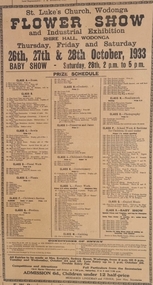
Newspaper - Advertisement for St Luke's Wodonga Flower Show and Industrial Exhibition, 1933
... stone. From the early 1900s the building was showing signs of serious structural problems. The community instigated a series of fund raising activities to enable renovations to be carried out. One of the most successful and long-lasting initiatives was the Annual Flower Show and Industrial...stone. From the early 1900s the building was showing signs of serious structural problems. The community instigated a series of fund raising activities to enable renovations to be carried out. One of the most successful and long-lasting initiatives was the Annual Flower Show and Industrial ...St Luke’s Anglican Church officially opened on 15 March 1863 and originally operated as a branch of the Albury church. The first minister to conduct a service there was Rev. Robert Potter, followed by Rev. B. Brownrigg , Rev. J. H. May, Rev. D. E. Jones and Rev. J. K. Tucker. The first resident minister at Wodonga was Rev. J. H. White who came in 1879. The Church was constructed from locally hewn stone. From the early 1900s the building was showing signs of serious structural problems. The community instigated a series of fund raising activities to enable renovations to be carried out. One of the most successful and long-lasting initiatives was the Annual Flower Show and Industrial Exhibition. The inaugural event took place in 1916 and the show continued as an annual event for several decades. Unfortunately the costs of the necessary structural and remediation work were too high. After serving the congregation for more than a century, the St Luke's Church was closed by the Health Commission due to its deteriorated condition which was judged to be beyond repair. It was demolished by voluntary labour on the 10 – 11 August 1968.This item is significant because it documents an important Church and community fundraising activity which was conducted annually for several decades in the early to mid 20th Century in Wodonga.A full-page advertisement from the Wodonga and Towong Sentinel of 1933 promoting the St Luke's Church Flower Show and Industrial Exhibition. The feature advertisement is surrounded by advertisements placed by a wide range of Wodonga businesses.st luke's church wodonga, wodonga and towong sentinel, community fundraising activities -
 Unions Ballarat
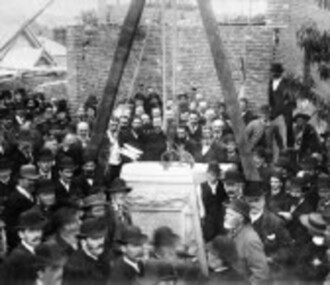
Photograph - Photograph: Laying of Trades Hall building foundation stone, 1887
... building a Trades Hall in Ballarat. In 1886, the present site at 24 Camp Street, Ballarat was agreed upon and land was granted to the committee in the name of the Ballarat Trades Hall and Literary Institute. The photograph depicts laying of the Ballarat Trades Hall foundation stone in1887. Relevance to the history of Ballarat Regional Trades and Labour Council and unions in the area. btlc ballarat regional trades and labour council ballarat trades hall ballarat trades and labour council ballarat trades hall - construction industrial disputes strikes unions Photograph - framed. ...The success of a significant wages dispute with Phoenix Foundry led to reconsideration of building a Trades Hall in Ballarat. In 1886, the present site at 24 Camp Street, Ballarat was agreed upon and land was granted to the committee in the name of the Ballarat Trades Hall and Literary Institute. The photograph depicts laying of the Ballarat Trades Hall foundation stone in1887. Relevance to the history of Ballarat Regional Trades and Labour Council and unions in the area.Photograph - framed.btlc, ballarat regional trades and labour council, ballarat trades hall, ballarat trades and labour council, ballarat trades hall - construction, industrial disputes, strikes, unions -
 Vision Australia
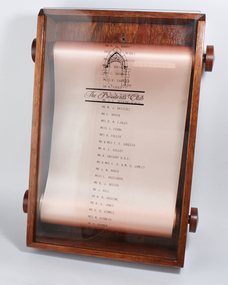
Textile - Object, Royal Blind Society Presidents club scroll
... A plastic cover protects the scroll, and printed upon this is an image of the stone archway (from the first building housing the Sydney Industrial Blind Institution) as well as the words 'The Presidents Club'. ...A plastic cover protects the scroll, and printed upon this is an image of the stone archway (from the first building housing the Sydney Industrial Blind Institution) as well as the words 'The Presidents Club'. ...Rose pink satin scroll with names of donors printed upon it rests inside a brown wooden box. A plastic cover protects the scroll, and printed upon this is an image of the stone archway (from the first building housing the Sydney Industrial Blind Institution) as well as the words 'The Presidents Club'. To view the scroll, turn the handles up or down. List of names represents people who donated to an appeal (date unknown). Box was designed to be mounted on a wall.Wooden box with satin scroll of printed namesThe Presidents Clubroyal blind society of nsw, fundraising
