
Showing 86 items matching "infantry section"
-
 4th/19th Prince of Wales's Light Horse Regiment Unit History Room
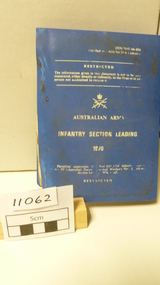
Booklet, Australian Army Infantry Section Leading 1970, 1970
... Australian Army Infantry Section Leading 1970...infantry section leading...A plastic covered loose leaf booklet covering basic tactical and technical information needed by an infantry section commander...This Pamphlet supersedes DSN7610-010-1354 Infantry Training volume IV (Australia) Tactics (Tropical Warfare) Part 1, Infantry Section Leading, 1956, Draft. 2 copies...infantry section leading DSN 7610-66-034-9298. This Pamphlet supersedes DSN7610-010-1354 Infantry Training volume IV (Australia) Tactics (Tropical Warfare) Part 1, Infantry Section Leading, 1956, Draft. 2 copies A plastic covered loose leaf booklet covering basic tactical and technical information needed by an infantry section commander Australian Army Infantry Section Leading 1970 Booklet ...A plastic covered loose leaf booklet covering basic tactical and technical information needed by an infantry section commanderDSN 7610-66-034-9298. This Pamphlet supersedes DSN7610-010-1354 Infantry Training volume IV (Australia) Tactics (Tropical Warfare) Part 1, Infantry Section Leading, 1956, Draft. 2 copiesinfantry section leading -
 National Vietnam Veterans Museum (NVVM)
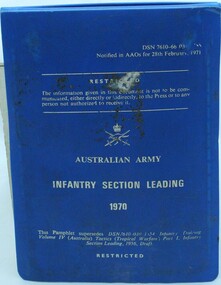
Pamphlet, Infantry section leading 1970
... Infantry section leading 1970......Infantry...Section...Blue plastic covered pamphlet containing tactical and technical information for infantry section commanders. Classified. Restricted....Pamphlet Infantry Section Leading DSN 7610-66-034 Blue plastic covered pamphlet containing tactical and technical information for infantry section commanders. ...Blue plastic covered pamphlet containing tactical and technical information for infantry section commanders. Classified. Restricted.DSN 7610-66-034pamphlet, infantry, section leading -
 Ringwood RSL Sub-Branch
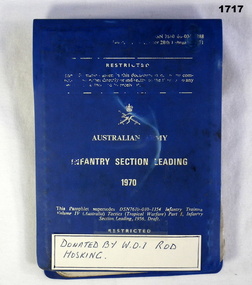
Book - Book, Infantry Section Leading, 1970
... Book, Infantry Section Leading...Infantry Section leading 1970 Blue Plastic Covers, for use in the field, has had some use....Book Book, Infantry Section Leading ...Infantry Section leading 1970 Blue Plastic Covers, for use in the field, has had some use. -
 Bendigo Military Museum
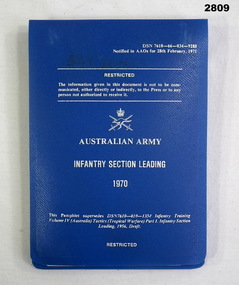
Manual - INFANTRY SECTION LEADING, 1970
... INFANTRY SECTION LEADING...Army manual for infantry sections. Blue vinyl covered cardboard covers, with spine at top and text printed in white....Manual INFANTRY SECTION LEADING ...Army manual for infantry sections. Blue vinyl covered cardboard covers, with spine at top and text printed in white.Inside cover "Cpl Hosking"books-educational/technical, military history-army, infantry training -
 Bendigo Military Museum
Manual - INFANTRY SECTION LEADING, Chief Of The General Staff, 1970
... INFANTRY SECTION LEADING...Training Manual Australian. Infantry Section Leading, 1970. Blue plastic cover, pages bound into cover with plastic screws, illustrated, page numbers not shown, shows 25 chapters, 2524 paragraphs, ...books-military-technical Passchendaele barracks trust Infantry Written inside front cover: "Sgt Jones" Training Manual Australian. Infantry Section Leading, 1970. Blue plastic cover, pages bound into cover with plastic screws, illustrated, page numbers not shown, shows 25 chapters, 2524 paragraphs, Manual INFANTRY SECTION LEADING Chief Of The General Staff ...Training Manual Australian. Infantry Section Leading, 1970. Blue plastic cover, pages bound into cover with plastic screws, illustrated, page numbers not shown, shows 25 chapters, 2524 paragraphs, Written inside front cover: "Sgt Jones"books-military-technical, passchendaele barracks trust, infantry -
 National Vietnam Veterans Museum (NVVM)
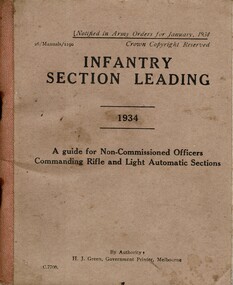
Booklet, Australian Army, Australian Army: Infantry Section Leading, 1934, 1934
... Australian Army: Infantry Section Leading, 1934......Infantry Section Leading...Australian Army Booklet Infantry Section Leading A brown coloured cardboard cover with black information on the front. ...A brown coloured cardboard cover with black information on the front. There is a darker brown material binding down the left hand side of the booklet and two metal staples down the spine of the booklet.australian army, booklet, infantry section leading -
 National Vietnam Veterans Museum (NVVM)
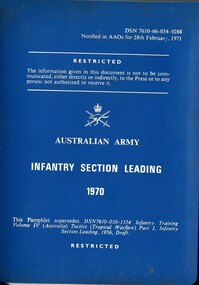
Booklet, Australian Army, Australian Army: Infantry Section Leading, 1970 (Copy 1), 1970
... Australian Army: Infantry Section Leading, 1970 (Copy 1)....Infantry Section...Infantry Section Australian Army A blue plasic cover with white information on the front. ...A blue plasic cover with white information on the front. Top right hand corner reads DSN 7610-66-034-9288. Under the Australian Army insignia are the details of the booklet. The booklet has two metal screws inside the cover.infantry section, australian army -
 National Vietnam Veterans Museum (NVVM)
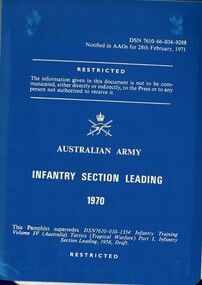
Booklet, Australian Army: Infantry Section Leading, 1970 (Copy 3), 1970
... Australian Army: Infantry Section Leading, 1970 (Copy 3).......Infantry Section Leading...Australian Army Infantry Section Leading A blue plasic cover with white information on the front. ...A blue plasic cover with white information on the front. Top right hand corner reads DSN 7610-66-034-9288. Under the Australian Army insignia are the details of the booklet. The booklet has two metal screws inside the cover.australian army, infantry section leading -
 Frankston RSL Sub Branch
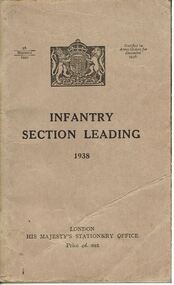
Handbook, Training, Infantry Section Leading
... Infantry Section Leading...Handbook for training Infantry Section Leading. Published by the UK War Office, December, 1938. ...Handbook for training Infantry Section Leading. Published by the UK War Office, December, 1938. ...Handbook for training Infantry Section Leading. Published by the UK War Office, December, 1938. This handbook contains 104 pages of illustrated notes for infantry training personnel. It is bound in a soft cover of heavy weight buff coloured paper. -
 Bendigo Military Museum
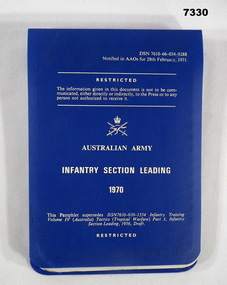
Manual - INFANTRY SECTION LEADING, ARMY, Australian Army, 1970
... INFANTRY SECTION LEADING, ARMY...Title on front cover is in white type. Manual INFANTRY SECTION LEADING, ARMY Australian Army ...A restricted document dated 1970, detailing infantry training for: ORDERS AND REPORTS, BATTLECRAFT, DEFENCE, COMMUNICATIONS, AIR, PRISONERS OF WAR AND DETAINEES, MEDICAL. Part of the collection of KEVIN JOHN HERDMAN No. 397661. See Cat No. 5942P for details of his service record.Blue coloured plastic covered manual. Cover is lift up type with pages secured at the top by slotted brass screws. All pages have cut edges with rounded bottom corners. Text is in black type with diagramatic illustrations. Title on front cover is in white type.training manual, infantry training, australian army, kevin john herdman -
 Bendigo Military Museum
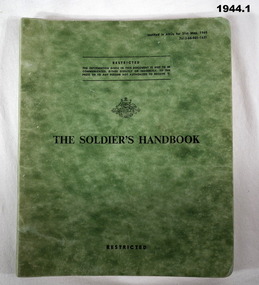
Book - HANDBOOKS, 1) The Dominion Press, 1) The Soldiers Handbook 31 May 1965. .2) Infantry Section Leading 28 February 1971, 1) 3.1969; .2) 1970
... .1) The Soldiers Handbook 31 May 1965. .2) Infantry Section Leading 28 February 1971....No page numbers, 25 chapters, cut, plain, white paper with black & white diagrams & mid green illustrations. .1) The Soldiers Handbook 31 May 1965. .2) Infantry Section Leading 28 February 1971. Book HANDBOOKS .1) The Dominion Press ....1) Soft cover, plastic coated mottled mid green card with black print on front & back covers. 148 pages, cut, plain, off white paper with black & white photos, maps & diagrams. .2) Blue plastic cover with white print on front & back covers. No page numbers, 25 chapters, cut, plain, white paper with black & white diagrams & mid green illustrations..1) Purple stamp on title page: “WAUR LIBRARY No (194 handwritten in black ink)” Handwritten in black ballpoint ink on 3rd page: .1) 1 MAR 69, 1A., 2, 1 NOV 69 ) 29 JUL 77” .2) Handwritten in black ink on 1st page: “ BOO”. ???books, military, infantry, hand book -
4th/19th Prince of Wales's Light Horse Regiment Unit History Room
Booklet, Infantry Training Vol IV Tactics. Infantry Section Leading & Platoon Tactics 1950, 1950
... Infantry Training Vol IV Tactics. Infantry Section Leading & Platoon Tactics 1950...Infantry Training Vol IV Tactics. Infantry Section Leading & Platoon Tactics 1950 Booklet ...A soft covered booklet dealing with the organisation and weapons of the infantry platoon, its training in peace and tactical handling in war.WO Code No 8593infantry tacticts, infantry tacticts -
National Vietnam Veterans Museum (NVVM)
Booklet, Australian Army: Infantry training, Vol. 4, Tactics: Infantry section leading and platoon tactics
... Australian Army: Infantry training, Vol. 4, Tactics: Infantry section leading and platoon tactics...Australia - Armed Forces - Service manuals In a plastic cover as cover page is missing Australian Army: Infantry training, Vol. 4, Tactics: Infantry section leading and platoon tactics Booklet Booklet Australian Army ...In a plastic cover as cover page is missingaustralia - armed forces - service manuals -
 National Vietnam Veterans Museum (NVVM)
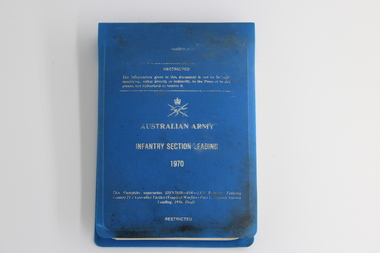
Booklet, Australian Army: Infantry Section Leading, 1970 (Copy 2), 1970
... Australian Army: Infantry Section Leading, 1970 (Copy 2)....Australian Army: Infantry Section Leading, 1970 (Copy 2). Booklet Australian Army ...Belonged to National Serviceman N J T Fothergill, Service no: 6708473, served in 3 RAR, 1967-8.A blue plastic cover, pages bound into cover with metal screws. Information of the front of the booklet is in white. Top right hand corner reads DSN 7610-66-034-9288. The Australian Army Insigni is in the middle of the cover with Australian Army written under this. The cover opens upwards.6708473. N. Fothergill Lt.fothergill, infantry manual, 3 rar -
 Bendigo Military Museum
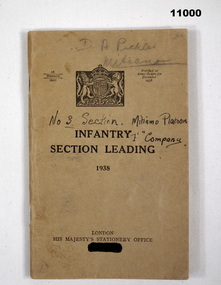
Manual - INFANTRY TRAINING, His Majesty's Stationery Office, London, "INFANTRY SECTION TRAINING", 1938
... "INFANTRY SECTION TRAINING"...Stationers adhesive label on Title page. "INFANTRY SECTION TRAINING" Manual INFANTRY TRAINING His Majesty's Stationery Office, London. ...Book. Cover - cardboard, beige coloured with black ink print on front with British Coat of Arms illustration. 104 pages, cut, plain, off white coloured paper. Illustrated with technical drawings. Two metal staples - centrefold. Handwritten information on front cover. Stationers adhesive label on Title page.Cover details - grey lead pencil, "D.A. Pickles/ Mitiamo" Black in pen, "No.3 Section. Mitiamo Platoon/ F "Company" Title page - black ink print on label. "ROBERTSON & MULLENS LTD/ Society and Commercial Stationers/ Printers and Bookbinders/ 107-113 ELIZABETH STREET/ MELBOURNE, C.1"publications, manuals, infantry, ww2 -
Tatura Irrigation & Wartime Camps Museum
Book, War Office, by Command of the Army Council, Infantry Section Leading, 1934
... Infantry Section Leading...Insert: single page, amendments (no. 1) P 603. 101 pages Infantry Section Leading Book War Office, by Command of the Army Council ...Book is a guide for non commissioned officers commanding rifle and light automatic sections. Reprinted with the permission of the controller, His Majesty's stationery office, London.soft buff coloured book, stapled at spine, back type. Insert: single page, amendments (no. 1) P 603. 101 pagesaustralian infantry -
 National Vietnam Veterans Museum (NVVM)
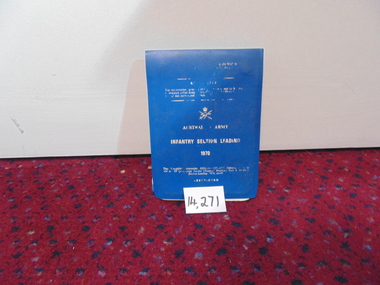
Book, Australian Army Infantry
... Australian Army Infantry section leading 1970...Australian Army Infantry section leading 1970 Australian Army Infantry Book Book ...Blue restricted plastic cover. Australian Army Infantry section leading 1970book, australian army infantry, infantry -
 Bendigo Military Museum
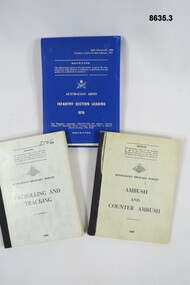
Manual - AMBUSH, PATROLING, SECTION LEADING, Australian Military Forces, 1965, 1970
... AMBUSH AND COUNTER AMBUSH. 3. INFANTRY SECTION LEADFING 1970....AMBUSH AND COUNTER AMBUSH. 3. INFANTRY SECTION LEADFING 1970. Manual AMBUSH, PATROLING, SECTION LEADING Australian Military Forces ...Manuals giving the Section Leader, Patrolling and Tracking and Counter Ambush Instructions. 1. PATROLLING AND TRACKING. 2. AMBUSH AND COUNTER AMBUSH. 3. INFANTRY SECTION LEADFING 1970.1. 5106. 2. Nil 3. HADDENpasschendaele barracks trust, patrolling, ambush, section leading, manuals -
 Diamond Valley Vietnam Veterans Sub-Branch
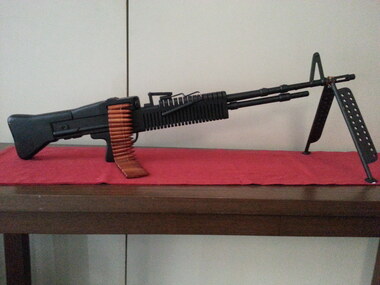
Craft - Model, M60, c2010
... A faithful model of an M60 machine gun, the prime heavy shooter of infantry sections....A faithful model of an M60 machine gun, the prime heavy shooter of infantry sections. A faithful depiction of that weapon which was often crucial to survival in Contact circumstances. vietnam vietnam war diamond valley vietnam veterans sub branch Wooden, metal and plastic model M60 machine gun on tripod. ...A faithful model of an M60 machine gun, the prime heavy shooter of infantry sections.A faithful depiction of that weapon which was often crucial to survival in Contact circumstances.Wooden, metal and plastic model M60 machine gun on tripod.vietnam, vietnam war, diamond valley vietnam veterans sub branch -
 Bendigo Military Museum
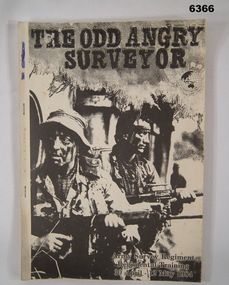
Administrative record - Army Survey Regiment Regimental Training 1984 - The Odd Angry Surveyor, Army Survey Regiment, Bendigo, 21 Feb 1984
... The Exercise conducted in two phases, Phase One- being theory lessons in a number of aspects of Infantry Minor Tactics at Section Level, whilst Phase Two- was putting into practice the lessons from Phase One....The Exercise conducted in two phases, Phase One- being theory lessons in a number of aspects of Infantry Minor Tactics at Section Level, whilst Phase Two- was putting into practice the lessons from Phase One. ...This is an Administrative Instruction setting out all aspects of the Army Survey Regiment Regimental Training Exercise "Odd Angry Surveyor" during the period 30 Apr - 12 May 1984. The Exercise conducted in two phases, Phase One- being theory lessons in a number of aspects of Infantry Minor Tactics at Section Level, whilst Phase Two- was putting into practice the lessons from Phase One.Light carboard covered A4 paper report stapled on left hand sideroyal australian survey corps, rasvy, fortuna, army survey regiment, army svy regt, asr -
 Shepparton RSL Sub Branch
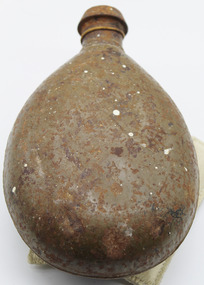
Water Bottle. WW1. German, Circa WW1
... WW1 German Infantry Water Bottle. Made in three sections - welded. ...WW1 German Infantry Water Bottle. Made in three sections - welded. water bottle ww1 german None All Metal WW1 German Water Bottle Missing Stopper, Cover, Leather Strapping and Hook plus string to neck which is 7cm. ...WW1 German Infantry Water Bottle. Made in three sections - welded. All Metal WW1 German Water Bottle Missing Stopper, Cover, Leather Strapping and Hook plus string to neck which is 7cm.Nonewater bottle, ww1, german -
 Australian Commando Association - Victoria
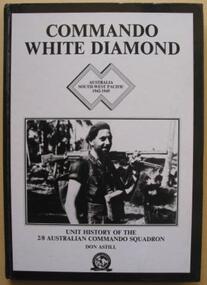
Book, Commando White Diamond: Unt History of the 2/8th Australian Commando Squadron
... sections could be operating at a time. Patrols generally lasted four to six days, but nine-day patrols were not unknown. The squadron collected and collated track information, terrain reports and located the enemy. Once patrols had gathered information, they were free to make a ‘strike’ against the Japanese by setting an ambush or taking a prisoner. These raids were very effective, as they forced the Japanese to deploy troops to their rear areas, removing men from the front created by the infantry ...The detailed history of the No.8 Independent Commando Company during World War II. Plastic protective cover over the book. The 2/8th Independent Company was formed at Wilson’s Promontory, Victoria, in July 1942 and travelled to Yandina, in Queensland, in September. While the other seven independent companies saw action in the islands off Australian and in New Guinea, the 2/8th spent most of the next two years based at Adelaide River, in the Northern Territory. While it was in the Territory, the independent companies underwent a series of reorganisations and the name of the 2/8th was changed from the 2/8th Independent Company to the 2/8th Cavalry (Commando) Squadron. This name was later simplified to just commando squadron. In July 1944, after years of waiting, the squadron left the Territory and sailed from Townsville to Lae, via Milne Bay. While at Lae, the squadron received an intake of 70 men from the 2/8th from the 2/3rd, 2/5th and 2/6th Cavalry (Commando) Squadrons, many of whom were veterans of the earlier New Guinea campaigns. Their experience was no doubt a useful reserve that would have been called upon during the 2/8th’s subsequent campaign in Bougainville. Others though, were able to implement some of their commando training when a small group from the 2/8th they made a secret landing on New Britain. Towards the end of the 1944 the 5th Division was preparing to make a landing at Jacquinot Bay in New Britain. Part of these preparations included landing a small group of officers from the division at Jacquinot Bay to make a secret reconnaissance of the potential landing site. As Jacquinot Bay was still in Japanese controlled territory, ‘C’ Troop from the 2/8th provided the protection for the reconnaissance party by establishing a position on the beach and by patrolling the surrounding country. Everything went well and the 5th Division later landed at Jacquinot Bay in November. The squadron too was on the move, and in October it sailed to Torokina, the main Australian base on Bougainville, where it joined the II Australian Corps. The campaign on Bougainville was dived into three areas, the Central, Northern and Southern Sectors. The 2/8th served in the latter two areas. The 2/8th made the first move of the Australian campaign in the Northern Sector, by patrolling from Torokina to Kuraio Mission and Amun once a week. The squadron did this from the second week of November unit the second week of December. The 2/8th was then transferred to the Southern Sector. The main battle for Bougainville was fought in the Southern Sector, as the 3rd Division advanced towards Buin – the main Japanese base on the island. As the division’s infantry brigades advanced along the coast, the 2/8th’s task was to protect their flank by conducting forward reconnaissance patrols, harassing the Japanese with raids and ambushes and conducting a form of guerrilla warfare. The squadron had a long campaign. For nine months, from the end of December until August 1945, the troopers were in action the whole time. After securing the Jaba River, they moved inland, first to Sovele Mission, then the villages of Opai, Nihero and Morokaimoro. They had reached Kilipaijino by the end of the war. Each village taken became a patrol base. Patrols were usually limited to two sections, although up to six sections could be operating at a time. Patrols generally lasted four to six days, but nine-day patrols were not unknown. The squadron collected and collated track information, terrain reports and located the enemy. Once patrols had gathered information, they were free to make a ‘strike’ against the Japanese by setting an ambush or taking a prisoner. These raids were very effective, as they forced the Japanese to deploy troops to their rear areas, removing men from the front created by the infantry. Following Japan’s surrender and the end of the war, the ranks of the squadron thinned quickly as men were discharged or were transferred to other units. For those who were left, the squadron returned to Australia at the end of December. In mid January 1946, at Liverpool, the 2/8th Commando Squadron was disbanded.non-fictionThe detailed history of the No.8 Independent Commando Company during World War II. Plastic protective cover over the book. The 2/8th Independent Company was formed at Wilson’s Promontory, Victoria, in July 1942 and travelled to Yandina, in Queensland, in September. While the other seven independent companies saw action in the islands off Australian and in New Guinea, the 2/8th spent most of the next two years based at Adelaide River, in the Northern Territory. While it was in the Territory, the independent companies underwent a series of reorganisations and the name of the 2/8th was changed from the 2/8th Independent Company to the 2/8th Cavalry (Commando) Squadron. This name was later simplified to just commando squadron. In July 1944, after years of waiting, the squadron left the Territory and sailed from Townsville to Lae, via Milne Bay. While at Lae, the squadron received an intake of 70 men from the 2/8th from the 2/3rd, 2/5th and 2/6th Cavalry (Commando) Squadrons, many of whom were veterans of the earlier New Guinea campaigns. Their experience was no doubt a useful reserve that would have been called upon during the 2/8th’s subsequent campaign in Bougainville. Others though, were able to implement some of their commando training when a small group from the 2/8th they made a secret landing on New Britain. Towards the end of the 1944 the 5th Division was preparing to make a landing at Jacquinot Bay in New Britain. Part of these preparations included landing a small group of officers from the division at Jacquinot Bay to make a secret reconnaissance of the potential landing site. As Jacquinot Bay was still in Japanese controlled territory, ‘C’ Troop from the 2/8th provided the protection for the reconnaissance party by establishing a position on the beach and by patrolling the surrounding country. Everything went well and the 5th Division later landed at Jacquinot Bay in November. The squadron too was on the move, and in October it sailed to Torokina, the main Australian base on Bougainville, where it joined the II Australian Corps. The campaign on Bougainville was dived into three areas, the Central, Northern and Southern Sectors. The 2/8th served in the latter two areas. The 2/8th made the first move of the Australian campaign in the Northern Sector, by patrolling from Torokina to Kuraio Mission and Amun once a week. The squadron did this from the second week of November unit the second week of December. The 2/8th was then transferred to the Southern Sector. The main battle for Bougainville was fought in the Southern Sector, as the 3rd Division advanced towards Buin – the main Japanese base on the island. As the division’s infantry brigades advanced along the coast, the 2/8th’s task was to protect their flank by conducting forward reconnaissance patrols, harassing the Japanese with raids and ambushes and conducting a form of guerrilla warfare. The squadron had a long campaign. For nine months, from the end of December until August 1945, the troopers were in action the whole time. After securing the Jaba River, they moved inland, first to Sovele Mission, then the villages of Opai, Nihero and Morokaimoro. They had reached Kilipaijino by the end of the war. Each village taken became a patrol base. Patrols were usually limited to two sections, although up to six sections could be operating at a time. Patrols generally lasted four to six days, but nine-day patrols were not unknown. The squadron collected and collated track information, terrain reports and located the enemy. Once patrols had gathered information, they were free to make a ‘strike’ against the Japanese by setting an ambush or taking a prisoner. These raids were very effective, as they forced the Japanese to deploy troops to their rear areas, removing men from the front created by the infantry. Following Japan’s surrender and the end of the war, the ranks of the squadron thinned quickly as men were discharged or were transferred to other units. For those who were left, the squadron returned to Australia at the end of December. In mid January 1946, at Liverpool, the 2/8th Commando Squadron was disbanded. -
 Bendigo Military Museum
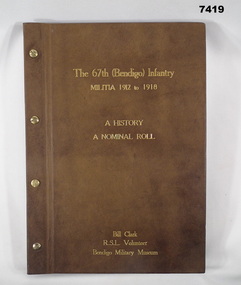
Book - BOOK, THE 67th INFANTRY, CLARK Bill, The 67th (Bendigo) Infantry MILITIA 1912-1918. / A History. / A Nominal Roll, Nov 2023
... Infantry This is a leather bound book (Manuscript). The type of leather is called "old goat leather". The title and words are gold embossed. It is fastened with 4 brass Chicago screw binders. Inside are pages of A4. size. The history section ...The 67th (Bendigo) Infantry was the local Militia Infantry Unit from 1912-1918. It's members came from Bendigo up to Deniliquin and Bendigo up to Kerang - Swan Hill areas.This is a leather bound book (Manuscript). The type of leather is called "old goat leather". The title and words are gold embossed. It is fastened with 4 brass Chicago screw binders. Inside are pages of A4. size. The history section is of 165 pages - text, images, black and white and colour. The second half of the book is A4 size excel spreadsheet with approx 2100 names.ww1, militia, citizen forces, 67th infantry -
 Bendigo Military Museum
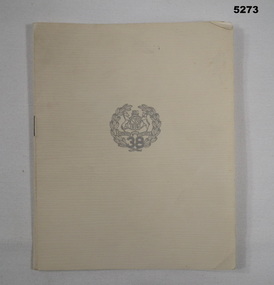
Card - CARD, CHRISTMAS, 38th Infantry Battalion, c1919-1962
... section, is printed on glossy white paper. Printed in colour in the centre, are the colours of the 38th Bn, with Christmas Greetings printed in blue ink on the right. 38 Inf. Bn - Northern Victorian Regiment, Mollison Street Bendigo. Card CARD, CHRISTMAS 38th Infantry ...Refers to service of Harry Burrell "MM".Refer Cat No 298.4 for his service detailsLocally made Christmas Card. The front has the 38th Battalion NVR badge in the centre in silver ink. The card has two sections; The outer which is folded, made out of strong paper. The other inner section, is printed on glossy white paper. Printed in colour in the centre, are the colours of the 38th Bn, with Christmas Greetings printed in blue ink on the right. 38 Inf. Bn - Northern Victorian Regiment, Mollison Street Bendigo. The sheets are folded with one staple binding.38th battalion, greeting card -
 Bendigo Military Museum
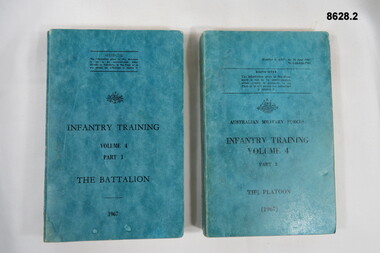
Manual - INFANTRY TRAINING, Australian Military Forces, 1967
... level, it covers the handling of these sub-sections in Tropical areas. Manual INFANTRY TRAINING Australian Military Forces ...1. Medium sized manual of 313 pages, the manual contains doctrine at Battalion level, it covers the handling of the Battalion in Tropical areas. 2. Medium size manual of 259 pages, the manual contains doctrine at Platoon and section level, it covers the handling of these sub-sections in Tropical areas.1. INFANTRY TRAINING Volume 4, Part 1 (1967) The Battalion. 2. INFANTRY TRAINING Volume 4 Part 2 (1967)passchendaele barracks trust, pbt 28 29, infantry, training -
 Bendigo Military Museum
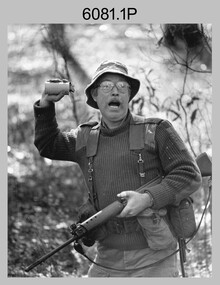
Photograph - Army Survey Regiment - Regimental Training Field Phase, c1986
... The aim of the training was to provide personnel a practical knowledge of infantry and minor tactics at the section level, navigation and map reading, RATEL and Survival in the Field. ...The aim of the training was to provide personnel a practical knowledge of infantry and minor tactics at the section level, navigation and map reading, RATEL and Survival in the Field. ...This is a set of eight photographs of Army Survey Regiment personnel undertaking regimental training in the Wellsford Forest, Bendigo, c1986. The aim of the training was to provide personnel a practical knowledge of infantry and minor tactics at the section level, navigation and map reading, RATEL and Survival in the Field. According to administrative instructions accompanying these photos, Air Survey, Cartographic, Lithographic and Headquarters Squadrons trained separately for one week from April to June 1986. Annotations on the back of photos .1P to .8P indicate Headquarters Squadron’s 4 Section in the ‘Axedale’ Forest. *Note - The forest was incorrectly named – It was most likely the training was in the Wellsford Forest. Sections were established for the period of regimental training only. This is a set of eight photographs of the Army Survey Regiment undertaking regimental training in the Wellsford Forest, Bendigo. c1986. The photographs were printed on photographic paper and are part of the Army Survey Regiment’s Collection. The photographs were scanned at 300 dpi. .1) - Photo, black & white, c1986, SGT Bruce Wetzig. .2) - Photo, black & white, c1986, PTE Tony Seely. .3) - Photo, black & white, c1986, SGT Bill Claydon. .4) - Photo, black & white, c1986, SGT Bill Claydon. .5) - Photo, black & white, c1986, SGT Gregory Smith. .6) - Photo, black & white, c1986, unidentified personnel. .7) - Photo, black & white, c1986, unidentified personnel. .8) - Photo, black & white, c1986, Mack water tanker..1P to .5P – Personnel are identified .6 to .8P – No personnel are identified Annotated ‘4 Section, Headquarters Squadron Axedale Forest’royal australian survey corps, rasvy, army survey regiment, army svy regt, fortuna, asr -
 Bendigo Military Museum
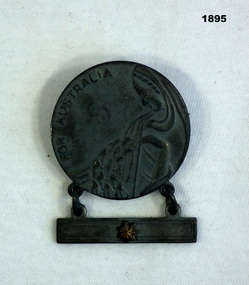
Badge - MOTHERS AND WIDOWS BADGE WW11, 1942
... It was part of the 8th Division's 27th Brigade, which was the last AIF infantry brigade raised for service during the Second World War.” numismatics - badges - military - army Mothers widows " issued by C'wlth govt A12229” Badge, metal, "for Australia." Circular section ...One star on the clasp means " One son K.I.A in WWII" This Mothers and Windows Badge was issued to Mrs M Baldwin, the mother of Pte Walter Robert Baldwin who died as a prisoner of war in Burma on the 27th of May 1943. He rests at the Thanbyuzayat Prisoner of War Cemetery, which is in what is now called Myanmar. This is a Death Railway related POW cemetery. Walter Baldwin was born in Mildura on the 12th of May 1921, and prior to enlisting lived at Iron Bark in Bendigo with his parents. He enlisted as No VX55835 in the 2nd AIF on 14.5.1941 in the 2/29th Batt aged 20 years. Embarked for Singapore on 30.7.1941 and disembarked 15.8.1941. He contracted Malaria in a December 1941. Taken POW early 1942 he is listed as died suffering from Cholera on 27.5.1943. “The 2/29th Infantry Battalion was formed at Bonegilla in Victoria in October 1940. It was part of the 8th Division's 27th Brigade, which was the last AIF infantry brigade raised for service during the Second World War.” Badge, metal, "for Australia." Circular section depicting a woman, wreath and an arm. suspended by two rings is a clasp with one star =. Rear has 2 lugs and a pin." issued by C'wlth govt A12229”numismatics - badges - military - army, mothers, widows -
 Bendigo Military Museum
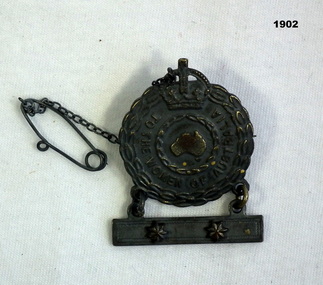
Badge - FEMALE RELATIVE BADGE WW2, G&E Rodd, 1940
... Infantry Battalion. Robert is believed to be Walter Robert BALDWIN No VX55835. He enlisted in the 2nd AIF on 14.5.1941 age 20 years. He was in the 2/29th Batt and is listed in their history as being in D Coy. He was taken POW and is listed as died while a POW on 27.5.1943. Refer 1895. numismatics - badges metalcraft "ISSUED BY THE C'WLTH GOVT A77484" Badge, metal, "To the Women of Australia". Centre section ...The badge belonged to Mrs May BALDWIN. Two stars on the badge showed she had two sons in the 2nd A.I.F, Ted & Robert. Ted (short for Edward) is believed to be George Edward BALDWIN No VX120046. He enlisted in the 2nd AIF on 10.7.1942 age 20 years. On discharge from the Army on 2.4.1946 he was a Pte in the 29/46th Aust Infantry Battalion. Robert is believed to be Walter Robert BALDWIN No VX55835. He enlisted in the 2nd AIF on 14.5.1941 age 20 years. He was in the 2/29th Batt and is listed in their history as being in D Coy. He was taken POW and is listed as died while a POW on 27.5.1943. Refer 1895.Badge, metal, "To the Women of Australia". Centre section is round with a crown over two circular wreaths with a map of Australia Centre. Attached by 2 rings is a clasp with 2 stars. A fine chain and pin attached at the top. Rear has 2 lugs and pin."ISSUED BY THE C'WLTH GOVT A77484"numismatics - badges, metalcraft -
 Bendigo Military Museum
Award - MEDAL
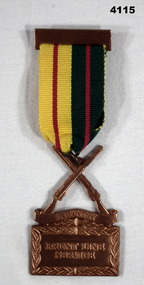
... Medal, brass with ribbon on a bar attached, medal has crossed Rifles over a rectangular section with the words, “INFANTRY FRONT LINE SERVICE”...These medals are not official Govt approved Medals Front Line Service On the rear engraved, “C.F.KOCH VX71365”, stamped on, “Copyright assigned to 2/12th Battalion Association” Medal, brass with ribbon on a bar attached, medal has crossed Rifles over a rectangular section with the words, “INFANTRY FRONT LINE SERVICE” Award MEDAL ...These medals are not official Govt approvedMedal, brass with ribbon on a bar attached, medal has crossed Rifles over a rectangular section with the words, “INFANTRY FRONT LINE SERVICE”On the rear engraved, “C.F.KOCH VX71365”, stamped on, “Copyright assigned to 2/12th Battalion Association”medals, front line service -
 Bendigo Military Museum
Award - MEDALS, 1937 - 1941
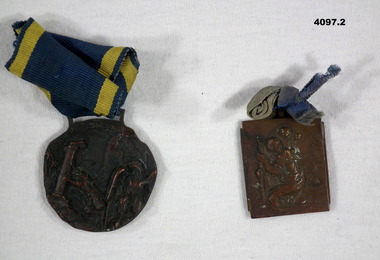
... .1) 6oth Italian Infantry Division, formed in May 1937 in Libya, destroyed in July 1942 near El Alamein. 60th Division Italian .1) “Divisioni Di Fanteria Sabratha (60)” on rear. .2) “fervent Rotae, fervent Animi, Gruppo vignola 1941 1X” on reverse. .1) Medal, roundish shape, metal with ribbon, green colour and yellow down both sides. .2) Medal, rectangular shape, metal with section of cloth attached. ....1) 6oth Italian Infantry Division, formed in May 1937 in Libya, destroyed in July 1942 near El Alamein..1) Medal, roundish shape, metal with ribbon, green colour and yellow down both sides. .2) Medal, rectangular shape, metal with section of cloth attached. Both have raised depictions..1) “Divisioni Di Fanteria Sabratha (60)” on rear. .2) “fervent Rotae, fervent Animi, Gruppo vignola 1941 1X” on reverse.60th division, italian
