
Showing 10 items matching "infection control"
-
 Alfred Hospital Nurses League - Nursing History Collection
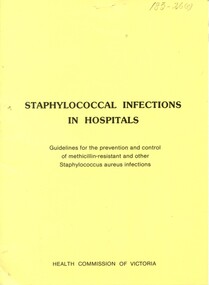
Booklet, Health Commission of Victoria, Staphylococcal infections in hospitals - guidelines for the prevention and control of methicillin-resistant and othe staphylococcus aureus infections, 1980
... ...infection control... Historic document, 1980 guidelines for the prevention and control of methicillin-resistant and othe staphylococcus aureus infections...Historic document, 1980 guidelines for the prevention and control of methicillin-resistant and othe staphylococcus aureus infections Insight into hospital infection control in 1980 MRSA Methicillin resistant staphylococcus aureus hospital infections infection control previous catalogue number at top right of front cover [pencil] Stapled booklet with yellow cover. ...Historic document, 1980 guidelines for the prevention and control of methicillin-resistant and othe staphylococcus aureus infectionsInsight into hospital infection control in 1980Stapled booklet with yellow cover. Front cover has black print detailing title and publisherprevious catalogue number at top right of front cover [pencil]mrsa, methicillin resistant staphylococcus aureus, hospital infections, infection control -
 St Vincent's Hospital Melbourne Archives
Journal - Notebook of lecture notes of St Vincent's Melbourne nurse, circa 1903
... The subjects range from Operation of Lithotomy instrument requirements to Infection Control including nursing management of Diptheria and Smallpox, diseases now controlled with vaccines. ...The subjects range from Operation of Lithotomy instrument requirements to Infection Control including nursing management of Diptheria and Smallpox, diseases now controlled with vaccines. ...kathleen o'brien, margaret scudds, nurse training, st vincent's hospital melbourne -
 Warrnambool and District Historical Society Inc.
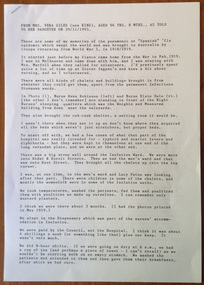
Document - Typescript, Spanish 'flu epidemic 1919, Originally written in 1995
... This article deals with methods of disease and infection control in Warrnambool. ...This article deals with methods of disease and infection control in Warrnambool. This article is significant because it is a first- hand record and gives a local perspective to a world- wide event. warrnambool spanish flu mrs vera giles warrnambool base hospital 1919 spanish flu dr holmes Covering letter from Mrs Giles’ daughter, Aurelin, dated January 22, 2015 Three pages of typed details about the Spanish flu in Warrnambool as recorded by volunteer Nurse Mrs Vera Giles (nee King). ...The 1918 Spanish 'flu was a deadly pandemic which infected 500 million people worldwide and killed millions. There is still discussion as to where the disease originated but the movement of troops at the end of WW1 contributed to the spread of the disease. This article deals with methods of disease and infection control in Warrnambool. This article is significant because it is a first- hand record and gives a local perspective to a world- wide event.Three pages of typed details about the Spanish flu in Warrnambool as recorded by volunteer Nurse Mrs Vera Giles (nee King). There are also photographs included and Victorian BDM records as well as general information on the 1918 Flu pandemic.Covering letter from Mrs Giles’ daughter, Aurelin, dated January 22, 2015 warrnambool, spanish flu, mrs vera giles, warrnambool base hospital, 1919 spanish flu, dr holmes -
St Vincent's Hospital Melbourne Archives
Pamphlet - Whooping Cough pamphlet published and distributed by Colonial Mutual Life Assurance Society Ltd for the benefit of its policyholders
... Underlined is the statement reflecting infection control standards in the 1930's - "Whooping Cough is a highly contagious and dangerous disease". ...Underlined is the statement reflecting infection control standards in the 1930's - "Whooping Cough is a highly contagious and dangerous disease". ...Published information about Whooping Cough is written over 3 pages, with headings Whooping Cough, Prevention, Symptoms and Treatment. Underlined is the statement reflecting infection control standards in the 1930's - "Whooping Cough is a highly contagious and dangerous disease". "Do not allow the patient to mix with other children" is underlined. The pamphlet would have been on display and available at doctors' surgeries and infant welfare centres. colonial mutual life assurance society limited, whooping cough, contagious disease -
 Alfred Hospital Nurses League - Nursing History Collection
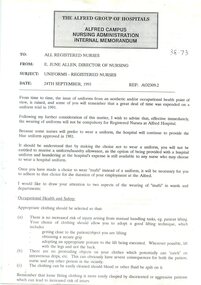
Document - Internal memorandum, E June Allen, Uniforms for Registered Nurses, Alfred Hospital, 1993, 19930924
... Choice of non-uniform should take into consideration occupational health and safety, and infection control. Guidence was also provided re clothing choices. ...Choice of non-uniform should take into consideration occupational health and safety, and infection control. Guidence was also provided re clothing choices. ...Memorandum stating that the wearing of uniforms by registered nurses will no longer be compulsory at the Alfred Hospital effective immendiately (24th September, 1993). This followed on from a uniform trial and survey held in 1991. Choice of non-uniform should take into consideration occupational health and safety, and infection control. Guidence was also provided re clothing choices. It was also noted that Identification badges should be worn above the waist, so staff could be easily distiguished. Unoforms would still be provided and laundered by the Alfred Hospital for those who chose to continue wering them.The memorandum was signed by E June Alllen, Director of NursingProvides information of when the wearing of uniforms by registed nurses at the Alfred Hospital was no longer compulsorary.Single sheet of white paper with black print on both sidesPrevious catalogue number handwritten [black ink] at top right of first page. The memorandum is signed on the second page by E June Allenalfred hospital nurses uniform, nurses uniform, nurses clothing -
 Alfred Hospital Nurses League - Nursing History Collection
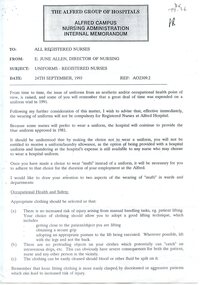
Document - Internal memorandum, E June Allen, Uniforms for Registered Nurses, Alfred Hospital, 1993, 19930924
... Choice of non-uniform should take into consideration occupational health and safety, and infection control. Guidence was also provided re clothing choices. ...Choice of non-uniform should take into consideration occupational health and safety, and infection control. Guidence was also provided re clothing choices. ...Memorandum stating that the wearing of uniforms by registered nurses will no longer be compulsory at the Alfred Hospital effective immendiately (24th September, 1993). This followed on from a uniform trial and survey held in 1991. Choice of non-uniform should take into consideration occupational health and safety, and infection control. Guidence was also provided re clothing choices. It was also noted that Identification badges should be worn above the waist, so staff could be easily distiguished. Unoforms would still be provided and laundered by the Alfred Hospital for those who chose to continue wering them.The memorandum was signed by E June Alllen, Director of NursingProvides information of when the wearing of uniforms by registed nurses at the Alfred Hospital was no longer compulsorary.Two sheets of white paper with black print Previous catalogue number handwritten [black ink] at top right of first page. The memorandum is signed on the second page by E June Allenalfred hospital nurses uniform, nurses uniform, nurses clothing -
Northern District School of Nursing. Managed by Bendigo Historical Society Inc.
Administrative record - Northern District School of Nursing Graduates Association - Examinations and Guides, 1965
... Sept 1965 3794.17i This document is a surgical nursing examination paper for general nurse training, focusing on key areas of patient management, operative and post-operative care, and infection prevention. 3794.17j This document is a nursing examination paper from the Northern District School of Nursing, focusing on general nursing practices. 3794.17k This nursing examination paper focuses on essential patient care procedures and clinical knowledge. 3794.17l This document is a nursing examination or study guide covering essential topics in general nursing theory, anatomy, physiology, and ward hygiene. 3794.17m This document is an examination paper for general nurse training, focusing on anatomy, physiology, and hygiene. 3794.17n This nursing examination paper covers essential topics in infection control, vital signs assessment, medication preparation, and ethical responsibilities. 3794.17o This document is a nursing examination paper from December 1965, designed to assess general nurse training. 3794.17p This document is a junior general nursing theory examination paper from 1965, focusing on essential nursing knowledge and practical skills. 3794.17q This nursing examination paper covers foundational topics in patient care and clinical procedures for first-year nursing students. ...Sept 1965 3794.17i This document is a surgical nursing examination paper for general nurse training, focusing on key areas of patient management, operative and post-operative care, and infection prevention. 3794.17j This document is a nursing examination paper from the Northern District School of Nursing, focusing on general nursing practices. 3794.17k This nursing examination paper focuses on essential patient care procedures and clinical knowledge. 3794.17l This document is a nursing examination or study guide covering essential topics in general nursing theory, anatomy, physiology, and ward hygiene. 3794.17m This document is an examination paper for general nurse training, focusing on anatomy, physiology, and hygiene. 3794.17n This nursing examination paper covers essential topics in infection control, vital signs assessment, medication preparation, and ethical responsibilities. 3794.17o This document is a nursing examination paper from December 1965, designed to assess general nurse training. 3794.17p This document is a junior general nursing theory examination paper from 1965, focusing on essential nursing knowledge and practical skills. 3794.17q This nursing examination paper covers foundational topics in patient care and clinical procedures for first-year nursing students. ...The Northern District School of Nursing in Victoria, Australia Graduates Association: History of the School Managed by a committee including hospital administrators, medical professionals, and nursing leaders from several regional hospitals. Associated with major hospitals in the Northern District, including Bendigo Base, Mildura Base, Castlemaine, Echuca, Swan Hill, St. Arnaud, and Kyneton District Hospitals. Provide high-quality theoretical and practical nursing training. Raise the standard of nursing education in the region. Maintain the highest principles of nursing practice. Applicants must be at least 17 years old and hold a Proficiency Certificate or higher educational qualification. Application involves submitting forms, certificates, an interview, an aptitude test, and a medical examination. A three-month probationary period follows initial acceptance. Preliminary Training School: Four-week introductory course covering basic nursing, anatomy, hygiene, and practical skills. Practical experience in various hospital departments, guided by senior staff. Study Block Plan: Includes several blocks of theoretical and practical instruction throughout the three-year program. Regular school exams and two state exams (First Professional and Final State) are required for progression and graduation. Nurses work a 40-hour week with at least one or two days off per week and three weeks of annual leave. Accommodation is provided in comfortable hostels with good facilities. Uniforms are supplied free; nurses provide their own shoes and stockings. Salaries and allowances are regulated, with deductions for board and free medical care. Additional Information Post-Graduate Opportunities. Senior positions require further experience and additional certificates (e.g., Midwifery, Infant Welfare).Diploma courses available in administration, teaching, and specialized nursing fields. Bursaries are available for advanced study.Career Prospects: Graduates can pursue roles in administration, teaching, ward and departmental leadership, district and visiting nursing, industrial and school nursing, and more. Opportunities existed both within hospitals and in community or specialized settings.FAQs and Practical Details. Minimal training costs (mainly exam fees and personal items).Living out allowances and travel expenses are covered. Four training intakes per year; waiting periods are short if qualifications are met.Northern District School of Nursing Graduates Association - Examination and Guides 1965 This item contains the following documents: 3794.17a This document is a Victorian Nursing Council examination paper for medical nursing, focusing on essential knowledge and practical skills for nurses. July 1965 3794.17b This document is a nursing examination paper focused on surgical and medical care scenarios. July 1965 3794.17c This document is a nursing examination paper from 1965 focused on medical nursing for general nurse training. 3794.17d This document is a first-year nursing theory examination paper from the Northern District School of Nursing, dated May 27, 1965. It covers foundational knowledge and practical skills for junior nurses. 3794.17e This document is a surgical nursing examination paper for general nurse training, focusing on practical and theoretical knowledge required for surgical patient care. 3794.17f This nursing examination paper covers essential topics in patient care, procedures, and medical terminology. 3794.17g This document is a junior general nursing theory examination paper from 1965, focusing on essential nursing procedures and patient care. 3794.17h This document is a professional nursing examination paper covering essential topics in human anatomy, physiology, and medical concepts. Sept 1965 3794.17i This document is a surgical nursing examination paper for general nurse training, focusing on key areas of patient management, operative and post-operative care, and infection prevention. 3794.17j This document is a nursing examination paper from the Northern District School of Nursing, focusing on general nursing practices. 3794.17k This nursing examination paper focuses on essential patient care procedures and clinical knowledge. 3794.17l This document is a nursing examination or study guide covering essential topics in general nursing theory, anatomy, physiology, and ward hygiene. 3794.17m This document is an examination paper for general nurse training, focusing on anatomy, physiology, and hygiene. 3794.17n This nursing examination paper covers essential topics in infection control, vital signs assessment, medication preparation, and ethical responsibilities. 3794.17o This document is a nursing examination paper from December 1965, designed to assess general nurse training. 3794.17p This document is a junior general nursing theory examination paper from 1965, focusing on essential nursing knowledge and practical skills. 3794.17q This nursing examination paper covers foundational topics in patient care and clinical procedures for first-year nursing students. nurse training, lister house, examinations -
 Flagstaff Hill Maritime Museum and Village
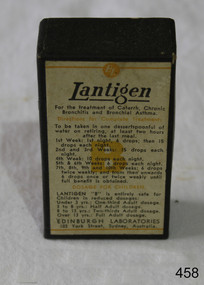
Container - Bottle & Box, Edinburgh Laboratories, Early - Mid 20th Century
... . ……….This study demonstrates Lantigen B's effectiveness in the prevention of bacterial complications and suggests that it can be used in patients who are particularly at risk of infection (children, the elderly, diabetics, and immunocompromised patients) or those in whom an infection might aggravate a clinical picture that is already inherently complicated (diabetics again, but also patients with heart, kidney, or liver disease). https://www.researchgate.net/publication/8349012_Efficacy_of_Lantigen_B_in_the_prevention_of_bacterial_respiratory_infections The control of respiratory conditions is essential to public health. ...Respiratory tract infections are among the most common diseases both in adults and children. ………….Lantigen B is an oral product based on bacterial lysates of six different inactivated strains commonly involved in respiratory tract infections. ……….This study demonstrates Lantigen B's effectiveness in the prevention of bacterial complications and suggests that it can be used in patients who are particularly at risk of infection (children, the elderly, diabetics, and immunocompromised patients) or those in whom an infection might aggravate a clinical picture that is already inherently complicated (diabetics again, but also patients with heart, kidney, or liver disease). https://www.researchgate.net/publication/8349012_Efficacy_of_Lantigen_B_in_the_prevention_of_bacterial_respiratory_infectionsThe control of respiratory conditions is essential to public health.Cardboard box containing a glass bottle of Lantigen colloidal mixture.Lantigen. For the treatment of catarrah, chronic bronchitis and bronchial asthma. Edinburgh Laboratories, 103 York Street, Sydney, Australia. Bacterial Vaccine. flagstaff hill, warrnambool, shipwrecked-coast, flagstaff-hill, flagstaff-hill-maritime-museum, maritime-museum, shipwreck-coast, flagstaff-hill-maritime-village, lantigen, medical, respiratory conditions -
 Flagstaff Hill Maritime Museum and Village
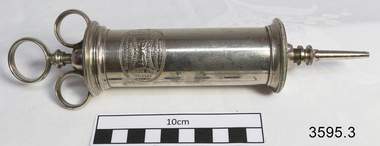
Equipment - Syringe, Late 19th - early 20th century
... infection. Direct visualisation of the ear canal is not necessary for safe and effective syringing. The tip of the syringe should not pass the outer one-third of the ear canal (approximately 8 mm) – the use of a rounded nozzle may assist with this. The jet of water should be aimed towards the edge of the cerumen to enable the debris to flow out of the ear canal. Cease immediately if the patient experiences pain or if bleeding occurs. Mechanical jet irrigators are available and some allow better control...infection. Direct visualisation of the ear canal is not necessary for safe and effective syringing. The tip of the syringe should not pass the outer one-third of the ear canal (approximately 8 mm) – the use of a rounded nozzle may assist with this. The jet of water should be aimed towards the edge of the cerumen to enable the debris to flow out of the ear canal. Cease immediately if the patient experiences pain or if bleeding occurs. Mechanical jet irrigators are available and some allow better control ...How to safely syringe ear wax Irrigation, or ear syringing, should be performed only after taking a full history, doing an ear examination and explaining the potential complications to the patient. It is also important to ensure appropriate assembly and use of equipment. Gentle irrigation of the ear canal can be performed with a large syringe (20 mL) and warm water. The use of sterile water or saline as opposed to tap water or bacteriostatic agent (eg dilute hydrogen peroxide) can decrease the risk of infection. Direct visualisation of the ear canal is not necessary for safe and effective syringing. The tip of the syringe should not pass the outer one-third of the ear canal (approximately 8 mm) – the use of a rounded nozzle may assist with this. The jet of water should be aimed towards the edge of the cerumen to enable the debris to flow out of the ear canal. Cease immediately if the patient experiences pain or if bleeding occurs. Mechanical jet irrigators are available and some allow better control of water pressure and direction of spray. After syringing, examine the external canal and tympanic membrane. Document the patient’s consent, procedure, and pre- and post-examination findings. https://www.racgp.org.au/afp/2015/october/ear-wax-management This ear syringe was donated to Flagstaff Hill Maritime Village by the family of Doctor William Roy Angus, Surgeon and Oculist. It is part of the “W.R. Angus Collection” that includes historical medical equipment, surgical instruments and material once belonging to Dr Edward Ryan and Dr Thomas Francis Ryan, (both of Nhill, Victoria) as well as Dr Angus’ own belongings. The Collection’s history spans the medical practices of the two Doctors Ryan, from 1885-1926 plus that of Dr Angus, up until 1969. ABOUT THE “W.R.ANGUS COLLECTION” Doctor William Roy Angus M.B., B.S., Adel., 1923, F.R.C.S. Edin.,1928 (also known as Dr Roy Angus) was born in Murrumbeena, Victoria in 1901 and lived until 1970. He qualified as a doctor in 1923 at University of Adelaide, was Resident Medical Officer at the Royal Adelaide Hospital in 1924 and for a period was house surgeon to Sir (then Mr.) Henry Simpson Newland. Dr Angus was briefly an Assistant to Dr Riddell of Kapunda, then commenced private practice at Curramulka, Yorke Peninsula, SA, where he was physician, surgeon and chemist. In 1926, he was appointed as new Medical Assistant to Dr Thomas Francis Ryan (T.F. Ryan, or Tom), in Nhill, Victoria, where his experiences included radiology and pharmacy. In 1927 he was Acting House Surgeon in Dr Tom Ryan’s absence. Dr Angus had become engaged to Gladys Forsyth and they decided he would take time to further his studies overseas in the UK in 1927. He studied at London University College Hospital and at Edinburgh Royal Infirmary and in 1928, was awarded FRCS (Fellow from the Royal College of Surgeons), Edinburgh. He worked his passage back to Australia as a Ship’s Surgeon on the on the Australian Commonwealth Line’s T.S.S. Largs Bay. Dr Angus married Gladys in 1929, in Ballarat. (They went on to have one son (Graham 1932, born in SA) and two daughters (Helen (died 12/07/1996) and Berenice (Berry), both born at Mira, Nhill ) Dr Angus was a ‘flying doctor’ for the A.I.M. (Australian Inland Ministry) Aerial Medical Service in 1928 . The organisation began in South Australia through the Presbyterian Church in that year, with its first station being in the remote town of Oodnadatta, where Dr Angus was stationed. He was locum tenens there on North-South Railway at 21 Mile Camp. He took up this ‘flying doctor’ position in response to a call from Dr John Flynn; the organisation was later known as the Flying Doctor Service, then the Royal Flying Doctor Service. A lot of his work during this time involved dental surgery also. Between 1928-1932 he was surgeon at the Curramulka Hospital, Yorke Peninsula, South Australia. In 1933 Dr Angus returned to Nhill where he’d previously worked as Medical Assistant and purchased a share of the Nelson Street practice and Mira hospital from Dr Les Middleton one of the Middleton Brothers, the current owners of what was once Dr Tom Ryan’s practice. Dr L Middleton was House Surgeon to the Nhill Hospital 1926-1933, when he resigned. [Dr Tom Ryan’s practice had originally belonged to his older brother Dr Edward Ryan, who came to Nhill in 1885. Dr Edward saw patients at his rooms, firstly in Victoria Street and in 1886 in Nelson Street, until 1901. The Nelson Street practice also had a 2 bed ward, called Mira Private Hospital ). Dr Edward Ryan was House Surgeon at the Nhill Hospital 1884-1902 . He also had occasions where he successfully performed veterinary surgery for the local farmers too. Dr Tom Ryan then purchased the practice from his brother in 1901. Both Dr Edward and Dr Tom Ryan work as surgeons included eye surgery. Dr Tom Ryan performed many of his operations in the Mira private hospital on his premises. He too was House Surgeon at the Nhill Hospital 1902-1926. Dr Tom Ryan had one of the only two pieces of radiology equipment in Victoria during his practicing years – The Royal Melbourne Hospital had the other one. Over the years Dr Tom Ryan gradually set up what was effectively a training school for country general-practitioner-surgeons. Each patient was carefully examined, including using the X-ray machine, and any surgery was discussed and planned with Dr Ryan’s assistants several days in advance. Dr Angus gained experience in using the X-ray machine there during his time as assistant to Dr Ryan. Dr Tom Ryan moved from Nhill in 1926. He became a Fellow of the Royal Australasian College of Surgeons in 1927, soon after its formation, a rare accolade for a doctor outside any of the major cities. He remained a bachelor and died suddenly on 7th Dec 1955, aged 91, at his home in Ararat. Scholarships and prizes are still awarded to medical students in the honour of Dr T.F. Ryan and his father, Dr Michael Ryan, and brother, John Patrick Ryan. ] When Dr Angus bought into the Nelson Street premises in Nhill he was also appointed as the Nhill Hospital’s Honorary House Surgeon 1933-1938. His practitioner’s plate from his Nhill surgery states “HOURS Daily, except Tuesdays, Fridays and Saturday afternoons, 9-10am, 2-4pm, 7-8pm. Sundays by appointment”. This plate is now mounted on the doorway to the Port Medical Office at Flagstaff Hill Maritime Village, Warrnambool. Dr Edward Ryan and Dr Tom Ryan had an extensive collection of historical medical equipment and materials spanning 1884-1926 and when Dr Angus took up practice in their old premises he obtained this collection, a large part of which is now on display at the Port Medical Office at Flagstaff Hill Maritime Village in Warrnambool. During his time in Nhill Dr Angus was involved in the merging of the Mira Hospital and Nhill Public Hospital into one public hospital and the property titles passed on to Nhill Hospital in 1939. In 1939 Dr Angus and his family moved to Warrnambool where he purchased “Birchwood,” the 1852 home and medical practice of Dr John Hunter Henderson, at 214 Koroit Street. (This property was sold in1965 to the State Government and is now the site of the Warrnambool Police Station. ). The Angus family was able to afford gardeners, cooks and maids; their home was a popular place for visiting dignitaries to stay whilst visiting Warrnambool. Dr Angus had his own silk worm farm at home in a Mulberry tree. His young daughter used his centrifuge for spinning the silk. Dr Angus was appointed on a part-time basis as Port Medical Officer (Health Officer) in Warrnambool and held this position until the 1940’s when the government no longer required the service of a Port Medical Officer in Warrnambool; he was thus Warrnambool’s last serving Port Medical Officer. (The duties of a Port Medical Officer were outlined by the Colonial Secretary on 21st June, 1839 under the terms of the Quarantine Act. Masters of immigrant ships arriving in port reported incidents of diseases, illness and death and the Port Medical Officer made a decision on whether the ship required Quarantine and for how long, in this way preventing contagious illness from spreading from new immigrants to the residents already in the colony.) Dr Angus was a member of the Australian Medical Association, for 35 years and surgeon at the Warrnambool Base Hospital 1939-1942, He served as a Surgeon Captain during WWII1942-45, in Ballarat, Victoria, and in Bonegilla, N.S.W., completing his service just before the end of the war due to suffering from a heart attack. During his convalescence he carved an intricate and ‘most artistic’ chess set from the material that dentures were made from. He then studied ophthalmology at the Royal Melbourne Eye and Ear Hospital and created cosmetically superior artificial eyes by pioneering using the intrascleral cartilage. Angus received accolades from the Ophthalmological Society of Australasia for this work. He returned to Warrnambool to commence practice as an ophthalmologist, pioneering in artificial eye improvements. He was Honorary Consultant Ophthalmologist to Warrnambool Base Hospital for 31 years. He made monthly visits to Portland as a visiting surgeon, to perform eye surgery. He represented the Victorian South-West subdivision of the Australian Medical Association as its secretary between 1949 and 1956 and as chairman from 1956 to 1958. In 1968 Dr Angus was elected member of Spain’s Barraquer Institute of Barcelona after his research work in Intrasclearal cartilage grafting, becoming one of the few Australian ophthalmologists to receive this honour, and in the following year presented his final paper on Living Intrasclearal Cartilage Implants at the Inaugural Meeting of the Australian College of Ophthalmologists in Melbourne In his personal life Dr Angus was a Presbyterian and treated Sunday as a Sabbath, a day of rest. He would visit 3 or 4 country patients on a Sunday, taking his children along ‘for the ride’ and to visit with him. Sunday evenings he would play the pianola and sing Scottish songs to his family. One of Dr Angus’ patients was Margaret MacKenzie, author of a book on local shipwrecks that she’d seen as an eye witness from the late 1880’s in Peterborough, Victoria. In the early 1950’s Dr Angus, painted a picture of a shipwreck for the cover jacket of Margaret’s book, Shipwrecks and More Shipwrecks. She was blind in later life and her daughter wrote the actual book for her. Dr Angus and his wife Gladys were very involved in Warrnambool’s society with a strong interest in civic affairs. Their interests included organisations such as Red Cross, Rostrum, Warrnambool and District Historical Society (founding members), Wine and Food Society, Steering Committee for Tertiary Education in Warrnambool, Local National Trust, Good Neighbour Council, Housing Commission Advisory Board, United Services Institute, Legion of Ex-Servicemen, Olympic Pool Committee, Food for Britain Organisation, Warrnambool Hospital, Anti-Cancer Council, Boys’ Club, Charitable Council, National Fitness Council and Air Raid Precautions Group. He was also a member of the Steam Preservation Society and derived much pleasure from a steam traction engine on his farm. He had an interest in people and the community He and his wife Gladys were both involved in the creation of Flagstaff Hill, including the layout of the gardens. After his death (28th March 1970) his family requested his practitioner’s plate, medical instruments and some personal belongings be displayed in the Port Medical Office surgery at Flagstaff Hill Maritime Village, and be called the “W. R. Angus Collection”. Ear wax is an ongoing problem for many people, and its safe and easy removal is important. The W.R. Angus Collection is significant for still being located at the site it is connected with, Doctor Angus being the last Port Medical Officer in Warrnambool. The collection of medical instruments and other equipment is culturally significant, being an historical example of medicine from late 19th to mid-20th century. Dr Angus assisted Dr Tom Ryan, a pioneer in the use of X-rays and in ocular surgery. Ear syringe from the W.R. Angus Collection with barrel, plunger and tip. Inscription on oval shaped plaque on barrel. Inscription on oval shaped plaque on barrel "10th / UNIVERSITY COLLEGE HOSPITAL" & "MAYER & MELTZER / MAKERS, LONDON" & " TO THE / HOSPITAL OF DESEASES (SIC) OF THE THROAT"" & "TO THE / HOSPITAL / FOR WOMEN" & "TO THE / MIDDLESEX / HOSPITAL" plus "R" inscribed on each side of the handlewarrnambool, shipwreck coast, great ocean road, flagstaff hill maritime village, maritime museum, dr angus, w.r. angus, dr t f ryan, medical instrument, surgical equipment, warrnambool base hospital, nhill base hospital, mira hospital, flying doctor, medical treatment, syringe, ear syringe, ear wax -
 Alfred Hospital Nurses League - Nursing History Collection
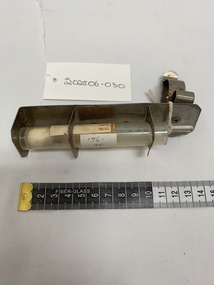
Equipment - mercury thermometer and metal bracket with plastic holder, mercury thermometer and holder for bed, 20250626
... The process of cleaning changed over the years in line with infection control practices. The thermometer is a very fragile glass vessel, often dropped and smashed on the floor, resulting in mercury on the floor. thermometer AHNL patient assessment plastic tube marked 176-98, bracket marked 176-98 (original catalogue notes 176-098) metal holder with bracket, plastic tube (not original) holding mercury thermometer mercury thermometer and holder for bed Equipment mercury thermometer and metal bracket with plastic holder ...Taking observations of a patient is a very important part of nursing assessment, and a thermometer would be used to assess a patient's temperature as required, at least daily for most patients. Nurses used this item commonly every day. The thermometer was attached to the patient's bed. The thermometers were supposed to be cleaned before use - kept in chlorhexidine solution in the holding tube, wiped over with alcohol swab prior to use in later years. The process of cleaning changed over the years in line with infection control practices. The thermometer is a very fragile glass vessel, often dropped and smashed on the floor, resulting in mercury on the floor. metal holder with bracket, plastic tube (not original) holding mercury thermometerplastic tube marked 176-98, bracket marked 176-98 (original catalogue notes 176-098)thermometer, ahnl, patient assessment
